It was a milestone day for me in managing the neurological issues I’ve faced following a *viral infection in early January. Twenty-one therapy sessions later and I’m much-improved. Not cured. Not fixed. Not all better. I’ll never be the same as I was pre-virus. But, through targeted therapy exercises, a lot of hard work and simply easing back into life, I’ve built my tolerance for everyday experiences. I can better handle sensory input. I can walk without feeling unbalanced. I can manage beyond sitting in a room with the curtains drawn to shut out light, windows closed to keep out noise.
I still have challenging days. I still struggle. But I am in a much better place than even a month ago.
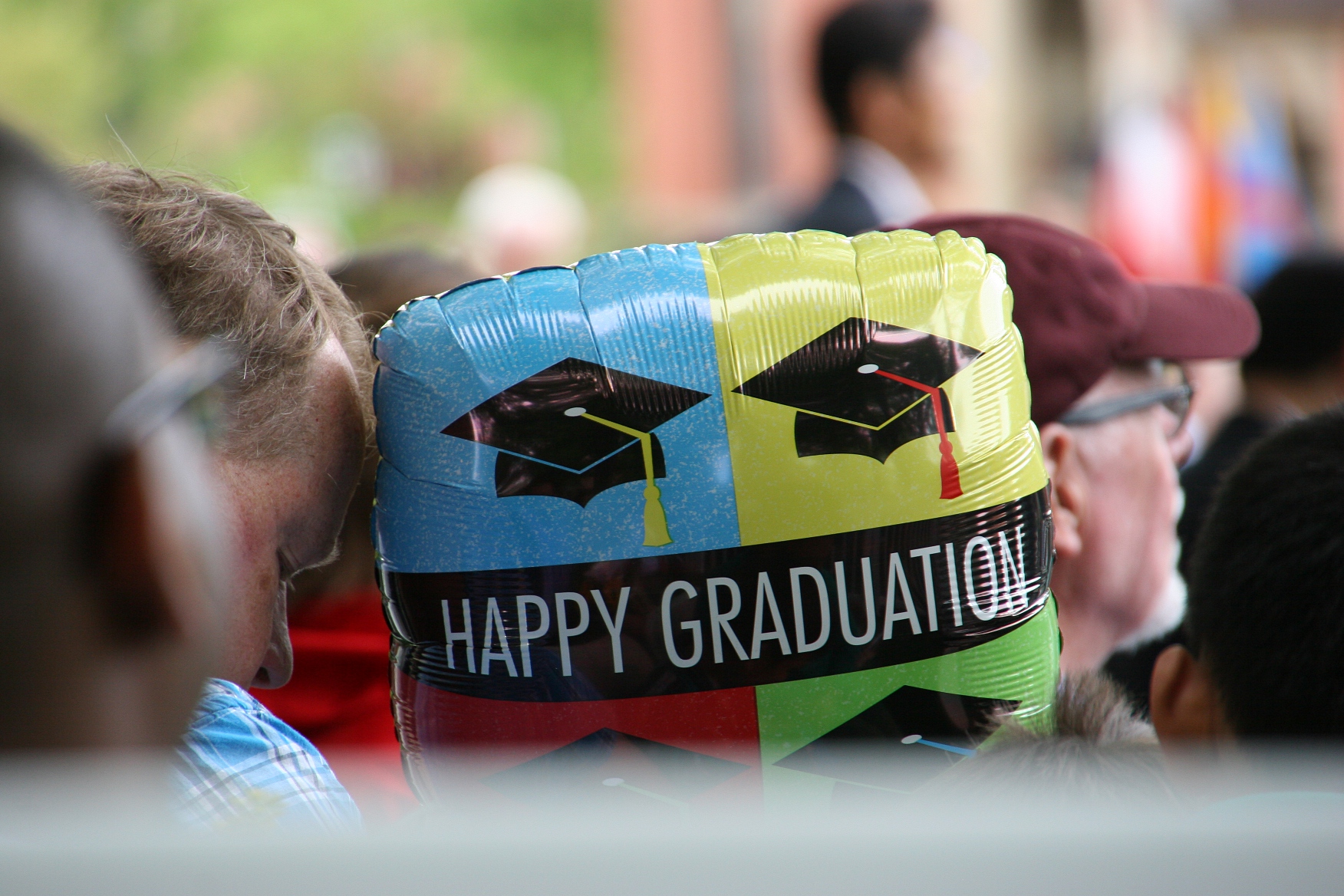
And so I graduated. Not because I wanted to leave Courage Kenny and my incredibly knowledgeable, supportive and caring therapist. But Ryan and I mutually agreed that I was ready. And so he asked, on that final day together, whether he should cue “Pomp and Circumstance” on his laptop, the same laptop he used to introduce me to virtual reality roller coasters as part of my therapy. I told him we could pass on the music. And I am happy to pass on roller coaster rides.
But I did bring celebratory homemade carrot cake cupcakes with homemade cream cheese frosting. Ryan laughed when I walked through the door carrying that box of cupcakes to share with the Courage Kenny team. When I’d asked the week prior if we would have graduation cake, he said only if I brought it. So I did, along with a thank you card and homemade chocolate chip cookies for this professional who worked tirelessly to improve my health. I always felt like we were a team.
And now, like any new graduate, I hold the knowledge and tools that will help me handle daily living. I participated in class (kinda hard not to when you’re the only student). I did the assigned homework each week. I followed through by getting back into the real world, sometimes failing in my efforts, sometimes succeeding. I’ve done my best, through tears and discouragement and struggles, to rise above the challenges. And now I’ve graduated. Onward.
* Even though I self-tested negative twice for COVID in January, my primary care doctor believes I had COVID, the cause of my multiple, ongoing neurological issues.
Early on in my diagnoses, my brain felt like this, scrambled. Art by Bill Nagel, previously exhibited at the Paradise Center for the Arts, Faribault. (Minnesota Prairie Roots copyrighted photo March 2023)
FOR ME, THE FEELING of imbalance started shortly after an early January virus, likely *COVID-19. At the time I didn’t make the connection between the two. But eventually medical professionals did. That led to multiple diagnoses of vestibular neuritis, Meniere’s Disease and peripheral sensory neuropathy. Yes, it’s been a lot to handle. But I’m in a much better place health-wise than nine months ago thanks to professional intervention and a whole lot of hard work.
The thing about having a vestibular disorder is that it’s unseen. You can’t see inside my brain to view the damage. And, for the most part, you can’t see the effects of a malfunctioning vestibular system, unless you’re my husband or eldest daughter who can. Randy and Amber can look at my face, see my eyes squinting, my look of fatigue, tell-tale signs I’m not doing well. And if I’m closing my eyes or holding my hands on the sides of my face, I’m blocking my peripheral vision, thus reducing visual input.
All of that aside, I’ve at least reclaimed my balance. Most days. Brief bouts of vertigo set me back mid-summer. Via vestibular rehab therapy to retrain my brain, I’ve learned to manage and live with my many ongoing symptoms and mostly get on with my life. Maybe not as I did previously, but with a renewed appreciation for something as simple as walking with confidence, as watching TV, as shopping for groceries.
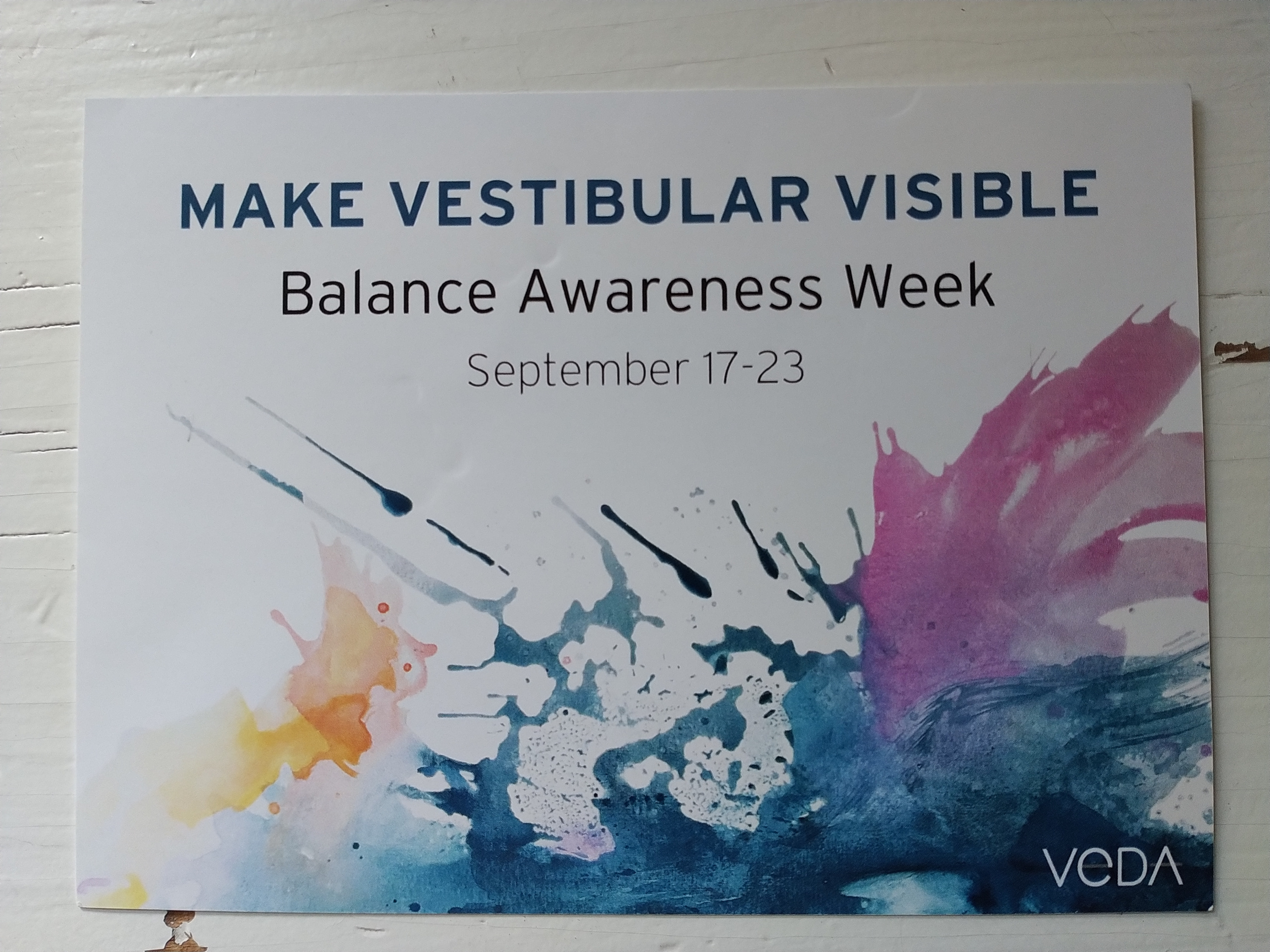
A promo postcard from VeDa. The painting, “Uncharted Waters,” is by vestibular patient Nicolle Cure.
FOCUS ON BALANCE
Today, though, I want to focus on balance, for two reasons. Imbalance was the first issue I overcame. And secondly, September 17-23 marks Balance Awareness Week, started in 1997 by the Vestibular Disorders Association. That national nonprofit is “a lifeline of support to anyone affected by vestibular (inner-ear and brain balance) disorders.” VeDA has proven an invaluable resource for me in learning about my vestibular-based diagnoses.
Knowledge is power. Just ask my physical therapist at Courage Kenny. Ryan answered many questions during my vestibular rehab therapy sessions, especially early on when I was just learning about my health issues. He always replied thoughtfully, helping me to understand what was happening in my brain and how we would work together through targeted exercises to manage my symptoms.
I’ve come a long way from the days of standing in place turning my head back and forth to the beat of a metronome. Today I’m power walking 15 minutes in the morning, 15 minutes in the evening with Randy. Even I’m amazed that I can do this. Not all that long ago, I couldn’t walk a block, often needing to hold onto Randy.
Fiona the Flamingo is VeDA’s Balance Awareness Week logo/mascot.
EVEN THOUGH MY DISORDER IS INVISIBLE, I STILL NEED TO BE SEEN, ENCOURAGED…
There is hope for anyone dealing with a vestibular disorder. Many seniors (and, yes, I’m a “senior”) struggle with balance. So do those who’ve suffered traumatic brain injuries like concussions. That includes my sister-in-law Rosie, my go-to support. Because she understands. And encourages. She realizes the importance of physical therapy in recovery.
In sharing a bit of my story with you, I am aiming to increase awareness. Make Vestibular Visible themes Balance Awareness Week. A promo from VeDA reads: Balance Awareness Week is our time to shout from the rooftops: “I have a vestibular disorder and this is my story.”
This is my story. One of challenges, of professional intervention, of hard work, of acceptance, of perseverance, of relying on others, of patience, of strength, of gratitude, of tears, of resilience, of focusing on what I can do (and not what I can’t). It is also a story of recognizing that no matter what we face in life—whether visible or invisible—we all need to be seen, to be uplifted, to feel cared for and loved.
*I self-tested negative twice for COVID, but those tests (if done incorrectly and for other reasons) can be wrong, my primary doctor told me. He guesses I had COVID in January, and I agree based on my symptoms.
I’ve owned this classical music album since the 1970s. (Minnesota Prairie Roots copyrighted photo June 2023)
IT’S BEFORE 8 AM, and I am twirling across my living room to early 18th century classical music playing on a stereo.
You might call this dancing. But, for me, this is an exercise in balance. For two months now I’ve been in physical therapy to help retrain my brain. That followed a diagnosis of vestibular neuronitis in my right ear and Meniere’s Disease in early April. And now I have the added diagnosis of peripheral sensory neuropathy. And more, possibly post-COVID symptoms, even though I’ve never tested positive for the virus. I had a virus in January and all of my symptoms started in the months thereafter.
I have been working really hard to do whatever I can to help my body adapt to the deficits in my brain that stretch well beyond a loss of balance. Thankfully, I can still write. There are many days when I feel frustrated, impatient, overwhelmed, anxious, exhausted, wondering if I will ever feel better. Able to live the life I once lived.
And so I continue this dance. Four steps across the living room floor, turn a 360, four more steps, turn, four more steps and turn again. By the third turn, I am feeling dizzy. Then it’s back twirling the other direction, pausing at the end of each set to regain my balance. Back and forth several times, the energetic music of Johann Ernst von Sachsen Weimar, Francesco Antonio Rosetti and Johann Wilhelm Hertel propels me across the floor.
IMPROVEMENT & DETERMINATION
There was a time early on in my diagnoses when I couldn’t have listened to this music. All I wanted was quiet, minimal auditory input. I worked in physical therapy to build my tolerance to sound. I still struggle with sound and other sensory issues. But I know I’m better than early on. The fact that I can even sit at a computer and type is proof. Early on that was difficult, if not impossible.
I just now paused to turn off that classical music. It was too much after 45 minutes of listening while exercising and now writing. The right side of my head feels as if it’s been slapped. I recognize that as a symptom that I need, in this moment, to calm.
Dealing with these multiple diagnoses feels as much a mental challenge as a physical one. I suppose anyone experiencing a serious health issue would say the same. I try to remain positive and hopeful, but I recognize that, in all reality, feeling upbeat takes effort.
Just like my physical therapy takes effort and commitment. I’m determined to follow through with the exercises my therapist, Ryan, gives me during our weekly sessions. I look forward to therapy because I feel so encouraged and empowered, like there’s something I can do to help myself get better and that I have the strong support of a caring and compassionate professional.
FOCUS, EXERCISE, TRY
And so I continue twirling across my living room. In another exercise, I focus my eyes on an X slashed on a Post It note I’ve placed at eye level on the wall. I keep my eyes on that X as I do figure eights around two containers of therapy putty I kept after breaking my left wrist several years ago. Because I also have diplopia, I see two Xes due to my eyes not tracking together.
Another exercise takes me outdoors to Central Park or the campus of the Minnesota State Academy for the Deaf. There I walk along the sidewalk and then on the uneven surface of grass, turning my head from side to side and then up and down. Randy walks near me as my spotter. I invariably veer hard to the left. It’s his job to keep me safe and I am grateful for his loving care and attention.
One of my biggest challenges remains the ability to engage in conversation. Listening and talking for any length of time tax my brain. When my dear aunt phoned the other day from Missouri, I finally had to end the call because my head was hurting so bad. I’m hoping my therapist can give me some exercises that will improve my ability to engage in conversation without experiencing symptoms.
And so I keep trying. I keep dancing, twirling to the early 18th century music of classical composers.
TELL ME: If you’re living with a chronic illness/disease or have dealt with a major health issues, what helped you cope? I’ve found coloring, playing with therapy putty, doing crosswords, lifting hand weights and rocking in the recliner with my eyes closed to be soothing, helpful distractions.
But I’m determined to do the best I can to manage what has now become a part of living. My physical therapist, with whom I’ve met eight times already, has been a great support in providing brain re-training exercises and encouragement. My balance is better. My double vision is easing. My tolerance to noise is improving. Certainly not like I was pre all of this, but I’ll take any improvement.
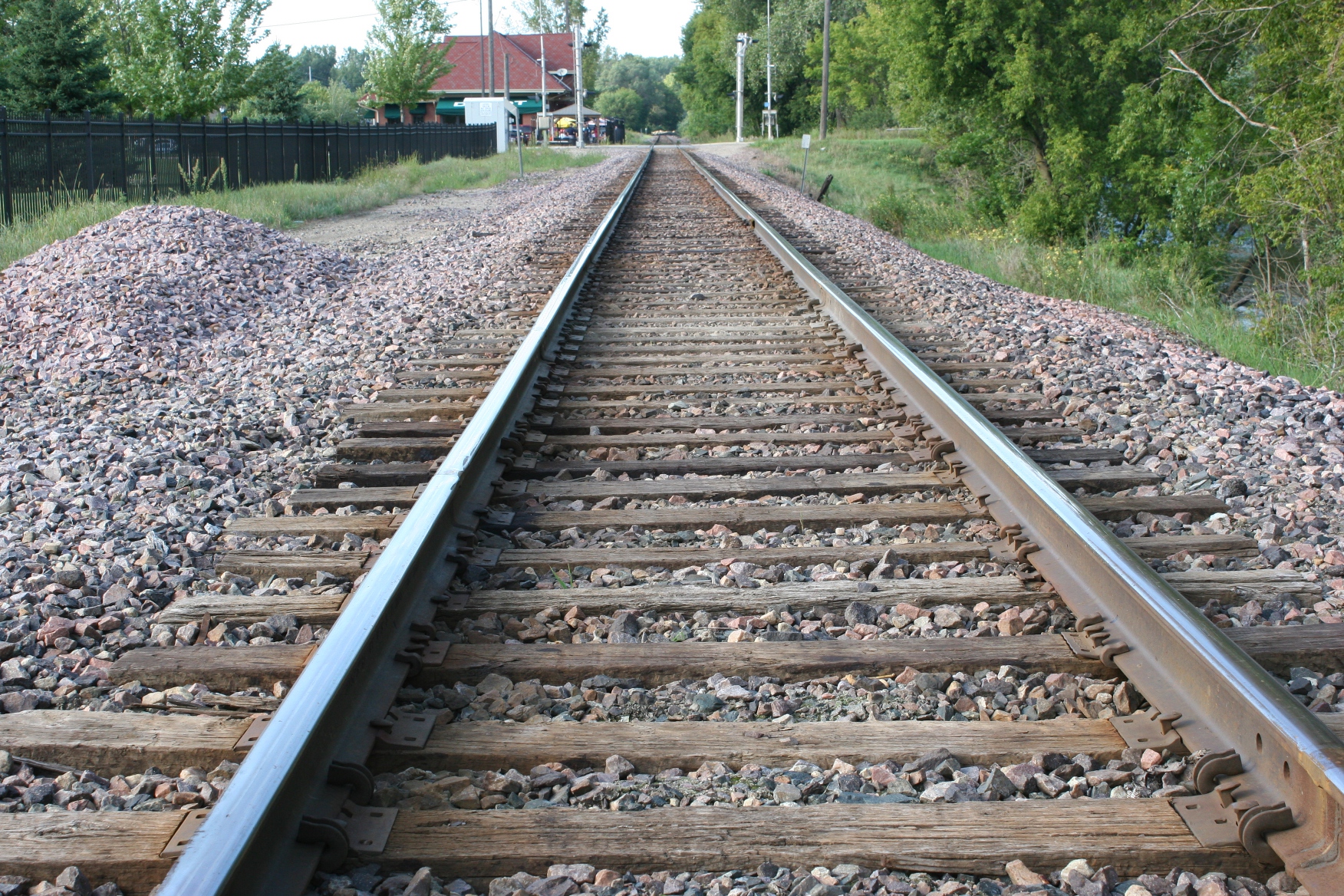
These railroad tracks lead to The Depot Bar & Grill in the distance. (Minnesota Prairie Roots copyrighted file photo)
JUST DOING MY HOMEWORK
My last assignment from Ryan, my vestibular rehab therapist, was to get out into the real world, even dine at a restaurant. I took my homework and ran with it, maybe too far. Saturday morning Randy and I stopped at a garage sale and then went grocery shopping at two stores. By the time we reached the second grocer, which is considerably larger, noisier and busier than the first, I felt my symptoms flaring from the sensory overload. Oh, boy, how would I manage lunch with his sister?
With a bit of time before lunch, I closed my eyes, rested and tried to settle my hardworking brain.
Soon my sister-in-law Cheryl arrived and we were off to The Depot Bar & Grill, housed in an historic depot along the train tracks next to the river. It’s a lovely place with typically good food. I asked to be seated in a quiet area, explaining that I have sensory issues, especially with sound. I thought I could handle it. After all, I’d been training myself at home by listening to white noise city traffic, roaring waterfalls, crashing thunderstorms while moving my hands near my face. Enough practice and I was managing that noise symptom-free.
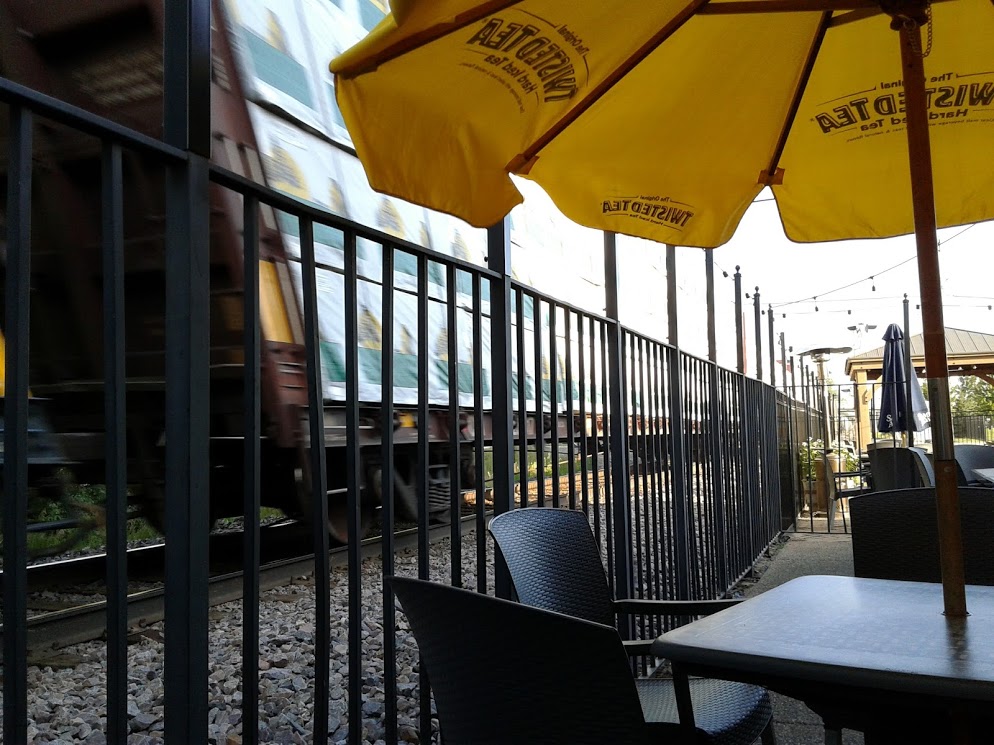
Dining tables are right next to the train track at The Depot. A train passed during a previous patio meal there. (Minnesota Prairie Roots copyrighted file photo)
A WHOLE LOT OF TOO MUCH FOR MY BRAIN
But practice is not reality. As we settled at our lower level table with only two other dining tables in that section occupied, I thought, “This won’t be too hard.” But then, as more people filled the restaurant and the volume of conversations increased, I felt my head hurting, my eyes hurting, the constant roar of people’s voices making me feel worse and worse. Finally, I conceded that we’d have to move to the patio. It was too much for me. Our waitress was generously accommodating.
She warned us ahead of time that the cottonwood trees along the Straight River were dropping their fluffy white seeds. That they were. As the white fluff swirled and danced and fell upon our table, I felt like we were in a snowstorm. After our food arrived, Cheryl covered her plate with a napkin. I didn’t, nor did Randy. Fluff landed in my water. I still wasn’t feeling well.
I tried to hang in there, taking only small bites of my French dip sandwich, offering the chips (I’m avoiding salt) to my table-mates. I tried to shut out the conversation of the two women dining near us. But their voices, even though not really loud, sounded loud to me. I tried to engage in conversation with Randy and his sister, whom we haven’t seen in a long time. It was a lot for my brain to handle—juggling listening, talking, surrounding noise, visual of swirling white fluff, staff up and down the nearby steps, traffic sounds (thankfully no train).
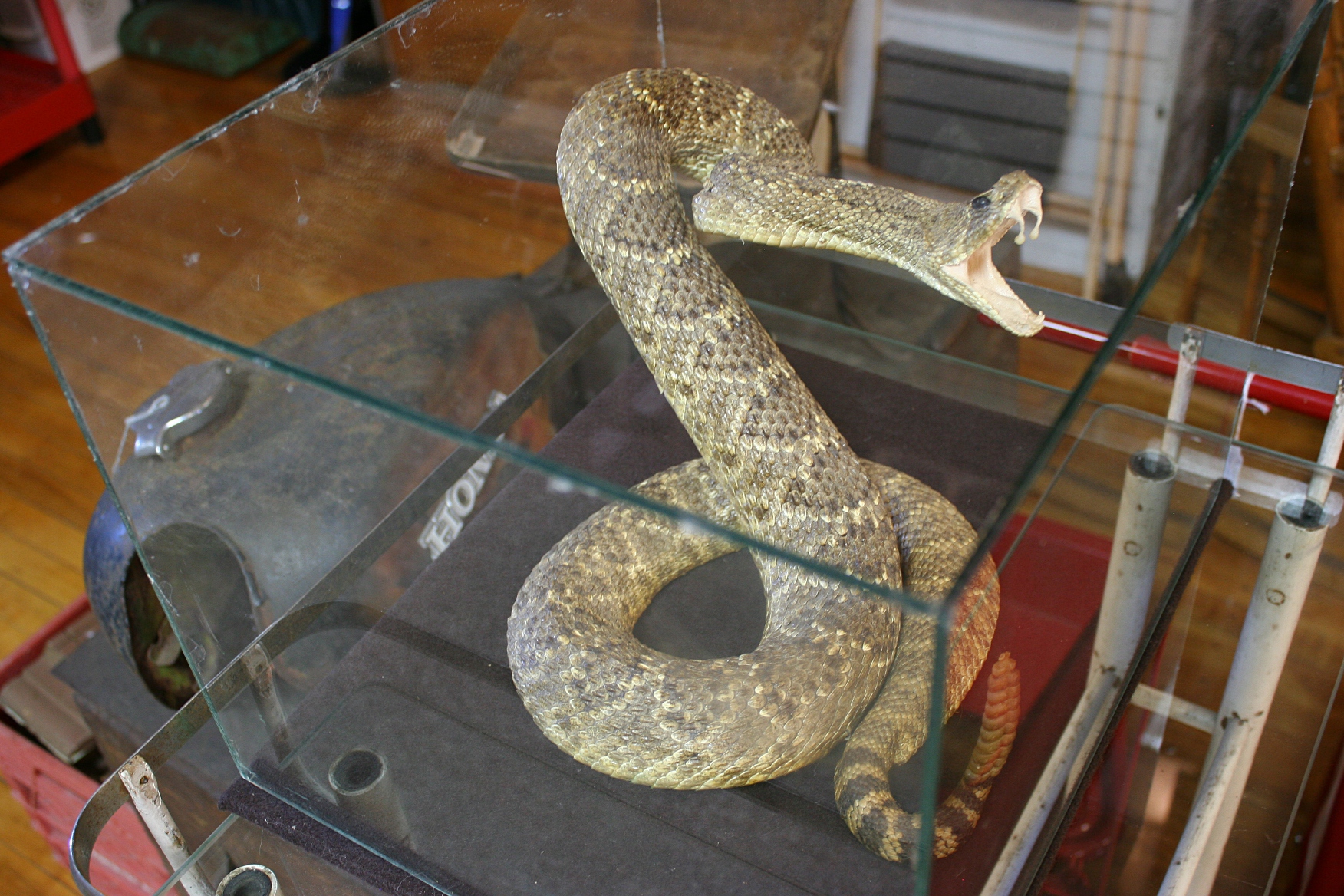
A dead rattlesnake inside a case at Grizzly Canyon, an antique shop in Sleepy Eye. (Minnesota Prairie Roots copyrighted file photo 2019)
AN UNEXPECTED DISTRACTION
Then in the midst of this feeling awful and trying to get through this meal, I saw a long snake slither from across the railroad tracks, under the wrought iron fence and onto the patio. It slid toward the nearby empty table, under the chairs, briefly lifting its head as if to inspect. I wasn’t scared, just thankful it was not by us. The snake drew significant attention. Had I been feeling better, I would have pulled out my cellphone to take pictures. Others did, before the snake reversed and headed back toward the tracks, back toward the grassy river bank. A guy identified the snake as a gopher snake. I knew this was not a garter snake, as the women next to us said. I would have guessed rattlesnake, which shows how little I know about snakes. I know only that I don’t like snakes.
After that excitement, we continued with our meals, me mostly leaning my head into my hand in an effort to at least stay until the others finished eating. Finally, I said, “We have to leave.” My symptoms had flared out of control. I tried. And, if anything, I came home with an interesting story to tell about the uninvited dinner (technically lunch) guest down by the (former) train station.







 Minnesota Prairie Roots
Recent Comments