

THE SETTING COULD BE FARIBAULT or any other Minnesota community which, in the latter part of World War II, housed German prisoners of war in POW camps. But the setting is at a camp in Greeley, Colorado, and on a farm site in nearby Berthoud. Locations matter not. The story does.
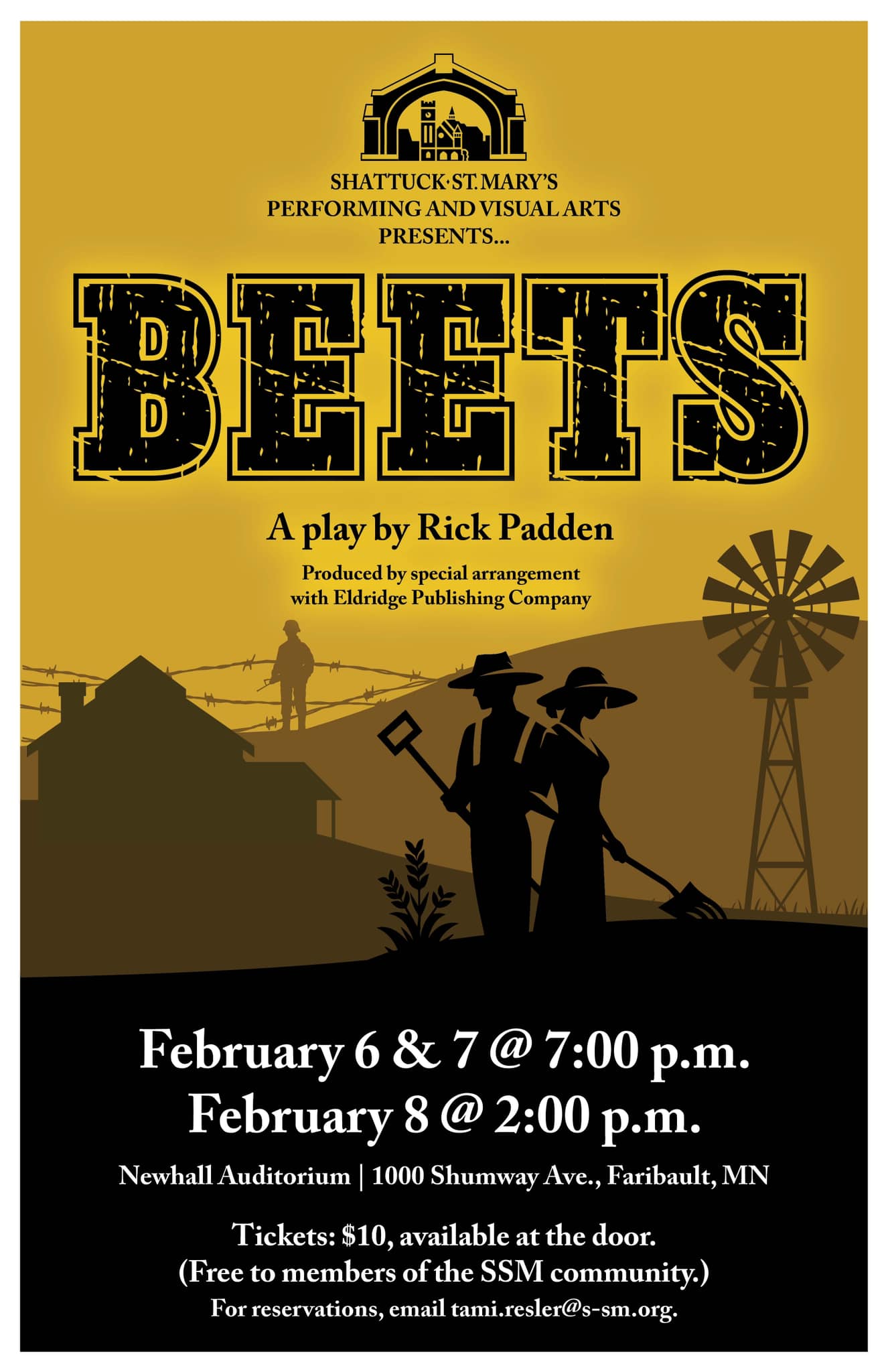
Thursday evening, I sat in the sparse audience of the historic Newhall Auditorium on the campus of Shattuck-St. Mary’s School, a private college prep school on Faribault’s east side, watching a story unfold in the theatrical production, “Beets.” An incredibly talented nine-member student cast immersed themselves in the roles of a farm family, German POWs, guards and a family friend to share a bit of history. And much more.
This play about POWs working on the Hunt family’s sugarbeet farm is more than a retelling of history. It is also about relationships, fear, culture and love. It is about the perceived differences that divide us and about the commonalities that unite us.
This is a play for our times. In a nation today divided by politics, by fear, by hatred and animosity, “Beets” is absolutely relatable.
As the storyline evolves, conflicts arise. Farmer Fred Hunt spews his hatred of the Germans. His wife, Isabelle, exudes compassion and love. And their daughter, Anna, settles somewhere in between, leaning initially toward dislike and distrust of the German POWs who have come to work her father’s land. Anna’s thoughts often turn to her brother, Jake, fighting the Germans abroad.

Slowly, interaction by interaction, things begin to change. The American farm family and the German prisoners realize they share a love of Bach. (Yes, a German composer.) And while the German POWs profess they will never eat corn, because that’s for pigs and cows—although Anna explains the difference between corn for livestock and sweetcorn—they all understand that they need to eat. The scenes in which Anna and Isabelle serve potatoes and cake to the POWs show how food brings people together. Trust grows. When Fred learns details about POW Dieter Meuhler’s family, he begins to understand the personal side of a man he saw only as an enemy. The walls of distrust, disdain and differences start crumbling, albeit slowly.
It is not lost on me that the Shattuck performers are themselves of diverse backgrounds. That only adds to the performance.

There are lessons to be learned from “Beets,” written by Rick Padden. First, we are all, at our core, just human beings with the same basic needs. Secondly, to overcome differences, we need to connect on a personal level. We need to open our hearts and minds, to embrace cultural and other differences. We need to show compassion and care, as farm wife Isabelle Hunt did on stage. We need to recognize that love is universal, as Anna and Dieter discovered.
“Beets” is one of those plays I wish everyone could see, especially now in these challenging days. I left the theater at Shattuck-St. Mary’s feeling a sense of hope. The fictional characters in “Beets” changed, for the better. They opened their hearts and minds to each other, despite their differences, or perceived differences. Perhaps we can do the same.
#
FYI: Two performances of “Beets” remain at Shattuck, one at 7 pm Friday, February 7, and the second at 2 pm Saturday, February 8. It’s a two-hour show (includes a 10-minute intermission) I highly recommend to anyone who enjoys well-done theater, history and a play with strong messages relevant to today.
© Copyright 2025 Audrey Kletscher Helbling


 Minnesota Prairie Roots
this sounds like an amazing and powerful play. I had heard a little about the German pow’s in something in the last year or so, and I had no idea before that they were even there. how wonderful that the theater/storytelling brings this to life and teaches us an important life lesson
Beth, you would love this play. I wrote about German POWs in the past year so perhaps that is where you learned about them. If you click on the highlighted copy in the first paragraph, you can reach that story.
oh, i think that’s it! thanks –
Thanks for the great review, Audrey. I’m thrilled that you enjoyed the play! Rick Padden
You’re welcome, Rick. Thanks for writing “Beets”. The themes and messages are so relevant to today. I wish EVERYONE could see your play on stage.
It would be super if you could post your review or comments here:
https://www.histage.com/beets
Rick, feel free to put a link to my review on Facebook or elsewhere. Readers, check out the link in this comment for more info about the play, a behind the scenes interview with Rick and to read existing reviews.
It wasn’t until we were well into our MN State Park adventures that we learned the history of the German POWs in our state. This play sounds so hopeful. I loved this phrase, “ We need to recognize that love is universal”… Thank you for sharing this with us.
Rose, you would have thoroughly appreciated “Beets.”
Sounds like a really great show—- good for you for making the time to go. You have so much going on in your area it must be difficult to choose what to attend.
It was a play I know you would appreciate, Beth Ann. Yes, lots happening around here. Cost factors into what we can do.