

This sign marks The Faribault Woolen Mill, which sits along the banks of the Cannon River in Faribault, Minnesota. Minnesota Prairie Roots file photo August 2015.
“DID YOU GUYS HAVE a tan mitten found yesterday?” customer Molly asked in a recent entry on the Faribault Woolen Mill Facebook page. She’d shopped at a mill overstock sale the day prior and lost a mitten knit by a family member. To Molly, it wasn’t about the mitten as much as the memory and love attached to it.
A mill employee asked Molly to send a photo to aid in the search. Whether the mitten has been found, I don’t know. But I view the mill’s response as a current day example of how this 150-year-old Faribault business cares like family.
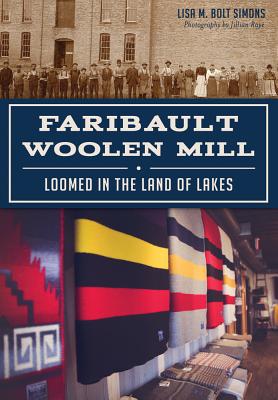
Book cover by The History Press
That’s a recurring theme in a just-published book, Faribault Woolen Mill—Loomed in the Land of Lakes, by my friend, Faribault author Lisa M. Bolt Simons. Lisa cites numerous cases of the mill’s loyalty to Faribault and its employees. In 1961, for example, mill owners purchased a cabin near Bemidji for use by employees, customers and others. That appreciation goes both ways. Community residents and employees have remained fiercely loyal to the woolen mill. Many employees returned to work after the mill briefly closed. Employment longevity reaches into decades, up to sixty years for one mill employee, spotlighting a strong work ethic.
Appreciative customers exist world-wide. Lisa found an August 1966 mill retail store guest book entry notation that The Beatles (yes, those Beatles) visited. That seems unlikely, though, given the Beatles only Minnesota concert, at Met Stadium, happened in August of 1965. However, during eight months in 1966, nearly 2,000 people from 45 states and nine countries signed the mill guest book.

Sandbags protect the historic Faribault Woolen Mill from the rising Cannon River in June 2014. The mill is listed on the National Register of Historic Places. That designation in 2012 allowed the business to apply for, and receive, a $300,000 grant from the Minnesota Historical Society for mill restoration. This photo is published in black-and-white on page 96 of Lisa M. Bolt Simons’ book. Minnesota Prairie Roots file photo 2014.
Lisa’s 126-page book, published by The History Press, is packed with information that shows extensive research on her part to tell the complete story of Minnesota’s oldest manufacturer. Her bibliography runs four pages. I must note here that Lisa references my June 12, 2012, blog post, “Historic Faribault Woolen Mill Opens Store with Artsy Vibe,” in the preface. One of my photos is also published in her book.

Perusing merchandise at The Mill Store shortly after it opened in 2012. Minnesota Prairie Roots file photo.
Typically, I do not enjoy reading history. But I finished Lisa’s book in just a few days. It was that interesting. I didn’t grow up in Faribault. So, unlike natives, I didn’t know the history of the mill which started with the Klemers, a family ownership that extended into five generations. I didn’t know about the mill’s multiple locations, about the five fires. I didn’t know how close the mill came to closing during several economic down-turns. I didn’t know why the family sold to outside investors, a move that eventually resulted in the mill’s closure in 2009.
Lisa references public court documents that offer insights into the short-term closure. She also quotes employees who dealt with bounced paychecks and unpaid health insurance premiums. Her information confirms what my neighbor, a retired mill retail store employee, told me years ago.
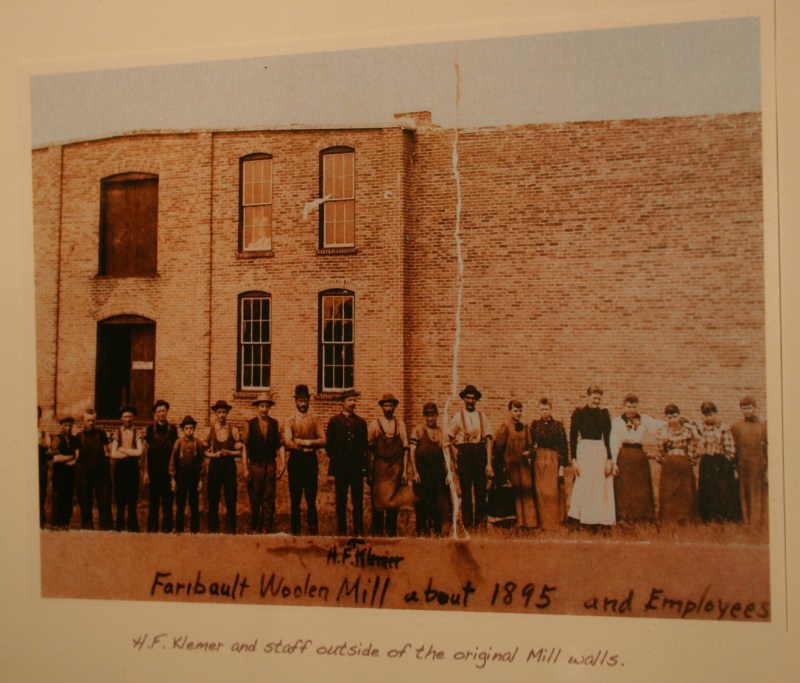
An historic photo from the mill, among those showcased in a mini wall of Woolen Mill history. Minnesota Prairie Roots file photo.
Through the challenges of fires, floods (in 2010 and 2014) and finances, the Faribault Woolen Mill survived with a tenacity that continues today under the ownership of Paul and Chuck Mooty and their leadership team. The cousins reopened the mill in 2011. A theme of endurance weaves throughout the book.

Crisp white cubbies, ever so perfect for showing off blankets/throws at The Mill Store. Minnesota Prairie Roots file photo 2012.
As it did from the beginning, the mill remains rooted in producing quality wool products, specializing in blankets that have warmed troops, hotel guests, airline passengers, newlyweds… Today you’ll find Faribault Woolen Mill products in boutiques and trendy places nation-wide, many of those notable locations listed in the book.
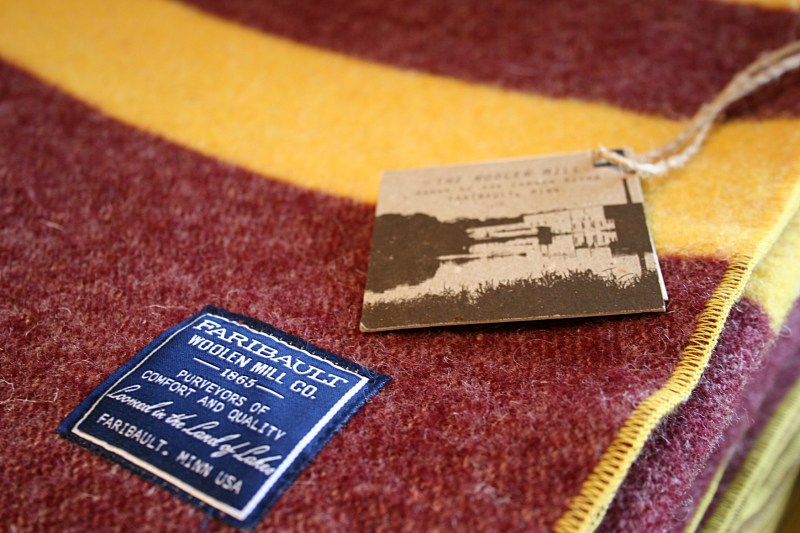
The mill’s products are labeled as “Loomed in the Land of Lakes” by “Purveyors of Comfort and Quality.” Minnesota Prairie Roots file photo 2012.
Because of Lisa’s book, I now hold a deeper appreciation of the Faribault Woolen Mill, one of the last vertical woolen mills in the U.S. I understand why locals value this business hugging the banks of the Cannon River. A quote from Jean Mooty, who restarted the retail store and is the wife of co-owner Paul Mooty, says it all: “The mill gets in your blood.”

Lisa M. Bolt Simons. Photo by Jillian Raye Photography.
FYI: The Mill Store, 1500 Second Avenue Northwest, will host “A Book, Beer + Blankets” book tour launch from 4 p.m. – 7 p.m. on Wednesday, December 9. Lisa will give a short presentation at 5:30 p.m. Faribault’s F-Town Brewery will offer beer tasting. And, of course, Faribault Woolen Mill products will be available for purchase.
(Note: I received a complimentary copy of Faribault Woolen Mill—Loomed in the Land of Lakes. The inclusion of my mill photo and references to me and my blog did not influence this unbiased and honest review of the book.)
© Copyright 2015 Audrey Kletscher Helbling
Book cover image by The History Press
Author portrait by Jillian Raye Photography


 Minnesota Prairie Roots
Recent Comments