
I NEARLY WALKED OUT of church once during a sermon. The pastor called Vincent Van Gogh “crazy.” Yes, the artist suffered from mental illness. But labeling him as “crazy” did not sit well with me. I find the term derogatory and disrespectful of anyone battling a mental health issue.
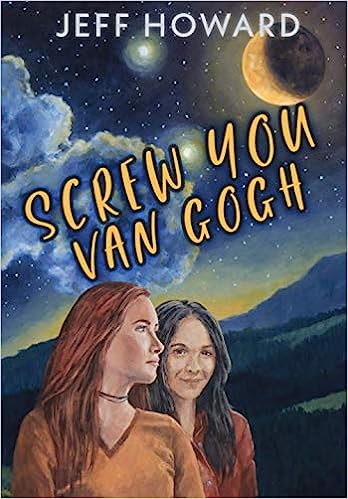
So when I picked up a newly-released book, Screw You Van Gogh, by Minnesotan Jeff Howard, I wondered how the Dutch painter would fit into the story line. Turns out the reference to the artist, who battled anxiety and depression, was held in asylums for the insane and eventually committed suicide, proved a good focal point for a story about high school students.
This fictional book, based on real life experiences, is not a feel good story about teenagers. But rather, this story is heavy, heavy with the issues teens face. Depression. Anxiety. Bullying. Relationship struggles. Trauma from abuse. Pressure to do well. And more.
WRITING WITH AUTHENTICITY
The author, a high school counselor for the past 15 years, writes with authenticity. A main character in the book, Michael Burns, is a counselor at Roosevelt High School. Therein comes the Van Gogh reference. Burns has a jigsaw puzzle of the artist’s painting, “Starry Night,” in his office for kids to work on with him. One of those students is Cassidy Towers, 16, new to Masonville, Iowa, and dealing with panic attacks, suicidal thoughts and more.
As the plot unfolds, so does a certain familiarity. This could be a high school anywhere so real are the characters. The popular kids. The quiet ones who follow the rules. The kids who, on the outside, appear not to give a damn about what they say or do, but who are hurting inside, hiding their truth. Like Tommi, who befriends Cassidy. She is in counseling for severe anxiety and depression, a fact she hides from her classmates. “Tommi could not bear the thought of people knowing she was crazy,” Howard writes.
There’s that word, “crazy,” again. But this time it fits because this is the thinking of a high school student with thoughts of suicide that sometimes “crept into her mind like an evil spirit.” As Tommi and Cassidy’s friendship grows, so does Cassidy’s awareness of Tommi’s struggles. She observes the vacant look in her friend’s eyes, her unkempt appearance, her repetitive petting of a kitten, all signs of Tommi’s declining mental health. By this time, Cassidy has worked through her own mental health issues via talking with the high school counselor, an improved relationship with her mother and using tools (like music) to help her cope.
HELP, HOPE & STIGMA
The author, given his professional work as a counselor, includes helpful ways to deal with anxiety, depression and more. Like Cassidy’s use of music. He emphasizes listening, empathy, deep breathing, hope…
He also addresses the ongoing stigma attached to mental illness. In a conversation with Cassidy, fictional counselor Burns talks about Van Gogh and how he grew anxious and depressed after art experts criticized his impressionist style of painting. Van Gogh turned to alcohol. Burns tells Cassidy that people, especially teens, “don’t want to admit they need help because that makes them weird.” And, because of that sometimes people “crash,” he says. That happens in this book, in a tragic way.
HUNTING & HOTDISH
Within all the heaviness of Screw You Van Gogh are the subplots of counselor Burns’ personal life and relationships and then a budding relationship between Cassidy and classmate Patrick, who once called her “a little crazy” and “goofy upstairs.” When the teens eventually go on a first date, it’s not to a movie, but pheasant hunting. That proved a lighthearted moment for me in the reading of this book. Oh, how rural Iowa/Minnesota, I thought. And then when the author threw in Minnesota’s signature tater tot hotdish served in the school cafeteria, I laughed aloud.
This book is authentic through and through and should be read by every teen, every parent, every educator, every counselor… And perhaps every counselor should purchase the jigsaw puzzle “Starry Night” as a tool to get kids to open up about their emotions, experiences, struggles, as Van Gogh did via his painting.
© Copyright 2023 Audrey Kletscher Helbling


 Minnesota Prairie Roots
Your review of Screw You Van Gogh is FABULOUS! All of your reviews are so great, but this one, considering the content is so, so well done. My favorite review of this book! Thank you so much!
Janell, I appreciate your kind words regarding my review. I am passionate about the topic of mental health.
this sounds like a wonderfully executed and thought out book, by someone who has been there and dealt with the realities of young adults and their lives. I agree, the term ‘crazy’ doesn’t sit well with me, and we need to treat these illnesses just like any other illness. I think this book will be a great vehicle for teens and adults to open a discussion about how they are feeling and to validate and acknowledge what they may be dealing with and going through
You’re right. This book could be used to open discussions between teens and adults. That’s a great idea.
Wonderful review of a seemingly wonderful book. Thanks.
Thank you, Ken. I hope this book will be widely read by both teens and adults.
Audrey … this is Jeff. It is not enough to simply thank you for the awesome review. But you need to know your thoughts and observations were so exactly, perfectly right on with what I wanted readers to “hear.” My gosh … makes all the work worth it. You really are a perceptive, deep reader. And I would say that even with a not so favorable review. But you gave me a good one … thank you.
You are most welcome, Jeff. Thank you for writing this powerful, much-needed book. I’ve read a lot of nonfiction books on mental health, but never a work of fiction focused on the topic. This is so relevant today. I hope your book makes its way into public and school libraries and counseling offices, even psychology classes. I pledge to continue writing on the topic of mental health.
Audrey, great job on the review and yes you are a very thoughtful and insightful reader. Mental health issues are a subject you have explored frequently in your blog posting over the years. This book is such a great resource for families and I agree it does open the door for dialogue between teens and adults.
Thank you, Sue. That means a lot coming from you, an avid reader, book reviewer and retired educator.
I love your book recommendations, Audrey. I end up purchasing several of them. Some end up in my reading stack, like “The Seed Keepers,” “Unglued” (I remember the author from my days at U of M) and another about the photographer of Native Americans. And the children’s books go to my office where my “work wife” and I like to maintain a children’s library of books recommended by people we respect so we can give a new book to children when their parents bring them to work: “Africa A to Z,” “A Trip to the Store,” “Little Leaders” and “Little Legends” all of which came from your recommendations I believe. Anyway, the book you reviewed here also sounds like a winner. I love the title and cover.
I am honored that my book reviews have prompted you to buy some of these books. I love that you and your co-worker buy children’s books to give to the kids who come with their parents to work. What a kind thing to do.
This looks like a very interesting read. Thanks for the review and recommendation.
Even Randy is reading this book and enjoying it. And he rarely reads fiction.
I love how you’ve highlighted the importance of understanding and empathy in dealing with mental health issues, especially among teens. The Van Gogh reference is indeed a clever touch, and your point about the jigsaw puzzle as a tool for opening up conversations is spot on. Thanks for the great read! Keep up the good work.
I appreciate your kind words regarding my book review. I am committed to educating/informing/highlighting mental health to help reduce the stigma and to increase awareness and understanding. The book is exceptional in addressing teen mental health specifically and would be a great resource for youth and mental health professionals.
Thank you for what your team does in mental health. Here in Minnesota the shortage of mental health professionals, especially in rural areas, is extreme. Waits are six weeks plus, if a provider is even accepting new patients. And if you’re in crisis or otherwise in need of care, six weeks is way too long.