

I RUN MY FINGERS across his dog tag, thumb caressing the raised letters and numbers stamped into metal. His name, KLETSCHER, ELVERN A. B blood type. P for Protestant. His Selective Service number, the same number on his Armed Forces of the United States Geneva Convention Identification Card, the laminated card he carried with him into war. Just like the duplicate dog tags that would identify him if he was injured or killed in action.

Seventy-one years ago, my dad was a fresh-faced young Minnesota farm boy fighting in the Korean War as a combat soldier for the U.S. Army. Each November, around Veterans Day, I pull out two shoeboxes filled with photos, letters, documents and more from Dad’s time in the service. And although I’ve looked through the contents many times in the 20 years since Dad died, I still feel the same overwhelming sense of sadness in all he experienced. The death of combat buddies. His killing of the enemy. Orphan children begging for food across barbed wire fences. The cold and hunger and fear. And then the Post Traumatic Stress Disorder he suffered upon his return home to southwestern Minnesota.

I feel all of that as I touch his dog tag, run my fingers along the short chain like fingers worrying rosary beads in prayer. War is hell.

Hell. Dad used that word in a March 4, 1953, letter to his parents and siblings. He criticized the draft board, his anger fueled by the possibility that a younger brother might also end up in Korea. He wrote, in part: “Do they know what it’s like over here? Hell no. Why the heck don’t some of them come over here and look this over? They’d probably come to there (sic) senses…” Not everything he wrote is printable. But his anger and frustration are palpable. And I don’t blame him.
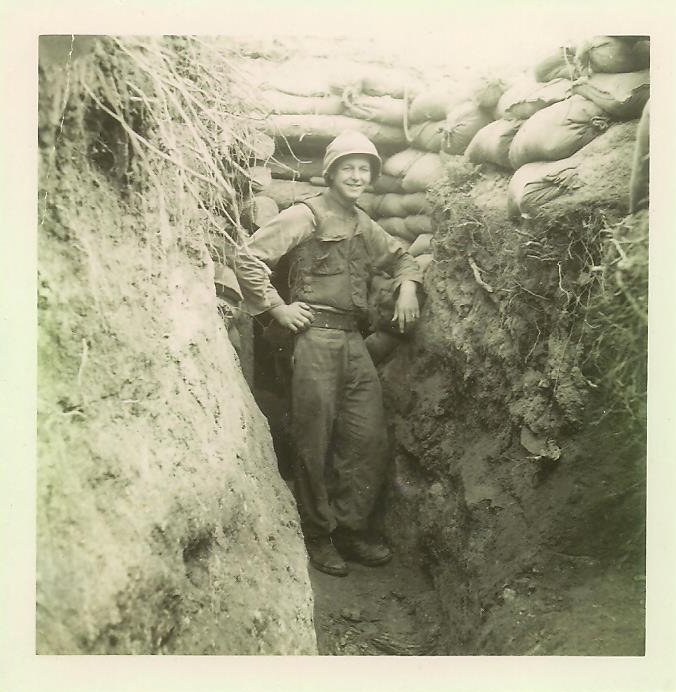
War is hell. I try to imagine my dad penning that letter on his 22nd birthday. Missing his family. No cake, no nothing to celebrate. But rather worry about whether he would live to the next day. He had reason to fear for his life. Only a week prior, he was wounded in action at Heart Break Ridge while engaged in mortar firing with the enemy. Shrapnel struck him in the face and he was hospitalized for several days.

Interestingly enough, Dad mentions none of that in his letter home. Rather, he closes with these sentences: “I’m feeling fine and don’t worry about me. I’ll write again soon.” I don’t believe Dad was “feeling fine,” in a place he called a “hell hole” in his letter.
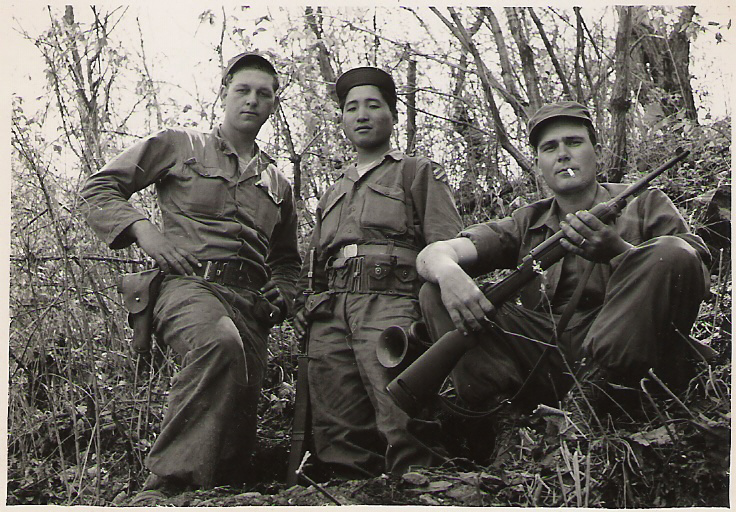
As I filter through the shoeboxes holding his military belongings, I pick up a hardcover 4 x 6-inch black book. It’s tattered, bent, dirty, obviously well-used. When I open the cover to read the words Dad penciled across lined paper, the realities of war strike me full force. Here are details and instructions on weaponry—60 mm mortars, submachine guns, tank mines, smoke screens, chemical warfare… He writes about reconnaissance, combat and security patrols and “avoid contact with enemy—may have to fight in self defense.” There are diagrams and fire commands and details I don’t understand, and don’t necessarily want to understand.

But “Conduct on lines” and the details that follow need no deciphering: “1) Hold fire until enemy is within 500 yards. 2) Listening post must have cover and concealment, must have good route for withdrawal…” I expect Dad carried this book into war. Just as he carried deep trauma home from “The Forgotten War,” as the Korean War has been dubbed.

War is hell, even if done for the right reasons—to defend democracy and freedom and country. For his time in the Army in 1953, Dad was paid $266.27. It’s documented on his federal income tax return. So little for so much given, not that there’s ever enough payment for a combat soldier.

I wish I could wrap my arms around Dad, hold him, tell him how deeply sorry I am for the horrors he endured while fighting as an infantryman on the front lines during the Korean War. Mostly, I wish I could simply listen, sitting quietly as I finger the chain of his dog tag, the beads providing tactile comfort as he talked (if he would talk) about the personal hell that is war.

NOTE: Please use this Veterans Day as a time to thank those who have served our country. But more than thanking, listen, support and encourage. The voices of our veterans need, and deserve, to be heard.
© Copyright 2023 Audrey Kletscher Helbling


 Minnesota Prairie Roots
oh, Audrey, this is so incredibly sad and moving. here is to your father and all those who fought in wars they did not choose. he was such a young man, as so many were, and he had no choice but to be thrown into the gates of hell, a war, even that is an understatement I’m sure. I understand your wish to take care of and comfort him. I’m sure there was not one person who has been in a war, who has not been forever changed and impacted in a very challenging way. I believe that your dad, is somehow looking down at all your concern and care when reminded of what he endured and how you continue to tell his story to help to get the word out to others who continue to suffer because of these wars. he would be so very proud of you, as you are of him.
Thank you, Beth. Your compassion for my dad, for me, for others, shines. I am grateful.
What a poignant tribute to your father and the men with whom he served. Your sharing the details of the contents in that box is beautifully described and evokes such feeling. I just heard the 1964 song Universal Soldier the other night and along with your post, the words remind us that War is Hell for certain.
It is the stories, the details which take war beyond a word to a personal experience. Therein lies the horror, the hell, the trauma. Thank you for appreciating my post honoring my father.
What a deeply somber post. Thank-you for honoring your father and reminding us to thank and listen to all of our veterans. War is hell. I don’t know why the world doesn’t learn that and stop it.
Thank you for appreciating my post and the story and reminders I share therein.
Love the old photos.
They are a treasure for sure.
Eye opening story!
Even I learned new things about my dad’s time in Korea while writing this post. I thought I’d looked through everything in the two shoeboxes. Clearly I hadn’t.
Having your dad’s memorabilia and letters from Korea ,and you mom’s journal…what a wealth of personal, family history. Thanks for sharing their stories.
I am fortunate to have these deeply personal items from each of my parents. They are worth far more than any “thing.”
Beautiful tribute while reflecting on a truly horrific time in the life of your father and many others.
Thank you. It’s important that I take time each Veterans Day to think about my dad’s time in Korea.