Minnesota Prairie Roots

Writing and photography by Audrey Kletscher Helbling

The aftermath of a hit-and-run from a mother’s perspective May 15, 2026

Filed under: Uncategorized — Audrey Kletscher Helbling @ 6:00 AM
Tags: , , , , , , , , , , ,
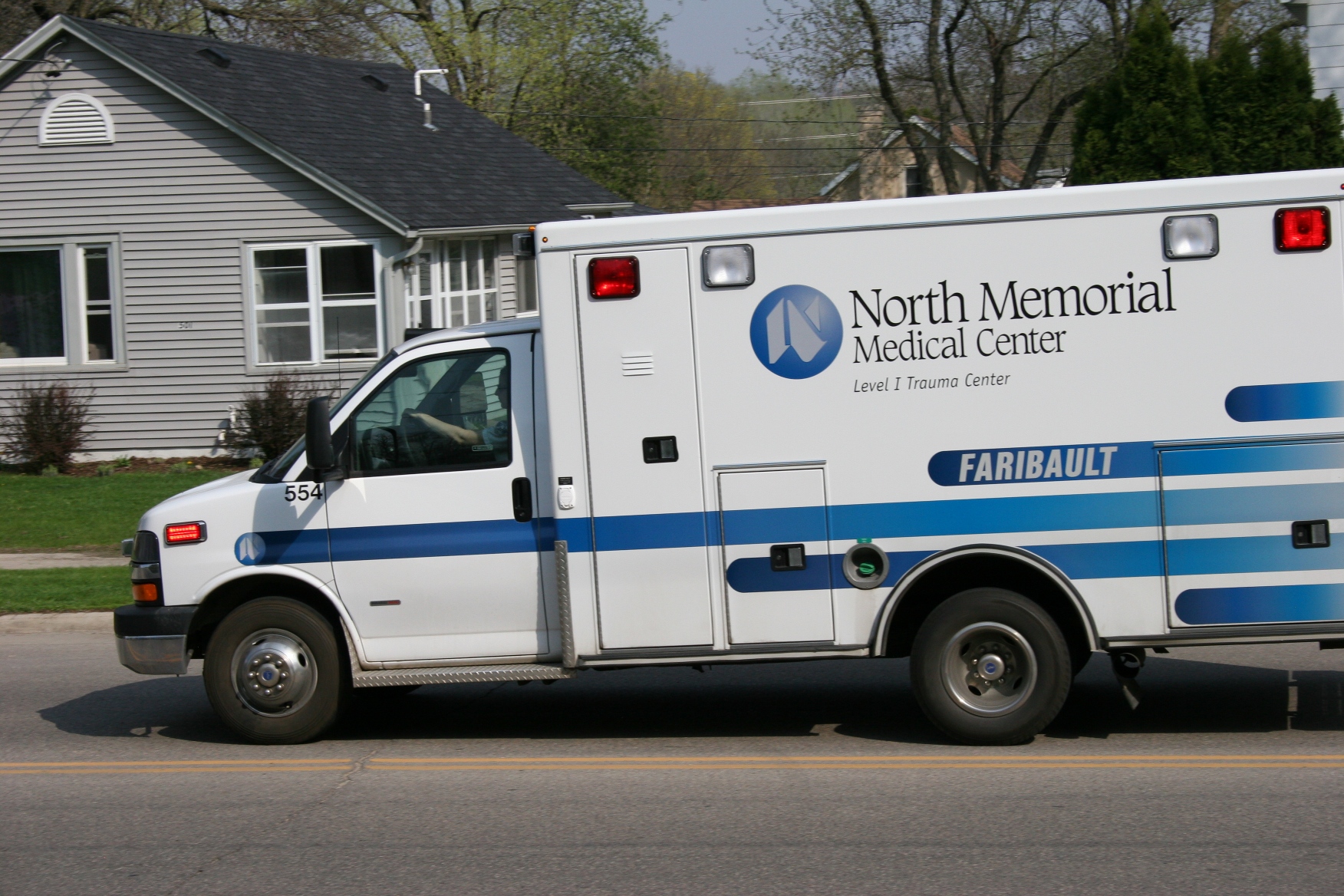
Twenty years ago an ambulance took my son to the Faribault hospital after he was struck by a car while crossing the street. (Minnesota Prairie Roots copyrighted file photo)

SHE DIDN’T UNDERSTAND, the mother said, how anyone could drive away, leaving her son lying in the road. I don’t understand either.

Tuesday morning the Fridley woman’s 17-year-old son was struck by a vehicle while riding his bike to Spring Lake Park High School. The driver left the scene.

Twenty years ago to the date, May 12, 2006, my then 12-year-old son was also struck by a vehicle while walking to his school bus stop along Willow Street less than a block from our Faribault home. That driver, too, left the scene.

Neither of the boys was seriously injured. My son suffered a broken bone in his hand, bump on his head, possible rib fracture and scrapes. The teen from Fridley suffered scratches and skid marks across his body, according to a media report.

But we all experienced trauma, compounded by the drivers of the vehicles who drove away. Drivers who left our sons lying in the street. Drivers who failed to show the decency and compassion to stop. Drivers who, for whatever reason, decided to continue on their way while our boys, our families, dealt with the fall-out of their actions and decisions.

I understand the anger of the Fridley mom. I felt the same 20 years ago. While time has mostly erased that anger, the questions remain. Who? Why? I would like to ask the driver, “How could you simply drive away, go about your morning, your day, your life as if nothing had happened, as if you had not just hit a child and left him lying on the side of the street?”

Despite a description of the vehicle as a blue 4-door, possibly a Chevy Cavalier or Corsica; a $1,000 reward (which is no longer valid); and investigative efforts by Faribault police, the driver was never found. Twenty years after this crime, I wonder if that driver carries any guilt.

I carry the memory of that day, fully aware that the results could have been much worse. Likewise, the mom in Fridley realizes the same. She is only in the early stages of dealing with her anger, her trauma, her questions. Twenty years removed from the hit-and-run involving my son, all three of those issues remain, although lessened by the passage of time, by the gratitude I feel of still having my son.

© Copyright 2026 Audrey Kletscher Helbling


Honoring mothers, including mine, on Mother’s Day May 7, 2026

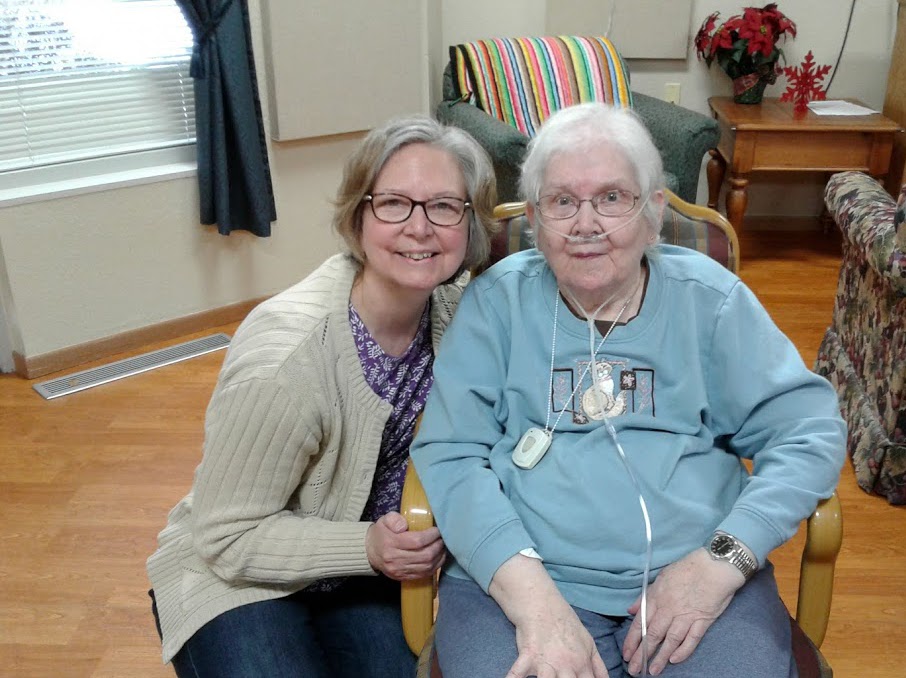
A photo of me with my mom taken several years before her death in 2022. (Minnesota Prairie Roots copyrighted file photo by Randy Helbling)

AS MY FIFTH MOTHER’S DAY without my mom approaches, I’m thinking of her, missing her, remembering her.

She lived a long life, living until nearly ninety, something none of us expected given her heart issues. Several times we were called to her hospital bedside to say goodbye. I remember one instance when Mom was not expected to make it through the night. The next morning she woke up much-improved and told us, “I guess God wasn’t ready for this stubborn old lady.”

I’ll never forget that. But I would argue that Mom was not stubborn. She was kind, caring, compassionate, loving and patient. With six children, she had to be patient. I raised three children and understand the patience required of mothers.

We all hold memories of our moms—positive, negative and otherwise. Moms, like all of us, are imperfect. But they try. They do their best.

Mom’s journals. (Minnesota Prairie Roots copyrighted file photo)

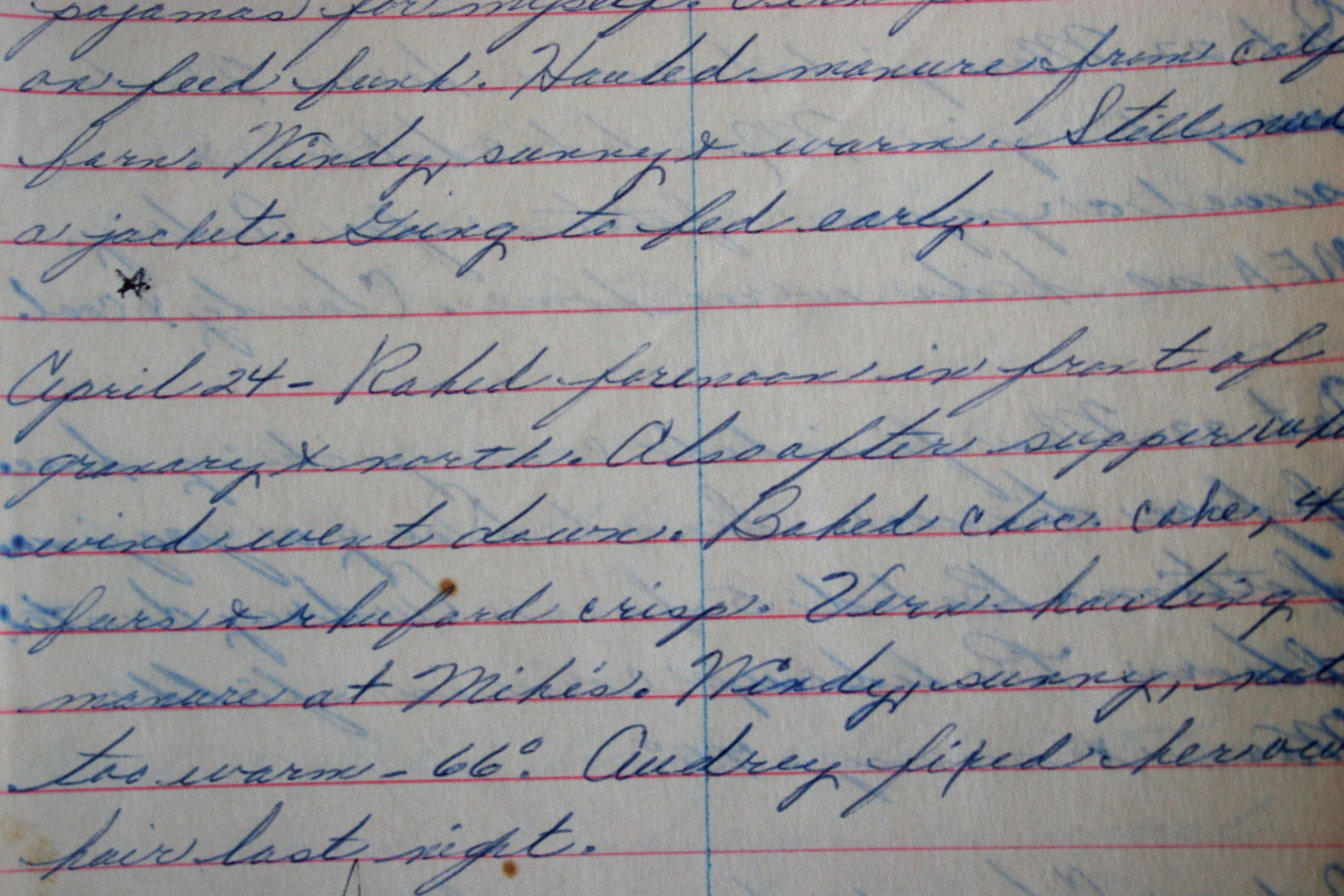
And sometimes they leave us a gift that offers glimpses into their lives. My mom left a stack of notebooks journaling her life from 1947-2014 with a few years missing. These are not diaries with personal feelings and thoughts expressed, but rather a documentation of daily life.

I treasure these notebooks filled with her handwritten observations and notes about life in rural southwestern Minnesota. Hard work filled her days. I pulled out her stenographer’s notebook dated 70 years ago to learn what she was doing in the 10 days before my birth.

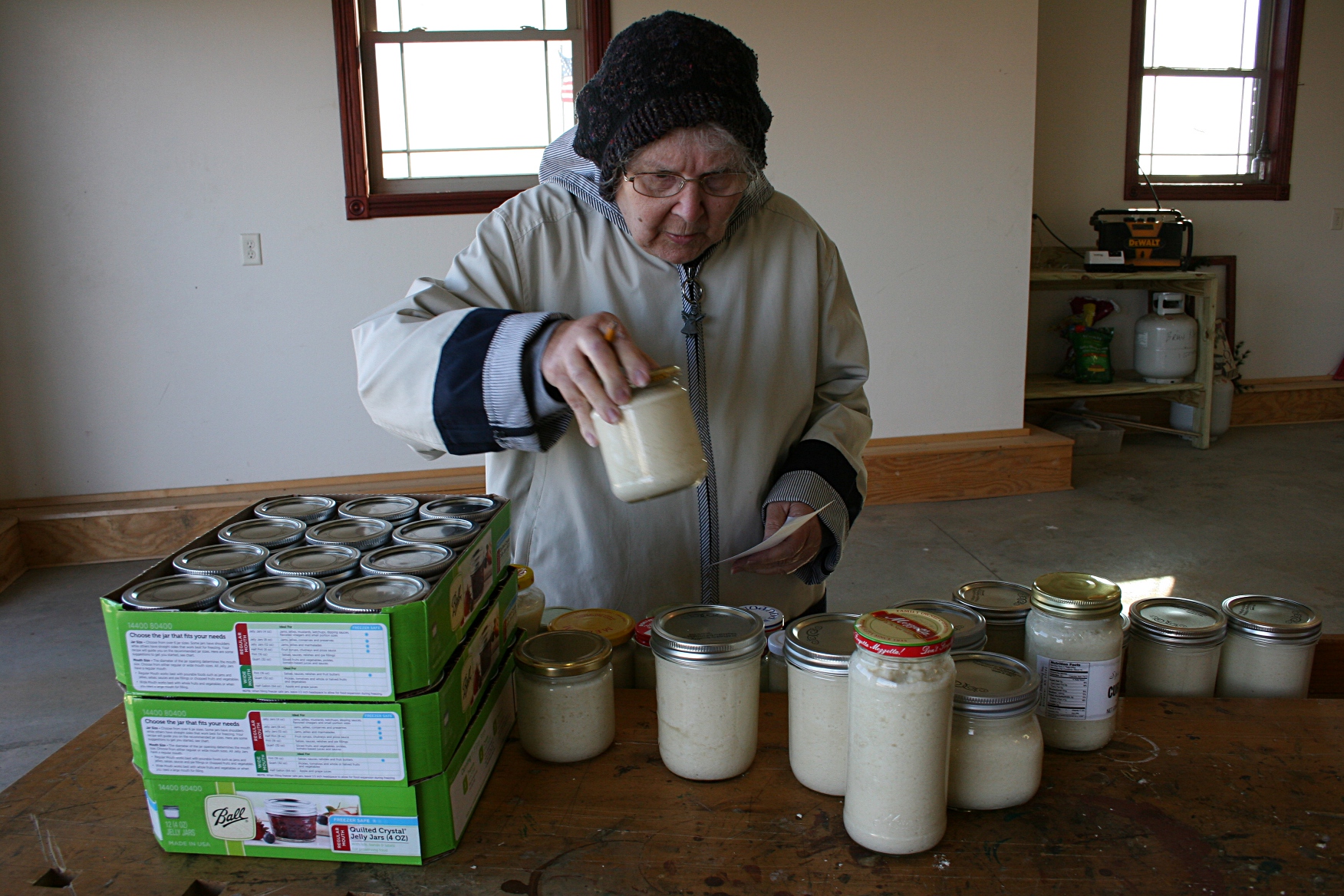
Even into her senior years, Mom was still working, supervising a family horseradish-making event and then counting jars of the condiment. (Minnesota Prairie Roots copyrighted file photo 2012)

There was the usual washing clothes in the Maytag wringer washer, mending, housecleaning, baking and preparing meals. But Mom also picked grapes with my dad, made grape juice the next day and the following day made 32 jars of grape jelly and 18½ quarts of tomato juice. And she was only days away from delivering me.

The day before I was born, Mom dusted floors, baked bread and cherry nut cake, took 13 dozen eggs into town and then celebrated her wedding anniversary with her in-laws. I’m tired simply reading that list of work she accomplished while nine months pregnant.

At 3 a.m. the next morning, Mom awoke in labor and arrived at the Redwood Falls hospital at 4:20 a.m., giving birth to 8 lb 12 oz. me 36 minutes later. That’s cutting it close, in my opinion. But when you go into labor in the early morning, need to get your one-year-old son to his grandparents’ house, and then travel 20 miles to the hospital, well, the time lapse seems reasonable.

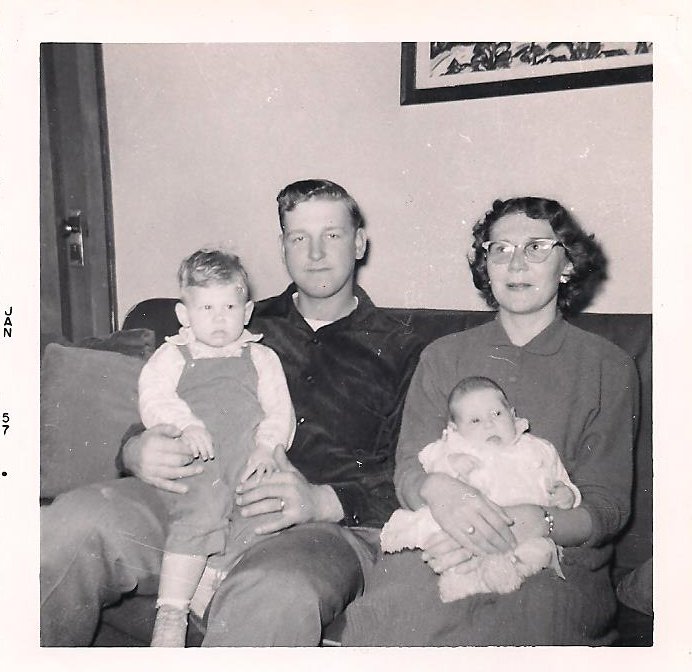
The only photo I have of my parents, Elvern and Arlene, with me as a baby. My dad is holding my oldest brother, Doug. (Minnesota Prairie Roots copyrighted photo)

Six days after my birth, Mom returned home. I should note here that on her fifth day in the hospital, Mom wrote, “Days are plenty long.” I suppose for a woman used to being busy all the time, lying around proved difficult. But she should have enjoyed the respite from work while she could.

Shortly, Mom was back in full work mode, not only caring for a newborn and a one-year-old and doing other routine household chores, but also feeding a crew of men picking corn on the farm for several days running.

Oh, how I admire this generation of Minnesota farm women who fed and cared for their families and others without the modern conveniences of today. No automatic washer, dryer, dishwasher, microwave. No bathroom or phone in our old farmhouse. Food came mostly from the farm, not the grocery store. And that meant gardening and putting up produce.

A sample entry from Mom’s journals. (Minnesota Prairie Roots copyrighted file photo)

I’m thankful my mom found time to journal daily. Even if her entries were only several lines long, she apparently thought this documentation important. And I suppose in farming it was, allowing her and my dad to look back on the previous year’s weather, planting and harvesting progress, and such. But I think, too, writing in those spiral bound notebooks gave her a creative outlet and time for herself.

My mom saved everything, including this Mother’s Day card I made for her in elementary school. I cut a flower from a seed catalog to create the front of this card. (Minnesota Prairie Roots copyrighted image)

Mother’s Day offers a time to reflect on motherhood. Most give selflessly, love unconditionally, do the best they can. Mine did. And she left, too, her words chronicling everyday life as a mother and as a farm wife. As a writer I cherish this gift, not only on Mother’s Day, but always.

© Copyright 2026 Audrey Kletscher Helbling

 

Building bridges in Faribault via a talk on Somali culture April 15, 2026

(Promo source: Rice County Historical Society)

IN EVER-INCREASINGLY DIVERSE Minnesota, including my community of Faribault, growing understanding between peoples rates as more important than ever.

To that point, Ibrahim Khalif, executive direction of the Faribault Youth Empowerment Center, will speak at 6 pm Thursday, April 16, on “Building Bridges: Intro to Somali Culture” at the Rice County Historical Society (RCHS) in Faribault.

I attended that same presentation by Khalif in late January at the local library and highly-recommend it to anyone who wants to learn more about the many Somalis who call my community, and Minnesota, home.

Khalif knows of what he speaks. He arrived in the U.S. as a teenage refugee from Somalia, grew up in Faribault, faced the challenged and embraced the joys of living here.

His January talk proved educational as Khalif shared personal stories, photos and information about the Somali culture. Both helped the sixty of us in attendance to better understand our Somali neighbors and ways we can connect to each other.

Certainly the word “bridges,” titling his talk, fits. Bridges connect. Khalif’s talk focuses on “building bridges in a diverse environment,” according to a media release from the RCHS. The release further states that Khalif “will share information and insights that help us foster mutual respect and understanding.”

I’m all for that and hope Thursday evening’s event is as well attended as his first at the library. I feel like way too many locals remain unwelcoming of the thousands of Somalis who call Faribault home. I’d like to see attitudes change. That starts with listening, learning, connecting on a personal level, bridging that which divides, recognizing that we are all just people.

FYI: To pre-register for “Building Bridges: Intro to Somali Culture” on April 16, call the RCHS at 507-332-2121. Admission is free for RCHS members and $5 for non-members.

Click here to read my January blog post about Ibrahim Khalif’s presentation at Buckham Memorial Library.

© Copyright 2026 Audrey Kletscher Helbling

 

The greening of the land & then a storm

Budding branches on the maple tree in my backyard during a recent sunset of pink sky. (Minnesota Prairie Roots copyrighted photo April 2026)

HERE IN SOUTHERN MINNESOTA, the greening of the land indicates the beginning of spring’s full-on arrival.

April showers, more like recent deluges of rain, and warmer temperatures have reawakened the earth. Once dormant brown grass now colors lawns greens.

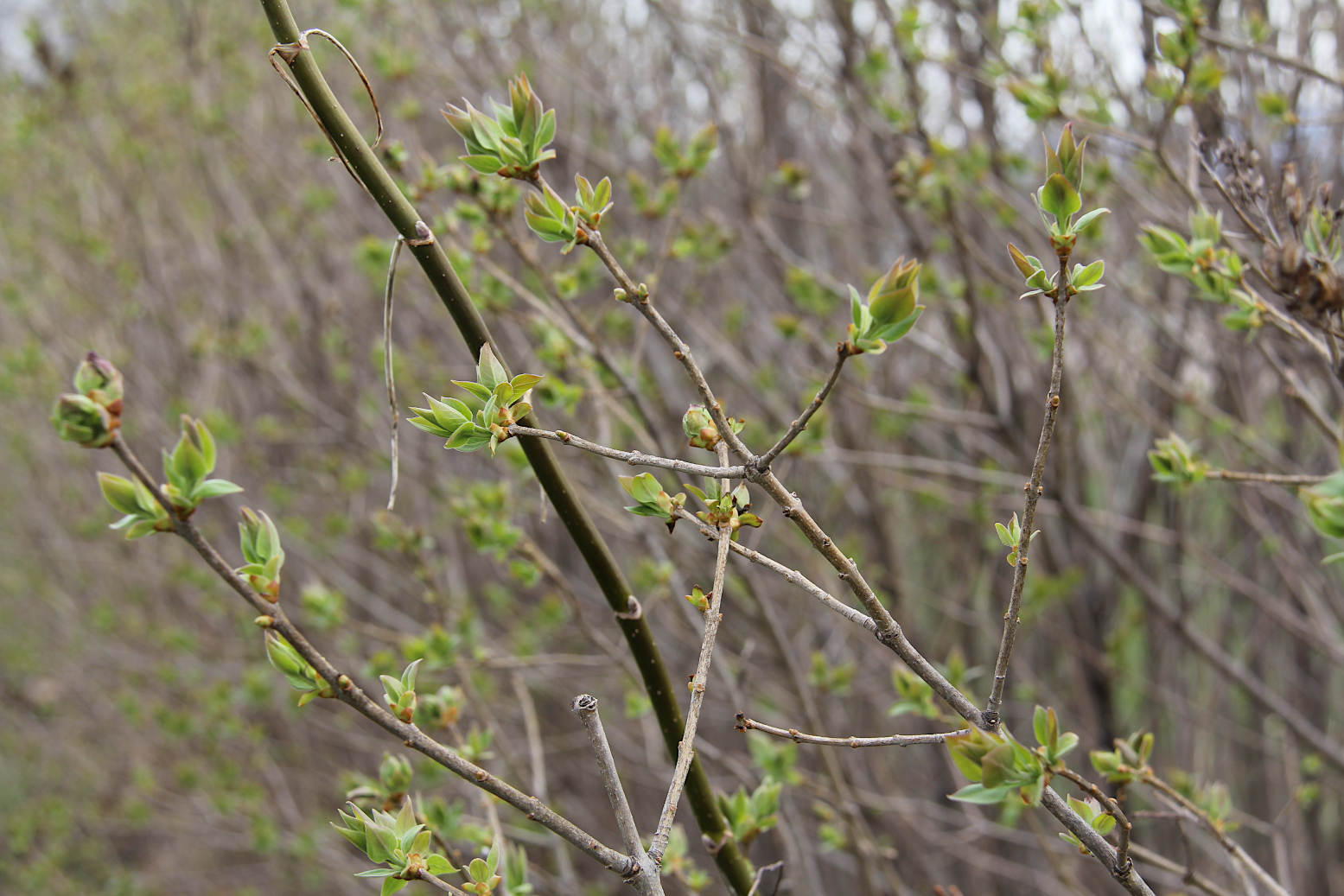
Buds begin to open on lilac bushes at North Alexander Park, Faribault. (Minnesota Prairie Roots copyrighted photo April 2026)

Buds tip tree branches and bushes, promising canopies of leaves and masses of flowers. I’m waiting for the lilacs to bloom in early May, their heady scent a gift to all of us upon winter’s departure.

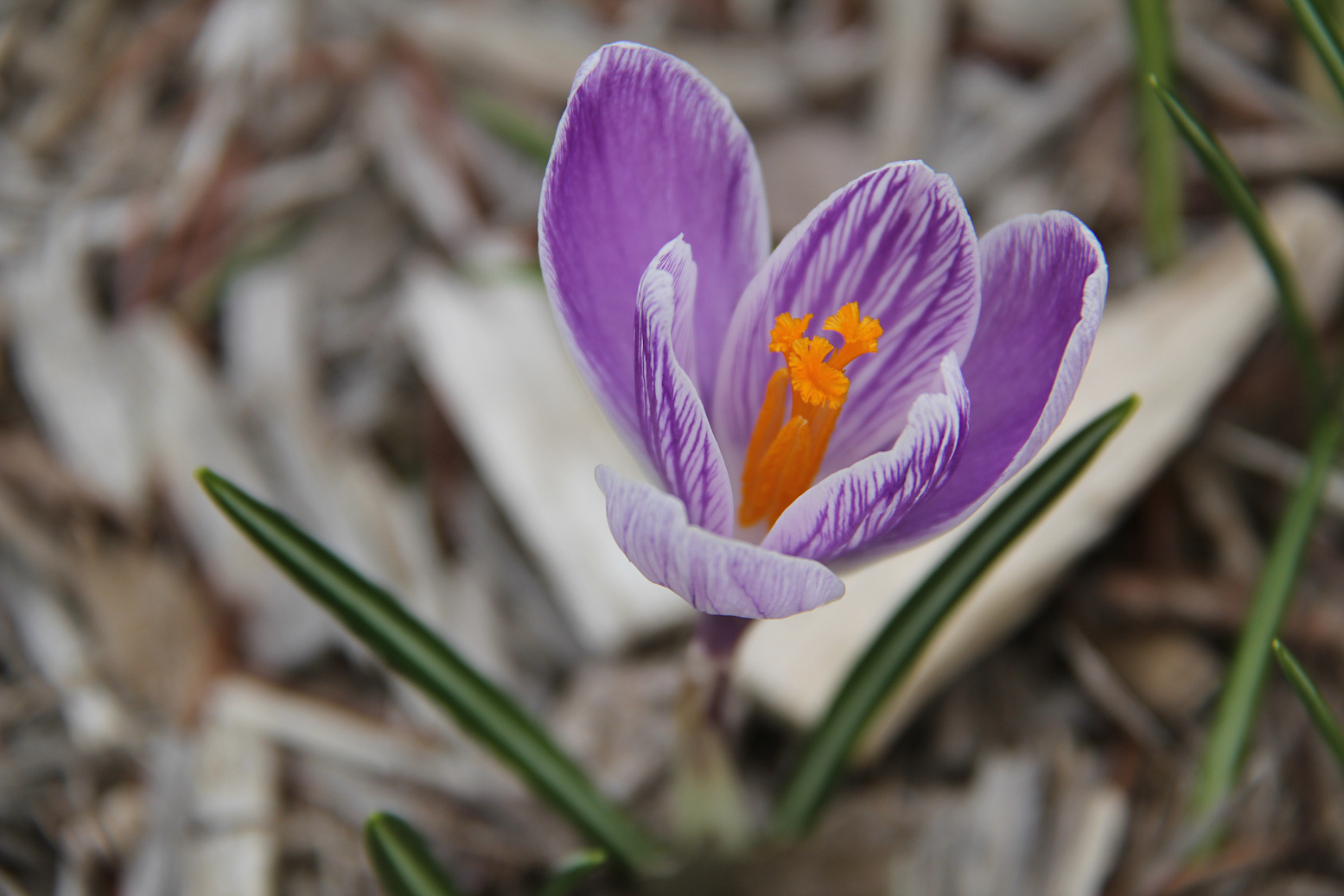
A crocus blooms at the Rice County Master Gardeners’ Teaching Garden on the Rice County Fairgrounds, Faribault. (Minnesota Prairie Roots copyrighted photo April 2026)

Crocuses, daffodils and other spring flowers burst through the soil, opening to the sun in a visual splash of color. A jubilant and celebratory scene that shouts happiness.

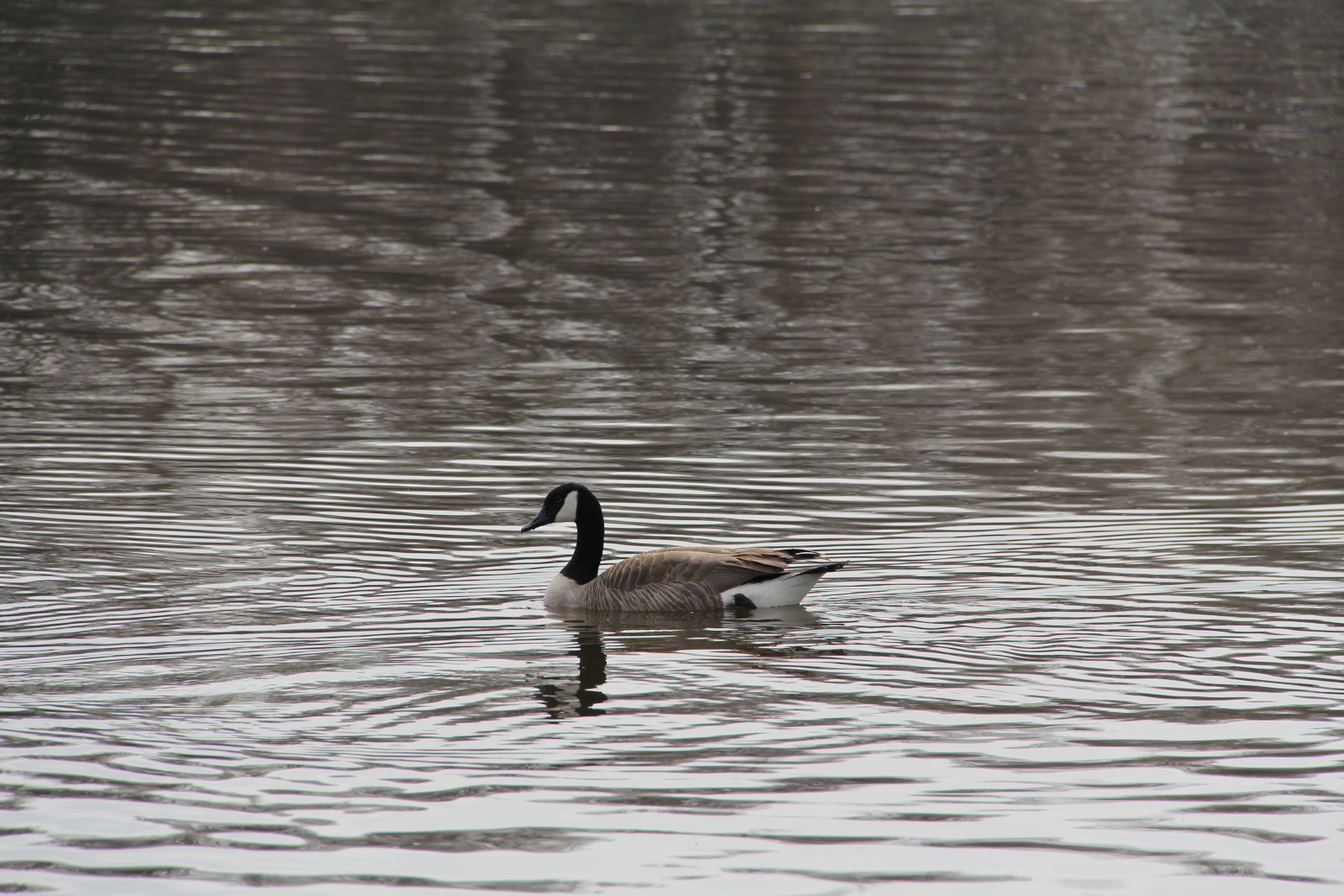
A Canadian goose swims in the Cannon River at North Alexander Park. (Minnesota Prairie Roots copyrighted photo April 2026)

Down by the river, geese and ducks share company, prepare for nesting and the arrival of little ones. I wait each spring for the goslings and ducklings. They fill my spirit with the promise of new beginnings. Hope in a world desperately in need of hope.

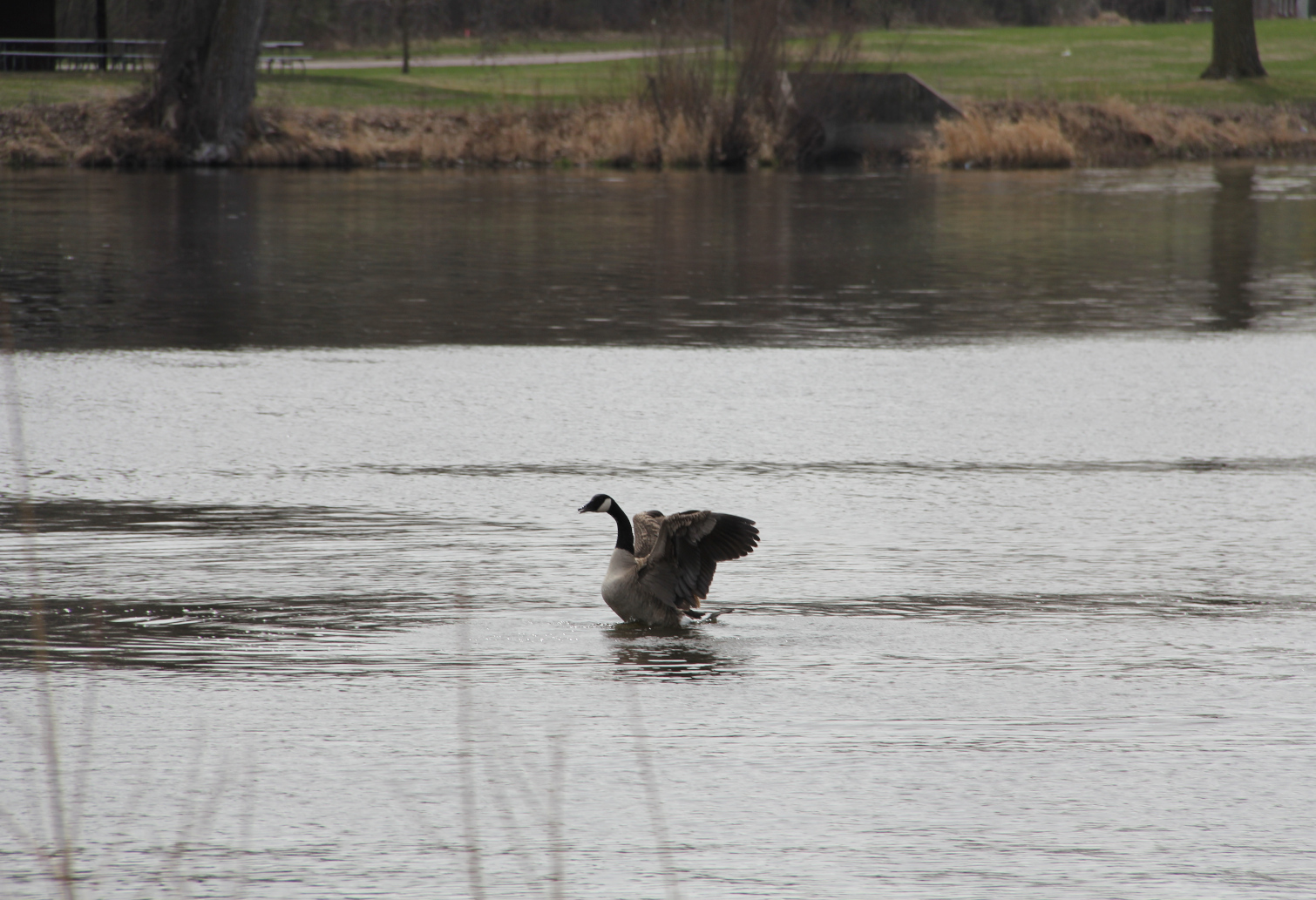
In the Cannon River, a Canadian goose spreads its wings. (Minnesota Prairie Roots copyrighted photo April 2026)

Along water’s edge, I simply stand and observe. Waves rippling, wings rising, water flowing under a gray April sky.

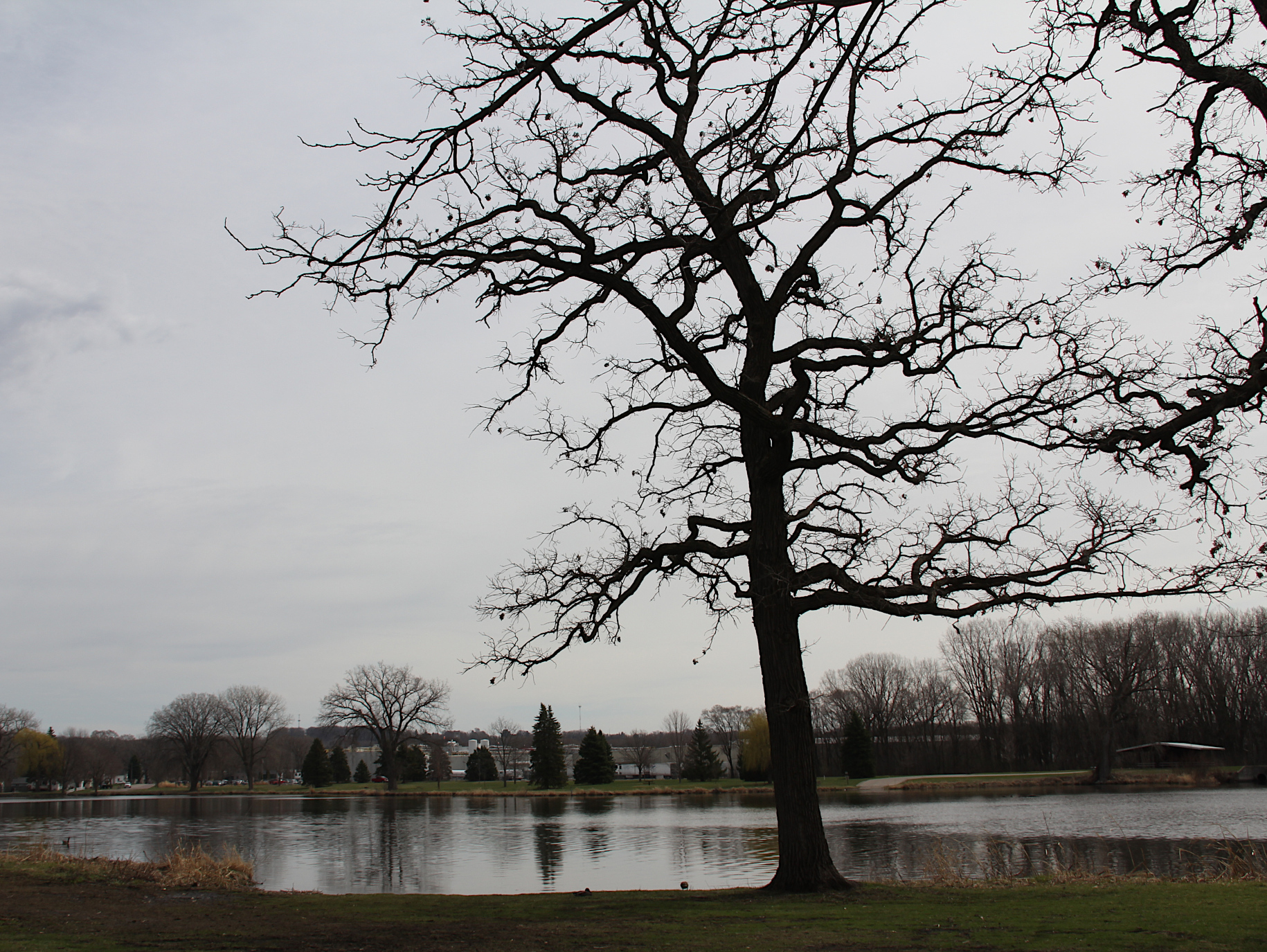
Branches on a riverside tree twist and turn. (Minnesota Prairie Roots copyrighted photo April 2026)

The day feels unsettled in its unseasonable warmth and humidity as I follow a paved path in Faribault’s North Alexander Park. Past the Cannon River, through the trees, then back to the river, I walk with my husband.

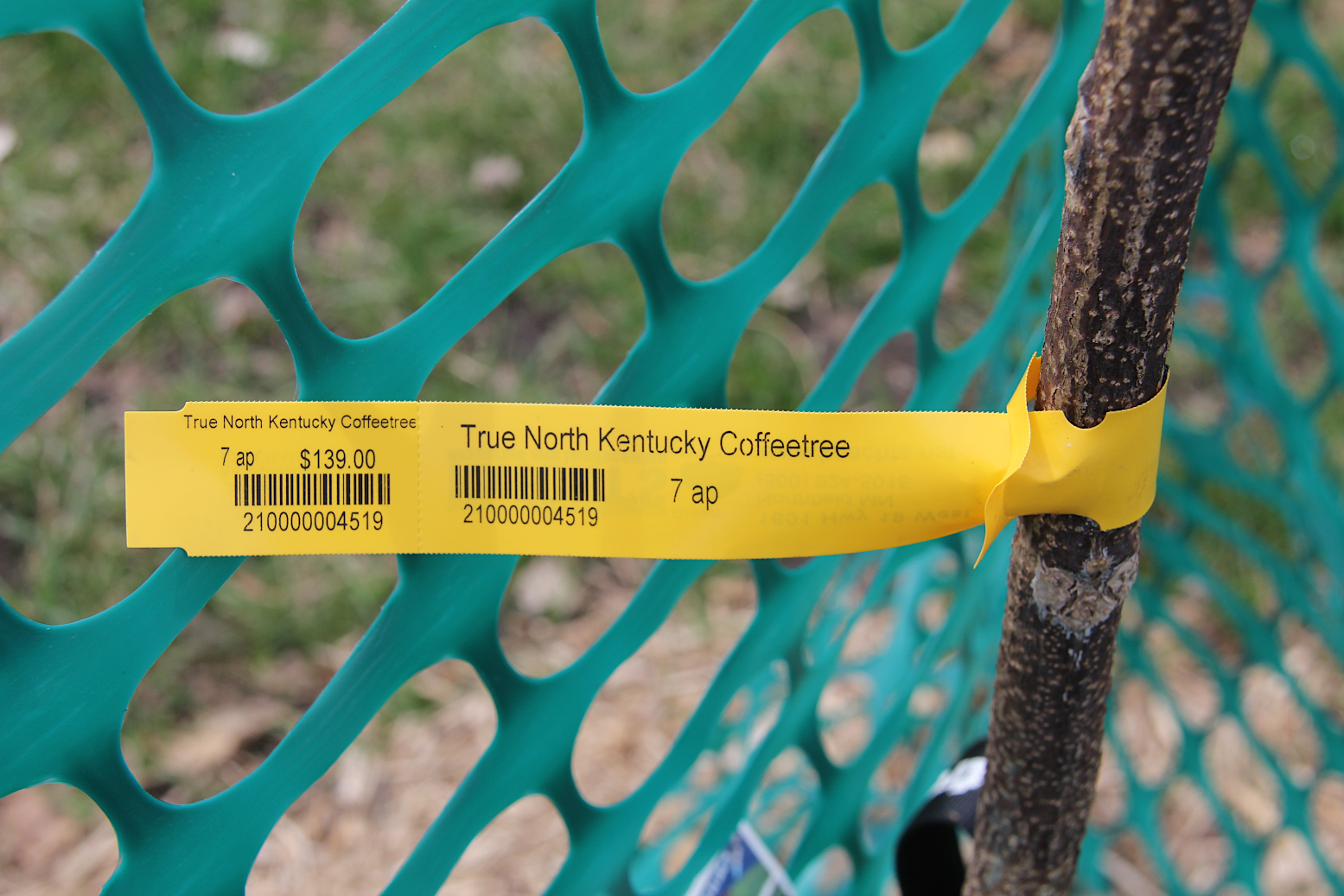
Tagged and planted at North Alexander Park, the True North Kentucky Coffeetree. A flag in the park reads “Tree City USA.” (Minnesota Prairie Roots copyrighted photo April 2026)

We pause to look at several newly-planted trees, including a True North Kentucky Coffeetree, developed, I later learn, through the University of Minnesota woody landscape breeding program. We both wondered about the viability of a coffee tree growing in this northern climate.

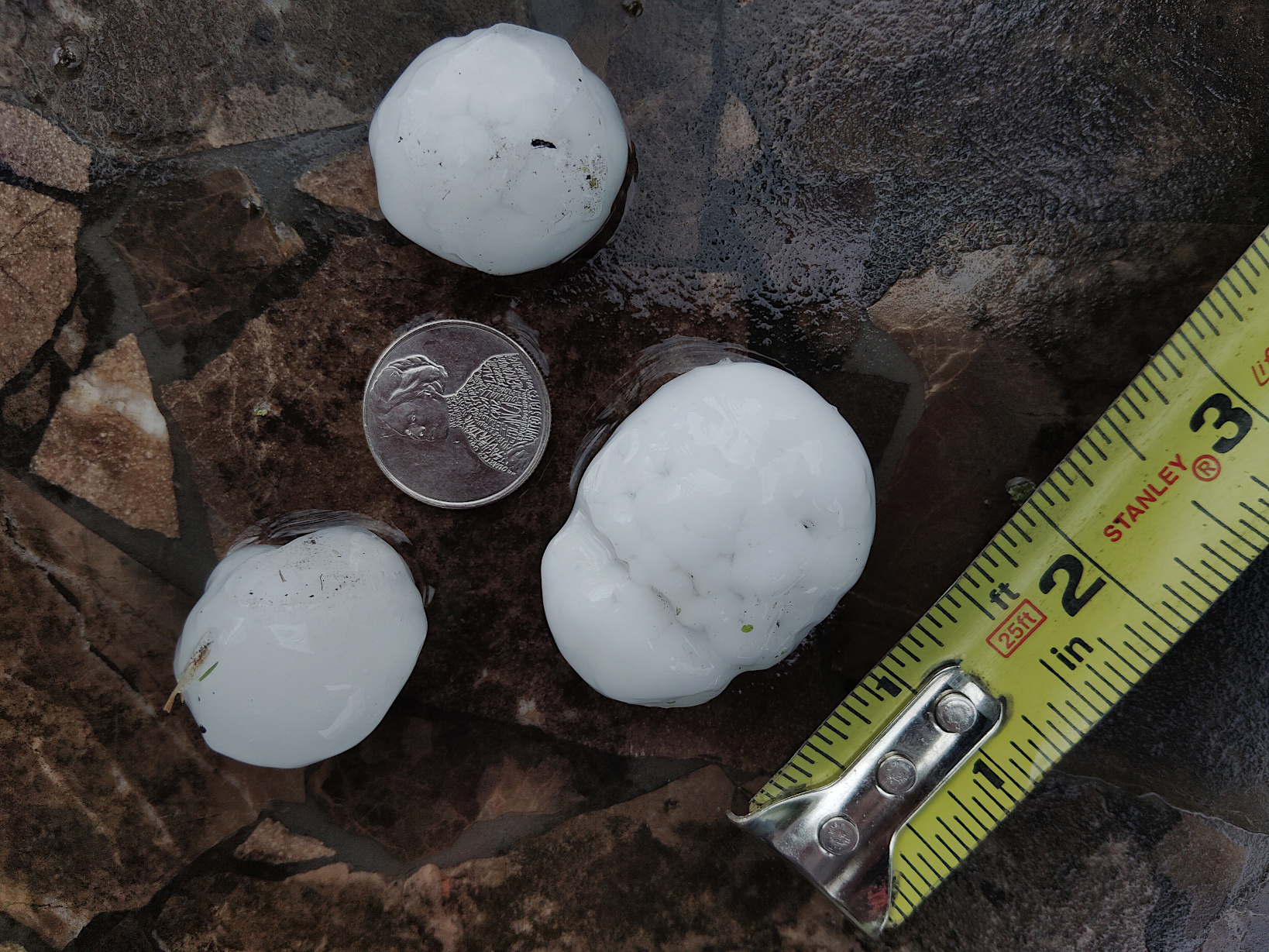
Measured and compared to a quarter, some of the larger hail that fell at our home on Monday afternoon. (Minnesota Prairie Roots copyrighted photo April 2026)

Hours later, the rain comes. And then the hail. First small, then some larger hailstones, pelt the lawn, the patio, the driveway, the street, the old rusty van. The house. Stones hit the aluminum awning over the back door with an unnerving shot-like bang. Randy and I stand and watch, moving from window to window, hoping the hail doesn’t damage our roof.

Afterwards I head outside to gather a few hailstones in baggies for freezing and measuring. We have yet to inspect for damage. The day after, out-of-town roofing companies are descending on Faribault like birds returning in the spring. There is no birdsong, though, only a circling around.

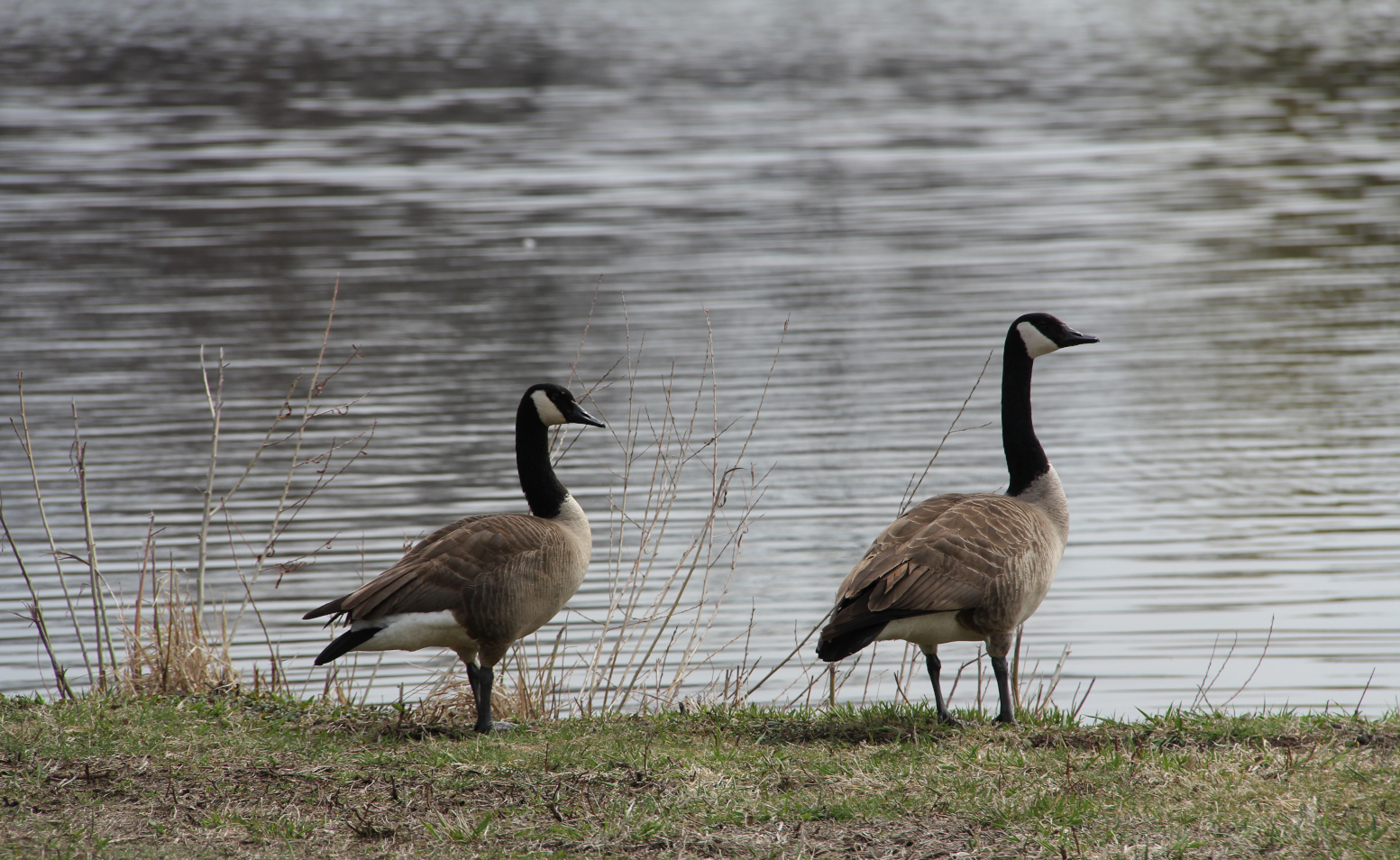
These Canadian geese stand guard on the bank of the Cannon River in North Alexander Park. (Minnesota Prairie Roots copyrighted photo April 2026)

With spring comes the greening of grass, the blooming of flowers, the budding of trees, the gathering of waterfowl and the occasional severe storm that moves across the land. Unwelcome, but not unexpected in this season of change.

© Copyright 2026 Audrey Kletscher Helbling

 

Out & about at River Bend on a summer-like spring day in Minnesota March 31, 2026

My husband, Randy, follows a paved trail through the woods at River Bend. (Minnesota Prairie Roots copyrighted photo March 2026)

A WALK INTO THE WOODS of River Bend Nature Center on a near 70-degree late March Sunday afternoon in Faribault yielded glimpses of spring unfolding, ever so slowly.

Patches of greenery emerged among dried and decaying leaves layering the earth. Tightly-clenched red buds tipped some branches. Subtle signs of early spring existed, if I looked closely. And listened.

A cardinal whistled. A woodpecker hammered. Both deep in the woods, unseen, but heard.

A mallard duck swims in the Turtle Pond. (Minnesota Prairie Roots copyrighted photo March 2026)

At the Turtle Pond, I expected turtles lining logs, basking in the afternoon sunshine. But I spotted only one, slipping into the slimy water before I could even lift my camera to focus a shot. Yet, the pond did not disappoint as a lone mallard duck glided across the shallow water, stopped and stood before swimming again, on toward the floating pedestrian bridge.

A geocache, found without geocaching. (Minnesota Prairie Roots copyrighted photo March 2026)

Randy and I paused in the brush near pond’s edge to examine a canister seemingly tossed on the ground. A geocache, perhaps in its proper place, perhaps not. We looked inside, then left it where found.

Lovely aspens cluster in the woods. (Minnesota Prairie Roots copyrighted photo March 2026)

I kept scanning the woods for wildflowers (too early), anything that would visually cue me to this season of spring. Finding little, I concentrated on the trees. The texture of bark, which I always find artistically fascinating. A cluster of aspens, a splash of white in the gray woods. Piles and slices of wood from trees cut down.

Signage on the interpretative center door. (Minnesota Prairie Roots copyrighted photo March 2026)

I observed a scattering of plastic bags attached to trees, collection vessels for sap that will be cooked into maple syrup. The bags proved a conversation starter with a young family who moved here from Iowa a year ago and was on their first hike at River Bend. I love meeting new people. I explained the sap collecting, welcomed them to Faribault. And then the attention quickly turned to the four-year-old, who showed me the gray stone she found, then the faded temporary tattoos laddering her left leg and then her sparkly shoes. She bubbled with joy, only frowning when her mom mentioned her cousins back in Iowa. Cousins she misses and will see at Easter.

I found the bark on the base of this tree visually interesting. (Minnesota Prairie Roots copyrighted photo March 2026)

Other families and couples and singles hiked here, too, on this loveliest of March days in Minnesota. Others biked. My friend Lisa and her husband, Tom, avid bird watchers who tend bluebird houses at the nature center, warned us about deer ticks after we exchanged personal updates.

The Straight River winds through River Bend, drawing people to its banks. (Minnesota Prairie Roots copyrighted photo March 2026)

Down by the Straight River, a family played along the shoreline, sunshine sparkling on water. It was so good to see all these families outside, connecting with each other and with nature, away from technology and other distractions of life.

Occasionally a train roars along the tracks that run through River Bend. (Minnesota Prairie Roots copyrighted photo March 2026)

A short train roared by across the river, a flash of yellow in the monotone woods.

Lots of people, including this family, were hiking on Sunday afternoon. (Minnesota Prairie Roots copyrighted photo March 2026)

Randy and I passed another young family, two little girls clutching stuffies, a child in a stroller. The eldest ran ahead, her long hair flying. And I remembered the times we came here with our preschool grandchildren who also ran like the wind. Free. Immersed in nature.

Prairie meets sky at River Bend. (Minnesota Prairie Roots copyrighted photo March 2026)

Exiting the woods, we crossed the prairie, its expanse stretching, meeting the sky.

Canadian geese on the prairie. (Minnesota Prairie Roots copyrighted photo March 2026)

At prairie’s edge, a pair of geese strode across the dried grasses matted by winter’s snow and wind. Occasionally the two would stop, peck at the grass, searching for food.

I arrived at River Bend wanting to photograph signs of spring. Rather, I mostly heard spring—in a din of spring peepers, in the honk of geese, in other unidentified birds singing. And in the voice of a four-year-old, excited to be out with her parents in the woods. Playing. Searching for stones to take home.

A fitting plaque on a memorial bench. (Minnesota Prairie Roots copyrighted photo March 2026)

Sometimes it takes a child to remind us of the smallest joys in life. To appreciate that which is before us rather than wishing for more.

© Copyright 2026 Audrey Kletscher Helbling
 

On the road under brooding March skies in southern Minnesota March 24, 2026

A farm site between Owatonna and Claremont. (Minnesota Prairie Roots copyrighted photo March 2026)

UNDER AN IMMENSE SKY in the wide open countryside of rural southern Minnesota, I always feel small.

Three US Air Force T-38 Talon Thunderbird jets landmark Owatonna Degner Regional Airport along Interstate 35. (Minnesota Prairie Roots copyrighted photo March 2026)

Sky and land dwarf me, impressing upon me the vastness and power of that which rises above and that which stretches around me.

On US Highway 14 just east of Owatonna, driving into early morning grayness. (Minnesota Prairie Roots copyrighted photo March 2026)

On a recent road trip to Rochester and back, the brooding sky of mid-March appeared unsettled, threatening. Cloud after cloud after cloud nearly swiped the earth while towering in a brute mass into seemingly infinity.

Heading east on highway 14, the All-Corn Clean Fuel ethanol plant by Claremont comes into view. (Minnesota Prairie Roots copyrighted photo March 2026)

Only occasionally did the sun fight through the clouds that darkened the day. Gray prevailed, a visual cue of the major winter storm that would arrive the next evening.

Harnessing the wind on a farm site near Claremont. (Minnesota Prairie Roots copyrighted photo March 2026)

In the flatness of the land, a strong wind bullied across the landscape. Pushing. Shoving. Bending the will of boughs. Punching at vehicles. Fearless and unrelenting.

On the return trip to Faribault, the clouds partially broke, opening to blue skies over Claremont. (Minnesota Prairie Roots copyrighted photo March 2026)

This is March in Minnesota. One day angry and roiling. The next day calm, even warm, sunny and inviting. March marks the indecisiveness of sometimes spring, sometimes still winter.

Byron Agri Center stretches skyward. (Minnesota Prairie Roots copyrighted photo March 2026)

There’s a certain restlessness this time of year among those of us who live in this cold climate state of long winters. We are weary of cold and snow, ready for real spring, not just the calendar spring. We crave sunshine, warmth and greenery.

A view of the ethanol plant near Claremont on the return trip, when skies lightened. (Minnesota Prairie Roots copyrighted photo March 2026)

But realistically, Mother Nature has her own mind, deciding when a season reveals herself, not simply teases. I see that in the sky on this drive. The heavy morning sky, wrapped in a mass of clouds, refuses to bare herself to the sun.

A farm site about 20 minutes west of Rochester. (Minnesota Prairie Roots copyrighted photo March 2026)

And so I feel pressed upon, diminished by sky. And land.

Dwarfed by the sky, a housing development atop a hill between Rochester and Byron. (Minnesota Prairie Roots copyrighted photo March 2026)

Buildings—barns and bins and houses—appear minuscule against this intimidating backdrop.

Wind turbines south of Dodge Center. (Minnesota Prairie Roots copyrighted photo March 2026)

Even wind turbines, which tower above treelines, and which I find visually unappealing, appear small-scale despite their height.

Sky and land meet in the immensity of this place. (Minnesota Prairie Roots copyrighted photo March 2026)

I suppose we really are small in the immensity of the universe. A road trip between Faribault and Rochester verifies that. The immense sky and stark, wide open land stretch before me, high and wide. And I feel small, oh, so small in the all of it in the midst of March in Minnesota.

NOTE: I took these on-the-road photos on March 13 as a front seat passenger in our van. I set my 35 mm camera at a fast shutter speed and shot images.

© Copyright 2026 Audrey Kletscher Helbling

 

Make way for geese March 19, 2026

Filed under: Uncategorized — Audrey Kletscher Helbling @ 6:00 AM
Tags: , , , , , , , , , , , ,
Geese cross a street in small town Kasson, Minnesota. (Minnesota Prairie Roots copyrighted photo March 2026)

TO TAKE PAUSE is sometimes necessary, as in a recent road encounter in the southeastern Minnesota community of Kasson. Two Canadian geese hurriedly crossed a downtown street, their long legs stretching, necks craning, wings lifting in flight.

They understood the danger of approaching vehicles. And we, in our vehicles, understood the need to stop and allow them to go safely on their way.

This marked, in some ways, a sweet moment in time when all of us on that roadway paused in our journeys to respect these geese, who were really at our mercy.

Both geese spread their wings to fly away from danger. (Minnesota Prairie Roots copyrighted photo March 2026)

It felt good to be in community on this mid-March morning without thought of differences or division, but rather in communal understanding that we all needed to do what was right. Sometimes that’s all it takes to realize that we truly can work together for the common good, this time for the common good of those birds. And I suppose for us, too, as I doubt anyone wanted a goose in their radiator.

There are lessons to be learned in everyday life. Lessons in patience and understanding and cooperation. On this winter morning in Minnesota, two geese taught all of us to slow down, to work together, to recognize that little moments matter in life as much as the big moments. The lives of those geese mattered enough for all of us to stop and that is a lesson we can take with us into our communities, our country, our world.

THOUGHTS? Any similar stories to share of an everyday moment like this with lessons learned?

© Copyright 2026 Audrey Kletscher Helbling
 

From Minnesota: Honoring Alex Pretti January 26, 2026

My cousin Jill Bode left this message at the memorial for Alex Pretti in south Minneapolis. (Photo credit: Jill Bode)

I HAVE EXTENDED FAMILY and friends living in south Minneapolis where ICE agents shot and killed two American citizens on the streets recently. First Renee Good and now Alex Pretti, both 37 years old.

My family has kept me updated on their participation in protests, their ICE sightings, their visits to memorials. I appreciate their first-person observations. And their activism.

A touching message from Felix, a former patient of Alex Pretti, an ICU nurse. (Photo credit: Jill Bode)

All images in this blog post were taken by my cousin Jill Bode at the memorial for Alex Pretti, an ICU nurse at the Minneapolis VA Medical Center. Veterans from all over Minnesota seek care at the VA. That includes my next door neighbor and my dad many years ago.

A view of the street by the Alex Pretti memorial where people continue to gather. (Photo credit: Jill Bode)

As hard as this whole situation is on me because I’m a Minnesotan and ICE is also in my community, it’s certainly much harder on my loved ones living in the epicenter of this massive, out-of-control enforcement effort by agents of the federal government. Jill and her husband, Mark, live about a mile from the place where Alex was shot and killed on Saturday morning. The granddaughter of a dear friend of mine was a neighbor to Alex and she’s taking it hard. We all are. My heart goes out to family and friends of Alex and Renee.

President Donald Trump promised “a day of reckoning and retribution” in Minnesota. I’m sharing that quote to remind everyone of his politically-motivated, threatening words, not to give him more voice.

Among the messages left at the memorial is one from a Louisiana veteran, top center. The pink building in the background is Glam Doll Donuts, directly across the street from where Alex was killed. (Photo credit: Jill Bode)

He underestimated Minnesotans—how tough and strong and determined we are, how we care for one another and also know right from wrong. We have a moral compass.

Take time to look closely at the messages left at the memorial. (Photo credit: Jill Bode)

To everyone across the country and world who has Minnesota’s back, who is supporting us via words and actions, thank you. I am grateful.

© Copyright 2026 Audrey Kletscher Helbling

Photos copyrighted by Jill Bode & used with permission


Thoughts as we begin 2026 during these challenging times in the U.S. January 1, 2026

I took this award-winning photo in 2012 at an International Festival in Faribault. To this day, it remains one of my favorite images reflecting diversity in my community. The gathered kids cared not about ethnicity, but only about breaking open a pinata. (Minnesota Prairie Roots copyrighted file photo 2012)

AS THE NEW YEAR begins, I enter it with a whole lot of trepidation, uncertainty and concern. Feeling optimistic right now does not come easily. I fear for our country. I fear for my community. I fear for my Latino and Somali neighbors, targeted by the federal government. Yes, ICE agents are visible and active in Faribault. Though I have not seen them myself, this information comes from reliable sources.

I fear that we are becoming desensitized to the ICE snatchings. I fear we are becoming desensitized to the lies, the rhetoric, the hatred, the awfulness spewing from, well, way too many leaders and even everyday people.

A pin gifted to me by a friend this past summer. I now have it pinned to a small bag that holds my cellphone, my way of getting a message out there. (Minnesota Prairie Roots copyrighted file photo)

What happened to common decency and goodness and kindness? And due process? Why is anyone accepting suppression, oppression, racism, discrimination and more as OK, especially those who claim Christianity as their belief system? None of what’s happening is Christian, not according to my Christian beliefs anyway. Not according to the Bible I read.

Encouraging words posted near a garden in the heart of downtown Faribault many years ago. (Minnesota Prairie Roots copyrighted file photo)

It’s hard, really hard, to remain hopeful in the light of all this. But I try. My mom raised me to be caring, kind and compassionate. She lived that way, helping others through volunteerism and monetary gifts, but mostly through her kind, quiet, gentle and caring spirit. She treated everyone with love and compassion. I wish Mom was still alive so I could talk to her about all of this.

A simple directive on a tombstone at Valley Grove. (Minnesota Prairie Roots copyrighted file photo)

But sometimes the dead still speak to us. I don’t mean that in a literal sense, but rather in the legacies and words the once-living leave behind. It is one of the reasons I meander through cemeteries. Valley Grove Cemetery, rural Nerstrand, is one of those final resting places that offers an abundance of wisdom upon gravestones.

From my personal collection, a painting on burlap by Mexican artist Jose Maria de Servin that depicts peace. (Minnesota Prairie Roots copyrighted file photo)

One particular tombstone stands out for the many positive affirmations it lists under the banner, BLESSED ARE THE PEACEMAKERS. (And this means authentic peacemakers, not those who pretend or claim to practice/bring peace.) Under that gravestone header is this broader message: EVERYONE HAS SOME GIFTS THAT CAN MAKE OUR WORLD A LITTLE BETTER. I absolutely agree.

Among a long list of ways we can make the world a better place as listed on a tombstone at Valley Grove Cemetery. (Minnesota Prairie Roots copyrighted file photo)

Then, on the massive slab of stone, are written specific ways in which we can make the world better and live as peacemakers. I especially appreciate these two messages: TREAT OTHERS THE WAY YOU WANT TO BE TREATED. And BE KIND TO ALL AS YOU NEVER KNOW THEIR BURDENS.

Those are simple, uncomplicated directives that seem easy enough to follow. In 2026, it is my hope that we can shift back to being a caring country, where we treat others as we would like to be treated. And that is with kindness, compassion, care and love.

TELL ME: What are your hopes for 2026 in the U.S., your community? What are your concerns for the new year?

© Copyright 2026 Audrey Kletscher Helbling

 

I saw the Northern Lights! November 11, 2025

Filed under: Uncategorized — Audrey Kletscher Helbling @ 11:32 PM

Tags: , , , , , , ,
The Northern Lights, photographed northeast of Faribault near Cannon City (with a treeline in the foreground) around 9 p.m. Tuesday, November 11. (Minnesota Prairie Roots copyrighted file photo November 2025)

IT TOOK A LIFE TIME, but I finally saw the Northern Lights for the first time. Ever. And they were poetic, artistic, inspiring, incredible, wondrous, glorious…all the adjectives you can use to describe a dark night sky colored with streaks of green, red and pink.

Randy and I were sitting comfortably in the warmth of our southern Minnesota home Tuesday evening when our son texted that he could see the Northern Lights even in the city lights of Boston. A photo proved it. Then the daughter who lives 35 minutes to the north of us texted that they, too, could see the lights in Lakeville, south of the Twin Cities. Photos proved it.
We popped up, grabbed our coats and set out to see for ourselves. We didn’t have to drive far into the countryside before we noticed the first streaks of light. Turning onto a gravel road, we parked, stepped outside and turned our eyes heavenward. Then we eventually tried to figure out how to photograph the majestic scene above us on our smartphones, with only minimal success.
While I would have loved some spectacular images, what matters most is that I saw, with my own eyes, that which I’ve wanted to see my entire life. Others were doing the same. We counted about a dozen vehicles parked along rural roads, the occupants gazing skyward.

This imprinted upon me how something like the Northern Lights can bring people outdoors, appreciating this beautiful natural world that surrounds us and, which on this November evening, put on a spectacular light show.

TELL ME: Have you seen the Northern Lights? When and where? How would you describe them?

© Copyright 2025 Audrey Kletscher Helbling