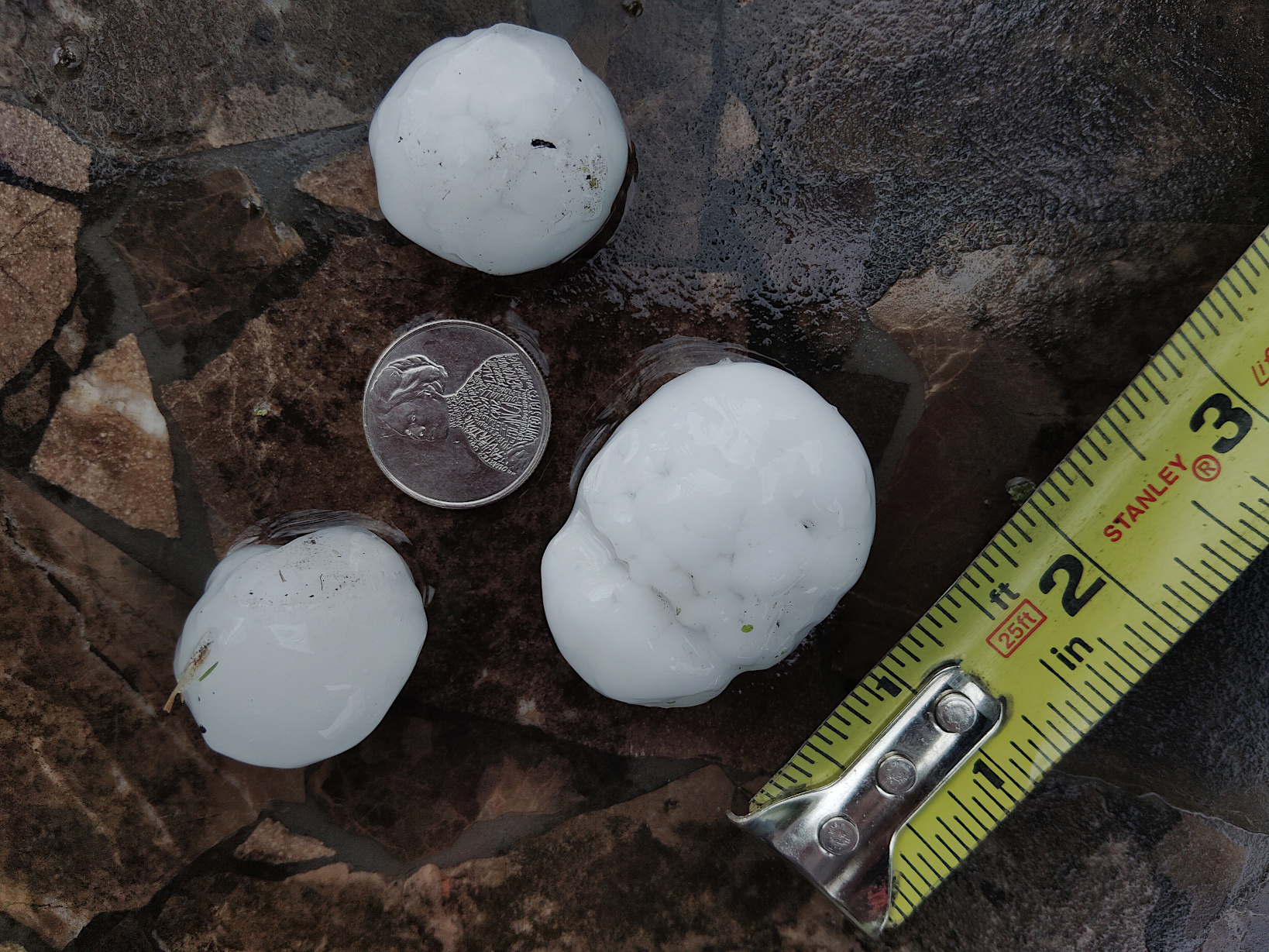
The hail that fell in Faribault and the surrounding area on April 13. (Minnesota Prairie Roots copyrighted file photo April 2026)
IN THE FOUR-PLUS MONTHS since destructive hailstones pummeled Faribault and the surrounding area, my community has been the site of ongoing exterior construction. Drive nearly anywhere in town and you will see roofing and siding crews or newly-repaired houses.
Seven hail-damaged houses within sight of mine, including ours, have been repaired, or have yet to be fixed. That’s a lot in a single neighborhood.
Business is booming for local and out-of-town roofers and other construction companies. Local contractors can’t possibly meet the immediate demand for work.
Removing two layers of siding from our garage and back of our house. (Minnesota Prairie Roots copyrighted file photo July 2026)
EMPATHETIC OBSERVATIONS
But blocks from my house, an underway construction project seems a community undertaking. I know because I talked with the owner. He bought the house with the intention of fixing and flipping it. Good for him if he can improve a dilapidated house and make money by selling it.
This particular renovation caught my eye because, when I passed by, I saw a house with rafters totally exposed, loose insulation inside and workers busy sheeting. Similar work was done on our house with new sheeting laid over the existing, mostly-solid roof boards. Rafters were not exposed. I appreciate that we now have a sturdier, straighter roof.
When I saw the condition of the flip house, my first thought was “that looks worse than ours (looked).” At least on the roof. I felt instant empathy for the homeowner. So, although I don’t usually stop at construction sites, I did at this one. I felt bad for the owner.
He just happens to be Hispanic. I learned from him that the Hispanic community is deeply connected. He tapped into the strength and skills of community for his house renovation. This did not totally surprise me. I’ve seen how Hispanic/Latino communities care for one another, how they work together, how they value family, culture and community.
If not for Hispanic roofing crews, hail-damaged houses in Faribault would go mostly unrepaired. These crews work hard and fast, putting in long days, often finishing roofs in a single day.
The north side of our house in the process of being re-sided with LP Smartside. The siding project is now completed. (Minnesota Prairie Roots copyrighted file photo August 2026)
THE VALUE OF COMMUNITY
My conversation with the flip house owner got me thinking about other communities which come together to help one another on construction endeavors. In the past, and maybe even still today, the Amish raise barns in a day. Habitat for Humanity brings volunteers together to build homes alongside professionals. Decades ago, friends came over to help shingle our roof. During this past year, volunteers rehabbed a rental house owned by my church.
And in 1967, extended family arrived at my childhood family farm to help my dad and a local carpenter build our new home with a walk-out basement. If not for helpful family, I don’t think my parents could have built new. The cost would have been out of reach. We needed a new house to replace the cramped, drafty 1 1/2-story aged farmhouse with a partial dirt cellar, no bathroom, three small bedrooms, and an oil-burning stove centered in the living room.
A protest sign I crafted earlier this summer and have held at recent Saturday morning protests in Faribault. I’ve been peacefully protesting locally for nine months. (Minnesota Prairie Roots copyrighted file photo June 2026)
WORSE THAN A HAILSTORM
All of this came to mind when talking with my new Hispanic acquaintance. I praised him for improving the neighborhood by buying and fixing up a run-down home. I also told him I’m sorry for the aggressive and often illegal detainment of Hispanics, Latinos and others by Immigration and Customs Enforcement (ICE) during Operation Metro Surge (and beyond) in Minnesota. That includes right here in my city.
Suddenly that April hailstorm in Faribault doesn’t seem all that bad in comparison with what’s unfolding in this country. And I’m not talking only immigration. I’m also talking about government surveillance, an unnecessary war, tariffs, efforts to suppress voting rights (especially those of Black voters and of women), high gas and food prices, a failing economy and on and on. So much damage has been done to our country that will take years, if not decades, to recover, to repair the destruction hailed upon this nation.
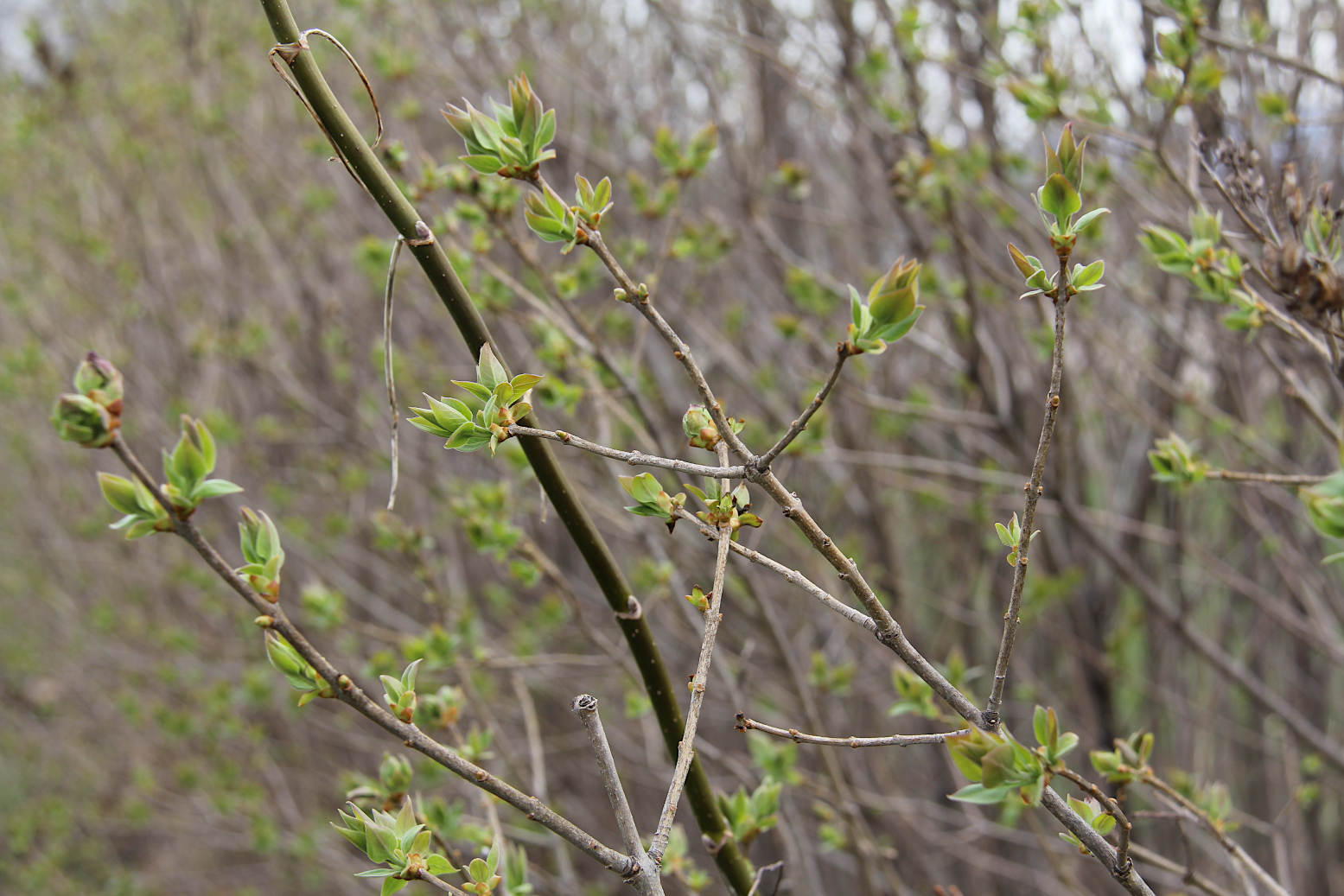
Budding branches on the maple tree in my backyard during a recent sunset of pink sky. (Minnesota Prairie Roots copyrighted photo April 2026)
HERE IN SOUTHERN MINNESOTA, the greening of the land indicates the beginning of spring’s full-on arrival.
April showers, more like recent deluges of rain, and warmer temperatures have reawakened the earth. Once dormant brown grass now colors lawns greens.
Buds begin to open on lilac bushes at North Alexander Park, Faribault. (Minnesota Prairie Roots copyrighted photo April 2026)
Buds tip tree branches and bushes, promising canopies of leaves and masses of flowers. I’m waiting for the lilacs to bloom in early May, their heady scent a gift to all of us upon winter’s departure.
A crocus blooms at the Rice County Master Gardeners’ Teaching Garden on the Rice County Fairgrounds, Faribault. (Minnesota Prairie Roots copyrighted photo April 2026)
Crocuses, daffodils and other spring flowers burst through the soil, opening to the sun in a visual splash of color. A jubilant and celebratory scene that shouts happiness.
A Canadian goose swims in the Cannon River at North Alexander Park. (Minnesota Prairie Roots copyrighted photo April 2026)
Down by the river, geese and ducks share company, prepare for nesting and the arrival of little ones. I wait each spring for the goslings and ducklings. They fill my spirit with the promise of new beginnings. Hope in a world desperately in need of hope.
In the Cannon River, a Canadian goose spreads its wings. (Minnesota Prairie Roots copyrighted photo April 2026)
Along water’s edge, I simply stand and observe. Waves rippling, wings rising, water flowing under a gray April sky.
Branches on a riverside tree twist and turn. (Minnesota Prairie Roots copyrighted photo April 2026)
The day feels unsettled in its unseasonable warmth and humidity as I follow a paved path in Faribault’s North Alexander Park. Past the Cannon River, through the trees, then back to the river, I walk with my husband.
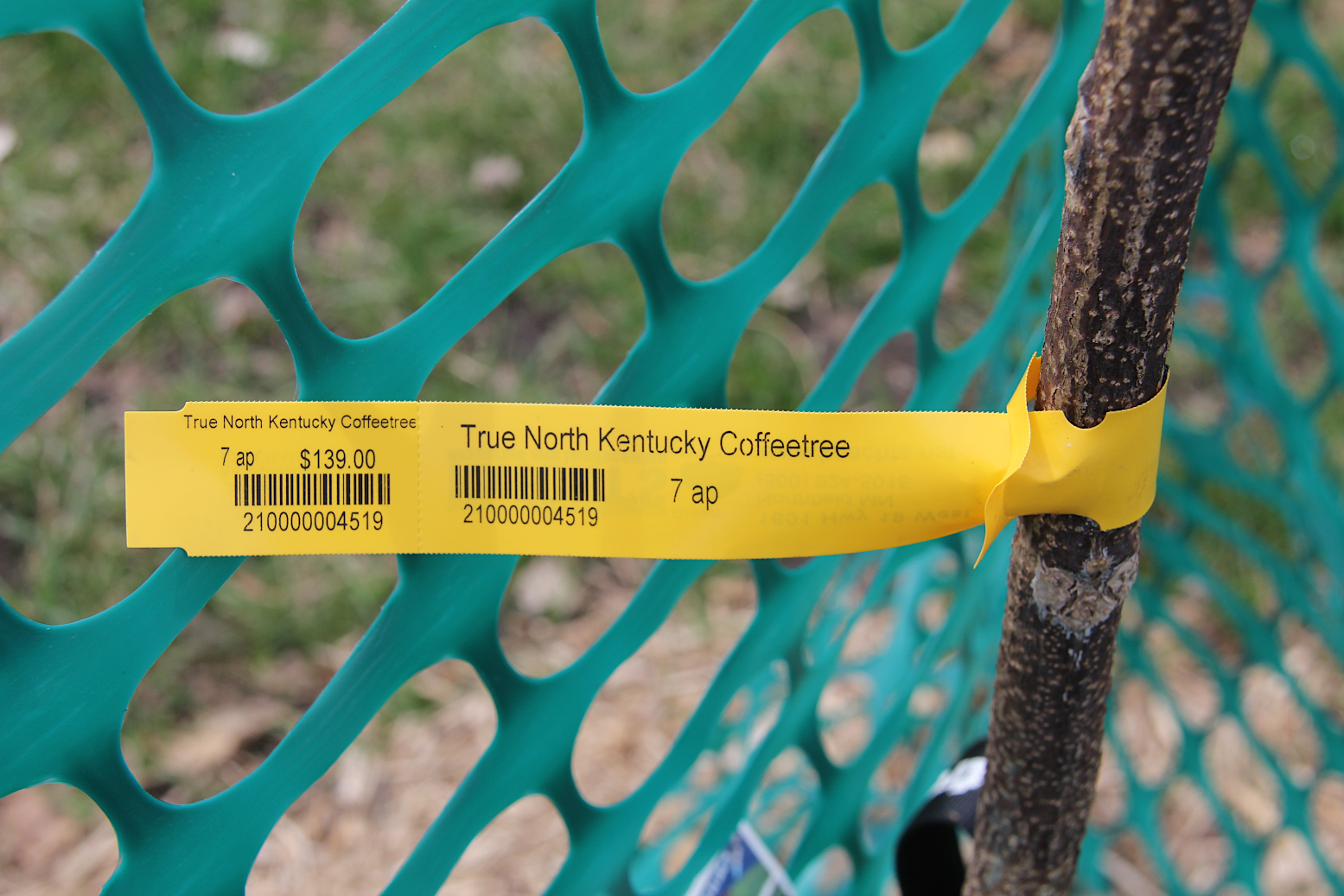
Tagged and planted at North Alexander Park, the True North Kentucky Coffeetree. A flag in the park reads “Tree City USA.” (Minnesota Prairie Roots copyrighted photo April 2026)
We pause to look at several newly-planted trees, including a True North Kentucky Coffeetree, developed, I later learn, through the University of Minnesota woody landscape breeding program. We both wondered about the viability of a coffee tree growing in this northern climate.
Measured and compared to a quarter, some of the larger hail that fell at our home on Monday afternoon. (Minnesota Prairie Roots copyrighted photo April 2026)
Hours later, the rain comes. And then the hail. First small, then some larger hailstones, pelt the lawn, the patio, the driveway, the street, the old rusty van. The house. Stones hit the aluminum awning over the back door with an unnerving shot-like bang. Randy and I stand and watch, moving from window to window, hoping the hail doesn’t damage our roof.
Afterwards I head outside to gather a few hailstones in baggies for freezing and measuring. We have yet to inspect for damage. The day after, out-of-town roofing companies are descending on Faribault like birds returning in the spring. There is no birdsong, though, only a circling around.
These Canadian geese stand guard on the bank of the Cannon River in North Alexander Park. (Minnesota Prairie Roots copyrighted photo April 2026)
With spring comes the greening of grass, the blooming of flowers, the budding of trees, the gathering of waterfowl and the occasional severe storm that moves across the land. Unwelcome, but not unexpected in this season of change.
DAN AND MARILYN SCHMIDT had just arrived for the July Fourth holiday weekend at a west central Minnesota lake when they got the phone call from their daughter, Heather Rokeh. She was calling from Marshall with news that a storm had swept through town. It was late Friday afternoon, July 1.
Dan asked about their farm 20 miles northeast of Marshall. Heather suggested that “it wouldn’t be a bad idea to have someone check it out.”
And so Heather’s sister, Amy St. Pierre, and Amy’s husband and daughter went to the farm, surveyed the damage, then called the Schmidts. The couple returned that night to inspect their Wood Lake area farm.
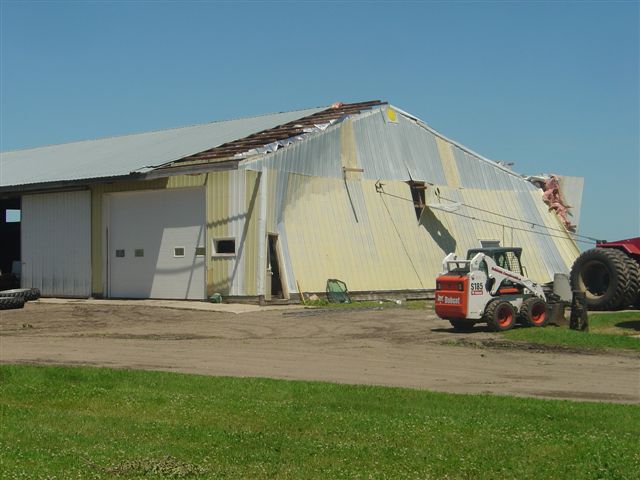
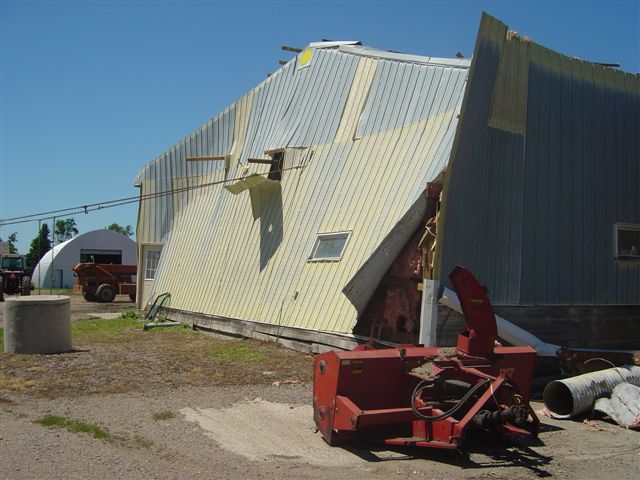
Every building had been damaged. Hail pounded holes in the siding on the house, where shingles and an antenna were blown off. The door of the Quonset building had been ripped away with part of the board trim speared into the ground.
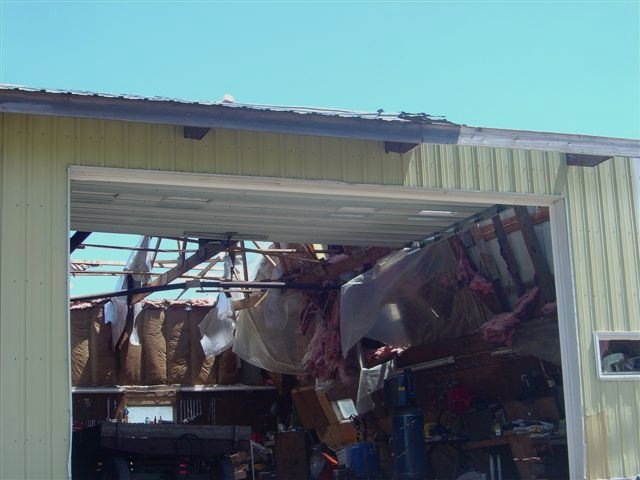
Half the roof was blown off the shop, collapsing an interior wall. That wall is now being held up by two chains and a tractor until items inside can be removed and the building demolished.
Another view of the caved-in shop wall.
The exposed interior of the shop.
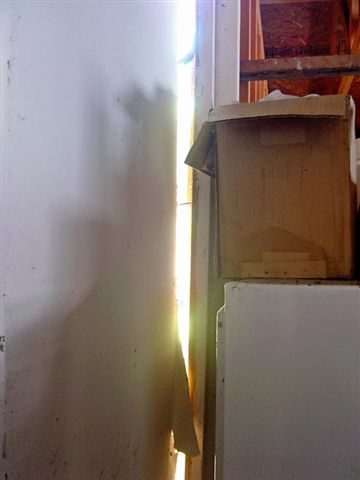
Trees were down or uprooted. Branches littered the farmyard. On one of the two houses on the farm site, the garage was pulled away from the house, leaving a visible gap.
Here you see light shining through the space where an attached garage was separated from the house during Friday's storm.
“A lot of these things spelled out tornado for us,” says Heather. “The twisting of the trees, things stuck in the ground and the twisted buildings all suggest tornado to us.”
Whether straight-line winds or tornado, Heather remains grateful: “We are so thankful no one was injured.”
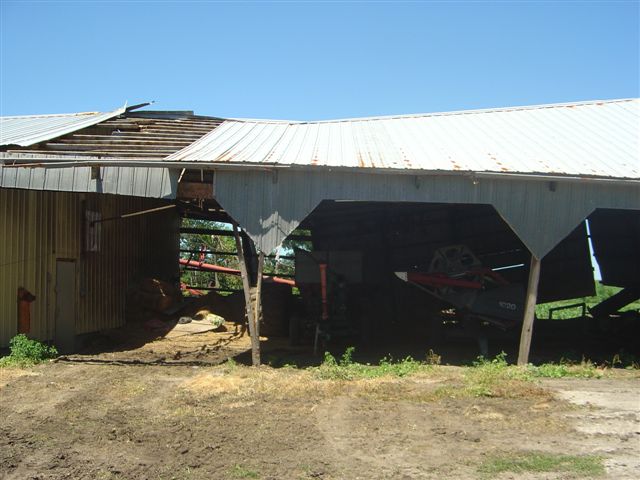
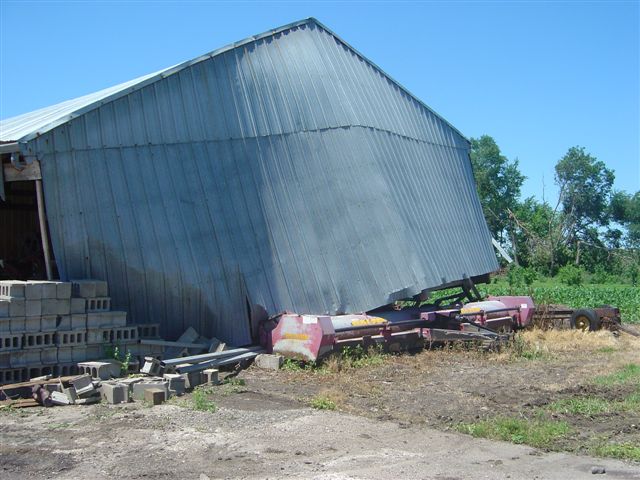
This lean-to, connected to a hog barn, was lifted up, twisted and set back down on top of a stock chopper. The hog barn was OK, but the lean-to was deemed unsafe and removed on Saturday.
This photo shows a portion of the lean-to that was lifted and dropped onto the stock chopper pictured here.
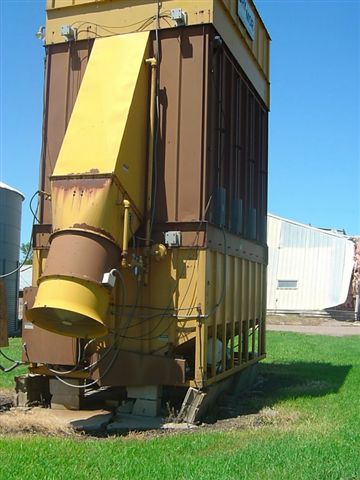
This grain dryer was moved and it is now sitting crooked on its foundation. The cement slab foundation was cracked and cement blocks are now sitting at an angle.
IF YOUR FARM, HOME or community was damaged during the July 1 storm in southwestern Minnesota, I’d like to hear from you. Submit a comment summarizing your storm experience, the damage to your property or town, and progress toward recovery. If you have photos to share, like those above from my cousin Heather, let me know and I’ll be in touch.










Destructive ice, the help of community & more August 27, 2026
Tags: commentary, community, construction, Faribault, hail, hail damage, hailstorm, Hispanics, immigration, Immigration and Customs Enforcement, Minnesota, Operation Metro Surge, opinion, storm, United States of America
IN THE FOUR-PLUS MONTHS since destructive hailstones pummeled Faribault and the surrounding area, my community has been the site of ongoing exterior construction. Drive nearly anywhere in town and you will see roofing and siding crews or newly-repaired houses.
Seven hail-damaged houses within sight of mine, including ours, have been repaired, or have yet to be fixed. That’s a lot in a single neighborhood.
Business is booming for local and out-of-town roofers and other construction companies. Local contractors can’t possibly meet the immediate demand for work.
EMPATHETIC OBSERVATIONS
But blocks from my house, an underway construction project seems a community undertaking. I know because I talked with the owner. He bought the house with the intention of fixing and flipping it. Good for him if he can improve a dilapidated house and make money by selling it.
This particular renovation caught my eye because, when I passed by, I saw a house with rafters totally exposed, loose insulation inside and workers busy sheeting. Similar work was done on our house with new sheeting laid over the existing, mostly-solid roof boards. Rafters were not exposed. I appreciate that we now have a sturdier, straighter roof.
When I saw the condition of the flip house, my first thought was “that looks worse than ours (looked).” At least on the roof. I felt instant empathy for the homeowner. So, although I don’t usually stop at construction sites, I did at this one. I felt bad for the owner.
He just happens to be Hispanic. I learned from him that the Hispanic community is deeply connected. He tapped into the strength and skills of community for his house renovation. This did not totally surprise me. I’ve seen how Hispanic/Latino communities care for one another, how they work together, how they value family, culture and community.
If not for Hispanic roofing crews, hail-damaged houses in Faribault would go mostly unrepaired. These crews work hard and fast, putting in long days, often finishing roofs in a single day.
THE VALUE OF COMMUNITY
My conversation with the flip house owner got me thinking about other communities which come together to help one another on construction endeavors. In the past, and maybe even still today, the Amish raise barns in a day. Habitat for Humanity brings volunteers together to build homes alongside professionals. Decades ago, friends came over to help shingle our roof. During this past year, volunteers rehabbed a rental house owned by my church.
And in 1967, extended family arrived at my childhood family farm to help my dad and a local carpenter build our new home with a walk-out basement. If not for helpful family, I don’t think my parents could have built new. The cost would have been out of reach. We needed a new house to replace the cramped, drafty 1 1/2-story aged farmhouse with a partial dirt cellar, no bathroom, three small bedrooms, and an oil-burning stove centered in the living room.
WORSE THAN A HAILSTORM
All of this came to mind when talking with my new Hispanic acquaintance. I praised him for improving the neighborhood by buying and fixing up a run-down home. I also told him I’m sorry for the aggressive and often illegal detainment of Hispanics, Latinos and others by Immigration and Customs Enforcement (ICE) during Operation Metro Surge (and beyond) in Minnesota. That includes right here in my city.
A recent media report states that the 5,000th immigrant detainee (since November 2025) was recently flown out of the Minneapolis-St. Paul International Airport. That’s documented by a Minnesotan with boots on the ground at the airport video-taping departures of shackled detainees.
ICE has targeted Hispanic roofers. In December 2025, ICE arrived at a construction site in Chanhassen, southwest of Minneapolis, stranding two workers on a roof for hours during sub-zero temperatures resulting in hypothermia. In Bemidji in far northern Minnesota, roofing companies lost nearly all of their crews during ICE raids this summer. Many other such detainments have happened across the state and country and are ongoing.
Soon a new ICE detention center will open in a former abandoned private prison in Appleton in far western Minnesota. CoreCivic, a name familiar to anyone who has followed ICE actions, sold the prison to the federal government and is now contracted to run the detention center.
Suddenly that April hailstorm in Faribault doesn’t seem all that bad in comparison with what’s unfolding in this country. And I’m not talking only immigration. I’m also talking about government surveillance, an unnecessary war, tariffs, efforts to suppress voting rights (especially those of Black voters and of women), high gas and food prices, a failing economy and on and on. So much damage has been done to our country that will take years, if not decades, to recover, to repair the destruction hailed upon this nation.
© Copyright 2026 Audrey Kletscher Helbling