Minnesota Prairie Roots

Writing and photography by Audrey Kletscher Helbling

United We Write, a May 14 poetry reading in Northfield May 11, 2026

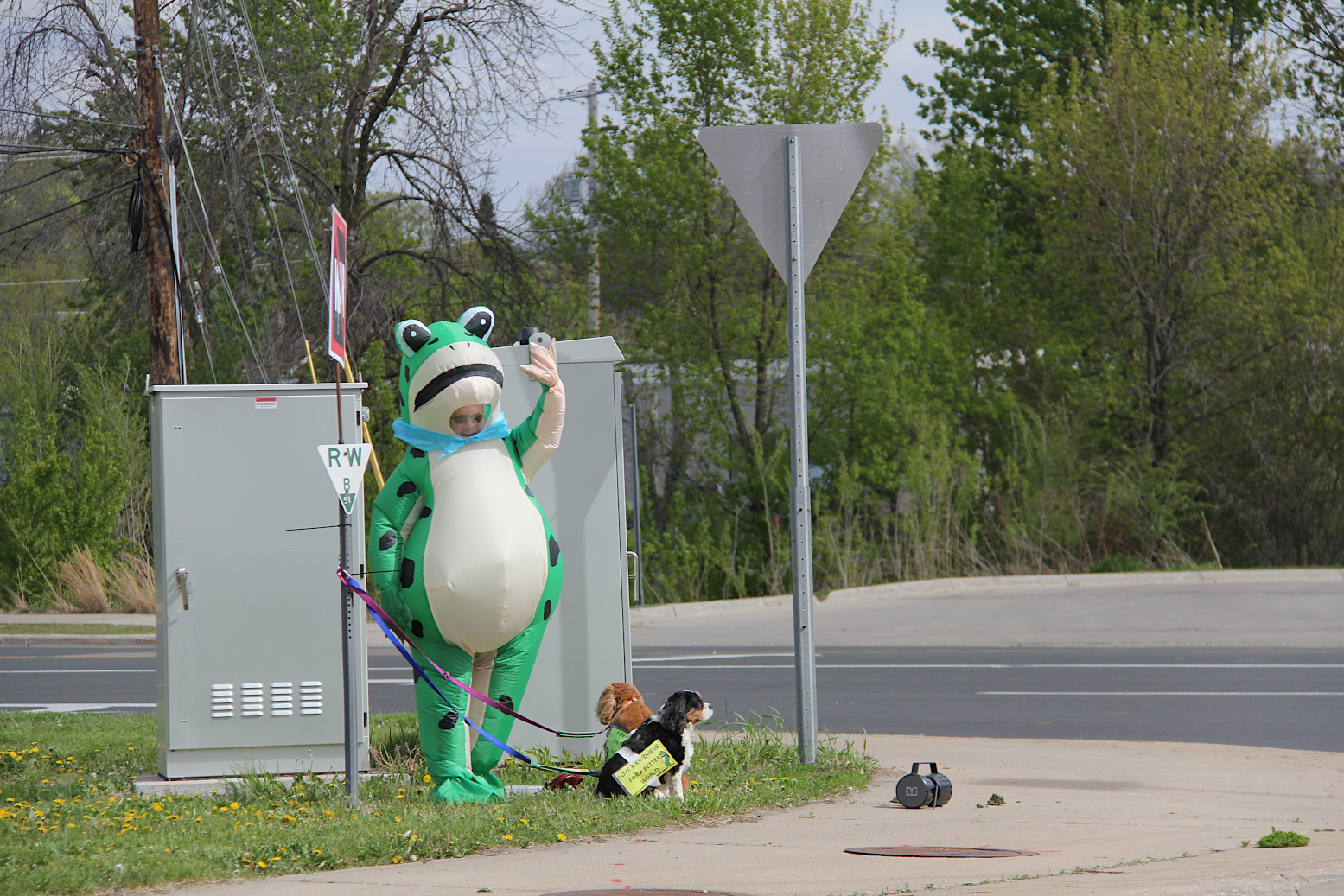
A protester stands at the intersection of Minnesota State highways 3 and 19 in Northfield last Friday afternoon. The inflatable frog costume traces to protests in Portland, Oregon, and signifies a humorous, nonviolent form of creative resistance. The dog’s sign reads, “Love & Kindness for a better world.” (Minnesota Prairie Roots copyrighted photo May 2026)

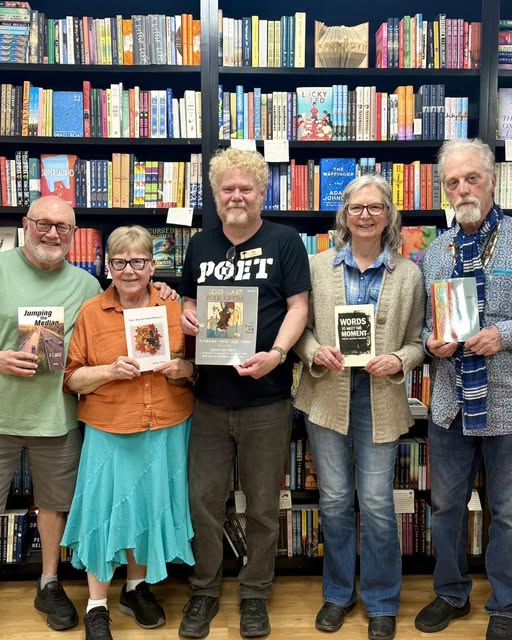
SIX POETS, me included, will read our poetry beginning at 7 p.m. Thursday, May 14, at Content Bookstore in Northfield.

I am honored to be in the company of prolific and talented poets Becky Boling, D.E. (Doug) Green, Rob Hardy and Dougie Padilla all of Northfield and Larry Gavin of Faribault. I’ve previously read with everyone except Padilla and consider them friends.

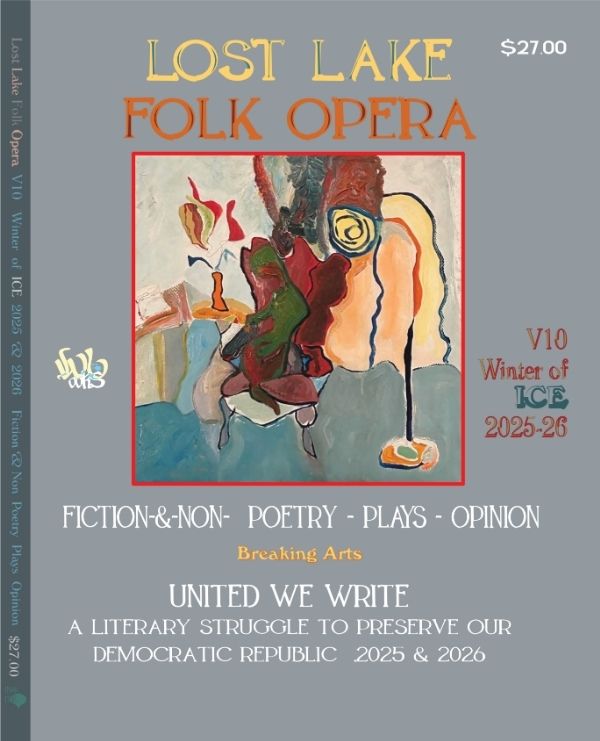
Poets will read from this publication on Thursday evening in Northfield. (Cover sourced online)

All have work published in Lost Lake Folk Opera, Volume 10, WINTER OF ICE. The publication is subtitled UNITED WE WRITE—A LITERARY STRUGGLE TO PRESERVE OUR DEMOCRATIC REPUBLIC. The five poets will read their poems published in Lost Lake at the bookstore event titled “Winter of ICE: United We Write.”

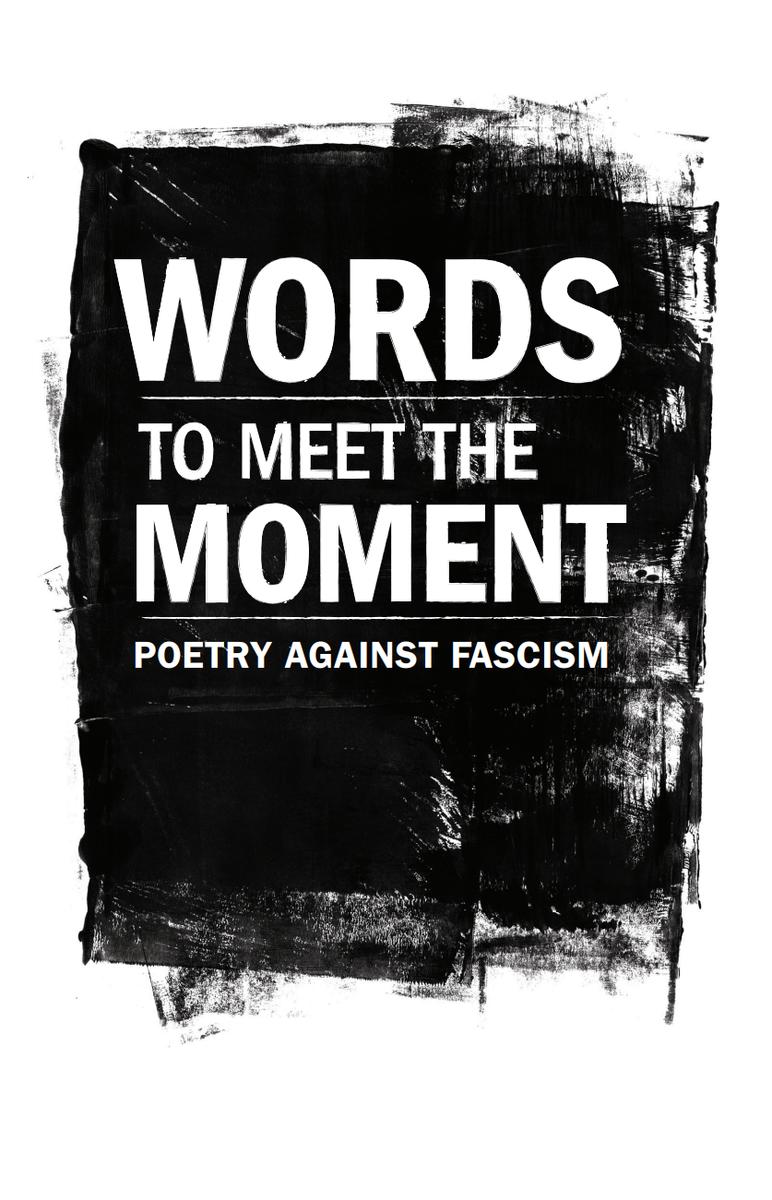
I will read two poems from this collection published by Content Bookstore. (Cover sourced online)

Two of the poems I plan to read—“Death of a Poet” and “Fiery Resistance”—are also anti-ICE. They published in Content Bookstore’s chapbook, Words to Meet the Moment: Poetry Against Fascism.

The years 2025 and 2026 have, indeed, been a time for us to use our words to resist, to rise up, to make a difference. Minnesotans did during Operation Metro Surge and continue to do so. I continue to write. I continue to protest. I continue to speak up, refusing to remain silent.

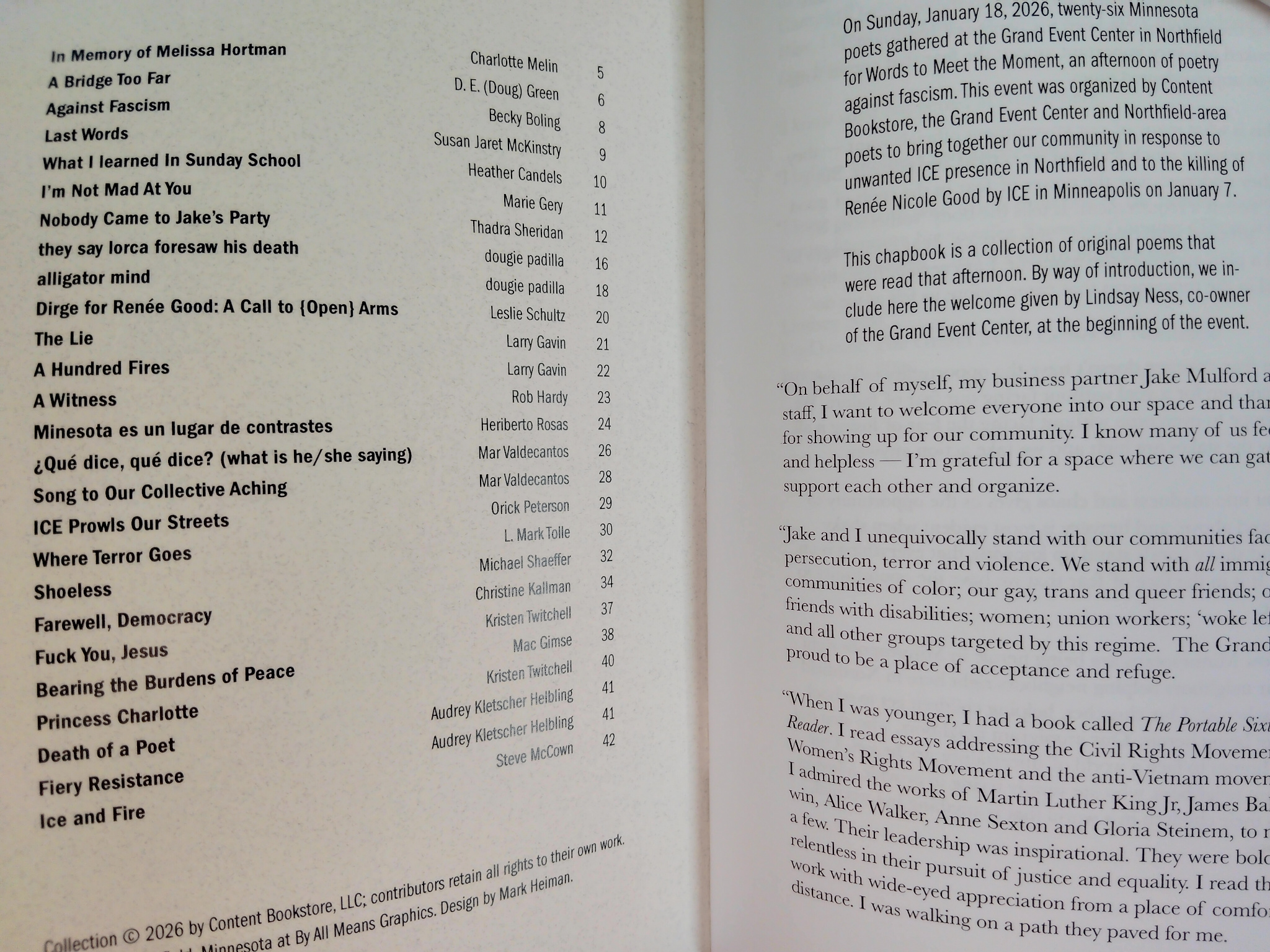
The table of contents for Words to Meet the Moment. (Minnesota Prairie Roots copyrighted file photo 2026)

Words hold power. When we stand united on issues, like preserving our democracy, supporting our immigrant neighbors, protecting voting rights, opposing an unnecessary war, calling out wrongs and much more, we can collectively make a difference. At some point those who hear, but disagree, may finally begin to understand what’s at stake.

Poetry matters. To step up to the mic in an independent bookstore in a small Minnesota college town to read the passionate anti-ICE poems I crafted may not seem like much. But when I am joined by five other poets who also fired poems that could melt ICE, we become part of a movement, a force. We care about our neighbors, about Minnesota, about our country, about the world enough to pen powerful poetry.

Join us from 7-8:30 p.m. Thursday to hear our poetry. United we write. United we read. United we rise.

© Copyright 2026 Audrey Kletscher Helbling


Honoring mothers, including mine, on Mother’s Day May 7, 2026

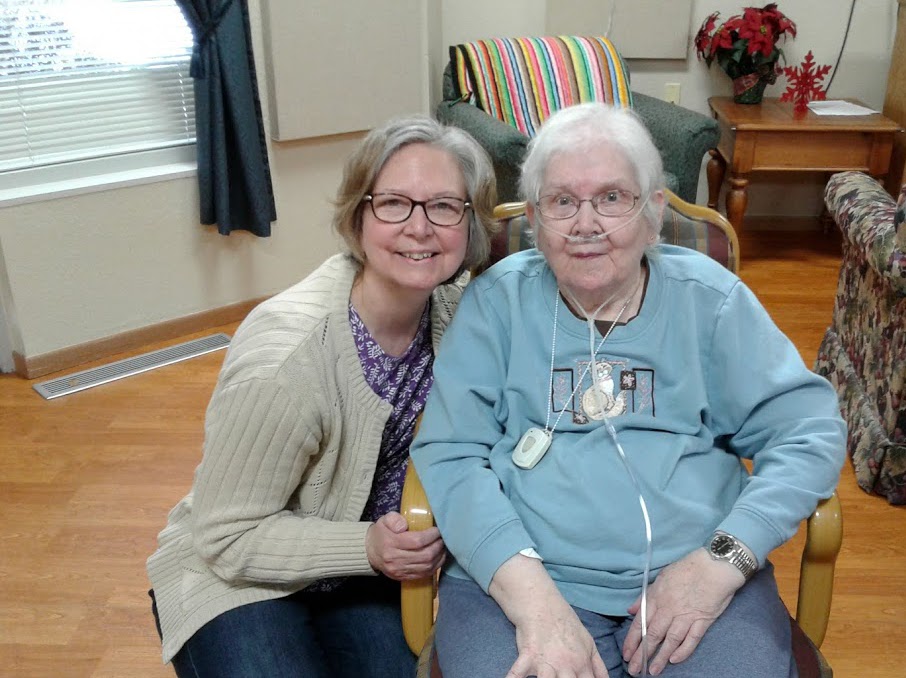
A photo of me with my mom taken several years before her death in 2022. (Minnesota Prairie Roots copyrighted file photo by Randy Helbling)

AS MY FIFTH MOTHER’S DAY without my mom approaches, I’m thinking of her, missing her, remembering her.

She lived a long life, living until nearly ninety, something none of us expected given her heart issues. Several times we were called to her hospital bedside to say goodbye. I remember one instance when Mom was not expected to make it through the night. The next morning she woke up much-improved and told us, “I guess God wasn’t ready for this stubborn old lady.”

I’ll never forget that. But I would argue that Mom was not stubborn. She was kind, caring, compassionate, loving and patient. With six children, she had to be patient. I raised three children and understand the patience required of mothers.

We all hold memories of our moms—positive, negative and otherwise. Moms, like all of us, are imperfect. But they try. They do their best.

Mom’s journals. (Minnesota Prairie Roots copyrighted file photo)

And sometimes they leave us a gift that offers glimpses into their lives. My mom left a stack of notebooks journaling her life from 1947-2014 with a few years missing. These are not diaries with personal feelings and thoughts expressed, but rather a documentation of daily life.

I treasure these notebooks filled with her handwritten observations and notes about life in rural southwestern Minnesota. Hard work filled her days. I pulled out her stenographer’s notebook dated 70 years ago to learn what she was doing in the 10 days before my birth.

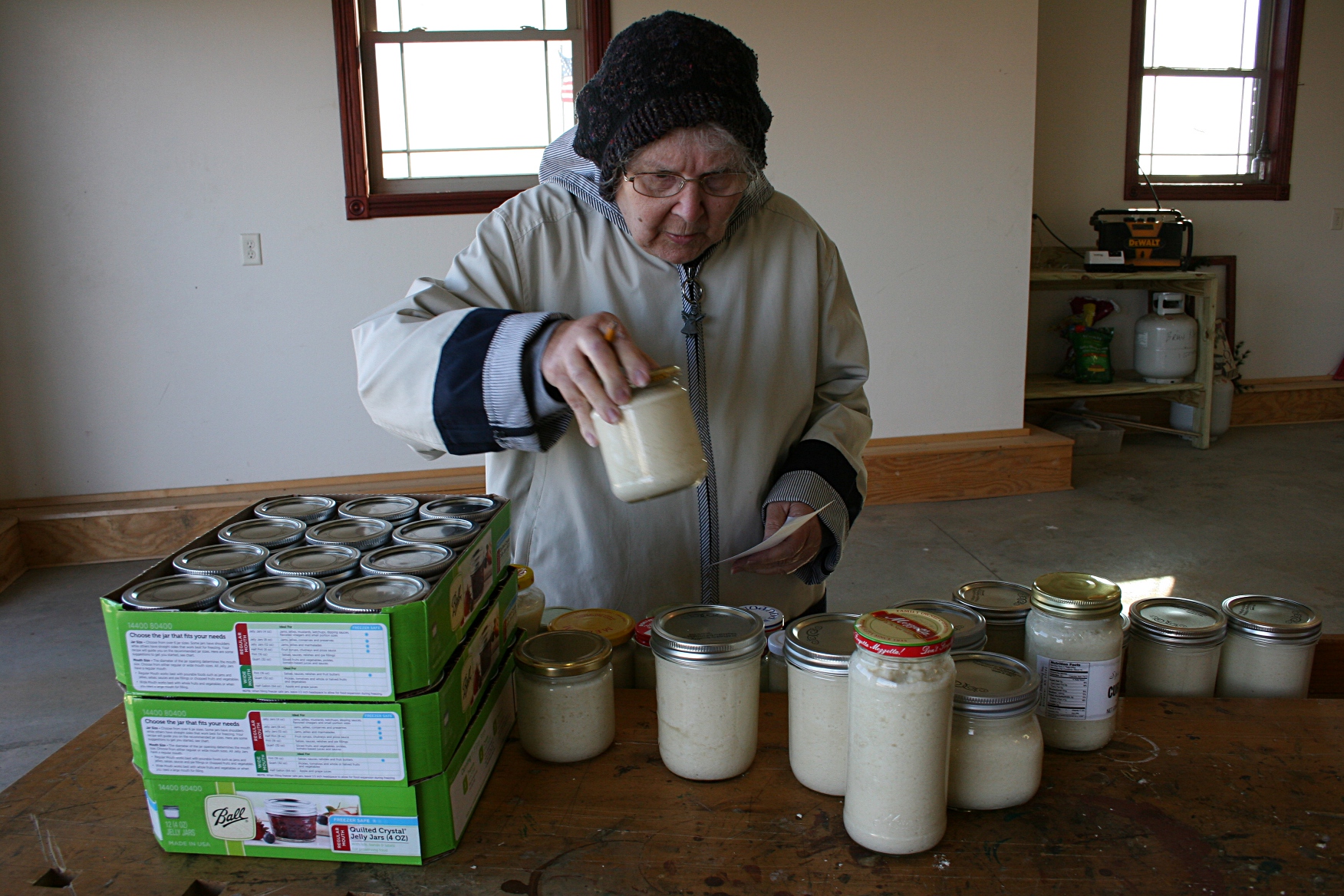
Even into her senior years, Mom was still working, supervising a family horseradish-making event and then counting jars of the condiment. (Minnesota Prairie Roots copyrighted file photo 2012)

There was the usual washing clothes in the Maytag wringer washer, mending, housecleaning, baking and preparing meals. But Mom also picked grapes with my dad, made grape juice the next day and the following day made 32 jars of grape jelly and 18½ quarts of tomato juice. And she was only days away from delivering me.

The day before I was born, Mom dusted floors, baked bread and cherry nut cake, took 13 dozen eggs into town and then celebrated her wedding anniversary with her in-laws. I’m tired simply reading that list of work she accomplished while nine months pregnant.

At 3 a.m. the next morning, Mom awoke in labor and arrived at the Redwood Falls hospital at 4:20 a.m., giving birth to 8 lb 12 oz. me 36 minutes later. That’s cutting it close, in my opinion. But when you go into labor in the early morning, need to get your one-year-old son to his grandparents’ house, and then travel 20 miles to the hospital, well, the time lapse seems reasonable.

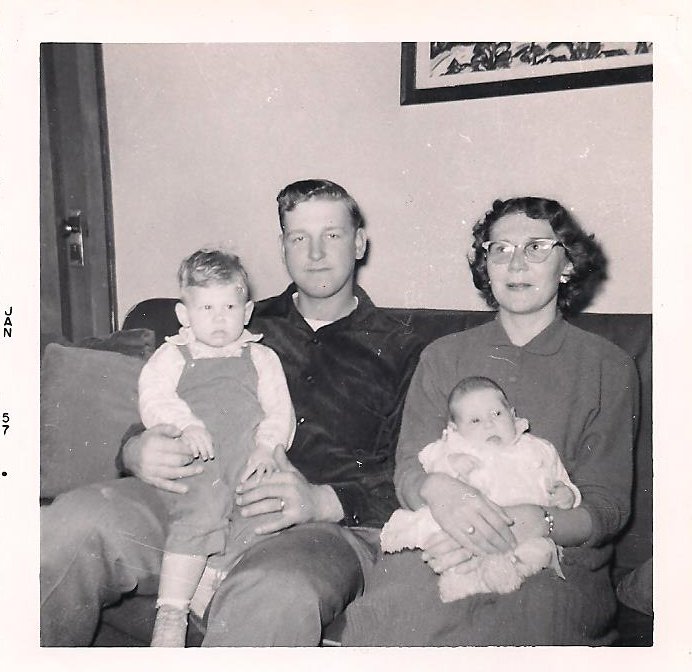
The only photo I have of my parents, Elvern and Arlene, with me as a baby. My dad is holding my oldest brother, Doug. (Minnesota Prairie Roots copyrighted photo)

Six days after my birth, Mom returned home. I should note here that on her fifth day in the hospital, Mom wrote, “Days are plenty long.” I suppose for a woman used to being busy all the time, lying around proved difficult. But she should have enjoyed the respite from work while she could.

Shortly, Mom was back in full work mode, not only caring for a newborn and a one-year-old and doing other routine household chores, but also feeding a crew of men picking corn on the farm for several days running.

Oh, how I admire this generation of Minnesota farm women who fed and cared for their families and others without the modern conveniences of today. No automatic washer, dryer, dishwasher, microwave. No bathroom or phone in our old farmhouse. Food came mostly from the farm, not the grocery store. And that meant gardening and putting up produce.

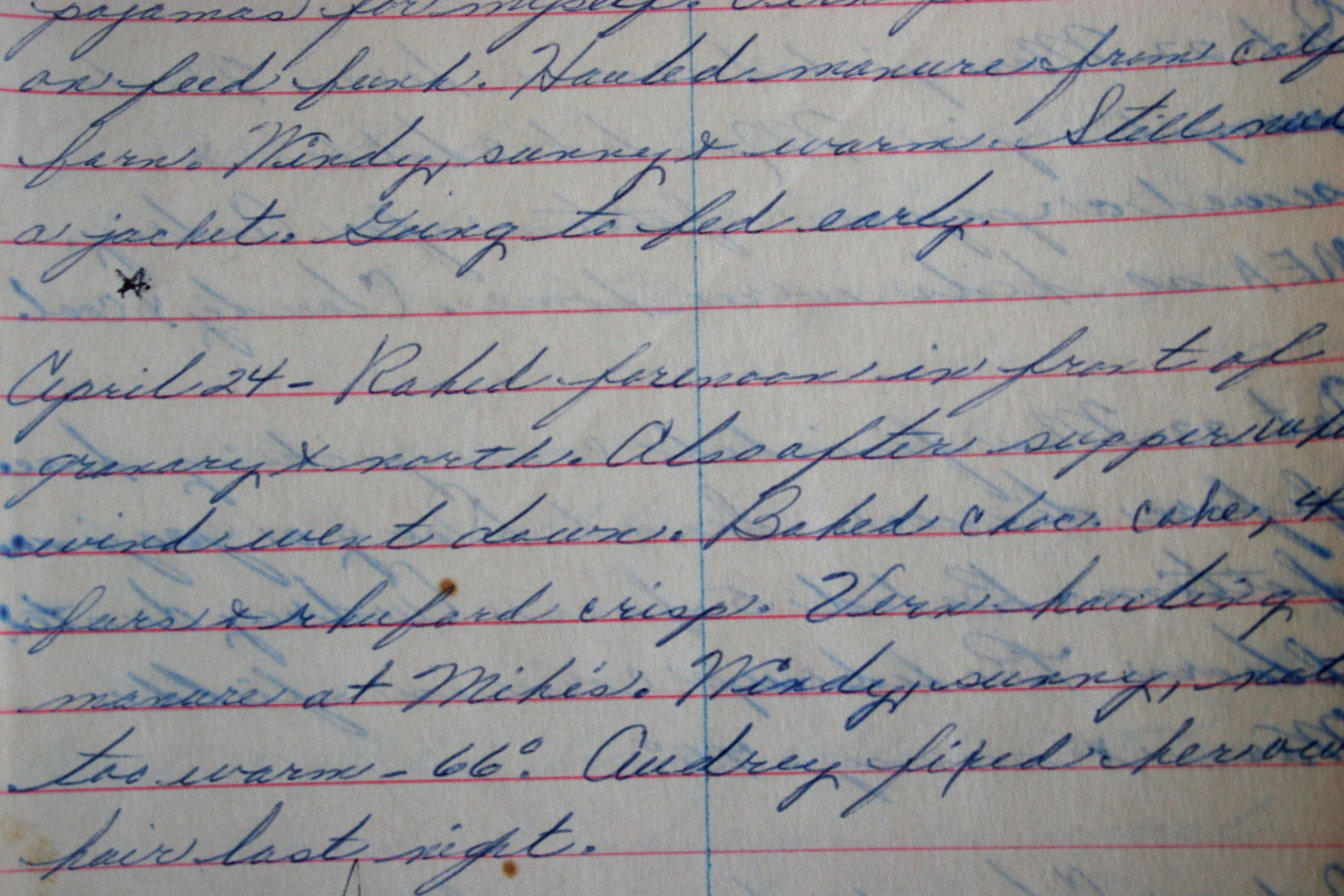
A sample entry from Mom’s journals. (Minnesota Prairie Roots copyrighted file photo)

I’m thankful my mom found time to journal daily. Even if her entries were only several lines long, she apparently thought this documentation important. And I suppose in farming it was, allowing her and my dad to look back on the previous year’s weather, planting and harvesting progress, and such. But I think, too, writing in those spiral bound notebooks gave her a creative outlet and time for herself.

My mom saved everything, including this Mother’s Day card I made for her in elementary school. I cut a flower from a seed catalog to create the front of this card. (Minnesota Prairie Roots copyrighted image)

Mother’s Day offers a time to reflect on motherhood. Most give selflessly, love unconditionally, do the best they can. Mine did. And she left, too, her words chronicling everyday life as a mother and as a farm wife. As a writer I cherish this gift, not only on Mother’s Day, but always.

© Copyright 2026 Audrey Kletscher Helbling


A look at “Jake’s Women,” on stage at the Paradise April 22, 2026

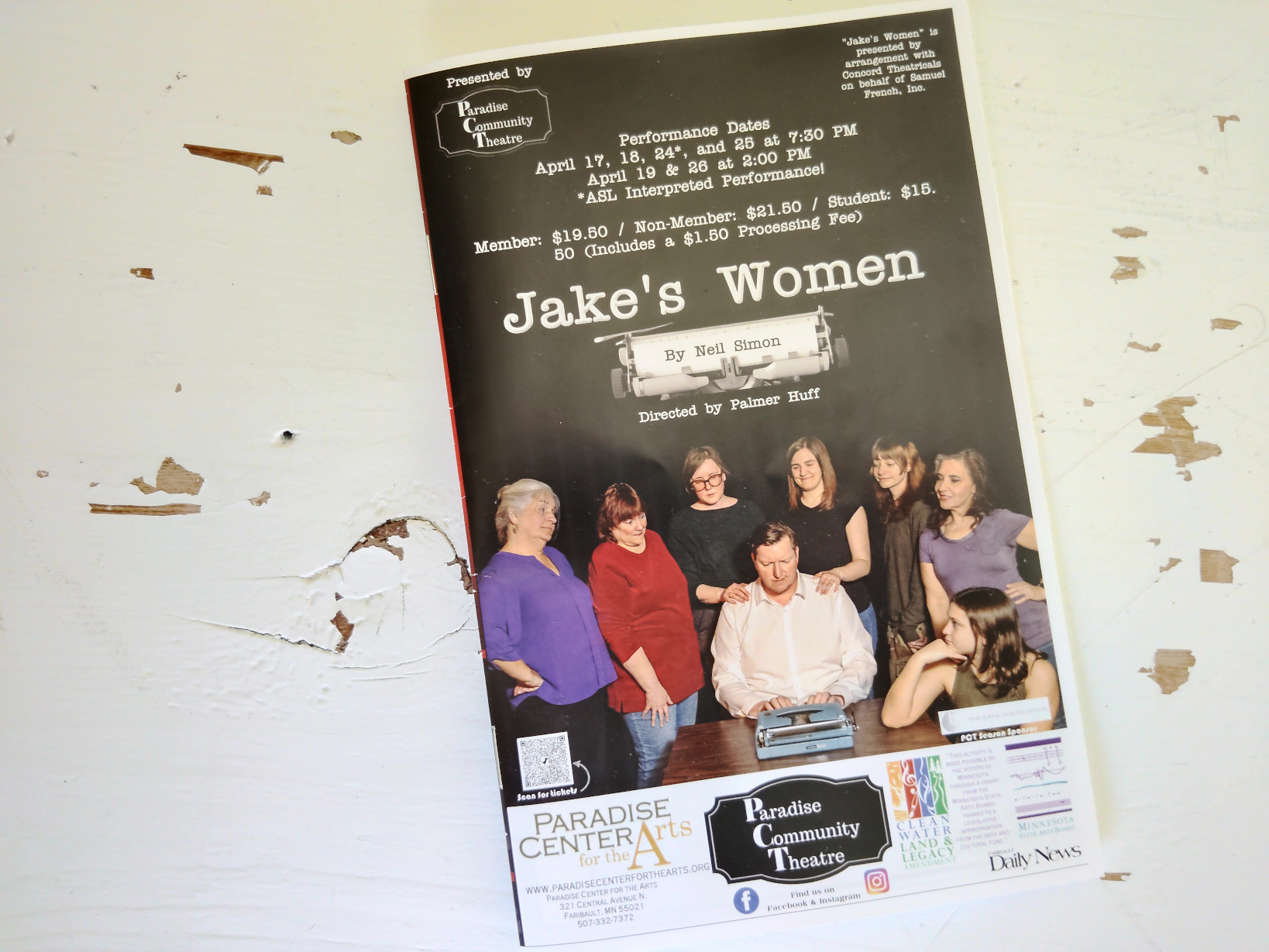
The program cover for “Jake’s Women,” now playing at the Paradise Center for the Arts, Faribault. (Minnesota Prairie Roots copyrighted photo 2026)

THEATER ENTERTAINS. But often it also makes us think, and think deeply.

That’s the case with Jake’s Women, a play by Neil Simon now unfolding on the stage of the Paradise Center for the Arts in Faribault.

I attended the play on opening night last Friday after volunteering to greet guests at the door. I admit I felt hesitant about watching this drama because I expected the content might unsettle me. It did. But sometimes we need a jumbling of emotions and thoughts in a controlled setting.

CONTROL

Control. Main character Jake, played by Jake Gustine, struggles with control issues, especially in his relationships. He’s a writer, which in itself requires discipline and control. Fiction writers shape characters, stories, dialogue, control the plot. As a writer who’s written short stories, I understand the craft and could, in many ways, relate to what I was hearing from Jake on the stage.

But this play stretches beyond control and Jake’s work as a writer to his relationships with women. He’s struggling in his marriage to Maggie, his second wife. His first wife, Julie, died. I’ve been married for 44 years. That’s enough decades to realize partners won’t always agree—and they shouldn’t. There will be joys, struggles and hard times. But I’ve found through all of it, the good times and the difficult ones, that my husband and I balance one another and that our love for one another has grown and deepened through the years.

COMMUNICATION

Communication is a hallmark in any relationship. That message resounds in Jake’s Women. As a professional communicator/writer, I wanted to walk onto the stage and yell at Jake, “Listen, just listen!” That’s how invested I was in the play. I consider myself to be a good listener, a necessary skill for my previous work as a newspaper reporter with a bachelor of science degree in Mass Communications. Listening seems underrated. But I’m convinced if we all listened more than we talked, we would all get along better.

CRISIS

There are certainly many conflicts between Jake and the other seven characters in this play. But conflict also exists within Jake as he experiences delusions while in the throes of a mental health crisis. He struggles to separate fact from fiction, a mark of psychosis. I appreciate whenever mental health gets a spotlight if for any reasons other than to raise awareness and educate.

Throughout the play, Jake “talks” to the women who have been an important part of his life. Here the play gets interesting. The audience needs to pay close attention to lighting to determine when Jake is living in reality and when he is delusional. The set never changes and Jake never leaves the stage, which is a feat in itself during a play that lasts more than two hours.

I quickly found that I could not allow my mind to wander during this theatrical production directed by Palmer Huff and performed by the Paradise Community Theatre. I had to listen closely to every word spoken by Jake Gustine and performers Brianna Bauernfeind, Linda Anderson, Charli Gomez, Casper Andersen, Kate Southwick, Clair Borgerding and Kris Snow.

Jake’s Women is an intense play. It’s also thought-provoking. And it’s a play I highly-recommend you see.

#

FYI: Upcoming performances of Jake’s Women are set for 7:30 p.m. Friday, April 24, and Saturday, April 25, and at 2 p.m. on Sunday, April 26. Click here for ticket information.

TELL ME: Have you seen Jake’s Women? If yes, what are your thoughts on the play?

© Copyright 2026 Audrey Kletscher Helbling


Celebrating immigrants in a children’s picture book by Faith Ringgold April 16, 2026

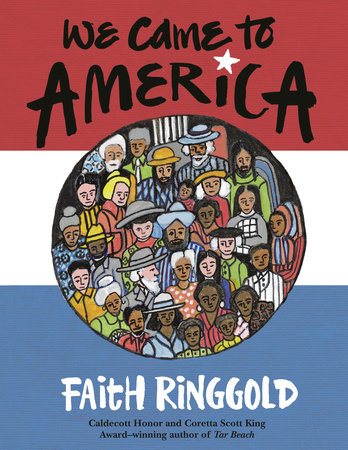
(Book cover sourced online)

TEN YEARS AGO, award-winning African American author and artist Faith Ringgold (1930-2024) published We Came to America. I find this children’s picture book especially relatable to today as ongoing federal immigration enforcement continues in this country.

I wish everyone who rails against immigrants would read this book to remind themselves of their roots. Unless Native American, every single one of us can trace our ancestral roots to a place other than the United States of America.

Ringgold celebrates the diversity of this country in this colorful, celebratory book featuring a diversity of peoples. She honors the music, food, culture, stories, dance and more of those who resettled here. She recognizes the reasons—injustice, fear and pain—many came.

MADE AMERICA GREAT

This author even uses the words “made America great,” not in a political context, but to celebrate how diversity enriches America.

“We came to America/Every color, race and religion/From every country in the world,” she writes in a poetic refrain.

LOVING THIS BOOK

I love this book. It’s simple. Easy to read. Joyful. Accurate. Timeless. Appropriate for all ages, including adults, especially adults.

I love that the author, born and raised in Harlem, was part of the Black Arts Movement and an activist who worked tirelessly for civil rights and social justice. Ringgold is best known for her story quilts.

PEACE, FREEDOM, JUSTICE

She dedicates her picture book about immigrants to all the children who come to America: “May we welcome them and inspire them to sustain a love and dedication to peace, freedom, and justice for all.” Reread those words: Peace. Freedom. Justice for all. Ringgold was 86 when she wrote those words, created the art for We Came to America.

I wonder how Ringgold would feel about the threats to democracy and personal freedom and about the injustices occurring in this country today? I expect she would use her creative voice to rise up, resist and remind all of us that we are valued, that together we are America. All of us, no matter our color, our race, our religion. And no matter our roots.

TELL ME: Have you read We Came to America or any of Faith Ringgold’s books? Or have you seen her art exhibited? I’d like to hear your thoughts on her work and/or that of other creatives like her.

© Copyright 2026 Audrey Kletscher Helbling


Reflecting on “Echoes & Shadows,” an artistic collaboration October 22, 2025

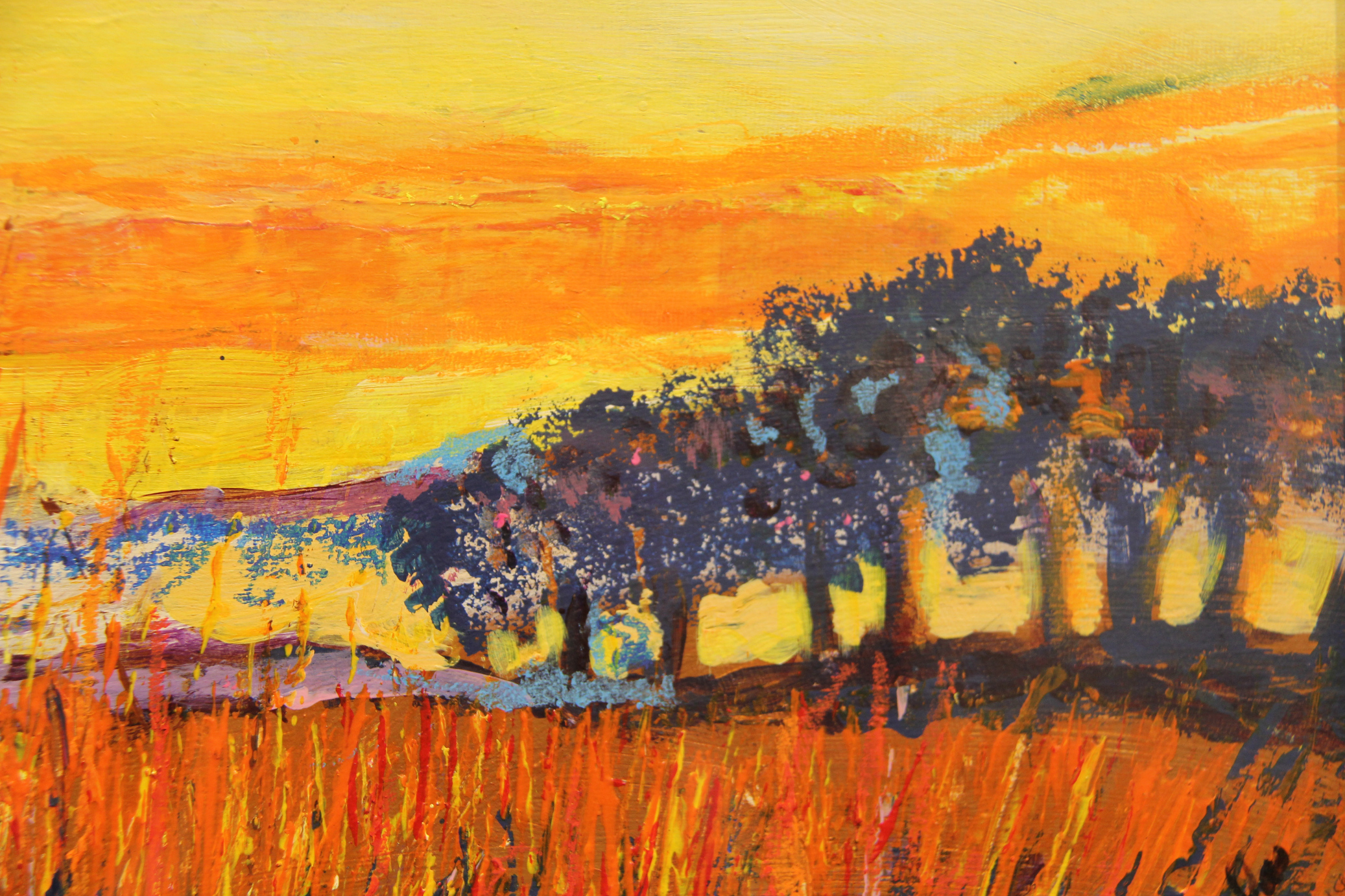
This shows a portion of “Wisconsin Sunset,” painted by Kate Douglas. (Minnesota Prairie Roots copyrighted photo October 2025)

WHEN LITERARY AND VISUAL ARTISTS collaborate, something beautiful happens. That was evident to me in viewing “Echoes & Shadows,” a poetry and art collaboration at FiftyNorth Gallery in Northfield. In this exhibit at the senior center, visual artists created art inspired by original poetry. The results are fascinating.

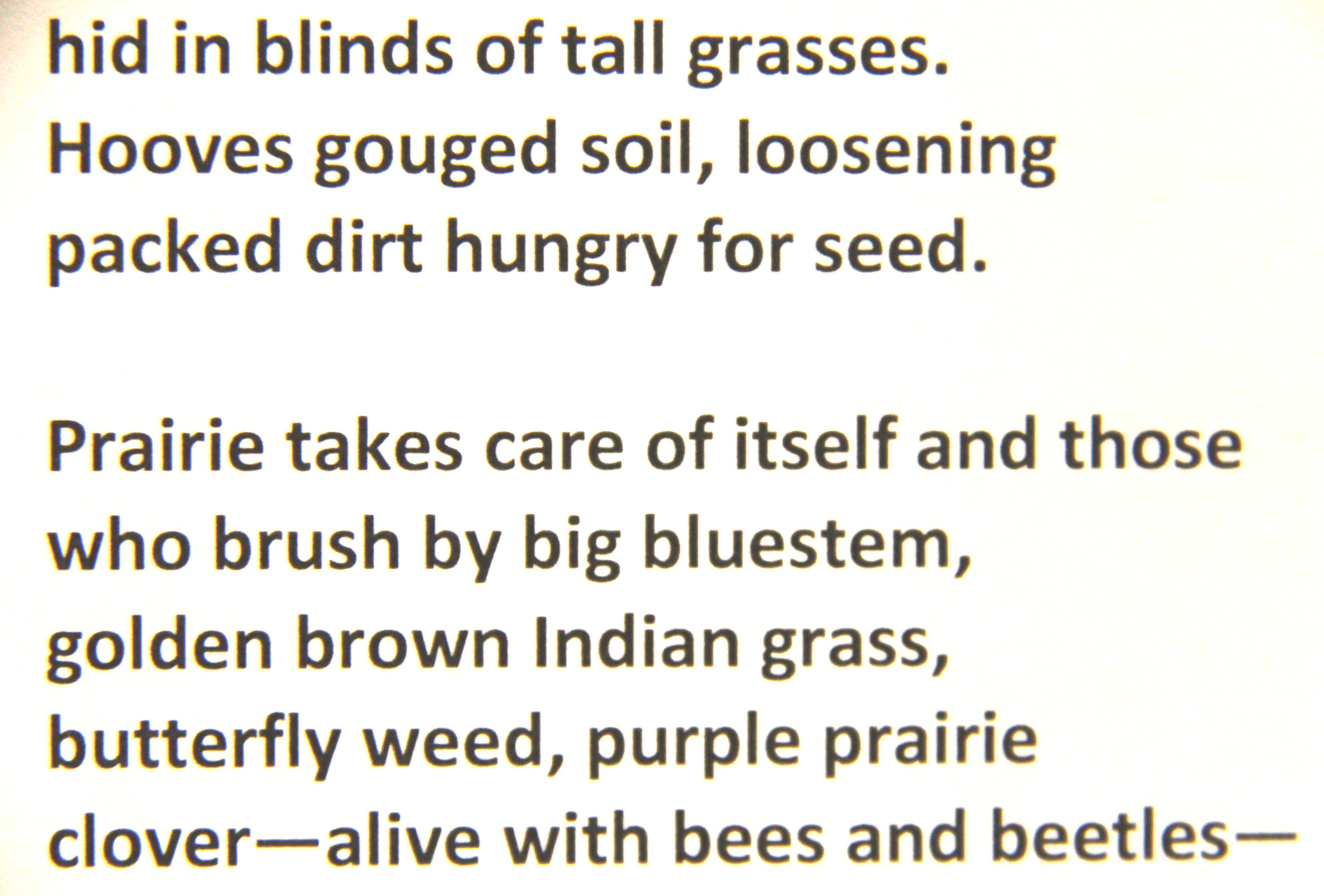
Here are some lines from Northfield poet Becky Boling’s poem, “Red Prairie,” inspired by “Wisconsin Sunset.” (Minnesota Prairie Roots copyrighted photo October 2025)

As a long-time writer and photographer, who is also a published poet, I’ve participated in similar collabs in nearby Zumbrota. I found it a whole lot of fun not only to write poems, but especially to see how an artist interpreted my poetry. I expect those participating in this pairing of poetry and visual art in Northfield feel the same. The work in this show is visual art inspiring poetry.

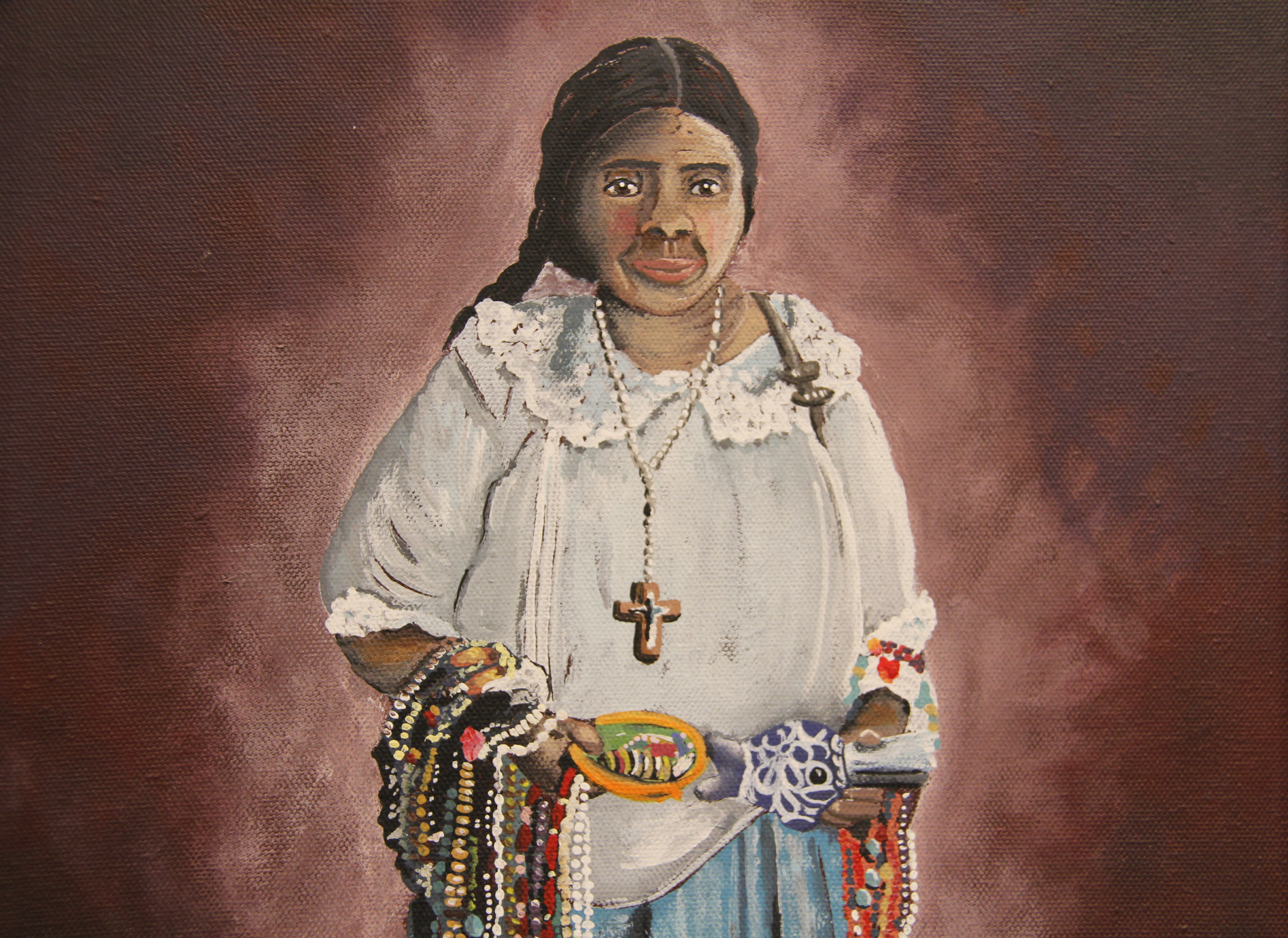
“Brave,” a poem by Orick Petersen, is paired with Sharon Henry’s painting, “The Bead Lady.”
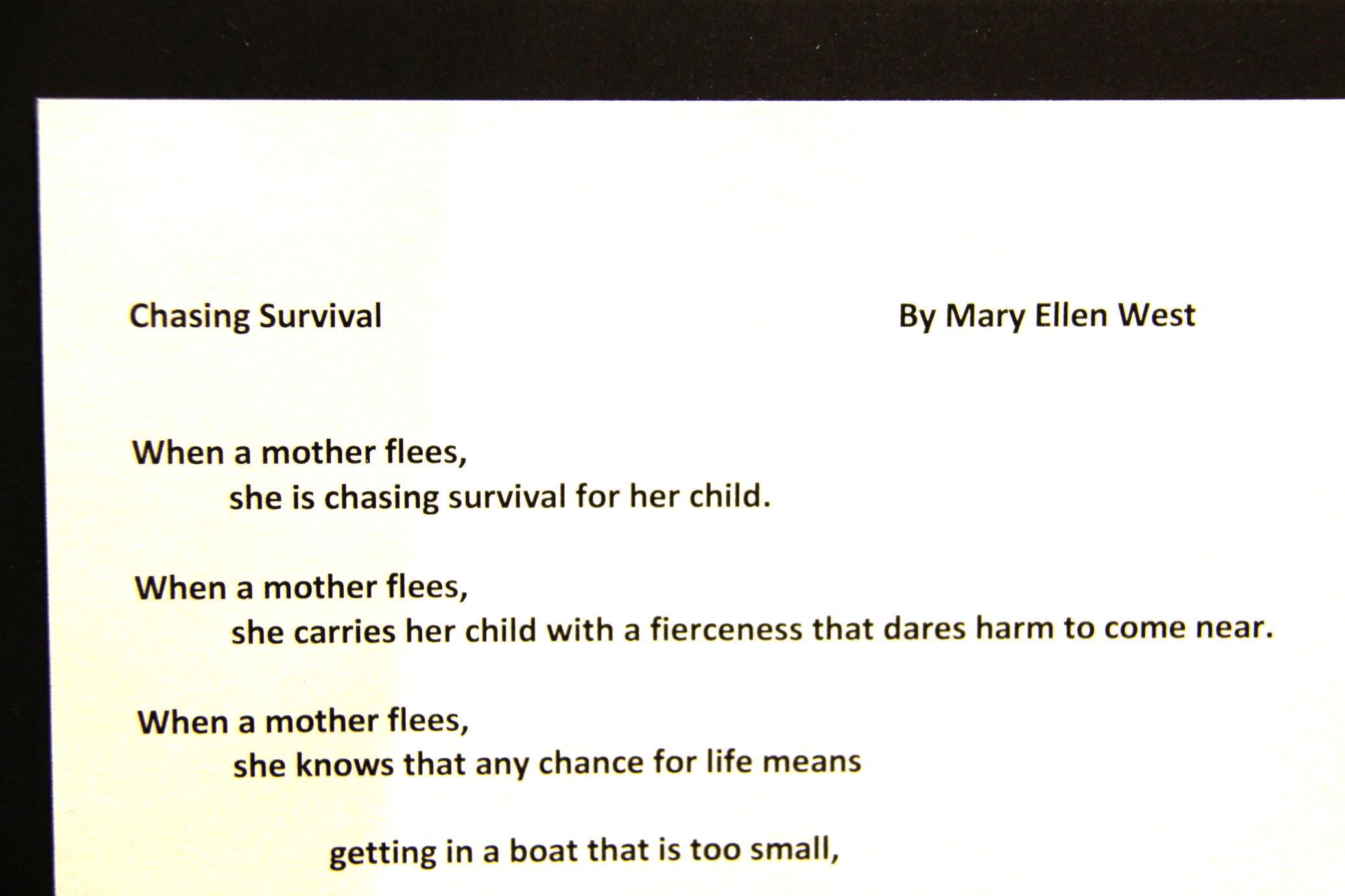
This shows several lines from a thought-provoking poem inspired by an equally thought-provoking photograph of a mother and child by Dean Neuburger. (Minnesota Prairie Roots copyrighted photo October 2025)
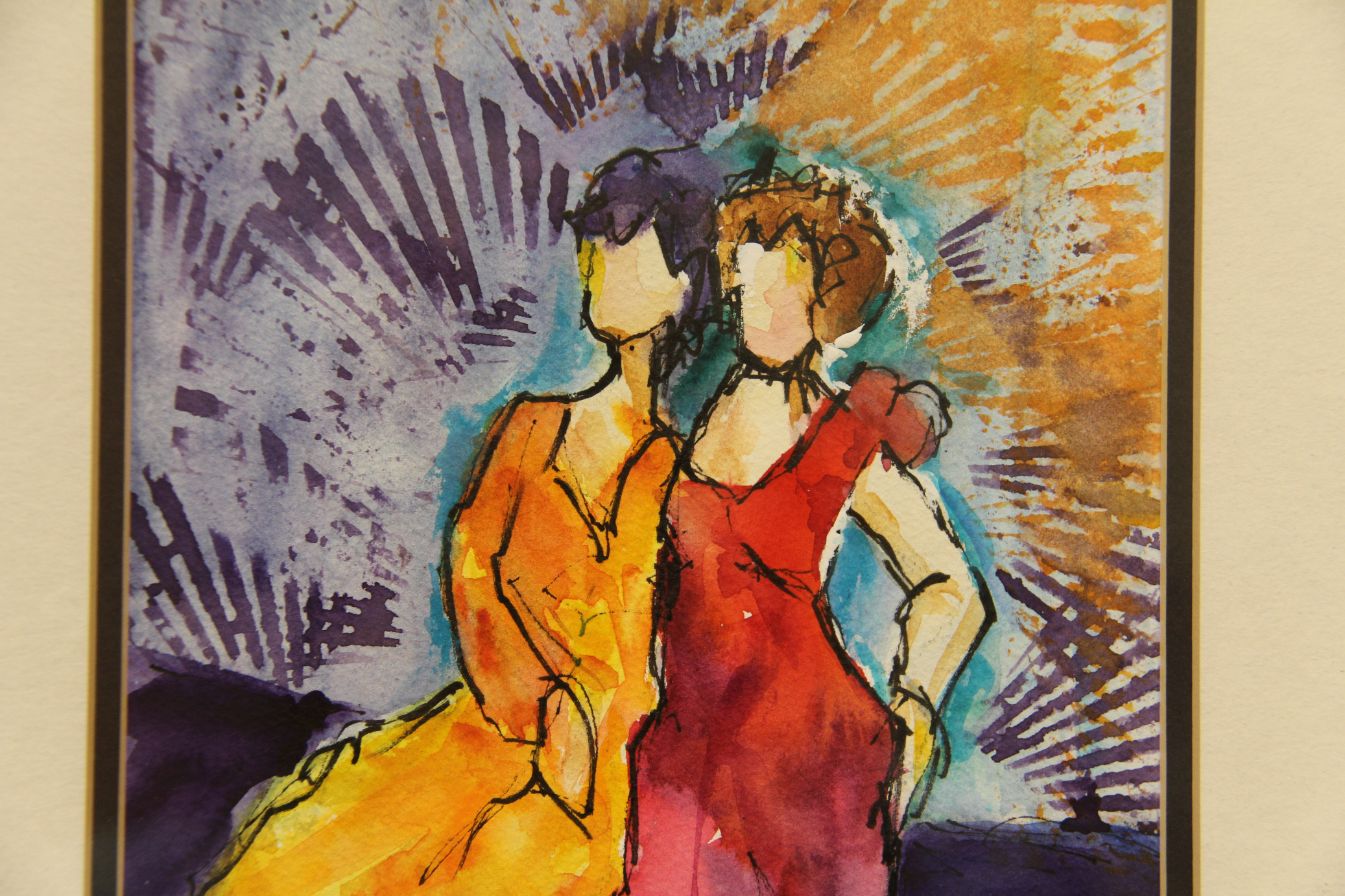
Marty Amundson’s watercolor and ink, “Sisters Still,” inspired Marie Gery’s poem, “30th High School Reunion.”

I feel fortunate to live in a region rich in the arts. The arts expose us to new ideas, thoughts, beauty and more. The arts open us to a world wide beyond our own. The arts can serve as a catalyst for positive change. The arts represent voice, a way for us to speak via our creativity.

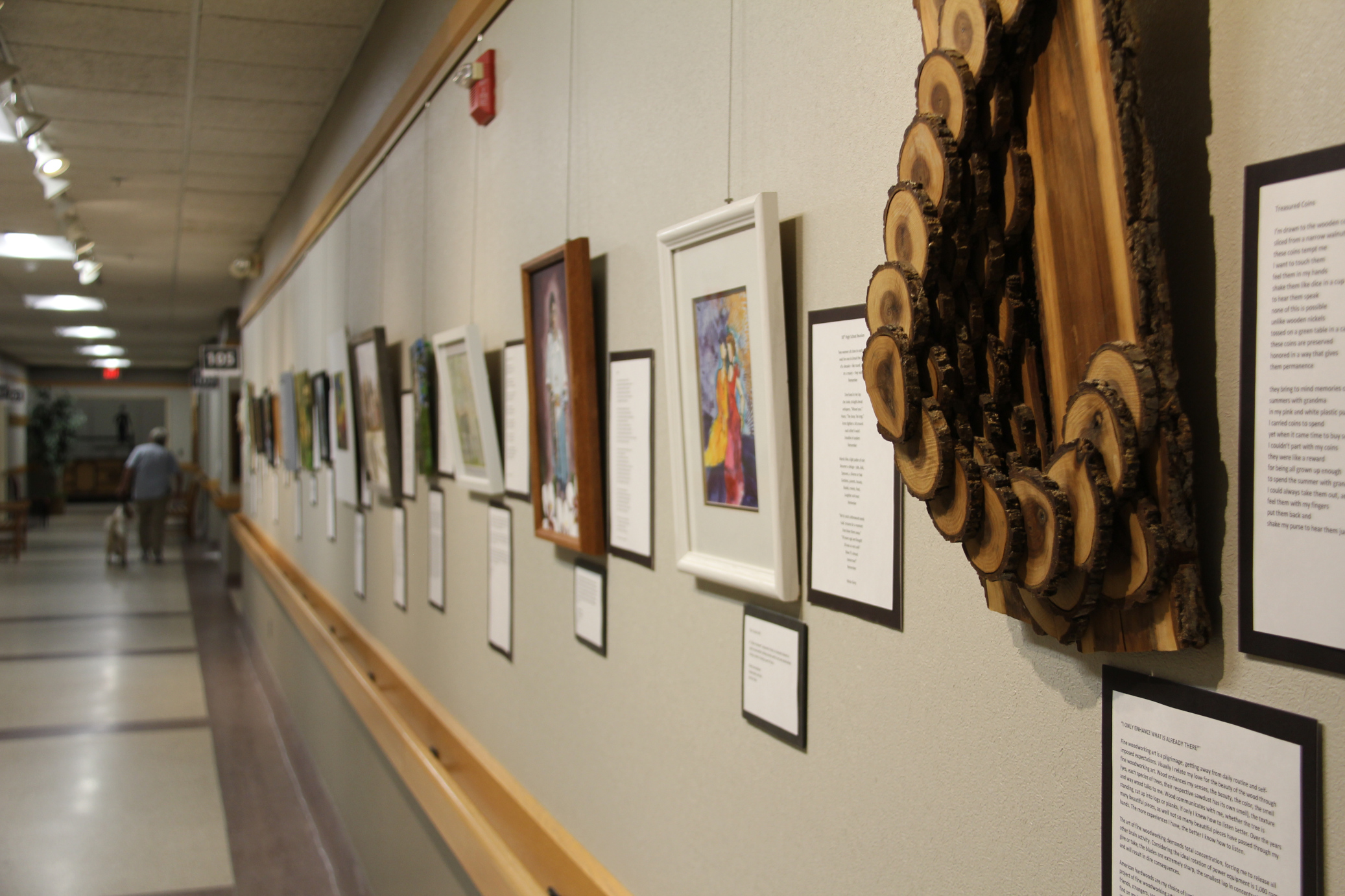
Art and poetry stretch along a hallway at FiftyNorth. (Minnesota Prairie Roots copyrighted photo October 2025)

In “Echoes & Shadows,” artists express themselves in carefully crafted words and in a variety of visual art that seems to fit its inspirational poetry. Painting, appliqueing, woodworking, photography, collage…all are part of this collaboration.

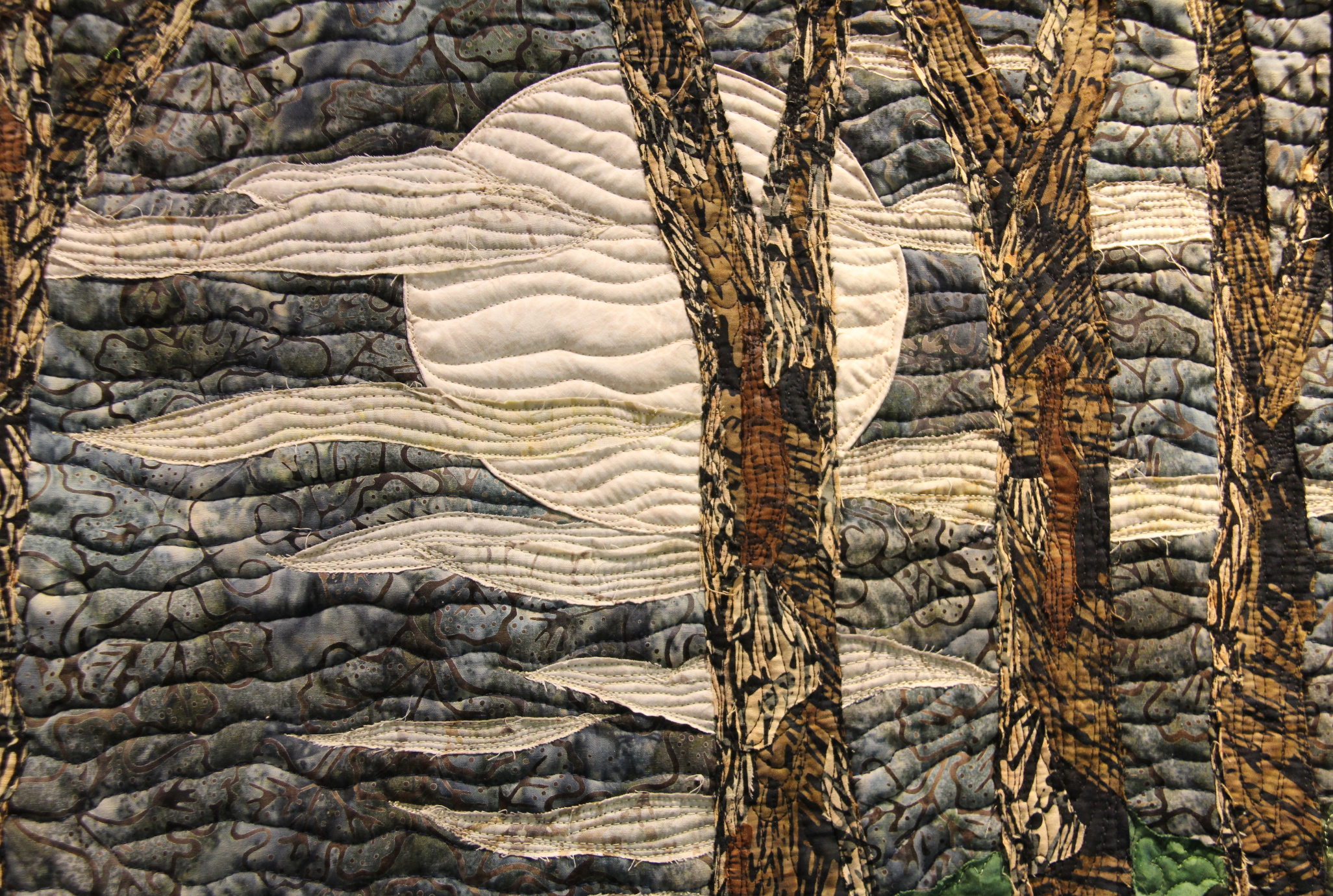
Lake Superior in northern Minnesota inspired Kathy Weed to create “Moon Glow” in textile art. (Minnesota Prairie Roots copyrighted photo October 2025)
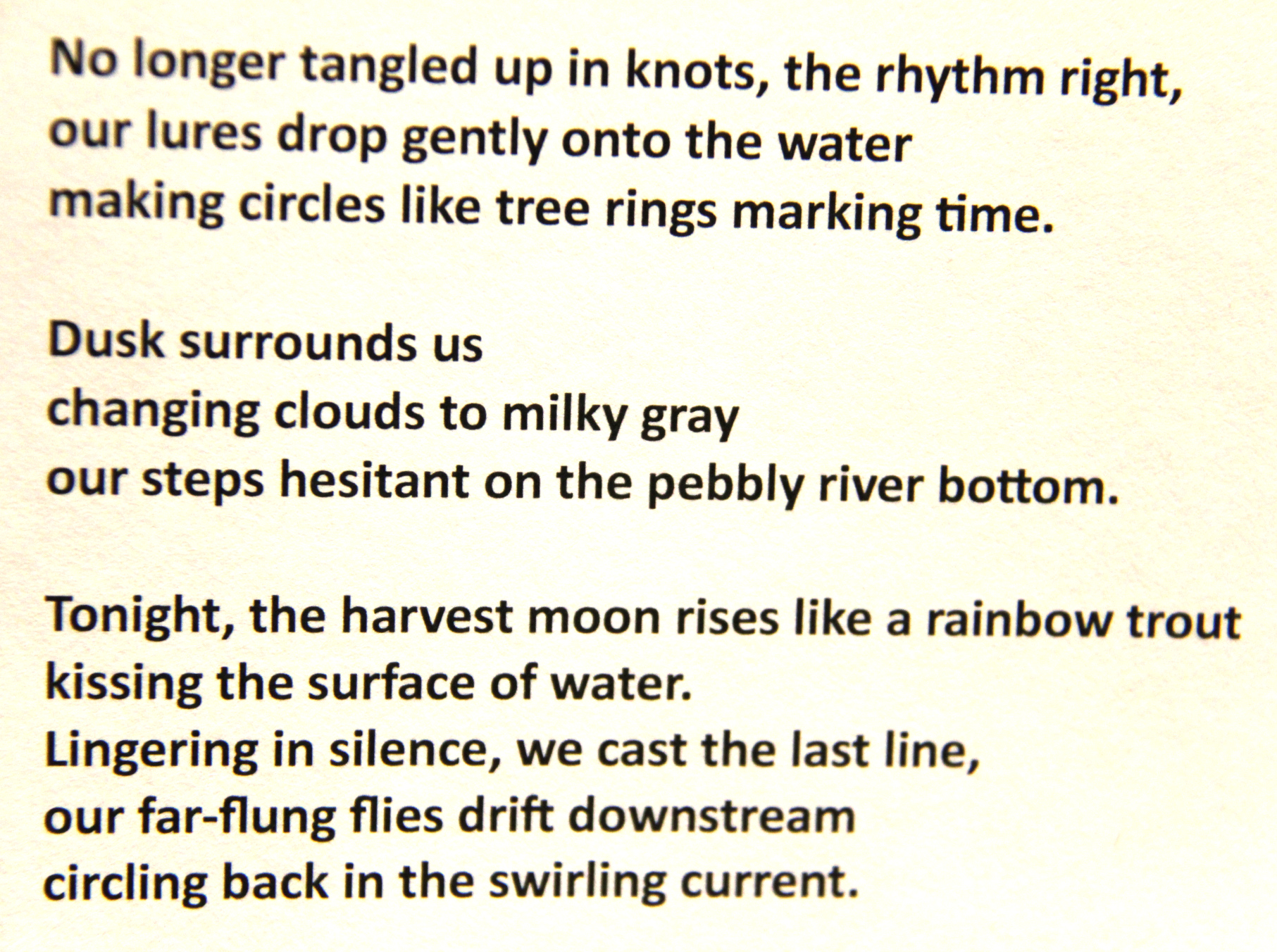
And then Jane Sarles Larson wrote “Circling Back” to pair with Kathy Weed’s art. (Minnesota Prairie Roots copyrighted photo October 2025)
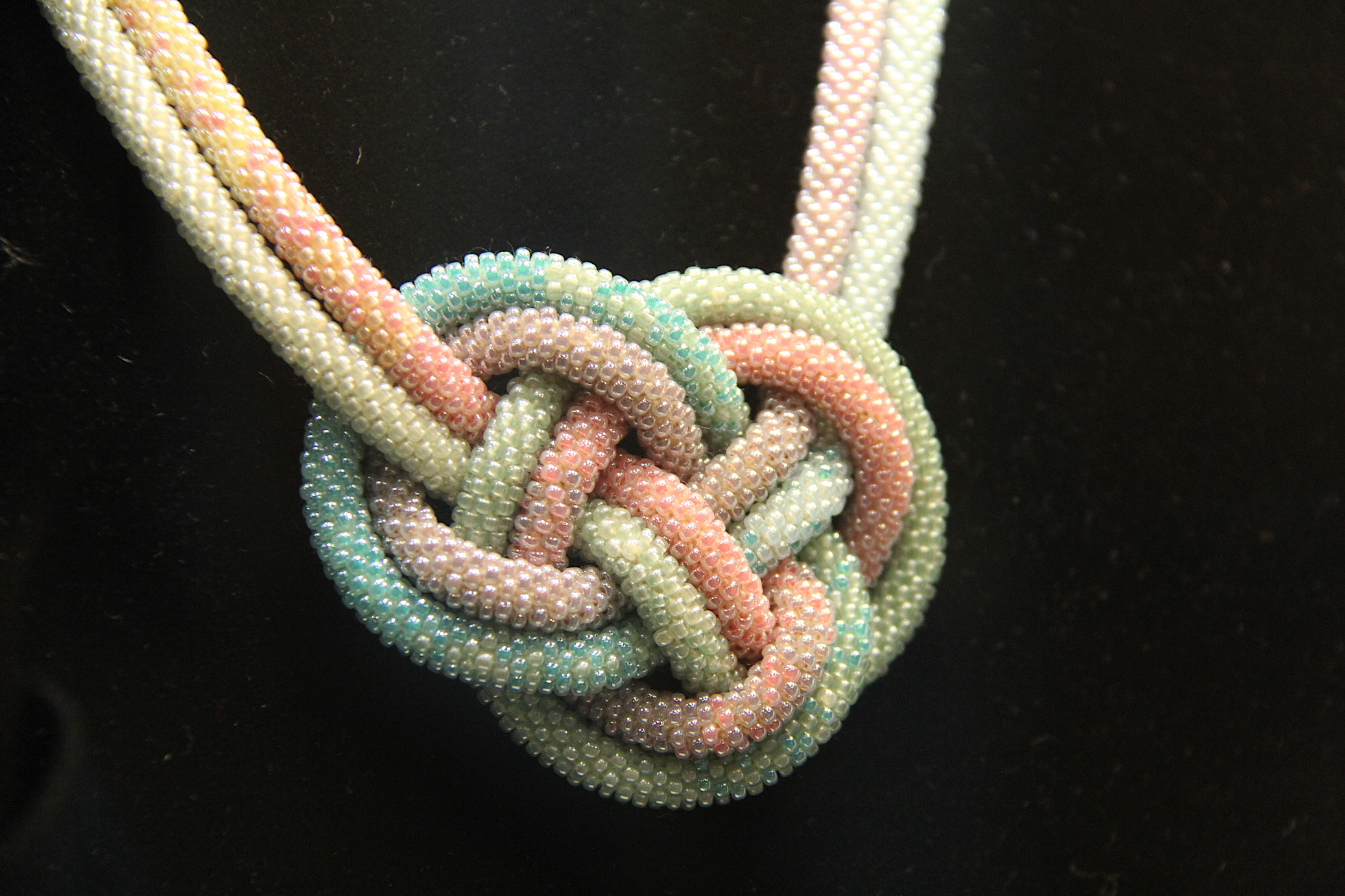
More knots…Judy Saye-Willis’ necklace inspired Marie Gery’s poem, “Knotty Reality.” (Minnesota Prairie Roots copyrighted photo October 2025)

I like that word, “collaboration.” It means working together. Even that seems especially meaningful today.

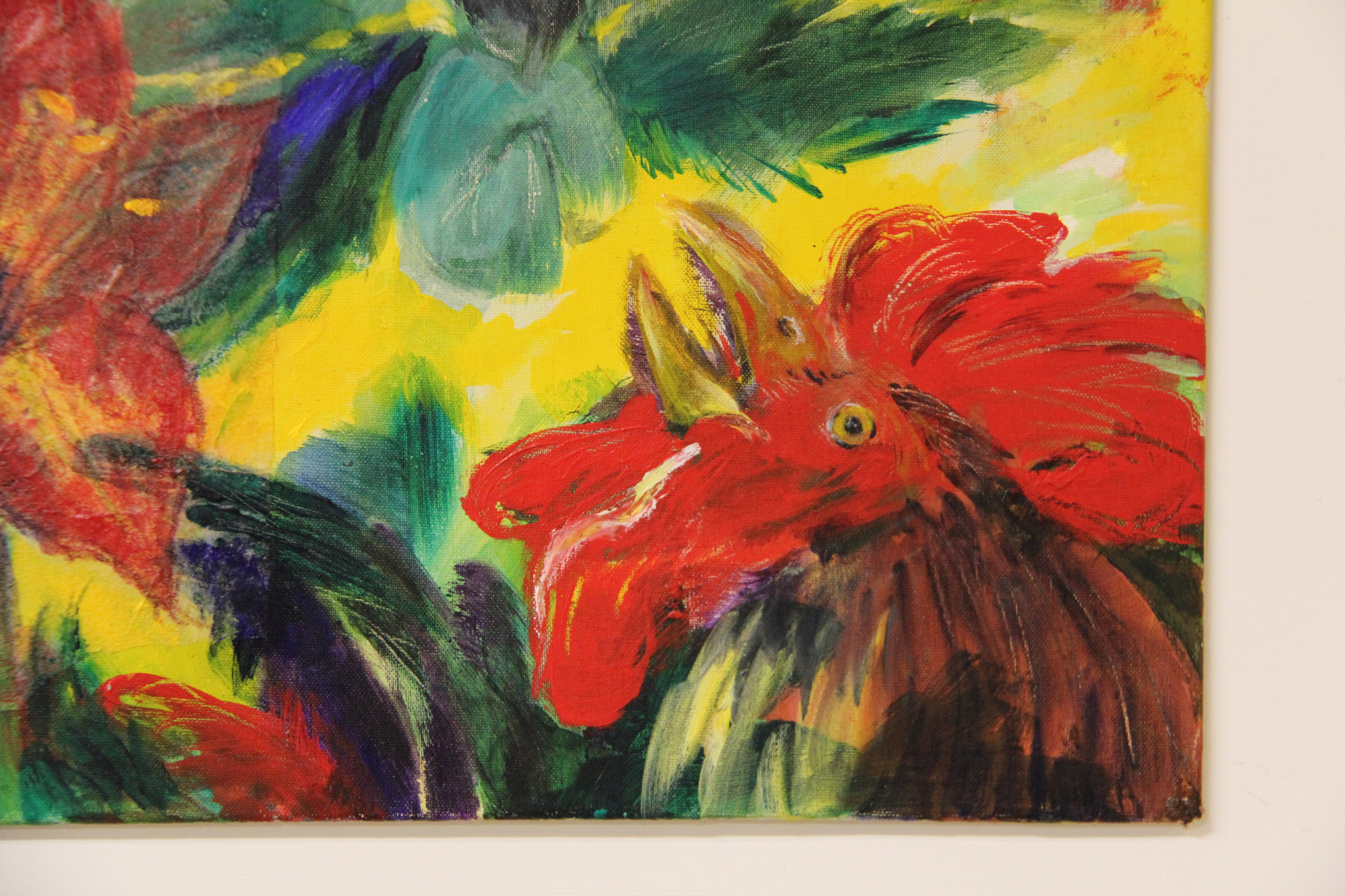
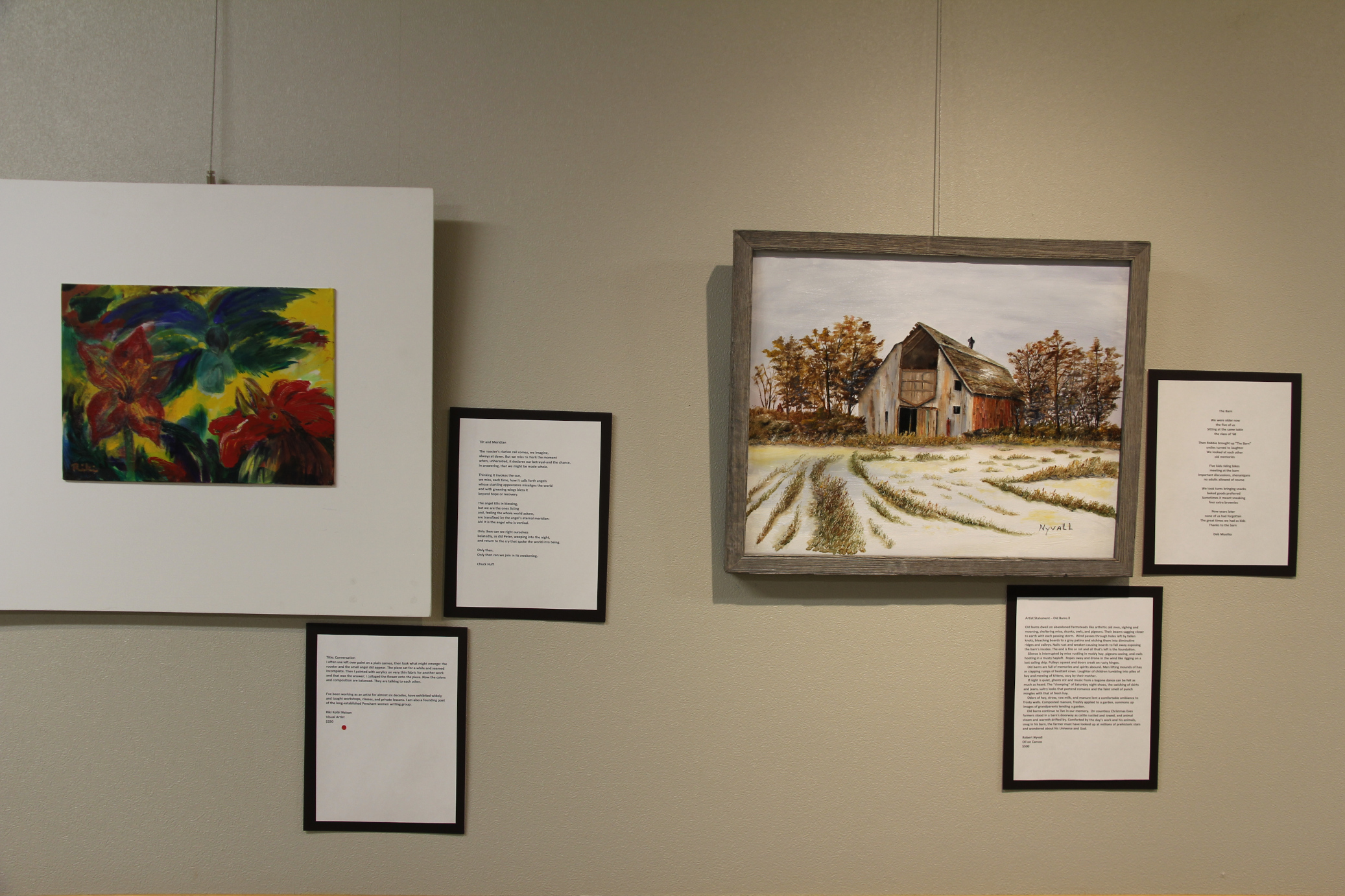
Riki Kolbl Nelson’s “Conversation” acrylic and collage of a rooster and angel inspired Chuck Huff to write “Tilt and Meridian.” (Minnesota Prairie Roots copyrighted photo October 2025)

In this pairing of art and poetry, I see collaboration, how literary art and visual art play off and balance one another, centering the two pieces of art into one unified piece without sacrificing individuality. Creatives are, after all, uniquely creative even when working together.

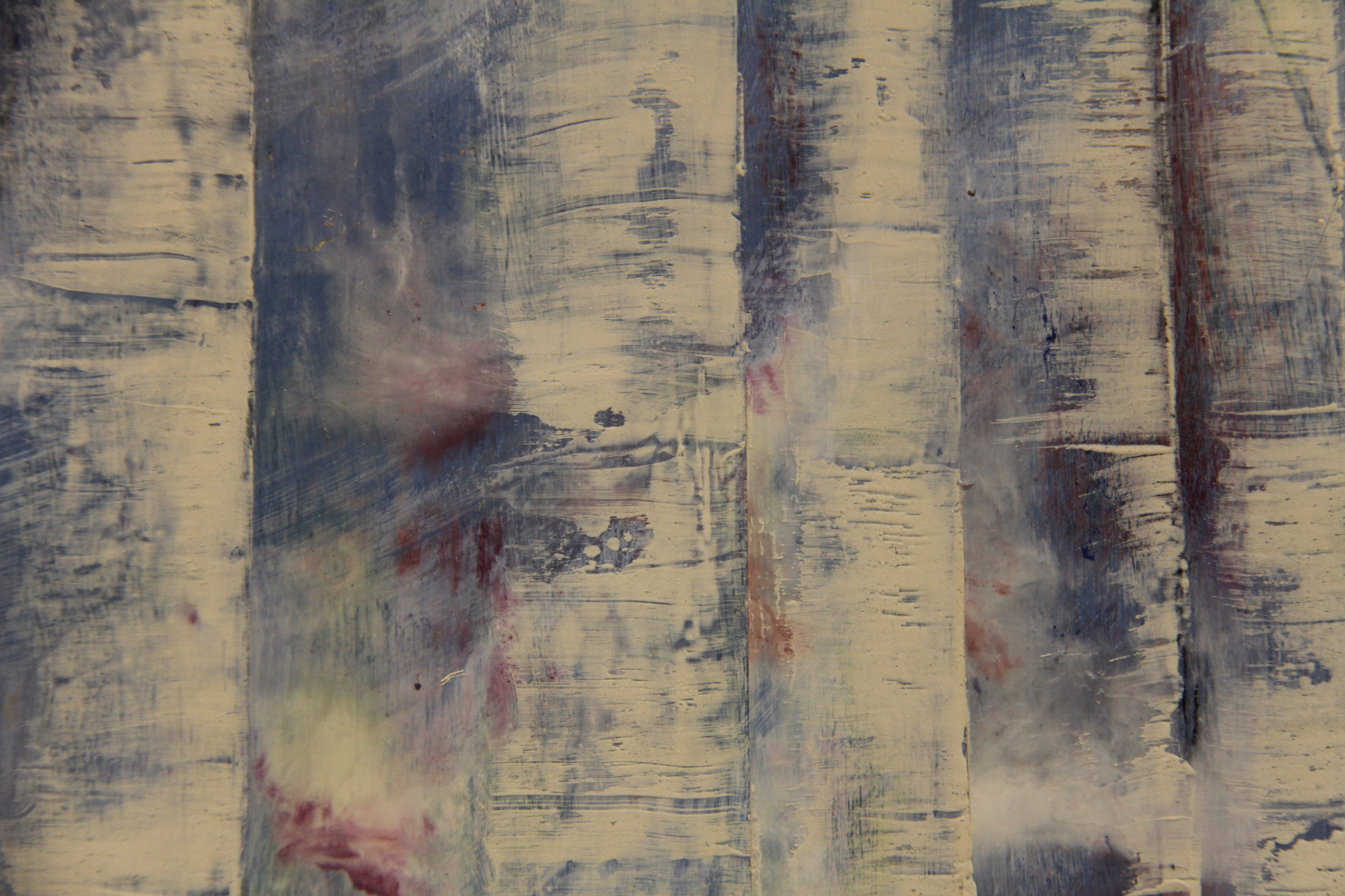
Barbara Bauer’s encaustic medium art inspired D.E. Green to write “Stand of Birches.” (Minnesota Prairie Roots copyrighted photo October 2025)

Promotional information about the FiftyNorth poetry and art collaboration, “Echoes & Shadows,” references a quote from poet Carl Sandburg: “Poetry is an echo, asking a shadow to dance.” Oh, how lovely those words. And how fitting for a collaboration that echoes and dances.

Pairings of poetry and art by Riki Kolbl Nelson, left, with poem by Chuck Huff and a barn painting by Robert Nyvall with accompanying poem, “We Are Older Now,” by Deb Muotka on the right. (Minnesota Prairie Roots copyrighted photo October 2025)

FYI: The “Echoes & Shadows” exhibit closes on October 31. To view the exhibit online, click here. Note that I photographed the art and poetry in this post with permission of FiftyNorth. In most cases, I’ve opted to show only part of the creative works. In featuring the poems, I’ve edited the images.

© Copyright 2025 Audrey Kletscher Helbling


My writing publishes in Minnesota literary anthology, again October 16, 2025

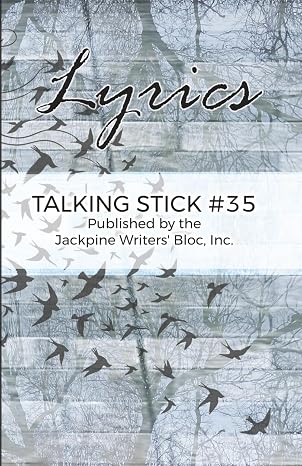
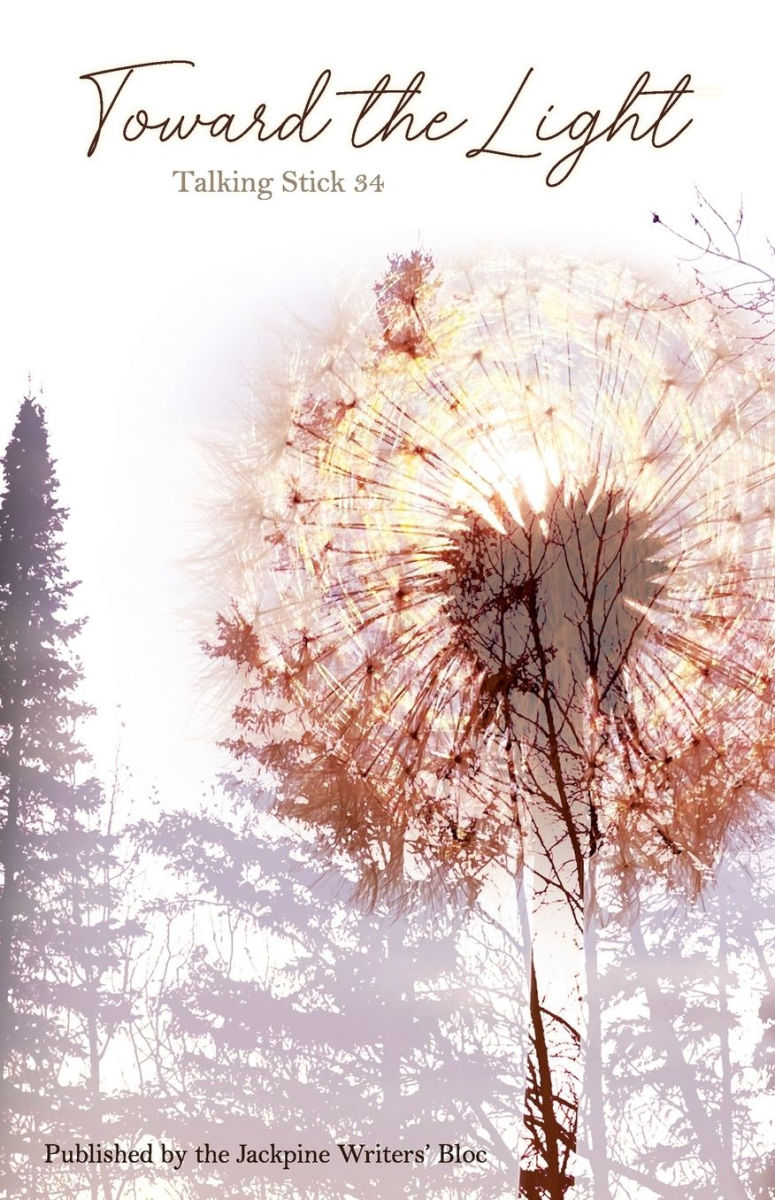
Two of my poems and a work of creative nonfiction are published in this literary anthology. (Book cover sourced online)

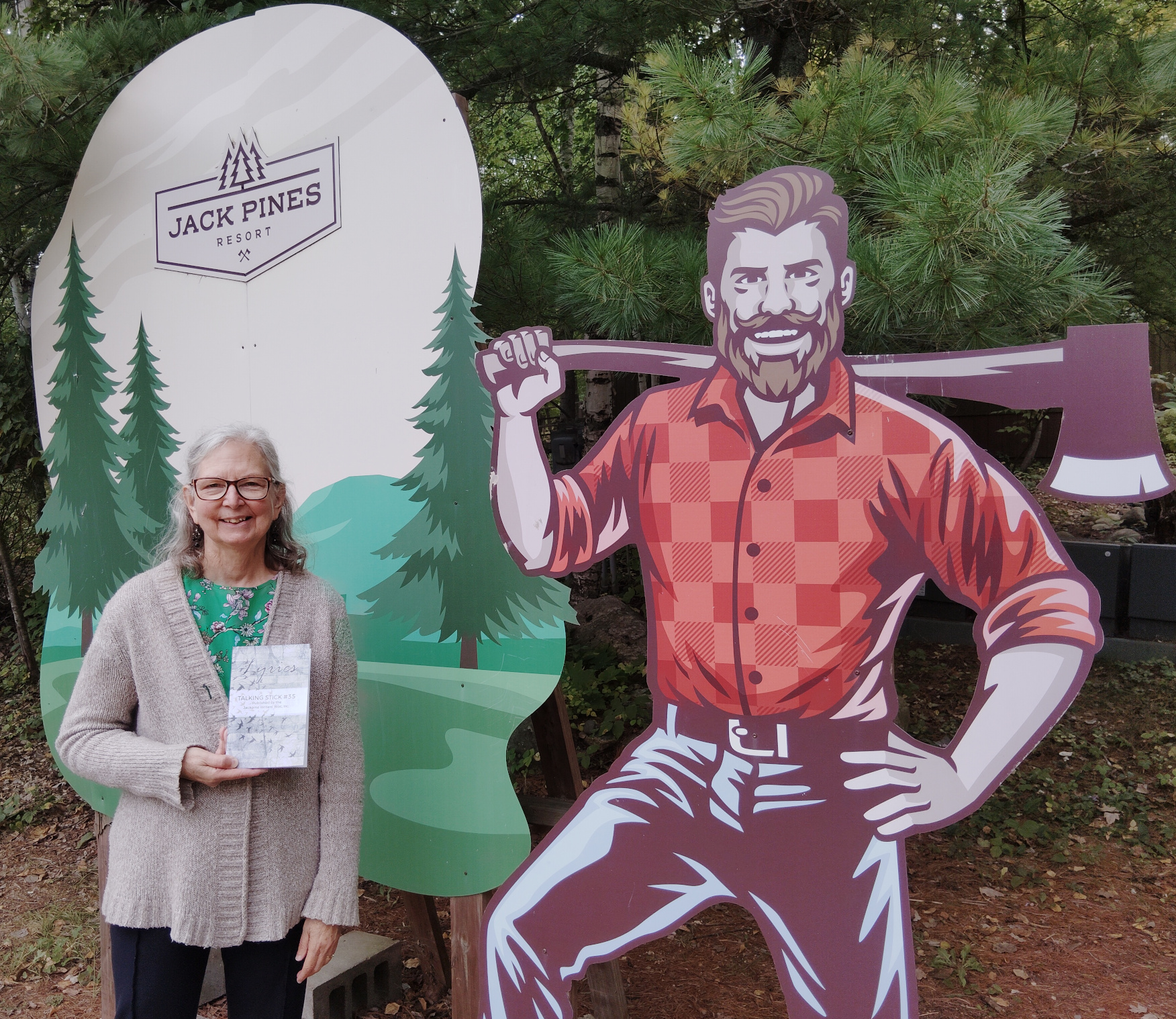
FOR THE 16thCONSECUTIVE YEAR, my writing has been selected for publication in the Talking Stick, a literary anthology published by the Jackpine Writers’ Bloc based in northern Minnesota.

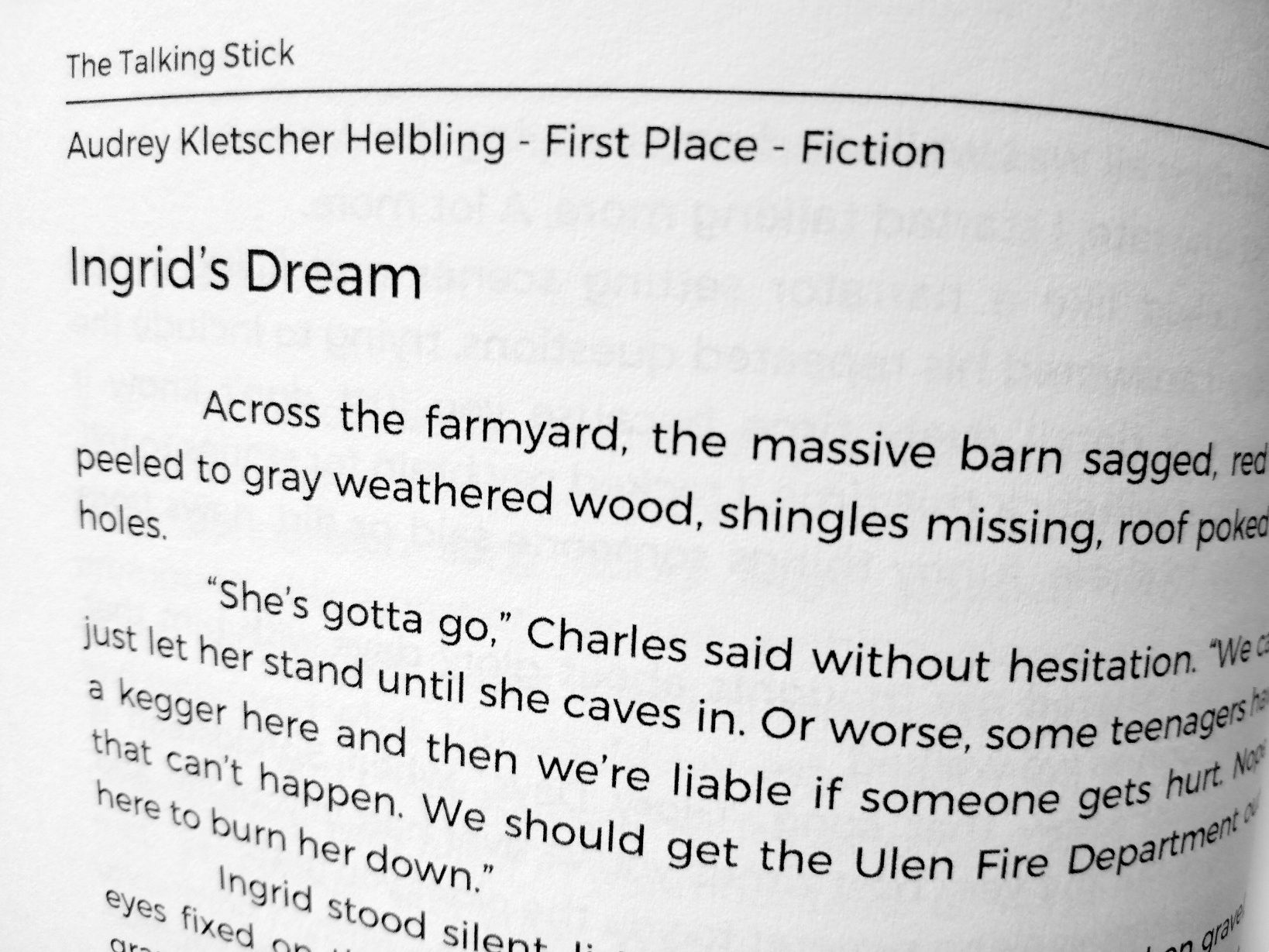
The editorial board chose two of my poems, “Up North at the Cabin” and “Where There’s Smoke, There’s Fire,” and a work of creative nonfiction, “Birthing Everett,” for publication in volume 34, titled Toward the Light. The recently-released book features 128 pieces of writing by 76 writers either from Minnesota or with a strong connection to the state.

I consider it an honor to be published in the Talking Stick, which includes the work of talented writers ranging from novice to well-known. I especially appreciate that entries are blind-judged so each piece stands on its own merits. There were 275 submissions from 119 writers for this year’s competition.

Grandpa Randy and grandchildren Izzy and Isaac follow the pine-edged driveway at the northwoods lake cabin. This is my all-time favorite cabin photo. (Minnesota Prairie Roots copyrighted file photo 2020)

I’m particularly excited about two of my pieces published in Toward the Light. Anyone who’s ever spent time at a lake cabin will enjoy my “Up North” poem as it centers on nature and family togetherness. I was in my sixties before I first experienced cabin life. Now I’m building memories with my grandkids each summer at a family member’s lake cabin. That centers this poem.

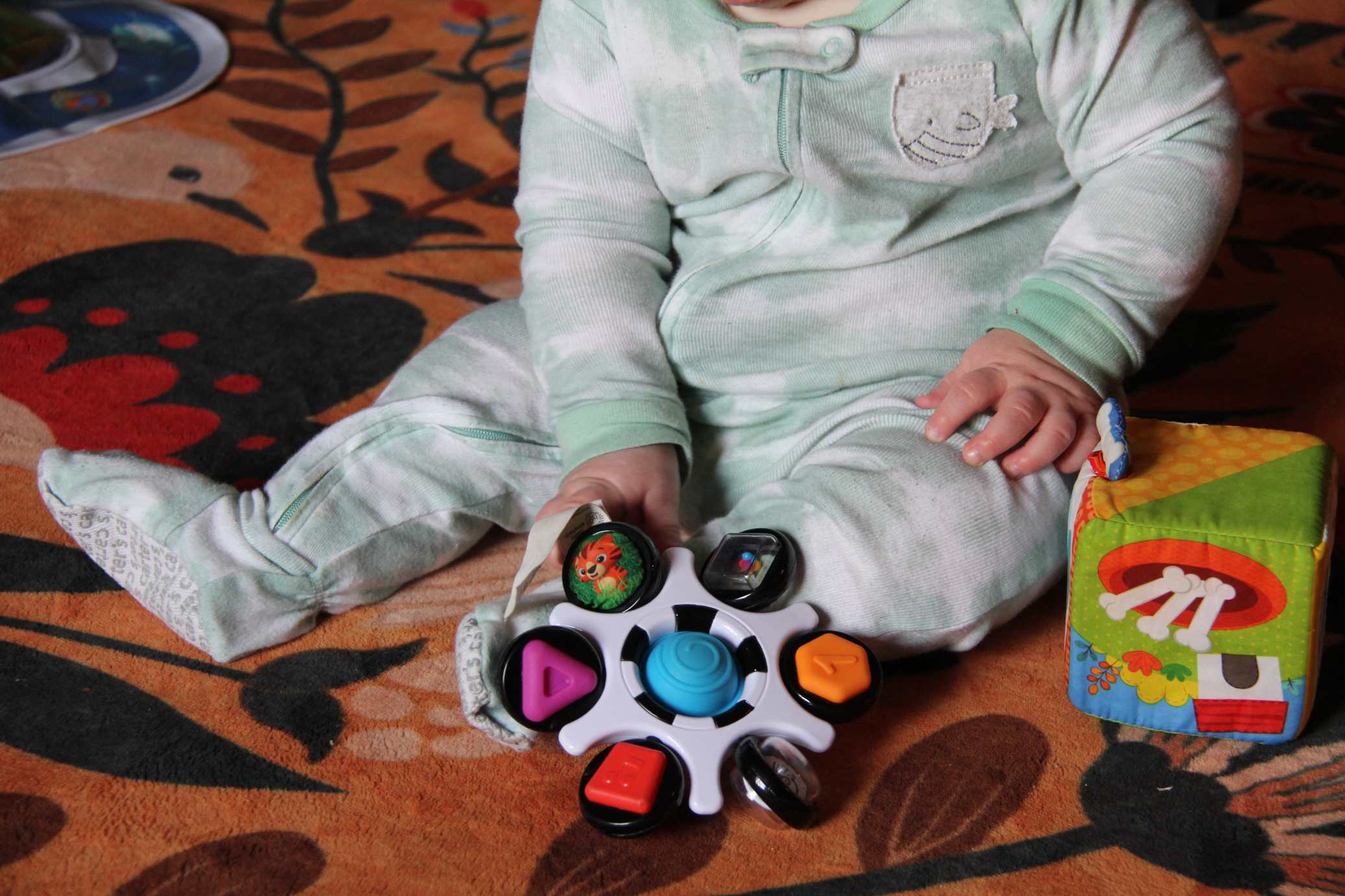
My grandson Everett, nine months old, plays with his toys in his Madison, Wisconsin, home. (Minnesota Prairie Roots copyrighted photo October 2025)

A grandchild also focuses “Birthing Everett,” a deeply personal story about the birth of my 10-pound grandson in January. My daughter Miranda nearly died during childbirth. I knew I needed to write about this to heal from my own trauma of nearly losing her. I will be forever grateful to the medical team at UnityPoint Health-Meriter Hospital in Madison, Wisconsin, for saving Miranda’s life. You just don’t think of women dying during childbirth any more, but it can, and does, happen.

My three recently-published works bring to 39 the total number of poems and short stories I’ve had printed in the Talking Stick. Toward the Light is available for purchase online by clicking here.

© Copyright 2025 Audrey Kletscher Helbling


Clearly I needed to write about homelessness & housing insecurity in Faribault…read on August 6, 2025

This poster inside Trinity Lutheran Church shows an architectural drawing of Ridgeview Heights and a Vacation Bible School mission fundraising goal for the housing project. (Minnesota Prairie Roots copyrighted photo August 2025)

ON MY WAY TO SUNDAY MORNING church services, I missed an opportunity to live my faith. Reflecting on that moment, I’m still uncertain what I could have done. But the guilt I feel about doing nothing at the time remains.

Let me set the scene. While driving to church, Randy and I dropped off some mail downtown. Up the hill from the post office, I noticed a parked car crammed with stuff. Someone clearly lived out of the vehicle, one I’ve previously seen. Then my eyes shifted to the adjacent street corner and an individual, cocooned in a bright gold blanket, sleeping atop a bench. And then we turned the corner.

“I should take a picture,” I told Randy, my mind already creating a story that would enlighten others about homelessness in Faribault. But then I quickly realized that taking a photo wouldn’t be particularly kind. And so we continued on to church.

Still, I couldn’t shake the image of that person stretched atop a bench along Central Avenue. I wondered about his story, why and how he found himself without a home. And I considered how vulnerable and exposed I would feel sleeping like that in a public place. Those thoughts followed me into church.

HOUSING FOR THE HOMELESS”

When I stepped inside the sanctuary, I immediately noticed a “Housing for the Homeless” poster near the organ. There are coincidences and then there are what I term “God moments.” And this, in my mind, was clearly divine. I’ve seen enough of these occurrences in my life to distinguish the two. God was assuredly nudging me to write on the topic of homelessness and housing insecurity in my community.
That sign in church was a promotional for the chosen mission of this year’s Vacation Bible School, which started that very evening at Trinity. Participants are donating their monetary gifts to Ridgeview Heights, an accessible, sustainable housing community to be built in downtown Faribault just blocks from the slumbering man on the bench. The VBS fundraising goal is $500.

That $500 may seem inconsequential considering the $2.5 million project cost. But every dollar helps in constructing the two buildings aimed at housing families with children, including those experiencing homelessness. Two of the eight units will serve as free emergency shelters and the other six will be market rate workforce units.

A COMMUNITY ACTS

The Community Action Center, which works collaboratively to alleviate hunger, homelessness and poverty among individuals and families in the community, is the lead on Ridgeview Heights. With an in-kind land donation from the city of Faribault, two grants, gifts, community donations and financing, the CAC is able to break ground at 4 p.m. today, August 6, for the much-needed two and three-bedroom units.

So first I saw the sleeping man, then the poster. And then came the sermon…with a directive that congregations ought to think, plan and act in ways that bless people. The guest pastor encouraged us not to think less of ourselves, but to think of ourselves less (a loose quote from C.S. Lewis). In other words, turn the focus outward on the community rather than inward to the church’s needs. The VBS kids will be doing exactly that this week with their “Housing for the Homeless” mission focus.


A FAMILY THAT CARES

Now you may think my story ends here. But it doesn’t. On July 28, I received a mass email about an upcoming Helbling family reunion. Organizers are changing things up this year by raffling items made by family members. One of several ways to qualify for a raffle entry is via a $5 charitable donation. All donations will go to the Community Action Center in Faribault with a dollar-for-dollar match from my eldest niece’s employer.

Truly, I was meant to write this story. I may have bypassed the man sleeping on the bench. But I got the message, loud and clear, that I needed to write about homelessness and housing insecurity in Faribault. I’ve seen the tents pitched along the river, beside train tracks, behind evergreen trees, next to a park. I’ve seen the homeless in the library, sleeping in the Central Park bandshell, biking and walking about town, including past my house. I am aware of the long waiting list for emergency shelter. Even if I failed to “do” something, I can raise awareness through my writing. And by doing that, perhaps I am helping in some small way to bless my community, including the man sleeping on a bench in the heart of downtown Faribault on a Sunday morning.

© Copyright 2025 Audrey Kletscher Helbling


Words that resonate from Northfield poet Becky Boling April 24, 2025

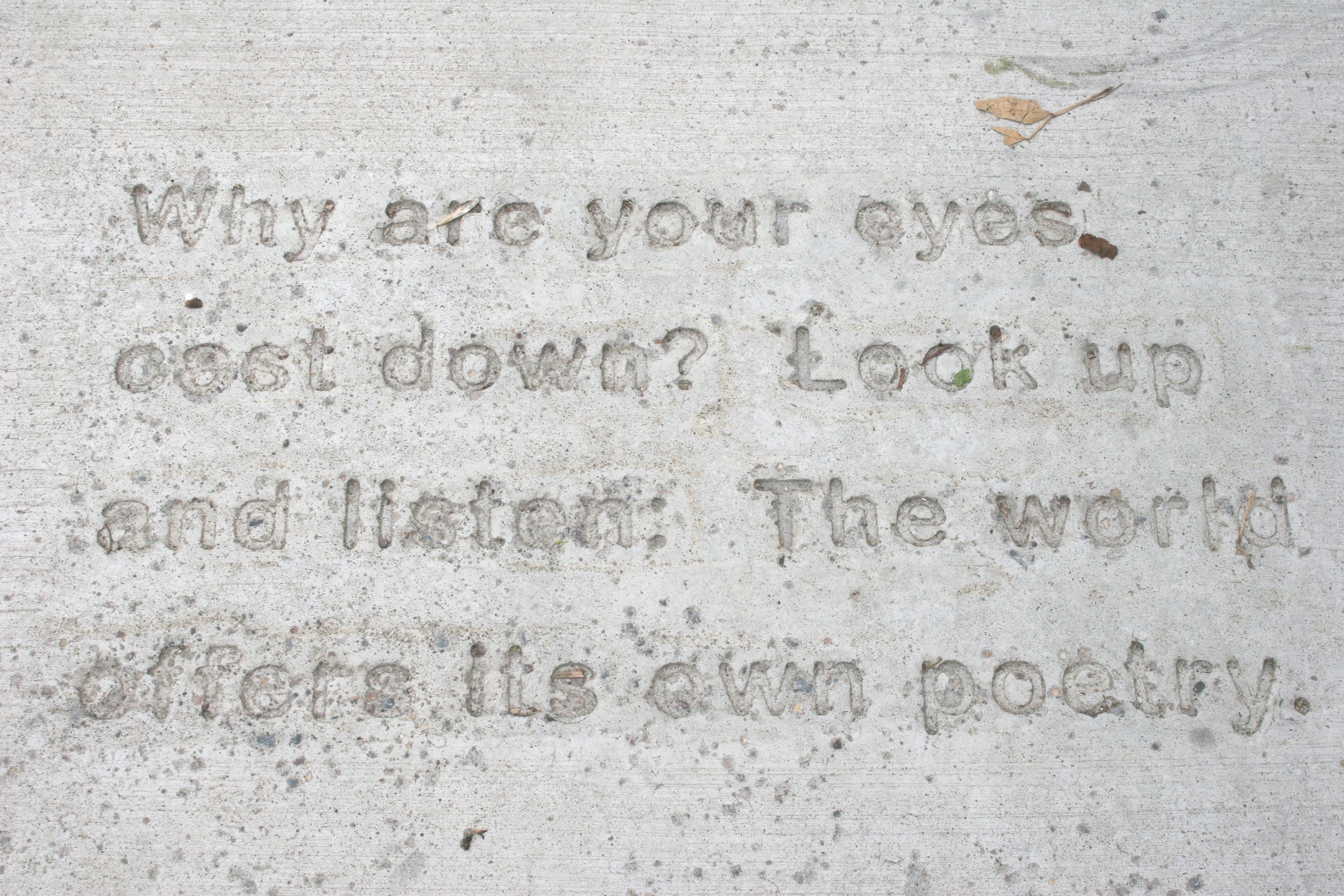
Sidewalk poetry in downtown Northfield, Minnesota, carries a powerful message. (Minnesota Prairie Roots copyrighted file photo)

I DON’T READ MUCH POETRY. I probably shouldn’t admit that given I’m a published poet. But I suspect most of you also are not big poetry readers. Yet, we all should be, especially me.

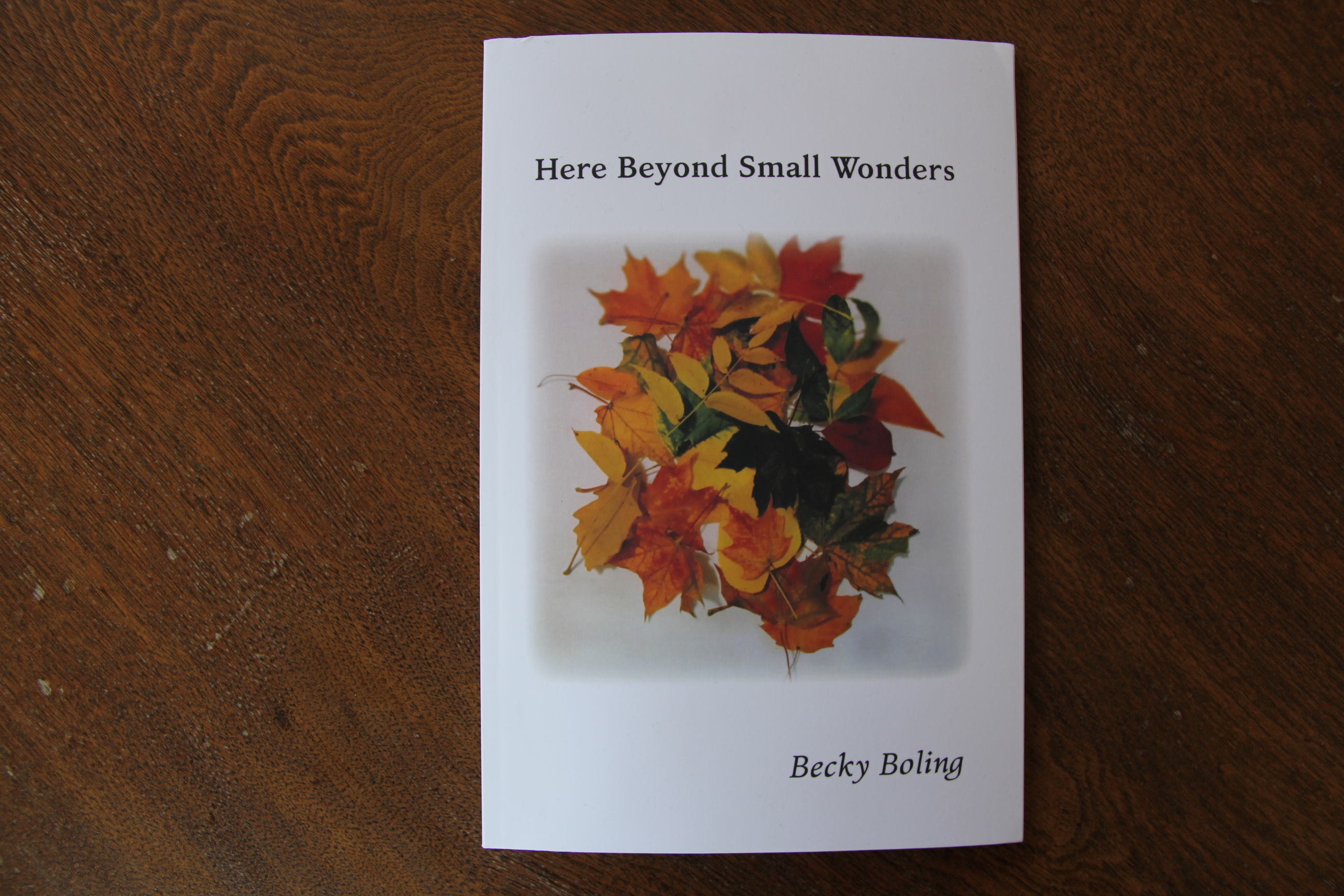
Becky Boling’s recently-released first collection of published poetry. The cover features the poet’s artwork. (Minnesota Prairie Roots copyrighted photo April 2025)

Poetry offers a creative way to view the world, to experience life, eliciting a whole range of emotional responses that connect us to each other, to the earth, to the past and present, and much more. I get excited when I discover a poet whose work truly resonates with me. And that would be the poetry of Northfielder Becky Boling.

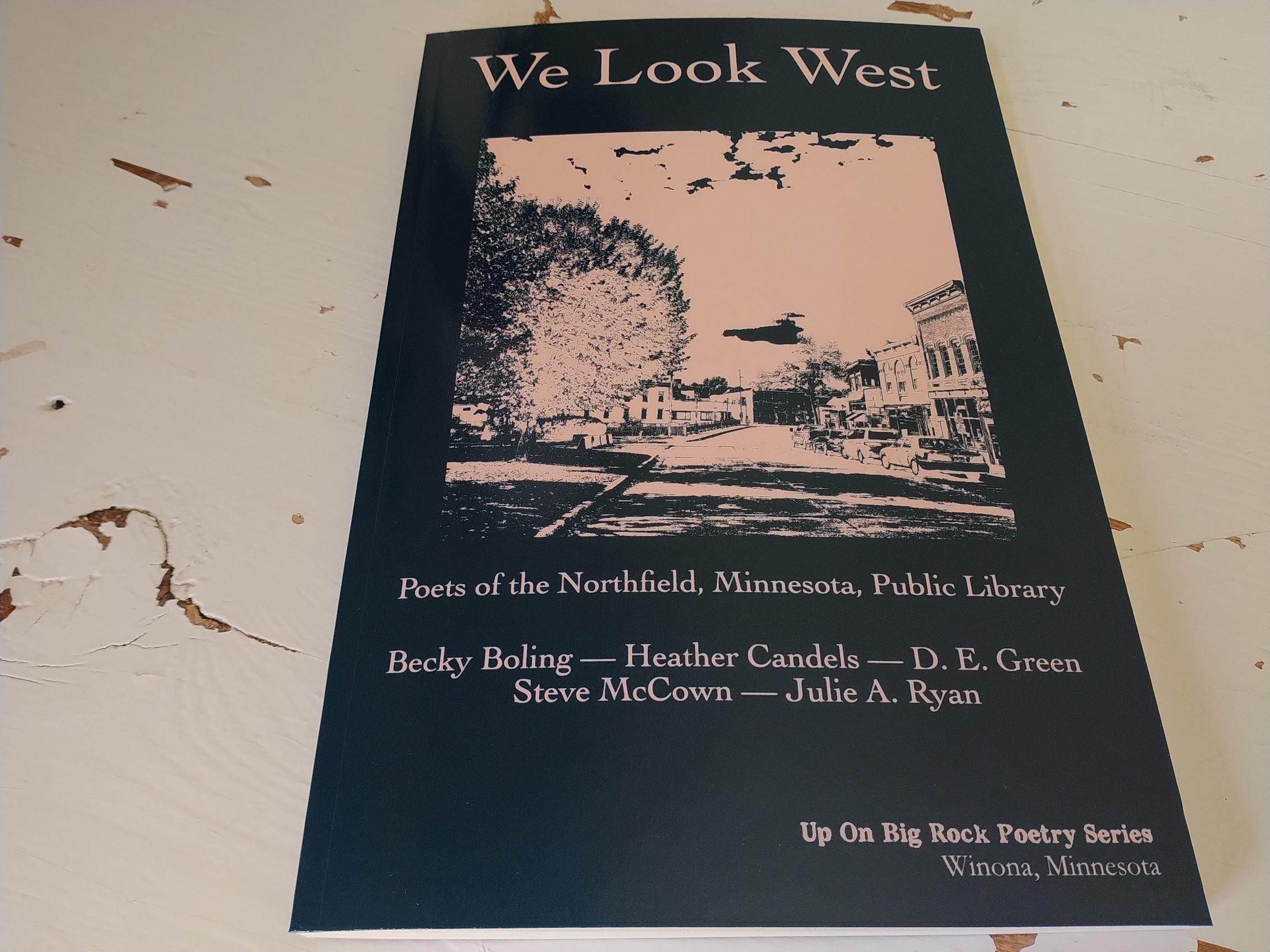
We Look West was published in early 2024 by Shipwreckt Book Publishing Company. (Minnesota Prairie Roots copyrighted file photo 2024)

A year ago, I met Boling when she dropped off a copy of the anthology, We Look West, a collaboration of the Poets of the Northfield Public Library. It includes her work and that of four other talented poets. I love the collection which takes the reader from the sunrise to the sunset of life. The poetry therein is so understandable and relatable.

A box holds bagged poems included in the “Poetry in a Bag” project. (Minnesota Prairie Roots copyrighted file photo 2024)

In May 2024, Boling, I and several other poets participated in a community poetry reading for the “Poetry in a Bag” project coordinated by Mercado Local, a Northfield marketplace for immigrants. Our poems were printed, rolled and bagged before distribution within our communities.

I would see Boling again in September 2024, when she and the other Northfield poets read from We Look West at Books on Central, a Rice County Area United Way used bookshop in Faribault.

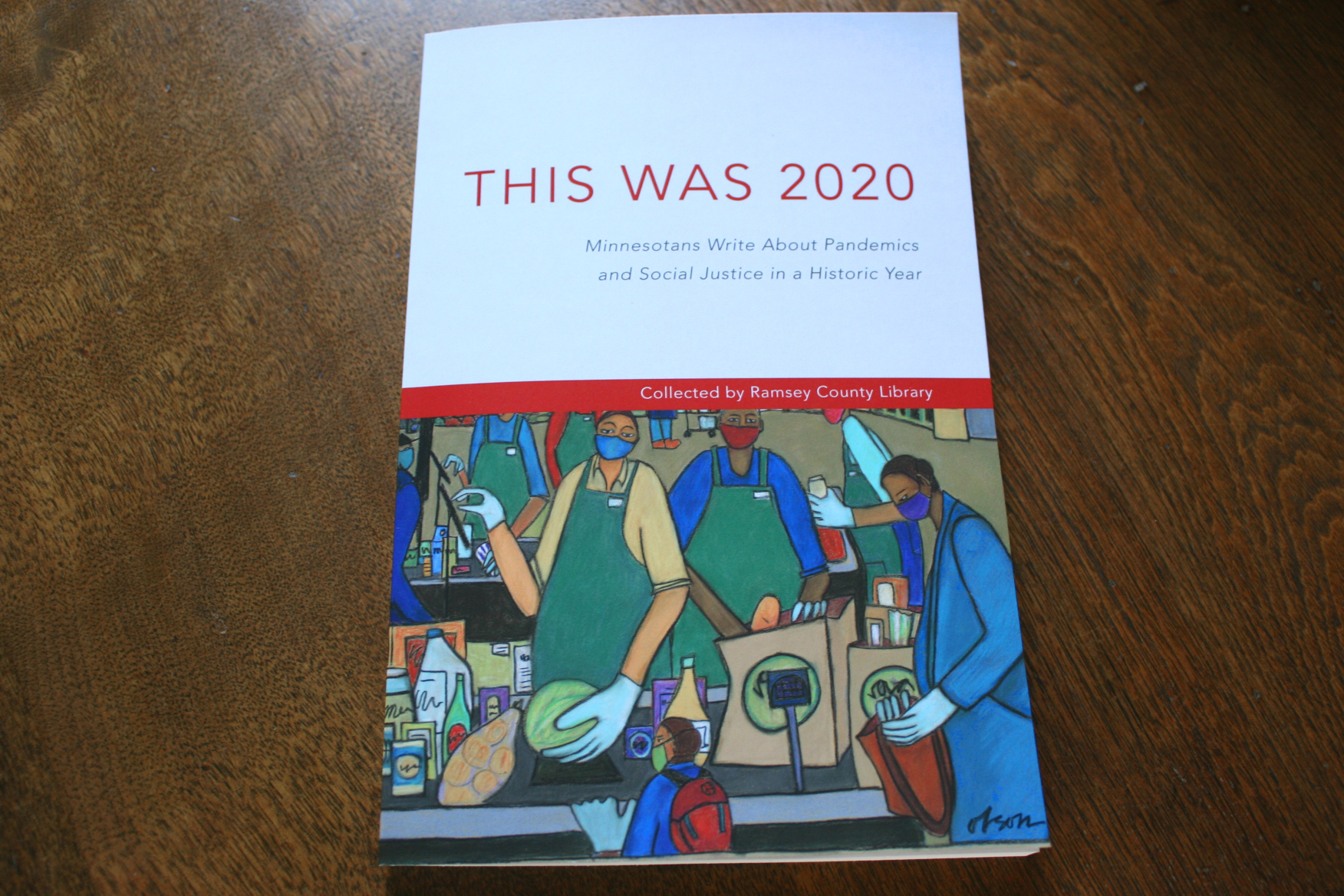
Selected prose and poetry about the pandemic and social justice issues were published by the Ramsey County Public Library in this anthology. (Minnesota Prairie Roots copyrighted file photo)

Somewhere along the line, I discovered that Boling’s “Pandemic Haiku” had published in This Was 2020—Minnesotans Write About Pandemics and Social Justice in a Historic Year. My poem, “Funeral During a Pandemic,” was chosen for publication in that same anthology during a competitive process. That book would go on to win the 2021 Minnesota Author Project Award in the Communities Create category.

The poetry of Becky Boling in her first published collection featuring 37 of her poems. (Minnesota Prairie Roots copyrighted photo April 2025)

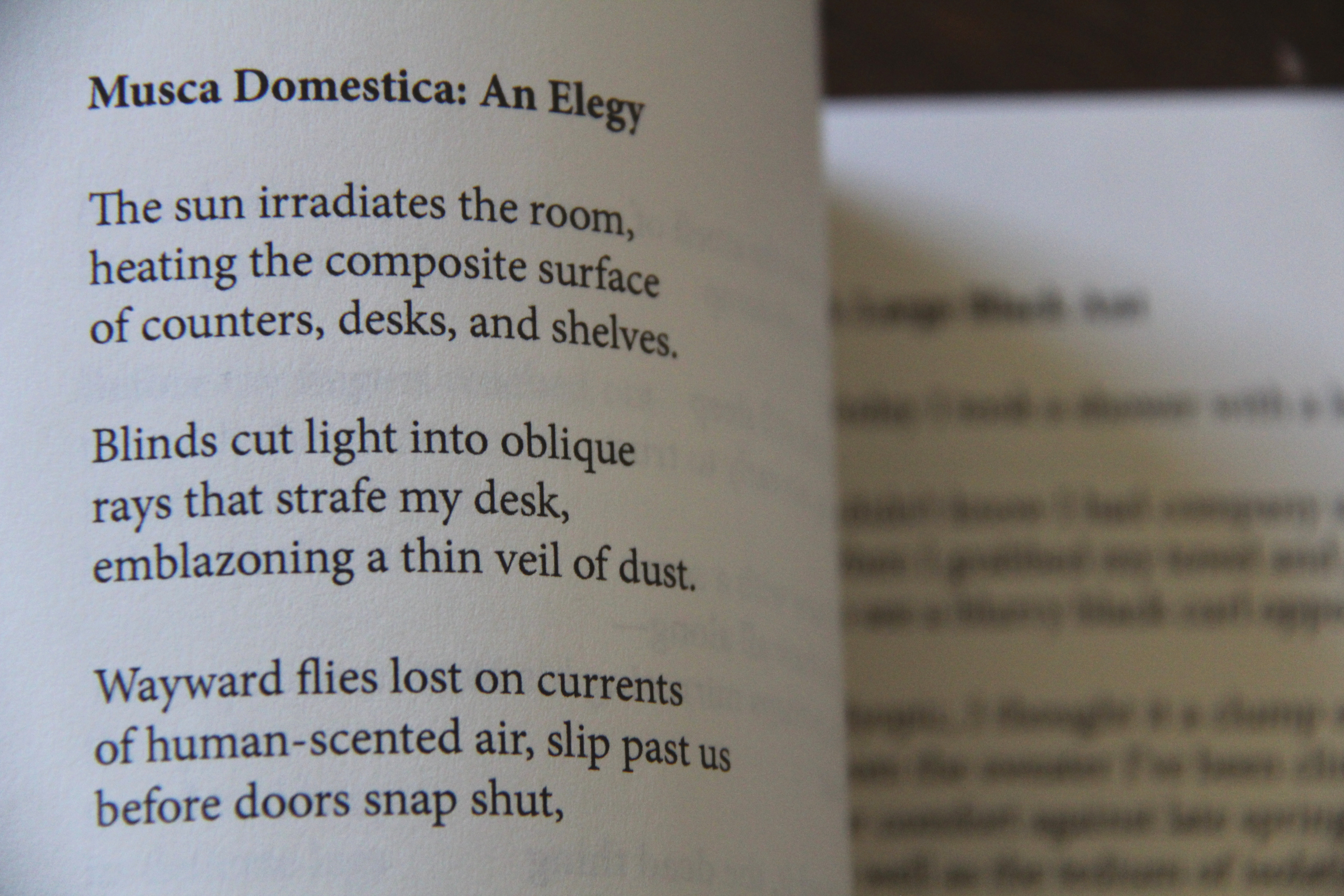
Because of those shared experiences, shared publications and shared love of words, I feel a sisterhood with Boling. So when she asked if I wanted a copy of her first solo poetry collection, I responded with an enthusiastic, “Yes!” Within the pages of Here Beyond Small Wonders, I found what I’ve come to expect from Boling—detailed writing, often about the most ordinary subjects—a dead mouse, a fly, walnuts… Topics you may not even consider poetry-worthy. But Boling has this ability to observe and engage all of her senses to craft words into connective, meaningful poetry.

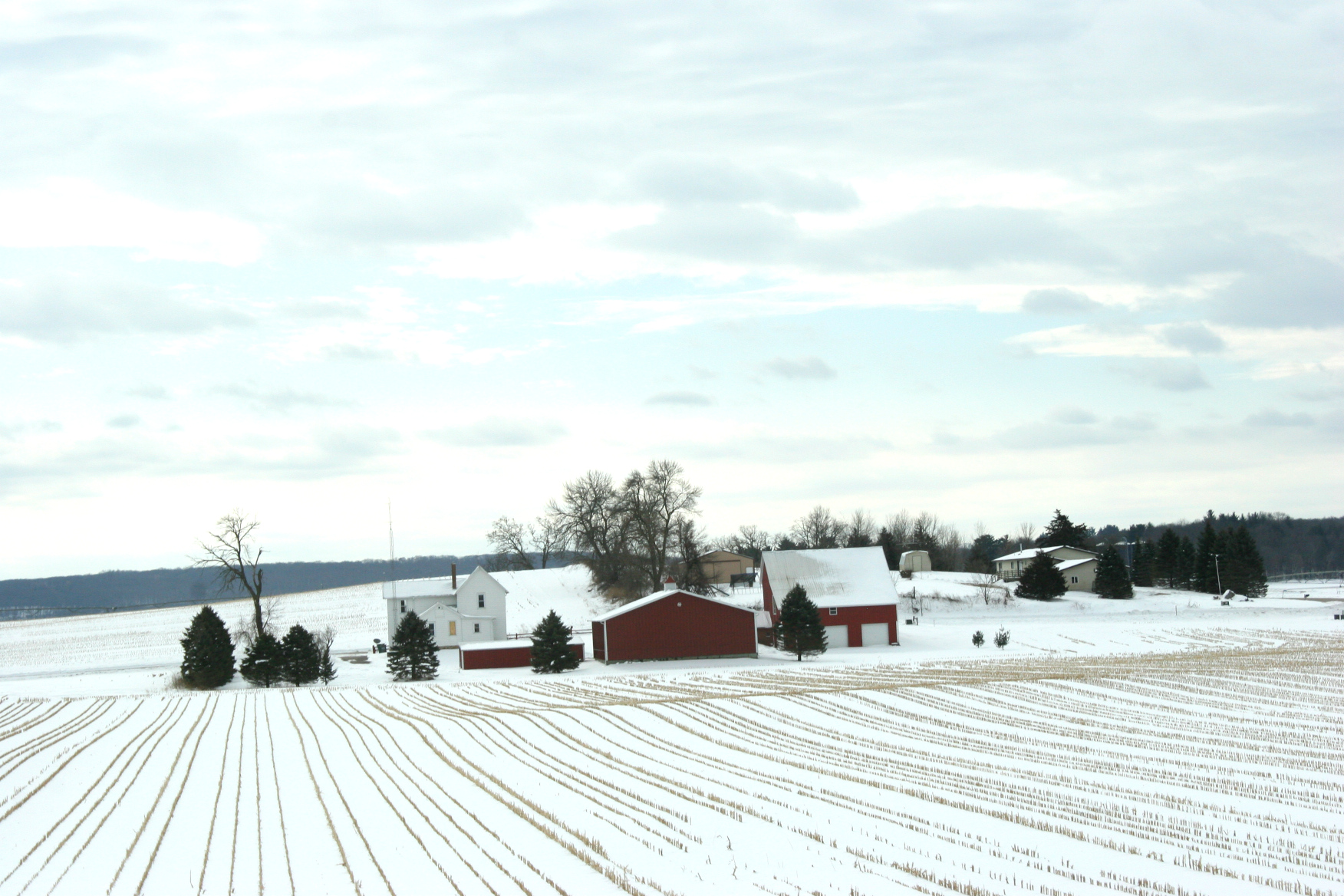
A Wisconsin farm site photographed from Interstate 90 could be a poetry prompt. (Minnesota Prairie Roots copyrighted file photo)

In her poem “Snow Pond,” she defines poetry: Poetry, like freezing temps, seizes the moment, recasts it—through the physics of sight, memory, language—resurrects it anew into patterns, sound and light, marks on a snowy page that glisten and melt on tongue, alight on the inner eye. That definition of poetry is among the best I’ve read, because it is poetry.

Clothespins on my clothesline clip clothing, not beach towels. (Minnesota Prairie Roots copyrighted file photo)

Anyone who writes poetry recognizes the challenges of finding just the right word, of stringing words together in a new, creative and succinct way, of connecting on an emotional level. But Boling makes the process look easy, taking the reader along with her, whether into her yard or onto the sandy shores of Lake Michigan. In her poem “Clothesline,” she writes of beach towels dancing in the wind. She takes the reader to the beach, to the sights, scents and sounds along the inland sea. I feel her fingertips unclipping the dried towels at end of day as she gathers them like weary babes into my open arms. I did not see that end coming. That element of surprise is, too, a mark of a gifted poet.

Kid-sized Adirondack chairs on a Minnesota beach. (Minnesota Prairie Roots copyrighted file photo)

Her “Adirondack Chair in Snow” is another favorite of mine in Boling’s collection of 37 poems published by Finishing Line Press. She writes of the typically-lakefront chair wedged into a snowbank outside her mother’s apartment building. But this poem is about so much more than an out-of-place chair buried in snow. Boling uses personification to write about her mother. In those six verses, I found myself missing my own mom, who died during the pandemic in January 2022. Boling’s emotions, my emotions, weave together in her writing and in my reaction.

My own artsy autumn leaf image, of leaves in the Cannon River. (Minnesota Prairie Roots copyrighted file photo)

In one of her longest poems, Boling writes about the transition to autumn in “Persephone’s Bouquet.” Unfamiliar with this Greek goddess, I learned that Persephone’s descent into the underworld is associated with the start of winter. Autumn themes Boling’s poem as the author gathers hot-pepper reds, creamy yellows…brazen scarlet…leaves, something I also enjoy doing in fall. But this is a poem about life, too, not just about a change in seasons. Plus, the poem connects to the cover of Here Beyond Small Wonders, Boling’s own autumn leaf art.

Her first collection of poems is about nature and place and seasons and life. Moments experienced. Details noticed right down to a tar-dark county roadhorse flies, green heads glistening in the sunreedy breath trembling into song. Boling, in her words, opens herself to a pool of words. And I, for one, embrace her poetic writing.

#

FYI: Becky Boling is a retired professor of Spanish and Latin American literature at Carleton College in Northfield. Her poetry and prose have been widely-published in literary journals and anthologies. She also served as a Co-Poet Laureate of Northfield. Click here to find Here Beyond Small Wonders on the Finishing Line Press website.

© Copyright 2025 Audrey Kletscher Helbling


Celebrating poetry during April, National Poetry Month April 3, 2025

The Riverwalk Steps Poem alongside the Cannon River in the heart of downtown Northfield. (Minnesota Prairie Roots copyrighted file photo)

I FEEL FORTUNATE to live in an area of Minnesota which values poetry. Some 20 minutes away in Northfield, poems imprint upon concrete throughout the city as part of the long-time Sidewalk Poetry Project. Along the Riverwalk, a poem descends steps. In the public library, a poem graces the atrium.

Sidewalk poetry in downtown Northfield carries a powerful message. (Minnesota Prairie Roots copyrighted file photo)

But that’s not all in Northfield. This city of some 21,000 has a poet laureate, currently Russ Boyington, who fosters poetry, organizes and publicizes poetry events, and leads an especially active community of wordsmiths. These are published poets, serious about the craft.

This anthology published in 2024. (Minnesota Prairie Roots copyrighted file photo)

Five seasoned Northfield poets recently collaborated to publish a collection of their work in We Look West. Even if you think you don’t like poetry, you will find something in this anthology which resonates. These poets take the reader through the seasons of life with humorous, sad, nostalgic, reflective and introspective poems. This anthology is especially fitting for anyone closer to the sunset, than the sunrise, of life.

A serene country scene just north of Lamberton in southern Redwood County on the southwestern Minnesota prairie. (Minnesota Prairie Roots copyrighted file photo)

April, National Poetry Month, marks a time to celebrate poets like those in Northfield and beyond. In my own community of Faribault, we have an especially gifted poet, Larry Gavin, a retired high school English teacher and writer. He’s published five collections of his work. Larry writes with a strong sense of place, his poems reflective of his love of nature, of the outdoors. A deep love of the prairie—he attended college, then lived and worked for a while in my native southwestern Minnesota—connects me to this remarkable poet. Plus, Larry has the rich voice of a poet, which makes listening to him read his poems aloud an immersive, joyful experience.

A chamber choir, directed by composer David Kassler, performs artsongs written from poems in 2017, mine included. (Minnesota Prairie Roots copyrighted file photo)

I, too, write poetry and am a widely-published poet, although certainly not as much as many other Minnesota poets. From anthologies to a museum, from the Mankato Poetry Walk & Ride to poet-artist collaborations, billboards and more, my poems have been out there in the public sector. Perhaps the most memorable moment came when a chamber choir performed my poem, “The Farmer’s Song,” during two concerts in Rochester in 2017. David Kassler composed the music for the artsongs.

Two of my rural-themed poems are included in an exhibit, “Making Lyon County Home,” at the Lyon County Historical Society Museum in Marshall. (Minnesota Prairie Roots copyrighted file photo)

Poetry has, I think, often gotten a bad rap for being stuffy, difficult, too intellectual and unrelatable. And perhaps it was all of those at one time. Butt that’s not my poetry. And that’s not the poetry of Larry Gavin or of the five We Look West Northfield poets or most poets today. The poetry I read, write and appreciate is absolutely understandable, rich in imagery and rhythm, down-to-earth connective.

My most recent poem selected for the Mankato Poetry Walk & Ride. Poets must follow character and line limits in writing these poems. This is a competitive process. (Minnesota Prairie Roots copyrighted file photo)

When I write poetry, I visualize an idea, a place, a scene, a memory, an emotion, then start typing. The words flow, or sometimes not. Penning poetry is perhaps one of the most difficult forms of writing. Every word must count. Every word must fit the rhythm, the nuances of the poem in a uniquely creative way.

Not the pancakes Grandpa made, but the pancakes and sausages made at the annual Faribault Lions Club Pancake Breakfast. (Minnesota Prairie Roots copyrighted file photo)

One of my most recent poems, “Pancakes with Grandpa,” was inspired by an exchange between my husband, Randy, and our grandson Isaac, then four. It was printed in Talking Stick 32—Twist in the Road, an anthology published in 2023 by northern Minnesota based Jackpine Writers’ Bloc. It’s a competitive process to get writing—poetry, fiction and creative nonfiction—in this collection.

So, in celebration of National Poetry Month, here’s my pancake poem, penned by a poet who doesn’t particularly like pancakes.

Pancakes with Grandpa

Batter pours onto the hot griddle,

liquid gold spreading into molten circles

molded by the goldsmith.

The collectors eye the coveted coins

that form, bubble, solidify

in the heat of the electric forge.

Appetite fuels imagination

as Grandpa’s coins fire

into golden brown pancakes.

Piled onto a plate, peanut butter spread,

syrup flowing and a nature lesson

in maple tree tapping.

The four-year-old forks the orbs.

“Peanut butter pancakes make me happy!”

he enthuses to the beaming craftsman.

© Copyright 2025 Audrey Kletscher Helbling


The craft of writing creatively, from idea to story February 11, 2025

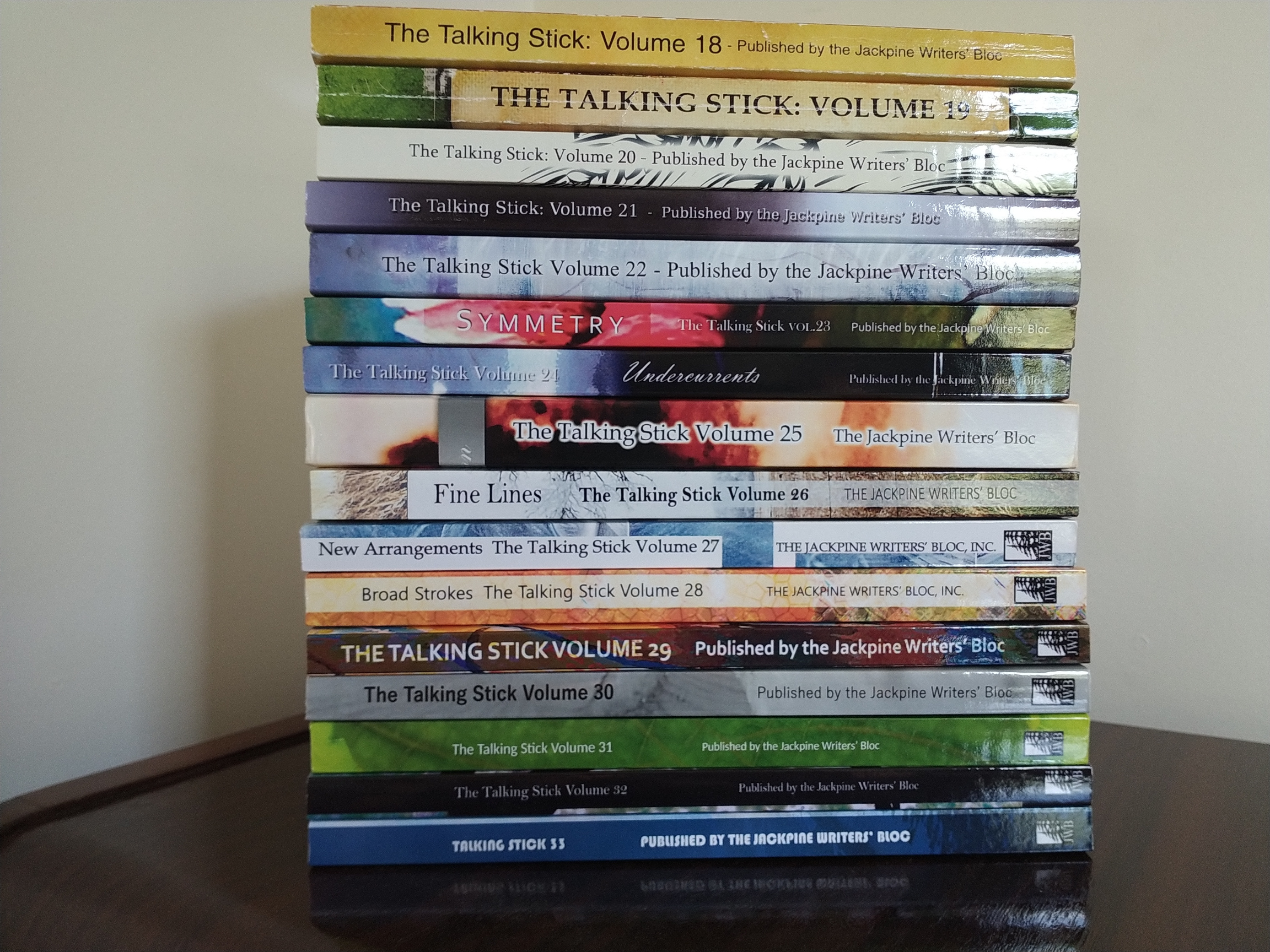
My fiction, creative nonfiction and poetry has published in all these volumes of The Talking Stick, plus volumes 32 and 33 not pictured here. (Minnesota Prairie Roots copyrighted file photo)

WITH ONLY WEEKS until the deadline for an annual writing contest, I am stretching my mind to come up with short stories and poetry that will please not only me, but also the editors of a Minnesota-based literary anthology. It’s not easy, this creative writing. Yet, I enjoy the challenge.

I can’t always explain from whence my fictional stories spring. I’ve written some really dark stuff that has landed me publication and sometimes prizes. Stories with undertones of darkness and violence. Nothing like I’ve experienced in real life, although certainly I’ve faced plenty of dark and trying days.

When I read my second place winning fictional story, “Dear Mother,” at last fall’s Talking Stick 33—Earth Signs book launch party in northern Minnesota, I qualified my reading with “I don’t know where this dark story came from.” It was implied that the main character killed her abusive mother. The writer who followed me as the first place winner in fiction also wrote a dark story. I don’t recall if Tara or some other writer explained that, in order to reach the light, we need to go through darkness. That resonated with me.

The beginning of “Barbershop Prompt,” published in Talking Stick 31–Escapes. (Minnesota Prairie Roots copyrighted file photo)

I’ve completed the initial draft of my first piece of fiction for this year’s contest. It, too, includes some dark elements. The community calendar in my local newspaper prompted the story, which I realize may seem rather odd. But, hey, inspiration can strike in the most unlikely of places. A previous work prompted by a sign at Bridge Square Barbers in Northfield earned me a second place in creative nonfiction in 2022.

Now three years later, with the printed community calendar of events lying on my office desk, I glanced from newspaper to computer screen as the idea of a story began to take shape. Once I finished the intro, words began to fly (OK, admittedly not always) from my brain to the keyboard to the screen. The draft is saved, awaiting a second look in a few days.

This sharing library in Pine River is inspiring my next creative work. (Minnesota Prairie Roots copyrighted photo July 2024)

Now I’m on to my next piece of writing. A photo I took of a sharing library (like a Little Free Library) in Pine River is serving as my inspiration for a story that has yet to unfold. But I see the possibilities in the many love-themed/titled books shelved inside that library adorned with a Peace/Love/Books sticker.

Romeo and Juliet by Shakespeare. Lunkers Love Nightcrawlers, author unknown to me. Tuesdays with Morrie by Mitch Albom, packed with life lessons, including that of love. Sin Killer by Larry McMurtry, a book of adventure, humor and romance on the American frontier. And then Absolute Power by David Baldacci, about a President “caught” with a billionaire’s wife. That title seems so relatable to today. Absolute power. But writing contest rules call for no political or religious rants, meaning I will need to steer clear of politics.

And so I’ll see where this idea goes. If a plot develops in my mind, if a story flows into something that may, or may not, be dark.

© Copyright 2025 Audrey Kletscher Helbling