Minnesota Prairie Roots

Writing and photography by Audrey Kletscher Helbling

Honoring mothers, including mine, on Mother’s Day May 7, 2026

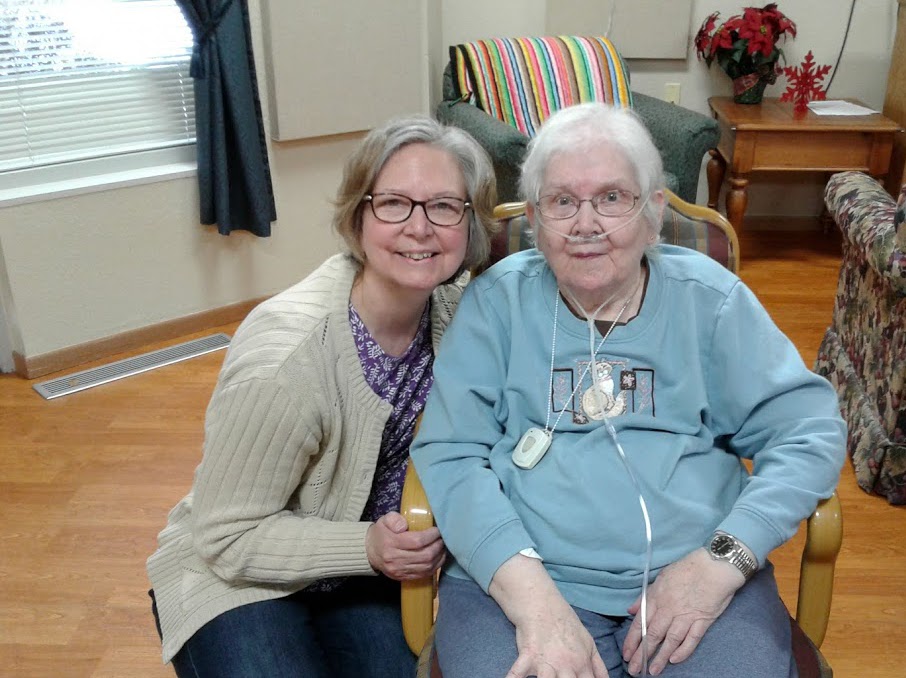
A photo of me with my mom taken several years before her death in 2022. (Minnesota Prairie Roots copyrighted file photo by Randy Helbling)

AS MY FIFTH MOTHER’S DAY without my mom approaches, I’m thinking of her, missing her, remembering her.

She lived a long life, living until nearly ninety, something none of us expected given her heart issues. Several times we were called to her hospital bedside to say goodbye. I remember one instance when Mom was not expected to make it through the night. The next morning she woke up much-improved and told us, “I guess God wasn’t ready for this stubborn old lady.”

I’ll never forget that. But I would argue that Mom was not stubborn. She was kind, caring, compassionate, loving and patient. With six children, she had to be patient. I raised three children and understand the patience required of mothers.

We all hold memories of our moms—positive, negative and otherwise. Moms, like all of us, are imperfect. But they try. They do their best.

Mom’s journals. (Minnesota Prairie Roots copyrighted file photo)

And sometimes they leave us a gift that offers glimpses into their lives. My mom left a stack of notebooks journaling her life from 1947-2014 with a few years missing. These are not diaries with personal feelings and thoughts expressed, but rather a documentation of daily life.

I treasure these notebooks filled with her handwritten observations and notes about life in rural southwestern Minnesota. Hard work filled her days. I pulled out her stenographer’s notebook dated 70 years ago to learn what she was doing in the 10 days before my birth.
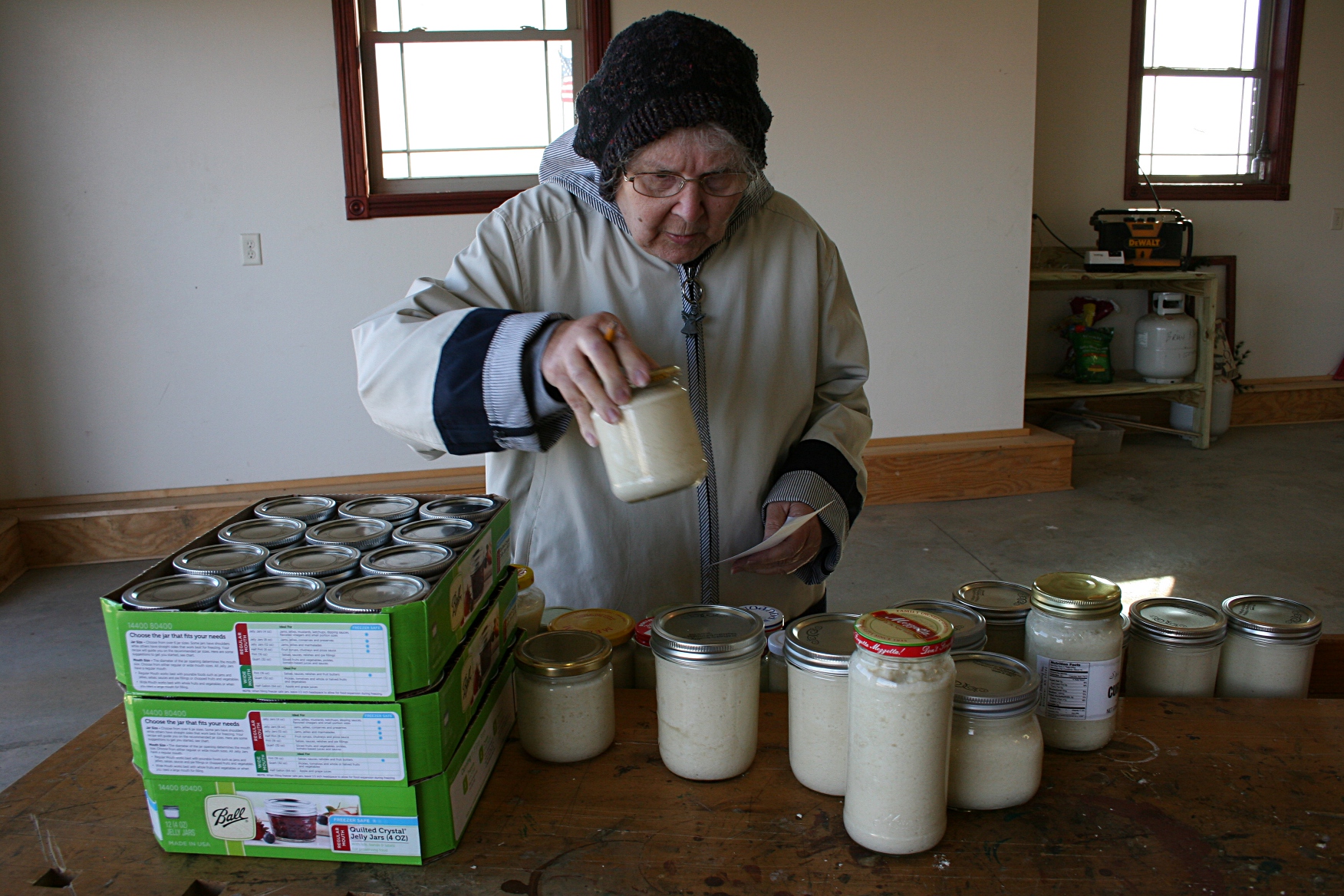
Even into her senior years, Mom was still working, supervising a family horseradish-making event and then counting jars of the condiment. (Minnesota Prairie Roots copyrighted file photo 2012)

There was the usual washing clothes in the Maytag wringer washer, mending, housecleaning, baking and preparing meals. But Mom also picked grapes with my dad, made grape juice the next day and the following day made 32 jars of grape jelly and 18½ quarts of tomato juice. And she was only days away from delivering me.

The day before I was born, Mom dusted floors, baked bread and cherry nut cake, took 13 dozen eggs into town and then celebrated her wedding anniversary with her in-laws. I’m tired simply reading that list of work she accomplished while nine months pregnant.

At 3 a.m. the next morning, Mom awoke in labor and arrived at the Redwood Falls hospital at 4:20 a.m., giving birth to 8 lb 12 oz. me 36 minutes later. That’s cutting it close, in my opinion. But when you go into labor in the early morning, need to get your one-year-old son to his grandparents’ house, and then travel 20 miles to the hospital, well, the time lapse seems reasonable.
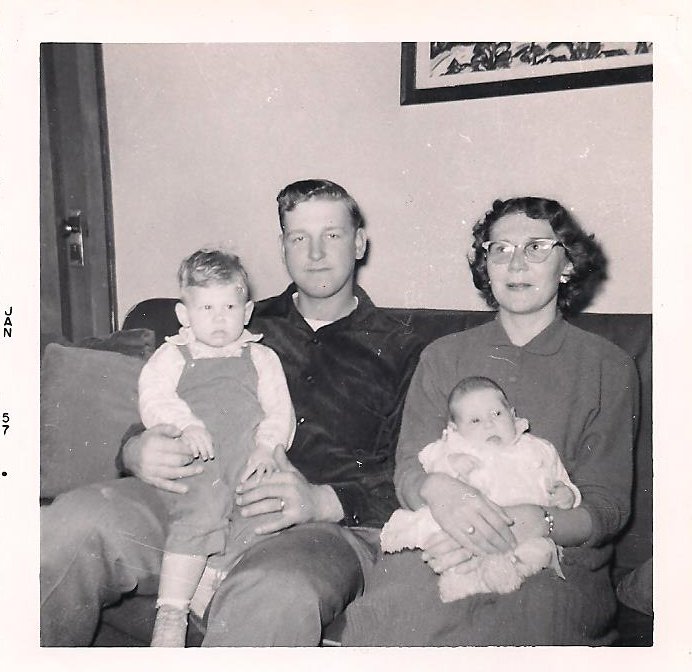
The only photo I have of my parents, Elvern and Arlene, with me as a baby. My dad is holding my oldest brother, Doug. (Minnesota Prairie Roots copyrighted photo)

Six days after my birth, Mom returned home. I should note here that on her fifth day in the hospital, Mom wrote, “Days are plenty long.” I suppose for a woman used to being busy all the time, lying around proved difficult. But she should have enjoyed the respite from work while she could.

Shortly, Mom was back in full work mode, not only caring for a newborn and a one-year-old and doing other routine household chores, but also feeding a crew of men picking corn on the farm for several days running.

Oh, how I admire this generation of Minnesota farm women who fed and cared for their families and others without the modern conveniences of today. No automatic washer, dryer, dishwasher, microwave. No bathroom or phone in our old farmhouse. Food came mostly from the farm, not the grocery store. And that meant gardening and putting up produce.
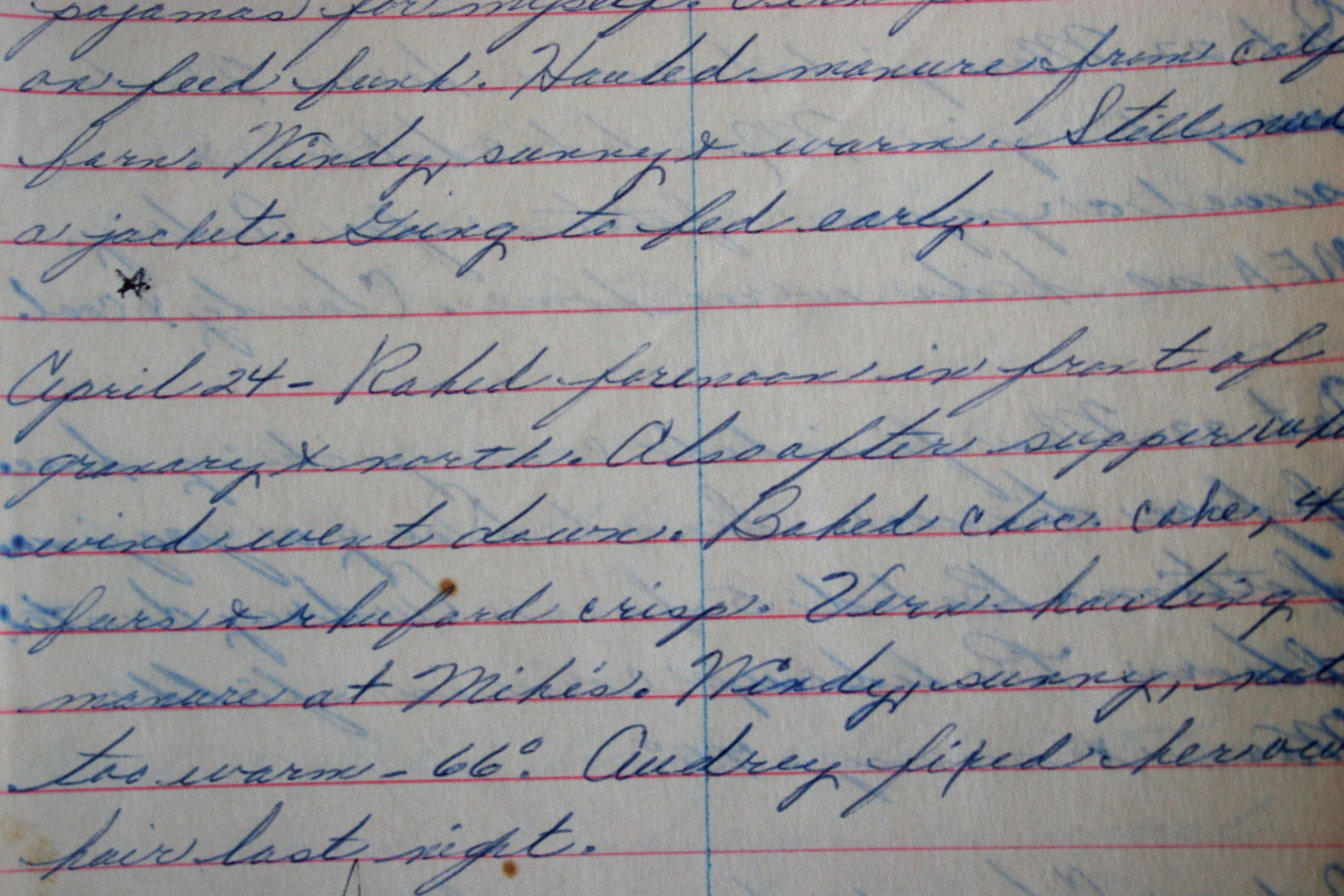
A sample entry from Mom’s journals. (Minnesota Prairie Roots copyrighted file photo)

I’m thankful my mom found time to journal daily. Even if her entries were only several lines long, she apparently thought this documentation important. And I suppose in farming it was, allowing her and my dad to look back on the previous year’s weather, planting and harvesting progress, and such. But I think, too, writing in those spiral bound notebooks gave her a creative outlet and time for herself.

My mom saved everything, including this Mother’s Day card I made for her in elementary school. I cut a flower from a seed catalog to create the front of this card. (Minnesota Prairie Roots copyrighted image)

Mother’s Day offers a time to reflect on motherhood. Most give selflessly, love unconditionally, do the best they can. Mine did. And she left, too, her words chronicling everyday life as a mother and as a farm wife. As a writer I cherish this gift, not only on Mother’s Day, but always.

© Copyright 2026 Audrey Kletscher Helbling


Published in Oakwood: My latest rural-rooted poem honors my farm wife mom April 28, 2017

An abandoned farmhouse along Minnesota State Highway 19 east of Vesta, my hometown. The house is no longer standing. This image represents my rural heritage and looks similar to the house I called home for the first 11 years of my life. Minnesota Prairie Roots file photo.


MORE THAN 40 YEARS removed from the farm, my creative voice remains decidedly rural, especially in the poetry I write.

My latest published poem, “Ode to My Farm Wife Mother,” honors the woman who raised me, alongside my father, on a southwestern Minnesota dairy and crop farm. My parents were of good German stock, a hardworking couple who believed in God, in family and in the land. I carry that heritage with me, ever grateful for my rural upbringing.


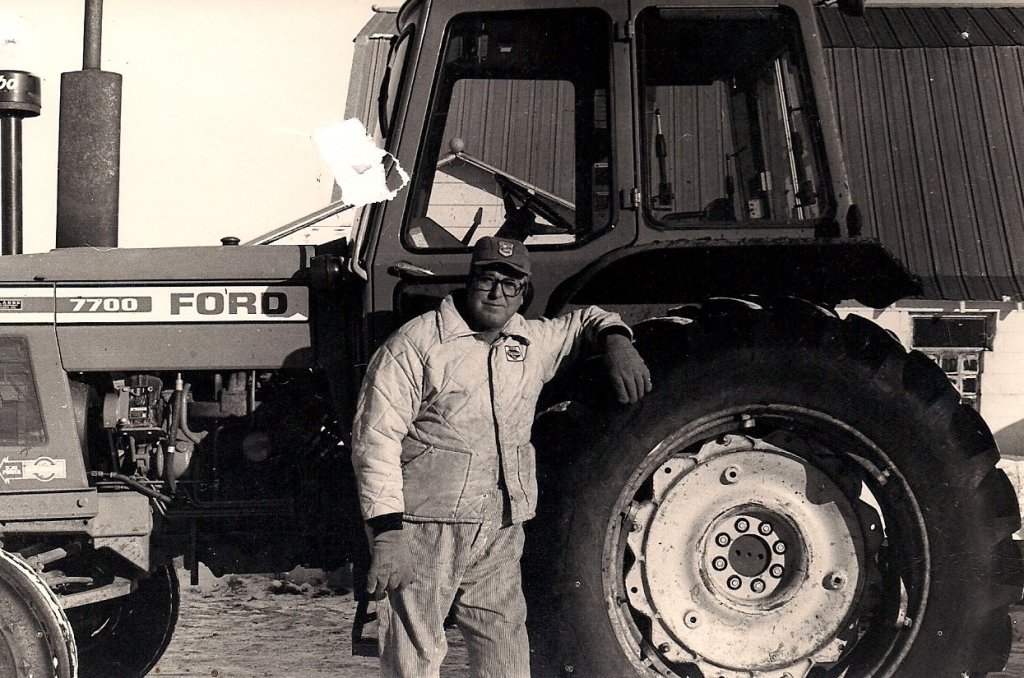
Dad farmed, in the early years with a John Deere and Farmall and IH tractors and later with a Ford. (Photo by Lanae Kletscher Feser)

A photo of my dad, Elvern, taken in 1980.


Life in rural Minnesota in the 1960s and 1970s was hard. I see that now from the perspective of an adult. My dad worked long hard hours in the barn milking cows and equally long hard hours in the fields. Farming was much more labor intensive then.


The only photo I have of my mom holding me. My dad is holding my brother, Doug.


Likewise, my mom’s job of caring for our family of eight required long hard hours of labor. She tended a large garden, preserved fruits and vegetables to stock the freezer and cellar shelves, baked bread from scratch, washed clothes with a wringer washer, did without a bathroom or telephone or television for many years, and much more.


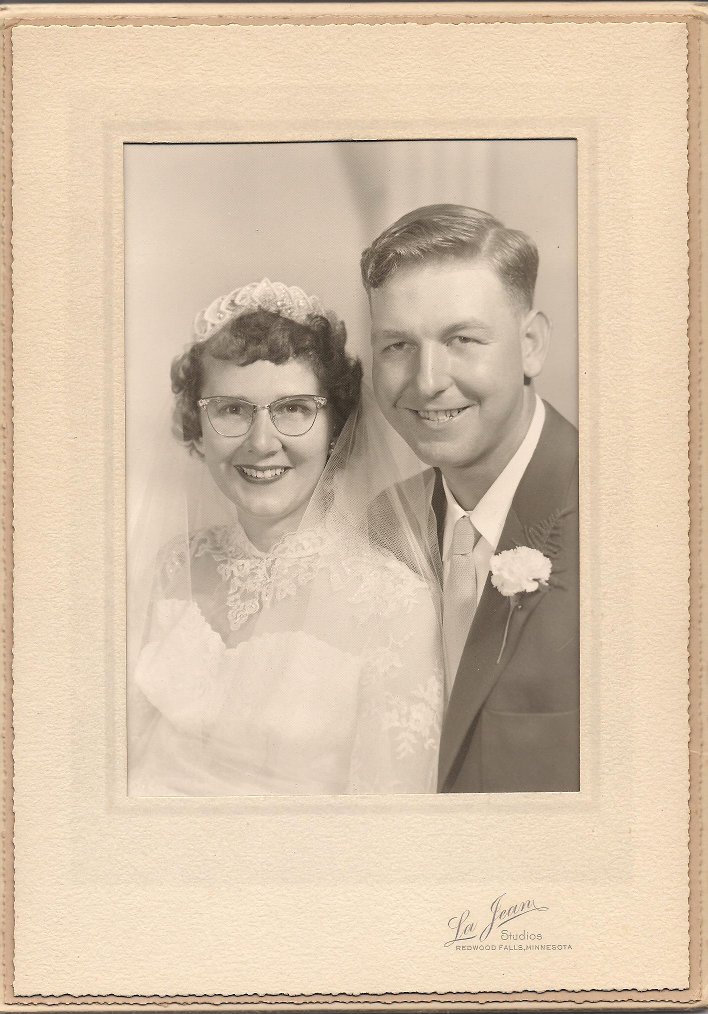
My parents, Vern and Arlene, on their September 25, 1954, wedding day.


Sometimes I think how much easier my mother’s life would have been had she not married my dad and stayed at her town job in Marshall.


Our family Christmas tree always sat on the end of the kitchen table, as shown in this Christmas 1964 photo. That’s me in the red jumper with four of my five siblings. I write about this red-and-white checked floor in my poem.


But then I remind myself of how much family means to my mom and I could not imagine her life without any of her six children. She centered us, grounded us, taught us kindness and gratitude, instilled in us a loving and compassionate spirit.


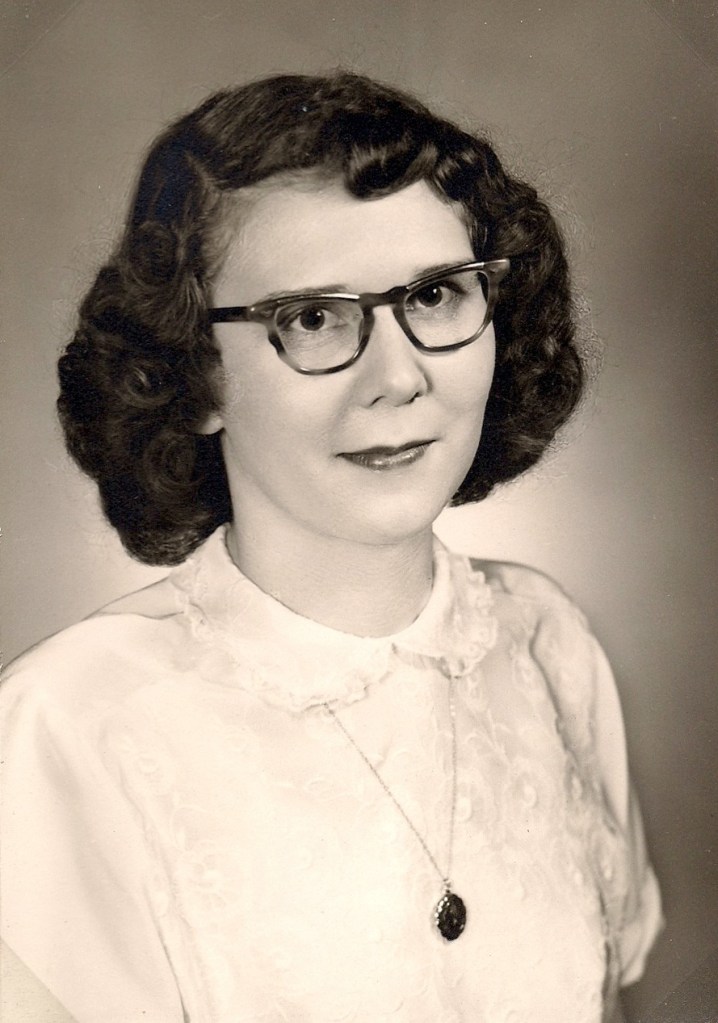
Arlene’s 1951 graduation portrait.


She has always been mom to me, a mother now nearing age 85. But there was a time when she was Arlene, not somebody’s wife, somebody’s mother. There was a time when she and my dad danced away a Saturday night in a southwestern Minnesota dance hall. They met at a dance.


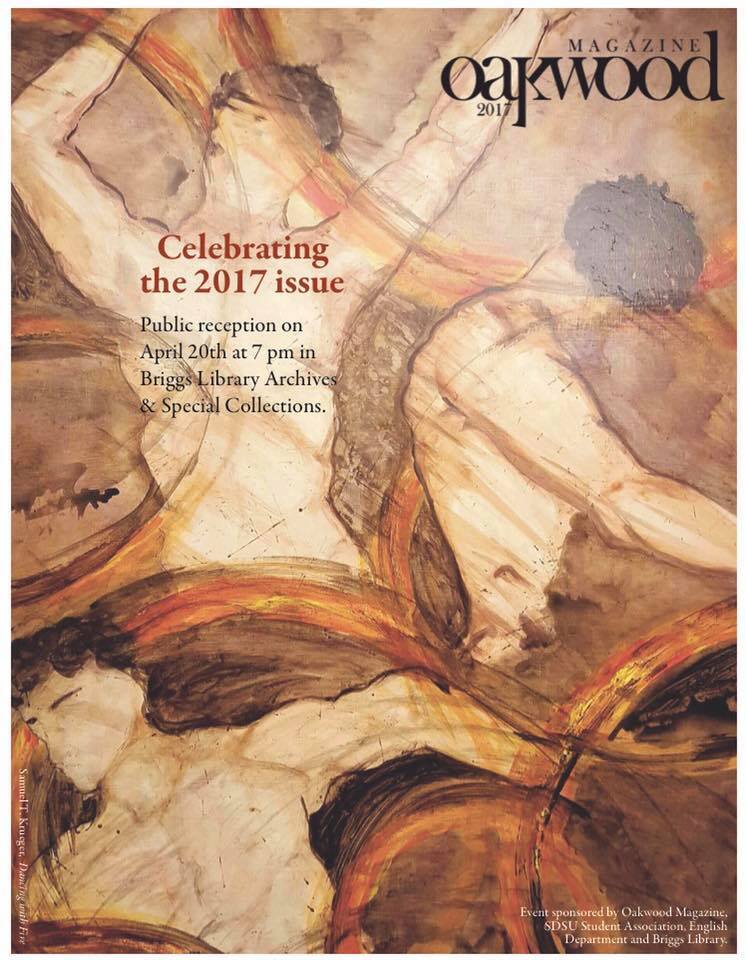
The promo for Oakwood 2017 features “Dancing with Fire,” the art of Samuel T. Krueger. Promo image courtesy of Oakwood.


Those thoughts inspired me to write “Ode to My Farm Wife Mother,” published last week in South Dakota State University’s literary journal, Oakwood. I am honored to have my poem selected for inclusion with the work of other writers and artists from the Northern Great Plains. It’s a quality publication that represents well those of us who call this middle-of-the country, often overlooked place, home.


Ode to My Farm Wife Mother

Before my brother,
you were Saturday nights at the Blue Moon Ballroom—
a bottle of Jim Beam whiskey in a brown paper bag,
Old Spice scenting your dampened curls,
Perry Como crooning love in your ear.

Then motherhood quelled your dancing duet.
Interludes passed between births
until the sixth, and final, baby slipped into your world
in 1967. Thirteen years after you married.
Not at all unlucky.

Life shifted to the thrum of the Maytag,
sing-song nursery rhymes,
sway of Naugahyde rocker on red-and-white checked linoleum.
Your skin smelled of baby and yeasty homemade bread
and your kisses tasted of sweet apple jelly.

In the rhythm of your days, you still danced,
but to the beat of farm life—
laundry tangled on the clothesline,
charred burgers jazzed with ketch-up,
finances rocked by falling corn and soybean prices.

Yet, you showed gratitude in bowed head,
hard work in a sun-baked garden,
sweetness in peanut butter oatmeal bars,
endurance in endless summer days of canning,
goodness in the kindness of silence.

All of this I remember now
as you shove your walker down the halls of Parkview.
in the final set of your life, in a place far removed
from Blue Moon Ballroom memories
and the young woman you once were.

                                         #

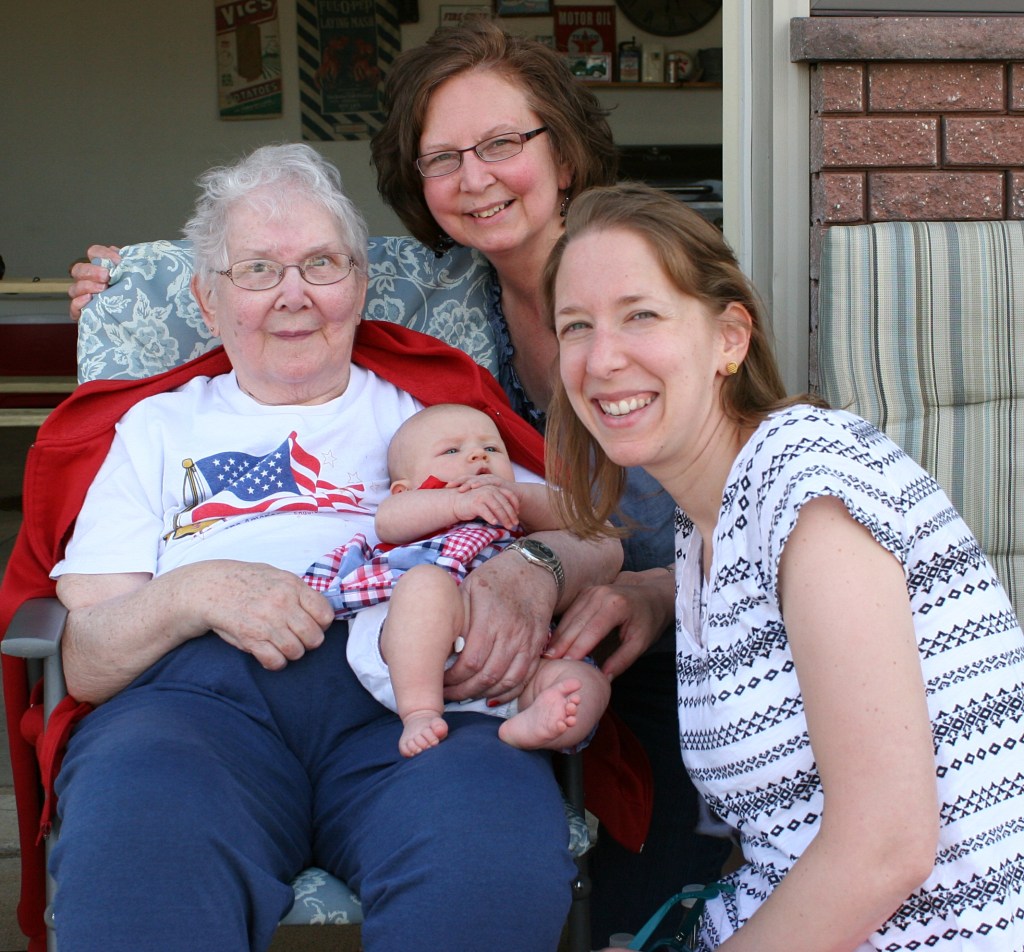
Four generations: Great Grandma Arlene, Grandma Audrey, mother Amber and baby Isabelle, all together for the first time in July 2016 in rural southwestern Minnesota. Minnesota Prairie Roots file photo 2016.


I took some liberties with my poem. I doubt my mom ever drank whiskey. But back in the day, folks brought booze bottles in brown paper bags to dances for set-ups. She didn’t dance in the Blue Moon Ballroom, although one once stood in Marshall. Arlene went to dances in Ghent, in a dance hall whose name eludes me. Blue Moon sounds more poetic. But the rest of the poem is factual right down to the Naugahyde rocker and my mom shoving her walker down the hallways of Parkview.

FYI: You can view my poem on page 78 of Oakwood, found online by clicking here. My bio is published on page 89, listed among the other 40 contributors’ bios. I am grateful to SDSU in Brookings for the opportunity to be part of this magazine which showcases the creative voices of Plains writers and artists. I shall always feel proud of my rural upbringing, the single greatest influence on me as a poet, a writer, a photographer.

Copyright 2017 Audrey Kletscher Helbling


My “farm wife” mother inspires my winning poetry February 28, 2014

MY 81-YEAR-OLD MOM inspires me.

She inspires me to live my life with the same positive outlook, grateful heart and kindness she’s exuded her entire life.

And she inspires my poetry. In recent poetry writing endeavors (click here and here), she has been the subject of my poems. This surprises her.

When I informed Mom that my poem, “The Farmer’s Wife, Circa 1960,” had been selected for inclusion in Poetic Strokes 2014, a regional poetry anthology published by Southeastern Libraries Cooperating, she responded with a humbleness that truly reflects her character.

“I didn’t know I led such an interesting life,” Mom said.

To most, she likely hasn’t. She grew up on the southwestern Minnesota prairie, attended Mankato Business College after high school, then worked at a government office in Marshall until marrying my father shortly thereafter and settling onto a farm near Vesta.

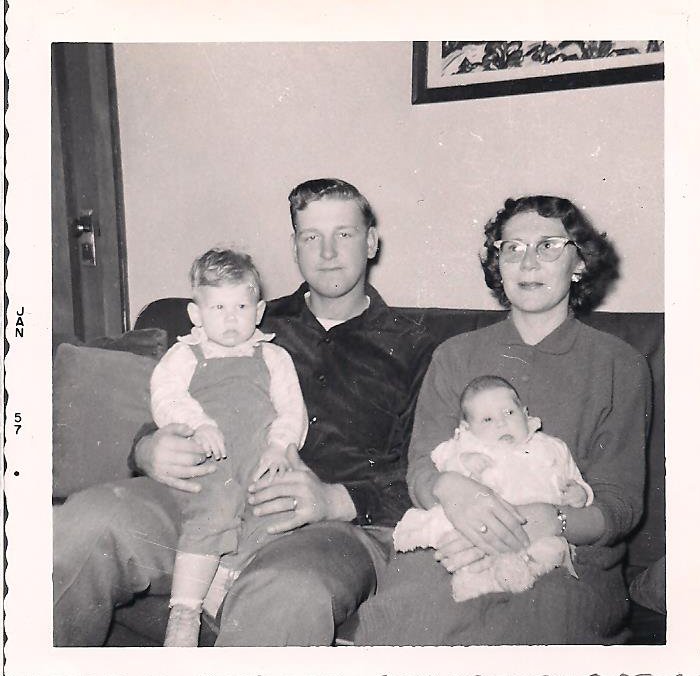
My parents holding my older brother, Doug, and me in this January 1957 photo.

My parents, Elvern and Arlene Kletscher, holding my older brother, Doug, and me in this January 1957 photo. Rare are the photos of my farm wife mother.

There she assumed the role of farm wife, the title given rural women long before stay-at-home mom became a buzzword. She no longer lives on the farm, having moved into my paternal grandmother’s home in Vesta decades ago.

As an adult, I now understand that her life as a farm wife was not particularly easy—raising six children on a limited income; doing laundry with a Maytag wringer washer; tending a garden and then canning and freezing the produce; doing without an indoor bathroom…

I sometimes wonder how her life would have unfolded
had she not locked eyes with my father on the dance floor…

–Lines one and two from “The Farmer’s Wife, Circa 1960”

Although I’ve never asked, I expect she dreamed of time just for herself. On rare occasions she and my dad would go out on a Saturday evening.

With those thoughts, I penned “The Farmer’s Wife, Circa 1960.” As much as I’d like to share that poem with you here, today, I cannot. That debut honor goes to Poetic Strokes, a copy of which will be gifted from me to my mom, the woman who has led an extraordinary life. Not extraordinary in the sense of great worldly accomplishments, but rather in the way she has treated others with kindness, compassion and love. Her depth of love for family, her faith and her empathy and compassion have served as guiding principles in my life.

I am proud to be the daughter of a farmer’s wife.

The cover of Poetic Strokes/Word Flow. Image courtesy of SELCO.

The cover of Poetic Strokes/Word Flow. Image courtesy of SELCO.

I AM HONORED, for the sixth time, to have my poetry published in Poetic Strokes, a Library Legacy funded project (through Minnesota’s Arts and Cultural Heritage Fund) that promotes poetry in southeastern Minnesota and specifically in SELCO libraries. Each library will have a copy available for check out near the end of March or in early April, National Poetry Month.

This year my county of Rice joins Winona County with the highest number of poets, six from each county, included in the Poetic Strokes section of the anthology. I am the sole Faribault poet with five from nearby Northfield.

Twenty-three poems from 21 poets in five of SELCO’s 11 counties will be published in Poetic Strokes 2014.

There were 196 poems submitted by 112 poets. Two published poets with PhDs in English literature and a third poet who is a former English teacher, fiction writer and contributor to the League of Minnesota Poets judged the entries.

Says SELCO Regional Librarian Reagen A. Thalacker of the judging process:

The general sense I received when the poems came back is that our judges felt that there was a great variety in subject matter and skill and that they were impressed with many of those that were submitted. There was also the overwhelming sense of having enjoyed thoroughly the opportunity to read the works submitted.

Additionally, the anthology includes 28 poems penned by youth ages 14 – 18 (or in high school) residing within SELCO counties. Twenty-eight poems chosen from 111 submissions will be featured. What an encouragement to young poets to be published in the Word Flow portion of this project.

For me, a seasoned poet, selection of “The Farmer’s Wife, Circa 1960” encourages me to keep writing in a rural voice distinctly mine, inspired by the land and the people I love.

FYI: Click here to read a full report on Poetic Strokes/Word Flow 2014, including a list of poets selected for inclusion in the anthology.

© Copyright 2014 Audrey Kletscher Helbling