Minnesota Prairie Roots

Writing and photography by Audrey Kletscher Helbling

“Beets,” a relevant play that bridges differences February 7, 2025

Former Faribault Daily News reporter Pauline Schreiber photographed these Faribault POW camp barracks shortly before they were torn down in 1990. (Photo courtesy of the Rice County Historical Society)

THE SETTING COULD BE FARIBAULT or any other Minnesota community which, in the latter part of World War II, housed German prisoners of war in POW camps. But the setting is at a camp in Greeley, Colorado, and on a farm site in nearby Berthoud. Locations matter not. The story does.

A promo for “Beets.” (Credit: Shattuck-St Mary’s School Facebook page)

Thursday evening, I sat in the sparse audience of the historic Newhall Auditorium on the campus of Shattuck-St. Mary’s School, a private college prep school on Faribault’s east side, watching a story unfold in the theatrical production, “Beets.” An incredibly talented nine-member student cast immersed themselves in the roles of a farm family, German POWs, guards and a family friend to share a bit of history. And much more.

This play about POWs working on the Hunt family’s sugarbeet farm is more than a retelling of history. It is also about relationships, fear, culture and love. It is about the perceived differences that divide us and about the commonalities that unite us.

This is a play for our times. In a nation today divided by politics, by fear, by hatred and animosity, “Beets” is absolutely relatable.

As the storyline evolves, conflicts arise. Farmer Fred Hunt spews his hatred of the Germans. His wife, Isabelle, exudes compassion and love. And their daughter, Anna, settles somewhere in between, leaning initially toward dislike and distrust of the German POWs who have come to work her father’s land. Anna’s thoughts often turn to her brother, Jake, fighting the Germans abroad.
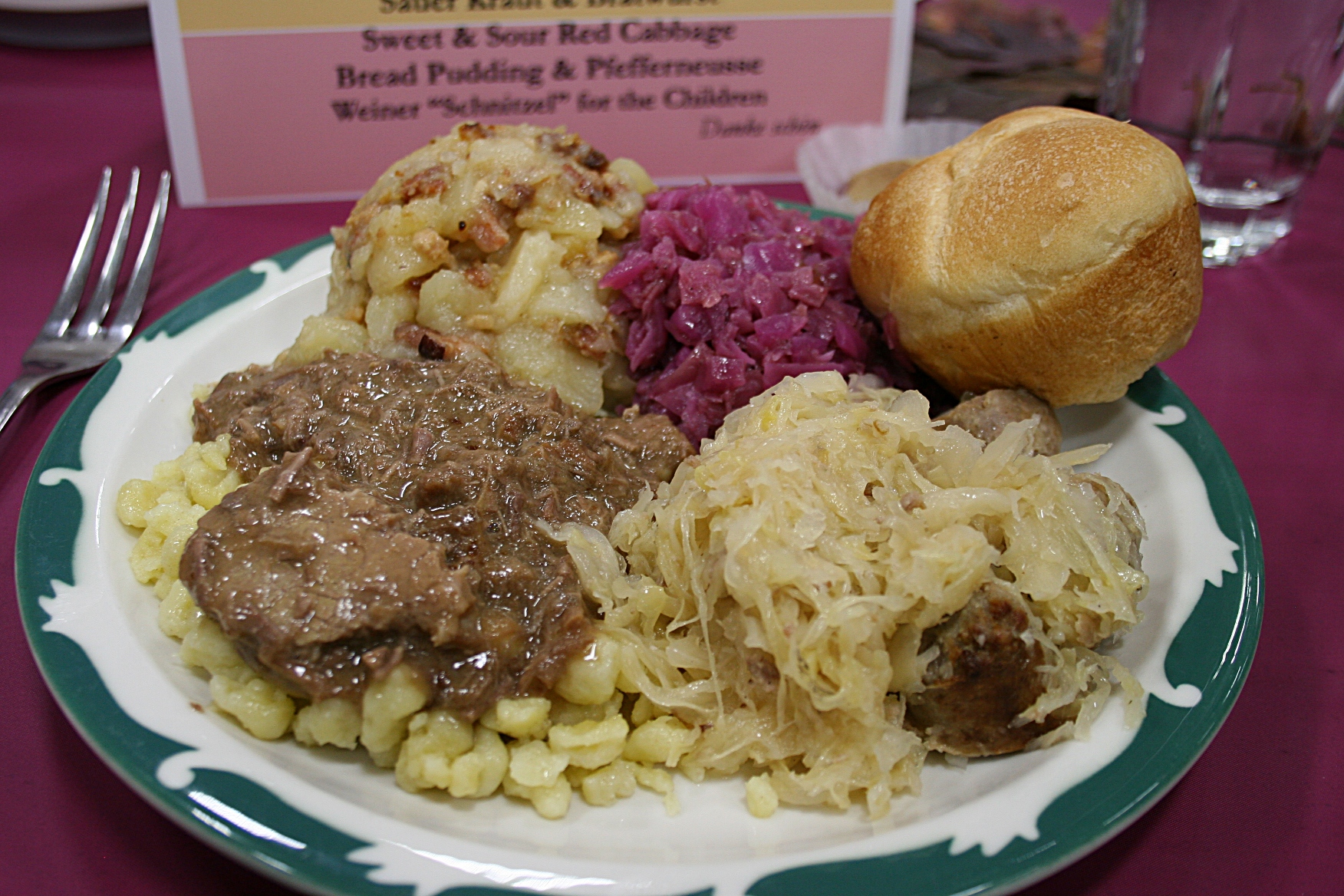
A German meal: sauerbraten and spaetzle on the left, German potato salad, sweet and sour cabbage, dinner roll and sauerkraut and brats. (Minnesota Prairie Roots copyrighted file photo)

Slowly, interaction by interaction, things begin to change. The American farm family and the German prisoners realize they share a love of Bach. (Yes, a German composer.) And while the German POWs profess they will never eat corn, because that’s for pigs and cows—although Anna explains the difference between corn for livestock and sweetcorn—they all understand that they need to eat. The scenes in which Anna and Isabelle serve potatoes and cake to the POWs show how food brings people together. Trust grows. When Fred learns details about POW Dieter Meuhler’s family, he begins to understand the personal side of a man he saw only as an enemy. The walls of distrust, disdain and differences start crumbling, albeit slowly.

It is not lost on me that the Shattuck performers are themselves of diverse backgrounds. That only adds to the performance.

There are differences in beets (these are not sugarbeets), just like in people. (Minnesota Prairie Roots copyrighted file photo)

There are lessons to be learned from “Beets,” written by Rick Padden. First, we are all, at our core, just human beings with the same basic needs. Secondly, to overcome differences, we need to connect on a personal level. We need to open our hearts and minds, to embrace cultural and other differences. We need to show compassion and care, as farm wife Isabelle Hunt did on stage. We need to recognize that love is universal, as Anna and Dieter discovered.

“Beets” is one of those plays I wish everyone could see, especially now in these challenging days. I left the theater at Shattuck-St. Mary’s feeling a sense of hope. The fictional characters in “Beets” changed, for the better. They opened their hearts and minds to each other, despite their differences, or perceived differences. Perhaps we can do the same.

#

FYI: Two performances of “Beets” remain at Shattuck, one at 7 pm Friday, February 7, and the second at 2 pm Saturday, February 8. It’s a two-hour show (includes a 10-minute intermission) I highly recommend to anyone who enjoys well-done theater, history and a play with strong messages relevant to today.

© Copyright 2025 Audrey Kletscher Helbling


A look at German POW camps, including in Faribault January 28, 2023

The Rice County Historical Society, host of the POW presentation. (Minnesota Prairie Roots copyrighted file photo July 2022)

JUST BLOCKS FROM THE VACATED SITE of the former Faribault Canning Company, a group packed a Rice County Historical Society Museum meeting room Thursday evening for a lesson in World War II-related regional history. Specifically, we learned about German Prisoner of War camps in Minnesota and Wisconsin from Matt Carter, executive director of the Dakota County Historical Society. He offered an overview of those camps, which included 15 in Minnesota, one at the canning company in Faribault. Carter is a native of Reedsburg, Wisconsin, home to a POW camp. Growing up, he never learned about the camp in school. That prompted him to later research, write about and present on POW camps in the US.

Former Faribault Daily News reporter Pauline Schreiber photographed the Faribault POW Camp barracks shortly before they were torn down in 1990. (Photo courtesy of the Rice County Historical Society)

WORKING AG-RELATED JOBS

I’ve always held an awareness of Camp Faribault and the prisoners who worked at the canning factory and on area farms. I also knew of the low-slung buildings housing the POWs who arrived here in June 1944. Those barracks were torn down in 1990 during an expansion of Faribault Foods, as the canning company came to be called. The business still exists today, in a sprawling manufacturing and distribution complex opened in 2017 in northwest Faribault’s industrial park.

Back during WWII, with millions of Americans off to serve in the military, POWs like those in Faribault offset the local labor shortage. Faribault Canning requested 200 prisoners to assist during the summer months with pea and sweet corn processing. The company paid the government 55 cents an hour for each POW laborer. That covered food and other living expenses. Prisoners received 80 cents a day for their work. Carter noted that the Faribault-based POWs worked within a 25-mile radius, some also laboring on farms, others installing power poles for Dakota Electric Association and 60 contracted to work for the local Andrews Nursery Company.

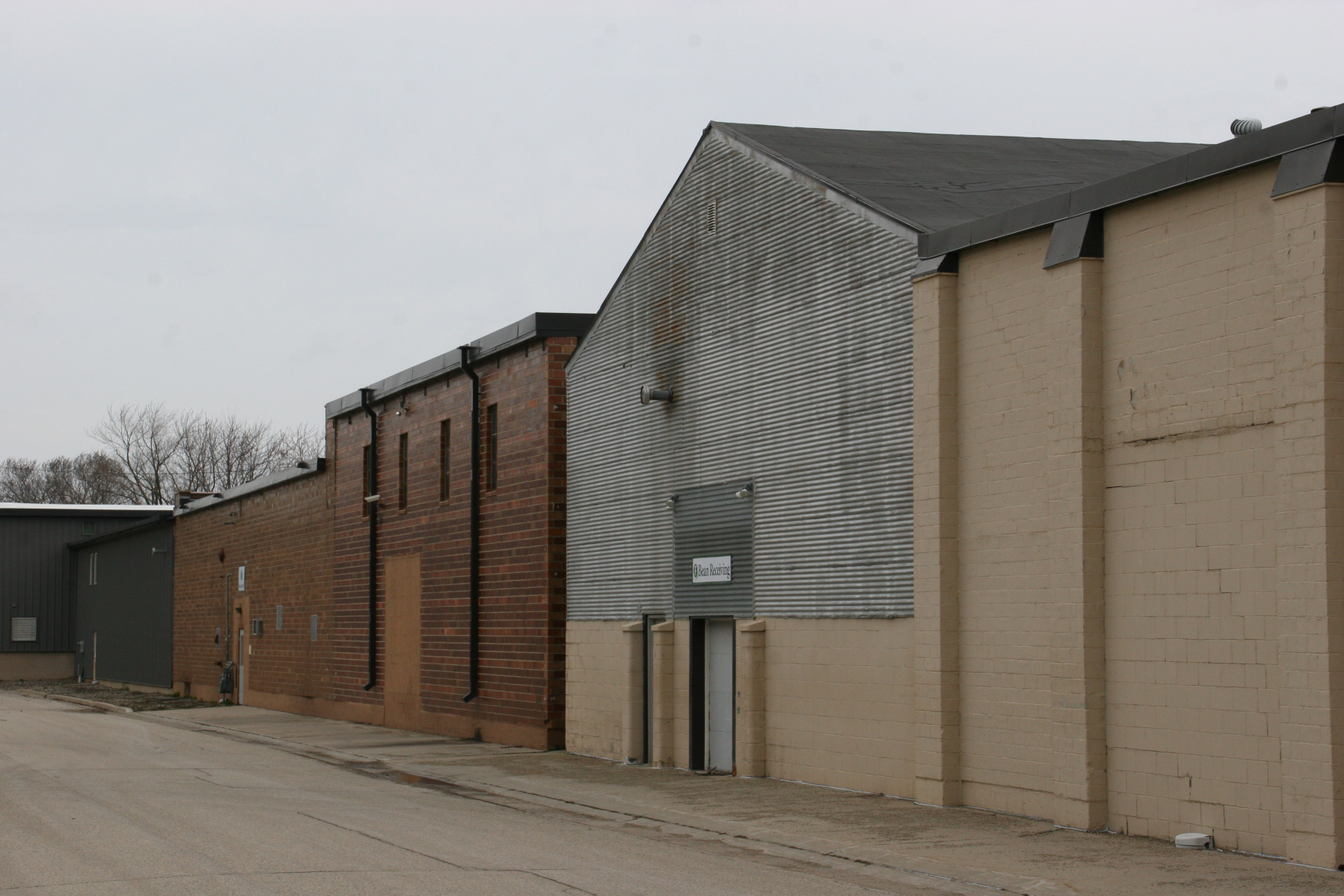
Some of the buildings remaining at the former Faribault Canning Co (Faribault Foods) site. I know nothing about the use or ages of the buildings. (Minnesota Prairie Roots copyrighted photo April 2022)

SETTLING IN AT CAMP FARIBAULT & BEYOND

POW camps were scattered throughout Minnesota with other nearby branch camps, as they were termed, in Owatonna, Montgomery and St. Charles. Camps farther north focused mostly on logging. All were offshoots of barbed wire-secured base camps (where prisoners initially arrived and were processed) in Algona and Clarinda, Iowa. Once prisoners settled in community camps like Faribault, they still remained under guard, although much more loosely watched. An estimated 450,000 – 600,000* prisoners arrived in the US on Liberty Ships during WWII to live in repurposed Civilian Conservation Corps camps, on fairgrounds, even in tents, Carter said. In Faribault, the POWS moved into barracks built by the canning company.

WEDDINGS, PROPAGANDA & “CODDLING”

Within the confines of his just-over-an-hour-long presentation, Carter presented an excellent overview of POW camps, adding some details that I found notably interesting. For example, proxy weddings were performed by local clergy. Under Geneva Convention rules, German prisoners could legally marry women back in Germany. Prisoners would gather flowers for the missing-brides prison camp weddings. Across the ocean their brides perhaps did the same while marrying absent grooms not seen in years.

Carter also shared that prisoners watched newsreels of German war atrocities as part of a reorientation program in the camps. Viewed as propaganda by some POWs, they responded by distributing handwritten propaganda while traveling on secured trains. Baffled by how these leaflets were dropped, officials determined that the papers were dropped down toilets and then onto the rails.

The third bit of shared information that struck me involves food. Newspapers reported how well prisoners ate, how they were being “coddled,” Carter noted. He showed a list of menus, which confirms the generous meals. The reaction was an outcry from an American public living on rationed foods and upset about the treatment of German-held US soldiers. In 1945, POWs were no longer allowed to buy beer, soda or cigarettes. And some of their food choices became less desirable (like hearts and liver).

Once the war ended, prisoners were repatriated, a process that took time. Many later returned to the US because of how well they were treated here, according to Carter. That was encouraging to hear. Even in war-time, kindness existed.

Matt Carter referenced this book during his talk, citing it as a good source of information about POW camps in Minnesota.

DIGGING DEEPER

Today all that remains of the Faribault POW Camp is a marker by the former canning company. If there are stories and photos, I am unaware. But I’m inspired now to dig deeper. I’ve already checked out Prudence by David Treuer from my local library. The novel focuses on a German soldier who escaped from a Minnesota POW camp. I also intend to read Anita Albrecht Buck’s Behind Barbed Wire: German Prisoners of War in Minnesota during World War II.

And maybe some day I’ll travel to Algona, Iowa, to visit the Camp Algona POW Museum and learn more about this place which housed prisoners sent to Minnesota, including to Faribault.

#

*Because of differences and discrepancies in record-keeping, the number of prisoners housed in US POW camps is uncertain. Some sources claim 600,000-plus, while Carter estimates closer to 500,000 prisoners based on his research.

© Copyright 2023 Audrey Kletscher Helbling