Minnesota Prairie Roots

Writing and photography by Audrey Kletscher Helbling

PS to my whooping cough post November 7, 2010

Filed under: Uncategorized — Audrey Kletscher Helbling @ 7:34 PM
Tags: , , , , , , , , ,

DELORIS EDNA EMILIE BODE died on May 10, 1935, from pertussis (whooping cough), pneumonia and a gangrene-type infection of the mouth.

The second-born daughter of Lawrence and Josephine Bode, she was only nine months and nine days old.

She was my aunt.

The gravestone of Deloris Edna Emilie Bode in the Immanuel Lutheran Cemetery, rural Courtland.

Copyright 2010 Audrey Kletscher Helbling


An update on whooping cough in Minnesota November 6, 2010

Filed under: Uncategorized — Audrey Kletscher Helbling @ 10:29 AM
Tags: , , , , , , , ,

WHENEVER I HEAR the words “whooping cough,” I listen. Last night a Twin Cities television station reported on the increased number of pertussis cases in Minnesota. Most recent statistics on the Minnesota Department of Health website show 1,000 reported cases as of October 21.

When I last checked those state stats in mid-August, and wrote about whooping cough on this blog, that number stood at 395, as of July 16.

The surge in this highly-contagious disease during the past several months is likely related to the start of school. A statement by the MDH seems to support that: “Minnesota is experiencing a peak period of pertussis that started back in the fall of 2008. Pertussis disease normally peaks every three to five years. Clusters continue to occur in the elementary school setting.”

I take a personal interest in whooping cough because I contracted the disease in the summer of 2005. If you don’t take pertussis seriously, you ought to. It’s called the 100-day cough, and it’s not misnamed, not by any stretch of the imagination.

Yes, you can die from the disease. Infants and senior citizens are particularly vulnerable.

Yes, vaccines exist to prevent whooping cough. But don’t mistakenly think you are protected because you were vaccinated as a child. Pre-teens need boosters. Adults can get a vaccine targeted especially for them.

If you want to know how many whooping cough cases have been reported to the MDH this year or in previous years in any Minnesota county, click here. As you would expect, the more densely-populated counties have reported more cases.

In Rice County, where I live, nine cases have been reported so far this year, holding steady with the previous two years of seven and nine cases.

But neighboring Steele County has seen a significant increase with cases rising from one and two the past two years to 37 thus far in 2010.

Similarly Mille Lacs County has shown a notable increase in numbers, from none in 2008, to six in 2009 and 29 this year.

I don’t know the reason for the rising numbers in those counties. But I do know that the disease spreads quickly and easily. My husband and one of my daughters caught whooping cough from me although their cases were not nearly as severe. Antibiotics administered in the early stage of the illness can reduce the severity.

I’ll leave you with this final note. When I asked my doctor five years ago where I could possibly have contracted pertussis, he told me, “You could have gotten it standing in the check-out line at the grocery store.”

That, my friends, is food for thought.

© Copyright 2010 Audrey Kletscher Helbling


How some Minnesota schools are serving healthier meals September 14, 2010

DECADES AGO when my relatives from the Cities (Minneapolis and St. Paul, for you non-Minnesotans), visited my southwestern Minnesota childhood farm, they would scoop up fresh garden produce by the bags full to take home. We didn’t mind, if we had extras, and were happy to share the bounty of the land.

I’ll admit, though, that even back then I felt a bit smug about our ability as farmers to provide food for the city dwellers. They had small gardens, but certainly could not grow what we could on our acres and acres of soil.

Today, as a city dweller, I’m the one carting home fresh garden produce from the country. No longer smug, I humbly accept the eggplant, tomatoes, spinach, cucumbers, okra, green beans, zucchini and other fruits and veggies that my country-dwelling family and friends share. I could live on fresh vegetables; I love them that much. But in my scrunched yard, I have room only for growing tomatoes and lettuce.
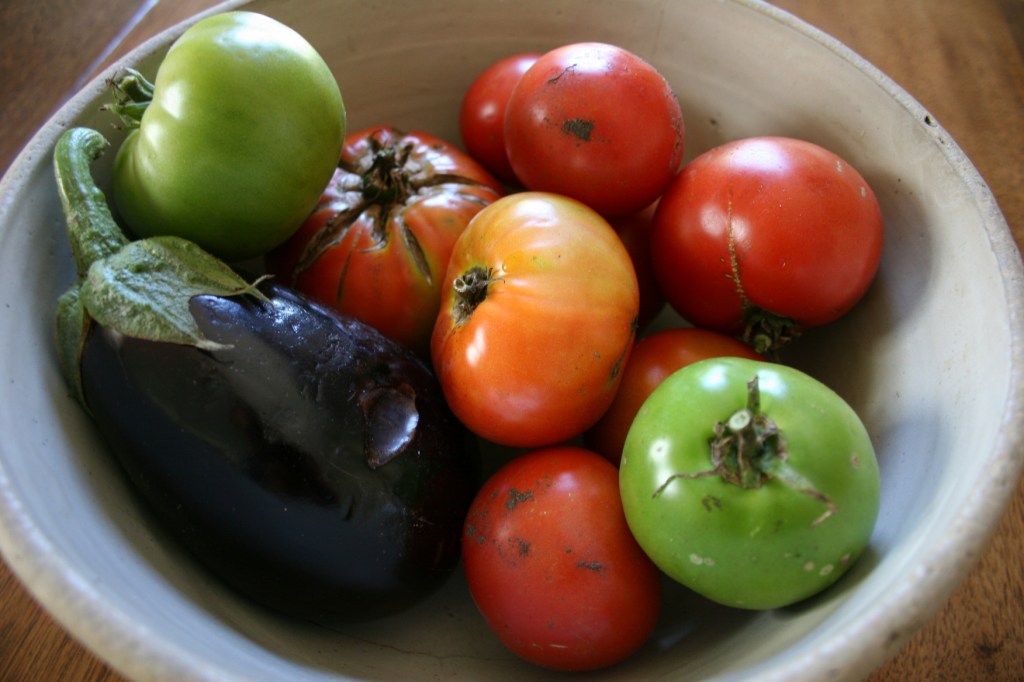
Some of the garden-fresh vegetables I got from my brother a few days ago.

Eating local, eating fresh, seems the healthy, trendy thing to do these days.

So when I read in the September 9 issue of The Gaylord Hub (a weekly newspaper where I worked in the 1970s) that students at the Sibley East, Arlington campus, will eat garden-fresh vegetables in their lunches this year, I took note.

According to the article, last spring students and staff planted a one-acre vegetable garden, which has produced beans, potatoes, cucumbers, onions, cabbage and squash. Later the garden will yield pumpkins, carrots and kale. Food service staff has been busy freezing the beans and making salsa and refrigerator pickles. The other vegetables will be incorporated fresh into meals.

Four grants are helping to fund the Farm to School Program project, which is more labor intensive and costly than a regular school food service offering.

Some Minnesota schools are growing onions in gardens.

Sibley East students grew cabbage, which will be made into coleslaw.

I don’t know if I’ve had my head in the refrigerator or what, but I don’t recall hearing about the Farm to School Program, which has been around nationally since the late 1990s and began in Minnesota in 2005.

Today a check of the Farm to School Program Web site reveals that an “estimated 69” Farm to School programs exist in Minnesota. (Sixty-nine doesn’t sound like an estimate to me but rather like a precise number.) Seventeen existing programs are profiled on the site.

Several districts, including Alexandria and Dover-Eyota, have planted apple trees.

Some Minnesota school districts have planted mini apple orchards.

In Bemidji, students at Solway Elementary School planted a garden and are now eating fresh, and frozen, vegetables. Others, including Dover-Eyota, plus Little Falls and Minneapolis Public Schools, are buying locally-grown produce.

Over in Montevideo, the public schools hosted an educational tomato-tasting event.

Down in the southeastern corner of the state, Winona Area Public Schools students are eating bison burgers and hot dogs thanks to a partnership with a local bison farm.

I liked what I read about these districts partnering up with local growers and producers. Even more, I like that some districts are taking the initiative and getting students involved by planting gardens and mini-orchards. Hands-on involvement, in my opinion, creates ownership, which spawns success.

Despite my excitement about the 69 Farm to School programs in Minnesota, I wonder why more districts are not involved. According to 2008-2009 statistics from the Minnesota Department of Education Web site, the state had 336 public-operating elementary and secondary independent school districts and 153 charter schools with a total of 2,006 public schools as of July 1 (2009).

Although I don’t know this for a fact, I suspect that funding is a problem in this tough economy and tight budgets. Perhaps also apathy and apprehension exist among parents, students, administrators and food service personnel. Finicky taste buds are likely a consideration given this generation is growing up on lots of processed foods and fast food.

Last winter I watched Jamie Oliver’s Food Revolution on television as Oliver sought to get fresh, healthy foods into a West Virginia school. The task proved difficult as food service workers, students and others didn’t exactly embrace the health-conscious meals.

But that doesn’t mean we shouldn’t keep trying. I would like to see more Minnesota schools join the Food to School Program and provide healthier meals for a student population that truly needs a healthier diet, both at home and in our schools.

Ditto for us adults. We certainly could learn to eat better too by buying (or accepting from family and friends) more locally-grown, fresh produce or growing our own.

© Copyright 2010 Audrey Kletscher Helbling


A closer look at whooping cough, including my story August 17, 2010

Filed under: Uncategorized — Audrey Kletscher Helbling @ 7:19 AM
Tags: , , , , ,

FIVE YEARS AGO, I earned the distinction of becoming my physician’s first adult whooping cough patient in his 30-plus year career.

I still remember that day when I perched on the examining table, so exhausted from my coughing fits and a subsequent lack of sleep that I could barely function. Five weeks earlier my doctor had diagnosed bronchitis. When I wasn’t getting any better, I returned and he gave me the same diagnosis. But now, on this third visit with my condition steadily deteriorating, I wanted answers.

Then I coughed.

For my doctor, that was a profound moment. He didn’t even hesitate. “I think you have whooping cough,” he blurted, then soon left the room to consult with another physician.

I don’t recall exactly how I responded, but I remember thinking that whooping cough couldn’t possibly exist in 2005.

How very wrong I was about that assumption. Today, five years after I struggled with this debilitating illness that invaded my lungs and throat, causing persistent coughing fits, a severe sore throat, asthmatic type attacks and a resulting inability to sleep, the disease continues to infect, and even kill.

California, if trends continue, is expecting more pertussis (whooping cough) cases in 2010 than it’s seen in 50-plus years, according to the California Department of Public Health. As of August 10, those numbers stood at 2,774 reported cases, including seven deaths among infants. The cases represent a seven-fold increase from the 395 reported during the same period in 2009.

Naturally, I wondered how Minnesota compares. According to statistics from the Minnesota Department of Health, as of July 16, there had been 395 cases reported. The report notes that the state is near the end of an outbreak that began in 2008.

In my home county, Rice, three cases of the disease have been recorded in 2010. The majority of infections are, as I would expect, in the more heavily-populated counties of Hennepin (75 cases), Wright (60), Dakota (52) and Ramsey (40).

But statistics really don’t matter if you’re the one with whooping cough. I remember the follow-up phone call from my physician who delivered the news that pertussis is known as “the 100-day cough.” He wasn’t kidding.

And he wasn’t kidding that he really couldn’t do anything for me. The disease would have to run its course—for me from early July until after Labor Day—and my body would need to heal on its own. Antibiotics help only early on in either preventing whooping cough or diminishing the severity of a case. The pertussis bacteria die off naturally after three weeks of coughing.

My entire family received a regiment of antibiotics with my husband and my second daughter both developing whooping cough, albeit much milder than mine.

Whooping cough, I can undeniably tell you, should be taken seriously. If you are an adult, or a teen, and haven’t been vaccinated since childhood, listen up. By age 10 or 12, you are no longer protected by that childhood vaccine. I was 48 years old when I developed pertussis. I’ll never know how I contracted the disease, but it’s highly-contagious. Infants are especially vulnerable.

Ironically, in the same year I became ill, new vaccines for adolescents and adults were approved. With widespread immunization, pertussis can become an illness of the past.

Within my own family, whooping cough claimed the life of my Aunt Deloris. On May 10, 1935, Deloris Edna Emilie Bode, second-born daughter of Lawrence and Josephine, died of pertussis, pneumonia and a gangrene-type infection of the mouth at the age of nine months and nine days.

Whenever I think of Deloris, I nearly weep at the thought of that beautiful baby girl wracked with uncontrollable coughing fits, struggling to breathe, fighting to live. I will feel forever linked to her by whooping cough, the 100-day cough, and today a preventable disease.

(The national Centers for Disease Control and Prevention has designated August as National Immunization Awareness Month.)

© Copyright 2010 Audrey Kletscher Helbling