Minnesota Prairie Roots

Writing and photography by Audrey Kletscher Helbling

Chief Taopi: Man of peace, community leader & more April 21, 2025

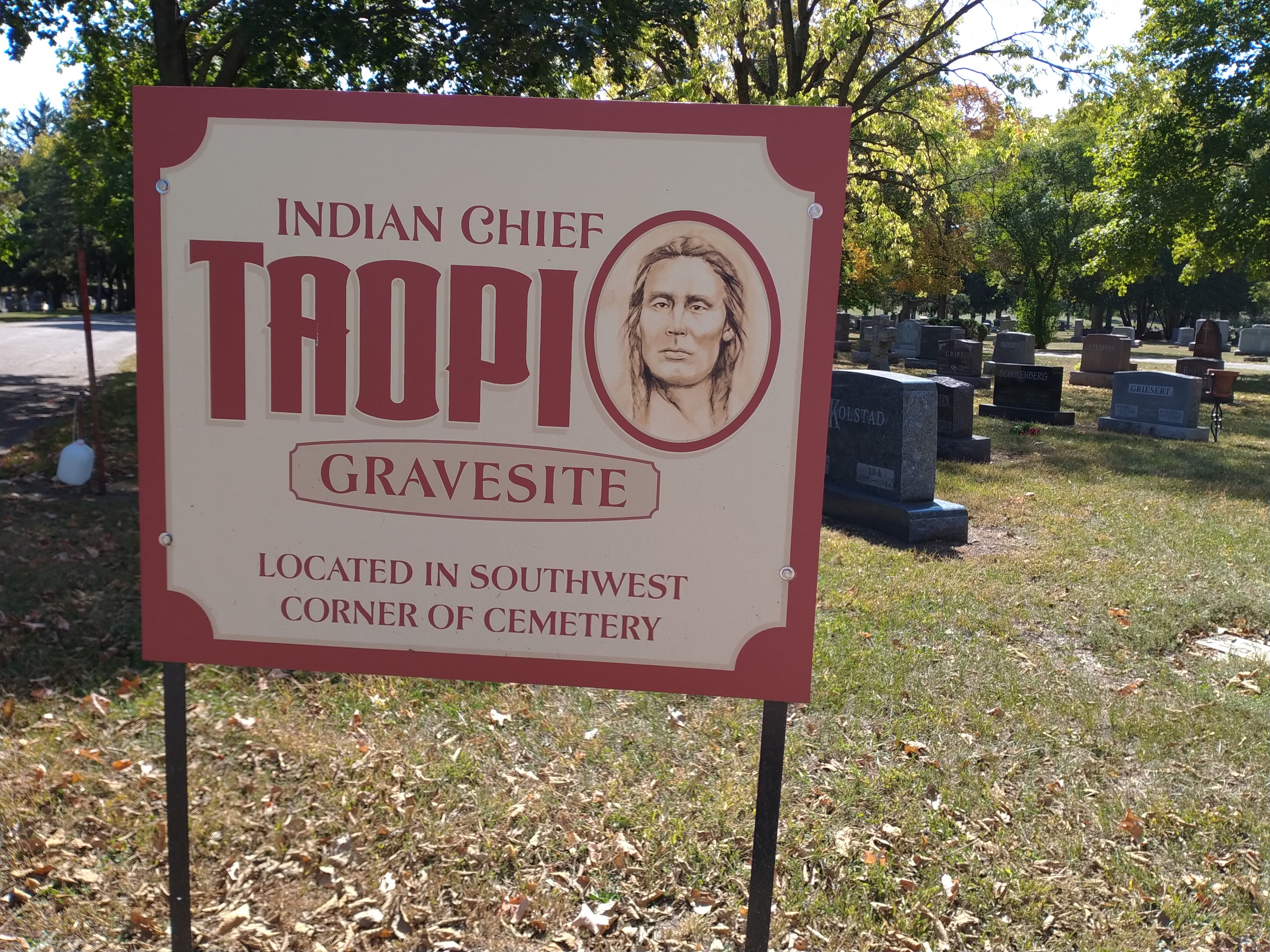
Prominent signage at Maple Lawn Cemetery directs visitors to the gravesite of Chief Taopi, “Wounded Man.” He was wounded in a battle with the Ojibwe. (Minnesota Prairie Roots copyrighted file photo)

HE FOUND HIMSELF AT ODDS with his own people. A “Farmer Indian” among “Blanket Indians.” A peace promoter among those who favored war. He was Chief Taopi, a member of the Little Crow Band of the Mdewakanton Dakota. He’s buried in Faribault, at Maple Lawn Cemetery.
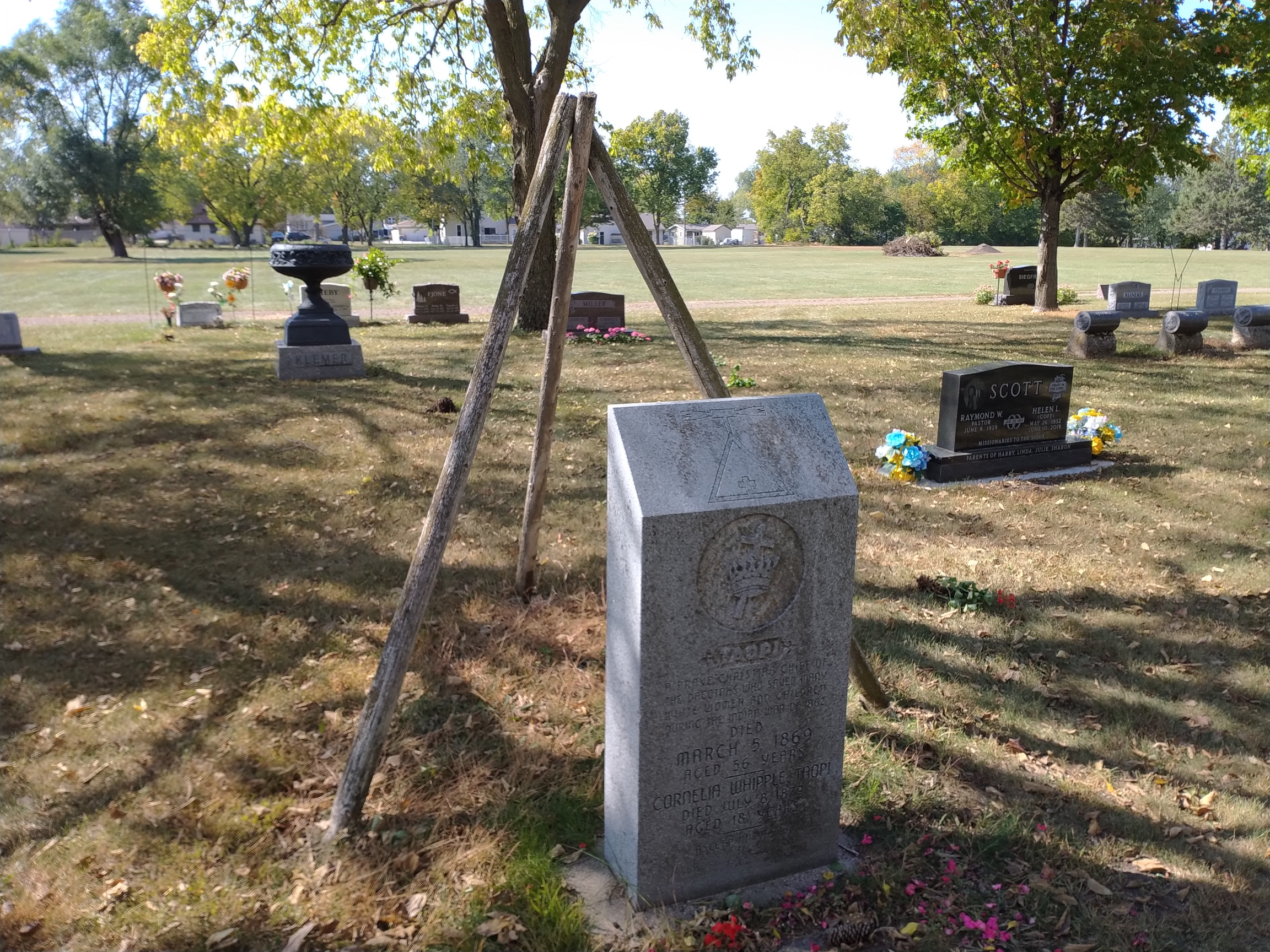
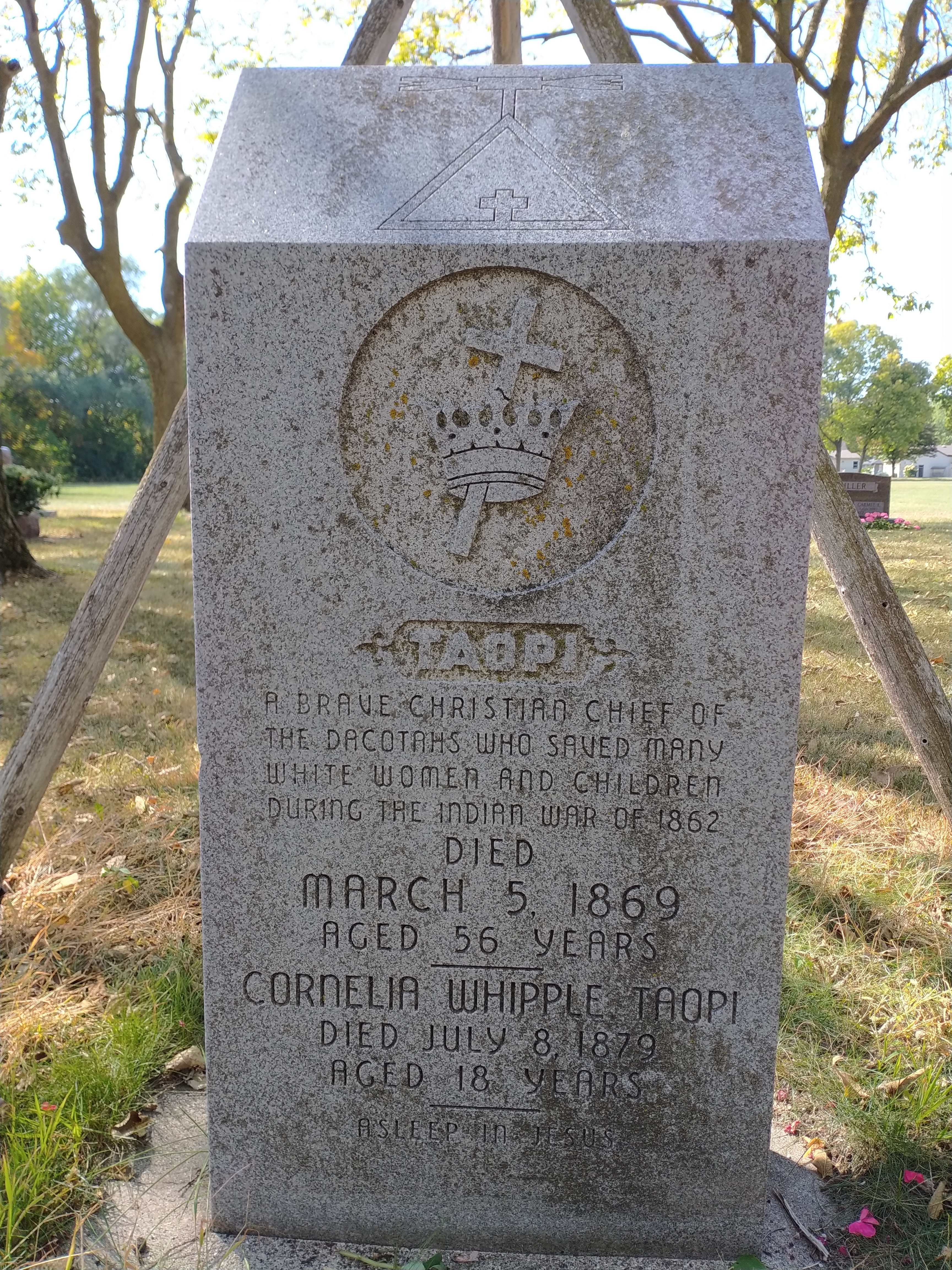
A tipi formation easily identifies the burial site of Taopi and his daughter, Cornelia Whipple Taopi. She died at age 18. He died at 56. (Minnesota Prairie Roots copyrighted file photo)

Recently, I attended a presentation about Taopi by Rice County Historical Society Executive Director Dave Nichols. It’s not the first time I’ve listened to local talks on the history of Native Americans in Minnesota, focused on those who called Faribault home. Each time I learn something new.
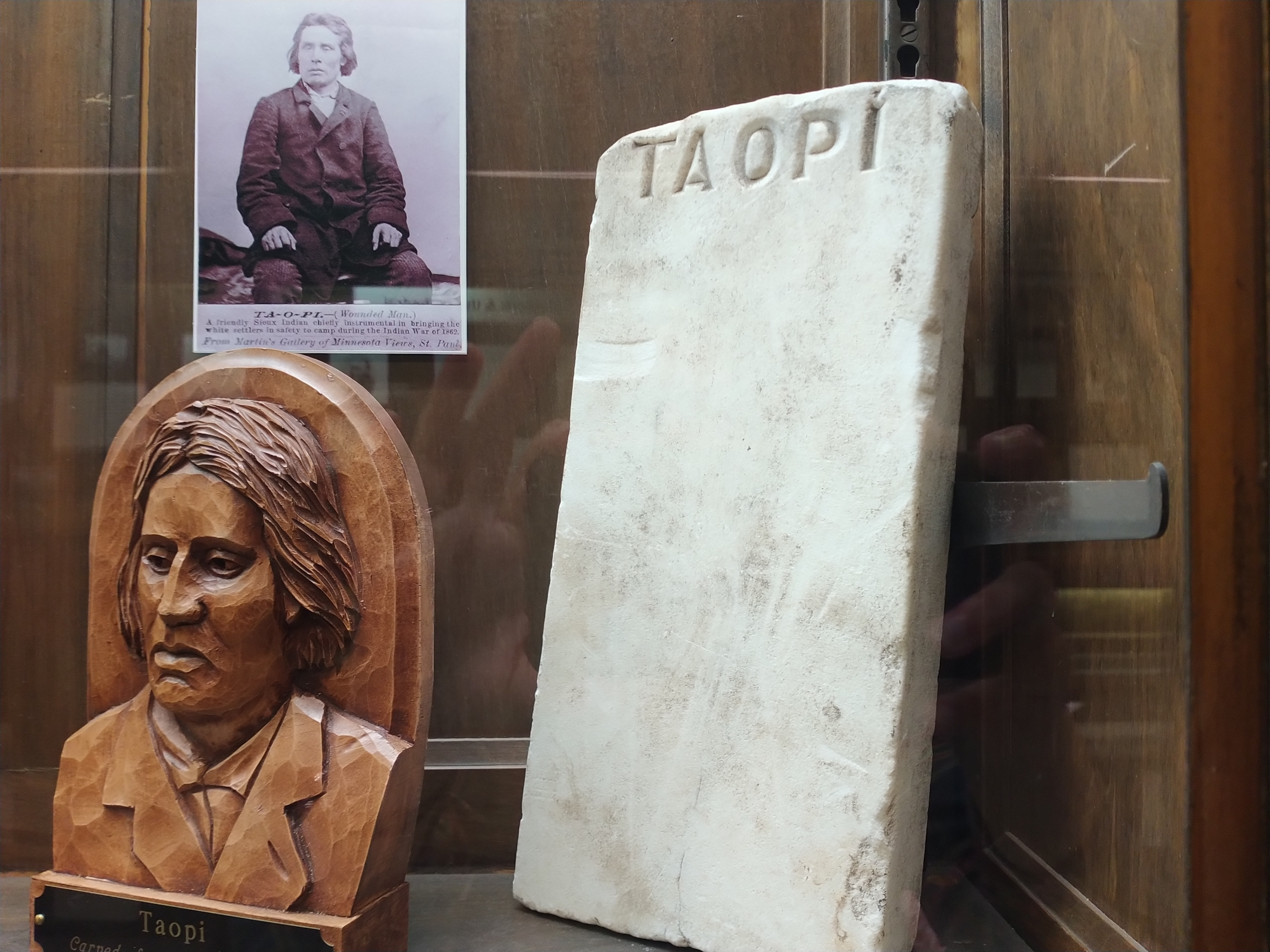
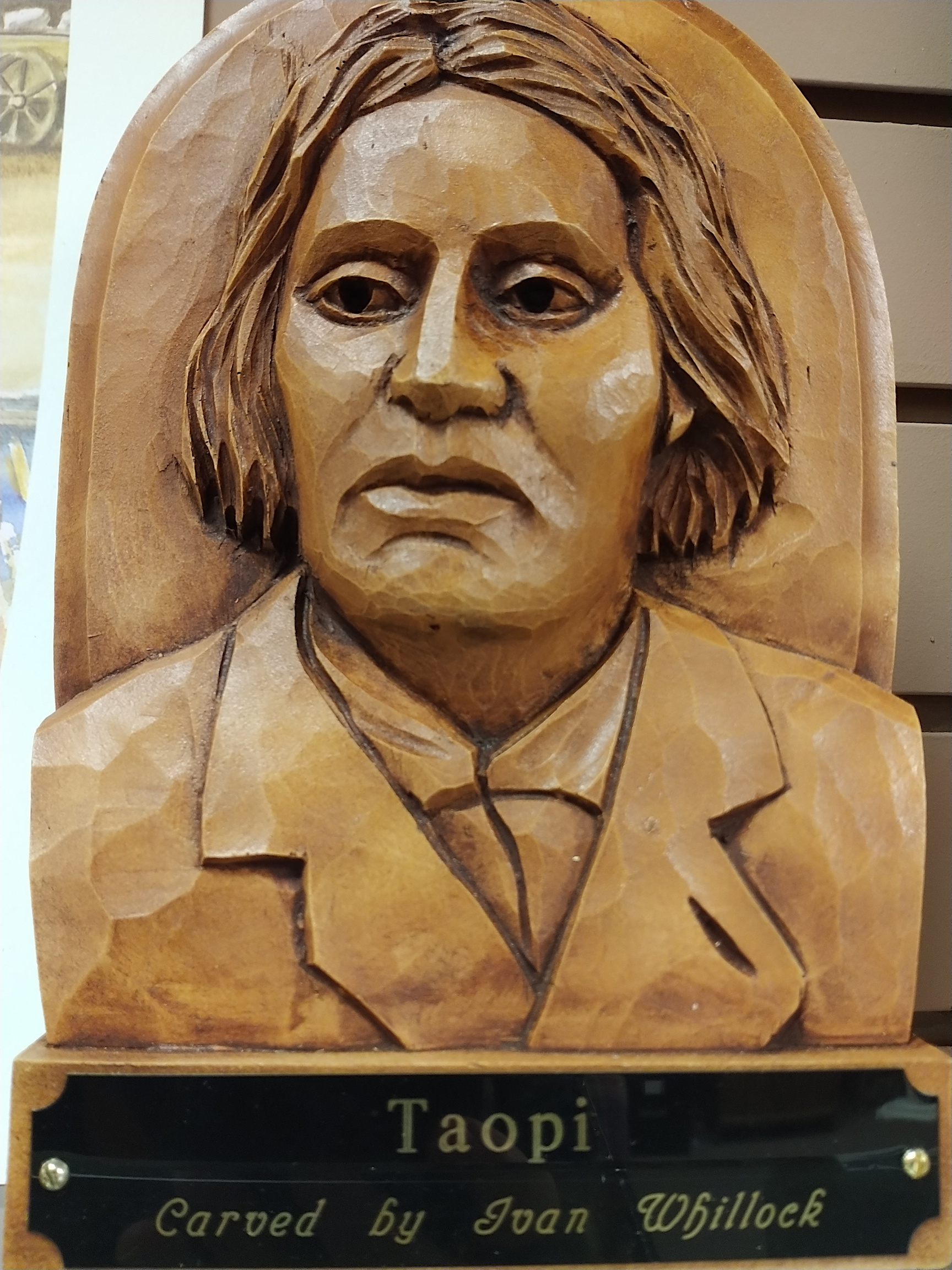
A Taopi exhibit at the Rice County Historical Society. The carving (by Ivan Whillock) and photo show Taopi with short hair as a “Farmer Indian.” (Minnesota Prairie Roots copyrighted file photo)

During his talk, Nichols called Taopi “a poster child for what an assimilated Dakota looks like.” And he didn’t mean that in a negative way. “You either assimilated or you would be destroyed,” Nichols said, qualifying that he wasn’t saying assimilation was right. Understood.

As settlers moved into Minnesota, pushing onto Native lands, the Dakota found themselves facing many challenges. Some, like Taopi, gave up their culture and adopted European ways, believing that was the only way to survive. That included learning to farm as the White man farmed. Taopi was considered the leader of the “Farmer Indians,” a term assigned during the U.S. Census. Dakota who continued in traditional cultural ways were labeled “Blanket Indians.”
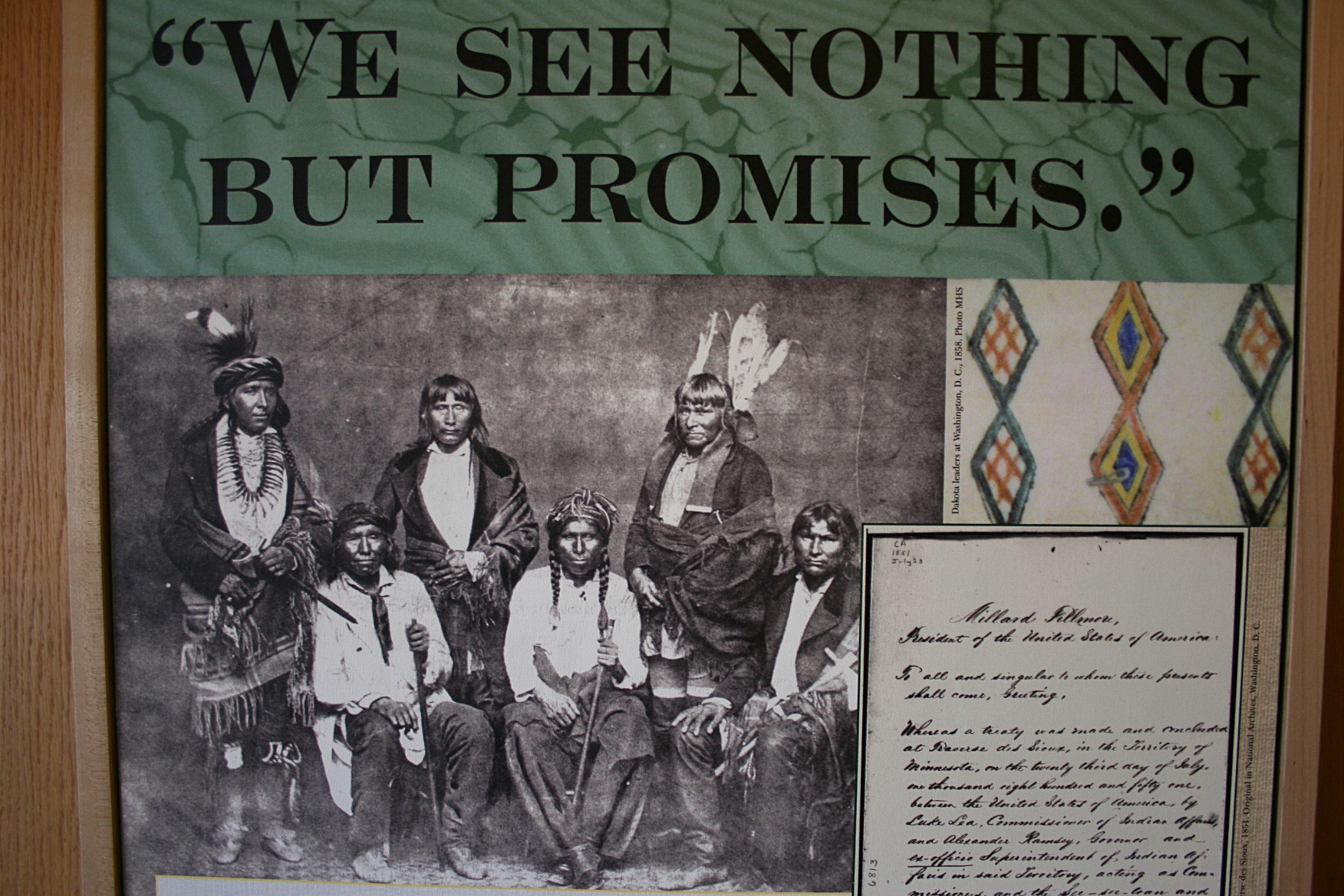
A photo panel at the Traverse des Sioux Treaty Center in St. Peter shows Dakota leaders photographed in Washington D.C. in 1858. The photo is from the Minnesota Historical Society. The war followed broken treaties. (Minnesota Prairie Roots copyrighted file photo)

Taopi farmed and established a school and mission, Hazelwood Republic, with chiefs Wabasha and Good Thunder on the Lower Sioux Reservation along the Minnesota River in southwestern Minnesota, Nichols shared. Because I grew up in that region, I’ve always been particularly interested in the Indigenous Peoples who were original inhabitants of the land, including Redwood and Brown counties. The region became the epicenter of the U.S.-Dakota War of 1862, which centered around issues of land, hunger and broken promises.
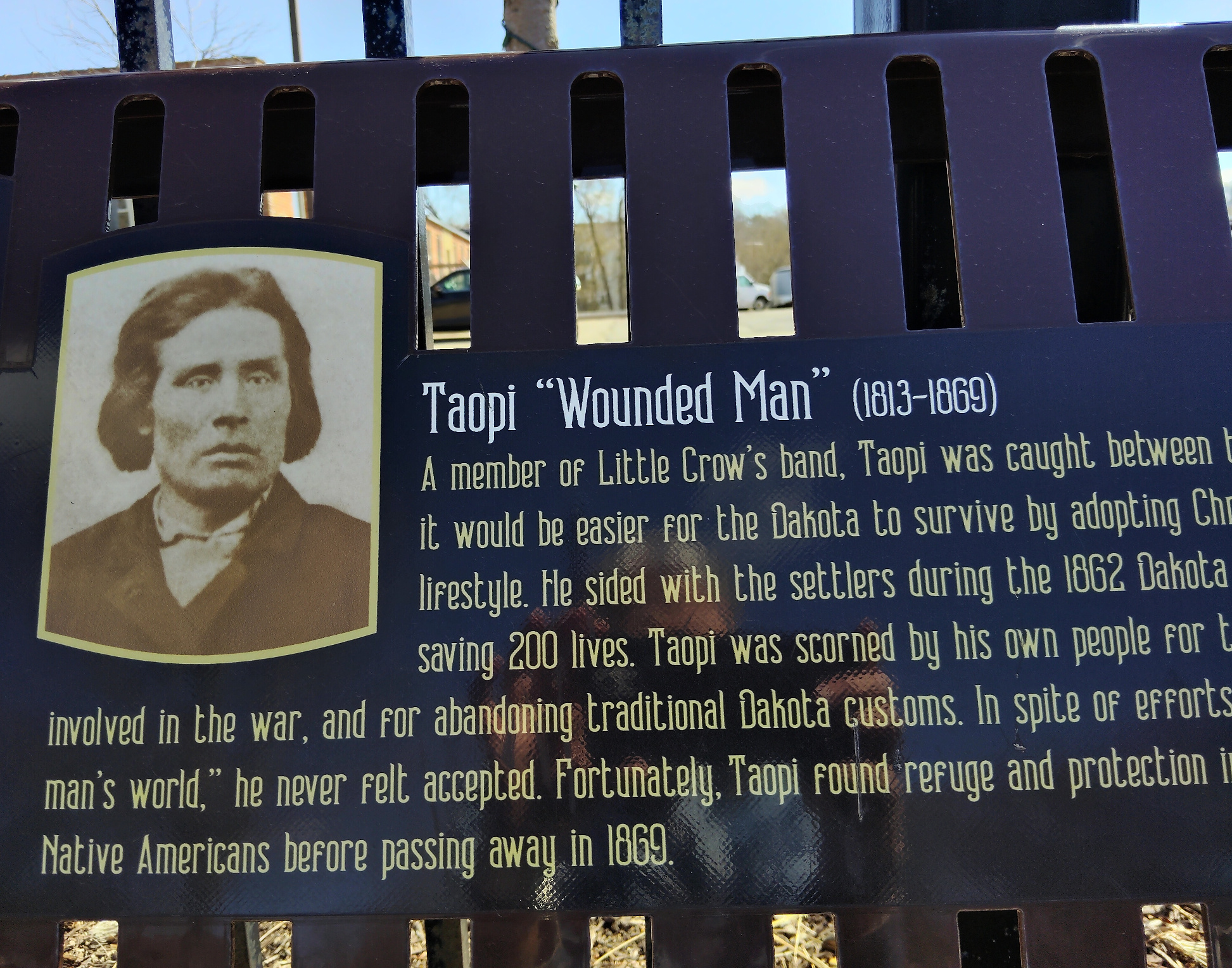
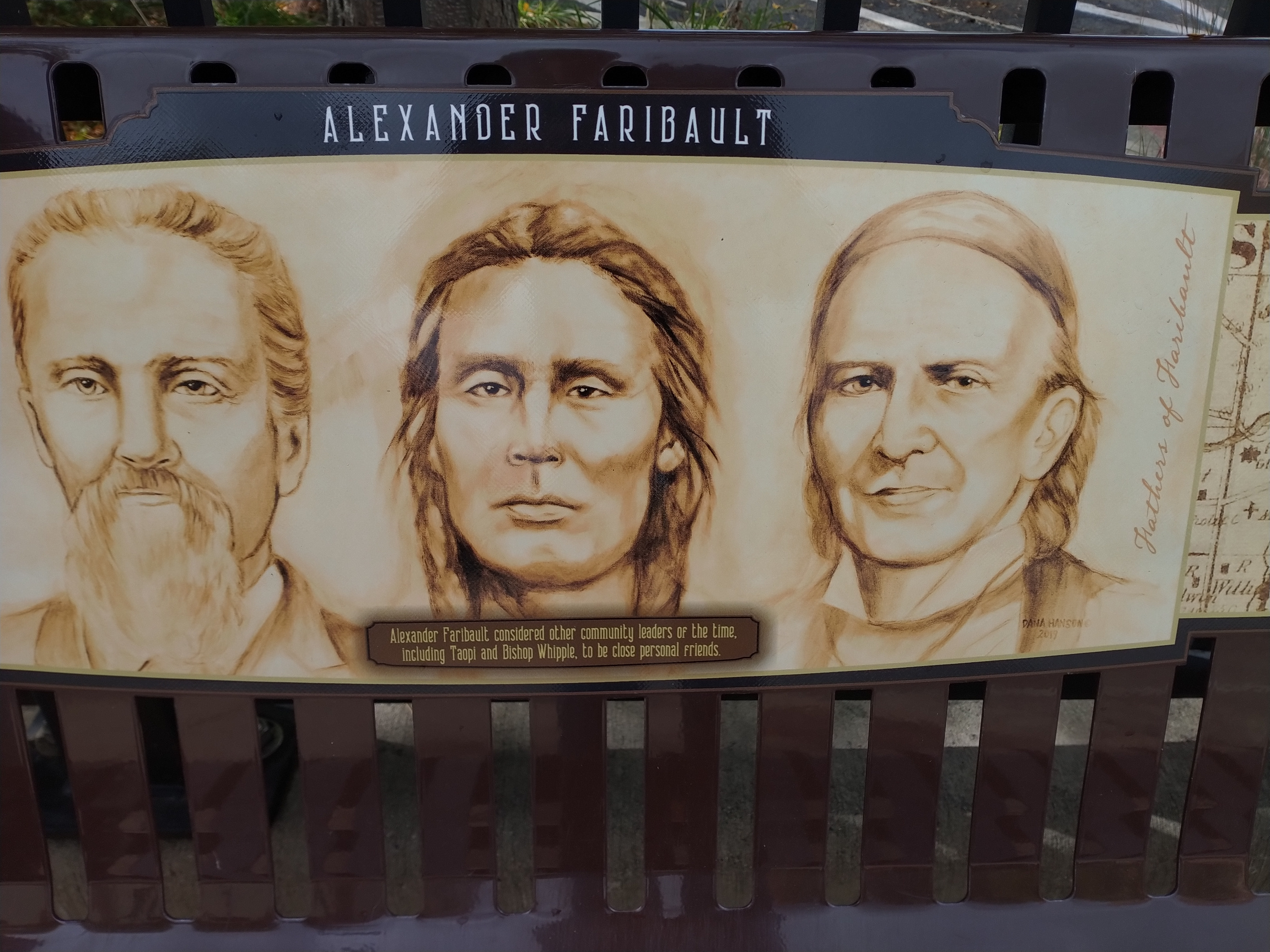
An historic-themed bench on the corner of Central Avenue and Sixth Street in Faribault highlights Taopi. (Minnesota Prairie Roots copyrighted photo April 2025)

That war facilitated the banishment of most Native Americans from Minnesota. If Taopi and other Dakota would have had their way, that war may not have happened. He led the Peace Party opposed to war, while his cousin, Little Crow, led the War Party, Nichols said. Taopi protected White settlers during the short war which claimed countless lives on both sides.
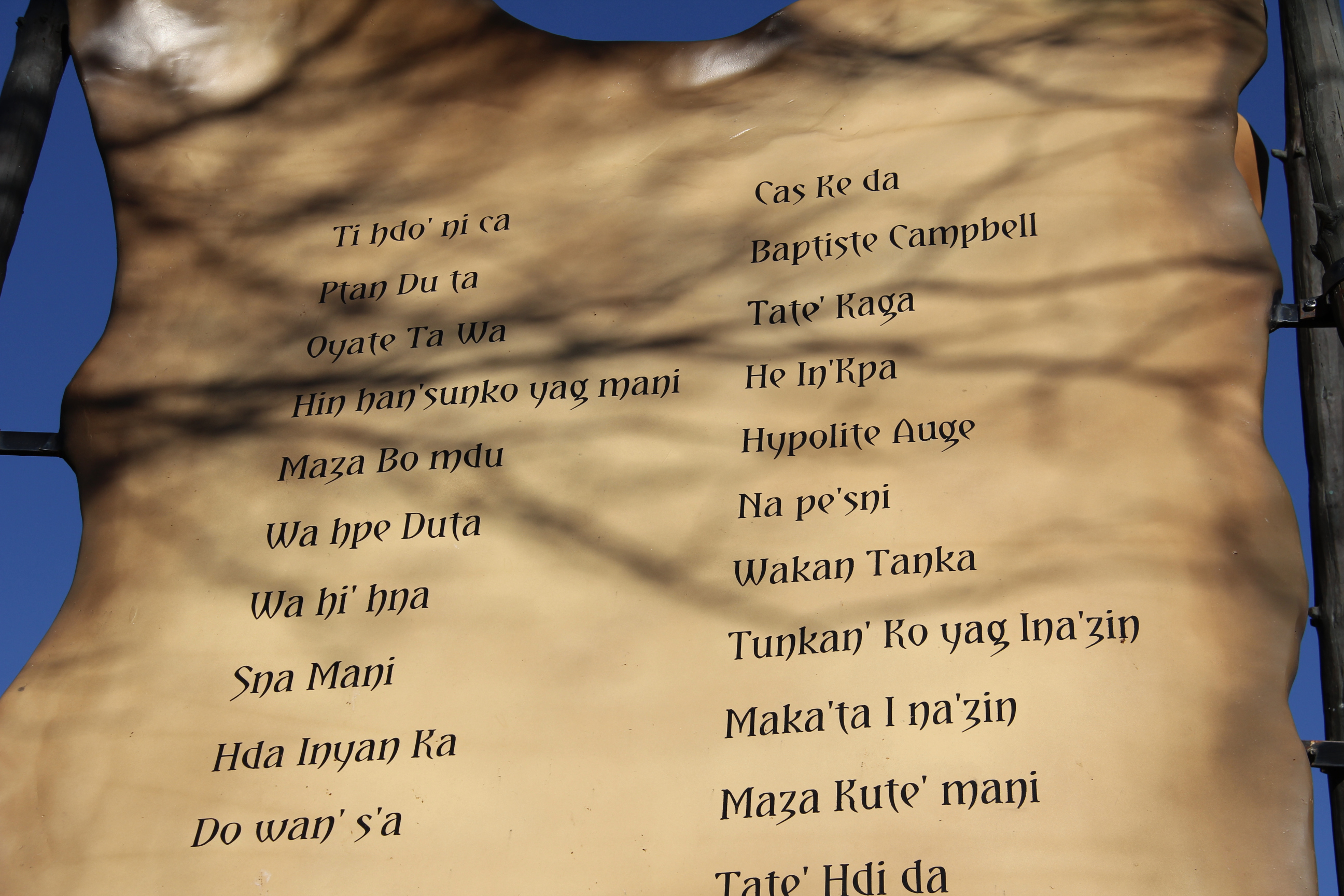
The names of the Dakota who were hung are listed at Reconciliation Park in Mankato. (Minnesota Prairie Roots copyrighted file photo)

Post-war, though, it mattered not to the U.S. government whether you were a Dakota person who opposed the war or who engaged in war, according to Nichols. All were considered guilty, imprisoned and eventually exiled from Minnesota (although not the Mdewakanton). Thirty-eight Dakota men were hung on December 26, 1862, in Mankato (40 miles from my community) during the largest mass execution ever in the U.S. It’s truly a tragic event in Minnesota history. But what multiples the awfulness is that 1,600 Dakota prisoners were marched to Mankato to watch the hangings before being marched back to Fort Snelling. That was new information I had not previously heard and it troubles me greatly.
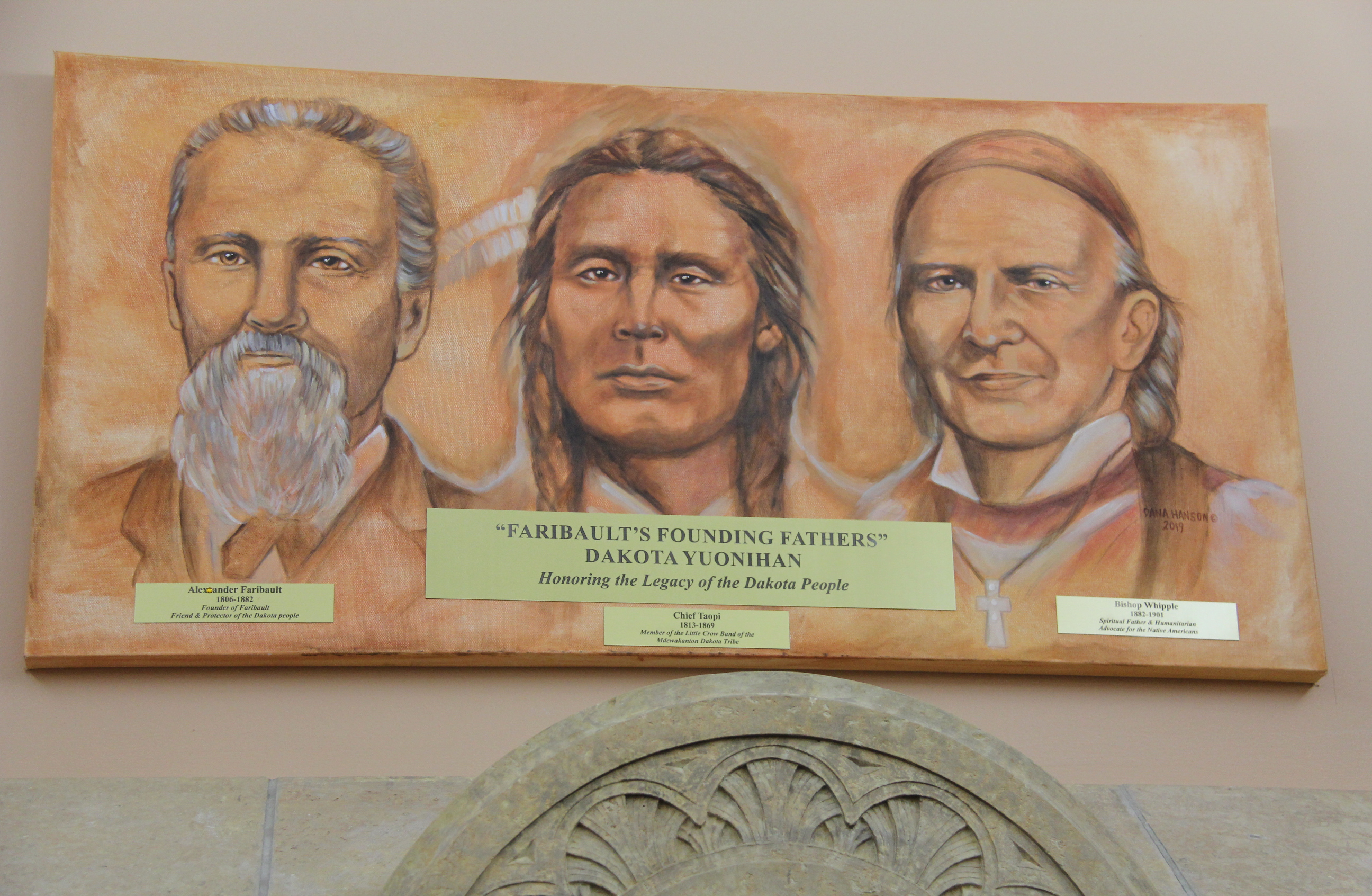
These portraits by Dana Hanson of Faribault’s Founding Fathers, Alexander Faribault (left to right), Taopi and Bishop Henry Whipple, hang in Buckham Memorial Library. (Minnesota Prairie Roots copyrighted file photo)

Taopi avoided prosecution and banishment, eventually landing in Faribault with 180 other Mdewakanton. About 80 were family members, according to Nichols. It was his friendship with Bishop Henry Whipple, who had long worked with and advocated for Native Peoples, that brought Taopi here. Town founder Alexander Faribault housed “the Peacefuls,” as the 180 were considered, on his land. They lived in tipis and lodges.
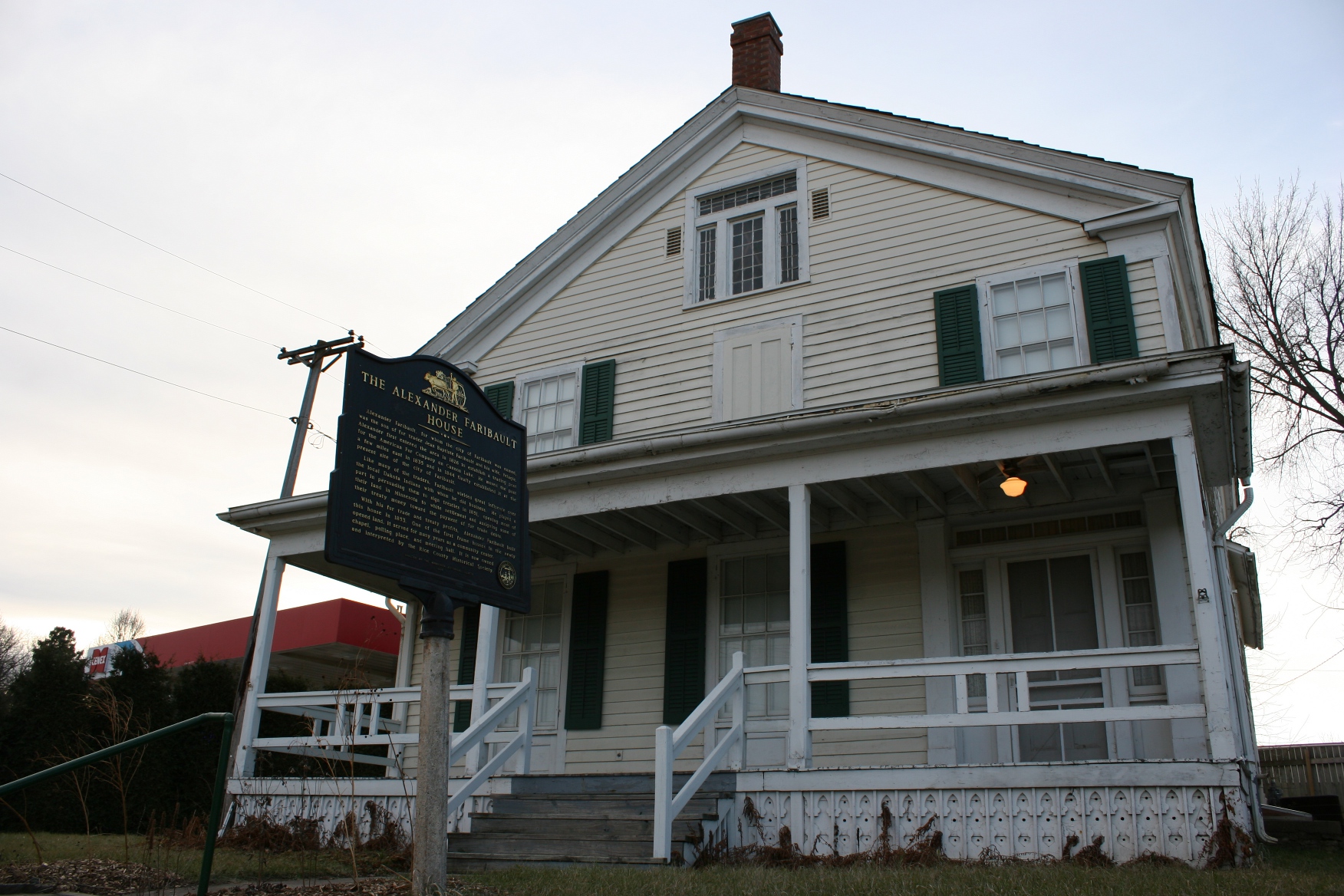
The home of fur trader and town founder Alexander Faribault. (Minnesota Prairie Roots copyrighted file photo 2017)

As you might rightly guess, not everyone in Faribault liked the Mdewakanton living among them. A wall was built in the area around Alexander Faribault’s house to protect them. Taopi became a community leader, said Nichols. As such he represented his people and mediated when necessary.

By the time of Taopi’s 1869 death, 90 of the 180 Mdewakanton who settled in Faribault had already left. But they left behind an imprint upon the land, not necessarily seen or appreciated even today. Yet, efforts are underway to change that with The Faribault Dakota Project. Nichols couldn’t speak specifically to that, only to say that local historian Jeff Jarvis has been working with the Dakota community on how to memorialize and honor the Indigenous Peoples of Faribault. That also includes the Wahpekute Dakota.
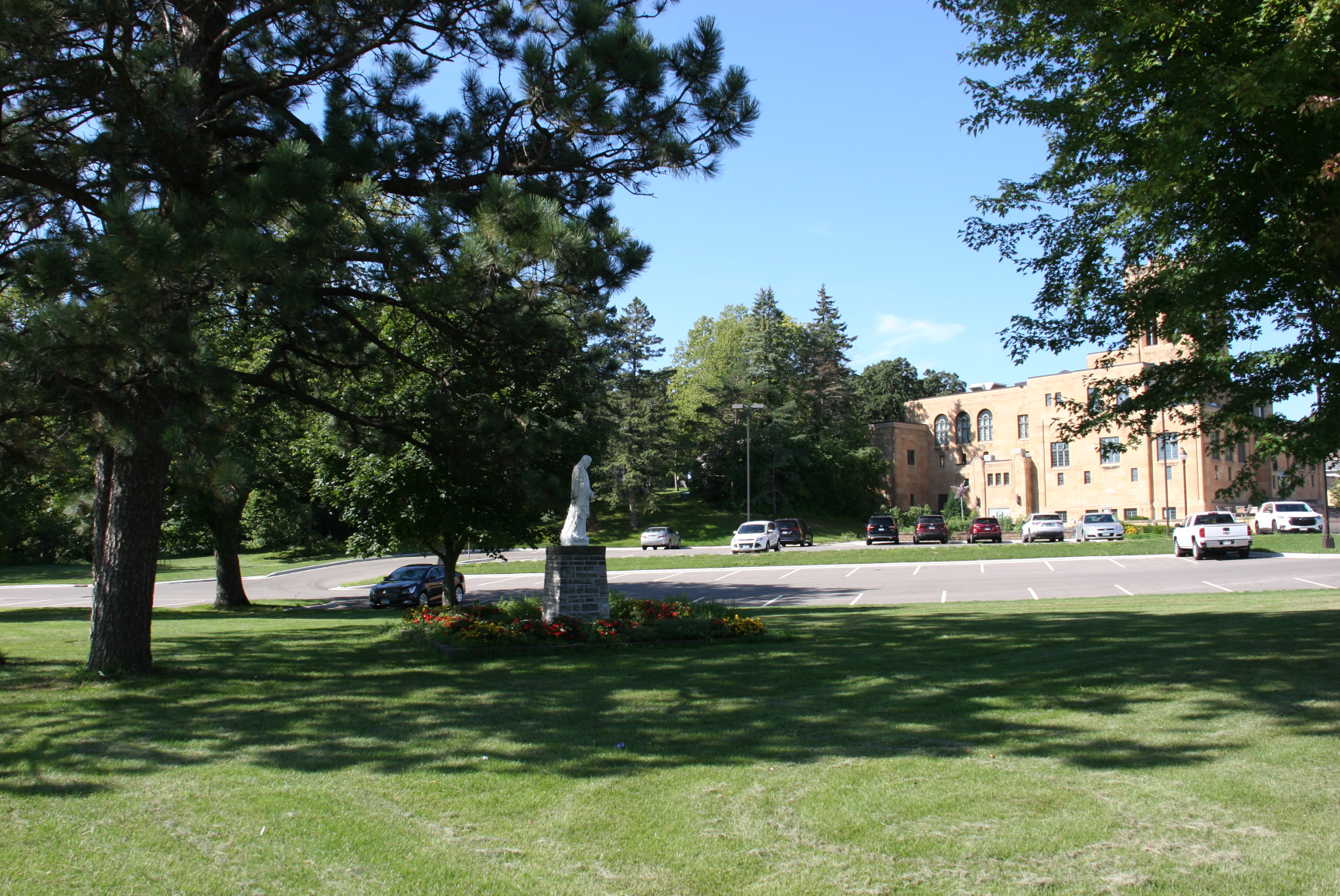
Peace Park, a protected Dakota burial site (but unmarked as such) next to the parking lot of Buckham Memorial Library. (Minnesota Prairie Roots copyrighted file photo)

Among the locales discussed by those attending Nichols’ talk was Peace Park, a triangle-shaped slice of property near Buckham Memorial Library. Alexander Faribault donated the land to the city with the stipulation that it never be developed. According to Nichols, the park is a protected burial site, where at least two Dakota are buried. Their bones were unintentionally uncovered in 1874 and then reburied. Today nothing marks that land as a cemetery. Rather a faith-based WWII monument stands in Peace Park. There is no reference to the Dakota. Perhaps some day this will be righted and the land publicly recognized as sacred ground. That is my hope as I continue to learn about the Dakota who once called Faribault home. I am grateful for every opportunity to grow my knowledge of them and their importance in local and state history.

#

FYI: Here are some suggested Dakota-connected places to visit in Faribault: the Rice County Historical Society Museum, Maple Lawn and Calvary cemeteries, the Cathedral of Our Merciful Saviour, a mural on the Central Park Bandshell and information on an historic-themed bench along Central Avenue.

Two fun facts: A small southeastern Minnesota town in Mower County near the Iowa border is called Taopi, named after the Mdewakanton Dakota chief. It suffered a devastating tornado in April 2022. The town celebrates its 150th birthday this year.

A woman attending Dave Nichols’ talk named her horse Taopi after Chief Taopi.

© Copyright 2025 Audrey Kletscher Helbling


A look at Taopi, plus an overview of failures, injustices & war in Minnesota October 9, 2023

Just inside the entrance to Maple Lawn Cemetery, a sign directs visitors to Taopi’s gravesite. (Minnesota Prairie Roots copyrighted photo October 2023)

MY GOAL WAS SIMPLE—to write a piece honoring Indigenous Peoples’ Day. My focus, I initially decided, would be on Taopi, a member of the Little Crow Band of the Mdewakanton Dakota Tribe. Taopi is perhaps best known in Faribault, where he lived for a while and is buried. A small Mower County town near the Iowa border also honors him in name. But my writing expanded beyond Taopi.

Taopi’s grave, and that of his daughter, are easily spotted via the propped poles. (Minnesota Prairie Roots copyrighted photo October 2023)

Recently I visited Taopi’s gravesite at Maple Lawn Cemetery. My interest piqued. I wanted to learn more about this Dakota leader and his importance in my community and in Minnesota history. His place in history connects to the US-Dakota War of 1862, a war all too familiar to me. My native Redwood County, where the Lower Sioux Agency was located, centered that deadly, short-lived conflict between white people and Native Peoples.

Now, viewing this war through a lens not tinted primarily by a white perspective, I understand the injustices. Decades ago, when I wrote a high school term paper on the war, I admittedly wrote a biased, unbalanced report based on biased, unbalanced research sources.

With time and maturity came the realization of the great injustices done, first when the US government acquired Indigenous Peoples’ land at a seemingly low cost and then failed to honor those treaties. The treaties opened nearly 24 million acres to white settlers. It was the Natives, the original inhabitants of this land, who found themselves cheated of government annuities, starving, pushed off their land and confined to strips of land along the Minnesota River. That includes the Wahpekute, a small band of the Dakota who lived in south central Minnesota, including the Faribault area. I live just below a Faribault city park called Wapacuta.

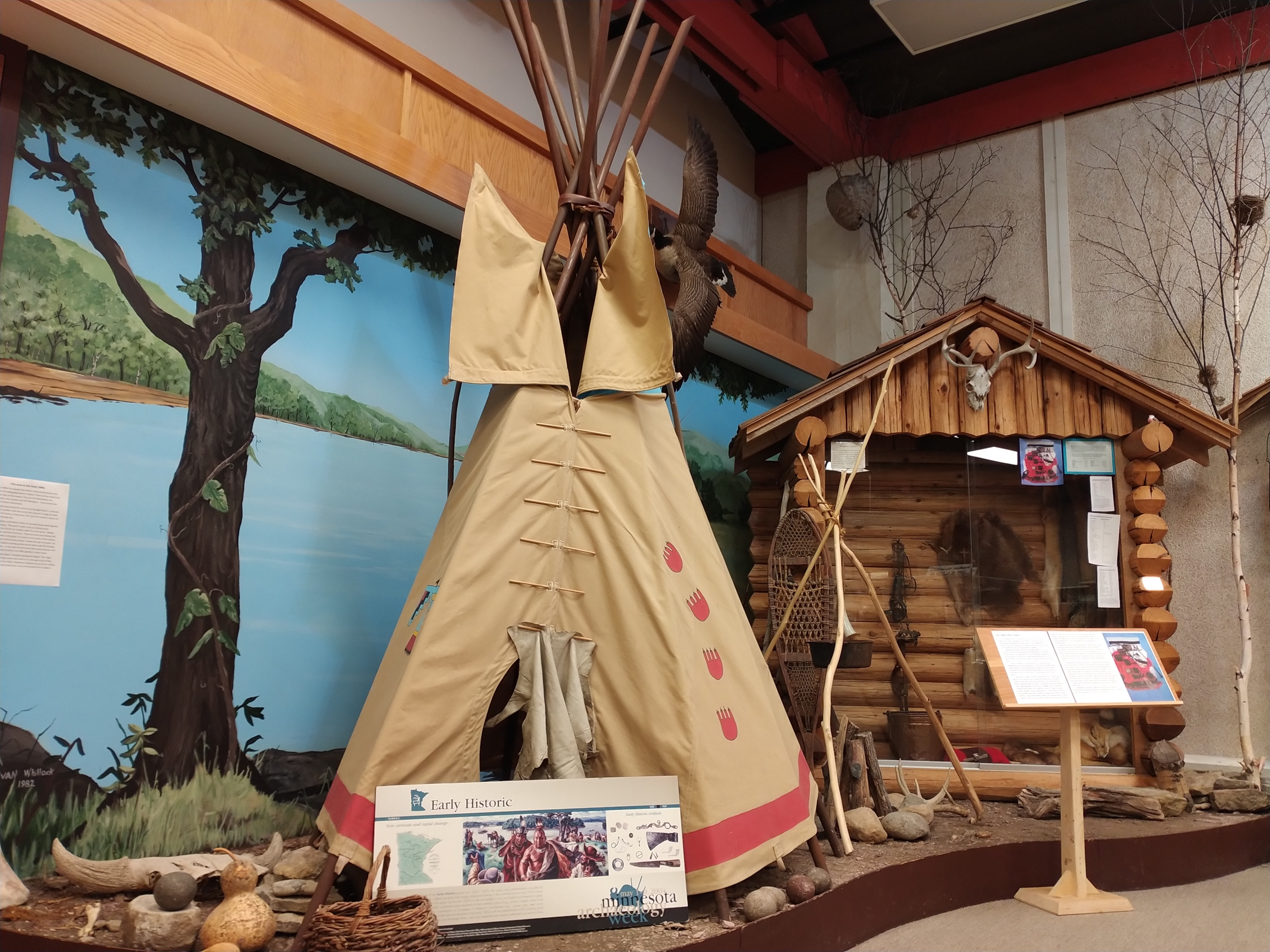
An exhibit at the Rice County Historical Society Museum. Artifacts from Indigenous Peoples are also displayed in cases. (Minnesota Prairie Roots copyrighted photo October 2023)

At the time of the US-Dakota War of 1862, Taopi was in the thick of all of it as a “farmer Indian,” the name tagged to Native Peoples who opted to farm, adapting the ways of the white man in occupation, dress and sometimes religion. He lived near the Lower Sioux Agency, relocated to a reservation there following the Treaty of Mendota in 1851. Those who continued with their hunting and fishing culture were known as “blanket Indians.” Taopi assuredly felt the animosity of his own people for the lifestyle and other choices he made.

A woodcarving of Taopi by noted Faribault artist Ivan Whillock is for sale in the Rice County Historical Society Museum’s gift shop. One is also displayed in a museum exhibit on Taopi. (Minnesota Prairie Roots copyrighted photo October 2023)

I can only imagine the pressure Indigenous Peoples experienced as white settlers moved into the area. The change, at times, had to feel overwhelming. Life would never be the same. Long-time homelands were lost, tradition and culture endangered. And so Taopi and others adapted, likely accepting that change was inevitable.

The gravesite of Taopi and his daughter, Cornelia Whipple Taopi (named after Cornelia Whipple, married to Bishop Henry Whipple). (Minnesota Prairie Roots copyrighted photo October 2023)

But one thing that remained constant with Taopi was his focus on peace. He opposed the war and was a leader in the Dakota Peace Party. He is credited with saving the lives of many.

Yet, at war’s end, Taopi found himself caught—disliked by his peoples, who considered him a traitor, and disliked by whites holding a deep animosity toward any Native person. In Faribault, though, he had a friend in Bishop Henry Whipple, a strong advocate for First Peoples, and in town founder Alexander Faribault. Eventually, Taopi and other Natives moved onto land owned by Alexander Faribault, living under his protection on a bluff overlooking the Straight River. Taopi died in 1869. In 1895, the Indigenous Peoples of Faribault were displaced once again, moved to the Lower Sioux Reservation. They had always existed on the fringes in Faribault, never fully-accepted by most residents while under the protection of the bishop and town founder.

Dana Hanson’s “Father’s of Faribault” (left to right, Alexander Faribault, Taopi and Bishop Henry Whipple) featured on a bench along Central Avenue in downtown Faribault. The same artwork hangs inside Buckham Memorial Library. (Minnesota Prairie Roots copyrighted photo October 2023)

And so that is a brief look at Taopi, whose gravesite I visited. His presence remains visible elsewhere in Faribault. He’s featured in an exhibit at the Rice County Historical Society Museum. A “Fathers of Faribault” portrait of Taopi, Bishop Whipple and Alexander Faribault by Dana Hanson hangs at Buckham Memorial Library. Just a block to the north, that same artwork graces an historic-themed bench. Taopi was, most assuredly, a man of importance in local and state history. I will remember him primarily as a man of peace in a time when peace was decidedly elusive.

#

© Copyright 2023 Audrey Kletscher Helbling

Sources: The First Cathedral, an Episcopal Community for Mission by Benjamin Ives Scott and Robert Neslund; the Minnesota Historical Society website; and the Rice County Historical Society Museum’s Taopi display.


Faribault’s famous (formerly forgotten) flier May 4, 2011

LAST WEEK DALE “RED” JACKSON joined aviators Elizabeth Wall Strohfus, Charles Lindbergh and some 150 others in the Minnesota Aviation Hall of Fame.

If you’re like me, you are surprised to hear that our state has a hall of fame for aviators. I only recently learned that when Jackson was about to be inducted.

So who are Jackson and Strohfus and what qualifies them for an aviation honor?

They are two famous aviators with roots in my community of Faribault. Strohfus, who was inducted into the hall of fame in 2000, was a member of the Women’s Air Force Service Pilots during World War II. She taught instrument flying to male cadets and later ferried B-17 and AT-6 warbirds around the country, according to the Minnesota Aviation Hall of Fame website. Today she is a noted speaker.

As  for Jackson, he was a stunt pilot and barnstormer during the late 1920s and early 1930s. In July 1929, Jackson and St. Louis flyer Forrest O’Brine circled the city of St. Louis for some 420 hours, refueling 48 times in flight. That broke an aerial endurance record. Later they remained in flight for 647 hours (27 days), setting their second record.

On January 6, 1932, at the age of 25, Jackson was killed while stunt flying over Miami. Nicknamed the “Flying Fool,” Jackson had apparently been warned not to try stunts in the tiny Curtiss Teal amphibian he was piloting on that fateful day. As he tried to straighten the plane after a loop and dive, a wing tore off. Jackson died in the wreckage, reportedly with one hand hooked into the ripcord of his parachute.

When Jackson’s body arrived in Faribault by train from St. Louis, where an earlier memorial service had been held, an estimated 3,000 people gathered at the Rock Island Depot, according to a January 11, 1932, article in The Faribault Daily News.

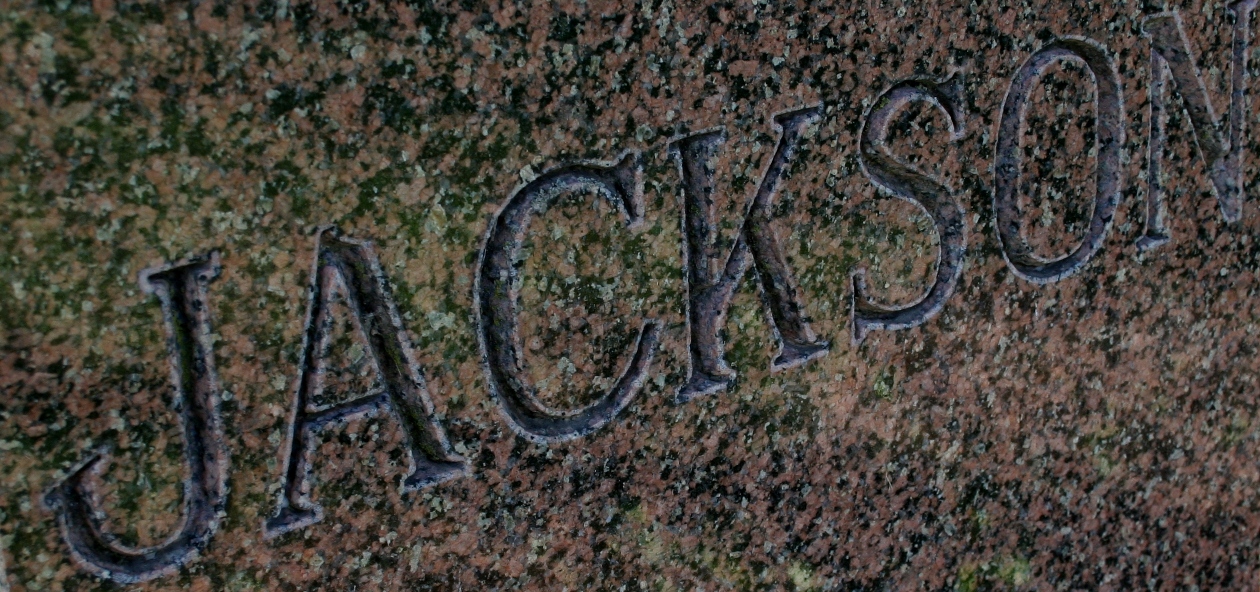
Jackson is the single word on a tombstone marking the Jackson family graves in Section K, Lot 61, at Maple Lawn Cemetery in Faribault.

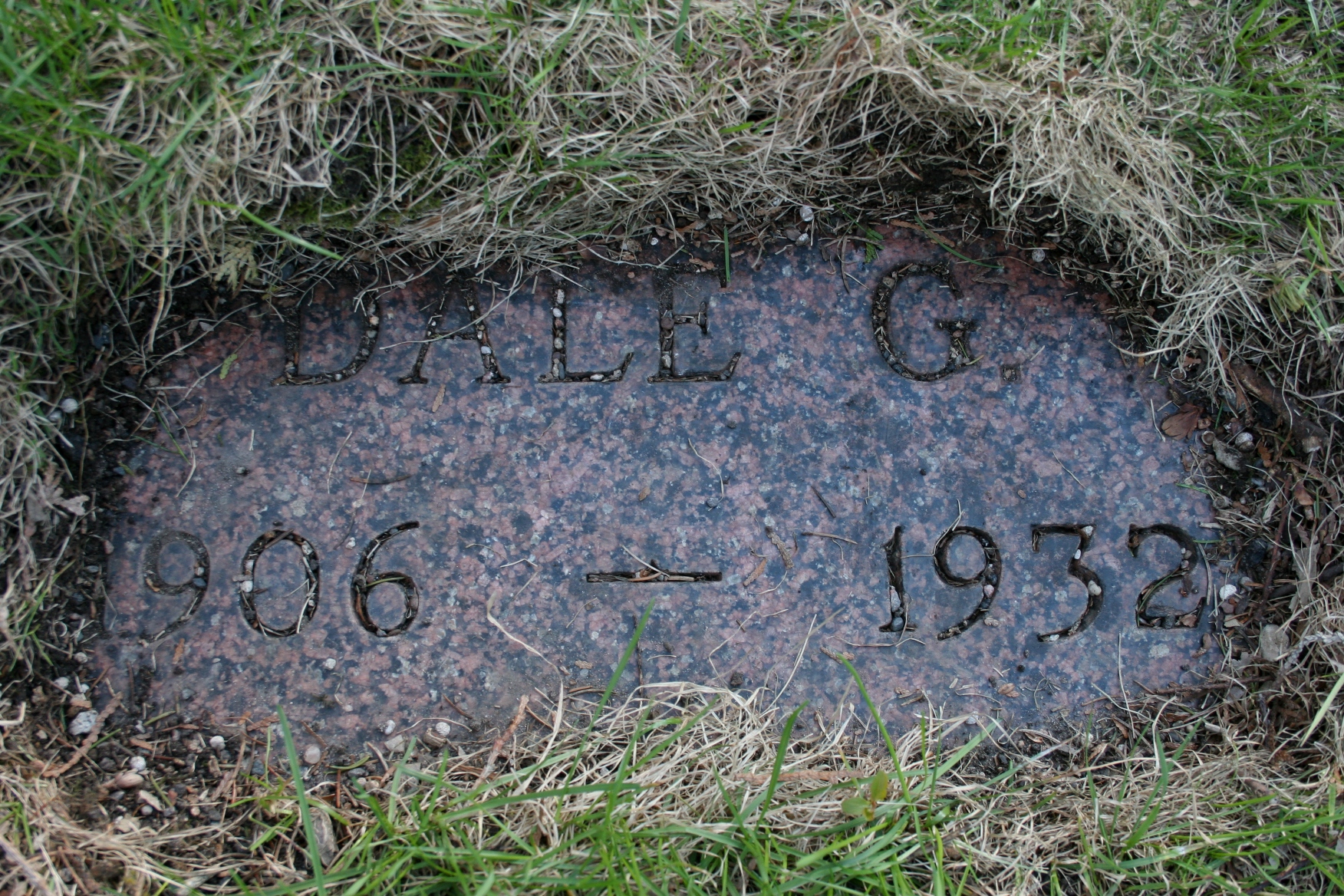
I nearly missed this in-ground marker for Dale Jackson, which lies about 12 feet from the family gravestone. I had to pull back the grass to reveal his first name and middle initial.

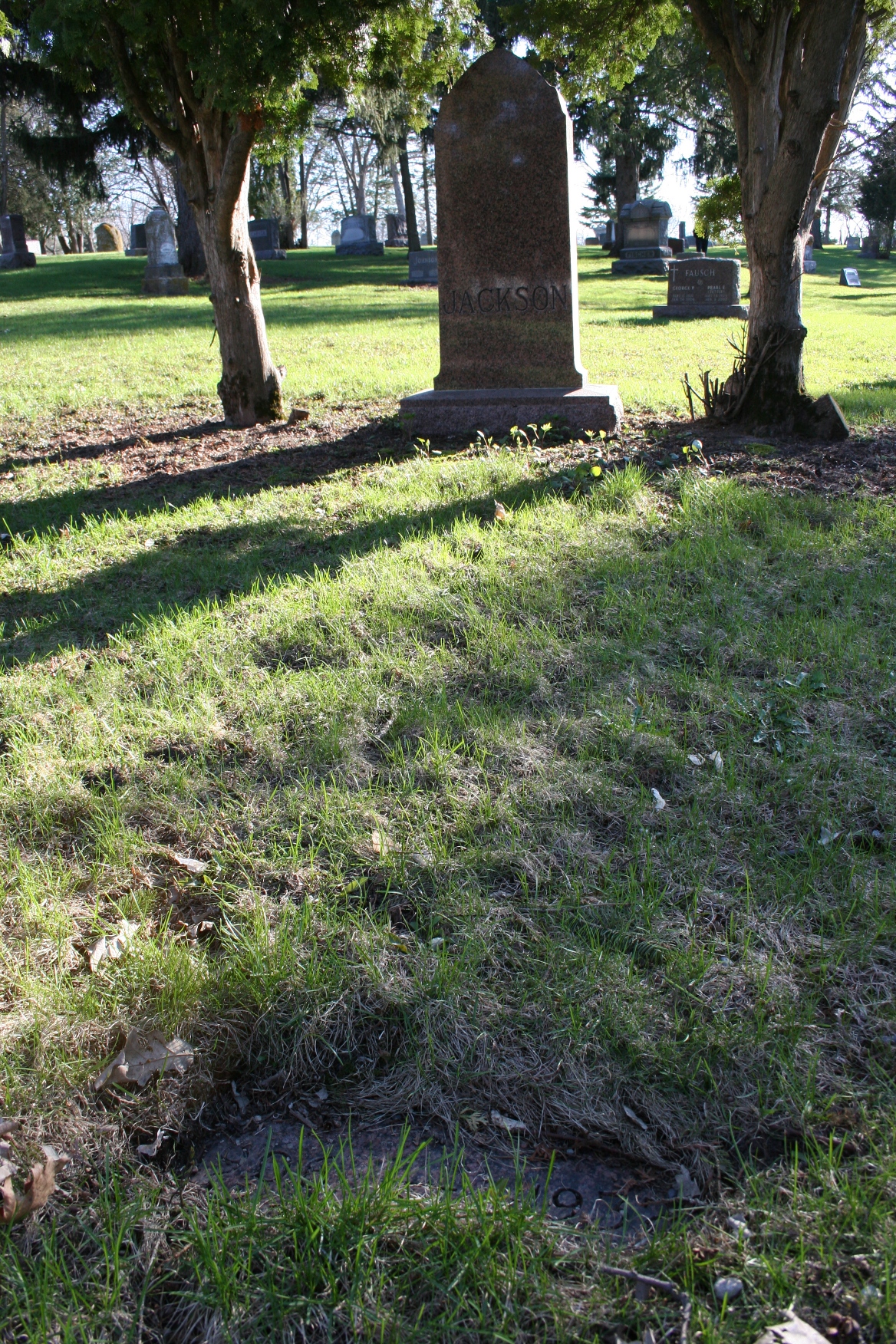
Dale Jackson's marker lies flush to the ground about a dozen feet from the Jackson family marker, between two cedar trees. I had expected a more opulent and noticeable gravesite.

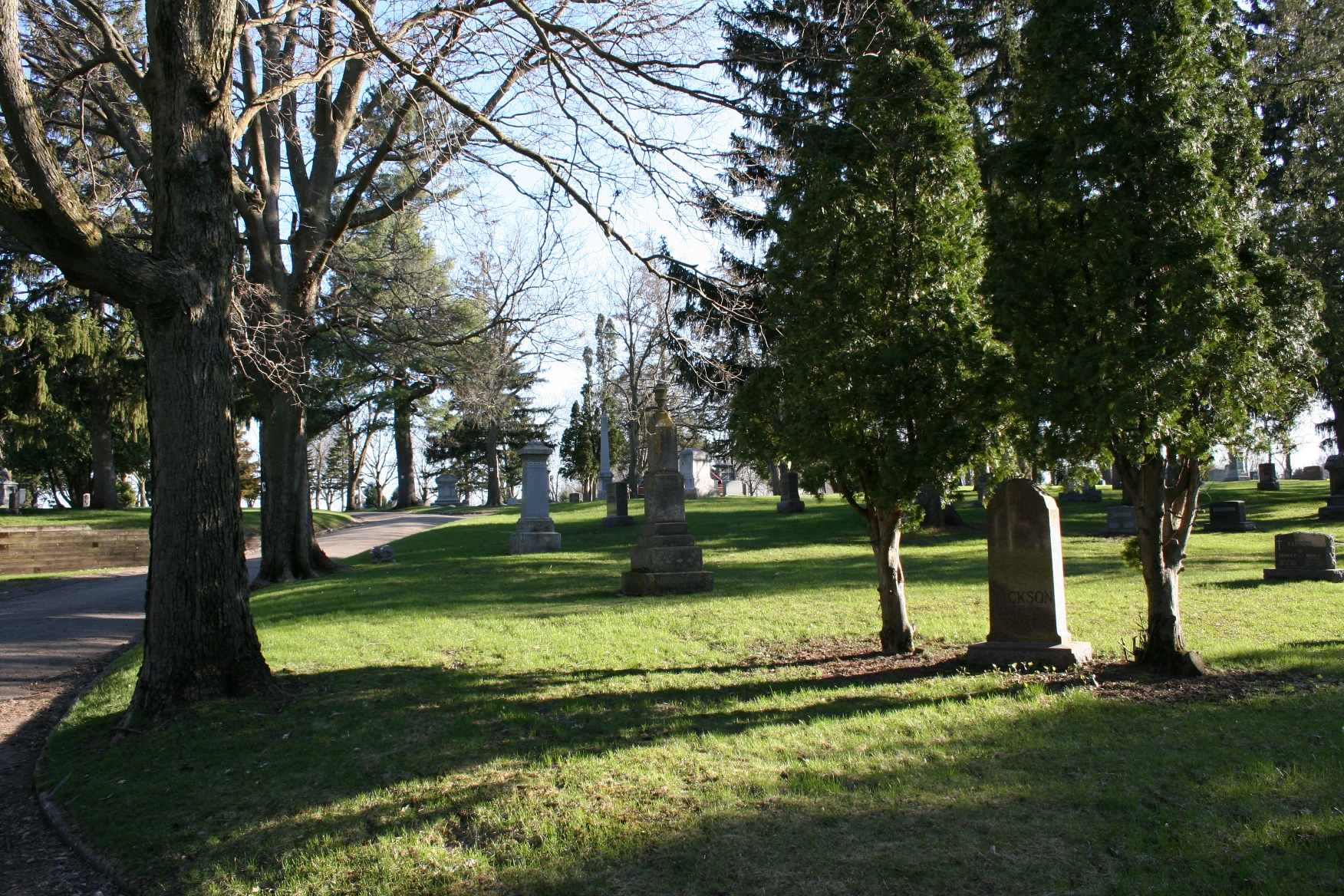
Dale Jackson is buried here along with his parents, Henry and Josephine, and his wife, Selma. The Jackson family headstone stands between the two cedar trees to the right in this photo.

Given Jackson’s national and international notoriety in the aviation world, I wondered why I had never heard of him before last week. He was born in Iowa, moved here with his family and graduated from Faribault High School.  Faribault has not, as far as I am aware, shone the spotlight on this daring stunt pilot since his barnstorming days and untimely, sudden death.

Why?

I think he would be worthy of more than a marker, half covered with grass, in Maple Lawn Cemetery. I’m thinking tourism possibilities here.

For now, his Minnesota remembrance comes via that Minnesota Aviation Hall of Fame induction last weekend. That’s a good start.

I wondered where this museum of sorts is located. After substantial googling, I discovered that an actual museum doesn’t exist. Rather the hall of fame consists of plaques honoring the inductees. Those hang in a secure section of the Duluth International Airport in an area inaccessible to the general public. Huh?

But that’s not all. Once a terminal renovation is completed at the Duluth airport in 2012, the plaques will need to be moved.

The Albert Lea City Council, in a motion passed in late January, has expressed an interest in bringing the Minnesota Aviation Hall of Fame to its community. No commitment. Just an interest right now.

In the meantime, if you want to check out aviators like Faribault’s Flying Fool, Dale “Red” Jackson, who have made it into the Minnesota Aviation Hall of Fame, you best do that online or visit Maple Lawn Cemetery.

© Copyright 2011 Audrey Kletscher Helbling