Minnesota Prairie Roots

Writing and photography by Audrey Kletscher Helbling

Connected by place & profession to a Minnesota tragedy June 20, 2025

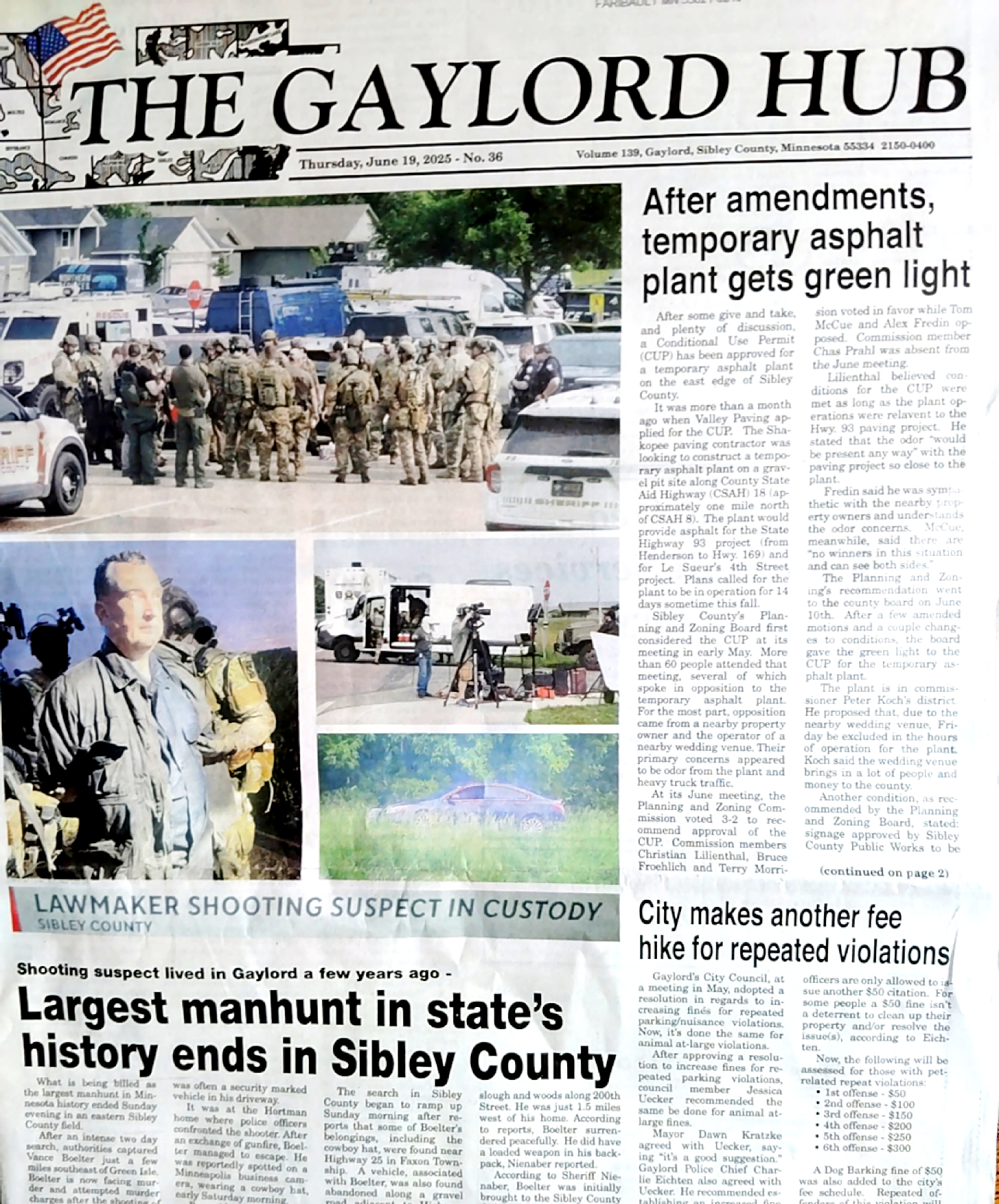
This shows an edited section of the front page of the June 19, 2025, The Gaylord Hub. (Minnesota Prairie Roots photo June 2025)

ALTHOUGH I AM DECADES removed from working as a full-time journalist, my innate curiosity remains unchanged. I still want to gather the facts, get answers, and uncover the who, what, when, where, why and how. That has never left me.

Last Saturday, June 14, memories of working as a newspaper reporter in Gaylord, the county seat of Sibley County, rushed back as the top news story in Minnesota, and the nation, unfolded. That breaking news was the politically-targeted assassinations of Minnesota State Representative Melissa Hortman and her husband, Mark, and the shootings of Senator John Hoffman and his wife, Yvette. The suspect now accused in the crimes, Vance Boelter, 57, lived near Green Isle. In rural Sibley County.

My first job fresh out of Minnesota State University, Mankato, in 1978 with a degree in mass communications, news/editorial emphasis, landed me in small town Gaylord, at The Gaylord Hub. I was affectionately dubbed “The Cub from the Hub,” or at least affectionately by those who appreciated my fair and balanced reporting. Some did not. Gaylord lies about 15 miles southwest of Green Isle, where Boelter was eventually apprehended near his home. Green Isle was mostly outside The Hub’s coverage area, although I recall writing a few stories from that part of Sibley County.
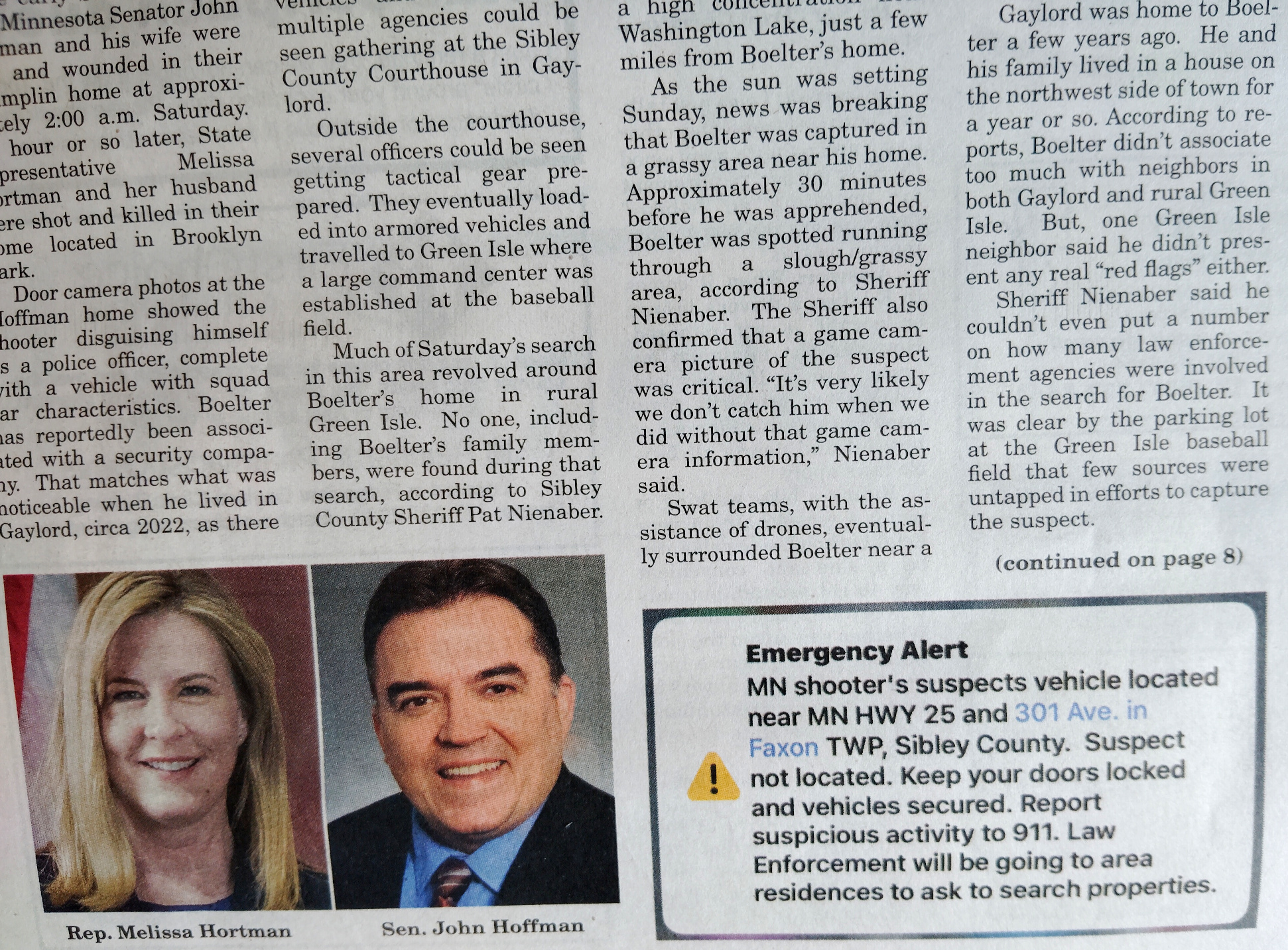
The bottom portion of the front page story written by Joseph Deis. (Minnesota Prairie Roots photo June 2025)

Today the June 19 edition of The Hub landed in my mailbox. I’d been waiting for this issue, curious to see how third-generation publisher and editor, Joseph Deis, would cover the largest news story in the paper’s history. The Hub front page headline reads: Shooting suspect lived in Gaylord a few years ago—Largest manhunt in state’s history ends in Sibley County.

I couldn’t help but think how hard Joe (he was just a kid when I worked for his dad, Jim, at The Hub) and other media have worked to cover this evolving story. It’s not easy to gather information from multiple sources and angles and keep everything straight. That said, law enforcement did an impressive job of informing the media and the public, at least from my at-a-distance perspective.

And Joe Deis did a good job of pulling everything together in a lengthy story that published in his weekly. His dad would be proud, as am I. His story included new-to-me information that Boelter and his family lived on the northwest side of Gaylord a few years ago. They mostly kept to themselves, the article states.

Now, as if the Gaylord/Sibley County connection to my past isn’t enough, there’s more. I left The Hub after several years to become a newspaper reporter at The Sleepy Eye Herald-Dispatch. The murder suspect grew up in Sleepy Eye, graduating from the public high school in 1985. (I was long gone.) Boelter returned to his rural southern Minnesota hometown, living with his family in Sleepy Eye from 2008-2011 and working at Del Monte. And he apparently preached occasionally at church services held in the high school gym, according to media reports. If I know one thing about Sleepy Eye, it’s that the community is deeply religious, with an especially strong Catholic base. I have no idea what Boelter’s childhood faith background may be. But he graduated from an interdenominational Bible college in Texas in 1990 and served as an evangelical missionary in the Democratic Republic of Congo in recent years.

These two connections to my past rattled me. But they also reminded me that, even in rural areas, a reporter’s job can be about more than covering government, sports, community events and the everyday happenings of small town life. Sometimes it can be about covering a really big, life-changing story. A story that grabs headlines locally, statewide, nationally and internationally as did the manhunt in Sibley County, in the readership area of a small town weekly newspaper where I once covered the news.

© Copyright 2025 Audrey Kletscher Helbling


-30- April 30, 2024

(Minnesota Prairie Roots copyrighted file photo)

THE LOSS IS IMMENSE, TRAGIC—the deaths of eight prominent community members in southern Minnesota last week. I knew none of them personally. Yet I did. We all did.

If you have ever read a community newspaper, then you knew the deceased. For it is eight Minnesota newspapers, not individuals, that died. Ceased publication, only weeks after an announcement of their forthcoming funerals.

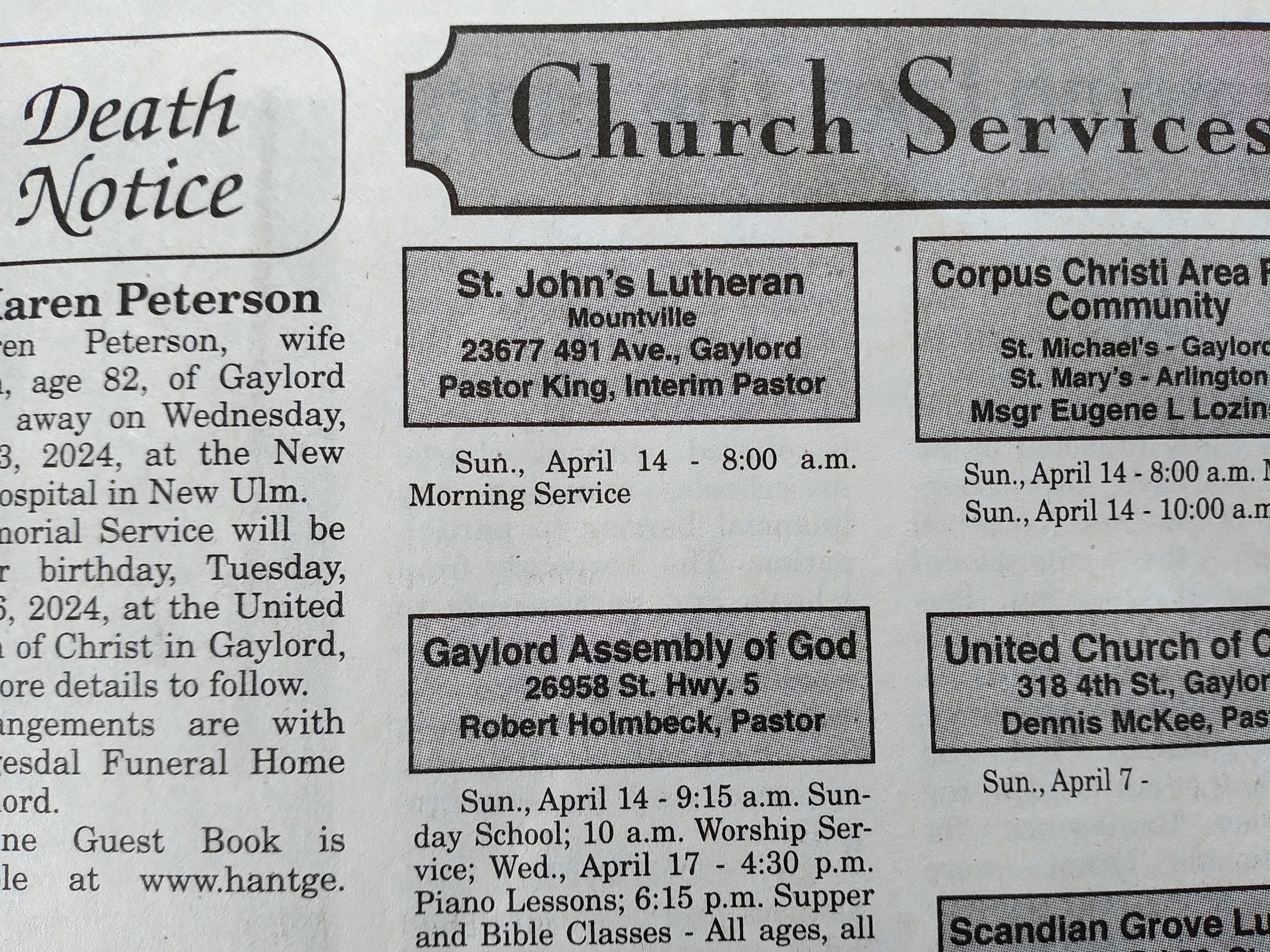
Death notices and church services, printed in The Gaylord Hub.

I am mourning the deaths of the Hutchinson Leader, Litchfield Independent Review, Chaska Herald, Chanhassen Villager, Jordan Independent, Shakopee Valley News, Prior Lake American and Savage Pacer, plus Crow River Press Printing Plant. All are owned by Denver-based MediaNews Group, part of hedge fund Alden Global Capital.

They ranged in age from 30 (Savage Pacer) to 162 (the Chaska and Shakopee papers). Five of the eight began publication between 1862-1880. That’s quite a legacy.

I am undeniably biased in reporting this news. I hold a journalism degree, have worked for community newspapers and write for publications owned by Adams Publishing Group. I believe in community journalism with the fierceness of recognizing its importance, its value, to the people who live and work in the places these papers cover. No one covers local like local.

My local paper, owned by Adams Publishing Group, still prints a special graduation section each spring.

And now that print coverage is lost in all these southern Minnesota towns, cities and rural areas: The watchdog coverage of school board, city council, county board, planning and zoning, and other government bodies. The stories about crime and tragedies. The stories about community events and celebrations. The interesting features that focus on people. Local sports and arts and entertainment stories. Community calendars, school honor rolls and lunch menus. Graduation. Obituaries and much more.

In my first journalism class at Minnesota State University, Mankato, I learned how to craft an obituary. It was our initial writing assignment, I think to impress upon all of us post-Watergate would-be reporters the importance of getting every detail correct in a story. That lesson stuck with me. Get it right.

I took that knowledge with me to The Gaylord Hub, a small town community newspaper printed at Crow River Press in Hutchinson. Each week a co-worker and I aimed north in a vintage Dodge van to deliver the newspaper lay-out sheets to the printing plant. The process of creating a newspaper in 1978 was decidedly different than today. Consider that I typed all my stories on a manual typewriter. A typesetter then typed my work into a typesetting machine. Stories were printed out in columns, then laid out and pasted onto lay-out sheets. No designing by computer. Then it was off to Crow River Press, where a co-worker and I watched the Hub roll off the press, bagged the freshly-inked papers and delivered them to the Gaylord Post Office, where subscribers eagerly waited to get their papers.

A front page story in the April 11 issue of The Gaylord Hub.

Yes, I’m feeling a tad nostalgic and sad thinking of the closure of Crow River Press. The recent shut-down left the publisher of The Gaylord Hub, and other small town newspaper owners, scrambling for a place to print their papers. Many printing plants, like community papers, have met their demise in Minnesota as large media groups acquired papers and plants.

This thank you published in the April 21 final edition of The Galaxy, a supplement to eight community newspapers printed by Crow River Press.

Times change. I understand that. The economy, technology, COVID, acquisitions and much more have factored into the deaths of community newspapers. Readers find their “news” elsewhere. Businesses spend their advertising dollars elsewhere. Far-removed executives make questionable business decisions. The list of reasons and excuses and explanations is extensive.

Community members, too, hold some responsibility in the deaths of newspapers. I can’t speak to the specific papers that closed last week in Minnesota, but I can tell you what I hear locally. And that is criticism, some deserved, much not. People have always criticized the media, failing to remember that reporters are reporting, not creating, the news. But the comments have become more intense, more rabid, more frequent. Freedom of the press feels threatened in our democracy.

The community journalists I know are honest, hardworking, (probably) underpaid and devoted to the craft. Just as I was when I worked as a full-time newspaper reporter.

This full page notice/thank you, an obituary of sorts, published in the April 21 final edition of The Galaxy.

Community newspapers are no longer valued like they once were, resulting in fewer subscribers. When I hear people say they no longer subscribe to the local paper, I suggest they reconsider. Community newspapers are vital to our cities, towns and rural areas. And sometimes we don’t understand that, until it’s too late, until we’re reading their obituaries.

-30-

NOTE: Print journalists have used -30- to signify the end of a story submitted for editing. I use # to indicate the ends of my stories, except today, when the old school -30- seems more appropriate.

© Copyright 2024 Audrey Kletscher Helbling


Remembering: Boys, blocks & 9/11 September 9, 2011

Filed under: Uncategorized — Audrey Kletscher Helbling @ 6:09 AM
Tags: , , , , , , , ,

THROUGHOUT THIS WEEK I’ve contemplated the post I would write about 9/11. And not once have I deviated from my initial idea.

So yesterday I headed to the basement and started digging through totes in search of building blocks and toy airplanes. I found the blocks, but not the planes. Those I discovered later while rummaging through my son’s upstairs bedroom closet.

Ten years ago, on September 11, 2001, my boy was only seven years old. He was home from school that day, not feeling well, when my husband phoned with news of the first plane crashing into the first tower.

I switched on the television. Typically I don’t have the TV on during the day and would not have known about the terrorist attacks until much later.

From that moment on, I could not take my eyes off the screen even though I worried about exposing my son and a younger boy in my care that day to the news coverage. How would they react? And did they truly understand the gravity of what was unfolding in our country?

I attempted to explain the situation, to tell the boys this was “real” and not some television show. They continued playing with whatever toys they had out at the time—I can’t recall.

But clearly they were listening and watching, for soon the two pulled a box of wooden building blocks from the toy box. Then they pulled out the toy airplanes.

I watched as my 7-year-old and his friend constructed teetering towers, then smashed those miniature planes into the towers. Blocks tumbled across the living room carpet.

I reconstructed a tower using the same blocks my son and his friend used on September 11, 2001, to duplicate what they saw on television. These are also the same airplanes they flew into the towers.

They repeated the action: Build the towers. Fly the planes. Smash the towers. Build. Fly. Smash.

I could have cried over the loss of innocence—mine and theirs.

WHAT ARE YOUR PERSONAL memories of September 11, 2001? Please submit a comment and share your story.

© Copyright 2011 Audrey Kletscher Helbling