Minnesota Prairie Roots

Writing and photography by Audrey Kletscher Helbling

Another chapter finished in the book of parenting March 2, 2012

Filed under: Uncategorized — Audrey Kletscher Helbling @ 9:27 AM
Tags: , , , , , ,

AFTER 22 YEARS of going to parent-teacher conferences, my husband and I attended our final one last night. The youngest of our three children, who is eight years younger than our eldest, graduates from high school in three months.

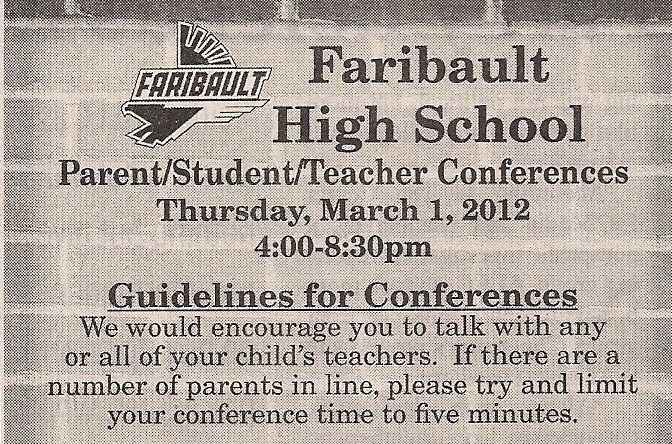
And to think we almost missed this notable occasion because I had not flipped the calendar from February to March yet. An ad in Thursday’s local daily newspaper alerted me of that evening’s sessions at Faribault High School.

En route to school, I mentally planned the extra words I would scrawl onto my name tag: “After 22 years, this is our final conference!”

But alas, the school did not provide name tags for parents on this occasion. What a disappointment.  Instead, I had to inform all four of our son’s teachers that they had the privilege of concluding our 22-year parent-teacher conference tenure.

It’s been a good ride. All three of our children have worked hard in school, done their best and been respectful. Teachers have always spoken highly of them.

So then you likely wonder why we have even bothered to attend conferences.

Simply put, we care. We are interested in the individuals who educate our children. We want to connect with them. We want them to know that we care.

We’ve gained insights into our children and learned about what they’re learning, because children/teens don’t always inform parents.

Parent-teacher conferences are a two-way process. We’ve always approached these meetings with the idea that we are there to glean information as much as to share it.

And now we’re done. Twenty-two years later. I’m not all misty-eyed and sad as one teacher suggested. But I’m not jumping for joy either.

I’m simply wondering how we got from crayons to calculus in the seeming blink of an eye.

IF YOU’RE A PARENT, have you attended parent-teacher conferences? What value do you find in them? How would you improve conferences if you think improvement is needed? Please share your thoughts and stories in a comment.

Likewise, if you’re a teacher, feel free to share your thoughts and insights.

© Copyright 2012 Audrey Kletscher Helbling


An aha moment at parent-teacher conferences March 5, 2011

EVER SINCE OUR TEEN stopped accompanying us to parent-teacher conferences, my husband and I have felt more open to asking candid questions about him. Not that we’re trying to talk about him behind his back, but his absence certainly allows us to ask questions we probably wouldn’t ask in his presence.

He’s a great student, near the top of his class. He’s taking rigorous courses, earns straight As and scores exceptionally well on tests. In other words, academics are not an issue.

So, then, you might wonder why we even bother to attend parent-teacher conferences. First, it’s important to show our son that we care about his education.

Secondly, it’s important for his teachers to know we care and to connect with them.

Third, I want to know what he’s learning, because I certainly don’t hear that information from him.

I’ll qualify that, though, by saying that this time, when our 17-year-old was helping me with dishes the night before conferences, I asked for an academics primer. I wanted a list of the classes he’s taking, the names of his teachers and what he is currently studying. Surprisingly, he obliged and I felt better prepared for conferences.

Just a note. I could have pulled his course information from a file, but engaging him in conversation about school seemed the better alternative. Also, I wasn’t completely oblivious to his class schedule or assignments.

When my husband and I headed off to conferences on Thursday evening, I wasn’t sure exactly what information I wanted to glean from or exchange with his teachers. Last time we focused on his future—his main interests, career options and college choices.

This time, though, a conversation with a friend several days earlier niggled in my mind. We were discussing our sons, who are both wired with strong science and math brains. Neither one cares all that much about engaging in social activities. My husband and I have worried for some time about our teen’s lack of interest in socializing and minimal participation in extracurricular activities.

About now, if you’re the parent of a teen, you’re probably thinking, how lucky to have that “problem.”

Well, as parents, we want a well-adjusted teen.

We were reassured by every teacher we asked that our son is well-liked by his peers, participates in class and socializes, has a great sense of humor that they enjoy, loves to learn, etc. In other words, they alleviated our worries.

While talking with his journalism teacher, I had one of those aha moments. My son, I realized, is confident enough in himself that he doesn’t feel the need to conform, to give in to peer pressure, to be surrounded by a group of friends. All the while I’ve been focusing on the negative when I should have been focusing on the positive, seeing the strengths in his personality.

Not everyone is interested in sports or theater or music, etc. And just because we as parents, as educators, as a society, think every kid should be intensely involved in extracurricular activities, we must also accept and realize that not every teen wants to be so involved. Not every teen is a social butterfly outside of the classroom.

My son doesn’t think like most teens. That’s OK. But he’s strong, smart, confident, inquisitive and more. When he focuses on a task, he wants his efforts to be invested in a real project, with real results. He doesn’t want to do something just to compete, although when he competes he’s very competitive. I finally understand that about him.

It just took asking the right questions at parent-teacher conferences to get there.

© Copyright 2011 Audrey Kletscher Helbling


What should we discuss at parent-teacher conferences? October 20, 2010

Filed under: Uncategorized — Audrey Kletscher Helbling @ 8:19 AM
Tags: , , , ,

AFTER THREE KIDS and 20 years of attending parent-teacher conferences, I realized Monday evening that my husband and I are in the home-stretch. We have only three more conference sessions before our son, our youngest, graduates from high school in 2012. Yeah.

It’s not that I dislike conferences. It’s just that I feel such meetings are not always as productive as they could, should, be. Our kids have done well in school, so grades have not been an issue. We are thankful for that. Teachers have always offered high praise for our children. We are thankful for that. Our kids have always been respectful and well-behaved. We are thankful for that too.

But that leaves us with a bit of a dilemma. What do we discuss at conferences?

At Monday’s sessions, I decided to focus more on our son’s future, asking about his passion for subjects, trying to get a feel for possible career choices. He’s already decided on a career in computers. But, as parents know, young adults are apt to change their minds more than once before settling on a specific career path.

Based on the input teachers gave me, my boy could succeed in many areas. He’s gifted in math and science. I already knew that. Sometimes, though, it’s reaffirming to hear from others.

I also inquired about advanced placement classes and testing. Such opportunities never existed when I attended high school, meaning I’m uninformed. If all goes as planned, my son should have college credits on his transcript when he graduates from high school.

And, yes, our conferences did include discussion about his grades, current classes and participation. I often ask teachers, too, what they are teaching because my teen certainly doesn’t inform me.

My spouse even suggested that one teacher enlighten his students by taking them on a field trip to the next-door college. He made the same suggestion to the same instructor two years ago. The educator seemed non-committal and, as we walked away, we wondered why he didn’t enthusiastically embrace an idea that seemed so clearly beneficial to students.

That all leads me to wonder, what do teachers expect from conferences?

What don’t they want to hear? A retired elementary school teacher recently told my husband that he didn’t like the accusatory “It’s your fault” words delivered by parents seeking to affix blame. In his later years of teaching, parents were becoming less respectful and more accusatory, he said.

So that leaves this whole topic open for discussion. If you’re an educator, what would you like parents to ask you at conferences? What do you want to talk about? What would you really, truly, like to tell parents?

If you’re a parent, what do you expect teachers to share with you? What would you really, honestly, like to ask them, or tell them?

© Copyright 2010 Audrey Kletscher Helbling