
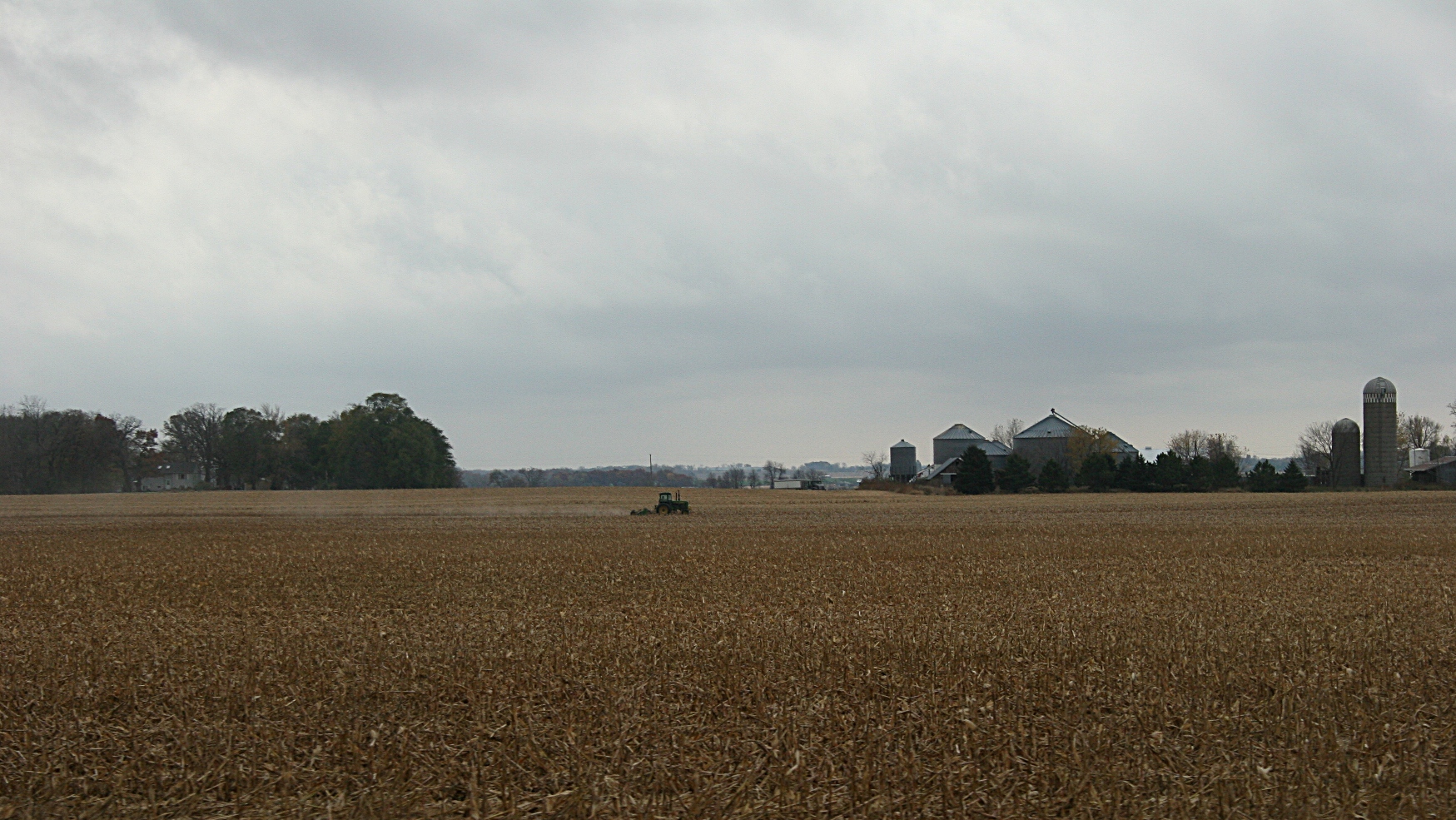
A farmer works the field recently in this scene shot in southeastern Minnesota.
HAVE YOU TRIED DIGGING into the ground lately? Takes some effort, doesn’t it? This soil in Minnesota rates as rock hard right now given the lack of moisture.
I’m hesitant to admit it, but I don’t think about soil conditions and moisture nearly as much as I once did, when I was not so long-removed from the farm.
But last week when a carpenter, who is also a farmer, was working on a project at my house, we chatted briefly about crops, soil conditions and weather.
Kenny shared how fall tillage has been especially trying this year. Farmers in his area around Owatonna in southeastern Minnesota have been breaking implement parts with all-too-often frequency in the dry, hard earth. He mentioned shanks, which he claims never break.
Some parts are in short supply, Kenny says, meaning farmers sometimes need to wait. That’s not a good thing when you’re trying to finish fall tillage before the snow flies.
Friends of mine who farm near Dundas finally halted all tillage work for the season, leaving some 300 acres, of 700, untilled. The rock hard dry soil proved too difficult to work and too tough on their equipment.
IN SOUTHWESTERN MINNESOTA, my brother Doug Kletscher, the parts manager at Westbrook Ag Power in Westbrook, confirms that tillage is tough there, too, and farmers are going through the parts. “We ran out of ripper points and they have been back-ordered for a good month. I have heard of a few farmers that have pulled their rippers in half,” Doug says. “We have sold at least five years’ worth of chisel plow spikes in one year. Bolts have also been in very high demand.”
On the flip, positive side, farmers haven’t had to deal with mud, Doug reports, and the corn has been very dry with 14 percent or less moisture content (a significant cost savings on corn drying).
However, farmers are facing another issue related to moisture-depleted conditions. “The fertilizer companies are not putting on any anhydrous as it is too dry to hold the anhydrous in the ground,” my brother continues. “Anhydrous needs moisture to adhere to keep it in the ground; also it (the soil) is pulling so hard that they would break their anhydrous bars.”
Doug reports the last rain over a half inch fell on July 14 with .78 inch. Since then any rainfall has been .10 inch or less. That makes for extremely dry soil conditions for farmers trying to prep the soil for next spring’s planting season.
LIKEWISE, IF YOU’RE a gardener, digging vegetables has been anything but easy this autumn. Take my friend Virgil Luehrs, who lives along Cedar Lake west of Faribault. Unearthing potatoes proved tough, he says. But then he got to the carrots:
“First I tried the garden spade, then a round-point shovel and then a tiling shovel. I had to dig a trench beside the rows to loosen the soil around the carrots to get them loose enough to pull out. Finally I resorted to a pick to loosen the soil and that was easier but still a lot more work than normal.”
Tilling the garden, even with a powerful Troybuilt rear tine tiller, proved equally challenging. “I could not get down deep enough,” Virgil reports. “Hopefully next spring.”
When Virgil talks soil and weather, I listen. He’s not just your average Minnesota gardener. He’s also a retired high school science teacher with a Masters in biology, a former interim and assistant director at River Bend Nature Center in Faribault, and a volunteer rain gauge reader for the Rice County Soil Water Conservation District (SWCD) and the state Climatology Lab.
In other words, he’s a knowledgeable resource.
So then, exactly how much rainfall has Virgil recorded at his Cedar Lake home (where the lake water level is the lowest in 20 years, but not as low as in the drought years of 1988- 1990). Thus far since April, Virgil has taken these rain gauge readings:
April: 3.14”
May: 4.63”
June: 5.26”
August: 1.38”
September: 1.00”
October: .58”
TOTAL during the past six months: 15.99”
Says Virgil: “This year we had a much wetter spring and that probably helped to carry us through the dry fall. Recall that last fall we had record rainfalls.”
His 2010 readings were as follows:
April: 1.35”
May: 2.75”
June: 4.76”
July: 5.49”
August: 3.91”
September: 9.13”
October: 1.91”
TOTAL during those six months: 29.3”
According to information Virgil passed along from State Climatologist James Zandlo and University of Minnesota Climatology/Meteorology Professor Dr. Mark Seeley, 2010 was the wettest year in Minnesota modern climate record. The 34.10-inch state average precipitation total was roughly 8 inches more than the historical average.
But here we are in November 2011, desperately short of moisture.
What will winter bring here in Minnesota? A continued shortage of precipitation? Or more snow than we care to shovel?
WHAT’S YOUR PREDICITON for snowfall in Minnesota this season? Submit a comment with a forecast and the reasoning behind your prediction.
IF YOU’RE A FARMER, an implement dealer or a gardener, have you faced any special challenges this year due to dry (or other) weather conditions? Submit a comment. I’d like to hear, whether you live in Minnesota or elsewhere.
CLICK HERE to link to climate.umn.edu for detailed statistics and information about Minnesota weather.
© Copyright 2011 Audrey Kletscher Helbling


 Minnesota Prairie Roots
I’m not a farmer, but I do love Minnesota. Here’s my ode to your state: http://50statesdesignproject.wordpress.com/2011/11/09/8-clear-minnesota/
What an interesting project. Glad you like Minnesota. I pretty much lover my home state, although not so much in the winter.
We had only about an inch and a half for the last 90 days here. Our other rainfall totals pretty much follow yours. Being only 30 miles from Westbrook we’ve had much the same experience as they have.
I do have a difference though. I have been reducing tillage for many years. We make as few trips across the field as possible and our neighbor who does tilling says it is making a difference. If at all possible I leave last years crop material on or near the surface. This has not only helped with water retention but with soil structure and water infiltration. All that driving on wet soils packs it down.
Tillage during wet conditions also compresses soil and makes the water stay on the surface or run off. Plant material makes a place for the water to enter the soil. It also reduces erosion and helps retain moisture in dry conditions.
Lately I’ve been watching my neighbors out breaking up soil and breaking machinery. Our machinery is in the shed. What tillage we did this fall was done with no broken machinery. Yes, we had hard soil, but it was hardest where it was worked the most.
Minnesota prairie soils were not made for the plow. The sooner we all learn to work with the soil, instead of against it, the better off we will all be.
Michael, thanks for the report from your acreage and the interesting insights into alternatives other than fall tillage. Some good food for thought.
hard as a rock here too, did not try to till this fall, it’s just too dry.
And where might you live, fowlguy?