Minnesota Prairie Roots

Writing and photography by Audrey Kletscher Helbling

In honor of spring planting season in southern Minnesota April 18, 2016

Filed under: Uncategorized — Audrey Kletscher Helbling @ 5:00 AM
Tags: , , , , ,
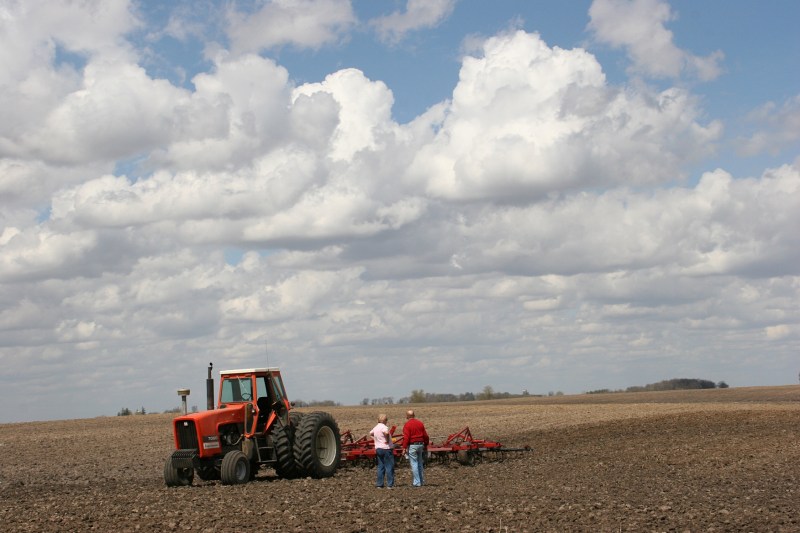
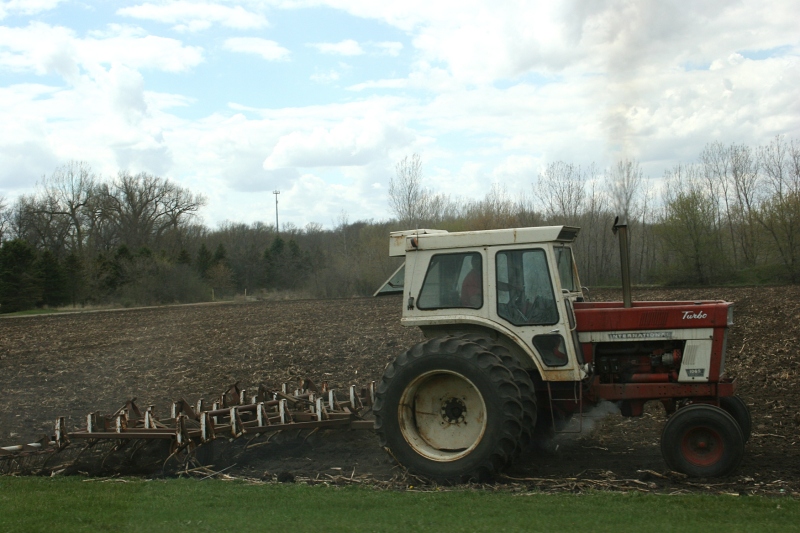
A pause in field work along the Rice-Steele County line Sunday afternoon.

A pause in field work along the Rice-Steele County line Sunday afternoon.

FARM IMPLEMENTS KICKED up dust Sunday afternoon under blue skies clumped with white clouds here in southeastern Minnesota.

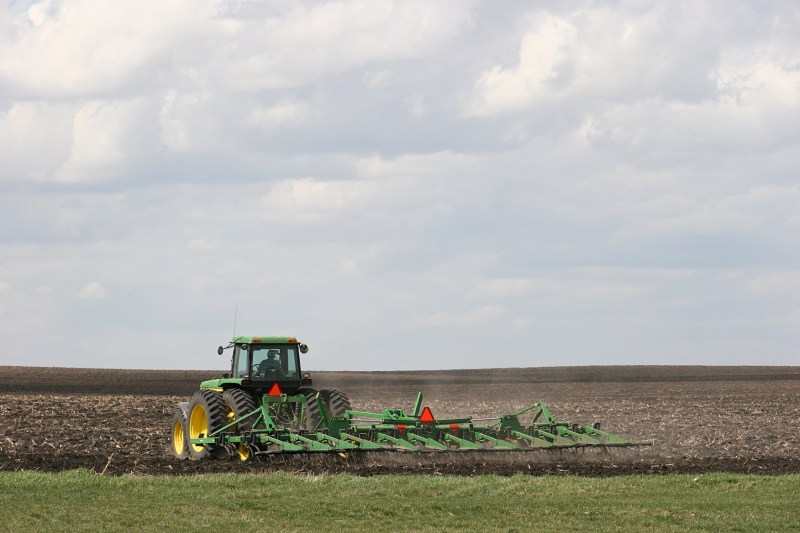
Prepping the soil for planting along 270th Street East in southern Rice County.

Prepping the soil for planting along 270th Street East in southern Rice County.

It was the kind of balmy spring day that draws me to the land, to memories of spring planting.

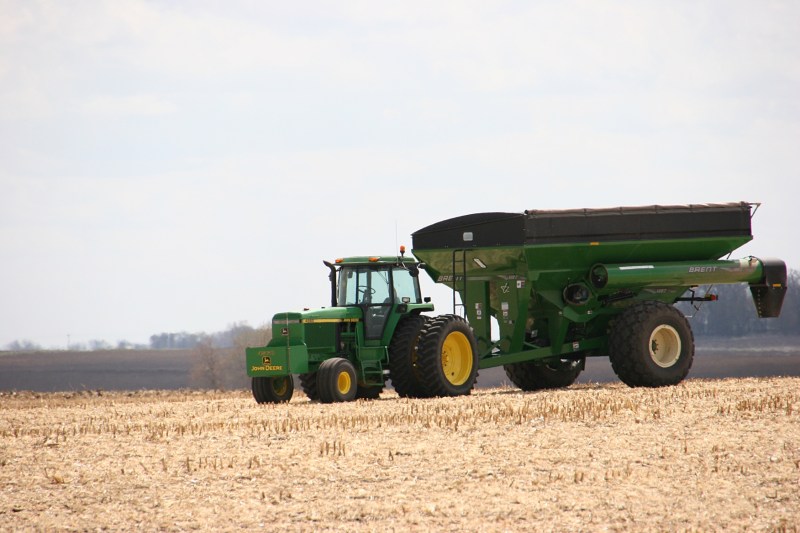
This tractor and grain cart (typically used during harvest) sat unattended in southern Rice County Sunday afternoon.

This tractor and grain cart (typically used during harvest) sat unattended in southern Rice County Sunday afternoon.

While tractors and other equipment have changed since I left the farm of my roots at age 17, way too many years ago, one constant remains. This is the season of transition. An awakening. Black earth turned to warm sun. Seeding of the soil. The promise of a harvest.

Just outside Medford this farmer prepped the soil Sunday afternoon.

Just outside Medford this farmer prepped the soil Sunday afternoon.

The farm girl in me still lingers, waiting for spring days like this, for a drive into the country, for an opportunity to honor the land via photos, via thoughts, via a deep emotional connection to the earth.

© Copyright 2016 Audrey Kletscher Helbling


Part II: The disasters of Steele County April 15, 2016

Steele County disasters, 107 pandemic display


OF ALL THE DISASTERS HIGHLIGHTED in a current local disasters exhibit at the Steele County History Center in Owatonna, it is the flu pandemic of 1918 that feels most personal. To read the names of victims like Cora, Helen and Forest and to see photos of gravestones grieved me. Every winter, even today, we hear of those who’ve died from the flu. Young. Old. In between. Thankfully, we have vaccines that prevent the illness from infecting most of us.

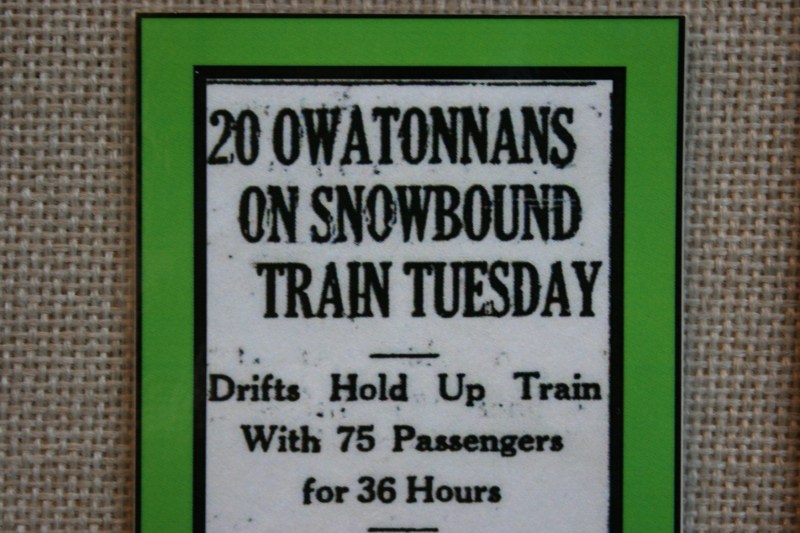
Snowdrifts blocked a train as noted in this news clip.

Snowdrifts blocked a train as noted in this news clip.

This detailed exhibit, an off-shoot of the Minnesota Historical Society Traveling Exhibit Disasters of Minnesota: Stories of Strength and Survival, connected a worldwide tragedy to Minnesota. To the county just to the south of mine.

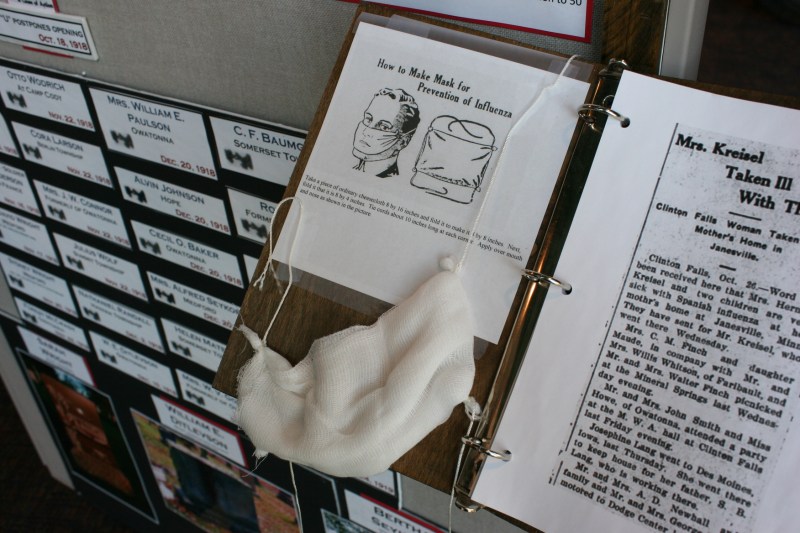
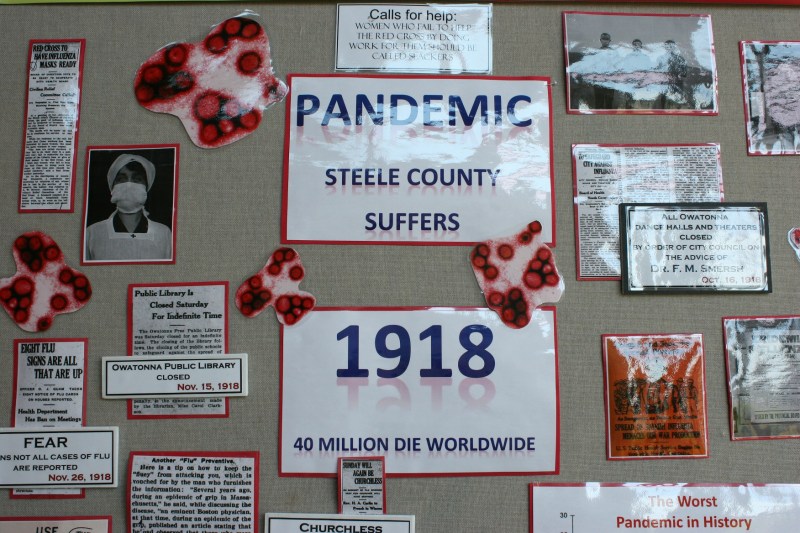
Masks, precautions and isolation helped protect against the flu epidemic. To the left in this photo are names of Steele County residents who died from the flu in 1918.

Masks, precautions and isolation helped protect against the flu epidemic. To the left in this photo are names of Steele County residents who died from the flu in 1918, plus photos of some of their gravestones.

In Minnesota alone, according to one report, as many as 12,000 died of the flu in 1918. Worldwide, sources put deaths at 40 or 50 million.

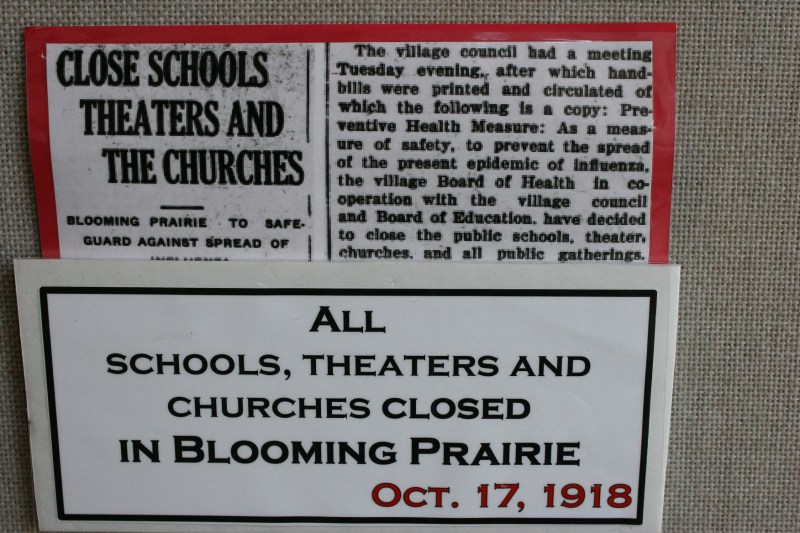
Activities that brought people together were suspended during the flu outbreak.

Activities that brought people together were suspended during the flu outbreak.

I’d never considered the vast scope of this tragedy, how fearful folks must have been, how deep the grief at losing loved ones and friends. I also hadn’t thought about the impact on everyday life. As I browsed the exhibit, I noted news stories about libraries, dance halls, theaters and churches closed because of the pandemic.

I am old enough to remember also the fringe ending of the polio epidemic, highlighted, too, in this exhibit.

These newspaper articles feature snowstorms in the county.

These newspaper articles feature snowstorms in the county.

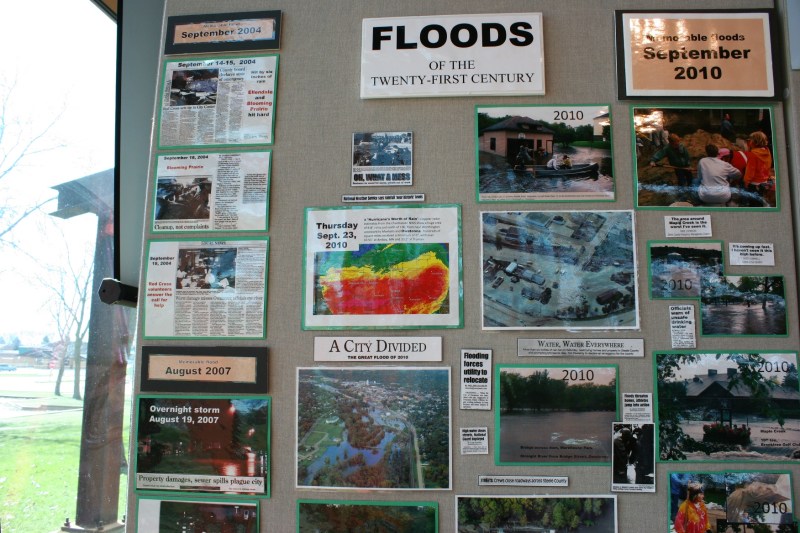
Steele County has experienced plenty of floods.

Steele County has experienced numerous floods.

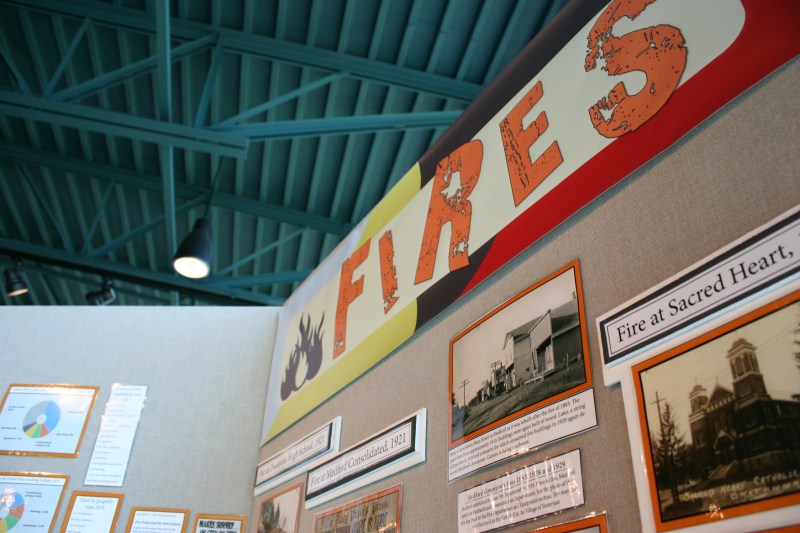
Fires, too, have devastated the county.

Fires, too, have devastated the county.

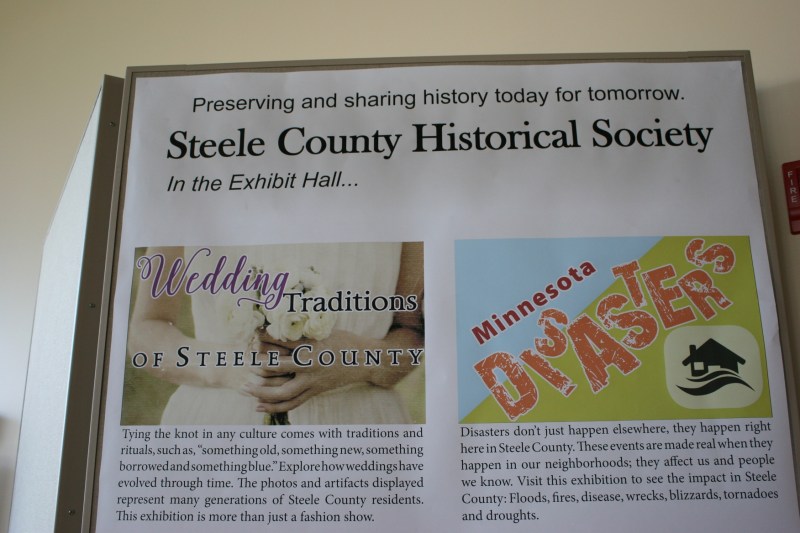
Steele County has experienced plenty of disasters involving snow, heat, wind, water and fire. These are outlined in panel displays.

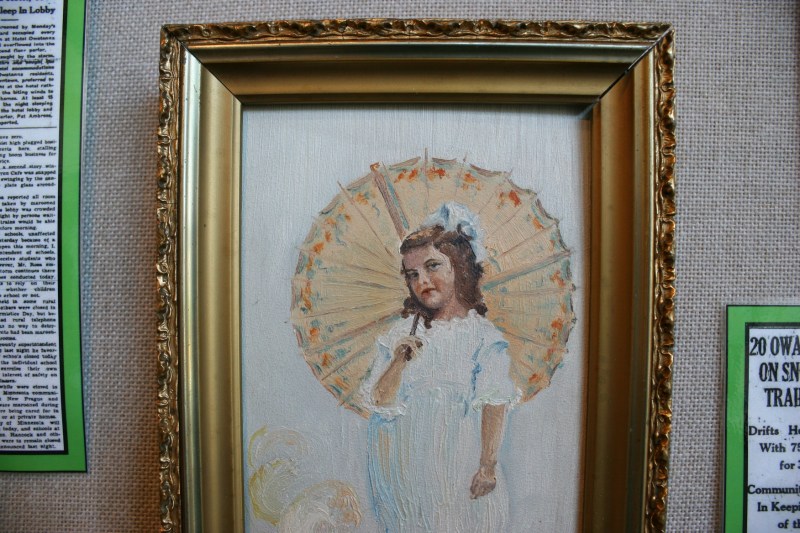
Portrait of Virginia Hart

Portrait of Virginia Hart

It would be easy to become discouraged, to feel only despair that so many southern Minnesota residents have suffered so much through the years. I was especially appreciative of stories that uplifted me, like that of Ruth Weinmann. The young teacher, ill with the flu in 1918, was taken in by a doctor’s family after her landlady refused to house her and the hospital was full. In gratitude to Dr. Alfred and Alice Hart, Ruth painted a portrait of their daughter, Virginia. It is a lovely expression of thankfulness.


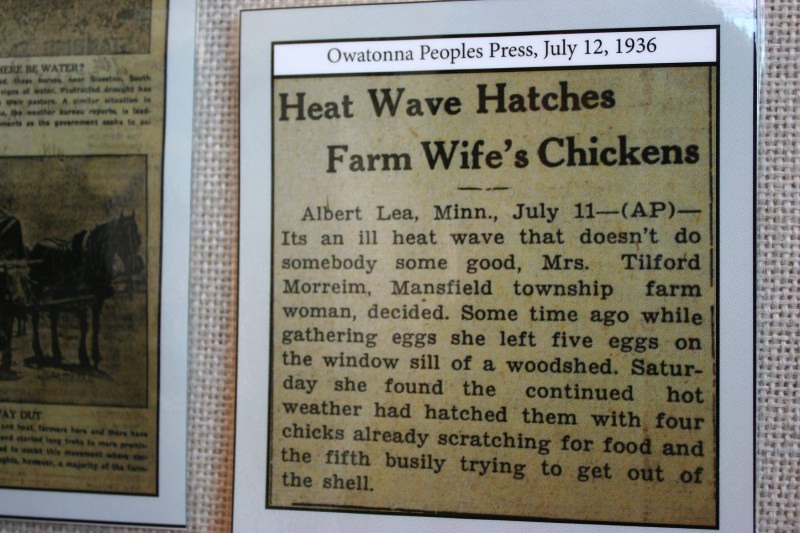
Steele County disasters, 104 chicks hatch in heat


And then there’s the story of chicks hatching in the middle of Steele County’s longest, hottest heat wave—13 straight days of temperatures above 100 degrees beginning on July 5, 1936. Mrs. Tilford Morreim left five eggs on the window sill of her woodshed. In the heat, the eggs hatched. I needed to read that humorous story in the midst of all the suffering and loss.

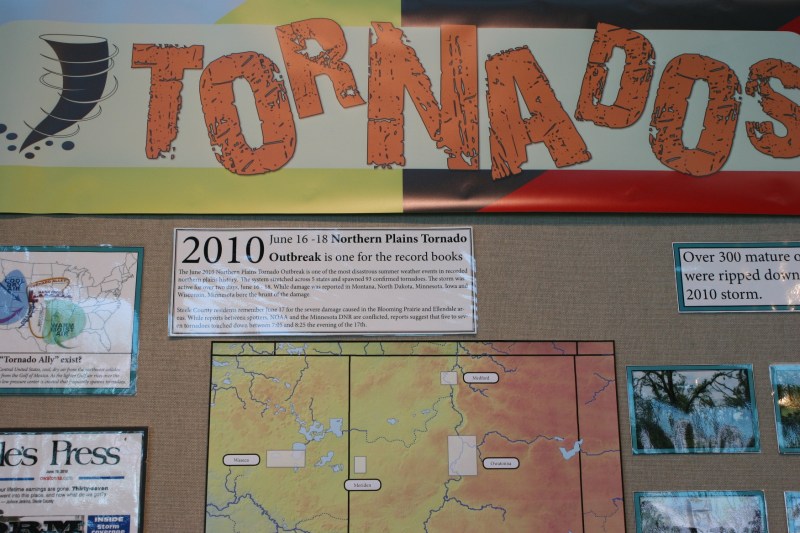
Information on tornadoes in Steele County.

Information on tornadoes in Steele County.

In every disaster, we must find a reason to be hopeful, to survive, to share our stories…for in sharing exists hope and resilience.

These two exhibits are on display through March 2017.

These two exhibits are on display through March 2017.

FYI: For more information about this exhibit, click here. To read my first post about this exhibit in Owatonna, click here. Check back for a post on a wedding dress exhibit also now showing at the Steele County History Center.

© Copyright 2016 Audrey Kletscher Helbling


Part I: Minnesota disasters up close April 14, 2016

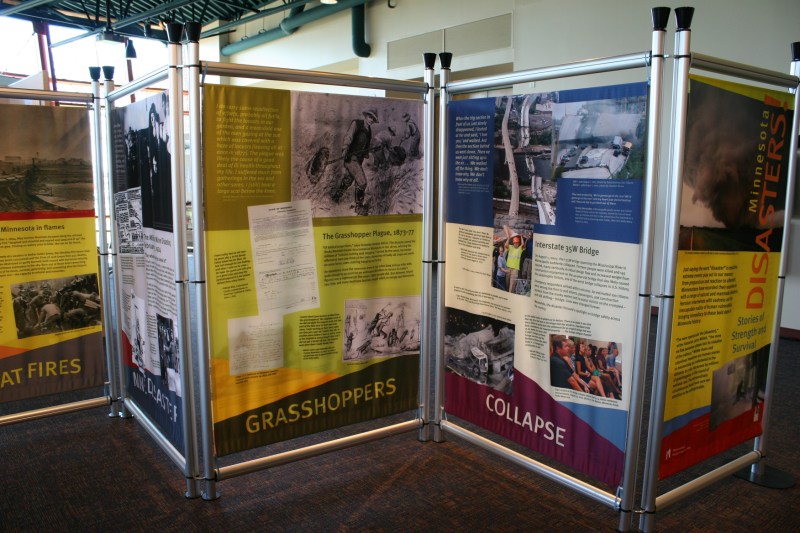
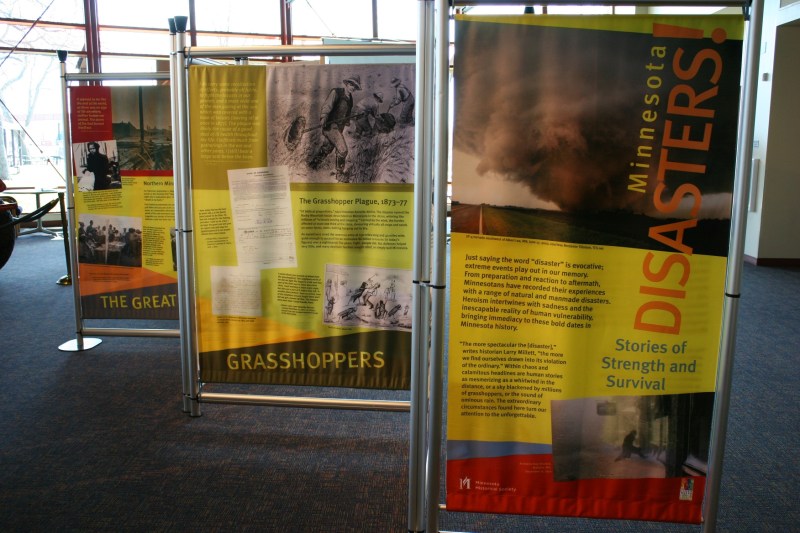
The panel to the right introduces the Minnesota Disasters exhibit with each panel featuring a different disaster in our state.

The panel to the right introduces the Minnesota Disasters exhibit with each panel featuring a different disaster in our state.

DISASTER. How do you define that word? In a Minnesota Historical Society Traveling Exhibit currently displayed at the Steele County History Center in Owatonna, disaster covers everything from tornadoes to the 35W bridge collapse to the grasshopper plague, drought, blizzards and more.

I personally remember many Minnesota disasters—such as the bridge collapse; the Halloween blizzard of 1991; the 1998 St. Peter-Comfrey tornadoes; the 1968 Tracy tornado which killed nine; the drought of 1976; and the devastating floods of September 2010.

During Severe Weather Awareness Week, we prepare for dangerous storms like tornadoes. One panel in the exhibit highlights some of Minnesota's deadliest and most devastating tornadoes. The Tracy tornado was not included.

During Severe Weather Awareness Week, we prepare for dangerous storms like tornadoes. One panel in the exhibit highlights some of Minnesota’s deadliest and most devastating tornadoes. The Tracy tornado was not included.

This week, Minnesota Severe Weather Awareness Week, seems an appropriate time to focus on the topic of disasters and to show you the MHS exhibit, Minnesota Disasters: Stories of Strength and Survival.

Eric Lantz, 16, of Walnut Grove, shot this award-winning photo of the Tracy tornado as it was leaving town. He often took photos for the Walnut Grove Tribune, owned by his uncle, Everett Lantz. This image by Eric was awarded third place in the 1968 National Newspaper Association contest for best news photo.

Eric Lantz, 16, of Walnut Grove, shot this award-winning photo of the Tracy tornado as it was leaving town. He often took photos for the Walnut Grove Tribune, owned by his uncle, Everett Lantz. This image by Eric was awarded third place in the 1968 National Newspaper Association contest for best news photo. This copyrighted photo is courtesy of Scott Thoma with the original copyright retainted by Lantz.

I expect many of you have been, at some point, personally impacted by a disaster. The deadly Tracy tornado forever put the fear of tornadoes in my heart. That southwestern Minnesota community lies only 25 miles from my hometown; I saw the devastation in Tracy. Decades later, a tornado damaged the farm where I grew up and high winds partially ripped the roof from my home church of St. John’s Lutheran in Vesta. I respect the powerful forces of nature, specifically of wind.
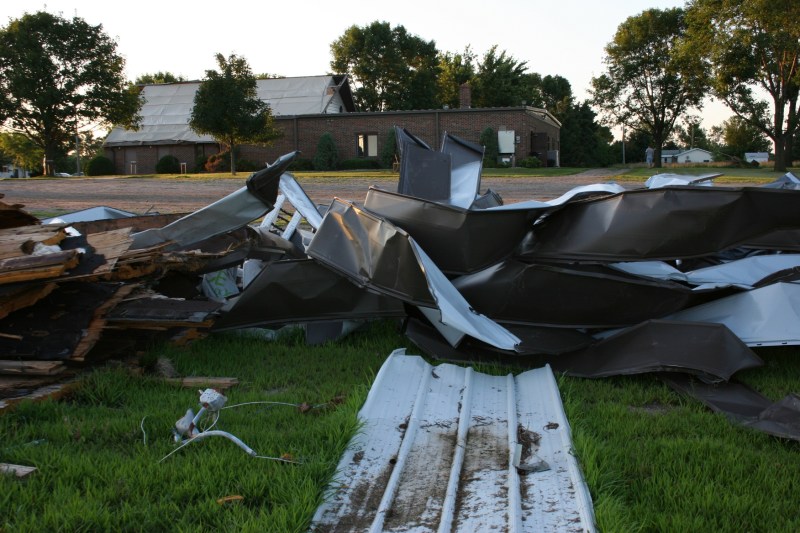
A debris pile on the edge of the church parking lot includes pieces of steel from the roof and brick from the bell tower. Photo taken in September 2011.

A debris pile on the edge of the St. John’s Lutheran Church parking lot includes pieces of steel from the roof (covered with a tarp here) and brick from the bell tower. Minnesota Prairie Roots file photo September 2011.

Elsewhere in Minnesota—in Belview, St. Peter and individual farm sites across Minnesota—I’ve seen the damage a tornado can cause.  I reported on and photographed tornado damage while working as a newspaper reporter. When a tornado warning siren blows, you won’t see me standing in the driveway looking for the twister. I’ll be sheltering in the basement.
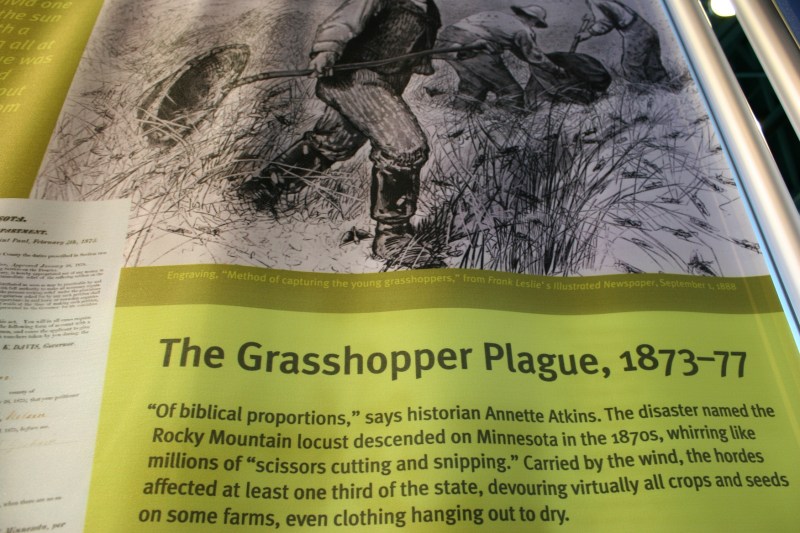
I cannot imagine so many grasshoppers that they obliterated everything.

I cannot imagine grasshoppers so thick that they obliterated everything.

As I perused the MHS disaster exhibit and the accompanying stories of disasters in Steele County, I realized the depth of loss Minnesotans have endured. The Grasshopper Plague of 1873-1877 recounts how locusts devoured even the laundry hanging on clotheslines.
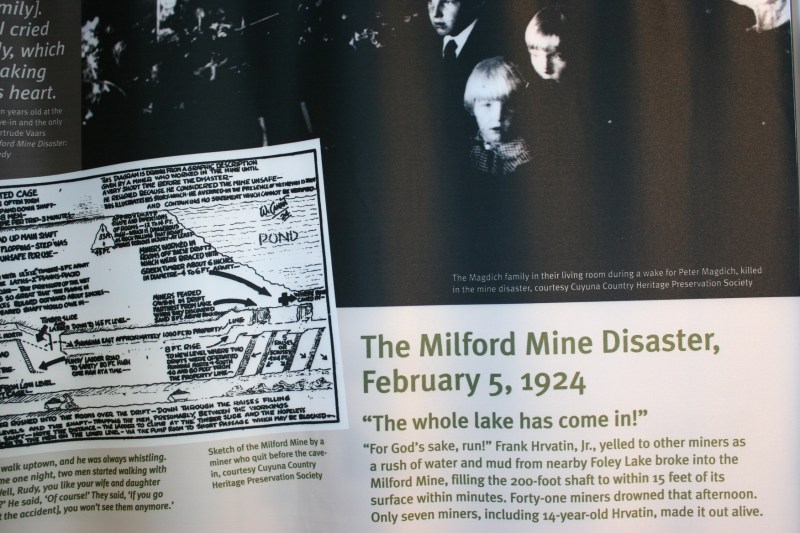
I knew nothing of the flooding at the Milford Mine until I read this panel.

I knew nothing of the flooding at the Milford Mine until I read this panel.

On February 5, 1924, forty-one miners drowned in the Milford Mine near Crosby in northern Minnesota. “For God’s sake, run!” one miner shouted to his co-workers. A warning like that floods the mind with fear. I’d never heard of the mine disaster until touring the MHS exhibit in Owatonna. Now I’ll never forget it.

Because I have extended family in the Hinckley area, I was fully aware of The Great Hinckley Fire of 1894 which claimed 418 lives. To read of feet baking inside shoes and stockings from the fire is horrifying.
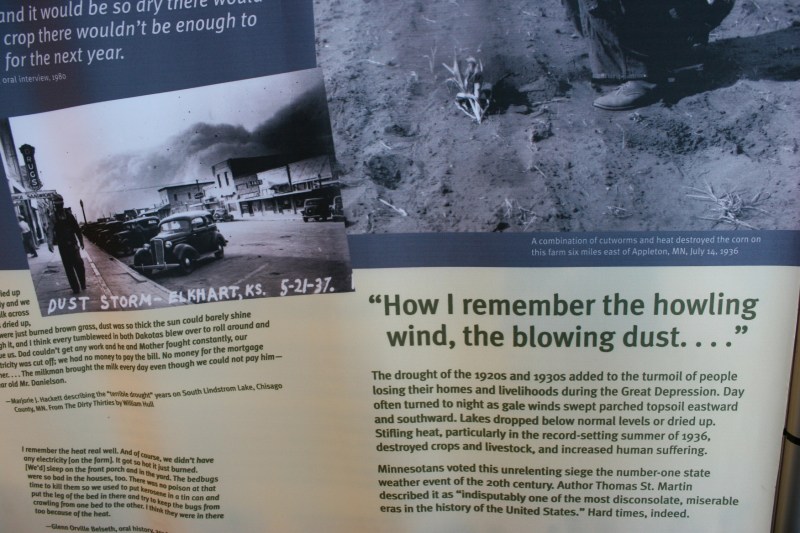
The devastation of dust and drought are covered in this panel.

The devastation of dust and drought are covered in this panel.

As bad as those and many other natural disasters, Minnesotans voted the drought of the 1920s and 30s (the Dust Bowl era) as the “number-one state weather event of the 20th century,” according to information posted in the exhibit. I was born decades after that disaster. But, as a teen, I recall a Good Friday dust storm that blew into Redwood County. We were shopping in nearby Marshall and arrived home to find the house layered in dirt; we’d left the windows open. For hours we worked to wash away the grime.
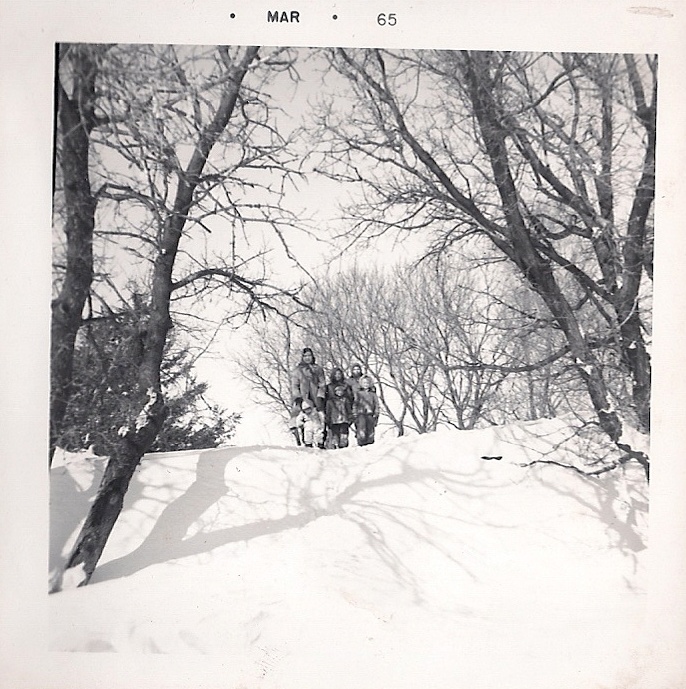
This huge, hard-as-rock snowdrift blocked our farm driveway in this March 1965 photo. I think my uncle drove over from a neighboring farm to help open the drive so the milk truck to reach the milkhouse.

This huge, hard-as-rock snowdrift blocked our rural Vesta driveway in this March 1965 photo. My uncle drove over from a neighboring farm to help open the drive so the milk truck could reach the milkhouse. I’m standing here with my mom, older brother and three younger siblings.

Blizzards, especially, imprinted upon my memory. There is nothing like a prairie blizzard that drives snow across open farm fields, sculpting the snow into rock-hard drifts around buildings and trees. Those winter storms of the 1960s and mid-1970s created all kinds of problems with roads closed, the power out and cows to be milked. Snowstorms of today don’t compare. And, no, I didn’t walk two miles to school uphill in a blizzard. Rather, in one particularly snowy winter, I rode to town on my dad’s cab-less John Deere tractor so I could catch the bus at Don’s Cafe to ride the 20 miles to junior high school in Redwood Falls. The bus drove sometimes on a single lane cut through snowbanks higher than the bus.
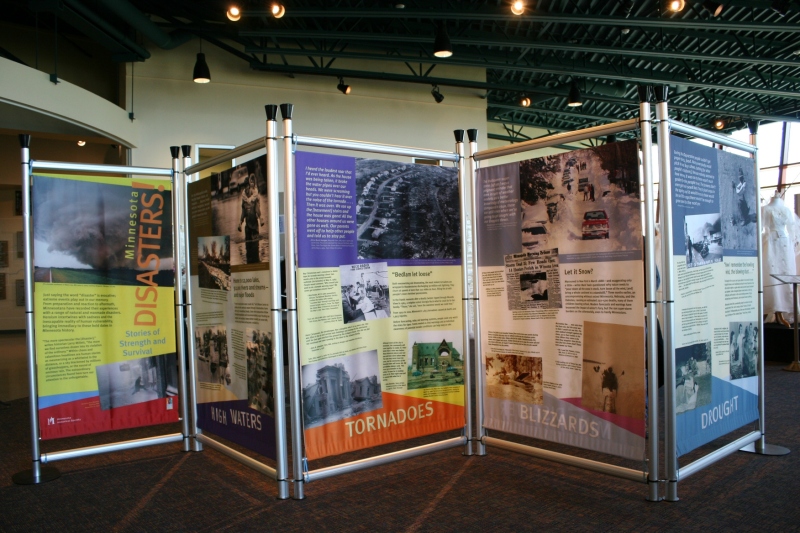
More panels in the Minnesota Disasters exhibit.

More panels in the Minnesota Disasters exhibit.

Tell me, what’s your story of dealing with a natural disaster? If you don’t have one, be thankful.

FYI: Check back tomorrow for a look at disasters in Steele County, Minnesota. The disasters exhibit will be on display through March 2017 at the history center in Owatonna. Click here for more information.

© Copyright 2016 Audrey Kletscher Helbling


On the road with distracted & dangerous drivers April 13, 2016

Filed under: Uncategorized — Audrey Kletscher Helbling @ 5:00 AM
Tags: , , , , , ,

TRAVELING ALONG 35E in the south metro recently, we pulled alongside an empty car carrier. My husband joked that he should move over and drive our van up the ramp and hitch a ride.

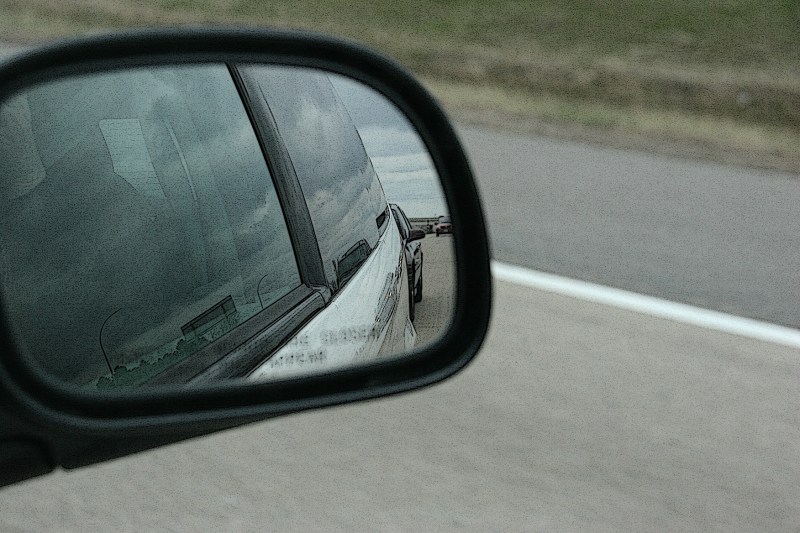
In this photo taken of the front passenger side mirror, you can see how close the tailgater is to our van.

In this photo taken of the front passenger side mirror, you can see how close the tailgater is to our van.

Some two hours later, retracing our route, a car followed us so close I thought it would drive up the rear of our van. We weren’t laughing. Such tailgating rates as irresponsible and dangerous.

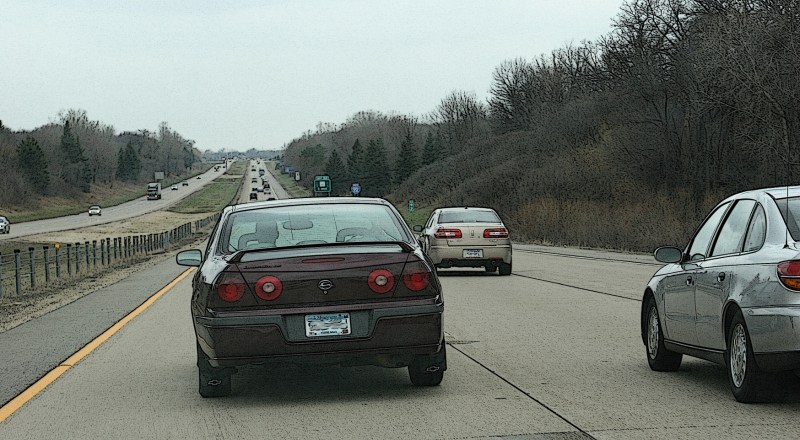
I zoomed in on the tailgating driver who couldn't wait to get around us. I've obscured his license plate; lucky him.

I zoomed in on the tailgating driver who couldn’t wait to get around us. I’ve obscured his license plate; lucky him.

What’s so important that a driver must snug nearly as tight as a puzzle piece into another vehicle? Instead of waiting for Randy to move into the right lane when traffic conditions safely allowed, this driver tailgated us, then zoomed to the right around us, squeezing between our van and a car. I might have said something like idiot.

This week, the Minnesota Department of Public Safety is focusing on the dangers of distracted driving. More than 300 law enforcement agencies across the state are participating in this extra enforcement effort. In Moorhead, police officers have found an innovative way to catch drivers who are texting or otherwise engaging in dangerous behavior. They are riding in school buses, giving them a bird’s eye view into vehicles. How clever is that?

Tell me, what have you seen on the roadways that made you want to shout idiot?

How can we curb this ongoing problem of irresponsible and distracted driving that’s endangering, injuring and killing innocent people?

© Copyright 2016 Audrey Kletscher Helbling
 

Sure signs of spring in Owatonna April 12, 2016

Filed under: Uncategorized — Audrey Kletscher Helbling @ 5:00 AM
Tags: , , , , , , ,

AFTER A LONG MINNESOTA WINTER, and they all seem long to me, we look for sure signs of spring. A robin. Snowbirds returning from Arizona, Texas and Florida. Road construction beginning.

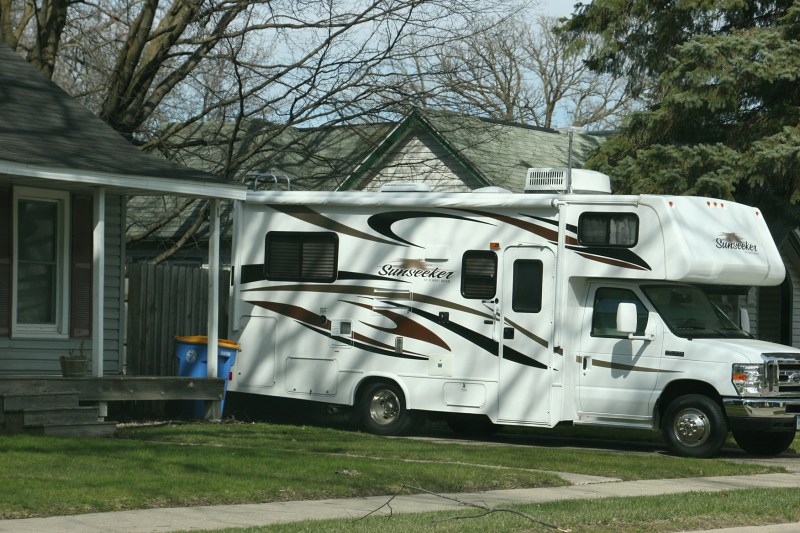
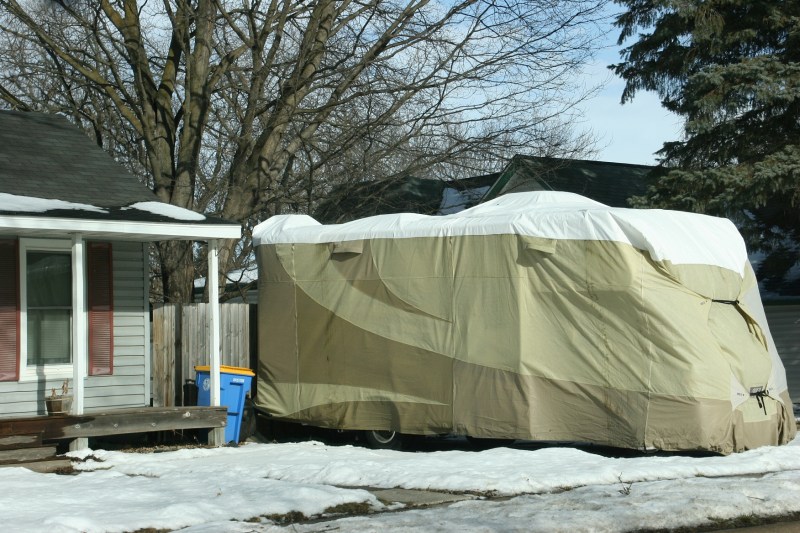
The recently unveiled motorhome in Owatonna.

The recently unveiled motorhome in Owatonna.

And in Owatonna, about a dozen miles to the south of my Faribault home, it’s the unveiling of a motorhome parked in a front yard along East Main Street, one of the town’s main drags. “This, like the return of the robins, is a sure sign of spring,” a friend and Owatonna resident shared in a recent email.

Motorhome in Owatonna in January

This is a photograph of the same motorhome taken in January.

I posted a photo of that camper in early February, when it was shrouded in a “blanket” and snow blanketed the yard.

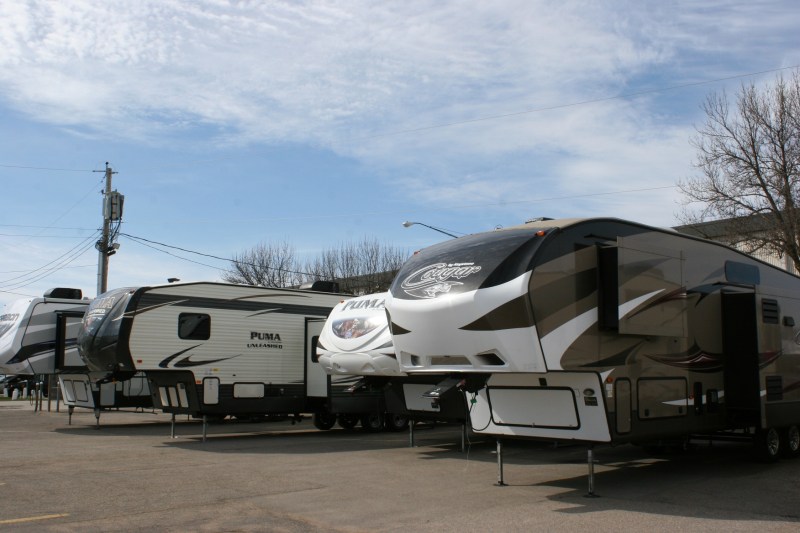
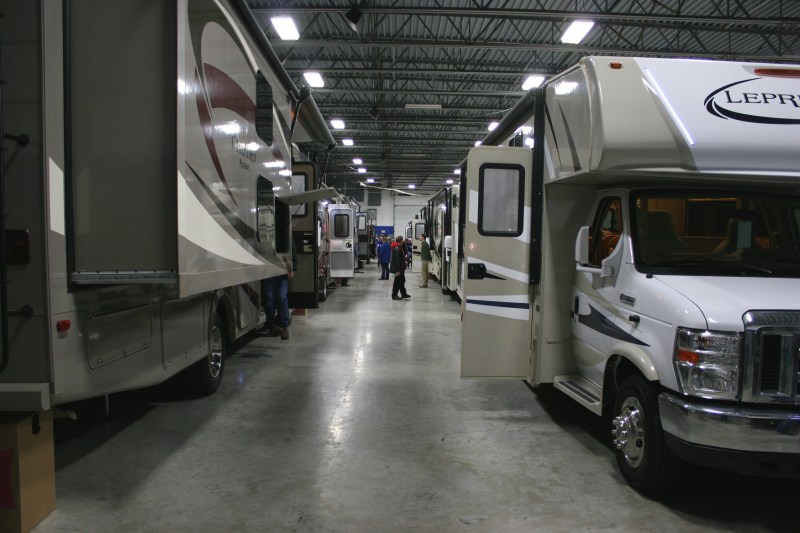
Campers filled the spacious Four Seasons Centre and spilled into a parking lot.

Campers filled the spacious Four Seasons Centre and spilled into a parking lot.

On Saturday I was in Owatonna again, this time to tour exhibits at the Steele County History Center (posts forthcoming on that). And while we were there, my husband and I checked out the Noble RV Camper Show next door at the Steele County Four Seasons Centre. Like the uncovered camper on Main Street, the camper show signals spring, even if temps are still in the 30s and windchills in the teens.

We’re not campers. But we wanted to tour these homes on wheels.

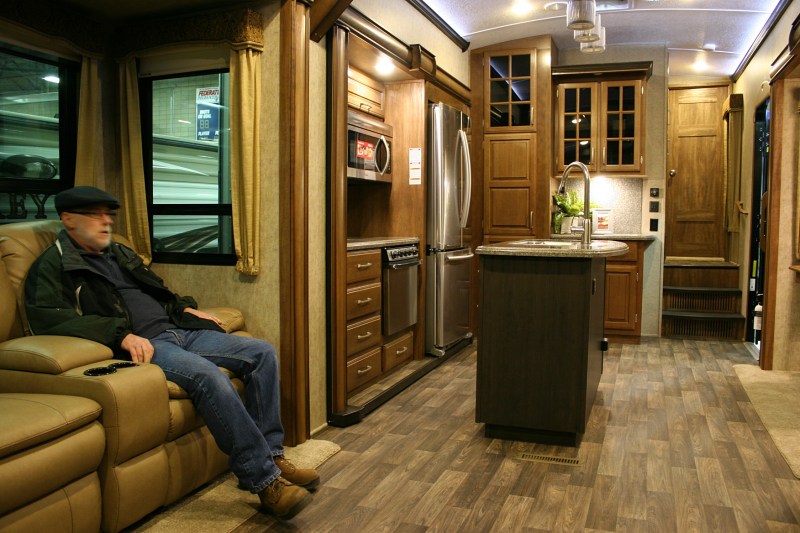
If he could have, Randy would have kicked back with a beer, watched TV and fallen asleep inside this comfy motorhome.

If he could have, Randy would have kicked back with a beer, watched TV and fallen asleep inside this comfy motorhome.

These are some pretty fancy schmancy rigs with fireplaces, steel appliances and kitchens way nicer than the one in my woodframe house. If this is camping, I could learn to like camping. My few camping experiences have involved leaky tents, deflating air mattresses, partying neighbors and, once, even a flood. So when people ask if I camp, I respond with an emphatic no.

If you were in the market for a camper, this was the place to be. So many to tour...

If you were in the market for a camper, this was the place to be this past weekend. So many to tour…

I lost count of how many motorhomes we toured on Saturday. But after awhile, they all began too look alike. And I was tired of carefully stepping up and down trios of stairs, my hand gripping a side hold lest I plummet onto the cement.

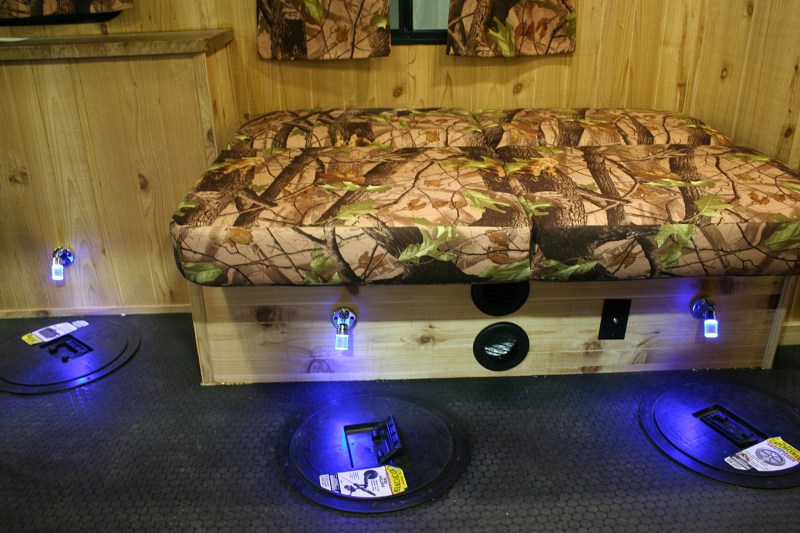
For the sportsman, there was even a ice fishing house/camper. Remove the lids and drop your line into the water on a frozen lake.

For the sportsman, there was even a ice fishing house/camper. Remove the lids and drop your line into the water on a frozen lake.

For one thing I was especially grateful. Not a single salesman approached us. So we didn’t have to feign interest in something that didn’t interest us beyond abating our curiosity.

© Copyright 2016 Audrey Kletscher Helbling
 

How my church is connecting to young adults April 11, 2016

Filed under: Uncategorized — Audrey Kletscher Helbling @ 5:00 AM
Tags: , , , , , , , ,
I purchased Scripture cards from christianbook.com to enclose in the greeting cards.

I purchased peace-themed Scripture cards from christianbook.com to enclose in the greeting cards.

FOR AWHILE NOW I’ve thought my church, Trinity Lutheran in Faribault, should mail care packages to college students. Finally that idea, although a bit modified, has become a reality.

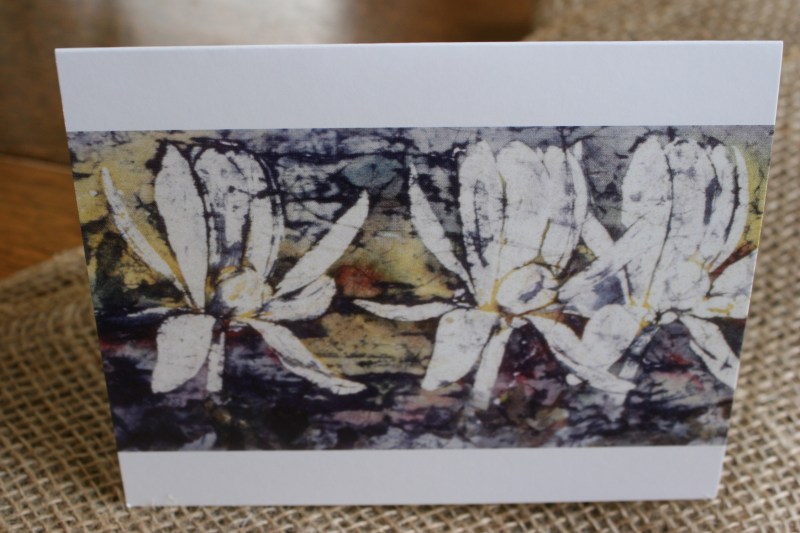
Artist Arlene Rolf, a friend and Trinity member, donated greeting cards for the outreach project. The cards are feature images of her batik art.

Artist Arlene Rolf, a friend and Trinity member, donated greeting cards for the outreach project. The cards feature images of her batik art.

Four of us, who are working on outreach as part of a visioning process, recently mailed greeting cards with encouraging messages, Scripture cards and gift cards to 23 young adults from our congregation. That option, rather than the more costly care packages, realistically fit our finances.

We can complain all we want about youth disengagement from the church. But if we don’t do something about it, then we really ought to stop whining.

I also ordered joy-themed Scripture and inspirational cards from christianbook.com.

I also ordered joy-themed Scripture and inspirational cards from christianbook.com.

I’m not so naïve as to believe this first project of the College Plus Connection Team is going to bring young people back to church. Yet, I am optimistic enough to believe these mailings, this connection, at least shows that we care. I care about these “kids” because they are part of my faith family. Many are also the sons and daughters of friends. Anytime someone cares is a positive. And that can make a difference in the life of a young person.

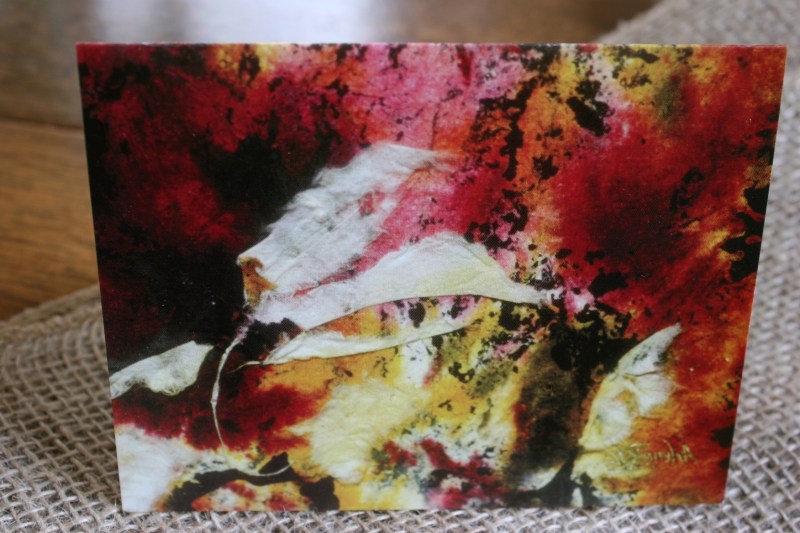
Another one of Arlene's batik print greeting cards.

Another one of Arlene’s batik print greeting cards.

Implementing a project like this can be a challenge. We started with a list of about 70 names. It’s really really tough to track down addresses and other information when many people no longer have landlines. Publicizing our efforts didn’t help either.

Rather than despair, our team decided that if we reached even one young person, we succeeded. So we succeeded 23 times. We mailed cards to young adults who are in college, working and/or serving in the military, thus the name College Plus. They live in places ranging from Faribault to Boston to Thailand and the Netherlands. They now know that we at Trinity care about them. And that’s important in any ministry. We all want to feel valued and connected to others, whether in a faith family, a school family, a work family or even our adoptive or blood family.

I’d like to hear more ideas on how a congregation can connect with young people once they’ve left home. Please share.

© Copyright 2016 Audrey Kletscher Helbling
 

Meet my beautiful granddaughter April 8, 2016

Filed under: Uncategorized — Audrey Kletscher Helbling @ 11:25 AM
Tags: , , , , , ,
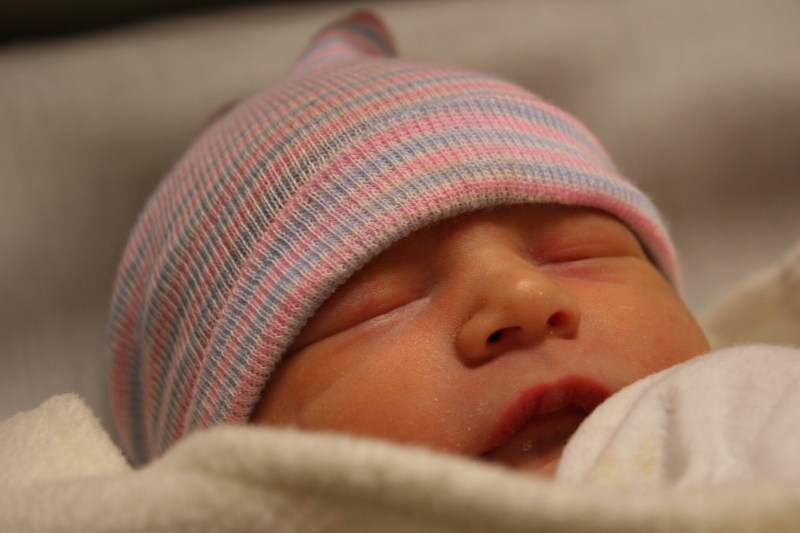
My new granddaughter, Isabelle ("Izzy" for short) Karis. Photographed when she was about 17 hours old.

My new granddaughter, Isabelle (“Izzy” for short) Karis, photographed when she was about 17 hours old.

SHE’S HERE. She’s beautiful. And she’s my first grandbaby, Isabelle Karis.

Born 19 days early late Wednesday afternoon, Isabelle weighed 6 lbs., 15 oz., and measured 20.5 inches. It is a joy to finally meet this little girl I’ve been loving since I learned in September of her forthcoming birth. I am thrilled to be part of what numerous well-wishers term The Grandparent Club.

Isabelle is named after her paternal great great grandmother, also her Oma’s middle name. Her middle name, Karis, is the Greek word for “grace.” So fitting. So lovely.

I felt that grace Thursday morning as my husband and I stood with our son-in-law at Amber’s bedside, baby Isabelle cradled in her arms, the hospital spiritual advisor also there. As Marc prayed a blessing upon his daughter, our hands hovering over her, tears leaked down my cheeks. It was a profound moment for me as I was overwhelmed by emotion. Relief. Thankfulness. Awed by the miracle of life. So in love with this little girl.

© Copyright 2016 Audrey Kletscher Helbling
 

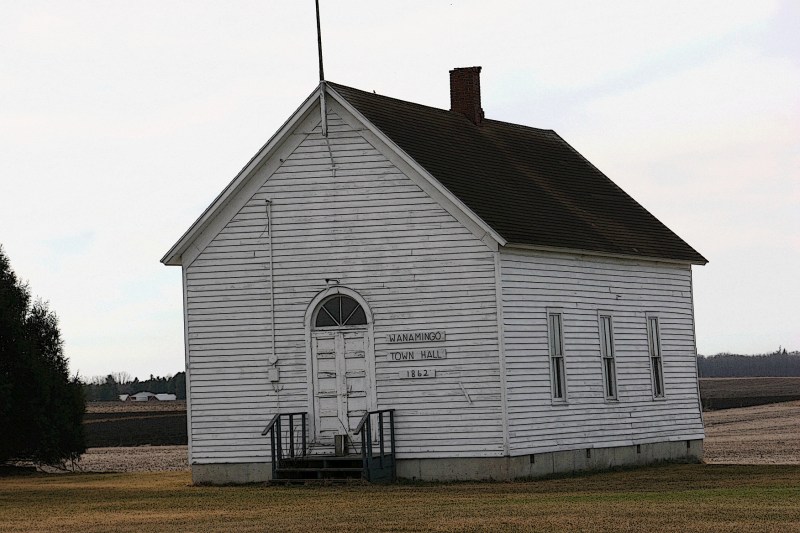
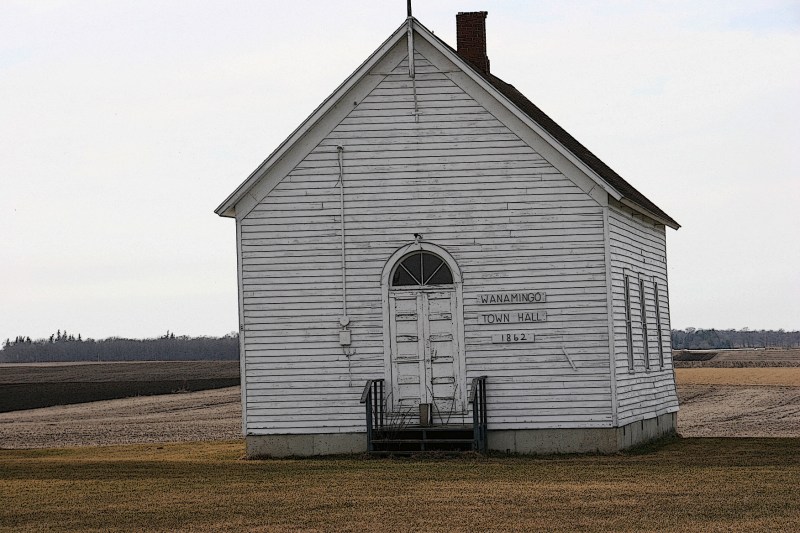
Wondering about the Wanamingo Town Hall

Wanamingo Town Hall, 112 view one


WOOD-FRAME TOWN HALLS aged by time hold a sense of history that always leaves me wondering.

The Wanamingo Town Hall, which I recently photographed in the ghost town of Aspelund in Goodhue County, is no exception. I thought a simple internet search would yield answers. It didn’t.


Wanamingo Town Hall, 113 view two


So I am left to wonder about this simple structure built during the Civil War and the U.S.-Dakota War of 1862. Was this originally a schoolhouse as town halls often were? Is it still used for township activities? For 4-H meetings? As a polling place? I found a photo of a new pole shed style town hall online indicating this historic building is no longer used by township government.

I also learned some history of the area from the book, Minnesota Geographic Names—Their Origins and Historic Significance, written by Warren Upham and published by the Minnesota Historical Society in 1920. Wanamingo, the author writes, “settled in 1854, organized in 1858, is almost wholly occupied by prosperous Norwegian farmers” (page 209).

Today Wanamingo Township remains agriculture-based. And you can still see the strong Norwegian heritage in family surnames, in country churches, in business names and more. Is the area still occupied by primarily prosperous Norwegian farmers? That I can’t answer.

© Copyright 2016 Audrey Kletscher Helbling


He’s not arriving on a jet plane April 7, 2016

Filed under: Uncategorized — Audrey Kletscher Helbling @ 5:00 AM
Tags: , , , , ,
I photographed this Frontier plane as it approached Minneapolis-St. Paul International Airport early Saturday afternoon. Edited image.

I photographed this Frontier plane as it approached Minneapolis-St. Paul International Airport early Saturday afternoon. Edited image.

SOMETIMES I AM SURPRISED by the nuances that impact me emotionally.

Recently it was the sight of jets flying into Minneapolis-St. Paul International Airport as my husband and I traveled along 35E in the south metro. My memory map directed me to the Cedar Avenue/Highway 77 exit, the route we take to the airport to pick up and drop off our son who attends Tufts University in the Boston metro.

I haven’t seen him now in three months, not since he returned to the East Coast following Christmas break. I miss him. Not with the kind of aching heart absence I felt when he first moved there three years ago. But with the sort of ache that slips below the surface and sometimes erupts into wanting to hug his lanky body and cook his favorite meal and tell him, in person, that I love him.

I felt the same at Easter. Instead of mailing him a chocolate bunny delivered by the U.S. Postal Service in three pieces, I would have preferred filling his Easter basket with too much candy and sugary PEEPS and hiding it in our Minnesota home for him to find. I don’t care that he’s 22. Everyone needs Easter candy.

I could imagine the loved ones awaiting the arrival of this Frontier jetliner.

I could imagine the loved ones awaiting the arrival of this Frontier plane.

I’ll admit to being envious of those moms who see their grown children on holidays, who can travel along a metro interstate, spot an aircraft and think nothing of it.

© Copyright 2016 Audrey Kletscher Helbling
 

Minnesota’s fifth season arrives April 6, 2016

Filed under: Uncategorized — Audrey Kletscher Helbling @ 5:00 AM
Tags: , , ,
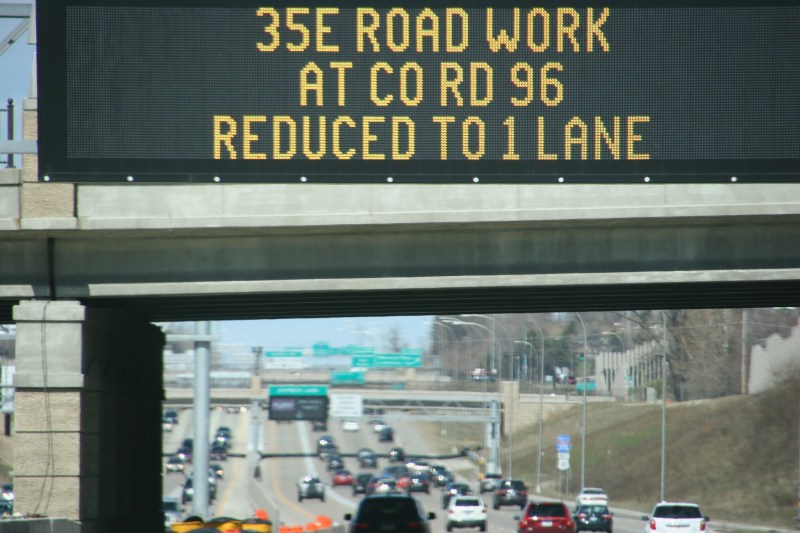
A sign near St. Paul flashes road construction info.

A sign near St. Paul flashes road construction info.

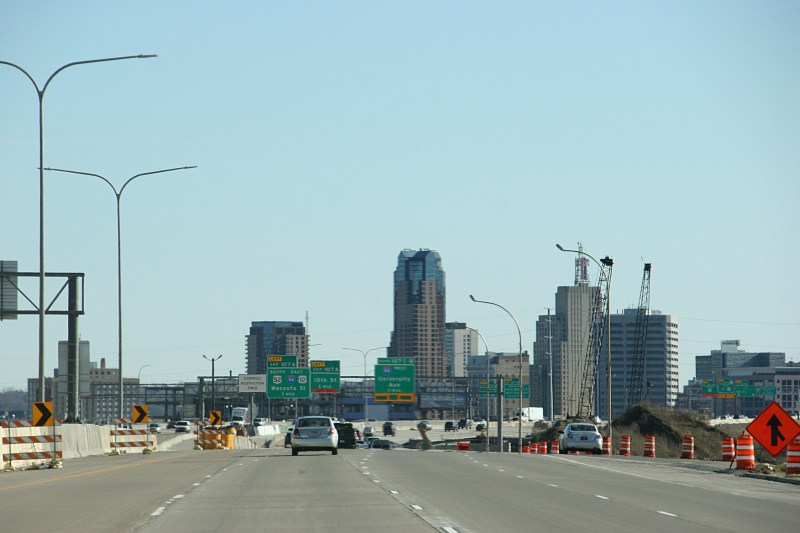
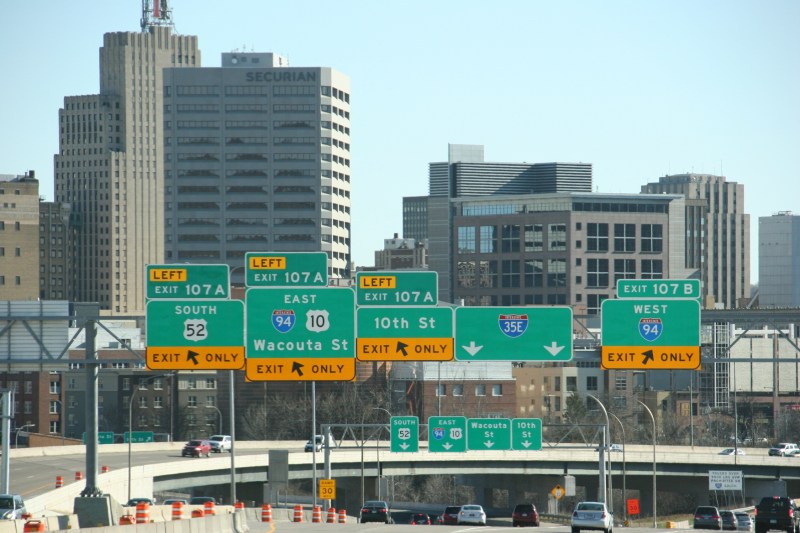
IT’S APRIL, AND ROAD CONSTRUCTION season is ramping up in Minnesota. Traveling in the Twin Cities metro, especially, can be a nightmare mess with road, ramp and lane closures and the accompanying snarl of slow-moving traffic or gridlock.
I am truly thankful that I live in Greater Minnesota, where road construction is a much more manageable problem.

Signature orange barrels mark construction zones.

Signature orange barrels and barricades mark construction zones approaching downtown St. Paul.

Still, with my eldest daughter and her husband living in the northern metro and extended family living points north, avoiding metro road construction is impossible.

So many signs and cones

So many signs and barrels nearing downtown St. Paul.

I know the traffic here is nothing compared to places like LA or Chicago. But still…

WHAT’S YOUR STRATEGY for dealing with road construction?

© Copyright 2016 Audrey Kletscher Helbling