
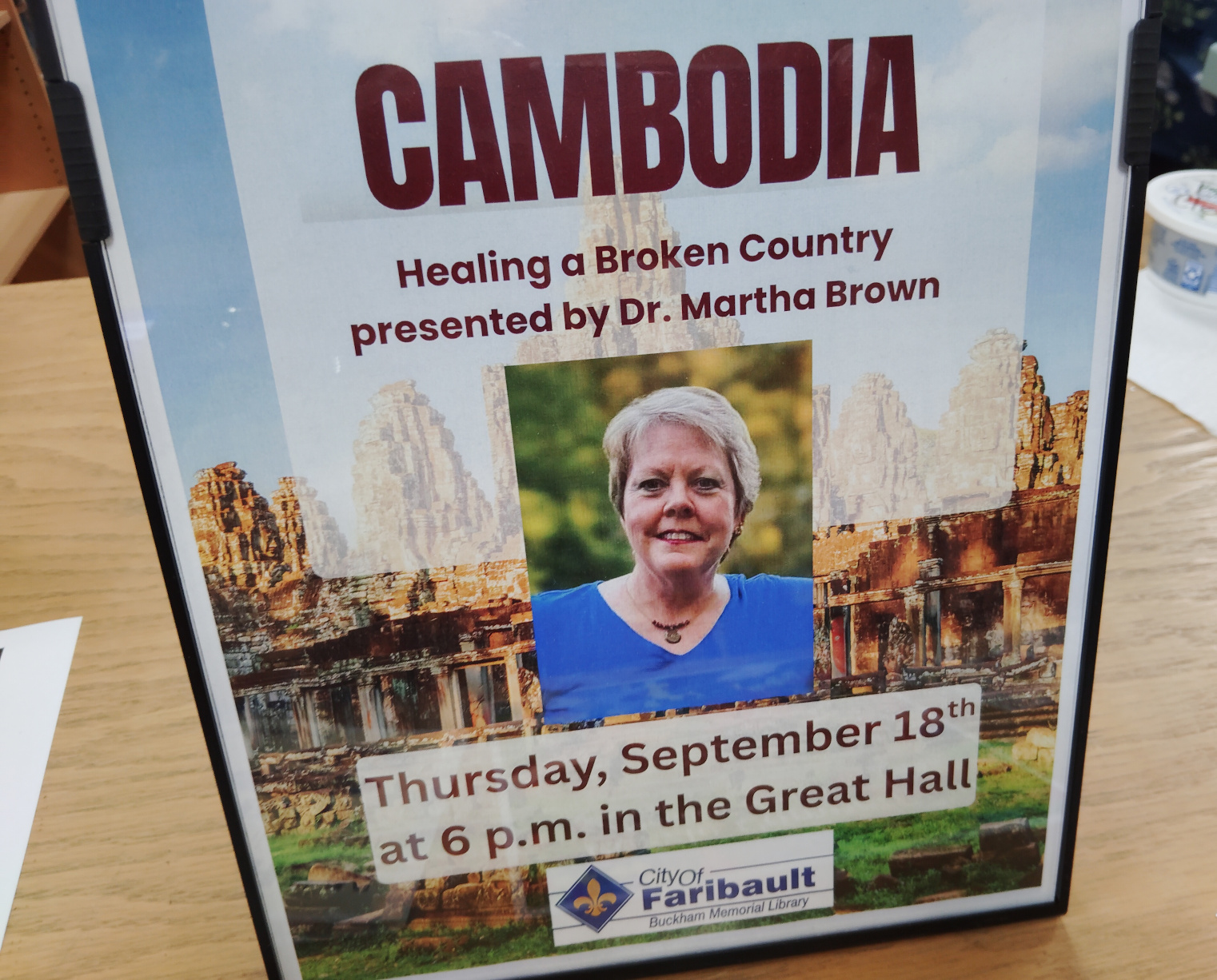
HISTORY CONNECTS THE STORIES of the two Marthas. One, Martha Ballard, a midwife and the main character in a book of historical fiction, The Frozen River by Ariel Lawhon. The second Martha is Martha Brown, local author, educator, speaker, musician and political candidate for state representative in my district. She shared her personal reflections about a trip to Cambodia on Thursday evening at the Faribault library in a presentation titled “Cambodia—Healing a Broken County.”
I’d just finished reading Lawhon’s book earlier Thursday so the commonalities between a story set in the late 1700s in postrevolutionary America and Brown’s recent trip to Cambodia connected in my mind. In both stories exist violence, trauma, strength, power and resilience within an historical context.
THE CAMBODIAN GENOCIDE
I’ll start with Brown. She focused on the time before and after the 1975-1979 Cambodian Genocide in which some 2 million Cambodians were murdered under the rule of Khmer Rouge, the Communist political party then in power. She also touched on the illegal and secret bombings of Cambodia by the U.S. in 1969 against North Vietnamese forces in Cambodia. That, too, claimed untold civilian lives.
I don’t want to get into historical details here or a political discussion about the Vietnam War. Rather, I intend the focus to be on those who suffered in Cambodia and those who survived. Just as Brown focused her hour-long talk. She arrived in Cambodia expecting to see trauma from the genocide. But instead, she said, she found recovery, healing and joy. She saw survivors of the genocide as part of the healing.
A HORRIFIC HISTORY NOT HIDDEN
The history of the genocide has not been hidden nor erased in Cambodia. “They don’t bury their history,” Brown said. I jotted that quote in my notebook, mentally connecting that to current day America and ongoing efforts by the current administration to erase/hide/rewrite history. We all know the quote—”Those who cannot remember the past are condemned to repeat it”—by Spanish Philosopher George Santayana. We would do well to contemplate and hold those words close.
In her presentation, Brown did not avoid the hard topics of children recruited and indoctrinated to participate in the Cambodian Genocide killings of educators, doctors, ordinary people, even those who wore eyeglasses. Perpetrators were never punished, went back to their lives, now live among the population. This was hard stuff to hear, especially about the brainwashing of children to kill. “We need to teach our children well,” said Brown, ever the educator who cares deeply about children.
LESSONS LEARNED IN CAMBODIA
Her passion was evident as she spoke of hugging survivors, of apologizing for the U.S. bombings of Cambodia, of crying while in the southeast Asian country. She learned that how you live and treat people is more important than wealth. She learned that people can be poor and still be happy. She learned about the differences in a society that focuses on community rather than self.
When Brown’s talk ended, others shared and a few of us asked questions, including me. Mine was too political to answer in a non-political presentation. But I asked anyway about the internal and external factors contributing to the rise and fall of empires. Brown hesitated, saying only that we could draw our own conclusions from her talk.
A MUST-READ BOOK
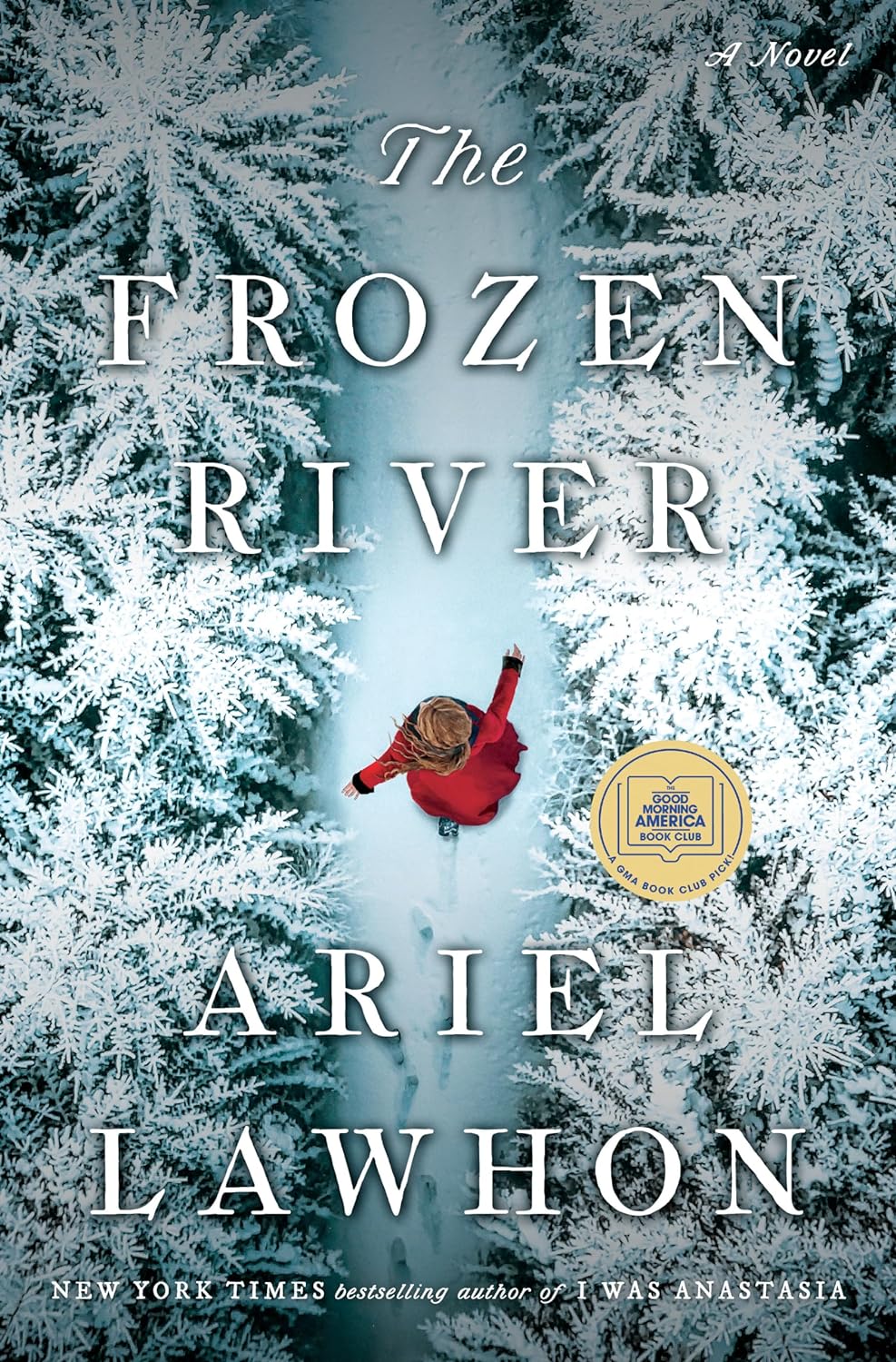
Then I wrote “The Frozen River by Ariel Lawhon” on a slip of paper. Not to give to Brown, but rather to the local director of Hope Center serving survivors and victims of sexual assault and domestic violence and their families. I handed the paper to Erica Staab-Absher after hugging her. “You need to read this book,” I said.
In this book of historical fiction, the author bases her writing on real-life midwife Martha Ballard, who documented her life in a journal. Ballard was witness to violence, sexual assault, injustices, secrets, manipulation, power, trauma and much more. This book will resonate with anyone who has survived a sexual assault or cared about someone who has been so viciously attacked. I cannot say enough about the value of reading this book and how empowering it was to me as a woman. It is a love story, mystery and a documentation of strength and resilience.
Resilience. Strength. Healing. Those three words come to mind as I connect the work of a New York Times bestselling author and a talk about the Cambodian Genocide at my southern Minnesota library. By reading and listening, I learned. To read a book pulled from the shelves at my public library and then to listen to personal reflections about a trip to Cambodia on the second floor of that same library are freedoms I no longer take for granted. Not today. I choose to remember and learn from the past. And hope we do not repeat it.
© Copyright 2025 Audrey Kletscher Helbling


 Minnesota Prairie Roots
Hi Audrey – thank you again for all you do, but please remember that in Vietnam we were fighting Communist forces in Vietnam, Laos and Cambodia – and the result was the killing fields when US departed Southeast Asis in 1975. Our books “Veterans in Crisis” describe the trauma of witnessing the terror of children stoned to death by Communist forces. One of the board members of our Rochester nonprofit, Veterans Empowered, was a Marine in Cambodia rescuing Laotian, Hmong, and Cambodian refugees in 1975. His dreams of the terror he witnessed remain to this day.
Thank you for adding to the conversation.
Audrey – thank you so much for writing this. It was beautiful. I have been thinking about violence in general lately – how some Americans use violence not as a last resort but as a way to assert domination and control, express anger, or make a point (including political ones). It doesn’t matter if the weapon is a fist or an AR15 – it’s the mindset behind it. Like I said last night, I have yet to be able to answer the questions, “How can humans do these kinds of things to each other?” But I DO work to prevent violence – that’s why I write about, teach, and train restorative justice and peaceful conflict resolution. And that’s why I was honored to talk at Buckhman. Each time we confront root causes of violence, we move one step closer to peace.
Thank you, again, Martha, for your talk and for all you do for peace. You need to take this presentation to other places, if you haven’t already.
On Saturday, while shopping at a Big Box store in the area, I had a conversations with a man who came here from Cambodia decades ago. It was interesting (and awful) to hear his stories. We started talking when I complimented him on the message printed on his t-shirt: “Hope anchors the soul.” Hope is one of my favorite words. Anyway, that I would meet this refugee, and now proud American, just days after your talk added to what I learned from you.
The Frozen River is on my to-read list. Another friend recommended it also. The speaker sounded interesting too.
I’ll be curious to hear your opinion of The Frozen River. And, yes, you would have enjoyed Martha Brown’s talk.
This is a good example of pattern power, finding connections between two different experiences that others may not see. Resilience, strength, and healing are precisely the types of things you look for, so it’s not surprising you’d find them, Audrey.
I didn’t know there was a name for connecting two stories like this. Pattern power. I like that. And, yes, my mind works in interesting ways to connect things.
I almost missed your post as I took a break from the internet. I’m so glad I didn’t! Somehow you have taken the everyday into the world of the mythic, making words images of subtle, profound building blocks of community and resistance. I’m wondering whether you know about Howlround Theatre Commons on-line. I think you would find a rich source of connection there. https://howlround.com/
I appreciate your thoughtful comment AND the link.
thank you for sharing several more books to add to my too read list. The Frozen River keeps popping up in my recommended books. I will keep your thoughts in mind before I start reading it.
I know you will appreciate this book.
both of these books sound very powerful and painful, yet the stories needed to be told and the lessons learned. the good that came from what happened ‘after’ the violence- the healing, the learned strength, the resilience, the new sense of community. after all the pain and suffering. how the survivors lived and went on with their lives, even after and in spite of what they and others around them endured. taking back their power and telling the stories in hope that others will not have to endure the same.
I may have confused you. One of the Marthas is a character in a book and the other was simply talking about her observations from Cambodia, not about a book she wrote. Never-the-less, you are correct that these stories need to be told.
thanks for clarifying and yes, each still needed to be told for sure –
You’re welcome.