Minnesota Prairie Roots

Writing and photography by Audrey Kletscher Helbling

Celebrating community journalism during National Newspaper Week & my backstory October 8, 2024

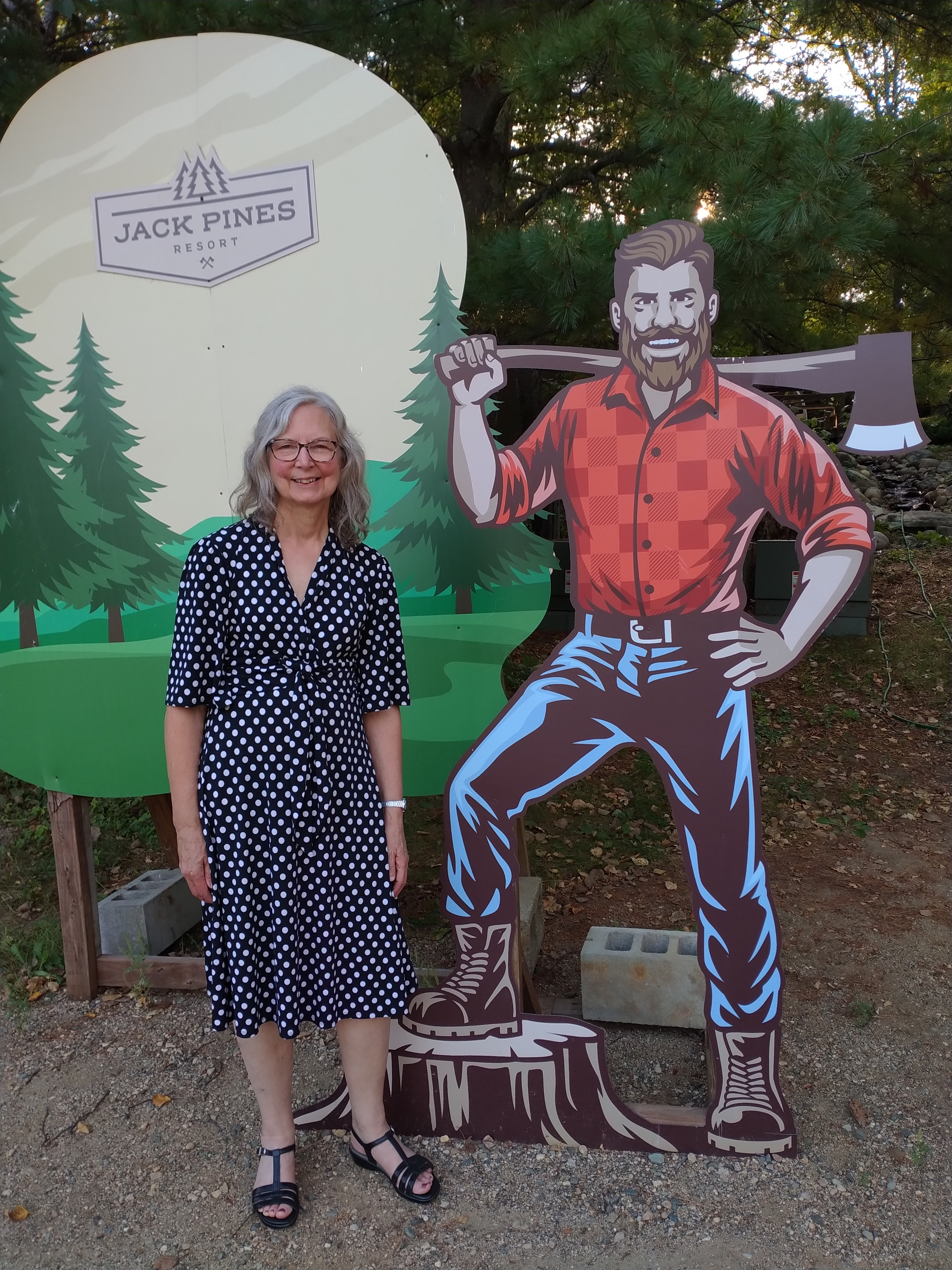
I am a down-to-earth writer who focuses on writing about people, places and events primarily in Minnesota. Here I’m pictured outside Jack Pines Resort, rural Osage. I was there attending a book launch party for an anthology in which my writing published. (Minnesota Prairie Roots copyrighted file photo by Randy Helbling, September 2024)

I’VE ALWAYS LOVED WRITING. From early on, my love of language, of words, of grammar, of, yes, even spelling, defined me. Give me a book to read. Give me a spelling test. Give me a pen and a notebook. And then a computer. Words, words and more words. I will find them, use them, create stories with them.

At one time, I wanted to pursue a degree in German. But, after a year in college, I changed direction because I didn’t want to teach. I decided to study journalism. It was absolutely the right decision for me, my interests and my skills.

With that intro, I join the many writers who are celebrating National Newspaper Week October 6-12. That includes journalists from my local paper, The Faribault Daily News, in which my writing publishes each weekend and sometimes more. I no longer consider myself a full-fledged journalist as much as a writer. These days I write from a personal perspective, more as a columnist, rather than as an objective reporter. I write fiction, creative nonfiction and poetry, too.

MY JOURNALISM EXPERIENCE

But I did work as a full-time newspaper reporter and photographer after graduating with a mass communications degree (news/editorial emphasis) in 1978 from Minnesota State University, Mankato. I worked for newspapers in Gaylord, Sleepy Eye, Mankato, Owatonna and Northfield. Eventually I gave up journalism when I started a family. The long and odd hours are not conducive to family life.

Today my three kids are long grown and gone, and I’ve found my way back to writing with an added focus on photography. What makes a good writer, a good newspaper reporter? Topping my list are the abilities to listen and focus on detail. I’ve always considered myself a good listener, a necessity for any newspaper reporter. I developed the skill of taking notes while actively listening. Organization also factors in. There’s always a bit of homework involved in prepping for an interview. Research the subject. Prepare questions, but be open to asking more as the interview progresses. Focus on details. Tell a story.

I worked in journalism before the days of cellphones, so I filled notebooks with pages of notes. I also studied and worked in the profession before computers and digital cameras. My first job out of college, I typed all of my stories on a manual typewriter, shot all my photos on film. I would never want to go back to either. Give me a computer and a digital camera. It’s much easier to create with those.

FOCUS ON LOCAL STORIES

I love sharing stories and photos of people, places and events that weave into my life, that I discover. I find joy in following a gravel road, in discovering interesting signage, in exploring small towns, in meeting ordinary people following their passions… People often tell me I find the most interesting things. I agree. And then I tell them it’s right here in their own backyard if only they pause to look, and see.

Therein lies the value of community journalism, which I want to highlight and honor during National Newspaper Week. Our local newspapers are all about local. Local reporters cover and write about the people, places and events that are happening locally. They write stories ranging from features to hard news. I covered all of those, too, while working as a full-time reporter. It’s not an easy job. People are quick to criticize, slow to praise. So I want to state right now that I appreciate our local news team. They work long, odd hours, just as I did, to gather and write the news. They care.

Everyone ought to care that freedom of the press thrives, that these journalists are covering our government meetings, writing about our neighbors, highlighting ordinary people who do extraordinary things and much more. We need newspapers as much today as ever before, perhaps even more.

Please, support your local newspaper by subscribing. And thank a newspaper reporter for their dedication to the profession. They deserve to be recognized, especially during National Newspaper Week.

© Copyright 2024 Audrey Kletscher Helbling


-30- April 30, 2024

(Minnesota Prairie Roots copyrighted file photo)

THE LOSS IS IMMENSE, TRAGIC—the deaths of eight prominent community members in southern Minnesota last week. I knew none of them personally. Yet I did. We all did.

If you have ever read a community newspaper, then you knew the deceased. For it is eight Minnesota newspapers, not individuals, that died. Ceased publication, only weeks after an announcement of their forthcoming funerals.

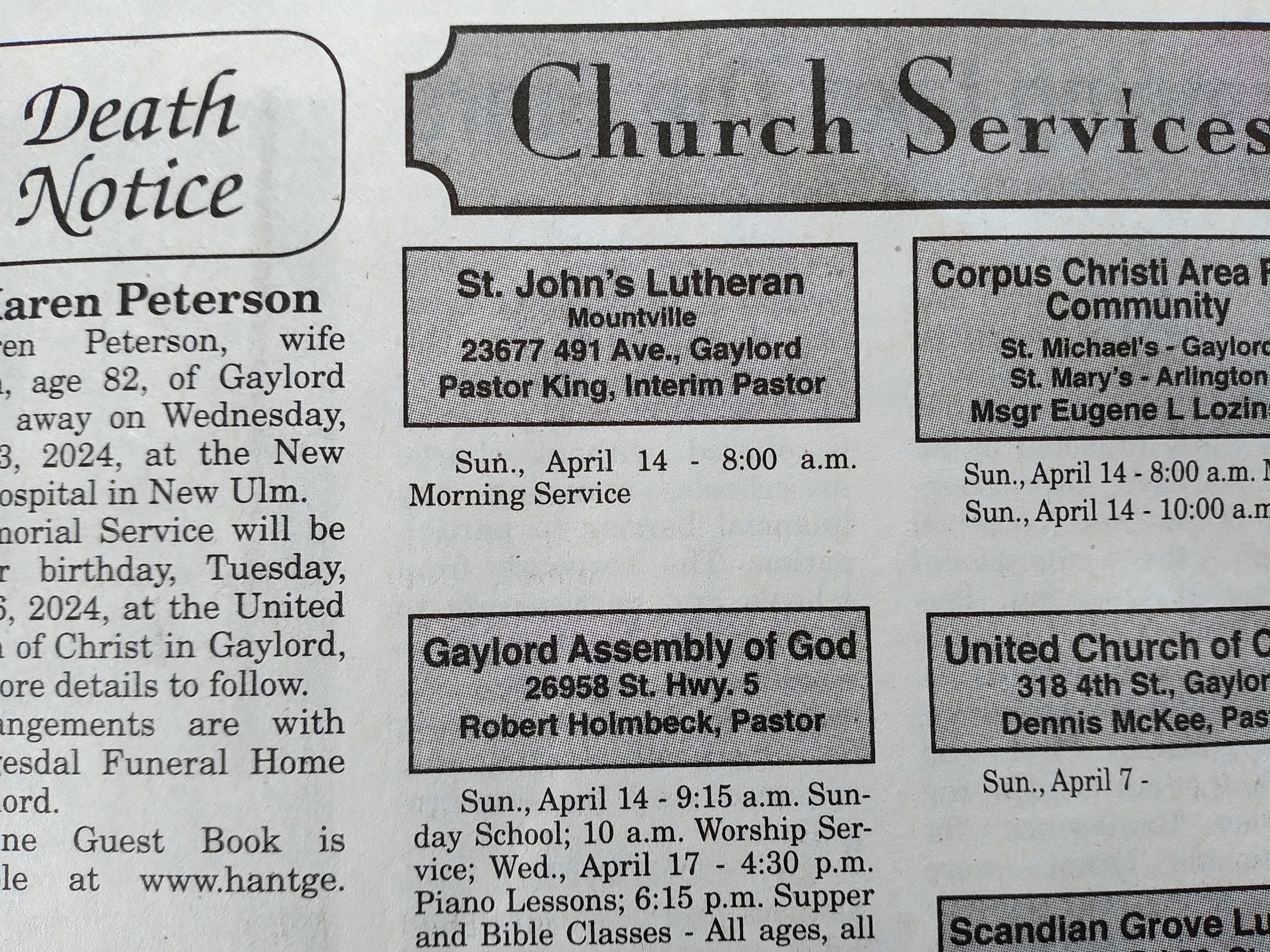
Death notices and church services, printed in The Gaylord Hub.

I am mourning the deaths of the Hutchinson Leader, Litchfield Independent Review, Chaska Herald, Chanhassen Villager, Jordan Independent, Shakopee Valley News, Prior Lake American and Savage Pacer, plus Crow River Press Printing Plant. All are owned by Denver-based MediaNews Group, part of hedge fund Alden Global Capital.

They ranged in age from 30 (Savage Pacer) to 162 (the Chaska and Shakopee papers). Five of the eight began publication between 1862-1880. That’s quite a legacy.

I am undeniably biased in reporting this news. I hold a journalism degree, have worked for community newspapers and write for publications owned by Adams Publishing Group. I believe in community journalism with the fierceness of recognizing its importance, its value, to the people who live and work in the places these papers cover. No one covers local like local.

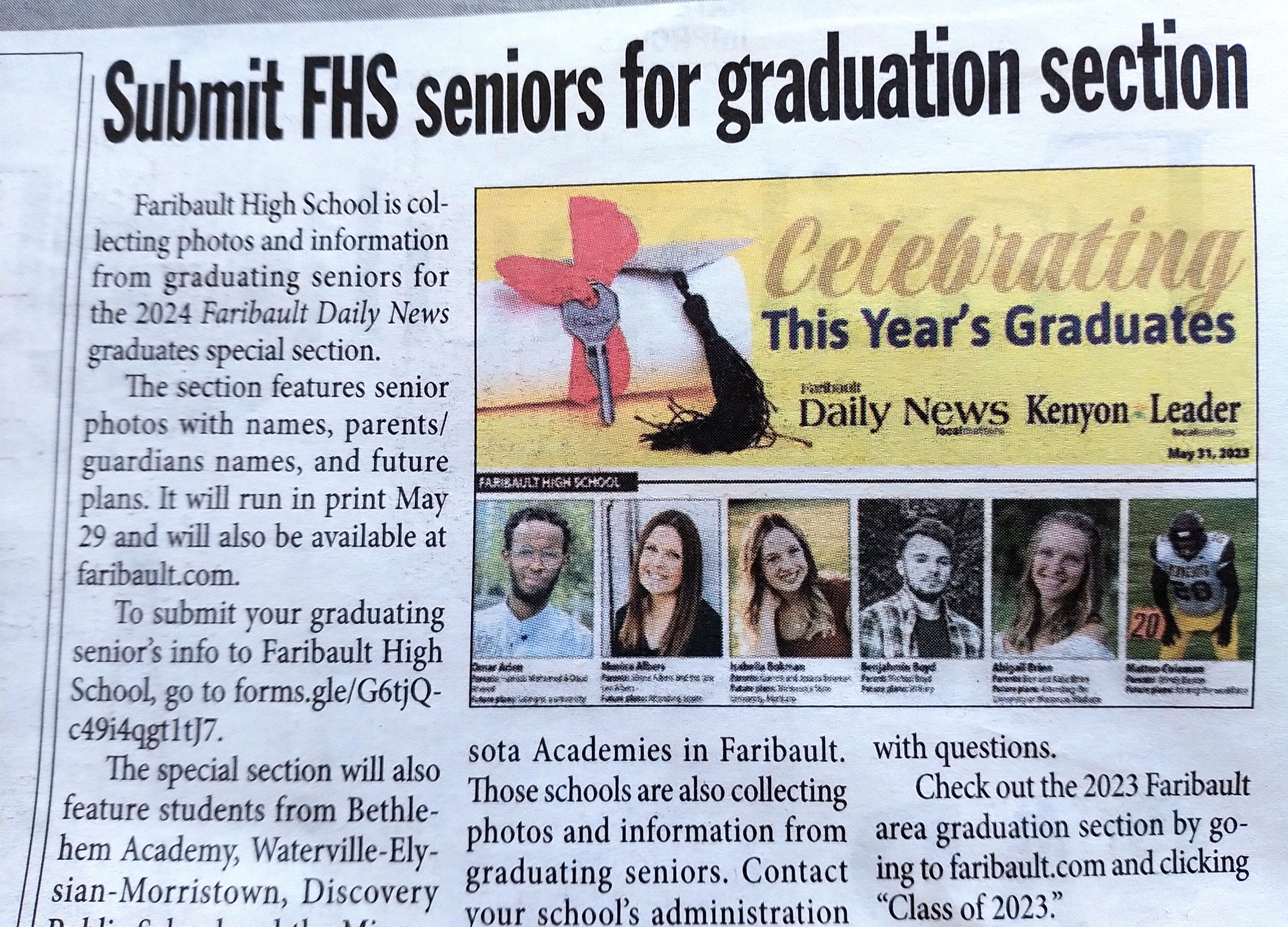
My local paper, owned by Adams Publishing Group, still prints a special graduation section each spring.

And now that print coverage is lost in all these southern Minnesota towns, cities and rural areas: The watchdog coverage of school board, city council, county board, planning and zoning, and other government bodies. The stories about crime and tragedies. The stories about community events and celebrations. The interesting features that focus on people. Local sports and arts and entertainment stories. Community calendars, school honor rolls and lunch menus. Graduation. Obituaries and much more.

In my first journalism class at Minnesota State University, Mankato, I learned how to craft an obituary. It was our initial writing assignment, I think to impress upon all of us post-Watergate would-be reporters the importance of getting every detail correct in a story. That lesson stuck with me. Get it right.

I took that knowledge with me to The Gaylord Hub, a small town community newspaper printed at Crow River Press in Hutchinson. Each week a co-worker and I aimed north in a vintage Dodge van to deliver the newspaper lay-out sheets to the printing plant. The process of creating a newspaper in 1978 was decidedly different than today. Consider that I typed all my stories on a manual typewriter. A typesetter then typed my work into a typesetting machine. Stories were printed out in columns, then laid out and pasted onto lay-out sheets. No designing by computer. Then it was off to Crow River Press, where a co-worker and I watched the Hub roll off the press, bagged the freshly-inked papers and delivered them to the Gaylord Post Office, where subscribers eagerly waited to get their papers.

A front page story in the April 11 issue of The Gaylord Hub.

Yes, I’m feeling a tad nostalgic and sad thinking of the closure of Crow River Press. The recent shut-down left the publisher of The Gaylord Hub, and other small town newspaper owners, scrambling for a place to print their papers. Many printing plants, like community papers, have met their demise in Minnesota as large media groups acquired papers and plants.

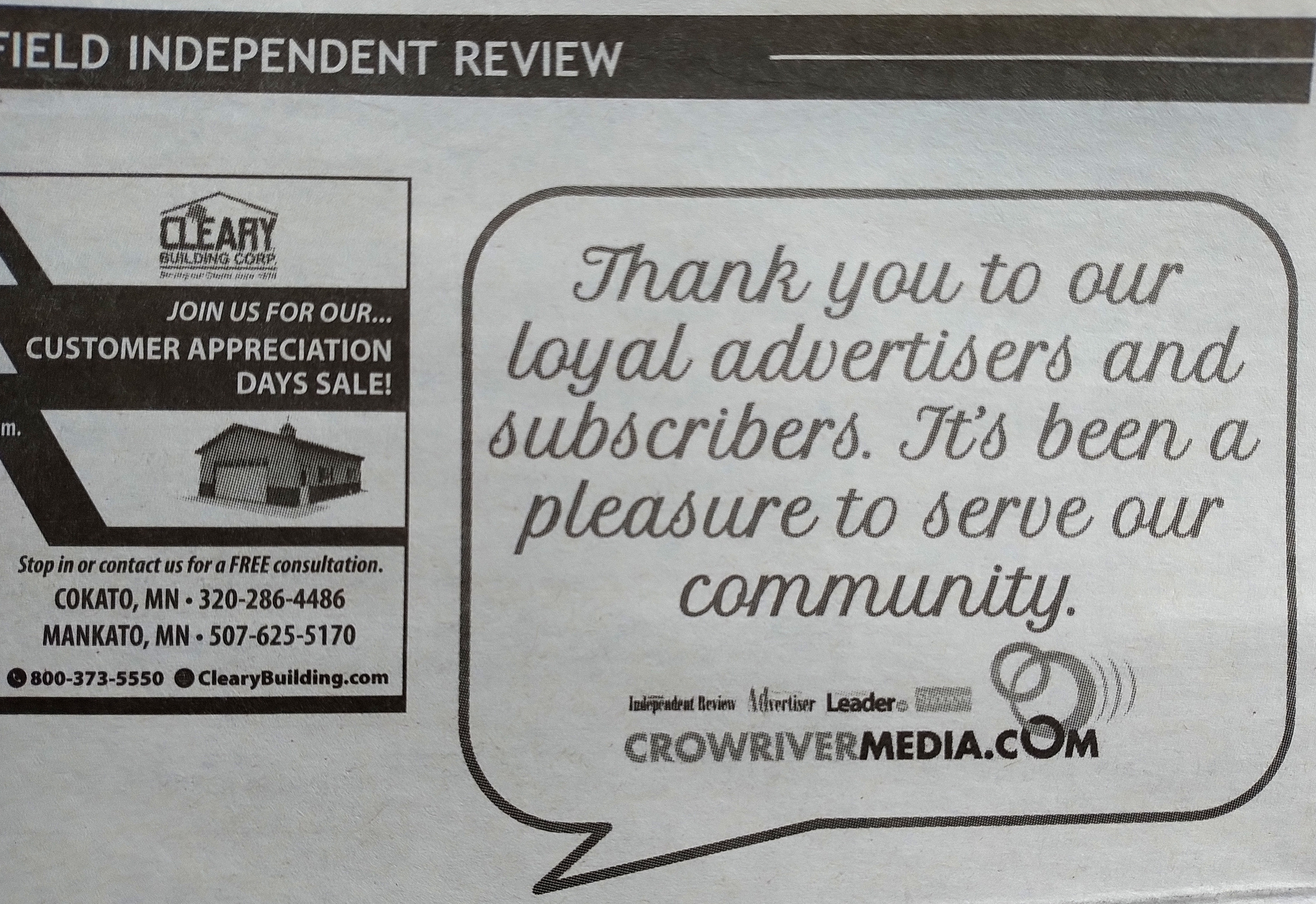
This thank you published in the April 21 final edition of The Galaxy, a supplement to eight community newspapers printed by Crow River Press.

Times change. I understand that. The economy, technology, COVID, acquisitions and much more have factored into the deaths of community newspapers. Readers find their “news” elsewhere. Businesses spend their advertising dollars elsewhere. Far-removed executives make questionable business decisions. The list of reasons and excuses and explanations is extensive.

Community members, too, hold some responsibility in the deaths of newspapers. I can’t speak to the specific papers that closed last week in Minnesota, but I can tell you what I hear locally. And that is criticism, some deserved, much not. People have always criticized the media, failing to remember that reporters are reporting, not creating, the news. But the comments have become more intense, more rabid, more frequent. Freedom of the press feels threatened in our democracy.

The community journalists I know are honest, hardworking, (probably) underpaid and devoted to the craft. Just as I was when I worked as a full-time newspaper reporter.

This full page notice/thank you, an obituary of sorts, published in the April 21 final edition of The Galaxy.

Community newspapers are no longer valued like they once were, resulting in fewer subscribers. When I hear people say they no longer subscribe to the local paper, I suggest they reconsider. Community newspapers are vital to our cities, towns and rural areas. And sometimes we don’t understand that, until it’s too late, until we’re reading their obituaries.

-30-

NOTE: Print journalists have used -30- to signify the end of a story submitted for editing. I use # to indicate the ends of my stories, except today, when the old school -30- seems more appropriate.

© Copyright 2024 Audrey Kletscher Helbling


A 1979 interview with Mike Max & reflections on community journalism June 12, 2020

A CARDBOARD BOX, stacked in an under-the-roof storage space on the second floor of my house, holds layers of yellowed newspaper clippings. Not stories of personal value because they are about me or my family. But rather stories I wrote, as a community journalist.

In March 1978, newly-graduated with a mass communications degree from Mankato State (now Minnesota State University, Mankato), I started my multi-faceted job at The Gaylord Hub. I was the first-ever journalist hired at the small rural weekly in Gaylord, the county seat of Sibley County. Prior to that, family at the then second-generation family-owned paper covered all the editorial work.

I did everything from writing news stories and features to taking and printing photos to writing headlines to going to the printing plant and then swinging canvas bags full of newspapers into the back of a van for delivery to the post office. I learned nearly every aspect of community newspapers except selling and designing ads and covering sports. Under the guidance of a supportive, encouraging and kind editor and publisher, Jim Deis, I grew my skills and my passion for small town community journalism.


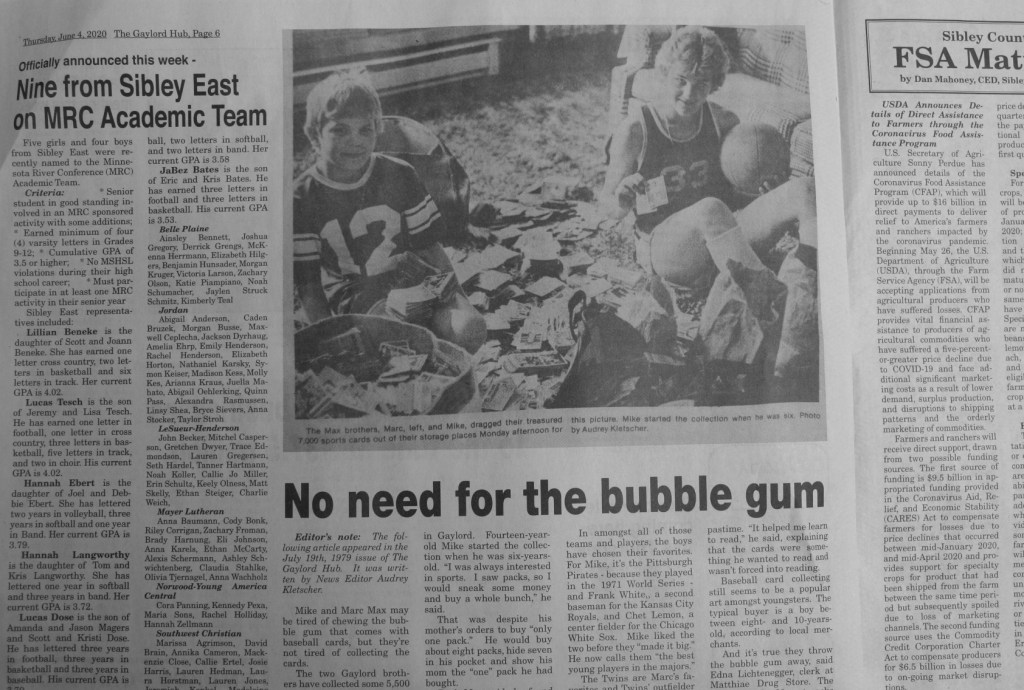
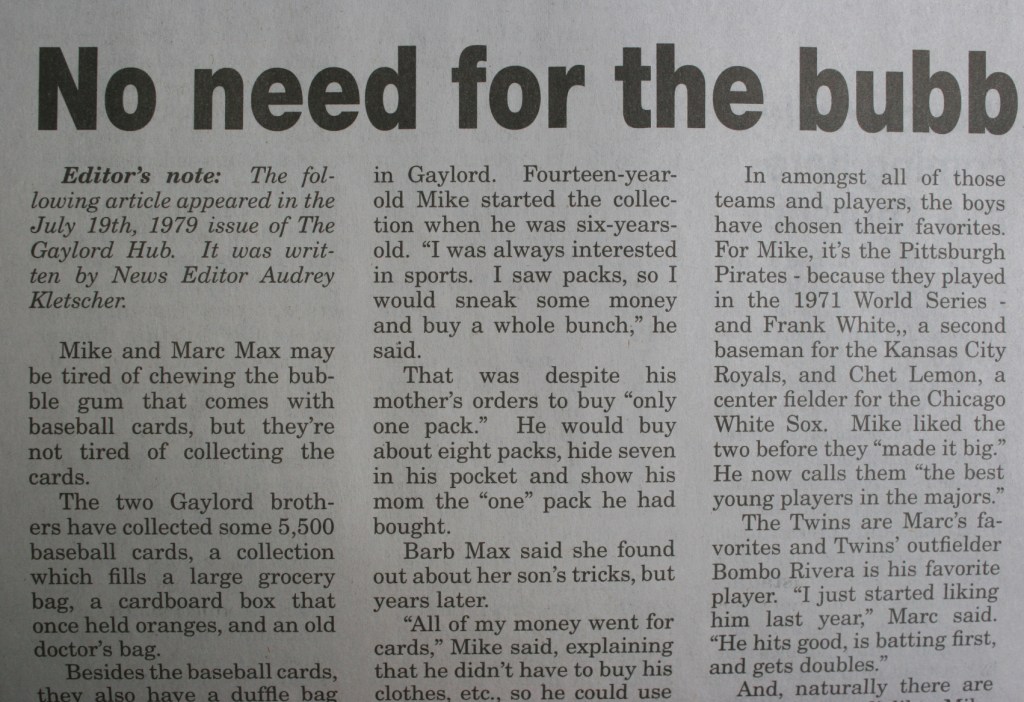
A feature I wrote in 1979 republished in the June 4, 2020, issue of The Gaylord Hub.


Forty years after I left The Hub, the newspaper still arrives weekly in my mailbox. Jim passed many years ago. His son, Joe, just a kid when I worked at the paper, now serves as the third-generation editor and publisher. And last week he republished a feature, No need for the bubble gum, I wrote in July 1979. Perhaps my one and only sports story. I interviewed the Max brothers—Mike and Marc—for a feature about their sports card collection.

I recall going to the brothers’ home in Lakeside Acres and the piles and piles of bagged, boxed and loose cards numbering some 7,000. But I didn’t remember details of that interview with the 9 and 14-year-olds. So rereading that story I wrote 41 years ago proved entertaining, especially considering where one of those boys landed. Mike Max went on to become the sports director for WCCO-TV in the Twin Cities. And more recently, he expanded to hard news by covering the protests surrounding the death of George Floyd in Minneapolis.


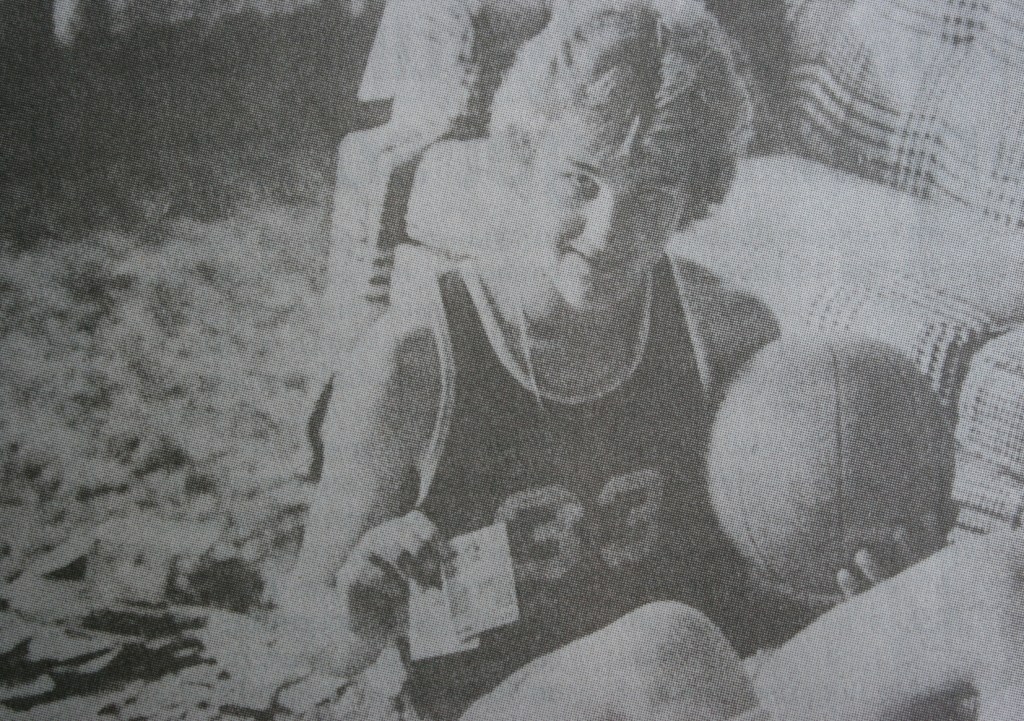
WCCO personality Mike Max, up close in a photo I took in 1979. Photo by Audrey Kletscher from The Gaylord Hub.


But back to that 1979 feature I wrote. Here’s my favorite quote from Mike:

“I was always interested in sports. I saw packs (of collector cards and bubble gum), so I would sneak some money and buy a whole bunch,” he said.

That was despite his mother’s orders to buy “only one pack.” He would buy about eight packs, hide seven in his pocket and show his mom the “one pack” he had bought.

Barb Max said she found out about her son’s tricks, but years later.

I love that part of the story.

But I find equally humorous this paragraph from my feature:

The two plan on keeping their cards, but speculate on selling some of them if the price is right. “I’ll save them until I get real old,” Marc said. “I’ll save them until they’re worth more and more, but maybe someday sell them if I need money real bad.”


A section of the republished story from 1979.


Reflecting on that feature of four decades ago, I am reminded of the importance of community newspapers. These are the stories we are losing as more and more small town weekly newspapers, and even some dailies, are folding. Declines in advertising revenue and subscribers, rising expenses and the growth of online media alternatives have all factored into the demise of print journalism. I can’t even begin to tell you how much that saddens me. We are losing such a valuable part of our communities. The watchdogs. The storytellers. The historians. The source of information about public meetings, community events, deaths—news in general. The media is too often under attack, blamed for reporting too much bad news. Don’t kill the messenger, I say.

I will always remain grateful for the two years I worked as The Cub from the Hub, a name tagged to me while in Gaylord. There I learned and grew as a writer, always striving for integrity, honesty and balanced reporting. By far, feature writing proved the most enjoyable aspect of my work. From Gaylord, I would go on to report for The Sleepy Eye Herald-Dispatch, The Mankato Free Press (St. James bureau), The Owatonna People’s Press and The Northfield News. Some were temporary fill-in jobs, others full-time. But no matter where I worked, I worked long, hard hours at low pay to cover the community. I reported the hard news and attended endless city council/school board/county board meetings into the late hours of the night. And sometimes I wrote, too, about kids who collect sports cards. Kids like Mike Max and his younger brother, Marc.

© Copyright 2020 Audrey Kletscher Helbling