Minnesota Prairie Roots

Writing and photography by Audrey Kletscher Helbling

Connecting, conversing and celebrating cultural diversity at Faribault festival August 28, 2012

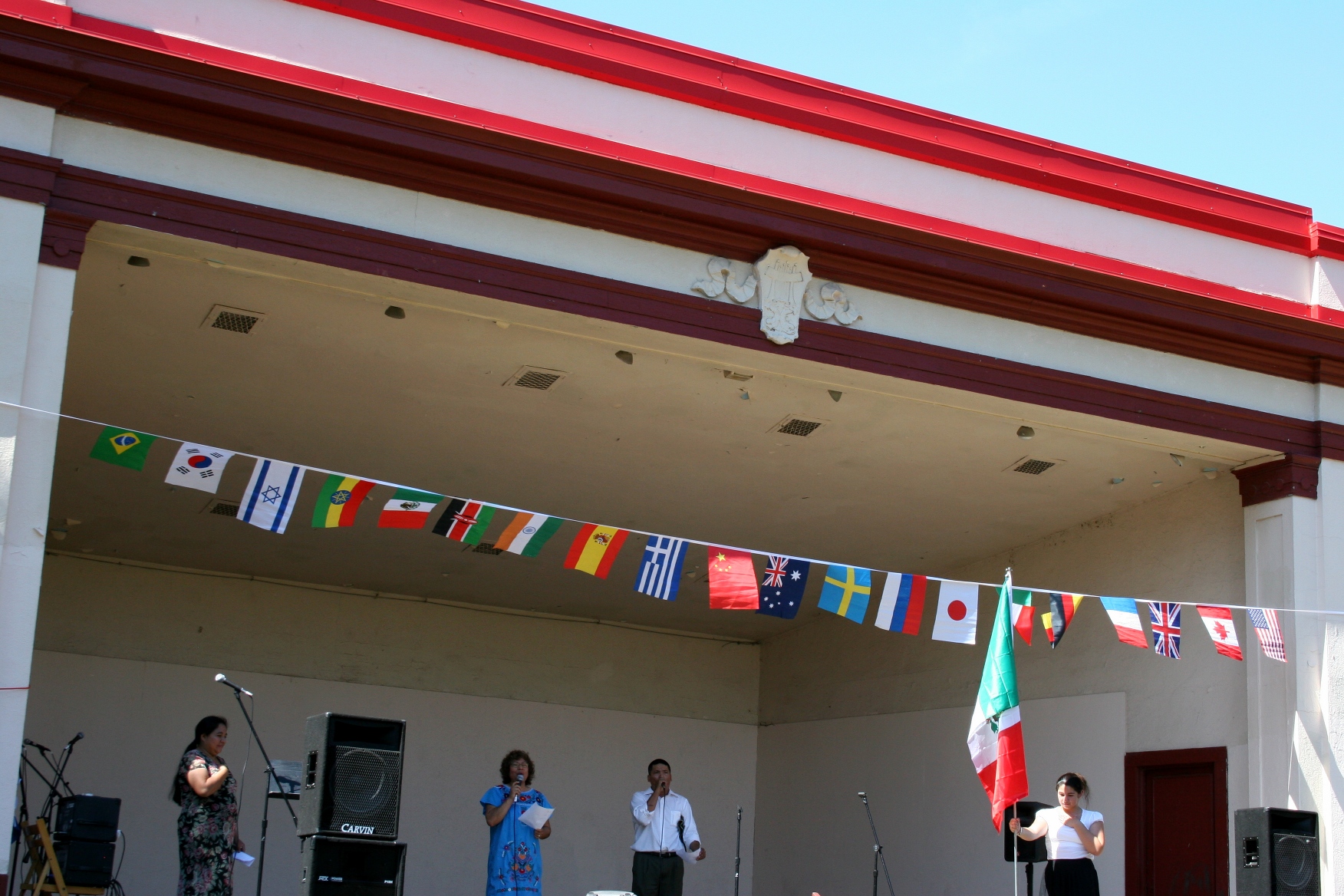
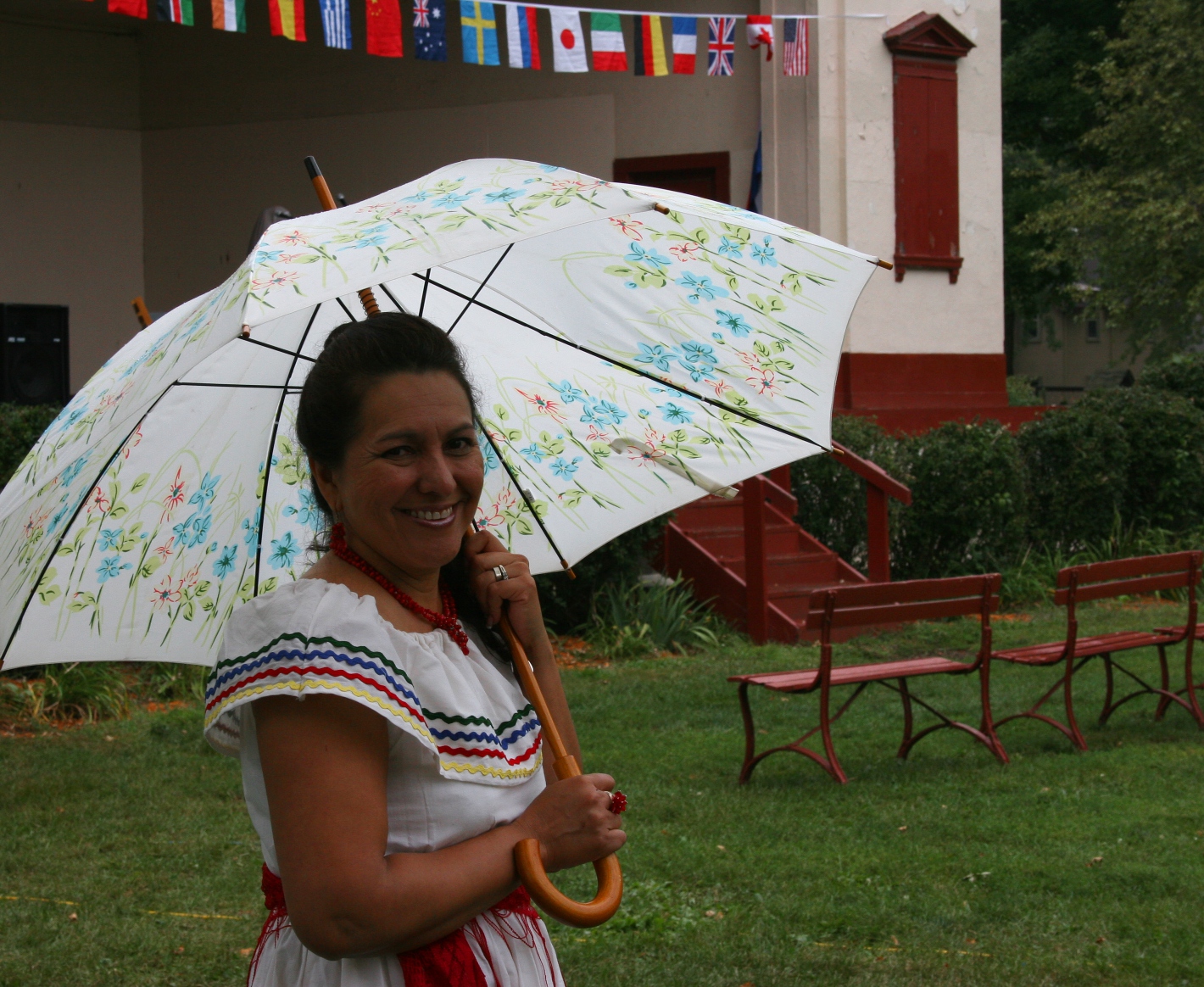
This woman represents El Salvador during the International Festival Faribault on a drizzly Saturday. Flags suspended from the Central Park band shell in the background show the countries participating in the event.

DESCRIBING AN EVENT like International Festival Faribault within the confines of a blog post or two seems daunting. How do I adequately convey the essence of this fest celebrating the cultural diversity of my community?

You can view my first effort by clicking here and reading “Yearning for respect & equality, ‘no matter what color you are.’”

Now, as I scroll again through the many photos I took during the fest (when rain wasn’t drizzling upon my camera), I ponder which images to share, what words to pen.
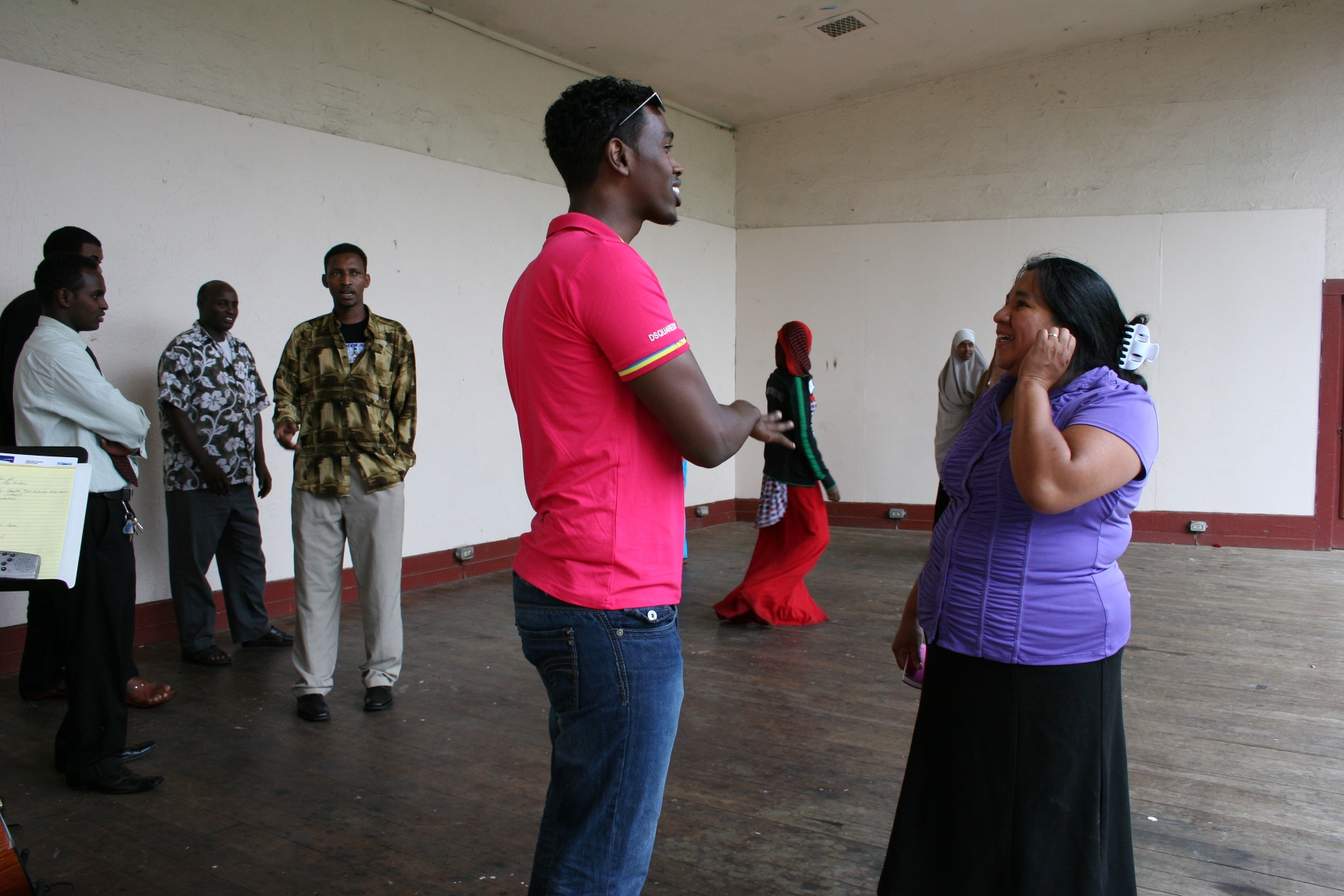
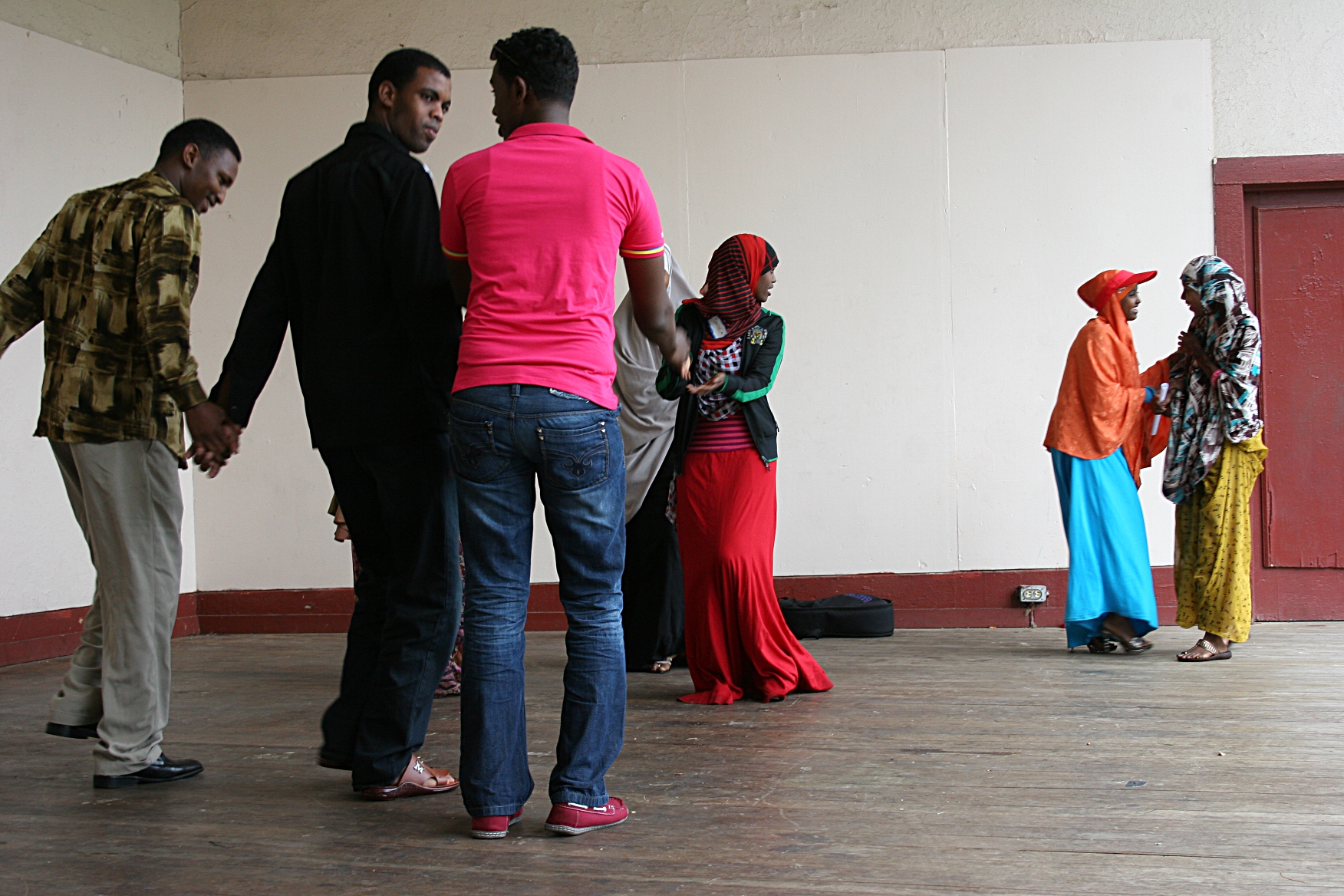
Cultures connecting on the band shell stage between musical acts.

And “c” words—like color, connecting, communicating, conversation, coloring, candy, culture, care, colorful clothing—pop out at me as I view my photos.

I should perhaps add “confusing” to that list because I felt overwhelmed when trying to photograph the wood carvings from Somalia and Kenya peddled by Bashir Omar and Asher Ali.

A woman, without prompting, took this mask from the table manned by Bashir Omar and Asher Ali and asked me to photograph her.

Suddenly, it seemed, everyone wanted to pose for a picture. And I much prefer candid to set up shots. I obliged, though, because it seemed the easiest thing to do.

Lul Abdi shows off beautiful wood crafts from Kenya and Somalia.

Then Lul Abdi, who had grabbed a wooden platter and giraffe, and held them up for me to photograph, asked me to write in my blog that an election is coming up in Somalia and I should tell everyone to vote for whomever it is she supports. Bashir Omar translated my answer—I don’t write about international political issues.

While this back-and-forth translation was occurring, I felt befuddled because, when too much noise (in this instance lots of conversation going on around me and music in the background), is coming my way, my brain doesn’t process anything. That issue is related to the 70 percent hearing loss in my right ear.

Despite the difficulties, this muddle served as an aha moment. Imagine if I was Lul, struggling on a daily basis to understand those around me. Life would be challenging.
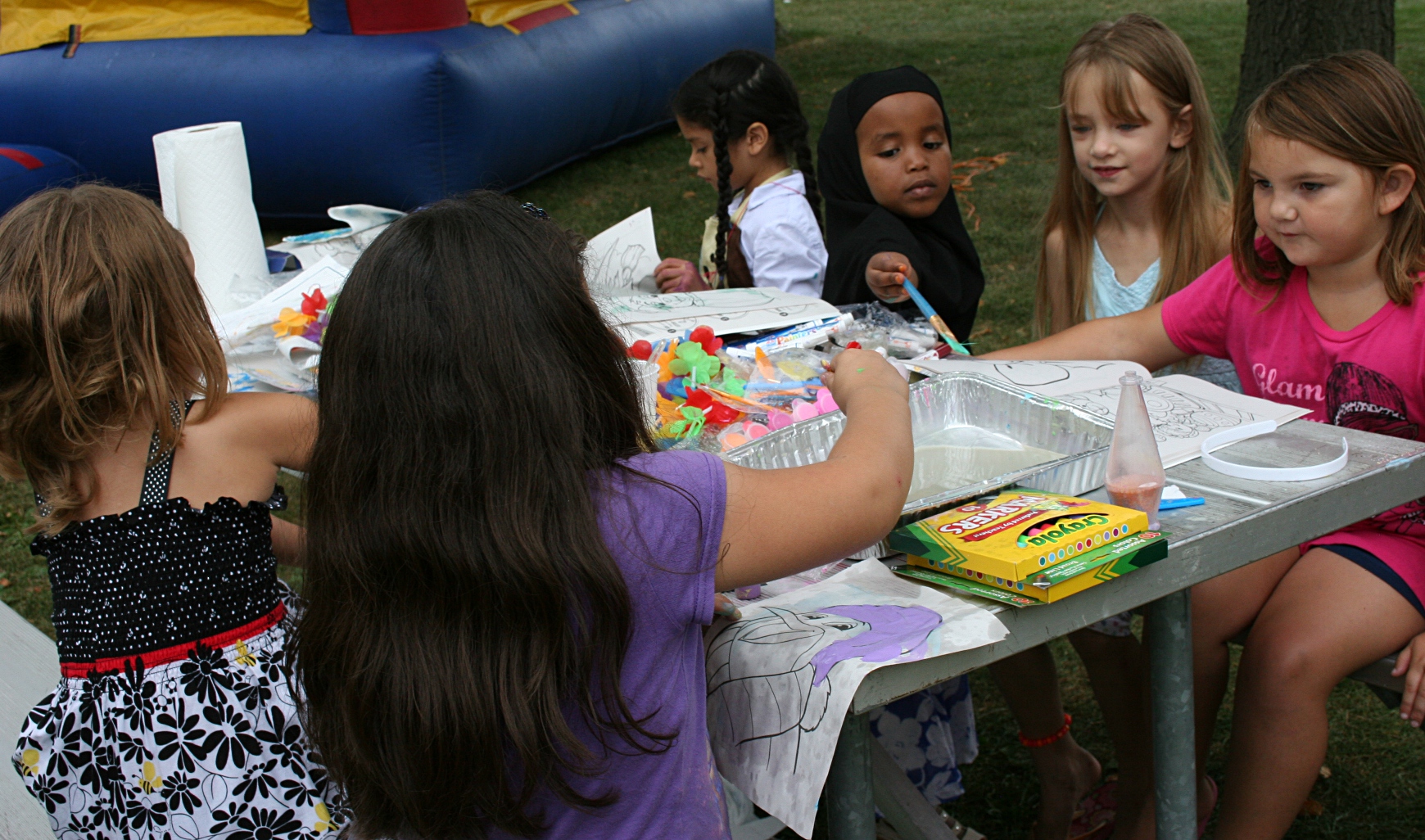
Busy artists at the kids’ activity table.

But sometimes we all speak the same language. And I saw, rather than heard, that on Saturday, at the festival, especially among the children. They sat side-by-side painting at the kids’ activity table, bounced side-by-side in the bouncy tent, stood side-by-side in line to take turns swinging at pinatas.

A little girl stands on the opposite side of the group of children waiting to swing at the pinata.

Differences in color and culture and language mattered not to these children. They shouldn’t matter to any of us. Therein lies the message I most want to communicate to you today and which was communicated so well via International Festival Faribault.
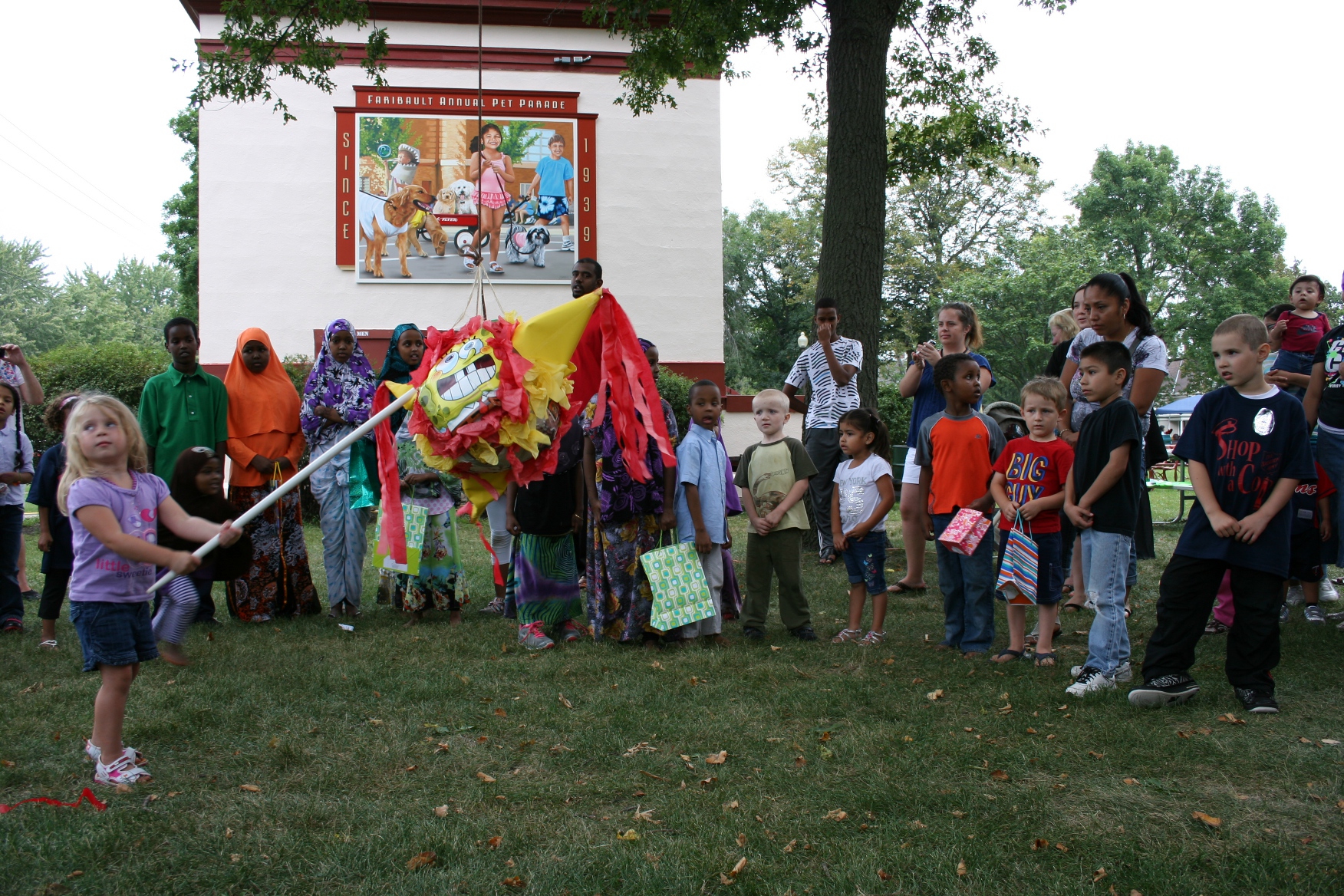
Happy children all focused on the same goal: breaking the pinata.
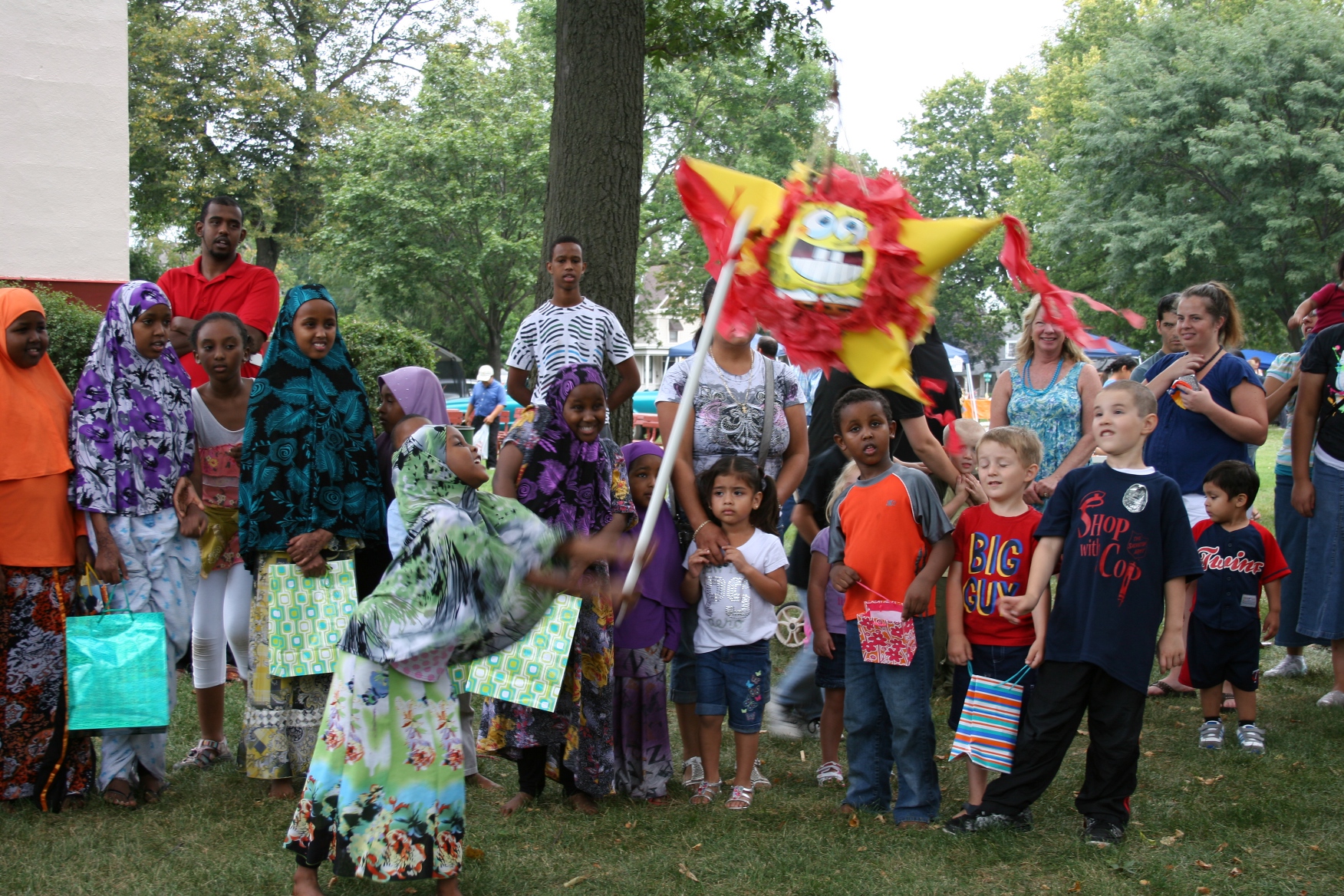
All around me, children and adults of all colors mingled.
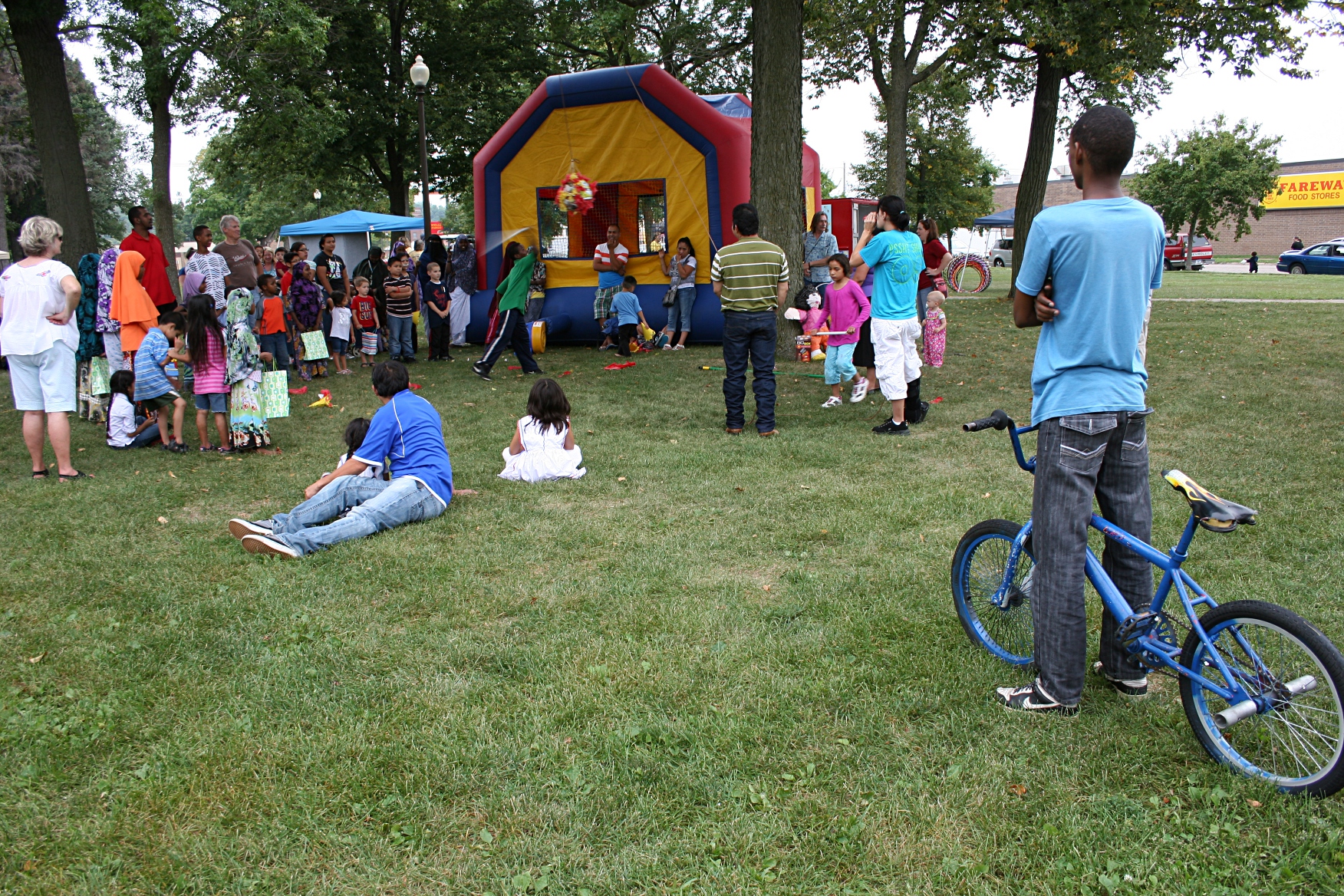
The boy on the right was biking past Central Park and stopped to watch the activities at a distance.

The scramble for candy once one of three pinatas is broken.

AND HERE ARE SOME ADDITIONAL BONUS PHOTOS:
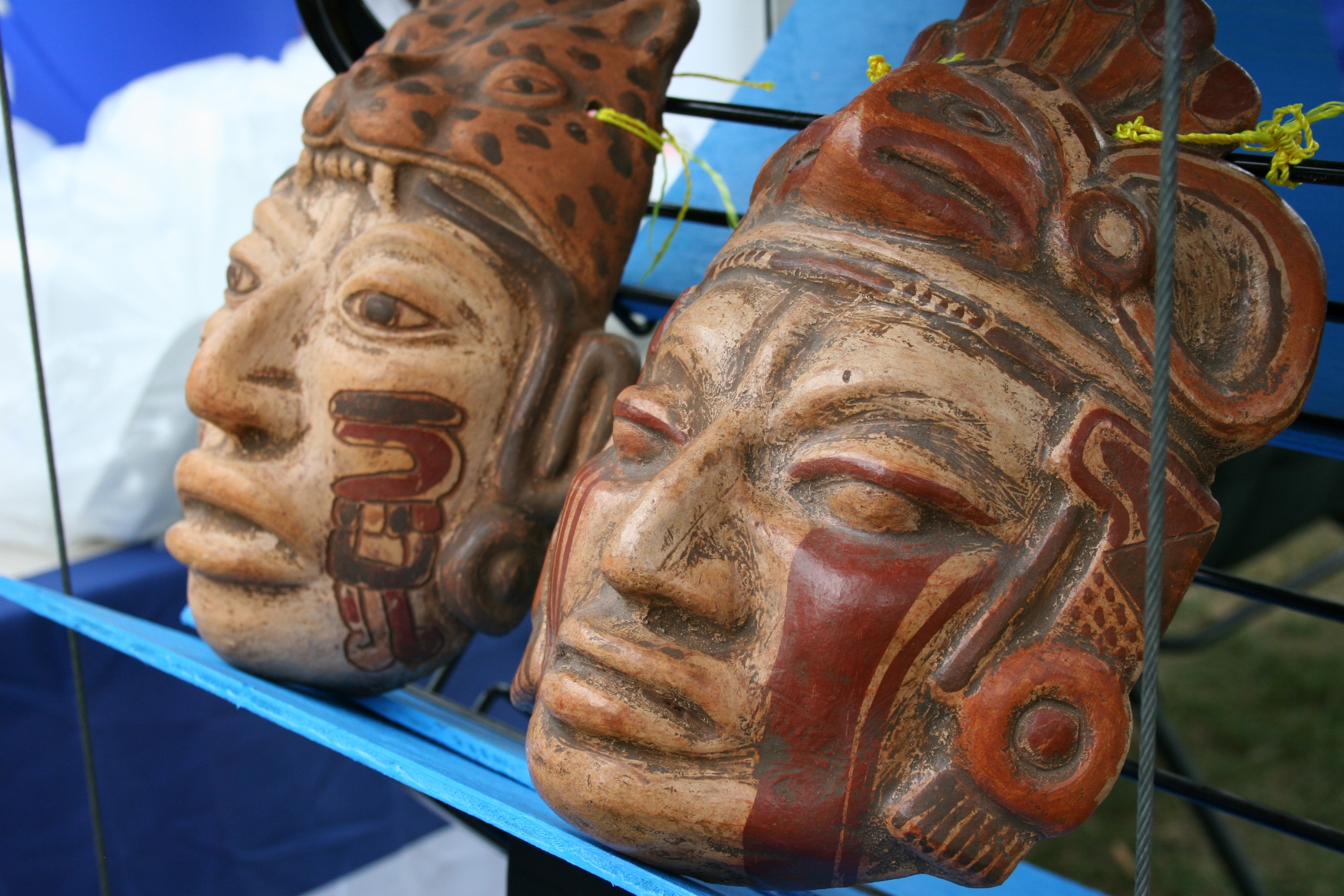
Masks displayed at the food vendor representing El Salvador.
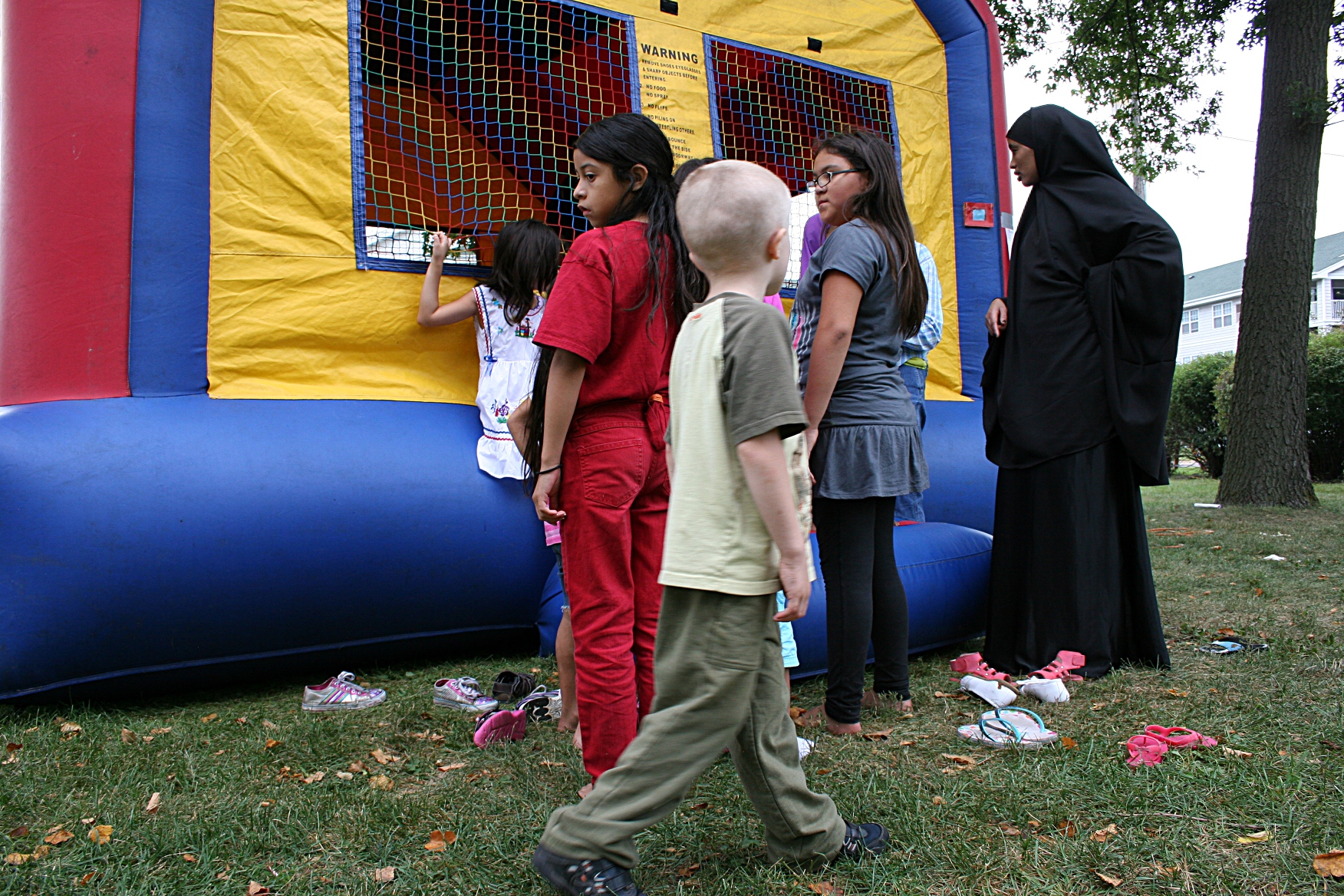
Waiting at the bouncy tent.
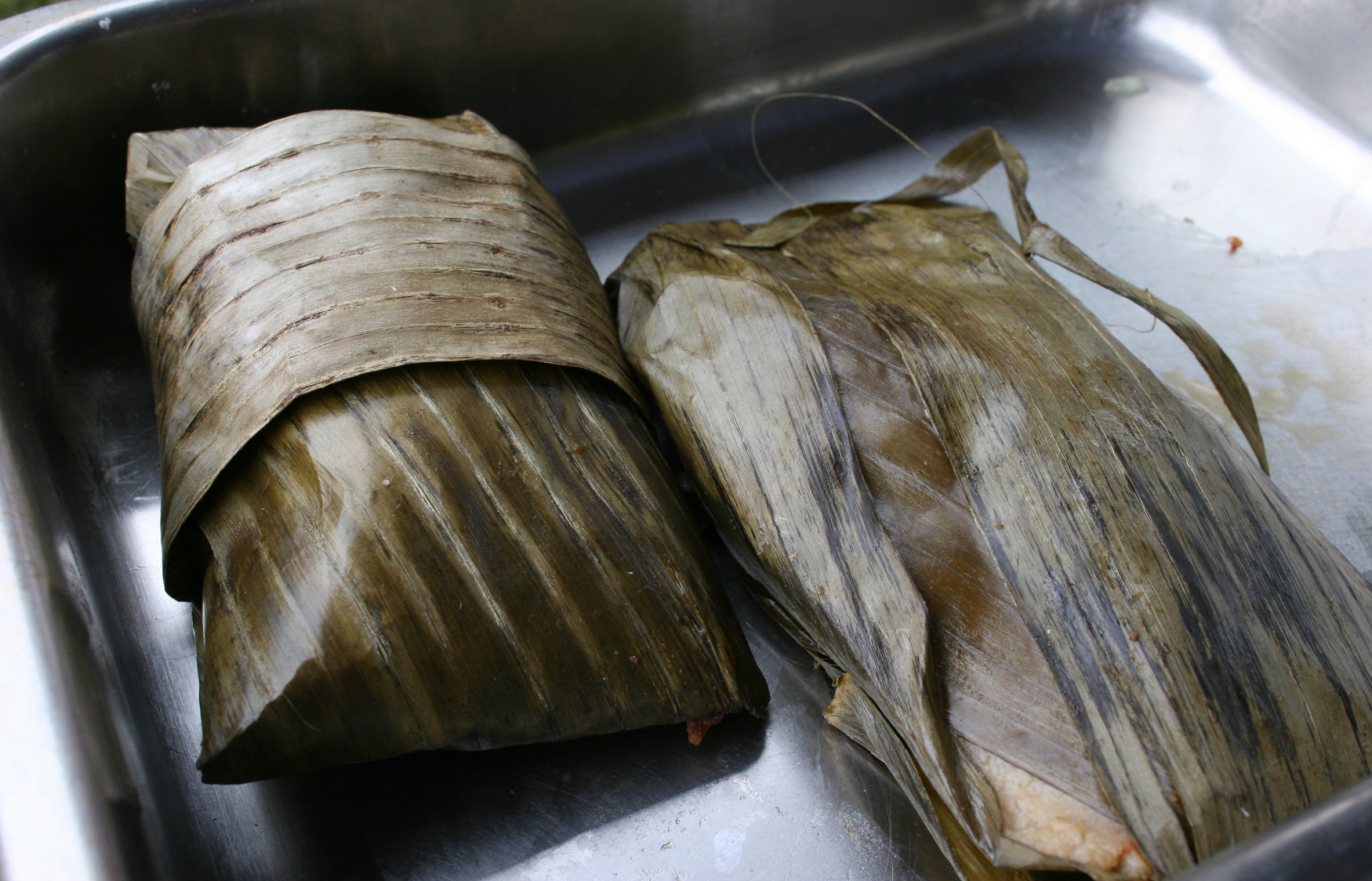
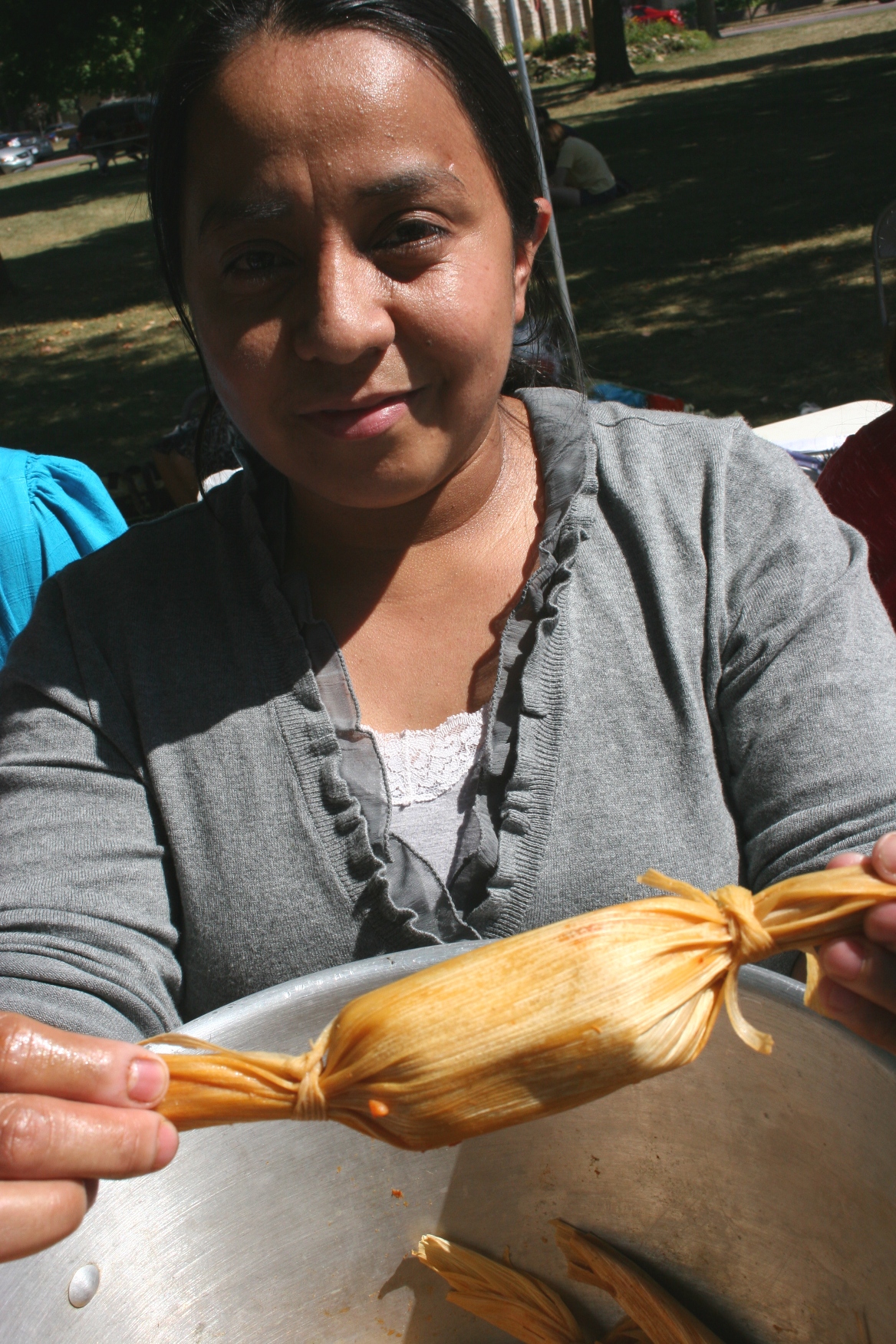
A Mexican dish (help me out if you know, but I think tortillas) was wrapped in banana leaves. My husband and I tried this.
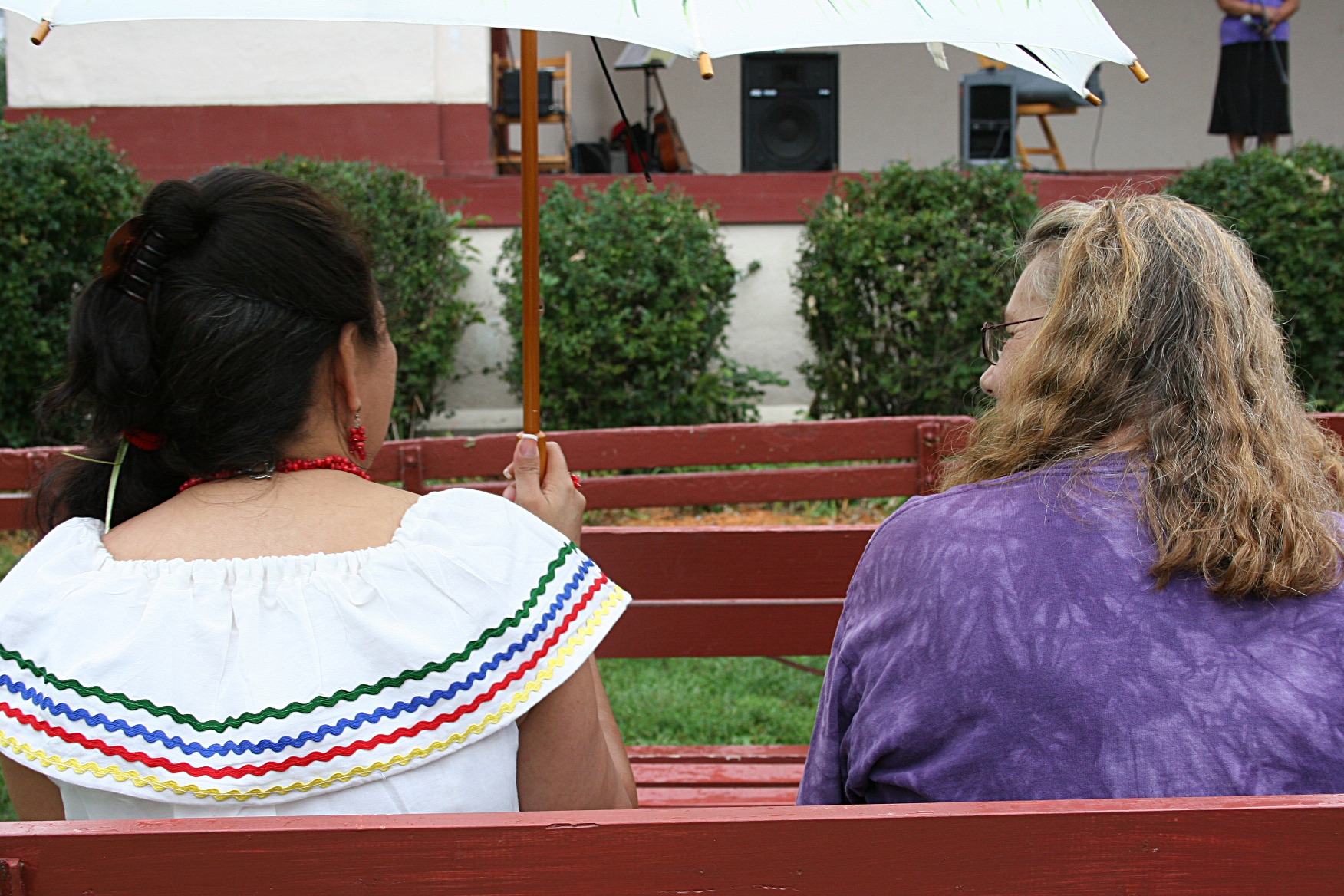
Conversation and connecting…, no other words necessary.
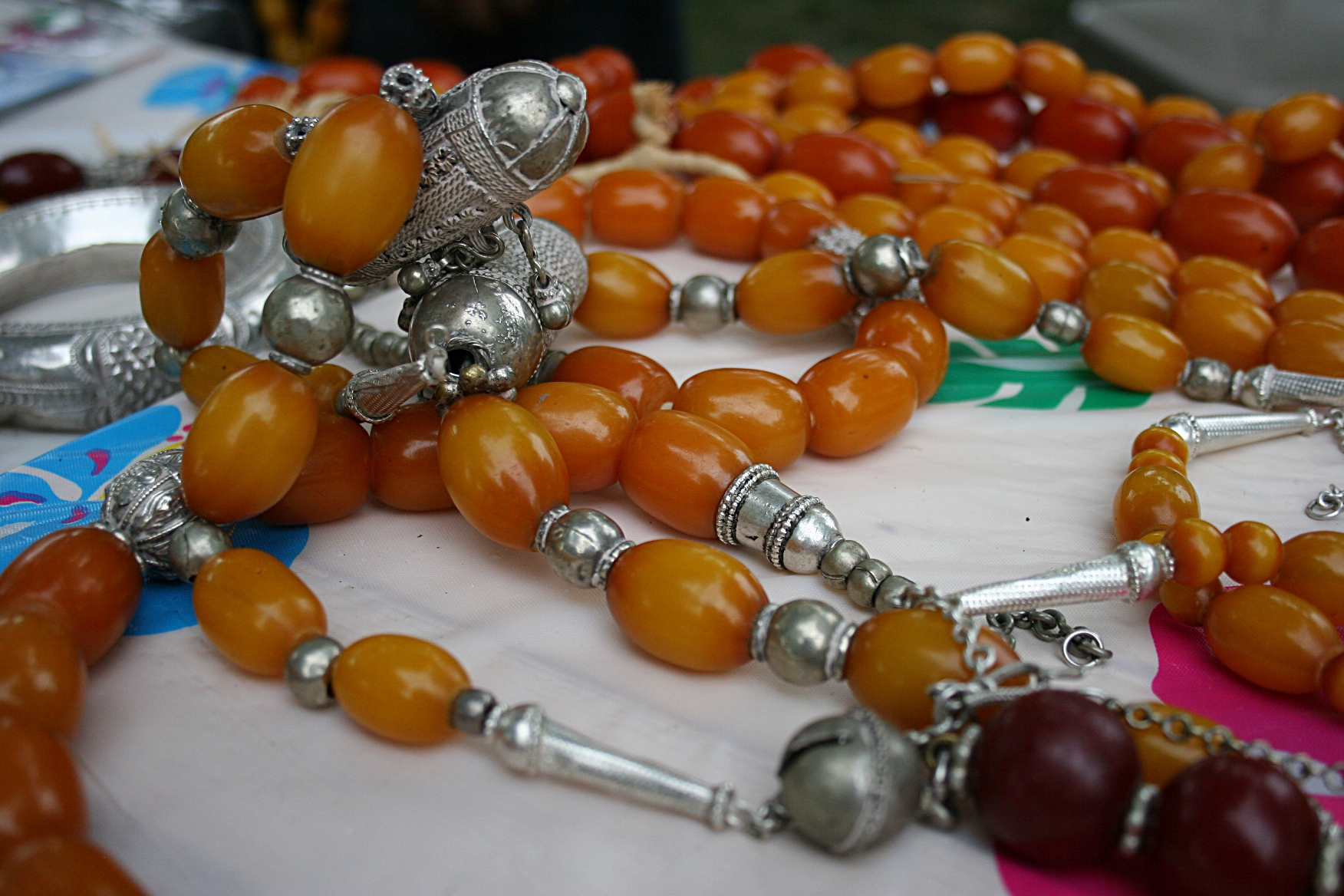
Necklaces and other jewelry from Kenya and/or Somalia and for sale at the festival.
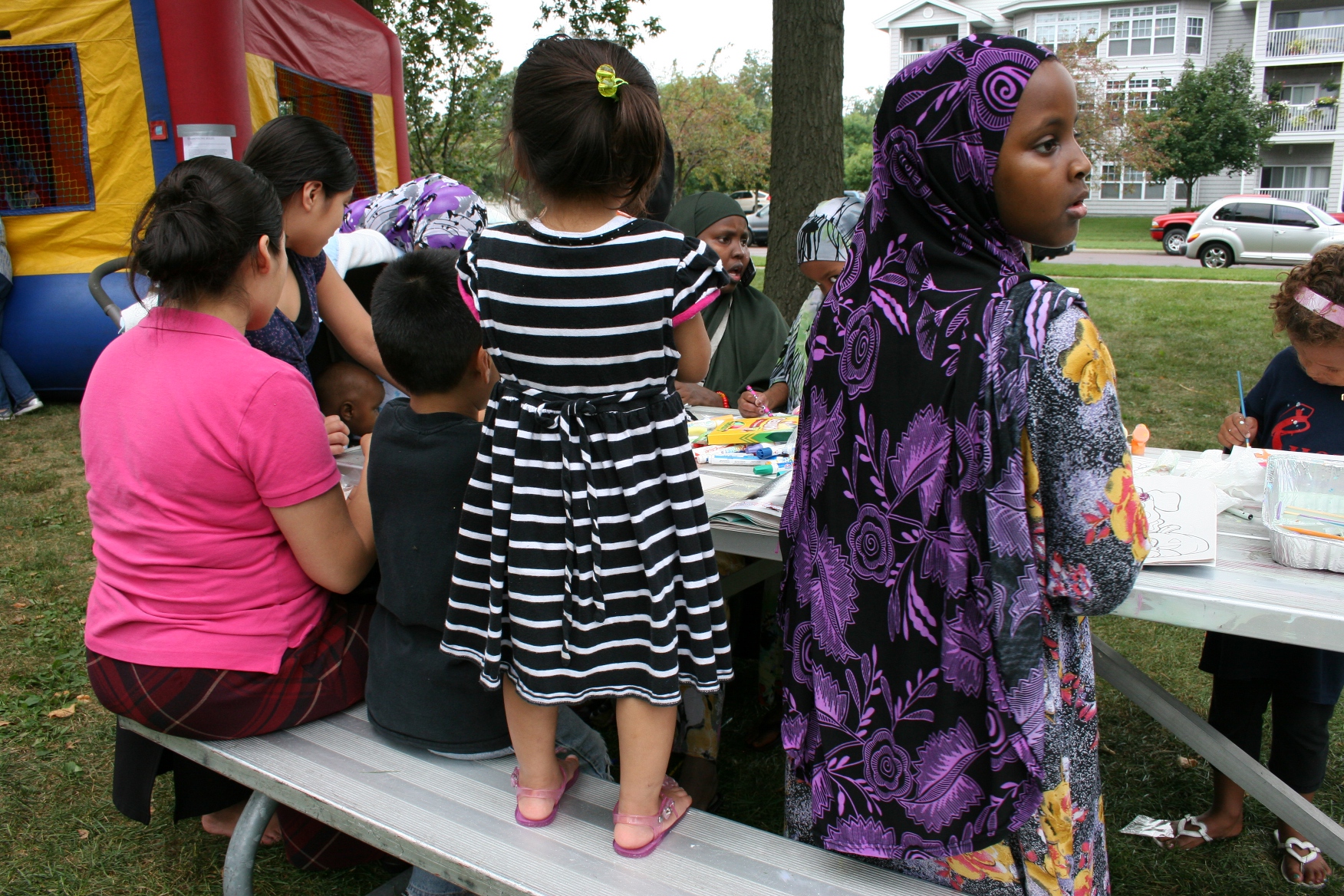
Kids painted and colored, etc., elbow to elbow at the always busy kids’ activity table.
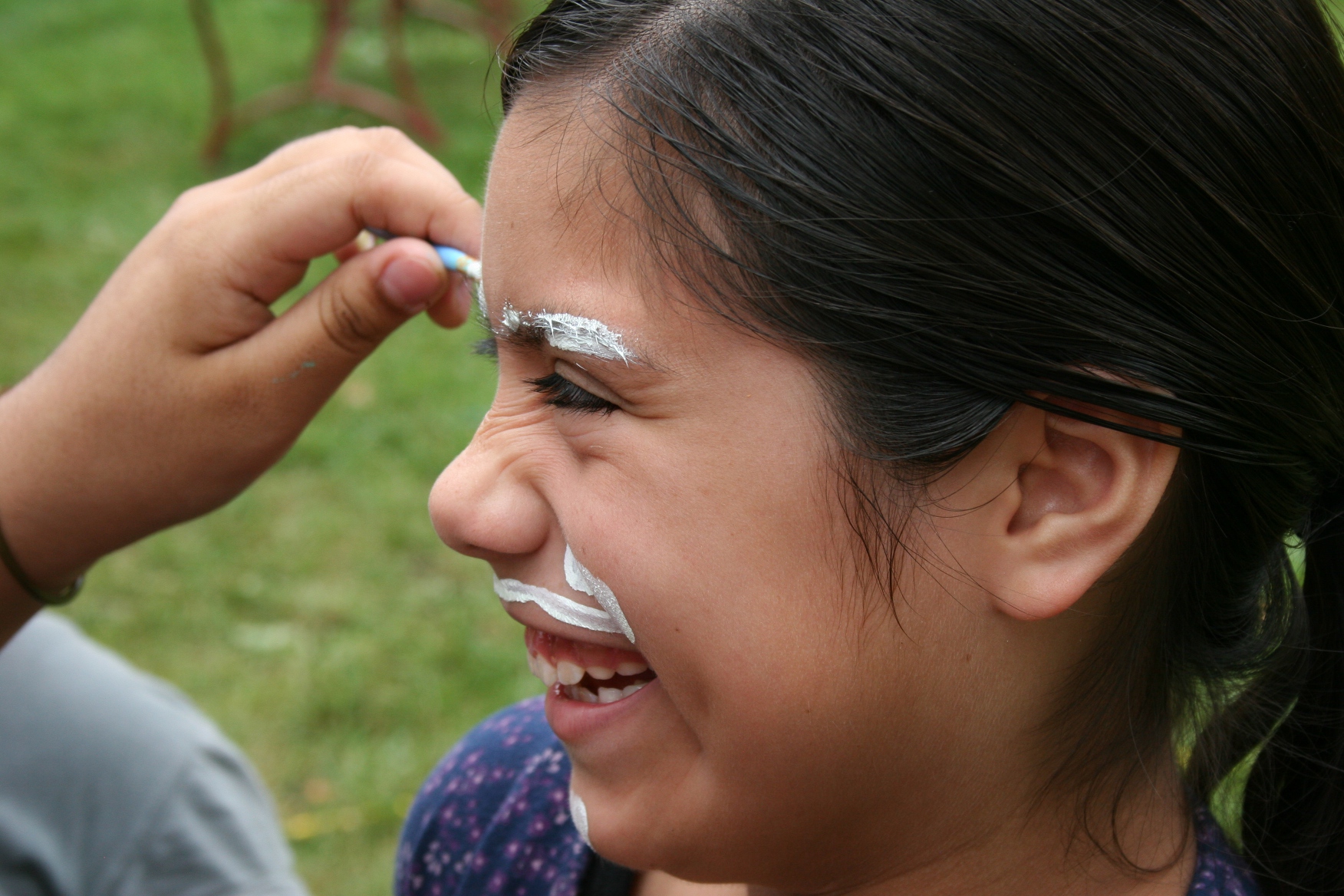
Some mischievous face painting was also part of the fun.

© Copyright 2012 Audrey Kletscher Helbling


Yearning for respect & equality, “no matter what color you are” August 26, 2012

I HAVE PHOTOGRAPHED them from a distance, their long skirts swaying as they walk across Central Park toward me.

Now the young women are standing before me and I am confused for a moment until Nasteho Farah tells me she wants to look her best and asks me to photograph them again.

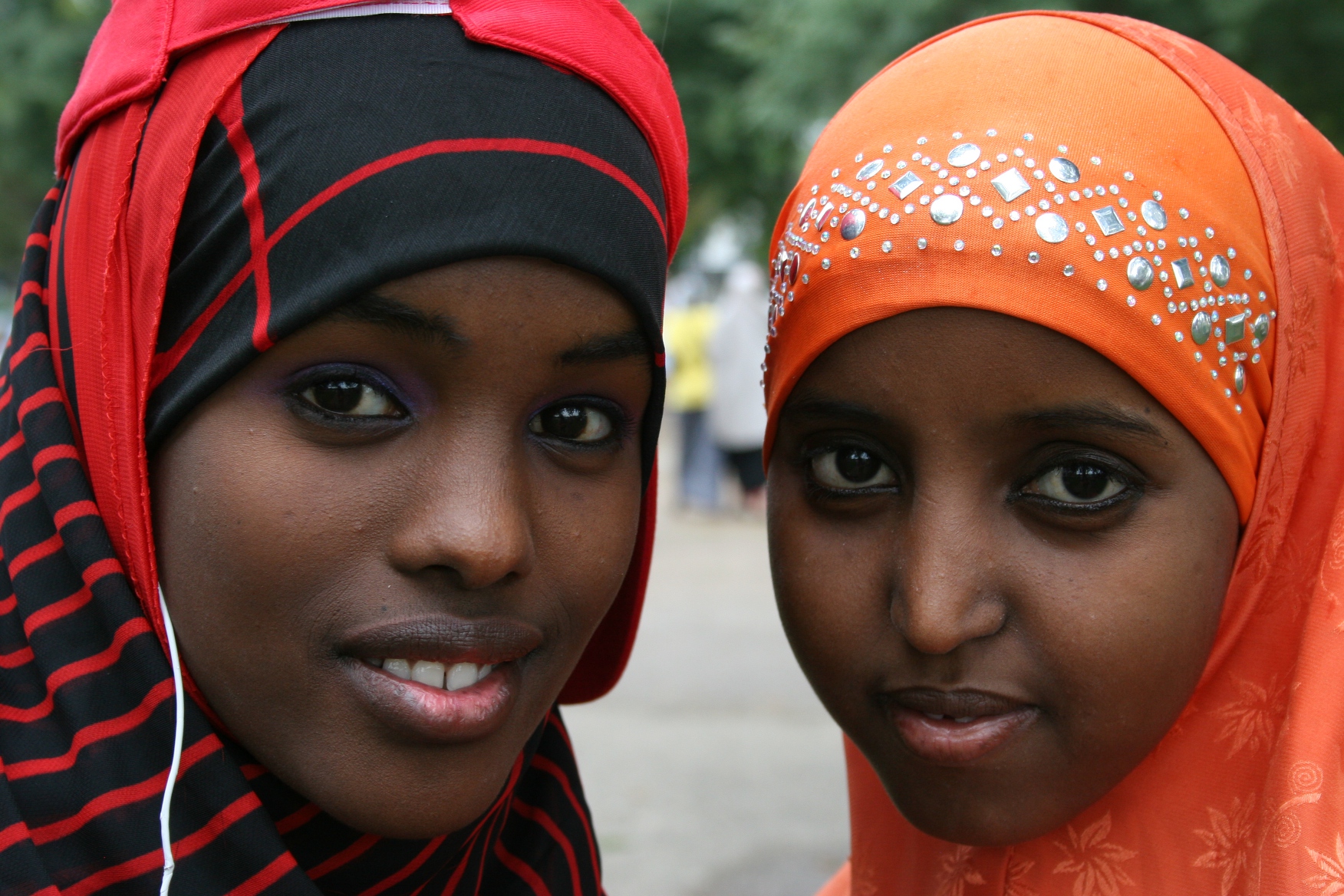
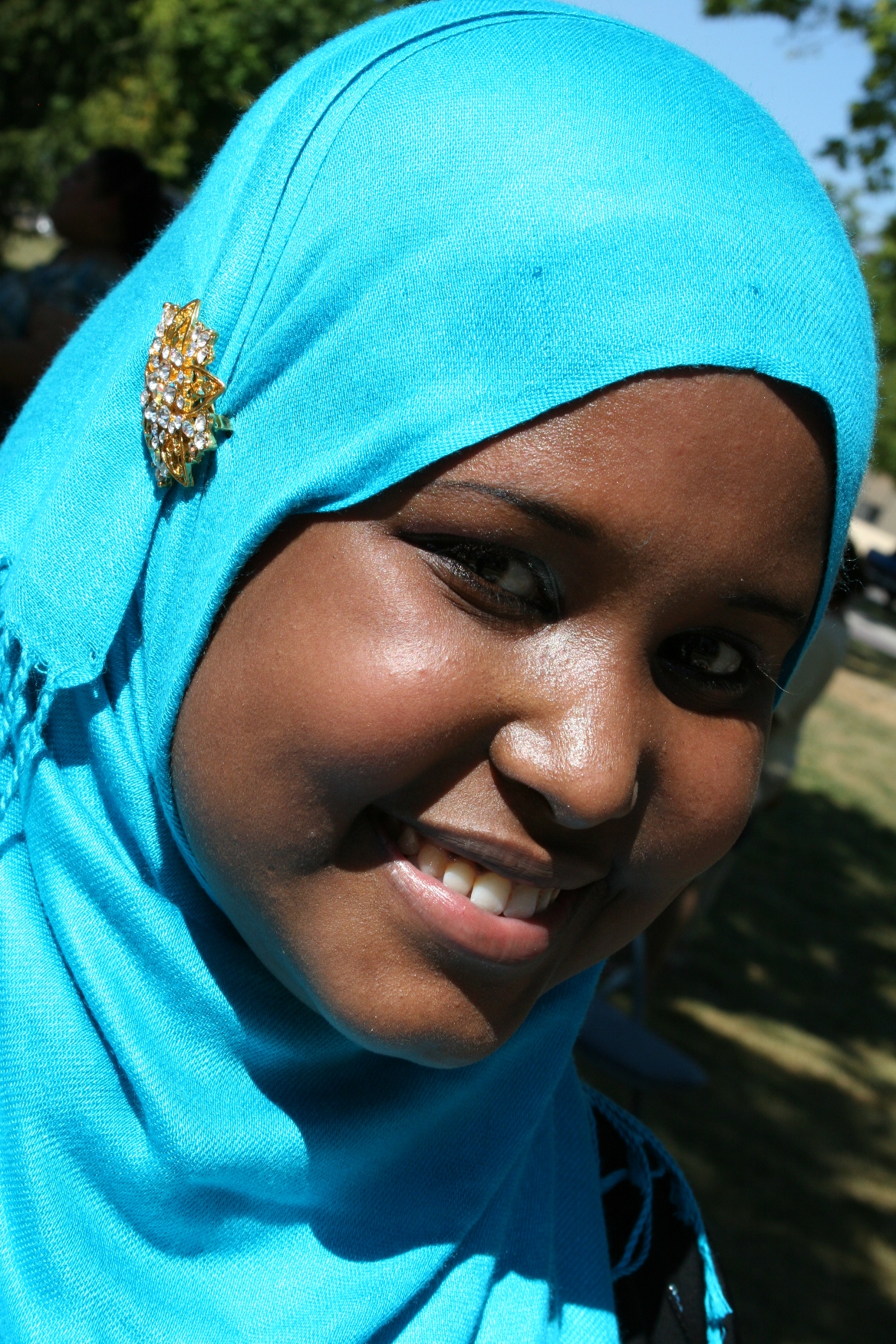
Friends, Nimo Abdi, a sophomore at Faribault High School, left, and Nasteho Farah, a senior.

I agree as I already envision the portrait possibilities—the expressive brown eyes, the warm skin tone, the way Nimo Abdi leans toward her friend, her hijab brushing Nasteho’s cheek. They are beautiful young women and I take only one shot, knowing I’ve captured a memorable portrait.

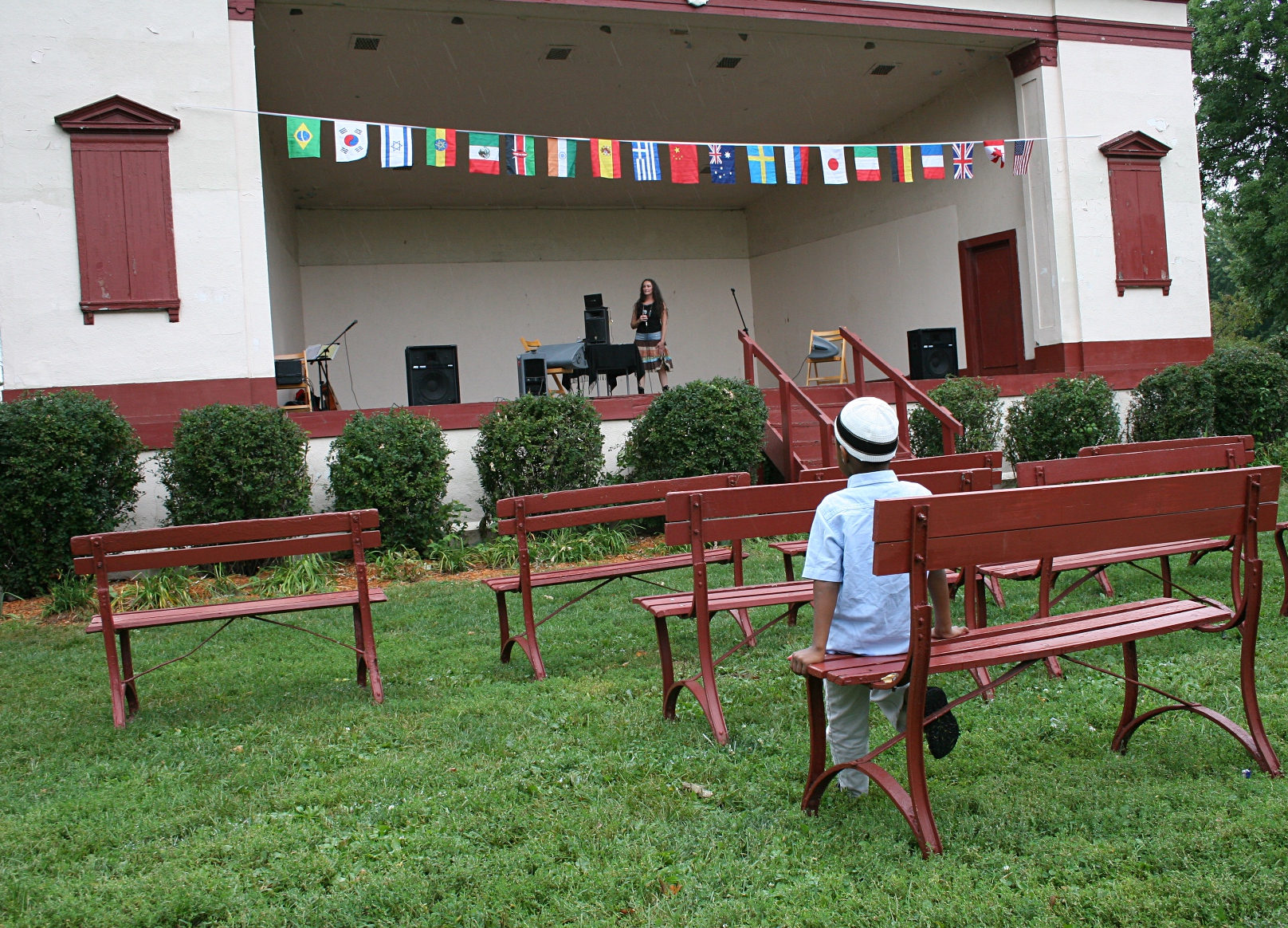
I love this image of  a fest performer and her single audience member for the message it portrays– the one on one connection that helps us understand one another, no matter our culture or skin color.

These Faribault High School students are among those participating in the International Festival Faribault on Saturday, an event designed to connect cultures through music, arts and crafts, kids’ activities, international cuisine, education and, on a personal level, conversation.

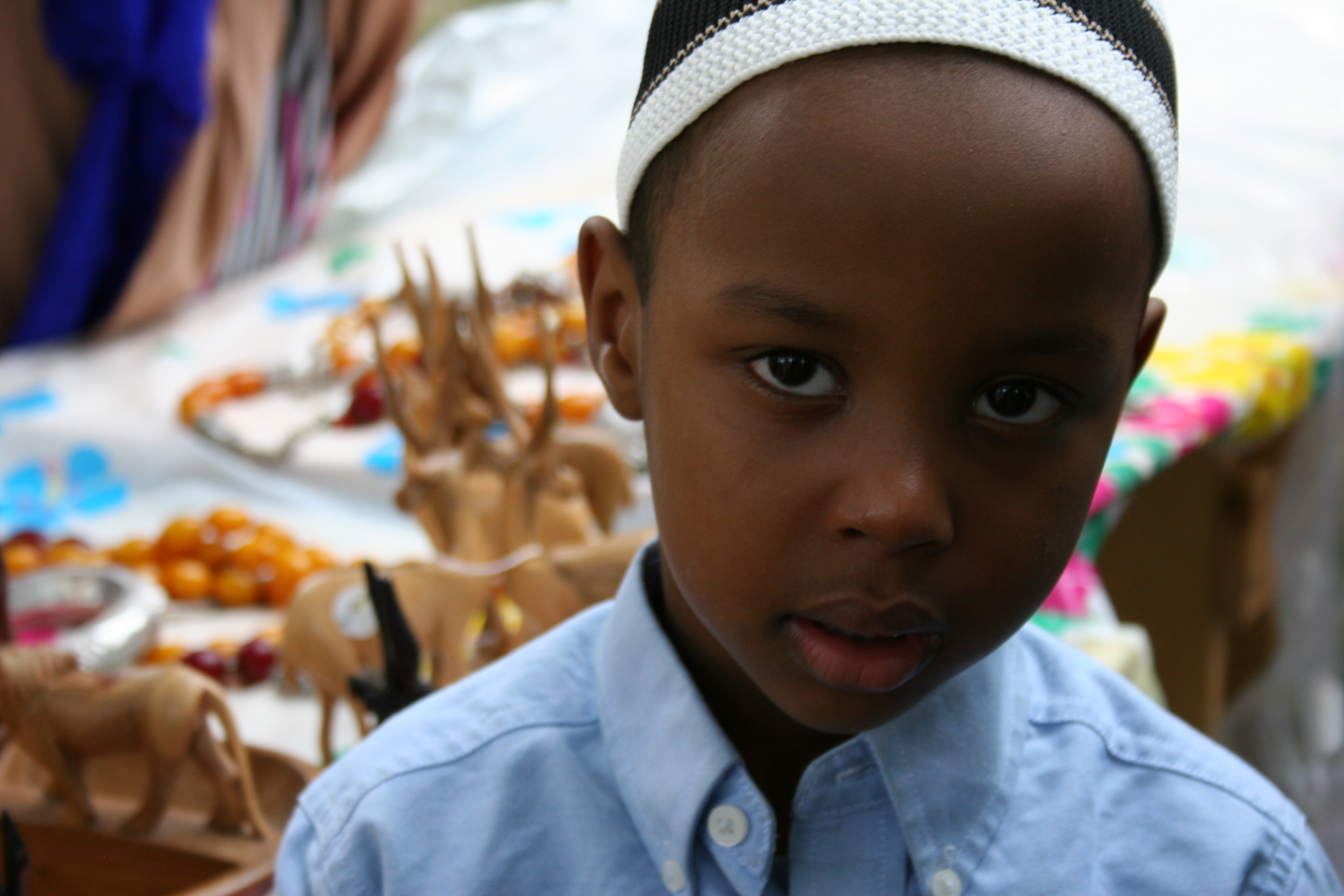
That same little boy who was so intently focused on the musician performing in the band shell.

After I photograph the friends, we talk about their experiences living in Faribault. And what Nasteho shares with me so upsets me that I apologize to her for the utter disrespect shown to her and her friend, who stands silently listening.

The native of Kenya, a Faribault resident for five years and prior to that a resident of Rochester, Owatonna and Waseca, says she is criticized for the scarf she wears, for her culture, for her…

“They assume I’m a terrorist.”

Her words temporarily stun me and I can feel my jaw drop.

She doesn’t define “they” specifically, but says the insults, the prejudice, happens randomly—in school, in the streets, even at work.

A group of young Somali dancers perform on the band shell stage during the festival.

When I ask for examples, Nasteho mentions the middle-aged man who comes through the drive-through at McDonalds in Faribault where she works. He tells her she should stop wearing her head scarf. She’s talked to her manager about it and he’s been supportive. For now, she mostly tries to ignore the customer’s spiteful comments.

When she walks into other businesses, like the grocery store, she feels the stares. When driving, she’s been flipped off.

“There is no respect for Somalis,” Nasteho assesses.

Yet, she doesn’t seem visibly angry, choosing instead to speak up or to take the position that those who choose to attack her or her culture do not know her or understand her.

I admire Nasteho’s positive attitude. She tells me she didn’t experience prejudice living in Rochester—a larger and more diverse community—but that it’s been much harder in a smaller town like Faribault. She was too young to remember what life was like in Owatonna or Waseca.

Faribault High School seniors Shukri Aden, left, and Khadra Muhumed.

Faribault High School students Shukri Aden and Khadra Muhumed, who are volunteering with STOPS, Students Together Offering Peer Support, at the International Festival, have also been subjected to hurtful comments from those who tell them to go back to their own country or that they smell.

“I try to talk to them,” says Shukri, who has lived in Faribault for seven years, since she came to the U.S. at age 12.

She wants everyone “to be equal no matter what color you are…to get to know each other.”

Lul Abdi shows off beautiful wood crafts from Kenya and Somalia for sale at the fest.

And this FHS senior has dreams—of going to college to become a nurse and then returning to Somali to help those in need.

On this Saturday, at this International Festival, the words of these young Somali women evoke mixed emotions within me. I am saddened by those in my community who fail to see beyond the scarves, the culture, the skin color, the language.

Mother and daughter check out the artwork from Kenya and Somalia.

These women are not terrorists. They are someone’s daughters. They are high school students. They live here, work here, shop here, worship here.

Despite the clear prejudice which angers me, I feel hope. These young women possess a maturity and poise beyond their teenage years. They yearn for understanding, for respect, for the personal connections that define them as individuals.

And on this Saturday afternoon they are trying, through their volunteerism at the International Festival Faribault, to, as Nasteho says, “bring everybody together.”

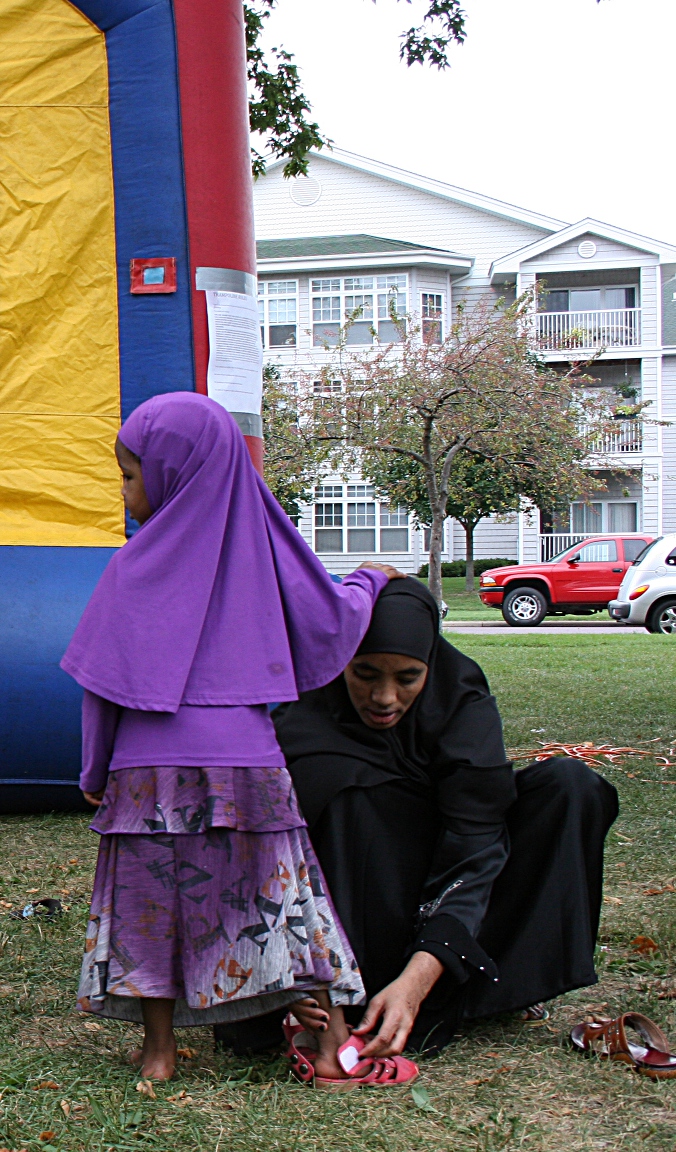
A mother’s love and care, the same in any language, any culture, any skin color.

CHECK BACK FOR A FUTURE post with photos from the seventh annual International Festival Faribault. Thank you to the organizers and participants in this festival who are trying to connect cultures, to make Faribault a better place to live, no matter your culture, skin color or country of origin.

© Copyright 2012 Audrey Kletscher Helbling


Faribault Festival offers opportunity to bridge differences & connect August 23, 2012

Filed under: Uncategorized — Audrey Kletscher Helbling @ 7:15 AM
Tags: , , , , , , , ,

TODAY I’D LIKE TO EXTEND an invitation to you. Pull out your calendars right now and add this event to your schedule: International Festival Faribault, 10 a.m. – 4 p.m. on Saturday, August 25, Central Park.

Several Latinos lead in singing of Mexico’s national anthem last September during the International Festival Faribault at Faribault’s Central Park. The flags strung across the band shell represent the countries featured at the fest. This weekend’s celebration marks the seventh such international fest in Faribault.

There. Done. Right?

The scramble for candy after the pinata is broken at last year’s festival. Kids of all races participated with no concern for skin color or cultural differences. So refreshing to see.

Served at the 2011 fest: Guatemalan chuchitos– chicken, corn and salsa wrapped in a corn husk. You’ll find vendors offering a variety of authentic international foods.

OK, why do I think it’s important for you to attend this festival which features multicultural entertainment, arts and crafts vendors, authentic international cuisine, kids’ activities, a silent auction and more?

Simple. We as a community need to meet each other, to connect on a personal level, to understand each other if we are ever to overcome the very obvious cultural differences which divide us.

I met then 16-year-old Riyaam, an Owatonna High School student, at last year’s festival. She spoke openly about the prejudice at OHS and a white student’s single comment, “Somalis don’t belong here,” which led to racial clashes and tension. OHS has since instituted a policy of “you fight, you’re out.” It broke my heart to listen to Riyaam.

You know what I’m talking about, the differences in skin color and language, in culture and in dress.

There’s way too much suspicion and mistrust, cautiousness and prejudice toward the minorities living and working in Faribault. I’ve heard the derogatory comments about the Somali men who hang out on downtown street corners, the Hispanics who commit all the crimes, the immigrants who take away our jobs, the people who don’t speak English.

Seriously, these Somali men live downtown and the sidewalk is their yard.

“Mexicans,” and I’ve heard that word spit out of too many mean mouths, do not commit all the crimes in our community. Do you know any Hispanics personally? I do. They are probably the most family-oriented individuals I’ve ever met and we could learn a lot from them about the importance they place on loving and caring for one another.

And about those Somalis and/or Sudanese who supposedly steal our jobs—I expect most of us would not want to work the factory jobs they work. I mean no offense to the places which employ them, like the local turkey plant. But if we are honest with ourselves, we’ll admit that we likely never would work at these physically-demanding and not always pleasant jobs.

As for speaking English, have you, as an adult, tried learning a new language? Now attempt learning a new language in a foreign country. Not so easy. Think back to a few generations before you. I bet your great grandparents didn’t speak English. Even my own mother’s first language was German, not English.

The other evening while shopping at a local Big Box retailer, I witnessed how difficult it was for a Hispanic woman to communicate due to her limited English. I almost got on my cell phone to call my second daughter who works as a Spanish medical interpreter in eastern Wisconsin to ask her to interpret.

Did you know that, according to the 2010 U.S. Census, 17.4 percent of Faribault’s 23,352 residents have a language other than English spoken at home? Stats show 9.4 percent of our city’s residents are foreign-born.

Vendors, like Riyaam, peddled their wares at the 2011 festival.

Instead of criticizing those who speak and dress and live differently than the majority of us, let’s begin to understand them. Mostly, I think, our misconceptions, our prejudices, are based on fear. We fear what we don’t understand.

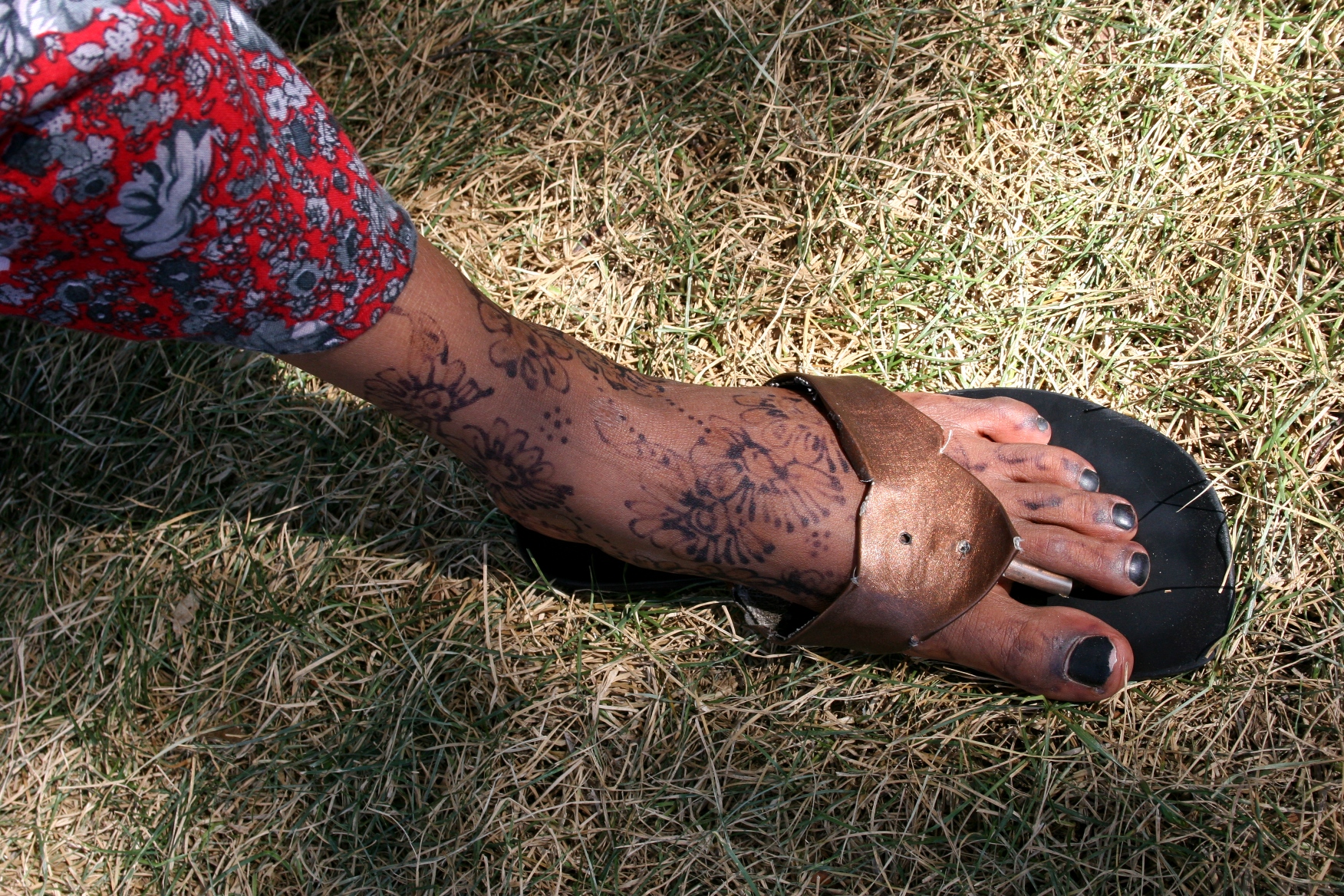
A young girl’s henna stained foot, photographed at the 2011 fest.

International Festival Faribault offers a common, public ground—a city park—on which to meet the minority individuals who call our community home. They are here to stay. Let’s get to know them. Engage in conversation. Show them you care, that you’re genuinely interested in learning more about them and their cultures. Once you’ve connected on a personal level, you will begin to view them as individuals and not by the color of their skin, the clothing they wear, the language they speak…

Xafsa, age 5, photographed at the 2011 festival.

FYI: Click here to link to the International Festival Faribault website.

While this post is directed specifically at the residents of my community, its content can apply to many communities. You’re all invited to Faribault for International Festival Faribault, no matter your community or country of origin. And just to be clear, many Faribault residents and organizations embrace the minorities who call our southeastern Minnesota city home. I in no way intend to mislead you into thinking we are all a bunch of bigots living here. However, neither am I going to hide the fact that obvious prejudices exist and are very much a concern in Faribault.

Click here to link to the post I wrote about last year’s International Festival Faribault.

© Copyright 2012 Audrey Kletscher Helbling
 

Join efforts to connect neighbors in a celebration of cultural diversity July 14, 2012

Several Latinos lead in singing of Mexico’s national anthem last September during the International Festival Faribault at Faribault’s Central Park.

ORGANIZERS OF THE SEVENTH ANNUAL international festival celebrating the cultural diversity of Faribault are looking for participants, help and donations for the Saturday, August 25 event.

Can you help?

And when I say “you,” I mean anyone, whether you live in or near Faribault or not.

Served at the 2011 fest: Guatemalan chuchitos– chicken, corn and salsa wrapped in a corn husk.

Drive on down from the Cities; we’re only an hour from downtown Minneapolis. Or drive across town to set up a booth showcasing your culture at International Festival Faribault. Sell ethnic cuisine. Pedal your ethnic arts and crafts or other merchandise. Show and tell and educate the public about your culture in this event pegged as “neighbor meeting neighbor.”

I like that neighborly phrase, for it is when we meet face-to-face and engage in conversation and sample each others food and learn each others customs that the cultural barriers begin to fall and friendships (or at least understanding) form.

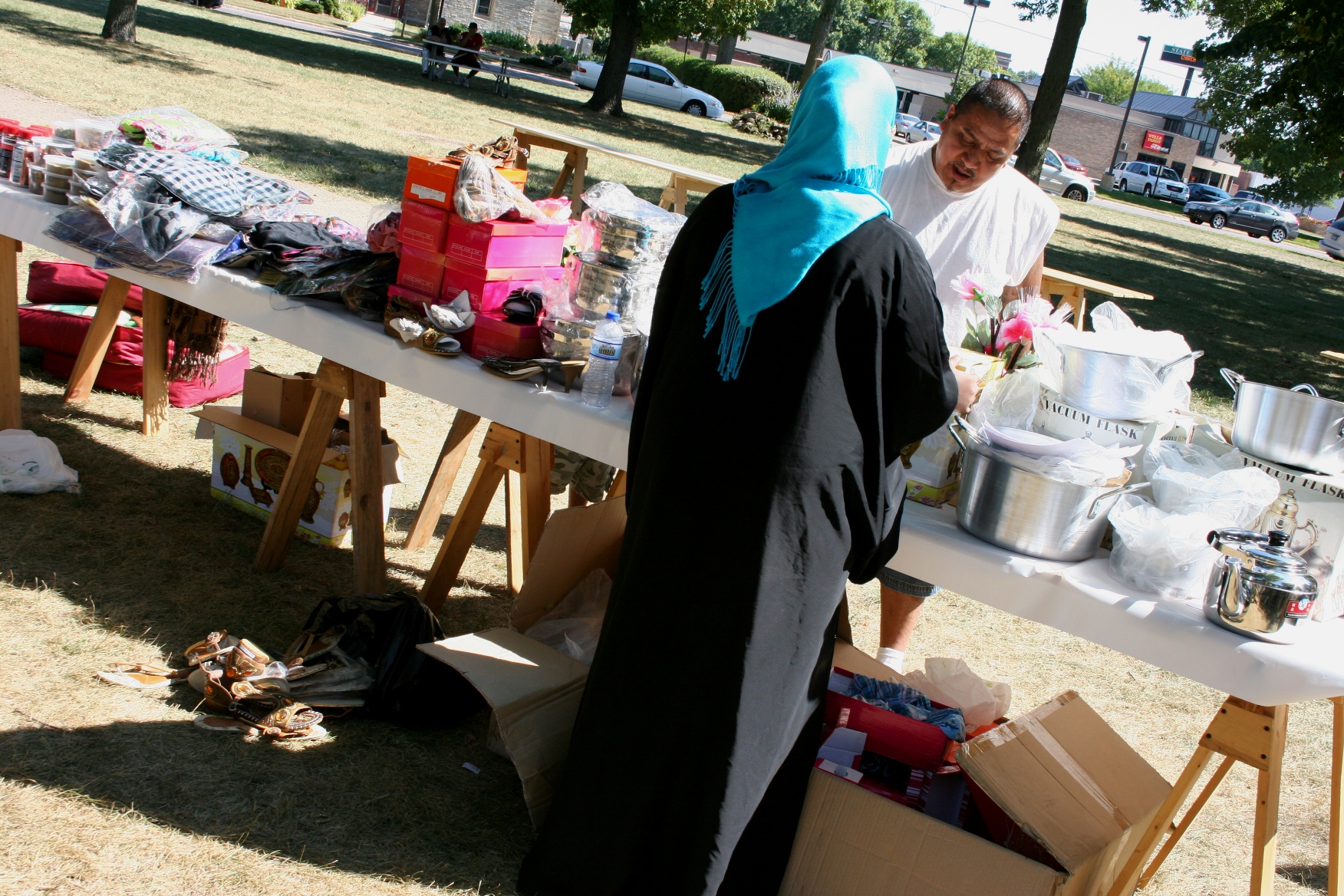
Vendors, like this Somali woman, peddled their wares at the 2011 festival.

Table and booth space at the 10 a.m. – 4 p.m. festival are currently available to the public for a $20 fee. But get this: You keep all profits earned. Non-profit organizations get free space.

Now if that isn’t enough incentive to book a spot in Faribault’s Central Park for the day, consider how you will help advance the mission of the non-profit International Festival Faribault. Here’s the organization’s mission:

…to promote understanding between diverse cultures within Faribault, MN; uniting the community with music, dance, ethnic foods and merchandise which is experienced at a once a year festival organized by the committee.

Hoop maker, performer and teacher Adrienne Lee teaches a Girl Scout the art of hoop dancing. The Girl Scouts were among the non-profit groups with booths at the 2011 fest.

Already, Spanish and Somali singers, a local dance academy and several small bands have committed to providing on-stage entertainment. A hula hooper and jugglers are signed on to wander through the crowd.

The scramble for candy after the pinata is broken at last year’s festival.

What can you contribute? Dancing, singing or other musical entertainment from your culture? On-site ethnic art/crafts demonstrations? Are you willing to sing your country’s National Anthem on the Central Park Bandshell stage? How about presenting a mini drama or storytelling focused on your ethnicity? Can you plan and lead ethnic activities for kids?

The group also needs volunteers to assist with set-up and clean-up, help throughout the day, etc.

Monetary and silent auction donations are also needed. Do you have a tent and/or tables the group can borrow? Can you help with banners or flyers? Donate food items?

Yes, the list of needs is lengthy. But remember the “neighbor” part of this festival? Neighbors help neighbors.

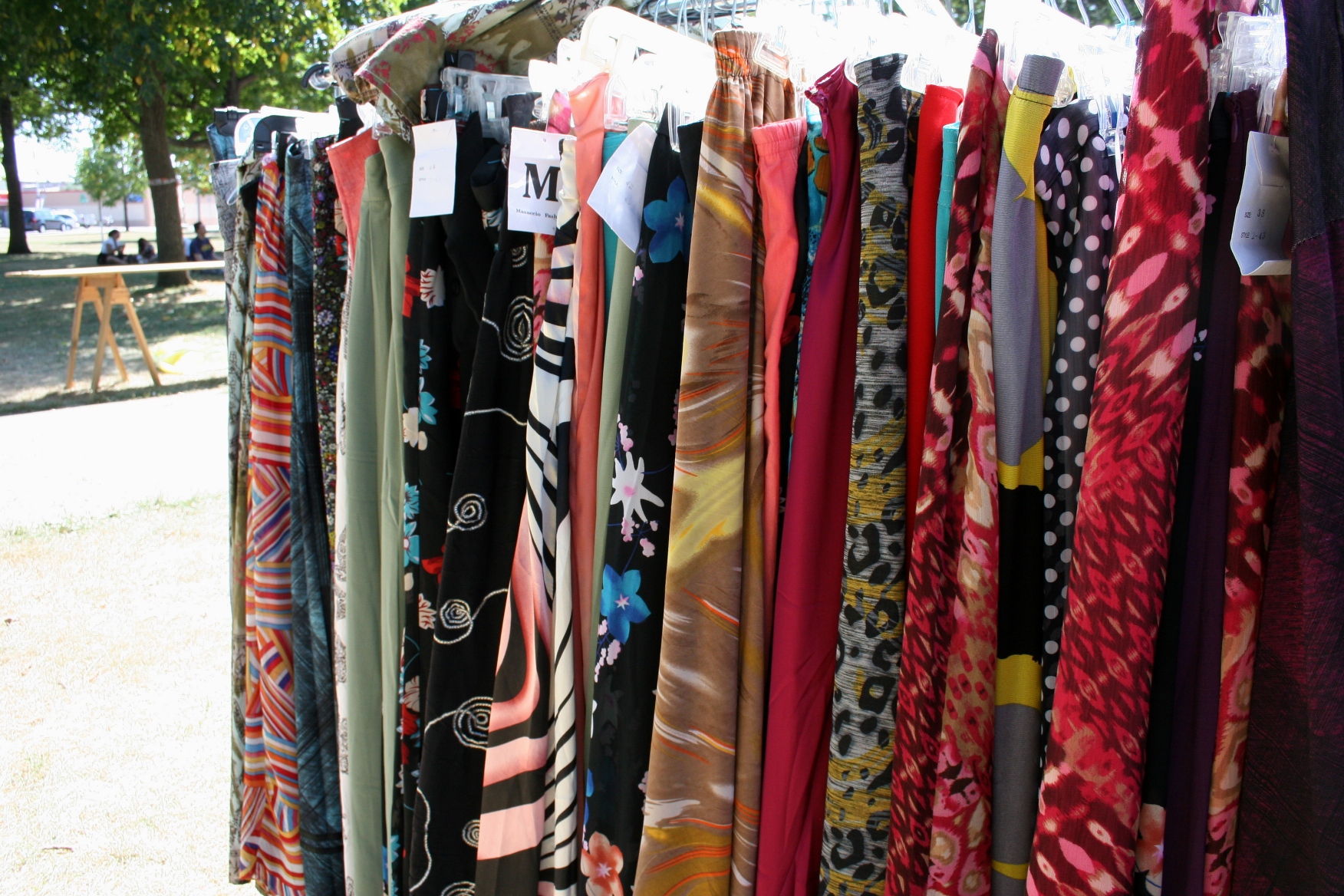
Colorful skirts for sale at Riyaam’s booth during the 2011 celebration.

If you are interested in participating, contributing or helping in any way, email internationalfestivalfaribault@gmail.com or call (507) 412-9139. You must complete an application form and submit the $20 payment in advance to reserve a booth/table space.

Also, click here to visit the festival website at http://internationalfestivalfaribault.blogspot.com.

Finally, even if you’re unable to participate or donate, mark your calendar for 10 a.m. – 4 p.m., Saturday, August 25, for the International Festival Faribault. Admission is free and I promise, you’ll come one step closer to understanding your neighbors.

A young girl’s henna stained foot, photographed at the 2011 fest..

© Copyright 2012 Audrey Kletscher Helbling