
 PICKING UP MINNESOTA WRITER Rachael Hanel’s We’ll Be the Last Ones to Let You Down—Memoir of a Gravedigger’s Daughter, I wonder how I can possibly relate to a book focused on death.
But I can, in many ways. I am, like Hanel, a native southern Minnesotan. That is telling. We are a people who tend to keep our emotions in check, even in grief.
Hanel’s association with death begins before age three, when her father, Paul Hager, becomes a gravedigger. Hanel grew up frequenting 20 Waseca area cemeteries under her family’s care. Their business motto, “We’ll be the last ones to let you down,” seems the perfect title for a memoir that is at times light-hearted, but mostly serious.
Imagine summers in a cemetery, flitting among gravestones or reading books while your father digs holes to receive the dead and your mom mows lawn. And imagine the day you understand that names, dates and words on tombstones reveal stories. I expect we all experience that epiphany at some point during our childhoods, realizing the numbers and letters on cold stone represent lives lived. But the daughter of the gravedigger wants more, asking her storytelling mother to share the stories of the deceased.
Hanel cites numerous examples of tragedies in the Waseca area—the September 11, 1959, deaths of seven members of the Zimmerman family whose car was struck by a train and the deaths of Busy Bee Cafe waitress Cheryl Tutttle and her young daughter—in sharing the graveyard stories which existed as a natural part of her childhood.
About two-thirds of the way into her 192-page memoir, Hanel writes:
My family went to wakes like some families went to movies.
Despite that familiarity with death, Hanel and her family find themselves reeling at the unexpected loss of her father to cancer when she is only 15. They know death, but not grief. Therein lies a major component of Hanel’s memoir in her personal struggles with grief and the fracturing of her family upon her father’s death.
This then-teen, who always leaned to the artistic—appreciating art in her childhood home, art in cemeteries, art in the rural Minnesota landscape—turns to words for solace. She seeks books that will tell her how to connect to her dead father. She tames her grief, she says, “by writing words on the page.”
Hanel also relies on her strong Catholic faith. Praying the rosary is her constancy.
Ironically, several years later, after she has married at the young age of 19, Hanel starts a job writing obituaries at the Mankato Free Press. It is the same newspaper where I worked as a news reporter, but never as an obit writer (although I did report on tragic deaths), for nearly two years, long before Hanel’s arrival. Eventually she, too, becomes a reporter there.
It is not that professional commonality, though, or Hanel’s general love of writing or her faith that cause me to feel most connected to this reporter turned author. Rather it is her understanding of small-town Minnesota. And her appreciation for the land. Hanel writes of biking near Elysian as farmers work the fields, upturning the earth for planting.
This gravedigger’s daughter writes:
I breathe in the freshly turned soil and that is all I want to breathe, night and day.
That I understand, from the perspective of a farmer’s, not a gravedigger’s, daughter.
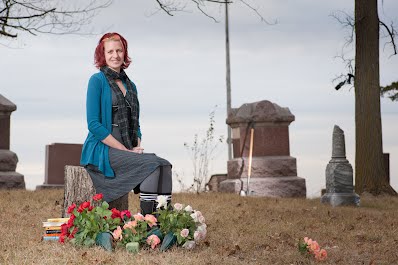
Minnesota author Rachael Hanel. Photo by Steve Pottenger.
© Copyright 2013 Audrey Kletscher Helbling


 Minnesota Prairie Roots
Recent Comments