Minnesota Prairie Roots

Writing and photography by Audrey Kletscher Helbling

Chief Taopi: Man of peace, community leader & more April 21, 2025

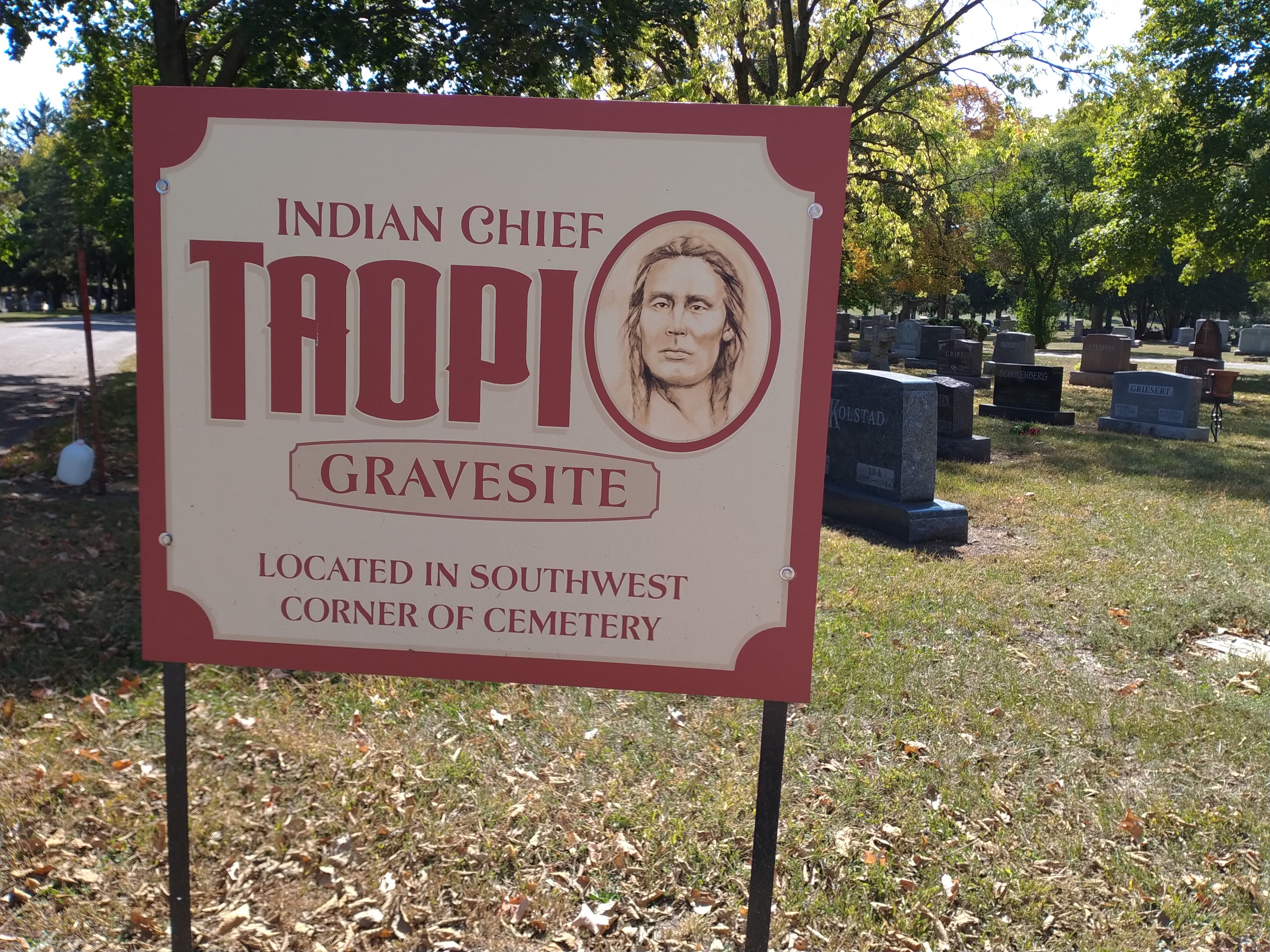
Prominent signage at Maple Lawn Cemetery directs visitors to the gravesite of Chief Taopi, “Wounded Man.” He was wounded in a battle with the Ojibwe. (Minnesota Prairie Roots copyrighted file photo)

HE FOUND HIMSELF AT ODDS with his own people. A “Farmer Indian” among “Blanket Indians.” A peace promoter among those who favored war. He was Chief Taopi, a member of the Little Crow Band of the Mdewakanton Dakota. He’s buried in Faribault, at Maple Lawn Cemetery.
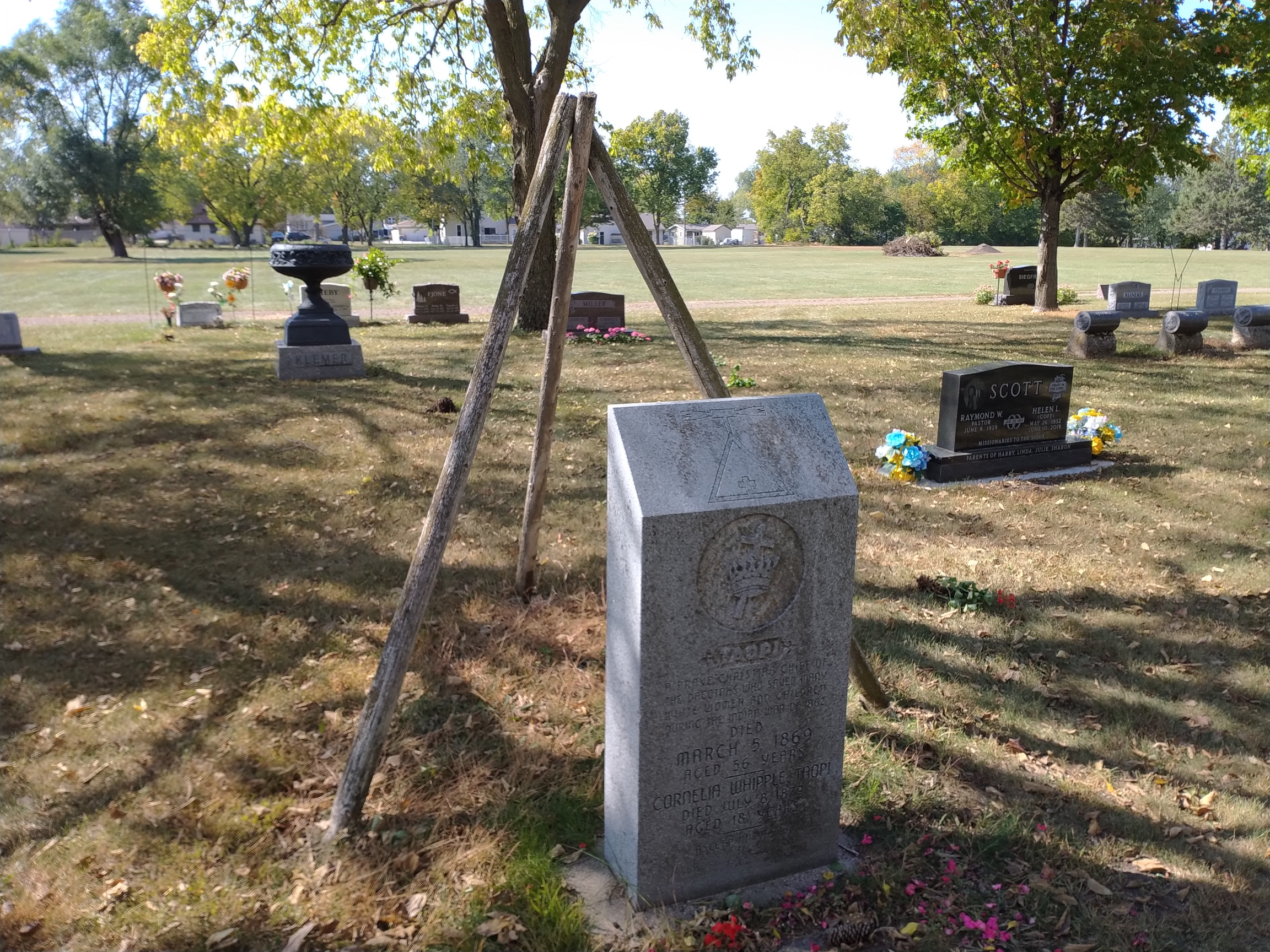
A tipi formation easily identifies the burial site of Taopi and his daughter, Cornelia Whipple Taopi. She died at age 18. He died at 56. (Minnesota Prairie Roots copyrighted file photo)

Recently, I attended a presentation about Taopi by Rice County Historical Society Executive Director Dave Nichols. It’s not the first time I’ve listened to local talks on the history of Native Americans in Minnesota, focused on those who called Faribault home. Each time I learn something new.
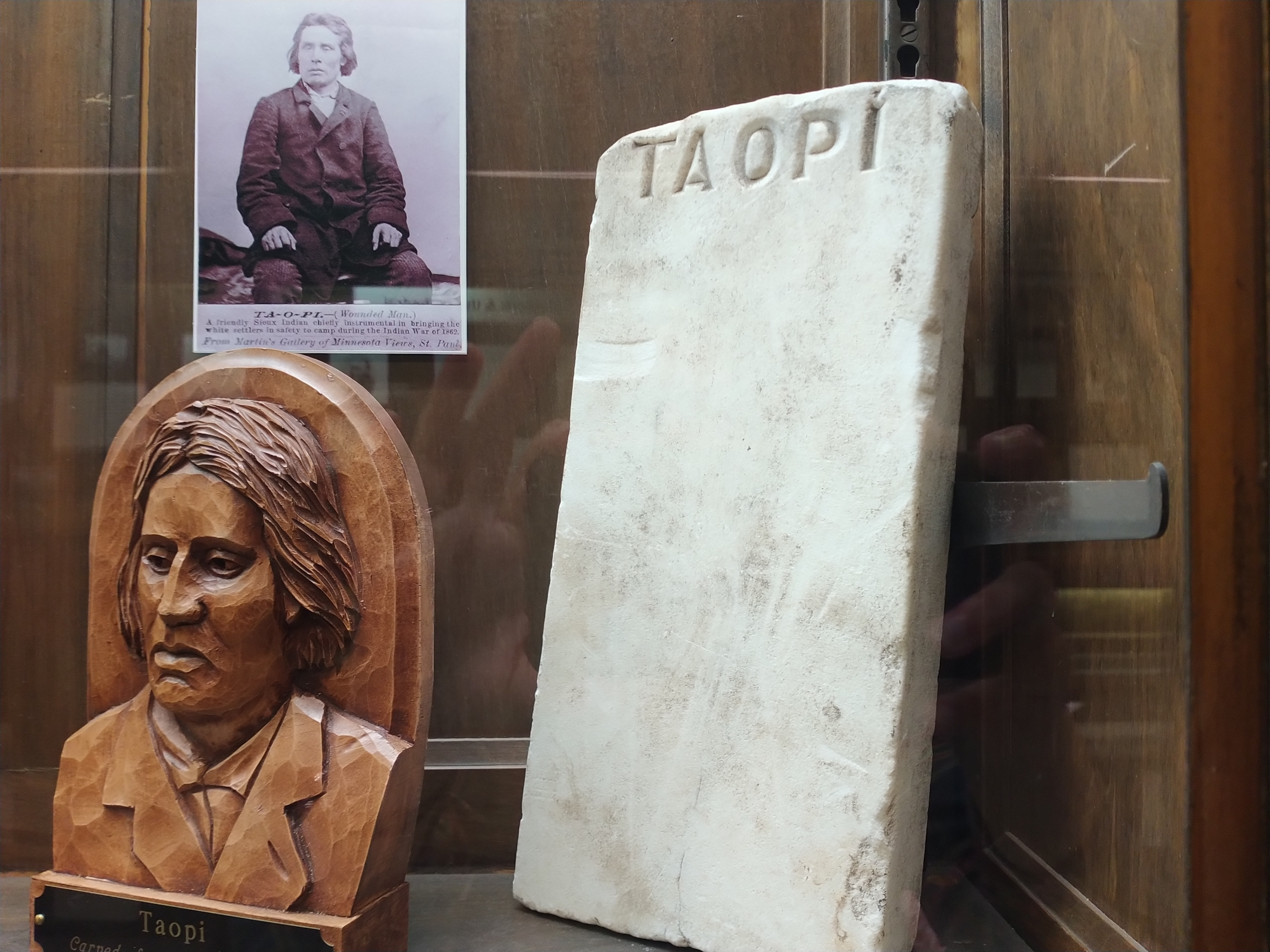
A Taopi exhibit at the Rice County Historical Society. The carving (by Ivan Whillock) and photo show Taopi with short hair as a “Farmer Indian.” (Minnesota Prairie Roots copyrighted file photo)

During his talk, Nichols called Taopi “a poster child for what an assimilated Dakota looks like.” And he didn’t mean that in a negative way. “You either assimilated or you would be destroyed,” Nichols said, qualifying that he wasn’t saying assimilation was right. Understood.

As settlers moved into Minnesota, pushing onto Native lands, the Dakota found themselves facing many challenges. Some, like Taopi, gave up their culture and adopted European ways, believing that was the only way to survive. That included learning to farm as the White man farmed. Taopi was considered the leader of the “Farmer Indians,” a term assigned during the U.S. Census. Dakota who continued in traditional cultural ways were labeled “Blanket Indians.”
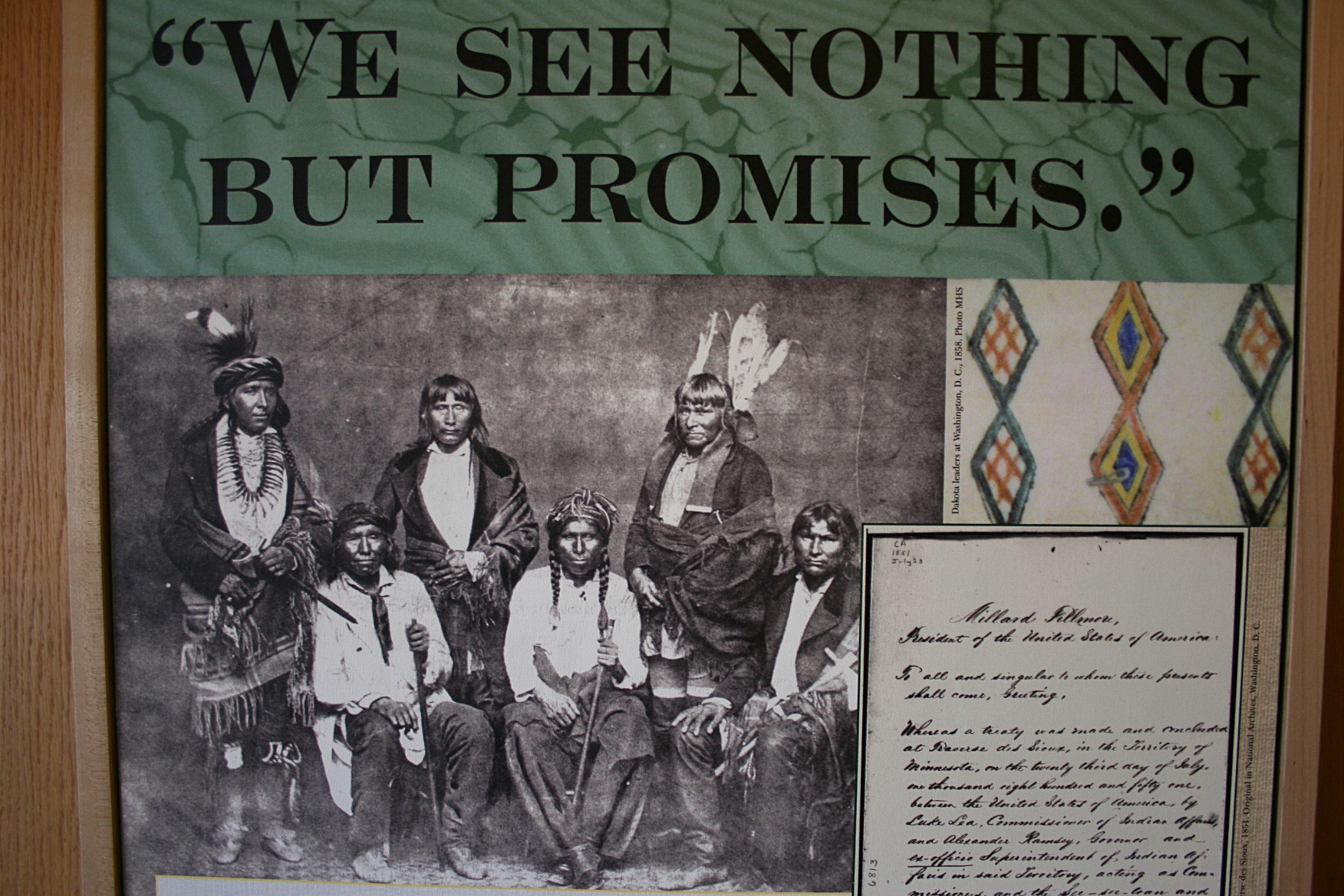
A photo panel at the Traverse des Sioux Treaty Center in St. Peter shows Dakota leaders photographed in Washington D.C. in 1858. The photo is from the Minnesota Historical Society. The war followed broken treaties. (Minnesota Prairie Roots copyrighted file photo)

Taopi farmed and established a school and mission, Hazelwood Republic, with chiefs Wabasha and Good Thunder on the Lower Sioux Reservation along the Minnesota River in southwestern Minnesota, Nichols shared. Because I grew up in that region, I’ve always been particularly interested in the Indigenous Peoples who were original inhabitants of the land, including Redwood and Brown counties. The region became the epicenter of the U.S.-Dakota War of 1862, which centered around issues of land, hunger and broken promises.
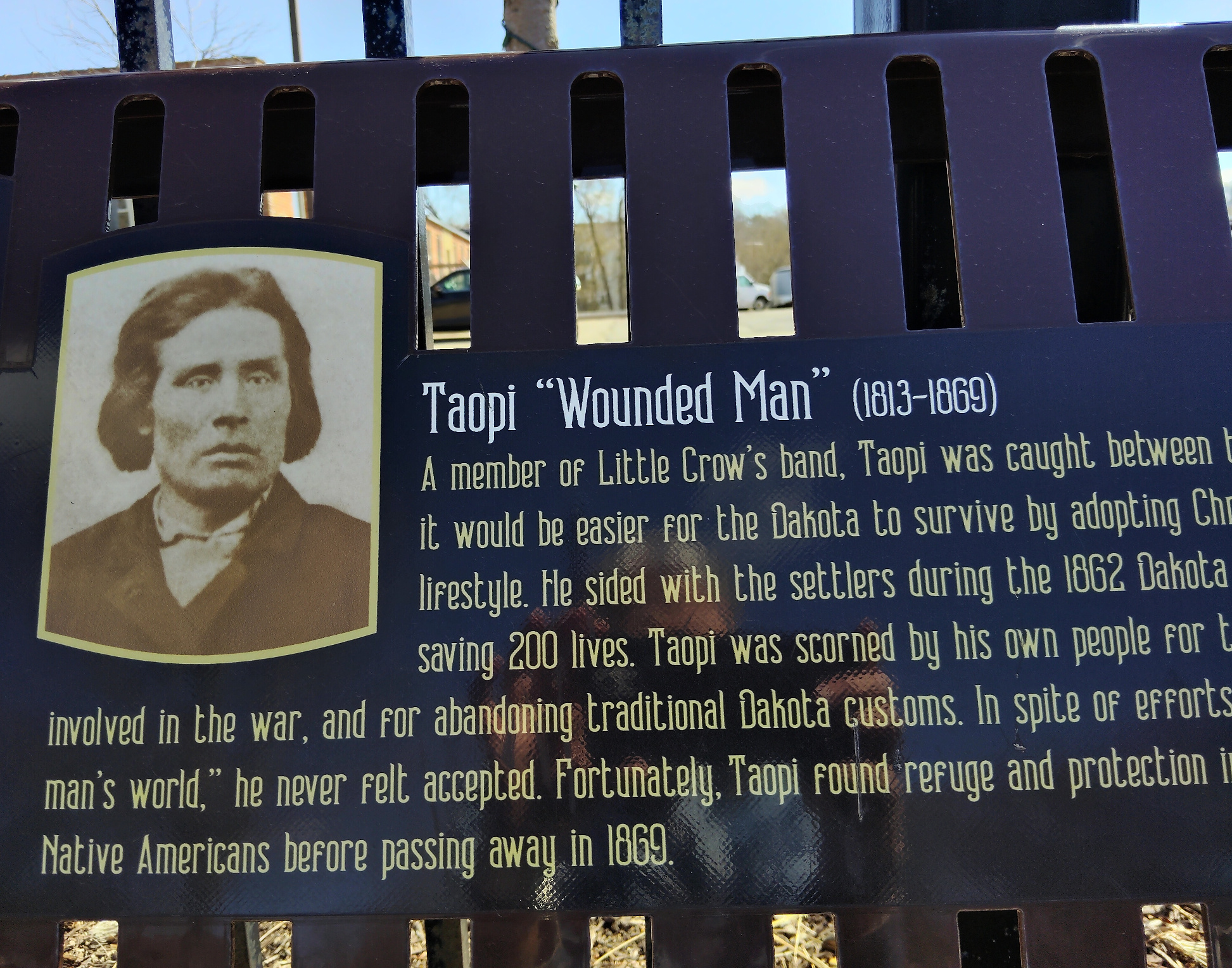
An historic-themed bench on the corner of Central Avenue and Sixth Street in Faribault highlights Taopi. (Minnesota Prairie Roots copyrighted photo April 2025)

That war facilitated the banishment of most Native Americans from Minnesota. If Taopi and other Dakota would have had their way, that war may not have happened. He led the Peace Party opposed to war, while his cousin, Little Crow, led the War Party, Nichols said. Taopi protected White settlers during the short war which claimed countless lives on both sides.
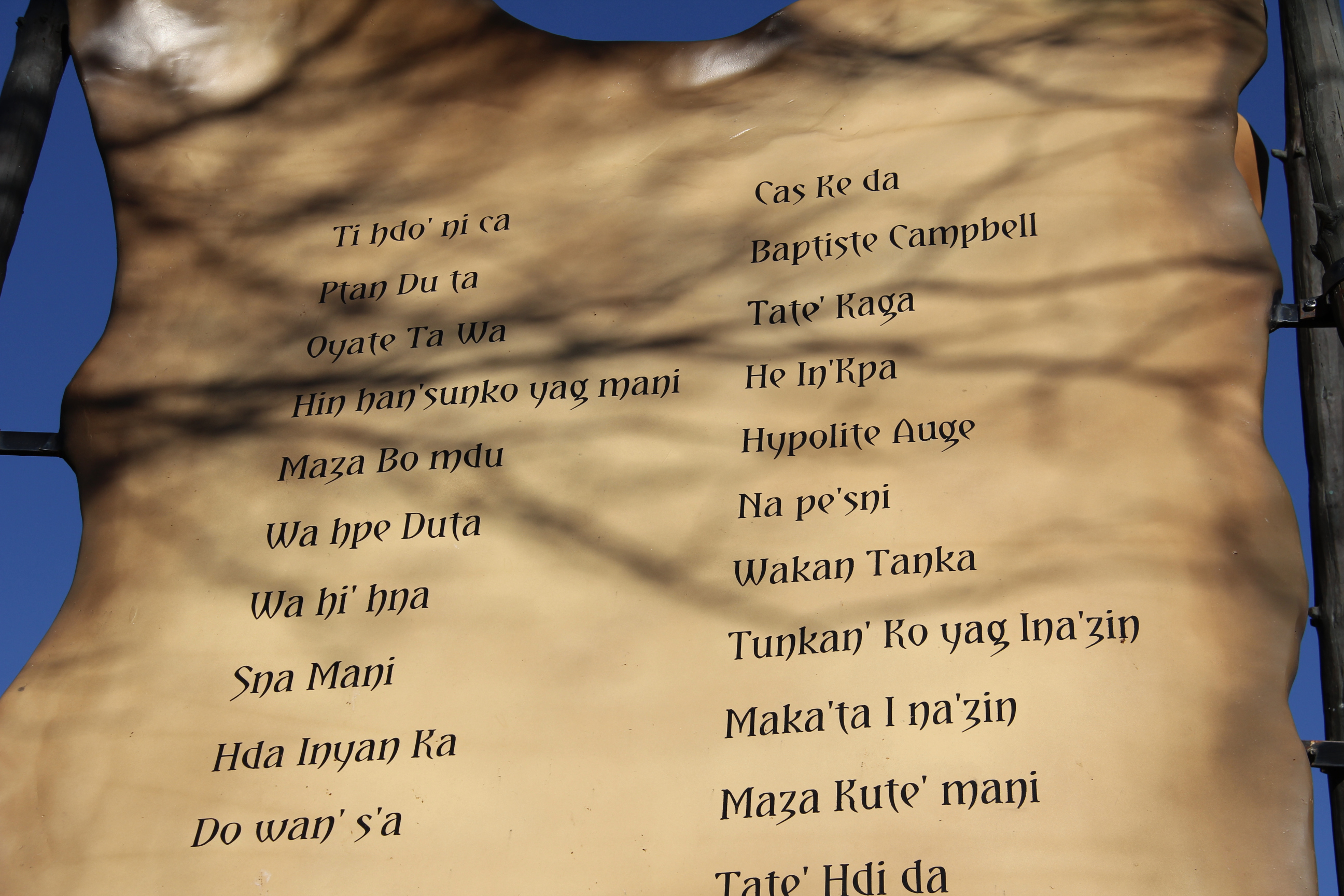
The names of the Dakota who were hung are listed at Reconciliation Park in Mankato. (Minnesota Prairie Roots copyrighted file photo)

Post-war, though, it mattered not to the U.S. government whether you were a Dakota person who opposed the war or who engaged in war, according to Nichols. All were considered guilty, imprisoned and eventually exiled from Minnesota (although not the Mdewakanton). Thirty-eight Dakota men were hung on December 26, 1862, in Mankato (40 miles from my community) during the largest mass execution ever in the U.S. It’s truly a tragic event in Minnesota history. But what multiples the awfulness is that 1,600 Dakota prisoners were marched to Mankato to watch the hangings before being marched back to Fort Snelling. That was new information I had not previously heard and it troubles me greatly.
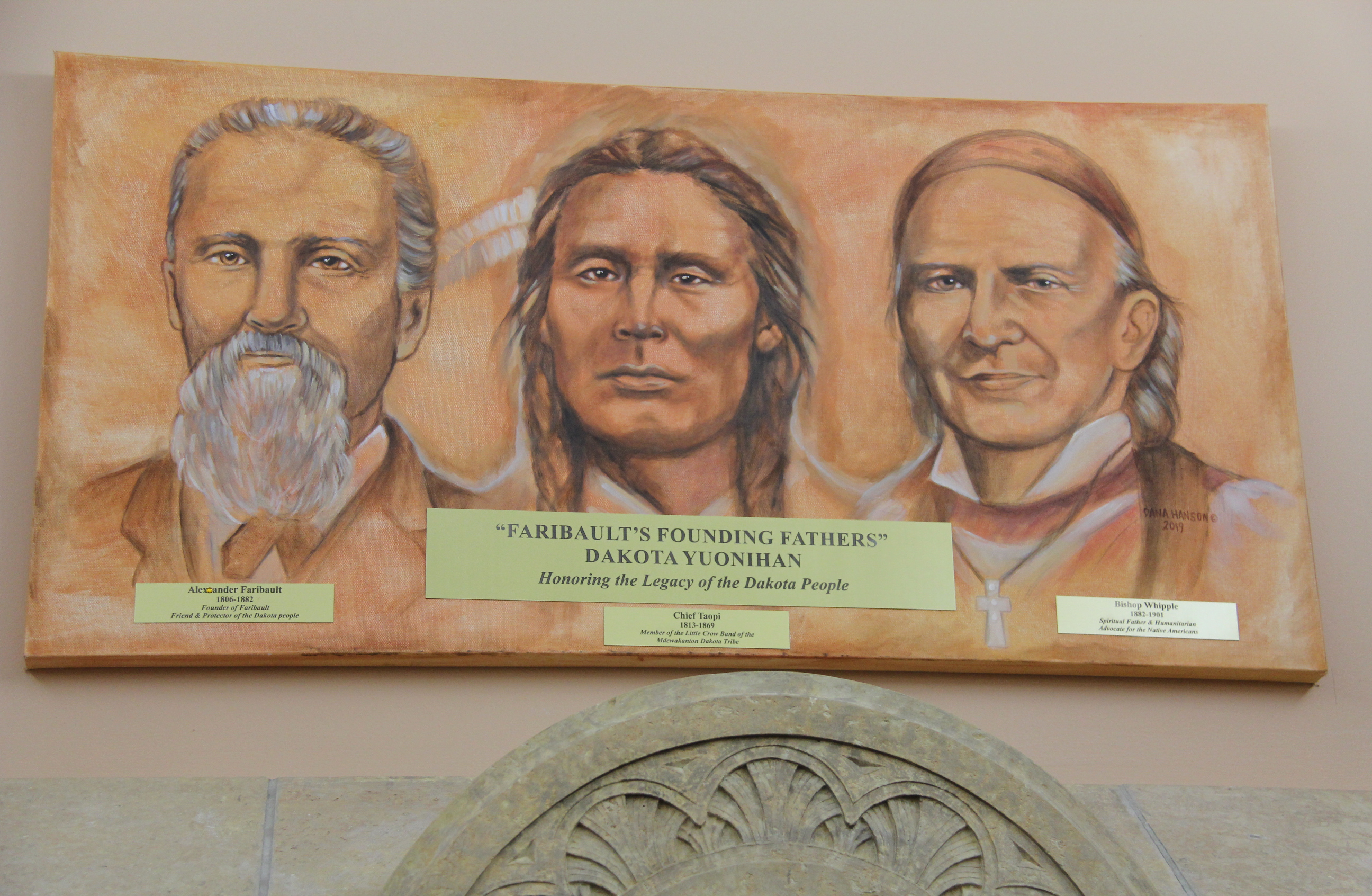
These portraits by Dana Hanson of Faribault’s Founding Fathers, Alexander Faribault (left to right), Taopi and Bishop Henry Whipple, hang in Buckham Memorial Library. (Minnesota Prairie Roots copyrighted file photo)

Taopi avoided prosecution and banishment, eventually landing in Faribault with 180 other Mdewakanton. About 80 were family members, according to Nichols. It was his friendship with Bishop Henry Whipple, who had long worked with and advocated for Native Peoples, that brought Taopi here. Town founder Alexander Faribault housed “the Peacefuls,” as the 180 were considered, on his land. They lived in tipis and lodges.
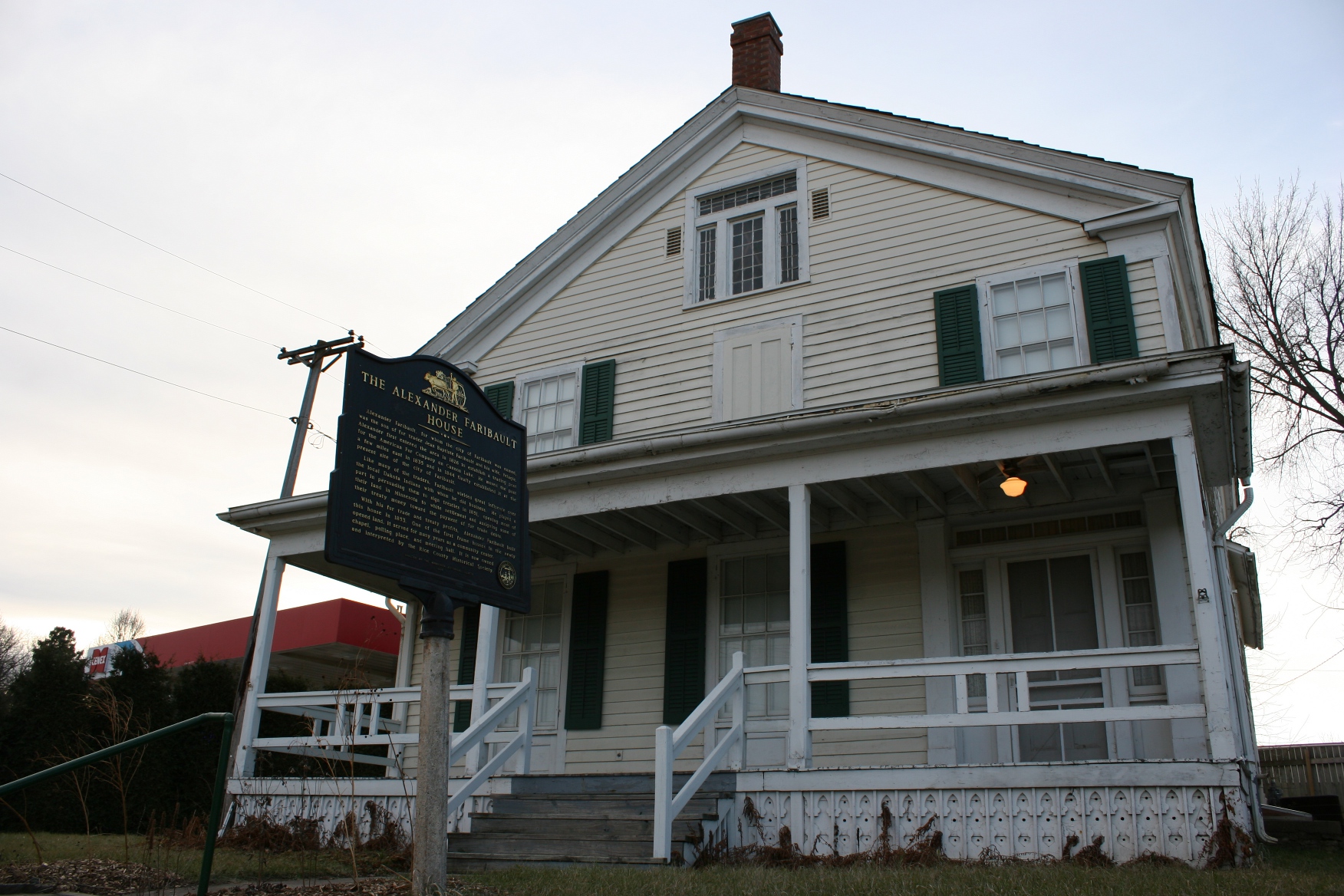
The home of fur trader and town founder Alexander Faribault. (Minnesota Prairie Roots copyrighted file photo 2017)

As you might rightly guess, not everyone in Faribault liked the Mdewakanton living among them. A wall was built in the area around Alexander Faribault’s house to protect them. Taopi became a community leader, said Nichols. As such he represented his people and mediated when necessary.

By the time of Taopi’s 1869 death, 90 of the 180 Mdewakanton who settled in Faribault had already left. But they left behind an imprint upon the land, not necessarily seen or appreciated even today. Yet, efforts are underway to change that with The Faribault Dakota Project. Nichols couldn’t speak specifically to that, only to say that local historian Jeff Jarvis has been working with the Dakota community on how to memorialize and honor the Indigenous Peoples of Faribault. That also includes the Wahpekute Dakota.
Peace Park, a protected Dakota burial site (but unmarked as such) next to the parking lot of Buckham Memorial Library. (Minnesota Prairie Roots copyrighted file photo)

Among the locales discussed by those attending Nichols’ talk was Peace Park, a triangle-shaped slice of property near Buckham Memorial Library. Alexander Faribault donated the land to the city with the stipulation that it never be developed. According to Nichols, the park is a protected burial site, where at least two Dakota are buried. Their bones were unintentionally uncovered in 1874 and then reburied. Today nothing marks that land as a cemetery. Rather a faith-based WWII monument stands in Peace Park. There is no reference to the Dakota. Perhaps some day this will be righted and the land publicly recognized as sacred ground. That is my hope as I continue to learn about the Dakota who once called Faribault home. I am grateful for every opportunity to grow my knowledge of them and their importance in local and state history.

#

FYI: Here are some suggested Dakota-connected places to visit in Faribault: the Rice County Historical Society Museum, Maple Lawn and Calvary cemeteries, the Cathedral of Our Merciful Saviour, a mural on the Central Park Bandshell and information on an historic-themed bench along Central Avenue.

Two fun facts: A small southeastern Minnesota town in Mower County near the Iowa border is called Taopi, named after the Mdewakanton Dakota chief. It suffered a devastating tornado in April 2022. The town celebrates its 150th birthday this year.

A woman attending Dave Nichols’ talk named her horse Taopi after Chief Taopi.

© Copyright 2025 Audrey Kletscher Helbling


The power of hair among Native Peoples September 19, 2023

“My Powerful Hair,” published in 2023 by Abrams Books for Young Readers. (Book cover source: Abrams Books)

SOME OF THE MOST MEANINGFUL, enlightening and powerful books I’ve read, I’ve found in the children’s picture book section of my local public library. That includes My Powerful Hair written by Carole Lindstrom and illustrated by Steph Littlebird.

I happened upon this book while searching for recently-published astronaut and geography books for my 4-year-old grandson. I never did find those sought-after titles. Not that it mattered. What I discovered instead were three must-read books: My Powerful Hair, Boycott Blues—How Rosa Parks Inspired a Nation and We Are Better Together.

Parks is certainly familiar to me as the Black seamstress who in 1955 refused to give up her seat to a white man on a city bus in Montgomery, Alabama. That sparked a bus boycott and the Civil Rights Movement. Likewise, working together to effect change, to improve our world, to help one another is a familiar theme.

“The Native Man, His Eagle & His Chanupa,” an oil painting by Dana Hanson and part of her 2018 “Healing the Land” exhibit at the Owatonna Arts Center. (Minnesota Prairie Roots copyrighted file photo 2018, used for illustration only. Art copyrighted by Dana Hanson.)

THE IMPORTANCE OF HAIR REVEALED

It is the story on hair, though, which proved a particularly teachable read. My Powerful Hair focuses on Native Peoples’ hair and its importance in their culture, their history, their lives. Through the writing of New York Times bestselling and award-winning author Lindstrom, who is Anishinaabe/Metis (and an enrolled citizen of the Turtle Mountain Band of Ojibwe), and Indigenous artist Littlebird of Oregon’s Confederated Tribes of Grand Ronde, I learned the symbolism and power of hair in Native American culture. Admittedly, this is something I should have known, having grown up on the southwestern Minnesota prairie between the Upper Sioux and Lower Sioux Indian Reservations (today termed “communities”). I thought I was informed. But I wasn’t, not about hair.

Told from the perspective of a young Native girl, My Powerful Hair explains the reasons Native Peoples grow their hair long. And keep it long. Hair holds stories, memories, strength, sorrow, connections to each other and to Mother Earth. And more. Page after page, the narrator shares events in her life that weave into her hair. When Nimishoomis (her grandfather) taught her to fish, her hair reached her ears. When her cousins taught her to make moccasins, her hair flowed past her shoulders. In the sharing of these moments, I began to understand the power of hair in Native American culture.

A photo panel at the Traverse des Sioux Treaty Center in St. Peter shows Dakota leaders photographed in Washington D.C. in 1858. The photo is from the Minnesota Historical Society and is used here for illustration only.

FORCED HAIRCUTS

I also understood fully, for the first time, the trauma inflicted upon Indigenous individuals forced long ago by white people to cut their hair. The writer and illustrator don’t hold back. In the first few pages, a young Nokomis (grandmother) is in tears as the hands of a Catholic nun grasp, then cut, her braids. It’s an emotionally impactful visual.

But this was reality at Indian boarding schools, within faith communities and elsewhere back in the day, in a time period when efforts focused on erasing Indigenous culture, on conforming Native Peoples to European ways. It was wrong.

Displayed at Bridge Square during Northfield’s Earth Day celebration in 2022. (Minnesota Prairie Roots copyrighted file photo April 2022, used for illustration only)

A TERRIBLE INJUSTICE”

A blogger friend from the central Minnesota lakes region recently shared a bit of her family’s experience per my request. Of unverified (records were often destroyed) Cherokee ancestry, Rose speaks of her mother’s trauma after being sent to a Catholic girls’ school in Crookston. “Mom didn’t tell us much about her experience there,” Rose says, “only that they made her cut her long black hair. My mom never cut her hair again for the rest of her life. She saw the forced haircut as a terrible injustice.” Injustice seems a fitting word.

In an author’s note, Carole Lindstrom shares the same trauma, documented, she writes, in a photo of her grandmother and two great aunts with their black hair shorn above their ears. They were forced into an Indian boarding school in the early 1900s.

“Honoring the Legacy of the Dakota People” focuses this artwork by Dana Hanson. Chief Taopi centers the painting with Alexander Faribault to the left and Bishop Henry Whipple on the right. The word “Yuonihan” means honor or respect. This art hangs inside Buckham Memorial Library. (Minnesota Prairie Roots copyrighted file photo November 2022. Art copyrighted by Dana Hanson.)

POWER IN STORIES, IN HERITAGE, IN RESPECT

Rose is thankful for books like My Powerful Hair. “I am glad that stories like this are being told,” she says. “Much First Nations history nearly disappeared. And many First Nations keep their ceremonies and other information ‘secret’ so it won’t be distorted or misused by people who don’t understand, or who seek to harm them.” Based on history, that seems warranted.

This Minnesota woman has one more reason to feel grateful for children’s picture books by Indigenous Peoples. Her grandchildren are of Ojibwe heritage; their other grandmother lives on the White Earth Nation in northwestern Minnesota. “My hopes for my grandchildren are that they learn all they can about their Ojibwe ancestors and customs and values,” Rose says. “I hope they can choose what lessons they want to carry forward in their own life. I hope they are fantastic examples of how people from different backgrounds can get along and respect and love one another.”

And so I learned, not only from Rose, but from reading My Powerful Hair. Stories woven into our hair matter. For they are powerful.

© Copyright 2023 Audrey Kletscher Helbling