Minnesota Prairie Roots

Writing and photography by Audrey Kletscher Helbling

Poetic Strokes, Volume Four, publishes June 8, 2010

Filed under: Uncategorized — Audrey Kletscher Helbling @ 9:41 AM
Tags: ,

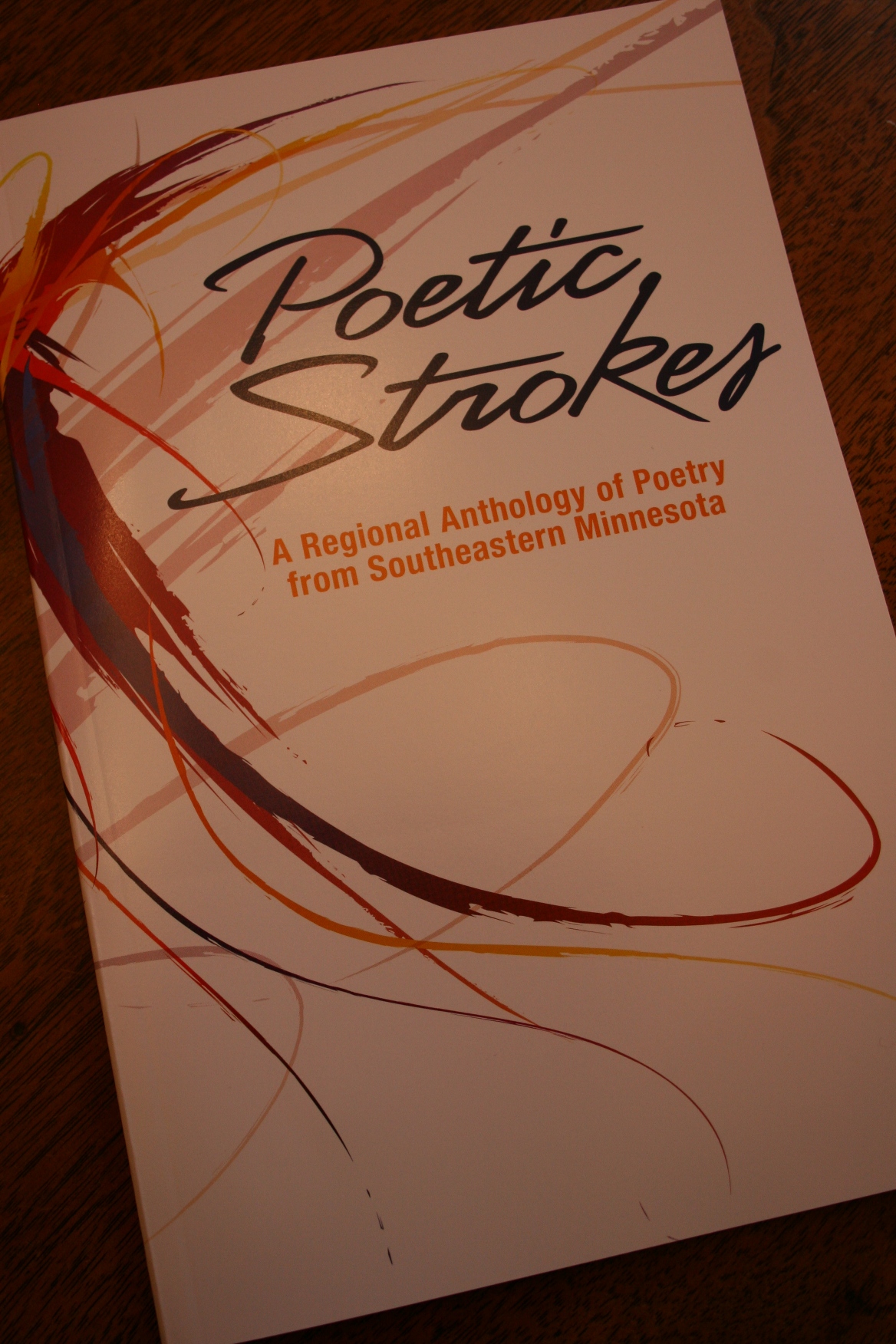
Poetic Strokes, Volume Four, just published and on sale for $5.

FOR EVERY WRITER, publication brings a certain thrill, a validation that the words they’ve written hold meaning for a publisher, an editor, and, most importantly, for the reader.

That’s especially true for poets. In poetry, every word counts. Poets understand that. In perhaps no other writing genre is word choice so important.

Of all the writing I’ve done through the years—newspaper, magazine, essay, devotionals, greeting card verses and poetry—poetry and greeting card verse writing have proved the most challenging.

When I nail a line, and then a whole verse or an entire poem, I know it. And, apparently, editors also realize that. I’ve attained success in both publishing of my greeting card verses and my poetry.

Last week a copy of Poetic Strokes, A Regional Anthology of Poetry from Southeastern Minnesota, arrived at my house. The slim volume published by Southeastern Libraries Cooperating includes my poems, A school without a library and Saturday night baths.

Mine are the first two poems in the book. Forty-two poems were selected for publication from 280 submitted by 118 poets in Dodge, Fillmore, Freeborn, Goodhue, Houston, Mower, Olmsted, Rice, Steele, Wabasha and Winona counties.

Of the 30 poets whose poems were selected for publication, 11 of us have multiple poems in the Legacy Amendment-funded anthology.

Within the pages of this volume, you’ll find poems that speak of libraries and veterans’ memorials, of personal pain and spoiled Americans, of wind and harvest and so much more. Among my favorites are Woman of the Earth and Final Harvest by Delores Daggett and The Garden by Ronda Anderson-Sand.

It’s no secret to me why I especially like these poems. They are similar to mine—rooted to the land and vivid with descriptive words that allow me to picture the place, the people, of which the poet writes. They also touch me emotionally.

Whenever I write a poem, I immerse myself in the subject, transitioning to the place or time that is the subject of my writing. I tap into my memory bank, remembering details that appeal to the senses. In Saturday night baths, I recall the red-and-white-checked linoleum, the slippery bar of soap, the oven door tilted open for warmth. Details like that make for a good poem.

Often, I write of my childhood experiences growing up on the southwestern Minnesota prairie. Those seem to resonate with readers.

You can read my latest published poetry by checking out Poetic Strokes, Volume 4, from any SELCO library. If you’re outside the system, request an inter-library loan.

Or, consider adding this anthology to your personal collection. In Faribault, Friends of Buckham Memorial Library are selling a limited number of Poetic Strokes for $5 at the circulation desk.

#

Friends and family, if you want a copy, let me know. For $5 and shipping costs (if you need the volume mailed), I’m willing to get a book for you.

© Copyright 2010 Audrey Kletscher Helbling


Embracing diversity in small-town Minnesota June 7, 2010

Filed under: Uncategorized — Audrey Kletscher Helbling @ 3:21 PM
Tags: , , , , ,

THREE DECADES AGO, maybe even two decades ago, you never would have seen this in rural southwestern Minnesota.

But of the 54 seniors graduating from Westbrook Walnut Grove High School on Sunday afternoon, 15 students were Asian. That’s remarkable in an area originally settled by primarily Scandinavians and Germans.

Seeing those dark-haired, dark-eyed graduates with olive-toned skin among students with fairer complexions struck me more than any single aspect of the WWG high school graduation ceremony.

Hearing surnames like Yang and Vang among Jensen, Erickson and Schweim, simply put, pleased my ears.

Demographics on the Minnesota prairie certainly have changed in the 36 years since I graduated from nearby Wabasso High School. In my class of 89, all of us were Caucasian. Our only cultural exposure came through the foreign exchange students who attended our school.

Thankfully, that has changed, at least in some rural Minnesota communities like Walnut Grove and Westbrook. Walnut Grove, childhood home of author Laura Ingalls Wilder, is home to many Hmong families and boasts a Hmong grocery store. Jobs, primarily in nearby Marshall, and affordable housing apparently drew these immigrants to this rural area.

For young people like my blonde German-Norwegian niece, who graduated with the WWG class of 2010, cultural diversity has always been a natural part of life.

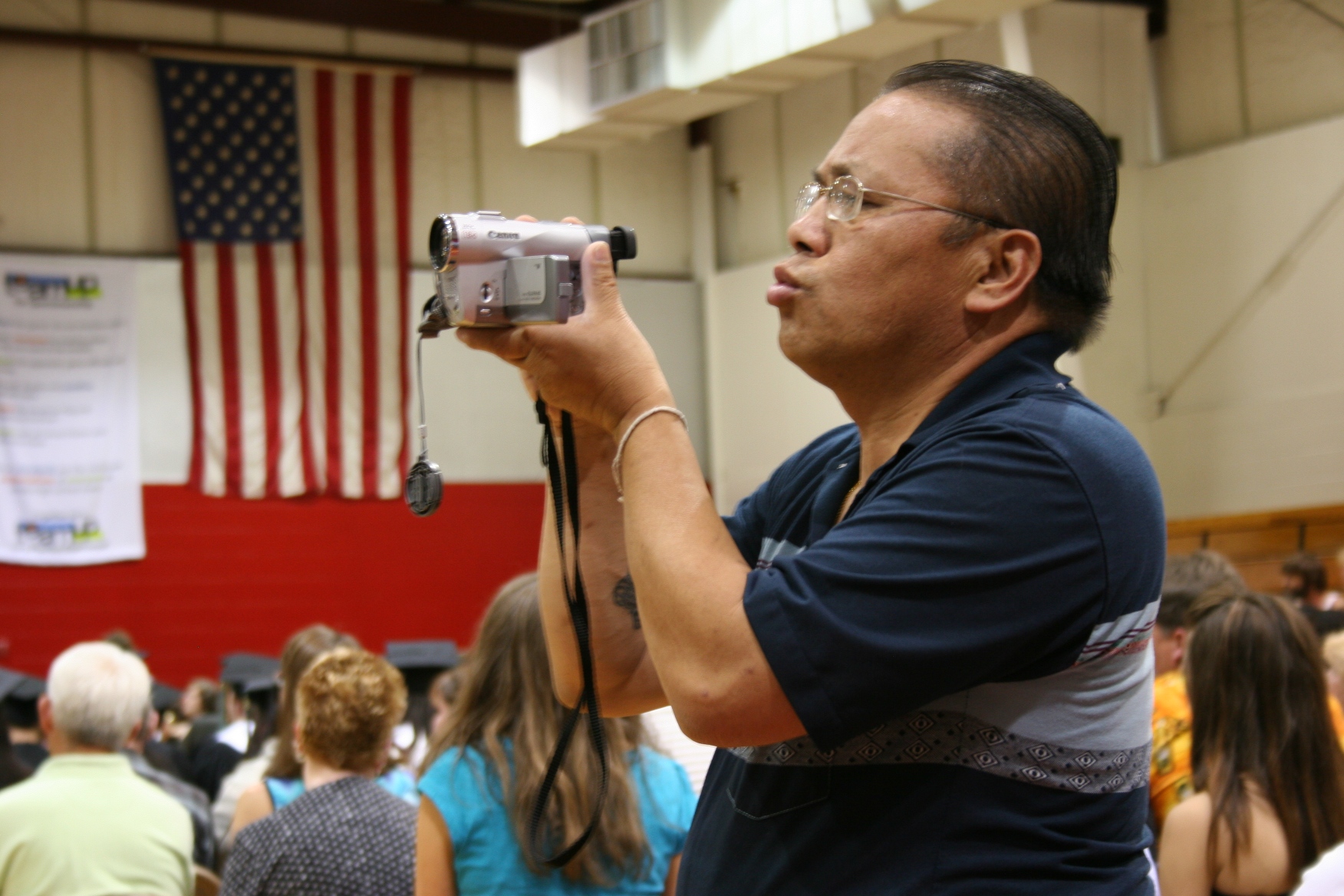
As I sat in the WWG gymnasium Sunday afternoon contemplating this, I watched a Hmong man across the aisle from me videotaping the ceremony. I wondered about his background. Had he fled a war-torn country? What had he endured? Did he feel accepted here? Was this the first generation of his family to graduate from high school? Did he miss his homeland?

A Hmong man videotapes the Westbrook Walnut Grove High School graduation ceremony Sunday afternoo.

Later, when slides of the graduates flashed upon a big screen at the front of the auditorium, I noticed several photos of students in traditional Hmong attire. They are a people proud of their heritage.

When I listened to the WWG High School Choir sing “We Are the World,” I appreciated the appropriateness of the song and pondered how this mixed ethnic group really is the future of our world.

I don’t know how the folks of Westbrook and Walnut Grove welcomed the Hmong. I expect initial adjustments were not always easy for long-time residents or for the newcomers. I expect there are still occasional clashes.

In Faribault, where I live, we still have much to learn as Somali, Sudanese and Hispanic people integrate into the community. Certainly, strides have been taken to bridge differences through efforts like those of the Faribault Diversity Coalition.

But I’ve heard all too many derogatory remarks about minority populations—about the Somali men who hang out on downtown sidewalks, about the Hispanics involved in drug crimes, about the gangs, even about the bright green color painted on a Mexican bakery (which, at the urging of some local businessmen, has since been repainted a subtler green to better fit the historic downtown).

Perhaps if we had, like the WWG class of 2010, grown up together, we would be more accepting of each other.

© Copyright 2010 Audrey Kletscher Helbling


Kitten rescue June 4, 2010

Filed under: Uncategorized — Audrey Kletscher Helbling @ 8:48 AM
Tags: , ,

A SHORT TRIP TO THE COUNTRY to shoot photos for a volunteer project turned into an animal rescue earlier this week.

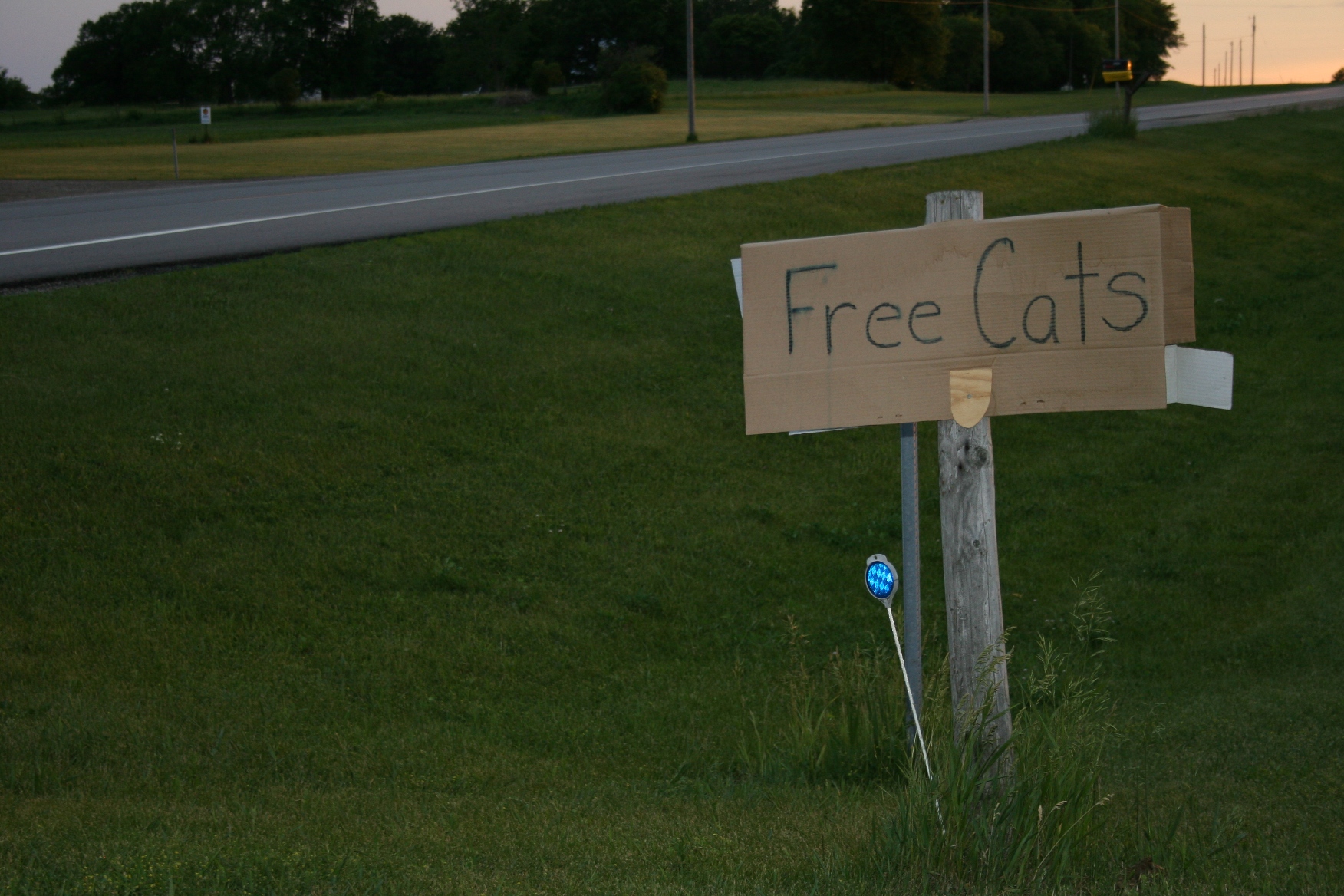
My husband and I never expect this, even though the “Free Cats” sign at the end of our friends’ driveway should have served as a warning.

My friends placed a sign at the end of their long country driveway offering free cats to passing motorists.

“We’d like a cat,” I tell Delores when she opens the door to her house.

“We don’t have any cats left, only kittens,” she answers.

“I’m just kidding,” I say, as I step inside. I have no interest in owning a cat, or a kitten.

Later, after I’ve finishing taking photos for my project, I ask to see the kittens. Delores’ 13-year-old granddaughter Anna, who is staying for the week with her grandparents, leaps from the couch. I follow her outside to a sprawling poleshed where four kittens jostle inside a wire cage.

Not wanting to traumatize the kittens by using the flash on my camera, I shot with natural light. This kitten comes from the older litter of three.

Anna has been caring for the kittens all week, feeding them milk with an eye-dropper.

“What happened to the mother cat?” I ask.

“We gave her away,” Delores answers. Remember that “Free Cats” sign? I’m pretty certain my friend didn’t know about the kittens before she gave away their mother.

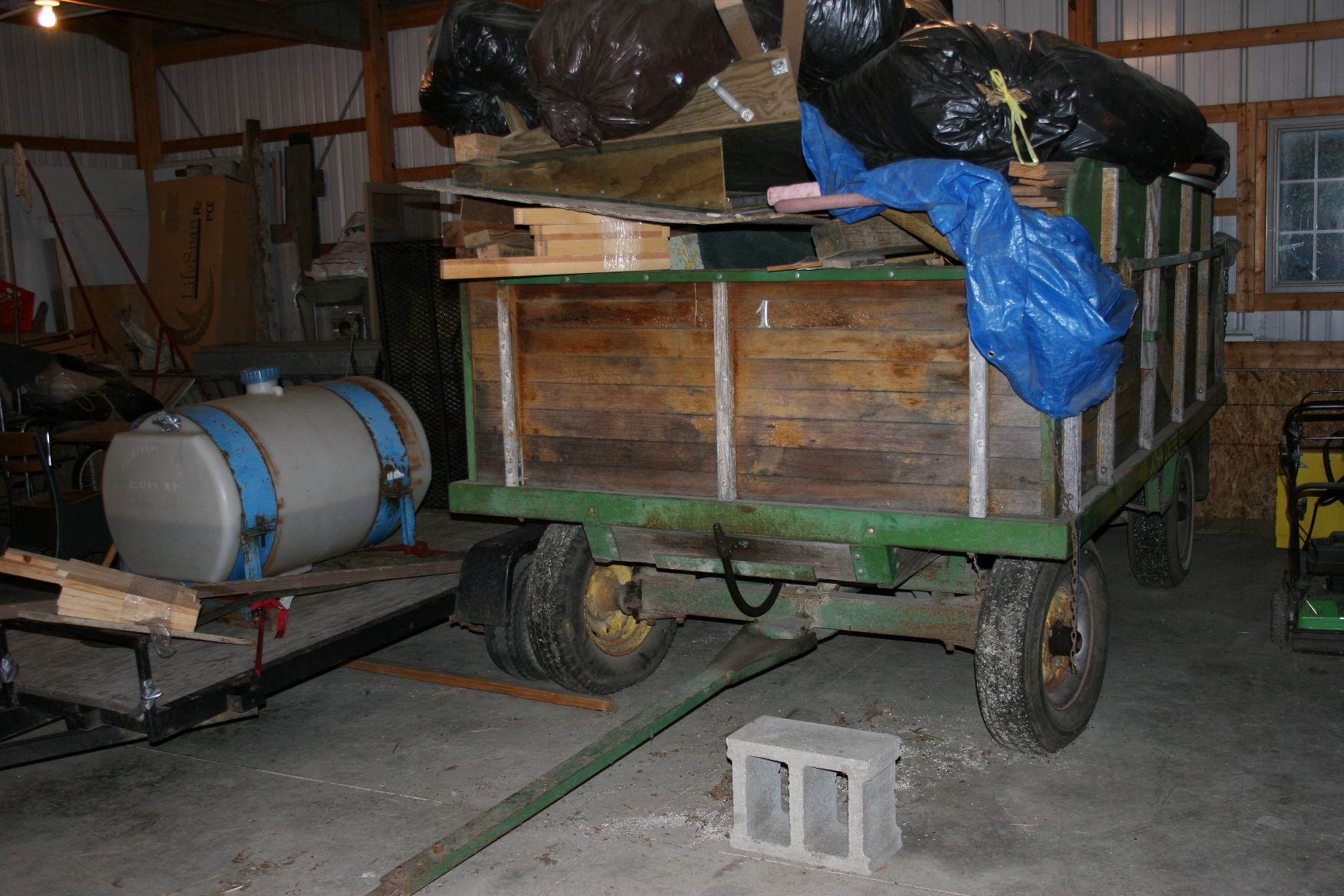
Now she has four hungry kittens to feed. Make that five. In the back room of the poleshed we hear another kitten mewing. In a matter of seconds, we determine that the kitten is trapped inside a wagon. And that wagon is topped with mounds of wood, garbage bags filled with aluminum cans and lots more. Rescuing this baby will be no easy feat.

With a flashlight, a mewing Anna and hands ready to grab, the kitten is eventually coaxed to the front of the wagon, snatched and carried to the cage.

One of the kittens rescued from the wagon, where the mother either gave birth or later hid her litter of three.

“How long has it been without milk?” I ask.

“Three or four days,” Delores says. Already this seems a miracle.

Two kittens were coaxed from the back of this wagon to the front. See that narrow opening near the blue tarp? They were grabbed through that opening.

And then we hear another faint mew coming from the trailer. We start all over again, this time adding a garden hoe to our rescue equipment.

“Come on baby,” Anna encourages, then mews, then encourages some more.

Finally, the kitten is close enough for my husband to gently hook with the hoe and guide into Anna’s welcoming hands.

Now six hungry, mewing kittens are crammed into the cage. Based on size, we quickly determine that these babies are from two different litters. Anna separates them, moving the bigger three into a portable kennel.

We say our goodbyes then as Delores and adoptive mom Anna hurry toward the house. They are on a mission to get milk for the hungry stowaways.

The next evening I call Delores. “How are the kittens?” I ask.

“One died,” she says. “The black one.” It is the first of the two we rescued.

“How is Anna doing?” I ask.

“She called her mom,” Delores answers.

© Copyright 2010 Audrey Kletscher Helbling


A must-read: Hidden History of the Minnesota River Valley June 3, 2010

Filed under: Uncategorized — Audrey Kletscher Helbling @ 9:51 AM
Tags: , ,

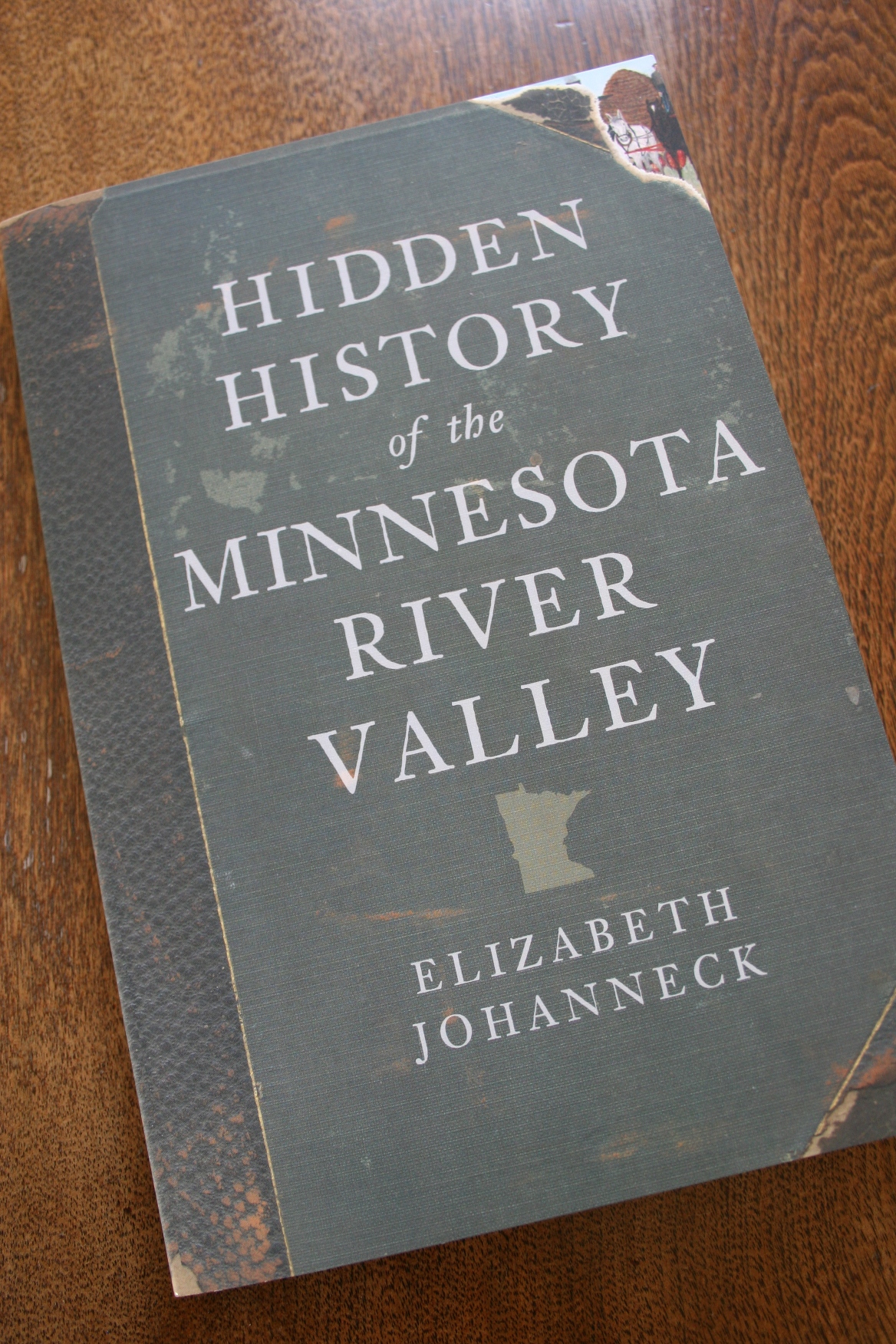
Elizabeth Johanneck, a rural Wabasso, Minnesota, native has just published this history book on the Minnesota River Valley.

I’VE NEVER BEEN THANKED in the introduction to a book…until now.

Minnesota author Elizabeth Johanneck publicly thanked me for guiding and mentoring her while writing Hidden History of the Minnesota River Valley. Her just-published, autographed book arrived Tuesday at my home.

The 156-page soft-cover title from The History Press also includes my essay, “Strong Words on Strong Stone at Birch Coulee.”

Beth’s book, as the title suggests, focuses on stories rooted in the Minnesota River Valley. You’ll read about everything from the founding of the Sears, Roebuck and Company to Alexander Ramsey Park to “The Myth about Scalping.”

Yes, some of the topics covered in this history book are unsettling. But through interviews and research, Beth presents the facts as honestly as possible, even if the truth disturbs or challenges what many of us have been taught.

My friend possesses strong storytelling skills that make her book more than a compilation of historical facts. Beth weaves personal experiences into her writing that connect with the history she shares. That personal perspective engages the reader.

Beth, like me, grew up on a Redwood County farm—she near Wabasso, me a bit further to the west just outside of Vesta. We attended Wabasso High School together where we shared a locker. Her down-to-earth personality and appreciation for the Minnesota River Valley area influence writing that is warm and folksy.

Check out Beth’s Minnesota Country Mouse blog, where she says “the ‘hayseed’ in her writing betrays her ‘city-slicker’ aspirations.”

Whether you’re from the Minnesota River Valley area or not, you’ll find stories in this book that are entertaining, poignant, shocking, revealing and, often, thought-provoking.

If you like ghost stories, you’ll appreciate “The Terrible Story of Little Annie Mary,” which tells of a 6-year-old girl supposedly buried alive in 1886.

Black-and-white photos, both current and historic, are generously dispersed through-out this book, adding to its appeal.

For anyone who enjoys Minnesota history, Beth’s book is a must-read. (And I’m not saying that simply because I’m a friend of the author and have a story in this book.)

Beth will be at the Barnes & Noble bookstore at the River Hills Mall in Mankato from 1 p.m. – 3 p.m. this Saturday, June 5, signing copies of Hidden History of the Minnesota River Valley. The book retails for $19.99.

She also has a signing set for 2 p.m. – 4 p.m. July 17 at the Bavarian Blast in New Ulm. You may also purchase her book online from major retailers.

© Copyright 2010 Audrey Kletscher Helbling


Remembering Cpl. Ray W. Scheibe, my dad’s Army buddy, killed in Korea on June 2, 1953 June 2, 2010

Filed under: Uncategorized — Audrey Kletscher Helbling @ 7:37 AM
Tags: , ,

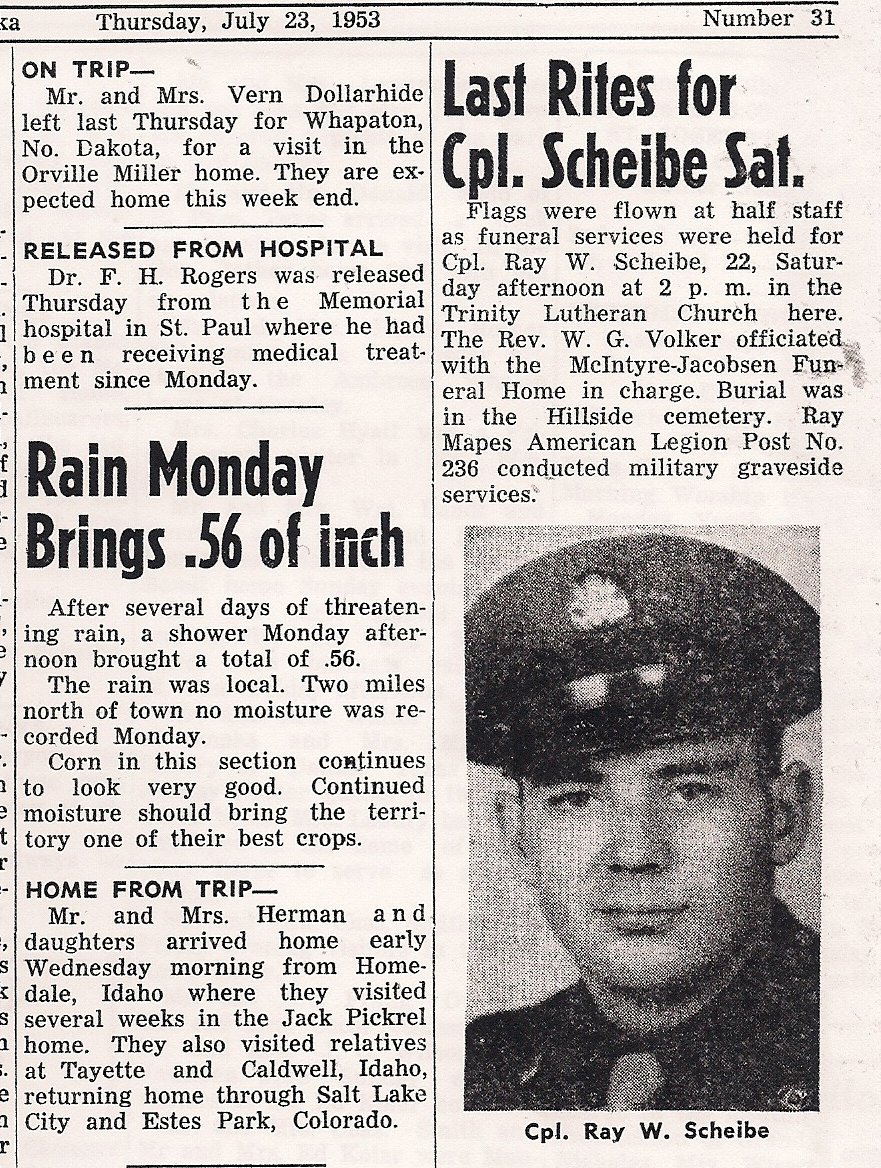
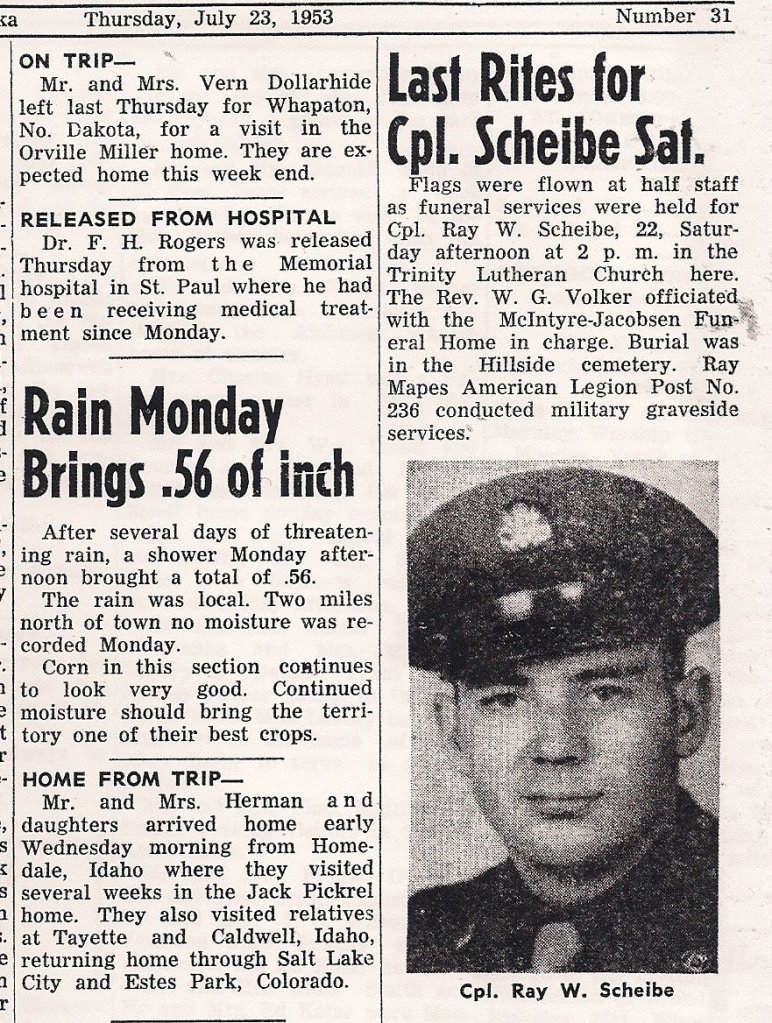
A portion of the story about Cpl. Ray W. Scheibe, published on the front page of the July 23, 1953, issue of The Wolbach (Nebraska) Messenger.

HER VOICE IS HESITANT, strained, edged with 50 years of grief.

I sit at my dining room table, phone clasped tightly to my ear, listening, jotting notes. In the quiet reserve of her voice, in the words she speaks, I hear her pain.

On June 2, 1953, our lives became forever linked. That day, on the battlefields of Korea, two young American soldiers forged into combat. One of them was blown apart by a mortar while the other watched in horror. My father came home; hers didn’t.

Today, after a two-month search, I am speaking to the daughter of Cpl. Ray W. Scheibe, my dad’s army buddy. I have anticipated this day, prayed for this day, wondered if this day would come. In recent months, I made it my mission to find Ray’s daughter, who was only six weeks old when he died in Korea.

My desire to find Teri Rae was spurred by the tragic story of her dad’s death. Just before he was killed, Ray told his comrades, my dad among them, that he was leaving Korea the next morning. Back home his wife and infant awaited his safe return. The new father was excited about seeing his child for the first time and his buddies shared his joy. That jubilation, however, was short-lived as minutes later the 22-year-old was hit by a deadly mortar.

Ray’s death impacted my dad more than any single wartime tragedy, for it is one of the few war memories he ever shared. He mourned for his buddy who would never see his child and for the child who would never know her father. While my dad always referred to the baby as a 9-month-old son, I learned during my search that the infant was really a 6-week-old daughter. My dad’s memory had failed him, but the memory of Ray’s horrific death never left him.

Now this grown daughter, today a grandmother, is on the phone, speaking to me from her home in southwestern Iowa. Only a week earlier I mailed a two-page letter to Teri, a letter which would change both of our lives. I wrote about our fathers’ friendship, about her dad’s death and about my search.

Teri tells me that she cried for two days after receiving my letter.

My quest for Teri began nearly two years after my dad’s 2003 death. While looking through a shoebox filled with my father’s military belongings, I found clues leading to the identity of Ray Scheibe.

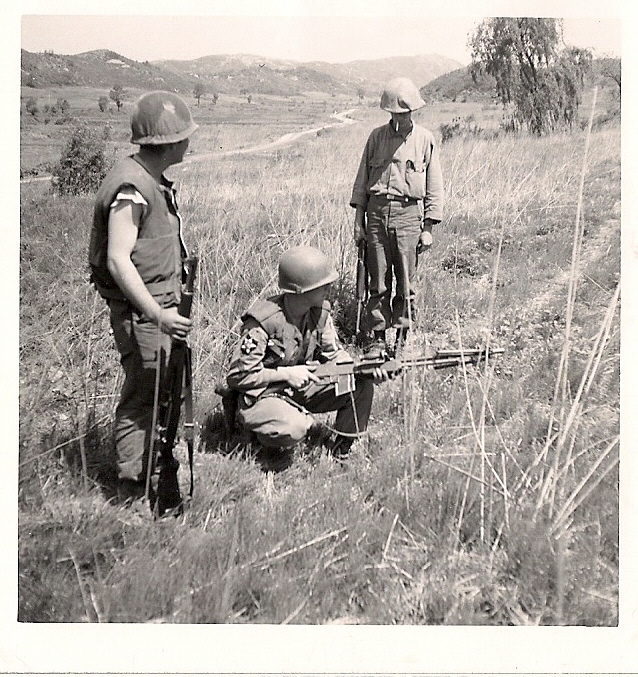
I share with Teri in our phone conversation that I discovered a photo of her dad taken in May 1953. My dad had written “Sgt. Shibe, June 2, 1953” on the back of the photo and drawn a box around it. I recognized the surname, although misspelled, as the one my dad had once spoken when talking about his deceased buddy.
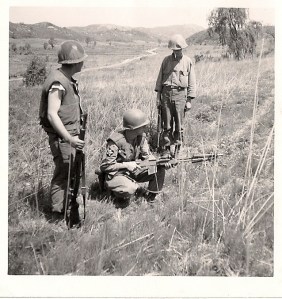
This May 1953 photo, taken by my dad in Korea, helped me track down Ray Scheibe's daughter, Teri Rae. Cpl. Scheibe is on the left.

It is that picture; the discovery of a memorial service bulletin from Korea with Ray’s name listed inside; military documents; internet research into military records; and a phone conversation with Ray’s best friend from high school that confirm the identity of the young soldier from Wolbach, Nebraska.

I compose a letter to Teri and include copies of documents related to her dad, then drop it in the mail, fully expecting I may never hear from her.

But she quickly responds, hers the words of a daughter grieving for her father. “This letter has made him a real person with feelings and personality, before I just knew he existed,” Teri writes in her first correspondence to me. She continues with details about her life and family, about the loss of her beloved husband, Lee, the love of her life, two years earlier.

“My pain has been going on for years it seems like, since I have been born. I have learned to be strong I guess,” Teri continues.

She first learned of her father after starting school in Omaha, Nebraska. Teri’s mom Marilyn had remarried and, as was customary in that time period, death was not openly discussed. But when her teachers called her “Teri Scheibe” instead of “Teri Todd,” her new name, the youngster began to ask questions. For the first time, Marilyn told her daughter about her birth father who died in Korea.

“I know very little about him as no one ever spoke of him,” Teri writes to me. “And I was afraid to ask because they said my mom didn’t take it very well, and I know I was always a reminder. Even his family never spoke of him.”

Now we are on the phone, talking about this man who has been described to me by Robert “Sonny” Nealon as fun-loving, outgoing and a friend to all. Sonny and Ray were best friends who hunted, fished and played sports together while growing up in Wolbach.

The two entered the service on the same day, Ray to the Army and Sonny to the Navy. Sonny, who had been my final contact in finding Teri, was completing his naval tour in California when he learned of Ray’s death. “It was a heart rendering time when we read of Ray’s death in Korea,” Sonny recalls in a letter to me.

He tells of a man nicknamed Pee Wee because Ray stood only five feet seven inches tall. “…recalling the days with Pee Wee brought nothing but smiles and near laughter,” Sonny continues.

It is Sonny’s description of a real, living, breathing person that I wish to share with Teri.  In the depths of 50-plus years of unresolved grief, I hope Teri will see her father through the eyes of his best friend.

I too yearn to know this man who meant so much to my dad. My father never made peace with Ray’s death and in the depths of my heart I carry my dad’s burden of unresolved grief.

As I speak with Teri, sorrow surfaces and I experience a deep sense of relief and of letting go. I sense that Teri, too, as we talk about her dad, his death and the tragedies in her life, is beginning to feel that same peace.

“You gave me a person to cry and grieve for. Thank you!” Teri says.

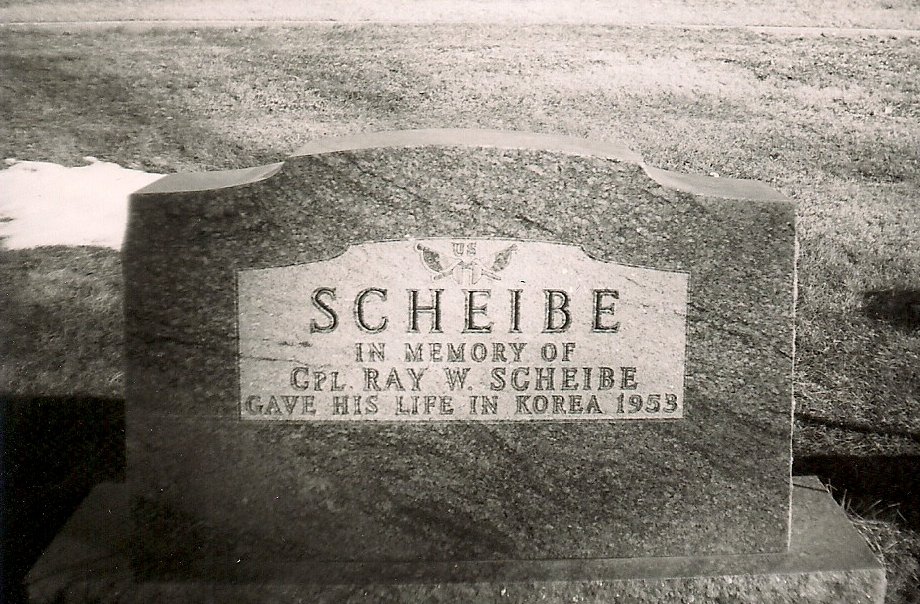
That first phone conversation is just the beginning of an ongoing correspondence with Teri and Sonny. We exchange photos and personal information. I view photos of Ray as a young man, read newspaper accounts of his death and cry over a snapshot of his tombstone, which reads in part, “Gave his life in Korea, 1953.”
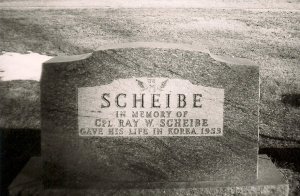
Sonny Nealon sent me this photo he took of his friend Ray's gravestone in Wolbach's Hillside Cemetery.

While Terri struggles with the details of her father’s death, she is comforted by my father’s remembrance of him. “It made me proud that your father thought so highly of him (Ray) and had never forgotten him and liked him,” Teri writes. “I now can imagine a man so excited to be coming home to his family, and he did know about me, because all the letters did not reach him, and he was proud of me and he did love us.”

My father’s memories comfort Teri. Sonny’s memories lift her spirits. “He (Sonny) has made me smile and laugh, which is rare here,” Teri says.

I couldn’t have asked for a better outcome. I can only imagine two fathers smiling down from heaven, delighted that their daughters have connected. A friendship which began on the battlefields of Korea has now come full circle more than half a century later.

#

I wrote this story in 2005 and am publishing it today for the first time in honor of Cpl. Ray W. Scheibe who died in Korea on June 2, 1953. His wife Marilyn died, also on June 2, many decades later. Some day I hope to meet Teri and embrace the woman to whom I am forever linked through the friendship of our soldier fathers.
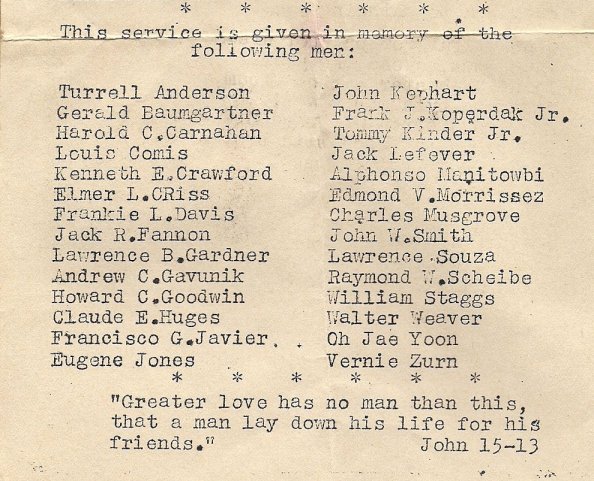
My dad, Elvern Kletscher, carried home a carefully folded July 31, 1953, memorial service bulletin from Sucham-dong, Korea. In the right column is listed the name of his fallen buddy, Raymond W. Scheibe.

© Copyright 2010 Audrey Kletscher Helbling


Beautiful peonies from my friends’ garden June 1, 2010

Filed under: Uncategorized — Audrey Kletscher Helbling @ 9:10 AM
Tags: , ,

MY FRIENDS VIRGIL and Jane grow beautiful flowers, like gladioli, lilies and peonies.

I know, because I’ve seen their lovely gardens, including a field of glads. Their flowers also often grace Trinity Lutheran Church in Faribault, which the three of us attend.

Bouquets of their carefully-tended florals have also graced my home.

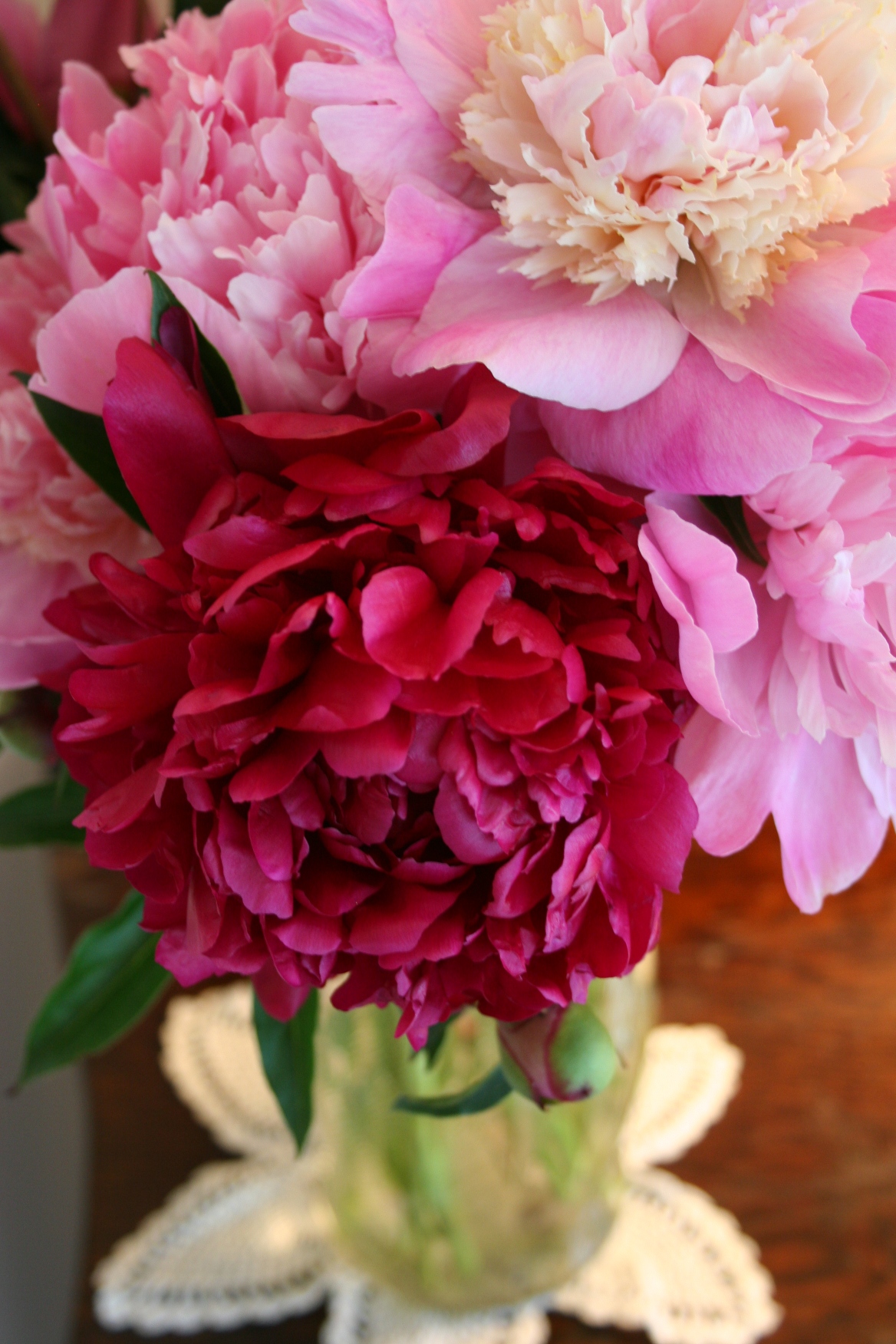
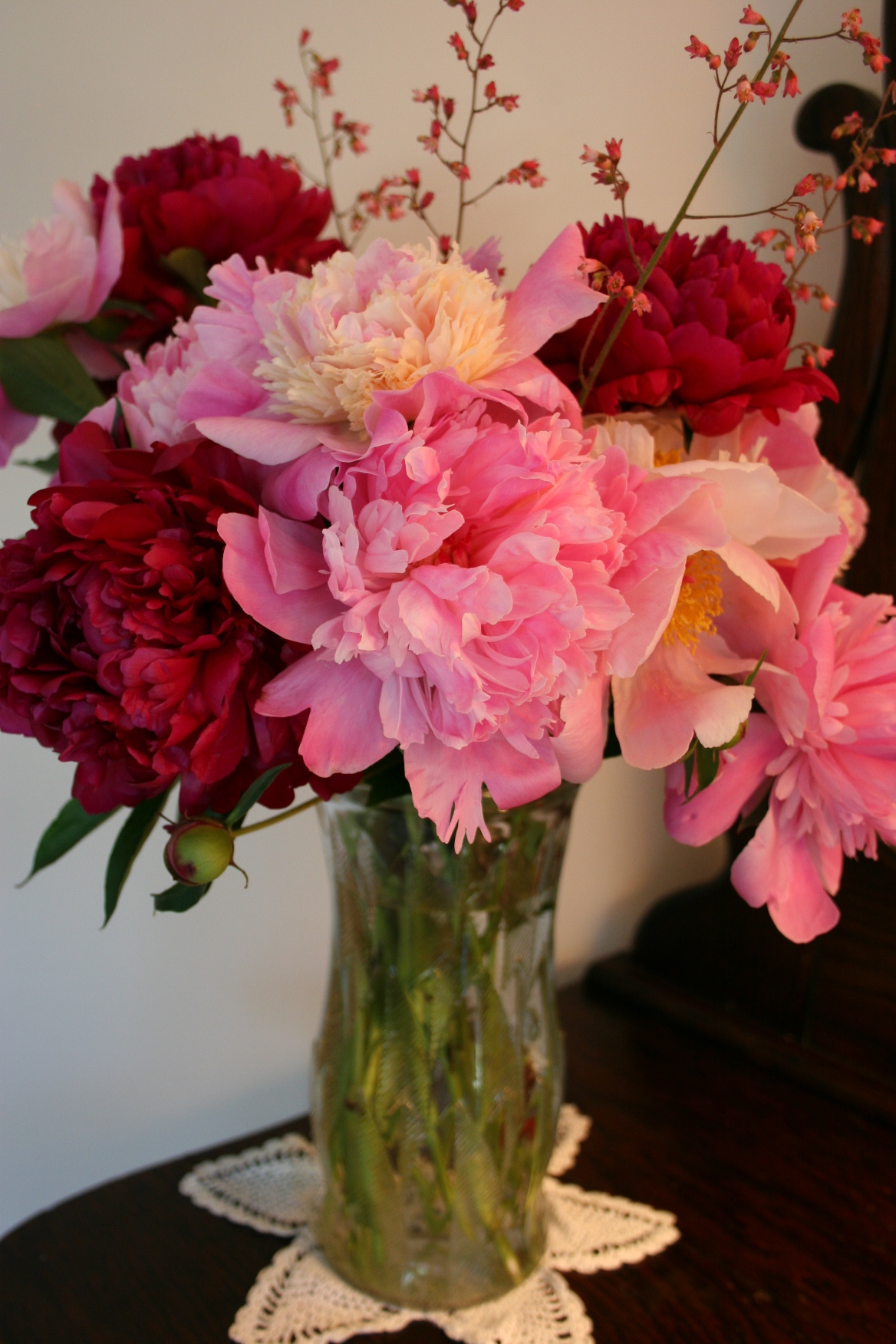
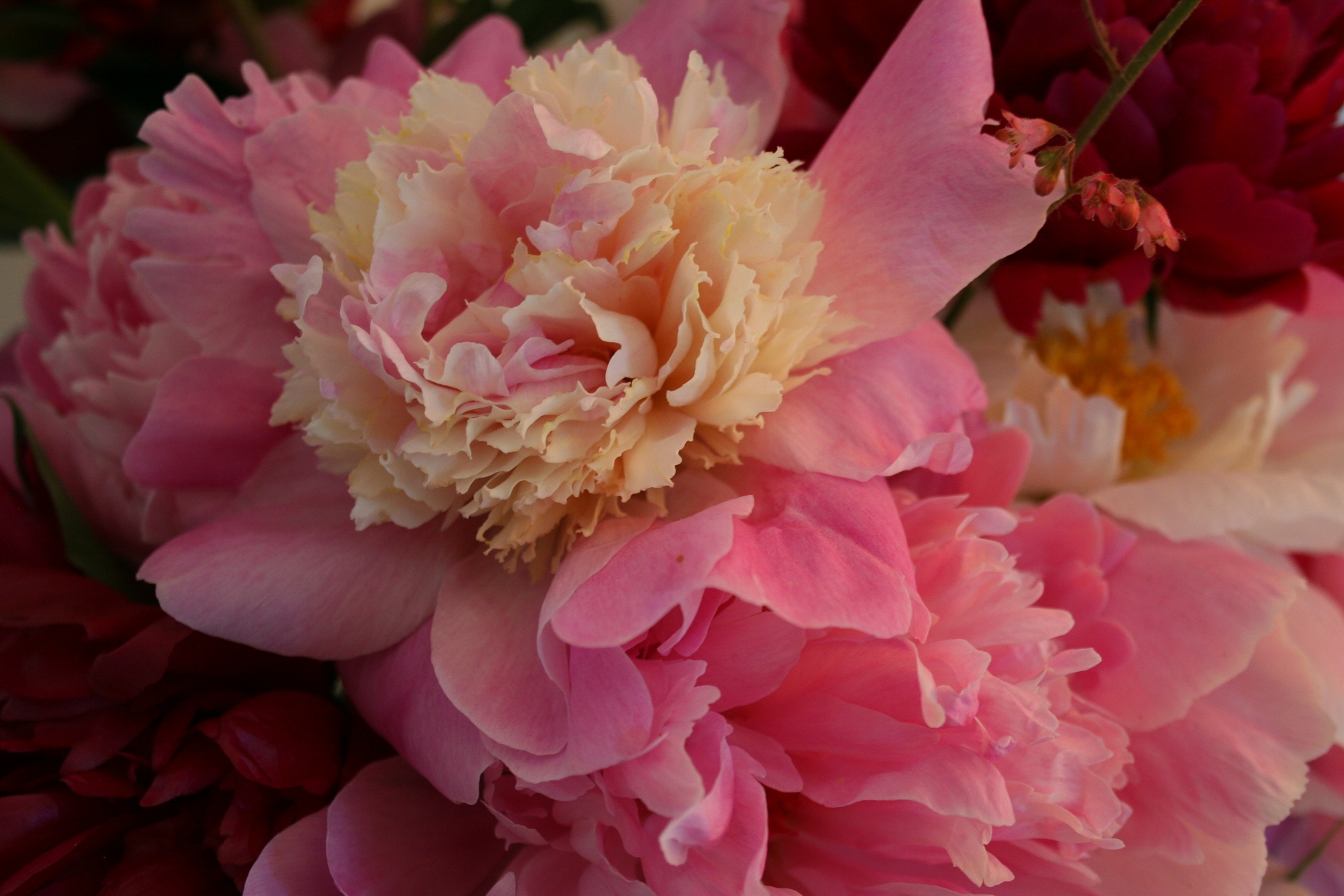
For the past several days, I’ve breathed in the deep perfumed scent of peony blossoms gathered into a beautiful arrangement accented by dainty corral bells. Virgil and Jane delivered them early Friday afternoon.

Always thoughtful, Virgil knew I would appreciate the peony centerpiece for my daughter’s college graduation party the next day. I did. I’m still enjoying the flowers, even as petals fall.

Many others have been the recipients of their flower garden beauties.

What a blessing to have friends like Virgil and Jane.

Copyright 2010 Audrey Kletscher Helbling