Minnesota Prairie Roots

Writing and photography by Audrey Kletscher Helbling

Do we need to call the fire department? February 6, 2013

Filed under: Uncategorized — Audrey Kletscher Helbling @ 8:18 AM
Tags: , , ,

“WE NEED TO GET the car out of the garage!” I yell, throwing open the passenger side door as I observe smoke seeping from under the hood. “Do we need to call the fire department?

“I don’t know. Get out and push,” my husband orders after he has turned off the car and then turned the ignition switch back on and then off, realizing his mistake.

And like that I rocket out the door, lock gloved hands onto the hood and push with all my might to get our 1995 Chrysler Concorde out of our attached garage.

Gas fumes hang heavy in the air. In that adrenalin-charged moment, a visual image of the car bursting into flames, igniting the garage and then catching our house afire flashes before my eyes.

I am scared, but not astute enough to realize that I could be placing myself in danger by staying with the car.

Together we manage to get the Concorde out the garage door and parked on the driveway next to the house, although I am screaming, “We need to push it to the end of the driveway away from the house (and other vehicles).”

Randy isn’t listening, mostly because he knows the car isn’t going to explode now. The danger has passed. He lifts the hood. The “smoke” I’d seen wasn’t smoke at all, but vapors from gas hitting a hot engine. However, I knew the danger had been real and a fire could have erupted. That Randy does not deny.

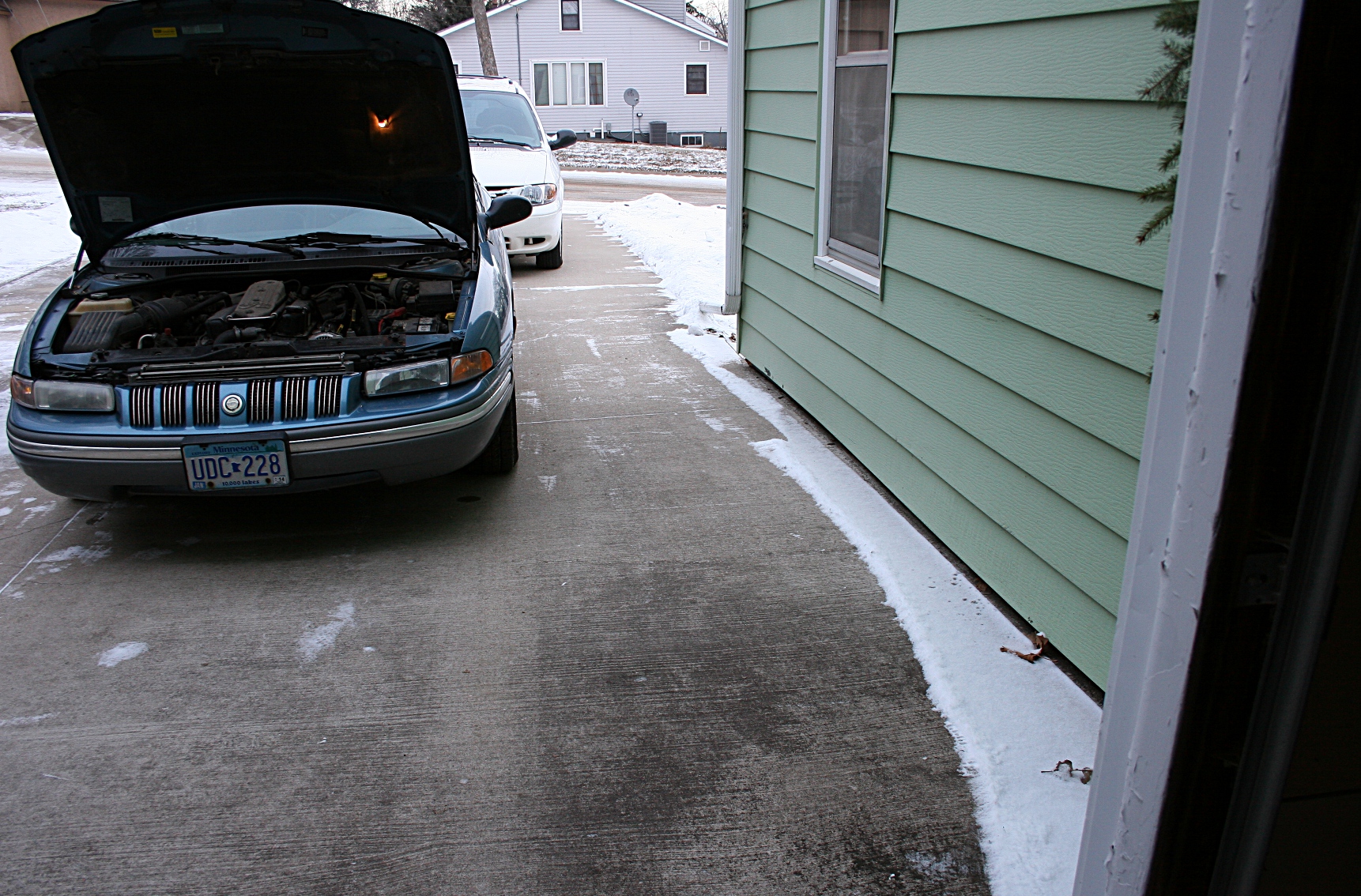
The Chrysler Concorde, photographed several hours after we pushed it from the garage.

The Chrysler Concorde, photographed several hours after we pushed it from the garage.

My automotive machinist husband diagnoses the problem as a leaky fuel line or valve. A stream of gas drips up the driveway, ending in a puddle at the front of the garage. It is less than a cup, probably, but spilled across the flat concrete floor appears to be more.

The car has dripped fuel all the way from the grocery store several miles away where the problem began. It was there that I first sniffed gas and Randy dismissed the odor as coming from another vehicle. He lifted the hood then, claimed not to smell anything unusual. I claimed otherwise. Perhaps his answer was a white lie designed to reassure me.

When we finished grocery shopping and returned to our car, the stench of gas still permeated the interior, intensifying when the engine fired up. We rolled down windows, expecting the gas odor to dissipate. The smell only worsened as we headed toward home. I could taste gasoline. I felt a bit off-kilter, as if the fumes were getting to me.

When we finally turned into the driveway, I relaxed. But then, once inside the garage, I noticed “smoke” rising from beneath the hood and my instincts kicked in.

Get the car. Out of the garage. Now.

NOTE: If my husband was to share this story, he’d likely present a less dramatic version with no fear or threat of fire involved. The car has now been repaired, the problem being a disconnected fuel line. The line was apparently not properly latched into place the last time Randy worked on the vehicle.

© Copyright 2013 Audrey Kletscher Helbling


Battling winter in Fargo February 5, 2013

Filed under: Uncategorized — Audrey Kletscher Helbling @ 8:02 AM
Tags: , , , , , , ,
A sign along a city street welcomes us to Fargo, North Dakota, from Moorhead, Minnesota, just across the Red River.

A sign along a city street welcomes visitors to Fargo, North Dakota, from Moorhead, Minnesota, just across the Red River.  I might change that “city of parks” to “The windy city.” Minnesota Prairie Roots file photo.

FARGO, NORTH DAKOTA, is flat. That is a fact.

The wind blows in Fargo. A lot. That is a fact.

Therefore, one could rightly conclude that staying warm during winter in flat and windy Fargo would present a challenge, even to a hardy Minnesotan.

During a recent cold snap, with wind chill readings in the minus 30 degrees Fahrenheit in Fargo, I received this text from my son, who attends North Dakota State University:

This cheap Walmart hat stands zero chance against the Fargo wind.

OK, I am 300 miles away so it’s not like I can run out and buy my boy a new hat. I suggested he take the $20 I’d recently sent and purchase warmer head attire.

Apparently, though, my son did not need my motherly assistance. He’d already gone online the previous evening and ordered a “nice Russian military surplus hat.” Alright, that ought to work in Fargo.

But then he mentioned one minor issue, which may or may not be an issue:

Unfortunately it has the good ol’ USSR sickle and hammer on the front. I’m hoping that I will be able to remove that.

When I expressed my concern about the symbol, he fired back:

We aren’t in the cold war anymore…

Ah, yes, my son, but you are.

© Copyright 2013 Audrey Kletscher Helbling


Call us crazy, but we really do drive vehicles onto lakes in Minnesota February 4, 2013

HOW WOULD YOU REACT if you read this warning on a website:

Winsted Lake closed to motor vehicle traffic

Now, if you are a native of say California or Texas, Hawaii or Florida, you might react with an incredulous expression and/or a follow-up question:

What do you mean, motor vehicle traffic on a lake?

But, if you reside say in Wisconsin, the Dakotas or Minnesota, you’d understand motor vehicles on a lake and the ban issued by the Minnesota Department of Natural Resources on January 25:

Winsted Lake in McLeod County has been temporarily closed to motor vehicle traffic due to deteriorating ice conditions…

The DNR urges the public to exercise extreme caution if using the lake, especially in the area near the aeration system. Ice thicknesses in that area may be less predictable than in other parts of the lake.

This is expected to be a temporary closure. Once ice thicknesses have stabilized, the lake will be reopened to motor vehicle traffic.

A recent ice fishing scene from Lake Mazaska west of Faribault in Shieldsville.

A recent ice fishing scene from Lake Mazaska west of Faribault in Shieldsville shows a cluster of fish houses and vehicles on the lake.

Yes, in Minnesota we drive cars, trucks and other vehicles onto frozen lakes to access ice fishing houses or open-air fishing spots. Sounds crazy, I know. But ice fishing, in which a hole is drilled into the ice to fish, is a big sport here. For example, some 5,500 fish houses are set up each winter on Mille Lacs Lake, probably our state’s most popular winter fishing destination. Roads are even plowed, bridges placed, across Mille Lacs to allow easier access to houses outfitted with kitchens, beds and other comfy accommodations.

Decades have passed since I ice fished on Roberds and Cannon lakes near Faribault with my husband, in the days before children. We’d fish, drink a little beer, play cards and, maybe, catch a few fish. That was all good and fun, until the first time I heard the ice crack. Let me tell you, that sharp crack and the sudden realization that ice can give way (duh) unsettled me. Not that I stopped ice fishing. But I thought more about the vast cold lake beneath me and how I couldn’t swim, as if swimming would be of any value anyway in icy water.

Those long forgotten worries crossed my mind the other day when my husband and I drove through Shieldsville, past Mazaska Lake where nomad fishermen (and perhaps some women, too) have set up a temporary village on the ice. Randy asked if I wanted to go onto the lake, as in our car. My answer was an emphatic no.

Simply put, I put faith in the DNR’s warning:

There is no such thing as 100 percent safe ice.

A slightly different version of the scene above. "What's that, a penguin walking across the lake?" my husband laughed.

A slightly different version of the scene above. “What’s that, a penguin waddling across the lake?” my husband laughed.

HAVE YOU EVER GONE ice fishing? What are your thoughts on the sport and/or driving onto a frozen lake?

FOR ANOTHER TAKE on ice fishing, check out Gretchen O’Donnell’s blog post, “Ice Fishing is for Real,” at A fine day for an epiphany by clicking here.

Or visit Gary Sankary’s humorous Old and in the Way blog to read about ice fishing in Wisconsin in “Blake Lake Report where I ask–What the hell?’ by clicking here. And then follow-up by clicking here to read his second post, “Ice Fishing–Answering the question “why?”, a persuasive “speech” on the merits of fishing on a frozen lake.

Did you know a production crew was in the Mille Lacs Lake area recently filming for a possible truTV show on ice fishing, according to the St. Cloud Times?

© Copyright 2013 Audrey Kletscher Helbling


Learning about my new neighbor, from the Minnesota Department of Corrections February 2, 2013

WE AREN’T EXACTLY ROLLING OUT the welcome mat in my Faribault neighborhood for our soon-to-be newest neighbor.

Phillip Louis Davis, after all, isn’t the type of neighbor any of us would want. But he’s served his prison time and now he’s free to go. Sort of. He’ll be under correctional supervision until his sentence expires in November 2018.  And he must register as a predatory offender for the next 10 years.

Thursday evening I attended a community notification meeting to learn more from Michéle Murphy of the Minnesota Department of Corrections about 54-year-old Davis who received a 98-month prison sentence in 2005 for first degree criminal sexual conduct with a 4-year-old. He had previously been charged with third degree criminal sexual conduct involving a 15-year-old at a hotel swimming pool. And, Davis has a history of exposing himself to adult females.

As Murphy began her presentation to about a dozen residents, she noted her goal—to help achieve “reduced anxiety” among those in attendance.

I don’t know that any of us left feeling less anxious. But we certainly exited the meeting more informed.

Informational sheets distributed at Thursday's community notification meeting.

Informational sheets distributed at Thursday’s community notification meeting.

That brings me back to Davis’ freedom. Although he’s free of prison walls, he’ll be under intensive supervised release. This is nothing I didn’t already know, having attended at least three previous community notification meetings involving other Level 3 predatory offenders scheduled for release into my neighborhood. But a review of conditions is always valuable information to carry in your pocket.

Davis, among other requirements, will be on GPS for the first 60-90 days (or longer); can be checked on at any time; must make daily phone contact with his supervising agent; must complete sex offender programming; cannot use the internet or any device with internet capabilities (and, yes, that includes a cell phone); and cannot have contact with minors.

In defining “contact with minors,” Murphy noted, for instance, that Davis can’t even wave at a child or, when he’s at the grocery store, ask, “Where’s the bread?”

That is good to know, especially since this predatory offender is moving into a neighborhood filled with children (15 within eyesight from my front yard) and about a stone’s throw from a school bus stop.

I worry about the children. I was particularly disappointed that the parents of neighborhood children and representatives of Faribault schools and the local school bus company did not attend the community notification meeting.

BUT AT LEAST ONE FARIBAULT FATHER, whose daughter was the victim of another Level 3 predatory offender, was there to raise questions and voice his concerns. You could feel his frustration, hear his anger, especially when he stated that he expects Davis to re-offend. For the sake of my community, I hope he is wrong.

The father also muttered something about wishing he could take matters into his own hands. At that point a representative of the Rice County attorney’s office and Faribault Police Chief Andy Bohlen warned the audience that vigilantism will not be tolerated, that Davis has served his time and is free to live within our community. They were correct to lecture us. But in that moment, my heart truly went out to that father who has walked through hell.

I struggled, too, at one point to curb my emotions when I asked why these Level 3 predatory offenders keep choosing my neighborhood, the same two blocks of Willow Street (four times now, maybe five, I’ve lost exact count). I got the same answer a police department spokesman gave me several days ago: Some property owners are just willing to rent to offenders.

When I pressed for information on how predatory offenders are getting these property owners’ names, I didn’t really get an answer. I don’t think they are sitting in prison reading the classifieds in the Faribault Daily News searching for an apartment to rent. Nor did I get an answer as to where Davis had been imprisoned or whether he had completed sex offender treatment while incarcerated.

DOC rep Murphy did add that offenders sometimes have friends and family in the neighborhood, which I don’t believe to be the case with Davis. (His offenses against the 4-year-old and 15-year-old did occur in Rice County.) Living arrangements are approved by the supervising agent.

SO HOW MANY LEVEL 1, 2 and 3 registered predatory offenders live in Faribault? Seventy. That number excludes those incarcerated at the Minnesota Correctional Facility, Faribault. Thirty-two more live in other parts of Rice County.

In the entire state of Minnesota, there are approximately 17,400 registered predatory offenders, Murphy said. Of those, 287 are classified as Level 3 “higher risk” predatory offenders, like Davis, for whom community notification is required by state law.

Minnesota, unlike some other states, does not have residence restrictions such as restricting predatory offenders from living near schools, daycares, parks, etc., Murphy said. Cases and statistics show, she said, “It’s not where someone lives, but the relationships they are engaging in (which determine who is victimized).” In Davis’ case, he knew his victims.

Ninety percent of sexually-abused children are abused by someone they know or trust, Murphy said.

Armed with that and other information, we were advised not to engage or approach Davis should we suspect/observe him violating conditions of his release. Rather, we should contact police immediately.

You can bet not a single person at that meeting would hesitate, not for a second, to inform law enforcement of suspected violations. We will be watching—for the sake of our children.

FYI: To learn more about Davis, the Level 3 predatory offender moving into the 300 block of Willow Street on February 7, click here to reach the Minnesota Department of Corrections offender information page.

© Copyright 2013 Audrey Kletscher Helbling


Photo art magic February 1, 2013

IF THERE’S ONE THING I’ve learned about photography, it’s that you never stop learning.

Take, for example, my recent discovery that even not-so-good bad images can be salvaged via the magic of digital editing.

Well, you’re probably thinking right about now, “Duh, Audrey, everyone knows that.”

Sure I am aware photos can be cropped, sharpened, contrast changed, etc. I’ve used all of those basic editing tools.

But how about transforming a ho-hum, out-of-focus and/or low-light photo into a work of art? It can be done with minimal effort. I basically just play around with artistic and other editing tools until I achieve results which please my eyes and fit whatever mood or effect I’m trying to achieve.

Most important, I approach my photos from an artistic, rather than a purely photojournalistic, perspective.

Now I know everyone is not going to like artsy photos. When I gushed to my husband about the images I’d edited, he viewed the “before” and “after” and stated emphatically that he preferred the originals. I wasn’t about to sway his opinion. He was clear on that.

That said, here are some original and reworked photos from Louie’s Toy Box Farm Toy Show held recently in St. Peter. I aimed primarily for a more vintage look, in most instances, given the subjects are vintage collectibles. With other photos, I emphasized strong lines and colors, or lack thereof, for a more modern art approach.

BEFORE:

Problem: Focus and glare issues.

Problem: Not bad, but some focus and glare issues.

AFTER:

Solution: Apply cartoon tool to reduce glare and lend a more vintage look.

Solution: Apply cartoon tool to reduce glare and lend a more vintage look. (That’s a rotary lawnmower, BTW.)

BEFORE:

Problem: Out-of-focus and boring photo.

Problem: Out-of-focus and boring.

AFTER:

Solution: Simplify by converting to black-and-white and then apply the posterize tool. This emphasizes the element  of strong lines.

Solution: Simplify by converting to black-and-white and then applying the posterize tool. This emphasizes the element of strong lines without the distraction of color.

BEFORE:

Problem: Totally out of focus and in need of cropping.

Problem: Totally out of focus and in need of cropping.

AFTER:

Solution: Apply the posterize tool to divert the eyes from focus problems, thus emphasizing the interesting lines and strong colors in this image. Also crop.

Solution: Apply the posterize tool to divert the eyes from focus problems, thus emphasizing the interesting lines and strong colors in this image. Also crop.

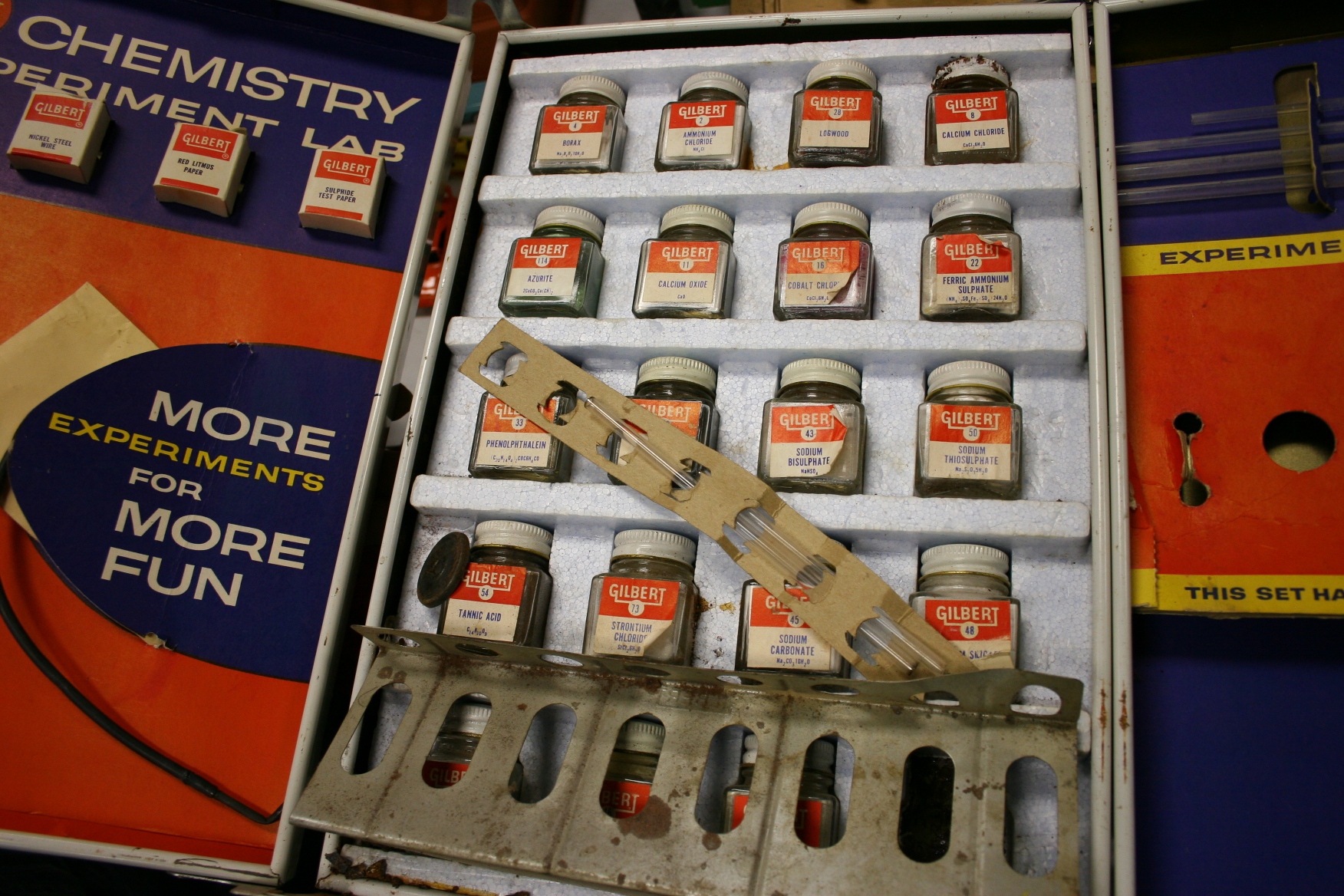
BEFORE:

Problem: This photo of a child's Gilbert Chemistry Experiment Lab does not have issues and could be published unedited.

Problem: This photo of a child’s Gilbert Chemistry Experiment Lab does not have issues and could be published unedited. But I wanted to give it a more vintage look.

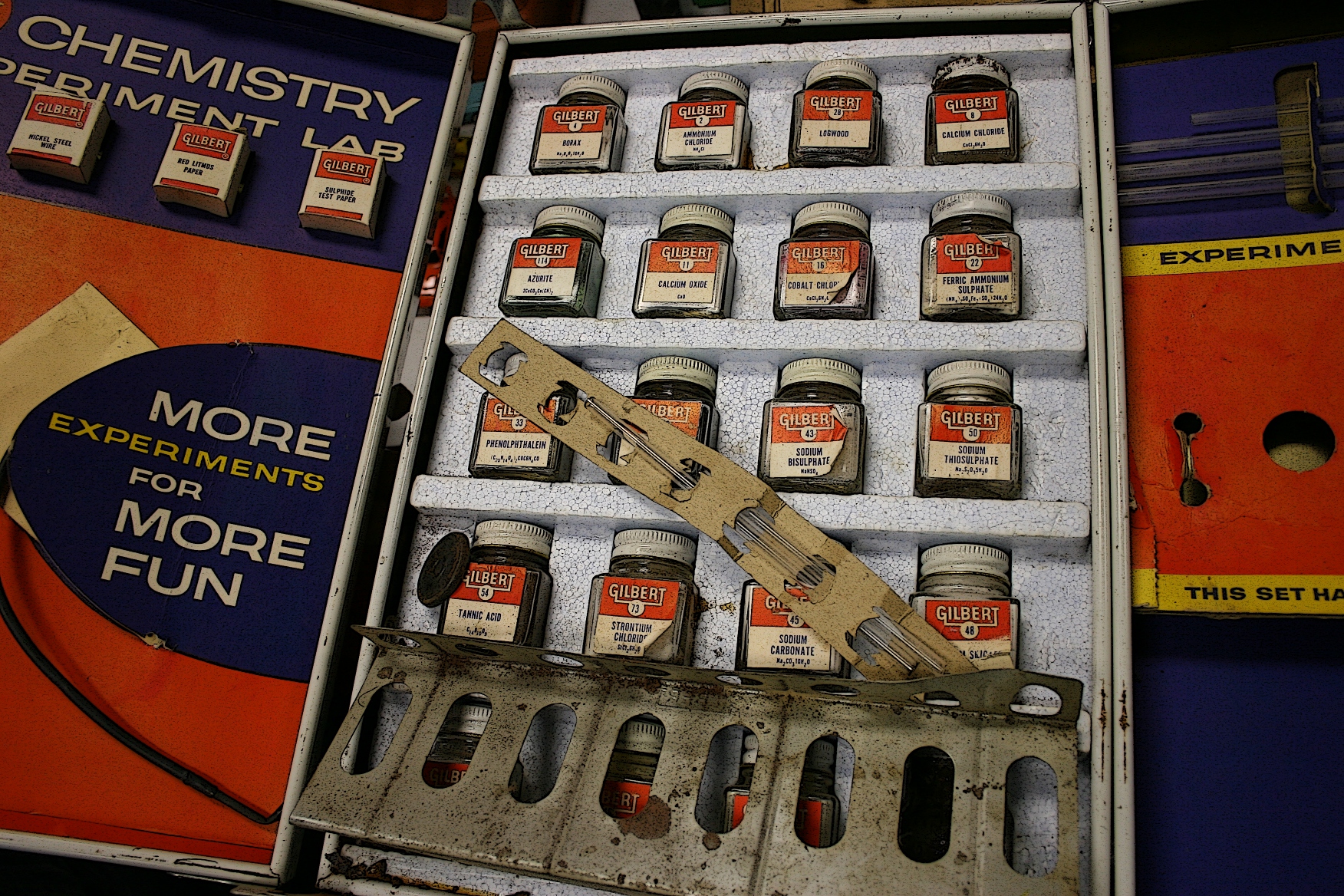
AFTER:

Solution: With the cartoon tool application, I added a subtle vintage vibe to the image.

Solution: With the cartoon tool application, I added a subtle vintage artsy vibe to the image.

Now if I was particularly tech savvy, which I am not, I’d be capable of producing even more creative photo art. But I’ve much to learn still and that keeps photography interesting.

THOUGHTS?

© Copyright 2013 Audrey Kletscher Helbling