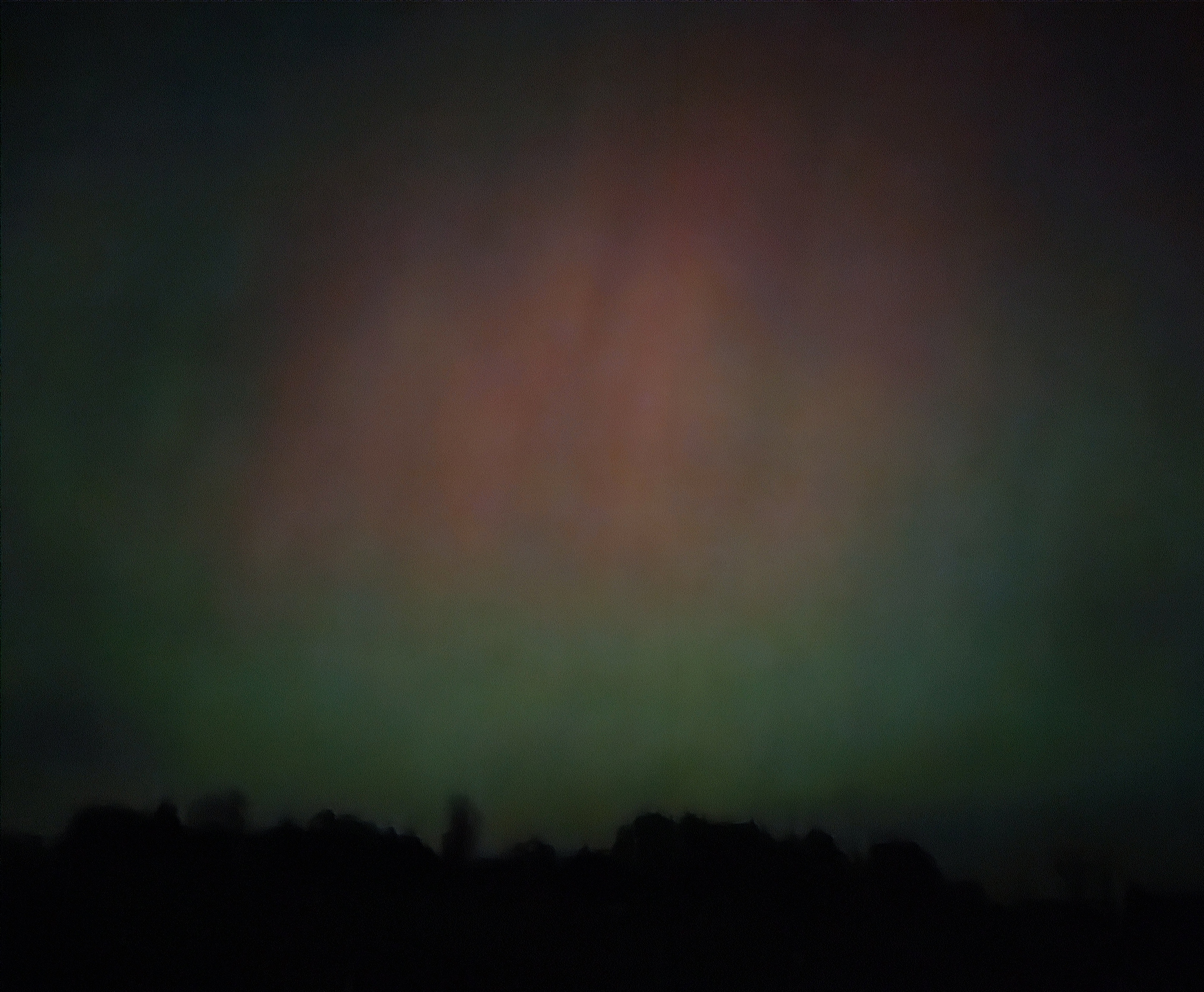
The Northern Lights, photographed northeast of Faribault near Cannon City (with a treeline in the foreground) around 9 p.m. Tuesday, November 11. (Minnesota Prairie Roots copyrighted file photo November 2025)
IT TOOK A LIFE TIME, but I finally saw the Northern Lights for the first time. Ever. And they were poetic, artistic, inspiring, incredible, wondrous, glorious…all the adjectives you can use to describe a dark night sky colored with streaks of green, red and pink.
Randy and I were sitting comfortably in the warmth of our southern Minnesota home Tuesday evening when our son texted that he could see the Northern Lights even in the city lights of Boston. A photo proved it. Then the daughter who lives 35 minutes to the north of us texted that they, too, could see the lights in Lakeville, south of the Twin Cities. Photos proved it.
We popped up, grabbed our coats and set out to see for ourselves. We didn’t have to drive far into the countryside before we noticed the first streaks of light. Turning onto a gravel road, we parked, stepped outside and turned our eyes heavenward. Then we eventually tried to figure out how to photograph the majestic scene above us on our smartphones, with only minimal success.
While I would have loved some spectacular images, what matters most is that I saw, with my own eyes, that which I’ve wanted to see my entire life. Others were doing the same. We counted about a dozen vehicles parked along rural roads, the occupants gazing skyward.
This imprinted upon me how something like the Northern Lights can bring people outdoors, appreciating this beautiful natural world that surrounds us and, which on this November evening, put on a spectacular light show.
TELL ME: Have you seen the Northern Lights? When and where? How would you describe them?
On the back of this photo, my dad simply penned “a letter from home.” I appreciate this photo taken by an unknown buddy while they were in the service. (From the Elvern Kletscher photo collection)
A SHORT BIT AGO, I reread a letter my dad wrote home to his parents in southwestern Minnesota on his 22nd birthday in March 1953. Dad penned the letter thousands of miles away in Korea, where he was fighting on the frontline during the Korean War.
Among my dad’s “Korea stuff” are a book of military instructions he carried into the battlefield, a newspaper clipping about him, and his dog tags atop his letter home, the chain circling the words “hell hole.” (Minnesota Prairie Roots copyrighted file photo November 2023)
One long paragraph of that missive stands out for me on this Veterans Day. That is Dad’s anger at the draft board and at those who thought it necessary to send young men like him into what he termed a “hell hole” and a war against Communism that he didn’t think could be won.
This photo from my dad’s collection is tagged as “Kim, Rowe, Allen & me, May 1953 Machine Gun Crew.” That’s my father on the right.(From the Elvern Kletscher photo collection)
I expect many others thought like Dad. How could you not after shooting, killing, watching your buddies die in battle? After living with hunger and bone-chilling cold in a mountainous land far from home.
At the time of his letter, Dad was especially concerned that his younger brother, Harold, would be drafted. He vowed revenge if that happened. I suppose when you’re an older brother and you’ve seen war like he has, you don’t want someone you love to experience the same. Dad’s words were just that. Words. Words written by a combat soldier weary of war. A soldier frustrated. A soldier counting the months until he could leave Korea and then be discharged from the Army.
Dad vented to his parents. He called for those in positions of power to come to the Korean battlefields, to see for themselves the realities of war. I imagine many a soldier wished the same, that officials, leaders and decision-makers understood the results of their policies, actions, decisions, orders.
My dad came home from Korea with the wounds of war. Mental, emotional and physical. He was wounded by shrapnel at Heartbreak Ridge. He experienced depression and post traumatic stress disorder.
Yet, he returned to America still patriotic, a proud American whose sacrifices and service were not then recognized. He served in what would become known as “The Forgotten War.” How demeaning, to be ignored, unsupported, just like Vietnam War veterans. Only decades later did Dad receive the Purple Heart he earned on the battlefield.
Dad went on to become an active American Legion member, serving as commander of the local post. He taught me and my siblings to respect veterans and those who died in battle. We attended every Memorial Day program in my hometown of Vesta. Afterwards we gathered at the cemetery for the playing of taps, prayer and a gun salute. We wandered among the tombstones.
I joined the Junior American Legion Auxiliary, which mostly involved selling poppies on Poppy Day. I also read “In Flanders Fields” at the community Memorial Day program and placed paper poppies on a wreath. My mom was an active American Legion Auxiliary member.
Dad integrated back into life in rural Minnesota upon his return from Korea as if nothing had changed for him. But it had. And it did. Going through his box of “Korea stuff” 72 years after he wrote that birthday letter home to his parents, I glimpse the “hell hole” of war he experienced. My anger rises, too, for all he endured and suffered on the battlefield and upon his return home to rural Minnesota.
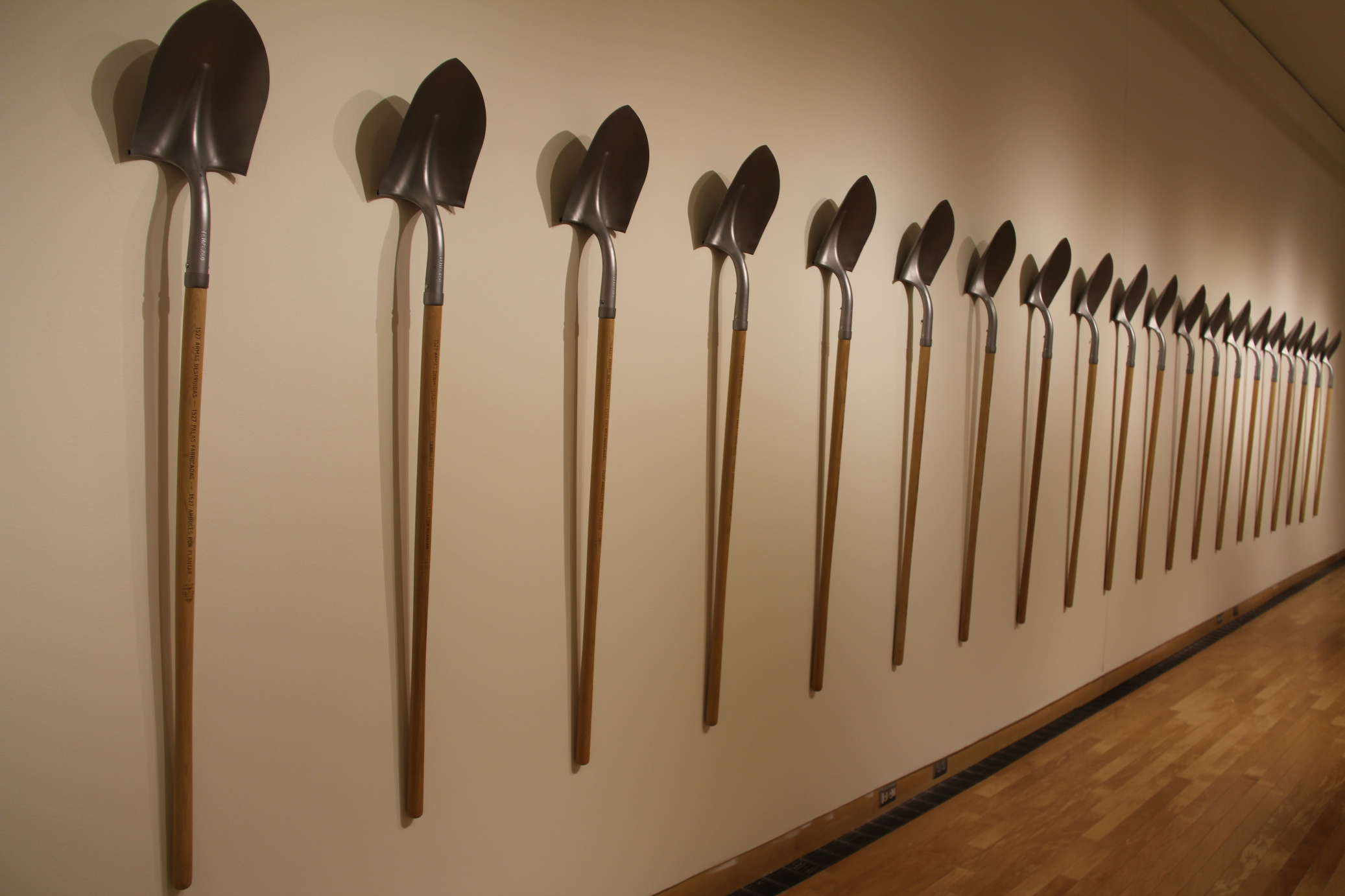
These shovels were crafted from melted guns and are part of an exhibit, “Ahimsa,” at Carleton College. (Minnesota Prairie Roots copyrighted photo October 2025)
INSIDE A GALLERY at a noted liberal arts college in a small southern Minnesota city, 20 identical shovels hang, evenly-spaced, along a beige wall. That may not seem impressive, until you read the story behind these tools.
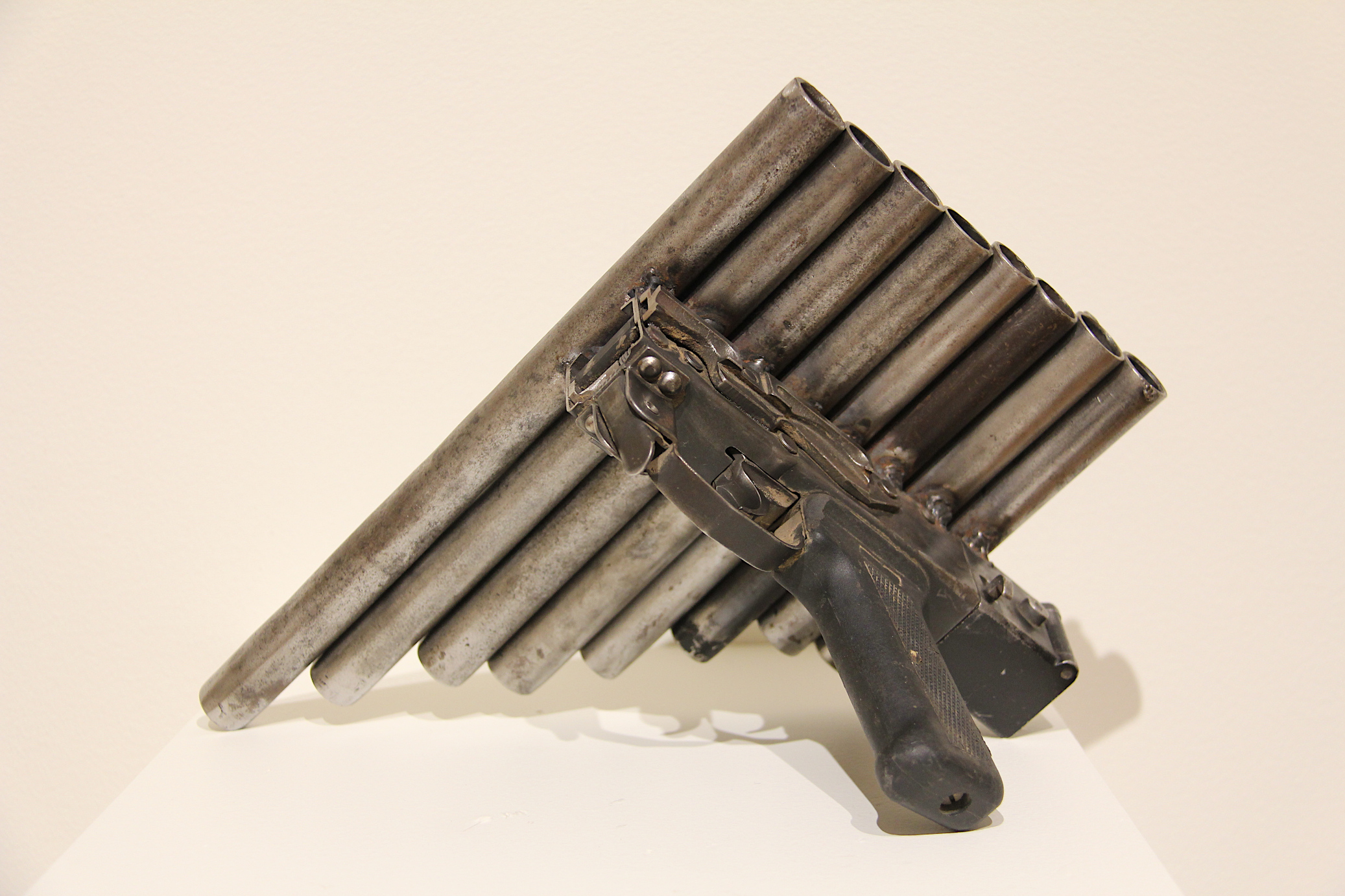
Pedro Reyes used surrendered and melted guns to create not only shovels, but also this “Disarm Pan Flute,” a playable instrument. (Minnesota Prairie Roots copyrighted photo October 2025)
These shovels were crafted from 1,527 guns surrendered in Culiacán, Mexico. Guns that were melted and made into 1,527 shovels used to plant 1,527 trees, including one at the corner of Union Street and Fourth Street East on the campus of Carleton College in Northfield.
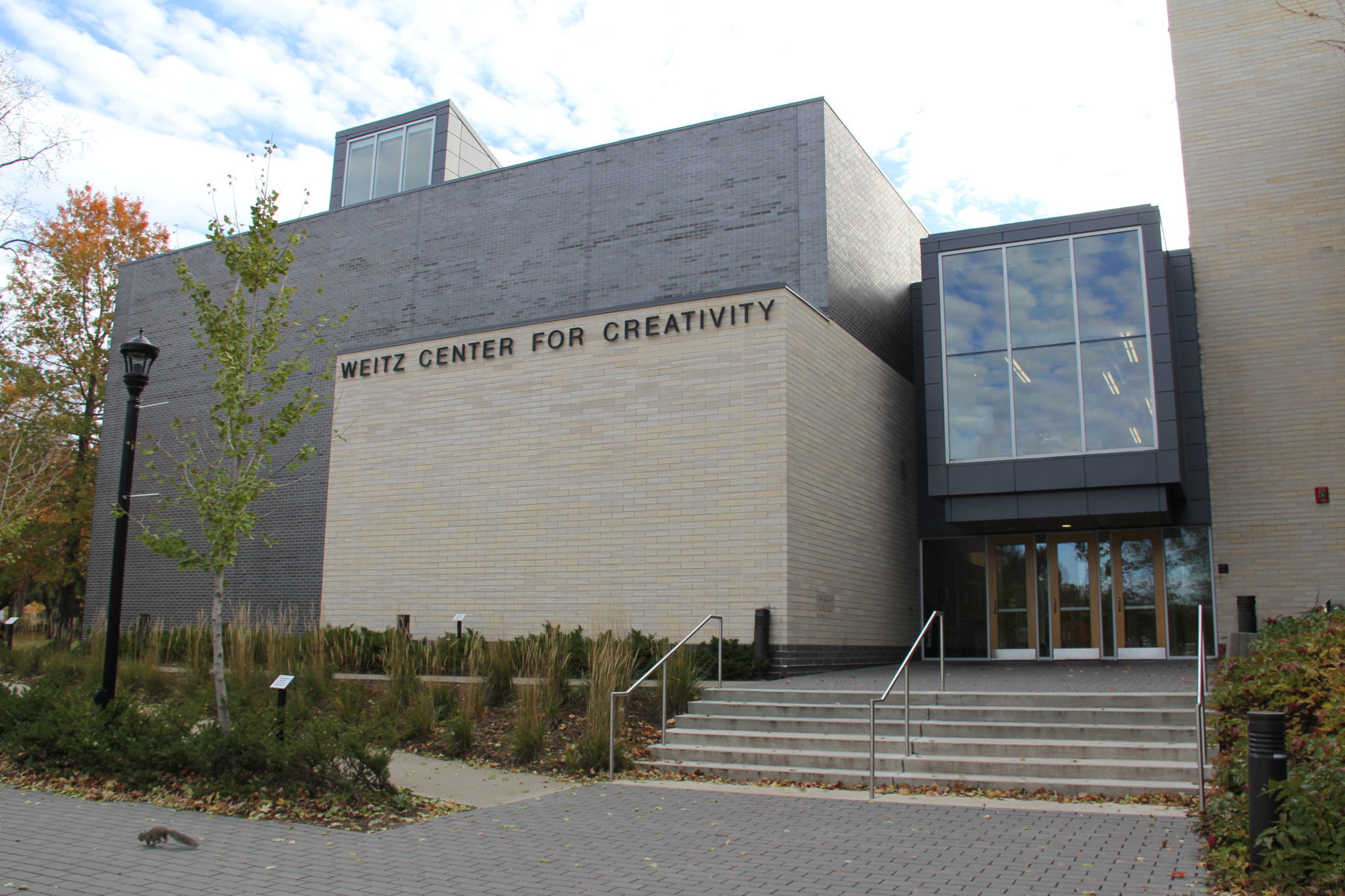
The exhibit is showcased in two galleries inside the Weitz Center for Creativity. (Minnesota Prairie Roots copyrighted photo October 2025)
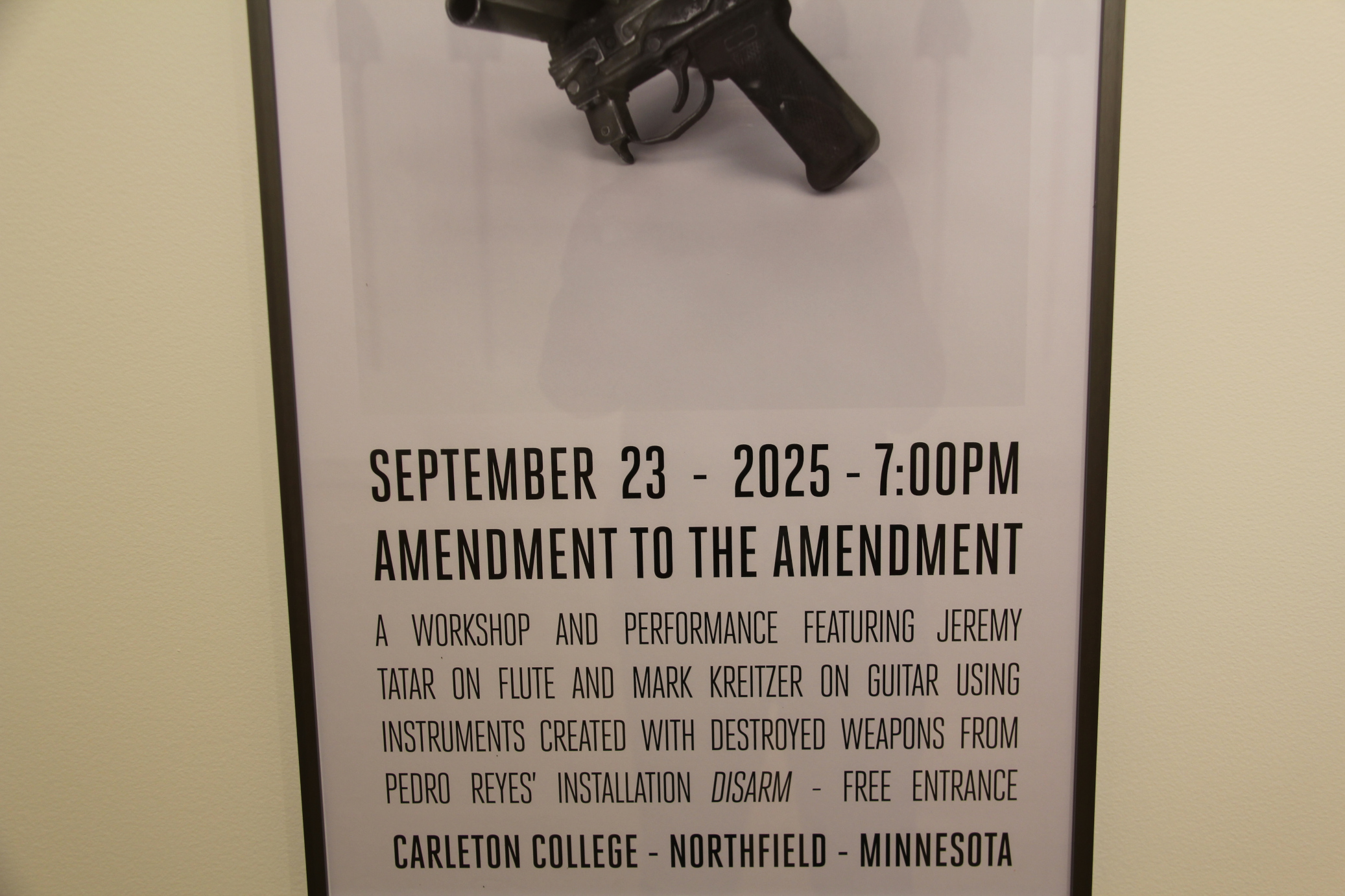
A wall of posters promoting Pedro Reyes’ exhibition shown around the world include this one from Northfield. His shows feature engaging events. (Minnesota Prairie Roots copyrighted photo October 2025)
With gun violence so prevalent in America, including right here in Minnesota with the political assassination of Minnesota House Speaker Emerita Melissa Hortman and her husband, Mark, in June and the deadly August mass shooting at Annunciation Catholic Church in south Minneapolis, I found Reyes’ exhibit profoundly relevant. I couldn’t help but think of the two Annunciation School children who were killed and the 27 other students and adults who were injured during morning Mass. Since then, voices have risen, loud and vocal, against gun violence. But thus far, nothing has changed, although discussion is ongoing with Minnesota Governor Tim Walz hosting town halls around the state on the topic.
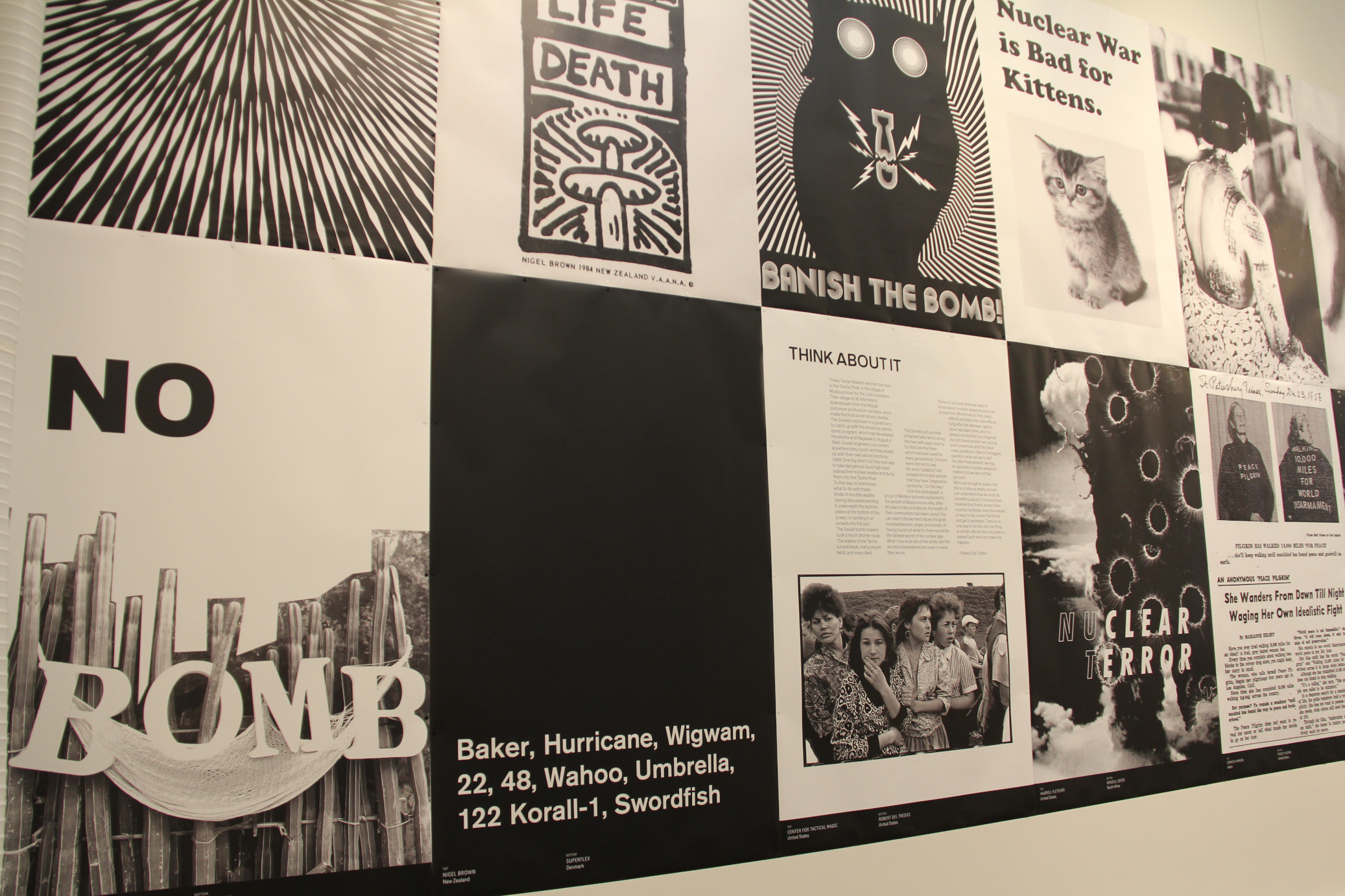
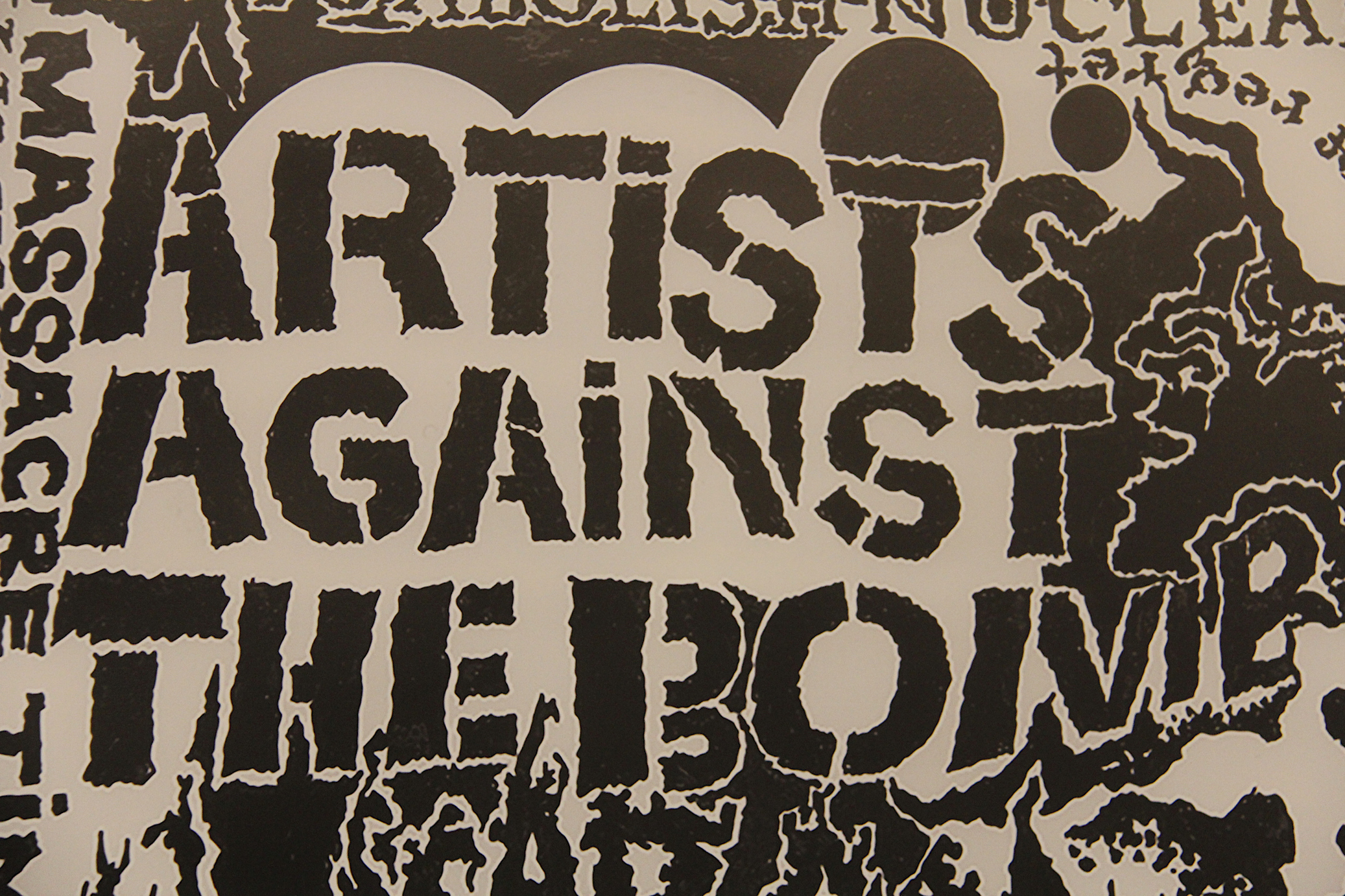
One gallery wall features posters created for “Artists Against the Bomb” by artists from around the world. (Minnesota Prairie Roots copyrighted photo October 2025)
The voice of this Mexican artist is among those rising. Upon entering the gallery, I read this: …Ahimsa reminds us that silence is complicity…
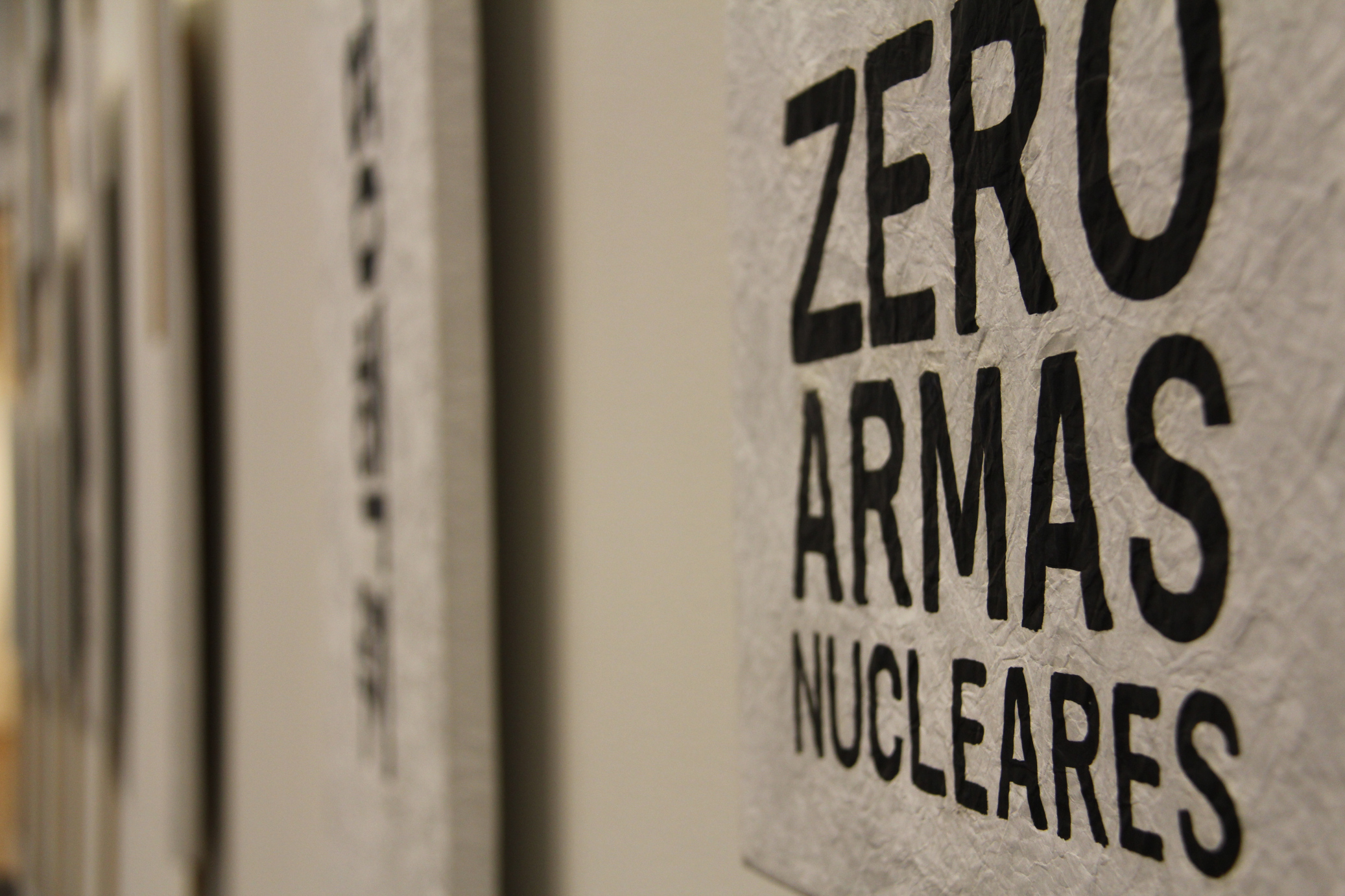
A closeup of a protest banner. A wall is covered with these signs in multiple languages with graphic symbols inspired by the conceptual element of zero. These are done in oil painting on Tyvek. (Minnesota Prairie Roots copyrighted photo October 2025)
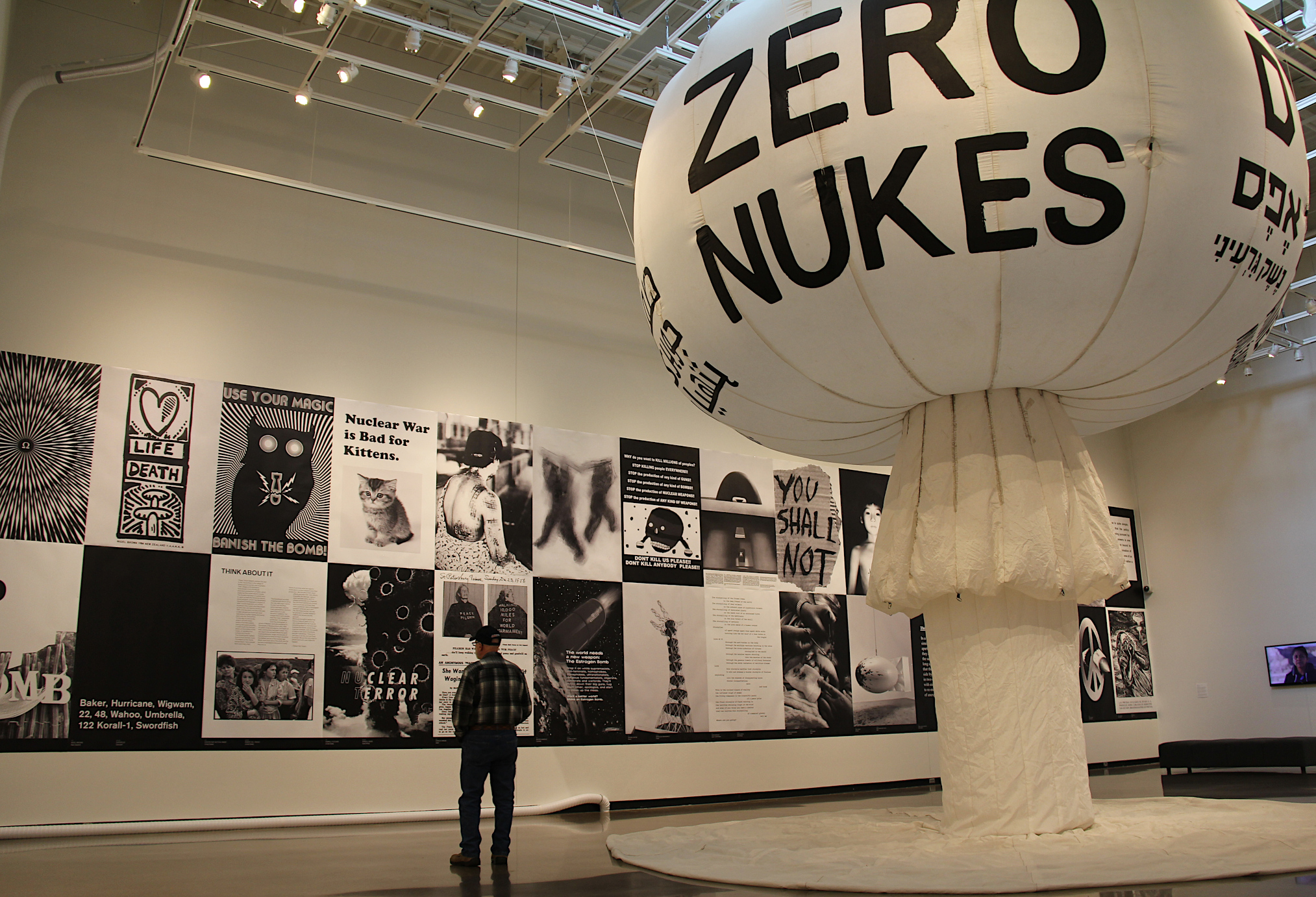
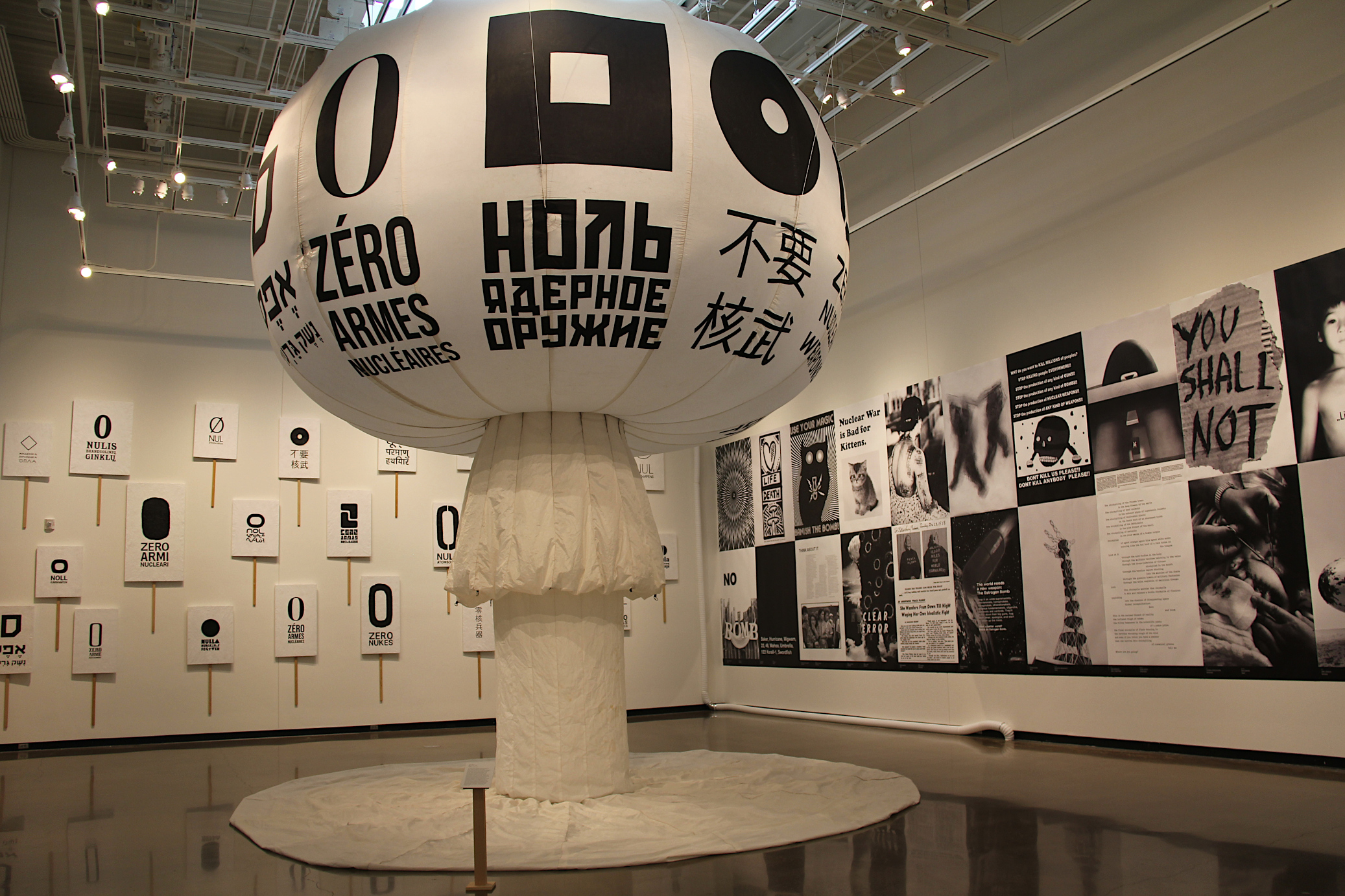
Reyes speaks out against more than gun violence in his exhibition. He also advocates for nuclear disarmament, another timely topic. And he does that in an artistically-mammoth way via a towering inflatable that overwhelms the high-ceilinged Braucher Gallery. Exactly the effect Reyes wants to make in his piece titled “Zero Nukes.”
The massive nuclear mushroom cloud centers the nuclear disarmament part of the exhibit. (Minnesota Prairie Roots copyrighted photo October 2025)
I felt minimal, small, dwarfed by the mushroom cloud upon which ZERO NUCLEAR WEAPONS is printed in eight languages.
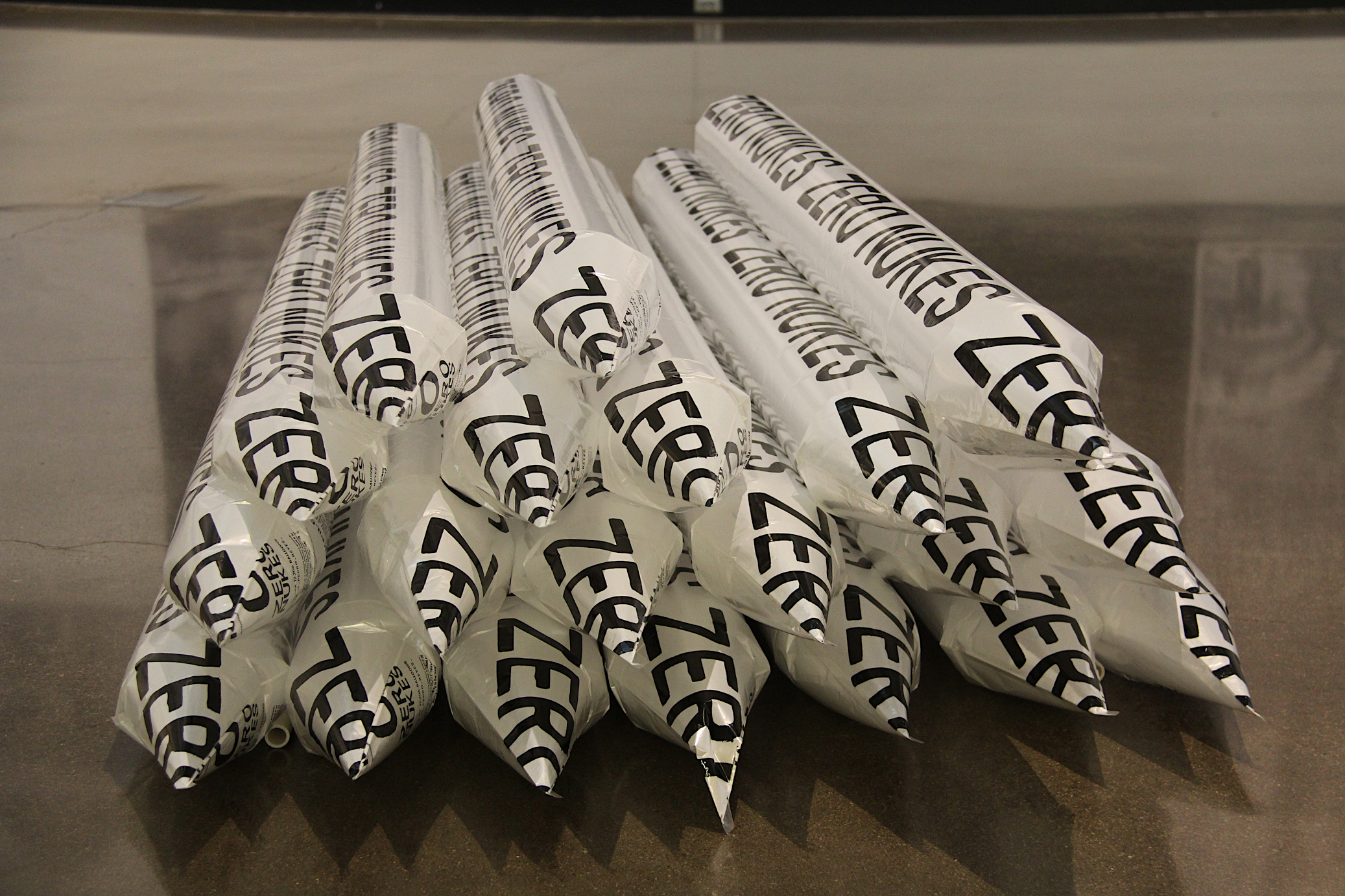
Inflatable warheads are part of the art installation. (Minnesota Prairie Roots copyrighted photo October 2025)
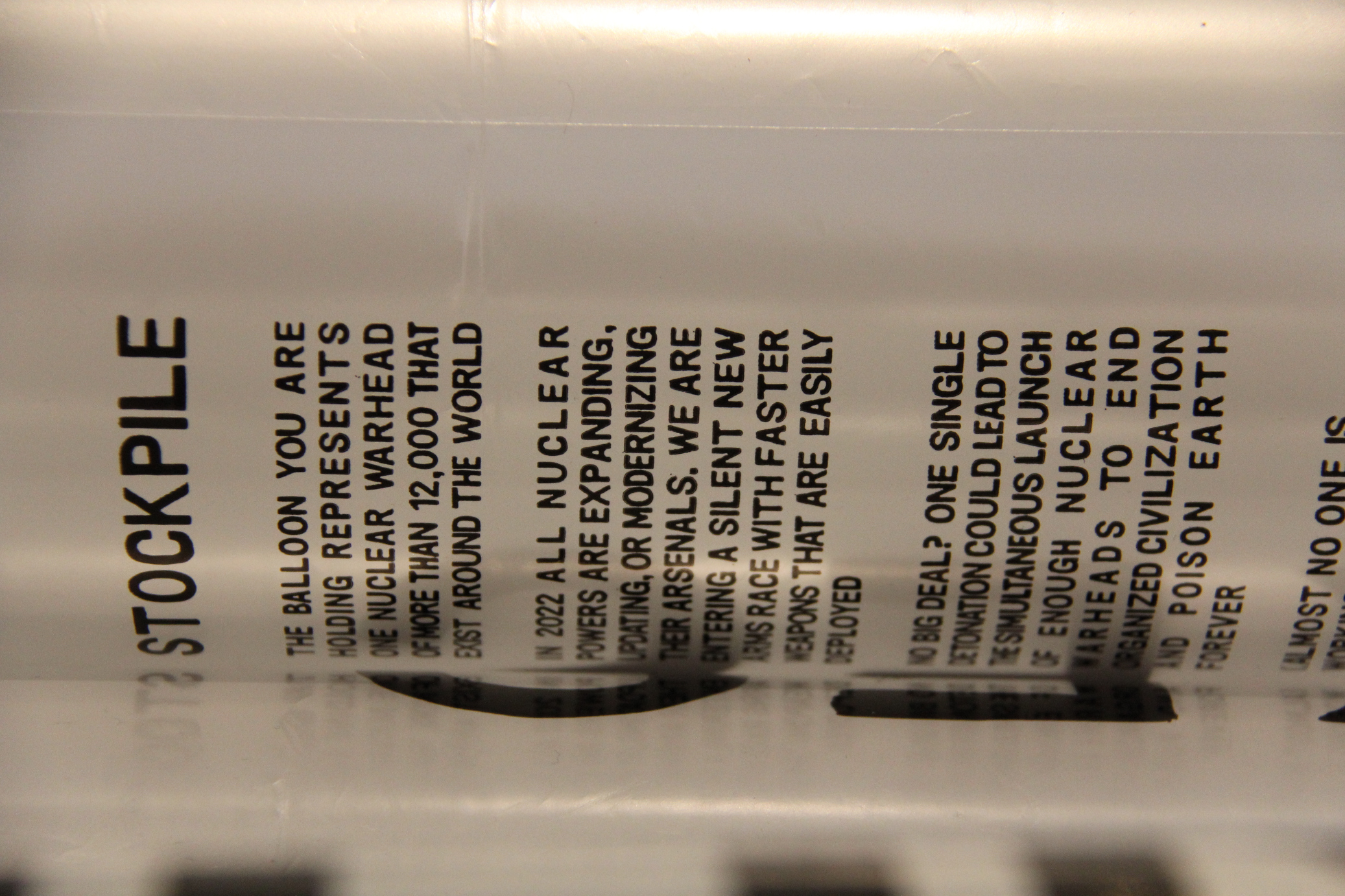
A closeup of the message printed on the inflatable warheads. (Minnesota Prairie Roots copyrighted photo October 2025)
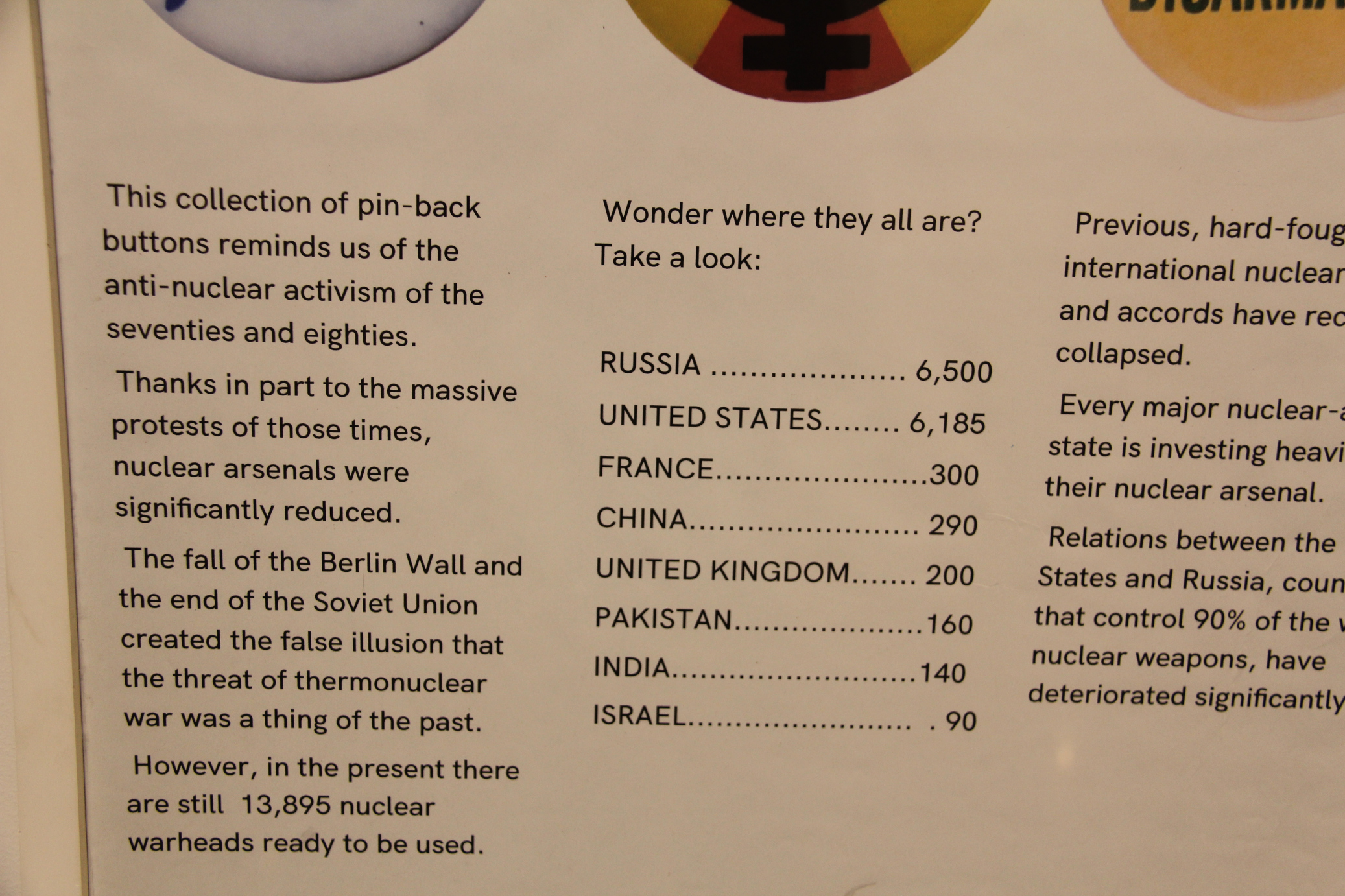
Nuclear warhead info and stats. Surprising. (Minnesota Prairie Roots copyrighted photo October 2025)
Nearby, a stockpile of inflatable nuclear warheads lies, another strong visual representing the nearly 14,000 nuclear warheads at the ready around the world. The statistics, cited as part of this display, are sobering, surprising (to me) and revealing.
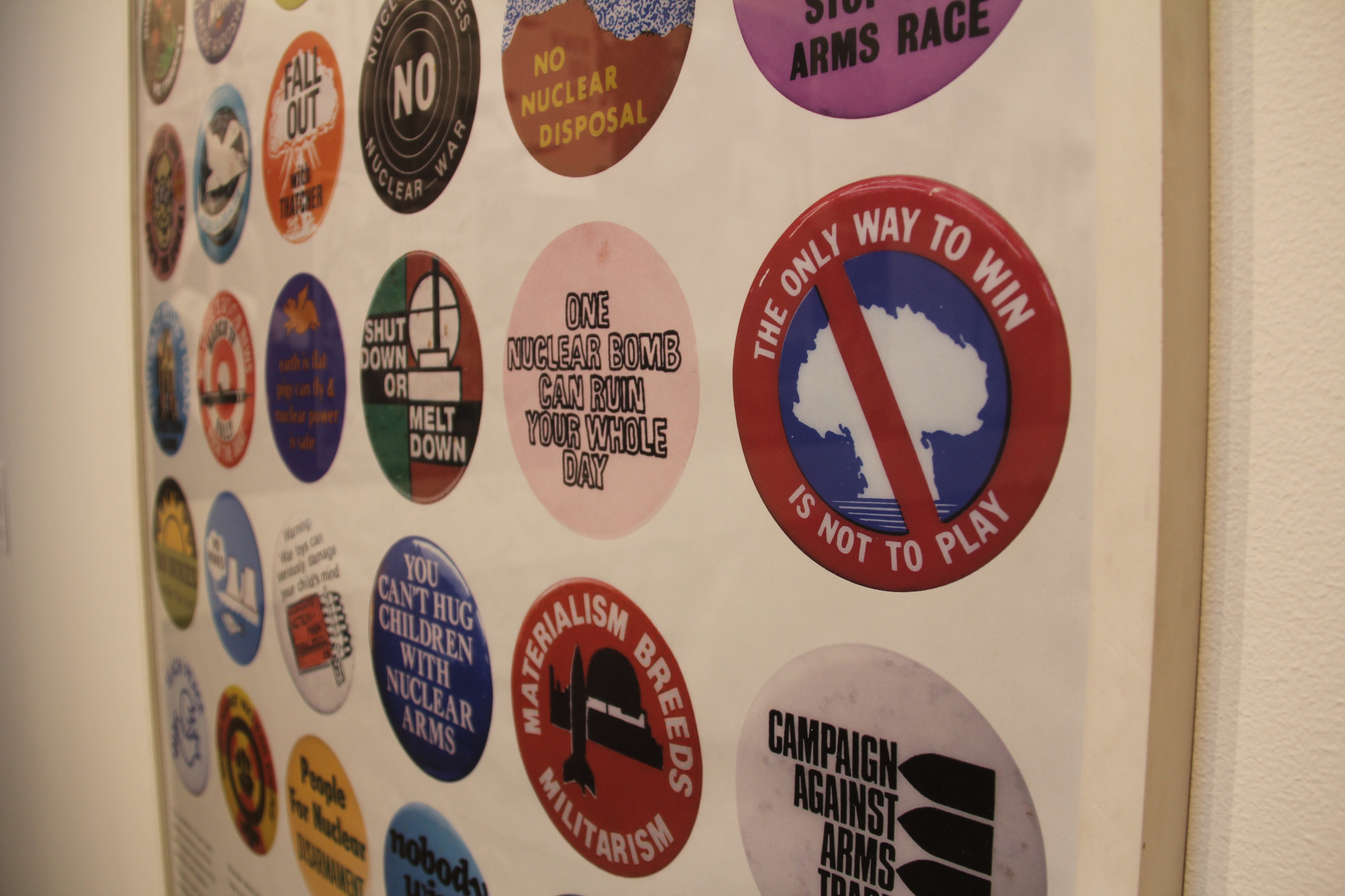
One section of the exhibit features images of buttons protesting nuclear weapons. (Minnesota Prairie Roots copyrighted photo October 2025)
One entire wall showcases the works of “Artists Against the Bomb. (Minnesota Prairie Roots copyrighted photo October 2025)
An overview of the campaign for nuclear disarmament shows the inflatable mushroom cloud, “Zero Nuclear Weapons” protest banners and a wall of protest posters, far right. (Minnesota Prairie Roots copyrighted photo October 2025)
Reyes, in his exhibit, shows us how art can be used to inform, educate, raise awareness, spark community conversation and action. He shows us via posters, buttons, sculptures, videos, inflatables and words how we can rise in protest against gun violence and nuclear weapons.
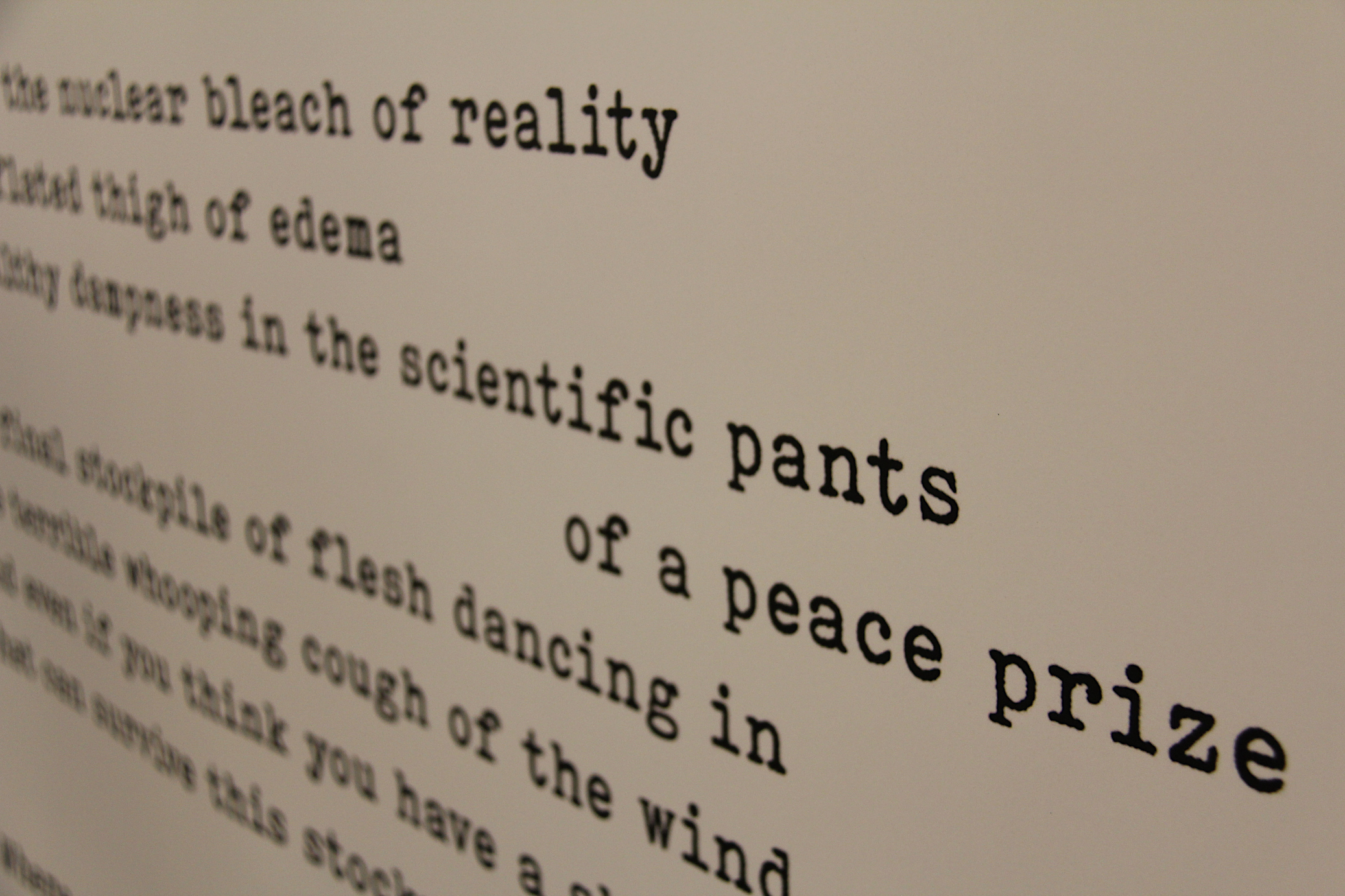
At its end, the poet asks, “Where are you going?” (Minnesota Prairie Roots copyrighted photo October 2025)
In the end we must ask ourselves the singular question posed in a poem on the protest poster wall: Where are you going? That’s in the event of nuclear war or similarly in the case of a mass shooting. I long ago stopped believing that the 1960s advice to duck and cover beneath a school desk would save me.
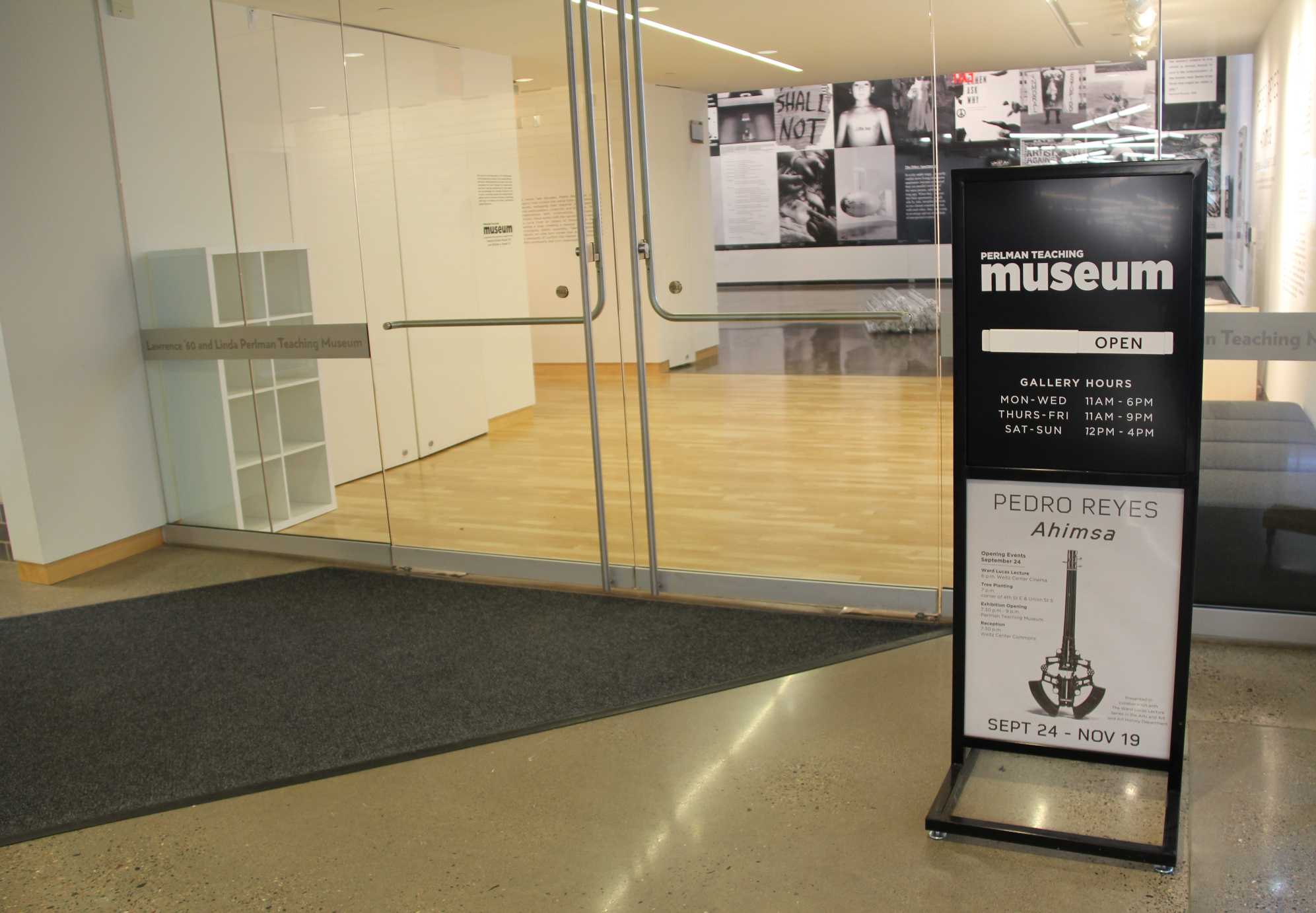
Open these glass doors and walk into the gallery showing Pedro Reyes’ “Ahimsa.” (Minnesota Prairie Roots copyrighted photo October 2025)
FYI: “Ahimsa” by Pedro Reyes is free and open to the public daily inside the Weitz Center for Creativity, 320 Third Street East, Northfield, until November 19. Hours vary. Click here for more information.





Recent Comments