
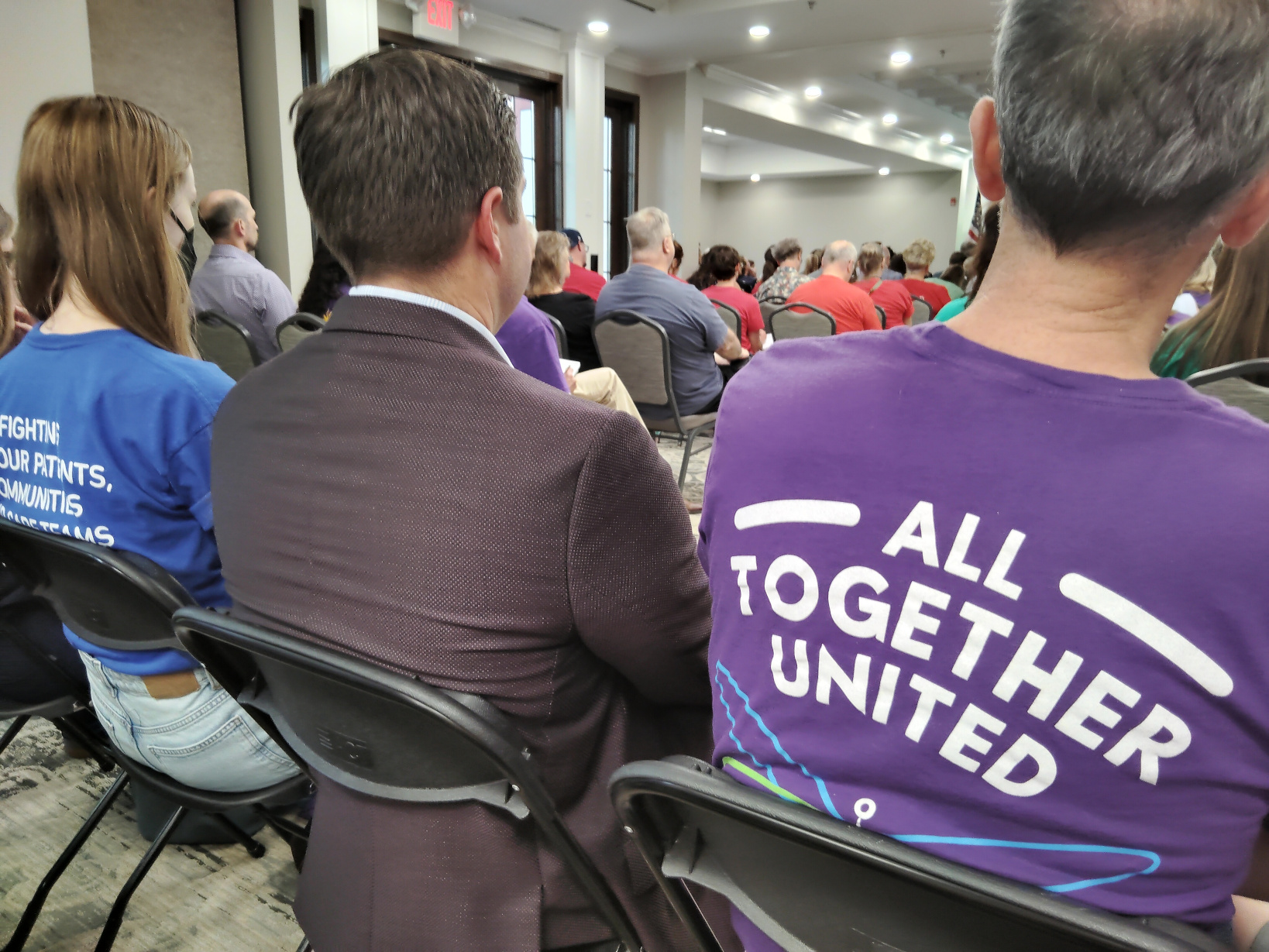
I’VE BEEN SITTING on pages and pages of notes from a community forum held in Faribault earlier this week on the proposed sale of Minnesota-based Allina Health to California-based Sutter Health. The Minnesota State Attorney General’s Office hosted the meeting, which drew around 200 people.
The intent of the listening session, according to Attorney General Keith Ellison, was to evaluate if the proposal is in the public interest. He cited concerns like wages, competition, unions and access to services. By state law (Statute 145D.01), Ellison is required to consider public input and then make a decision.
But Wednesday’s listening session, which allowed those who signed up in advance to comment for one minute each, seemed anything but a community-oriented event. Rather, Sutter flew in top leaders. Likewise Allina was well-represented by leaders and employees. This seemed well-orchestrated and slanted toward the proposed acquisition. Sixty-two people, nearly all healthcare leaders or professionals and others in leadership positions, spoke.
AVERAGE PERSON UNHEARD
I felt like the average person, the patients, the people in my city and surrounding areas served by Allina Health, were not well-represented. Maybe it’s their fault for not showing up more than they did. Maybe they weren’t aware of the meeting. Maybe they were, like me, intimidated by speaking before a crowd. Maybe jumping through the hoops to comment and/or register online and then waiting to learn the meeting location proved too technologically difficult. I think all factored into the voice of everyday people being mostly left unheard. Two friends of mine who registered online never received email notification of the meeting location.
I didn’t speak. I could have. But I’m uncomfortable standing in front of and addressing a large audience. I’d prefer a roundtable approach, where every voice, not just those of polished professionals, is heard, in person, not via a comment form.
AN IMPACTFUL STORY
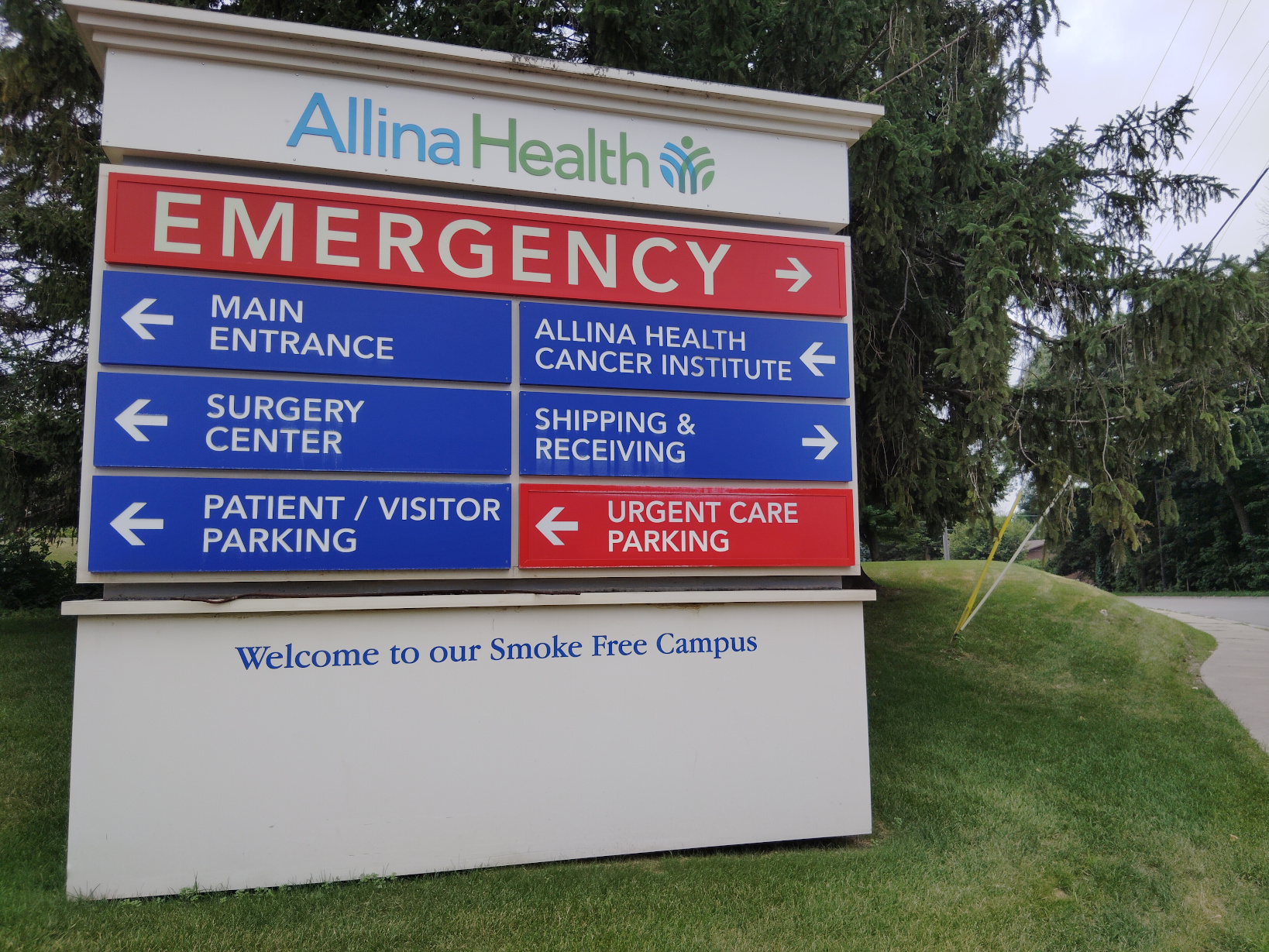
Yet it was the voice of a rural Faribault resident who made the most impactful comment of the evening, in my opinion. And it was because of a personal story he shared. Stories connect us, proving to be undeniably powerful in making a point.
This man spoke of a neighbor finding him unresponsive, an ambulance transporting him to the Faribault hospital and then learning from his healthcare team that he had been within minutes of death. His point: He likely would not have survived a longer transport to a hospital in another community.
“If we have to go back to the municipal model, let’s do it,” he said. The Faribault hospital was community-owned until Allina bought Rice County District One Hospital in 2015. And now, 11 years later, change could be, likely will be, coming again with a large California-based healthcare nonprofit buying a smaller Minnesota healthcare nonprofit.
FROM OUT OF STATE & BIGGER
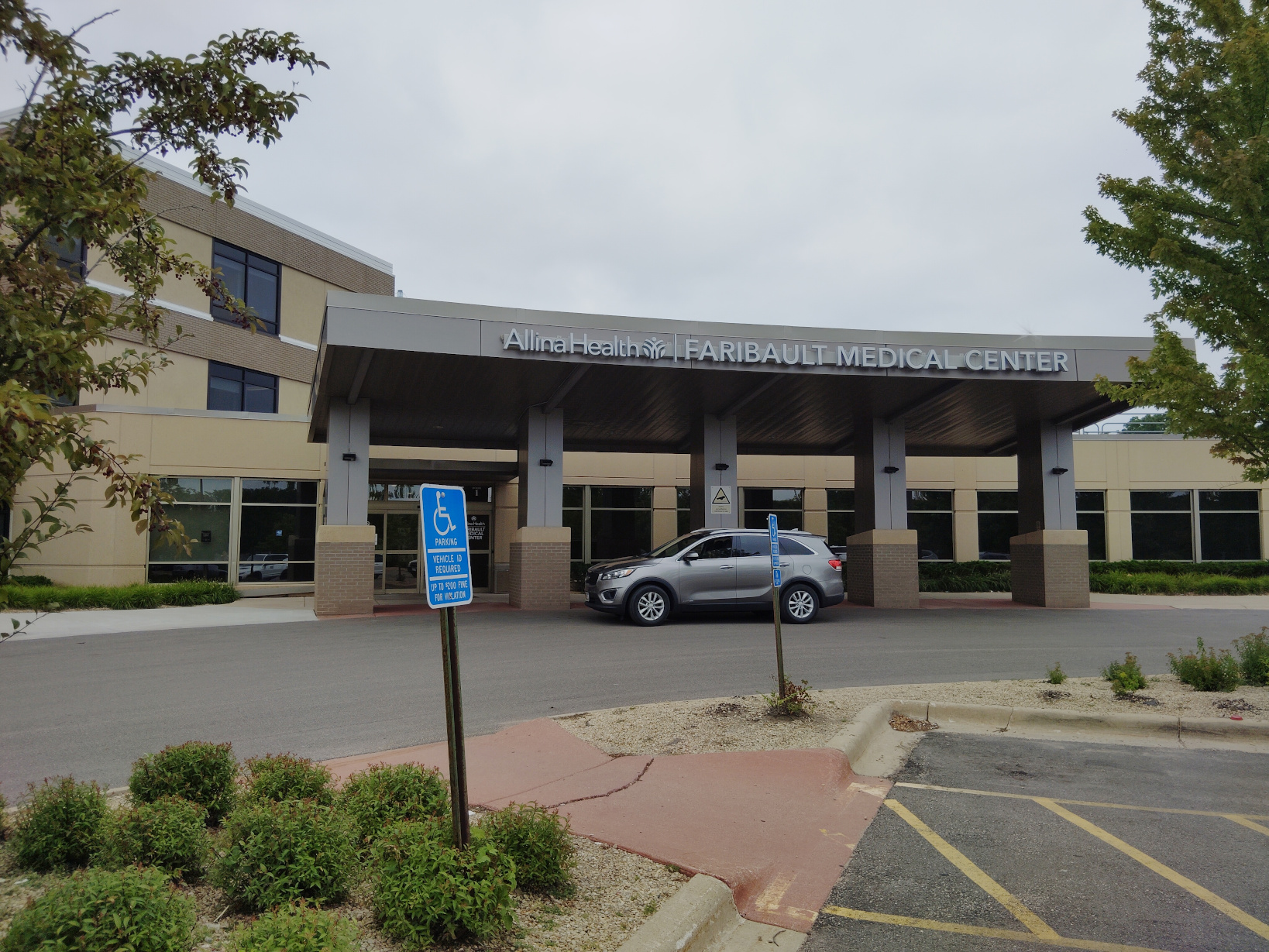
That concerns me—a much larger entity from out of state buying a healthcare system that currently provides services throughout Minnesota and western Wisconsin, including in Faribault and neighboring Owatonna. Allina just recently closed Faribault’s birthing center.
The CEOs of both Allina and Sutter used the word “partnership” multiple times in describing the proposed purchase of Allina by Sutter. In my head, I was thinking, “Call it what it is, a sale.”
EMPHASIS ON LOCAL CARE
Allina CEO Lisa Shannon, stating that “healthcare is in real trouble,” something we all know, promised access to affordable and high quality care, keeping the patient as close to home as possible. Likewise Sutter CEO Warner Thomas said several times that “Local care is best care.” I agree. I prefer local to going out of town for my healthcare, although I understand sometimes that’s necessary.
I hope the two CEOs mean what they said. Numerous commenters asked for assurances in writing to protect patients and employees. That seems a valid request.
TECHNOLOGY & FINAL THOUGHTS
The topic of technology also came up repeatedly in referencing benefits of the acquisition by Sutter Health. That bothered me, not because I don’t consider advances in technology in healthcare to be important, but because technology was emphasized so much. It is people who are at the heart of healthcare, not technology.
I could write much more about the positives and negatives expressed during the state-hosted listening session. But rather I’ll stop, hoping that the distrust, doubts and concerns I feel are unwarranted. I will continue to stay informed.
I hope, if this purchase happens, that healthcare in Faribault remains strong—available, accessible and affordable for everyone. That means no closures, no loss of services. I hope I can continue to get most of my healthcare locally from professionals I’ve grown to know and trust. That’s important to me, especially as an aging Baby Boomer.
THOUGHTS?
© Copyright 2026 Audrey Kletscher Helbling


Unfortunately, this is the state of healthcare in urban, rural and frontier areas across America. Large, for profit, healthcare corporations are purchasing mid-sized and smaller health care providers, many of which are non-profit organizations. Promises are made, sometimes in writing but more often than not, verbally. The bottom line nearly always is a reduction in services, higher costs and limited access to vital health services.
I grew up in Montgomery, just twenty miles west of Fairbault. In the 1950’s through the early 1970’s, health care was not a for profit business. Health insurance offered by large corporate insurance companies did not exist. Once insurance companies and venture capitalists figured out how to invest themselves in the health care arenas, profit became the bottom line of health care. Eventually, physicians were no longer able to practice medicine without the approval of some distant care manager sitting at a computer and dictating what a physician or other health care provider could do based upon an algorithm.
Today, millions of Americans are losing their healthcare insurance under the Patient Protection and Affordable Care Act (Obamacare), because republicans in Congress decided to reduce taxes permanently for the wealthiest Americans on the backs of middle-class and lower income Americans.
Ultimately, those American’s who have lost their health insurance due to the health care cost cutting in The One Big Beautiful Bill, will have to rely on county hospital emergency rooms. They will not seek preventive healthcare, nor will they travel the distance to seek health care until their illnesses are so severe that they have no choice.
Emergency departments in any hospital is the most expensive form of health care provision. In county hospitals, many of which are closing due to the cost cutting, the burden is borne by the local taxpayers. These taxpayers will be the same hard-working Americans who are being squeezed by higher costs for housing, food, fuel, clothing and other necessities.
This sad story is playing out across America. We are just beginning to reap the horrors of the impact of the One Big Beautiful Bill. The largest land mines laid by the republican’s reconciliation bill are yet to be detonated. They will be coming after the mid-term elections in November. These land mines that will harm middle- and low-income Americans were planted by design, to go off after the people have voted in the November 2026 mid-term elections.
Think about your health care, your children’s health care and the future you want for them when you enter the voting booth in November.
Well stated. I agree with you and appreciate the time you took to craft this detailed and informative comment. Thank you!
honestly Audrey I am surprised that they are not starting to go in the opposite direction- opening small healthcare centres in multiple regions. We are going to slowly turn back to local services as gas prices go up and stay up and resources get scarcer and people cannot drive so far for care and/or work.
already my husband in Illinois has to drive two hours to get a heart check up. So if I am not there to nag – he just doesn’t go.
I read an interesting article the other day about when they were recruiting soldiers in the US for Ww2 and 30% were turned away because they did not meet the wellness criteria. Later they brought in Medicare and Medicaid (and funded local facilities) to raise the health of the nation. It was a wake up call. Interesting right?
we have to be careful not to run back in the wrong direction – yet we all feel so powerless.
You make some really good points, Cecilia. The price of everything continues to rise. And, yes, the cost of gas and maybe even the possibility of needing to rent a hotel when getting healthcare in a distant city can be a determining factor whether one even seeks care. I’m sorry your husband must drive two hours to get his heart checked. But I know this is reality in rural areas. If I need specialty care, my drive is an hour into the Twin Cities metro. I like your idea of returning to smaller healthcare centers. I’m sure the argument would be cost and staffing shortages. Good to hear from you on this important topic.
the buildings are already there and your staffing flag is a solid one. Maybe if there was more money to train the staff, educate the people in health, etc. But I know these things are not in our hands either – imagine if we were billionaires the number of kids we could send off to school and regional health care units we could kit out!!
Yes, imagine…
Well done! (spoken? written?)
This certainly reflects my inclinations. I am thankful that the municipal hospital and clinics organization in my hometown bought out the Allina clinic before these new changes loomed. (Perhaps that was a sign that the Allina board wanted to get out of business some time ago.)
I thought the same about the Northfield hospital. Interestingly enough, someone in a leadership position at the Northfield hospital (didn’t get his name) commented during the meeting, in support of the proposed acquisition of Allina by Sutter. Before commenting, he said his was a “rural independent healthcare system.”
I appreciate your comment here.
thanks for sharing your summary and take on this, Audrey. it is unfortunate that they didn’t allow the time and an an easy process for local people who wanted to speak. as you said, local care has been good for you and i’m hopeful that if the change does happen, they will keep the local hospitals/clinics open and they will honor their word.
one thing on top of everything else is that the white house is canceling the subsidy that kept costs down for seniors who have medicare part D to cover prescription drugs. in some rural communities, the paramedics have been the ones who have to offer medical care and support when the small local clinics and hospitals shut down and people live too far away from their health care centers. the paramedics are exhausted. you are doing your due diligence and know that you and others wil follow the story, as it impacts the community/state.
So much is broken right now in the healthcare system. Insurance is unaffordable. Costs for healthcare are unaffordable. People are losing access to healthcare. For those living in rural areas, it’s a real challenge especially.
I am incredibly thankful to be on Medicare after years of paying ridiculously high insurance premiums through my husband’s work plan. His employer paid only half of his premium. We kept our deductible high to keep the premiums lower. We were still paying around $20,000 annually in health insurance premiums, basically to cover catastrophic health issues.
that is so awful. tomorrow is our primary election, and one of our dem candidates for the US Senate, Dr. Abdul El-Sayed is a progressive ,and part of his platform is Universal Health Care. He is brilliant and empathetic and took over the City of Detroit’s Health Department, reopening clinics in the city, free glasses for children, paid off millions in medical debt for people for pennies on the dollar, pro choice/women’s heath care, etc. – i’ve been volunteering some of my time on his election and i really hope he wins, because we really need people who want to help people to be in power.
I hope your candidate wins. Please email me with results. I’d like to hear.
I wish everyone would consider this when they vote: “…we really need people who want to help people to be in power.”