Minnesota Prairie Roots

Writing and photography by Audrey Kletscher Helbling

A spectacular fireworks show, sort of July 5, 2010

Filed under: Uncategorized — Audrey Kletscher Helbling @ 9:49 AM
Tags: , ,

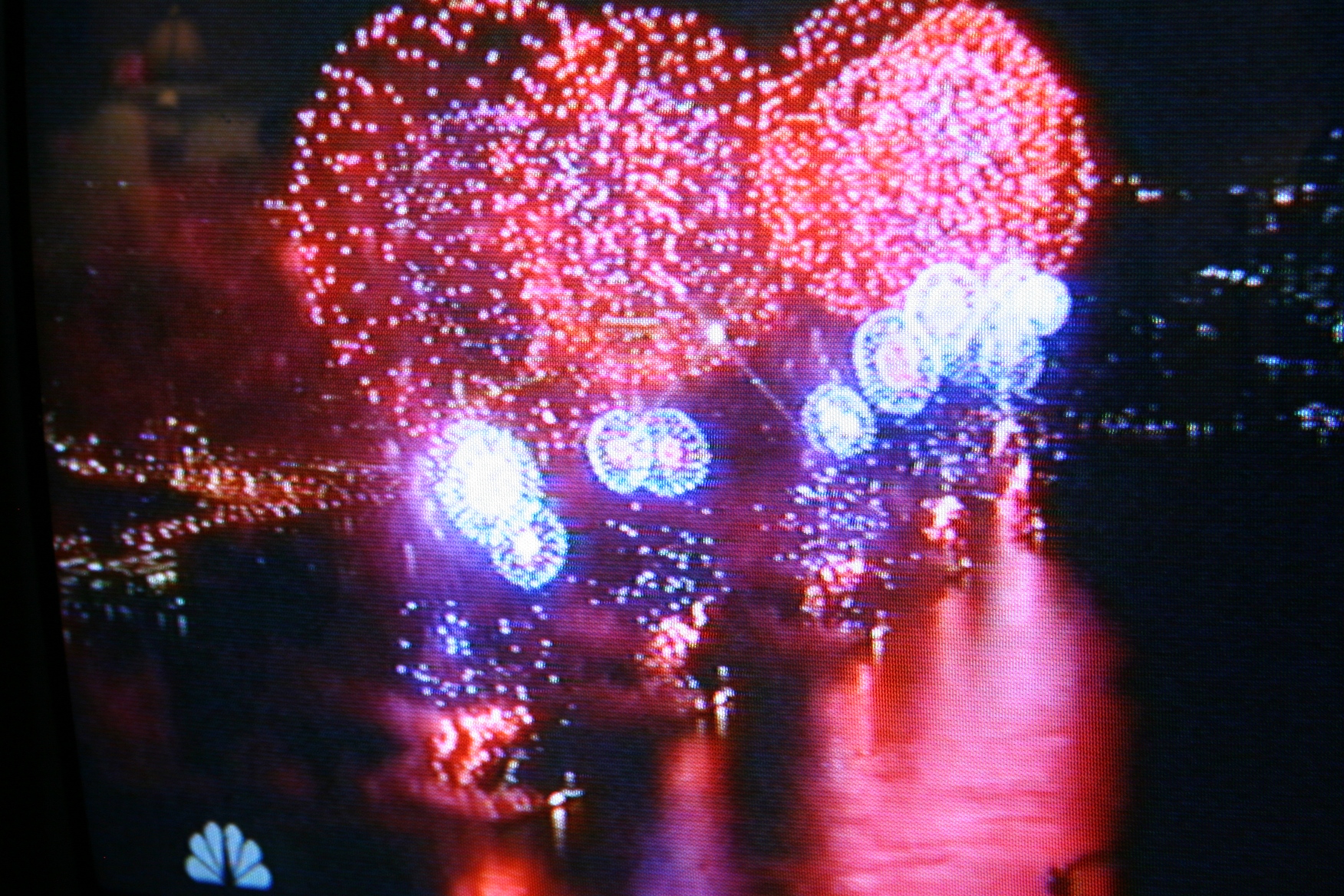
The most magnificent of fireworks displays, viewed by millions.

THIS WAS, WITHOUT QUESTION, the best fireworks display I’ve ever seen.

Multiple fireworks shot simultaneously above the water, exploding non-stop in the night sky like “the rockets red glare, the bombs bursting in air.”

I sat riveted, in awe, wondering how the pyrotechnicians managed this show, this exact timing, this magnificence before me.

Coordinated with patriotic songs like The Battle Hymn of the Republic and The Star Spangled Banner, this Fourth of July fireworks show impressed and inspired. I’d never seen such a spectacular scene on Independence Day.

Yet, something was missing. And, truth be told, watching fireworks from the comfort of a La-Z-Boy recliner in your air conditioned living room simply does not measure up to sitting outdoors on a lawn chair in a mid-sized Minnesota town watching fireworks soar, one by one, into the air.

For the first time in forever, my family skipped the local fireworks show, choosing instead to view the annual Macy’s fireworks extravaganza televised from New York.

Although the show ranked beyond impressive, I missed the experience of lounging outside, gazing at the expansive sky, anticipating each burst, hearing the ooooohs and the aaaaahs, the cheering, the clapping.

But I didn’t miss the mosquitoes, droning and diving, circling and attacking, and the reason we opted for a bug-free front row seat beside the Hudson River.

Fireworks over the Hudson River, as seen on my television from my La-Z-Boy recliner in Minnesota.

Text © Copyright 2010 Audrey Kletscher Helbling


A WW II flag of honor reminds me of freedom’s price on Independence Day July 4, 2010

Filed under: Uncategorized — Audrey Kletscher Helbling @ 8:38 PM
Tags: , , , , ,

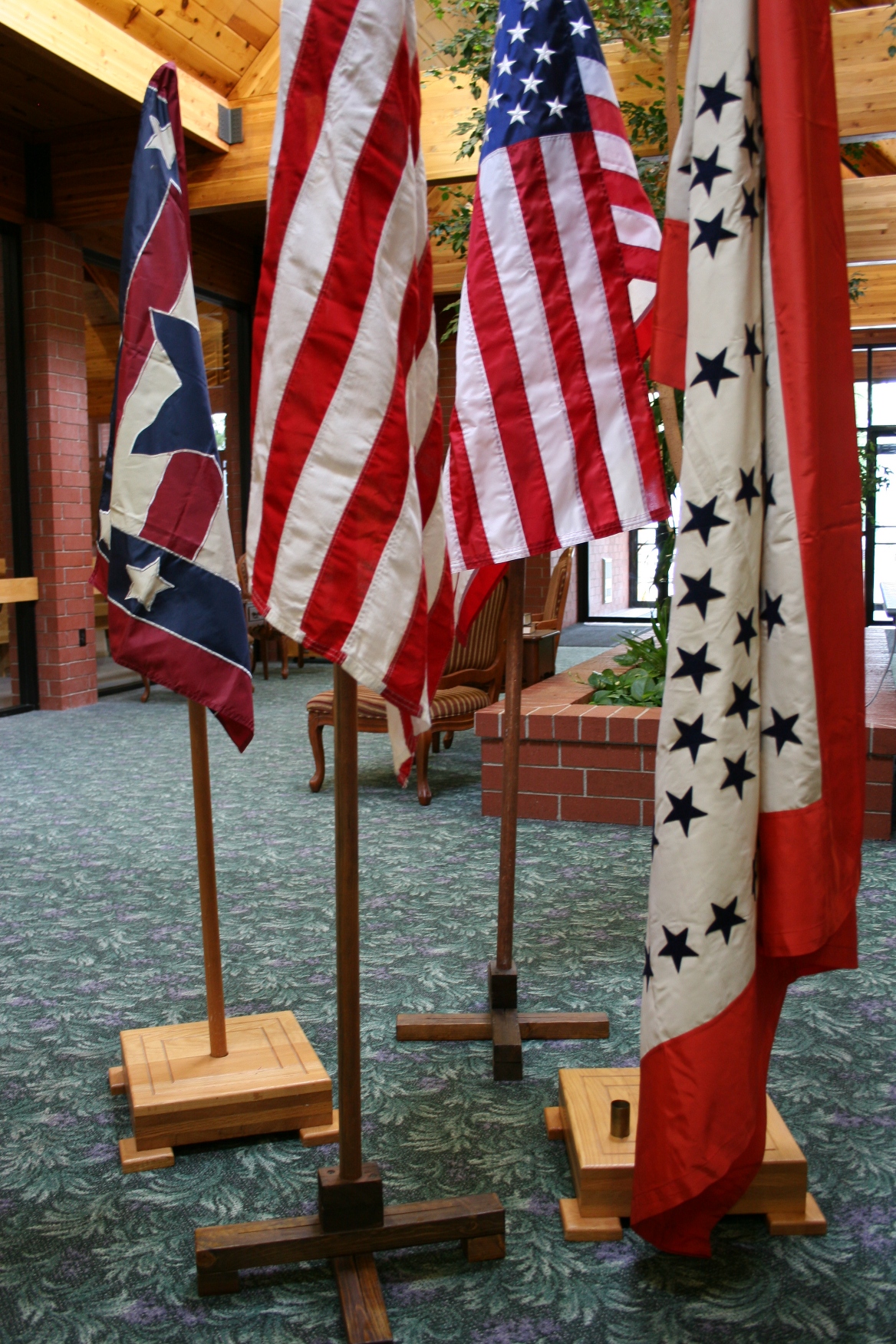
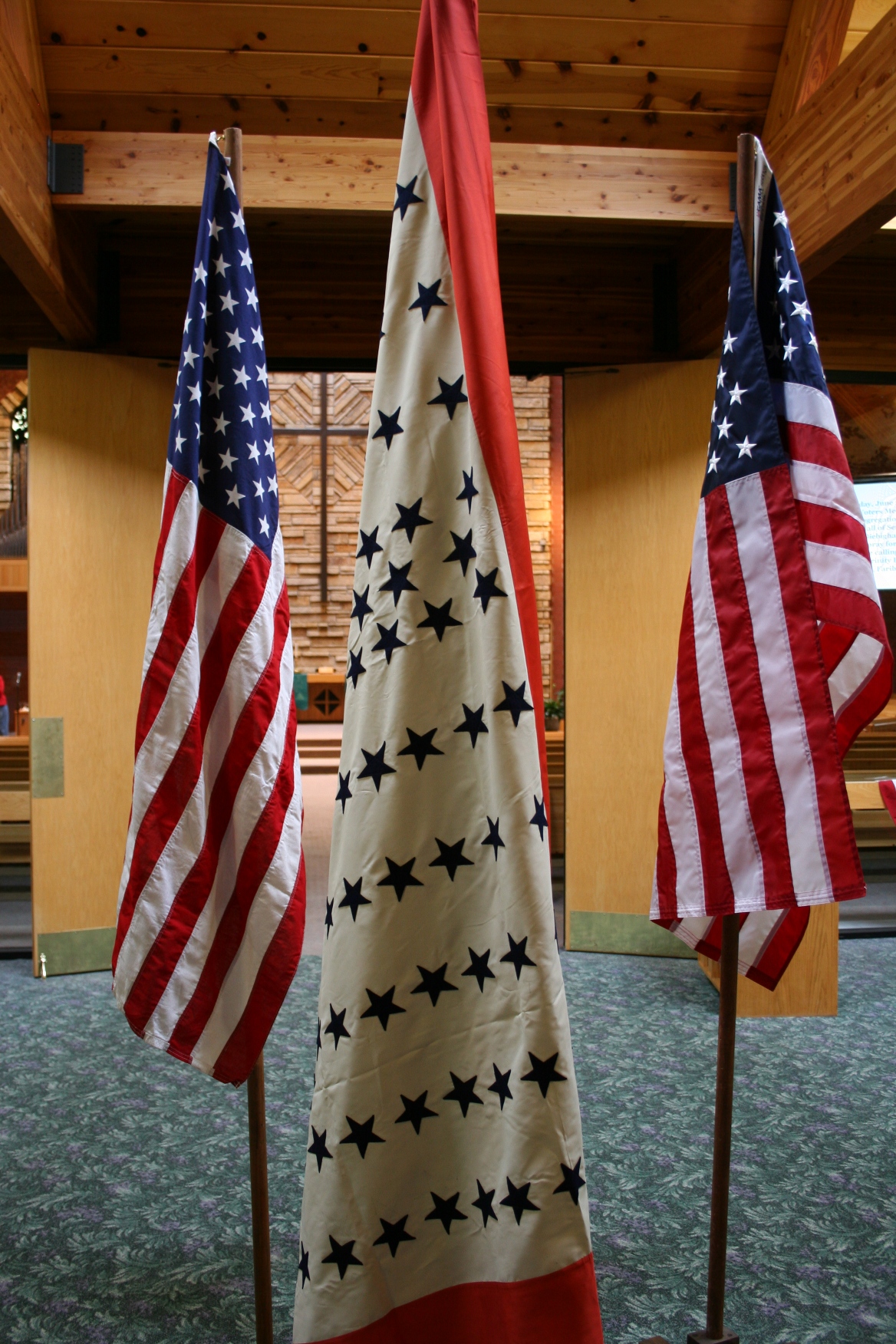
Four flags, including an American flag that flew in Iraq, stand in the narthex of Trinity Lutheran Church, Faribault, Minnesota.

FOUR FLAGS STAND in a circle in the Trinity Lutheran Church narthex—two American flags, the other two unrecognizable to me.

So I inquire on this Sunday morning, this Fourth of July, this day we celebrate our nation’s birthday, this day of independence.

The one flag, with the big blue star in the center and the smaller white stars along the sides belongs to Kathy, who manages the church office. She knows nothing about its background, only that she purchased and proudly flies this red-white-and-blue at her home along with an American flag.

But the other flag, oh, the large star-studded flag, draws the attention of many. “What is this flag?” we ask each other as we unfold the fabric to reveal a sea of stars on white fabric bordered by red.

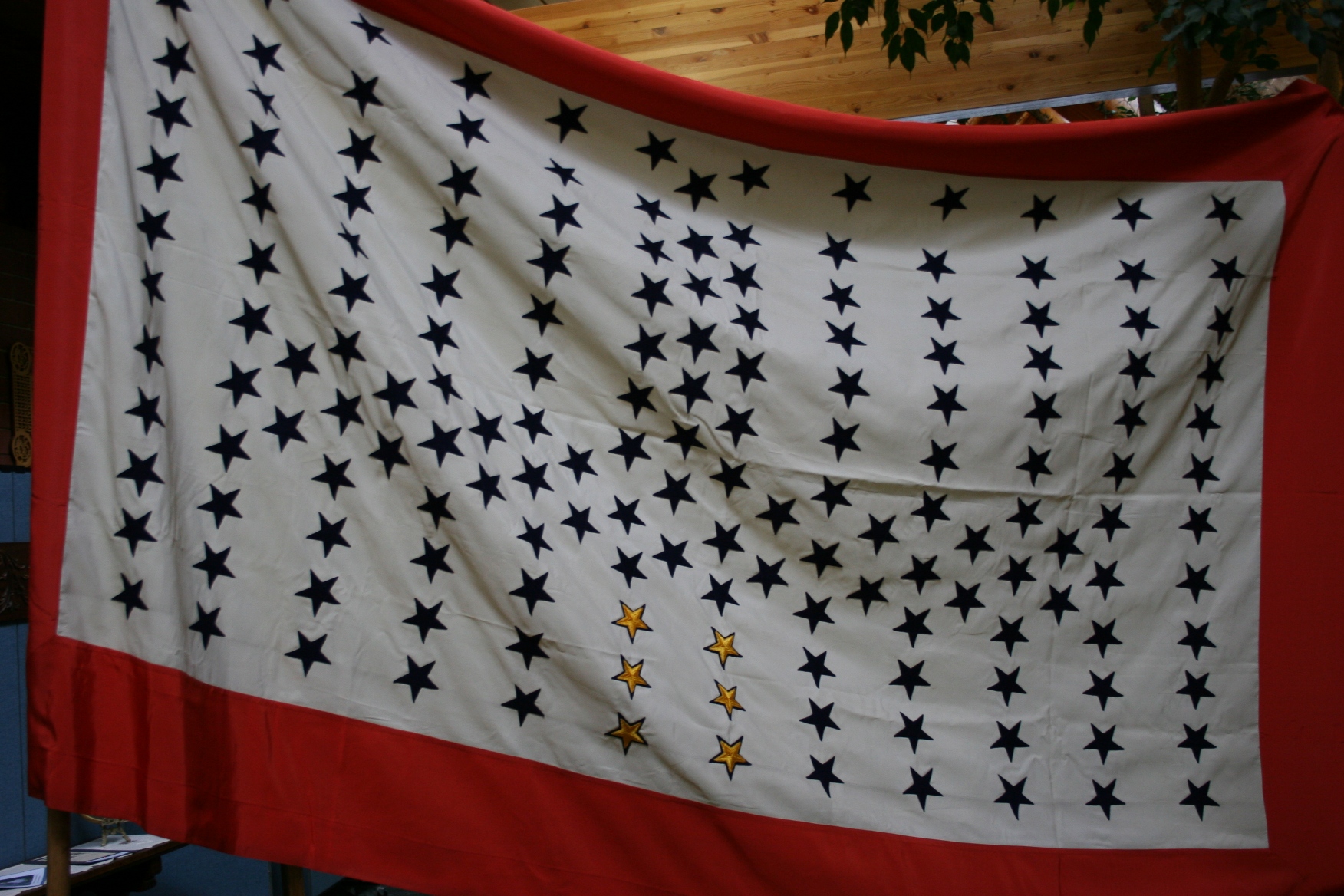
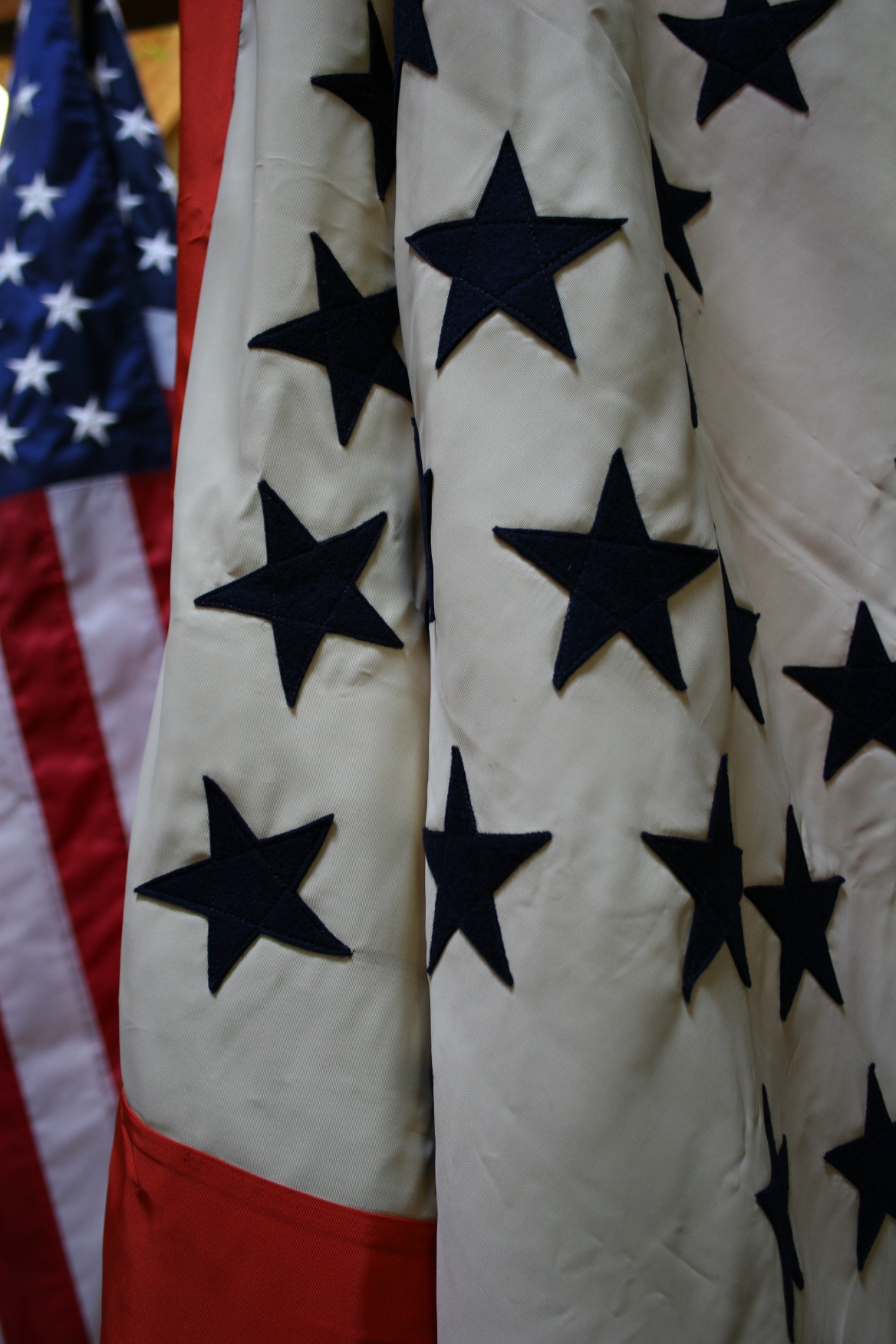
The women of Trinity Lutheran Church stitched this WW II honor flag.

And no one knows, until Dave arrives and uncovers the mystery. It is, he says, a flag recognizing those congregational men and women who served our country during WW II. The blue stars denote all who served. The six gold stars hand-stitched atop six blue stars honor those who never came home.

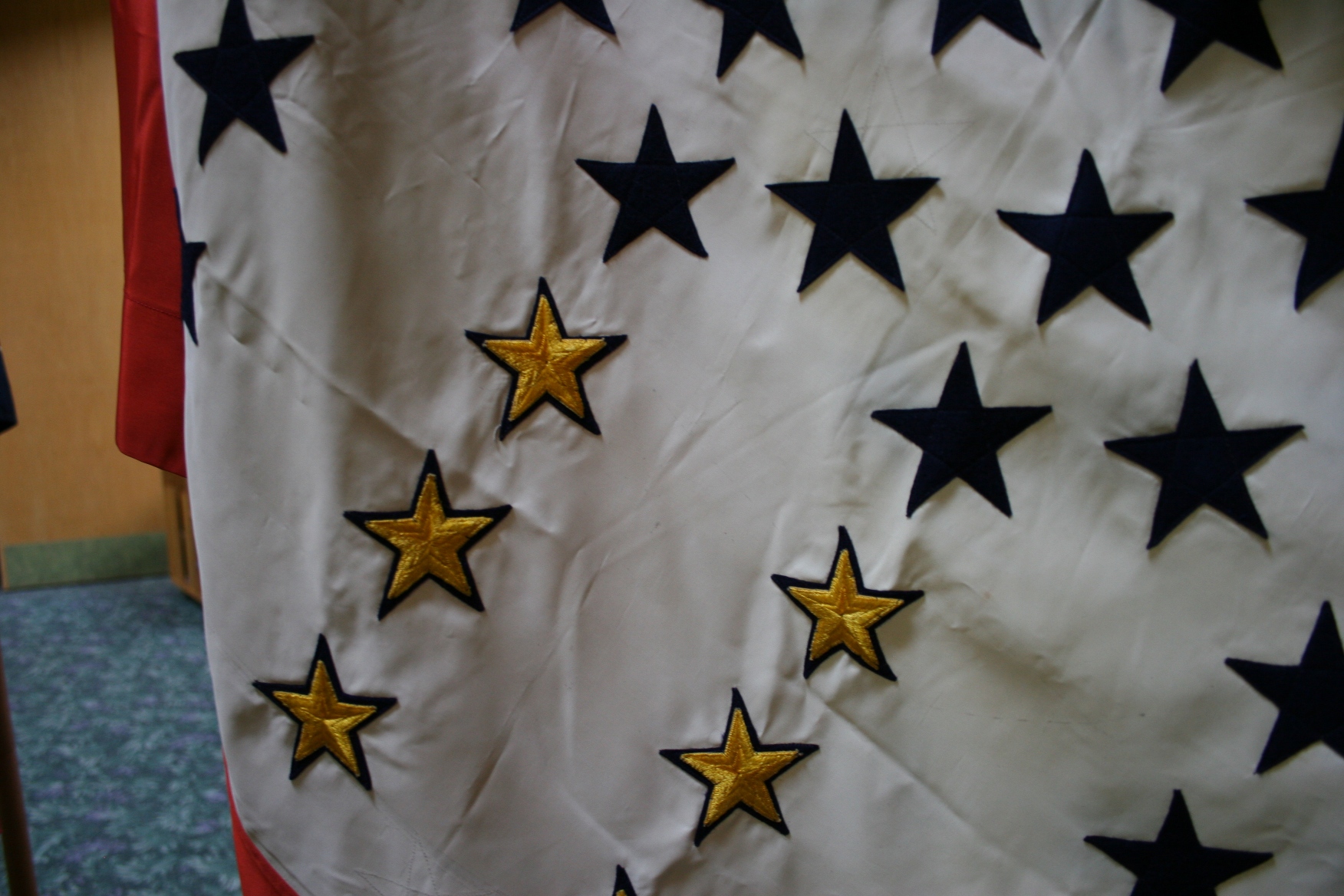
Six gold stars represent the six Trinity members who gave the ultimate sacrifice, their lives, during WW II.

I stand there awed, really, that so many individuals from this German Lutheran church in a mid-sized Minnesota community answered the call to duty during a single war. My friend Lee and I count: 162 blue stars and six double stars of gold upon blue.

The blue stars number 162, one for every Trinity member serving in WW II.

Six young men gave their lives for their country. The thought of such grief within a single congregational family overwhelms me.

I feel now as if I am viewing a sacred cloth. I wonder how many tears fell upon this flag as the ladies of the congregation stitched these stars.

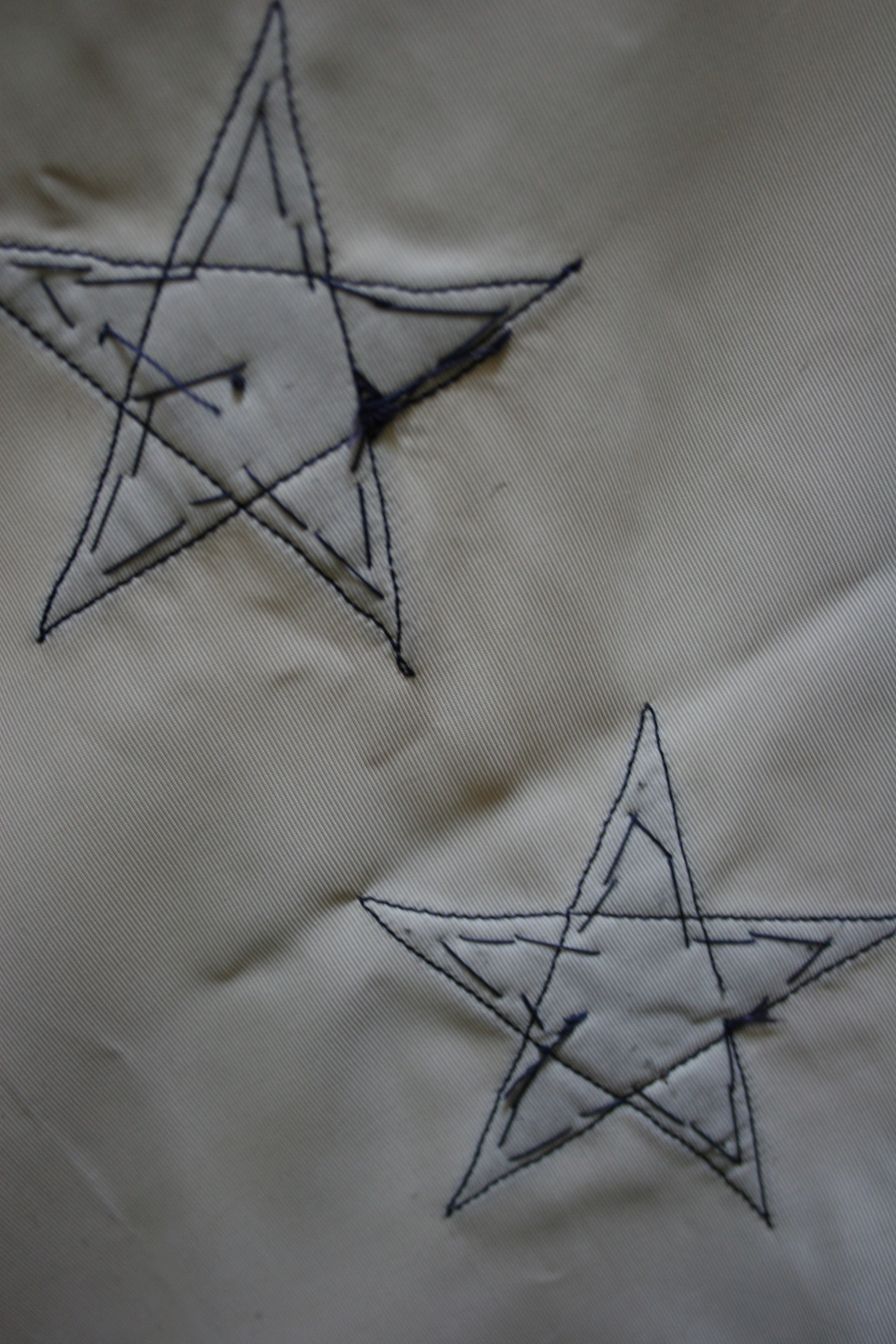
I lift the flag, gently flip the fabric to the back side and examine the even machine-stitching on the blue stars. And then I examine the long, uneven stitches on the gold stars, sewn in place by hand.

Hand-stitching on the backs of two gold stars honoring those who died. The outer row is machine-stitching, holding the blue stars in place.

Dave tells us the flag stood at the front of the church, as did similar flags at churches through-out our community of Faribault. Roger steps up, says he remembers a smaller flag in the church he attended during WW II.

And if Dave’s memory serves him right, this flag remained on display until the end of the war.

Today I am glad, even though also saddened, that this flag of honor has been taken out of storage and put on display. For this one morning, on this Independence Day, those of us gathered here freely to worship have been reminded again that freedom does not come without a price.

A view of three of the flags, looking into the sanctuary, centered by a cross.

© Copyright 2010 Audrey Kletscher Helbling


Reflections from Iraq, and America, on the Fourth of July July 3, 2010

Filed under: Uncategorized — Audrey Kletscher Helbling @ 8:54 PM
Tags: , , , ,

WHEN YOU’RE GATHERED with family or friends at a Fourth of July barbecue, just kicking back at home with a beer or taking in a fireworks display, I want you to think of guys like my brother-in-law Neil. He’s on his second tour of duty in Iraq, serving with the United States Air Force.

Back here in the States, unless you’re a veteran or an immediate family member of a military man or woman, it’s all too easy to take this day—and freedom—for granted.

Take me. I’ve been more concerned about the potatoes I’m bringing to my sister’s picnic than considering how I might show my patriotism. And then, just this morning as I thought about the Fourth and its meaning, I couldn’t remember the words to The Star Spangled Banner. Repeatedly in my head, I sang, like a stuck record, “Oh, say can you see, by the dawn’s early light.” Shame on me for forgetting the words to our national anthem.

It’s not that I don’t care about freedom and independence and patriotism. But because I’ve always been free, I likely don’t care with the depth that I should.

To those like Neil, stationed at Joint Base Balad, the central logistical hub for American forces in Iraq, the Fourth seems more meaningful. (I’ve e-mailed asking him to share his thoughts on patriotism.) “I think that the military folks have a better appreciation for our freedoms than most Americans as we’ve faced the possibility of laying down our lives for it,” Neil says.

And then he includes some information that surprises me, even though it really shouldn’t given he’s now living in a war zone. He sends me photos of the base and tells me about the mortar-mitigating roofs that cover sections of the Air Force Theater Hospital (he’s a lab manager), the gym, the dining facilities and the theater.

Whoa, wait a minute. I never really thought much about mortars hitting his base, which lies near the center of Iraq about 40 miles north of Baghdad. But why wouldn’t the Iraqis target this key military base with some 24,000 residents?

Neil writes: “You’re probably wondering, do we get a lot of attacks from outside the fence? They used to be quite frequent. These days, only occasionally. Most of the mortars fall harmlessly near the fence line, because the enemy (wisely) doesn’t want to get too close to our defenses. They seldom fall anywhere near the housing areas. I do not know of anyone getting wounded by a mortar attack when I was here last time, and so far, it hasn’t happened yet since I arrived here this time. When an attack comes, there’s usually a warning that goes off so that you have at least a few seconds to react appropriately.”

OK, then. I naively thought that since Neil isn’t on a truck convoy or a foot soldier, he is safe. But as the daughter of a Korean War veteran, I should know better. Whenever you’re in a war-torn country, you’re always in danger.

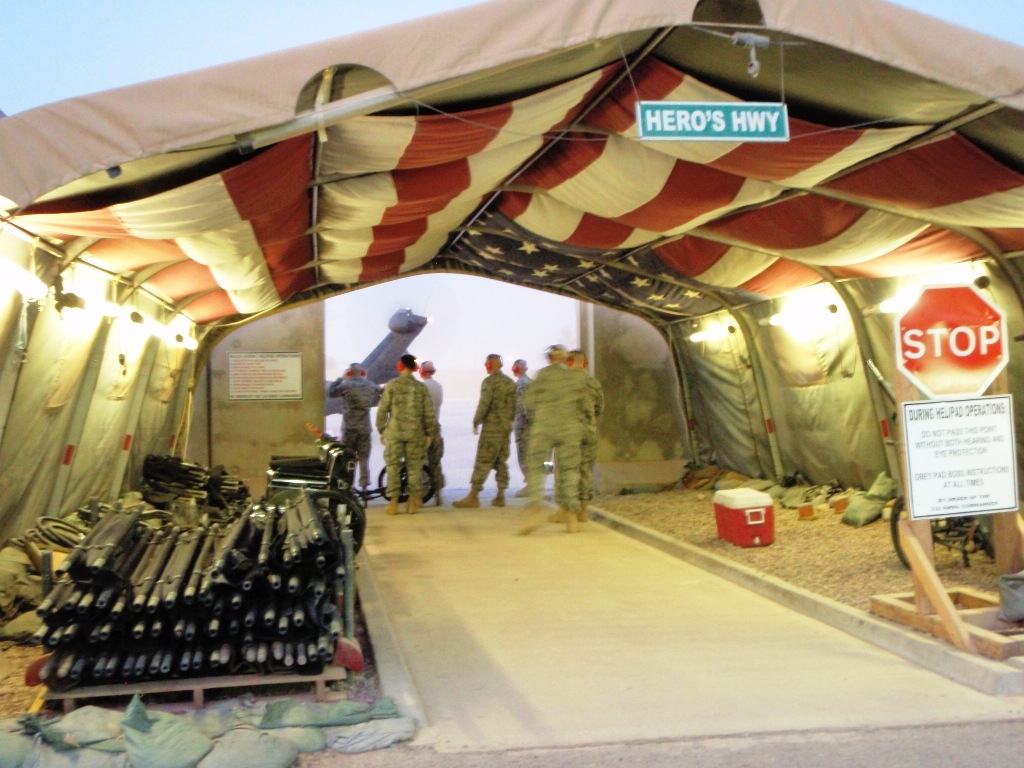
Of all the photos and information Neil e-mails, I am especially moved by the images of Hero’s Highway. The highway is not really a roadway, but rather a tented structure through which wounded soldiers enter the Air Force Theater Hospital trauma bay. A huge American flag forms the “ceiling” of this tent. You can only imagine the psychological impact this has upon those arriving here.

A large American flag decorates the tent structure, known as Hero's Highway, at Joint Base Balad, Iraq.

“The flag allows the patients to know that they’ve arrived at a US hospital,” my brother-in-law writes. “We have a record of saving lives – 98% of the patients who have arrived here alive have also left here alive. A statistic like that provides reassurance to those that are out on the battlefield.” Indeed.

Wanting to lighten the mood a bit, I ask Neil how he’ll celebrate the Fourth. Mostly he will work, pulling the 7 p.m. to 7 a.m. shift. But he’ll also have barbequed ribs and chicken. The USO is putting on a concert featuring Uncle Kracker. There’s a 5K run, which is part of every holiday at the base.

Finally, my brother-in-law wanted to assure I didn’t overlook the sacrifices made by those back home—like the spouses fulfilling duo parenting roles, the kids without a parent. I knew he was missing his wife, Jamie, and their son, Christian.

“Even after the deployment, the families often have to deal with a lot of aftermath, as you yourself can attest to,” Neil explains. (He’s referring to the challenges my dad faced upon returning from Korea and how that affected my immediate family.) “In many ways, they’re the unsung heroes in all of this.”

Yes, Neil gives us much to ponder.

And tomorrow, as we celebrate our freedom, consider these words from my brother-in-law, written shortly after he arrived in Balad: “Every time I travel outside our borders, I gain a renewed appreciation for just how wonderful life is in the US! With the exception of Canada, I haven’t been anywhere where the living standards are so good. The things we take for granted are not available to people in other nations. Living in the US is like living in paradise! It’s no wonder so many people in the world want to live there! Well, enough of that… I’m feeling a bit more passionate than usual about my homeland right now since I’m not there.”

Did you notice all of the exclamation marks in Neil’s e-mail? I did.

Text © Copyright 2010 Audrey Kletscher Helbling

Photo e-mailed by my brother-in-law Neil as sourced from a shared drive at his military base.


American pride shines at the Stars & Stripes Garage in small-town Minnesota July 2, 2010

Filed under: Uncategorized — Audrey Kletscher Helbling @ 7:08 AM
Tags: , , , , ,

YOU DON’T RUN ACROSS MEN like Joel and Louie Kukacka every day. These guys—father and son—are darned proud to be Americans, proud enough to publicly parade their patriotism.

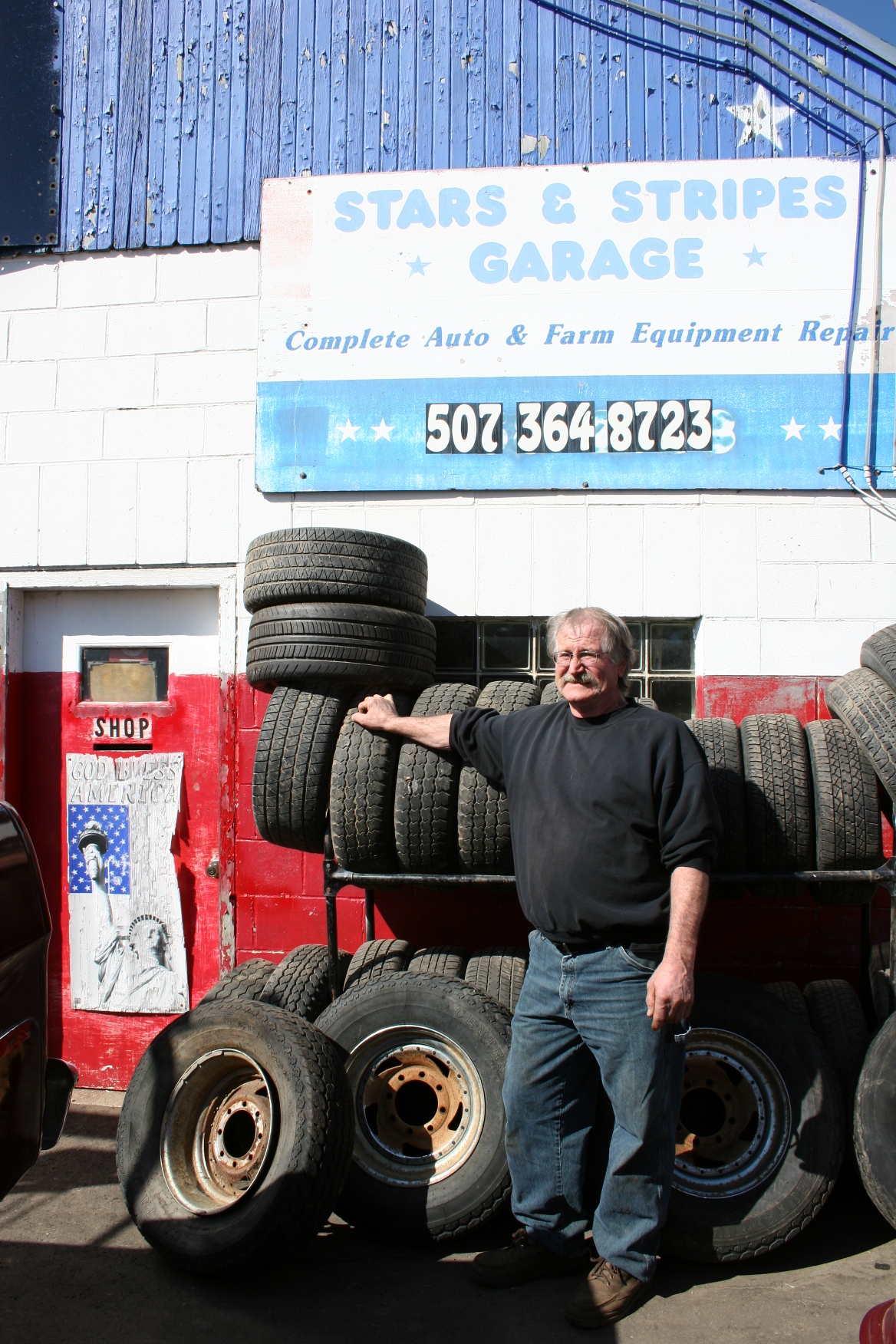
Drive through the tiny Le Sueur County burg of Heidelberg and you’ll find a smattering of houses, St. Scholastica Catholic Church and a bar. And next to that bar, you can’t miss the Stars & Stripes Garage owned by Joel Kukacka.

Painted red, white and blue and adorned with stars and a front-and-center American flag from the Harvestore silo company, this garage shouts American pride.

There’s nothing artificial about this outward display of patriotism. Joel and Louie really are as true-blue patriotic American as they come.

Several months ago I met the pair while working on a magazine feature article. They immediately impress me as men who possess a strong, independent spirit. If the word “redneck” didn’t have such negative connotations, I might even label them as such. Or I may even tag them as “mavericks,” but then I’ve got that whole Sarah Palin connection going and I’m not sure they would appreciate the tie.

So let’s just call Joel and Louie independent and patriotic small-town American businessmen.

Joel Kukacka outside his Stars & Stripes Garage in tiny Heidelberg.

Joel, who is 59 and a Vietnam War era veteran (he served in Germany and not Nam) opened his auto and farm equipment repair shop in 1980. The “Stars & Stripes” moniker seems a good fit given his military service, his affinity for eagles (including the $18 eagle tattoo he got in Germany) and his preference for American-made products.

As Louie, 33, tells it, for awhile his dad refused to buy anything that wasn’t made in the U.S.A. You simply have to admire someone with that level of American loyalty. But, Louie concedes, eventually Joel had no choice but to buy foreign-made goods.

Get Louie going, and his feisty attitude emerges. It’s clear to me that Joel, who is pretty quiet, has raised a strong boy not afraid to speak his mind. About those eagles his dad loves, well, “they represent independence and freedom, what this country used to be,” the younger Kukacka says.

Not wanting to get into a heated political discussion, I don’t ask Louie to expand on “what this country used to be,” although I’m certain he would give me an earful about government programs and subsidies and a whole list of other issues.

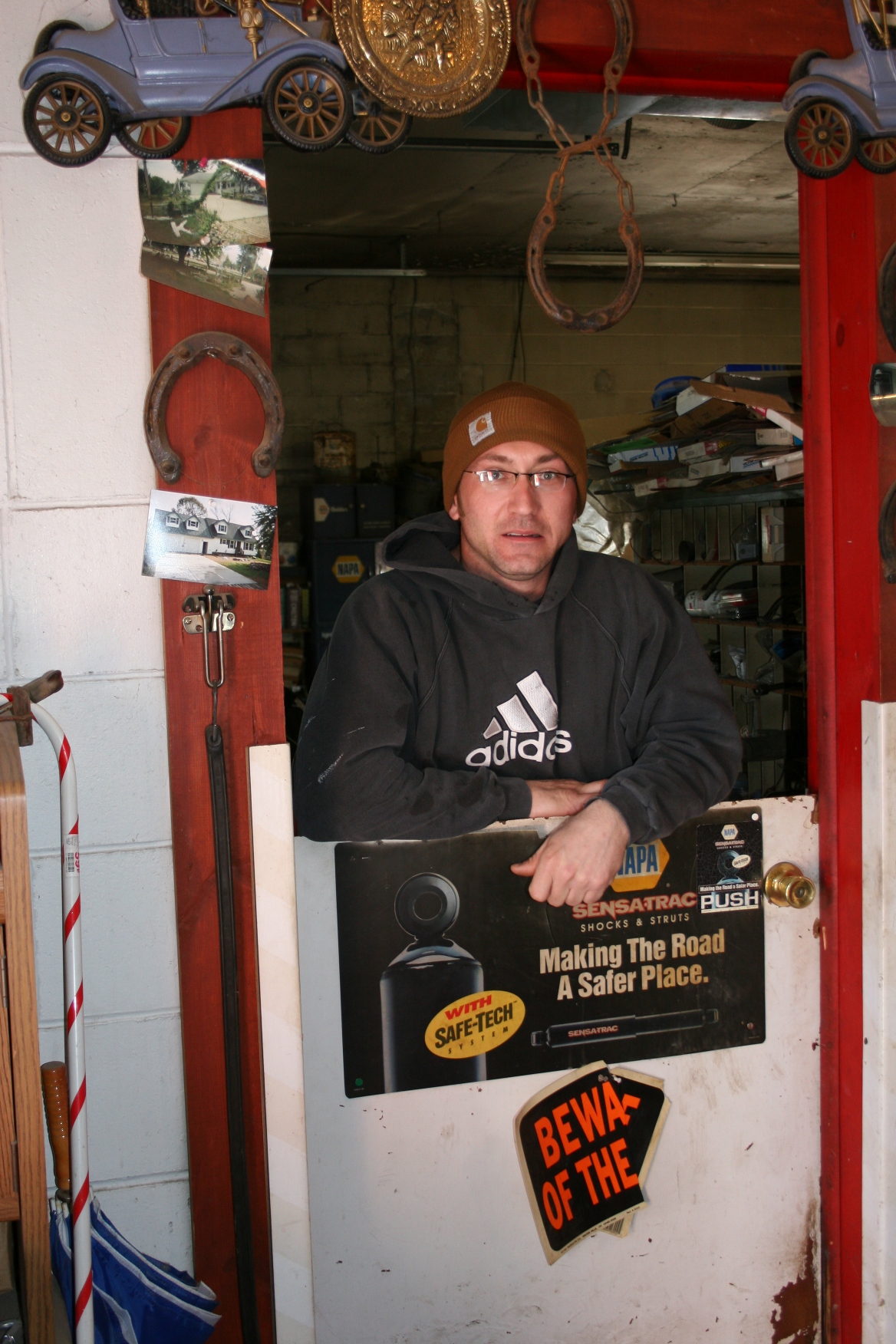
Louie Kukacka, leaning on the half-door between the garage bay and the office, speaks his mind about America and independent businessmen.

“He’s somebody that takes pride in their work,” Louie says of his dad. “That’s America, what we’re here for.”

Louie praises the independent businessmen (versus the big companies) who work long, hard hours to make a living. Joel and Louie openly admit, though, that surviving in rural Minnesota, and in the current depressed economy, isn’t always easy. During slow times, they supplement their income by collecting and selling scrap metal. These are, indeed, self-sustaining men who don’t mind getting a little dirt under their fingernails.

I admire their entrepreneurial spirits and their positive attitudes. They seem entirely content to live and work in Heidelberg, which, according to the 2000 U.S. census, has a population of only 72. Most Minnesotans likely never have driven through this off-the-beaten path town. But anyone who has traveled this section of Le Sueur County Road 30 will remember that patriotically-painted garage.

Louie is especially proud that his nearly 3–year-old daughter, Brigid, spends time in the garage and is already learning to work a wrench, getting covered head-to-toe, he says, in garage grime.

Already, I can imagine Brigid as a strong, independent woman, influenced by her outspoken father and by her Vietnam War era grandfather—a man who loves eagles, displays a photo of former Minnesota Governor Jesse Venture in his office and operates the red, white and blue Stars & Stripes Garage in the American burg with the German name.

© Copyright 2010 Audrey Kletscher Helbling


They serve the best food in Minnesota church basements July 1, 2010

Filed under: Uncategorized — Audrey Kletscher Helbling @ 7:36 AM
Tags: , , , ,

FOR ALL OF YOU FOODIES out there, here’s a little secret. Some of Minnesota’s best down-home food is served in church basements.

Whether a chicken and ham dinner, an annual lutefisk meal, a soup supper or simply an old-fashioned ice cream social, the faithful serve up some mighty heavenly culinary delights. I know. I’ve indulged—uh, sinfully overindulged—at plenty of these church-sponsored social events.

Take last Sunday, for example, when my husband and I church-hopped from a worship service at the Old Stone Church along Monkey Valley Road south of Kenyon to Moland Lutheran Church several miles further south and west.

“Are you going to the Strawberry Festival at Moland?” a fellow worshiper asks Randy while I’m off shooting photos of the historic stone church.

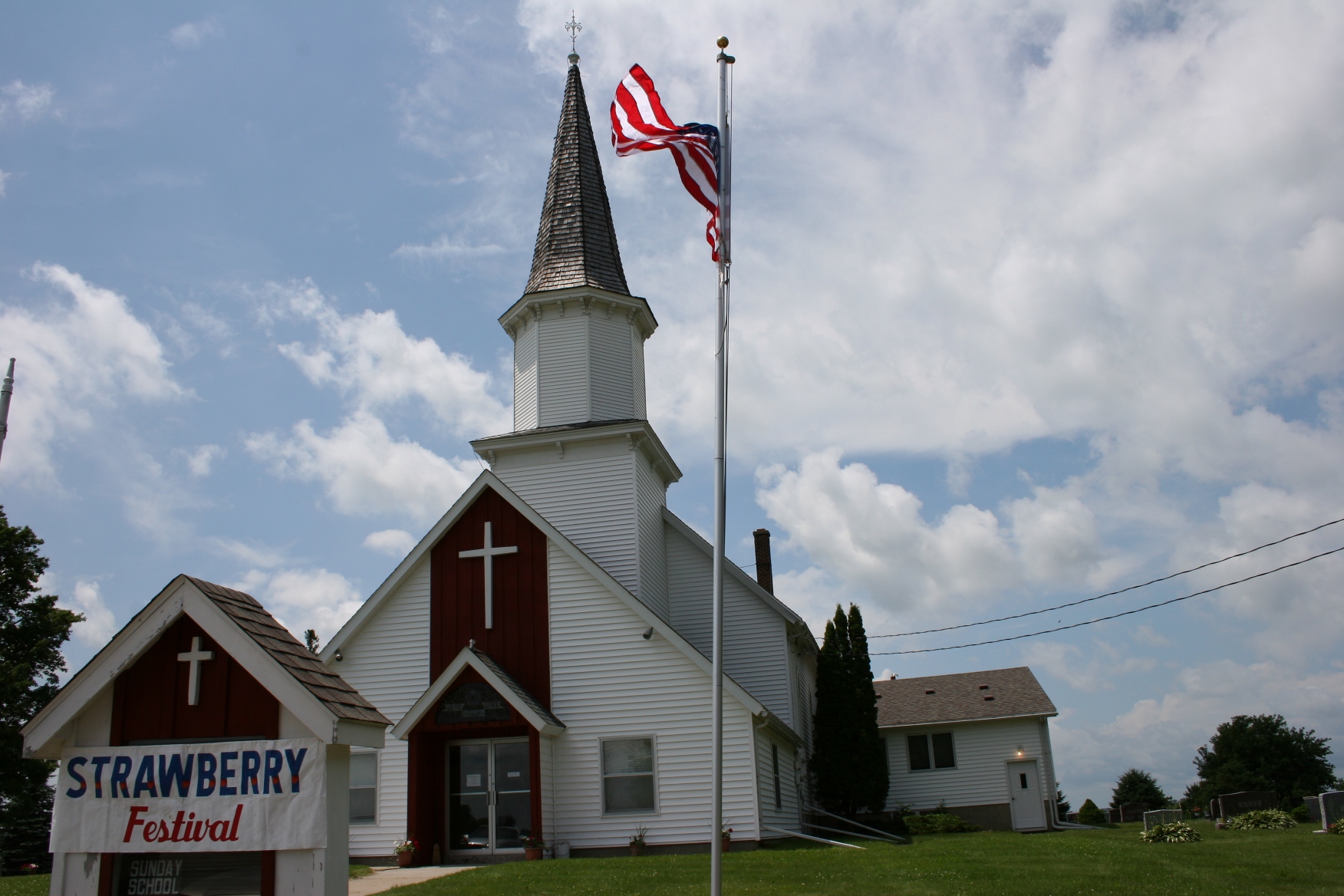
Moland Church, near the Dodge, Goodhue, Rice and Steele County lines, held its first Strawberry Festival in 1955.

After hearing this man rave about Moland’s festival and how he never misses a dinner there, Randy and I decide we’re heading south. With the clock ticking toward noon, we’re hungry and tempted to eat of the tasty, unforbidden fruit.

However, I secretly question our decision since we picked nearly 20 pounds of strawberries a day earlier and still have about five pounds sitting on the counter at home. We really don’t need more strawberries.

But the promise of pulled pork sandwiches, and for me the promise of getting inside another old country church, entices us to Moland.

I expect the fest to be held outdoors in tents strategically-placed under towering shade trees. But this church, ringed by a graveyard, stands in the full sun, exposed to the elements.

So we head inside, down the narrow stairs to the church basement where tables are crammed together and a serving line awaits us. We both choose a pork sandwich, a generous spoonful of potato salad and two scoops of vanilla ice cream (not homemade; I ask) topped with a mountain of fresh, sliced strawberries.

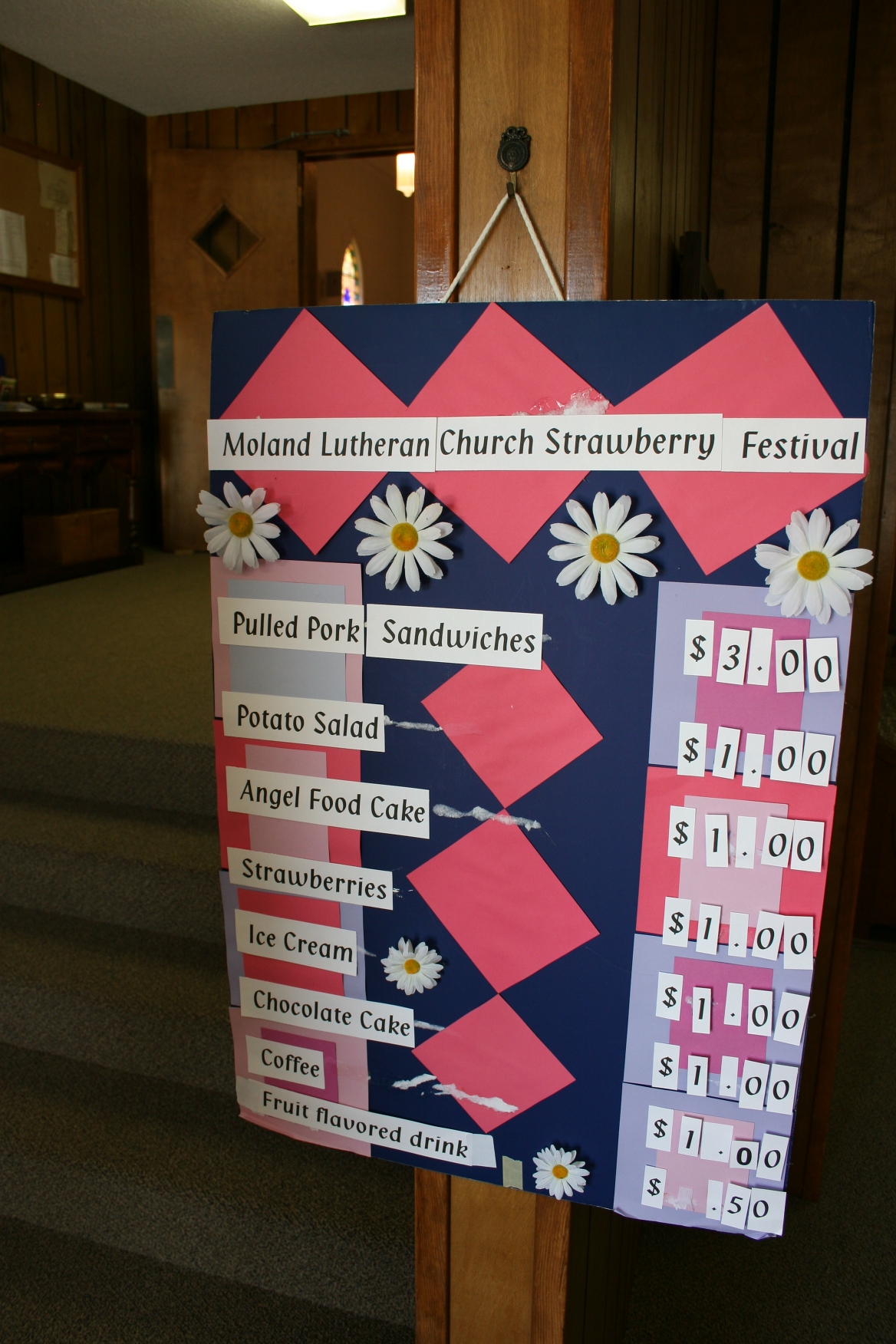
A sign in the church entry lists the food choices at The Strawberry Festival.

I am surprised at the quantity of strawberries, but shouldn’t be given this is a Strawberry Festival. For $12, we’ve gotten more than enough food to fill our stomachs. The two homemade baby dill pickles I spear onto my plate seal the deal for me.

We weave our way past tables and support posts to a table along the north wall. Despite the din (why is it always so hard to hear in these church basements?), we strike up a conversation with our dining companions, Angie who has driven down from Eagan to visit her aunt and uncle and the aunt and uncle from Owatonna whose names now elude me. They are a cordial trio.

We discuss church dinners, churches, pastors, computers, cursive writing, strawberry picking, diverticulosis (where food gets stuck in pockets of the colon, namely strawberry seeds in the case of the unnamed uncle) and whether it’s OK to eat our strawberries and ice cream before we eat our sandwiches.

We are served a generous amount of strawberries with two scoops of ice cream.

Randy and I agree that sampling our quickly melting ice cream before we finish our savory pulled pork sandwiches is no sin.

Before we part, our new friends make a confession. In a few hours, they’ll drive over to St. John’s Lutheran Church in Claremont for, uh, some strawberry pie.

#

IN A FUTURE POST, I’ll take you on a photographic journey inside Moland Lutheran Church.

© Copyright 2010 Audrey Kletscher Helbling


Are we failing to properly express thanks? June 30, 2010

Filed under: Uncategorized — Audrey Kletscher Helbling @ 7:05 AM
Tags: , ,

HAVE WRITTEN THANK YOU notes, like handwritten letters, become an outdated form of expressing gratitude?

Unfortunately, I think so.

Weeks have passed since I attended several high school graduation receptions, where I left cards and money for the graduates. I have yet to receive a single handwritten thank you, although all verbally thanked me for coming to their parties.

Eventually I expect these notes may arrive in my mail, make that snail mail. Yet I’m not holding my breath. Generally speaking, and I’m not pointing my finger at youth (we’re all guilty), we have become a society lax, or even forgetful, about writing personal thank you notes.

Maybe I’m old school, but prompt, from-the-heart gratitude penned on paper shows me that the recipient of my gift truly values my gift. It’s that simple. The words are right there, on paper, to read and reread, to appreciate again and again.

Recently, I struck up a conversation with a dad shopping for packaged thank you notes. Typically I don’t see men perusing these cards, which is exactly why I initiated a conversation.

He was buying note cards for his son, a recent high school graduate. The new graduate’s mother was insisting her son write thank yous—especially to the two aunts who had just signed a check paying for his first year of college.

Ya, think?

As the mother of two daughters and one son, I know, though, that boys sometimes need a little extra prodding to write anything. (Sorry, guys, but it’s true.) My now 16-year-old whines and complains, moans and groans, pouts and dawdles every year about writing thank you notes for birthday and Christmas gifts.

But I persist, insist and, yes, even demand he write these. Some day he may actually “get it,” that people appreciate the time and effort he’s taken to write personal thanks.

Now I have a confession to make.

I failed to write thank you notes for the wedding gifts my husband and I received in 1982. At the time, a trend of mass-printing thank yous had just begun. Unfortunately I followed that fad. To this day, I regret rolling up those impersonal thank you slips, securing them with a pretty little ribbon and placing them in a basket on the table next to the guestbook.

For nearly 30 years I’ve carried the guilt of these unwritten thank you cards. So, to my wedding guests, accept this sincere apology for never properly acknowledging your gifts. But please, please, don’t tell my teenage son about my etiquette error.

© Copyright 2010 Audrey Kletscher Helbling


Preserving the past at the Old Stone Church, Kenyon, Minnesota June 29, 2010

Filed under: Uncategorized — Audrey Kletscher Helbling @ 7:41 AM
Tags: , , , ,

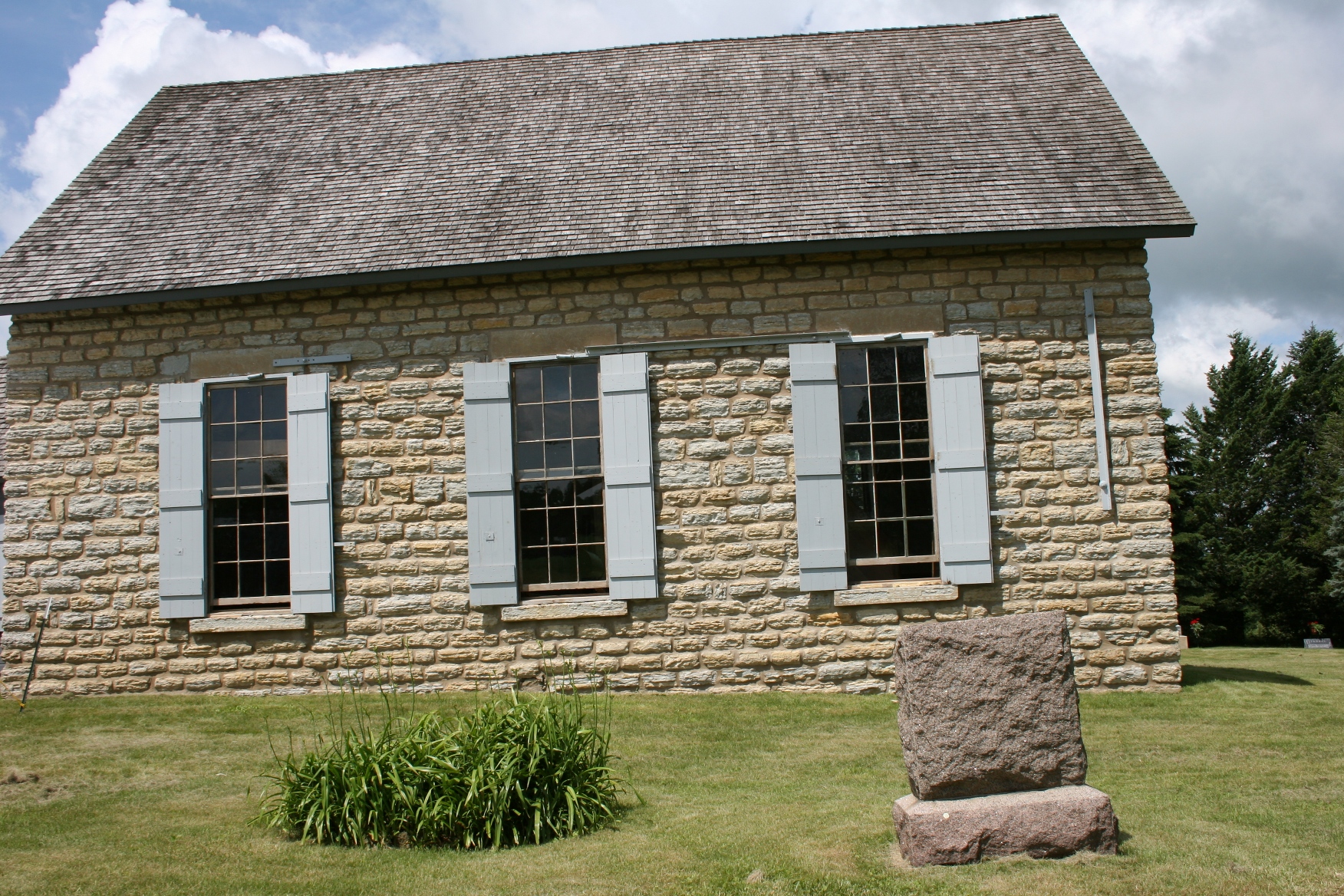
As part of the restoration process, the limestone at the Old Stone Church was tuck-pointed. This shows the east side of the 1870s church located along Monkey Valley Road southwest of Kenyon, Minnesota.

I CAN’T PINPOINT specifically when old country churches became a passion for me. But sometime in recent years, I realized that these rural houses of worship and their often adjoining cemeteries reflect a history and art worth appreciating and preserving.

Such is the Old Stone Church built by Norwegian immigrants near Kenyon in the late 1870s and closed in 1902. A committee of four, whom I met at a Sunday morning worship service, is working tirelessly to preserve this historic church and cemetery for future generations. Already, some $100,000 has been invested in tuck-pointing the native limestone, replastering the interior and more.

These people genuinely care about the original gathering place for members of Hauge Free Lutheran Church, which celebrated its 150th anniversary in 2009. The congregation’s current center of worship stands in Kenyon.

“I wanted to see the old Hauge church come back to life,” says Glen Rud, whose Norwegian grandfather walked several miles from town to attend services here. He appreciates the peacefulness of this secluded location in Monkey Valley, where deer and turkeys range. Here, in this place of peace, lies Rud’s burial plot.

Likewise, preservationist Bob Dyrdahl possesses strong ties to this land. He was born in a nearby log cabin. He’s planted trees around the cemetery and with his sisters donated a historical marker. His daughter was married here two years ago.

Such devotion, respect and care for the Old Stone Church impress me.

Sunday morning as I join the descendants of Norwegian immigrants (and others) in prayer and song, I feel the kinship of faithful fellowship. I feel the very presence of those early settlers who sat upon these pews and raised their voices in their mother tongue. Today, more than a century later, this congregation still sings Ja, vi elsker, the Norwegian national anthem, with the conviction of a generation determined to remember their heritage.

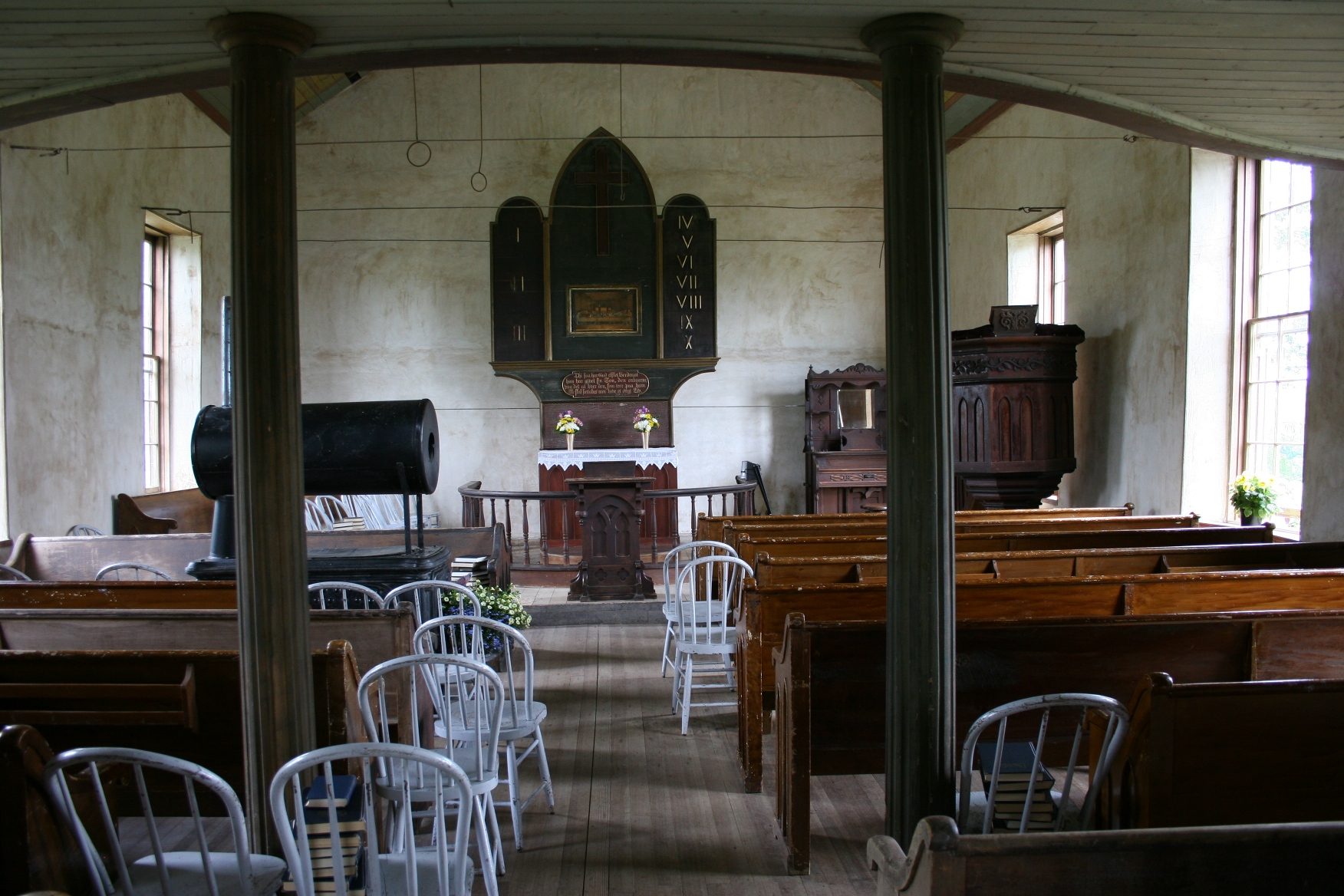
A view from the balcony shows the choir seated next to the beautiful altar. The choir director speaks in Norwegian, then translates, "Stand up, that means." And all rise for the Norwegian national anthem.

This Old Stone Church altar intrigues me because I've never seen one similar. I wonder whether The Last Supper painting at the center of the altar is a cherished possession transported by ship from the homeland. I wonder why replica tablets of the 10 Commandments were chosen for the altar. And, finally, I appreciate the inscription of John 3:16 in Norwegian.

This photo gives a broad view of the sanctuary. I was seated in the chair to the right side of the balcony support post during worship services. As I take in my surroundings, I notice the knots in the back of the pew before me and the floor patched with a section of wood underneath the sandal of the woman seated next to me. And as my left shoulder brushes against the wooden column, I admire the workmanship and craftsmanship that surrounds me.

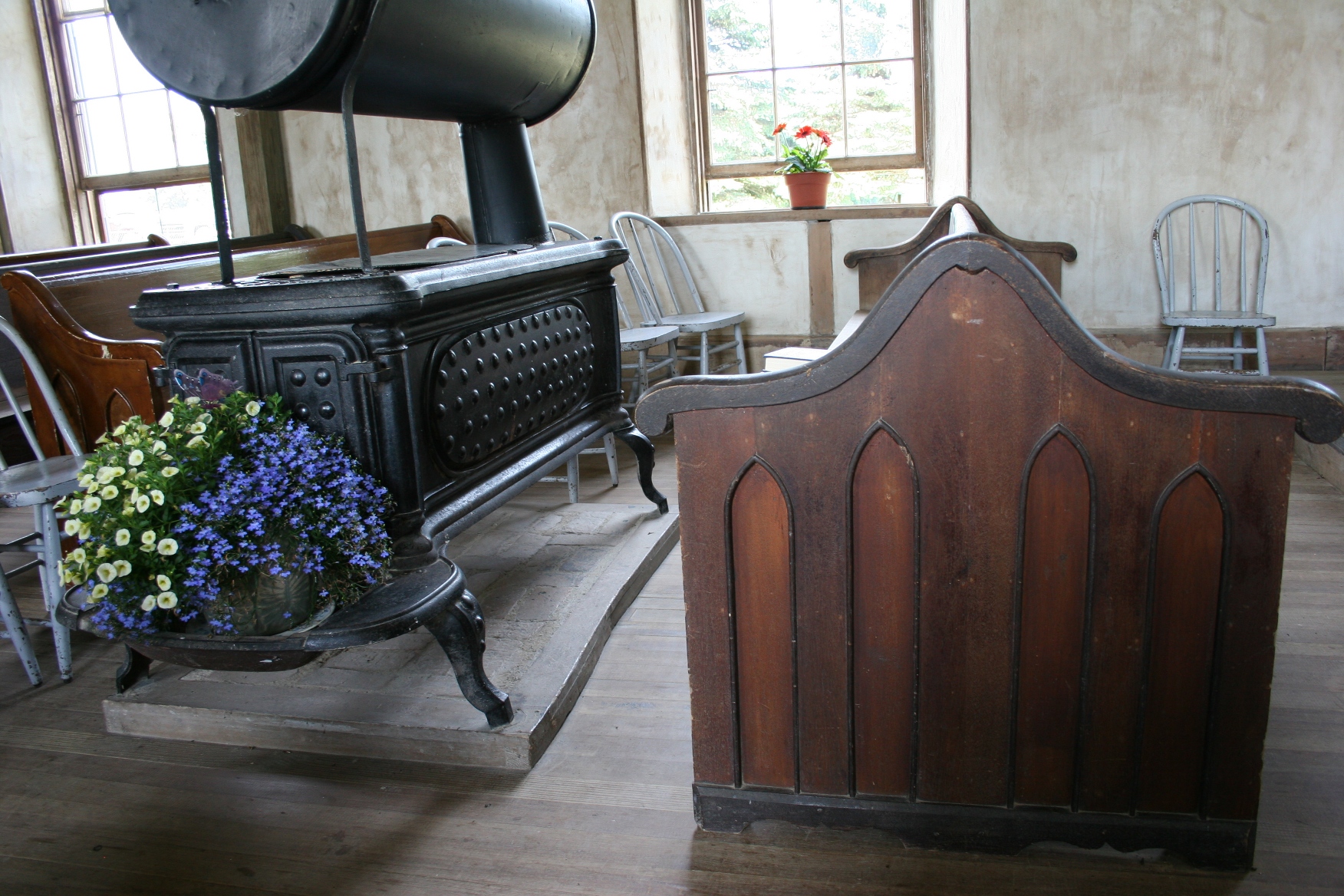
Bob Dyrdahl explains that the double-sided pew provided a place for mothers to sit with their babies next to the warmth of the wood-burning stove. Such concern, such love, for those early pioneer mothers touches me.

A steep narrow stairway, just inside the church's interior double doors, winds to the balcony. Even here, in this plainness, I can appreciate history and craftsmanship. At the bend in the stairway, is a band of stenciled wood.

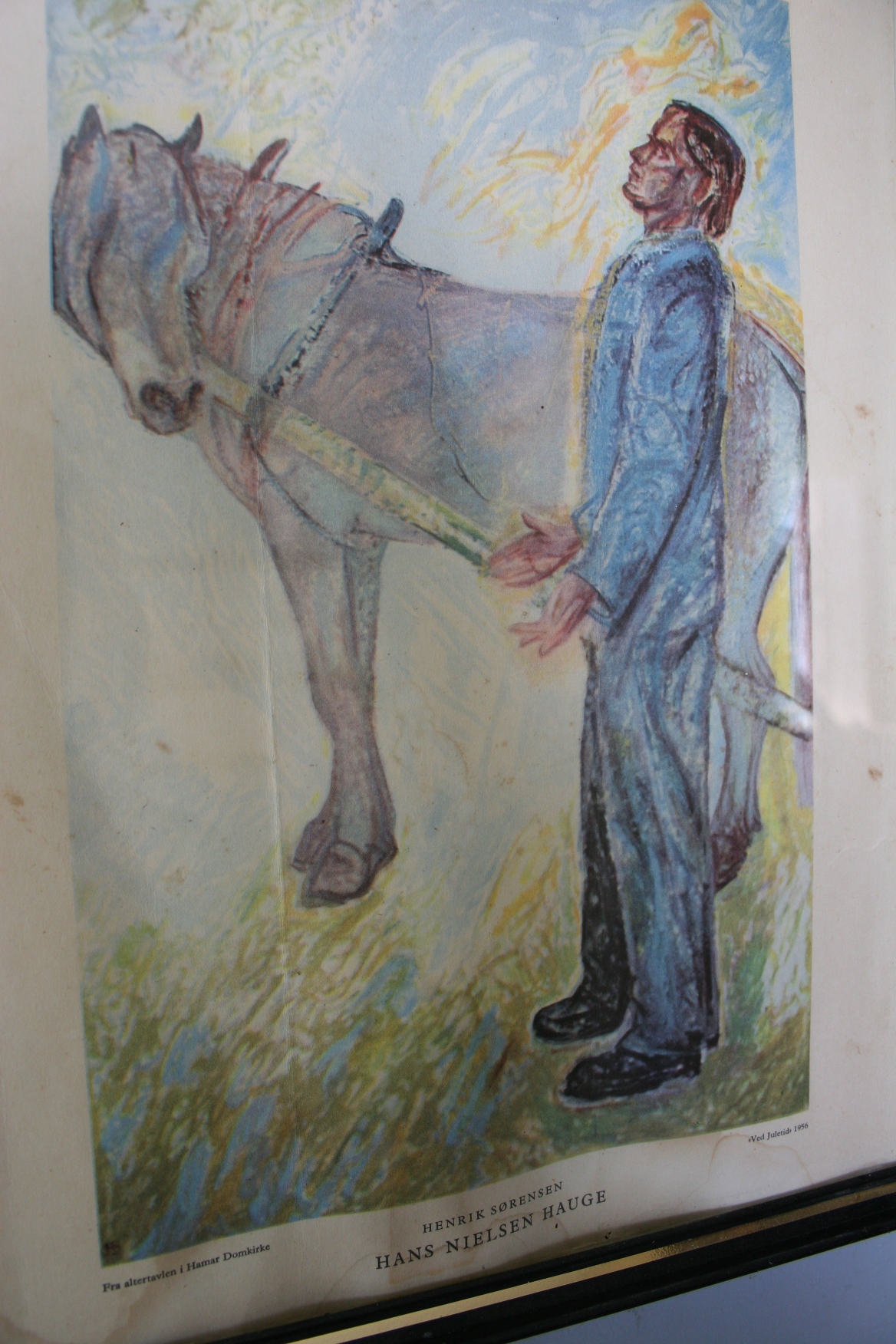
A print of Hans Nielsen Hauge, a 1700s lay leader and reformist in the Lutheran Church of Norway, hangs in the entry of the Old Stone Church. Immigrants honored this lay preacher by naming their church after him. Calling the baptized in the congregation, who have wandered away from the Lord, back to repentance is a common preaching theme among "the Haugeans," current Pastor Martin Horn says.

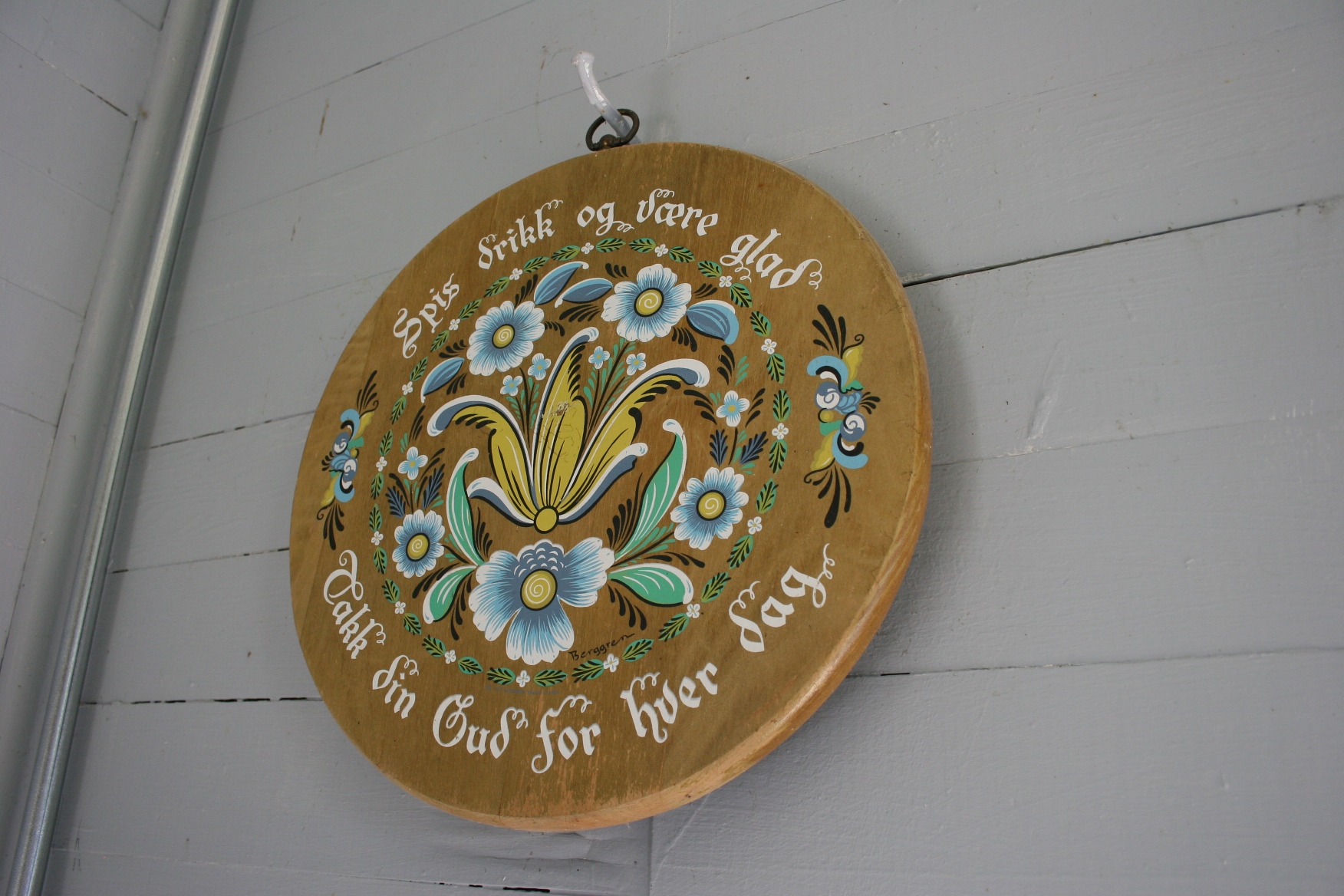
This Norwegian plaque hangs in the Old Stone Church entry. Since I'm German and not Norwegian, I rely on Google translate to tell me this sign basically thanks God for food and drink.

Six shuttered windows span two sides of the limestone church. The shutters are thrown open for the once-a-year church service and then battened shut.

The Old Stone Church cemetery, a final resting place for generations past and for those yet to be buried upon this land in peaceful Monkey Valley near Kenyon, Minnesota.

FOR MORE INFORMATION and additional photos of the Old Stone Church, see my June 27 Minnesota Prairie Roots blog post.

© Copyright 2010 Audrey Kletscher Helbling


Inside the Old Stone Church, rural Kenyon, Minnesota June 27, 2010

Filed under: Uncategorized — Audrey Kletscher Helbling @ 7:35 PM
Tags: , , ,

“DIRECTIONS: At the west end of the Boulevard of Roses, take Goodhue County 12 south for 1.3 miles and go west on Monkey Valley road for one mile.”

“Let’s go,” I tell my husband Saturday evening after reading an open invitation in the local newspaper to attend worship services at the Old Stone Church. Pair the adjectives “old” and “stone” with church and I already have one foot in the door. Add “Monkey Valley Road,” and you’ve really piqued my interest.

So Sunday morning Randy and I are on our way to Kenyon, where we turn right at the west end of the narrow boulevard lined with roses. We follow the published directions, turning right onto Monkey Valley Road, a gravel road that soon leads us to the Old Stone Church.

Once a year a worship service is held at the Old Stone Church, built by Norwegian immigrants near Kenyon.

I am expecting a church defined, as most country churches are, by a steeple. But, instead, I see before me a simple limestone building that could pass for a schoolhouse. Yet, the plain exterior, minus a steeple, seems perfect for this spot embraced by trees and rolling valleys on two sides and by flat open farm fields on the opposite sides.

Welcome to Monkey Valley.

“How did this place get its name?” I ask a group of men clustered outside the Old Stone Church.

They offer two theories. The first story goes that monkeys escaped from a traveling circus and fled into the wooded valley. The second story goes that a threshing crew arrived here and pronounced: “We’re just going to the valley and monkey around.”

Randy and I buy the monkey story, which seems probable given traveling circuses once roamed the countryside.

“I have to go,” I say, abruptly ending this monkey business. I hear the strains of my favorite hymn, Beautiful Savior, drifting through the open doors and windows. I don’t want to miss this and I am anxious to get inside the small country church.

I’ll later learn that Norwegian immigrants built this structure, beginning in 1872, with limestone cut from a nearby quarry. A historical marker dates the building, which is on the National Register of Historic Places, as 1875. And that steeple I wondered about—apparently the church founders discussed a steeple, but never had the money to erect one.

Eventually, those early members moved out of Monkey Valley and, in 1902, Hauge Lutheran congregation built a new church in Kenyon. For years the Old Stone Church stood abandoned. In 1947 restoration began, a process that continues today.

All of this written and memorized history interests me, but only to a point. I prefer, instead, to wander, to notice the details, to take in my surroundings, to appreciate for myself the beauty that this church holds.

During a service filled with music, the choir and congregation sing in Norwegian, "Ja, vi elsker." The wire rods you see anchored to the walls (running horizontally across the top of the photo) provide structural stability.

Rugged pews and rustic wood floors remind worshipers of bygone years. Copies of The Concordia Hymnal, piled on a pew, date to 1967. The hymn books are stashed in covered plastic containers after the service.

I lean forward and photograph the hands of an elderly woman in quiet meditation. This image, more than any photo I take, captures the essence of the Old Stone Church. For in these folded hands and in the back of the roughly-hewn pew, history and faithfulness meld, encompassing the importance of preserving historic churches.

Sitting near the back of the church, I study these words, thinking in German until I remember I am inside a Norwegian church. After the service, I talk with historian and preservationist Bob Dyrdahl. The scriptural quote comes from John 3:16, he tells me. "For God so loved the world that He gave His only begotten Son..." Sure enough, upon closer examination I determine that Bob knows his Norwegian.

I run my fingers across the flowers on the pulpit and imagine the rough hands of a Norwegian immigrant shaping this wood into a beautiful work of art. In the background is the top of the altar, defined by tablets, signifying the 10 Commandments and centered by a cross and a painting of The Last Supper.

In the balcony, historian Bob Dyrdahl shows me this treasure, the dated (October 30, 1894) signature of A. P. Lindgren who painted stars upon the ceiling and edged it with this stenciled border. His work also graces other sections of the sanctuary, along the stairway, for example.

A rear view of the Old Stone Church, a simple structure with three shuttered windows on each side of the building.

A stone's throw from the Old Stone Church, a view of Monkey Valley.

#

THIS IS JUST A SAMPLING of the photos I shot at the Old Stone Church. Please check back for additional images to be posted this week on Minnesota Prairie Roots.

Copyright 2010 Audrey Kletscher Helbling


The “truth” about the color of that pink Argentine palace June 26, 2010

Filed under: Uncategorized — Audrey Kletscher Helbling @ 8:15 AM
Tags: , ,

IF YOU SEE A PINK building, you might think, “Oh, how beautiful” or “Oh, how ugly.” You also probably will wonder “why pink,” somewhat of an odd color choice (especially in Minnesota).

Argentina's presidential palace, La Casa Rosada, is painted pink. This is the back of the palace.

In Argentina, though, the presidential palace is pink. And there is, according to my daughter Miranda who is currently interning with a company that gives walking tours of Buenos Aires, a very good reason.

“La Casa Rosada is pink because they used to mix cows’ blood with the clay/rock to preserve the building against humidity,” she tells me after learning this trivia during her first day on the job.

“Yuck, gross, disgusting,” I inwardly react and then wonder whether this is fact or urban legend.

But brief online research confirms the cows’ blood angle. (Just a note here: The palace has been repainted, so when you view it today, this is not the original cows’ blood tint you see.)

Additionally, I learn that the pink symbolizes unity between the two main political parties—distinguished by red and white—at the time of palace construction in 1873.

Whatever the total truth, the cows’ blood angle has forever changed my perspective on pretty pink palaces.

© Copyright 2010 Audrey Kletscher Helbling

Photo courtesy of Miranda Helbling


My not-so-royal shopping experience June 25, 2010

Filed under: Uncategorized — Audrey Kletscher Helbling @ 9:11 AM
Tags: , , ,

DID YOU REALIZE that Walmart has a wedding department? I didn’t…until last night.

While my husband shops for weed killer, I am several aisles away browsing the mish mash of merchandise in the bargain aisle. I am prowling for items that will make suitable game prizes for a family reunion. (Bear with me here; I’m getting to that matrimonial merchandise.) Think humorous here, not necessarily wonderful, prizes.

I finger placemats, examine drinking glasses, grab a small bag of plastic compasses. “Do you think these really work?” I ask my husband, who by this time has found the weed killer, walked half way across the store for an ink cartridge and returned to the discount section.

“Well, if there weren’t so many, I could probably tell,” he says, flipping the compass package in his palm. He tosses the bag back onto the shelf.

I can see he’s getting a bit impatient with me, although I explain that my shopping was stalled by my visit with friends Michelle and Eric, who are also scanning this section.

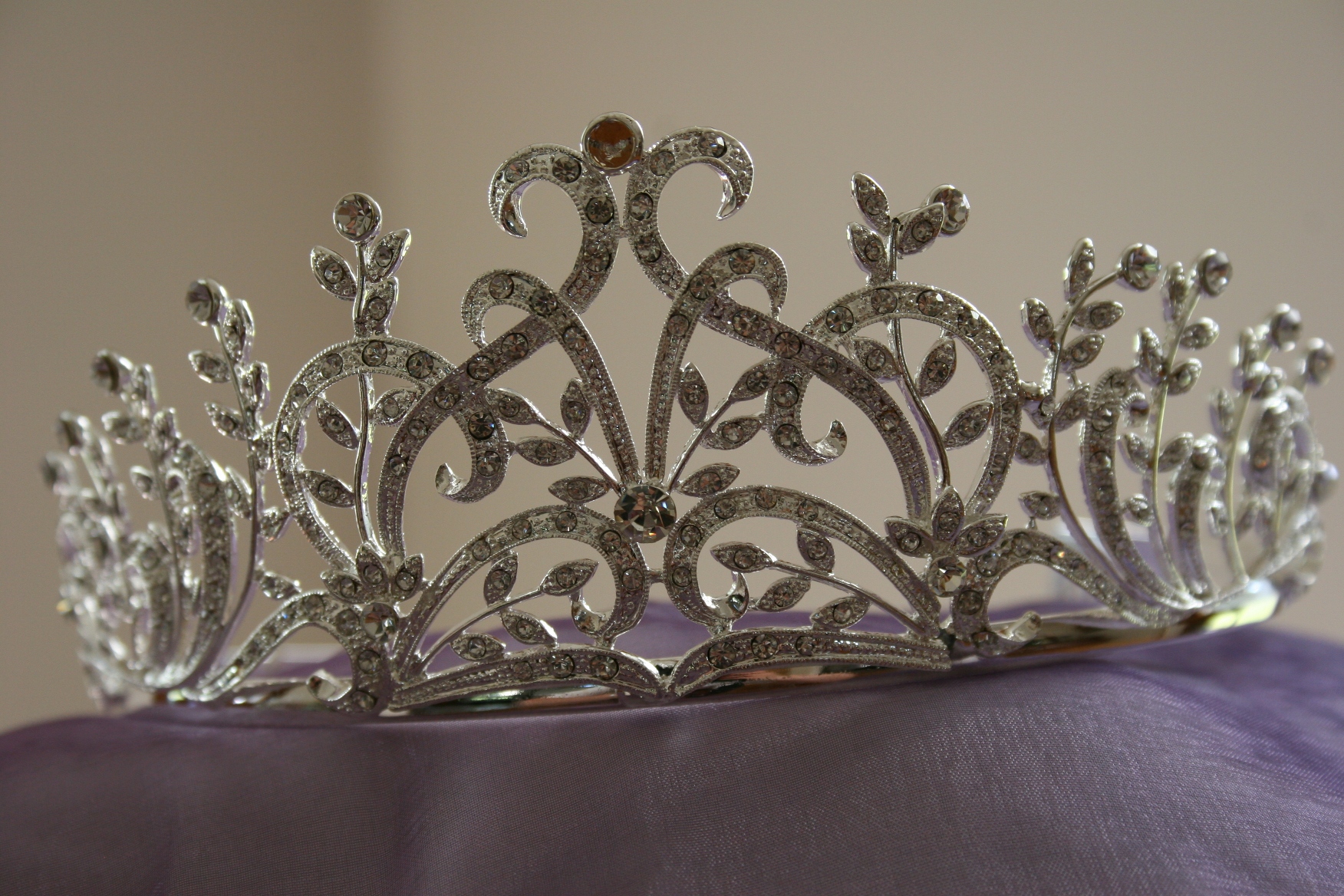
Half-way down the aisle, I spot a jeweled tiara. I pick up the crown which, except for a tiny, missing center “diamond,” will make the perfect pretty prize for the woman who brings the most beautiful bridesmaid’s dress to the reunion.
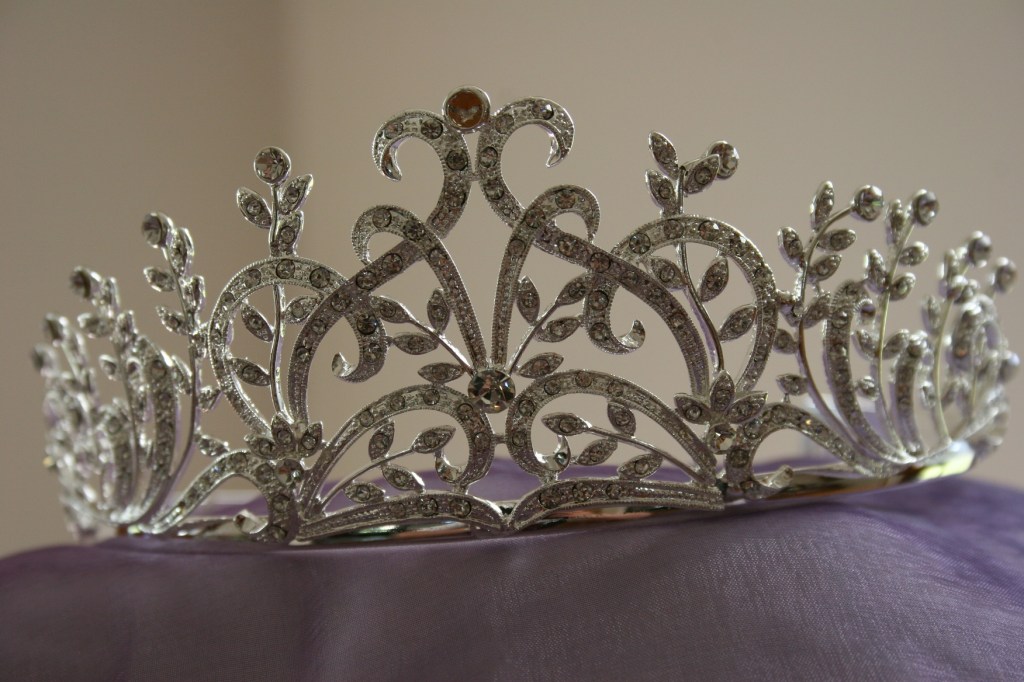
We’re going with a wedding theme at the family gathering. Long story on that, but suffice to say that we are celebrating the 20th wedding anniversary of my cousin Jeff and his fictional northwoods bride, Janet. Jeff’s “marriage,” primarily the announcement of said event on April Fool’s Day 1990, is the stuff of family legends. But I digress.

This hefty tiara, which is no cheaply-made, plastic version for some princess’ birthday party, seems quite appropriate for the planned theme. But, as delighted as I am with this find, I encounter one problem. The tiara is unmarked—no bar code, no discount price sticker, no nothing—and there are no other crowns on the shelves.

This spells Cinderella-type trouble. I know that upon reaching the cash register, I will have to wait and wait and wait until someone does a price check. If I’m lucky, that someone will not possess the personality of a wicked step sister.

I am not lucky.

“Did you get this in the wedding department?” asks the clipboard-carrying supervisor who has taken her sweet old time responding to the cashier’s call for assistance.

“Uh, no, I got it in the bargain aisle. I didn’t know you have a wedding section,” I reply.

“Did you know it’s missing a jewel?” she asks, seeming hopeful that I will vanish.

“Yeah, but I don’t care,” I say. “I want it.”

“Were there any others back there like this?” she questions.

I want to say, but don’t, “How stupid do you think I am?” Rather I simply reply, “No.”

Behind me, the line of customers grows. “You might want to go to another check-out lane,” I tell the woman behind me. “This could take awhile.”

“That’s OK. I’m waiting for my husband,” she smiles.

Beside me, my husband fidgets. “Let’s just go,” he states, his voice edged with impatience. He’s not smiling.

“No, I really want this. Don’t be so crabby,” I say, foregoing an explanation of why I need this tiara. He’s tired and not in the mood for an explanation.

My fear now is that the treasured crown, since it originated in the wedding department, will cost more than I am willing to pay.

“Can’t I just have it for a dollar?” I ask the clipboard-carrying supervisor.

“I can’t do that,” she glares.

OK then, sorry I asked, I think to myself.

Eventually, she gives me a price of $3.50. It’s more than I want to pay. But since I’ve made my husband and all those Walmart customers wait, I buy the tiara.

Just for good measure, when we arrive home, I place the crown upon my head and wave a slow, lazy princess wave, first with my right arm and then with my left, turning from side to side as if greeting my subjects.
“I’m Miss Vesta,” I say, referring to my hometown, site of the upcoming family reunion.

“You don’t live in Vesta any more,” my husband notes.

He’s right. But for one night, this night, I deserve this moment. I have, after all, overcome so many obstacles to acquire this crown.

© Copyright 2010 Audrey Kletscher Helbling