Minnesota Prairie Roots

Writing and photography by Audrey Kletscher Helbling

Bison: History, cultural importance, a film & a poem October 12, 2023

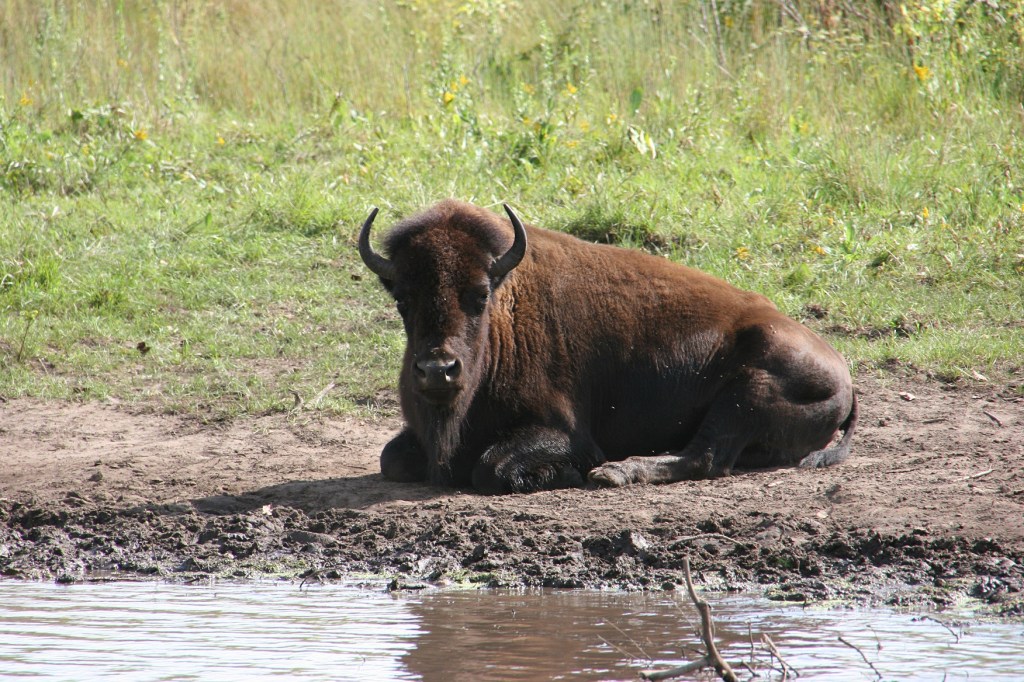
Minneopa State Park near Mankato is home to 30-40 bison fenced on 325 acres of primarily prairie. (Minnesota Prairie Roots copyrighted file photo 2019)

THEY ARE MASSIVE BEASTS, once roaming the American Great Plains by the millions. They are bison, also called buffalo, today numbering some 370,000 in North America. Most are raised as livestock. But some 31,000, or eight percent, are part of conservation herds, including right here in Minnesota. Such herds are designed to protect wild bison and preserve their genetic diversity.
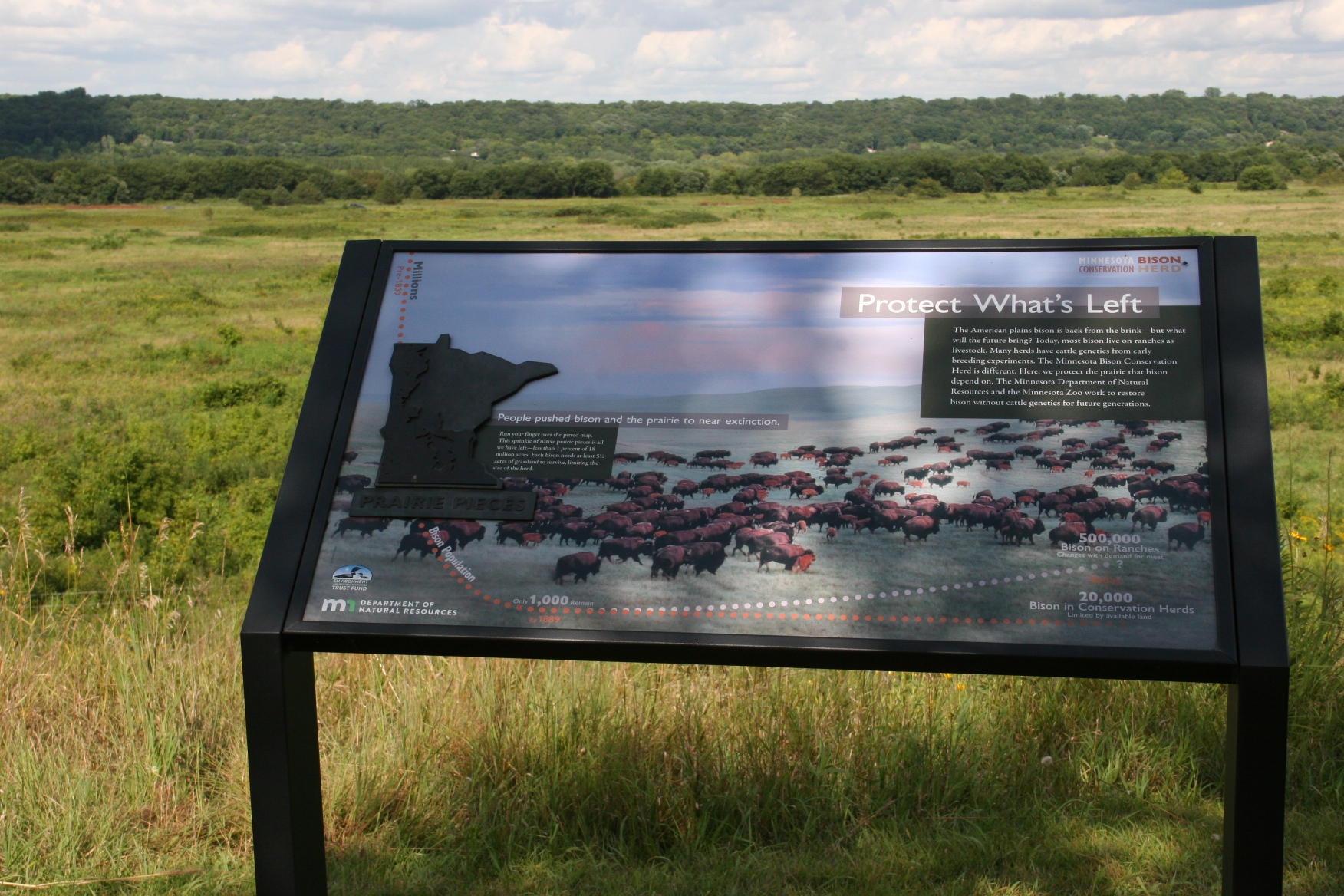
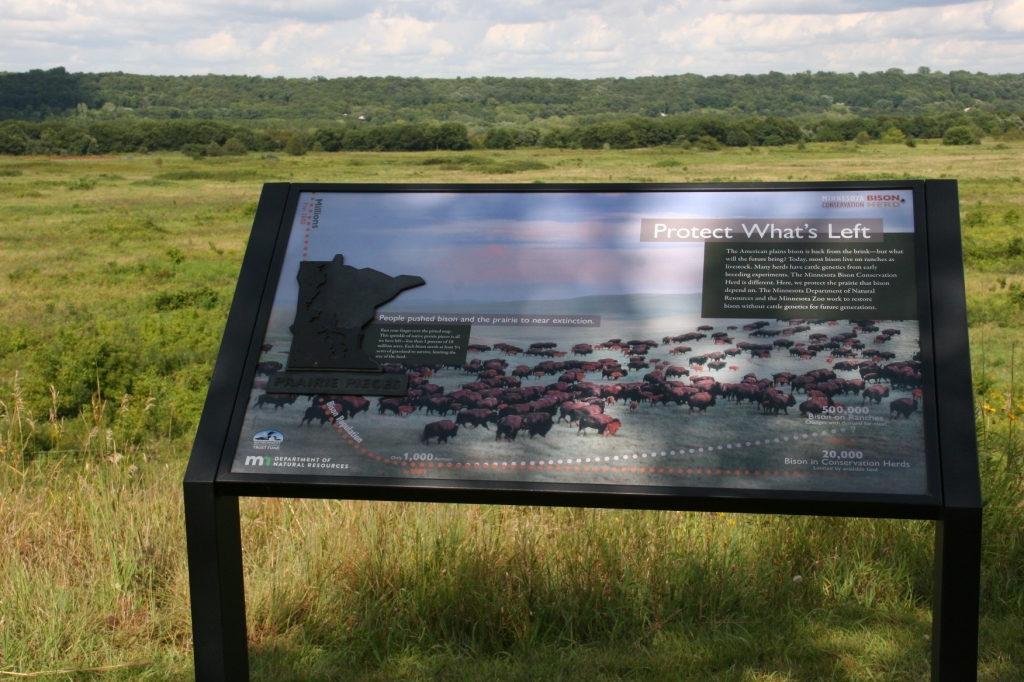
Interpretive signage about bison overlooks the prairie at Minneopa State Park. (Minnesota Prairie Roots copyrighted file photo 2019)

An upcoming documentary, “The American Buffalo—A Story of Resilience” by awarding-winning filmmaker Ken Burns, and my own recently posted poem about bison prompted my renewed interest in this animal. Burns’ 4-hour film airs in two parts, at 7 pm on Monday, October 16, and on Tuesday, October 17, on PBS. His documentary traces the history of bison, their importance in Native peoples’ lives and culture, their near extinction, and efforts to bring them back.

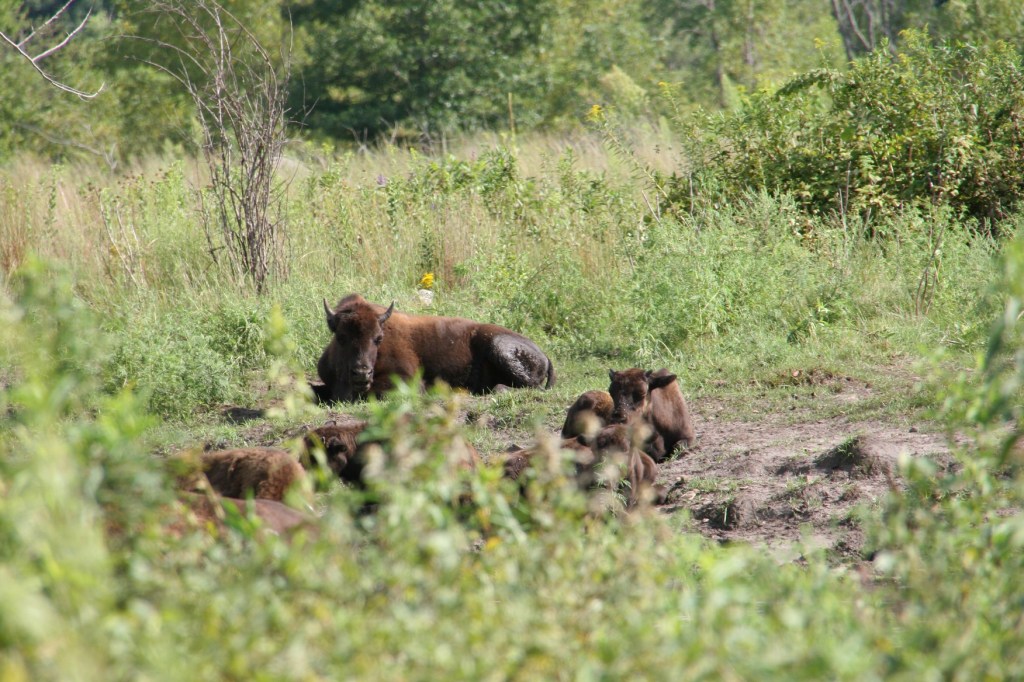
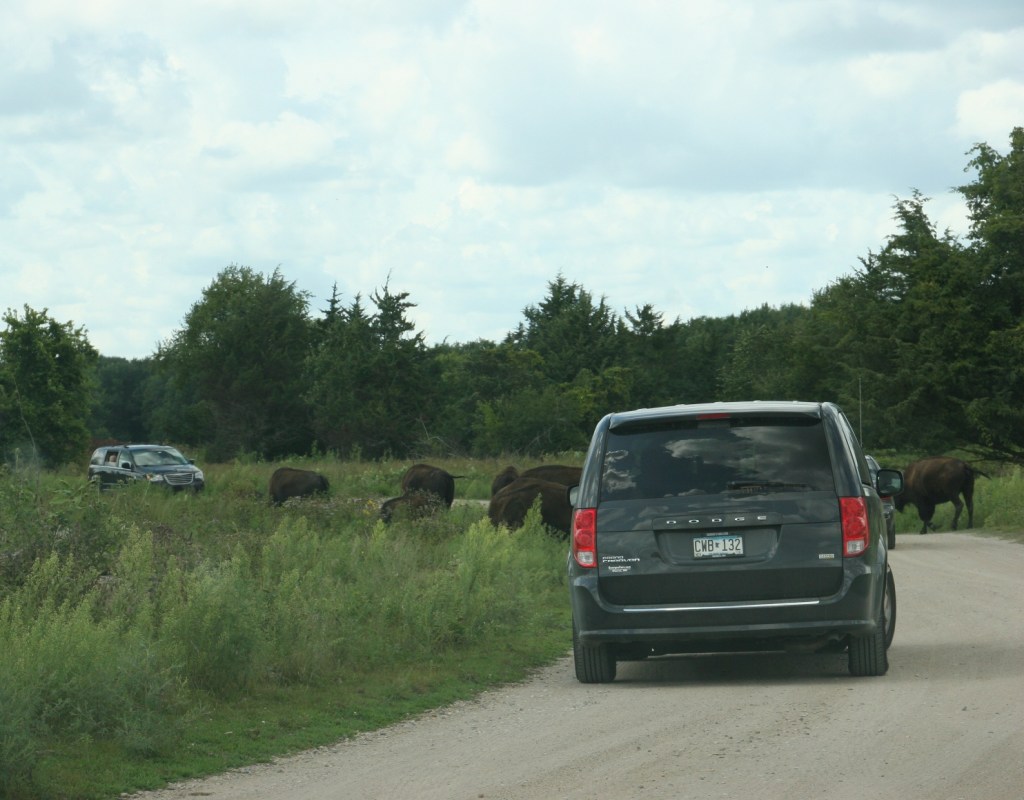
Bison up close while driving through Minneopa State Park. (Minnesota Prairie Roots copyrighted file photo 2019)

My connection to bison began decades ago with childhood visits to Ramsey Park (in Redwood Falls), now also more appropriately called Cansayapi Park. Cansayapi in the Dakota language means “where they marked the trees red,” the traditional Minnesota River valley homeland of the Dakota. The Lower Sioux Indian Community is located near nearby Morton with an enrolled membership of 930 of the Mdewakanton Band of the Dakota.
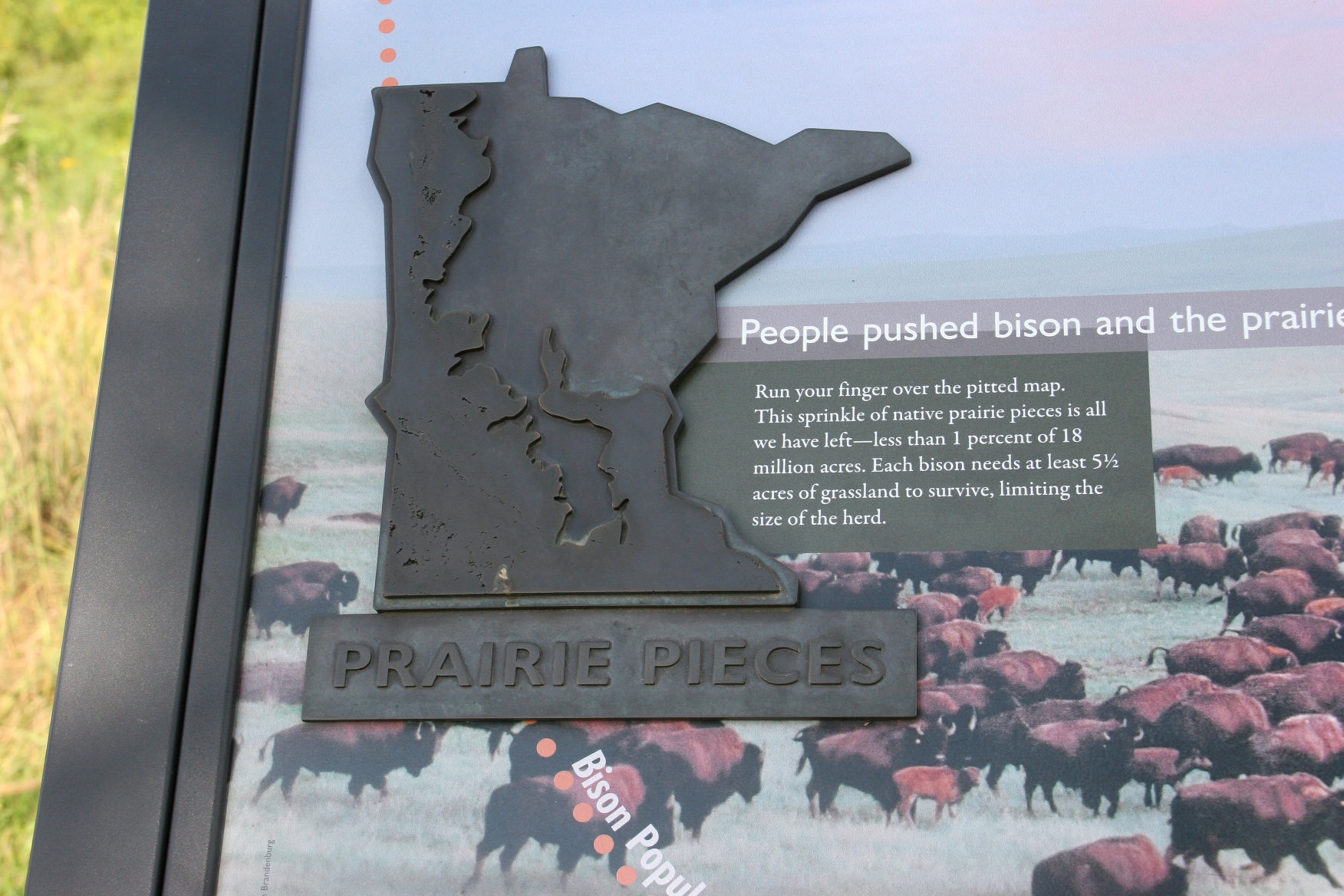
A map, posted in Minneopa State Park, shows the prairie and historic bison territory in Minnesota. (Minnesota Prairie Roots copyrighted file photo 2019)

Given the region’s rich Native heritage, the presence of a small group of bison in the Ramsey Park Zoo seems fitting. I recall rushing to see the buffalo there, both excited and intimidated by their massive hulk. Today I’m not so much afraid as respectful of their size and their importance in Indigenous Peoples’ culture.

A sculpture of White Buffalo Calf Woman, part of Indigenous culture, displayed at the 2011 Mankato City Art Walking Sculpture Tour. Artwork by Lee Leuning and Sherri Treeby. (Minnesota Prairie Roots copyrighted file photo 2011 by Audrey Kletscher Helbling)

One need only look back in history to see how invaluable bison were to these original inhabitants of the prairie, the plains. Bison provided food, shelter, clothing and more to Indigenous Peoples. They also held spiritual and cultural significance. Bison were considered kin, respected by those who respected Mother Earth.

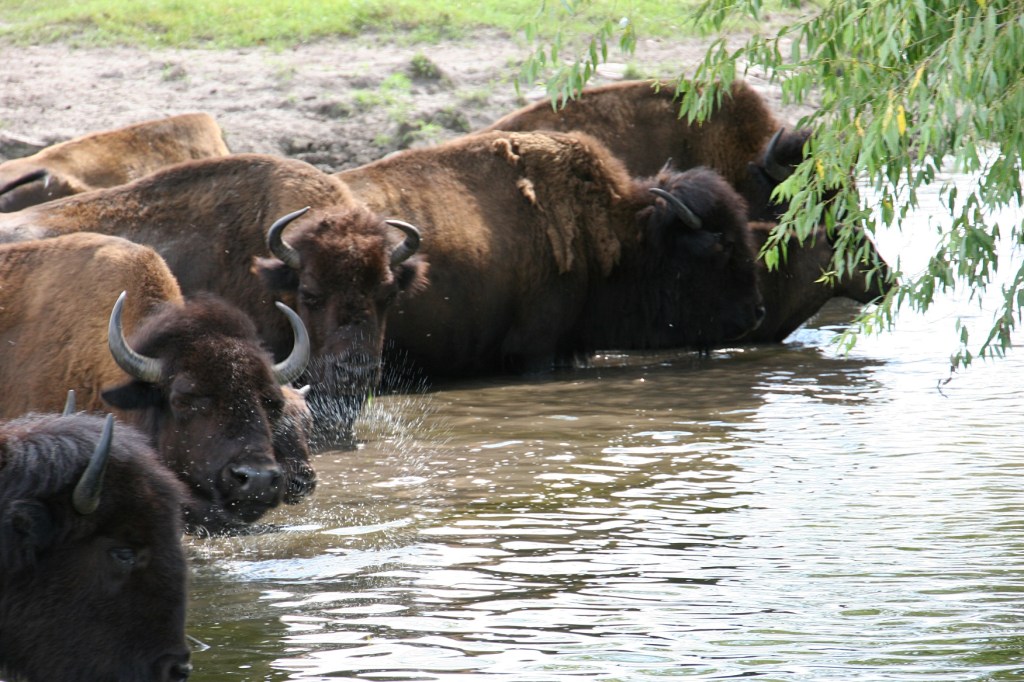
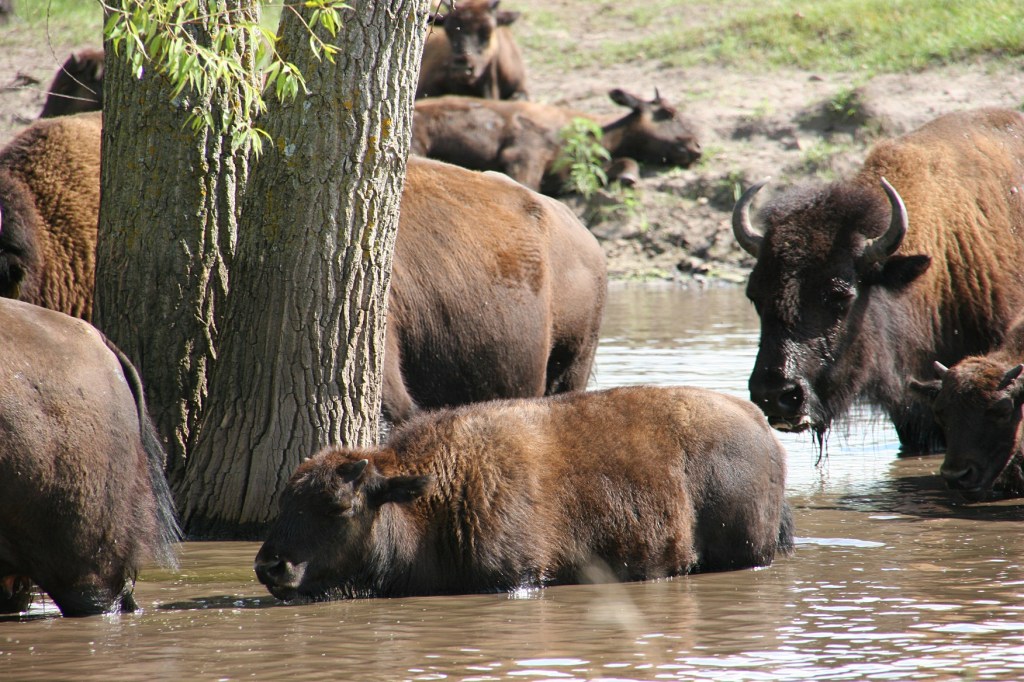
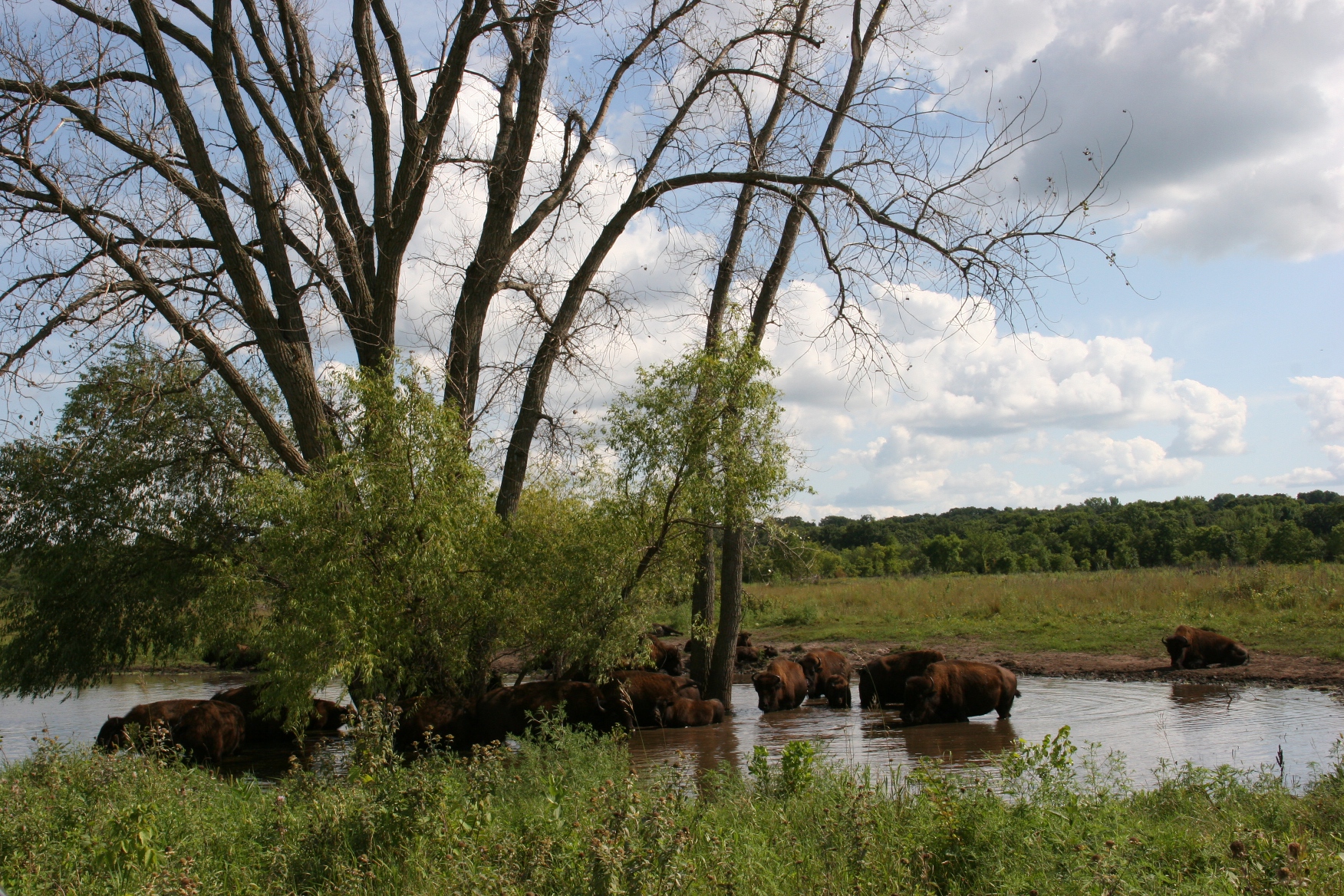
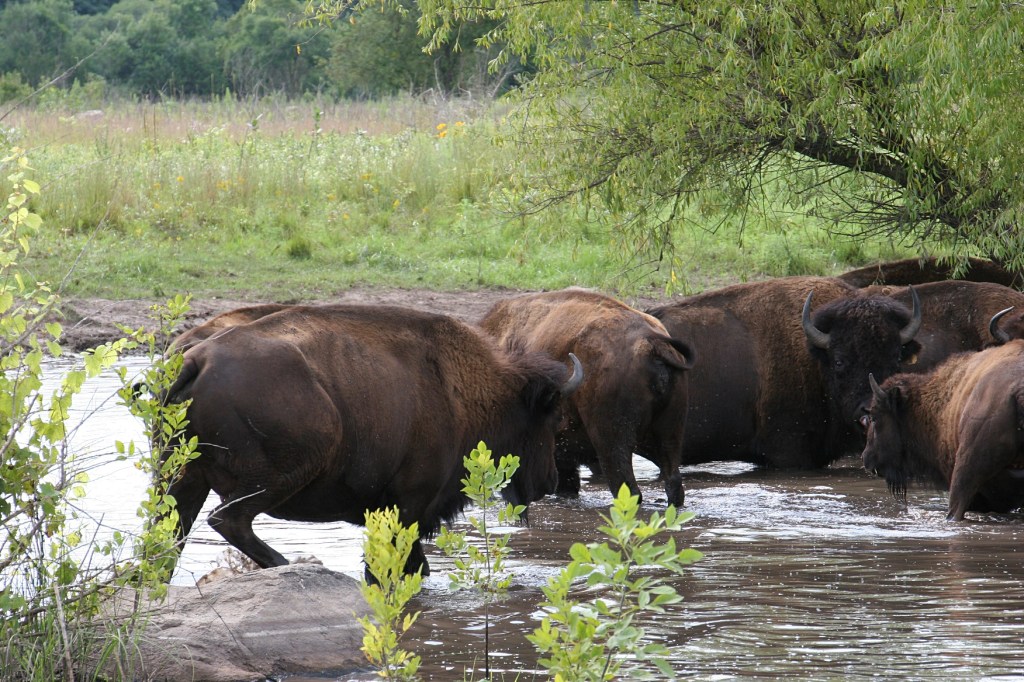
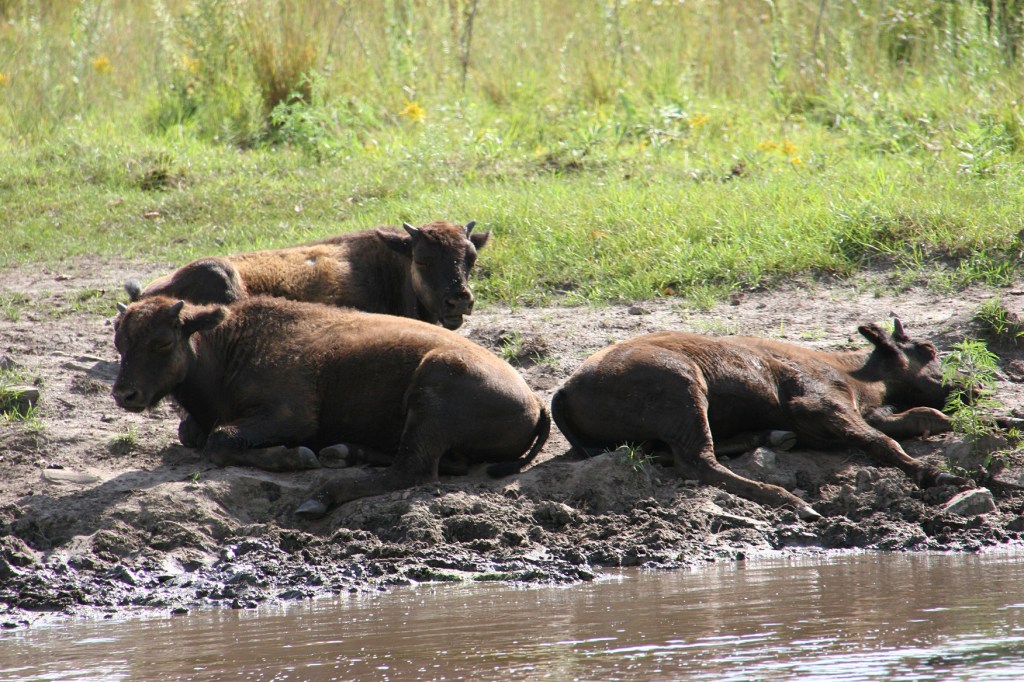
Bison at Minneopa State Park watering hole. (Minnesota Prairie Roots copyrighted file photo 2019)

And then the white man came in the 1800s, overtaking the land, nearly driving bison to extinction as they hunted and slaughtered the animal primarily for their hides.
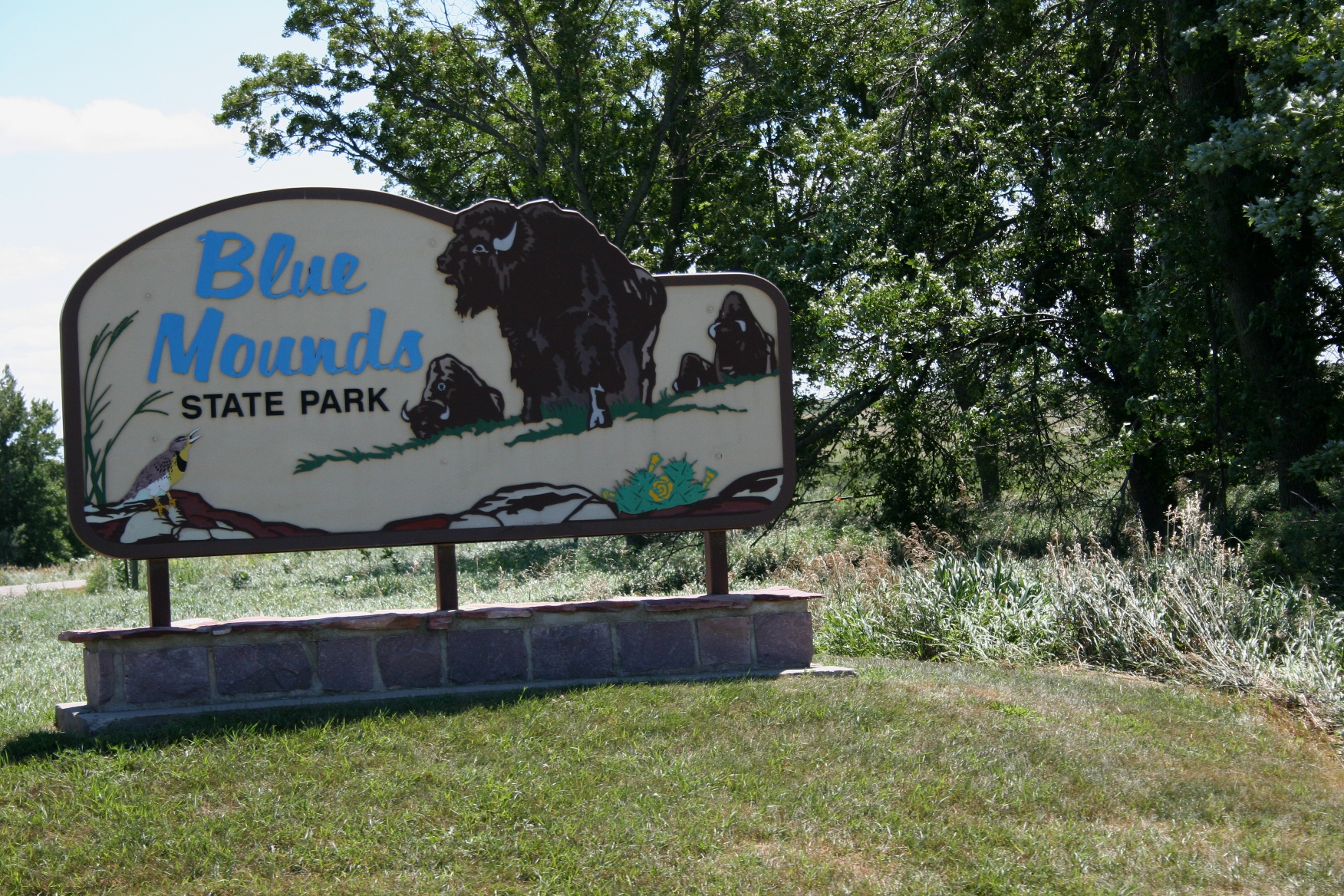
Blue Mounds State Park in rural Rock County, Minnesota, is home to 80-90 bison, although I did not see them when I visited the park in 2013. (Minnesota Prairie Roots copyrighted file photo 2013)

And so the story of bison is not only one of past atrocities in American history, but also one of personal history for me with those fenced bison in Minnesota’s largest municipal park, known as “The Little Yellowstone of Minnesota” for its beautiful natural topography seemingly like Yellowstone National Park. Yellowstone, the one in Wyoming, is home to nearly 6,000 bison.

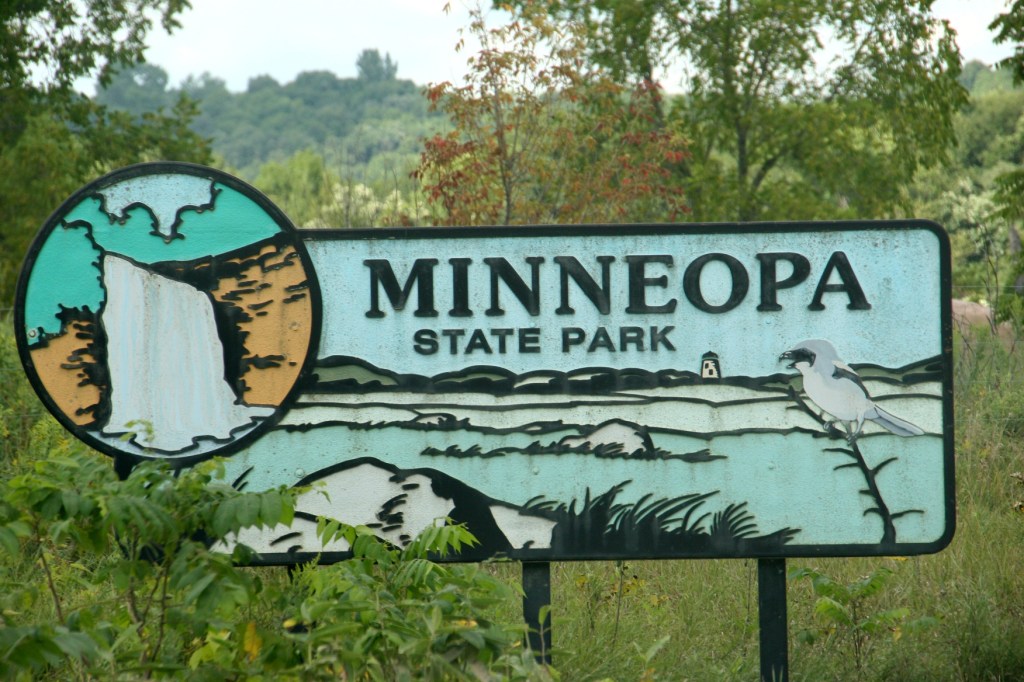
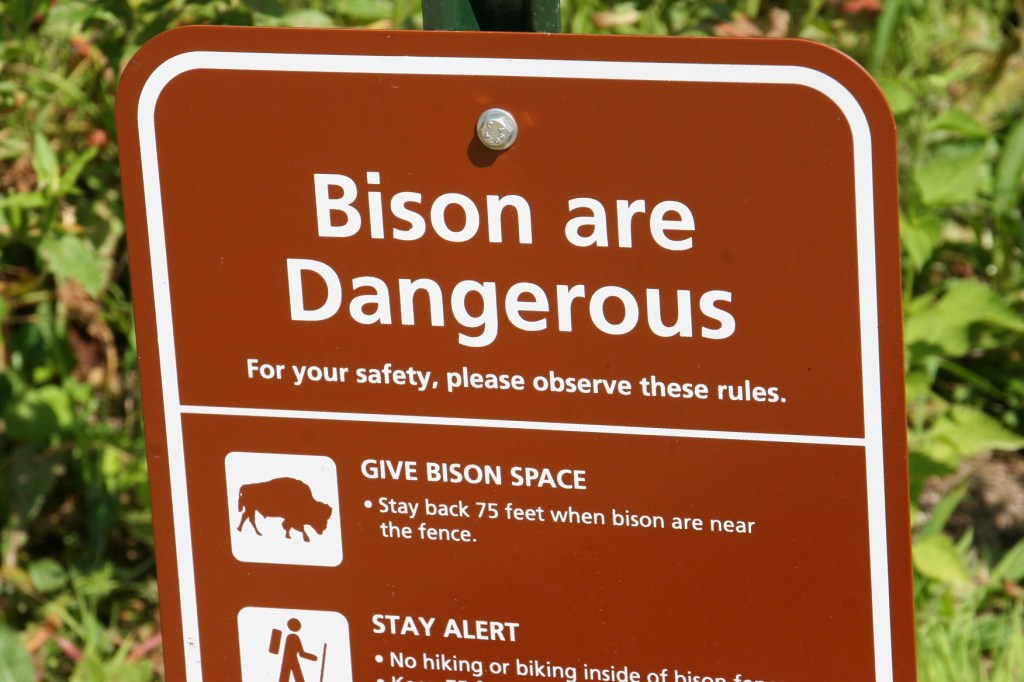
A sign along the prairie’s edge at Minneopa State Park informs about bison in Minnesota. (Minnesota Prairie Roots copyrighted file photo 2019)

In my youth, I didn’t understand the importance of bison in Native culture. I simply delighted in seeing them in the zoo at then Alexander Ramsey Park in my native Redwood County. Neither did I recognize how offensive the name of the park I loved as a child—Alexander Ramsey Park. Alexander Ramsey served as our first territorial governor and then as the second state governor of Minnesota during the US-Dakota War of 1862. He offered a bounty to anyone who killed a Dakota person and called for Indigenous Peoples to be driven out of Minnesota.
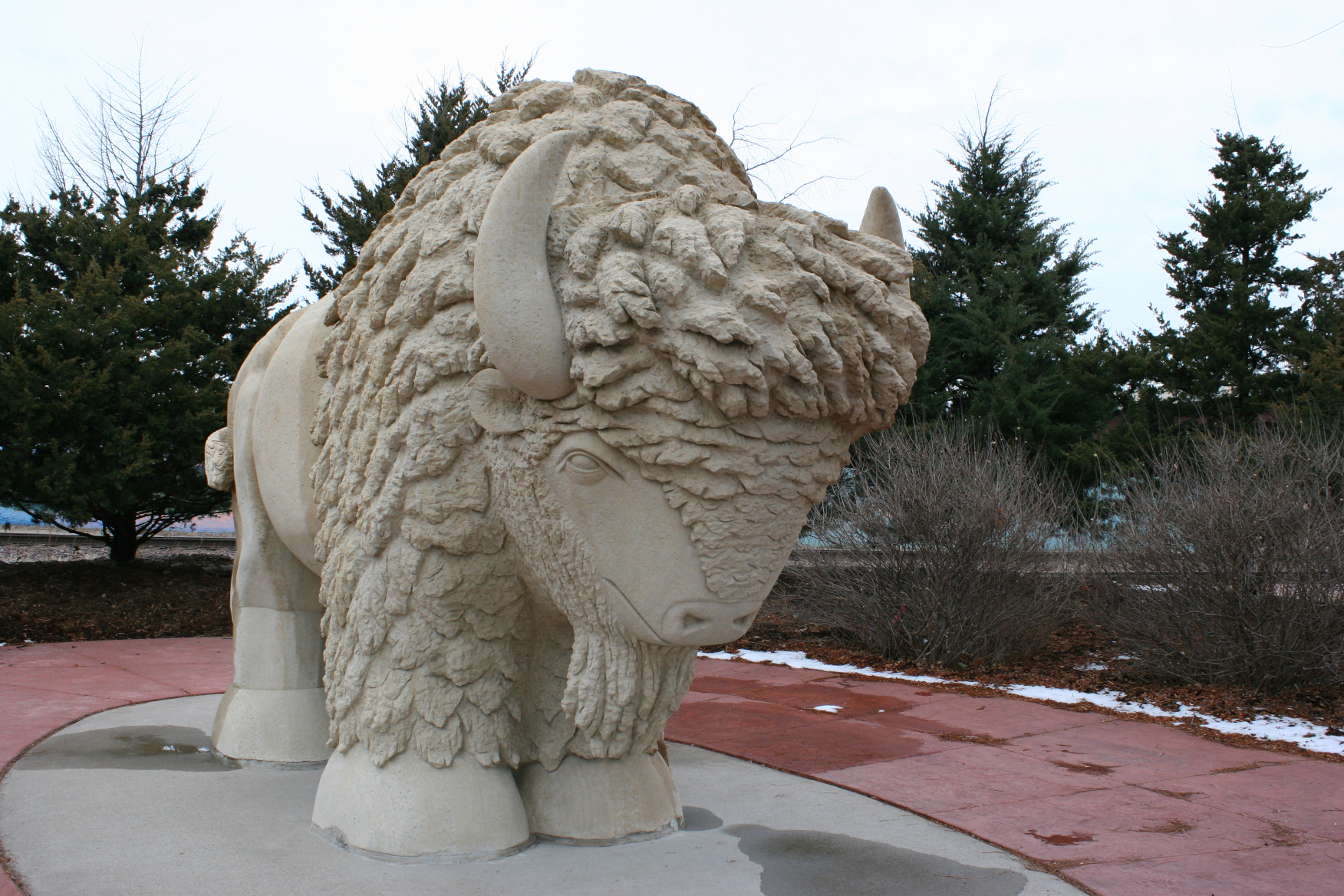
This 67-ton Kasota limestone sculpture stands in Reconciliation Park in Mankato. It symbolizes the spiritual survival of the Dakota People and honors the area’s Dakota heritage. The park is the site of the largest mass hanging in U.S. history. (Minnesota Prairie Roots copyrighted file photo 2019)

With that backstory and an understanding of a period in Minnesota history marked by hatred and injustices, I paid homage to bison in a poem now gracing a sign in Mankato. Mahkato, a Dakota word which means “blue earth,” was the site of the largest mass execution in the United States on December 26, 1862. Thirty-eight Dakota, sentenced to death in sham trials for their roles in the US-Dakota War, were hung in Mankato.
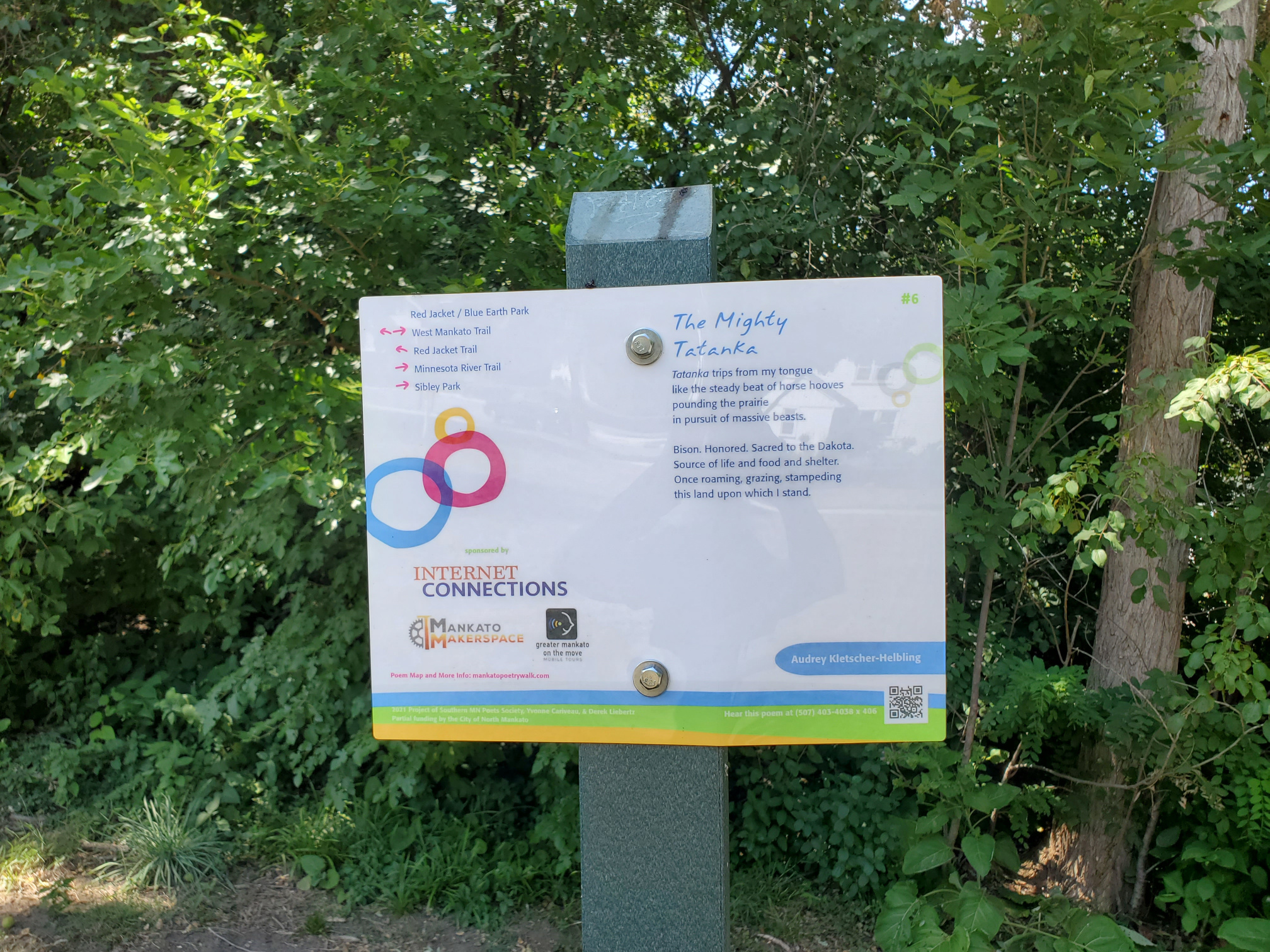
My poem posted along a recreational trail in Mankato. (Photo credit: Kay Herbst Helms)

I wanted to honor the original inhabitants of Mahkato, the bison, the Native culture, the land. And so I wrote “The Mighty Tatanka,” using the Dakota word for bison. My poem was selected for inclusion in the Mankato Poetry Walk & Ride and is posted on a sign in West Mankato.

The Mighty Tatanka

Tatanka trips from my tongue
like the steady beat of horse hooves
pounding the prairie
in pursuit of massive beasts.

Bison. Honored. Sacred to the Dakota.
Source of life and food and shelter.
Once roaming, grazing, stampeding
this land upon which I stand.

While my poem is succinct, limited by wordage requirements in the poetry competition, I’d like to think “The Mighty Tatanka” is powerful. It holds not only the rhythm of carefully selected words, but a story. A story of bison, of Indigenous Peoples, of a way of life, of a culture. It holds, too, honor for the land and of those who first inhabited, and respected, it.

#

FYI: My poem is posted on a sign along the West Mankato Trail near the intersection of Owatonna Street and Blue Earth and Sylvia Streets in West Mankato. You can listen to me read my poem by calling 507-403-4038 and entering 406.

Noted Minnesota wildlife photographer Jim Brandenberg’s (right in video) work, including this image of bison, is featured in a gallery bearing his name in Luverne, near Blue Mounds State Park. (Minnesota Prairie Roots copyrighted file photo 2013)

To see Minnesota Bison Conservation Herd bison in Minnesota, visit Minneopa State Park near Mankato, Blue Mounds State Park near Luverne, the Minnesota Zoological Garden, Oxbow Park & Zollman Zoo by Byron, and Spring Lake Park Reserve Bison Prairie in Dakota County.

© Copyright 2023 Audrey Kletscher Helbling


Mingling with the bison in Minnesota August 28, 2019

Filed under: Uncategorized — Audrey Kletscher Helbling @ 5:00 AM
Tags: , , , , , , , ,

With more than 300 acres to roam, the bison conveniently clustered around a watering hole next to the road through the prairie during our visit to Minneopa State Park.


OH, GIVE ME A HOME, where the buffalo roam…


This pair was so close to our van that I could almost have reached out and touched the calf.


Whenever I think of buffalo, those lyrics pop into my head. My classmates and I sang the words during informal music time at Vesta Elementary School some 50-plus years ago.


Interpretive signage about the bison is positioned overlooking the prairie.


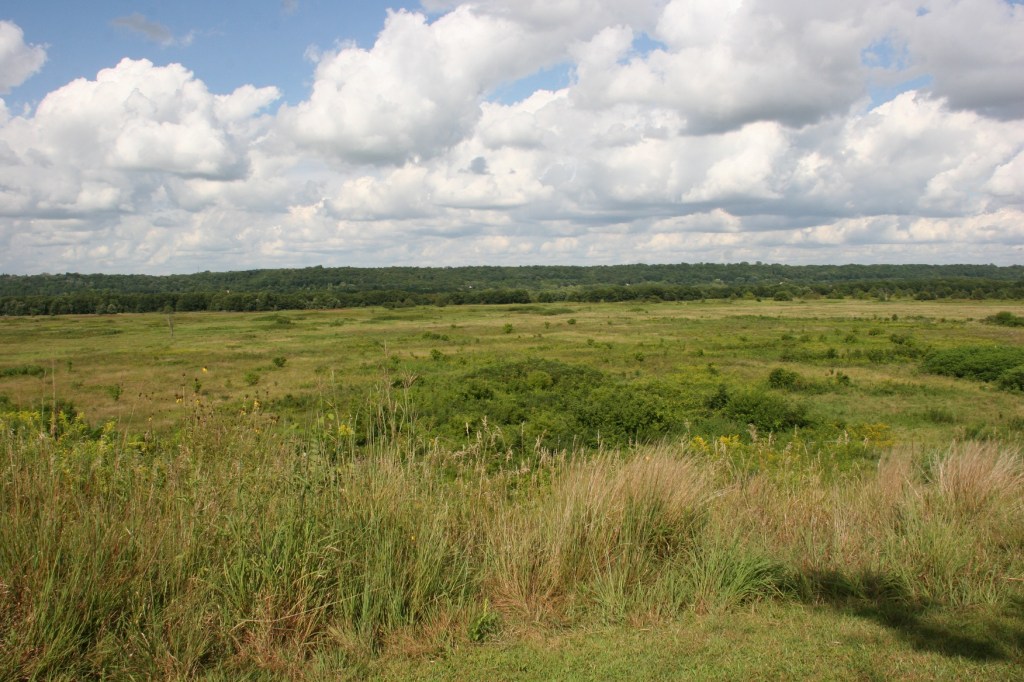
An overview of the Minneopa prairie, home to a herd of bison.


A map shows native prairie remaining in Minnesota, land needed by bison for grazing.


Or, whenever I think of buffalo, I remember childhood visits to the small zoo at Alexander Ramsey Park in Redwood Falls. There a tall wire fence separated us from these massive animals I associate with Native American buffalo hunts on the prairie.


Or, more accurately, bison hunts. These powerful animals are technically bison, not buffalo.


Today you can see them in Minnesota at the Minnesota Zoo, Blue Mounds State Park near Luverne and now at Minneopa State Park outside Mankato.


A gravel road slicing through the Minneopa prairie allows visitors to get a close-up view of the bison herd.


On a recent weekday afternoon, we drove to Mankato into bison territory. Literally. Vehicles turn onto a gravel road that winds through the Minneopa prairie, home to about 20 bison. Having grown up on a dairy and beef farm (with several mean bulls), I respect animals that outsize me, especially those with horns.


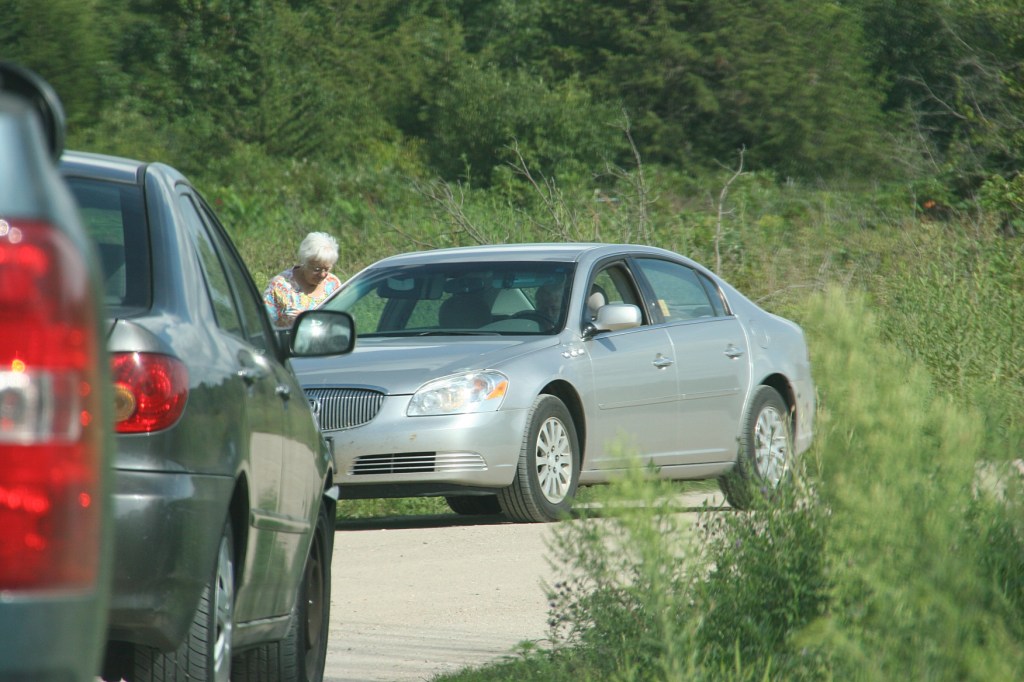
Vehicles park to watch the bison and a passenger steps out to photograph the dangerous animals.


I didn’t even question the validity of signage warning visitors to stay inside their vehicles because bison are dangerous. I watched in disbelief as a woman stood outside a car taking photos with the bison herd within stone’s throw. What on earth was she thinking? Only moments earlier a sheriff’s car passed by and I wished the deputy had seen, and ticketed, her.


We had a bit of a scare ourselves when a bison walking nearby suddenly bolted toward our van, but veered away at the last second. I envisioned horns impaling the metal.


These animals command respect. They are massive, powerful and beautiful, a part of our state’s history.


To share space with them upon the prairie is not only an experience, but an honor.

© Copyright 2019 Audrey Kletscher Helbling
 

Flat Fargo August 24, 2012

Filed under: Uncategorized — Audrey Kletscher Helbling @ 6:47 AM
Tags: , , , , , , , ,

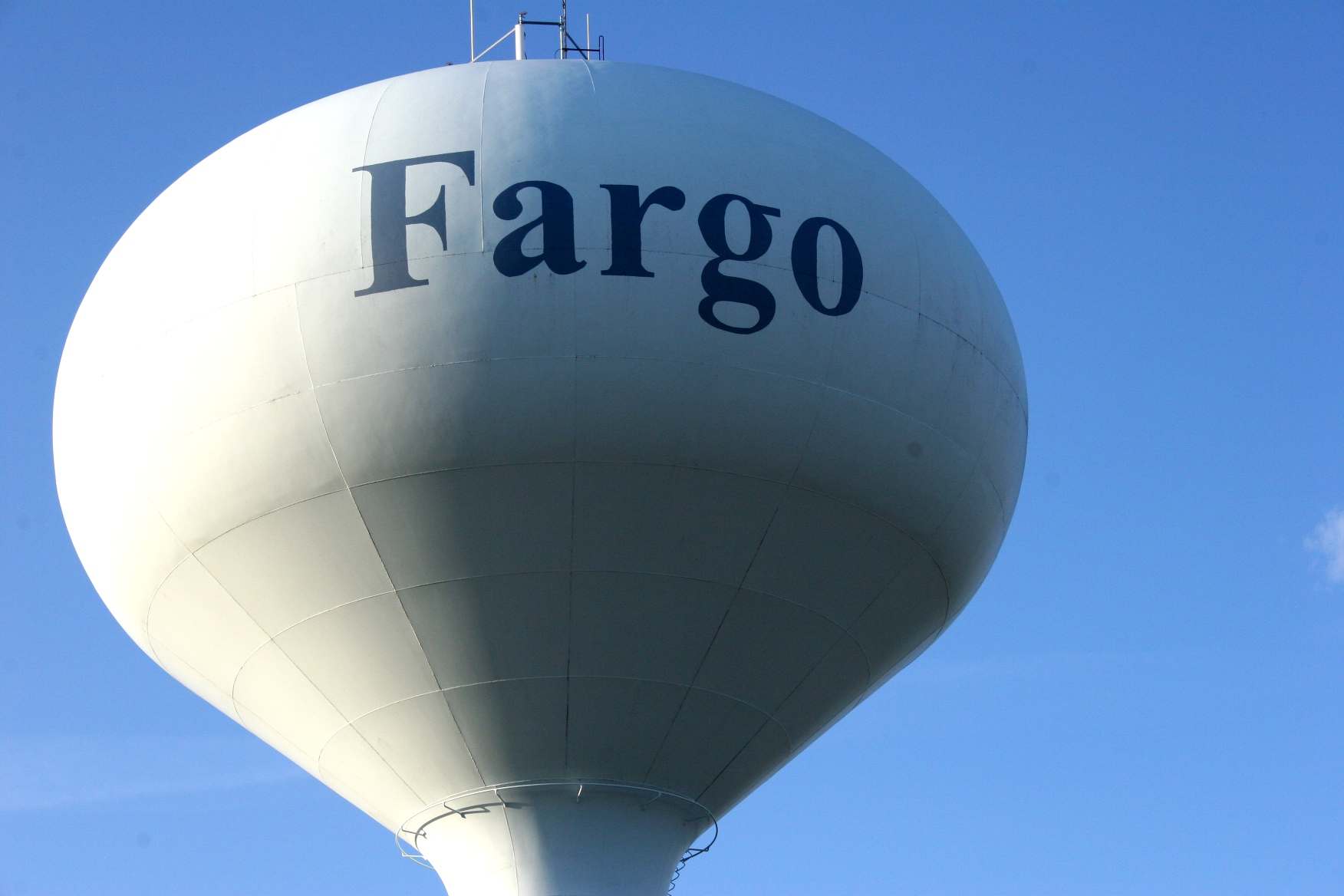
This water tower is located in West Fargo, an area of shopping malls, restaurants, Big Box stores, hotels, etc. The tower is a rare vertical structure, breaking the flat, horizontal landscape of the Fargo area.

I THOUGHT I KNEW FLAT having grown up on the southwestern Minnesota prairie where the land seems to stretch far and unbroken into flat infinity.

But not until this year, when my family traveled thrice nearly 300 miles north and west to Fargo, North Dakota, and back did I truly understand the definition of flat.

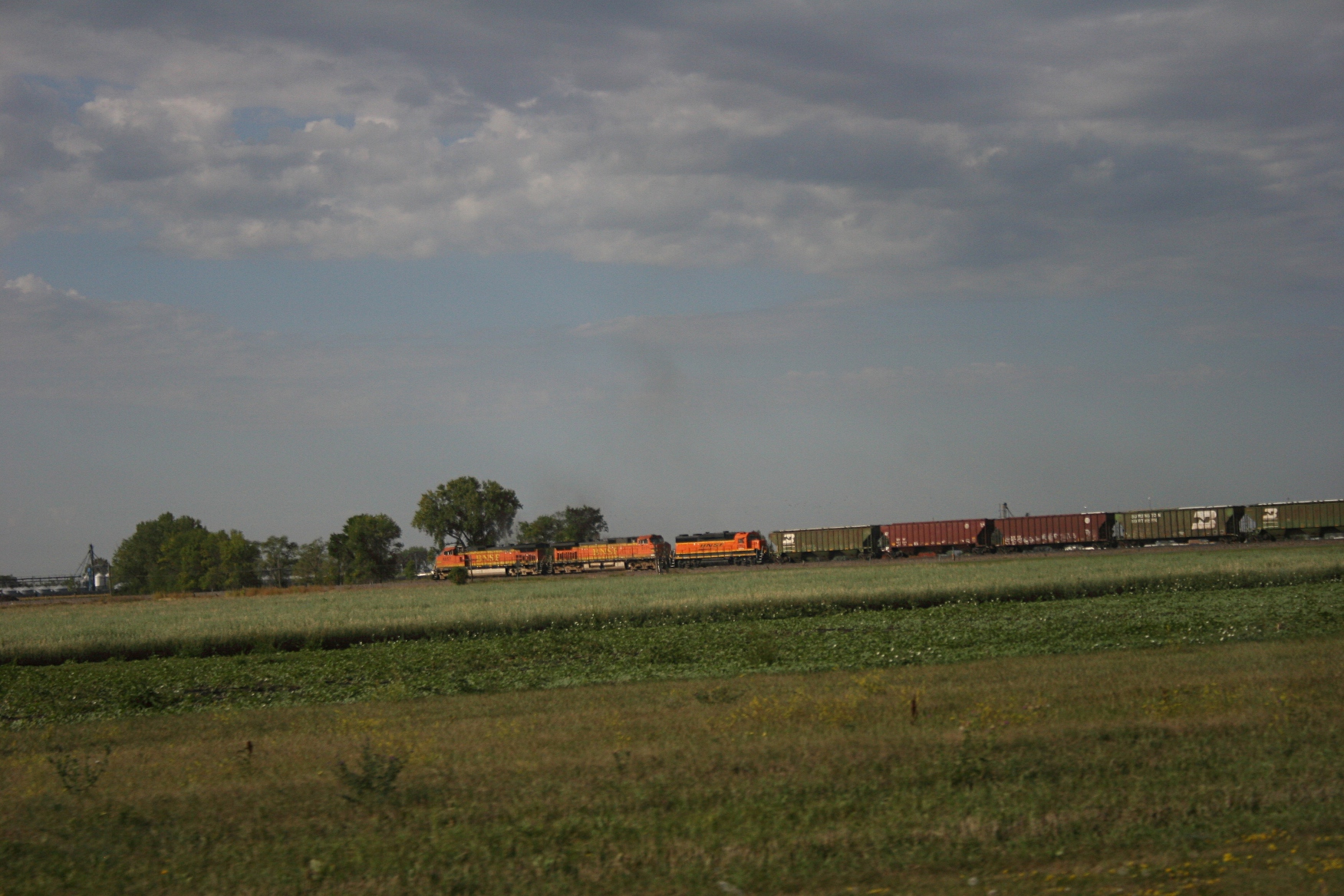
A train rumbles through the northwest side of Fargo near the airport and the campus of North Dakota State University. No, this is not a hill. I simply did not have my horizon straight as I photographed this train while traveling along a city street.

I doubt I have ever seen a city as flat as Fargo. You know, when you spill a glass of milk on the table how the liquid flows fast and free over the edge of the table. Well, that table would be Fargo. The milk would be the Red River of the North. I totally understand now why this city is so prone to flooding each spring.

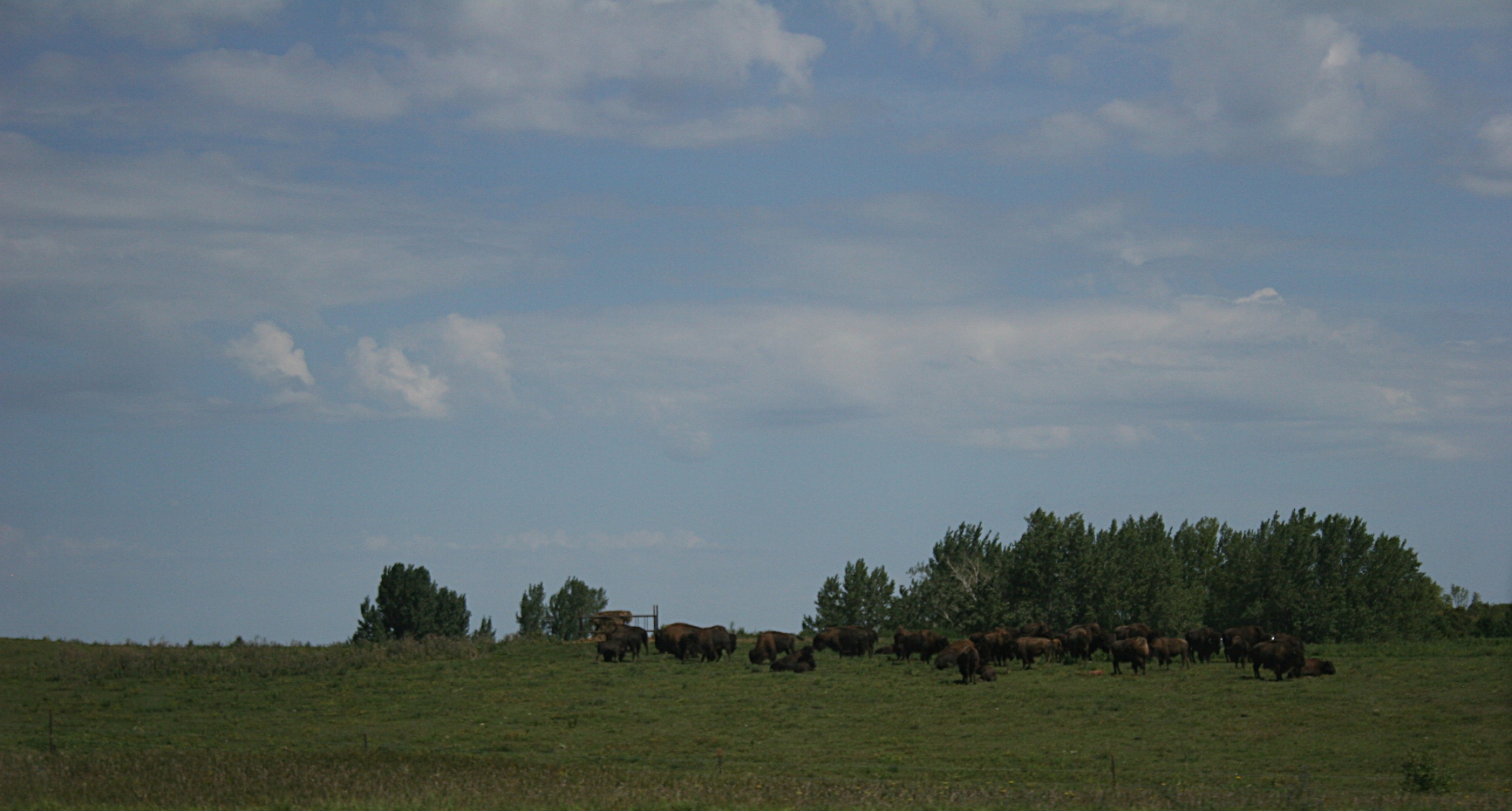
A herd of buffalo photographed along Interstate 94 east of Fargo, which places them in Minnesota.

I swear, if I had driven to the western edge of Fargo, I would see the world’s largest buffalo—26-foot tall, 60-ton concrete Dakota Thunder sculpted in 1959 by Elmer Petersen—90 miles away atop a hill in Jamestown’s Frontier Village. I saw the buffalo about 20 years ago while en route to a Helbling family reunion in Mandan/Bismarck, cities which actually do have hills. I think.

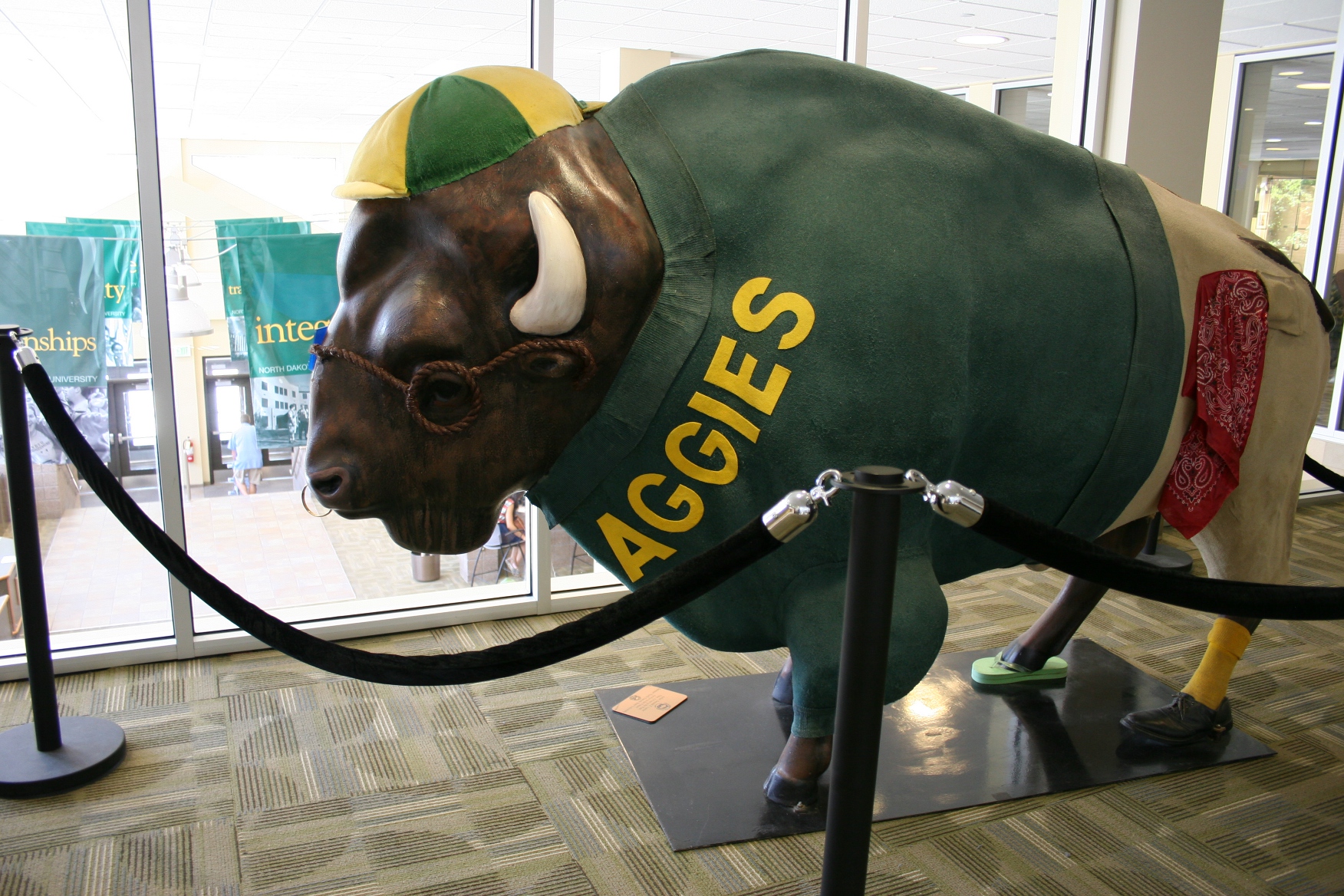
Inside the NDSU Memorial Union, I photographed this sculpture of a bison, the university’s mascot, in June.

About those buffalo… The flat and forever Dakota plains provide ideal grazing grounds for these massive creatures, or at least once did. Dakotans are proud of their native bison as evidenced in business names; art like “Herd About the Prairie” in Fargo; and even a bison mascot for North Dakota State University where my son is now a student.

A bus bench and sidewalk in West Fargo draw the eye west toward the horizon and the setting sun.

My apologies for momentarily edging away from that flat land issue. Even I, a girl of the prairie, find the Fargo flatness somewhat unsettling. I’d like a few more mature trees, especially on the sprawling growth west side of the city, upon which to rest my eyes. I’d like a few rises in the land, other than the rare man-made ones, to break the monotony of a straight horizontal line.

I expect that if I lived in Fargo, I’d adjust and think nothing of the flat landscape. But when you’re a visitor, you notice things like the lay of the land and the wind, oh, the winds of Fargo.

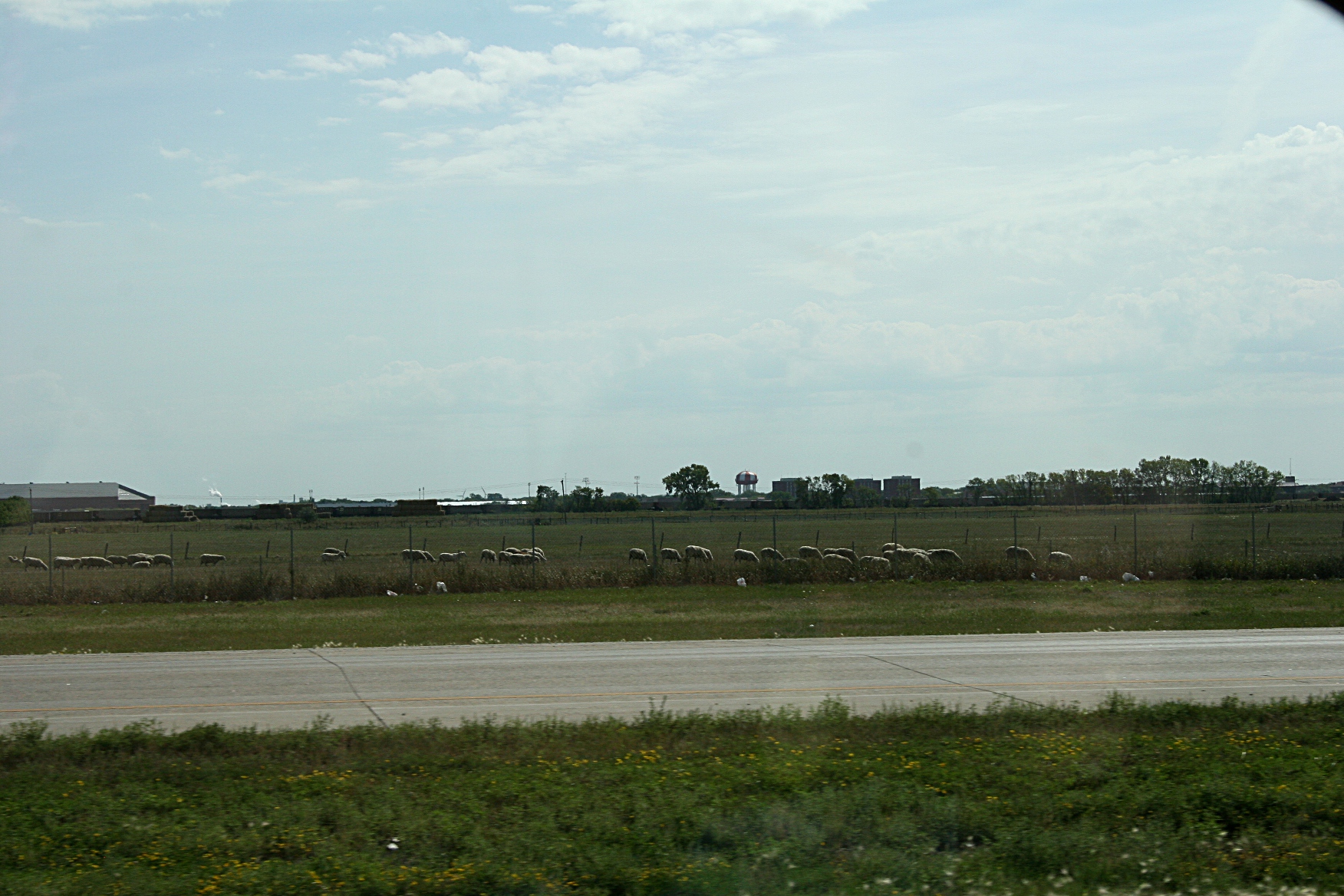
Just off Interstate 29 a flock of sheep graze pastureland as part of North Dakota State University’s Sheep Experiment Station.

Throughout West Fargo you’ll see open patches of land like this clover field next to the Fairfield Inn, where we’ve stayed twice. The hotel has strong horizontal lines like most structures in Fargo.

A fenceline and cornfield in Fargo, near (or part of, I’m not sure) the NDSU campus. More horizontal lines…

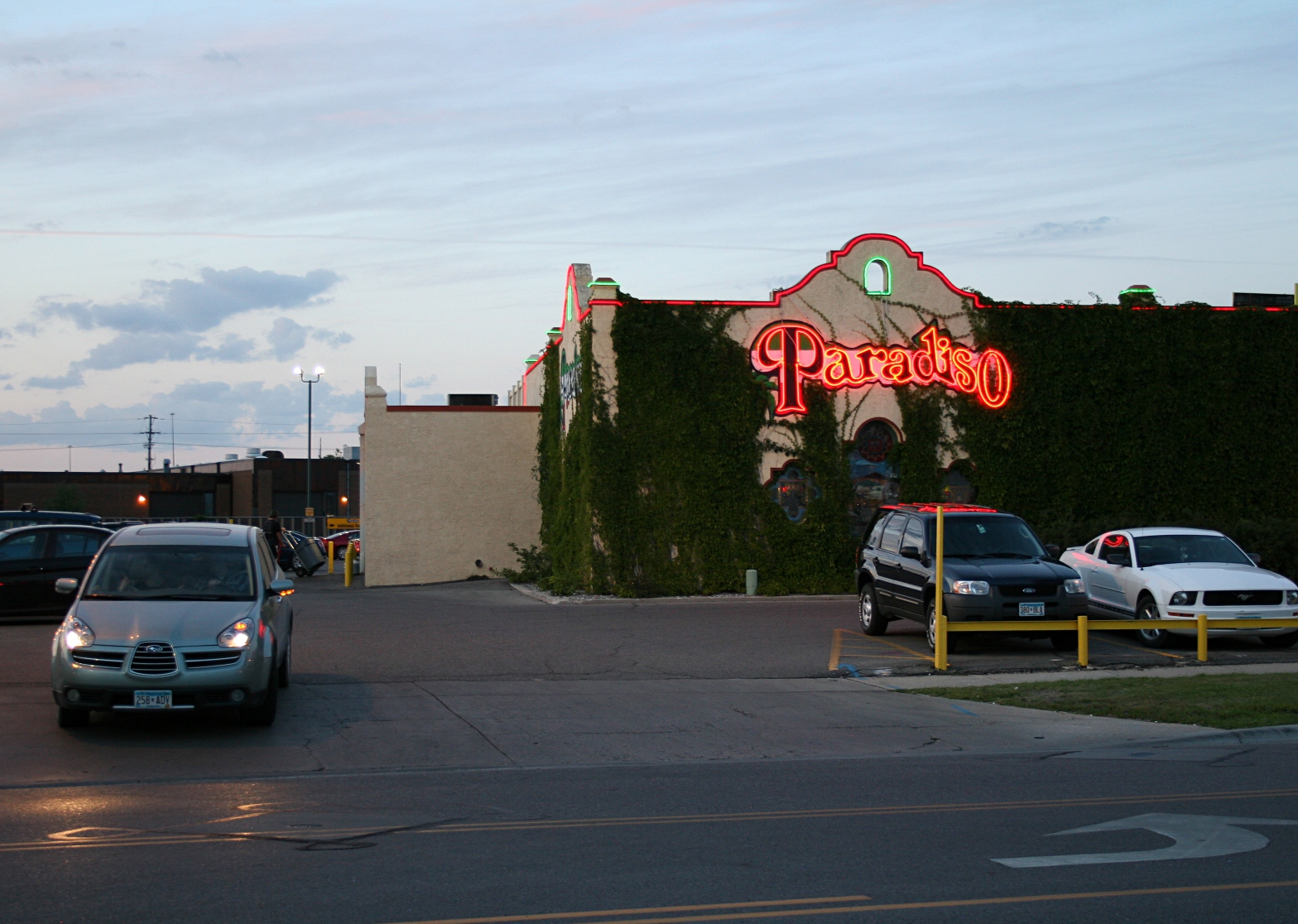
Paradise in Fargo, the Paradiso Mexican Restaurant, that is.

© Copyright 2012 Audrey Kletscher Helbling
 

Welcome to Fargo, as in the “real” Fargo June 20, 2012

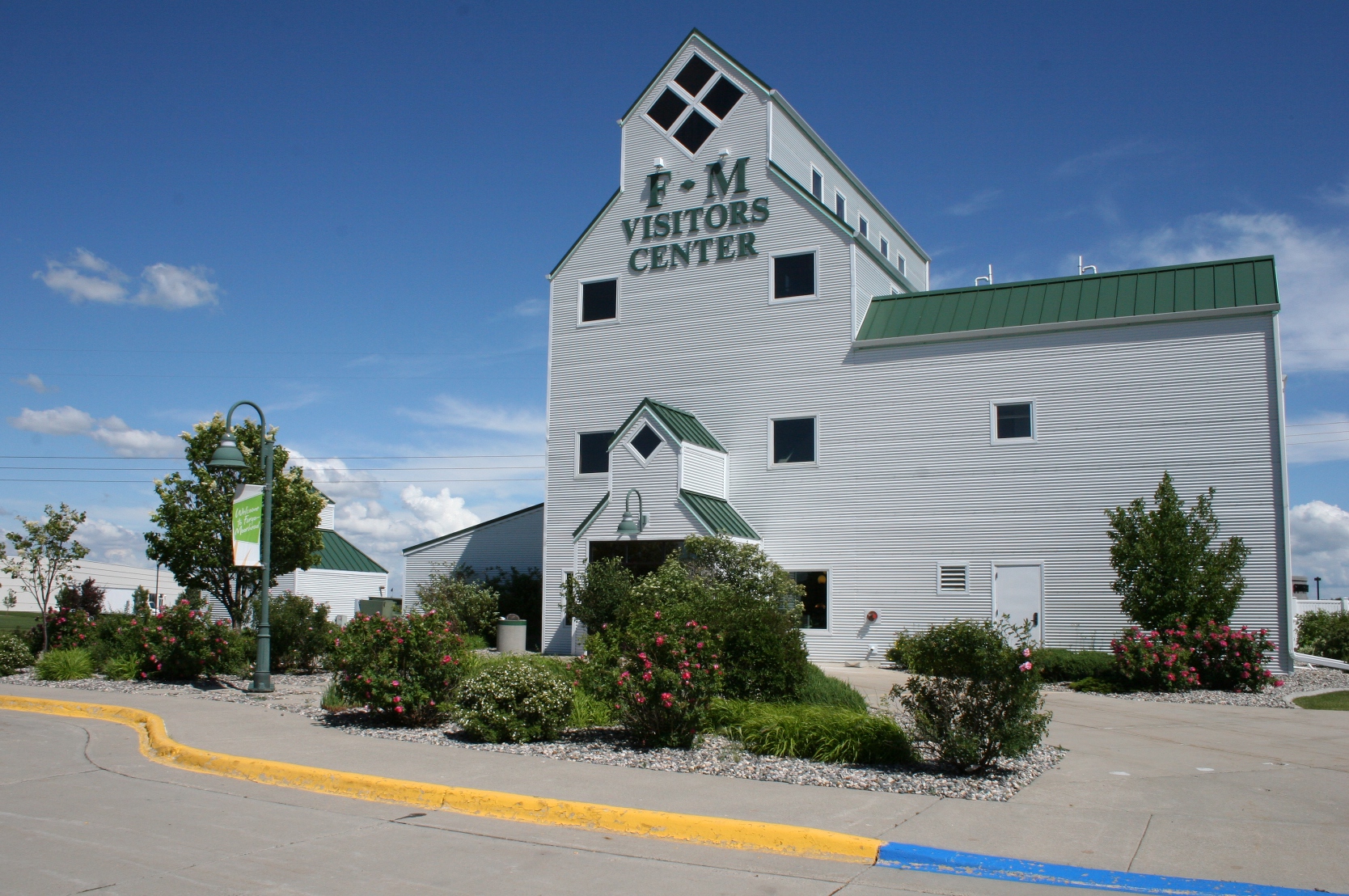
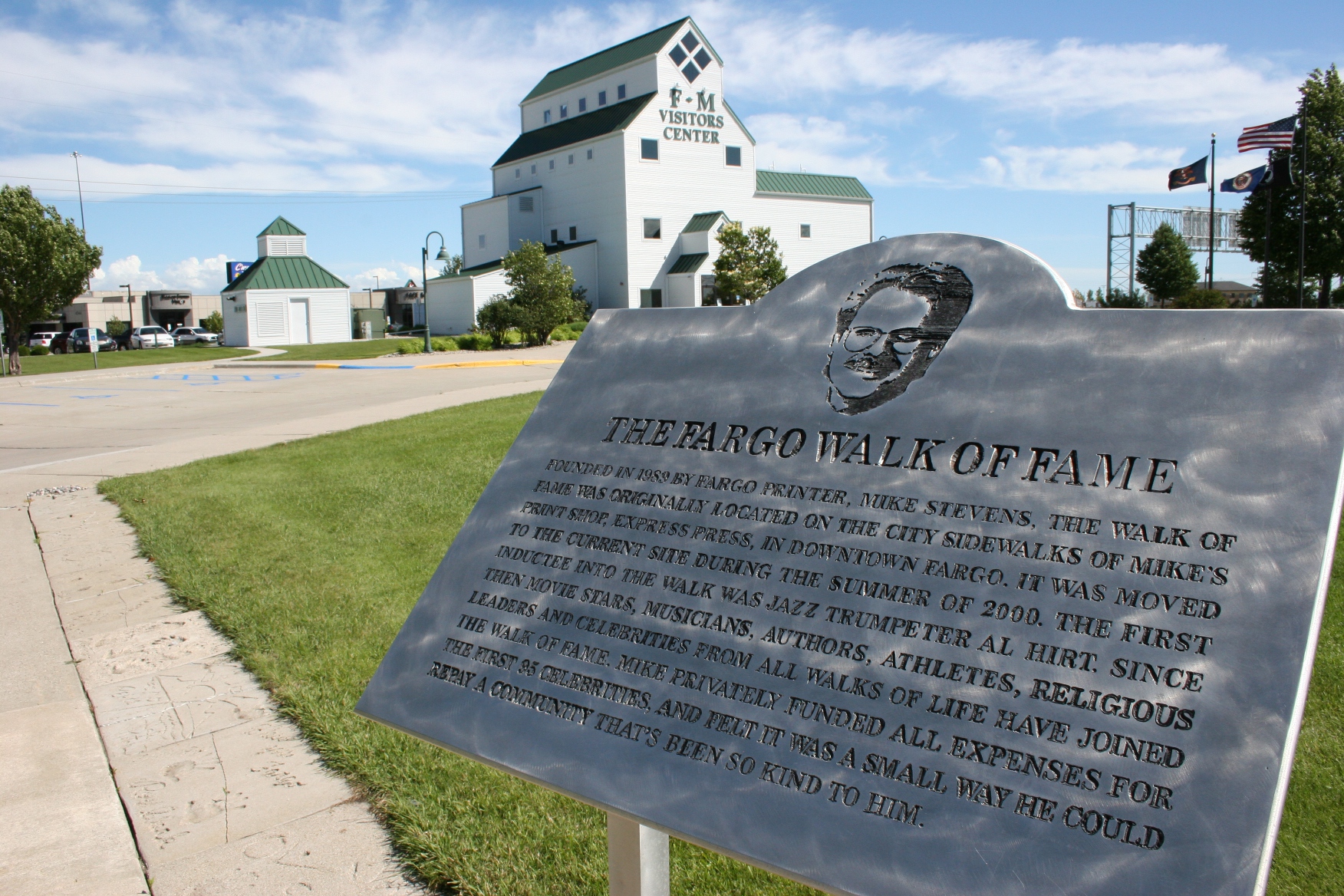
The official Fargo-Moorhead visitors guide reads: A warm welcome awaits you. Our Visitors Center, the “Grain Elevator,” located at Interstate 94 exit 348, has bushels of information, maps, brochures and a gift shop.

THE RAPID POP, pop, pop of tumbling popcorn, its buttery aroma scenting the air, impresses upon my senses as I enter the Fargo-Moorhead Vistors Center on a hang-onto-your-hat, grass-bending windy summer afternoon in North Dakota. (Is it always windy here?)

We’ve arrived in town around 4 p.m., five hours after leaving Faribault. I am determined on this, my third visit to Fargo—the first was 18 ½ years ago passing by on the interstate, the second in February—to see the infamous woodchipper from Minnesotans Joel and Ethan Coen’s 1996 award-winning dark comedy/crime film, Fargo.

The famous woodchipper from the movie, Fargo, is a focal point in the Visitors Center. Other film memorabilia is also on display.

In all honesty, I don’t recall the “feeding a body into the woodchipper” bit from the movie. Perhaps I shut my eyes or turned away as I cannot handle gruesome scenes. I remember, instead, the accents that made us northerners sound like backwoods hicks.

Visitors can also peruse copies of the Fargo script written by the Coen brothers from Minnesota.

But the F-M Visitors Center hypes up the film and specifically that woodchipper. And why not? Tourists embrace this kind of stuff, this opportunity to pull on furry ear flapper caps, pose next to the “real” woodchipper from the movie and then post the images on “The Woodchipper in Fargo” Facebook page.

I didn’t even attempt to persuade my husband and 18-year-old son to pose for a woodchipper photo.

A Fargo businessman started the Celebrity Walk. When his business moved, the Walk was relocated to the F-M Visitors Center. Some of the cement squares cracked during the move. Others have cracked due to weather.

We just grabbed bags of popcorn, quite fitting for the whole going-on movie theme, and munched while gathering brochures, asking questions and then, back outside, checking out the names imprinted in cement on The Celebrity Walk of Fame. The Coen brothers were noticeably absent.

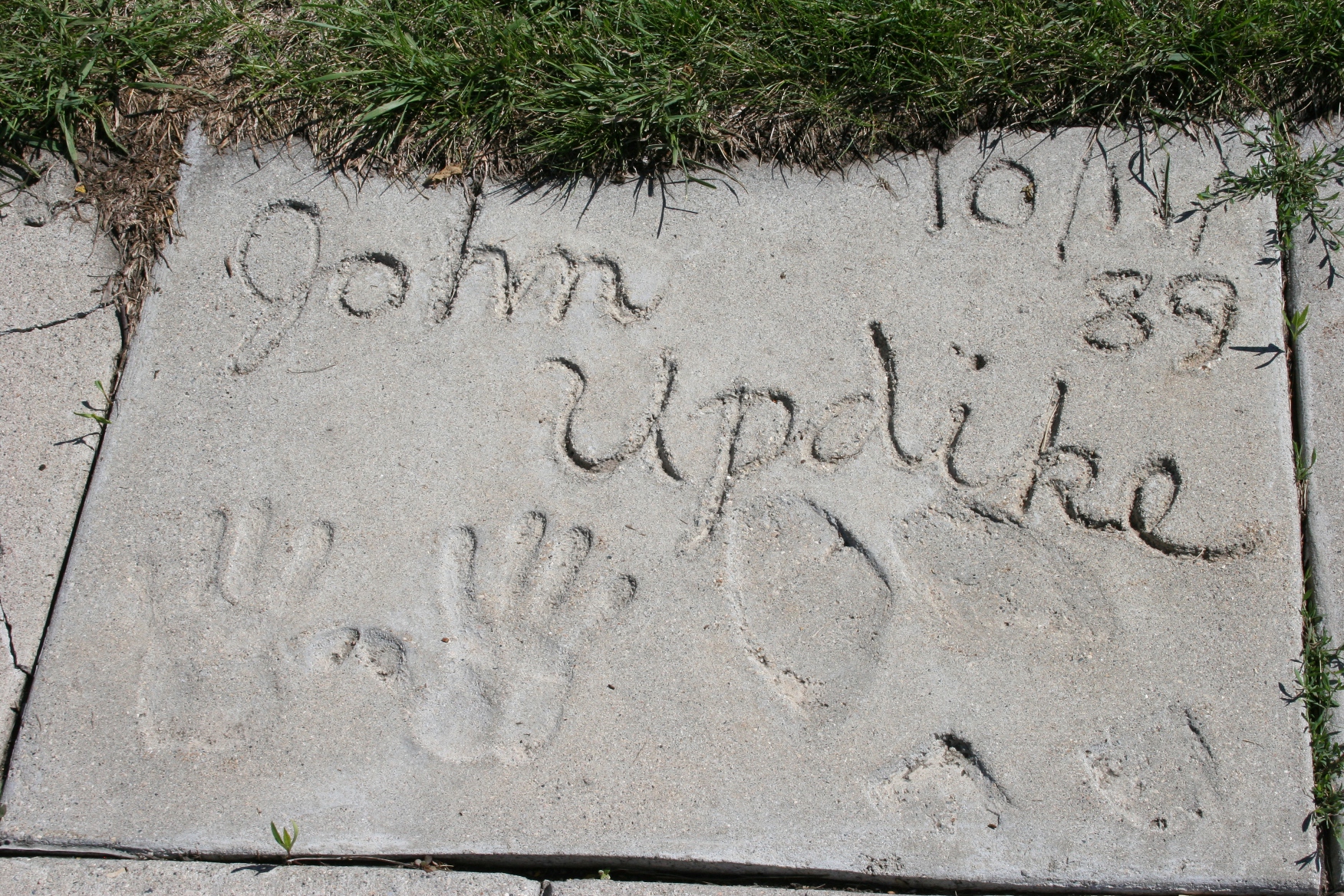
Of course, you might know that I would photograph the signature and handprints and footprints of a writer, like John Updike, who several times won the Pulitzer Prize in fiction.

But you’ll find the names, and sometimes hand and footprints and art, of 113 celebrities—from authors to movie stars to musicians and more—here. Notables like The Moody Blues, Bill Gates, Toby Keith, Paul Harvey, Travis Tritt, Conway Twitty, Garth Brooks, Kiss and many more have left their marks on 150-pound squares of cement in Fargo.

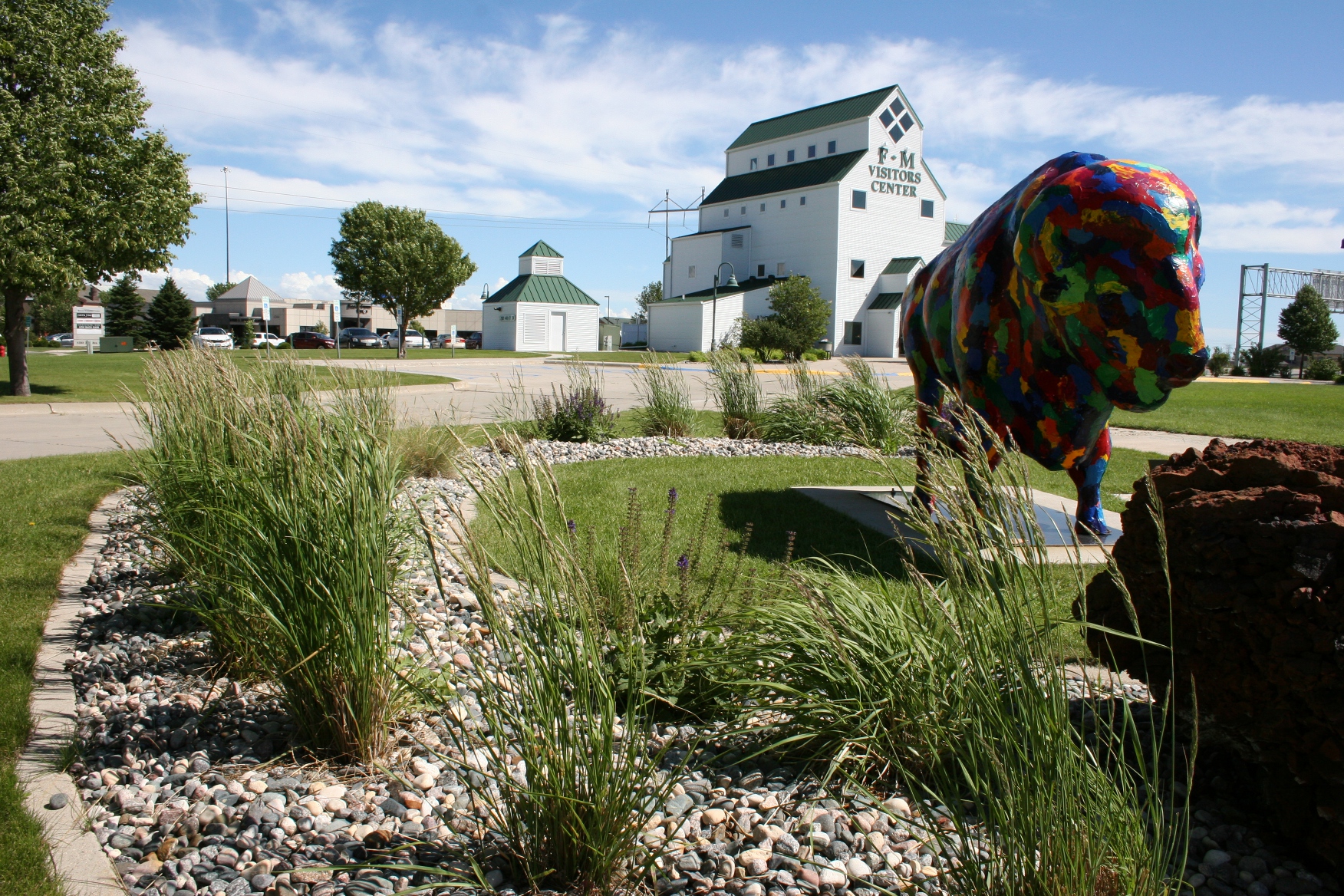
Anne Bradley Kiefel’s colorful “Herd About the Prairie” public art sculpture, right, is located at the Visitors Center.

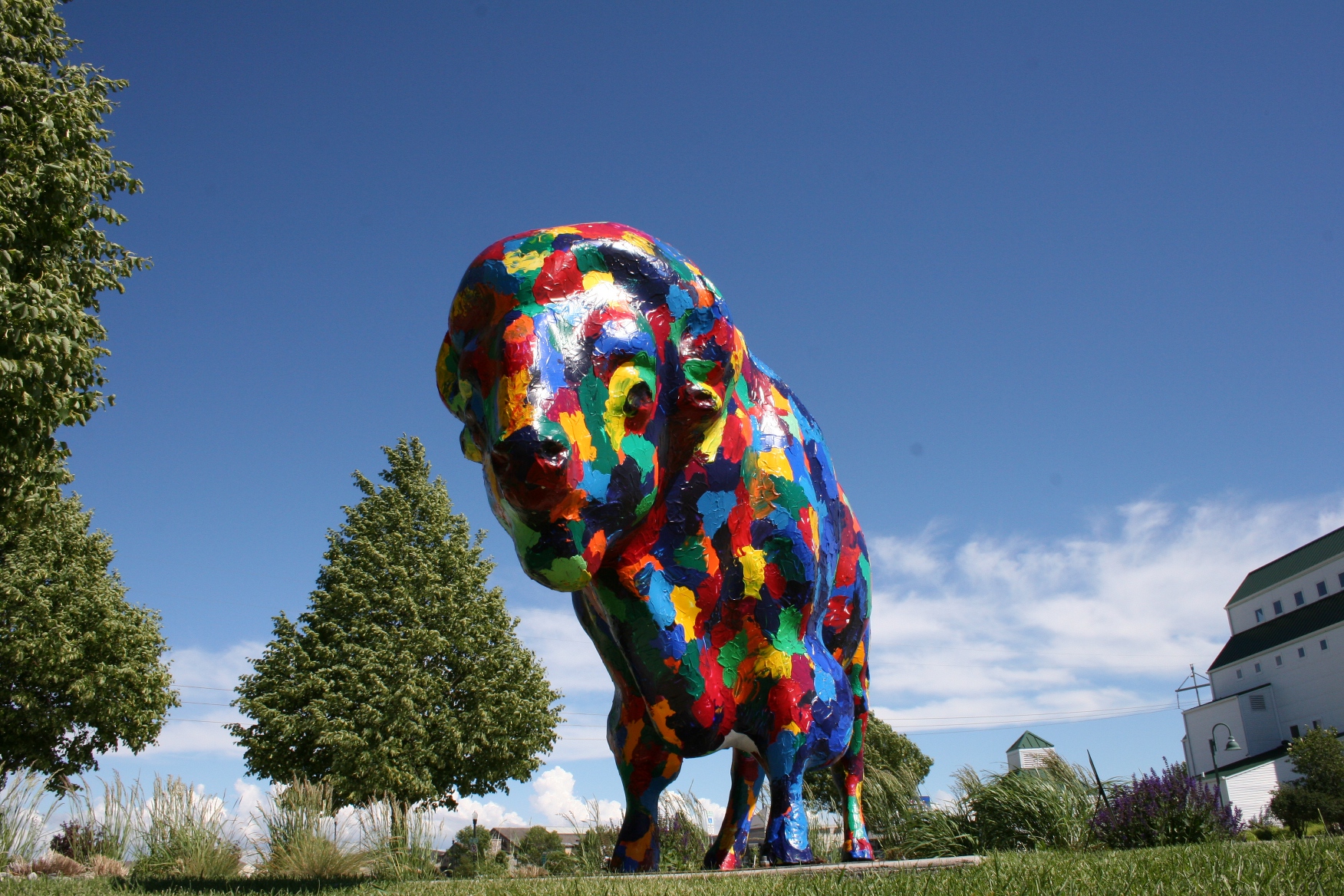
While circling the Celebrity Walk, I broke away to snap photos of the colorful fiberglass buffalo sculpture, “Aunie,” created by Anne Bradley Kiefel as part of a 2006 Lake Agassiz Arts Council public art project, “Herd About the Prairie.” The Visitors Center bison is among 19 such sculptures in the Fargo-Moorhead area.

A looking-up-from-the-ground shot of the buffalo.

Spend any time here, and you’ll soon discover that these F-M folks love their buffalo as much as they love Fargo.

P.S. I just checked out a copy of the movie, Fargo, from my local public library last night. I never intended to do so. But as I was walking past a catch-all basket for books/movies/magazines, there was Fargo, right on the top, staring up at me. Gives you goosebumps, doesn’t it? So…, I will see if I am actually able to watch the woodchippper scene this time around.

© Copyright 2012 Audrey Kletscher Helbling