Minnesota Prairie Roots

Writing and photography by Audrey Kletscher Helbling

The journey November 12, 2021

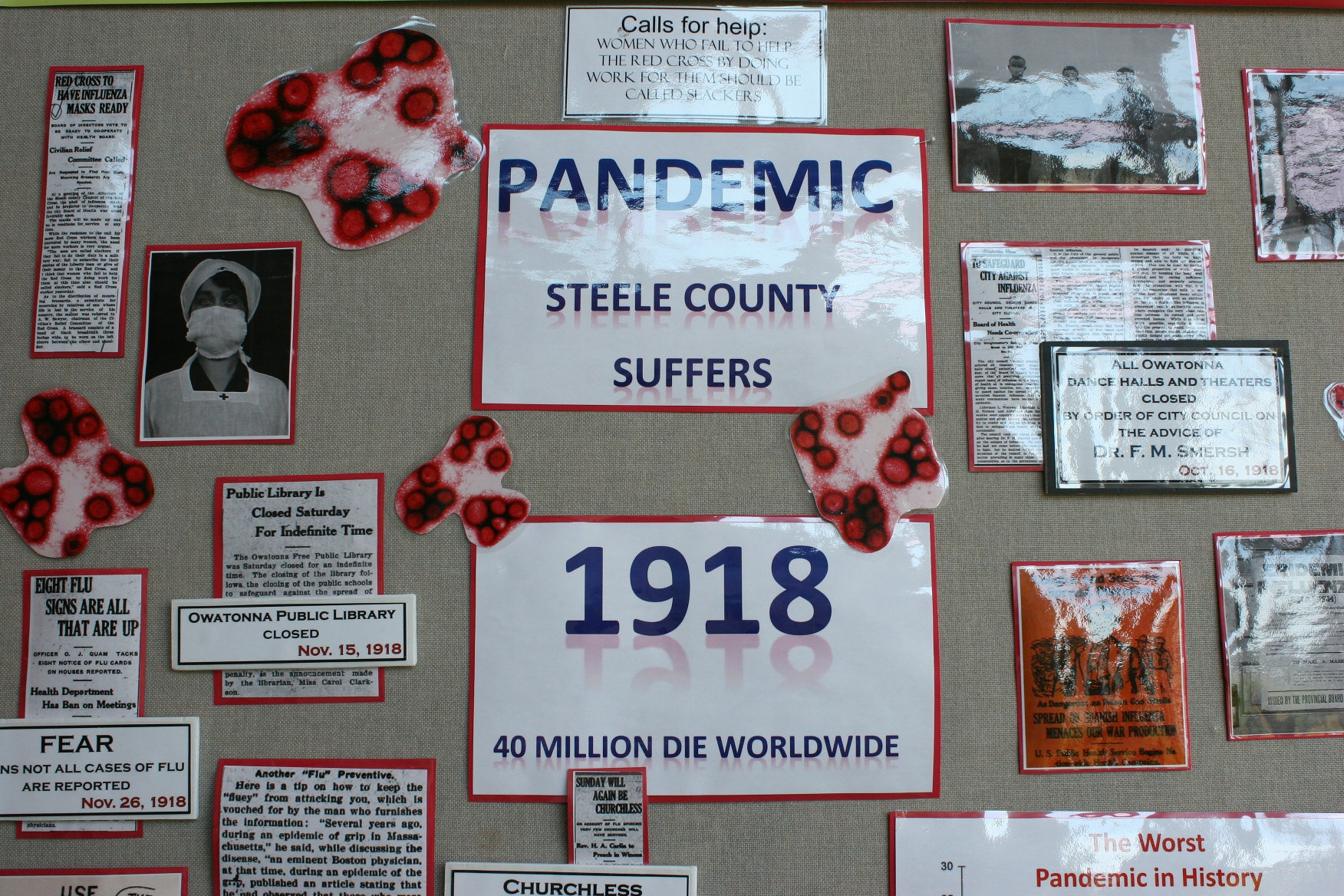
Featured in a 2016-2017 “Minnesota Disasters” exhibit at the Steele County History Center in Owatonna. (Minnesota Prairie Roots copyrighted file photo 2016)

ONCE UPON A TIME in The Land of Plenty, a waif of a girl and her mother wound through the packed dirt and cobblestone streets of their remote village.

Sometimes they walked side-by-side. Other times the wee girl trailed her mother. But when they reached the village square, where a raucous crowd had gathered, they clasped hands and quickened their pace. The pair wanted to avoid the angry villagers crowded around The Village Know-It-All. He stood high above the throng, encouraging them to resist all attempts by The Ministry of Health and other officials in a far away city to stop The Great Invader.

His voice boomed authority across the square. “Stand strong,” he urged. “There is no need to defend yourselves against The Great Invader. He poses no threat. Stories of his strength are greatly exaggerated. There is no need to arm yourselves with protective gear or to hide or to avoid each other. There is no need for a potion to keep you safe. That’s nonsense. Lies. No one can tell us what to do! No one!”

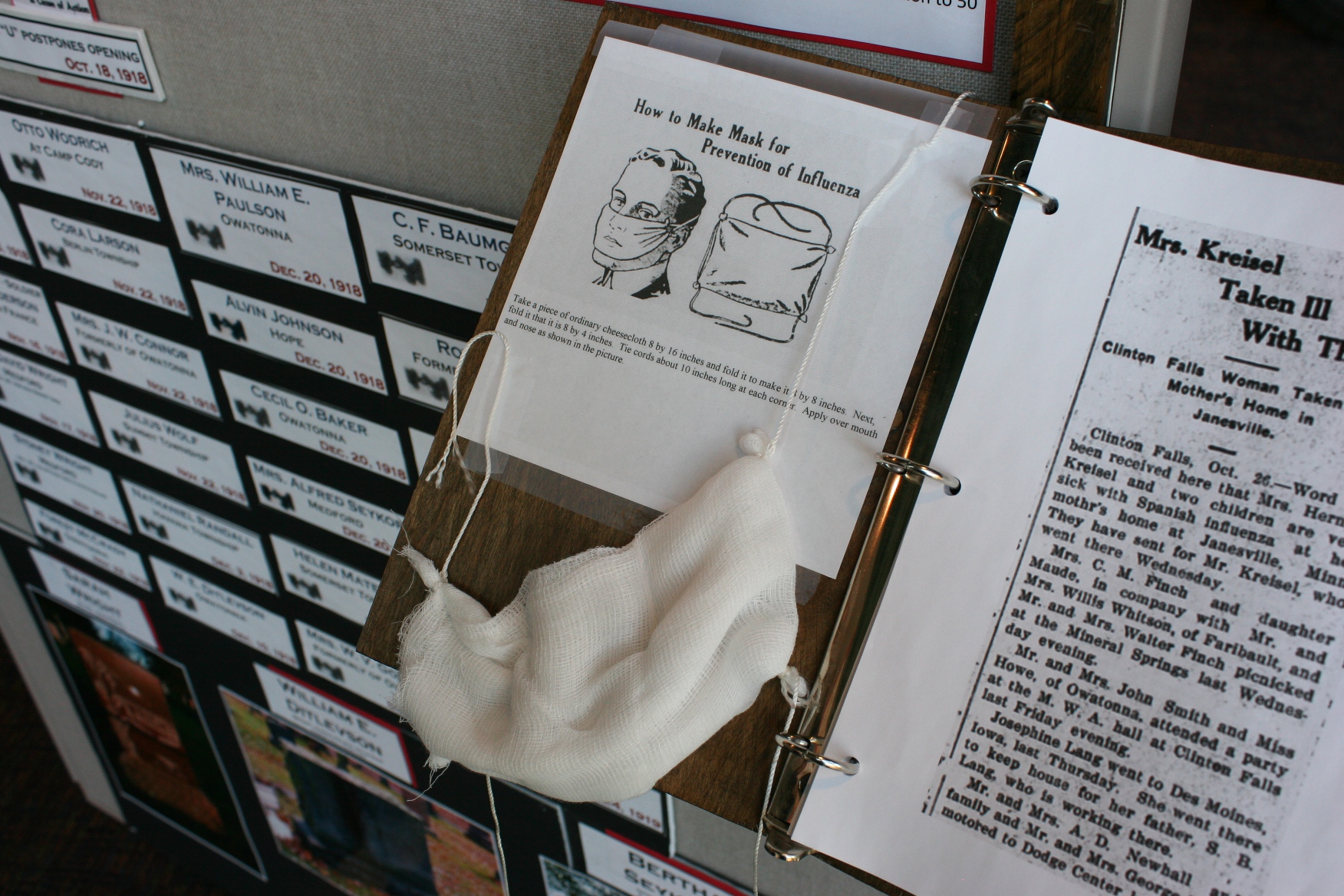
Masks, precautions and isolation helped protect against the flu epidemic. To the left in this photo are names of Steele County residents who died from the flu in 1918. (Minnesota Prairie Roots copyrighted file photo 2016)

DEATH & DENIAL ALL AROUND

As mother and daughter fled, reaffirming cheers created a deafening din. The two wanted nothing more than to escape the ire and untruths that raged.

Soon the pair passed The Village Center for Healing where an overflow of the sick and dying lay in cots along the street. While the ill-informed words of The Village Know-It-All droned on, echoing through the streets, the ill struggled with fits of coughing, gasping for breath. Fevers wracked their bodies and some lay stone still, perhaps already dead.

The mother shuddered in fear, clenching her daughter’s hand, distancing them as best she could along the narrow pathway.

They pressed on, passing the marketplace where vendors and villagers crowded among wagons heaped with grain, potatoes and overripe tomatoes. The mother had heard stories of villagers stealing the rotting tomatoes to lob at healers. She couldn’t understand why the healers—those who toiled endless days and nights to care for the sick—were now targeted, viewed as traitors. She could only trace that hatred to The Village Know-It-All and his followers who continued to spew misinformation about The Great Invader.

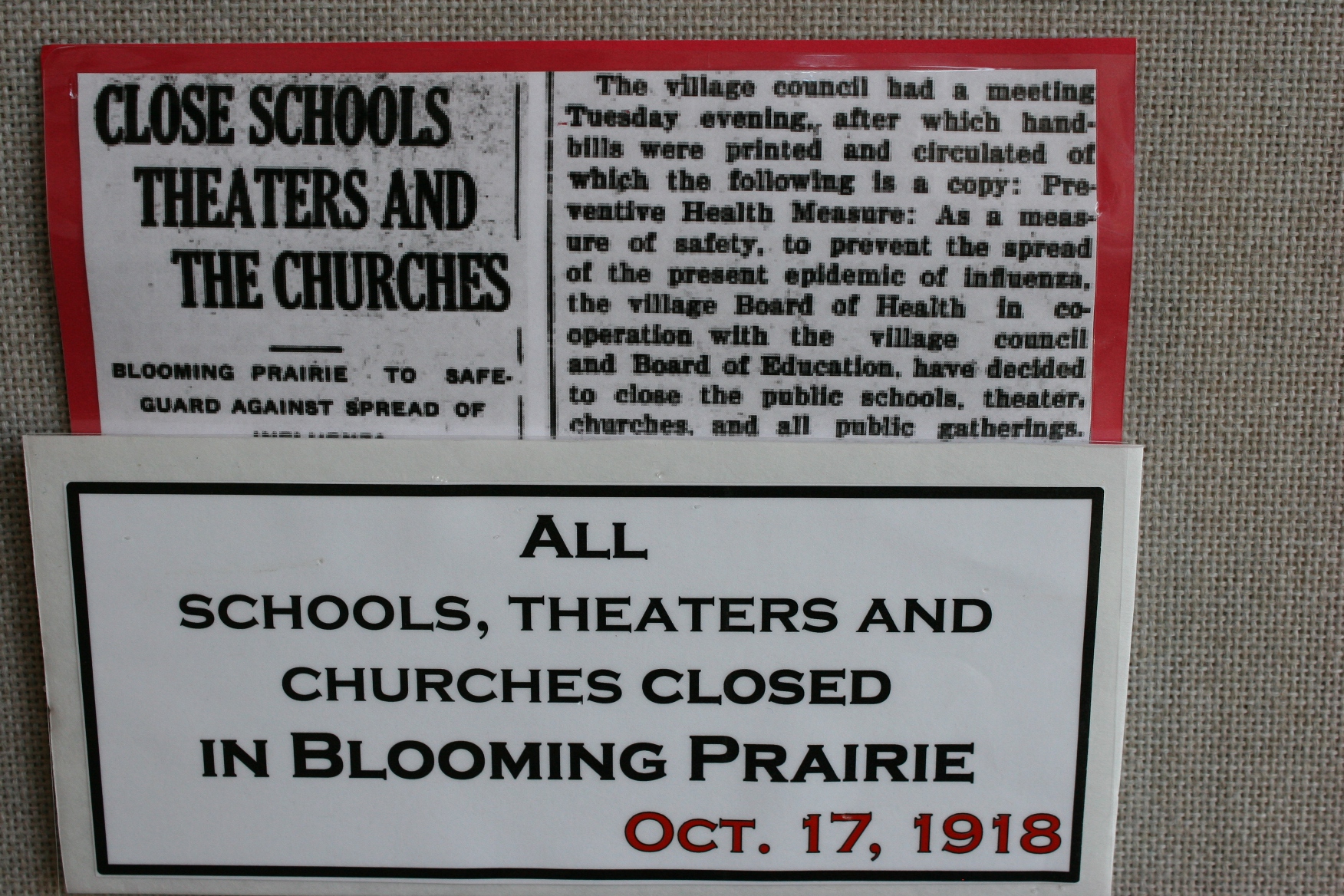
Activities that brought people together, including here in southern Minnesota, were suspended during the flu outbreak. (Minnesota Prairie Roots copyrighted file photo 2016)

INSIDE THE VILLAGE SCHOOL

Soon they reached the village school where children scratched sticks across the dirt yard. Inside, other students crammed onto benches in cramped, windowless rooms made of clay walls and dirt floors. After her daughter shared of the crowded conditions, of sick classmates and no efforts to keep The Great Invader out of school, the concerned mother kept her daughter home. She could not fathom risking her daughter’s health or life. Already a long-time elder educator had succumbed to The Great Invader and another, much younger teacher, lay gravely ill.

THE DARKNESS OF GRIEF, THE LIGHT OF HOPE

Just beyond the school on the outskirts of town, the duo passed by the graveyard. To their right, a cluster of villagers circled as the local gravedigger lowered a pine box into a dark hole. The heartbreaking wails of mourners pierced the air. The mother recognized many of the grieving for theirs was a small village. Sadness clenched her thoughts. She knew this much-loved elder had succumbed to The Great Invader, although his family and friends denied the truth. The Office of Truthfulness posted a daily record in the village square and she had seen the man’s name on that list before The Village Know-It-All ripped down the official death document.

Witnessing such grief and observing the cemetery grounds marked by countless rectangles of black, mounded dirt, the mother hurried on. Past a simple marker with a familiar name. She hoped to reach a distant, much larger, village by nightfall. There she would accept the preventative potion to protect her beloved child. Just as she had sought out for herself many months earlier. She’d waited for this day, through the grief of losing her husband to The Great Invader only weeks before the magical potion was created and distributed, then subsequently destroyed by The Village Know-It-All. She focused on the journey at hand, through her weariness and grief, determined, filled with hope.

#

NOTE: In every story exists truth, this one no exception. This story about The Great Invader (COVID-19) is part of an ongoing series on the topic. If you read my previous posts, you understand that I believe science and health. I support vaccines and other measures to keep us all safe.

Minnesota is currently in a precarious place with COVID-19 cases at a 2021 high, few ICU hospital beds available and deaths increasing.

I welcome comments, but will not give voice to anti-vaccine, anti-masking, etc. viewpoints and misinformation on this, my personal blog. I moderate all comments.

© Copyright 2021 Audrey Kletscher Helbling


A river of grief October 29, 2021

Minnesota Prairie Roots copyrighted file photo.

GRIEF RUNS LIKE A RIVER through the communities of Faribault and Northfield. Rushing. Rising. Roaring. Flooding over banks.

This week, three tragic events have claimed the lives of three. A beloved priest. A woman who lived a life of service. And an, as yet, unidentified individual.

We are two Rice County communities collectively mourning.

The latest loss occurred at 9:25 pm Thursday when a car slammed into the Warsaw Town Hall in a fiery crash that set both vehicle and hall afire, according to the Rice County Sheriff’s Department. The driver, the sole occupant of the car westbound on County Road 39/230th St. West, remains unidentified. This location, a T intersection (CR 39 and Dalton Avenue meet), has been the site of numerous crashes.

UPDATE, November 2, 2021: The driver of the vehicle involved in the fiery crash has been identified as Robin (Robinson) Roberts of Waseca. My heart breaks for Robin’s family, whom I know. Robin was the granddaughter of my former, and now-deceased, next door neighbors. She was a beautiful soul in every way from her mega smile to her loving and caring spirit. She cared for her Uncle Terry after his dad passed and his mom was no longer able to care for him. Terry had downs syndrome and was like a brother to Robin. We felt blessed to have Terry (who passed several years ago) and his parents living next door to us for many many years. And I feel blessed, too, to have met Robin, a joyful and kind woman who brought much compassion and love into this world.

Only a day prior at 9:36 am Wednesday, another tragedy occurred, this one nearly 300 miles to the north on Lake Vermilion in Greenwood Township near Tower. Eva Gramse, 72, of Faribault died in a fiery house explosion, according to the St. Louis County Sheriff’s Department. Her husband, Michael, was found outside their cabin and was airlifted to a Duluth hospital with severe injuries.

The Gramses are well-known in Faribault. Michael Gramse founded MRG Tool & Die, now led by their son Rod as president of the company. But the couple’s imprint extends beyond their business with both actively involved in the community. Michael Gramse has advocated for youth pursuing careers in trades. And Eva, according to media reports, advocated for underprivileged children and led a bible study at her church, Peace Lutheran. I knew of her from previous involvement with Faribault Lutheran School, a Christian school my children attended. I expect the depth of Eva’s impact on my community will emerge in the coming days as friends and family share stories of this woman who meant so much to them.

In neighboring Northfield, that community is grieving the tragic death of the Rev. Dennis Dempsey, 73, who served the Church of St. Dominic for 15 years up until recently. He died on Monday when a vehicle struck the bike he was riding in Rosemount. The driver of the vehicle has a history of speeding and other violations and faces possible charges in this deadly incident.

By all accounts, Father Denny as he preferred to be called, was beloved by many. With 41 years in the priesthood, including time at a Venezuelan mission, he touched many lives. Those who knew him speak to his kindness, his love of the outdoors, his support of the local Latino community, his overall caring spirit and love of people. My connection to him comes through dear friends served by this man of God. Their hearts are broken.

St. Dominic’s celebrates their much-loved former priest today (Friday) with visitation from 4-8 pm and a 7 pm Vigil Liturgy service. Father Denny’s funeral mass is set for 10:30 am Saturday at his current parish, Church of the Risen Savior in Burnsville.

Grief runs like a river. Through Northfield. Through Faribault. To grieve is to have loved…

© Copyright 2021 Audrey Kletscher Helbling


Reflecting on 9/11 after 20 years September 10, 2021

A drawing by my then young son of “something to remember” for a grade school assignment: A plane crashing into the World Trade Center. Minnesota Prairie Roots copyrighted file photo.

TWENTY YEARS. TWO DECADES. Two hundred and forty months.

Whatever words are attached to the time that has passed since the September 11, 2001, terrorist attacks on the United States, the reality of that day in our nation’s history remains forever imprinted upon our collective memories.

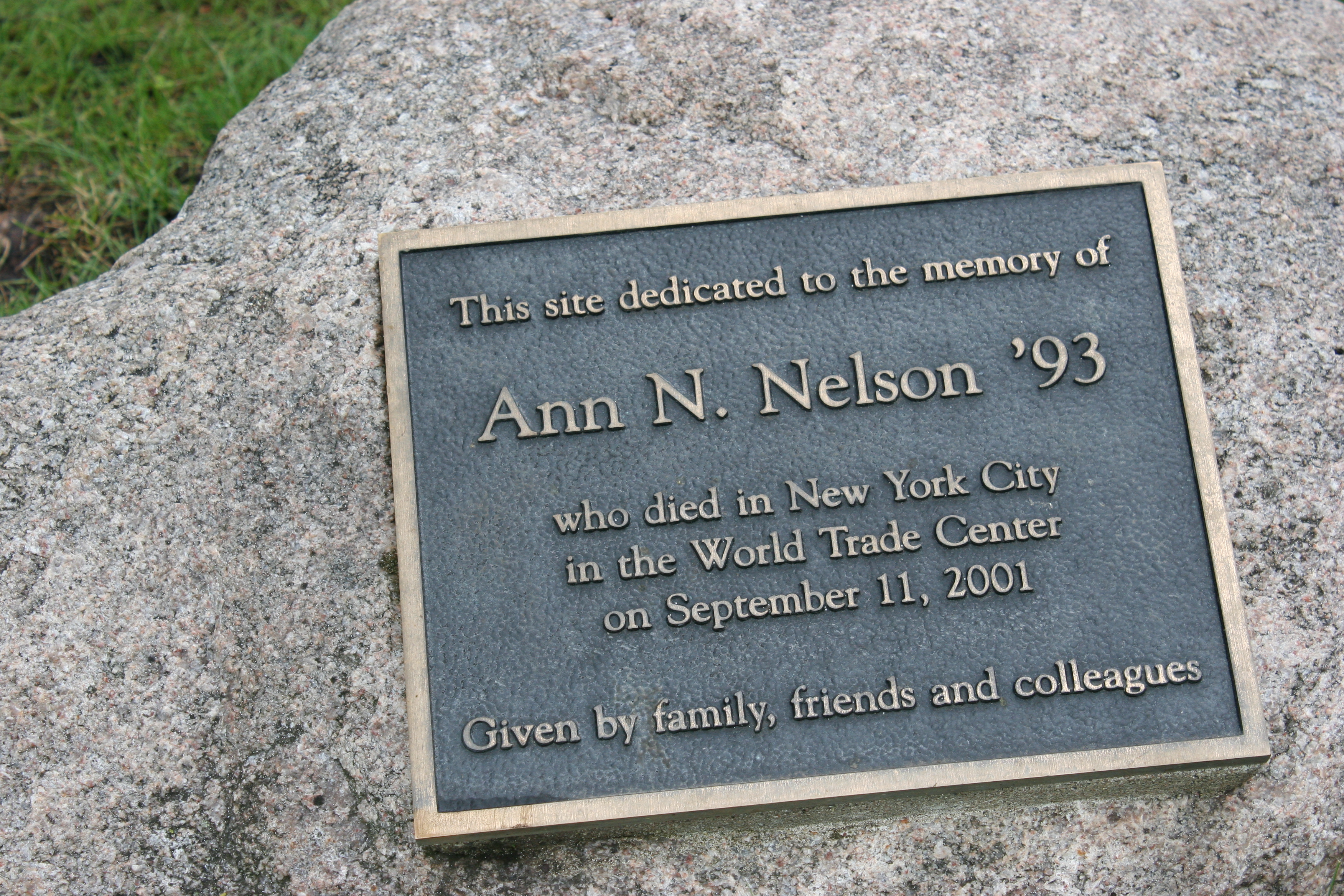
On the campus of Carleton College in Northfield, Minnesota, a plaque honors an alumna who died on 9/11. Minnesota Prairie Roots copyrighted file photo.

That day changed us. It changed how we view each other and the world. The acts of those terrorists not only claimed lives, but our sense of security. Our sense of peace. And much more.

I remember well that September morning, how my then seven-year-old son and his friend Sam reacted to scenes unfolding on our television set. My husband had phoned me from work, alerting me to the attacks. I switched on the TV. And the boys saw it all, right alongside me. Perhaps I should have been a responsible mother/caregiver and turned off the television. But I didn’t.

I reconstructed a tower using the same blocks my son and his friend used on September 11, 2001, to duplicate what they saw on television. These are also the same airplanes they flew into the tower. Minnesota Prairie Roots copyrighted file photo September 2001.

Soon Caleb and Sam were building twin towers with wooden blocks and flying toy airplanes into the skyscrapers. It was heart-breaking to watch. Both reality unfolding on the screen and then the re-enactment on my living room floor.

For a Minnesota mom geographically far-removed from the World Trade Center, the Pentagon and a field in Pennsylvania, none of this seemed distant. I felt the collective fear. I felt the collective pain. I felt the collective grief.

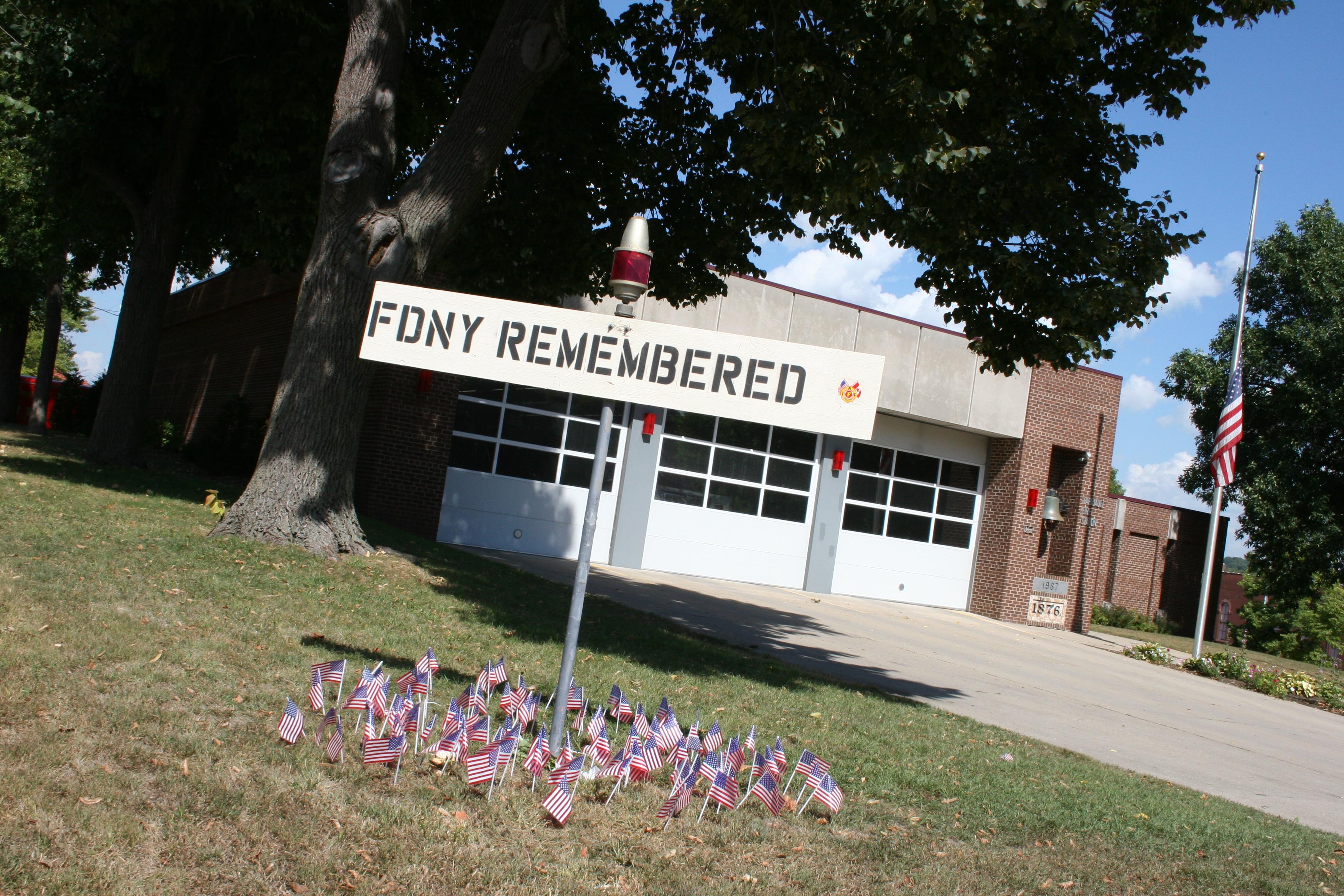
A memorial at the Faribault Fire Department honoring those who died on 9/11. The department will host a commemoration this Saturday, September 11, beginning at 7:46 am. That includes a welcome by the fire chief, a flag presentation, ringing of the bell and a brief eulogy. Minnesota Prairie Roots copyrighted file photo.

Today I remember, 20 years later, those who died. The families left without loved ones. The heroes. And those two little boys who saw, yet didn’t fully-understand, the events unfolding far from Minnesota. Yet too close.

Here’s a poem I wrote shortly after September 11, 2001:

September 11, 2001

You clutch your silver toy jetliners

then blast them into the twin towers,

blocks scattering across the floor.

Like that show on TV,

you tell me,

where the planes crashed

into those two tall buildings.

—————————————-

Somehow I must tell you

that this was no show on TV,

but real people

in real buildings.

Moms and Dads

with little boys just like you,

boys who build towers and fly toy airplanes.

—————————————————————

How do I begin to show you the truth

behind a scene so terrifying

that it keeps replaying in my mind?

Hollywood could have written the script,

the latest disaster film, grossing millions

for an industry embedded in itself.

You’re right; this could be a show on TV.

———————————————————-

Except this is very real,

so real that I want you to believe

those were just pretend buildings, pretend airplanes.

But you see the worry in my eyes,

hear the sadness in my voice.

You know the truth,

even before I tell you.

——————————-

My son, only seven years old,

too young to fully understand

the evil that has invaded the world,

the fear that grips the American heart, my heart,

the sense of security forever lost.

Like so many blocks scattered across the floor,

we must pick up the pieces and rebuild, peace by peace.

#

Copyright 2021 Audrey Kletscher Helbling


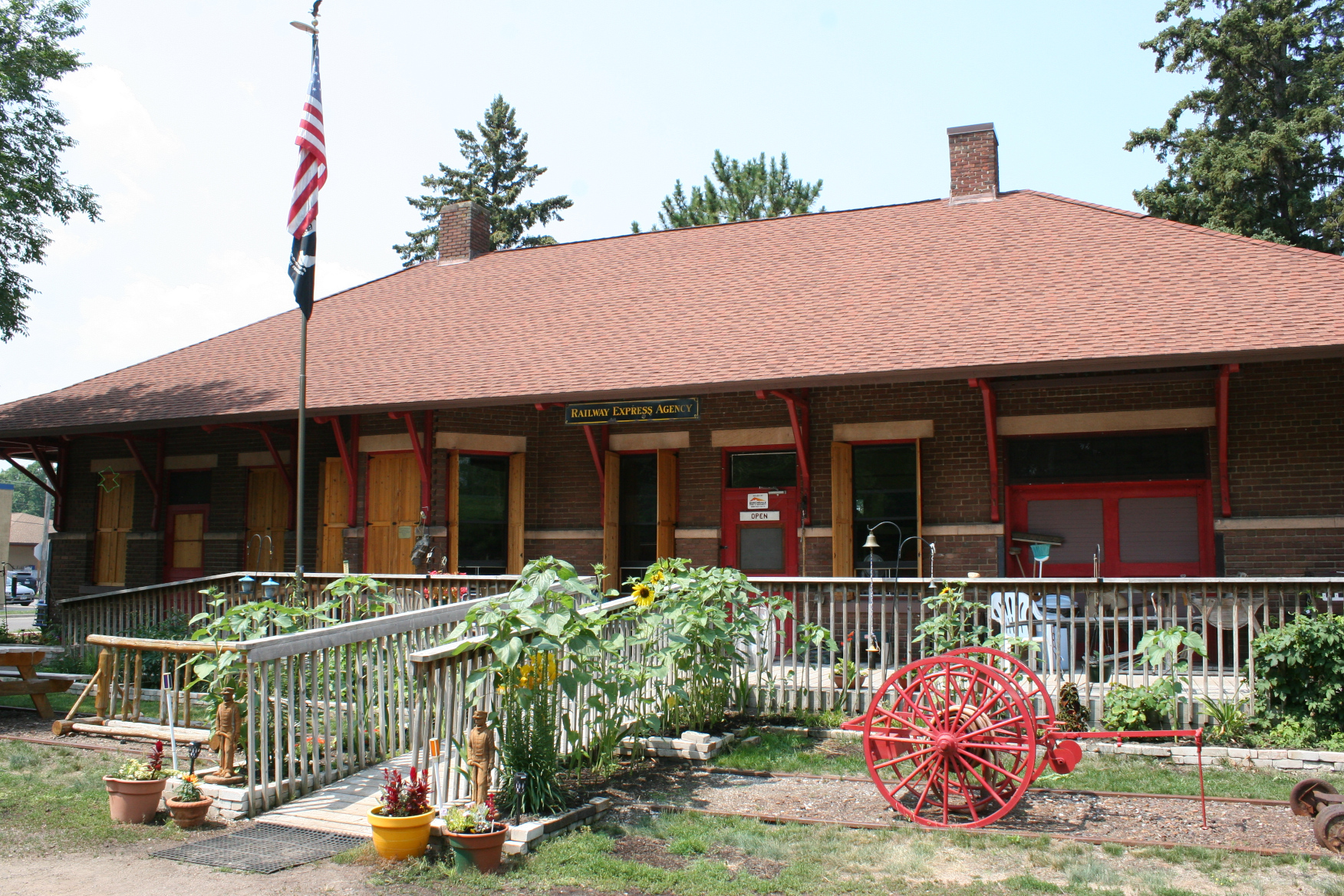
Learning about Minnesota’s worst mining disaster September 1, 2021

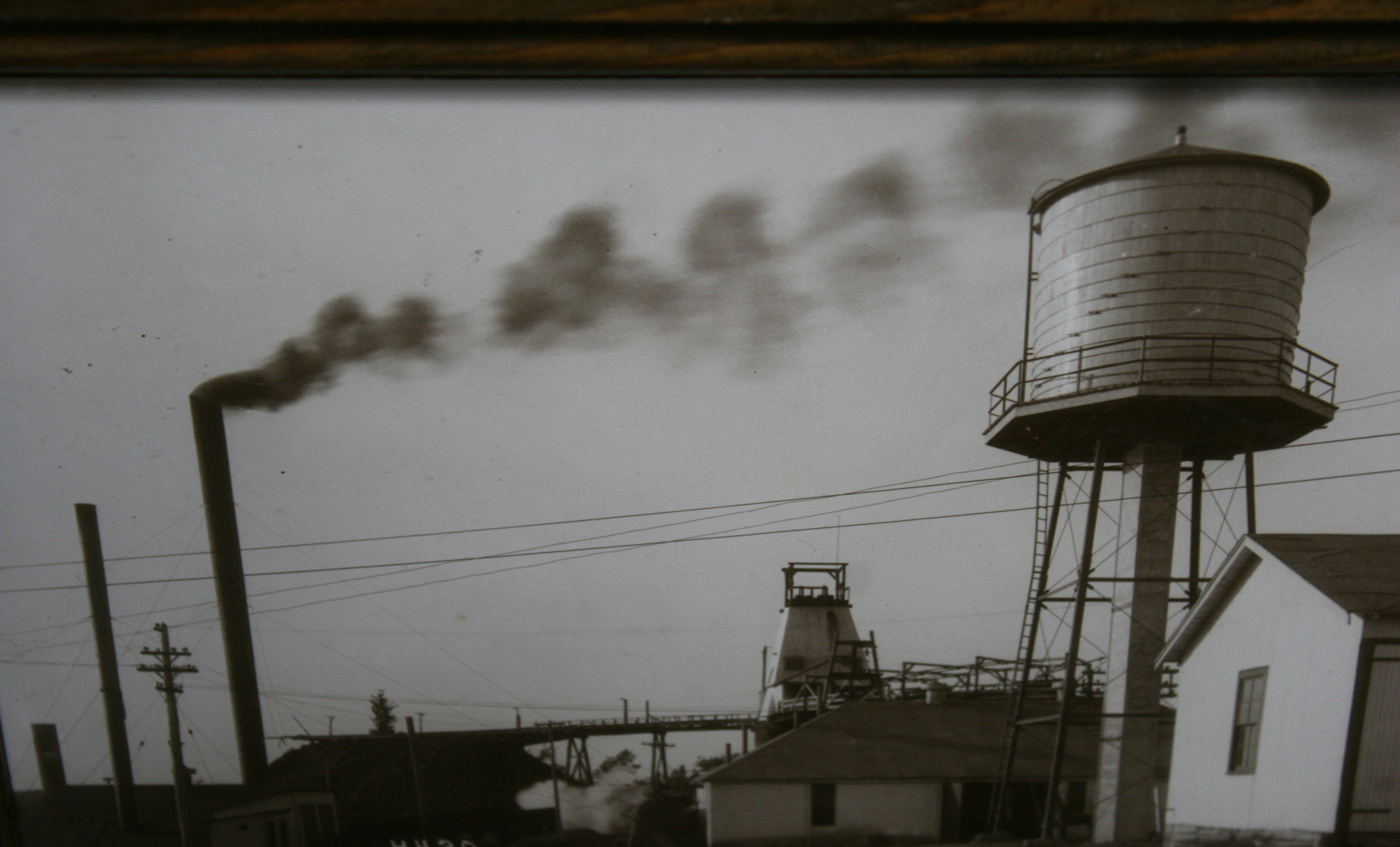
A photo of iron ore miners displayed at the Soo Line Depot Museum in Crosby, Minnesota. Minnesota Prairie Roots photo July 2021.

I CANNOT IMAGINE WORKING as a miner. Underground. Enclosed in tight spaces. Enveloping darkness. Fear and danger and sometimes unsafe working conditions. I couldn’t do the job. I need light and air and space. To feel free, not trapped.

A photo of the Milford Mine displayed at the Crosby museum. Minnesota Prairie Roots photo July 2021.

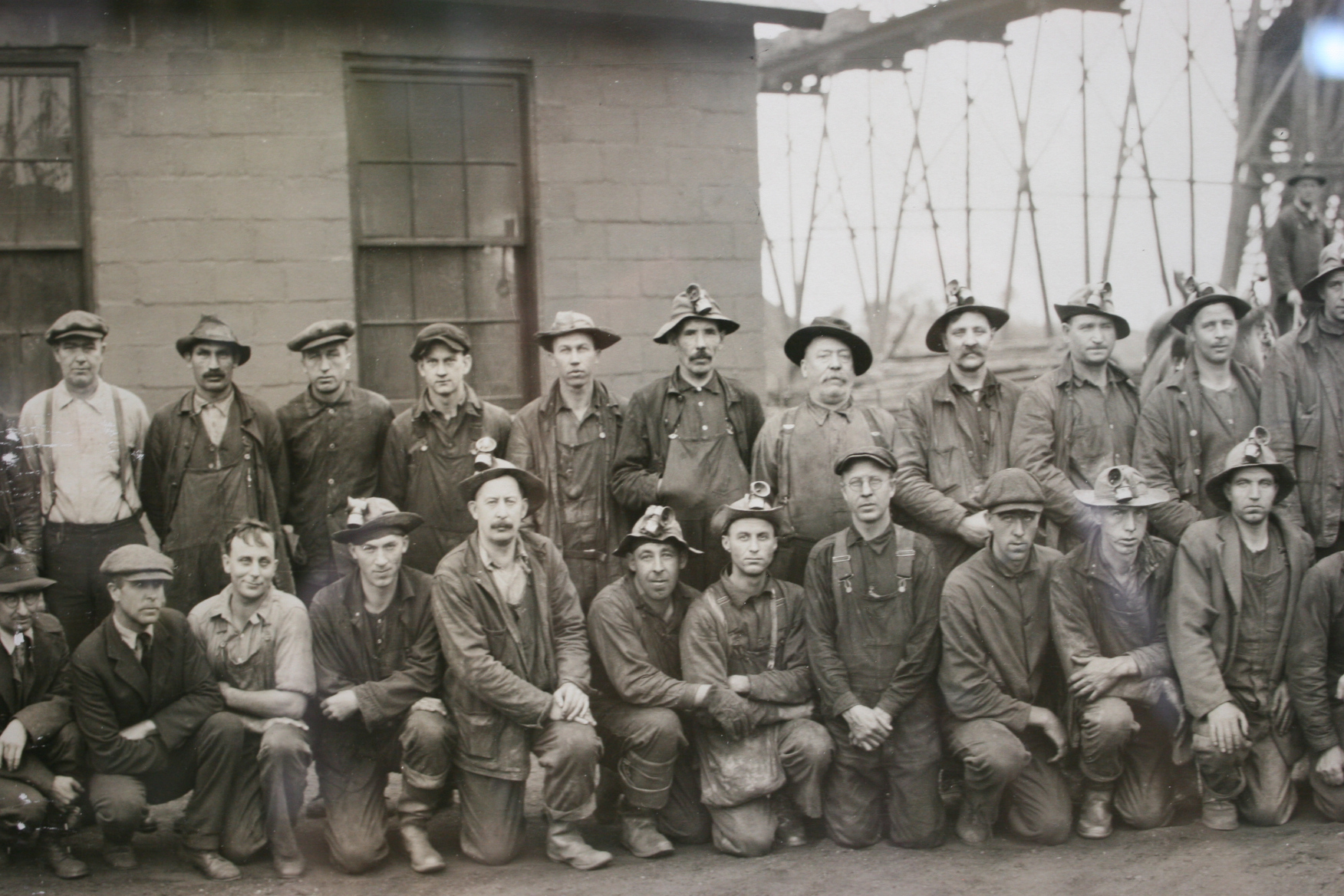
On February 5, 1924, nearly 50 men mining iron ore in the Milford Mine on the Cuyuna Iron Range in central Minnesota faced their greatest fear. Death. They were only 15 minutes from the end of their shift when the unthinkable happened at 3:45 pm on a Tuesday. When mud, water and quicksand from Foley Lake flooded the shaft. Only seven of the 48 miners escaped.

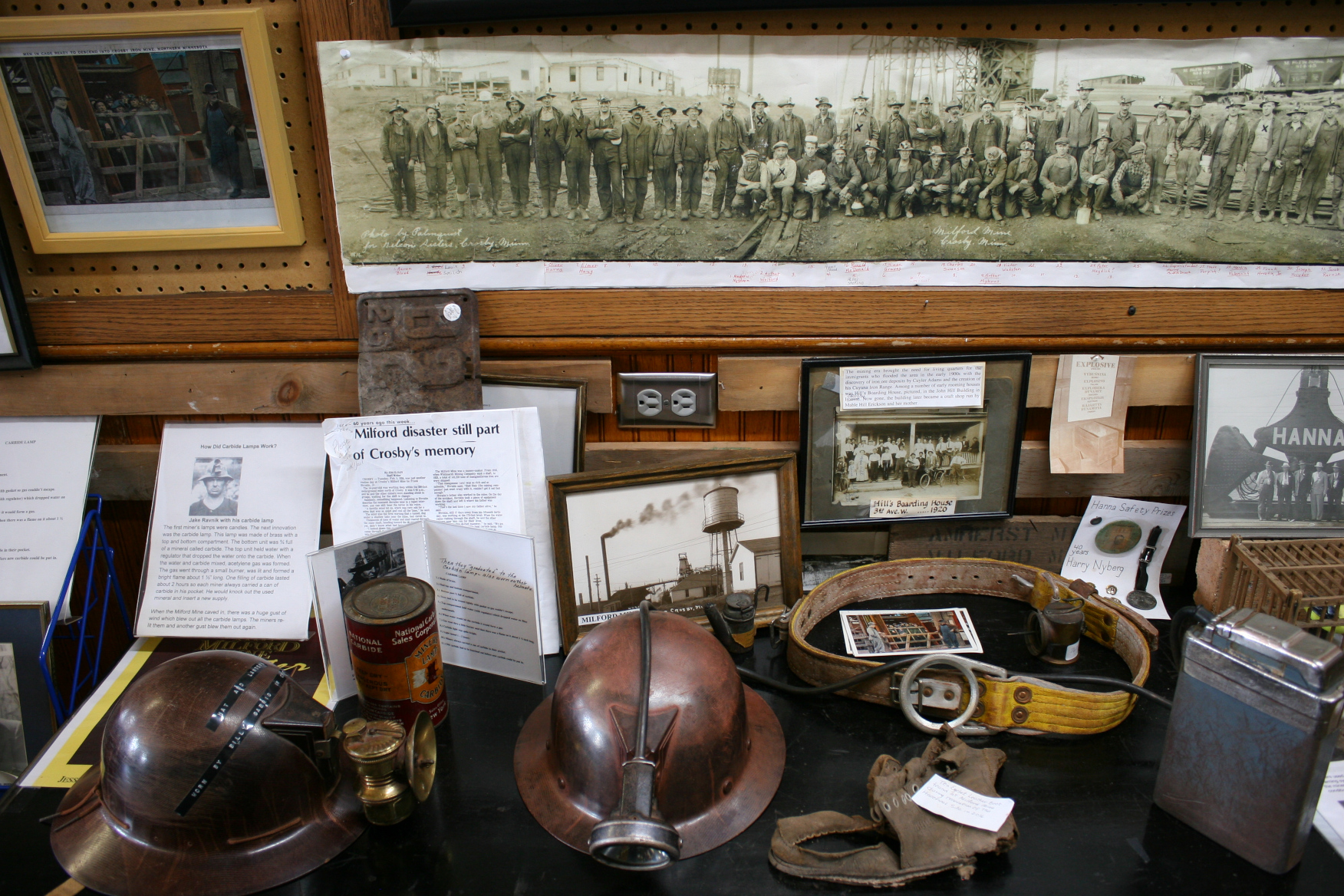
Mining photos and equipment are part of the museum display. Minnesota Prairie Roots copyrighted photo July 2021.

I cannot imagine the horrible scene which unfolded in that mine as these hardworking men struggled to get out. To survive. To return to their families. To see the light of day. To breathe.

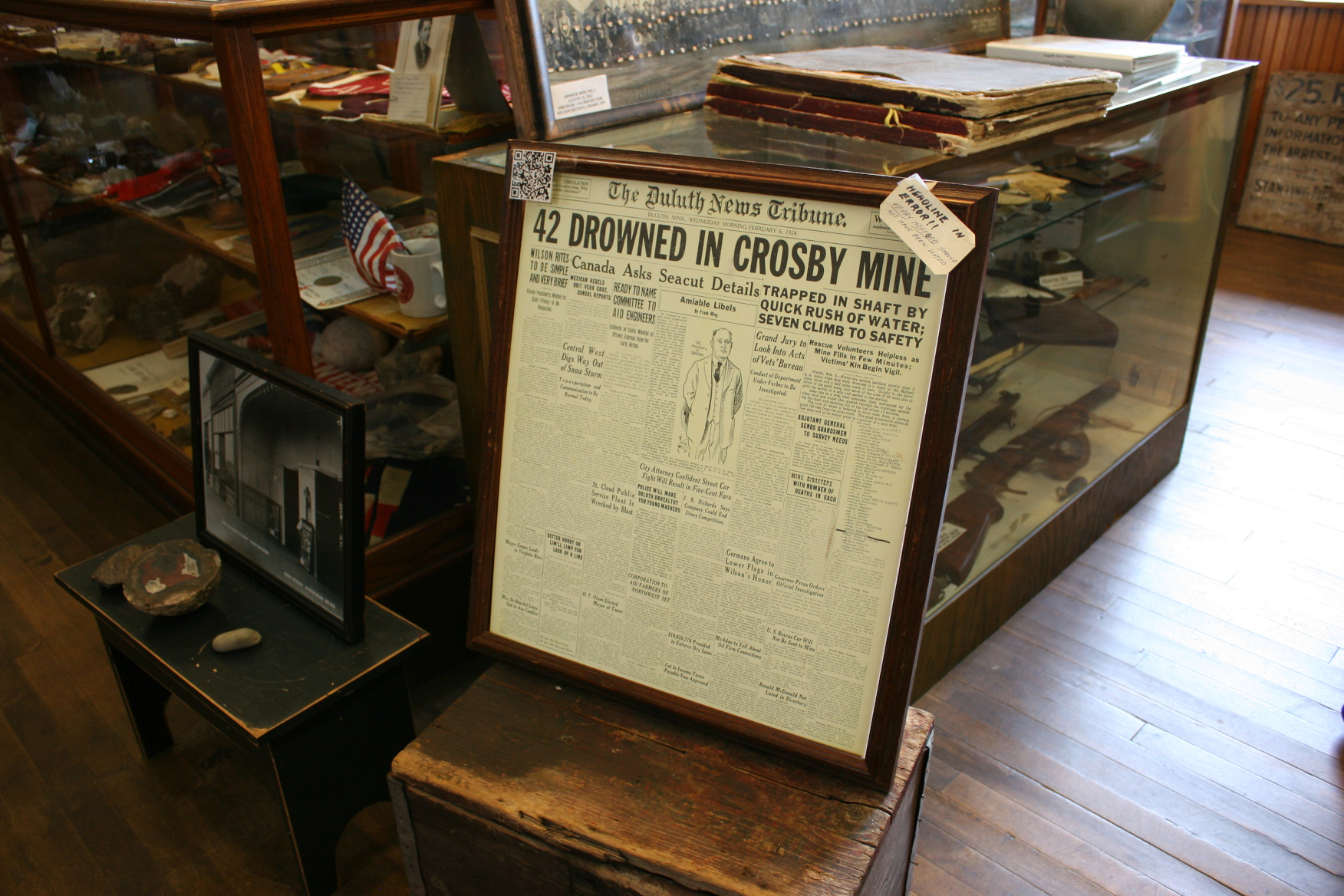
The headline in the Duluth newspaper erroneously reports that 42 (not 41) miners drowned. Minnesota Prairie Roots copyrighted file photo July 2021.

Forty-one men died as the 200-foot deep mine shaft filled with water to within 15 feet of the surface in just 20 minutes. That’s not much time to scramble up a ladder to safety.

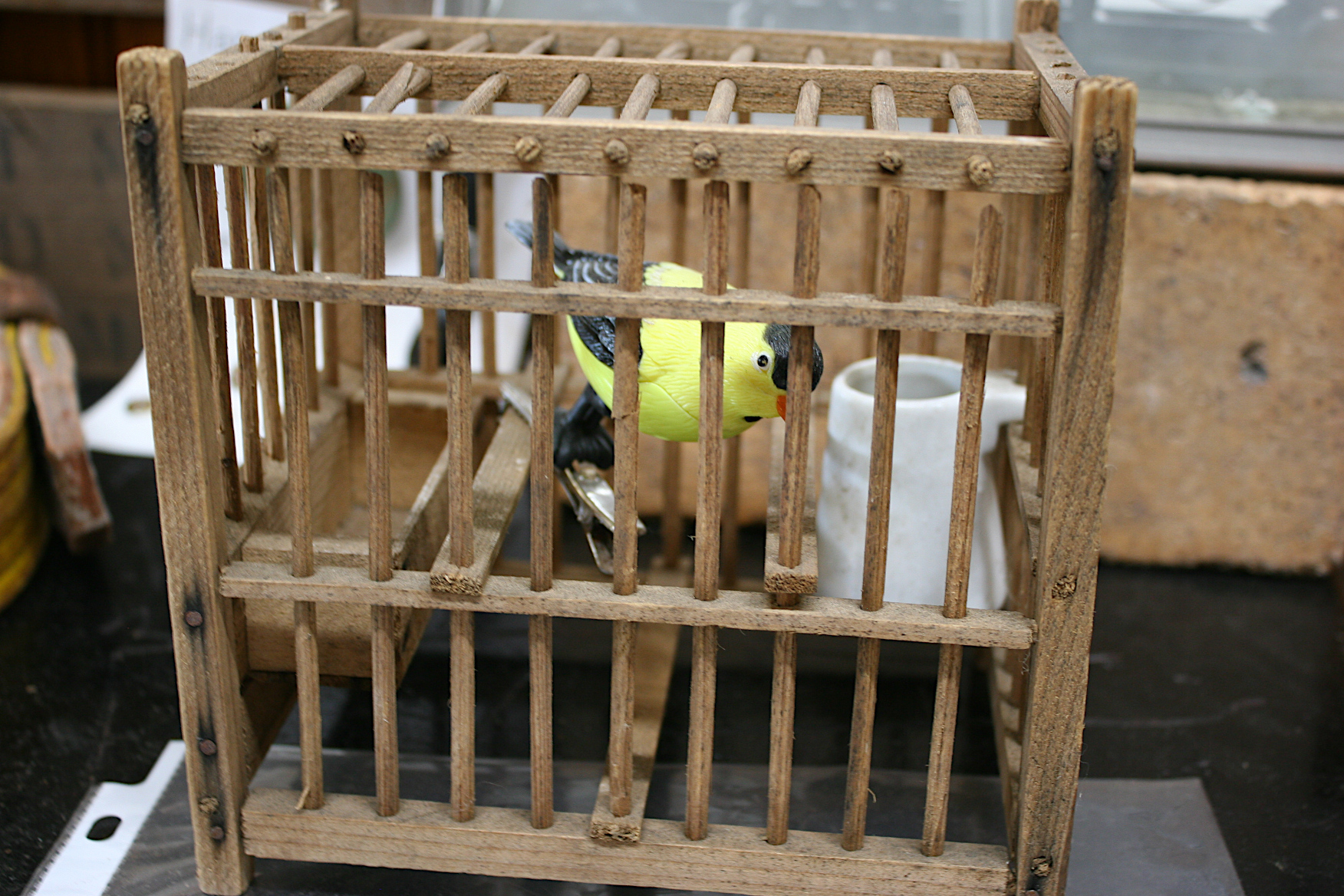
Canaries really were used to detect gas levels in mines, as replicated at the museum. Minnesota Prairie Roots copyrighted file photo July 2021.

Until two months ago, my knowledge of Minnesota’s worst mining disaster was limited to just that—an awareness that this tragedy happened. Beyond that, I was uninformed. I don’t recall ever hearing of this disaster in any history classes.

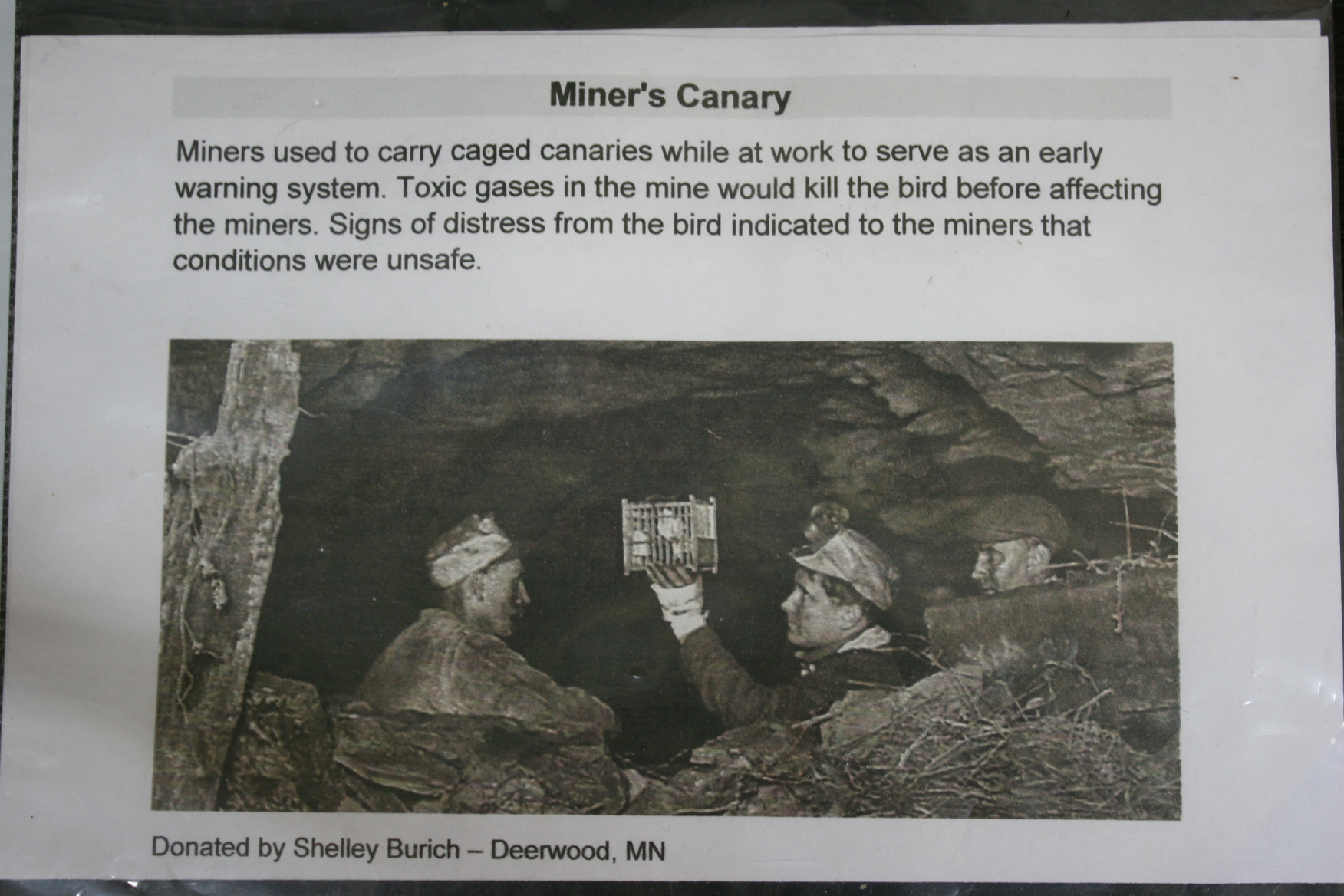
Info on use of caged canaries is included in the museum exhibit. Minnesota Prairie Roots copyrighted file photo July 2021.

Yet, this event, this substantial loss of life in a single horrific tragedy, needs to be taught and remembered. It’s an important part of our state’s mining history and of the families who lost loved ones in the Milford Mine. I expect many a family in the Crosby area—the mine was located just miles from town—can trace genealogy back to the disaster.

The Soo Line Depot Museum. Minnesota Prairie Roots copyrighted file photo July 2021.

In Crosby, the Soo Line Depot Museum, 101 1st St. NE, features a display on iron ore mining with an emphasis on the mining disaster at Milford. The displays heightened my interest, my desire to learn more. And I did by visiting Milford Mine Memorial Park located some four miles north of Crosby on Milford Lake Drive, just off Crow Wing County Road 30, just off Minnesota State Highway 6.

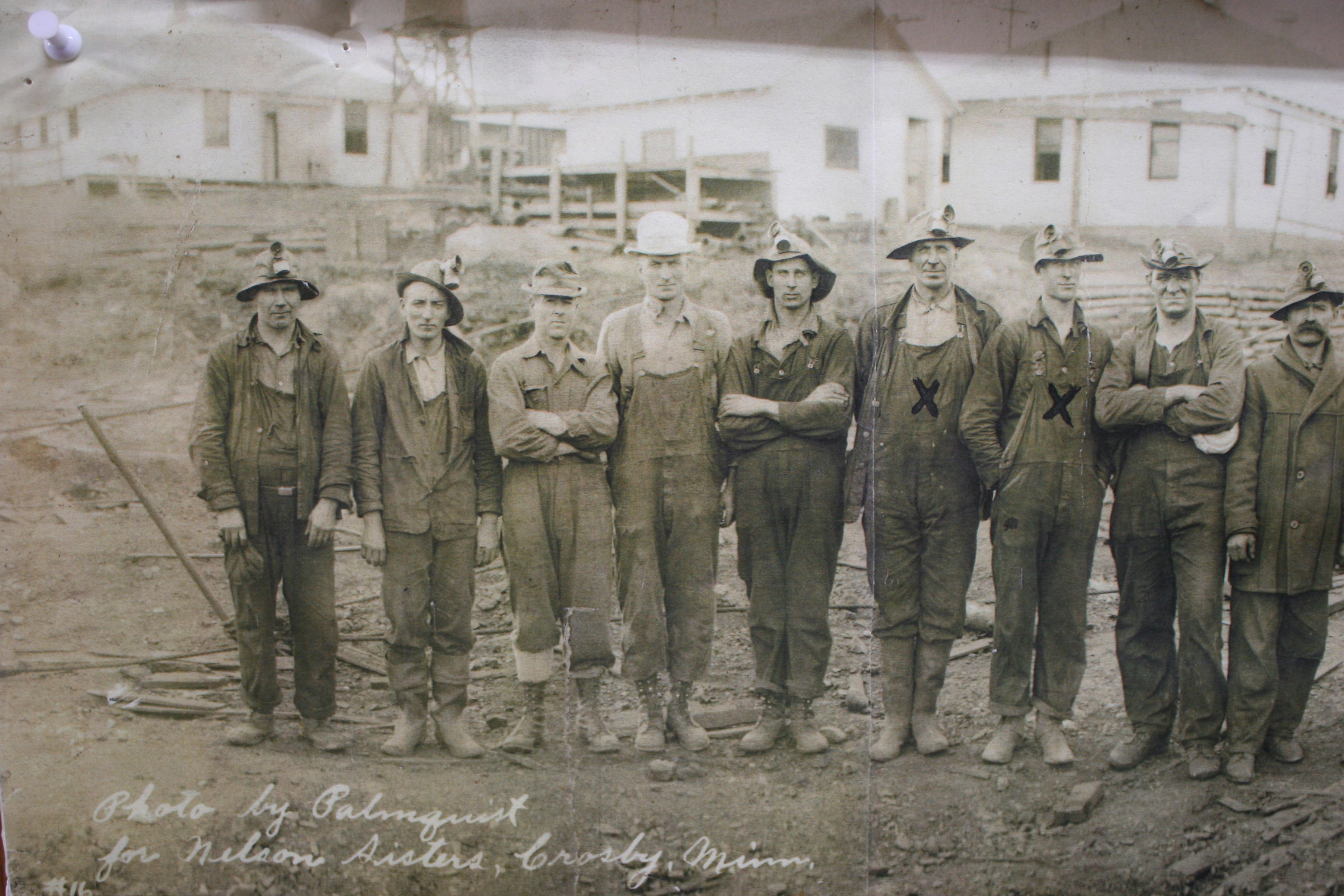
Miners pose for a photo in this image displayed in the Soo Line Depot Museum. Minnesota Prairie Roots photo July 2021.

I’ll take you to that memorial park, which personalizes this tragedy and honors the men who died and those who survived. It’s a remarkable park in volume of historical information and setting—on-site of the disaster. Boardwalks and hiking trails lead visitors into the woods, across marshland and along a mining lake. In a beautiful natural setting, where, 97 years ago, 41 miners died, trapped underground.

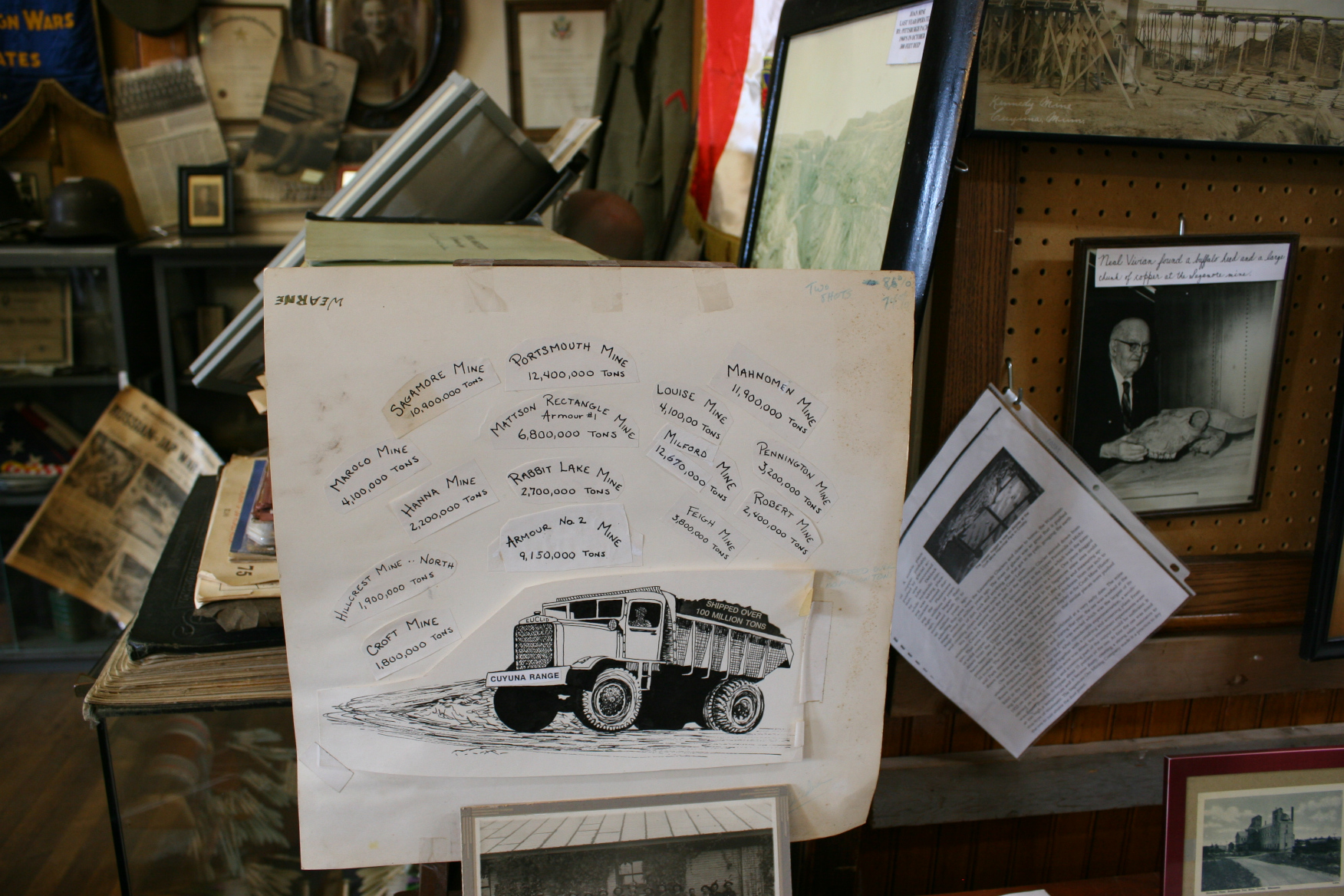
A list of mines on the Cuyuna Range shown at the museum. Minnesota Prairie Roots copyrighted file photo July 2021.

NOTE: The Soo Line Depot Museum closes for the season on Labor Day weekend and reopens Memorial Day weekend. Milford Mine Memorial Park is open daily from sunrise to sunset.

© Copyright 2021 Audrey Kletscher Helbling


A strong message from a man who died of COVID-19 June 11, 2021

Filed under: Uncategorized — Audrey Kletscher Helbling @ 10:41 AM
Tags: , , , , , , , , ,

Robert Tersteeg. Image from KLGR website.

HIS LAST NAME, Tersteeg, grabbed my attention as I scrolled through the local funeral announcements on the KLGR radio website. I occasionally check the site since I grew up near Redwood Falls.

Back when I lived in this region of southwestern Minnesota, I associated the surname Tersteeg with a grocery store in this Redwood County community. My mom shopped there and my siblings and I sometimes accompanied her.

But the obituary was for Robert Tersteeg, 46, of Minot, North Dakota, and a native of Bird Island. Not someone from my home county, but from neighboring Renville County. Still, I read the obituary given Robert’s young age and familiar name.

He died on June 3 at the University of Minnesota Hospital “after a fierce battle with COVID-19.”

Now that could be the end of the story. But Rob’s family—or more accurately Rob—wanted more to be shared about this “vicious virus.” The part that humanizes COVID-19, that reveals the regrets of a man who died from the virus:

Rob’s final wish was that his journey with COVID might save even just one more loving husband, son, father, uncle, friend. Rob regretted not being vaccinated and, immediately upon hospitalization, made Amy (his wife) promise to vaccinate the kids (Nikolai, Olivia, Kaylie).

Saturday morning those who loved Rob will gather for his funeral at St. Mary’s Catholic Church in Bird Island. He is not just another number in the statistics of COVID deaths. He was a family man who loved and was loved. And now he is gone, too soon, leaving one final wish—a desire to save lives with his message to “get vaccinated.”

#

NOTE: If you are anti-vaccine, please do not comment on this post. I won’t publish your comment on this, my personal blog. I feel grateful to Rob’s family for publicly sharing his final wish/message in a desire to save lives.

© Copyright 2021 Audrey Kletscher Helbling


Mourning Week Day, age six May 4, 2021

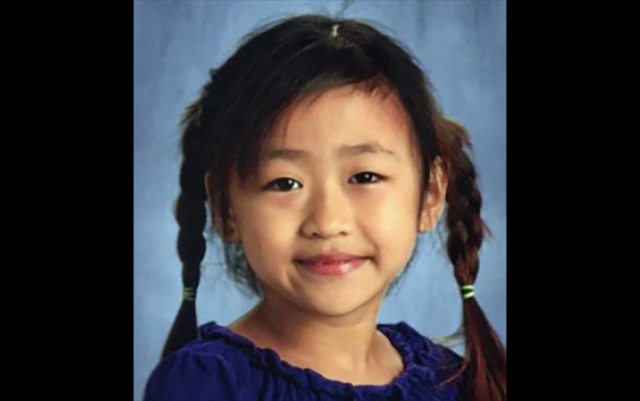
Week Day. Photo source: Hamilton Funeral Home.

TODAY A FAMILY BURIES their six-year-old daughter and sister on the southwestern Minnesota prairie. My heart breaks. Tears flow. And sorrow roots deep within me.

To see the photo of an adorable girl with a sweet smile and braided pigtails makes this all too real. This COVID-19. This deadly virus which, on April 25, claimed the life of Week Day.

She emigrated with her family from a Thai refugee camp to Marshall, Minnesota, in December 2015. Week was not quite 18 months old. The daughter of Mu Mu and He Lars. And then big sister to Michael.

And when she passed, the first grade student of Ms Hewitt and a classmate and friend at Park Side Elementary School.

My heart breaks for those who knew and loved this little girl. The girl who loved the color pink and singing and dancing and drawing and painting. The little girl with the kind heart, best attitude, bright smile.

Any death from COVID-19 is tragic. But, when a child loses her life, it’s especially difficult to take.

If you wish to show your love and support to the family of Week, please send cards, words of encouragement and donations to:

Hamilton Funeral Home

Family of Week Day

701 Jewett St.

Marshall, MN. 56258

Thank you.

© Copyright 2021 Audrey Kletscher Helbling


Ashes to ashes February 18, 2021

Filed under: Uncategorized — Audrey Kletscher Helbling @ 5:00 AM
Tags: , , , , ,
Photographed at St. Mary’s Catholic Church, New Trier, MN. Minnesota Prairie Roots file photo March 2017.

ASH WEDNESDAY PASSED yesterday not without my lack of awareness of this special day in the Christian church. Rather, I experienced the day with an acute awareness rooted in a recent personal loss—the death of my father-in-law.

Now, a day after the Wednesday symbolizing death and repentance and the beginning of Lent, I am thinking of my husband’s father, his funeral and burial only one week ago.

…for dust you are and to dust you will return—Genesis 3:19.

I doubt any words can better describe the reality of death. Ashes to ashes. Dust to dust. That’s basic. Understandable. Maybe uncomfortable for some. But it’s truth. We’re all going to die, whether at age 90 like my father-in-law or age 19 like my nephew Justin in 2001. Sometimes death takes our loved ones way too soon.

Last Thursday, as we celebrated the Mass of Christian Burial for Tom and heard the priest speak those familiar words of dust to dust, grief and reality descended. Yet, as a woman of faith, hope balances that in the belief that I will see my loved ones again in heaven. Dad Helbling. Justin. My dad and grandparents and many aunts and uncles…and others I’ve had the joy of loving. For to love is to also open one’s heart to grief. And to hope.

© Copyright 2021 Audrey Kletscher Helbling


A time to mourn, on a frigid February day in Minnesota February 12, 2021

Filed under: Uncategorized — Audrey Kletscher Helbling @ 6:13 PM
Tags: , , , , , , , , , ,

THERE IS A TIME for everything, and a season for every activity under heaven…a time to weep and a time to laugh, a time to mourn and a time to dance…

Thursday was a day to mourn as the Helbling family celebrated the Mass of Christian Burial for my father-in-law, Tom Helbling. He died on February 5 at the age of 90.

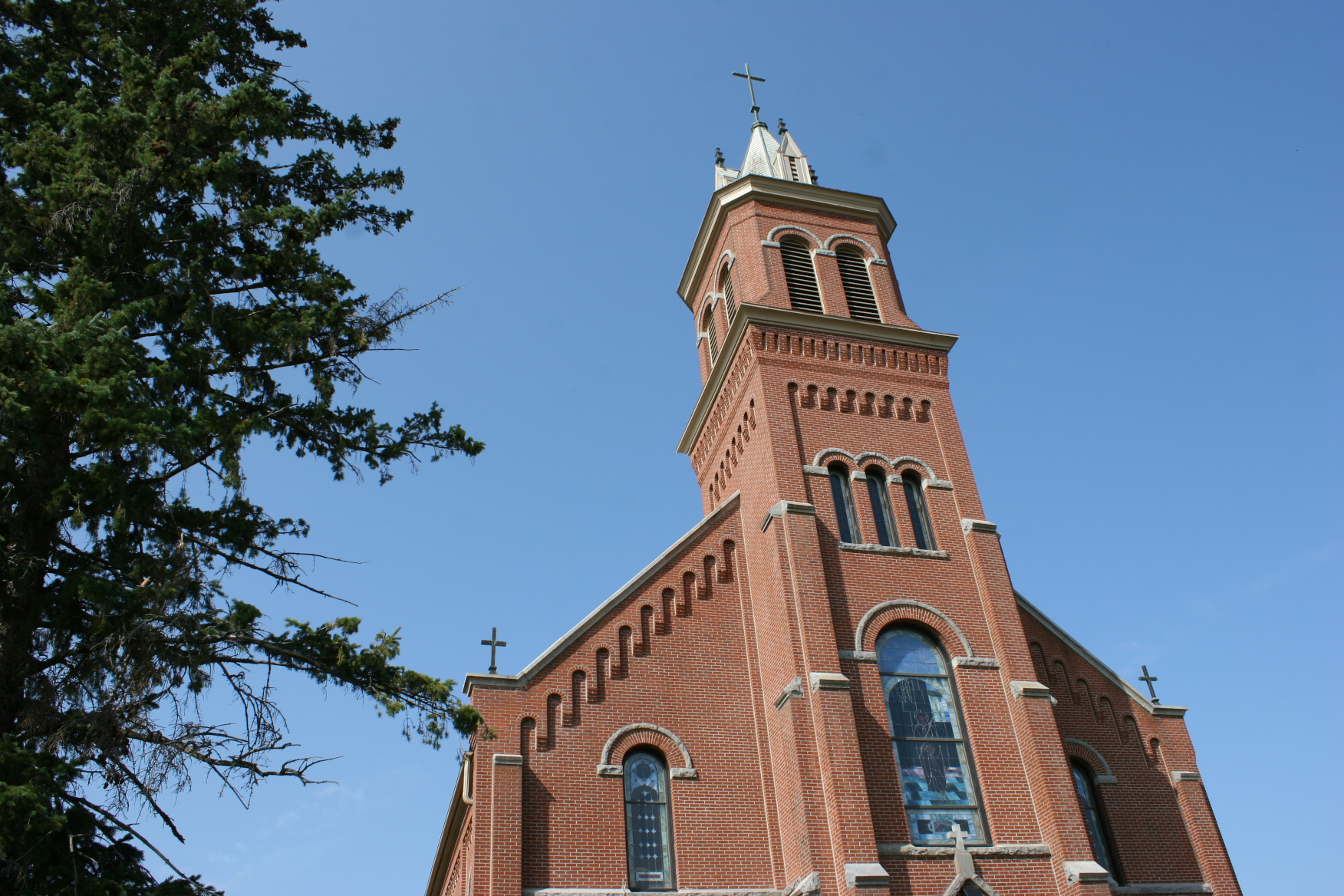
St. Michael’s Catholic Church, Buckman, MN. Minnesota Prairie Roots file photo September 2020.

It was an unusually frigid February day in central Minnesota with the temp hovering around zero as we gathered at St. Michael’s Catholic Church in Buckman. Over the course of more than three hours, memories imprinted upon me. Memories shaped in part by a global pandemic, which affected the ways in which we could be comforted. Randy and I declined hugs and handshakes. There would be no luncheon, the time of one-on-one visits. No getting together with siblings, at least for us, either before the funeral or after.

Yet, simply being together in the same building brought comfort. Comfort came, too, in flowers and music and Scripture. Like the words of Ecclesiastes 3:1-14, read by my sister-in-law Rosie. When she read a time to embrace and a time to refrain, I thought, how fitting for a funeral during COVID-19.

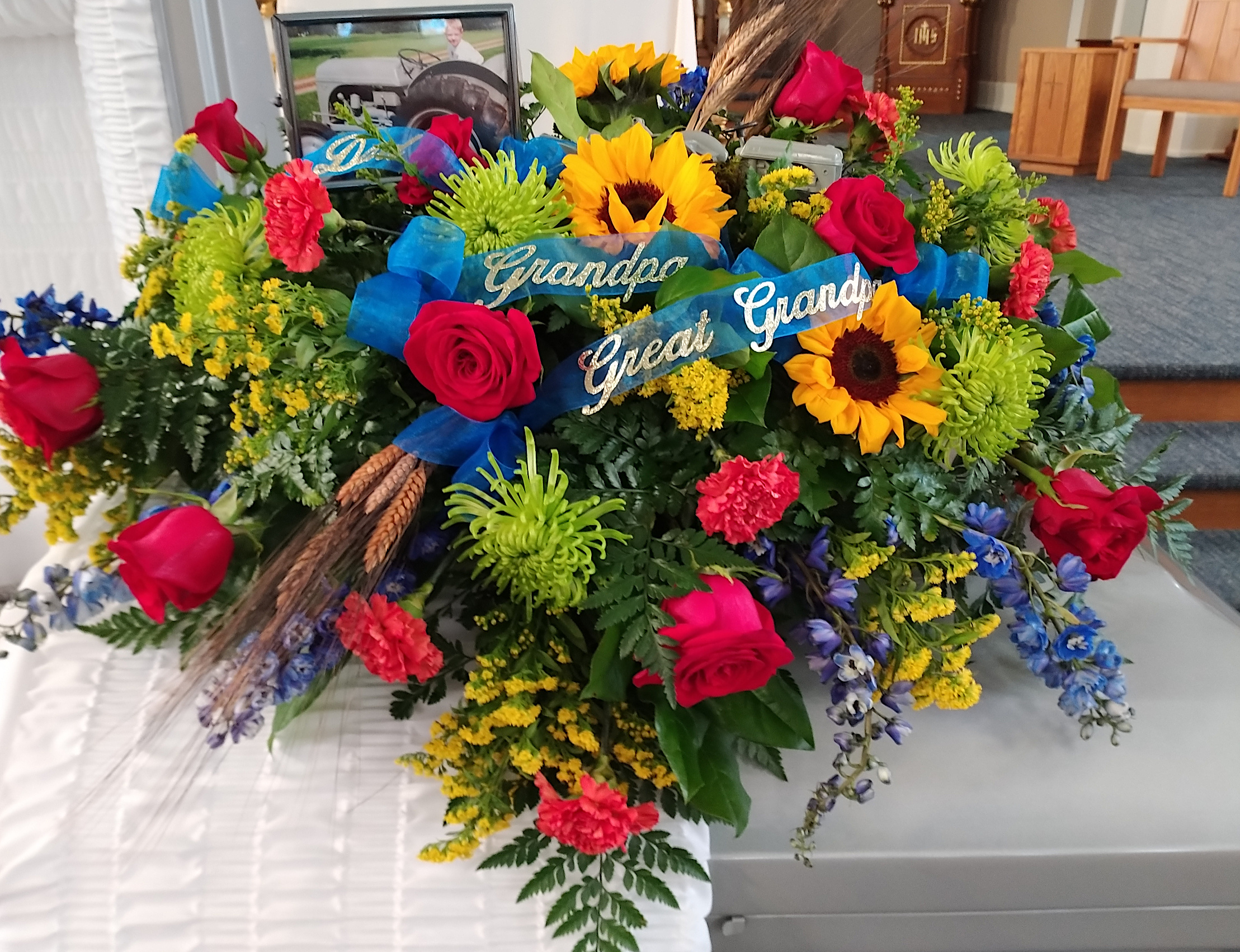
The casket spray, which incorporated a tractor photo and a toy tractor.

Images seared into my mind—like the lowering of the casket lid over my father-in-law. Or the surprise of seeing my then preschool-aged son in an image atop the casket spray. He was perched on the seat of his grandpa’s Ford 9N tractor in a photo I took decades ago.

We sat in the front pew to the left. Above the altar, in the blue ceiling, are the heavenly angels that drew my focus. Minnesota Prairie Roots file photo September 2020.

Many times throughout the service—especially during the farewell chant and song of angels welcoming Dad into heaven—I focused on the heavenly angels painted on the ceiling high above the altar. What a gift the artists and craftsmen of this aged church left for mourners. Art comforts.

Pipes on the St. Michael’s organ. Minnesota Prairie Roots file photo September 2020.

So does music, especially music. “Joyful, Joyful, We Adore Thee” and “The Lord is My Shepherd” and “Holy God, We Praise Thy Name” and many other songs filled this massive church with the most beautiful, heavenly music performed by musicians in the balcony. St. Michael’s has incredible acoustics. Randy and I suggested to his classmate Janel prior to the service that perhaps the musical team could play a polka or waltz in honor of Dad, who so enjoyed both and who also played piano, organ and accordion (not the concertina, as the priest noted). My sister-in-law Vivian shared with me later that the hymn “Whispering Hope,” played before the casket closed, was a popular waltz at wedding dances in the area and was a favorite of her parents. I love nuances like that which personalize a funeral.

As I sat through the service next to Randy on an uncomfortably hard straight-back pew, physically-distanced from family, I determined not to cry. I didn’t want to cry into my mask. I considered how surreal this felt to experience a funeral during a global pandemic. And how surreal also to experience a funeral during Minnesota’s longest cold snap in nearly three decades.

We dressed for the weather, wearing long johns under our dress pants. Randy told me his dad wore long johns often back on the farm so this extra layer of warmth seemed another fitting tribute. Before heading to the cemetery, we slipped out of dress shoes into snow boots.

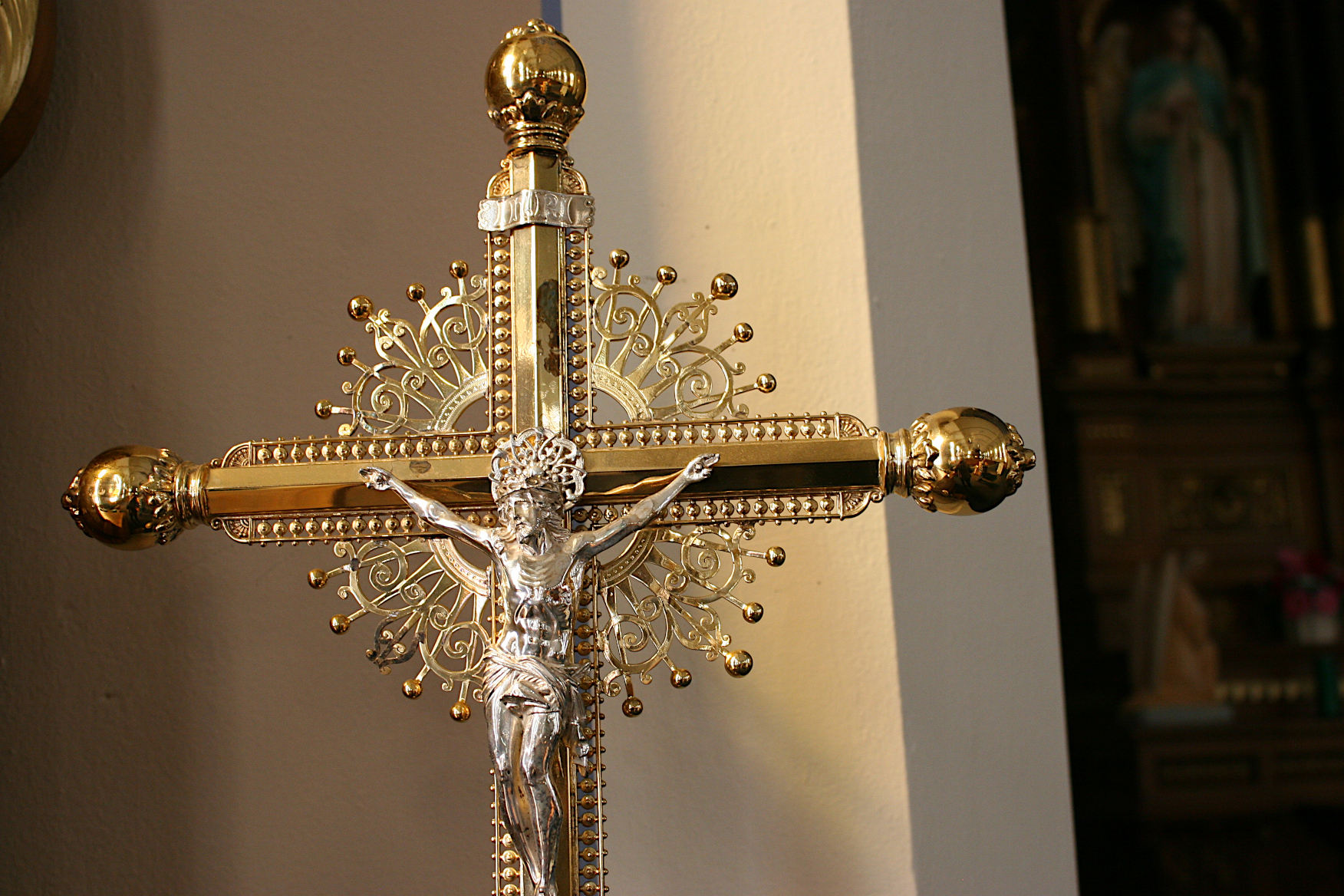
The crucifix carried to the cemetery. Minnesota Prairie Roots file photo September 2020.

And then, once grandchildren slid their grandfather’s casket into the hearse for the short drive to the cemetery, mourners followed by foot, crossing Minnesota State Highway 25. A church officiant stood half-way into the traffic lane, bundled for warmth, purple mask covering his face, holding a pole with crucifix atop as traffic waited out of respect for us to cross the road. It was a strong visual moment for me. The red pick-up truck parked curbside contrasting with mourners dressed in black. Waiting vehicles. Masks and stocking caps and bald heads (among those who chose to brave the elements minus head coverings). The priest in his, oh, so Minnesotan red buffalo plaid coat and matching ear flapper cap. An icy parking lot with occasional welcome patches of gravel. And then, the final steps across the snow to the burial site.

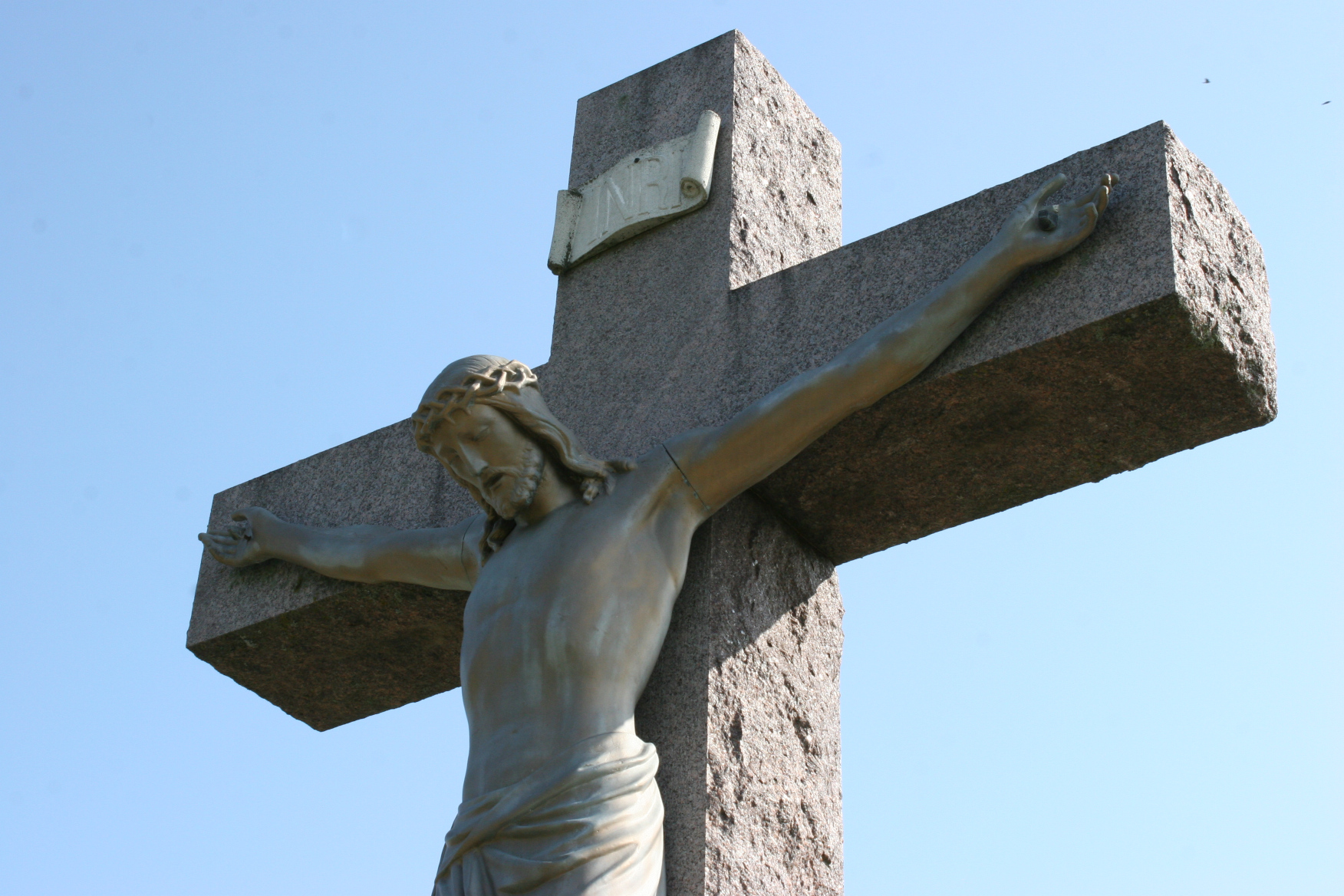
This art rises above St. Michael’s Cemetery. Minnesota Prairie Roots file photo September 2020.

As my nieces and nephews carried my father-in-law’s casket, I felt the heaviness of grief. The cold of death, balanced by the promise of eternal life. Grief and joy.

And then, in one last act of love, we each stepped up to pull flowers from the casket spray to lay upon the casket. I chose a red rose, not yet blackened by the cold, placed it on the shiny grey surface. And then, with my mittened hand, I patted the lid twice in a final farewell to my father-in-law.

© Copyright 2021 Audrey Kletscher Helbling


In loving memory of my father-in-law February 9, 2021

Filed under: Uncategorized — Audrey Kletscher Helbling @ 2:38 PM
Tags: , , , , , , , ,
Tom and Betty Helbling, photographed in 1988.

HE DIED PEACEFULLY Friday morning, two of his daughters by his side.

He is my father-in-law, Tom. Age 90. His death came quickly after a short hospitalization, discharge, sudden change in health, admittance to hospice, then gone the next day.

Mass of Christian burial for my father-in-law will be celebrated in St. Michael’s Catholic Church, Buckman.

Now we are preparing to say goodbye in the deep of a brutally cold stretch of weather here in Minnesota in the midst of a global pandemic. Both add to the challenges.

Today, though, I want to focus on Tom and my memories of the man I’ve known for nearly 40 years. A man with a large and loving family, whom he loved, even if he didn’t often openly show it.

Tom and Betty Helbling, circa early 1950s.

Tom has always been surrounded by a large family, beginning with his birth into a blended family in rural St. Anthony, North Dakota, in December 1930. After farming on the Helbling homestead, Tom and his wife, Betty, moved in 1963 with their young children to a central Minnesota farm. Their family grew to nine children, 18 grandchildren and 20 great grandchildren.

As a young child, Tom briefly attended Catholic boarding school, which leads to one of my favorite stories about him. Apparently oatmeal was often served for breakfast. And Tom disliked oatmeal. One morning he stuffed the cooked grain in his pocket rather than eat it, so the story goes. I expect it wasn’t long before the nuns discovered the oatmeal mess and meted out punishment.

Yes, Tom could be particular about the foods he ate. He liked, in my opinion, the strangest foods—Braunschweiger, summer sausage, pickled beets, herring… And, yes, his son, my husband Randy, also likes herring. Shortly before his health declined, Tom enjoyed a few of those favorites delivered to his care center room by a daughter.

Ripened corn field. Minnesota Prairie Roots file photo.

Visitor restrictions due to COVID-19 were hard on Tom, as they have been for most living in congregate care centers and their families. But my father-in-law has overcome much in his life, most notably the loss of his left hand and forearm following an October 1967 farming accident. The accident happened when Tom hopped off the tractor to hand-feed corn into a plugged corn chopper. The rollers sliced off his fingers and pulled in his hand, trapping it. As Tom screamed for help, Randy, only 11 years old, disengaged the power take-off, then raced across fields and swampland to a neighbor’s farm. It’s a harrowing story that could have easily turned tragic.

My father-in-law’s prosthetic hand. Tom put a band-aid on his hand after he burned a hole in it while frying potatoes in 2009. I laughed so hard. Prior to getting his hand, Tom wore a hook to replace his amputated limb. Minnesota Prairie Roots file photo.

Despite a missing limb, Tom managed to continue milking cows and, in later years, to run a small engine repair business. He also grew and sold strawberries and pumpkins. I remember harvesting pumpkins with him one cold October evening, rain slicking the field with mud. We were drenched and miserable by the time we’d plucked those pumpkins.

One of my favorite photos of Tom giving an impromptu concert on his Lowrey organ. Minnesota Prairie Roots file photo 2012.

It is the creative side of Tom which I especially appreciated. He was a multi-talented life-long musician who played the piano, organ and accordion (until he lost his hand). He could play music by ear and had a piano tuning business. At age 81, he took refresher organ lessons and in 2012 gave an impromptu concert for Randy and me in the small St. Cloud apartment he shared with his second wife, Janice. His first wife, Betty, died in 1993. He treated us to Hank Williams’ “Your Cheatin’ Heart” and “Somewhere My Love” from the movie Dr. Zhivago. What a gift to us.

Threshing on the home place in North Dakota, a painting by my father-in-law, Tom Helbling.

Tom also painted, a hobby he took up late in life. Randy and I have two of his original oil paintings and several prints. They are a reminder of my father-in-law, of his history, of his rural upbringing, of his creative side. I consider these a legacy gift. Valued now more than ever at his passing.


© Copyright 2021 Audrey Kletscher Helbling


My poem included in collection vying for Minnesota writing award September 23, 2020


Minnesota Prairie Roots file photo.


WE ARE SIXTEEN STRONG, 16 area poets whose collected poetry, Legacies: Poetic Living Wills, is now a finalist in the 2020 Minnesota Authors Project: Communities Create contest.

I learned of this honor only recently via Northfield Poet Laureate Rob Hardy. A gifted poet and tireless promoter of poets and poetry, he submitted the collection to the debut contest sponsored by the Minnesota Library Foundation, Minnesota libraries and Bibliolabs.

According to the MN Reads MN Writes website, the new contest is designed “to recognize community-created writing and to highlight the central role that libraries play in providing support for local authors and the communities they serve.”

I crafted my poem, “Life at Forty Degrees,” in response to Hardy’s 2018 call for submissions to an anthology of “poetic living wills.”

The content of the poetry collections is summarized as “poems (that) deal with death and dying, with the things that make life meaningful in the face of death, and with the legacies that the poets hope to leave behind or have received from others before them.” My poem, about hanging laundry on the clothesline, focuses on the legacy passed on to me by my grandmothers.

You can read the collection by clicking here.

The winner of the first-ever Minnesota Authors Project: Communities Create contest will be announced later this month at the annual Minnesota Library Association’s annual conference. No matter the outcome, I feel honored to stand in the “finalist” category with 15 other gifted poets from Northfield and nearby (like me from Faribault).

© Copyright 2020 Audrey Kletscher Helbling