Minnesota Prairie Roots

Writing and photography by Audrey Kletscher Helbling

“Beets,” a relevant play that bridges differences February 7, 2025

Former Faribault Daily News reporter Pauline Schreiber photographed these Faribault POW camp barracks shortly before they were torn down in 1990. (Photo courtesy of the Rice County Historical Society)

THE SETTING COULD BE FARIBAULT or any other Minnesota community which, in the latter part of World War II, housed German prisoners of war in POW camps. But the setting is at a camp in Greeley, Colorado, and on a farm site in nearby Berthoud. Locations matter not. The story does.
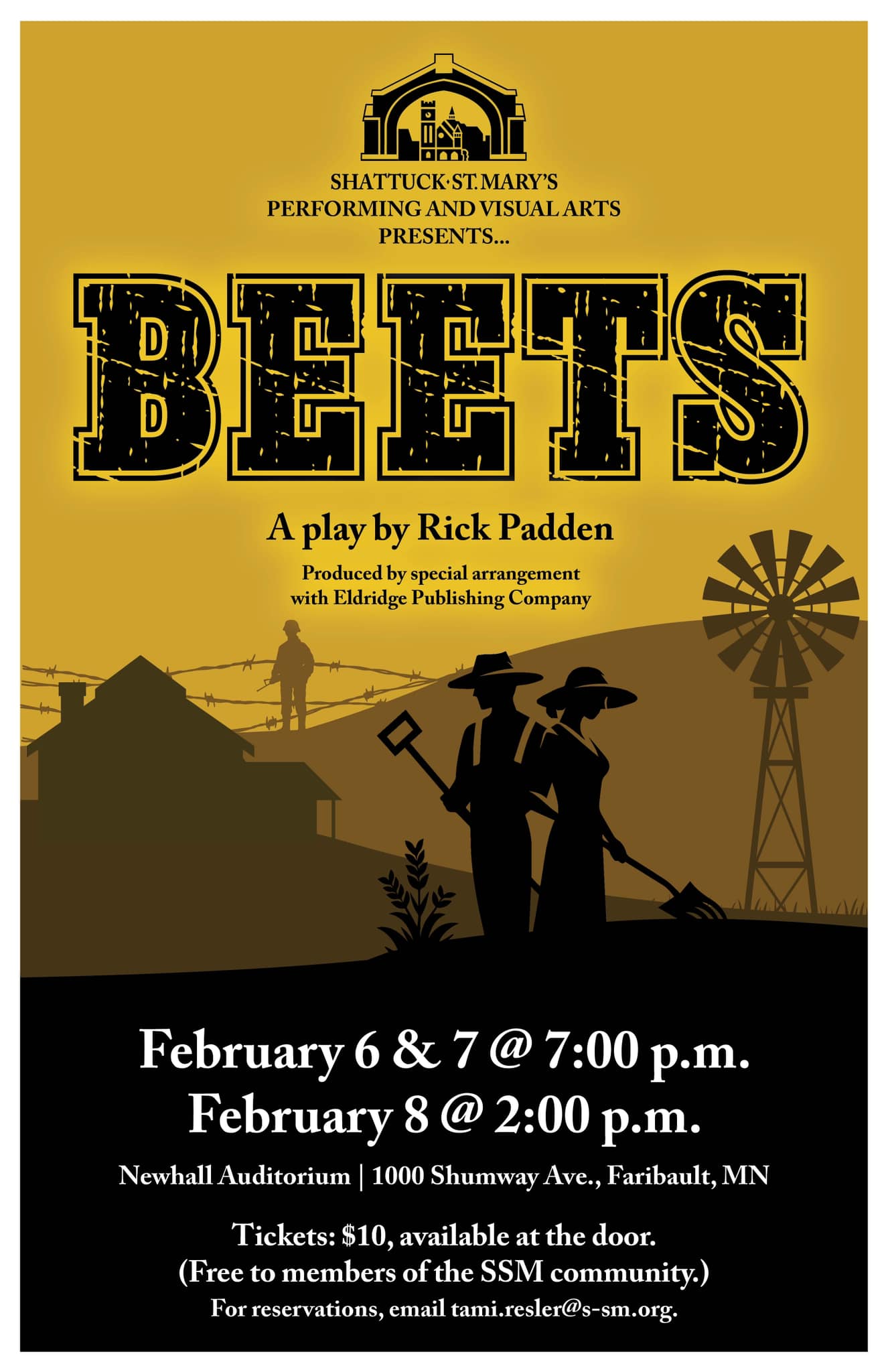
A promo for “Beets.” (Credit: Shattuck-St Mary’s School Facebook page)

Thursday evening, I sat in the sparse audience of the historic Newhall Auditorium on the campus of Shattuck-St. Mary’s School, a private college prep school on Faribault’s east side, watching a story unfold in the theatrical production, “Beets.” An incredibly talented nine-member student cast immersed themselves in the roles of a farm family, German POWs, guards and a family friend to share a bit of history. And much more.

This play about POWs working on the Hunt family’s sugarbeet farm is more than a retelling of history. It is also about relationships, fear, culture and love. It is about the perceived differences that divide us and about the commonalities that unite us.

This is a play for our times. In a nation today divided by politics, by fear, by hatred and animosity, “Beets” is absolutely relatable.

As the storyline evolves, conflicts arise. Farmer Fred Hunt spews his hatred of the Germans. His wife, Isabelle, exudes compassion and love. And their daughter, Anna, settles somewhere in between, leaning initially toward dislike and distrust of the German POWs who have come to work her father’s land. Anna’s thoughts often turn to her brother, Jake, fighting the Germans abroad.
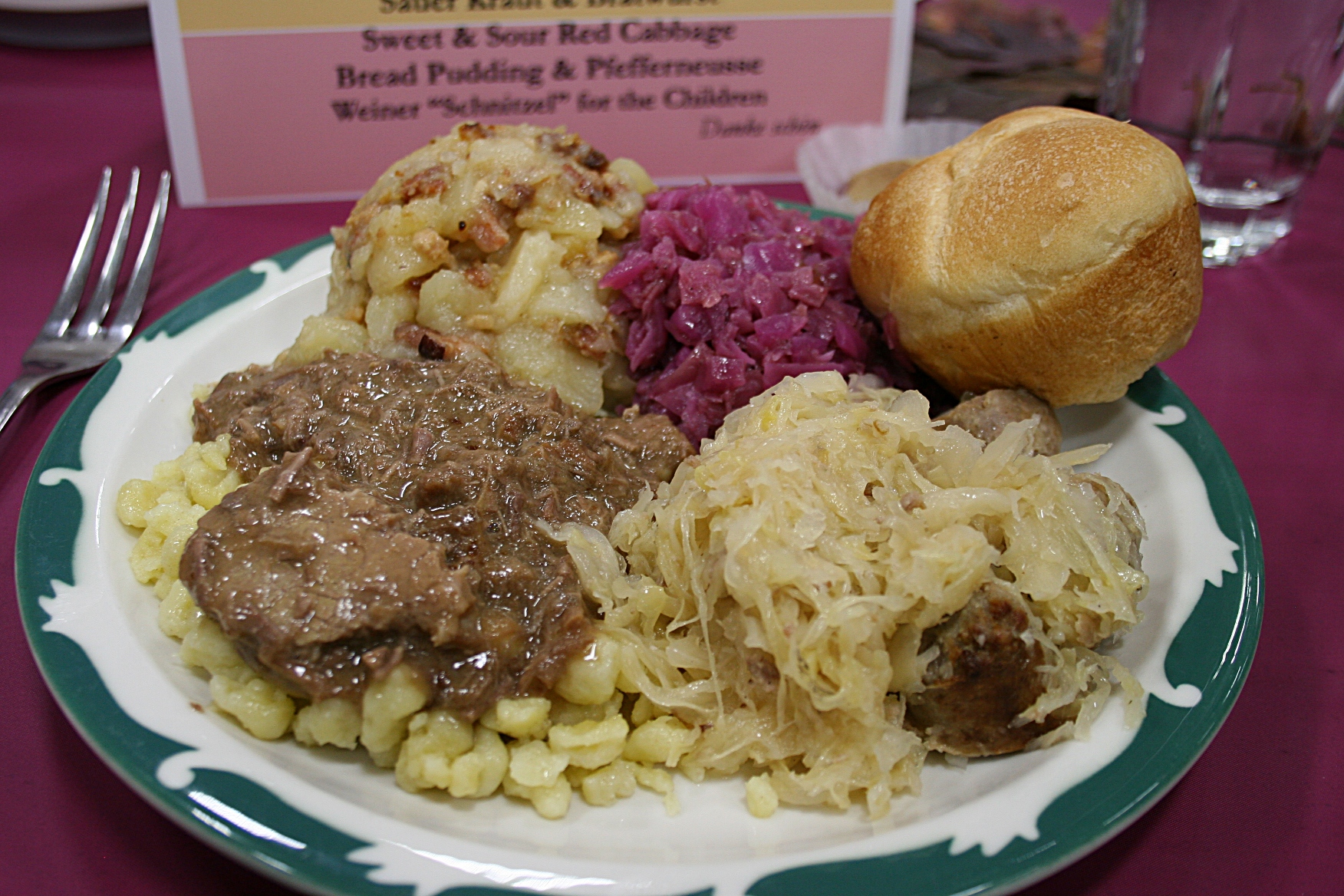
A German meal: sauerbraten and spaetzle on the left, German potato salad, sweet and sour cabbage, dinner roll and sauerkraut and brats. (Minnesota Prairie Roots copyrighted file photo)

Slowly, interaction by interaction, things begin to change. The American farm family and the German prisoners realize they share a love of Bach. (Yes, a German composer.) And while the German POWs profess they will never eat corn, because that’s for pigs and cows—although Anna explains the difference between corn for livestock and sweetcorn—they all understand that they need to eat. The scenes in which Anna and Isabelle serve potatoes and cake to the POWs show how food brings people together. Trust grows. When Fred learns details about POW Dieter Meuhler’s family, he begins to understand the personal side of a man he saw only as an enemy. The walls of distrust, disdain and differences start crumbling, albeit slowly.

It is not lost on me that the Shattuck performers are themselves of diverse backgrounds. That only adds to the performance.
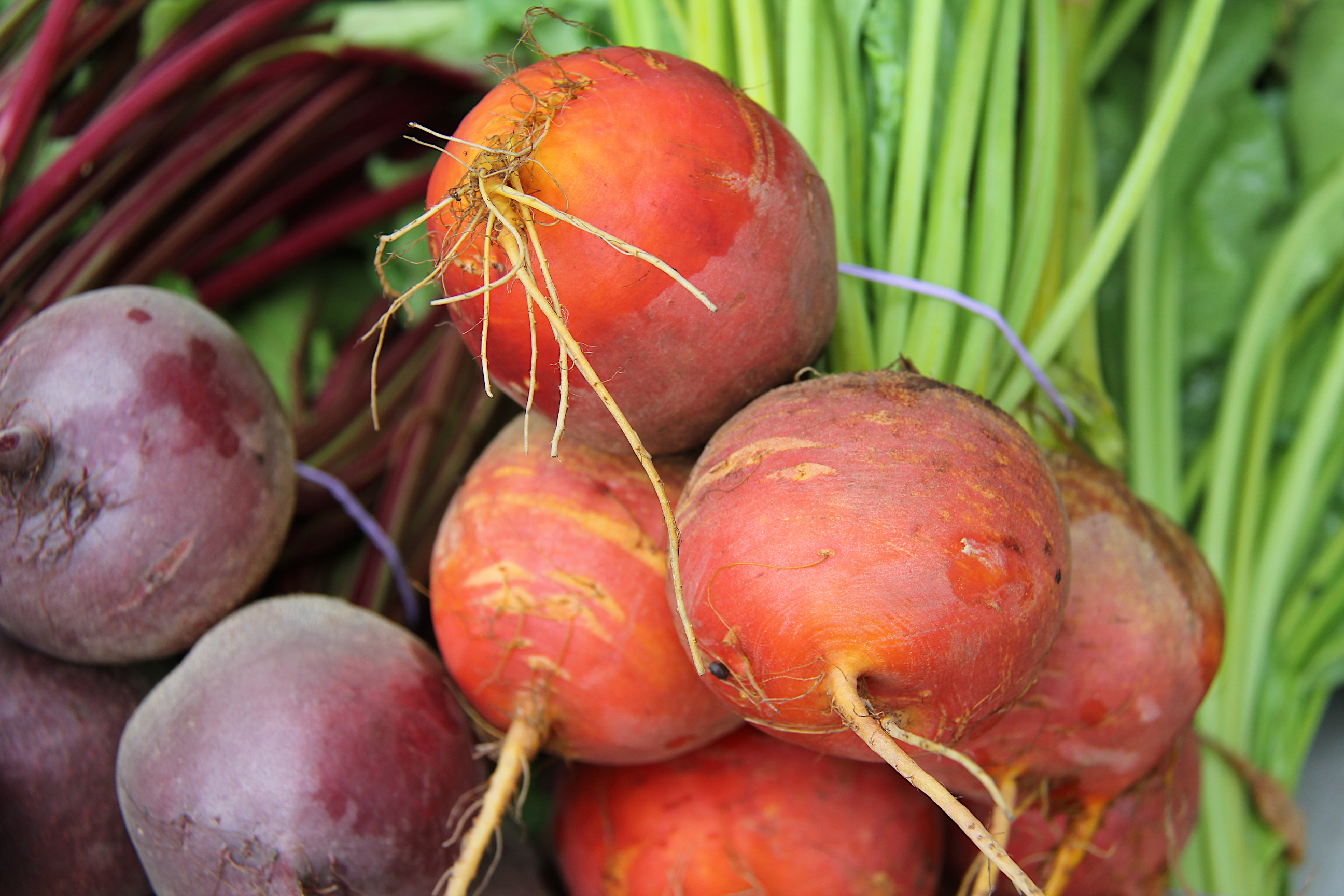
There are differences in beets (these are not sugarbeets), just like in people. (Minnesota Prairie Roots copyrighted file photo)

There are lessons to be learned from “Beets,” written by Rick Padden. First, we are all, at our core, just human beings with the same basic needs. Secondly, to overcome differences, we need to connect on a personal level. We need to open our hearts and minds, to embrace cultural and other differences. We need to show compassion and care, as farm wife Isabelle Hunt did on stage. We need to recognize that love is universal, as Anna and Dieter discovered.

“Beets” is one of those plays I wish everyone could see, especially now in these challenging days. I left the theater at Shattuck-St. Mary’s feeling a sense of hope. The fictional characters in “Beets” changed, for the better. They opened their hearts and minds to each other, despite their differences, or perceived differences. Perhaps we can do the same.

#

FYI: Two performances of “Beets” remain at Shattuck, one at 7 pm Friday, February 7, and the second at 2 pm Saturday, February 8. It’s a two-hour show (includes a 10-minute intermission) I highly recommend to anyone who enjoys well-done theater, history and a play with strong messages relevant to today.

© Copyright 2025 Audrey Kletscher Helbling


No need to wonder about the power of this movie December 14, 2017

Filed under: Uncategorized — Audrey Kletscher Helbling @ 5:01 AM
Tags: , , , , , , , , ,

IF EVER THERE’S a current movie everyone should see, it’s “Wonder.”

And for me to state that is noteworthy. “Wonder” is the first movie I’ve viewed in a theater since 2011. Yes, I really have not been inside a cinema since I last saw “The Help,” another memorable movie, six years ago. Most movies don’t interest me. Too much violence and genres that don’t appeal to me. I prefer movies with a message, with a purpose other than to simply entertain and with content that moves me.

“Wonder” fits those criteria.

Based on the New York Times bestselling book by R. J. Palacio, “Wonder” tells the story of 10-year-old Auggie Pullman, born with facial deformities and entering school for the first time after being homeschooled. As you would expect, Auggie faces incredible challenges, including bullying.

This film shows the real-life psychological harm of peer pressure and bullying to individuals and to families and then presents multiple ways people address it. And not always in good ways, just like in real life.

“Wonder” should be required viewing for every child, teen and adult. The book was assigned reading at my eighth grade great nephew’s Minnesota school, followed by a class field trip to see the movie. I applaud educators like those in Tristan’s school who realize the value in this film as a teaching tool and as an opportunity to open up conversations on differences, bullying, peer pressure, kindness, compassion and more.

As a survivor of junior high school bullying and even bullying as an adult, I understand this issue all too well. I refuse to tolerate bullying (and abuse) on any level. “Wonder” champions strength to rise and to overcome, making it one powerful movie.


FYI: If you haven’t read about the recent bullying of a young boy in a Tennessee school, then click here and read Keaton’s story. It breaks my heart. Decades ago, this was me. Crying. Suffering. Unable to stop the bullying. I was not bullied in the same ways as Keaton. But the bullying I experienced in junior high school hurt me. Deeply. Just like Keaton. This behavior needs to stop.

© Copyright 2017 Audrey Kletscher Helbling


It’s OK if you don’t have pickle bumps September 23, 2010

I’LL ADMIT TO MORE than a bit of skepticism about a children’s picture book titled Pickle Bumps for Baby Dill. “What kind of book is that?” I wondered before calling the author, Bob Fulton.

Well, exactly as the title suggests, this is a story about Baby Dill, a pickle born without bumps. But that’s not all. You see, after speaking with Fulton and upon reading his book, I learned the real purpose. And it’s much more than a story about cute, talking pickles.

Fulton delivers a strong message via the Dill family and Baby Dill’s friends. The message: “It’s OK to be different.”

That’s a message especially fitting for this time of year, the beginning of school.

I would speculate that many students have, in recent weeks, felt like they don’t quite fit in with their classmates. Maybe they aren’t wearing the latest fashions. Maybe they’re in a new school, struggling to make friends. Maybe they’re shy, quiet. Maybe their hair or their skin is the “wrong” color. Maybe they’re struggling with learning.

Maybe, like Baby Dill, they wonder why they are different from everyone else.

Fulton addresses that concern, which leads the Dill family on a shopping trip for pickle bumps. In the end, Baby Dill decides, with the support of his friends, that he would rather remain bump less.

While Fulton’s story has a positive ending, I know that isn’t always reality. In real life, kids bully, tease, make fun of, pick on, humiliate—whatever words you want to choose—those who are different. For all too many kids, there are no understanding friends to stand by and support them.

A book like Fulton’s offers encouragement. “We like you just the way you are,” Baby Dill’s friends tell him. That’s a message that needs to reverberate through-out our schools, our homes, our communities.

Pickle Bumps for Baby Dill would be a good addition to any elementary school classroom or library. While aimed at preschoolers and lower elementary students, the story also appeals to 10 – 12-year-olds, Fulton says. Having experienced bullying myself while in junior high school, I applaud any efforts to help students, parents and teachers address the issue.

The college educator—he taught chemistry for 39 years at St. John’s University and The College of Saint Benedict—has even added a list of 12 questions at the end of his book to prompt discussion.

He shares, too, that his book evolved from telling stories to his grandchildren and a specific request from his youngest grandson to “Tell us a story about a pickle.”

Fulton did and then put his tale into writing in Pickle Bumps for Baby Dill, published by Pickle Bump Press. Melissa Meyer, originally from Saint Joseph, Minn., illustrated the book.

#

AS A SIDE NOTE, please be aware that October is National Bullying Prevention Month. Check out the PACER Center Web site for information that can help you address bullying. Perhaps by working together, through understanding and listening and empathy, we can help reduce the bullying that is all too prevalent in our society, especially in our schools.

© Copyright 2010 Audrey Kletscher Helbling