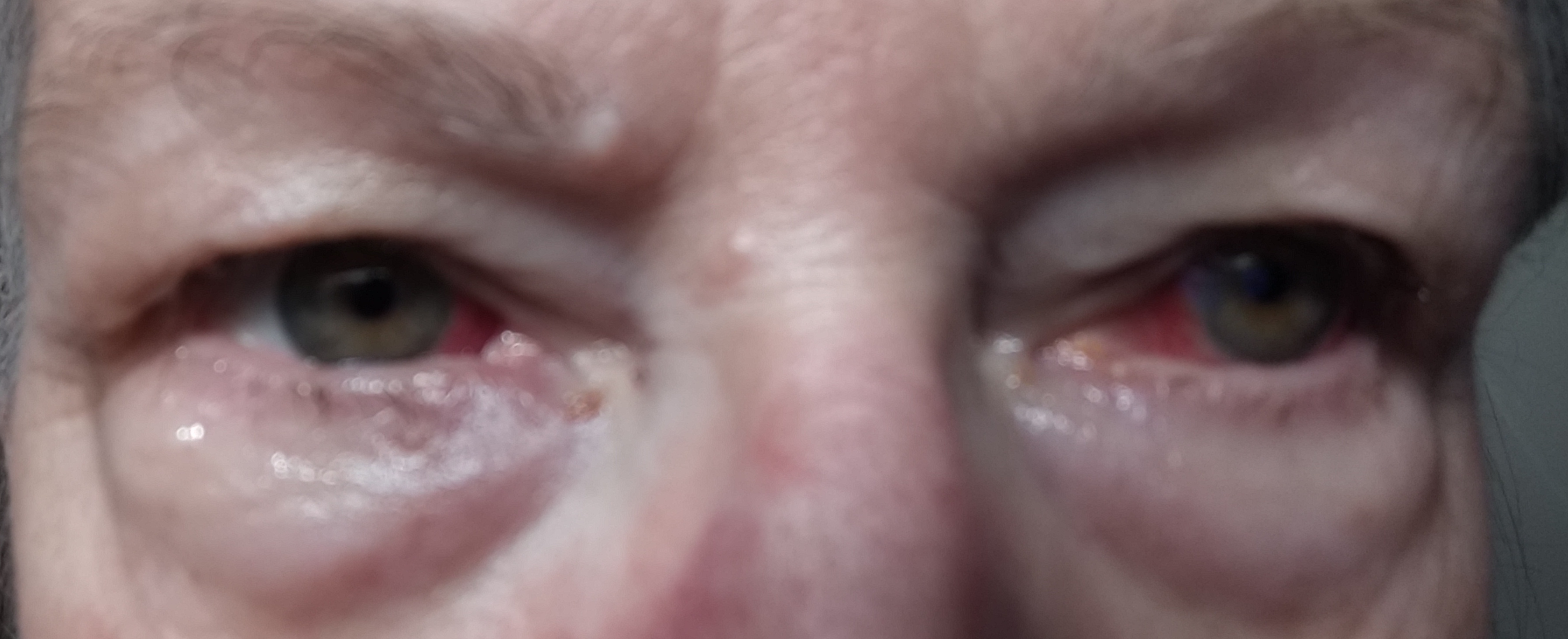
Not a good photo at all…but this gives you an idea of what my eyes look like. Randy took this pic Tuesday afternoon. (Minnesota Prairie Roots copyrighted photo January 2024)
TWO DAYS OUT from bilateral strabismus eye surgery at M Health Fairview Surgery Center at the University of Minnesota in Minneapolis, I am looking less Frankenstein’s monster than I did. Not that I look exactly like the fictional monster created by Dr. Victor Frankenstein in Mary Shelley’s novel. But I feel like I appear as ghoulish with my red, fluid-leaking eyes.
All humor aside, surgery to correct my eye misalignment went well. Neuro ophthalmologist Dr. Collin McClelland and his team performed the 1 ½-hour surgery on both eyes Monday morning with adjustable sutures stitched in my left eye. Post surgery, Dr. McClelland pulled the left eye stitches to tweak the alignment before tying them off. Yes, I was awake. Yes, it was painful.
On surgery day, the surgeon was pleased with results. Healing, time and my brain adjusting to my new vision will determine the final outcome. But I am optimistic that my double vision will be mostly, or totally, eliminated.
In the meantime, I’ve dealt with pain managed by over-the-counter meds and have tried to rest my eyes. For someone who likes to read and write, it’s a challenge to limit both. But when my eyes hurt, I’m relieved to shut them.
Finally, last night, I slept well. Each day brings improvement. Less pain. Less blood and fluid seeping from my eyes. Healing takes time and patience.
Randy has been a great support along with serving as resident nurse and pharmacist. He squeezes ointment into my eyes thrice daily to prevent infection. I struggle with putting anything in my eyes and would likely misjudge and stab my eyes with the ointment tube. I can’t have that happening.
Occasional blurry vision and double vision, especially upon awakening in the morning, continue. My eyes feel gritty. This is not unexpected. My eyes have been through a lot of trauma with this surgery. The surgeon found extensive scarring in both eyes from this same surgery done in 1960 by Dr. Theodore Fritsche in New Ulm. Dr. Fritsche’s corrective repair of my misaligned four-year-old eyes lasted 60-plus years. If my new surgeon’s work lasts that long, I will be good to go.
Onward.
#
FYI: I will continue to limit my screen time as I recover. But feel free to leave comments because I will read them at some point. I likely will not reply, though. I appreciate all of the support, encouragement and prayers from you, my dear dear readers. Thank you.
Once I’m feeling better and am able to write more, I will share more about my surgery day experience. I assuredly have stories to tell (once a journalist, always a journalist) from my time at M Health Fairview, where I received excellent and compassionate care.
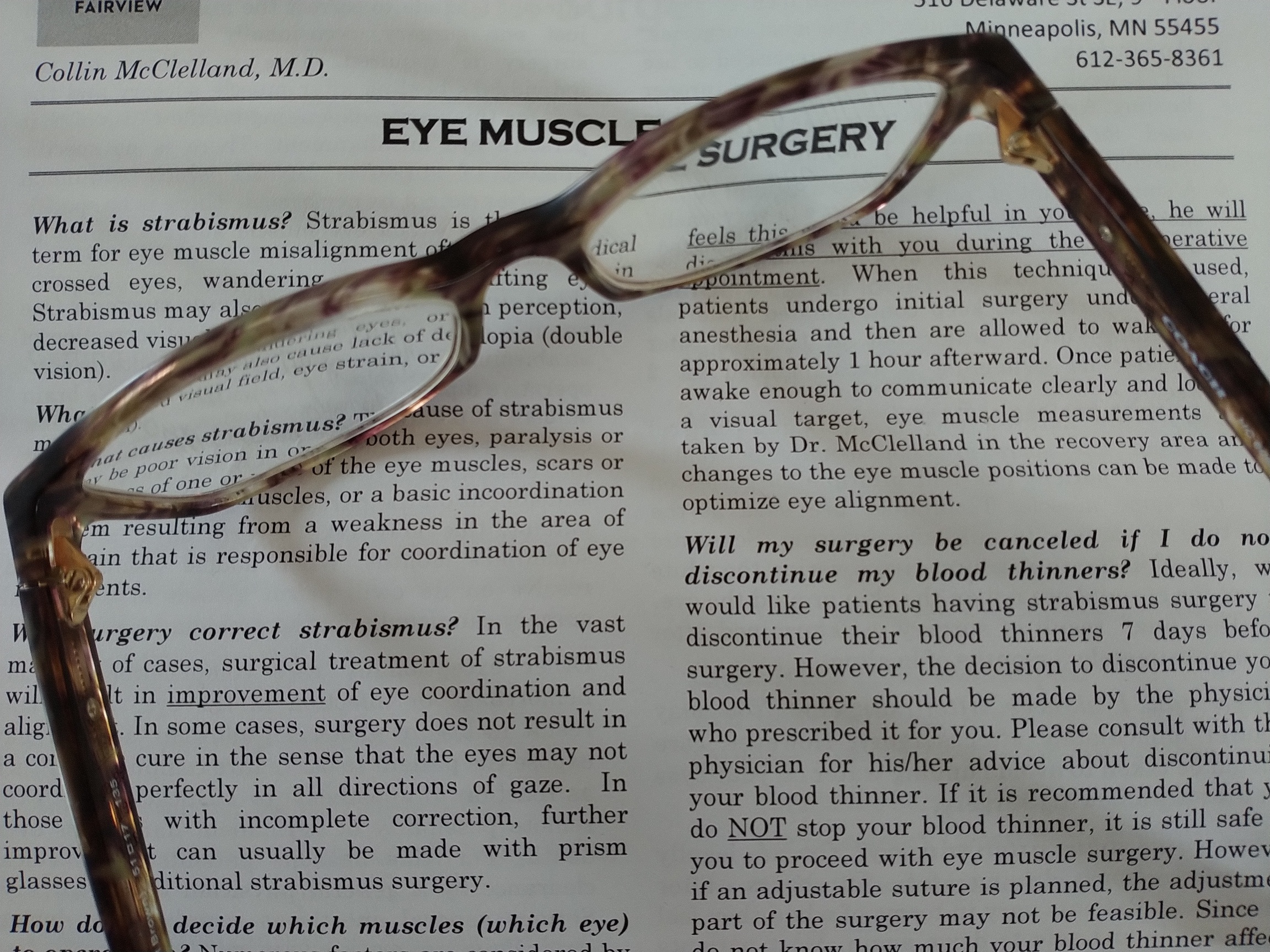
My current eyeglasses atop info about bilateral strabismus eye surgery. (Minnesota Prairie Roots copyrighted file photo November 2023)
THE EYES HAVE IT. Until they don’t.
Next week I undergo bilateral strabismus eye surgery at M Health Fairview Clinics and Surgery Center in Minneapolis. Basically, I’m having surgery to align my misaligned eyes. The neuro ophthalmologist will cut into the white of my eyes and then the muscles, tightening them into alignment using adjustable sutures. That’s the plan. Randy has advised me not to watch any online videos. I have no intention of doing so. Reading about this surgery is more than enough for me.
If you look closely at this image, you can see the patch covering my left eye. This 1960 photo of my mom, sister Lanae and brother Doug was taken on a rare family vacation to the North Shore near Duluth, Minnesota.(Photo sourced from my personal photo album)
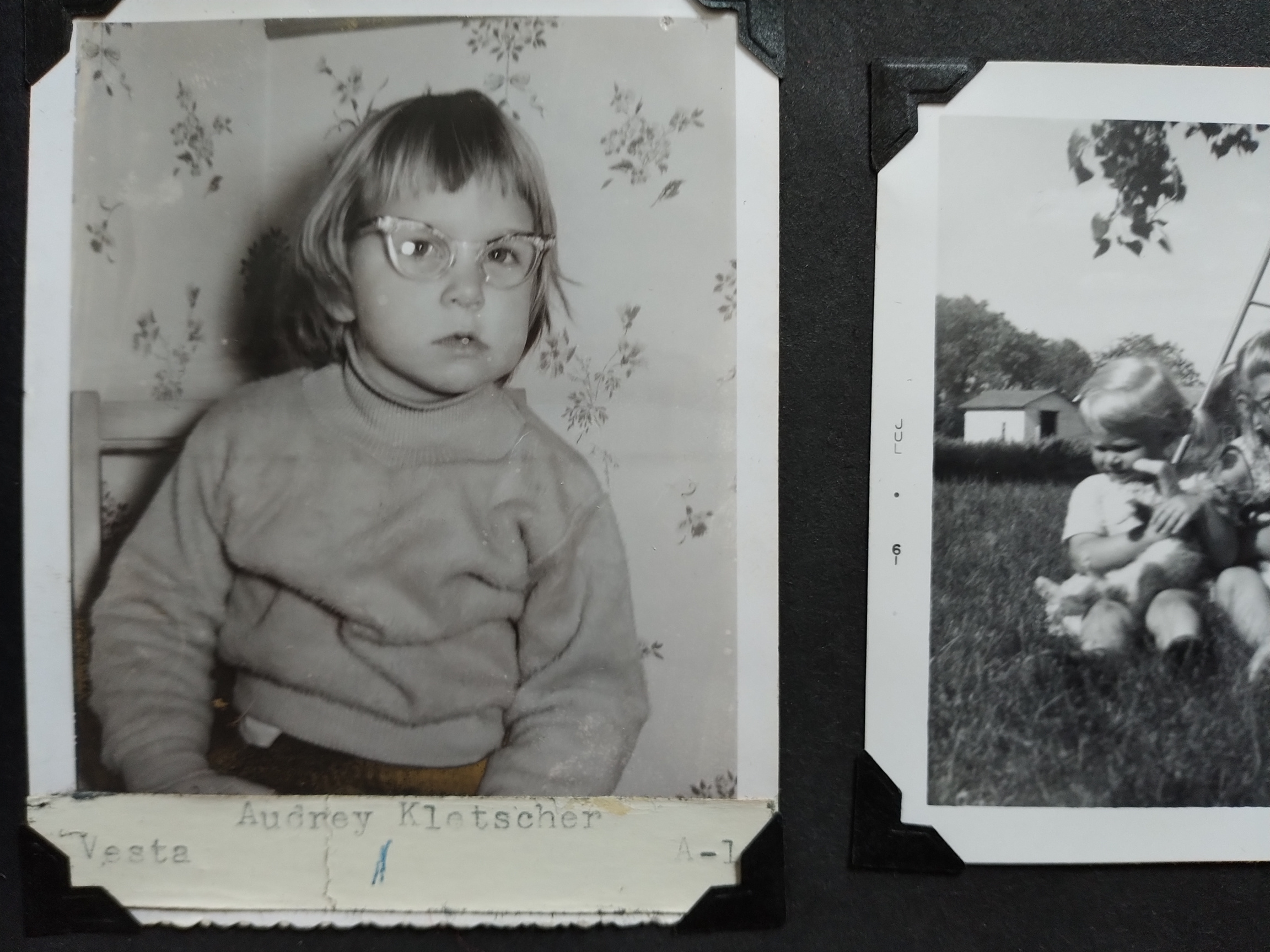
The thing is, I’ve had this surgery before. Sixty-three years ago. I was just four, cross-eyed and needing medical intervention to correct my vision. Patching my lazy eye didn’t work. So my parents took me to a specialist in New Ulm 60 miles away from our southwestern Minnesota farm. Eventually, ophthalmologist Dr. Theodore Fritsche would do corrective eye surgery at Union Hospital. I will always be grateful to this surgeon and to my parents for recognizing I needed help or I likely would have gone blind in one eye.
I remember little about that long ago surgery except drinking tomato juice at the hospital and looking at books. The books I understand. But tomato juice? I like it now, but didn’t as a preschooler. I also remember getting orange circus peanut candy as a treat from the dime-store following my numerous appointments. I’ve blocked any other memories.
Fast forward to today and how I got here, on the brink of another corrective eye surgery.
As my neuro ophthalmologist explains, my eye muscles loosened through the decades, shifting my eyes into misalignment. My brain was compensating for the most part until I experienced neurological issues following a January 2023 viral infection suspected to be COVID. (I self-tested negative twice.) The niggles of double vision which had bothered me for a few years, mostly in the evening when I was tired, worsened. COVID messed up my brain function and communication between the brain and my eyes was misfiring. In the past year, it’s become increasingly difficult to only see one, even with prisms in my prescription lenses. Trying to see only one taxes, exhausts, me. Sometimes I can’t read. Sometimes I close one eye simply to eliminate the double vision. It is getting to be too much.
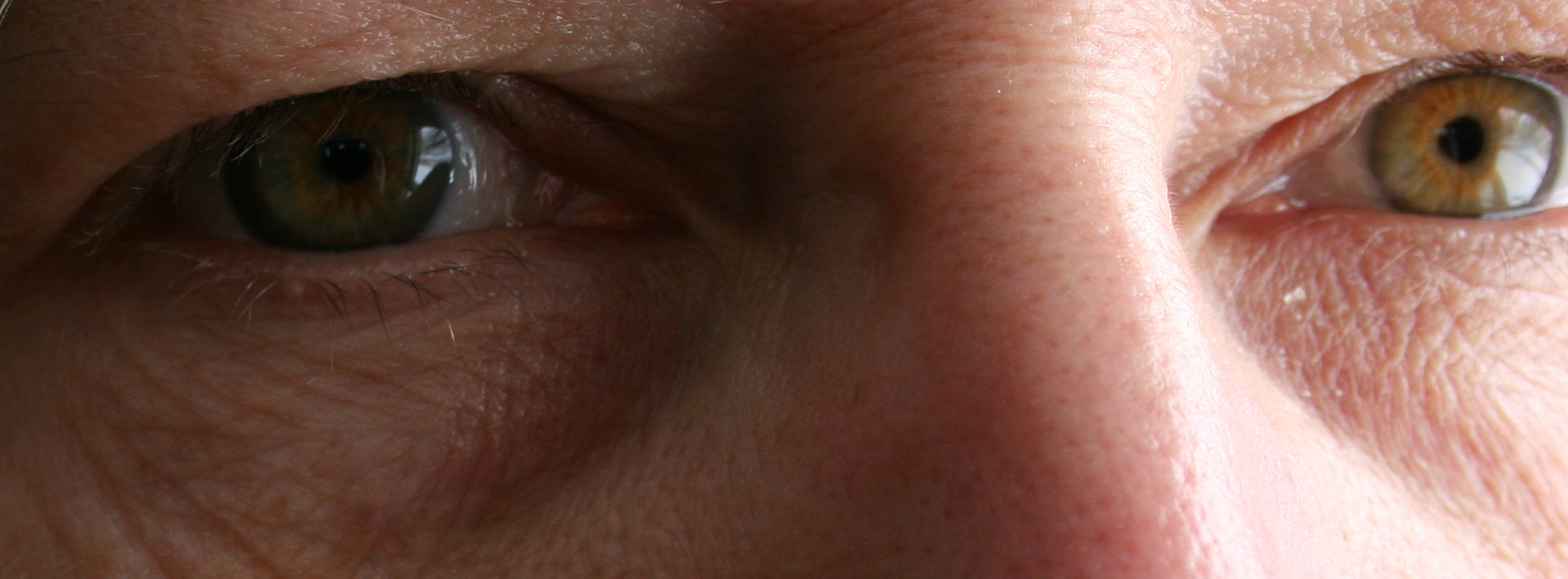
My green eyes up close pre double vision. (Minnesota Prairie Roots copyrighted file photo)
Once I completed 5 ½ months of vestibular rehab therapy to retrain my brain and help me deal with the devastating affects of long haul COVID, I was ready to see a professional about my double vision. I started locally. I went into an August ophthalmology appointment optimistically thinking I could simply get a new pair of prescription eyeglasses with more prisms added. Not so. As the ophthalmologist held up prism after prism to my eyes, it became clear nothing in his trays of prisms would effectively improve my vision. I was, he said, beyond his realm of expertise and would need to see a specialist.
After a several-month wait, I saw the neuro ophthalmologist at M Health Fairview in late October. Following 2 ½ hours of exhaustive testing, of looking through prisms and layers of prisms, I understood that I was well beyond the corrective lenses with prisms option. I would need surgery.
A childhood photo of me taken at an optometrist’s office in Redwood Falls. (Photo sourced from my personal photo album)
So here I am after another long wait—three months this time—on the cusp of bilateral strabismus eye surgery. I just want to be done. I am hopeful this outpatient surgery will fix my eyes and eliminate my double vision. Am I scared? Yes. The idea of undergoing general anesthesia and having a surgeon cut into my eyes and eye muscles is frightening. If only I could zoom back in time to my 4-year-old self who remembers nothing but books, tomato juice and circus peanut candy.
#
FYI: If I’m absent from blogging for a while, it’s because I’m resting my eyes, recovering from surgery. I’ll be back, hopefully no longer seeing double.
Raspberry chicken salad, one of the best salads I’ve eaten, at the Amboy Cottage Cafe, Amboy, Minnesota. (Minnesota Prairie Roots copyrighted file photo)
FOR MANY OF US, these early January days prompt thoughts of embracing a healthier lifestyle. Eating better, exercising, losing weight, reducing stress and more top lists. But taking this from ideas to action requires determination and hard work.
If you live in a cold weather climate like me, getting motivated and active during the winter can prove challenging. Just the thought of bundling up to go outdoors makes me wish for warmer, sunnier days. This time of year, I’d rather snuggle under a fleece throw and read.
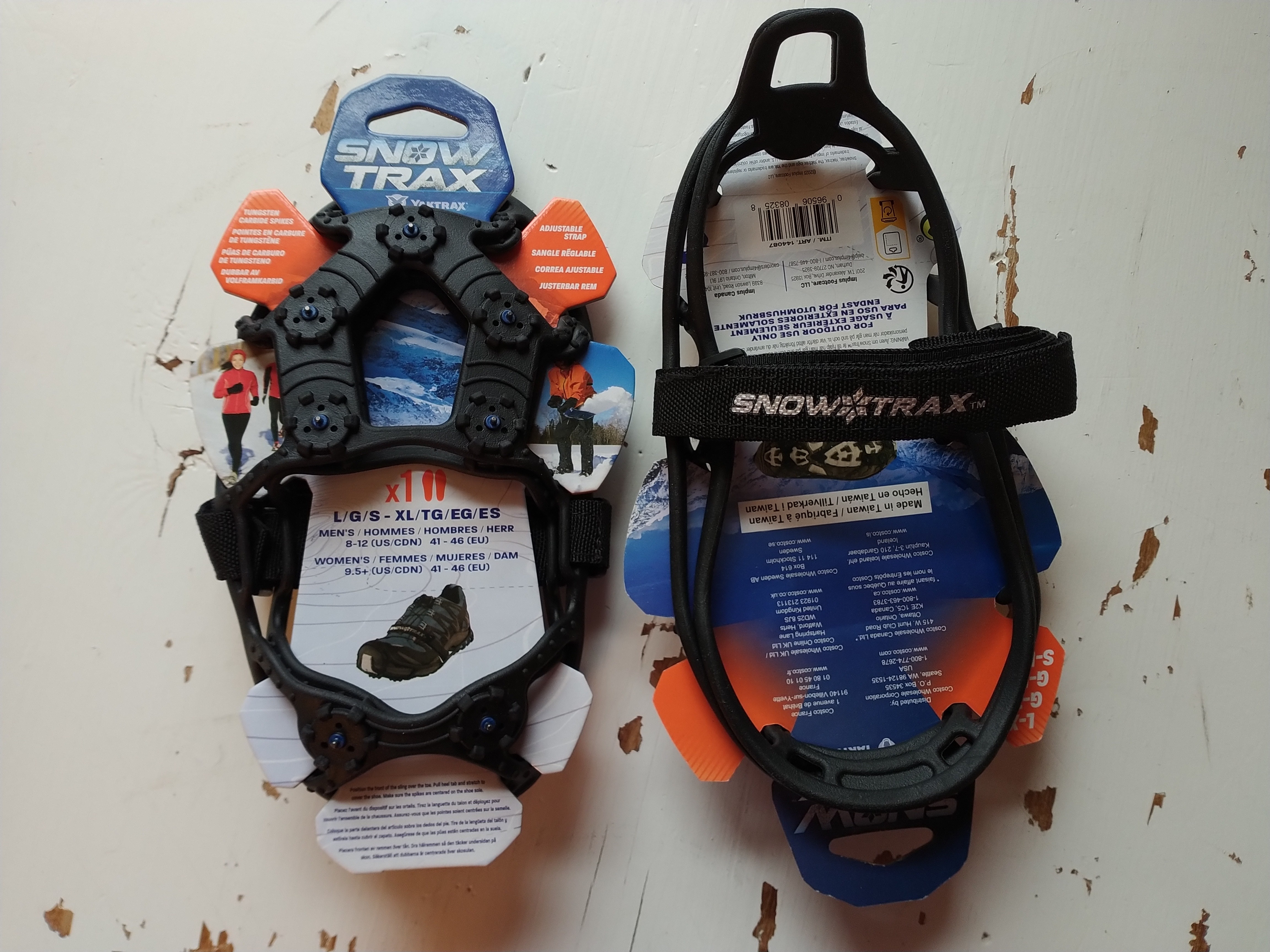
These as yet unused grippers will go over my snow boots to keep me safe on snowy and icy surfaces. (Minnesota Prairie Roots copyrighted photo January 2024)
But I’m determined in 2024 to work harder at appreciating winter. I won’t be taking up downhill skiing or ice skating. But I am open to trying cross country skiing and snowshoeing decades out from my last attempt at either. I’ll leave ice fishing for the die-hard anglers. And I can certainly walk/hike, especially now that I have clamp-on Snow Trax with tungsten carbide spikes for gripping snowy and icy surfaces. I have not yet tested them to see if they actually work as promised. We’ve had only minimal snow and ice. Of one thing I’m certain. I can’t risk falling and breaking a bone. Not at my age, which is closing in on 70.
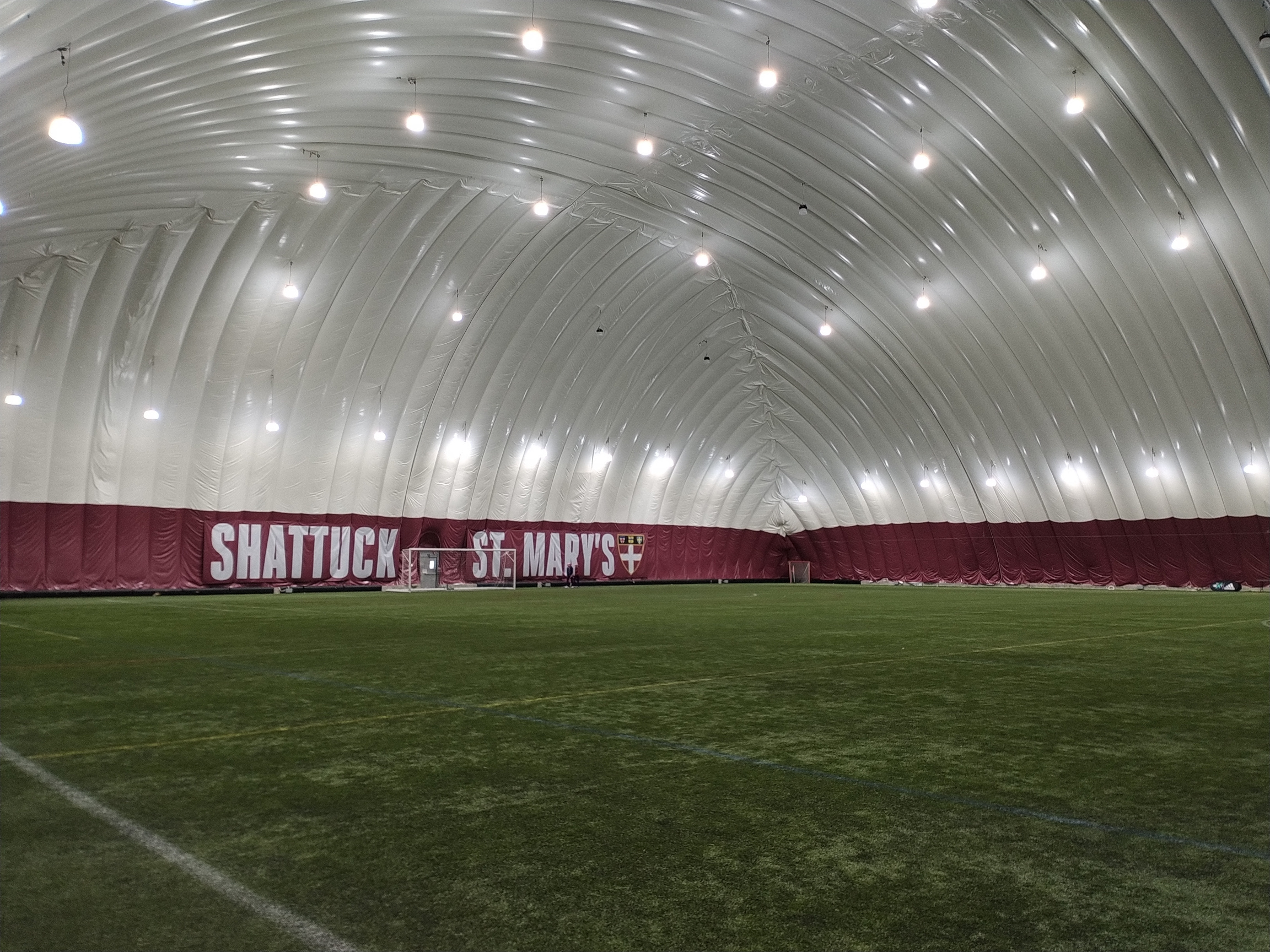
Inside the Shattuck-St. Mary’s soccer dome. (Minnesota Prairie Roots copyrighted photo December 2023)
If I really want to play it safe and simultaneously stay warm, I can walk indoors. Shattuck-St. Mary’s, a private college prep school on Faribault’s east side, opens its dome to the public from 6:10 – 9:30 am weekdays for running and walking. Five loops around the soccer field perimeter equal about a mile, the distance Randy and I typically walk. It’s truly amazing that I can go this far given six months ago I could barely manage to walk a block due to the affects of long haul COVID.
The curving Straight River as photographed from the Straight River Trail, Faribault. (Minnesota Prairie Roots copyrighted photo February 2023)
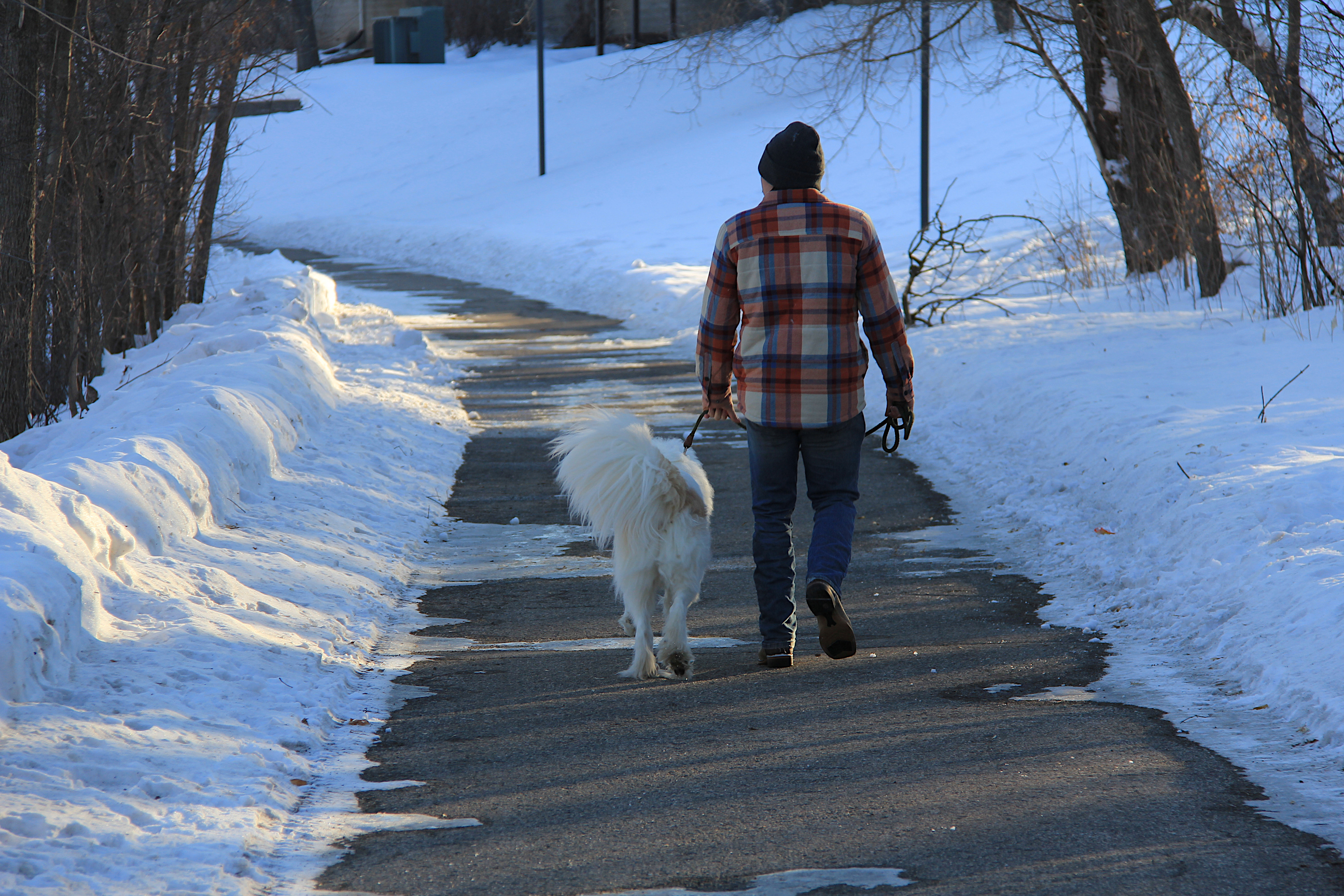
On days when temps are not horribly cold and the wind is calm, I much prefer walking outside. There’s something about being outdoors, in nature, that is more relaxing, calming than in an indoor environment. I like the feel of sunshine on my face, even the crisp air, and the sight of twisting river and bare trees and a sometimes bold, blue sky. Last time walking at the Minnesota State Academy for the Deaf campus, 10 deer stood statue still watching Randy and me as we stood statue still watching them. I felt such joy in seeing this wildlife in the heart of my community.
Pre-long haul COVID, I was lifting 12-pound weights. I’ve resumed lifting weights, but not 12 pounds yet. (Minnesota Prairie Roots copyrighted photo January 2024)
Walking and weight lifting, along with taking Vitamin D and getting sufficient calcium in my diet, are ways I am improving my health, too, specifically my bone health. Dairy has always been an important part of my daily food in-take given I grew up on a dairy farm. I like lifting hand weights. I feel empowered and stronger. With a family history of osteoporosis, my own diagnosis, two past broken bones and my tall, thin frame, I take bone health seriously.
Then there’s diet beyond dairy. If one good thing came from developing long haul COVID in 2023, it was losing 25 pounds. Granted, I wouldn’t recommend this weight loss plan. But I’m happy to have a current body mass index of 20.7, which is on the lower end of my “normal” weight range.
Oatmeal laced with fruit is my typical breakfast. (Minnesota Prairie Roots copyrighted file photo 2014)
I find I no longer crave sweets as much as I once did. With the kids long gone from home, I seldom bake. I eat a bowl of old-fashioned oatmeal with fresh fruit added nearly every morning and have done so for many years. It took several weeks of eating oatmeal for the grain to grow on me. In the back of my head, I remembered how much my father-in-law disliked oatmeal, so much so that he stuffed oatmeal into his pockets at Catholic boarding school. Not quite sure how he managed that as a young lad under the watchful eyes of the nuns.
Flamin’ Bleupizza from Pizzeria 201 in Montgomery, Minnesota. (Minnesota Prairie Roots copyrighted file photo)
I try to eat smaller portions, avoid junk food and bread, and eat plenty of fruits and vegetables (which I love). Admittedly, I also love pizza, a grilled cheese sandwich, cheesecake, ice cream, etc. and don’t deny myself foods that aren’t necessarily “good” for me. It’s about portion control. Have a small scoop of ice cream, not several. On occasion, I’ve been known to devour a handful of dark chocolate chips when I’m craving chocolate.
Seldom do I dine out, for two reasons—cost and my inability to tolerate noisy environments due to sensory issues from long haul COVID. I’ve only eaten out a handful of times in the past year. Twice I left because I couldn’t manage the noise. While I appreciate restaurants, I recognize that such dining can lead to overeating and consuming calorie-laden foods because, who isn’t tempted by French fries?
Walking is one way to reduce stress. Many communities have trails, perfect for walking even in the winter. This photo was taken along the Straight River Trail near Fleckenstein Bluffs Park in Faribault. (Minnesota Prairie Roots copyrighted file photo February 2023)
Reducing stress is perhaps my biggest challenge. I tend to worry, to ruminate. And that is unhealthy. I’m getting better at letting go, at lessening demands on myself, on understanding that life never has been, and never will be, perfect.
#
TELL ME: What do you do to stay healthy? What goals have you set for 2024?
My great niece Keira painted this HOPE stone, which sits on my office desk. (Minnesota Prairie Roots copyrighted file photo)
I HADN’T PLANNED on writing a third post related to my health issues following a case of suspected COVID in early January. But then blog readers shared their experiences with the virus and I felt compelled to write more, to offer insights and, most importantly, hope.
In this sharing of stories in the circle of my blog, I’ve learned that some of you have endured symptoms similar to mine. Keith in New York City. Diane in Iowa. And then Beth in Michigan with an altered sense of smell.
In the aftermath of COVID infections, there’s still much to learn. I quickly recognized that during my struggles and also via your stories. Answers don’t come easily. Help can be elusive. Frustration and despair set in and it’s a challenge to be heard, to remain hopeful. Telling our stories is important, necessary.
I received this book in the mail, sent anonymously by a reader. The book and note made me laugh and uplifted me when I really needed uplifting. (Minnesota Prairie Roots copyrighted file photo)
THE NEED FOR VALIDATION, FOR SUPPORT
I remember telling my physical therapist, Ryan, early on that I felt unseen because I was dealing with unseen neurological issues few seemed to understand. But when he compared my symptoms to those of someone with a traumatic brain injury, I felt validated. That’s all I needed, an affirmation that this was real, not just in my head. But it literally was in my head, in my brain.
My sister-in-law Rosie, who endured two concussions following falls, was (and is) among my biggest encouragers. She understands my symptoms, especially my inability to tolerate sensory overload. Having a key empathetic person is, in my opinion, vital. Likewise core family support is essential.
This quarter-sized token, gifted to me by my friend Beth Ann many years ago, lies on my computer desk. (Minnesota Prairie Roots copyrighted file photo)
GETTING HELP& SETTING GOALS
But personal support only goes so far. I am fortunate to have a primary care doctor who listens, shows great compassion, admits when he can’t help me, and referred me to specialists. My many office visits extended well beyond the allotted 20 minutes. Vestibular rehab therapy set me on a course to better health. I started therapy in mid-April. That continued weekly until mid-September. Therapy worked in retraining my brain, in helping me manage my symptoms.
On my final day of therapy in September, I told my therapist that I had three immediate goals: to get my hair cut, to return to worship services at church and to dine in a restaurant. Within two months, I accomplished all three with varying degrees of success. I share this to offer hope.
Here’s how I managed: I alerted my hair stylist to my sensory issues pre-appointment. Donita turned off the salon music and took care overall to minimize sensory input. Worship has proven a bit harder, especially managing the organ music, which often assaults me like a tsunami. Even with an ear plug, I struggle. I’ve learned that my brain struggles most in the early mornings and evenings and in busy environments. Restaurant dining remains challenging, although I managed in a quiet chain restaurant. I have yet to try a homegrown, noisy restaurant.
Inspirational and honoring words are embedded in mosaic tile at a memorial in Faribault. (Minnesota Prairie Roots copyrighted file photo)
HOLDING HOPE
There is hope. Always hope. It is, and has been, my go-to word through many struggles in life. For any of you struggling with post-COVID health issues, I hope I have offered you hope, or at least validated what you are experiencing.
These mini cards were a gift from Roxy, a blog reader from Owatonna who has been one of my strongest encouragers. I have sent these cards to others in need of support, passing along the gift of encouragement. (Minnesota Prairie Roots copyrighted file photo)
WAYS TO ENCOURAGE
For those of you who know someone dealing with long haul COVID, please support your family member or friend. Listen. Mail a greeting card. Text or call with encouraging words. (All helped me mentally; thank you, readers.) What we are going through may not be seen. But it is real, all too real.
This art by Faribault middle schooler Mohamed depicts how my brain felt post-COVID. (Minnesota Prairie Roots copyrighted file photo)
IT’S BEEN A JOURNEY. That best summarizes the path I’ve been on since January to reclaim my health. It’s been difficult, stressful, taxing, challenging, emotional and often overwhelming. But I was determined to do what I could to reach a better place health-wise in the aftermath of unconfirmed, but suspected, COVID.
This was a virus which messed with my brain, my neurological system, leaving me with a long list of debilitating symptoms. Prior to COVID, I was healthy, medication-free, living a normal life. And then…everything changed. (Click here to read my initial post about how COVID affected me.)
My route to managing long haul COVID began with my medical team, including my compassionate primary care doctor who listened, who admitted when he couldn’t help me, who referred me to specialists, who handed me tissues when I cried in the exam room. He never gave up on me. Nor did my vestibular rehab therapist.
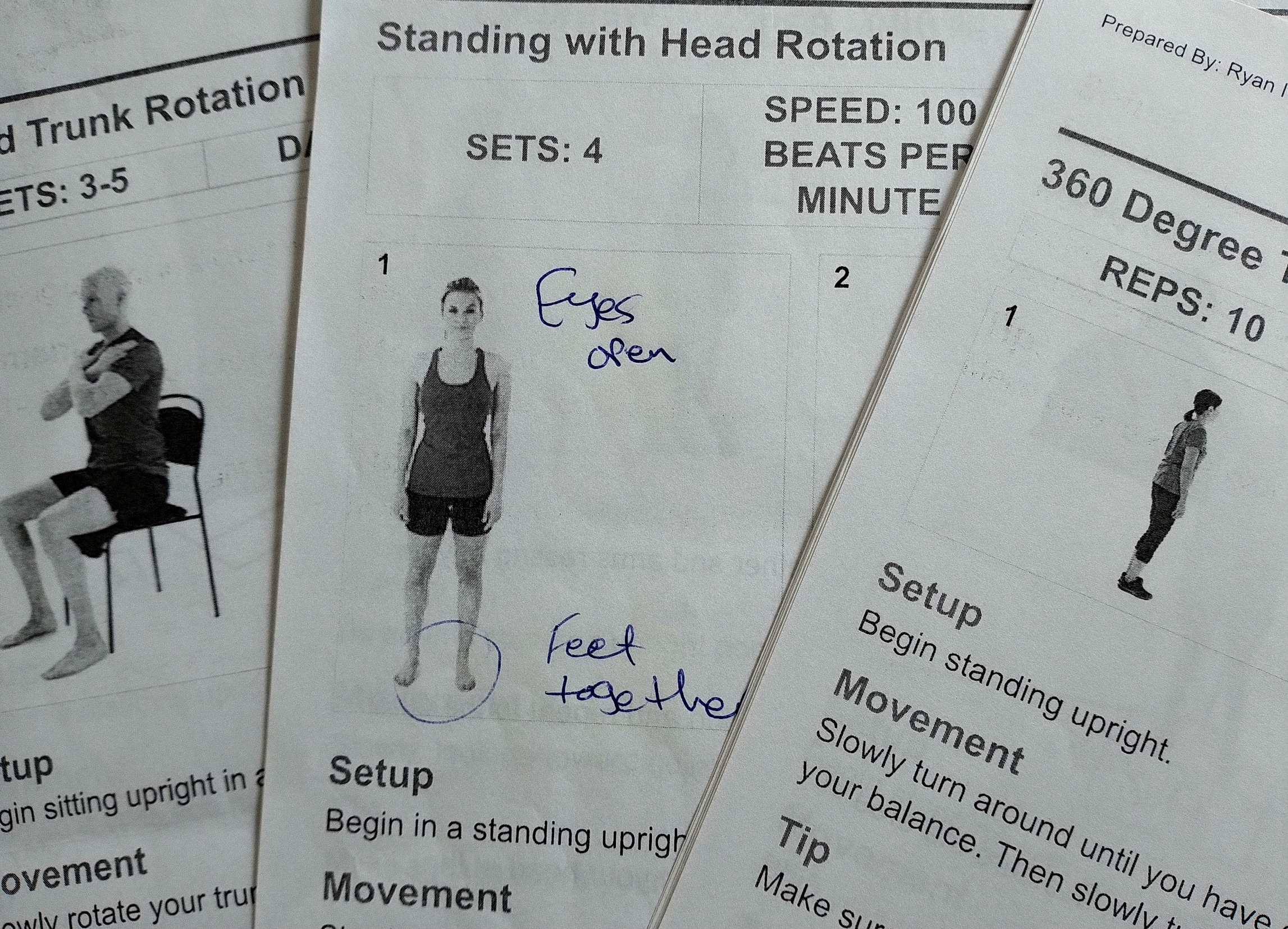
Some of the exercises I did in vestibular rehab therapy. (Minnesota Prairie Roots copyrighted photo November 2023)
VESTIBULAR REHAB THERAPY, MY ROAD TO RECOVERY
I credit my physical therapist, Ryan at Courage Kenny Rehabilitation Institute in Faribault, for leading the way in my recovery. He has extra training in vestibular issues. From the get-go, Ryan encouraged me, worked with me, supported me, showed deep care and compassion. Those went a long way in empowering me to work hard. And that I did.
During those initial once-a-week visits with Ryan, I barely managed conversation with him. I would mostly close my eyes and listen as he told me how we would work first on overcoming my balance problems. And then I would do as he instructed. Simple things like turning my head while seated. Then trunk rotations. Then turning my head while walking. Soon rotating while walking. Moving my hands back and forth aside my head while listening to white noise. I was building my tolerance for sensory input one exercise at a time. Retraining my brain. It took many months to progress through these seemingly basic exercises. But they were helping.
Each session Ryan gave me homework, which I faithfully did. I understood that no amount of therapy would work if I wasn’t willing to work hard at home. Soon he was encouraging me to get out, to try socializing. He even convinced me I could manage a mid-summer stay at a lake cabin, giving me coping tools to handle the long drive (close my eyes and wear ear plugs and sunglasses), to handle sensory overload (take breaks) and more. I managed that vacation get-away, but not easily. I remember the evening I snuggled next to my eldest daughter, put my head on her shoulder and sobbed, “I can’t do this any more.”
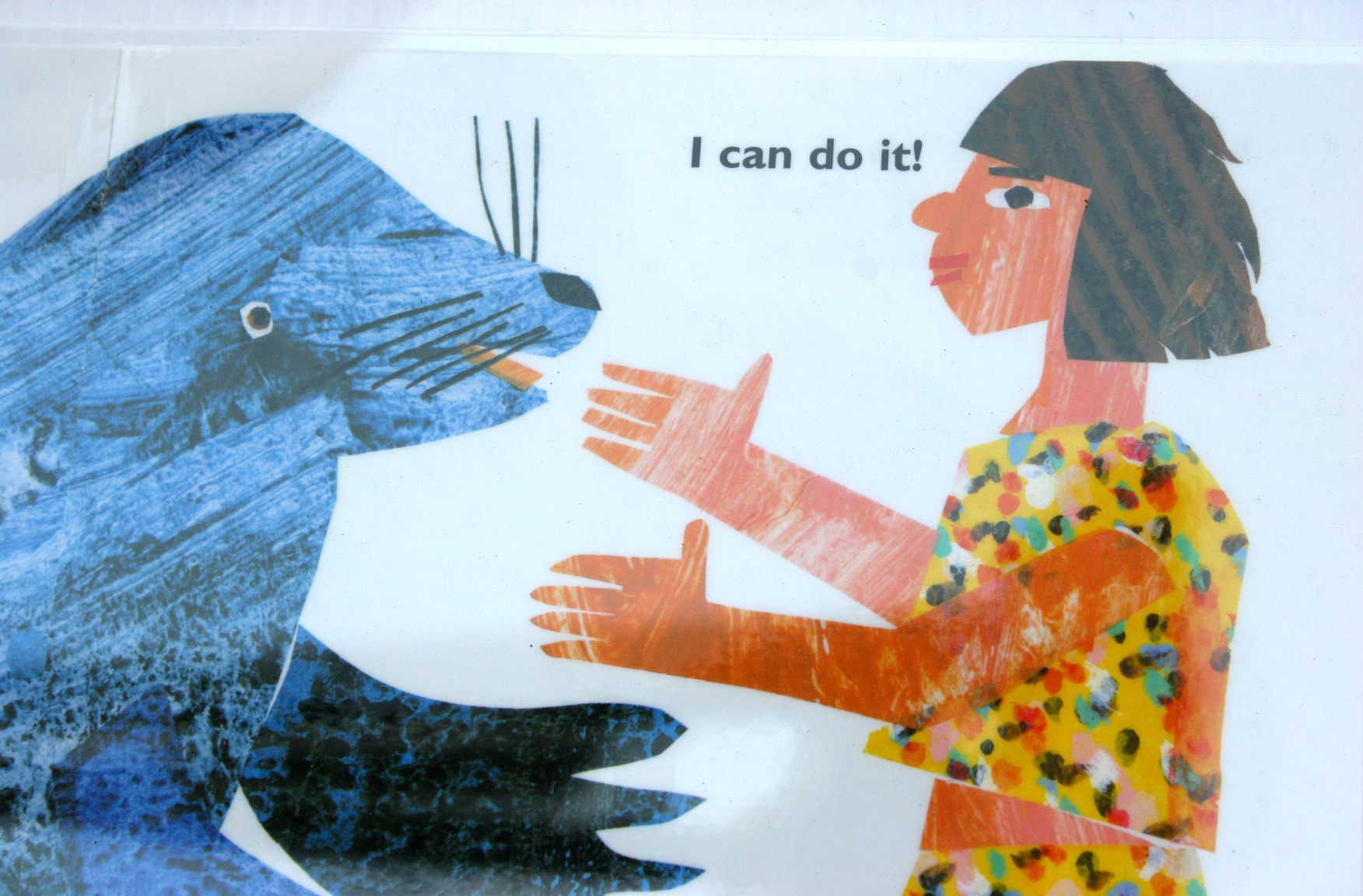
A page from Eric Carle’s book, “From Head to Toe” inspires me. (Minnesota Prairie Roots copyrighted file photo)
ENCOURAGEMENT IN THE MIDST OF DESPAIR
Many times I felt despair, as if I wasn’t making progress. Ryan assured me I was improving, even if I couldn’t always see it. I often felt, too, like no one understood what I was going through (although I’m sure that’s not true). But what I had was unseen, literally in my head. And when people can’t see, or make no effort to understand neurological issues, support lacks. That said, I had a core support group of friends and several sisters-in-law who gave me ongoing encouragement.
And so the months passed. Randy and our eldest daughter, especially, offered unconditional love and support that carried me through some of my darkest days. I wanted desperately to feel better, to have my old life back, pre-virus. By mid-September when I’d advanced to virtual reality roller coaster rides, my physical therapist deemed me ready to graduate. I was ready, yet I wasn’t. I would miss Ryan’s weekly encouragement.
Here I am today, two months out from therapy’s end. I am in a much better place than when I began vestibular rehab therapy in mid-April. I am out and about. Grocery shopping, attending church, speed walking a half hour daily, going to concerts, socializing… I still struggle if I overdo it, if I have too much sensory input. I rely on ear plugs to handle loud music. I close my eyes. Sometimes I have to leave a place or event. I am not the same as I was pre-COVID.
Up next, eye muscle surgery. (Minnesota Prairie Roots copyrighted photo November 2023)
UP NEXT, EYE SURGERY
In January, I will undergo bilateral strabismus surgery at the University of Minnesota to realign my eyes. It is a re-do of a 1960 surgery. As my neuro ophthalmologist explained, the eye muscles that were surgically tightened decades ago have loosened through the decades. Up until my neurological system was affected by COVID, my brain compensated. No more. I am seeing double, and not just when I read. Trying to focus my vision to see only one exhausts me.
But in the all of everything I’ve endured since January, I’ve made significant progress. I’m doing much better. Mostly managing. And that is reason to feel thankful.
IT’S BEEN A YEAR. No other words exist to define 2023, a year in which I’ve been overwhelmed by fall-out from a virus in early January. Although I self-tested negative twice for COVID, my primary care doctor suspects I did, indeed, have COVID given the neurological and other issues I’ve experienced since then. I fully agree.
This is my story, one that needs to be shared so that others understand just how viruses affect some of us. This story needs to be shared also to offer hope to others. This story needs to be shared, too, so that anyone who is ill thinks twice about going to work, the grocery store, church, concerts, family gatherings or elsewhere, thus exposing others to infectious diseases.
To tell my story, it’s necessary to give some background. In 2005, at the age of 48, I caught whooping cough. I was sick, really sick, for three months. Gasping for air sick. Coughing until my stomach hurt sick. Exhausted, unable to sleep. In 2011, I lost the hearing in my right ear due to a virus. My body, for whatever reason, does not handle bacterial and viral infections well.
And then came January 2023, and the virus that would change my life.
This artwork by Bill Nagel fits how my neurological system felt, still feels sometimes when I experience sensory overload. (Minnesota Prairie Roots copyrighted photo November 2023)
IN THE BEGINNING
Symptoms started with feeling off-balance, off-kilter, as if I was fighting the world just to be upright. I waited to see my doctor, thinking (like most of us do) that I would get better. I didn’t. I, in fact, got worse. I experienced a bout of vertigo, a rapid heart rate, high blood pressure, all new and troubling symptoms. I felt like I’d been slapped on the right side of my head, a feeling that persisted for many months. And when I tried to sleep, my legs practically ran a marathon in bed.
My primary care physician acknowledged early on that his ability to help me was limited. But he listened, tried…and sent me to an ear/nose/throat doctor for an evaluation. To even get through these medical appointments was a struggle. I had to close my eyes to converse. I felt overly-anxious and agitated, also new symptoms. I was, by then, feeling ear pain, fullness, pressure and tinnitus. I couldn’t sleep. My head hurt. My fingertips hurt. I couldn’t handle screen time. Eventually I would see a neurologist, undergo a CT scan, then an MRI of my brain to rule out a tumor or anything else. It was as if my body was being assaulted.
I felt overwhelmed. I struggled sometimes to find the right words. “Why can’t I talk?” I asked Randy. My brain seemed to be malfunctioning, misfiring, miscommunicating. My neurological system was under siege. My memory, which has always been stellar, was (and remains) affected.
This cool mint toothpaste set my mouth afire. For a while I brushed my teeth with baking soda, then switched to kids’ bubblegum flavored toothpaste. I only recently returned to using mint toothpaste. (Minnesota Prairie Roots copyrighted photo November 2023)
MAJOR SENSORY OVERLOAD
But the symptom which proved particularly debilitating was sensory overload. I couldn’t tolerate light or noise. I sat in the recliner, living room curtains drawn, body folded into the fetal position. No sound except the ringing in my own ears. I rocked 100 miles an hour, occasionally arose to pace the floor, stretched putty left from previous occupational therapy. Nothing calmed my body or mind. All I wanted was darkness, quiet, nothing stimulating entering my brain.
I struggled to get through Easter dinner at our house, missed my grandchildren’s birthday parties and a niece’s baby shower. Most heartbreaking of all was missing my son’s graduation with his master’s degree. I couldn’t handle the long road trip to Indiana, sit through the ceremony at Purdue. I couldn’t even manage grocery shopping; too much white noise from coolers and too much visual stimulation. Phone calls proved taxing, any conversation difficult. I was primarily housebound except for trips to the clinic and one to the ER following an allergic reaction to an unknown something. By then I’d been diagnosed with Meniere’s Disease and vestibular neuritis.
And then came the morning I brushed my teeth, the mint taste so overwhelming that I spit out the toothpaste. Rather than losing my sense of taste, mine intensified. For a week, until I saw my doctor (who added peripheral sensory neuropathy to my diagnoses) and got a prescription to settle my nervous system, I could eat only the blandest of foods. Oatmeal. Soda crackers. Graham crackers. I lost nine pounds in five days. Overall, I’ve lost 25 pounds this year. I’m OK with losing that weight, but don’t recommend this weight loss method. I went through a lengthy period of eating only a few bites of food at a meal.
All of this I experienced following COVID. Plus a rash and hair loss, either from the virus or from anti-anxiety meds. Nearly a year out from the virus, I am in a much better place. It took five months of vestibular rehab therapy, time and a lot of hard work to get here. Next up, I will write about retraining my brain, learning to manage my symptoms and how I found my way back to semi “normal.”
#
NOTE: I’ve been asked by several people whether the COVID vaccine caused my neurological and other issues since I am fully-boosted and vaccinated. No. My health problems began when I had that January virus, thought to be COVID. Had I not been vaccinated and boosted, I firmly believe I would have ended up in the hospital, perhaps even died. Negative comments about the vaccine and boosters will not be posted on this, my personal blog.
Purple spotlights transformed trees to shades of purple. (Minnesota Prairie Roots copyrighted photo September 2023)
IN THE EARLY EVENING DARKNESS of Faribault’s Central Park, on an unseasonably summery September Saturday, I felt enveloped in a magical world of autumn leaves sparkling purple. The setting seemed surreal, magical, enchanting. And the feeling felt hopeful.
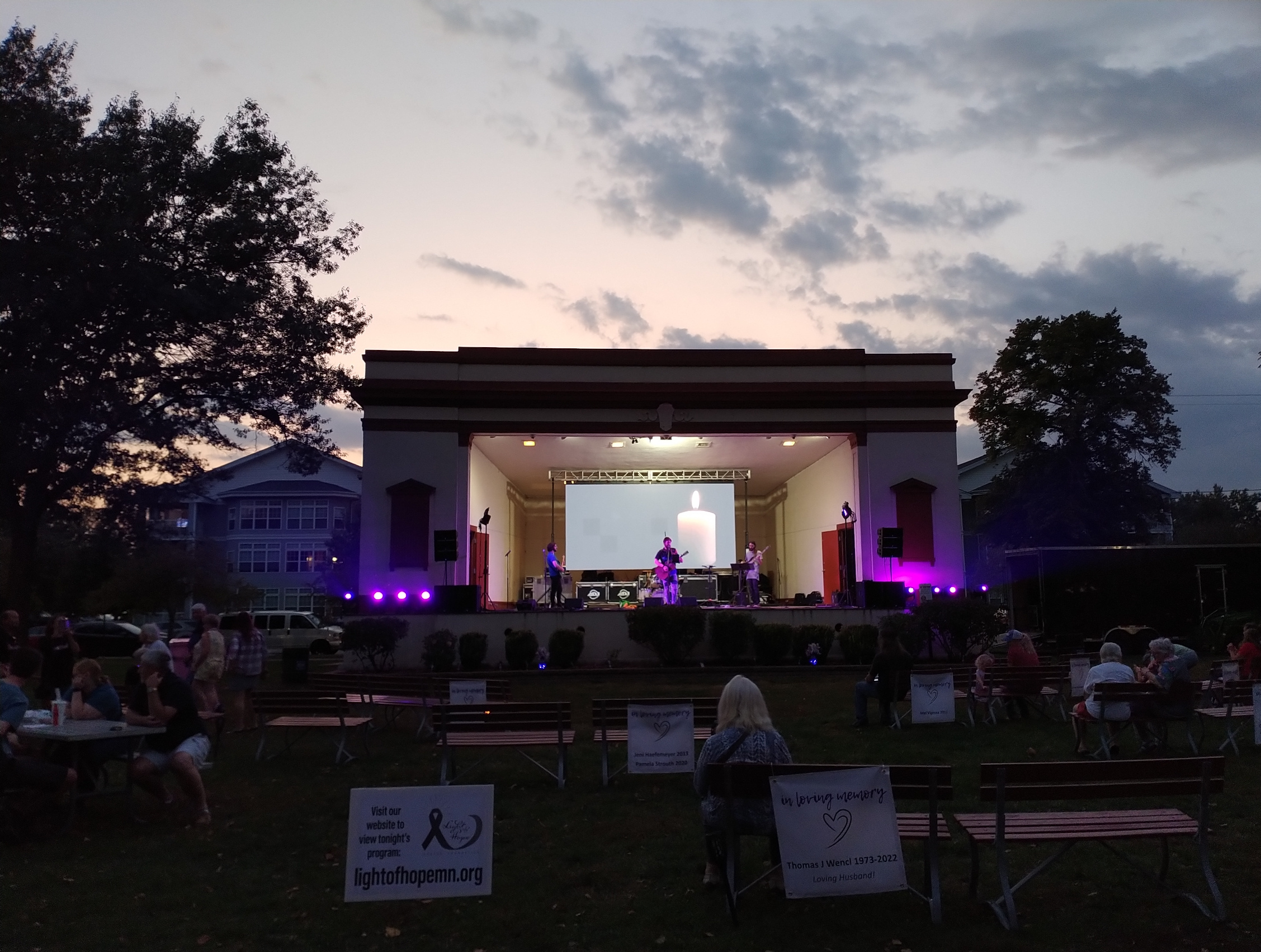
Musician Steve Huber performed first followed by Joe and the Mechanics in the Central Park Bandshell. (Minnesota Prairie Roots copyrighted photo September 2023)
I was among hundreds gathered for the first-ever Light of Hope Celebration to recognize those lost to cancer, those battling cancer, those who’ve survived cancer…and those of us who love (d) them. Purple spotlights shone on trees centering the park, creating a serene, yet celebratory, scene while musicians performed in the bandshell, speakers spoke and kids engaged in activities just for them.
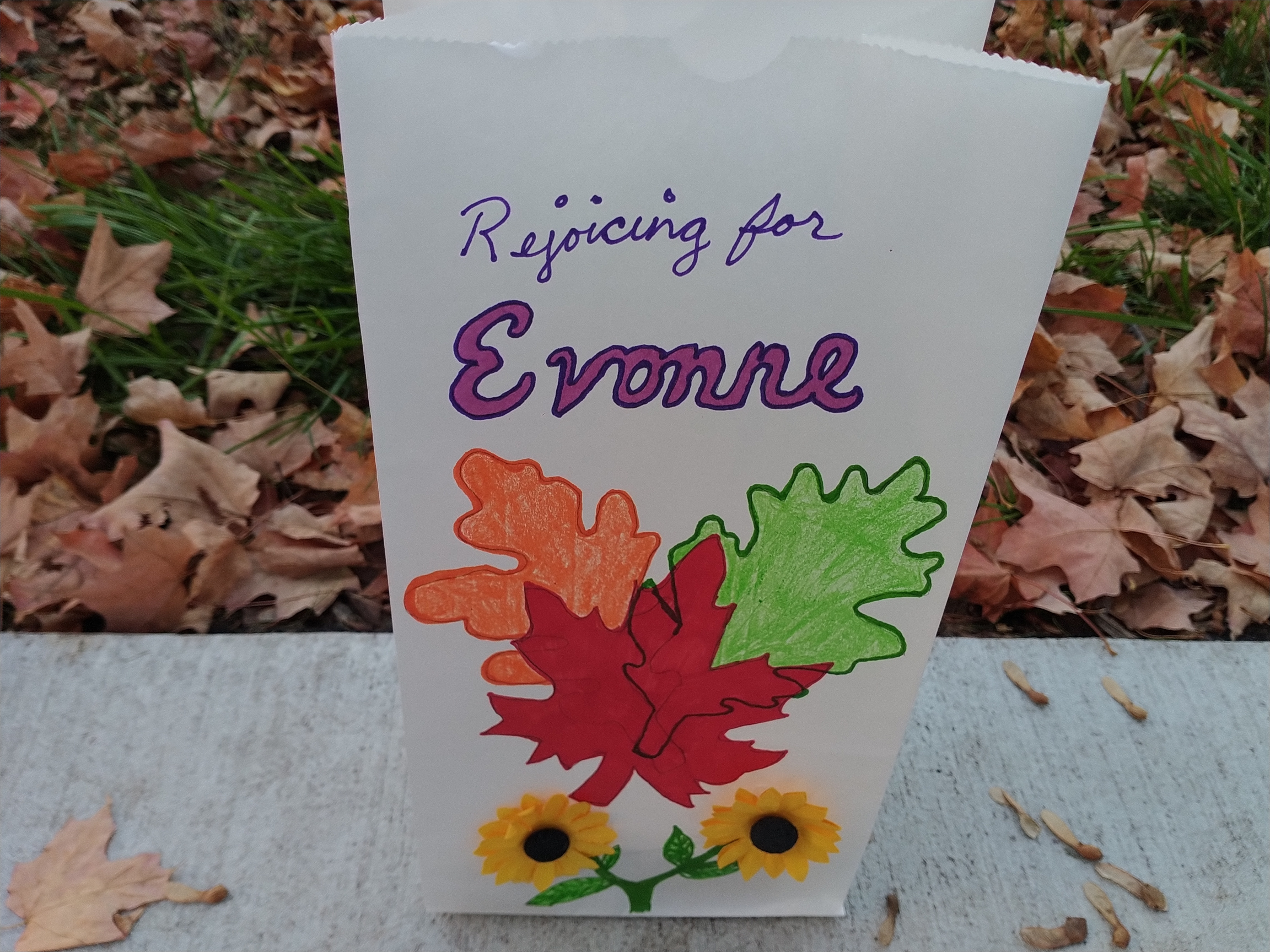
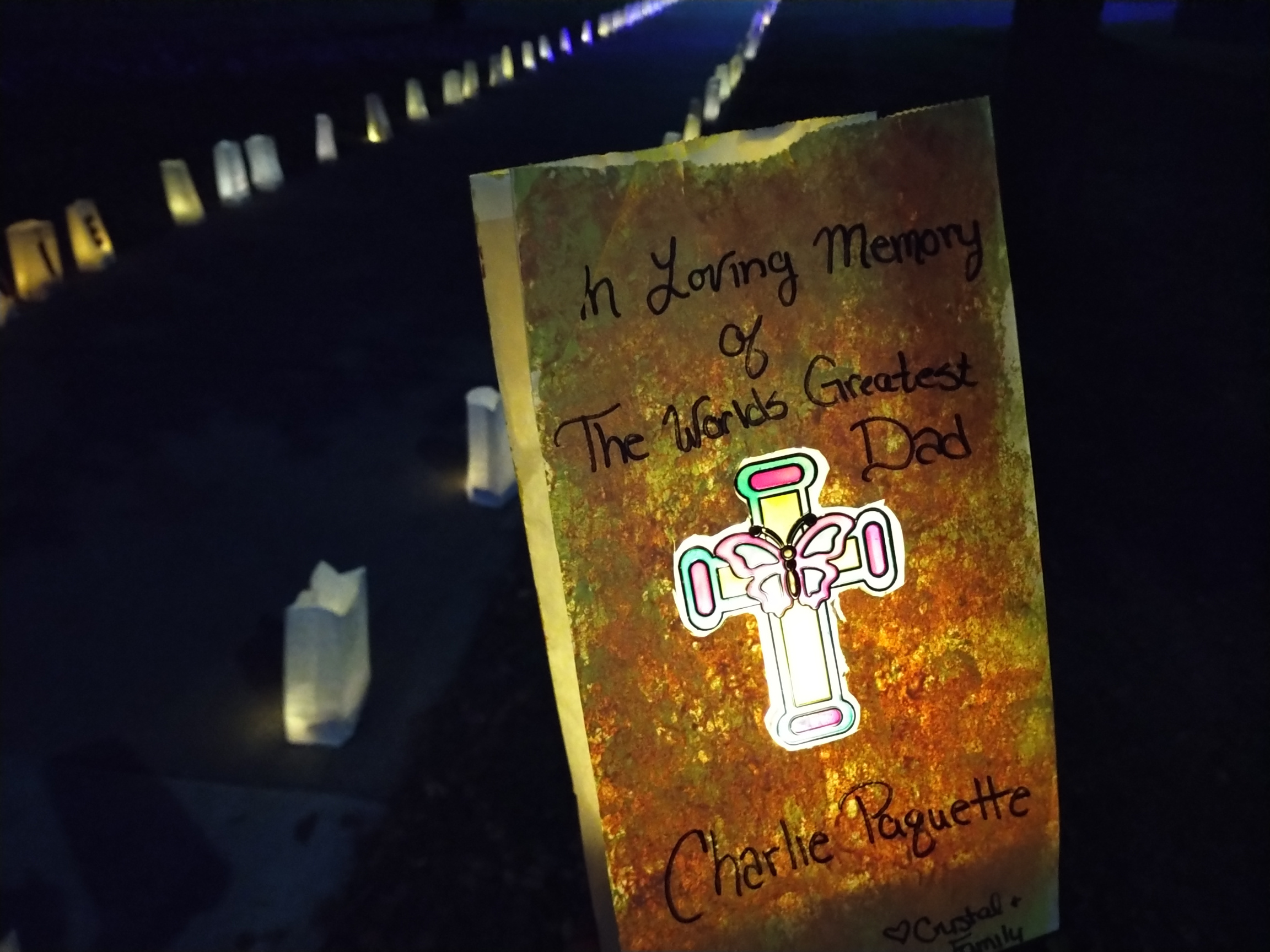
An autumn-themed luminary for a cancer survivor. (Minnesota Prairie Roots copyrighted photo September 2023)
My focus, though, was on the hundreds of luminaries lining the sidewalks that edged and crisscrossed this central community gathering spot. I walk here daily, among the towering trees and scampering squirrels. The din of traffic, the presence of others, the locations of St. Vincent de Paul and the Cathedral of Our Merciful Saviour across the streets are all reminders that Faribault truly is about community. We need one another. And I felt, at this event, a strong sense of community, of coming together, of leaning on one another.
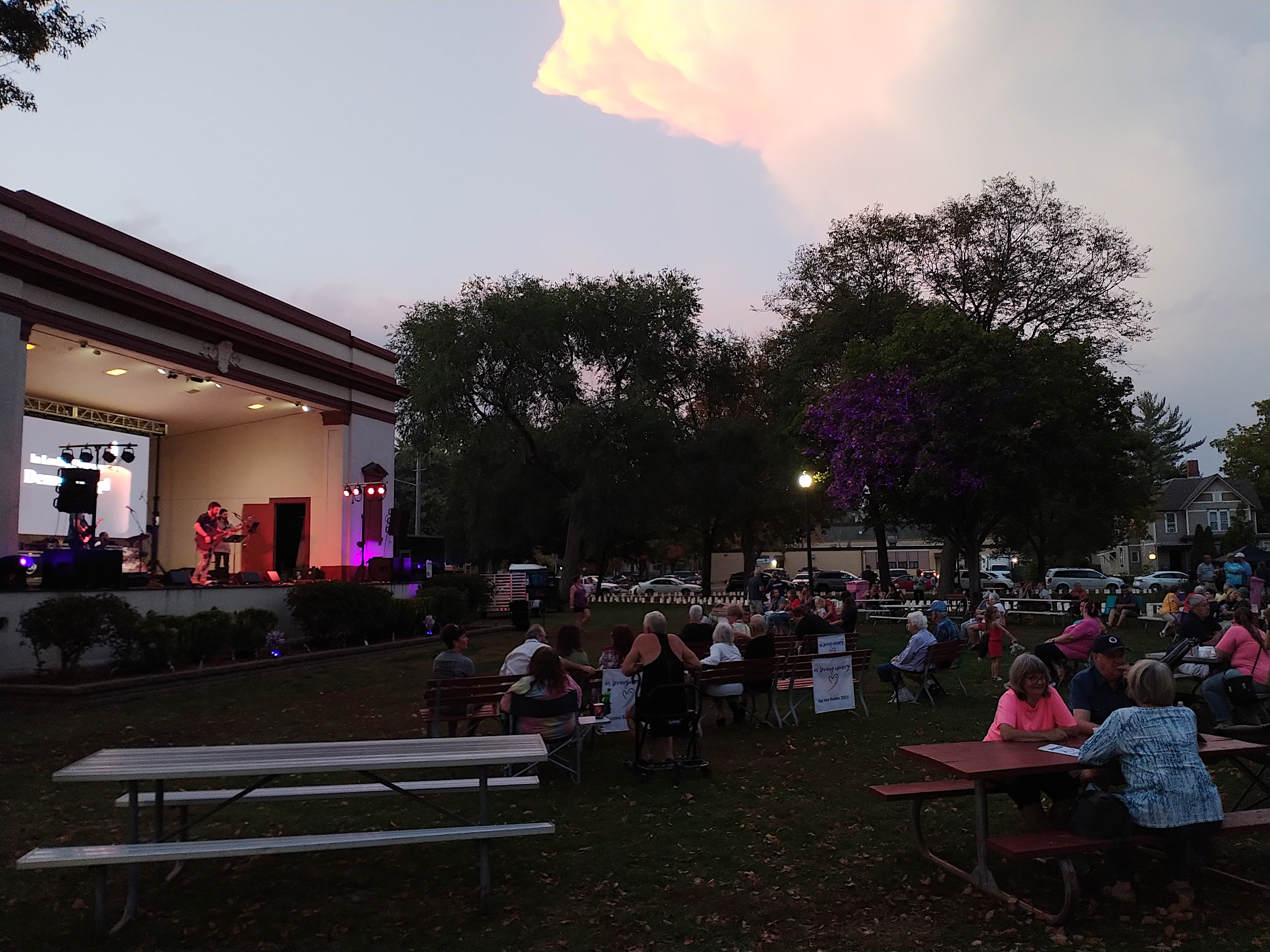
Gathering to talk, to listen to music, to celebrate. (Minnesota Prairie Roots copyrighted photo September 2023)
I felt such love as I hugged the local x-ray tech who did my recent mammogram. I assured her my results were good. She and I have a history, meeting several years ago in the hospital ER when I broke my wrist. I hugged others, too, whom I haven’t seen in a while. It felt right, to reach out and encircle these individuals who, at some point, have been there for me, whether personally or professionally. And if my cousin and a friend, who are currently undergoing chemotherapy for aggressive, advanced breast cancer, had been there, I would have held them close in prolonged hugs also.
I saw so much love written upon luminaries by those who lost loved ones to cancer. (Minnesota Prairie Roots copyrighted photo September 2023)
Twenty years ago I was on the receiving end of many hugs as I stood inside my hometown church, St. John’s Lutheran in Vesta, embracing family and friends at the death of my dad. He died of esophageal cancer and other health issues. At the cemetery, I wrapped my arm around my mom, shaking with cold and grief on that brutal winter day. She was a breast cancer survivor.
Many family—including my husband, a sister and sister-in-law—and friends have survived cancer. Many family—including a dear nephew and aunt—and friends have died of cancer. And today many in my circle are battling cancer, including a much-beloved cousin, a brother-in-law and a dear friend. Cancer is brutal and awful and horrible. And it seemingly spares no family.
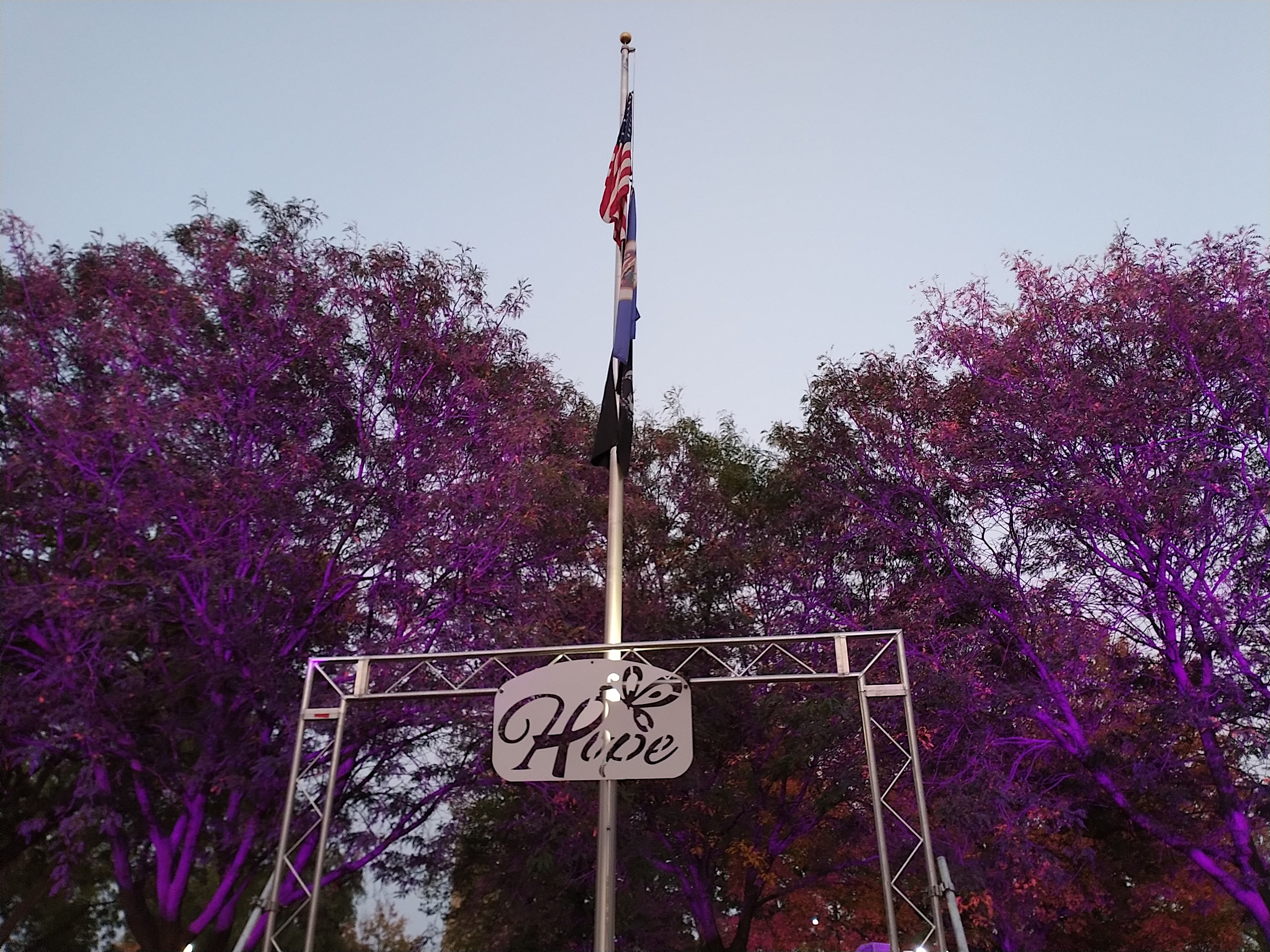
A beautiful hope sign suspended in the center of the park. (Minnesota Prairie Roots copyrighted photo September 2023)
But there is hope. In the support of others. In events like the one on Saturday organized by the Light of Hope Cancer Foundation with a mission “to empower local cancer patients and families to focus on treatment and healing by providing immediate and practical financial support while advocating and fundraising for research, education and cancer prevention.” There is strength in a supportive and caring community.
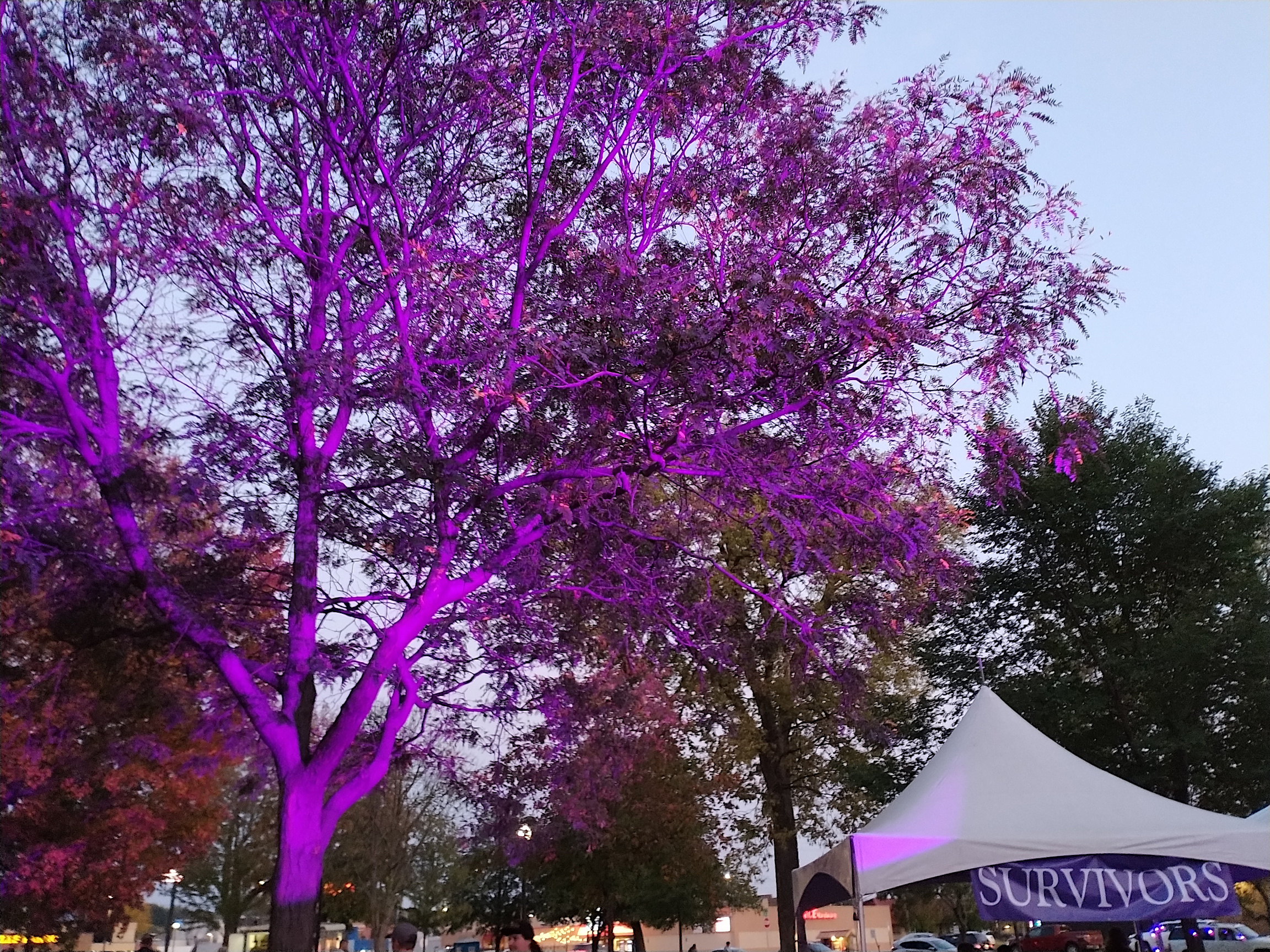
A survivors’ tent, right, offered survivors of cancer a place to gather, celebrate and enjoy cake. (Minnesota Prairie Roots copyrighted photo September 2023)
And there is hope, too, in knowing options are available for treatment. That is also personal for me as my uncle, Dr. Robert M. Bowman, developed the drug Letrozole (Femara), approved by the Food and Drug Administration in 1998 to treat certain types of breast cancer in post-menopausal women. Today, as my retired chemist uncle lies in hospice suffering from Parkinson’s, his wife, my beloved Aunt Dorothy, tells me how grateful Robin feels for having created a life-saving drug. He gave women hope.
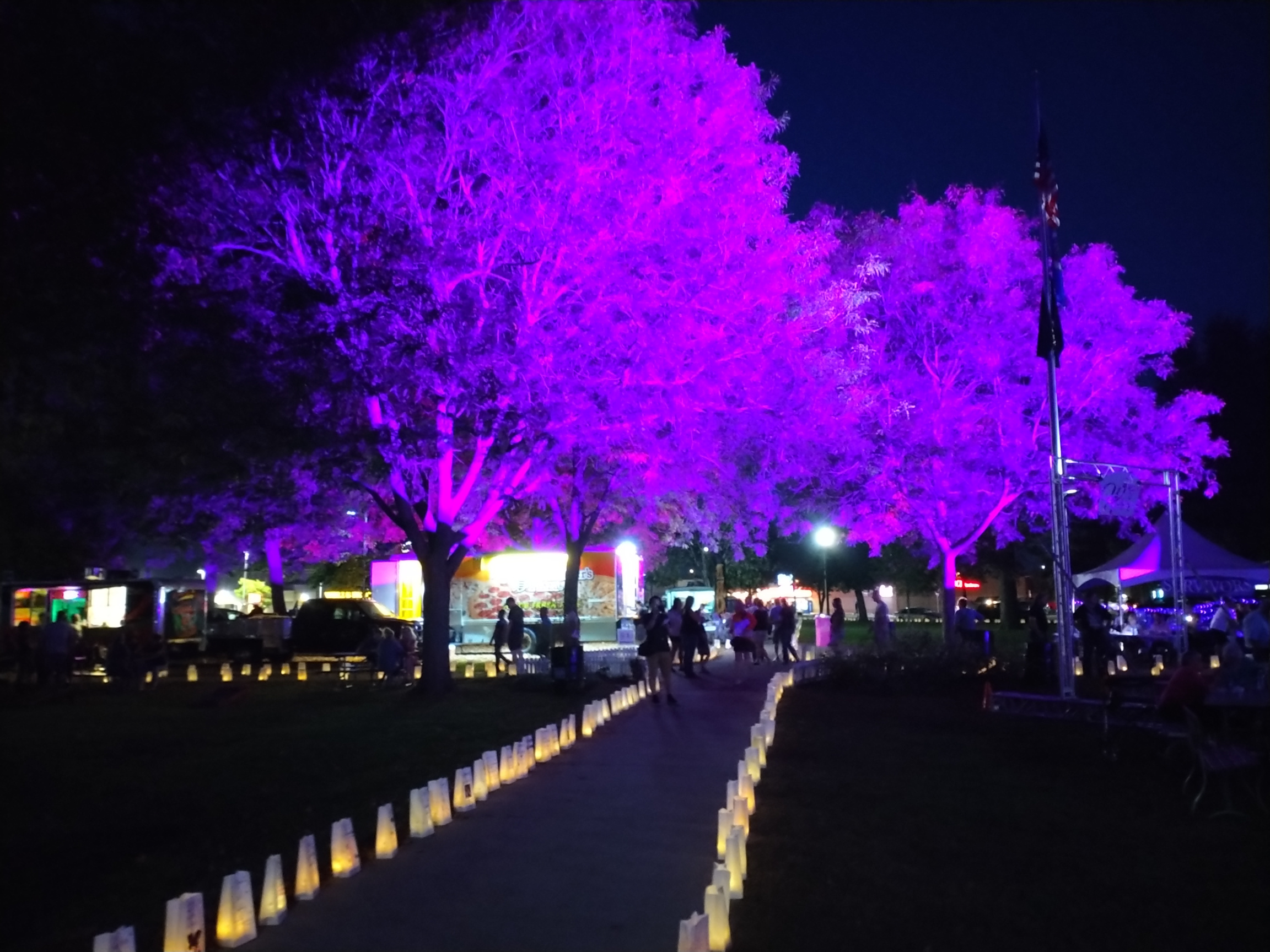
I shot this scene shortly before leaving at 7:45 pm. So beautiful…the luminaries, the trees morphed purple by spotlights. (Minnesota Prairie Roots copyrighted photo September 2023)
As I walked among the hundreds of luminaries, first in the light of early evening and then in the darkness, I remembered, grieved silently, contemplated, celebrated… And I felt hope. Strong, beautiful, powerful hope.
It was a milestone day for me in managing the neurological issues I’ve faced following a *viral infection in early January. Twenty-one therapy sessions later and I’m much-improved. Not cured. Not fixed. Not all better. I’ll never be the same as I was pre-virus. But, through targeted therapy exercises, a lot of hard work and simply easing back into life, I’ve built my tolerance for everyday experiences. I can better handle sensory input. I can walk without feeling unbalanced. I can manage beyond sitting in a room with the curtains drawn to shut out light, windows closed to keep out noise.
I still have challenging days. I still struggle. But I am in a much better place than even a month ago.
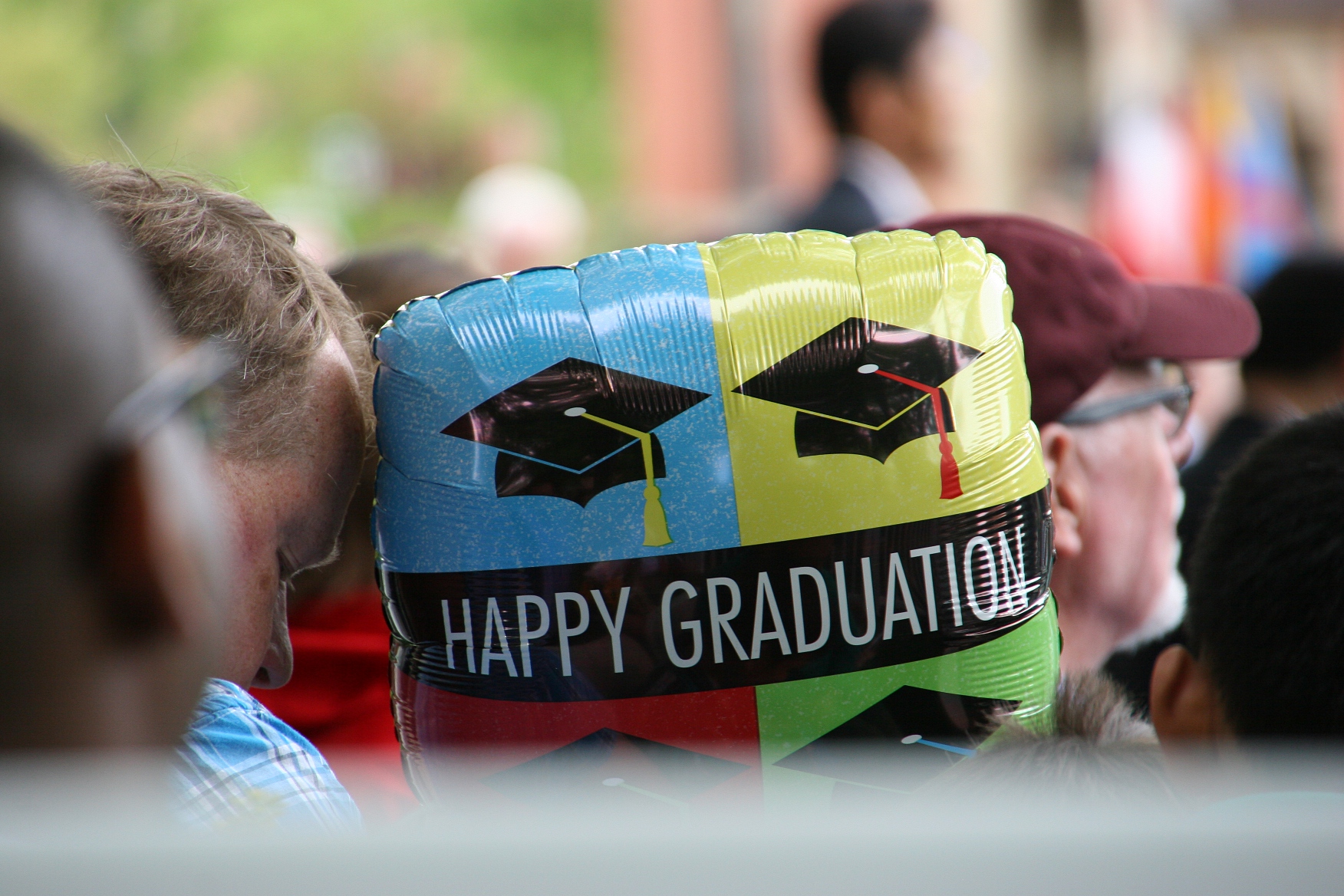
And so I graduated. Not because I wanted to leave Courage Kenny and my incredibly knowledgeable, supportive and caring therapist. But Ryan and I mutually agreed that I was ready. And so he asked, on that final day together, whether he should cue “Pomp and Circumstance” on his laptop, the same laptop he used to introduce me to virtual reality roller coasters as part of my therapy. I told him we could pass on the music. And I am happy to pass on roller coaster rides.
But I did bring celebratory homemade carrot cake cupcakes with homemade cream cheese frosting. Ryan laughed when I walked through the door carrying that box of cupcakes to share with the Courage Kenny team. When I’d asked the week prior if we would have graduation cake, he said only if I brought it. So I did, along with a thank you card and homemade chocolate chip cookies for this professional who worked tirelessly to improve my health. I always felt like we were a team.
And now, like any new graduate, I hold the knowledge and tools that will help me handle daily living. I participated in class (kinda hard not to when you’re the only student). I did the assigned homework each week. I followed through by getting back into the real world, sometimes failing in my efforts, sometimes succeeding. I’ve done my best, through tears and discouragement and struggles, to rise above the challenges. And now I’ve graduated. Onward.
* Even though I self-tested negative twice for COVID in January, my primary care doctor believes I had COVID, the cause of my multiple, ongoing neurological issues.
Early on in my diagnoses, my brain felt like this, scrambled. Art by Bill Nagel, previously exhibited at the Paradise Center for the Arts, Faribault. (Minnesota Prairie Roots copyrighted photo March 2023)
FOR ME, THE FEELING of imbalance started shortly after an early January virus, likely *COVID-19. At the time I didn’t make the connection between the two. But eventually medical professionals did. That led to multiple diagnoses of vestibular neuritis, Meniere’s Disease and peripheral sensory neuropathy. Yes, it’s been a lot to handle. But I’m in a much better place health-wise than nine months ago thanks to professional intervention and a whole lot of hard work.
The thing about having a vestibular disorder is that it’s unseen. You can’t see inside my brain to view the damage. And, for the most part, you can’t see the effects of a malfunctioning vestibular system, unless you’re my husband or eldest daughter who can. Randy and Amber can look at my face, see my eyes squinting, my look of fatigue, tell-tale signs I’m not doing well. And if I’m closing my eyes or holding my hands on the sides of my face, I’m blocking my peripheral vision, thus reducing visual input.
All of that aside, I’ve at least reclaimed my balance. Most days. Brief bouts of vertigo set me back mid-summer. Via vestibular rehab therapy to retrain my brain, I’ve learned to manage and live with my many ongoing symptoms and mostly get on with my life. Maybe not as I did previously, but with a renewed appreciation for something as simple as walking with confidence, as watching TV, as shopping for groceries.
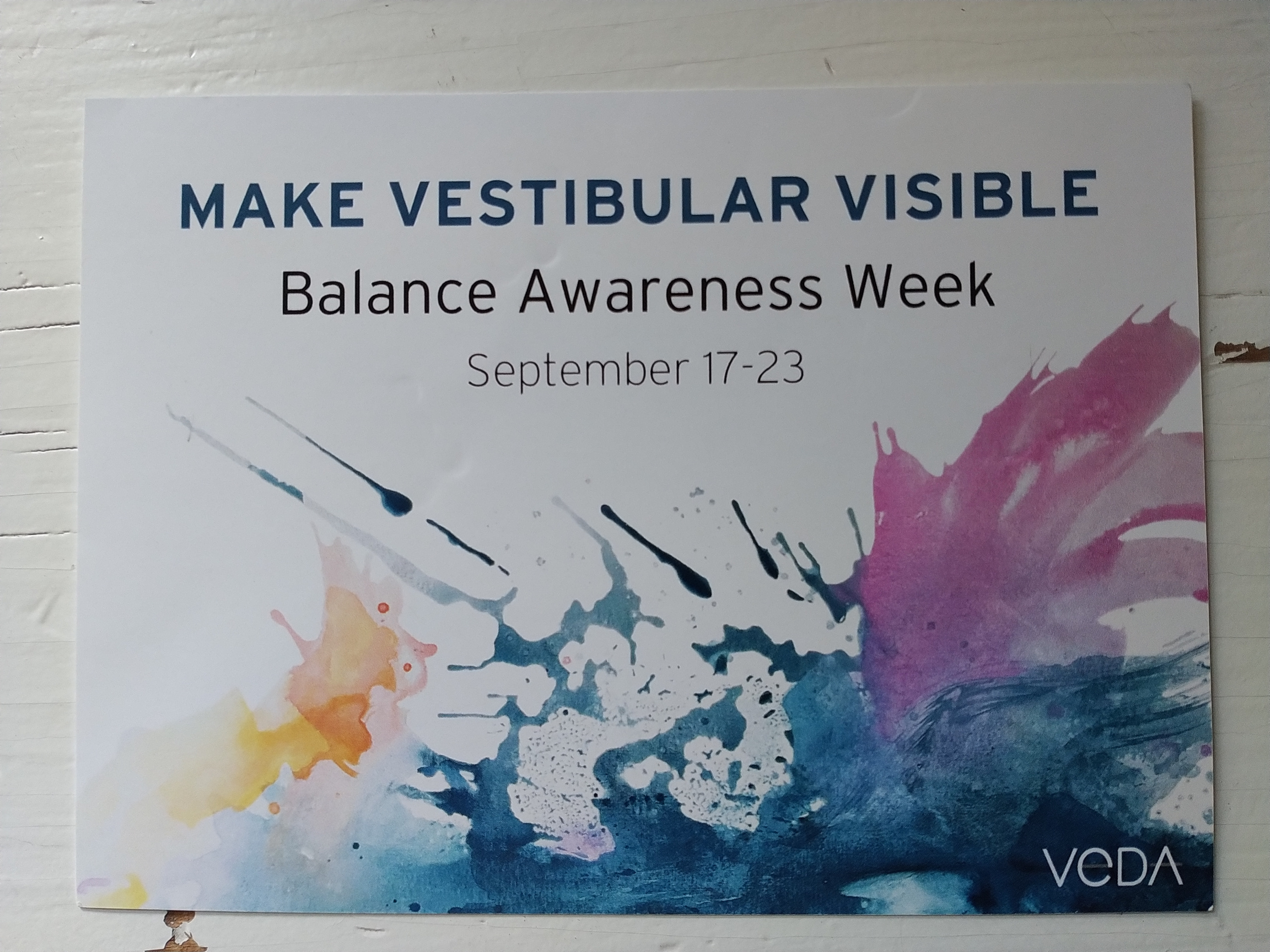
A promo postcard from VeDa. The painting, “Uncharted Waters,” is by vestibular patient Nicolle Cure.
FOCUS ON BALANCE
Today, though, I want to focus on balance, for two reasons. Imbalance was the first issue I overcame. And secondly, September 17-23 marks Balance Awareness Week, started in 1997 by the Vestibular Disorders Association. That national nonprofit is “a lifeline of support to anyone affected by vestibular (inner-ear and brain balance) disorders.” VeDA has proven an invaluable resource for me in learning about my vestibular-based diagnoses.
Knowledge is power. Just ask my physical therapist at Courage Kenny. Ryan answered many questions during my vestibular rehab therapy sessions, especially early on when I was just learning about my health issues. He always replied thoughtfully, helping me to understand what was happening in my brain and how we would work together through targeted exercises to manage my symptoms.
I’ve come a long way from the days of standing in place turning my head back and forth to the beat of a metronome. Today I’m power walking 15 minutes in the morning, 15 minutes in the evening with Randy. Even I’m amazed that I can do this. Not all that long ago, I couldn’t walk a block, often needing to hold onto Randy.
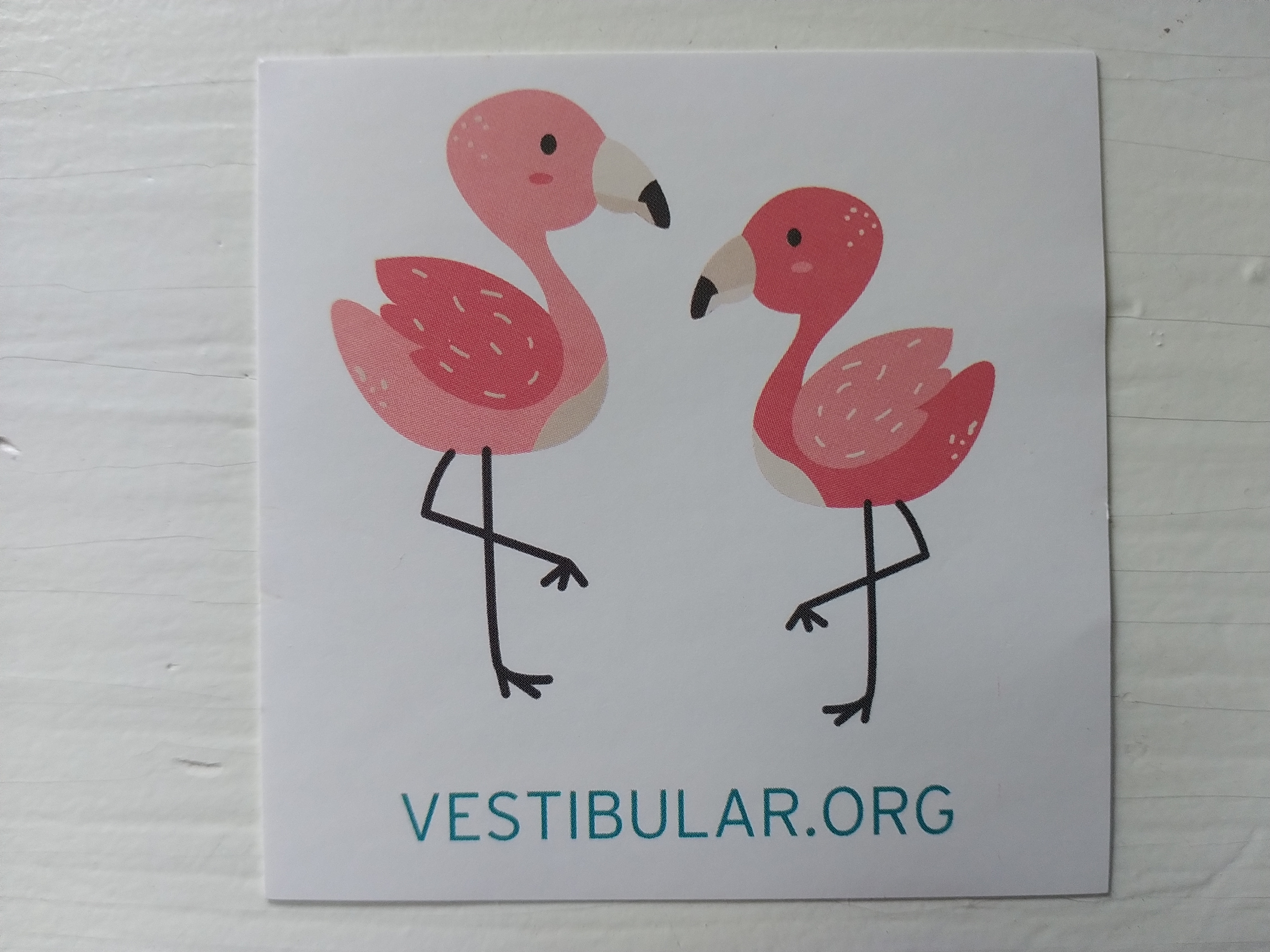
Fiona the Flamingo is VeDA’s Balance Awareness Week logo/mascot.
EVEN THOUGH MY DISORDER IS INVISIBLE, I STILL NEED TO BE SEEN, ENCOURAGED…
There is hope for anyone dealing with a vestibular disorder. Many seniors (and, yes, I’m a “senior”) struggle with balance. So do those who’ve suffered traumatic brain injuries like concussions. That includes my sister-in-law Rosie, my go-to support. Because she understands. And encourages. She realizes the importance of physical therapy in recovery.
In sharing a bit of my story with you, I am aiming to increase awareness. Make Vestibular Visible themes Balance Awareness Week. A promo from VeDA reads: Balance Awareness Week is our time to shout from the rooftops: “I have a vestibular disorder and this is my story.”
This is my story. One of challenges, of professional intervention, of hard work, of acceptance, of perseverance, of relying on others, of patience, of strength, of gratitude, of tears, of resilience, of focusing on what I can do (and not what I can’t). It is also a story of recognizing that no matter what we face in life—whether visible or invisible—we all need to be seen, to be uplifted, to feel cared for and loved.
*I self-tested negative twice for COVID, but those tests (if done incorrectly and for other reasons) can be wrong, my primary doctor told me. He guesses I had COVID in January, and I agree based on my symptoms.
“The Legend,” one of a few remaining wooden roller coasters, located at Arnolds Park Amusement Park in the lakes region of northwestern Iowa. Built in 1930, it is the 13th oldest wooden roller coaster in the world. (Photo courtesy of Arnolds Park Amusement Park Marketing)
SOME 2 ½ MONTHS AGO, I boarded a roller coaster for the first time since I was a teenager screaming my lungs out while riding “The Legend,” a wooden roller coaster at Arnolds Park Amusement Park in Arnolds Park, Iowa. It’s not that I decided this would be a fun activity to try again in my late sixties. Rather, the choice was made for me, as part of my vestibular rehab therapy.
I warned my physical therapist that I don’t like amusement rides. But my comment didn’t deter Ryan. He determined that riding a virtual reality roller coaster on a June morning might be exactly what my brain needed to retrain itself. Since January, I’ve struggled with neurological-based issues resulting from a viral infection, suspected to be COVID, even though I twice self-tested negative for the virus. In early April, I started physical therapy and have been working hard ever since to manage my many debilitating symptoms.
Fast forward to today. I am in a much better place, even while on a VR roller coaster, a tool I’m using to build my visual, auditory and spatial tolerance. Early on I had doubts about my therapist’s plan. Initially, I couldn’t tolerate the VR roller coaster for long (less than a minute) before symptoms flared. After minimal exposure, my head hurt, my eyes hurt and I felt utterly exhausted. When I experienced a health setback mid-summer with vertigo returning, Ryan abandoned the amusement ride therapy for therapies less taxing on my brain.
ROCKS, RABBITS & A ROLLER COASTER
Slowly, surely, I started feeling better and Ryan decided it was time to pull out the VR headset again for another go on the roller coaster. I did not enthusiastically hop on board, only reluctantly agreeing to give it a try. I lasted 25 seconds on a roller coaster ride where boulders tumbled off rocky mountains toward me. Rabbits loping under the track proved the only redeeming feature. I hold a fondness for rabbits, my high school mascot being a White Rabbit.
That was two weeks ago. The following week I did better, albeit on a less visually-stimulating ride, this one under the sea in a darker environment. Still, I could manage only bursts of riding before needing to pause.
NOT ONE, NOT TWO, BUT THREE ROLLER COASTERS
Five days later I was back at therapy, knowing full well that I would again be riding a roller coaster. Make that plural. Three roller coasters. I started therapy Wednesday morning with the least stimulating under-the-sea ride. And just to make that more challenging, Ryan asked me to stand, rather than sit. He allowed me to place my hands on the back of a chair to ground myself. I successfully finished the ride, then took a break before re-boarding, this time without touching the chair. Success again. Time to up the challenge.
Ryan pulled out the rabbit-loping, boulders-falling themed ride. This time I completed the ride, which was visually much more exciting with dynamite and fire and a whole lot more coming at me. Once again, I tolerated the roller coaster twice while standing and without needing to stop.
I felt my confidence grow as each roller coaster ride became more sensory challenging. I could do this. But when the next ride began with a garish parrot getting in my face, I questioned whether I could manage a tropical-themed roller coaster with worn vivid red and yellow rails. (Was it even safe to ride?) It was a lot—the bold hues, the squawking flapping seagulls, the palm trees, the steep climbs, the height, the sharp turns. But I made it. Twice on that roller coaster curving toward the ocean.
DOING GREAT, BUT I HAVE MY LIMITS
My brain was adjusting, learning, retraining itself to take in more visual, auditory and spatial input. Ryan praised my success, both of us somewhat surprised by how well I’d tolerated those roller coasters Wednesday morning.
But before I left therapy, I wanted Ryan to know one thing. If he planned a field trip to nearby Valley Fair Amusement Park next Wednesday for a ride on a real roller coaster, I wouldn’t be showing up for therapy.













 Minnesota Prairie Roots
Recent Comments