Minnesota Prairie Roots

Writing and photography by Audrey Kletscher Helbling

Spotlighting cancer in the light of hope October 2, 2023

Purple spotlights transformed trees to shades of purple. (Minnesota Prairie Roots copyrighted photo September 2023)

IN THE EARLY EVENING DARKNESS of Faribault’s Central Park, on an unseasonably summery September Saturday, I felt enveloped in a magical world of autumn leaves sparkling purple. The setting seemed surreal, magical, enchanting. And the feeling felt hopeful.
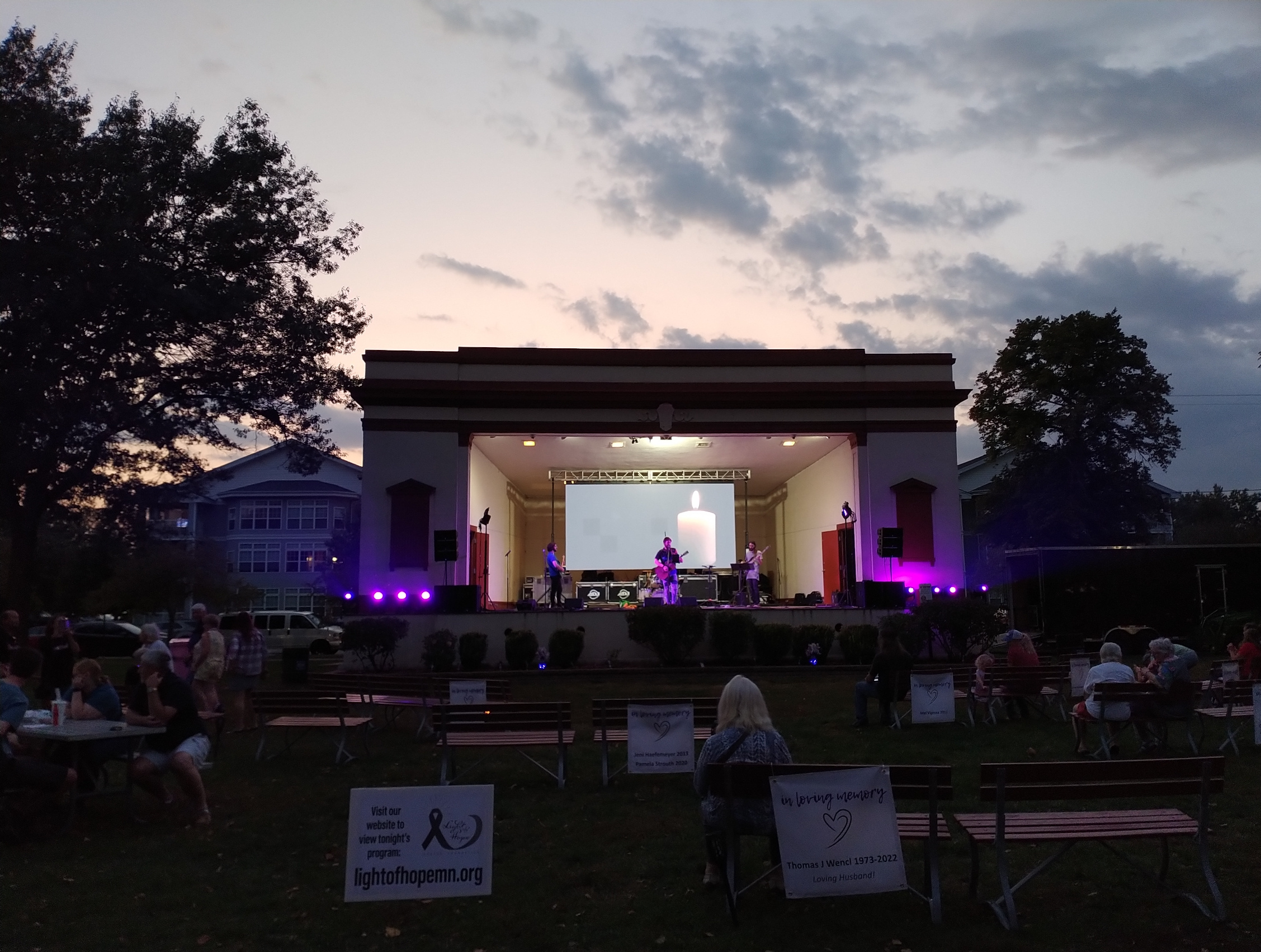
Musician Steve Huber performed first followed by Joe and the Mechanics in the Central Park Bandshell. (Minnesota Prairie Roots copyrighted photo September 2023)

I was among hundreds gathered for the first-ever Light of Hope Celebration to recognize those lost to cancer, those battling cancer, those who’ve survived cancer…and those of us who love (d) them. Purple spotlights shone on trees centering the park, creating a serene, yet celebratory, scene while musicians performed in the bandshell, speakers spoke and kids engaged in activities just for them.
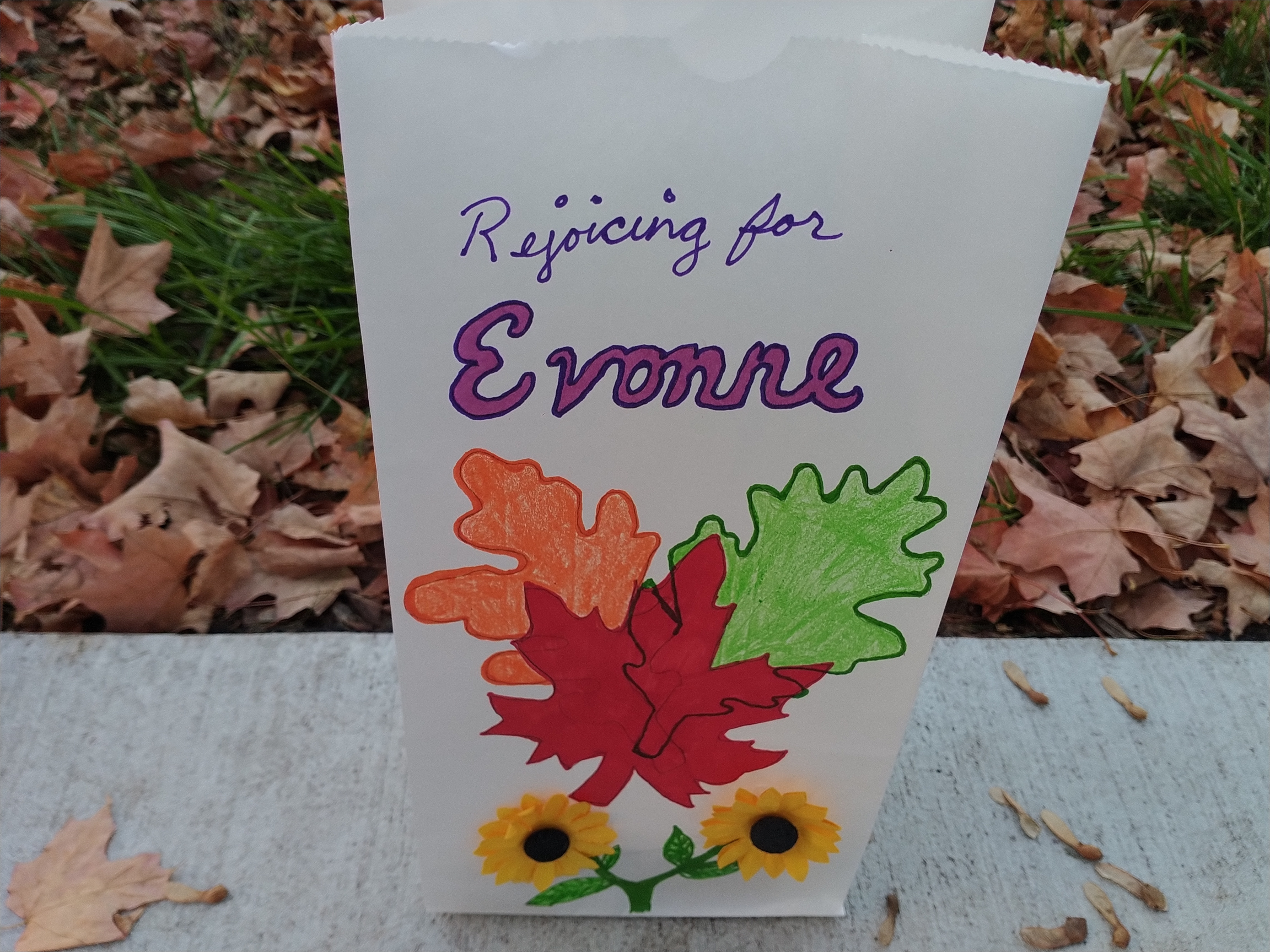
An autumn-themed luminary for a cancer survivor. (Minnesota Prairie Roots copyrighted photo September 2023)

My focus, though, was on the hundreds of luminaries lining the sidewalks that edged and crisscrossed this central community gathering spot. I walk here daily, among the towering trees and scampering squirrels. The din of traffic, the presence of others, the locations of St. Vincent de Paul and the Cathedral of Our Merciful Saviour across the streets are all reminders that Faribault truly is about community. We need one another. And I felt, at this event, a strong sense of community, of coming together, of leaning on one another.
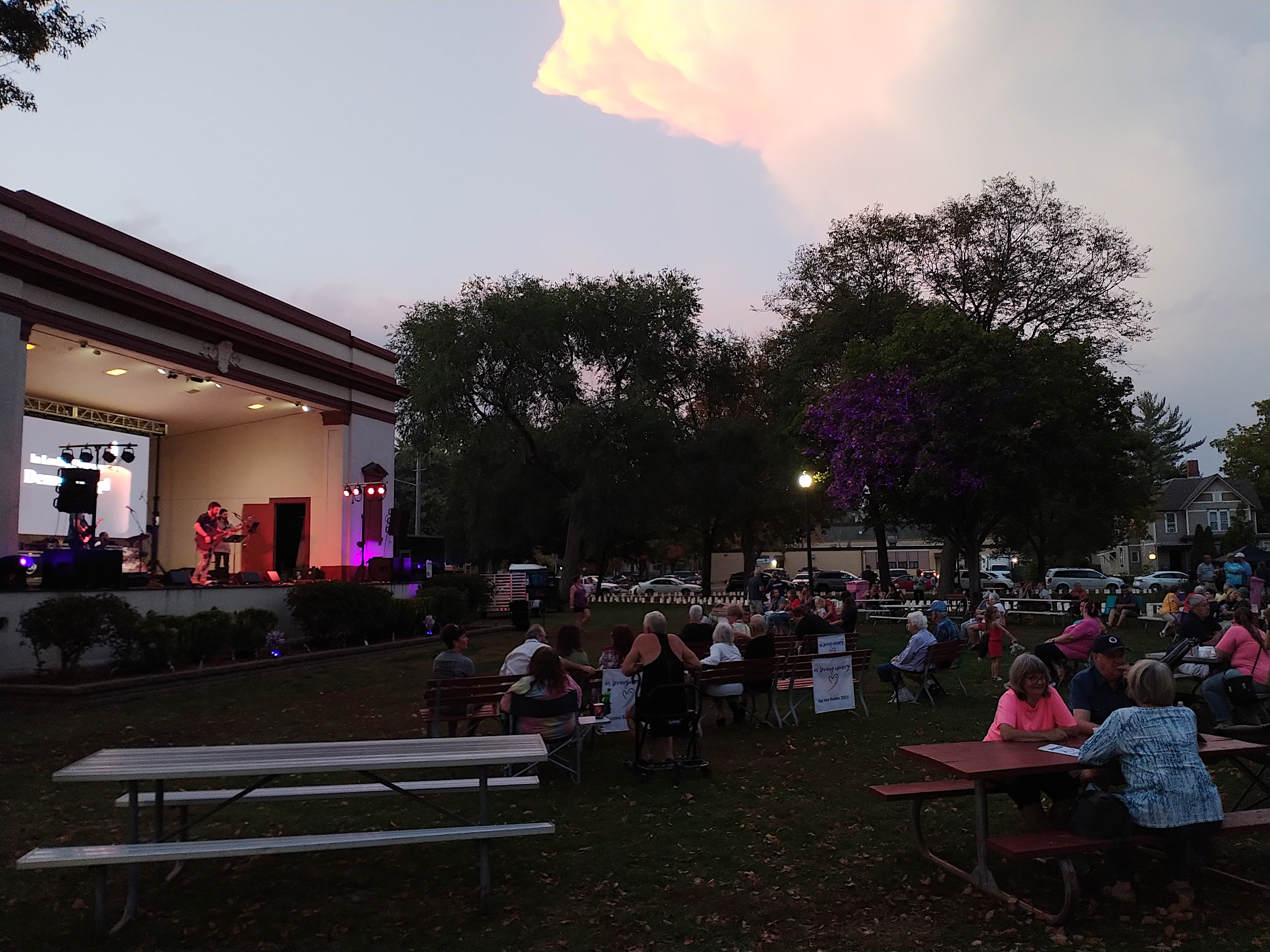
Gathering to talk, to listen to music, to celebrate. (Minnesota Prairie Roots copyrighted photo September 2023)

I felt such love as I hugged the local x-ray tech who did my recent mammogram. I assured her my results were good. She and I have a history, meeting several years ago in the hospital ER when I broke my wrist. I hugged others, too, whom I haven’t seen in a while. It felt right, to reach out and encircle these individuals who, at some point, have been there for me, whether personally or professionally. And if my cousin and a friend, who are currently undergoing chemotherapy for aggressive, advanced breast cancer, had been there, I would have held them close in prolonged hugs also.
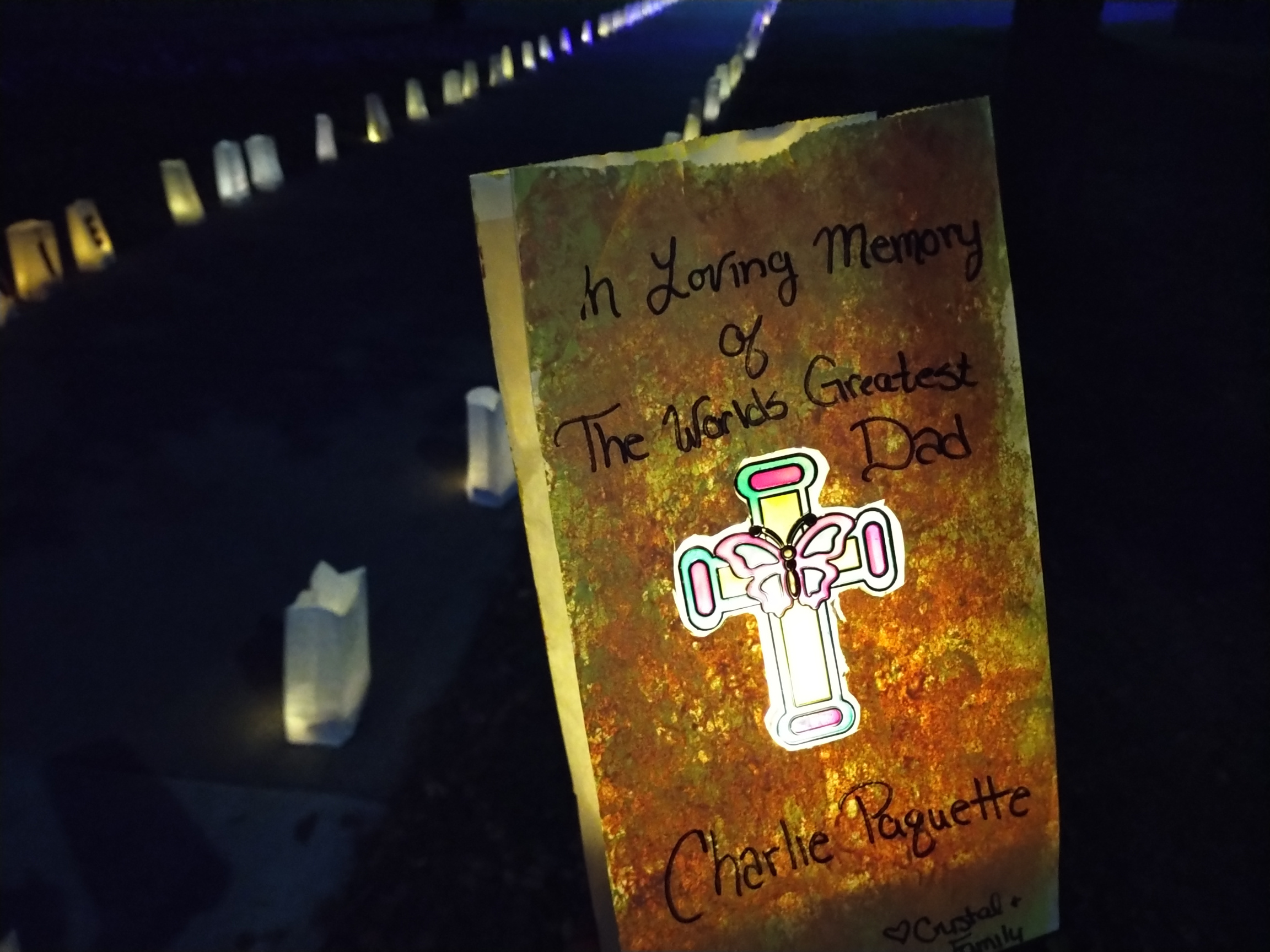
I saw so much love written upon luminaries by those who lost loved ones to cancer. (Minnesota Prairie Roots copyrighted photo September 2023)

Twenty years ago I was on the receiving end of many hugs as I stood inside my hometown church, St. John’s Lutheran in Vesta, embracing family and friends at the death of my dad. He died of esophageal cancer and other health issues. At the cemetery, I wrapped my arm around my mom, shaking with cold and grief on that brutal winter day. She was a breast cancer survivor.

Many family—including my husband, a sister and sister-in-law—and friends have survived cancer. Many family—including a dear nephew and aunt—and friends have died of cancer. And today many in my circle are battling cancer, including a much-beloved cousin, a brother-in-law and a dear friend. Cancer is brutal and awful and horrible. And it seemingly spares no family.
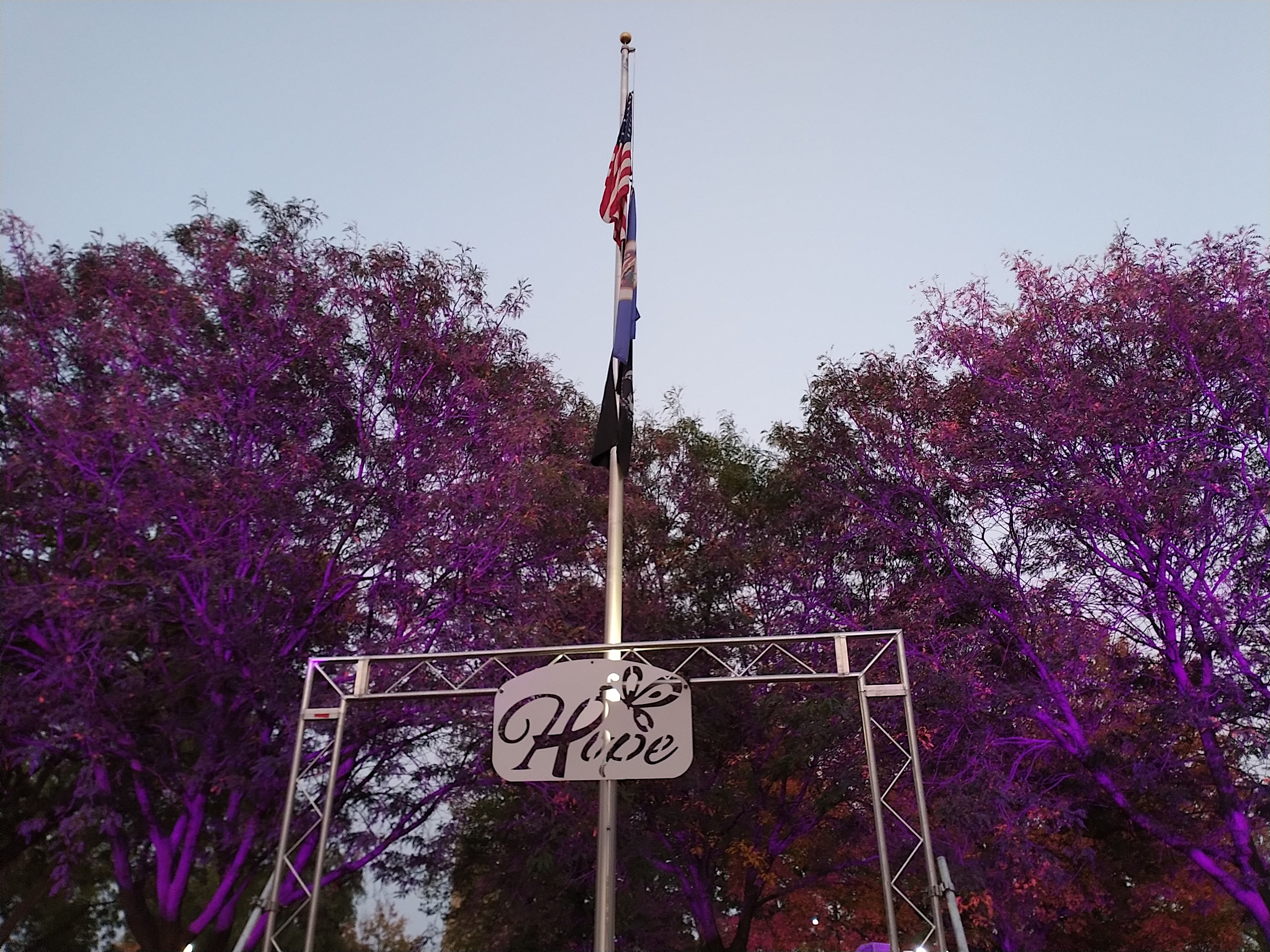
A beautiful hope sign suspended in the center of the park. (Minnesota Prairie Roots copyrighted photo September 2023)

But there is hope. In the support of others. In events like the one on Saturday organized by the Light of Hope Cancer Foundation with a mission “to empower local cancer patients and families to focus on treatment and healing by providing immediate and practical financial support while advocating and fundraising for research, education and cancer prevention.” There is strength in a supportive and caring community.
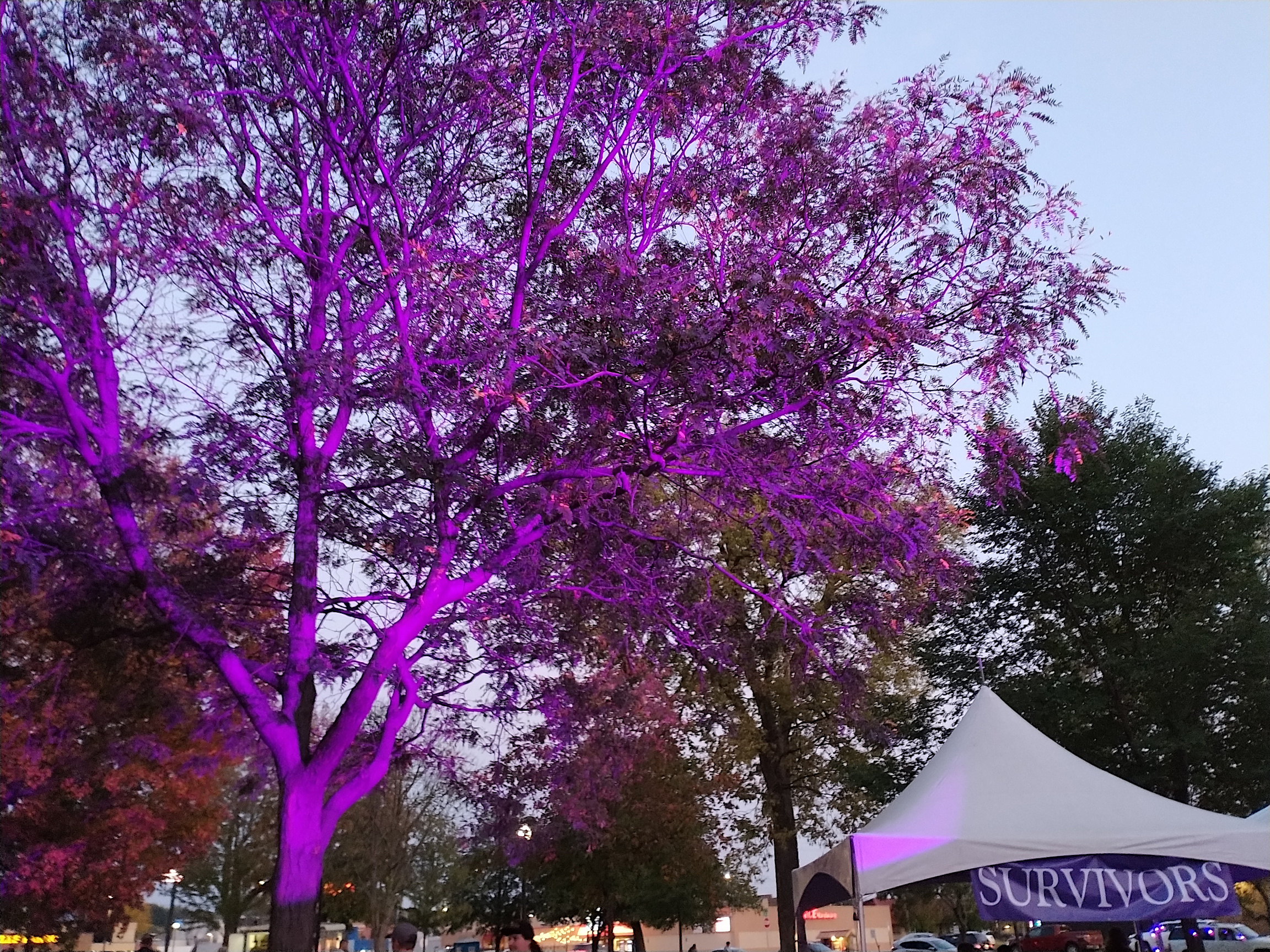
A survivors’ tent, right, offered survivors of cancer a place to gather, celebrate and enjoy cake. (Minnesota Prairie Roots copyrighted photo September 2023)

And there is hope, too, in knowing options are available for treatment. That is also personal for me as my uncle, Dr. Robert M. Bowman, developed the drug Letrozole (Femara), approved by the Food and Drug Administration in 1998 to treat certain types of breast cancer in post-menopausal women. Today, as my retired chemist uncle lies in hospice suffering from Parkinson’s, his wife, my beloved Aunt Dorothy, tells me how grateful Robin feels for having created a life-saving drug. He gave women hope.
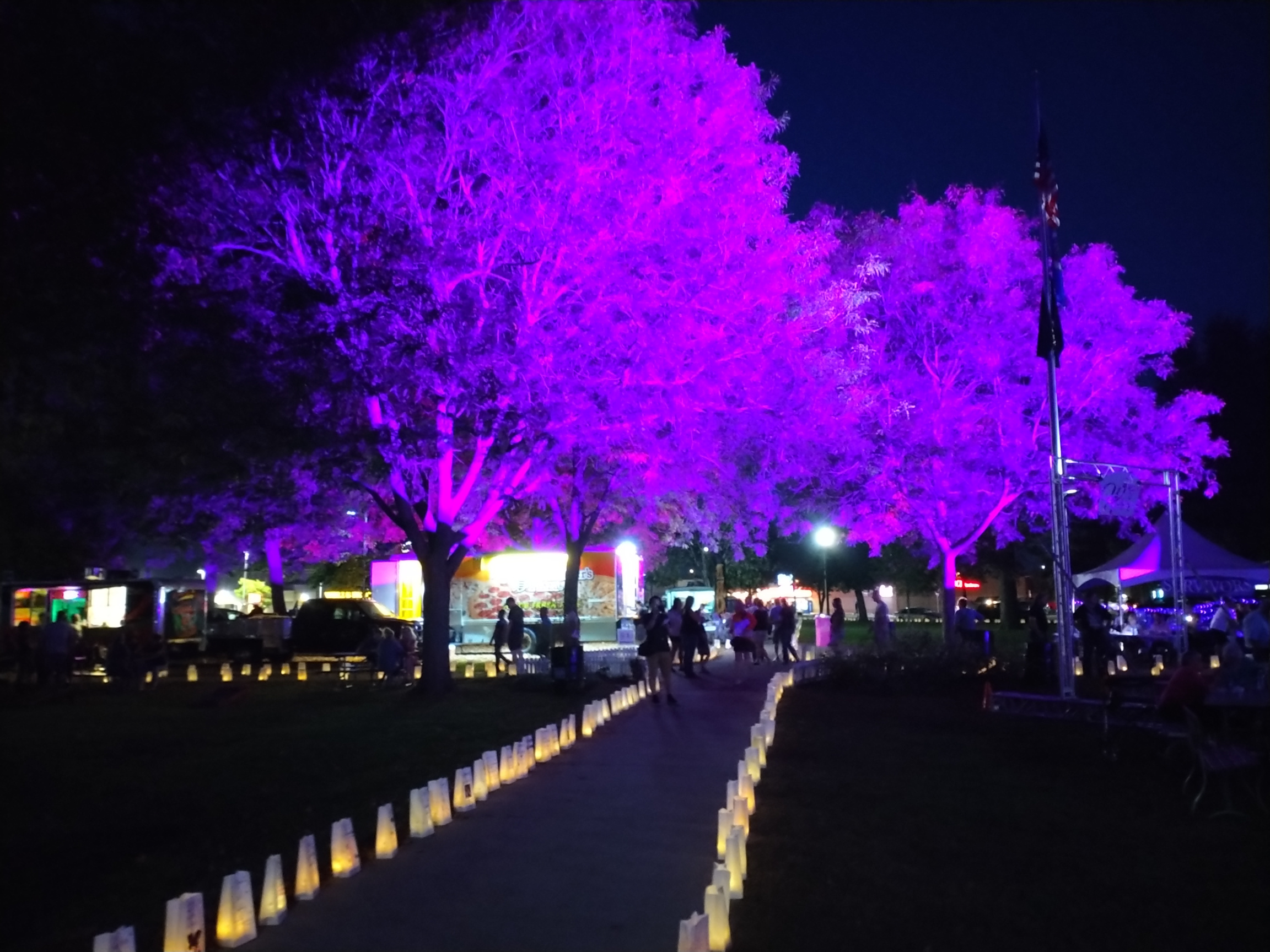
I shot this scene shortly before leaving at 7:45 pm. So beautiful…the luminaries, the trees morphed purple by spotlights. (Minnesota Prairie Roots copyrighted photo September 2023)

As I walked among the hundreds of luminaries, first in the light of early evening and then in the darkness, I remembered, grieved silently, contemplated, celebrated… And I felt hope. Strong, beautiful, powerful hope.

© Copyright 2023 Audrey Kletscher Helbling


No more VR roller coasters for this graduate September 26, 2023

(Minnesota Prairie Roots copyrighted file photo May 2016)

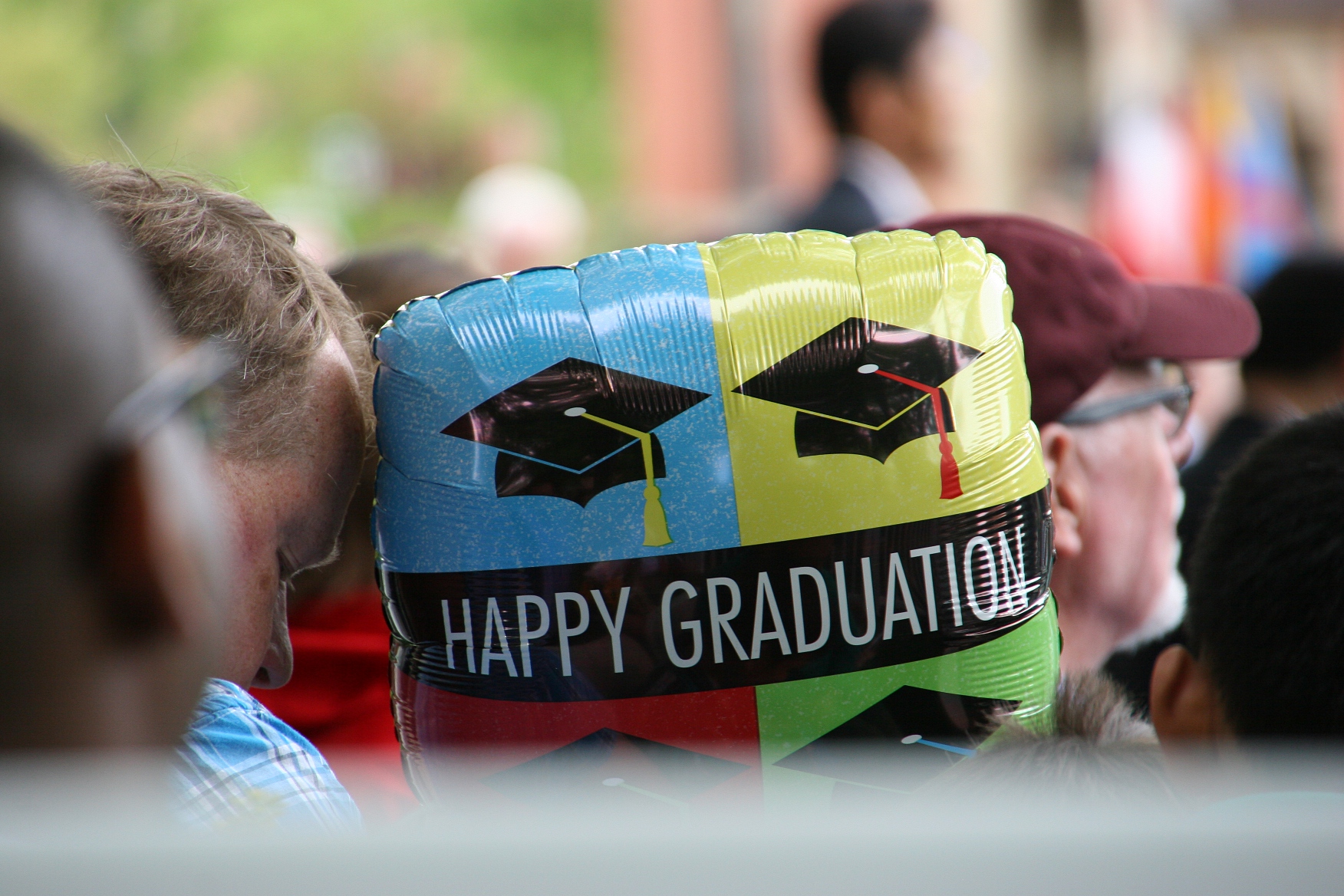
CUE “POMP AND CIRCUMSTANCE.” Wednesday, September 20, marked graduation day for me. After six months of vestibular rehab therapy at Courage Kenny Rehabilitation Institute in Faribault, I graduated.

It was a milestone day for me in managing the neurological issues I’ve faced following a *viral infection in early January. Twenty-one therapy sessions later and I’m much-improved. Not cured. Not fixed. Not all better. I’ll never be the same as I was pre-virus. But, through targeted therapy exercises, a lot of hard work and simply easing back into life, I’ve built my tolerance for everyday experiences. I can better handle sensory input. I can walk without feeling unbalanced. I can manage beyond sitting in a room with the curtains drawn to shut out light, windows closed to keep out noise.

I still have challenging days. I still struggle. But I am in a much better place than even a month ago.

And so I graduated. Not because I wanted to leave Courage Kenny and my incredibly knowledgeable, supportive and caring therapist. But Ryan and I mutually agreed that I was ready. And so he asked, on that final day together, whether he should cue “Pomp and Circumstance” on his laptop, the same laptop he used to introduce me to virtual reality roller coasters as part of my therapy. I told him we could pass on the music. And I am happy to pass on roller coaster rides.

But I did bring celebratory homemade carrot cake cupcakes with homemade cream cheese frosting. Ryan laughed when I walked through the door carrying that box of cupcakes to share with the Courage Kenny team. When I’d asked the week prior if we would have graduation cake, he said only if I brought it. So I did, along with a thank you card and homemade chocolate chip cookies for this professional who worked tirelessly to improve my health. I always felt like we were a team.

And now, like any new graduate, I hold the knowledge and tools that will help me handle daily living. I participated in class (kinda hard not to when you’re the only student). I did the assigned homework each week. I followed through by getting back into the real world, sometimes failing in my efforts, sometimes succeeding. I’ve done my best, through tears and discouragement and struggles, to rise above the challenges. And now I’ve graduated. Onward.

© Copyright 2023 Audrey Kletscher Helbling
* Even though I self-tested negative twice for COVID in January, my primary care doctor believes I had COVID, the cause of my multiple, ongoing neurological issues.


Invisible, but, oh, so real September 20, 2023

Early on in my diagnoses, my brain felt like this, scrambled. Art by Bill Nagel, previously exhibited at the Paradise Center for the Arts, Faribault. (Minnesota Prairie Roots copyrighted photo March 2023)

FOR ME, THE FEELING of imbalance started shortly after an early January virus, likely *COVID-19. At the time I didn’t make the connection between the two. But eventually medical professionals did. That led to multiple diagnoses of vestibular neuritis, Meniere’s Disease and peripheral sensory neuropathy. Yes, it’s been a lot to handle. But I’m in a much better place health-wise than nine months ago thanks to professional intervention and a whole lot of hard work.

The thing about having a vestibular disorder is that it’s unseen. You can’t see inside my brain to view the damage. And, for the most part, you can’t see the effects of a malfunctioning vestibular system, unless you’re my husband or eldest daughter who can. Randy and Amber can look at my face, see my eyes squinting, my look of fatigue, tell-tale signs I’m not doing well. And if I’m closing my eyes or holding my hands on the sides of my face, I’m blocking my peripheral vision, thus reducing visual input.

All of that aside, I’ve at least reclaimed my balance. Most days. Brief bouts of vertigo set me back mid-summer. Via vestibular rehab therapy to retrain my brain, I’ve learned to manage and live with my many ongoing symptoms and mostly get on with my life. Maybe not as I did previously, but with a renewed appreciation for something as simple as walking with confidence, as watching TV, as shopping for groceries.

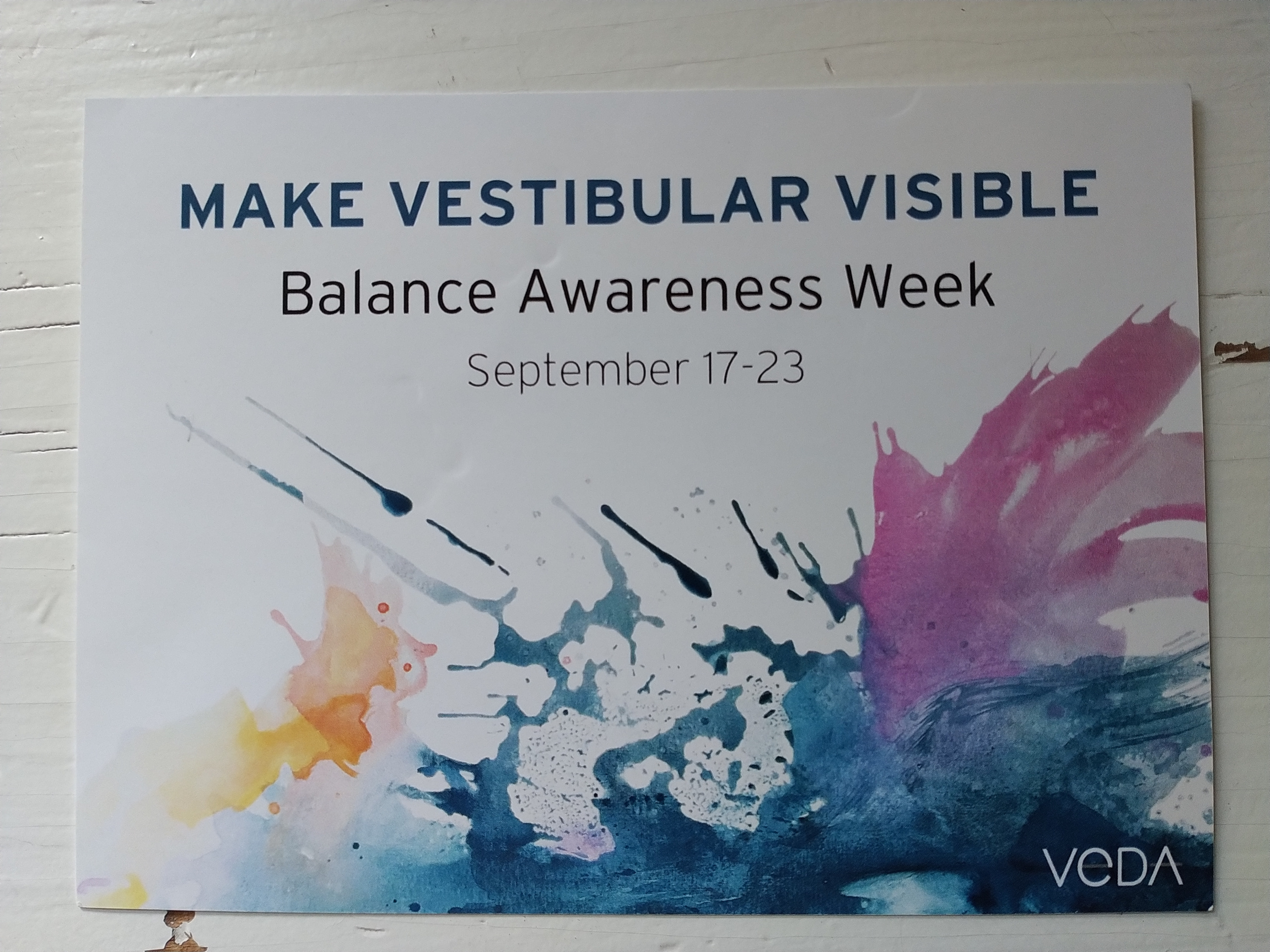
A promo postcard from VeDa. The painting, “Uncharted Waters,” is by vestibular patient Nicolle Cure.

FOCUS ON BALANCE

Today, though, I want to focus on balance, for two reasons. Imbalance was the first issue I overcame. And secondly, September 17-23 marks Balance Awareness Week, started in 1997 by the Vestibular Disorders Association. That national nonprofit is “a lifeline of support to anyone affected by vestibular (inner-ear and brain balance) disorders.” VeDA has proven an invaluable resource for me in learning about my vestibular-based diagnoses.

Knowledge is power. Just ask my physical therapist at Courage Kenny. Ryan answered many questions during my vestibular rehab therapy sessions, especially early on when I was just learning about my health issues. He always replied thoughtfully, helping me to understand what was happening in my brain and how we would work together through targeted exercises to manage my symptoms.

I’ve come a long way from the days of standing in place turning my head back and forth to the beat of a metronome. Today I’m power walking 15 minutes in the morning, 15 minutes in the evening with Randy. Even I’m amazed that I can do this. Not all that long ago, I couldn’t walk a block, often needing to hold onto Randy.

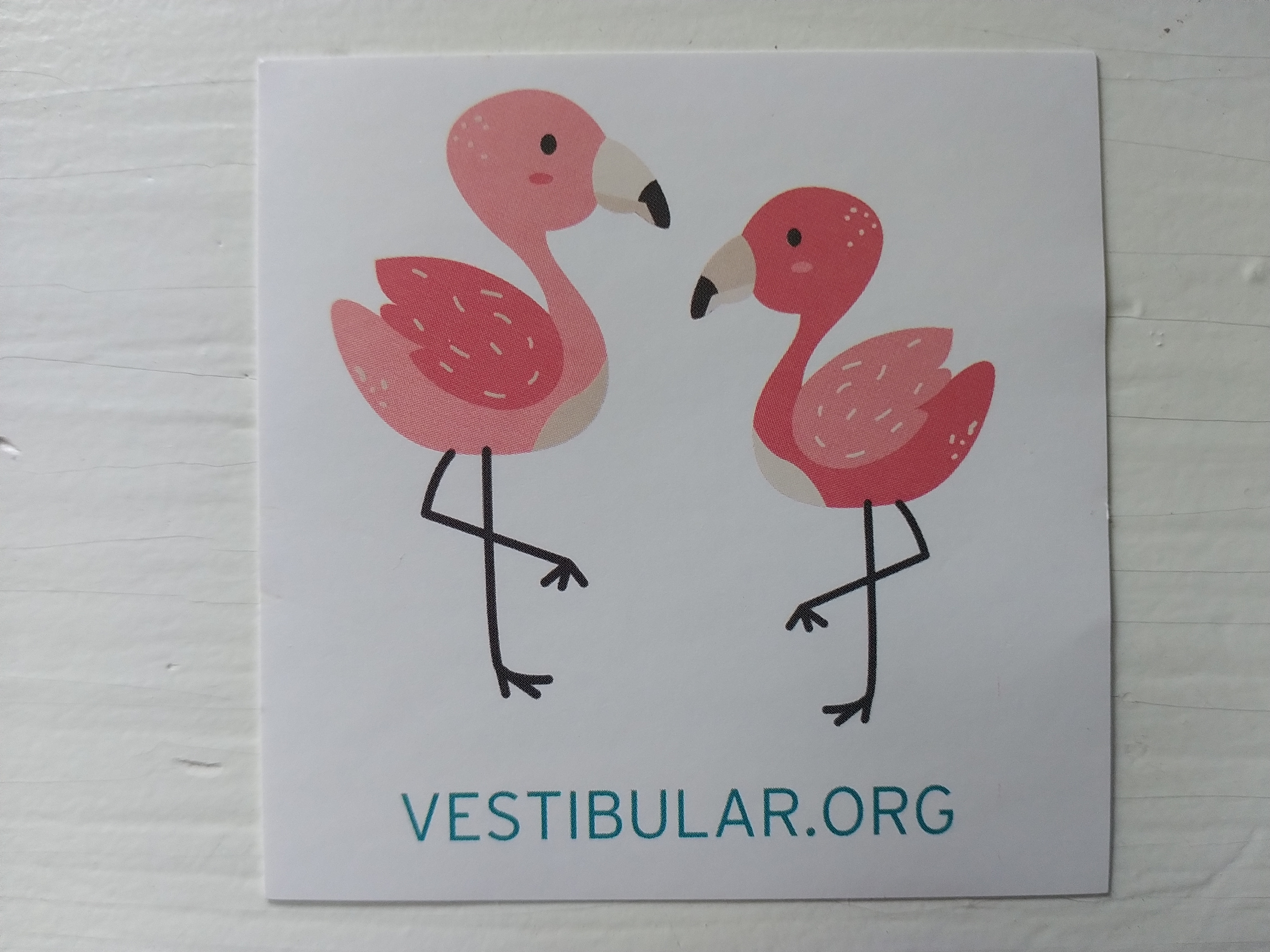
Fiona the Flamingo is VeDA’s Balance Awareness Week logo/mascot.

EVEN THOUGH MY DISORDER IS INVISIBLE, I STILL NEED TO BE SEEN, ENCOURAGED…

There is hope for anyone dealing with a vestibular disorder. Many seniors (and, yes, I’m a “senior”) struggle with balance. So do those who’ve suffered traumatic brain injuries like concussions. That includes my sister-in-law Rosie, my go-to support. Because she understands. And encourages. She realizes the importance of physical therapy in recovery.

In sharing a bit of my story with you, I am aiming to increase awareness. Make Vestibular Visible themes Balance Awareness Week. A promo from VeDA reads: Balance Awareness Week is our time to shout from the rooftops: “I have a vestibular disorder and this is my story.”

This is my story. One of challenges, of professional intervention, of hard work, of acceptance, of perseverance, of relying on others, of patience, of strength, of gratitude, of tears, of resilience, of focusing on what I can do (and not what I can’t). It is also a story of recognizing that no matter what we face in life—whether visible or invisible—we all need to be seen, to be uplifted, to feel cared for and loved.

#

© Copyright 2023 Audrey Kletscher Helbling

*I self-tested negative twice for COVID, but those tests (if done incorrectly and for other reasons) can be wrong, my primary doctor told me. He guesses I had COVID in January, and I agree based on my symptoms.


It’s been a roller coaster ride September 14, 2023

“The Legend,” one of a few remaining wooden roller coasters, located at Arnolds Park Amusement Park in the lakes region of northwestern Iowa. Built in 1930, it is the 13th oldest wooden roller coaster in the world. (Photo courtesy of Arnolds Park Amusement Park Marketing)

SOME 2 ½ MONTHS AGO, I boarded a roller coaster for the first time since I was a teenager screaming my lungs out while riding “The Legend,” a wooden roller coaster at Arnolds Park Amusement Park in Arnolds Park, Iowa. It’s not that I decided this would be a fun activity to try again in my late sixties. Rather, the choice was made for me, as part of my vestibular rehab therapy.

I warned my physical therapist that I don’t like amusement rides. But my comment didn’t deter Ryan. He determined that riding a virtual reality roller coaster on a June morning might be exactly what my brain needed to retrain itself. Since January, I’ve struggled with neurological-based issues resulting from a viral infection, suspected to be COVID, even though I twice self-tested negative for the virus. In early April, I started physical therapy and have been working hard ever since to manage my many debilitating symptoms.

Fast forward to today. I am in a much better place, even while on a VR roller coaster, a tool I’m using to build my visual, auditory and spatial tolerance. Early on I had doubts about my therapist’s plan. Initially, I couldn’t tolerate the VR roller coaster for long (less than a minute) before symptoms flared. After minimal exposure, my head hurt, my eyes hurt and I felt utterly exhausted. When I experienced a health setback mid-summer with vertigo returning, Ryan abandoned the amusement ride therapy for therapies less taxing on my brain.

ROCKS, RABBITS & A ROLLER COASTER

Slowly, surely, I started feeling better and Ryan decided it was time to pull out the VR headset again for another go on the roller coaster. I did not enthusiastically hop on board, only reluctantly agreeing to give it a try. I lasted 25 seconds on a roller coaster ride where boulders tumbled off rocky mountains toward me. Rabbits loping under the track proved the only redeeming feature. I hold a fondness for rabbits, my high school mascot being a White Rabbit.

That was two weeks ago. The following week I did better, albeit on a less visually-stimulating ride, this one under the sea in a darker environment. Still, I could manage only bursts of riding before needing to pause.

NOT ONE, NOT TWO, BUT THREE ROLLER COASTERS

Five days later I was back at therapy, knowing full well that I would again be riding a roller coaster. Make that plural. Three roller coasters. I started therapy Wednesday morning with the least stimulating under-the-sea ride. And just to make that more challenging, Ryan asked me to stand, rather than sit. He allowed me to place my hands on the back of a chair to ground myself. I successfully finished the ride, then took a break before re-boarding, this time without touching the chair. Success again. Time to up the challenge.

Ryan pulled out the rabbit-loping, boulders-falling themed ride. This time I completed the ride, which was visually much more exciting with dynamite and fire and a whole lot more coming at me. Once again, I tolerated the roller coaster twice while standing and without needing to stop.

I felt my confidence grow as each roller coaster ride became more sensory challenging. I could do this. But when the next ride began with a garish parrot getting in my face, I questioned whether I could manage a tropical-themed roller coaster with worn vivid red and yellow rails. (Was it even safe to ride?) It was a lot—the bold hues, the squawking flapping seagulls, the palm trees, the steep climbs, the height, the sharp turns. But I made it. Twice on that roller coaster curving toward the ocean.

DOING GREAT, BUT I HAVE MY LIMITS

My brain was adjusting, learning, retraining itself to take in more visual, auditory and spatial input. Ryan praised my success, both of us somewhat surprised by how well I’d tolerated those roller coasters Wednesday morning.

But before I left therapy, I wanted Ryan to know one thing. If he planned a field trip to nearby Valley Fair Amusement Park next Wednesday for a ride on a real roller coaster, I wouldn’t be showing up for therapy.

© Copyright 2023 Audrey Kletscher Helbling
 

A bit like Alfred Hitchcock’s “Vertigo” August 1, 2023

Filed under: Uncategorized — Audrey Kletscher Helbling @ 5:00 AM
Tags: , , , , , ,
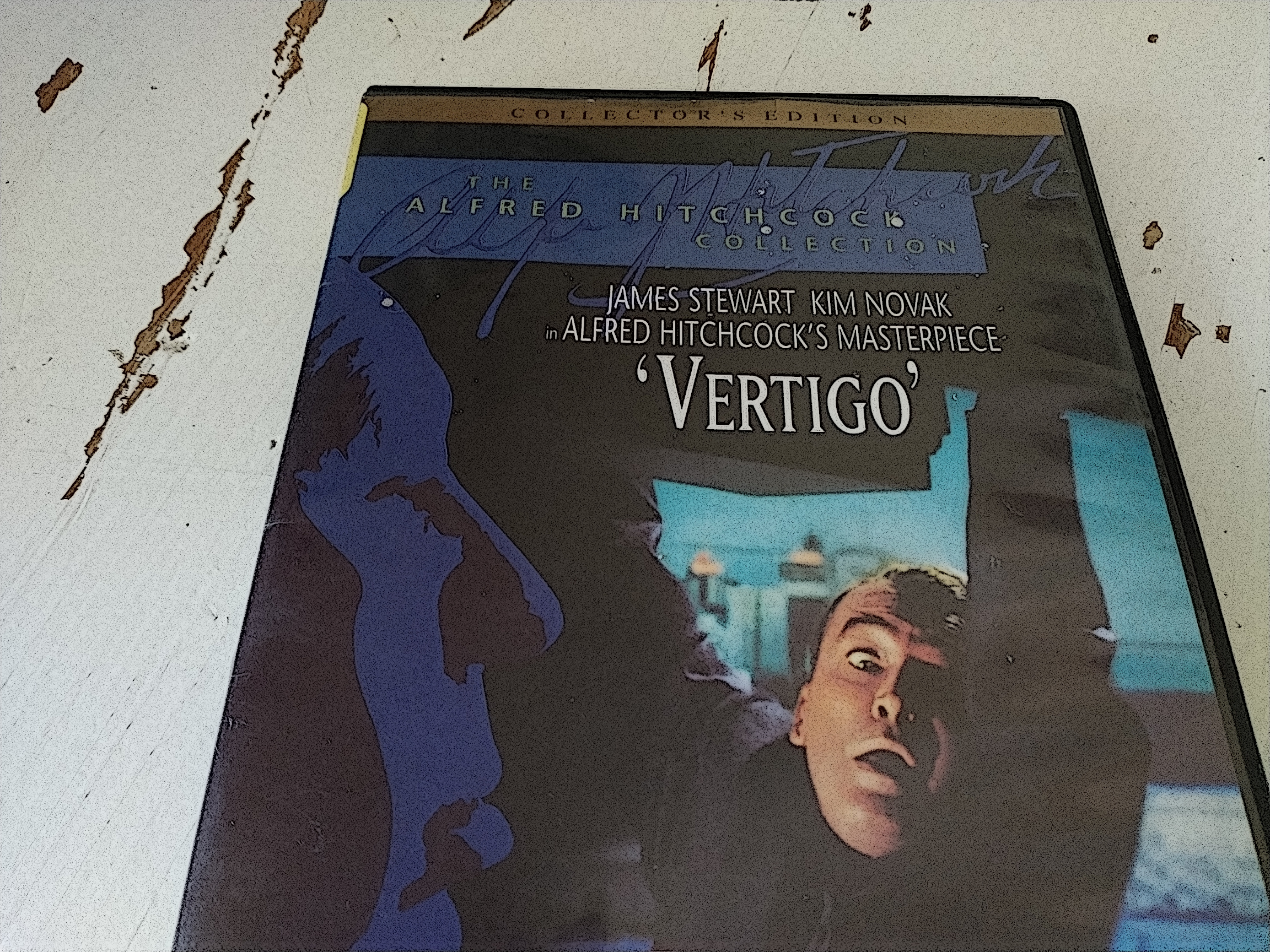
DVD cover of “Vertigo.” (Minnesota Prairie Roots copyrighted photo August 20230

“VERTIGO.” I CAN BARELY TOLERATE reading the title of the movie, considered by many to be Alfred Hitchcock’s greatest achievement. That may be so. But when Randy pulled the “Vertigo” DVD from a shelf at the local library and asked if I wanted to watch it, my response was immediate. “NO!”

Vertigo is not something I want to see depicted in a masterpiece film by the simultaneous use of forward zoom and reverse tracking shot. No, thank you. I don’t need that visual. I recently experienced extreme vertigo in real life. And that was beyond awful.

But Randy was attempting to infuse humor into my thoughts, an effort I appreciate given all I’ve been through this summer. The vertigo I experienced back in early April returned a few weeks ago, leaving me dizzy and once again feeling unbalanced. To say I felt frustrated would be an understatement. I’d made notable progress in vestibular rehab therapy, which is retraining my brain in the areas of balance, handling sensory overload and more. All of this connects to my triple diagnoses of vestibular neuronitis, Meniere’s Disease and peripheral sensory neuropathy.

To feel two instances of vertigo and like I was living in a world once again a kilter seemed like a major setback. My physical therapist chose other words: “a bump in the road.” Ryan’s right. I didn’t lose the progress I’d made, just slowed down due to that speed bump. He’s so encouraging, one of the traits I most appreciate in a deeply compassionate and caring physical therapist.

Yet, on the Friday Ryan checked me for benign paroxysmal positional vertigo and then twice performed the Epley Maneuver to move misplaced crystals in my right inner ear back in place, I wasn’t all too happy about his action plan. It was, of course, a correct and necessary procedure. It involved Ryan turning my head to the right and holding it in place while I was sitting, then lying down on my back and going through an Alfred Hitchcock-worthy scene of extreme room spinning vertigo. I gripped Ryan’s forearm with such intensity that I later joked he should receive hazard pay. Without going into more nightmarish detail, he then repeated the procedure. The second time my vertigo had lessened. And when Ryan rechecked me for vertigo a week later, it was gone.

Now I’m trying to get back on track, rebuilding my confidence in doing the assorted exercises designed to retrain my brain. These are familiar exercises, ones I’d mostly mastered before the bump in the road. I left therapy Monday afternoon feeling absolutely wiped out, though, and symptomatic. It’s going to take time for my brain to adjust to exercising.

I’m determined to work hard, to do my exercise homework, to try and live my life as best I can while managing my symptoms. I understand my limits, when I need to take breaks (including limiting screen time) and how to help calm my system. Already my balance is improving. I’m slowly beginning to feel better, to eat better. (I’ve lost 15 pounds.) And I’m overcoming my fear of vertigo returning.

But I’ll never ever watch Alfred Hitchcock’s “Vertigo.” The title triggers too many nightmarish memories.

© Copyright 2023 Audrey Kletscher Helbling
 

An encouraging message meant for me July 14, 2023

Filed under: Uncategorized — Audrey Kletscher Helbling @ 5:00 AM
Tags: , , , , , , , , , ,
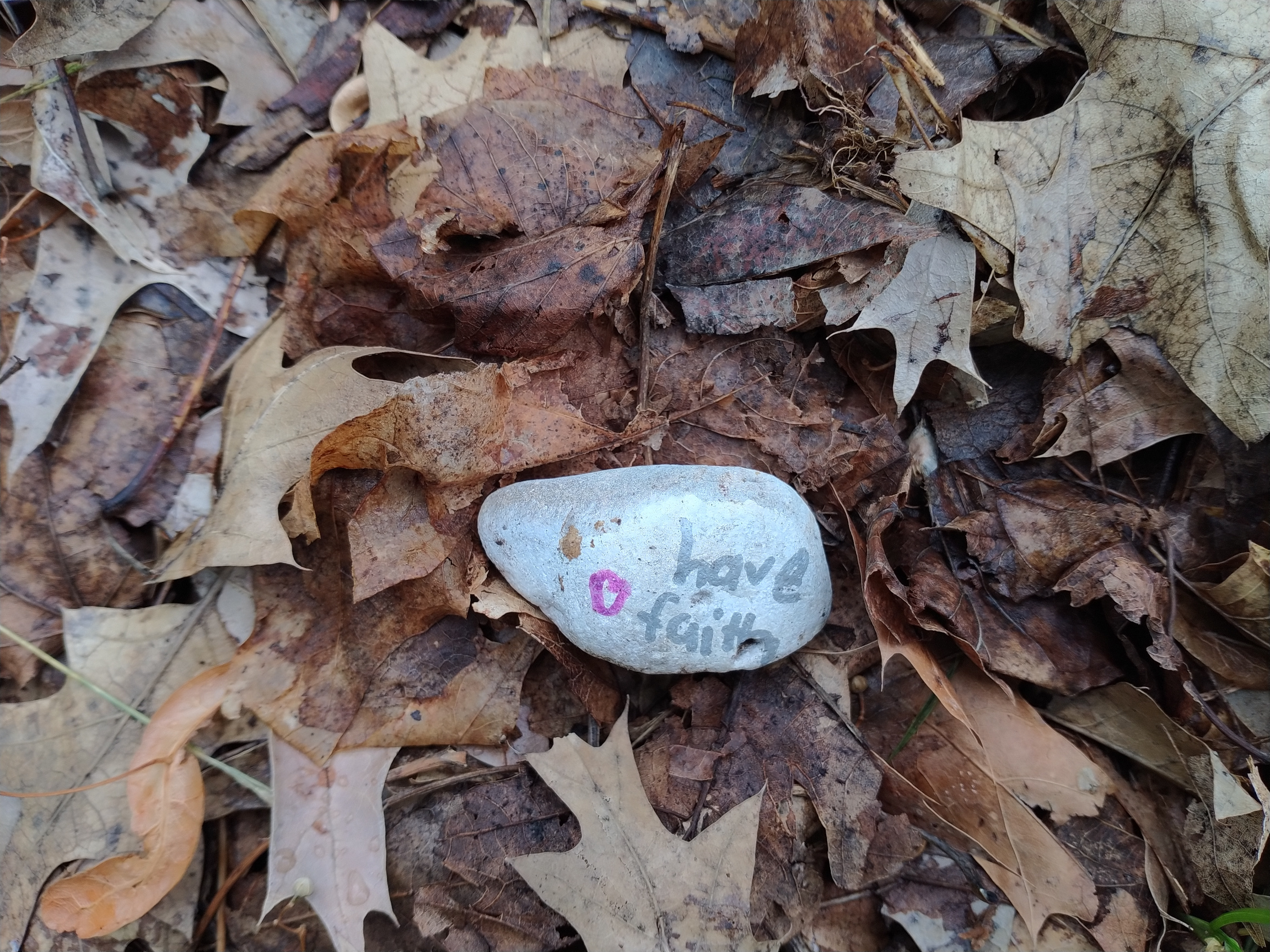
A found message. (Minnesota Prairie Roots copyrighted photo July 2023)

CALL IT SERENDIPITY, coincidence, even divine intervention. But when I spotted a white stone in a flowerbed at Faribault’s Central Park recently, then flipped the stone to read the words, have faith, I felt with certainty this message was meant for me.

I needed these encouraging words. It’s been a long past several months as I deal with ongoing challenging health issues that sometimes leave me feeling hopeless and in tears. It’s a lot, these layered diagnoses of vestibular neuronitis, Menerie’s Disease and peripheral sensory neuropathy. When symptoms flare, which is often, I wonder if I will ever be myself again. And every time a new symptom arises, I wonder why my body is seemingly under siege. Definitive answers and solutions feel elusive.

Yet, if I reflect on this journey, I can see improvements in balance and my ability to handle sensory input. I attribute those to 3.5 months of vestibular rehab therapy and the prayers of many. Have faith. Those two words are powerful, filled with hope. Hope for better days, better health, a return to life as I once lived it.

#

THANK YOU to you, my blog readers, for your gifts, cards, prayers and words of encouragement. Every caring word and act of kindness uplifts me and makes me feel, oh, so loved. I am grateful for your support, care and concern.

© Copyright 2023 Audrey Kletscher Helbling


All about circles & numbers at physical therapy July 6, 2023

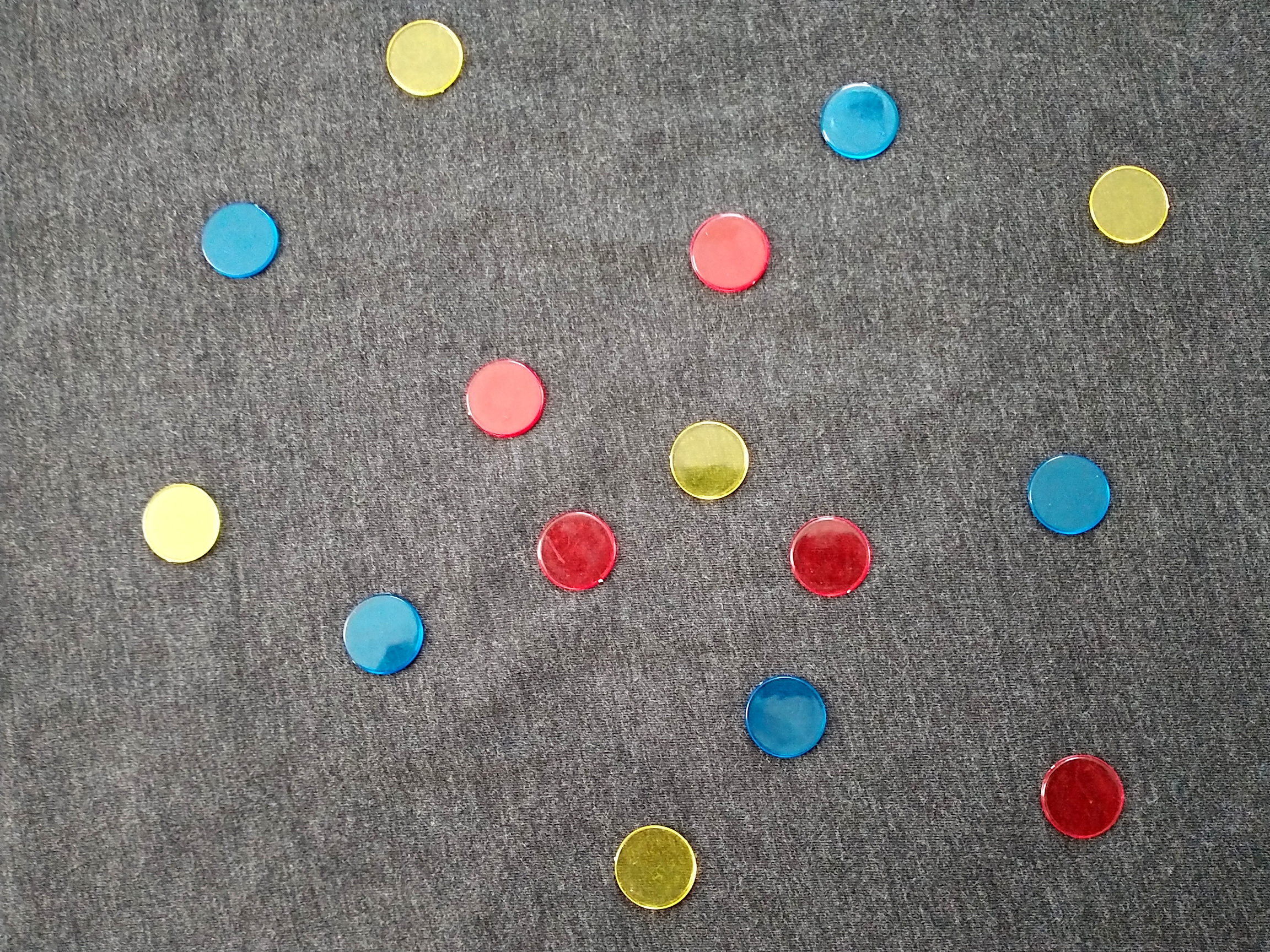
Pretend this is a screen with moving circles. Tap all the red circles, then the blue, then the yellow. (Minnesota Prairie Roots copyrighted photo used for illustration only, June 2023)

“THIS IS FUN!” I effused as I touched a series of red circles, then white, then blue on a big screen. Since I quickly mastered that Fourth of July-themed task after several tries, my vestibular rehab therapist upped the challenge.

Next Ryan had me tapping first a square with a pulsing letter inside and then white circles that popped up randomly on the screen. Whenever the letter changed, I had to tap the blinking letter and then those elusive white floating circles.

I felt like I was getting not only a visual workout (the goal), but also my morning exercise as I stretched to reach the circles. At the ends of rounds, Ryan would adjust the time, increasing the difficulty. When he saw me struggling, he decreased the screen size. Magical, I thought in my exercising brain. My therapist’s aim was neuromuscular re-education via use of the Bioness Integrated Therapy Systems, software designed to present me with dual tasking and visuospatial processing challenges.

At this point the word “fun,” rather than “brain work-out,” still held my thoughts. But just as I was feeling good about my successes, my therapist determined I needed a bigger challenge. Circled numbers popped onto the screen. I should have stopped Ryan right then and there and told him that I am not a numbers person. Words are my thing. He knows I’m a writer. But I was willing to try as long as I didn’t have to solve math equations.

Turns out I only needed to know how to count. No problem. Easy peasy. Or so I thought. I was instructed to tap the numbers 1-10 in sequence inside a large rotating circle. That requires some visual dancing. The numbers disappeared as I tapped them. Then, of course, Ryan added more numbers. Fifteen. Then 20. He also adjusted the speed. And then he told me the numbers would not disappear. Oh, boy.

By then, the word “fun” had vanished, poof, just like that from my thoughts. I felt a tad dizzy and my head hurt. Ryan noticed. Play ended. I sat, closed my eyes, didn’t always look Ryan in the eye when he talked to me. Those are all cues that my brain is experiencing sensory overload.

We chatted about July Fourth plans and vacations and how I can manage my symptoms when they flare. I’ve come to understand what helps me deal with agitation and sensory overload—deep breathing, coloring, therapy putty, rocking, closing my eyes, ear plugs, retreating to a quiet place. But it’s always good to review those coping skills.

It was nearing the end of my 45-minute weekly therapy session. I still felt like my head had been slapped. At that point, Ryan gave me a break. He had planned to use the virtual reality roller coaster again to strengthen my visual and auditory tolerance. But he recognized my brain had had enough sensory exposure. Or perhaps to much exposure to numbers.

© Copyright 2023 Audrey Kletscher Helbling
 

Quite the ride June 28, 2023

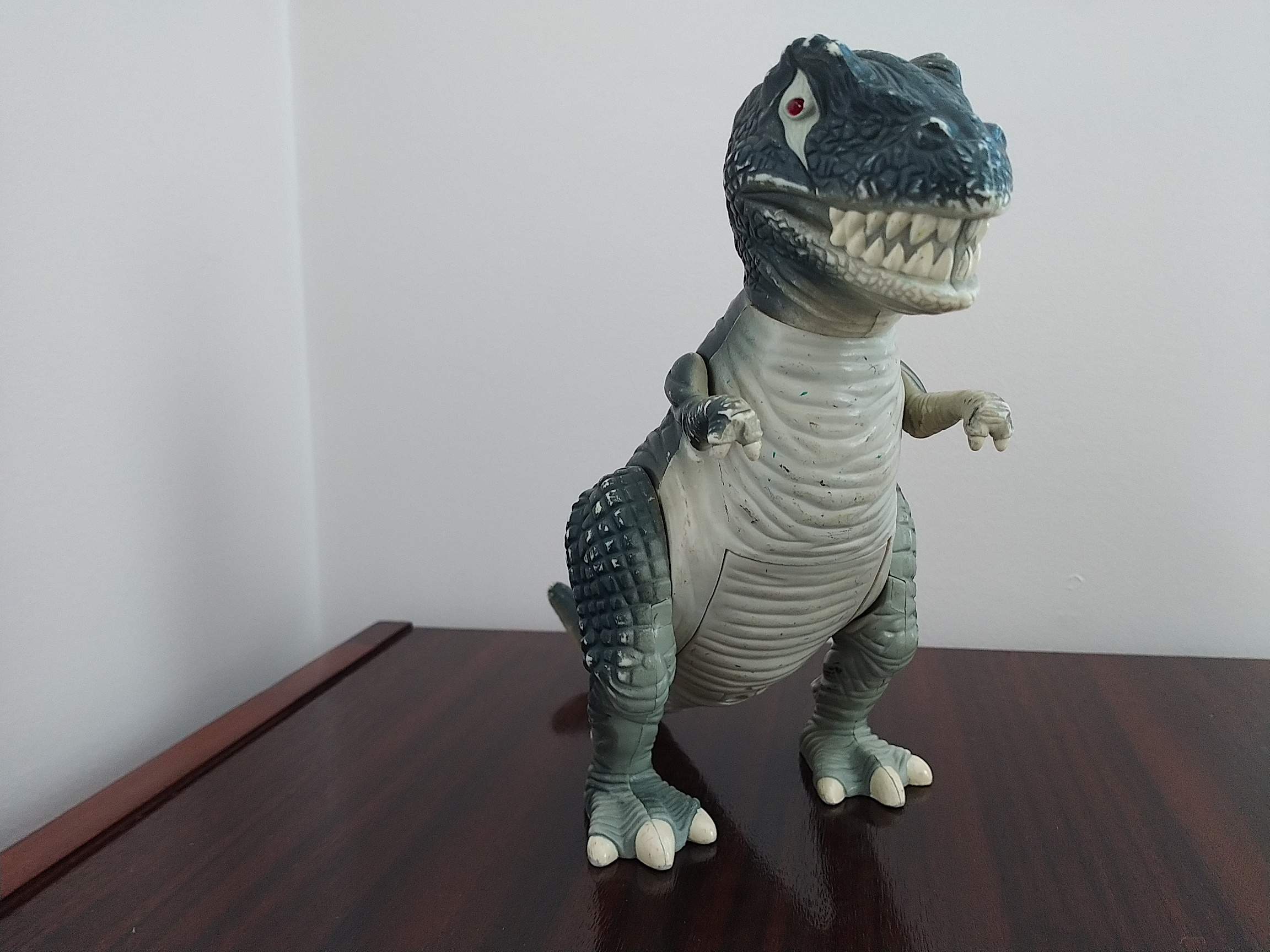
This battery-powered T-Rex was my son’s toy. It roared, turned its head, moved its arms and flashed its red eyes. My grandkids were terrified of it at one time. (Minnesota Prairie Roots copyrighted photo June 2023)

IF YOU HAD JUST DISEMBARKED a roller coaster only to see a T-Rex chomping up the tracks and roaring towards you, would you trust that you would survive?

So what does this have to do with anything relevant to today and, well, to me? Lots.

Last week my vestibular rehab therapist changed things up a bit. He led me from our usual private meeting room down the hall to a more spacious room with a large screen TV, a table, chairs, toys, a dollhouse and some type of exercise equipment I couldn’t identify.

“Yeah, I get to play,” I exclaimed to Ryan.

WE’RE GOING TO DO WHAT?

He had other things in mind. “You’re going to ride a roller coaster,” he said. I looked at him in disbelief and then with fear as he pulled out a virtual reality headset.

“I don’t like roller coasters,” I stated. That is true. The last one I rode was nearly 50 years ago. The Woody at Arnold’s Park in Spencer, Iowa. They called it The Woody back then for a reason. Built in 1930, this is the 13th oldest wooden roller coaster in the world. And this amusement ride was, for me, absolutely terrifying as the cars clacked up and down and around the tracks.

I also have minimal exposure to VR, having tried my son’s headset once and experiencing great difficultly in navigating anything. Simply being in a virtual world proved uncomfortable and disorienting.

So when Ryan mentioned roller coaster and VR in the same sentence, I felt my angst rise. But I recognized that he was serious and that this was just one more effort to retrain my brain by exposing me to motion and to noise in an attempt to manage symptoms resulting from vestibular neuritis, Meniere’s Disease and peripheral sensory neuropathy.

REMIND ME, WHICH BUTTONS DO I PUSH?

Alright then. Ryan set up the computer program, tightened the headset on my head, then handed me the controls, instructing me on which buttons to push. He told me to point the laser at the triangle to start the ride. I couldn’t even manage that as my hands shook. I failed at multiple attempts to use the hand controls, so eventually my patient PT took over. Young people can manage tech stuff far better than aging Baby Boomers like me.

Soon I was on the dreaded roller coaster, riding up and down and all around while noise roared. It was a lot of visual and auditory stimuli as intended. Curves and the roar of a waterfall proved the most challenging. Almost immediately I asked to sit. But when I grew more comfortable, Ryan had me standing with my hand touching the back of a chair to help me feel grounded. I took multiple breaks.

OH, NO, THERE’S MORE!

When I thought a roller coaster ride was surprise enough, yet more awaited me. I soon noticed dinosaurs lurking in the background. Then a Tyrannosaurus separated from the herd and began chomping the track, moving at a ferocious pace directly towards me.

“My granddaughter would love this,” I said in the midst of all that chaos, then corrected myself. “Well, maybe not.” Isabelle, 7, loves dinosaurs but even this teeth-baring meat eater might scare her.

In the end, I survived. Both the T-Rex and the roller coaster. Ryan was pleased with my ability to mostly handle the stimuli. Now I wonder what he has planned for physical therapy tomorrow?

© Copyright 2023 Audrey Kletscher Helbling
 

The dance goes on June 23, 2023

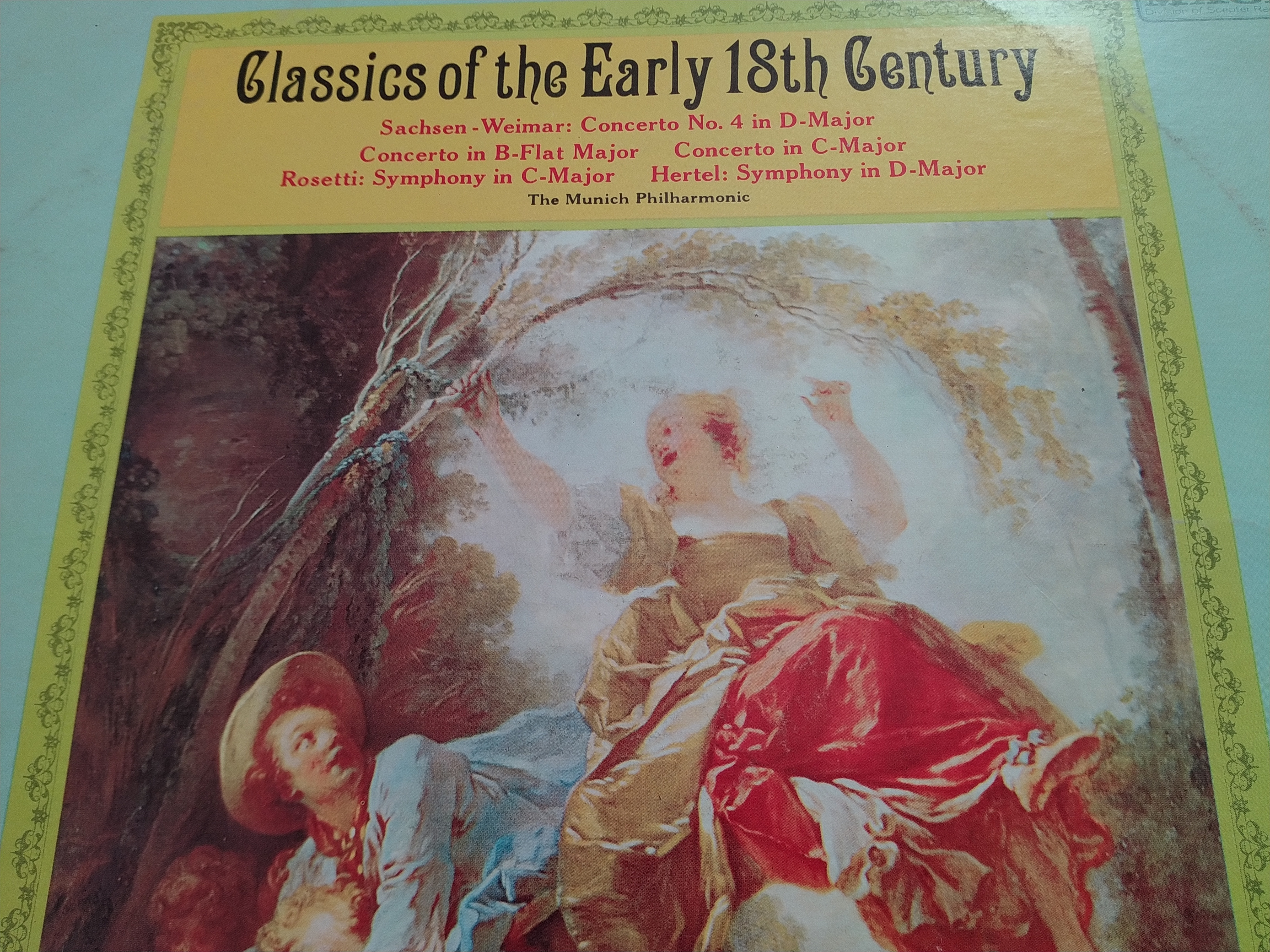
I’ve owned this classical music album since the 1970s. (Minnesota Prairie Roots copyrighted photo June 2023)

IT’S BEFORE 8 AM, and I am twirling across my living room to early 18th century classical music playing on a stereo.

You might call this dancing. But, for me, this is an exercise in balance. For two months now I’ve been in physical therapy to help retrain my brain. That followed a diagnosis of vestibular neuronitis in my right ear and Meniere’s Disease in early April. And now I have the added diagnosis of peripheral sensory neuropathy. And more, possibly post-COVID symptoms, even though I’ve never tested positive for the virus. I had a virus in January and all of my symptoms started in the months thereafter.

I have been working really hard to do whatever I can to help my body adapt to the deficits in my brain that stretch well beyond a loss of balance. Thankfully, I can still write. There are many days when I feel frustrated, impatient, overwhelmed, anxious, exhausted, wondering if I will ever feel better. Able to live the life I once lived.

And so I continue this dance. Four steps across the living room floor, turn a 360, four more steps, turn, four more steps and turn again. By the third turn, I am feeling dizzy. Then it’s back twirling the other direction, pausing at the end of each set to regain my balance. Back and forth several times, the energetic music of Johann Ernst von Sachsen Weimar, Francesco Antonio Rosetti and Johann Wilhelm Hertel propels me across the floor.

IMPROVEMENT & DETERMINATION

There was a time early on in my diagnoses when I couldn’t have listened to this music. All I wanted was quiet, minimal auditory input. I worked in physical therapy to build my tolerance to sound. I still struggle with sound and other sensory issues. But I know I’m better than early on. The fact that I can even sit at a computer and type is proof. Early on that was difficult, if not impossible.

I just now paused to turn off that classical music. It was too much after 45 minutes of listening while exercising and now writing. The right side of my head feels as if it’s been slapped. I recognize that as a symptom that I need, in this moment, to calm.

Dealing with these multiple diagnoses feels as much a mental challenge as a physical one. I suppose anyone experiencing a serious health issue would say the same. I try to remain positive and hopeful, but I recognize that, in all reality, feeling upbeat takes effort.

Just like my physical therapy takes effort and commitment. I’m determined to follow through with the exercises my therapist, Ryan, gives me during our weekly sessions. I look forward to therapy because I feel so encouraged and empowered, like there’s something I can do to help myself get better and that I have the strong support of a caring and compassionate professional.

FOCUS, EXERCISE, TRY

And so I continue twirling across my living room. In another exercise, I focus my eyes on an X slashed on a Post It note I’ve placed at eye level on the wall. I keep my eyes on that X as I do figure eights around two containers of therapy putty I kept after breaking my left wrist several years ago. Because I also have diplopia, I see two Xes due to my eyes not tracking together.

Another exercise takes me outdoors to Central Park or the campus of the Minnesota State Academy for the Deaf. There I walk along the sidewalk and then on the uneven surface of grass, turning my head from side to side and then up and down. Randy walks near me as my spotter. I invariably veer hard to the left. It’s his job to keep me safe and I am grateful for his loving care and attention.

One of my biggest challenges remains the ability to engage in conversation. Listening and talking for any length of time tax my brain. When my dear aunt phoned the other day from Missouri, I finally had to end the call because my head was hurting so bad. I’m hoping my therapist can give me some exercises that will improve my ability to engage in conversation without experiencing symptoms.

And so I keep trying. I keep dancing, twirling to the early 18th century music of classical composers.

TELL ME: If you’re living with a chronic illness/disease or have dealt with a major health issues, what helped you cope? I’ve found coloring, playing with therapy putty, doing crosswords, lifting hand weights and rocking in the recliner with my eyes closed to be soothing, helpful distractions.

© Copyright 2023 Audrey Kletscher Helbling
 

A health update: I like savory food, but not this tasty June 17, 2023

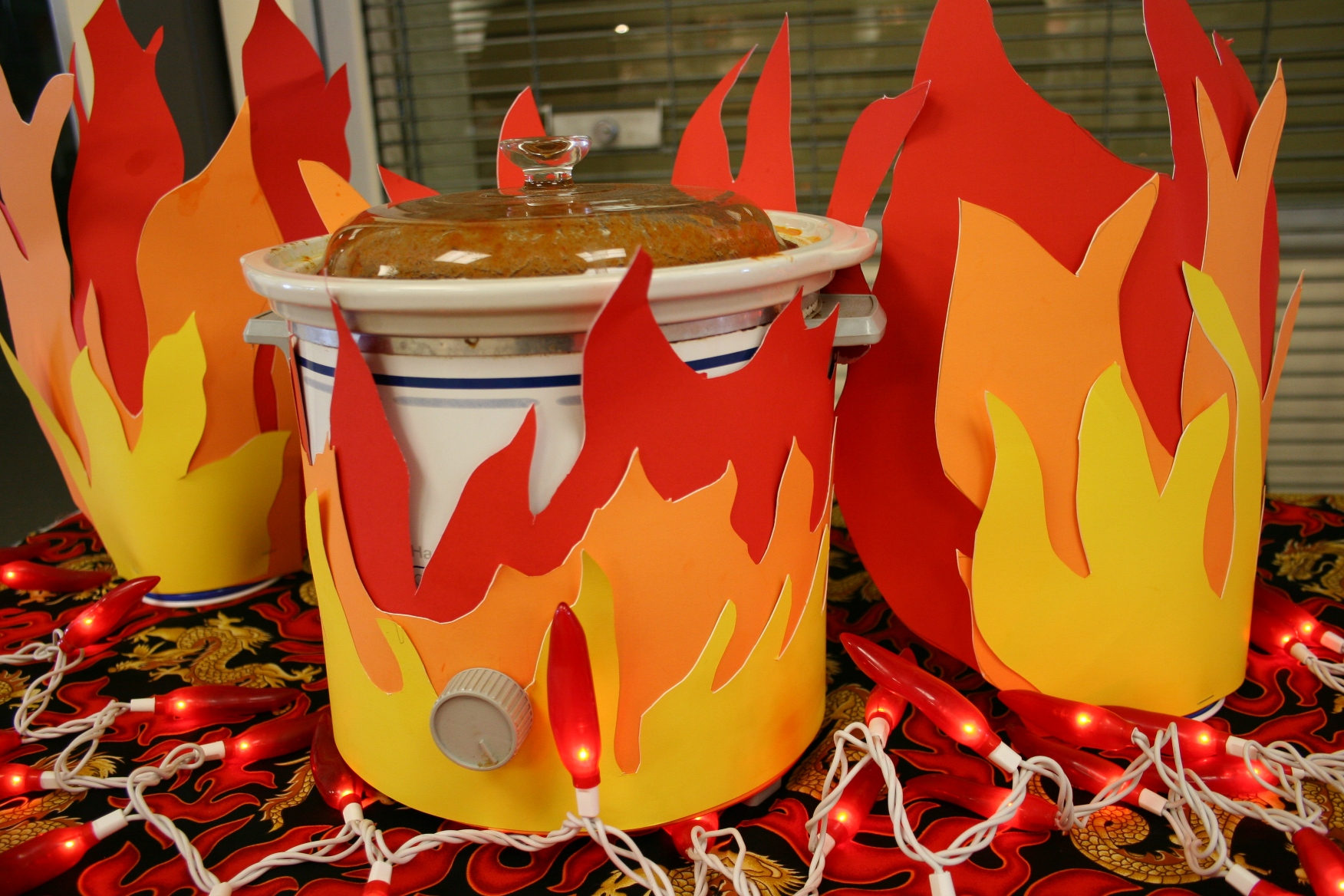
Nothing spicy for me last week. Nope. (Minnesota Prairie Roots copyrighted file photo)

AT 7:11 PM TUESDAY I TEXTED this to my oldest daughter: Do not forget you have super sensitive taste buds & lick an envelope flap. Really bad idea.

I was the one who forgot, not her. I was the one with the hypersensitive taste buds. I was the one who grabbed my bottled water and ran to the bathroom to repeatedly rinse the strong taste from my mouth. I was the one with overly-active taste buds, just another of the many sensory overload symptoms I’ve experienced following a virus in early January.

Of all the past and present symptoms—from imbalance; short-lived vertigo (only when prone): ear ringing, popping and pain and feeling of moisture in my ear; sensitivity to light, sound, smell and touch; feelings of ice water coursing through my body; feeling like I’ve been slapped on the face; headaches; and more I’m likely forgetting right now—this taste issue proved particularly challenging. It landed me in the ER one Thursday afternoon recently with swelling of my tongue and lips and a feeling of my throat closing. That’s scary, darned scary.

Oatmeal with brown sugar, not bananas or any other fruit, was one of the few foods I could eat last week. (Minnesota Prairie Roots copyrighted file photo)

WEARY OF OATMEAL

Thereafter, for the next week, I could eat only bland foods and only small amounts. Oatmeal. Graham crackers. A blueberry proved too intense. So did a grape. It tasted awful. In five days, I lost nine pounds. Not a weigh loss program I recommend. Anything I ate caused an allergic reaction, but thankfully not enough for a return ER visit.

I couldn’t brush my teeth because my taste buds couldn’t tolerate even a non-flavored toothpaste. Toothpaste set my mouth afire. Eventually, after contacting my dentist’s office, I tried baking soda. That tasted like someone dumped a load of salt in my mouth.

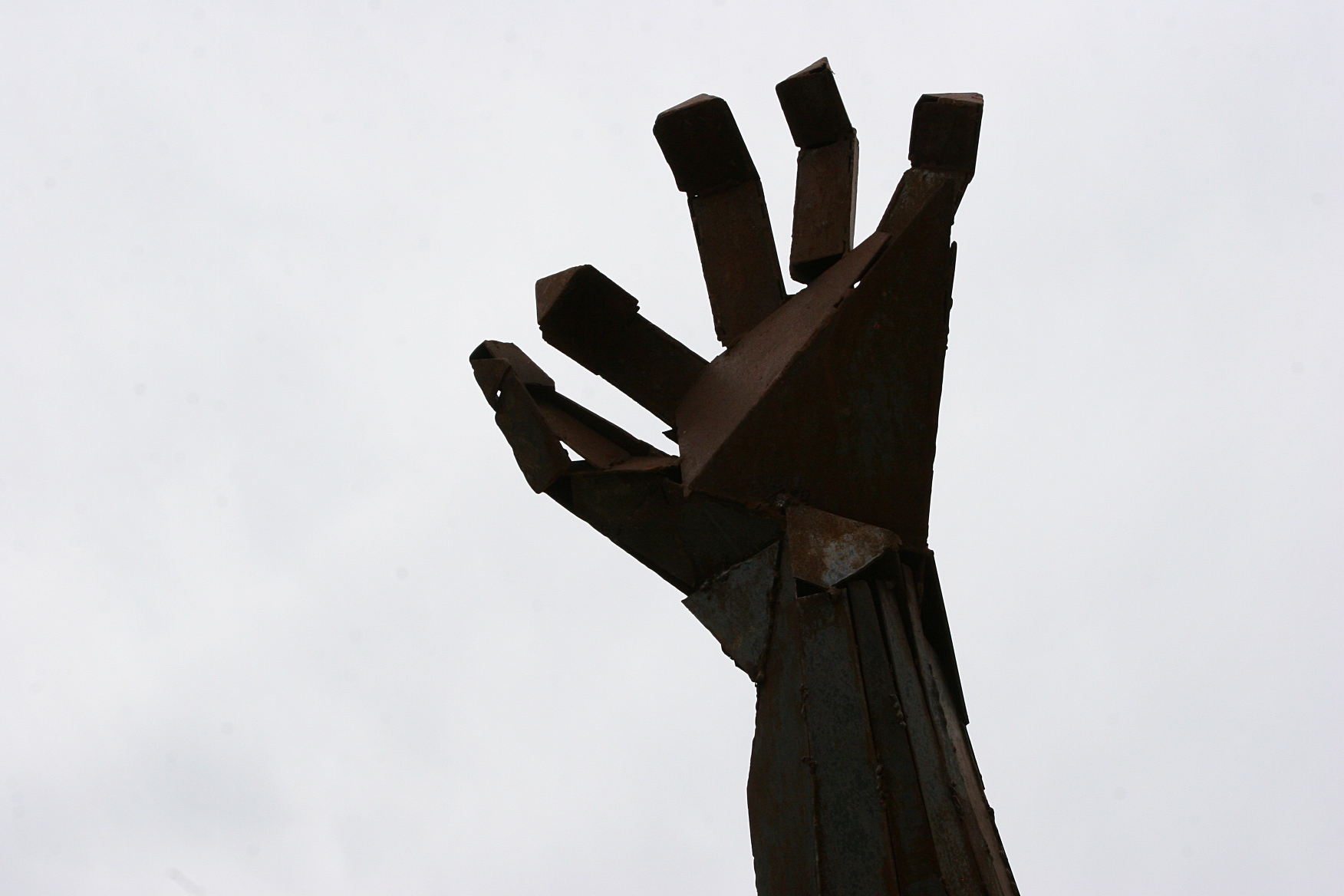
I feel like I’m reaching reaching for help as seen in this public art sculpture, “Waist Deep,” photographed in Northfield in 2019. (Minnesota Prairie Roots copyrighted file photo)

JUST WANTING TO BE WELL

To say it was a hellish week would be an understatement. I was scared. Frustrated. Anxious. Wanting answers and hope. More than once, Randy heard me state, “I just want to feel better.” He was patient, encouraging, supportive, as he has been through the past six months of multiple building symptoms.

Back at the end of May already, I noticed toothpaste seemed especially minty. I told two of the doctors I was seeing of this occasional taste oddity. That went nowhere and perhaps I did not push the point enough. And then came that Thursday afternoon ER trip and my taste buds run amok.

This art by Faribault eighth grader Mohamed represents how I feel regarding my overstimulated senses. This art was shown at a student art show earlier this year. (Minnesota Prairie Roots copyrighted file photo 2023)

TIME TO CALM THOSE NERVES IN MY BRAIN

It was at my ER follow-up visit with my primary care doctor that I found hope in a physician with deep compassion and care. I could see both in his eyes, hear both in his words. He pledged to try what he could to help me. He prescribed a medication to help calm the overactive nerves in my brain which control the senses. After one dose, I was already feeling relief. My taste buds are back to normal. I can eat without feeling like the food I just put in my mouth is starting a fire. No more throat, tongue or lip swelling. If it continues to work, and I have no reason to think otherwise, then I am grateful.

A THEORY, GUESS OR WHATEVER YOU WANT TO CALL IT

This is all a bit of a guessing game, a try and see what works process. Even my family doctor’s diagnosis of peripheral sensory neuropathy seems a best guess. The sensory part fits for sure. His theory is that the virus I had in January was COVID, even though I self-tested negative twice for the virus. Those home tests, he said, can be inaccurate if the tester doesn’t quite do things right. I am beginning to believe more and more that he’s right, that I am experiencing post-COVID symptoms.

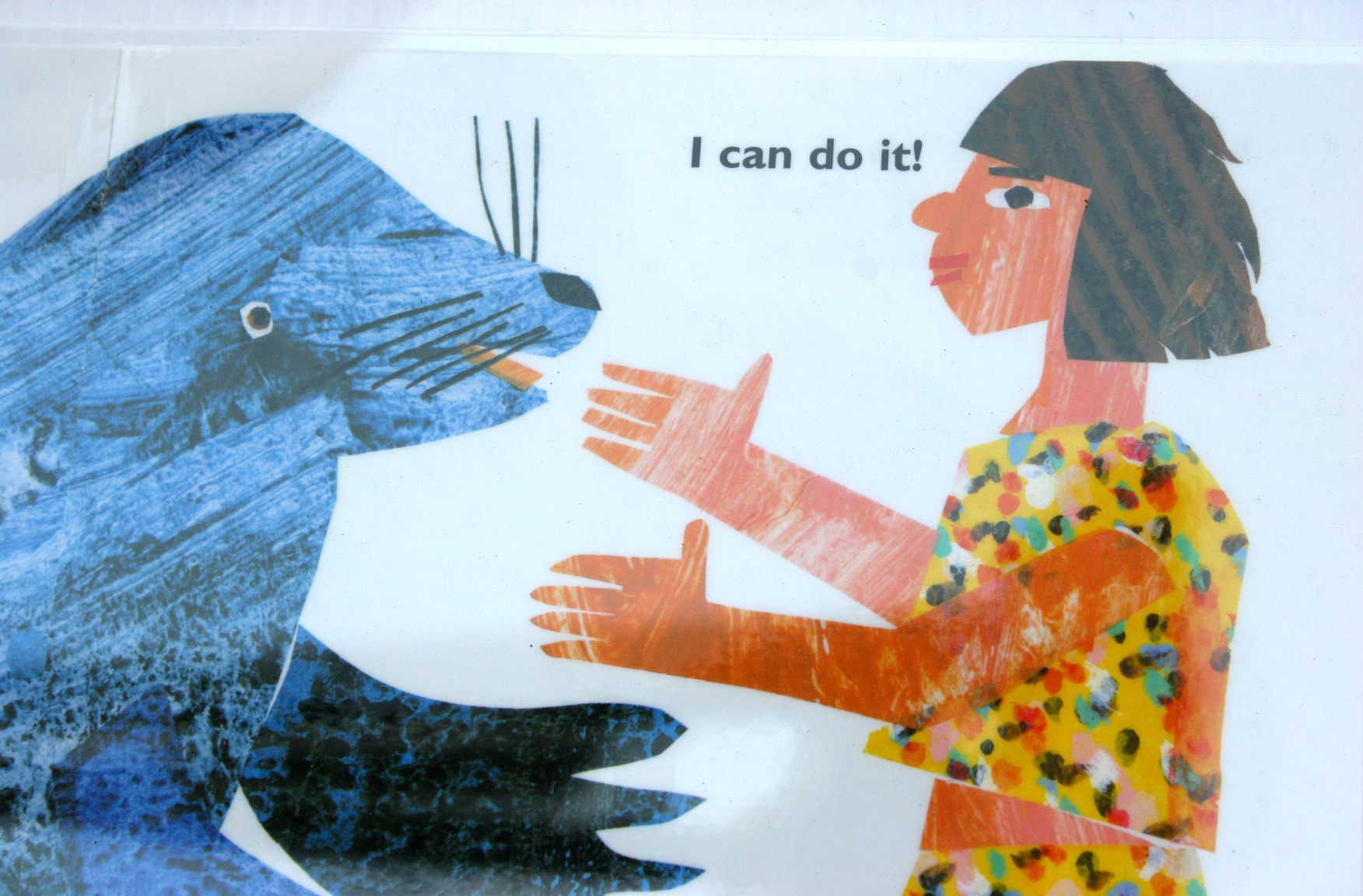
A page from Eric Carle’s book, From Head to Toe. I ought to frame this page and hang it in my office. (Minnesota Prairie Roots copyrighted file photo)

PHYSICAL THERAPY CONTINUES

I continue with vestibular rehab therapy to retrain my brain to compensate for the irreversibly-damaged 8th vestibular nerve in my right ear. That nerve controls balance. My initial diagnoses of vestibular neuritis and Meniere’s Disease (due to hearing loss caused by a virus in 2011) remain.

All of this is a lot. These are diseases that I must learn to live with and manage. I have good days and bad. But I am determined, working hard at therapy, getting out and about to build up my sensory tolerance. A recent attempt to dine out at a restaurant proved overwhelming. But I managed a dental cleaning with a sensory accommodating hygienist. A trip to a big box store nearly proved too much given the music, the people, all the visual stuff. I managed an outdoor concert with an ear plug in my good ear. I struggled to get through a meeting with a financial planner when I had to listen closely and engage in conversation. I am beginning to understand my limits, yet try to push myself just over, to challenge myself without experiencing full-blown symptoms.

These roses are for you, dear blog readers, for your kindness, compassion and support. (Minnesota Prairie Roots copyrighted file photo)

WITH GRATITUDE

Onward I go. I want to pause and thank you, my dear readers, for your ongoing encouragement and support. I’ve needed both, welcomed both, felt so very loved. I am grateful. I told Randy, “I have the best blog readers!” You are. The best.

© Copyright 2023 Audrey Kletscher Helbling