Minnesota Prairie Roots

Writing and photography by Audrey Kletscher Helbling

Stories of kindness, compassion & humor following eye surgery February 27, 2024

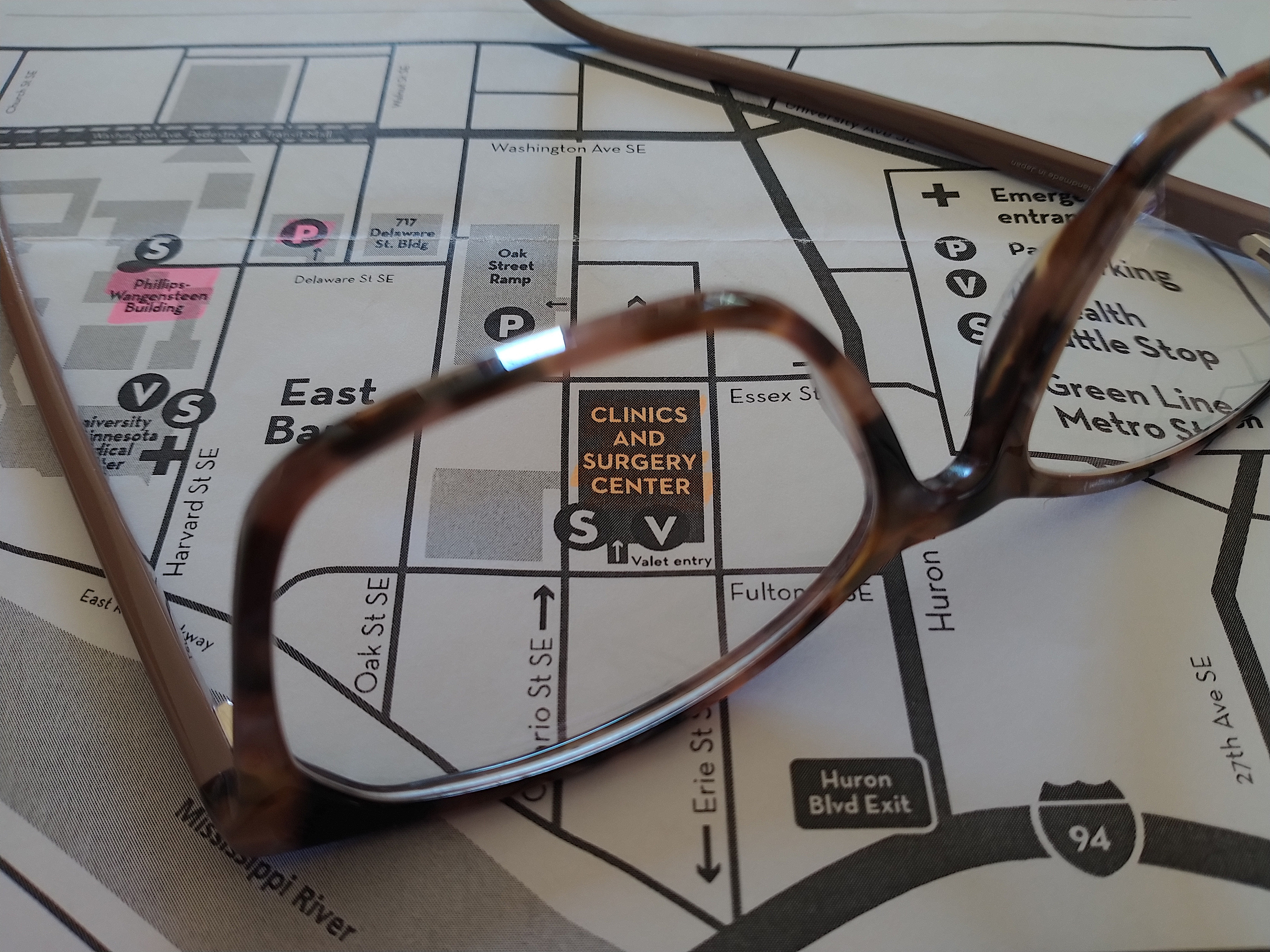
A lens on my new prism-free prescription eyeglasses circles the surgery location in Minneapolis. (Minnesota Prairie Roots copyrighted photo February 2024)

“I’M SO HAPPY IT’S OVER.” That, Kat told me, was my first statement post January 22 bilateral strabismus eye surgery at M Health Fairview Clinics and Surgery Center in Minneapolis. I don’t remember saying those words. But I don’t doubt my recovery room nurse.

After a 1 ½-hour surgery to realign my misaligned eyes, I was still groggy. Yet, Kat noted, I was coming out of general anesthesia quickly and well. For that I felt thankful. Not everyone handles anesthesia without side effects.

Given my emerging level of alertness, I don’t recall timelines or all conversations. But I do remember the kindness of Kat. And kindness is key when you’re coming out of surgery.

There was no vodka in the recovery room (nor did I want any; I seldom drink hard liquor). (Minnesota Prairie Roots copyrighted photo February 2024)

HERE, HAVE A DRINK

In addition to compassion and care, Kat gave me food and drink. It was well after lunch and I hadn’t consumed anything (except a few sips of water with Tylenol right before surgery) for many hours. Typically I get hangry when I don’t eat on time. Ask my family. Kat brought cranberry juice along with soda crackers and graham crackers and then ginger ale which she suggested I mix with a second cup of cranberry juice, a cocktail without the vodka. (I think Kat mentioned vodka, but maybe I did.) I shared that my Bible study group has a signature cranberry drink, sans the alcohol. Kat kept a watchful eye on me. I hope she didn’t notice that I didn’t particularly like cranberry juice and ginger ale mixed. Too sweet for me.

But I appreciated the sweetness of my caring nurse, who moved to Minnesota from Missouri, who was named Katherine, called Kathy by her mom and then called Kat in college. Kat suits her, even if she owns three dogs, not cats. More on that later.

At some point, before my surgeon came to see me in recovery, Kat suggested I change from my lavender paper gown into my street clothes. I was all for that. She removed my hospital slipper socks and then helped slip my socks and shoes onto my feet. Can’t have a just-out-of-surgery patient getting all lighted-headed by bending down. I managed the rest of dressing myself, proving I was becoming more alert, alert for the next step in surgery completion.
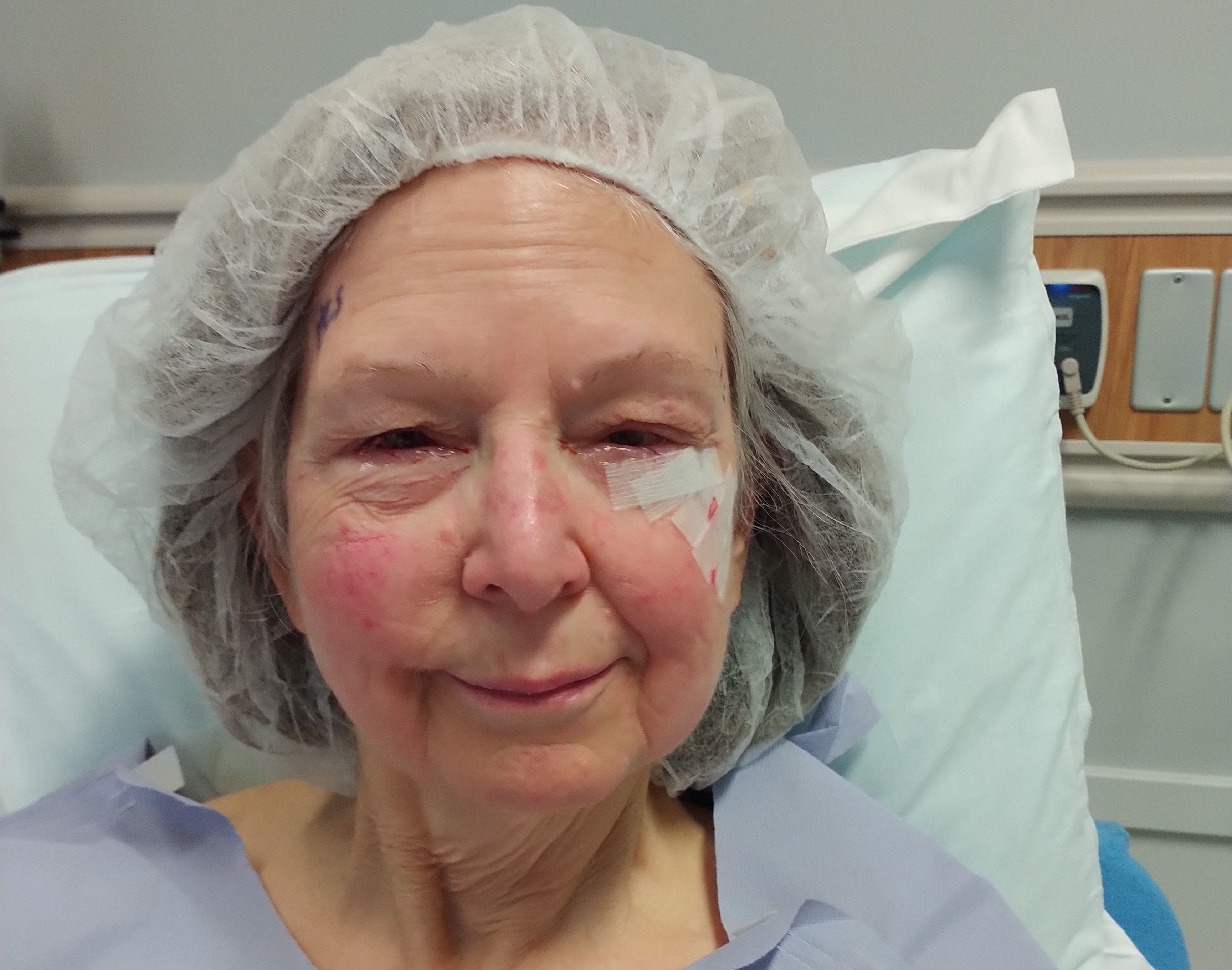
In the recovery room after eye muscle alignment surgery. (Copyrighted photo by Randy Helbling, January 22, 2024)

LOOK AT THAT “E”

Enter my neuro ophthalmologist surgeon, Dr. Collin McClelland, and a second doctor who had been in the operating room. I dreaded this moment when Dr. McClelland planned to tweak his work by pulling an adjustable suture stitched into my left eye.

Alright then. Look at that E across the room. Do you see one or two? Two. (He did some other vision checks, not just with the E, during the alignment process.) After my surgeon dropped a topical anesthetic into my left eye, he removed the steri strips adhering the suture onto my cheek. He hovered over me, his tools and face a blur. Don’t move. Look up to the left. You’re going to feel a tug. Yup. I did. OK, let’s check that E again. One or two? Two. OK, we need to do this again. Tug. Pain. You’re doing great. Check the E for the third time. Mostly one. OK, I’m going to leave it. And then my doctor worked to tie and cut that suture, simultaneously encouraging me with his gentle voice. You’re doing great. The adjustment process took 20 minutes and was made easier by my kind surgeon.

A section of a 1974 album cover from my collection. (Minnesota Prairie Roots copyrighted photo February 2024)

WE’RE OFF TO PROM

Kindness. I felt that in the care I received at M Health Fairview Surgery Center. Skilled care that came with humor and compassion and distractions that enabled me to manage eye muscle surgery. Kind Kat remained after Randy left to get the van from a nearby parking ramp. She escorted me to the restroom, our arms linking as if we were going to prom, Kat said. We needed a song, perhaps John Denver’s “Sunshine on My Shoulders,” theme for my 1970s era prom, I suggested. We laughed, Kat and I.

But I wasn’t laughing when we returned to my recovery room and I noticed Randy’s cellphone and charger lying on a chair, hidden beneath a tote bag. He was supposed to call when he reached the patient pick-up spot. But Randy was long gone, so I grabbed his phone and charger. Then Kat wheeled me onto the elevator that carried us downstairs to await Randy’s arrival, “old people” wrap-around sunglasses protecting my eyes. Thanks, Kat, for the (un)fashionable eyewear.
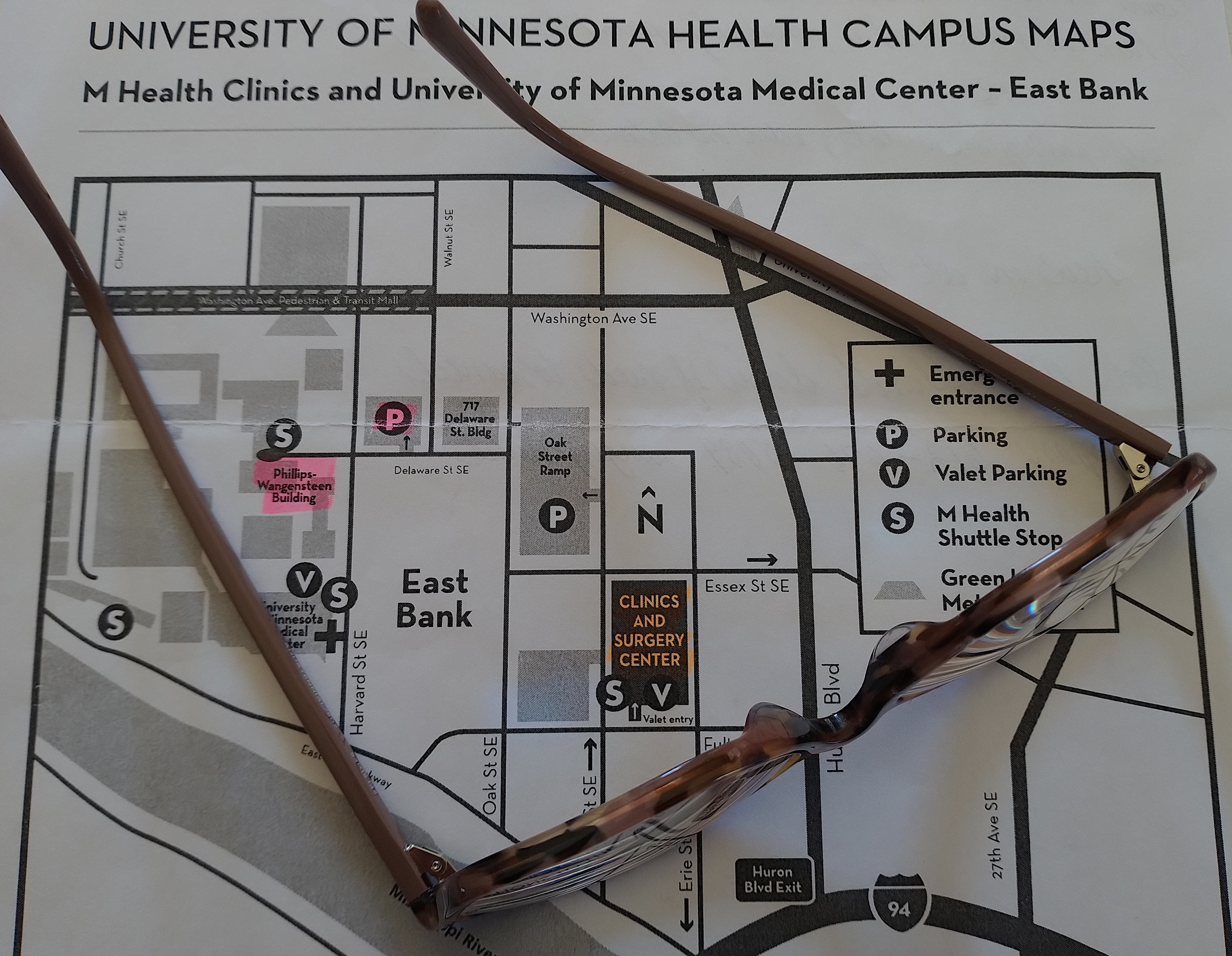
I’m becoming familiar with these two locations on the campus of the University of Minnesota in Minneapolis. (Minnesota Prairie Roots copyrighted photo February 2024)

THE LONG MINNESOTA GOODBYE, SORT OF

I expected Randy to simply drive up. He didn’t. Rather, he retraced his steps in an attempt to find his phone. Kat called someone to clarify I had his phone. As we waited, I grew restless. I just wanted to go home. Kat sensed that, pulling out her phone to show me a picture of her three dogs. Not cats. I appreciated the momentary distraction.

Eventually, Randy arrived and Kat steered me to our van, guiding me into the passenger seat. Then she hugged me. That loving gesture filled me with happiness, as if I was Kat’s sister rather than simply another patient. Happy despite the eye pain. Happy despite the long, exhausting day.

That happiness soon vanished as Randy took a wrong entrance ramp and we found ourselves aiming east toward St. Paul rather than west toward Minneapolis. I was in no mood for a longer trip, even if lengthened by only 15 minutes. But onward, back home to Faribault to rest and begin healing. Five weeks out, I am doing just that, continuing to heal. And I am remembering, too, the many kindnesses and the skilled care given to me by my compassionate medical team.

© Copyright 2024 Audrey Kletscher Helbling


Reflecting on pre-surgery anxiety & ways I coped February 20, 2024

Information about my eye muscle surgery. (Minnesota Prairie Roots copyrighted file photo 2023)

SURGERY. Most of us would rather not hear that word when it comes to our health. But sometimes surgery is necessary. I’ve had surgery nine times in my lifetime. I’m currently four weeks out from my second bilateral strabismus eye surgery (the first was at age four) to realign my misaligned eyes. Healing and recovery are progressing.

Nearing downtown Minneapolis, the route to M Health Fairview Surgery Center and Clinics. (Minnesota Prairie Roots copyrighted file photo)

Today’s post, though, is not about recovery, but rather about my January 22 surgery day. As a creative, I have stories to tell about my experiences at M Health Fairview Clinics and Surgery Center. Admittedly, I felt anxious as Randy and I aimed north along Interstate 35 to the surgery center about an hour away on the campus of the University of Minnesota in Minneapolis. I detest metro traffic, which added to my pre-surgery anxiety. But on this morning, traffic was not horrible.

Waiting is always the hard part. I waited at check-in behind an angry patient. We’d ridden the same elevator to the fifth level, but she got ahead of me because she knew where she was going. I did not. And so I had to stand there listening to her spew about how she’s never been called about whatever. Her voice volume increased. I felt increasingly frustrated by this hostile woman who should have taken her complaints elsewhere, not to the surgery check-in desk. She was not there for surgery. Finally, I bypassed her to another check-in station, wondering if the first employee would need to call security. This was not off to a good start.

I settled onto a green upholstered chair in a spacious room filled with people, most on their phones, waiting. A bank of tall windows revealed a sunny day. I heard persistent coughing on the other side of a waiting room half-wall, somewhat worrisome to me. I’d been screened for COVID symptoms, but Randy and other caregivers weren’t. That is typical of clinic screenings, it seems. But I digress.

Eventually, after I’d people-watched, tried to work a crossword puzzle, studied abstract fabric artwork, Tatenda called me to begin the process of preparing for surgery. That started with basic questions followed by depression screening. I am thankful this screening is now routine in healthcare and I told Tatenda that. And then I added, “But you didn’t ask about anxiety.” Anyone who says they aren’t anxious about surgery is, in my opinion, not being truthful. Thankfully, Tatenda and others who cared for me understand pre-surgery anxiety and helped ease mine.

One of my go-to Bible verses when I’m worried or anxious. This is displayed at my church, Trinity Lutheran in Faribault. (Minnesota Prairie Roots copyrighted photo February 2024)

There was one point, though, when I had to dig deep mentally to stop myself from fleeing a small room where I waited alone for the next step in surgery prep. Tatenda handed me a lavender paper gown, instructing me to change into that and pull on a pair of purple socks. Then she left. Do. Not. Leave. Me. Alone. I expected her back quickly. As the minutes ticked by, I felt my anxiety rising. I was cold, shivering almost, hugging my folded legs to my body for warmth. The over-sized, one-size-fits-all paper gown that smelled to me of antiseptic provided zero warmth. Maybe I should have wrapped it around my slim body twice. I attempted to calm myself by repeating the words of Psalm 46:10: Be still…be still…be still…

Eventually nurse Amanda arrived and connected a hose to my lovely lavender gown, a hose that blew air inside to either warm or cool me. She explained how I could turn a switch to adjust the temperature. It was a game-changer not only for my comfort level, but also in giving me control. Of. Something.

Signage on The Pearl, a popular ice cream spot in downtown La Crosse. (Minnesota Prairie Roots copyrighted file photo 2015)

As Amanda searched and poked twice for an adequate vein to start an IV, we talked. Conversation distracts me. This nurse, the same age as my eldest daughter, and I chatted about her hometown of Potosi, Wisconsin, where I’ve been to the brewery; our love of La Crosse (and The Pearl ice cream shop); motorcycles; and then how I met Randy and where we went on our first date. “Stir Crazy,” I replied. The movie starring Richard Pryor and Gene Wilder. Amanda said she would ask Randy the same when she brought him to see me shortly before surgery. When he answered “Blazing Saddles” to the first date question, I told Amanda that he was an imposter, that she needed to find my real husband. We laughed. Humor helps.

Once Amanda left, the anesthesiologist and neuro ophthalmologist surgeon arrived for last-minute briefings and questions. I was ready. Soon I was being wheeled down a hallway toward the operating room. I remember nothing until I awoke 1 ½ hours later in recovery. That is another story…please check back for more storytelling.

TELL ME: If you’ve had surgery, how did you cope with pre-surgery anxiety? How did others help ease your anxiety right before surgery?

© Copyright 2024 Audrey Kletscher Helbling
 

Update: My eyes are aligned February 5, 2024

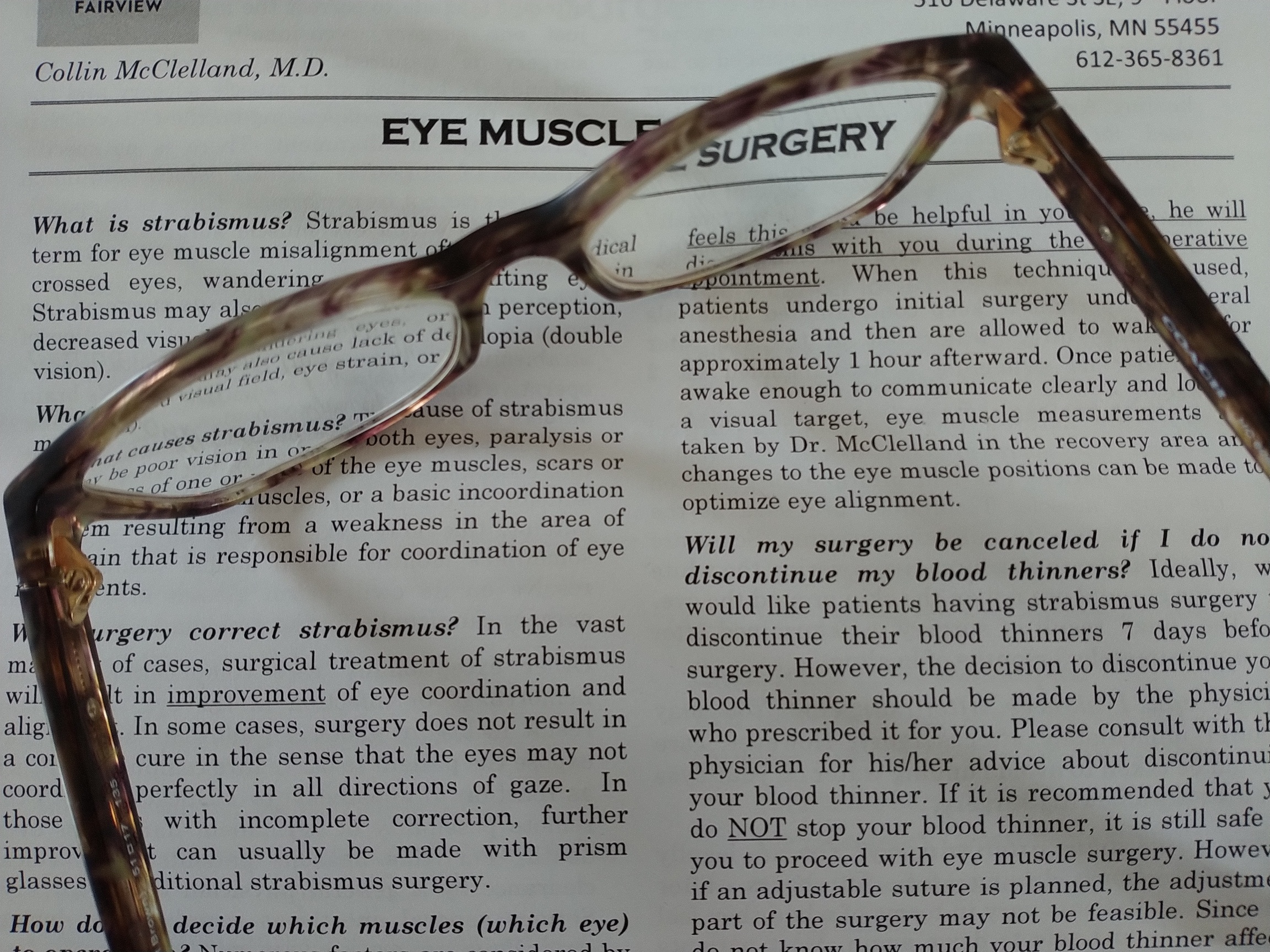
My old glasses with prisms atop information about bilateral strabismus eye surgery. (Minnesota Prairie Roots copyrighted file photo November 2023)

TWO WEEKS OUT from bilateral strabismus eye surgery at M Health Fairview Clinics and Surgery Center in Minneapolis, my vision is looking good, pun intended.

Neuro ophthalmologist Dr. Collin McClelland was pleased with the results of his 1.5-hour surgery on my eyes. I saw him and his team last Wednesday for my post op visit. My previously misaligned eyes are now in full alignment. In three to four months, I should know the final outcome. Eyes can shift yet as muscles heal and my brain adapts to the new alignment.

Updated glasses (minus prisms) and updated eyes, nine days after surgery. (Copyrighted photo by Randy Helbling)

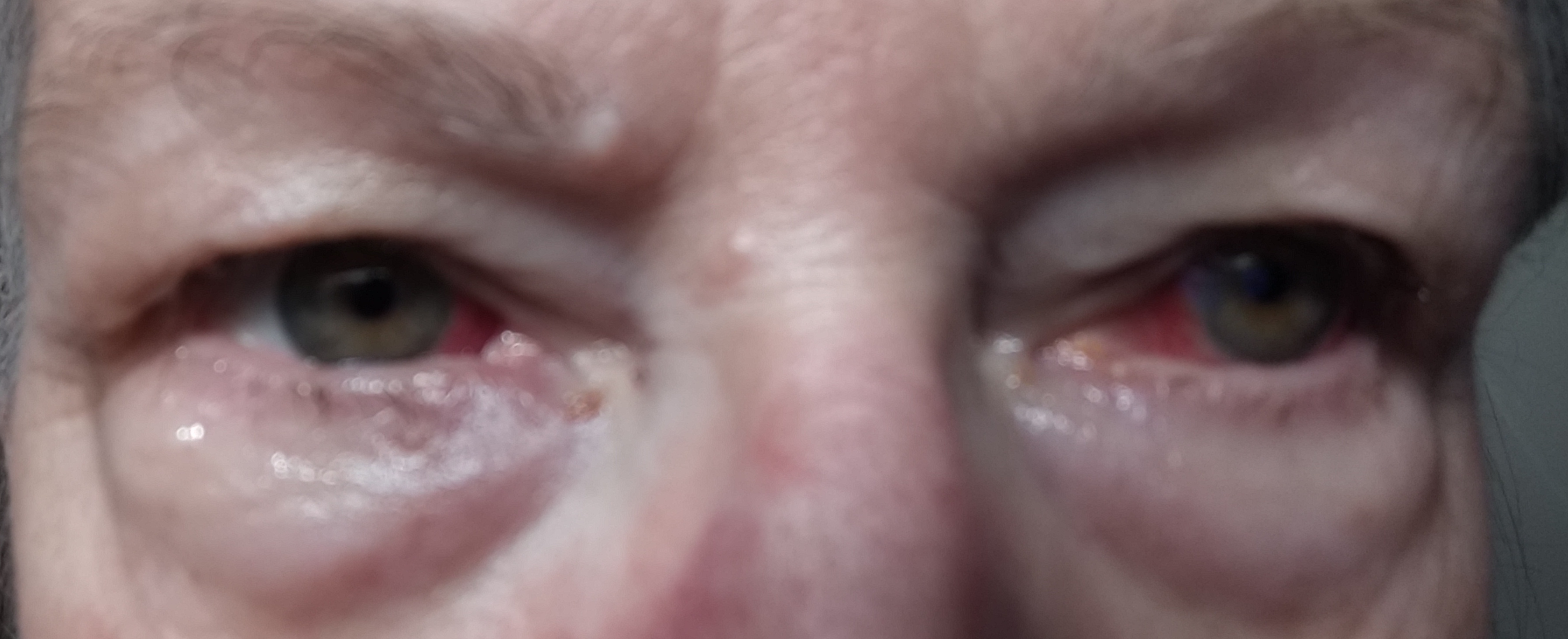
This is a process, this recovery and healing. I can tell my brain is working hard to adapt to my new way of seeing the world. My eyes remain red, irritated and itchy. But I am looking less ghoulish each day with my eyes no longer leaking fluid and blood. Time, healing, ointment and eye drops have all helped.

Mostly gone is the double vision which led me first to my local ophthalmologist late last summer and then to the specialist at the University of Minnesota in Minneapolis in October. Today I see double only upon awakening and for a while thereafter and when I’m overly-tired. That compares to more often than I could count pre-surgery. That is reason to feel thankful.

As you may expect, I arrived at my post-op visit with a list of questions, tasking Randy to take notes as I focused on eye checks done by two doctors and another medical staff member. Yes, the exams were repetitive and exhausting. But I appreciate the thoroughness of the post-op evaluations.

I won’t get into the medical details of my surgery, not that I understand them anyway. But I learned that Dr. McClelland worked on two muscles in my right eye and one in my left to realign my eyes. He had to work through extensive scar tissue from this same surgery done in 1960 by Dr. Theodore Fritsche in New Ulm.

This is what I looked like shortly after surgery in the recovery room. If you look closely at my left eye, right above the steri strips, you’ll see a black thread taped to my skin. That’s the end of the adjustable suture. (Copyrighted photo by Randy Helbling. I asked him to take the photo, not realizing how awful I looked.)

Perhaps the most intriguing part of my recent surgery is the adjustable sutures stitched into my left eye. That’s exactly what it means. Adjustable. During recovery, when I was alert enough to focus on a big letter E across the room, Dr. McClelland tweaked the alignment based on what I saw. Twice he had to pull on the sutures to move my left eye into alignment. I’m thankful for the topical anesthetic eye drops that semi dulled the pain and for my inability to clearly see what he was doing. I could only see the blurry movement of his hands and what I think was a tweezers. I will admit the tug on my eye felt unsettling.

Several days post-surgery, I was already looking better. It’s difficult to see my red eyes in this image. But trust me, they were still very red. The flowers are from my dear children, sons-in-law and grandkids. (Photo credit: Randy Helbling)

But here I am today, two weeks out from all of that. Each day brings some improvement in the physical appearance of my eyes and in the way my eyes feel. I still feel, though, like a pebble is stuck in my right eye. That, my surgeon explained, is likely the end of a suture irritating my eye. I asked him to clip it off. Of course, I was joking because I realized he couldn’t possibly do that. But I had to bring some humor into the post-op exam room where medical residents listened, observed and learned.

Healing takes time and patience. Not only do my eye muscles need to heal, but my brain needs time to adjust. I’ve learned a lot about the brain in the past year since developing neurological issues from COVID and undergoing six months of vestibular rehab therapy, finishing that less than five months ago. My brain, an amazing and complex organ, is still trying to manage all that goes into it.

Beth, a blogger friend from Michigan, sent this handcrafted get well card, which made me laugh aloud. I love it and all the other cards and wishes I’ve received. (Minnesota Prairie Roots copyrighted photo 2024)

Now with this recent eye surgery, I must limit screen and reading time. I learned this past Saturday that shopping is like physical therapy for my eye muscles and brain. My eyes hurt and I felt exhausted after grocery shopping and stops at Books on Central, Eclectic Alliance and a Big Box retailer. Eyes move a lot when you’re looking at items on store shelves. I overdid it.

My vision is not crystal clear and is sometimes blurry and distorted. I haven’t attempted photography yet, except with my cellphone. Putting anti-inflammatory drops into my eyes four times a day to reduce inflammation has proven challenging. I can’t seem to master that skill. I am thankful for Randy’s help.

Meanwhile, I am wearing prescription glasses without prisms. Before surgery, no number of prisms would correct my double vision. To see such improvements so soon after surgery leaves me feeling grateful to my surgeon and this team—for their knowledge, their skill and their compassion.

#

NOTE: I am grateful also to you, my blog readers, for your support and encouragement offered in the comments section and in get well cards I’ve received. You’ve lifted my spirits. Thank you.

© Copyright 2024 Audrey Kletscher Helbling

 

The healing power of smiles & laughter January 29, 2024

Filed under: Uncategorized — Audrey Kletscher Helbling @ 5:00 AM
Tags: , , , , , , , , ,
(Minnesota Prairie Roots copyrighted file photo 2018, used for illustration only)

A WEEK OUT FROM BILATERAL STRABISMUS eye surgery to realign my eyes, I am feeling like most people post-surgery. I want this healing and recovery process to move faster. I feel as if I’ve stalled after an initial sprint. So it goes.

In the meantime, this past weekend brought some much-needed laughter into my life. Laughter is healing. It was also the theme of Global Game Jam, a week-long world-wide game development event. My son, who lives and works half a country away in greater Boston, participated, working with three others to create the video game “Addicted to Laughter.” That followed the event theme of “Make Me Laugh.” I love that theme because we need more laughter in this world.

I’ve personally needed extra laughter in the past week during my recovery. Laughter is a good diversion when dealing with eye pain/irritation, headaches, insomnia, distorted/blurry/double vision and a brain that is working over-time to adapt to my newly-aligned eyes. Yes, side effects should lessen, but in the meantime…

Photo I took of the DVD collection

Randy and I have been binge-watching a DVD collection of Blue Collar TV sketches by comedians Jeff Foxworthy, Larry the Cable Guy and Bill Engvall. Some of the content is more redneck and offensive than I like. But all in all, the trio made me laugh. Kudos to Randy for choosing this when I asked him to “find something funny” to check out from our local public library. I’d rather be reading, but my ability to read for any length of time is currently limited.

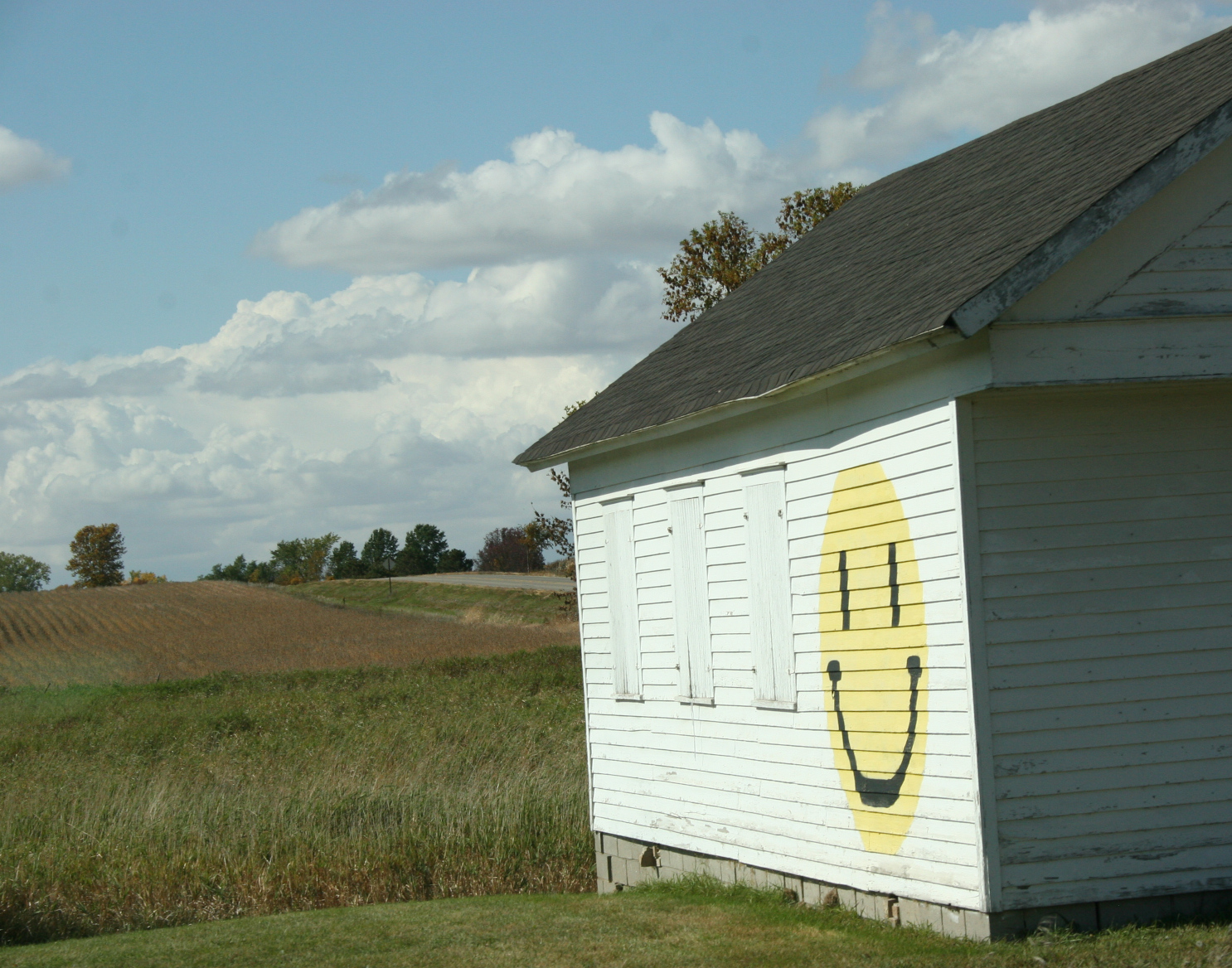
A smiley face has long graced this building near Roberds Lake, rural Faribault. (Minnesota Prairie Roots copyrighted file photo)

But I have read, and appreciate, the many get well cards I’ve received, including one from my cousin Diane. It’s sunny yellow with smiley face art. Simply reading the words and seeing all those printed smiley faces make me smile and laugh aloud at some of the statements (like turning cartwheels) in this “The Healing Power of the Smiley Face” themed card. And, bonus, I’ve always loved smiley faces and once had a vivid yellow smiley face bulletin board hanging in my lime green basement bedroom with candy striped carpet. Ah, sweet memories of teenage years…

“Tranquil Garden Bouquet” had me smiling broadly Thursday afternoon. (Photo credit: Randy Helbling)

I must sidetrack here for a moment to share that my dear family of three adult children, two sons-in-law and two grandchildren sent me the most stunning flowers Thursday afternoon. I cannot begin to tell you how much that bouquet and the enclosed message lifted my spirits. I felt as if a million smiley faces were floating in a thought balloon around my head.

I felt the same late Saturday afternoon after a visit from dear friends Tammy and Billie Jo. I haven’t seen Tammy in several years; she and her family moved to northwestern Minnesota. When Tammy walked in the kitchen door, we embraced in a fierce hug. And I realized just how much I’ve missed her. I nearly cried at the joy of seeing her again. And so the three of us talked and laughed and talked and laughed and talked and laughed. Laughter heals.

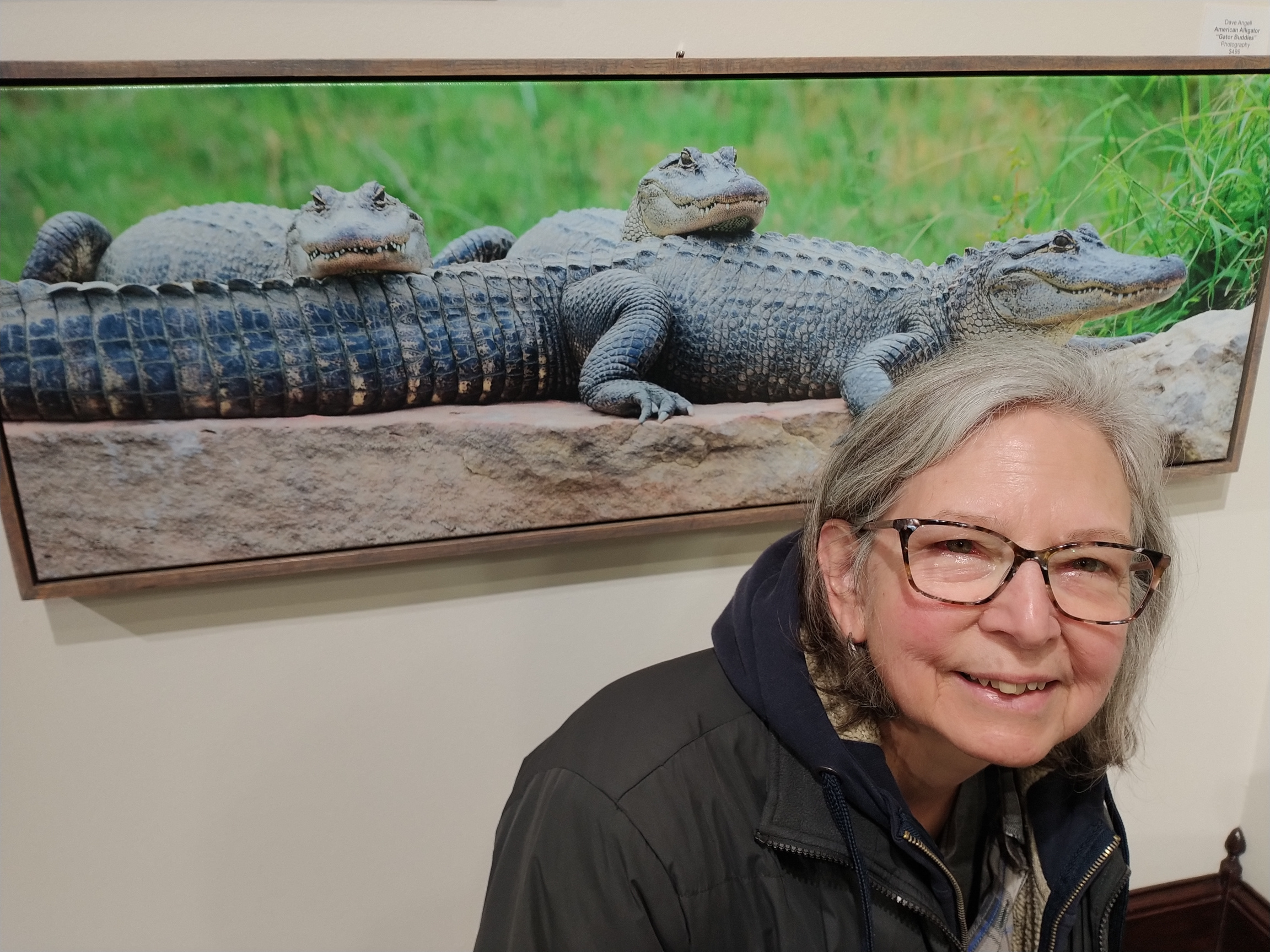
Me, five days after eye surgery, posing in front of Dave Angell’s photo of alligators in Africa. (Photo credit: Randy Helbling)

My grandkids often make me laugh with their observations. Isaac, 5, didn’t let Grandma down after I texted a photo to his mom, my eldest daughter Amber, on Saturday. The day prior, Amber sent an image of Isaac outside the crocodile exhibit at the Minnesota Zoo. So when Randy and I viewed an exhibit by Faribault wildlife photographer Dave Angell at the Paradise Center for the Arts Saturday morning, I knew I needed a photo of me with Angell’s photo of alligators in the wilds of Africa. (Angell’s one gifted photographer.)

Isaac was not impressed by my efforts. “Those aren’t real!” he told his mom. I read his response and laughed aloud. Laughter heals. Oh, yes, it does.

© Copyright 2024 Audrey Kletscher Helbling

 

A post eye surgery update January 24, 2024

Not a good photo at all…but this gives you an idea of what my eyes look like. Randy took this pic Tuesday afternoon. (Minnesota Prairie Roots copyrighted photo January 2024)

TWO DAYS OUT from bilateral strabismus eye surgery at M Health Fairview Surgery Center at the University of Minnesota in Minneapolis, I am looking less Frankenstein’s monster than I did. Not that I look exactly like the fictional monster created by Dr. Victor Frankenstein in Mary Shelley’s novel. But I feel like I appear as ghoulish with my red, fluid-leaking eyes.

All humor aside, surgery to correct my eye misalignment went well. Neuro ophthalmologist Dr. Collin McClelland and his team performed the 1 ½-hour surgery on both eyes Monday morning with adjustable sutures stitched in my left eye. Post surgery, Dr. McClelland pulled the left eye stitches to tweak the alignment before tying them off. Yes, I was awake. Yes, it was painful.

On surgery day, the surgeon was pleased with results. Healing, time and my brain adjusting to my new vision will determine the final outcome. But I am optimistic that my double vision will be mostly, or totally, eliminated.

In the meantime, I’ve dealt with pain managed by over-the-counter meds and have tried to rest my eyes. For someone who likes to read and write, it’s a challenge to limit both. But when my eyes hurt, I’m relieved to shut them.

Finally, last night, I slept well. Each day brings improvement. Less pain. Less blood and fluid seeping from my eyes. Healing takes time and patience.

Randy has been a great support along with serving as resident nurse and pharmacist. He squeezes ointment into my eyes thrice daily to prevent infection. I struggle with putting anything in my eyes and would likely misjudge and stab my eyes with the ointment tube. I can’t have that happening.

Occasional blurry vision and double vision, especially upon awakening in the morning, continue. My eyes feel gritty. This is not unexpected. My eyes have been through a lot of trauma with this surgery. The surgeon found extensive scarring in both eyes from this same surgery done in 1960 by Dr. Theodore Fritsche in New Ulm. Dr. Fritsche’s corrective repair of my misaligned four-year-old eyes lasted 60-plus years. If my new surgeon’s work lasts that long, I will be good to go.

Onward.

#

FYI: I will continue to limit my screen time as I recover. But feel free to leave comments because I will read them at some point. I likely will not reply, though. I appreciate all of the support, encouragement and prayers from you, my dear dear readers. Thank you.

Once I’m feeling better and am able to write more, I will share more about my surgery day experience. I assuredly have stories to tell (once a journalist, always a journalist) from my time at M Health Fairview, where I received excellent and compassionate care.

© Copyright 2024 Audrey Kletscher Helbling
 

Seeing one, then two, then one, then two January 17, 2024

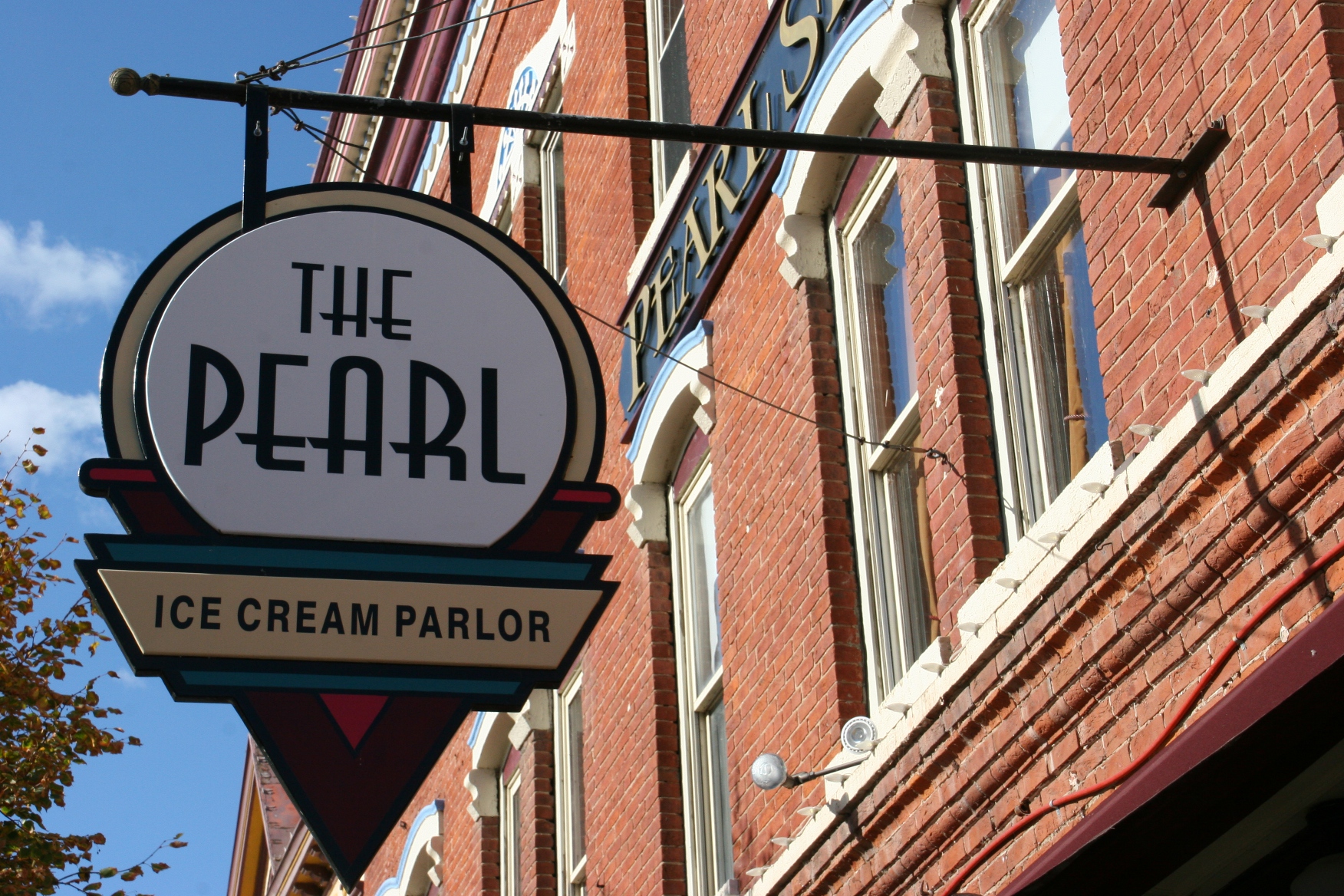
My current eyeglasses atop info about bilateral strabismus eye surgery. (Minnesota Prairie Roots copyrighted file photo November 2023)

THE EYES HAVE IT. Until they don’t.

Next week I undergo bilateral strabismus eye surgery at M Health Fairview Clinics and Surgery Center in Minneapolis. Basically, I’m having surgery to align my misaligned eyes. The neuro ophthalmologist will cut into the white of my eyes and then the muscles, tightening them into alignment using adjustable sutures. That’s the plan. Randy has advised me not to watch any online videos. I have no intention of doing so. Reading about this surgery is more than enough for me.

If you look closely at this image, you can see the patch covering my left eye. This 1960 photo of my mom, sister Lanae and brother Doug was taken on a rare family vacation to the North Shore near Duluth, Minnesota. (Photo sourced from my personal photo album)

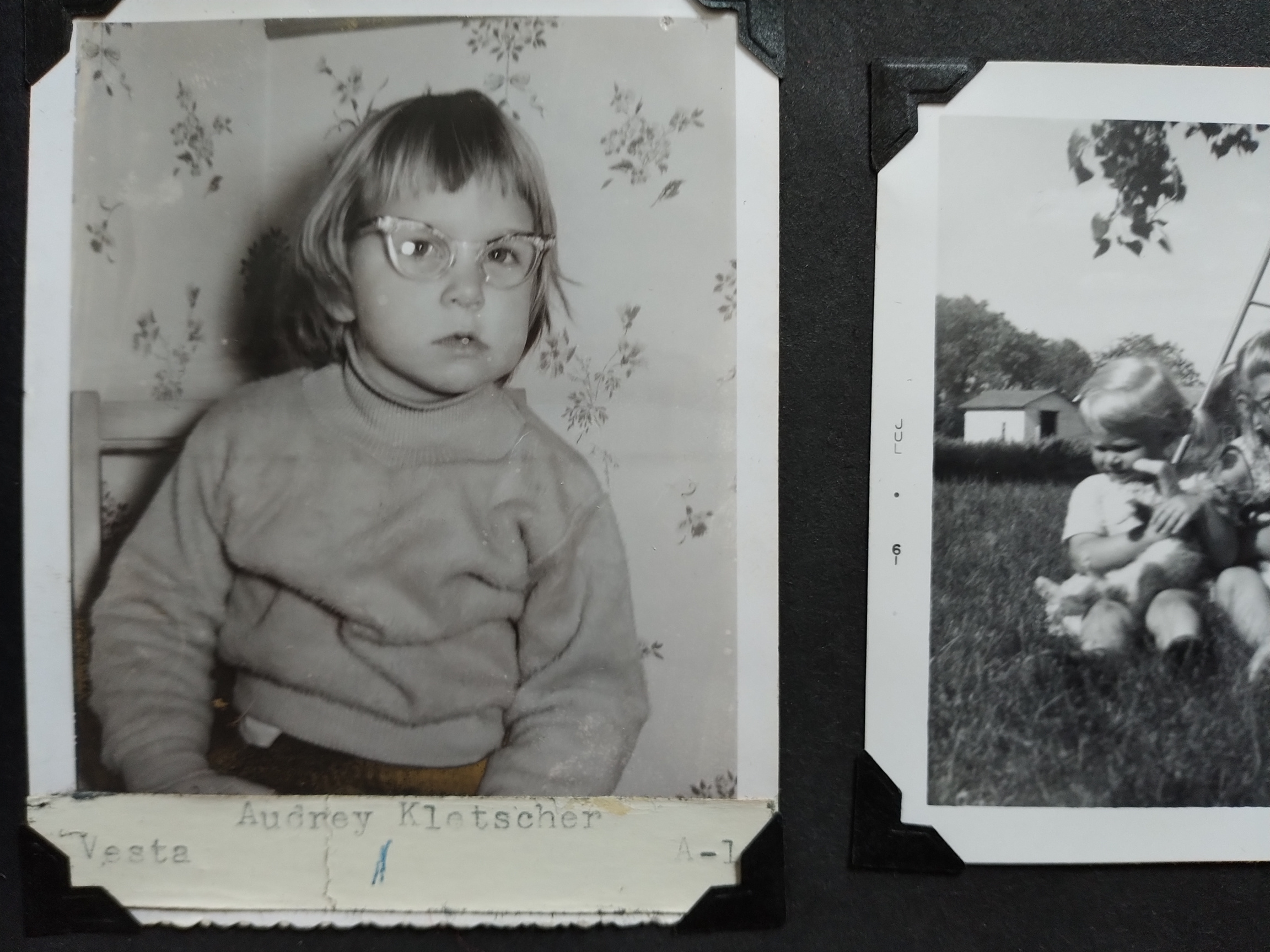
The thing is, I’ve had this surgery before. Sixty-three years ago. I was just four, cross-eyed and needing medical intervention to correct my vision. Patching my lazy eye didn’t work. So my parents took me to a specialist in New Ulm 60 miles away from our southwestern Minnesota farm. Eventually, ophthalmologist Dr. Theodore Fritsche would do corrective eye surgery at Union Hospital. I will always be grateful to this surgeon and to my parents for recognizing I needed help or I likely would have gone blind in one eye.

I remember little about that long ago surgery except drinking tomato juice at the hospital and looking at books. The books I understand. But tomato juice? I like it now, but didn’t as a preschooler. I also remember getting orange circus peanut candy as a treat from the dime-store following my numerous appointments. I’ve blocked any other memories.

Fast forward to today and how I got here, on the brink of another corrective eye surgery.

As my neuro ophthalmologist explains, my eye muscles loosened through the decades, shifting my eyes into misalignment. My brain was compensating for the most part until I experienced neurological issues following a January 2023 viral infection suspected to be COVID. (I self-tested negative twice.) The niggles of double vision which had bothered me for a few years, mostly in the evening when I was tired, worsened. COVID messed up my brain function and communication between the brain and my eyes was misfiring. In the past year, it’s become increasingly difficult to only see one, even with prisms in my prescription lenses. Trying to see only one taxes, exhausts, me. Sometimes I can’t read. Sometimes I close one eye simply to eliminate the double vision. It is getting to be too much.

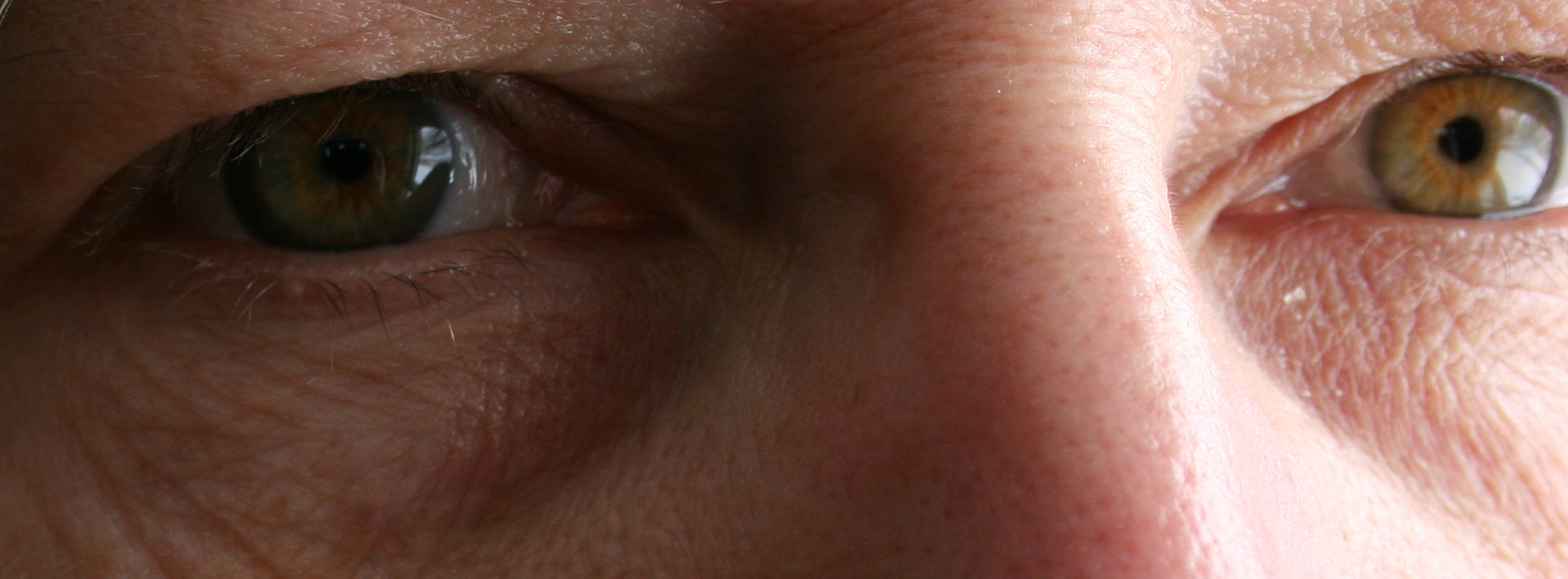
My green eyes up close pre double vision. (Minnesota Prairie Roots copyrighted file photo)

Once I completed 5 ½ months of vestibular rehab therapy to retrain my brain and help me deal with the devastating affects of long haul COVID, I was ready to see a professional about my double vision. I started locally. I went into an August ophthalmology appointment optimistically thinking I could simply get a new pair of prescription eyeglasses with more prisms added. Not so. As the ophthalmologist held up prism after prism to my eyes, it became clear nothing in his trays of prisms would effectively improve my vision. I was, he said, beyond his realm of expertise and would need to see a specialist.

After a several-month wait, I saw the neuro ophthalmologist at M Health Fairview in late October. Following 2 ½ hours of exhaustive testing, of looking through prisms and layers of prisms, I understood that I was well beyond the corrective lenses with prisms option. I would need surgery.

A childhood photo of me taken at an optometrist’s office in Redwood Falls. (Photo sourced from my personal photo album)

So here I am after another long wait—three months this time—on the cusp of bilateral strabismus eye surgery. I just want to be done. I am hopeful this outpatient surgery will fix my eyes and eliminate my double vision. Am I scared? Yes. The idea of undergoing general anesthesia and having a surgeon cut into my eyes and eye muscles is frightening. If only I could zoom back in time to my 4-year-old self who remembers nothing but books, tomato juice and circus peanut candy.

#

FYI: If I’m absent from blogging for a while, it’s because I’m resting my eyes, recovering from surgery. I’ll be back, hopefully no longer seeing double.

© Copyright 2024 Audrey Kletscher Helbling


Onward into 2024 with morning walks, oatmeal & chocolate chips January 4, 2024

Raspberry chicken salad, one of the best salads I’ve eaten, at the Amboy Cottage Cafe, Amboy, Minnesota. (Minnesota Prairie Roots copyrighted file photo)

FOR MANY OF US, these early January days prompt thoughts of embracing a healthier lifestyle. Eating better, exercising, losing weight, reducing stress and more top lists. But taking this from ideas to action requires determination and hard work.

If you live in a cold weather climate like me, getting motivated and active during the winter can prove challenging. Just the thought of bundling up to go outdoors makes me wish for warmer, sunnier days. This time of year, I’d rather snuggle under a fleece throw and read.

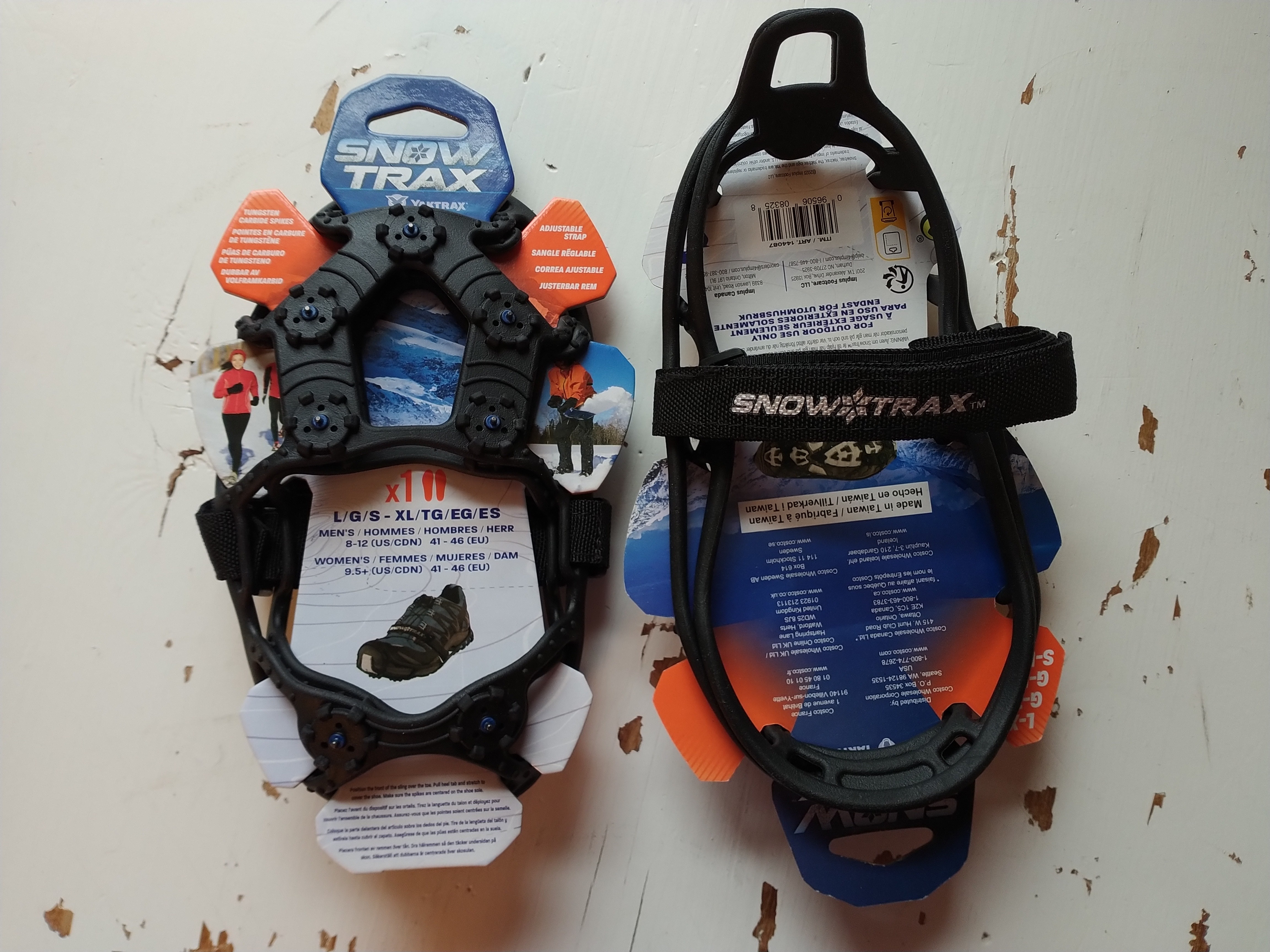
These as yet unused grippers will go over my snow boots to keep me safe on snowy and icy surfaces. (Minnesota Prairie Roots copyrighted photo January 2024)

But I’m determined in 2024 to work harder at appreciating winter. I won’t be taking up downhill skiing or ice skating. But I am open to trying cross country skiing and snowshoeing decades out from my last attempt at either. I’ll leave ice fishing for the die-hard anglers. And I can certainly walk/hike, especially now that I have clamp-on Snow Trax with tungsten carbide spikes for gripping snowy and icy surfaces. I have not yet tested them to see if they actually work as promised. We’ve had only minimal snow and ice. Of one thing I’m certain. I can’t risk falling and breaking a bone. Not at my age, which is closing in on 70.

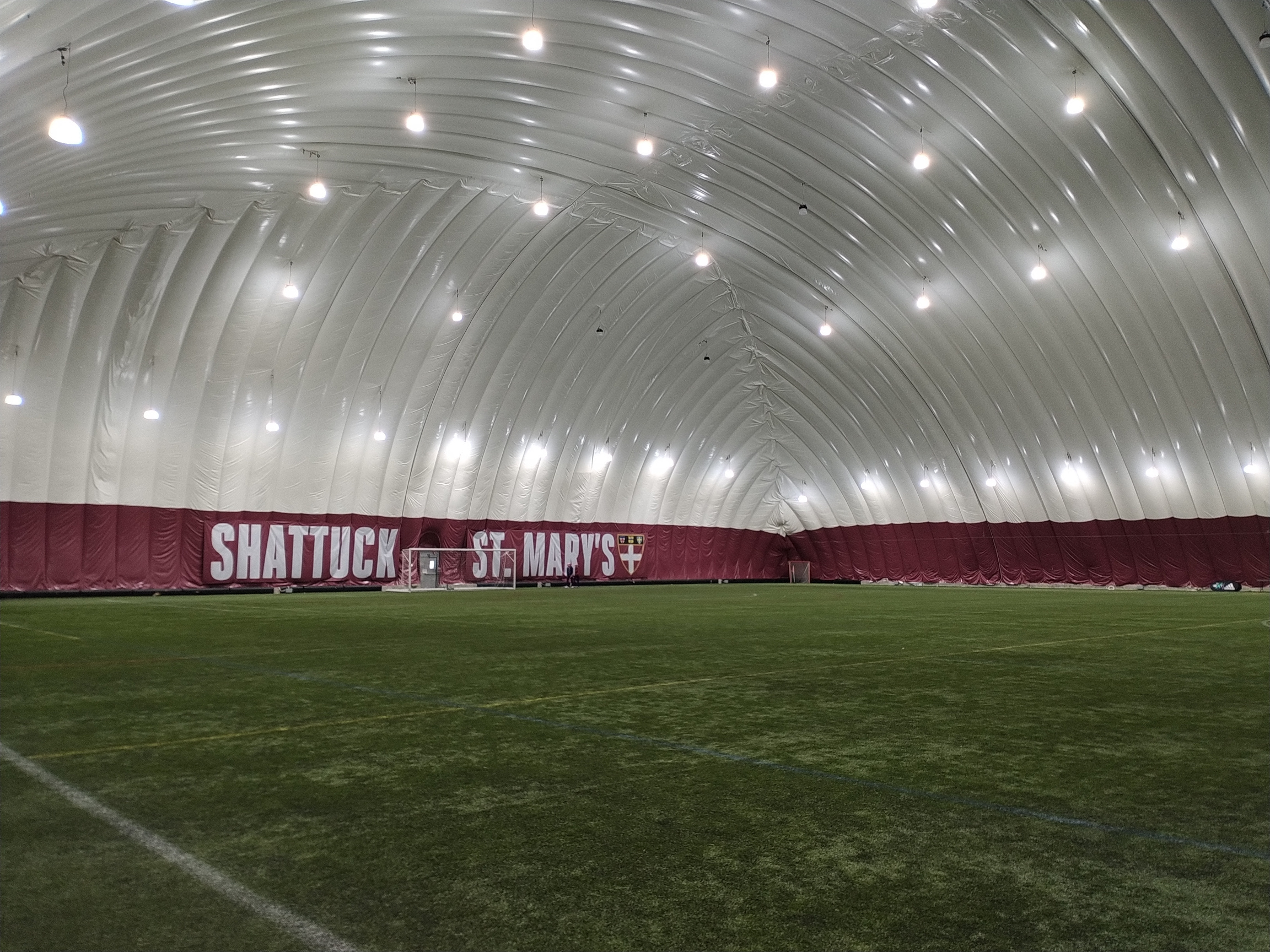
Inside the Shattuck-St. Mary’s soccer dome. (Minnesota Prairie Roots copyrighted photo December 2023)

If I really want to play it safe and simultaneously stay warm, I can walk indoors. Shattuck-St. Mary’s, a private college prep school on Faribault’s east side, opens its dome to the public from 6:10 – 9:30 am weekdays for running and walking. Five loops around the soccer field perimeter equal about a mile, the distance Randy and I typically walk. It’s truly amazing that I can go this far given six months ago I could barely manage to walk a block due to the affects of long haul COVID.

The curving Straight River as photographed from the Straight River Trail, Faribault. (Minnesota Prairie Roots copyrighted photo February 2023)

On days when temps are not horribly cold and the wind is calm, I much prefer walking outside. There’s something about being outdoors, in nature, that is more relaxing, calming than in an indoor environment. I like the feel of sunshine on my face, even the crisp air, and the sight of twisting river and bare trees and a sometimes bold, blue sky. Last time walking at the Minnesota State Academy for the Deaf campus, 10 deer stood statue still watching Randy and me as we stood statue still watching them. I felt such joy in seeing this wildlife in the heart of my community.

Pre-long haul COVID, I was lifting 12-pound weights. I’ve resumed lifting weights, but not 12 pounds yet. (Minnesota Prairie Roots copyrighted photo January 2024)

Walking and weight lifting, along with taking Vitamin D and getting sufficient calcium in my diet, are ways I am improving my health, too, specifically my bone health. Dairy has always been an important part of my daily food in-take given I grew up on a dairy farm. I like lifting hand weights. I feel empowered and stronger. With a family history of osteoporosis, my own diagnosis, two past broken bones and my tall, thin frame, I take bone health seriously.

Then there’s diet beyond dairy. If one good thing came from developing long haul COVID in 2023, it was losing 25 pounds. Granted, I wouldn’t recommend this weight loss plan. But I’m happy to have a current body mass index of 20.7, which is on the lower end of my “normal” weight range.

Oatmeal laced with fruit is my typical breakfast. (Minnesota Prairie Roots copyrighted file photo 2014)

I find I no longer crave sweets as much as I once did. With the kids long gone from home, I seldom bake. I eat a bowl of old-fashioned oatmeal with fresh fruit added nearly every morning and have done so for many years. It took several weeks of eating oatmeal for the grain to grow on me. In the back of my head, I remembered how much my father-in-law disliked oatmeal, so much so that he stuffed oatmeal into his pockets at Catholic boarding school. Not quite sure how he managed that as a young lad under the watchful eyes of the nuns.

Flamin’ Bleu pizza from Pizzeria 201 in Montgomery, Minnesota. (Minnesota Prairie Roots copyrighted file photo)

I try to eat smaller portions, avoid junk food and bread, and eat plenty of fruits and vegetables (which I love). Admittedly, I also love pizza, a grilled cheese sandwich, cheesecake, ice cream, etc. and don’t deny myself foods that aren’t necessarily “good” for me. It’s about portion control. Have a small scoop of ice cream, not several. On occasion, I’ve been known to devour a handful of dark chocolate chips when I’m craving chocolate.

Seldom do I dine out, for two reasons—cost and my inability to tolerate noisy environments due to sensory issues from long haul COVID. I’ve only eaten out a handful of times in the past year. Twice I left because I couldn’t manage the noise. While I appreciate restaurants, I recognize that such dining can lead to overeating and consuming calorie-laden foods because, who isn’t tempted by French fries?

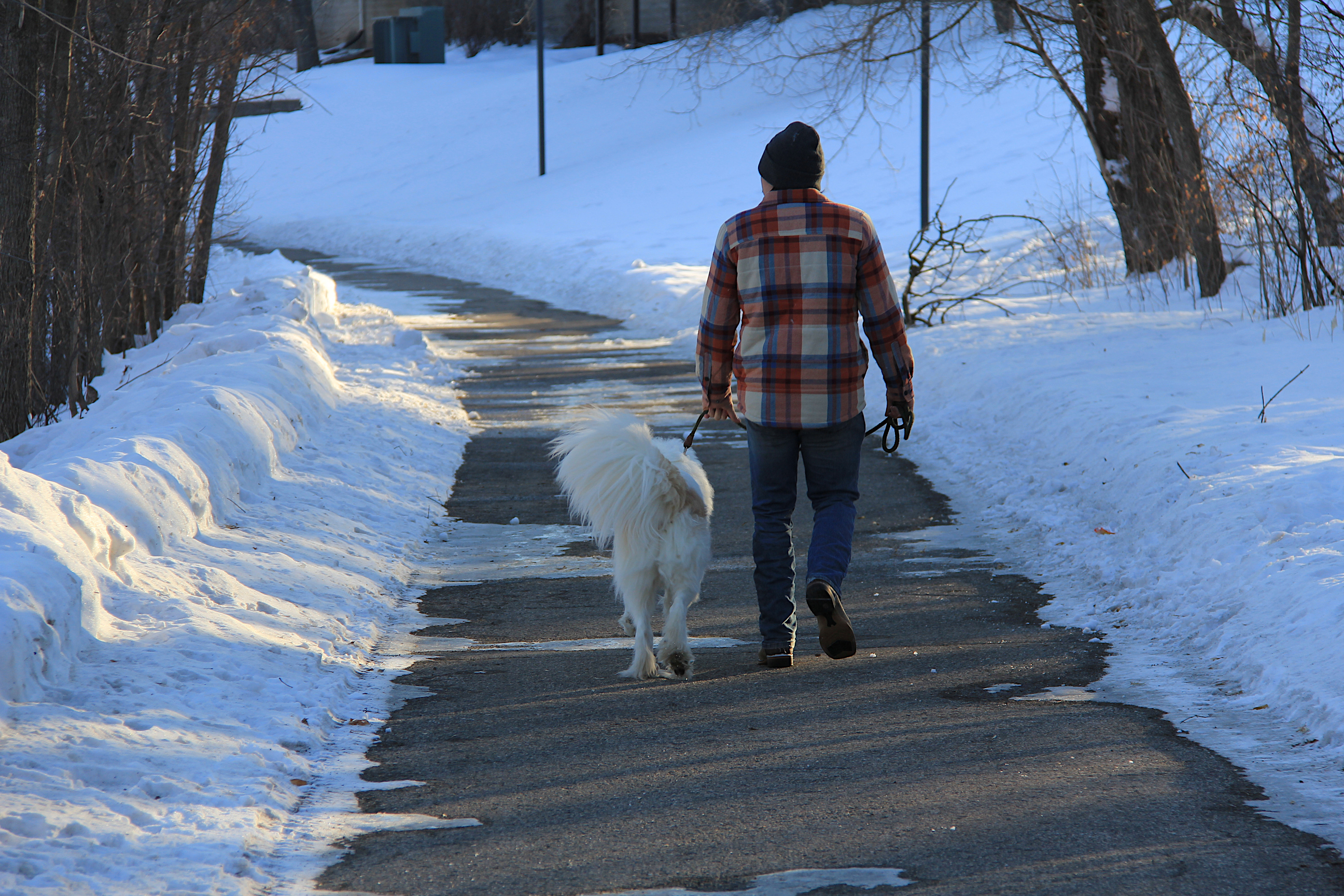
Walking is one way to reduce stress. Many communities have trails, perfect for walking even in the winter. This photo was taken along the Straight River Trail near Fleckenstein Bluffs Park in Faribault. (Minnesota Prairie Roots copyrighted file photo February 2023)

Reducing stress is perhaps my biggest challenge. I tend to worry, to ruminate. And that is unhealthy. I’m getting better at letting go, at lessening demands on myself, on understanding that life never has been, and never will be, perfect.

#

TELL ME: What do you do to stay healthy? What goals have you set for 2024?

© Copyright 2024 Audrey Kletscher Helbling
 

Onward with hope post-COVID November 30, 2023

Filed under: Uncategorized — Audrey Kletscher Helbling @ 5:00 AM
Tags: , , , , , ,
My great niece Keira painted this HOPE stone, which sits on my office desk. (Minnesota Prairie Roots copyrighted file photo)

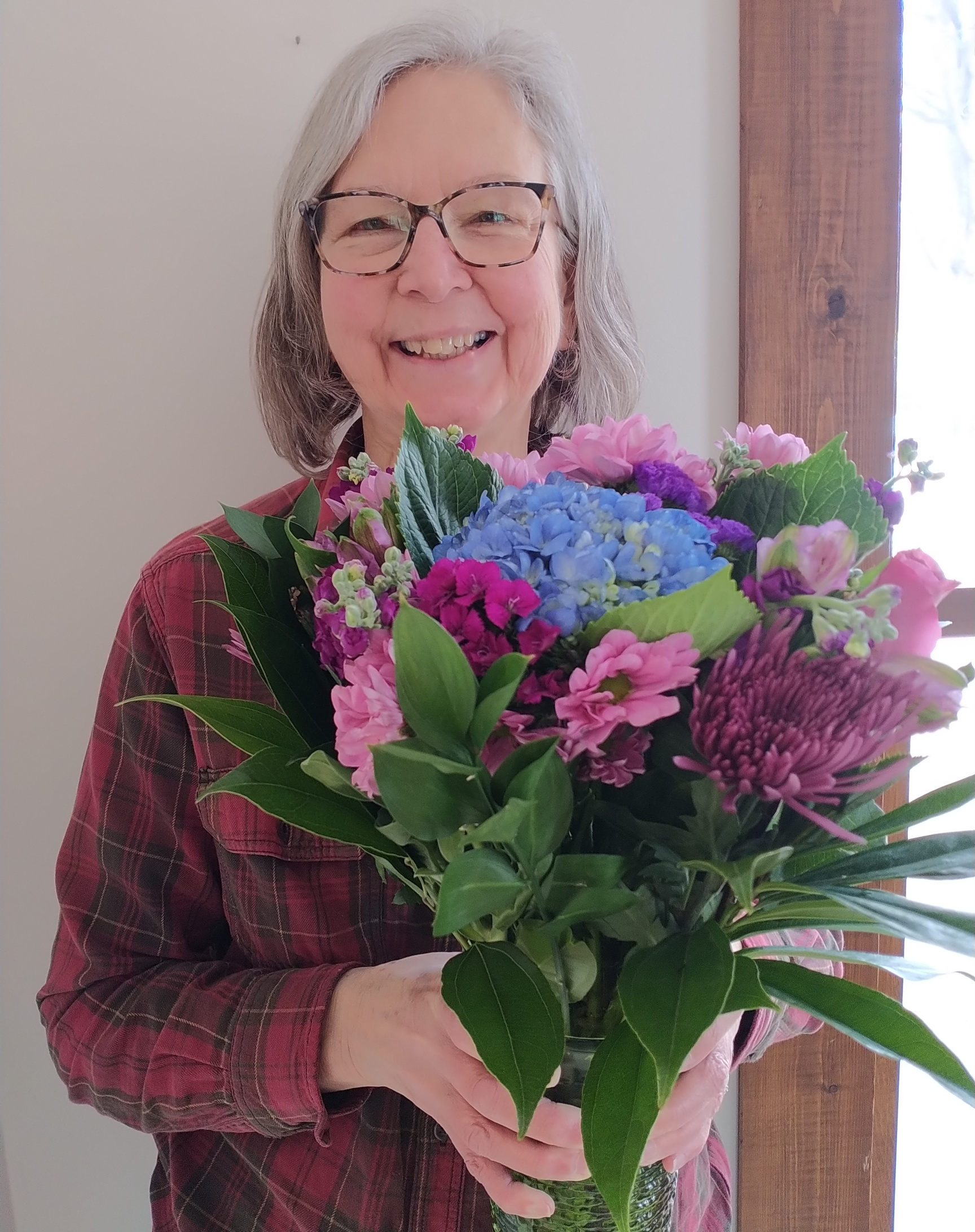
I HADN’T PLANNED on writing a third post related to my health issues following a case of suspected COVID in early January. But then blog readers shared their experiences with the virus and I felt compelled to write more, to offer insights and, most importantly, hope.

In this sharing of stories in the circle of my blog, I’ve learned that some of you have endured symptoms similar to mine. Keith in New York City. Diane in Iowa. And then Beth in Michigan with an altered sense of smell.

In the aftermath of COVID infections, there’s still much to learn. I quickly recognized that during my struggles and also via your stories. Answers don’t come easily. Help can be elusive. Frustration and despair set in and it’s a challenge to be heard, to remain hopeful. Telling our stories is important, necessary.

I received this book in the mail, sent anonymously by a reader. The book and note made me laugh and uplifted me when I really needed uplifting. (Minnesota Prairie Roots copyrighted file photo)

THE NEED FOR VALIDATION, FOR SUPPORT

I remember telling my physical therapist, Ryan, early on that I felt unseen because I was dealing with unseen neurological issues few seemed to understand. But when he compared my symptoms to those of someone with a traumatic brain injury, I felt validated. That’s all I needed, an affirmation that this was real, not just in my head. But it literally was in my head, in my brain.

My sister-in-law Rosie, who endured two concussions following falls, was (and is) among my biggest encouragers. She understands my symptoms, especially my inability to tolerate sensory overload. Having a key empathetic person is, in my opinion, vital. Likewise core family support is essential.

This quarter-sized token, gifted to me by my friend Beth Ann many years ago, lies on my computer desk. (Minnesota Prairie Roots copyrighted file photo)

GETTING HELP & SETTING GOALS

But personal support only goes so far. I am fortunate to have a primary care doctor who listens, shows great compassion, admits when he can’t help me, and referred me to specialists. My many office visits extended well beyond the allotted 20 minutes. Vestibular rehab therapy set me on a course to better health. I started therapy in mid-April. That continued weekly until mid-September. Therapy worked in retraining my brain, in helping me manage my symptoms.

On my final day of therapy in September, I told my therapist that I had three immediate goals: to get my hair cut, to return to worship services at church and to dine in a restaurant. Within two months, I accomplished all three with varying degrees of success. I share this to offer hope.

Here’s how I managed: I alerted my hair stylist to my sensory issues pre-appointment. Donita turned off the salon music and took care overall to minimize sensory input. Worship has proven a bit harder, especially managing the organ music, which often assaults me like a tsunami. Even with an ear plug, I struggle. I’ve learned that my brain struggles most in the early mornings and evenings and in busy environments. Restaurant dining remains challenging, although I managed in a quiet chain restaurant. I have yet to try a homegrown, noisy restaurant.

Inspirational and honoring words are embedded in mosaic tile at a memorial in Faribault. (Minnesota Prairie Roots copyrighted file photo)

HOLDING HOPE

There is hope. Always hope. It is, and has been, my go-to word through many struggles in life. For any of you struggling with post-COVID health issues, I hope I have offered you hope, or at least validated what you are experiencing.

These mini cards were a gift from Roxy, a blog reader from Owatonna who has been one of my strongest encouragers. I have sent these cards to others in need of support, passing along the gift of encouragement. (Minnesota Prairie Roots copyrighted file photo)

WAYS TO ENCOURAGE

For those of you who know someone dealing with long haul COVID, please support your family member or friend. Listen. Mail a greeting card. Text or call with encouraging words. (All helped me mentally; thank you, readers.) What we are going through may not be seen. But it is real, all too real.

#

FYI: To read my first post, “How COVID changed my life,” click here. To read my second post, “Retraining my brain post-COVID,” click here.

© Copyright 2023 Audrey Kletscher Helbling


Retraining my brain post-COVID November 29, 2023

This art by Faribault middle schooler Mohamed depicts how my brain felt post-COVID. (Minnesota Prairie Roots copyrighted file photo)

IT’S BEEN A JOURNEY. That best summarizes the path I’ve been on since January to reclaim my health. It’s been difficult, stressful, taxing, challenging, emotional and often overwhelming. But I was determined to do what I could to reach a better place health-wise in the aftermath of unconfirmed, but suspected, COVID.

This was a virus which messed with my brain, my neurological system, leaving me with a long list of debilitating symptoms. Prior to COVID, I was healthy, medication-free, living a normal life. And then…everything changed. (Click here to read my initial post about how COVID affected me.)

My route to managing long haul COVID began with my medical team, including my compassionate primary care doctor who listened, who admitted when he couldn’t help me, who referred me to specialists, who handed me tissues when I cried in the exam room. He never gave up on me. Nor did my vestibular rehab therapist.

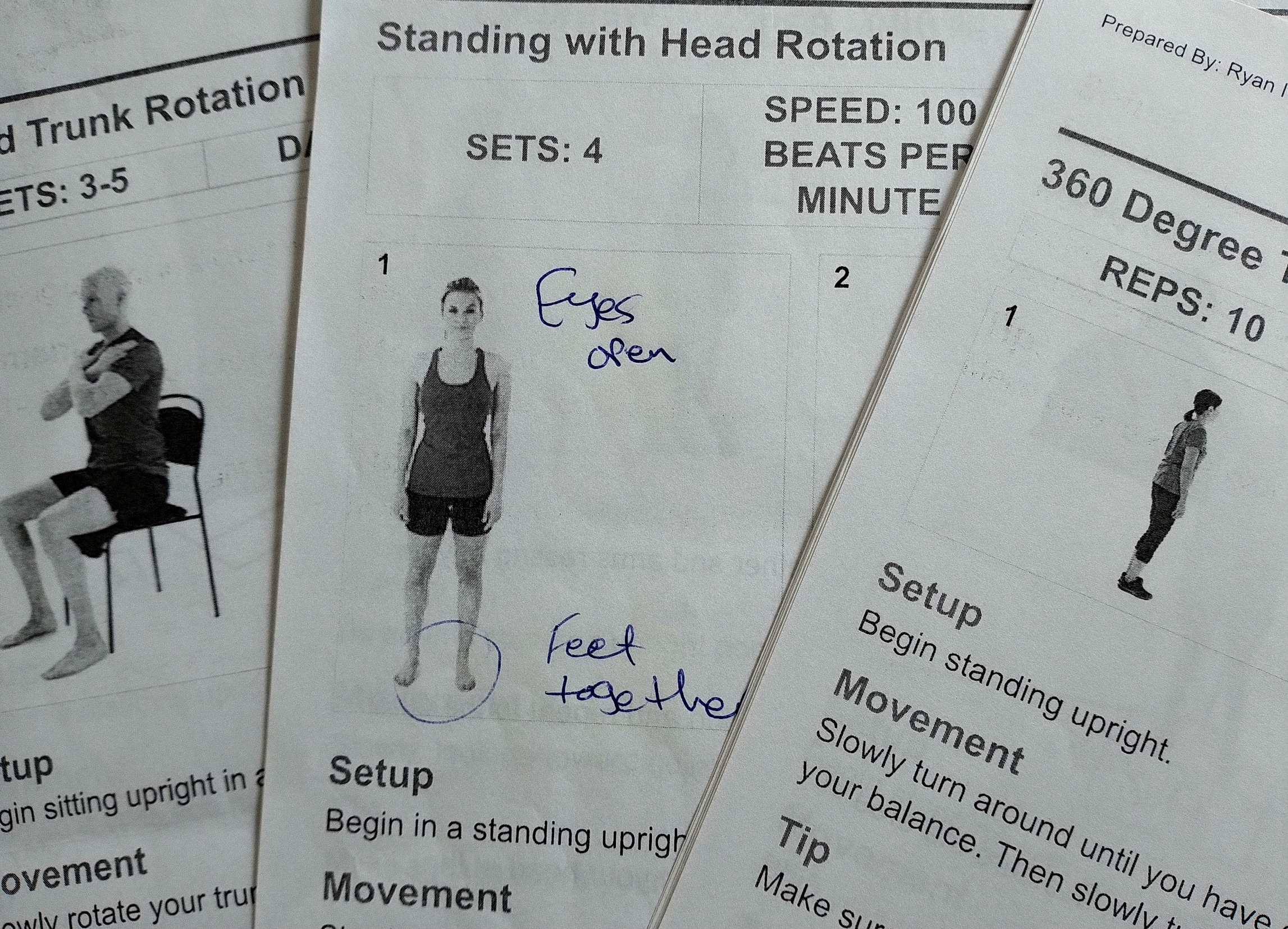
Some of the exercises I did in vestibular rehab therapy. (Minnesota Prairie Roots copyrighted photo November 2023)

VESTIBULAR REHAB THERAPY, MY ROAD TO RECOVERY

I credit my physical therapist, Ryan at Courage Kenny Rehabilitation Institute in Faribault, for leading the way in my recovery. He has extra training in vestibular issues. From the get-go, Ryan encouraged me, worked with me, supported me, showed deep care and compassion. Those went a long way in empowering me to work hard. And that I did.

During those initial once-a-week visits with Ryan, I barely managed conversation with him. I would mostly close my eyes and listen as he told me how we would work first on overcoming my balance problems. And then I would do as he instructed. Simple things like turning my head while seated. Then trunk rotations. Then turning my head while walking. Soon rotating while walking. Moving my hands back and forth aside my head while listening to white noise. I was building my tolerance for sensory input one exercise at a time. Retraining my brain. It took many months to progress through these seemingly basic exercises. But they were helping.

Each session Ryan gave me homework, which I faithfully did. I understood that no amount of therapy would work if I wasn’t willing to work hard at home. Soon he was encouraging me to get out, to try socializing. He even convinced me I could manage a mid-summer stay at a lake cabin, giving me coping tools to handle the long drive (close my eyes and wear ear plugs and sunglasses), to handle sensory overload (take breaks) and more. I managed that vacation get-away, but not easily. I remember the evening I snuggled next to my eldest daughter, put my head on her shoulder and sobbed, “I can’t do this any more.”

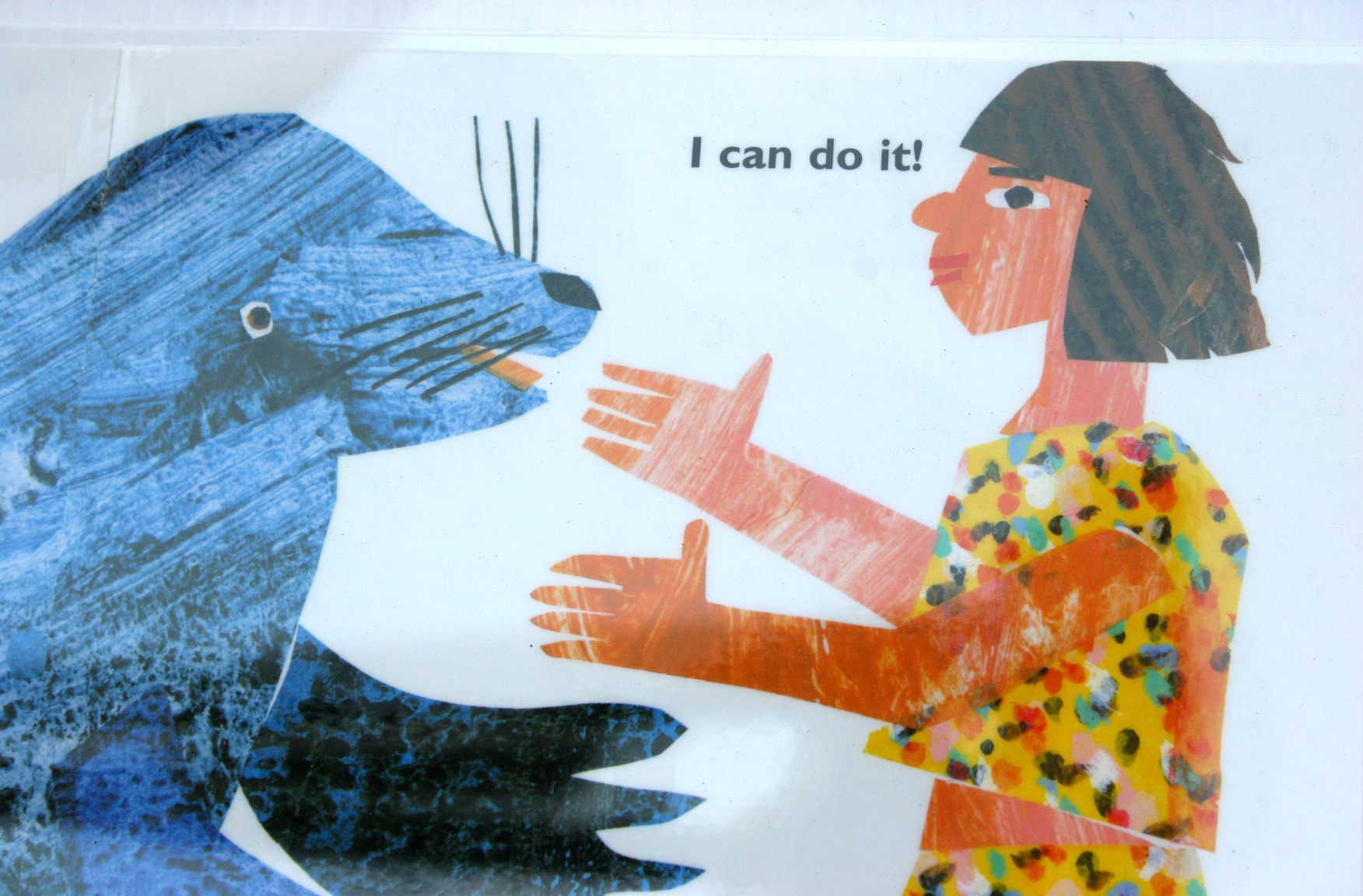
A page from Eric Carle’s book, “From Head to Toe” inspires me. (Minnesota Prairie Roots copyrighted file photo)

ENCOURAGEMENT IN THE MIDST OF DESPAIR

Many times I felt despair, as if I wasn’t making progress. Ryan assured me I was improving, even if I couldn’t always see it. I often felt, too, like no one understood what I was going through (although I’m sure that’s not true). But what I had was unseen, literally in my head. And when people can’t see, or make no effort to understand neurological issues, support lacks. That said, I had a core support group of friends and several sisters-in-law who gave me ongoing encouragement.

And so the months passed. Randy and our eldest daughter, especially, offered unconditional love and support that carried me through some of my darkest days. I wanted desperately to feel better, to have my old life back, pre-virus. By mid-September when I’d advanced to virtual reality roller coaster rides, my physical therapist deemed me ready to graduate. I was ready, yet I wasn’t. I would miss Ryan’s weekly encouragement.

Here I am today, two months out from therapy’s end. I am in a much better place than when I began vestibular rehab therapy in mid-April. I am out and about. Grocery shopping, attending church, speed walking a half hour daily, going to concerts, socializing… I still struggle if I overdo it, if I have too much sensory input. I rely on ear plugs to handle loud music. I close my eyes. Sometimes I have to leave a place or event. I am not the same as I was pre-COVID.

Up next, eye muscle surgery. (Minnesota Prairie Roots copyrighted photo November 2023)

UP NEXT, EYE SURGERY

In January, I will undergo bilateral strabismus surgery at the University of Minnesota to realign my eyes. It is a re-do of a 1960 surgery. As my neuro ophthalmologist explained, the eye muscles that were surgically tightened decades ago have loosened through the decades. Up until my neurological system was affected by COVID, my brain compensated. No more. I am seeing double, and not just when I read. Trying to focus my vision to see only one exhausts me.

But in the all of everything I’ve endured since January, I’ve made significant progress. I’m doing much better. Mostly managing. And that is reason to feel thankful.

© Copyright 2023 Audrey Kletscher Helbling
 

How COVID changed my life November 28, 2023

Filed under: Uncategorized — Audrey Kletscher Helbling @ 5:00 AM
Tags: , , , , , ,
Image of first coronavirus. Source: CDC.

IT’S BEEN A YEAR. No other words exist to define 2023, a year in which I’ve been overwhelmed by fall-out from a virus in early January. Although I self-tested negative twice for COVID, my primary care doctor suspects I did, indeed, have COVID given the neurological and other issues I’ve experienced since then. I fully agree.

This is my story, one that needs to be shared so that others understand just how viruses affect some of us. This story needs to be shared also to offer hope to others. This story needs to be shared, too, so that anyone who is ill thinks twice about going to work, the grocery store, church, concerts, family gatherings or elsewhere, thus exposing others to infectious diseases.

To tell my story, it’s necessary to give some background. In 2005, at the age of 48, I caught whooping cough. I was sick, really sick, for three months. Gasping for air sick. Coughing until my stomach hurt sick. Exhausted, unable to sleep. In 2011, I lost the hearing in my right ear due to a virus. My body, for whatever reason, does not handle bacterial and viral infections well.

And then came January 2023, and the virus that would change my life.

This artwork by Bill Nagel fits how my neurological system felt, still feels sometimes when I experience sensory overload. (Minnesota Prairie Roots copyrighted photo November 2023)

IN THE BEGINNING

Symptoms started with feeling off-balance, off-kilter, as if I was fighting the world just to be upright. I waited to see my doctor, thinking (like most of us do) that I would get better. I didn’t. I, in fact, got worse. I experienced a bout of vertigo, a rapid heart rate, high blood pressure, all new and troubling symptoms. I felt like I’d been slapped on the right side of my head, a feeling that persisted for many months. And when I tried to sleep, my legs practically ran a marathon in bed.

My primary care physician acknowledged early on that his ability to help me was limited. But he listened, tried…and sent me to an ear/nose/throat doctor for an evaluation. To even get through these medical appointments was a struggle. I had to close my eyes to converse. I felt overly-anxious and agitated, also new symptoms. I was, by then, feeling ear pain, fullness, pressure and tinnitus. I couldn’t sleep. My head hurt. My fingertips hurt. I couldn’t handle screen time. Eventually I would see a neurologist, undergo a CT scan, then an MRI of my brain to rule out a tumor or anything else. It was as if my body was being assaulted.

I felt overwhelmed. I struggled sometimes to find the right words. “Why can’t I talk?” I asked Randy. My brain seemed to be malfunctioning, misfiring, miscommunicating. My neurological system was under siege. My memory, which has always been stellar, was (and remains) affected.

This cool mint toothpaste set my mouth afire. For a while I brushed my teeth with baking soda, then switched to kids’ bubblegum flavored toothpaste. I only recently returned to using mint toothpaste. (Minnesota Prairie Roots copyrighted photo November 2023)

MAJOR SENSORY OVERLOAD

But the symptom which proved particularly debilitating was sensory overload. I couldn’t tolerate light or noise. I sat in the recliner, living room curtains drawn, body folded into the fetal position. No sound except the ringing in my own ears. I rocked 100 miles an hour, occasionally arose to pace the floor, stretched putty left from previous occupational therapy. Nothing calmed my body or mind. All I wanted was darkness, quiet, nothing stimulating entering my brain.

I struggled to get through Easter dinner at our house, missed my grandchildren’s birthday parties and a niece’s baby shower. Most heartbreaking of all was missing my son’s graduation with his master’s degree. I couldn’t handle the long road trip to Indiana, sit through the ceremony at Purdue. I couldn’t even manage grocery shopping; too much white noise from coolers and too much visual stimulation. Phone calls proved taxing, any conversation difficult. I was primarily housebound except for trips to the clinic and one to the ER following an allergic reaction to an unknown something. By then I’d been diagnosed with Meniere’s Disease and vestibular neuritis.

And then came the morning I brushed my teeth, the mint taste so overwhelming that I spit out the toothpaste. Rather than losing my sense of taste, mine intensified. For a week, until I saw my doctor (who added peripheral sensory neuropathy to my diagnoses) and got a prescription to settle my nervous system, I could eat only the blandest of foods. Oatmeal. Soda crackers. Graham crackers. I lost nine pounds in five days. Overall, I’ve lost 25 pounds this year. I’m OK with losing that weight, but don’t recommend this weight loss method. I went through a lengthy period of eating only a few bites of food at a meal.

All of this I experienced following COVID. Plus a rash and hair loss, either from the virus or from anti-anxiety meds. Nearly a year out from the virus, I am in a much better place. It took five months of vestibular rehab therapy, time and a lot of hard work to get here. Next up, I will write about retraining my brain, learning to manage my symptoms and how I found my way back to semi “normal.”

#

NOTE: I’ve been asked by several people whether the COVID vaccine caused my neurological and other issues since I am fully-boosted and vaccinated. No. My health problems began when I had that January virus, thought to be COVID. Had I not been vaccinated and boosted, I firmly believe I would have ended up in the hospital, perhaps even died. Negative comments about the vaccine and boosters will not be posted on this, my personal blog.

© Copyright 2023 Audrey Kletscher Helbling