Minnesota Prairie Roots

Writing and photography by Audrey Kletscher Helbling

I’d rather not be in Vegas April 6, 2011

I've lost 70 percent of the hearing in my right ear due to a sudden sensory hearing loss.

I AM NOT A RISK TAKER.

I’ve walked through a Minnesota casino twice and failed to pull a single lever on a slot machine or drop a single coin.

I prefer to play it safe, to not risk losing for the slim possibility of winning. It is the reason I don’t buy lottery tickets. I feel like I’m throwing away my money.

That is partially why a decision I am currently facing is so incredibly difficult.

Do I have surgery or not?

Will I be among the 25 in 100 who benefit from a sac round window graft? Even the name of the surgery is daunting. I don’t know enough right now about the outpatient ear surgery to decide.

But I have the statistics. For only one in four patients, the surgery successfully restores some hearing. But the percentage of hearing regained is perhaps only 20 percent. The slim possibility exists—about two percent—that the surgery could cause me to lose all of my hearing in my right ear. That really doesn’t matter given I’m basically deaf in my right ear anyway due to a sudden sensory hearing loss that occurred a month ago.

I currently have only 30 percent hearing in that ear. I hear only “noise,” nothing as distinguishable as a word. I also suffer from tinnitus, ringing in my right ear.

On Tuesday when I met with a renowned ear specialist in Minneapolis, I was presented with the surgery option. I was not expecting this, was not prepared with a list of questions. My immediate thought was this: “I don’t want to have more surgery.”

Already in my life, I’ve had seven surgeries, the first at age four to correct my vision. Since then, I’ve had oral surgery to remove my wisdom teeth, three Caesarean sections, inguinal hernia surgery and my last, total right hip joint replacement, not quite three years ago.

I am not anxious to rush into another surgery.

But time is of the essence. Apparently the sooner the surgery is done after the hearing loss, the better. I don’t understand why and I didn’t think to ask.

My doctor offered no recommendation on the surgery. I asked. He says he doesn’t recommend, only presents the options and information and allows the patient to decide.

I am at the point now of researching, pondering, praying, considering a second opinion, losing sleep over this decision.

What should I do?

Should I risk throwing away $3,000—my health insurance deductible? Should I risk not having the surgery if it could restore even a small percentage of my hearing? (A hearing aid will not help with the type of hearing loss I have.) Should I risk the risks that are always there whenever you have surgery?

I’m not a gambler. But right now I feel like I’m in Vegas.

© Copyright 2011 Audrey Kletscher Helbling


I can’t hear you March 31, 2011

Filed under: Uncategorized — Audrey Kletscher Helbling @ 8:01 AM
Tags: , , , , , , ,

COULD SOMEONE PLEASE answer the phone, turn off the radio and fix the potholes?

That isn’t going to happen. Not for me now, anytime soon or perhaps ever.

Welcome to my new world of ringing telephones, annoying transistor radios and bothersome potholes. I’ll explain after giving you some background.

Three weeks ago I suffered a sudden sensory hearing loss. One minute I could hear mostly fine in my right ear. The next minute it was as if someone had closed the door to my hearing.

At this point, why I suddenly lost 70 percent of the hearing in my right ear remains an unknown. It could be related to an ear trauma three years ago at a Wisconsin waterpark where a waterfall pounded my head. That caused permanent nerve damage, and some hearing loss, to my right inner ear. Or it could be the result of a viral infection, or something else.

Whatever the cause, I now have only 30 percent of my hearing in my right ear.

Thus, the ringing telephone, the transistor and the problem potholes have become issues for me. It’s not like I didn’t try to eliminate all three.

I tried a 10-day mega dose of inflammation-reducing steroids in an attempt to salvage some, if not all, of my hearing. The Prednisone didn’t work, only made me jittery, sleepless and emotional. I noticed no improvement in my hearing. The drug is typically most effective within 48 hours of symptom onset and my treatment started long after that.

I see a specialist next week to recheck my hearing and perhaps get some answers.

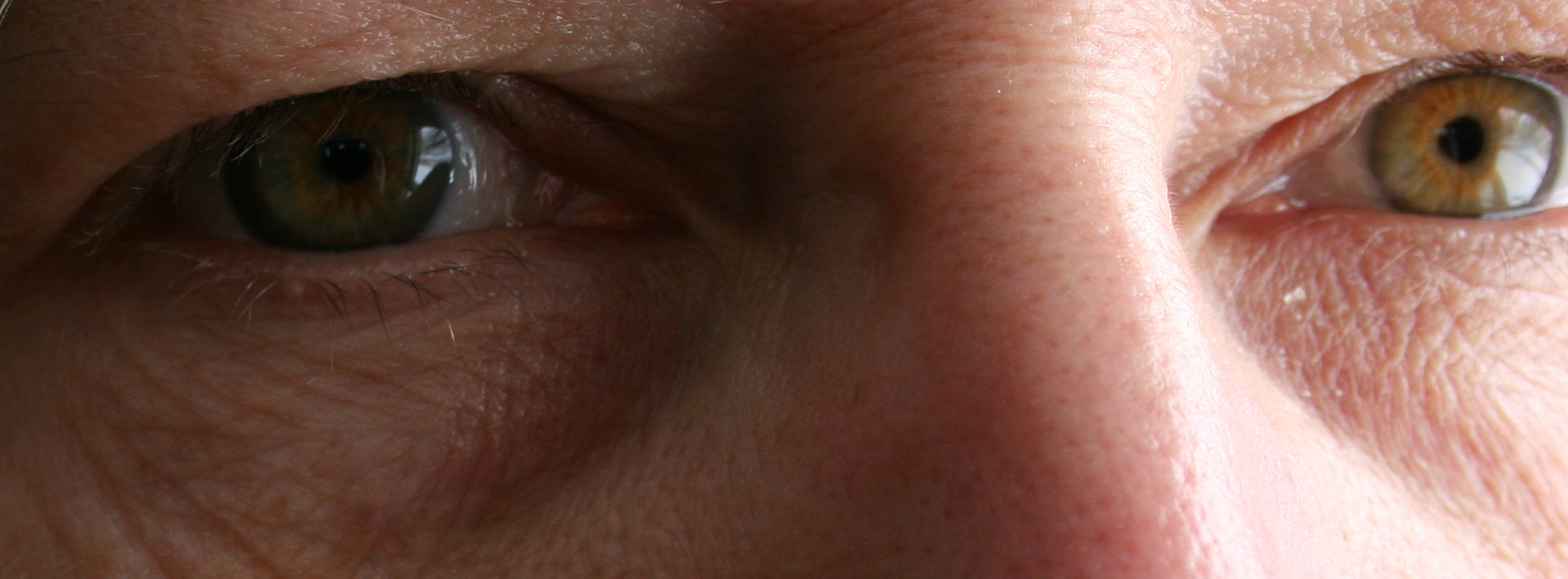
I took this photo of my eyes last week when I wasn't getting much sleep due to the effects of my steroid treatment. I'm still having sleep issues.

For now, I’ve accepted the fact that this is my new world of hearing. Sometimes the tinnitus is so bad that I joke to my husband, “Can you please answer the telephone?” Only problem, the telephone is inside my right ear.

As for the transistor, those of you old enough to remember transistor radios will also recall how they were often plagued by poor reception resulting in lots of static. I’m hearing that type of static now in my right ear more often than I like.

With my “bad” right ear I hear just “noise,” nothing as clear or distinct as an individual word.

Driving over an uneven roadway surface, like a pothole or a crack, hurts my ear with the thump echoing unpleasantly inside my ear.

I’m trying to adjust to this hearing loss. But, honestly, it’s not always easy. I can barely tolerate the organ music in church and singing isn’t too much fun any more.

My right ear, in which I've lost 70 percent of my hearing due to a sudden sensory hearing loss.

But most difficult for me, like anyone with a hearing loss, is the inability to clearly hear conversations. And for me, a blogger and writer, that’s a very big deal. I need to hear, and hear accurately.

All too often I find myself asking others to speak louder. I’m sure they’re thinking, “Why doesn’t she just get a hearing aid?” It’s not that simple. An audiologist and an ear/nose/throat doctor have told me that a hearing aid will not help, not with this type of hearing loss.

Put me in a room full of people, and I struggle to hear.

The other night while waiting in a check-out line at the grocery store, I was frustrated because I couldn’t hear everything the young male checker in the lane next to me was telling the bagger. He was offering her relationship advice, something about his fiancée who’d gone to college on the East Coast and who’d cheated on him. I caught the advice about hanging on to someone you care about and to, basically, not mess it up. It would have been a great blog topic, but I couldn’t hear enough of the conversation to accurately pull together a post. My days of eavesdropping may have ended with this sudden sensory hearing loss.

Despite all of this, I realize my health issues could be much worse and that many people suffer from severe hearing losses.

Like all other challenges I’ve faced in my life, I’ll adjust, adapt, accept and move on.

Yet, if I feel the need to cry, which I have several times already, I’ll cry.

© Copyright 2011 Audrey Kletscher Helbling


Suddenly going nearly deaf in one ear March 21, 2011

THE ELDERLY COUPLE stood in line next to me at the pharmacy gripping their skinny white canes.

He fidgeted, a plastic grocery store bag rustling in his hands. I wondered how much he could see through the thick lenses of his glasses.

She waited beside him. Calm. Steady. Sure. I doubted she could see me, only sense that I was there, close by.

I considered for a minute allowing them ahead of me. But I’d already returned for the second time to the pharmacy and didn’t want to give up my spot.

So I stood there, health insurance and debit cards clenched in my right hand, arms folded across my chest. I did not want to be there sandwiched between the mom with a clearly sick child and the visually-impaired couple. But, mostly, I did not want to be there because I did not want the prescription drugs I was picking up.

Eight hours earlier I laid on my back, head strapped down, face covered with a mask, as my head and upper body slid inside a magnetic resonance imaging machine.

Several hours after that, I sat in a sound-proof booth getting my hearing tested.

A half hour later I braced myself for the MRI results, hoping for the best, semi-prepared for the worst. The news was good. No tumor. No stroke. No anything abnormal, the ear specialist told me. I breathed deeply, the release of tension in my body palpable.

But the hearing, that was different. I had lost most of the hearing in my right ear. I had “one shot,” the doctor told me, to restore some of my hearing. There were no guarantees.

That is when I cried, although the tears had been building since the audiologist pointed to a graph showing that I had lost 70 percent of the hearing in my right ear. I verged on tears when she told me, too, that a hearing aid would not help me.

I listened to the doctor tell me that a 10-day mega dose of steroids could possibly restore some of my hearing. No promises. The Prednisone is most effective within 48 hours of symptom onset. Four days had passed since my symptoms—sudden hearing loss and eight hours of dizziness and nausea—began.

“You’ll cry some more,” he said, explaining that the steroid will throw me into emotional mood swings, cause insomnia, make me jittery, maybe even nauseated. He minced no words: The treatment course “will be difficult.”

And then I asked, “Is it worth it?”

He told me this was my “one shot” to regain some of my hearing.
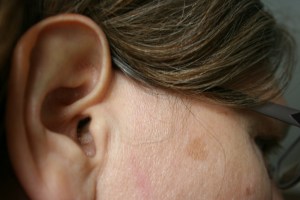
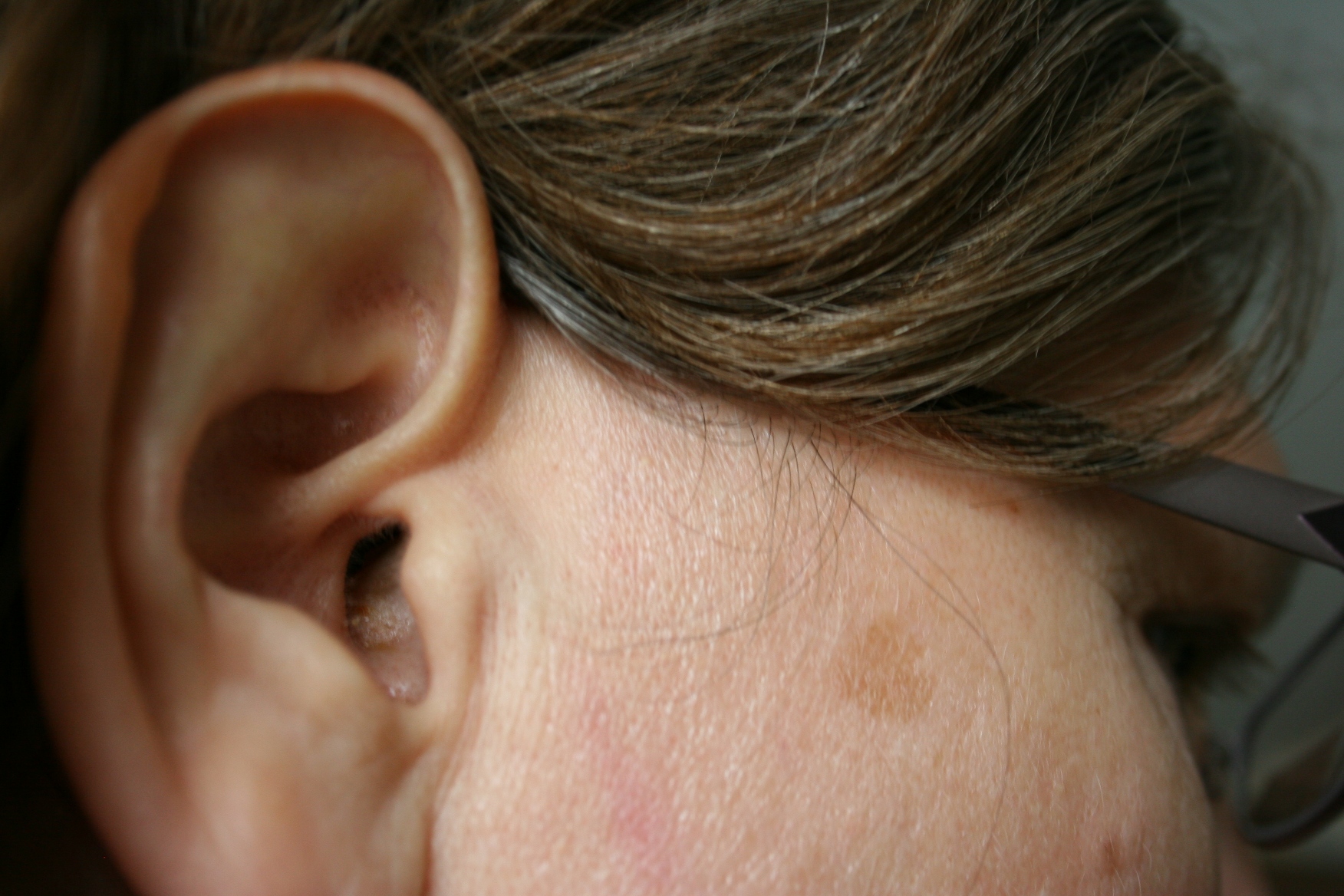
Do you know how difficult it is to photograph one's ear? This is my best shot after many attempts. I could have done without the photo, but images always add to a blog. So there you have it, my right ear that I am hoping, praying, will be healed. Yes, I see the wax. Yes, I know my ear is not petite. Typically it's draped by my hair. But I don't care about lack of prettiness right now. I care only that I get some, or all, of my hearing back.

AND SO I FOUND MYSELF waiting in line at the pharmacy, next to the visually-impaired couple. As I watched them, I asked myself, “Would you rather be blind or deaf?” I don’t mean to offend any of you readers, but that is, honestly, what I was thinking.

The debate swirled briefly through my brain. As the store clerk placed the visually-impaired woman’s hand on a bottle and told her it was fish oil, I chose deafness. I determined that I would rather deal with the loss of hearing in one ear than lose my ability to see.

And so the next 10 days will reveal whether a portion of my hearing can be salvaged. Ten days. I am trying to steel myself for the negative physical and emotional side effects I am certain to experience from the high steroid dosage. I’ve been on the drug before, for whooping cough. I hate it.

I am trying to prepare myself, too, for the very real possibility that this course of treatment will not work—because I waited too long. I did call my clinic within an hour of the symptom onset, but was advised only to come in if my condition worsened. Within several hours, I was feeling better, although my hearing had not improved.

I thought I might be suffering a Meniere’s disease attack related to a previous ear trauma as my symptoms matched those of Meniere’s.

I am writing this post because I need your prayers for healing and strength through my treatment.

I am also writing to warn you that, should you ever experience sudden hearing loss, see a doctor immediately. Don’t wait. Ever. I waited four days to schedule a clinic appointment, another day to get in and then another day to have the MRI and get the diagnosis.

My ear doctor saw several patients just this week with the same sudden sensory hearing loss, leading him to believe a viral infection of some type is going around the Faribault community.

Since developing this issue, I’ve had several friends tell me of acquaintances who’ve suffered the same snap-of-the-finger hearing loss. One regained her hearing; two did not.

The cause of my sudden sensory hearing loss has not been determined. I’m following up with another specialist in several weeks, the same expert I’ve seen since that traumatic ear injury at a Wisconsin water park several years ago.

In the meantime, I am adjusting to the ringing and static (like a bad transistor radio) and partial deafness that are now a part of my world.

I am learning to position myself with my “good” left ear to anyone who is speaking to me.

And I am holding on to hope.

FOLLOW-UP: Today I started my fourth day of steroid treatment. Thus far I’ve noticed no improvement in my hearing. But I am still hopeful that some of my hearing may be restored. Many family and friends are praying for me and for that I am grateful.

I am feeling the effects of taking the Prednisone. Yesterday afternoon and into the evening, I was unsettled and sat twirling my hair, which is not a regular habit of mine. I had trouble falling, and staying, asleep.

Yet, through all of this, I remain cognizant that this diagnosis could have been something far worse than a hearing loss. In the realm of possible medical issues, this is minor.

If, by telling my story, I can prevent one person, even one, from delaying treatment for a sudden sensory hearing loss, then something good will have come from this.

Seven more days to go…

© Copyright 2011 Audrey Kletscher Helbling


The snow angels of rural Minnesota December 22, 2010

THEY ARE THE ANGELS of rural Minnesota.  The volunteer firefighters. The volunteer first responders. The volunteer ambulance crews.

If you don’t believe me, then spend some time in a place like Vesta, population around 330, on the southwestern Minnesota prairie where I grew up.  In small towns like this, the nearest clinic and hospital are often a 20-mile drive or more.

My mom still lives in my hometown and, because she’s getting up there in age, I worry about her. But that concern is offset somewhat by the knowledge that first responders will come to her aid in a medical emergency. And they have.

So when I read an article in the December 16 The Gaylord Hub, a community newspaper where I worked decades ago right out of college, I knew I had to share a story by reporter Lisa Uecker. She wrote about an ambulance trip from Gibbon to New Ulm during the December 11 blizzard.

Uecker is graciously permitting me to retell that story here. It’s worth your time to read for the lessons it teaches in dedication and care and how those in small towns will go the extra mile to assist their friends and neighbors.

In this instance, the miles, literally, were extra and a trip which should have taken perhaps 30 minutes became a 3 ½-hour ordeal.

The incident begins at 2:30 p.m. on Saturday, December 11, during the height of the two-day blizzard. The volunteer Winthrop Ambulance Service receives a call to Gibbon some eight miles to the west. Once the crew reaches Gibbon and the patient, they backtrack to Winthrop knowing they must travel the longer, but safer, state highways rather than follow the shorter route along county roads. From Winthrop, they are headed 16 miles south along Minnesota State Highway 15 to the hospital in New Ulm.

A paramedic intercept is impossible, the crew learns, so snowplows are dispatched to meet the ambulance at the intersection of Highway 15 and Nicollet County Road 1 near Lafayette. One plow goes into the ditch. Another is low on fuel. The third has mechanical problems. None of the plows make it to the appointed rendezvous site.


If you're unfamiliar with Sibley and Nicollet counties, here's a map photo to show you the roadways and towns highlighted in this story.

The ambulance crew is on its own, traveling in white-out conditions near Klossner. The rescue vehicle soon becomes stuck on the shoulder. Because snowplows have been pulled off the roads, the Lafayette Fire Department comes to the rescue, freeing the ambulance with its pumper truck.

After passing Klossner, the ambulance gets stuck again, but the driver–ambulance captain and assistant Sibley County attorney Donald Lannoye–is able to rock the vehicle free.

Finally, at 6 p.m., the patient, who has been stable throughout the ride, is delivered to the New Ulm Medical Center.

The four-member volunteer ambulance crew spends the night in New Ulm.

In an interview with reporter Uecker, Lannoye says that once he passed Sibley County Road 8 right outside of Lafayette, he could never drive more than five miles per hour due to poor visibility and road conditions. The crew saw 11 – 15 cars in ditches and 4 – 6 cars stuck in traffic lanes near Lafayette.

Then Lannoye also reveals that his crew began their day at 5 a.m., transporting a patient on icy roads to Hutchinson.

If ever there was an outstanding example of the care and concern residents of rural Minnesota have for each other, then this would be it. We should all be thankful for volunteers like Lannoye, ambulance crew members Lisa Klenk and Todd Storms,  EMT-in-training Katie Uecker and Lafayette Volunteer Fire Department members who braved a blizzard to help their neighbors.

They are, indeed, snow angels.

IF YOU HAVE A STORY to share about how volunteers have helped you or someone you love, submit a comment. I’m certain there are many such stories out there.

© Copyright 2010 Audrey Kletscher Helbling and Lisa Uecker


He smashed his thumb November 30, 2010

Filed under: Uncategorized — Audrey Kletscher Helbling @ 10:16 AM
Tags: , , ,

MY HUSBAND CALLED late yesterday afternoon. “I’m at the clinic.” Those are words a wife does not want to hear.

“What did you do?” The question popped automatically out of my mouth.

“Smashed my thumb with a hammer.”

This did not sound good, not good at all.

“They’re going to do an x-ray and I may need stitches.”

For my automotive machinist spouse, his hands are his tools, so these types of injuries always concern me.

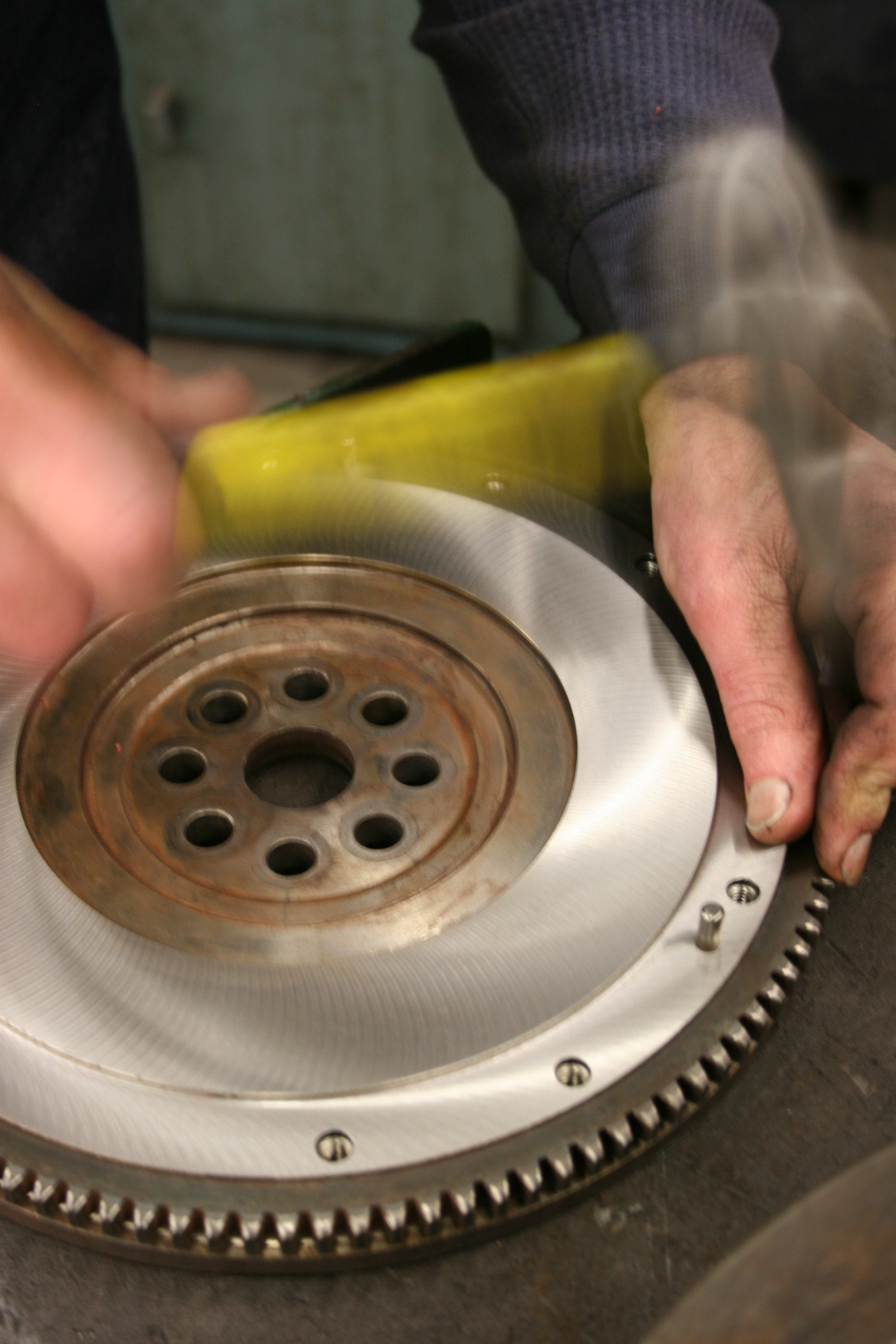
My husband at work with a hammer, a tool he uses often as an automotive machinist.

I hung up, then worried and fretted and worried some more while waiting for a follow-up phone call. Forty-five minutes later he called from the Northfield clinic to say he was on his way home to Faribault.

“I got three stitches.”

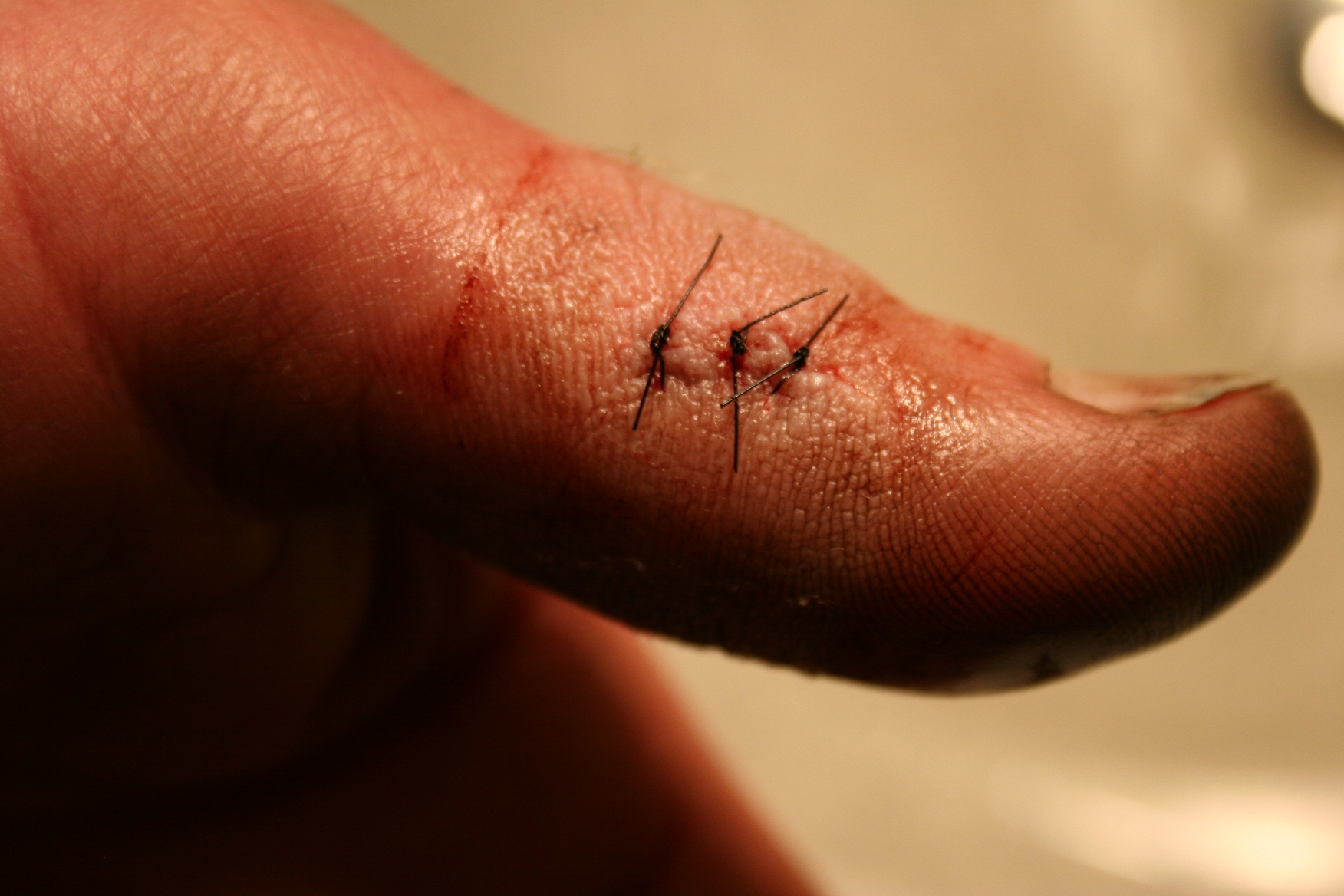
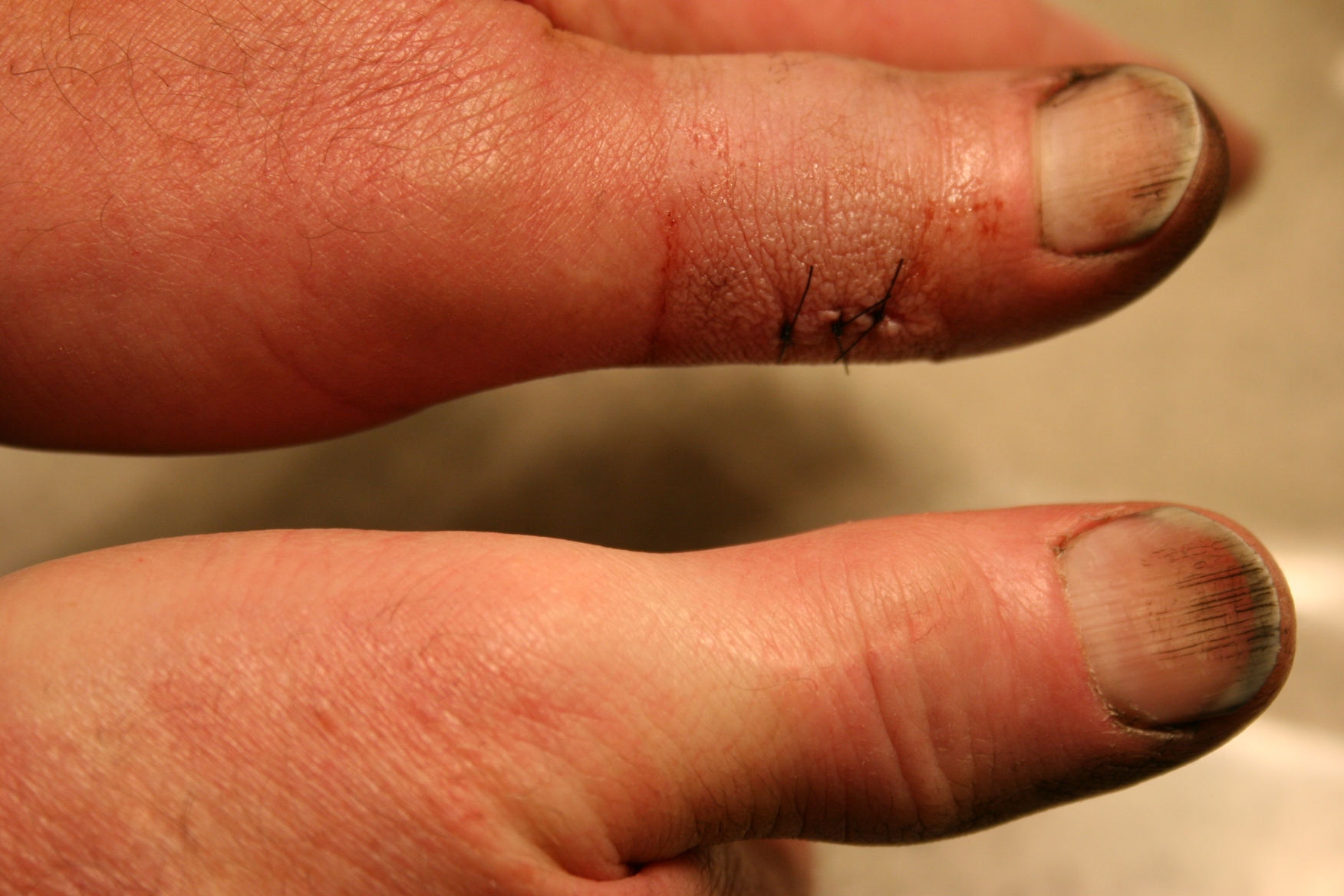
The injured, and stitched, left thumb. My husband says I will gross you out with this image. To abate his concerns, I've down-sized the photo.

“What’s the prognosis?”

“It’s not broken, but they found bone fragments floating around. They think it might be from a previous injury, maybe not, and want me to come back in a week for another x-ray.”

He claims he didn’t injure the thumb prior to yesterday.

I doubt that statement. Throughout our 28 ½ years of marriage, he’s hit his thumbs more than once with a hammer at work, although certainly not this severely.

Here's proof of a previous injury. Note the semi-circle scar on the right thumb, the telltale mark of stitches from an earlier injury.

This time he delivered a glancing blow to his left thumb with a two-pound hammer while pounding universal joints out of a drive shaft. Ouch.

He’s off to work this morning, despite the doctor’s instructions that he stay home.

He told her he couldn’t. Too much work and he wasn’t going to let an injury like this keep him down. He possesses a strong work ethic and a degree of German stubbornness.

The physician conceded, told him to keep the thumb clean and dry. I’m uncertain how he will manage that given the nature of his job gets his hands dirty and greasy.

My husband at work in the automotive machine shop where he is employed.

This morning he struggled to button his shirt. How will he operate machinery, deal with heavy and grimy automotive parts? But, he’s determined. My concern, a few stitches, a clumsy splint, swelling and a little pain aren’t going to stop him from working.

© Copyright 2010 Audrey Kletscher Helbling


Sick of high healthcare costs November 27, 2010

Filed under: Uncategorized — Audrey Kletscher Helbling @ 12:56 PM
Tags: , , , ,

MY HEALTH INSURANCE premium arrived in the mail yesterday. Happy holidays!

Not.

It’s due shortly before Christmas.

Bah! Humbug!

In mid-June, the premium increased from $801 to $813 for three months of coverage. Do the math. That’s $271 per month or $3,252 a year.

I am not happy.

Here’s the deal. I foolishly thought healthcare reform would mean lower premiums and lower costs for medical visits, in other words, more affordable healthcare for families like mine. We are not wealthy. We live in a modest home in a modest neighborhood. We have no debt. We spend carefully and wisely.

But when it comes to health insurance, I believe the word “affordable” cannot fit, cannot even be squeezed, into the same sentence.

I pay $271 a month for coverage with a $3,000 deductible. In other words, my coverage is basically major medical.

I’ve evaluated getting onto my husband’s plan at work. That would cost me even more than the individual policy I have as a self-employed writer. His employer pays only a small portion of his health insurance premium and my spouse, too, has a high deductible.

I haven’t crunched the numbers lately, but my family (which also includes one still-at-home 16-year-old) is forking out a lot of money every month for health insurance.

Yet, we rarely go to the doctor because of the high deductibles and the high cost of healthcare. Cost is a great deterrent for skipping routine exams. I’m just being honest here.

Another problem I face is past medical history. I had total hip replacement surgery in 2008. I will need a new, and very costly, hip in 15 – 20 years. Insurance companies have these policies about pre-existing conditions.  So, even if I was to look for different insurance, the hip would likely be excluded from coverage.

I have no answers to any of this. I just know that I am sick and tired of the high cost of health insurance and of healthcare.

WHAT ARE YOUR THOUGHTS on the topic and do you have any answers? What are you spending every month on health insurance premiums?

© Copyright 2010 Audrey Kletscher Helbling


“Can I get a refund on my hip?” September 20, 2010

Filed under: Uncategorized — Audrey Kletscher Helbling @ 7:44 AM
Tags: , , ,

CONSIDER THIS SCENARIO. At the age of 51, you received a total right hip replacement after 2 ½ years of living in pain 24/7 due to osteoarthritis. That would be me.

Now, consider this. Two years later, a friend, who also has a hip implant, tells you of a nation-wide recall on artificial hips.

How would you react?

I faced this very situation recently when my friend, I’ll call her Jane, told me of the recall on her 3-year-old hip. Jane initially reacted as I would expect, with disbelief, anger and outrage. She has since calmed down.

When I heard the news from Jane, I was quite certain I didn’t have the ASR hip system from DePuy Orthopaedics because I knew my implant was different than hers. Yet, I wasn’t certain. So I checked my medical files, which didn’t show the type of hip I sport, and then contacted my orthopaedic clinic.

After explaining the reason for my call and giving the name of my surgeon, I was assured that I likely didn’t have the recalled hip. My doctor apparently does not use the DePuy ASR hip system.  But just to be certain, I was told that a physician’s assistant would check my records and call me back.

Fortunately, my surgeon selected, for me, a metal femur stem from Osteonics with a thigh bone head made of ceramic and a Pinnacle cup with a plastic liner. I later learned while researching online that DePuy makes the Pinnacle cups. But, as far as I know, those are not part of the recall.

If you have a recalled hip, you likely already know. When I contacted my clinic about 10 days ago, employees were compiling a list of patients to notify about the recall and drafting a letter of proper procedures to follow.

According to info published on DePuy’s Web site, data shows that five years after implantation, approximately 13 percent of patients (one in eight) who received the ASR total hip replacement needed revision surgery.

Now, if you’re among that one in eight—and my friend Jane isn’t at this point in time—you would have cause for concern. Hip surgery the first time around is major and expensive and requires a lengthy recovery. Imagine using a walker and then a cane while transitioning to solo walking about two months later. Imagine needing assistance to get in and out of bed, even to handle personal care issues. Recovery isn’t easy, even if you’re only in your 50s. Imagine if you’re decades older, which is typical for most hip replacement patients.

Now imagine being told that you need a new hip, because you’re having problems with your DePuy ASR hip. I feel for those patients and understand their anger. Going through a repeat surgery like they face has to be difficult. Heck, I don’t even want to consider the hip surgery I’ll need in about 20 years when my replacement needs replacing.

Recall of medical devices is nothing new, although when one affects you, such action is certainly personally alarming. In fact, a week prior to my June 2008 hip replacement surgery, news came out that joints in some individuals with ceramic on ceramic (head and cup) hip implants squeaked when they moved.

So guess what my surgeon had planned for me? Ceramic on ceramic. The morning of my surgery, he informed me that we were going to Plan B, ceramic and plastic. Sometimes I think about that. What if I had had my surgery a week or more earlier? Would I squeak when I walk? Or what if my doctor had selected the DePuy ASR hip? Maybe instead of just reading the ad in my local newspaper to call a certain attorney, I would be sitting in his office discussing my legal options.

© Copyright 2010 Audrey Kletscher Helbling


My daughter experiences Argentine healthcare: A “nice” doctor, but… July 13, 2010

Filed under: Uncategorized — Audrey Kletscher Helbling @ 7:15 AM
Tags: , , ,

“I THOUGHT I SHOULD let you guys know that right now I am sick…”

This is not the e-mail news I want to read from my 22-year-old daughter who is living in Buenos Aires, Argentina. She has a fever, runny nose and a cough, all the symptoms of H1N1.

Unfortunately, I am well aware that a year ago Argentina suffered a major outbreak of the illness with a death rate (1.6 percent) more than three times the world average, according to a July 3, 2009, New York Times article. Yet, those deaths ran behind Mexico and the United States. Currently the World Health Organization reports that Argentina has “low activity and only sporadic detections of both pandemic and seasonal influenza viruses during the early part of winter.”

Yet, this provides little reassurance to me, a Minnesota mom with an unvaccinated daughter nearly 6,000 miles away who is exhibiting H1N1 symptoms.

Didn’t I tell her to get the H1N1 vaccine last winter at the University of Wisconsin, La Crosse, where she was finishing her senior year of college? She didn’t and I didn’t push the issue. Now I regret my lackadaisical attitude.

“Please don’t worry about me; I’m sure I will be better soon,” my daughter writes. “I’ve been drinking lots of water and tea. Also, my roommate Lucas has been taking really good care of me, bringing me soup, Kleenex, tea, water etc. Later today when he gets home from work he is going to go w/ me to the doctor.”

OK then, she tells me not to worry, but she feels sick enough to see a physician. This is not good.

But I am here, she is there and I can’t exactly bring her chicken soup. So, as any responsible mom would do, I worry and await her next e-mail.

The next morning she updates me. She doesn’t have H1N1, but a viral infection that should clear up in three days. My daughter relays that the doctor was nice and seemed competent, checking her temperature, blood pressure, heart, throat, symptoms, etc., “all the normal stuff they do in the States.” Alright then, that’s good.

But then she tells me about the free public clinic. “The clinic was probably the worst clinic I’ve ever been to. We had to wait forever to see the doctor, and they only had super-uncomfortable wooden benches in the very cold waiting room. After a while, I decided it would be more comfortable to sit on the floor b/c I could at least put my head against the wall, and Lucas covered me up w/ his jacket. This was a good idea b/c it was indeed more comfy and then 2 different doctors came up to us and tried to get us in sooner b/c I probably looked like crap. Also, the bathroom there was EXTREMELY disgusting! I don’t think any of the toilets flushed, there was no toilet paper (thankfully I had some Kleenex w/ me), and the sinks weren’t working.”

OK, up until that revelation, I was feeling better.

© Copyright 2010 Audrey Kletscher Helbling