Minnesota Prairie Roots

Writing and photography by Audrey Kletscher Helbling

A misplaced torch at a veterans’ memorial July 1, 2011

TYPICALLY, I WOULD NOT criticize a veterans’ memorial project. I respect those who have served our country and those who lead efforts to honor them via public memorials.

However, last week when I saw the latest addition to the in-progress Rice County Veterans Memorial Expansion Project at the county courthouse in Faribault, I could not believe what I was seeing.

There, guiding my eyes toward a center bronzed eagle and dove, was a flashing neon flame depicting “our never ending vigilance.”

The new, fake torch at the Rice County Veterans Memorial at the courthouse in Faribault. Here you see the wing tip of the bronzed eagle below the torch. I have not edited this image taken one evening last week.

My initial reaction has not changed since I stopped that night to closer inspect and photograph this neon torch better suited for a casino—anything but a veterans’ memorial.

As we all know, first impressions count. In this case, the neon flame certainly does not fit. This is supposed to be a place of reverence, of quiet meditation, of respectful honor for those who have served the United States of America. A fake, flickering fire does not portray that message of honor.

I am disappointed.

Prior to installation of this imitation torch, a fuel-fed torch burned near the historical Civil War statue which has long graced the courthouse lawn. Apparently that flame went out all too often, leading to its removal and installation of the Vegas style torch.

The long-standing Civil War statue sets a historical mood for the Rice County Veterans Memorial. I shot this image last fall.

To the right, in this unedited photo, you'll see a side view of the historical Civil War marker. In the center is the torch and the bronzed eagle and dove with flags and the courthouse in the background.

I could go on and on about how much I dislike this cheapening alternative, how it fails to fit the historical context of this place, the courthouse architecture or the long-standing Civil War marker. I won’t because I’ve said enough.

View my photos and tell me what you think. I’d like your opinion.

But even more, if you agree that this style of torch does not belong at a veterans’ memorial, offer a solution. I have none. Except to pull the plug.

Honorary pavers line sidewalks leading to the center of the Rice County Veterans Memorial in this image taken last fall.

© Copyright 2011 Audrey Kletscher Helbling


WARNING: Proposal would erode Minnesota’s Freedom to Breathe Act April 11, 2011

WARNING: Cigarettes are addictive.

WARNING: Tobacco smoke can harm your children.

WARNING: Cigarettes cause fatal lung disease.

WARNING: Cigarettes cause cancer.

WARNING: Cigarettes cause strokes and heart disease.

WARNING: Smoking during pregnancy can harm your baby.

WARNING: Smoking can kill you.

WARNING: Tobacco smoke causes fatal lung disease in nonsmokers.

WARNING: Quitting smoking now greatly reduces serious risks to your health.


I didn't need to search long or hard to find these cigarette butts. Two were tossed into one of my flowerbeds by a neighbor. I found the third in the street by my house.

Just as Minnesota legislators are considering proposed changes to the state’s Freedom to Breathe law, the U.S. Food and Drug Administration is finalizing plans to modify warnings on cigarette packaging and advertising.

Following requirements of The Family Smoking Prevention and Tobacco Control Act, the FDA has proposed that cigarette packaging and ads bear one of the above nine warnings along with a matching colorful graphic.

The shock value of the proposed graphics—like a toe-tagged corpse and a mother blowing smoke into her baby’s face—are an effort to make a powerful impact on the smoking public. Enough to make a smoker stop smoking.

The final graphics will be selected by June 22 and the warnings must be in place on all cigarette packages sold in the U.S. and in cigarette ads by October 2012.

As a nonsmoker, I’m all for this move to prevent, reduce or stop smoking.

However, I don’t support proposed legislation in Minnesota that would once again allow smoking in bars under specific conditions. Not that I frequent bars, but bars and restaurants are often interconnected, so this matters to me.

The plan basically would allow smoking in bars if a ventilation system is installed to remove the smoke. In bars connected to restaurants, the bar must be walled off with a door separating the bar and restaurant.

Come on. A door will not keep smoke from filtering into a restaurant. And I don’t know about you, but I don’t need smoke served with my meal.

I make no apologies for my strong stand against smoking and my intense dislike of cigarette smoke.

I’m also honest enough to admit that, in my youth, I tried tobacco products on several occasions, enough to realize smoking wasn’t for me.

My dad became addicted to cigarettes when he was in the military, serving on the front lines during the Korean Conflict. He preferred Camel cigarettes. Sometimes he also rolled his own.

My dad, a smoker for many years, first exposed me to cigarettes. Once he even let me puff on his Camel. Now before you start calling him an irresponsible parent, consider this.  He knew I’d cough and sputter and spit and never want to touch a cigarette again. He was right. Eventually he gave up smoking but never quit chewing snuff.

Although I never took up smoking, I was addicted to candy cigarettes as a kid. But candy cigarettes were as popular as Bazooka bubble gum back in the 1960s and no one thought anything of subtly encouraging kids to smoke via those chalky white sticks with the red tips.

As for the few Swisher cigars I smoked in my mid-20s, I offer no excuse except my ignorant, youthful stupidity. I bet many smokers who are now habitual tobacco users wish they’d never started.

If you’re a smoker and want to smoke in the privacy of your home, then go ahead. Just don’t invite me over because, physically, I can’t tolerate cigarette smoke.  I’ve had numerous bad experiences with cigarette smoke.

Back in the early 1980s, I worked for a southern Minnesota daily newspaper that allowed smoking in the office. I came home every night smelling like I’d been in a bar all day. My clothes reeked. My skin reeked. My hair reeked. I remember complaining, with several other nonsmokers in the office, about the smoking. Nothing changed, because the news editor smoked. She didn’t care. So what if the copy editor sat outside the conference room during the weekly staff meeting because he couldn’t tolerate the smoke? I wish I had joined him instead of breathing the toxic air. So what if the news editor should have been more considerate given the Minnesota Clean Indoor Air Act passed in 1975? None of that mattered.

My second worst experience with smoking occurred several years ago at a Winona hotel. The manager tried to pass off a smoking room as a nonsmoking room. The instant I walked into the room, I smelled cigarette smoke. The mobile air purifier that was running on high and the lack of a sign on the door stating that this was a nonsmoking room confirmed my suspicions. When I went to the front desk and demanded a nonsmoking room, the manager denied that he had given me a smoking room. I didn’t believe him. My nose and lungs don’t lie.

My other notable smoke experience also involves a hotel, this one at a southwestern Minnesota casino. I was there attending a cousin’s wedding reception. Although the hotel room my family booked was supposedly smoke-free, the odor of cigarette smoke filtered from the smoke-filled hotel lobby, halls and casino into our room. I barely slept that night because of the tightness in my chest caused by the smoke.

So, Minnesota legislators, listen up. Listen to representatives of The American Cancer Society, the American Heart Association, the American Lung Association and Clearway Minnesota, all of whom have been at the State Capitol opposing the proposed changes to Minnesota’s Freedom to Breathe Act.

Consider the 83.9 percent of adult Minnesotans (according to results of the 2010 Minnesota Adult Tobacco Survey) who do not smoke. Please keep our Freedom to Breathe Act intact and smoke-free.

© Copyright 2011 Audrey Kletscher Helbling


The not-so-surprising results to a diversity question March 23, 2011


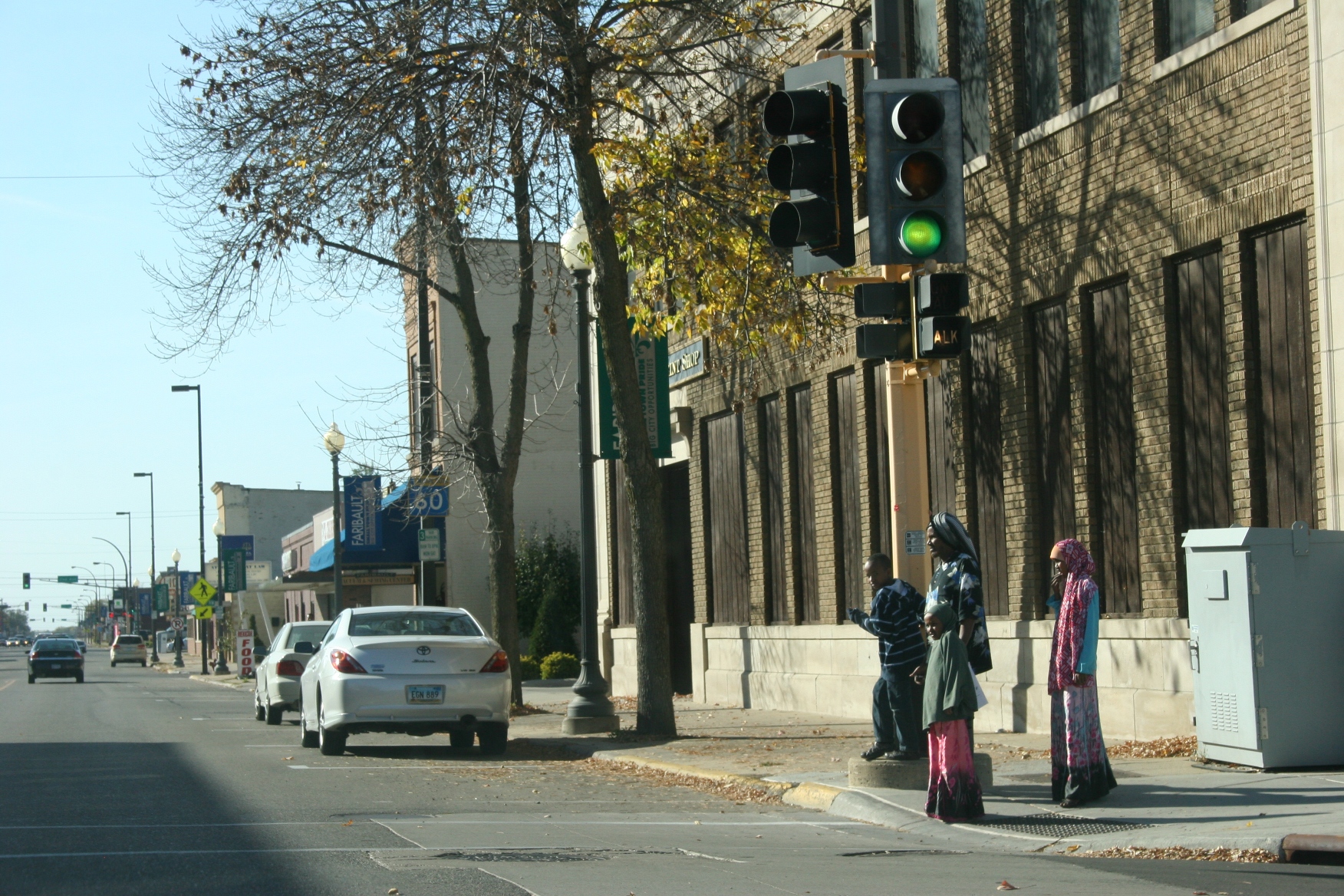
An immigrant family in downtown Faribault represents the changing face of our community. I took this photograph in October 2010.

I DON’T KNOW WHY I was surprised. I should have expected the results given the many racist comments I’ve heard through the years.

Yet, when results of an online poll conducted by The Faribault Daily News were published in Tuesday’s edition, I was still shocked or, more honestly, embarrassed by the numbers.

The newspaper, after publishing stories on changing demographics in Faribault,  polled readers on this question: “Do you enjoy the increased diversity in Faribault?”

An overwhelming majority, 70.2 percent, responded with a “No.”

Only 20.8 percent voted “Yes.”

The other nine percent checked the “What increased diversity?” option.

Granted, polls like this, printed in each issue of the paper and then open for online voting, are not scientifically controlled and therefore could be substantially flawed. We have only the number of respondents, 312 for this question, and the tallied results, from which to draw conclusions.

However, when you live in a community long enough—I’ve been in Faribault for 29 years—you know how people feel. And, I think it would be fair to say that many residents in my community are not all that welcoming of minorities.

I hear it in the off-the-cuff negative comments about Somali men hanging around downtown or about the Hispanic family that moved in down the street. I hear it in the warning to avoid certain retail destinations at night. I hear it in the spewed words, “I don’t want any Somalians moving in next door.”

I read it in the comments submitted to the local newspaper whenever race or diversity is the subject of an article.

The words are mean, cutting, derogatory, and, most definitely, prejudiced.


Downtown Faribault businesses include Banadir Restaurant, a Somali restaurant.

Many times I find myself defending the Hispanic, Somali and Sudanese people who comprise most of the nearly 17 percent of minorities living in my community of 23,352.

My standard answer is something like this, “There are good white people and there are bad white people, just like there are good Hispanics (or fill in the blank with another race) and bad Hispanics. The only bad experiences I’ve had are with white people.”

That is almost true. Several years ago my husband and I, unbeknown to us, sold a car to a Minneapolis-based Latino gang member who then used our vehicle in a gang-related shooting.

I really struggle with individuals who negatively label an entire ethnic group. It is unfair and unjustified.

That said, many individuals, churches, schools and organizations in Faribault are working hard to welcome and assist our minority population. Such examples are the Society of St. Vincent de Paul Center for Charitable Services and The Faribault Diversity Coalition. Unfortunately, The Welcome Center closed late last year.


Different cultures, all the faces of today's Faribault, mingled during the Fall Festival in October 2010. Our town's current Black or African/American population is 7.5 percent.

But, really, efforts to embrace the newcomers in our community begin with each of us, on a personal level, in our hearts.

On my personal level, I’ve come to better understand other cultures because my second daughter is a Spanish language major who has lived and studied and done mission work abroad. She is currently a Spanish medical interpreter.

I try to attend ethnic events in Faribault like the annual summertime International Market Day celebration.


A member of Ollin Ayacaxtli dances at Faribault's International Market Day celebration. Faribault's Hispanic or Latino population numbers 3,026, according to the 2010 U.S. Census.

I’d like to see The Paradise Center for the Arts, reach out to minority artists, and that is a project I hope to help the local art center pursue.

I’ve wondered, too, and this might seem odd to mention, but why do I seldom, if ever, see obituaries published in the local newspaper for minority members of our community? We need to recognize these seemingly small things that set us apart.

If we take small steps, first as individuals, in educating ourselves, then our attitudes toward each other can change. We will have a stronger, better community that is built on understanding and acceptance rather than on differences.


A family matriarch oversees the making of pupusas from her chair at the International Market Day in Faribault in 2009. This is one of my all-time favorite portraits that I've ever taken.

CLICK HERE for 2010 U.S. Census results from Minnesota. Scroll down to Rice County, which includes Faribault, and shows a county minority population of 9,576 or 14.9 percent. Statewide, our minority population is 16.9 percent.

© Copyright 2011 Audrey Kletscher Helbling

 

The precious children February 27, 2011

Filed under: Uncategorized — Audrey Kletscher Helbling @ 8:32 PM
Tags: , , , , , ,

A snippet of a painting that hangs in a hallway at my church shows Jesus holding a baby.

“WHY ARE WE HERE? It’s not just because the children are precious. We are here because the children are precious to God.”

Dr. James Lamb, executive director of Lutherans for Life, delivered that message to me and other worshippers today at Trinity Lutheran Church in Faribault as we celebrated “Sanctity of Human Life” Sunday. By the way, I thought his surname—Lamb—quite fitting for a man who heads up an organization that “equips you to be gospel-motivated voices for life, to love and speak the truth compassionately.”

Now I’m not the protesting type, although I wore a pro-life bracelet back in the 1970s. I’ve never rallied against abortion, but I strongly oppose it. I’m not the type to stand on a public soapbox and loudly express my viewpoint.

But I’ve been gifted, through my writing, with the ability to share my thoughts and feelings, facts and opinions, to make a point, or to cause readers to pause and think.

So, this morning, when Rev. Lamb stepped behind the pulpit, I grabbed a pencil and started scribbling notes in the margins of my worship service folder. I expected he might tell me a thing or two regarding human life that I would want to pass along to you. He did.

All the while I was listening to him, I thought of the precious baby girl, newborn Valentine’s Day baby, Abigail Grace, who was sleeping several pews behind me. I almost wished, as the preacher preached, that little Abigail could be up front with him, making a strong visual impact as he talked about the value of human life.

“You knitted me together in my mother’s womb,” Pastor Lamb read from Psalms and then explained that the “knitting together” means not only the physical part, but our essence, our very being, our souls.

We each are, he said, one in 70 trillion.

And then he tossed out more numbers which astonished me. There have been 52 million lives lost to abortion since it was legalized in the U.S. in 1973, he said. Today in the U.S., there are 3,200 abortions daily, he continued.

I thought of little Abigail several pews back, so loved by parents who call her their blessing.

“Your value comes from God, who made you,” the Rev. Lamb told us.

How true?

A portion of Jesus face, photographed from a stained glass window at Trinity Lutheran Church, Faribault.

But then, lest I began feeling all smug and innocent sitting there in my pew on a Sunday morning, the pastor dared to suggest that we worshippers might share in the blame of millions of lives lost through abortion.

Have we failed to speak out against abortion? Have we made the abortion issue a political one rather than focusing on the value of human life that comes from God? Have we failed to show compassion to those who’ve had abortions? Have we failed to tell them, Pastor Lamb said, that “you too are blessed with the forgiveness that is free, unearned, unconditional and complete (through Jesus)”?

Guilty.

So I am doing my part today, from a heart that cares deeply for the unborn children of God and for precious little ones like Abigail Grace, to tell you that I am upholding the sanctity of life because “the children are precious to God.”

Precious.

Children of God.

© Copyright 2011 Audrey Kletscher Helbling

 

Sports at what cost December 15, 2010

Filed under: Uncategorized — Audrey Kletscher Helbling @ 8:43 AM
Tags: , , , , , , , ,

I’VE NEVER BEEN ATHLETIC. When elementary school classmates picked teams for Red Rover or softball, I was among the last chosen. Who would want a skinny girl with toothpick arms trying to hold the line against brawny boys becoming men or strong farm boys who could slug the ball into the outfield?

I wouldn’t have chosen me either. Even though I could scoop silage and ground feed, carry milk pails and toss hay bales nearly as well as my brothers, I possessed no athletic prowess. And, frankly, I didn’t care, although it did hurt sometimes to always be the last team member chosen.

I needed to care about sports only enough to pass physical education classes. I remember one junior high school p.e. teacher who expected everyone in the class to excel in gymnastics, just like the pencil-thin, all-legs-and-arms girl who could bend like Gumby. Needless to say, I got a “C” in that class. Thankfully today’s gym teachers seem to have changed their expectations and grading tactics, realizing that not every student is a naturally-gifted athlete.

But too many parents think their kids are the next Brett Favre, Joe Mauer or whoever else is considered a sports star. (Those are the only two names I could come up with off the top of my head since I don’t follow professional sports.)

Anyway, in my opinion, too many parents have become obsessed with athletics, pushing their little Jimmy or Janie into multiple sports that continue non-stop year-round. When, exactly, do kids have time to relax and just be kids? How can they learn to use free time, to entertain themselves, if their lives are always scheduled with this practice and that practice and this game and that game?

Now, before I raise the ire of coaches, parents and student athletes, let me clarify that student athletics have value. Kids learn to work hard. They learn team work and self-discipline. They learn to set and achieve goals. And they get a good work out. Sports can also be entertaining.

The problem arises, in my opinion, when sports overtake family life and everything evolves around practices and games. This time of year I am especially troubled by the scheduling of practices and tournaments during holiday breaks. When student athletes should be celebrating with their families or simply enjoying some down time, they are running to practices and games and tournaments.

I remember a friend once telling me about her son’s soccer game scheduled on a week night in Marshall, a three-hour, one-way, drive from Faribault. Now tell me that makes sense. None of the moms wanted to go and I can’t blame them given their sons were only middle-schoolers. That’s just one example of how ridiculous this traveling sports competition has gotten.

I wonder, too, how families can afford, weekend after weekend, to travel out of town for tournaments, shelling out money for gas, fast food, admission tickets and hotel rooms. How do they work those multi-hundred dollar weekends into their family budgets and is it worth the money spent? Maybe. Maybe not.

Sunday practices and games for student athletes also bother me. A lot. I’ve often wondered why parents don’t simply revolt against coaches and organizers (or whomever) that schedule these Sunday activities.

Are sports so important at the elementary and high school level that families have to give up their Sundays?

NOW IN CASE YOU’RE WONDERING what prompted this spiel, I will tell you: Brett Favre and the collapse of the Mall of America Field roof.

I really do not care about Favre or whether he played in Monday’s  Minnesota Vikings’ game. But the amount of news coverage earlier this week made me think I should care. Honestly, why?

As for the dome collapse, I dislike how some are now using this incident to say, “We need a new stadium.” Well, this taxpayer does not want to pay for a new Vikings stadium. Let the Vikings, with their highly-paid football players, pay for their own stadium.

But, hey, you know, this society seems obsessed with sports…

I’m sure many will disagree with the opinions I’ve expressed here. But I’m certain many of you out there will agree. What’s your take on sports at the elementary and high school level and how athletics impact families? And, what’s your opinion on a new stadium? Sorry, I’m not asking your opinion on Favre, but if you want to offer one, go ahead.

© Copyright 2010 Audrey Kletscher Helbling