Minnesota Prairie Roots

Writing and photography by Audrey Kletscher Helbling

“From Somalia to Snow” offers insights into our new Minnesota neighbors May 29, 2024

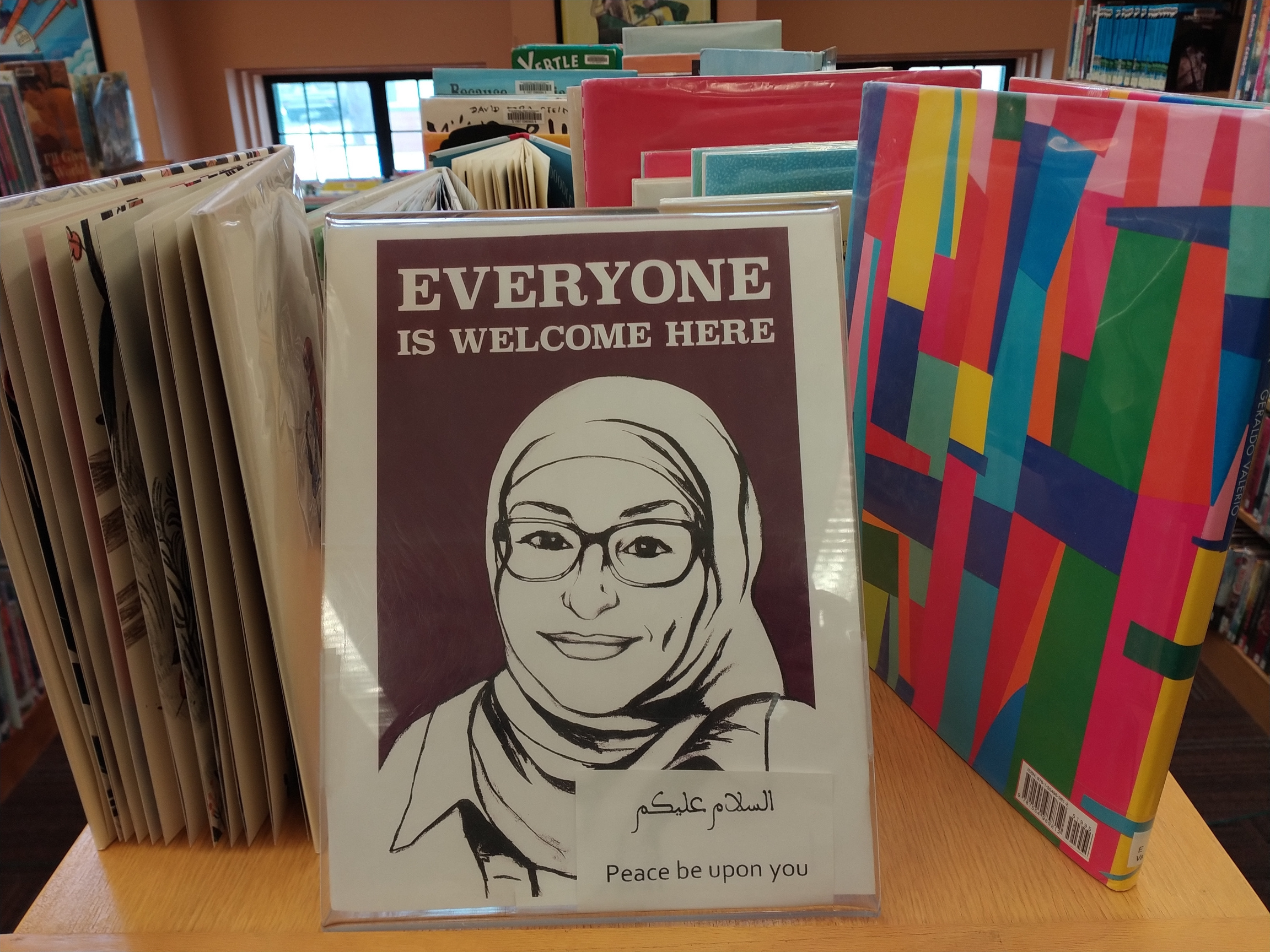
A welcoming sign photographed earlier this year in the children’s section of Buckham Memorial Library, Faribault. (Minnesota Prairie Roots copyrighted photo 2024)

KNOWLEDGE IS POWER. Not in the sense of personal power, but in understanding. And I am always about growing my knowledge and understanding, especially within my community.

Faribault, like many neighboring communities, is culturally-diverse, home to immigrants, refugees and those who have received American citizenship. Somalis. Hispanics. Latinos. And others from countries that fit anything but the mostly White European backgrounds of rural Minnesotans. We are a state evolving in diversity, and I embrace that.
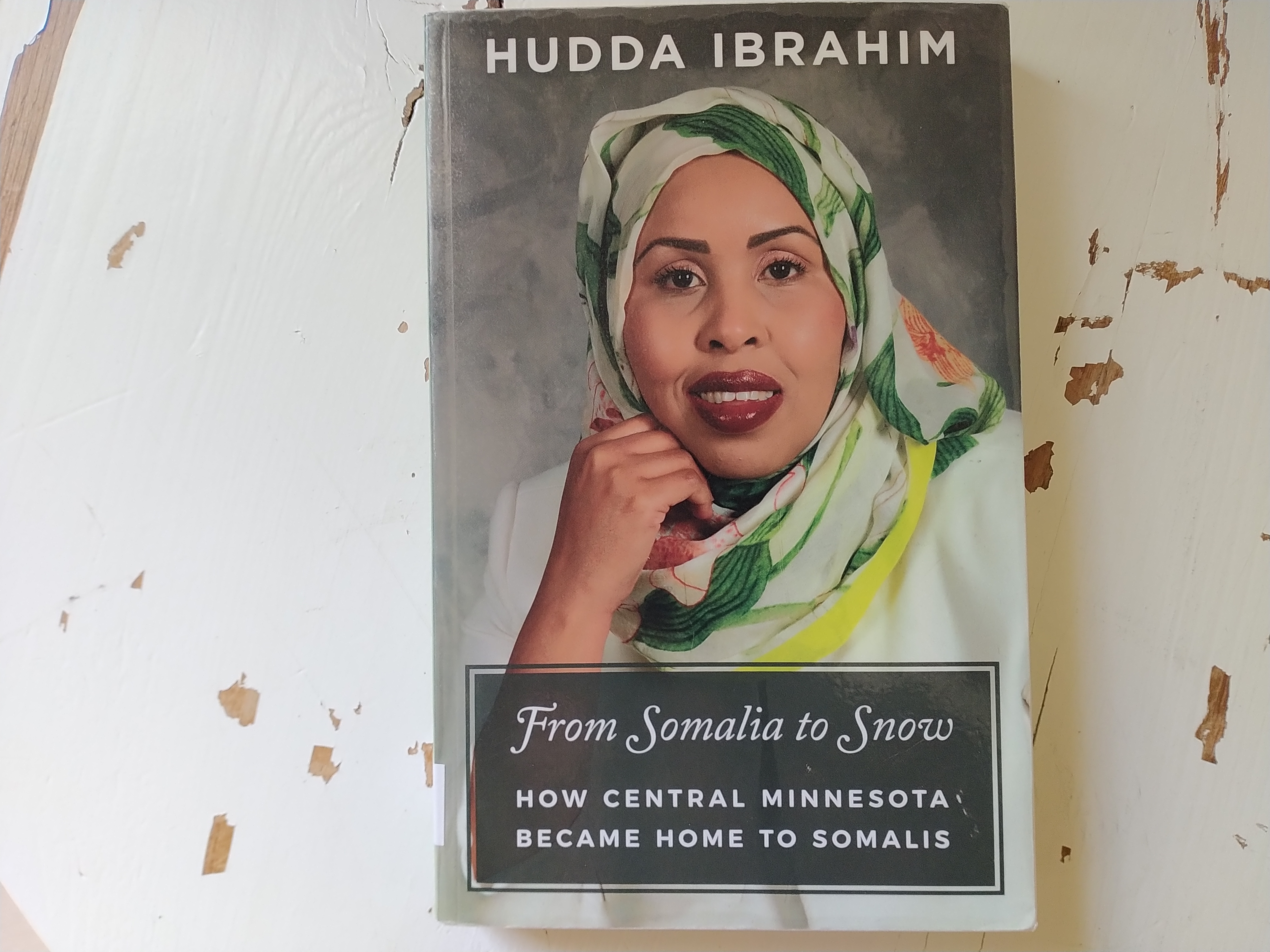
Hudda Ibrahim’s book offers an in-depth look at Somalis living in Minnesota. (Minnesota Prairie Roots copyrighted photo May 2024)

Recently I met a central Minnesota author who was in town as part of an event celebrating Somali culture at the Paradise Center for the Arts. Hudda Ibrahim of St. Cloud, which has a sizable Somali population, was selling her books, including From Somalia to Snow—How Central Minnesota Became Home to Somalis. Although I didn’t purchase her book then, I eventually checked it out through my regional library system. That and her nonfiction children’s picture book, What Color Is My Hijab?

Hudda Ibrahim’s children’s book inspires girls to be whatever they want to be via Ibrahim’s empowering words and Meenal Patel’s vivid art. (Book cover sourced online)

After reading those two books, I have better insights into the backgrounds, stories, culture and challenges of my new neighbors. Ibrahim writes with authenticity. She was born and raised in Africa (Somalia, Ethiopia and Kenya), came to the U.S. in 2006, teaches diversity and social justice in St. Cloud, and works closely with Somalis there. From Somalia to Snow includes interviews with Somalis in Ibrahim’s community along with her observations, insights and recommendations.

I quickly discovered that I had much to learn, even when it comes to understanding the basics. A person of Somali ethnicity is not a “Somalian,” as I’d incorrectly said, but rather a “Somali.” I appreciate that about Ibrahim’s writing. She doesn’t presume her readers know, making her book a really good source of basic, yet detailed and thorough, information.
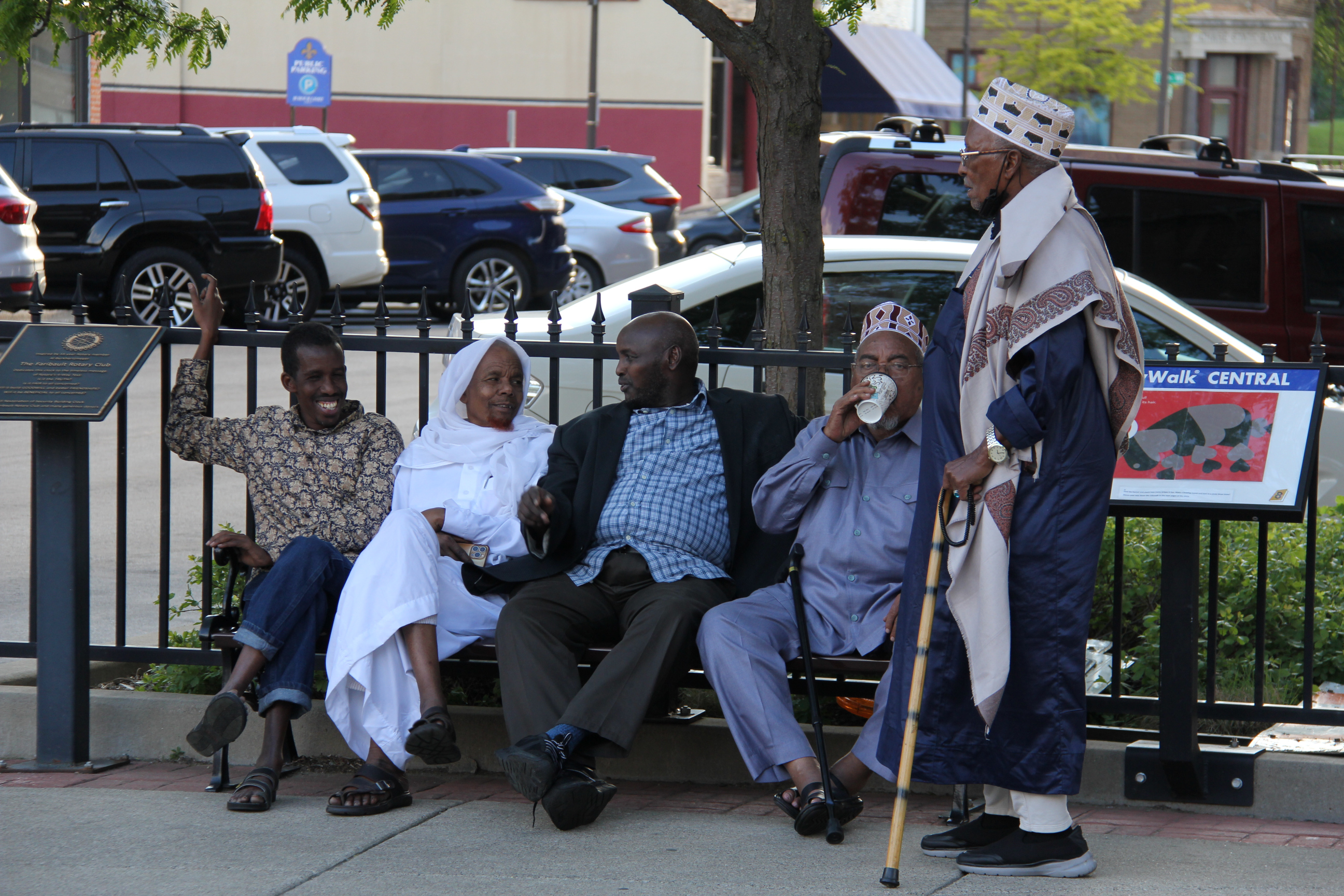
I often see Somali men visiting in downtown Faribault, where many live. (Minnesota Prairie Roots copyrighted file photo May 2024)

I especially appreciated her chapter titled “Integration and Assimilation” because I’ve heard the comments from locals about how Somalis need to do this and that because they’re living in America now. Ibrahim states that Somalis prefer to “integrate,” not “assimilate.” That makes sense to me, that our new neighbors want to retain their cultural identity while also adapting to their new home. I think back to my own maternal ancestors who settled together near New Ulm in southern Minnesota and clung to their German identity, speaking in German, following customs and traditions from the Old Country. The same can be said for Scandinavians, who still eat lefse and lutefisk. Cultural identity is important to all of us.

So is family. Like my German ancestors settled together, so do those who come from Africa. They want to be near people who get them, understand them, share a language and faith and customs and culture. Jobs and family (clans) brought Somalis to St. Cloud, Ibrahim writes. Many work in meat-packing plants, just like in my community.
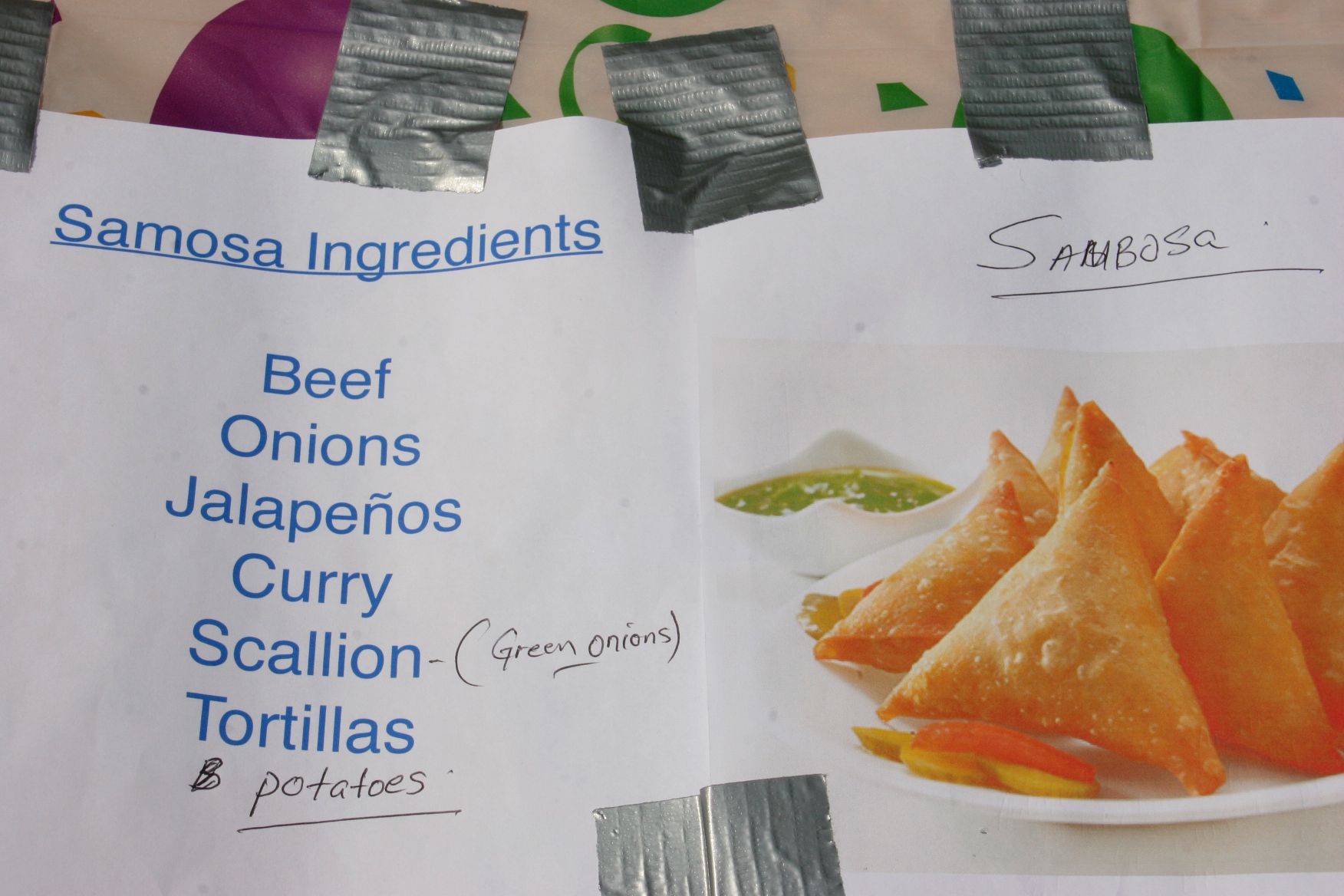
This sign for Somali food was posted at a past International Festival in Faribault. I especially like sambusa, a spicy, meat-filled triangular pastry. It was served at the recent Somali-focused event I attended. (Minnesota Prairie Roots copyrighted file photo)

Others have pursued higher education and entrepreneurship, opening businesses which serve primarily their community. I need only walk Faribault’s downtown business district to see numerous Somali-owned shops and restaurants. I love the color and culture they bring. And I love Somali tea, which I tried at that event where I met Ibrahim. It’s tea mixed with milk and spiced with cinnamon, ginger, cloves, cardamom… The scent is heavenly, the taste divine. And I can buy it locally.

Faribault is a culturally-diverse city, as seen in this image taken during a car show in downtown Faribault in 2015. (Minnesota Prairie Roots copyrighted file photo 2015)

Ibrahim’s book is packed with insights: Somalis value oral communication over written. They are good oral poets. Restaurants often do not have printed menus, primarily because they serve Somalis. Muslims memorize the Quran (with 6,666 verses), a process that can take years. Socializing and community are important. Barriers remain in healthcare. There’s just a whole lot to learn via reading From Somalia to Snow. It starts with an overview of Somali history and then takes readers into the lives, cultures and challenges of Somalis living in Minnesota today. Thanks to Ibrahim’s writing, I now have a better understanding of my new neighbors. And for that I am grateful.

© Copyright 2024 Audrey Kletscher Helbling


Thoughts following an attack at a Central Minnesota mall September 20, 2016

Filed under: Uncategorized — Audrey Kletscher Helbling @ 5:00 AM
Tags: , , , , , , , ,

A vehicle travels along Interstate 90 near La Crosse in the rain Friday morning. Fog shrouds the bluffs in grey.

A vehicle travels along Interstate 90 near La Crosse, on the Minnesota side of the Mississippi River, in the rain Friday morning. Fog veils the river bluffs.

WHEN FOG DESCENDS, shrouding the landscape in a veil of grey, the value of light magnifies.

Our eyes search for light.

We look for ways to banish the grey, to illuminate our world. We want desperately to find the light and to hold it high.

Events of the past weeks have shaded our skies grey here in Minnesota—first with the discovery of Jacob Wetterling’s remains and now the stabbings of 10 individuals at Crossroads Center in St. Cloud in what appears to be a possible act of lone wolf terrorism.

That both of these major crimes happened some five miles apart in Central Minnesota is pure coincidence. But it is not lost on me that the kidnapping of 11-year-old Jacob nearly 27 years ago and the mall attack on Saturday evening are in the backyard of Garrison Keillor’s fictional Lake Wobegon.

I like to think that Lake Wobegon—the region in which some of my in-laws live—is a pastoral setting of grazing cows, church spires and old-timers playing cards at the Chatterbox Cafe. It is and it isn’t. In today’s world, no place, not even Central Minnesota, is safe.

Even so, we Minnesotans are a strong, determined and resilient lot. We will, through the greyness of these days, search for the light of goodness and of hope. Of that I am certain.

© Copyright 2016 Audrey Kletscher Helbling


A lesson in Minnesota sales taxes April 4, 2011

Filed under: Uncategorized — Audrey Kletscher Helbling @ 7:09 AM
Tags: , , , , , , , , ,

How much does your community tax purchases?

“ARE YOU A SEVEN?” she asked.

“What?” I asked her to repeat what she’d just told me over the phone.

“Are you a seven?” she repeated.

Still, I didn’t understand. Then she—the saleswoman at J.C. Penney in the Burnsville Shopping Center—explained that sales tax rates vary, depending on where you live in Minnesota. She wondered if I lived in an area with a seven percent rate.

Huh? I had no idea, about the rate or that such differences existed.

I live in Faribault. Is that a “seven,” or some other number?

The helpful saleswoman, who was trying to calculate the cost of pleated shades (which I’m not buying because they are way too costly at nearly $400 for two windows, but which I really, really want), was confusing me. Apparently orders shipped to my home would be taxed based on where I live, or something like that.

Not one to simply let this piece of information slip through the recesses of my brain, I googled “Minnesota sales tax” and ended up on the Minnesota Department of Revenue sales tax rate calculator website. It’s an easy-to-use site where I could type in Minnesota zip codes, a dollar amount and, zip, the sales tax rate appeared. The calculator covers Minnesota and local general sales and use taxes. Any other special taxes, such as those on entertainment, liquor, dining and lodging, are not figured into the totals.

First, I needed the nine-digit zip codes for my sample towns. Once I had those zip codes from a U.S. Postal Service link, I typed the numbers and my sample dollar amount of $10 into the tax calculator website.

I quickly discovered that Faribault is not a seven. Our sales tax rate, like that of my brother who lives in Redwood County in rural southwestern Minnesota, is 6.875 percent. We would each pay 69 cents in sales tax on a qualifying $10 purchase in our parts of Minnesota. We have no extra taxes, just the 6.875 state-wide basic sales tax levied by the state.

My daughter who lives an hour away from me in south Minneapolis, however, will pay more for purchases made in her area. The sales tax rate for her address is 7.775 percent. That breaks down to the standard state sales tax rate, plus an additional 0.15 percent levied by Hennepin County, 0.5 percent by the city of Minneapolis and 0.25 percent for Transit Improvement. She would pay 78 cents in taxes on a $10 purchase.

In Woodbury, where my youngest brother and his family live, a 0.25 percent Transit Improvement levy is also in place. It’s the only extra sales tax in that city, so tax on a $10 purchase there would be 71 cents.

I was surprised to learn that St. Cloud also has an extra tax, of 0.5 percent, pushing the sales tax rate there to 7.375 percent. That helped pay for an airport and other projects. You’d pay 74 cents sales tax on a $10 purchase.

But my biggest surprise came when I typed in a friends’ nine-digit zip code up in Duluth. There the local government has imposed a one percent additional general sales tax, pushing the sales tax in that port city to 7.875 percent. The tax on a $10 purchase is 79 cents. Authorized in 1973, that special tax “may be used for any city purpose, as determined by the city council.” It has no expiration date and is the longest-running local sales tax listed on a September 2010 document from the Minnesota House of Representatives Research Department.

Now, if you’re like me, you’ve just gotten a good basic education on sales tax rates in Minnesota.

Funny, isn’t it, how that J.C. Penney employee’s seemingly simple question—“Are you a seven?”—educated me about sales tax rates in Minnesota.

THE MINNESOTA LEGISLATURE is considering legislation that would loosen current restrictions on local sales taxes. Under the proposal, cities or groups of cities could impose local sales taxes with local voter approval. Twenty-two Minnesota cities currently have a local option sales tax.

© Copyright 2011 Audrey Kletscher Helbling