Minnesota Prairie Roots

Writing and photography by Audrey Kletscher Helbling

Yes, I sent this to Jay Leno June 11, 2013

I HOPE THE SON of my long ago boss possesses a sense of humor. When I received my June 6 issue of The Gaylord Hub, a community newspaper in Gaylord in southern Minnesota, I chuckled at the in-house subscription renewal ad published on the classified ads page.

Fortunately, I am not about to expire. Or at least I hope not.

Published in the June 6 issue of The Gaylord Hub.

Read the ‘Hub’scription ad published in the June 6 issue of The Gaylord Hub.

And, yes, I mailed this to The Tonight Show with Jay Leno for consideration.

Now, please continue reading of my association with, and deep appreciation for, The Gaylord Hub in a letter addressed to the current publisher and editor, Joe Deis.

#

Dear Joe,

Thirty-five years have passed since I arrived at your dad’s weekly newspaper fresh out of college with a journalism degree ready to set the world afire. Or at least Gaylord, Minnesota.

Your father, Publisher and Editor Jim Deis, set up a corner office furnished with a desk and chair and equipped with a phone and a Remington manual typewriter. He also handed me a stash of thin yellow paper upon which to type my news stories. (Yes, I can hear the quips about yellow journalism.)

Being the first reporter ever hired to cover happenings in Gaylord, I came to The Gaylord Hub in 1978 as a bit of a shock to the locals. Here was this 21-year-old out-of-towner suddenly asking questions, quoting public officials and seeking out stories beyond the usual Legion Fish Fry.

I was particularly disliked by the school superintendent; by a certain teacher, whom I quoted (how dare you do that) at a school board meeting; and by a local realtor, whom I had also quoted at a city council meeting. I will never forget their anger—which to this day I find totally unsuited to men in these positions. When you speak at a public meeting, expect to be quoted.

Your dad, bless him, totally backed me up. On everything. He knew my standards, my dedication, my journalistic ethics in getting it right. Today I still hold to the highest standards in decency, fairness and accuracy.

For two years I covered news and events in Gaylord, transitioning from greenhand to experienced in all aspects of community journalism—reporting to photography to lay-out to overseeing the final product at the printing plant to delivering the bagged newspapers to the post office.

I covered major fires (church, school and chicken barn), wrote about tragic accidents, sat through endless public meetings, found local angles in national news stories, covered the controversy over chicken barns and more.

Joe, I shall be forever grateful for your dad’s guidance those first years as a reporter. Every newbie needs a mentor and Jim was mine.

All these decades after exiting Gaylord for work at another weekly newspaper and thereafter a southern Minnesota daily, I still get The Hub each week. I read the familiar names, sometimes in the obituaries now (including your dad). And I think back on those long ago years of entering journalism shortly after Watergate was exposed by Washington Post reporters Bob Woodward and Carl Bernstein.

The profession was wide open then; I had my pick of jobs.

So much has changed. While community newspapers like yours still exist, many papers today are owned by large media companies. With that often comes a loss of community connection and care. Not always. But finances, more and more, take precedence over the editorial side. The internet, certainly, has factored into the demise of the newspaper as we once knew it.

Times change. I got out of the newspaper profession decades ago, knowing the long and odd hours would not be conducive to raising a family. My family became my focus and I’ve never regretted that choice.

Yet, during those years away, I never lost my passion for writing and have returned to writing, although not at a newspaper. (Click here to read a list of the projects I’ve pursued in recent years.)

All of that said, I find it remarkable, Joe, that you are carrying on the tradition of community journalism established first by your grandfather, Frank “Chick” Deis, and then by your father, Jim. Three generations running a small town newspaper. Outstanding, from my perspective.

Warm regards,

Audrey, “The Cub from The Hub

© Copyright 2013 Audrey Kletscher Helbling


Oh, the interesting topics you’ll find in small town newspapers…of bullets, burgers & babies… August 14, 2012

Filed under: Uncategorized — Audrey Kletscher Helbling @ 6:51 AM
Tags: , , , , , ,

SMALL TOWN NEWSPAPERS make for some interesting reading. Stories can get downright personal and to the point.

For example, I found a gem last week online at The Redwood Falls Gazette, a twice-a-week newspaper published in Redwood County in southwestern Minnesota. It’s the newspaper I grew up reading.

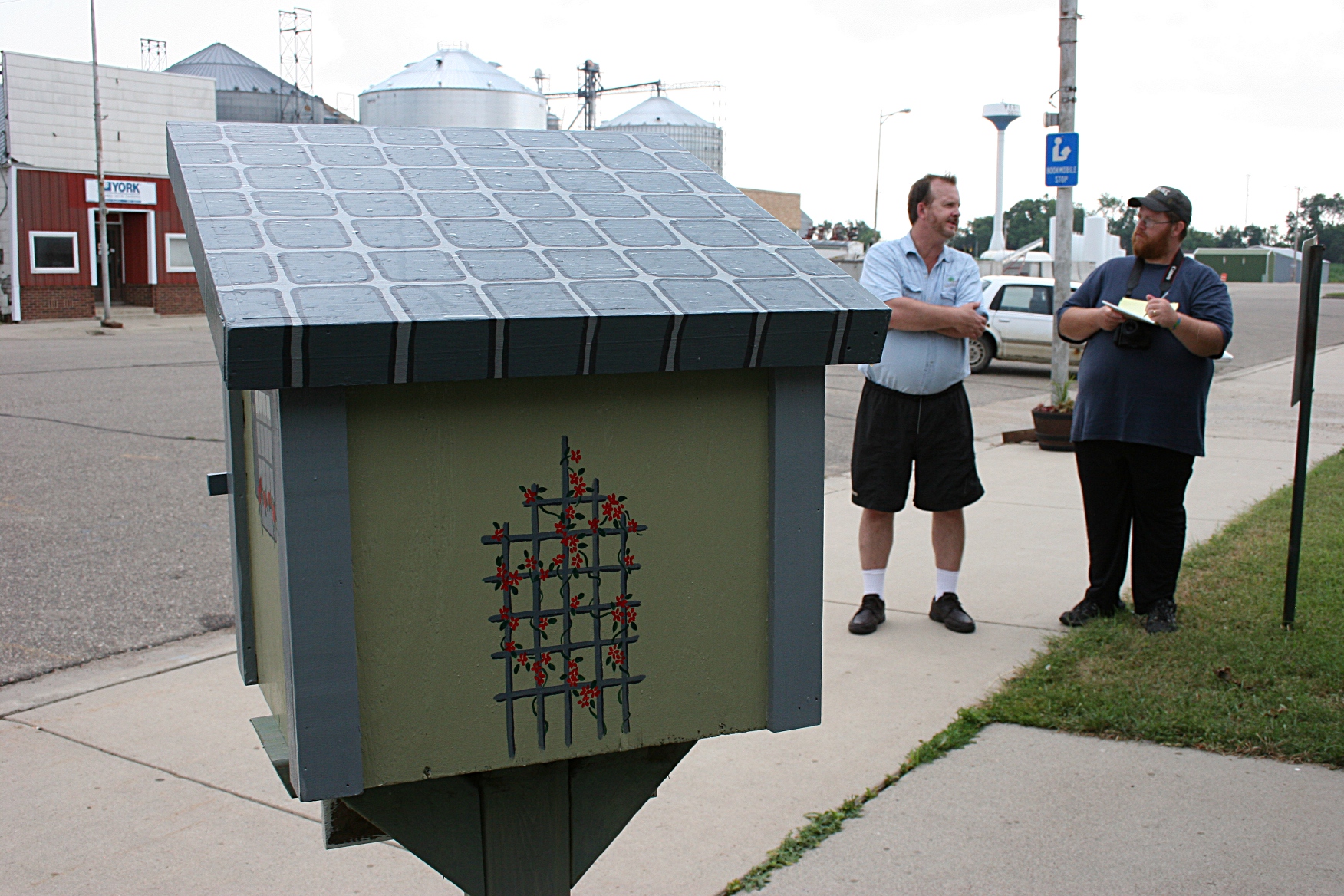
The Redwood Falls Gazette editor Troy Krause, right, interviews Todd Bol, co-founder of the Little Free Library in Vesta in early July. Bol gave a LFL to my hometown and installed it at the Vesta Cafe.

In the “Backward Glance” section of the newspaper, under 1987—25 years ago, this tidbit of information was published:

In the listings of the Redwood County 4-H county fair champions, Troy Krause of the Loyal Scotties was overall grand champion in flower gardens, while Kelly Zwaschka of the Vesta Vikings won champion child development.

(Note: Troy is editor of the Redwood Gazette, while wife Kelly gave birth to their seventh child, Gideon, this week. Congrats from the Gazette staff!)

How’s that for a birth announcement? Obviously Kelly’s interest in child development, even as a 4-Her, was a clear indicator of her future. As for Todd, I believe flower gardening could be connected to creativity/writing.

You’ll also find a brief about a game warden, shot through the head in 1937 by another game warden who mistook him for a bear. That’s listed in the 50 years ago section of “Backward Glances.” So, yes, apparently Merle Shields survived the incident as he was celebrating his 20th year as a Redwood County game warden in 1962. (BTW, since writing this post, I discovered that The Gazette has upgraded its website and the “Backward Glance” I reference here cannot be found, or I couldn’t find it.)

The third piece of interest was published in last week’s The Gaylord Hub, where I worked for two years as a news reporter and photographer right out of college. Avery Grochow, past president of The Gaylord Chamber of Commerce, penned a letter to the editor which I am certain is the current coffee shop talk of Gaylord.

I’ll summarize parts of his lengthy, six-paragraph letter and quote directly when needed. Grochow begins:

We, as the chamber board, are constantly trying to do our best for our community and are constantly being criticized by some for our decisions.

Apparently locals were grumbling about the food—who supplied it and how it tasted—at the community’s annual Eggstravaganza summer festival. New volunteers, replaced Dewey (whoever that is; my words here, not Avery’s), who “wanted a year off from all the arguments.” They stepped up and worked through a new bidding process for the supplies, awarding the bid to the lowest bidder.

Grochow continues:

We have had comments both ways about the supplying of hamburger. Some have criticized us in the past because the hamburger was too spicy, that they would rather have plain burgers, and we are now being criticized that we are having plain burgers and not spiced burgers.

No matter what we do as volunteers and directors for the Chamber, we can’t please everyone…We did what we thought was fair to everyone by taking bids on everything and stand by our decision.

Now, just imagine how difficult it must have been for Grochow to write this letter. Not an easy thing to do when you live in a small town like Gaylord where everyone’s lives are intertwined.

I give Grochow credit for having the guts to publicly voice his opinion in print. He doesn’t just vent, though. He offers a solution. And therein lies the point best taken by those who read his letter.

…if anyone has better ideas for us, we still are short of directors and could use all the help we can get to make our Chamber even more successful. We also have openings on the board so you can be part of the decision making, instead of just always making bad comments because you don’t like what we did. Remember, we, as the Chamber Board of Directors, are just volunteers trying to make Gaylord a better place to live and hopefully to have a great celebration.

Those closing remarks are words we could all heed because I expect you, like me, are guilty of occasional grumbling and complaining.


The generous gift of a St. Paul woman to a rural Minnesota food shelf January 6, 2012

TODAY I’M TREATING YOU to a gem of a story published yesterday in a weekly community newspaper, The Gaylord Hub.

It’s an inspiring and uplifting story of a St. Paul woman who purposely sought out a rural food shelf as the recipient of a Christmas gift. And a mighty generous one from someone with apparently no connection to Gaylord, a southern Minnesota Sibley County seat town of around 2,300.

Hub officer manager and bookkeeper Elizabeth Reishus shares the tale of generosity in her January 5 “The Word From High Avenue” column as shared with her by Yvonne O’Brien of Sibley County Food Share, Inc.

Writes Reishus:

A woman from St. Paul had called Second Harvest food bank to ask for a list of rural food shelves. Second Harvest was not able to give her that information, but did give her O’Brien’s phone number.

The woman then called O’Brien and asked questions about the food shelf. What percent of families served were minorities? Is the need higher in the summer? What kinds of resources does your food shelf have to rely on for donations?

O’Brien explained that about 40 percent of clients at the food shelf are people of a minority. The need for help increases in the summer when seasonal workers arrive to work at area farms and other agriculture-related jobs. She also explained that unlike bigger towns and cities, we do not have the big chain stores such as Wal-Mart, Target, Cub or Cash Wise that donate food. The Sibley County Food Shelf is maintained through the generosity of area people and some grant money, O’Brien explained.

The St. Paul woman said she would like to send a donation to the food shelf. O’Brien gave the woman the mailing address for donations and expected to receive a check for about $50. She was pleasantly surprised to find that the donation check was for 10 times that amount. The generous mystery woman gave $500 to the Sibley County Food Shelf.

How’s that for Minnesota Nice and for thinking beyond the metro?

Consider the effort this mystery woman took to find just the right place for her $500 donation. What motivated her to seek out a rural food shelf, to ask those specific questions about minorities, to give that much money to a single food shelf?

I’d never really thought, prior to reading Reishus’ column, how small-town food banks typically don’t receive food donations from chain stores, relying instead primarily on the generosity of locals.

So thank you to that woman from St. Paul for thinking beyond the metro area of the need in rural Minnesota and for blessing Sibley County Food Share with $500.

She offers us much food for thought.

FOR MORE INFORMATION about Sibley County Food Share, click here.


Dispelling a Mayberry myth in rural Minnesota December 16, 2011

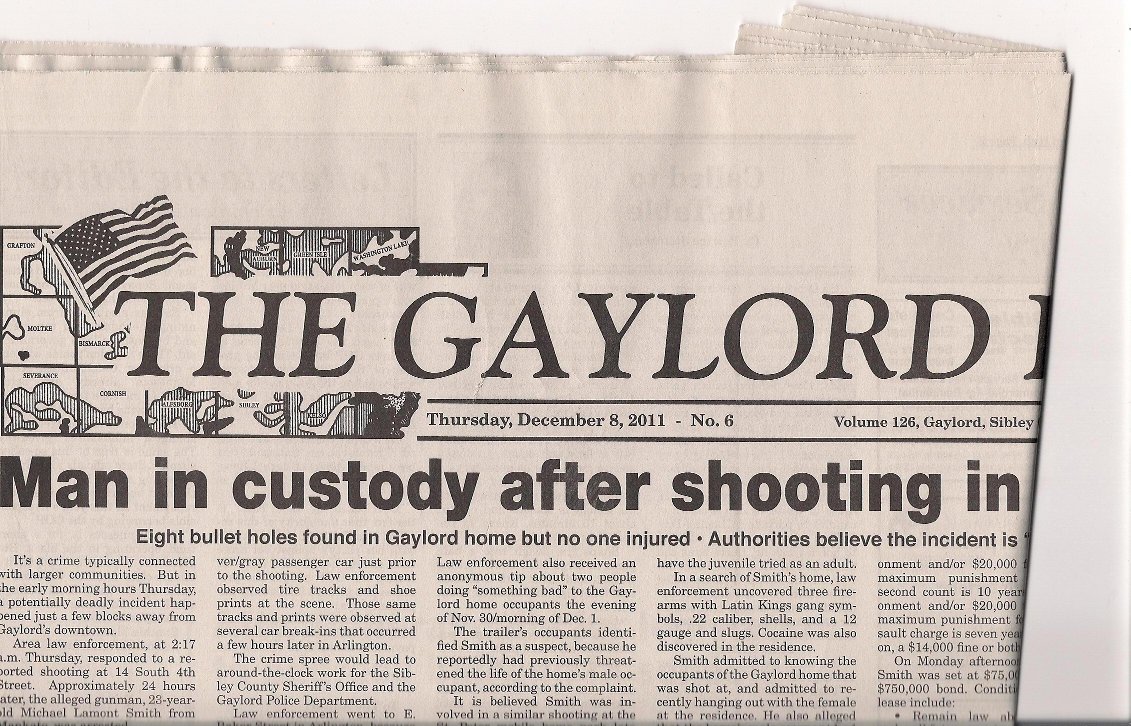
Man in custody after shooting in Gaylord

Two men arrested after incident with police officers in Winthrop

Three years since rural Green Isle homicide

These disturbing headlines all published recently in a single issue of a 10-page small-town Minnesota weekly newspaper.

How life has changed in the 31 years since I pounded out news articles there, for The Gaylord Hub, on a vintage manual typewriter. The biggest news stories during my 1978 – 1980 tenure as a reporter were fires and motor vehicle crashes and the controversy over the expansion of local chicken barns.

I didn’t write about eight bullets fired into a Gaylord home in an alleged gang-related shooting or a scuffle between police and a suspect or a three-year unsolved homicide.

And I didn’t have to report on a courthouse shootings like the one which occurred Thursday in quiet Grand Marais, an artsy get-away destination along the shores of Lake Superior.

Thirty years ago, small towns were still relatively untouched by violent, drug-related or other crime. Not so anymore. One need only pick up any weekly newspaper to read about major crimes that rock even the most rural regions.

Just this week in Redwood County in rural southwestern Minnesota, warrants were issued for 31 individuals on felony drug charges following a year-long, five-county investigation, according to information published in The Redwood Falls Gazette. Most suspects have been arrested and charged.

That’s my home county you’re talking about here, a place of small towns, grain elevators, farm sites, and corn and soybean fields—about as rural as you can get.

This isn’t Mayberry anymore.

While I can wax nostalgic about how things “used to be,” the reality of life is this: Times have changed. People have changed. Respect for parents and authority and laws have eroded.

Crime, once considered a big-city problem, reaches deep into the most rural of locations.

It is sad.

But it is the truth.

IF YOU LIVE in a rural area, have you see increases in crime? Explain. How have you, personally, or your community been impacted? How is your community dealing with crime? Please submit a comment and share.

© Copyright 2011 Audrey Kletscher Helbling


Some fine examples of giving in rural Minnesota April 5, 2011

WHEN I READ through the March 31 edition of The Gaylord Hub, a rural Minnesota weekly newspaper where I worked from 1978 – 1980, something caught my eye.

The 10-page paper was packed with stories about community members helping one another. The quantity of articles impressed me enough to write this post, to emphasize to you that even during these challenging times, Minnesotans are reaching out to one another.

These are stories we need to read among the hard news stories of floods and earthquakes, wars and suicide bombers, rising gas prices and falling property values, the news that causes us to ask, “What is this world coming to?”

The articles I read reaffirm that among all the bad in the world, plenty of good still exists. And often, young people are leading the way to assist those in need.

In Gaylord, the Sibley East Junior High Student Council recently raised $600 for the Sibley County Food Shelf. Likewise, the Gaylord Cub Scouts, Boy Scouts, leaders and parents collected 1,032 pounds of food and $70.65 for the county food shelf in a one-day drive.

Students from Sibley East Elementary Schools in Gaylord and Arlington raised $10,431.32 in the Pennies for Patients fundraiser for the Leukemia and Lymphoma Society, placing in the top 25 among 473 participating schools. How’s that for a small school (between 200 – 499 students) in rural Minnesota?

The adults in the Gaylord area aren’t sitting idly by watching the younger generation pursue charitable giving.

The winner in a local drawing chose Sibley County Food Share, Inc., as the recipient of a $2,500 donation from the Monsanto Fund.

Sertomans, at their weekly meeting, discussed plans for a benefit to help the Lindemann family as their daughter, Paisley, battles cancer.

The newspaper also published a story about an education memorial fund established for Kaylee and Gavin, the young children of Michael Struck, a Minnesota Department of Transportation worker who died after his backhoe was swept away recently in flood waters.

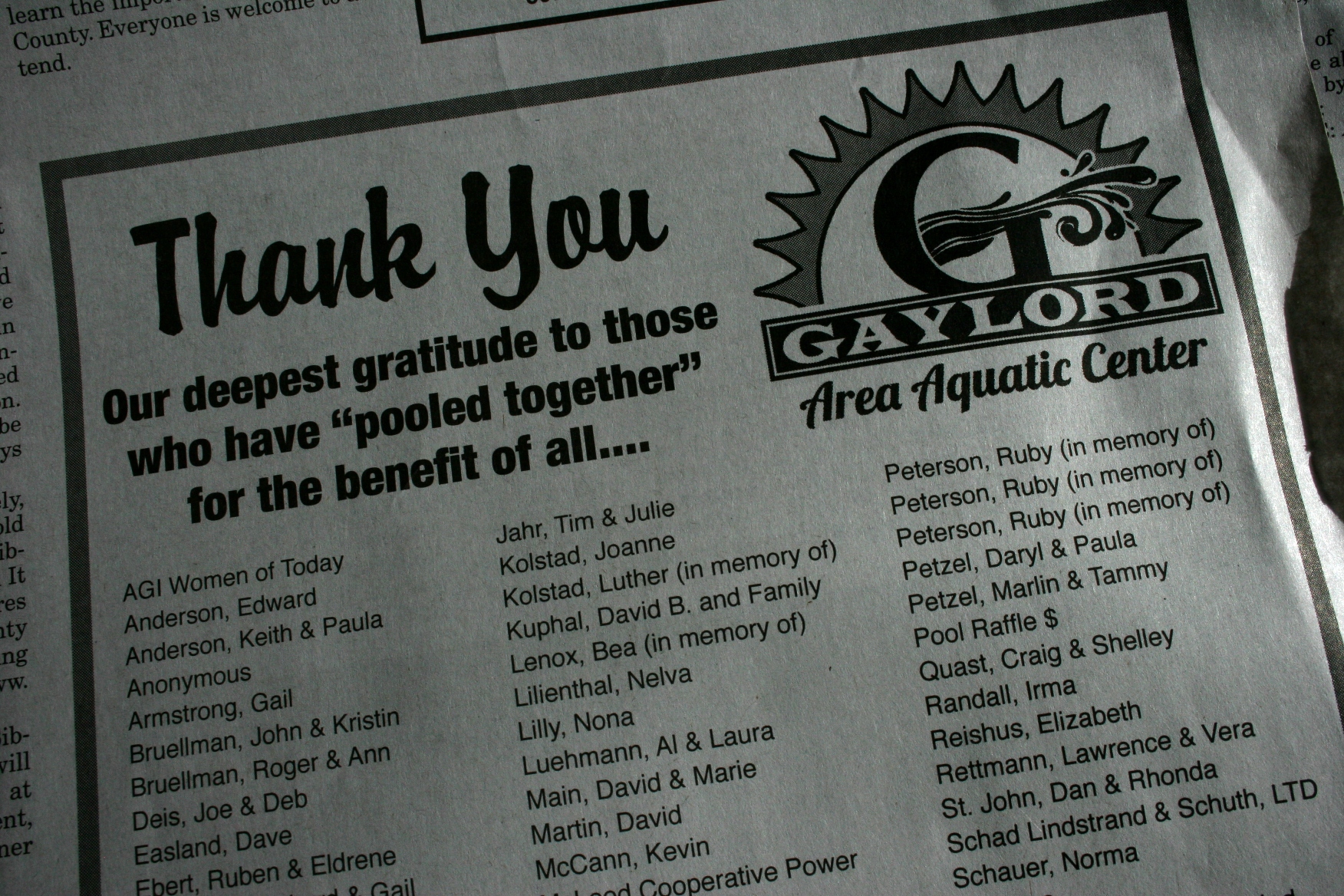
And then, in a front page article, readers learned that $63,000 in donations have been made to Gaylord’s new aquatic center. Donations will be used to buy amenities (play features) for the pool. All 69 donors are listed in an ad published on page 5.

This is just an observation I’ve made over the years—and I think it’s an accurate one—but residents of small towns are often willing to open their pocketbooks to projects that in larger cities would be funded with taxpayer dollars. Why? I think community pride and ownership and the deep personal connections small town residents have to one another prompt such generosity.

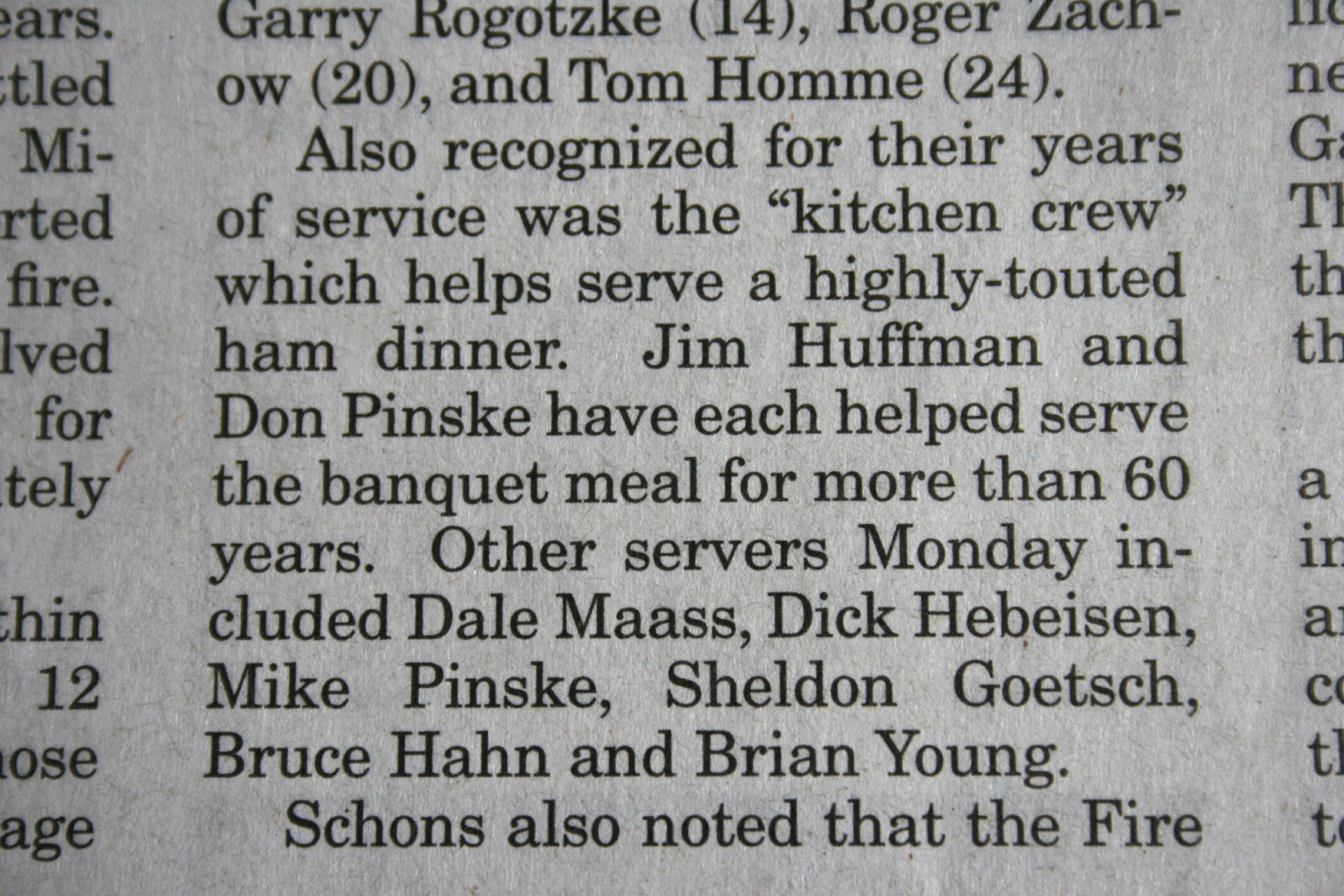
Finally, the last philanthropic piece of news was buried deep in a front page article titled “Fire Department receives FEMA grant.” After explaining that the local department has received a nearly $60,000 grant to purchase firefighting equipment, the reporter writes about the annual firemen’s banquet.

And that is where I found this little gem: “Also recognized for their years of service was the ‘kitchen crew’ which helps serve a highly-touted ham dinner. Jim Huffman and Don Pinske have each helped serve the banquet meal for more than 60 years.”

Sixty years. Now that’s dedication and an outstanding example of selfless giving back to the community.

© Copyright 2011 Audrey Kletscher Helbling


The snow angels of rural Minnesota December 22, 2010

THEY ARE THE ANGELS of rural Minnesota.  The volunteer firefighters. The volunteer first responders. The volunteer ambulance crews.

If you don’t believe me, then spend some time in a place like Vesta, population around 330, on the southwestern Minnesota prairie where I grew up.  In small towns like this, the nearest clinic and hospital are often a 20-mile drive or more.

My mom still lives in my hometown and, because she’s getting up there in age, I worry about her. But that concern is offset somewhat by the knowledge that first responders will come to her aid in a medical emergency. And they have.

So when I read an article in the December 16 The Gaylord Hub, a community newspaper where I worked decades ago right out of college, I knew I had to share a story by reporter Lisa Uecker. She wrote about an ambulance trip from Gibbon to New Ulm during the December 11 blizzard.

Uecker is graciously permitting me to retell that story here. It’s worth your time to read for the lessons it teaches in dedication and care and how those in small towns will go the extra mile to assist their friends and neighbors.

In this instance, the miles, literally, were extra and a trip which should have taken perhaps 30 minutes became a 3 ½-hour ordeal.

The incident begins at 2:30 p.m. on Saturday, December 11, during the height of the two-day blizzard. The volunteer Winthrop Ambulance Service receives a call to Gibbon some eight miles to the west. Once the crew reaches Gibbon and the patient, they backtrack to Winthrop knowing they must travel the longer, but safer, state highways rather than follow the shorter route along county roads. From Winthrop, they are headed 16 miles south along Minnesota State Highway 15 to the hospital in New Ulm.

A paramedic intercept is impossible, the crew learns, so snowplows are dispatched to meet the ambulance at the intersection of Highway 15 and Nicollet County Road 1 near Lafayette. One plow goes into the ditch. Another is low on fuel. The third has mechanical problems. None of the plows make it to the appointed rendezvous site.


If you're unfamiliar with Sibley and Nicollet counties, here's a map photo to show you the roadways and towns highlighted in this story.

The ambulance crew is on its own, traveling in white-out conditions near Klossner. The rescue vehicle soon becomes stuck on the shoulder. Because snowplows have been pulled off the roads, the Lafayette Fire Department comes to the rescue, freeing the ambulance with its pumper truck.

After passing Klossner, the ambulance gets stuck again, but the driver–ambulance captain and assistant Sibley County attorney Donald Lannoye–is able to rock the vehicle free.

Finally, at 6 p.m., the patient, who has been stable throughout the ride, is delivered to the New Ulm Medical Center.

The four-member volunteer ambulance crew spends the night in New Ulm.

In an interview with reporter Uecker, Lannoye says that once he passed Sibley County Road 8 right outside of Lafayette, he could never drive more than five miles per hour due to poor visibility and road conditions. The crew saw 11 – 15 cars in ditches and 4 – 6 cars stuck in traffic lanes near Lafayette.

Then Lannoye also reveals that his crew began their day at 5 a.m., transporting a patient on icy roads to Hutchinson.

If ever there was an outstanding example of the care and concern residents of rural Minnesota have for each other, then this would be it. We should all be thankful for volunteers like Lannoye, ambulance crew members Lisa Klenk and Todd Storms,  EMT-in-training Katie Uecker and Lafayette Volunteer Fire Department members who braved a blizzard to help their neighbors.

They are, indeed, snow angels.

IF YOU HAVE A STORY to share about how volunteers have helped you or someone you love, submit a comment. I’m certain there are many such stories out there.

© Copyright 2010 Audrey Kletscher Helbling and Lisa Uecker