
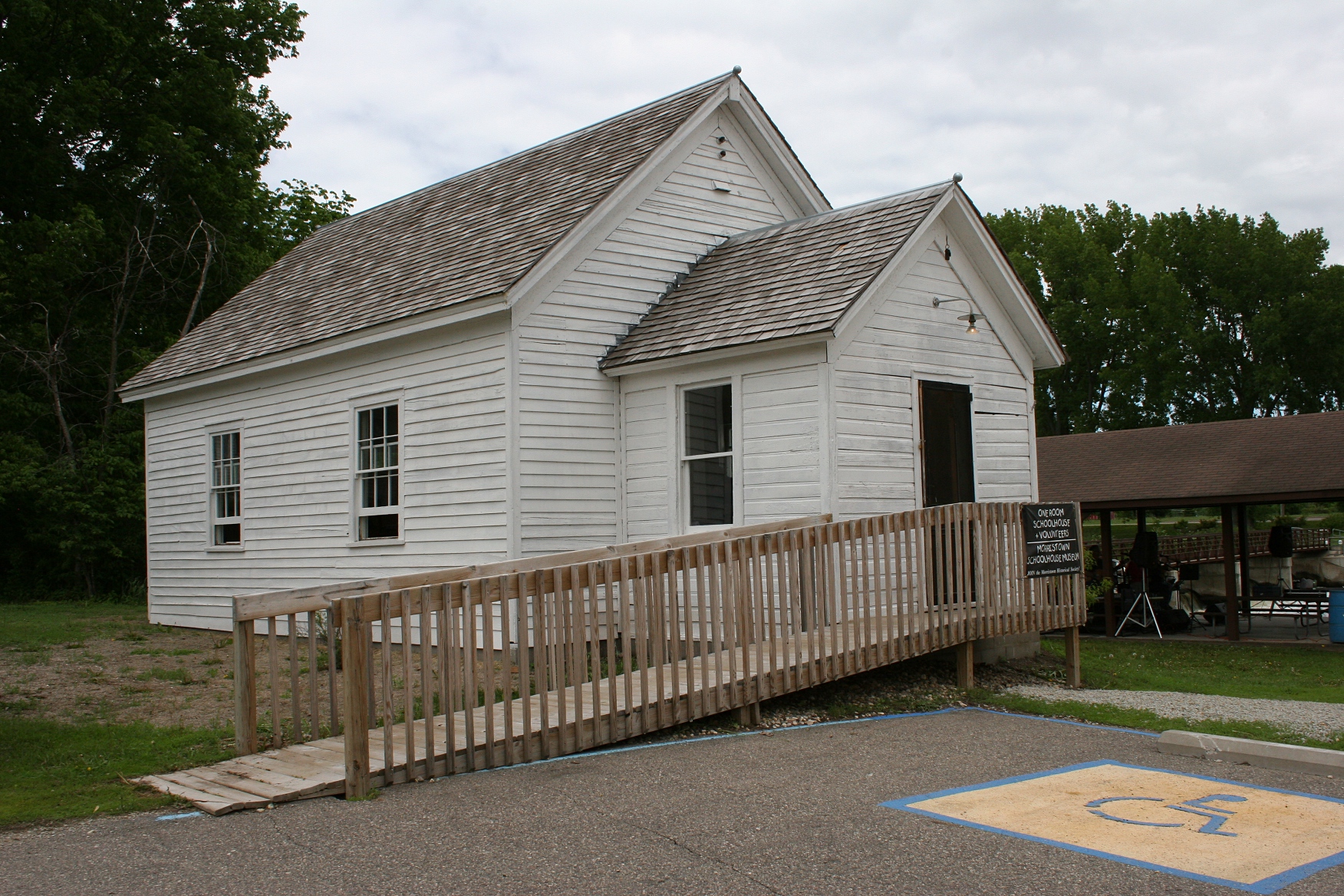
The District #54 country school, built in 1870, was moved into Morristown several years ago to a site next to the old mill along the banks of the Cannon River.
OH, THE THINGS YOU LEARN upon visiting a grassroots historical society run by volunteers in a small town.

One of my favorite images is this one of 87-year-old volunteer Helen Newman’s hand. the life-long Morristown resident was cutting and taping info into the 2005 sesquicentennial album shown here.
Nothing against sprawling museums with paid staff—those places are fabulous, too. But there’s something especially touching about folks from a small town collecting photos and artifacts, memories and information, to display in a building(s) with a deep connection to the community.
You’ll find exactly that in Morristown, population around 1,000, in Rice County in southeastern Minnesota. Set next to the Cannon River are the Morristown Feed Mill, once home to a sawmill and flour mill, and the District 54 Epard School moved in from a few miles north of Morristown and today the District #54 Schoolhouse Museum. The Morristown Historical Society maintains both buildings, which I toured during the recent Dam Days community celebration.
I didn’t study the content of the two buildings like a local with an intimate connection to this place. Rather, I picked topics of particular interest to me to read and photograph.
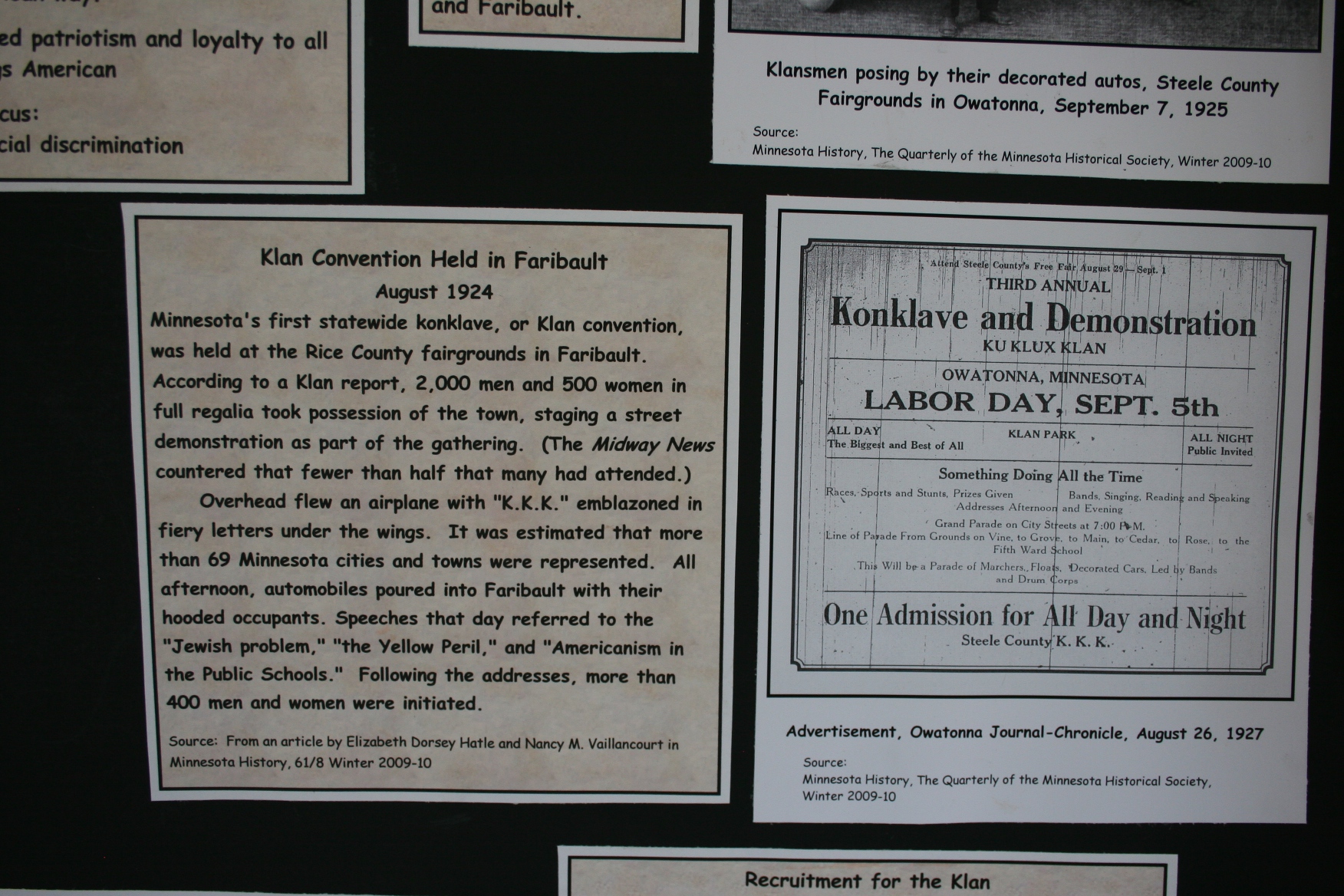
Information about the Ku Klux Klan’s presence in Morristown and the region.
For example, I was unaware that my county of Rice was home to Ku Klux Klan chapters and hosted the first statewide Klan convention at the fairgrounds in August of 1924. Chapter #26 was headquartered in Morristown with other chapters in nearby communities like Faribault and Owatonna and Austin and Albert Lea further to the south. Certainly, such membership doesn’t please me. But I’m thankful the Morristown Historical Society didn’t ignore this negative part of the town’s history. We need to learn from our mistakes.
A “Morristown Crime Wave of 1914” display also caught my eye with crimes such as profane and abusive language, drunken and disorderly conduct, and stealing fish noted.

News stories about the devastating 1900 fire in downtown Morristown.
In another display, a front page article published in the February 1, 1900, issue of the Morristown Press detailed a devastating fire which destroyed 20 buildings, nearly the entire business district, in downtown Morristown. “Loss will reach $35,000,” a sub-head reads.

Mrs. Lydia Meehl, who helped so many Morristown area women birth their babies.
My friend Dale, who joined a historical walking tour on the day I visited the schoolhouse museum and mill, learned about his place of birth in the Meehl Maternity Home. Hundreds of local babies were birthed there with the assistance of licensed practical nurse Mrs. Lydia Meehl. A newspaper story quotes the 82-year-old Meehl as saying she “loves them all (the 500-plus babies born in her maternity home).”

A snippet of the artifacts and info displayed inside the schoolhouse turned museum. Those are Civil War cannonballs on the shelf near the center of the photo
In the museum collection, you’ll also find the usual military (including Civil War cannonballs), school, telephone and other small town artifacts.
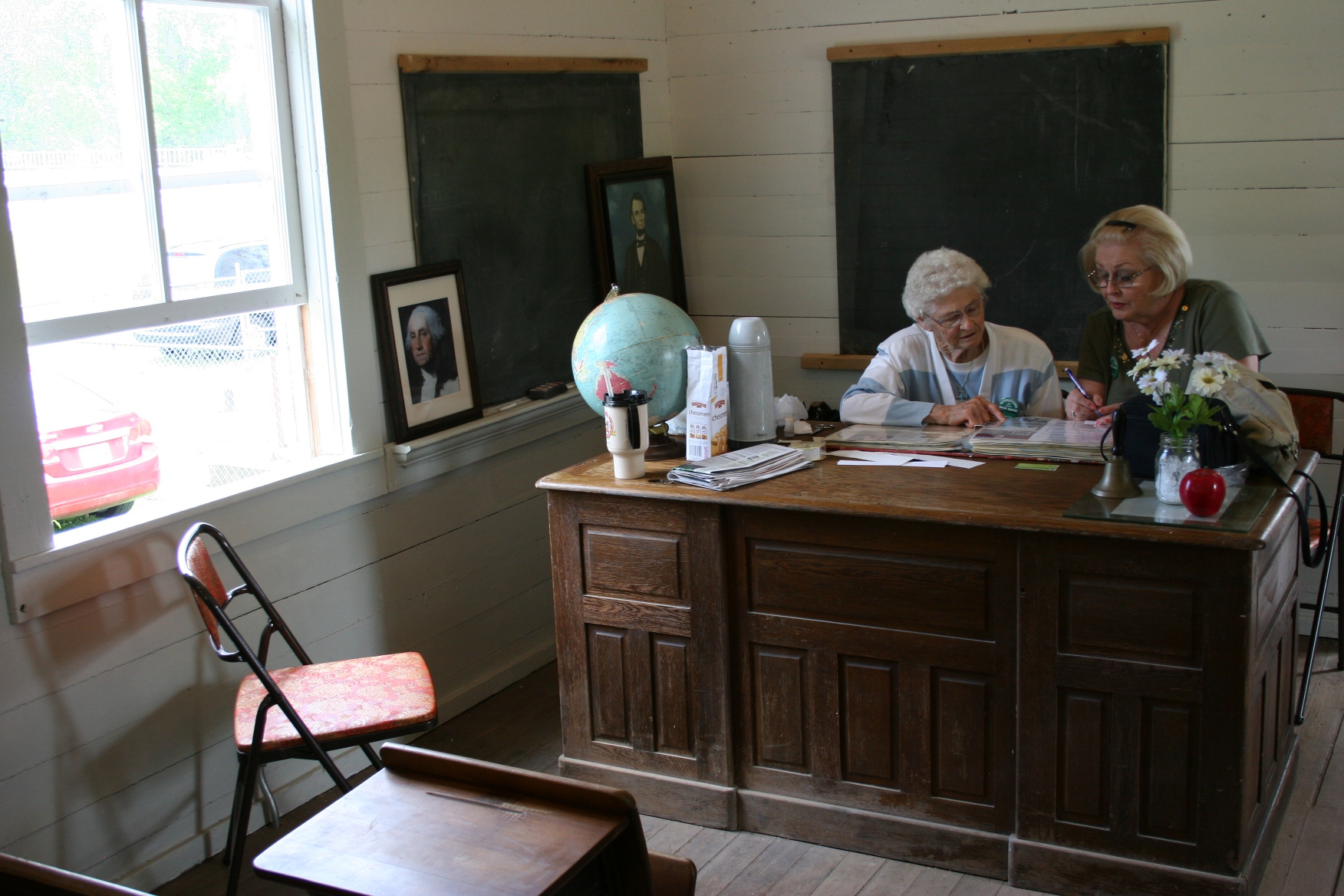
Helen Newman and Cindy Packard work on a sesquicentennial album.
As a bonus, I met 87-year-old Helen Newman, who’s lived in Morristown her entire life, and Morristown native Cindy Packard, visiting her hometown from Colorado Springs. The two were seated behind a hulk of a desk inserting info into an unfinished album about the town’s 2005 sesquicentennial.
Packard brought with her a few items for the schoolhouse museum, including a spatula imprinted with “Our Twentieth Year LLOYD’S FOOD MARKET, Morristown, Minn.” She kind of hated to give it up, but…

Switchboard wires and switches reportedly from Adolph Hitler’s bunker.
Upon my request, the pair pulled the spatula and a snippet of wires and two switches from a plastic bag resting on the corner of the desk. The switches came from the switchboard in Adolph Hitler’s bunker and were brought back by Oscar Ahlman to Hewitt Thomspon in Morristown, according to a note accompanying Packard’s donation.
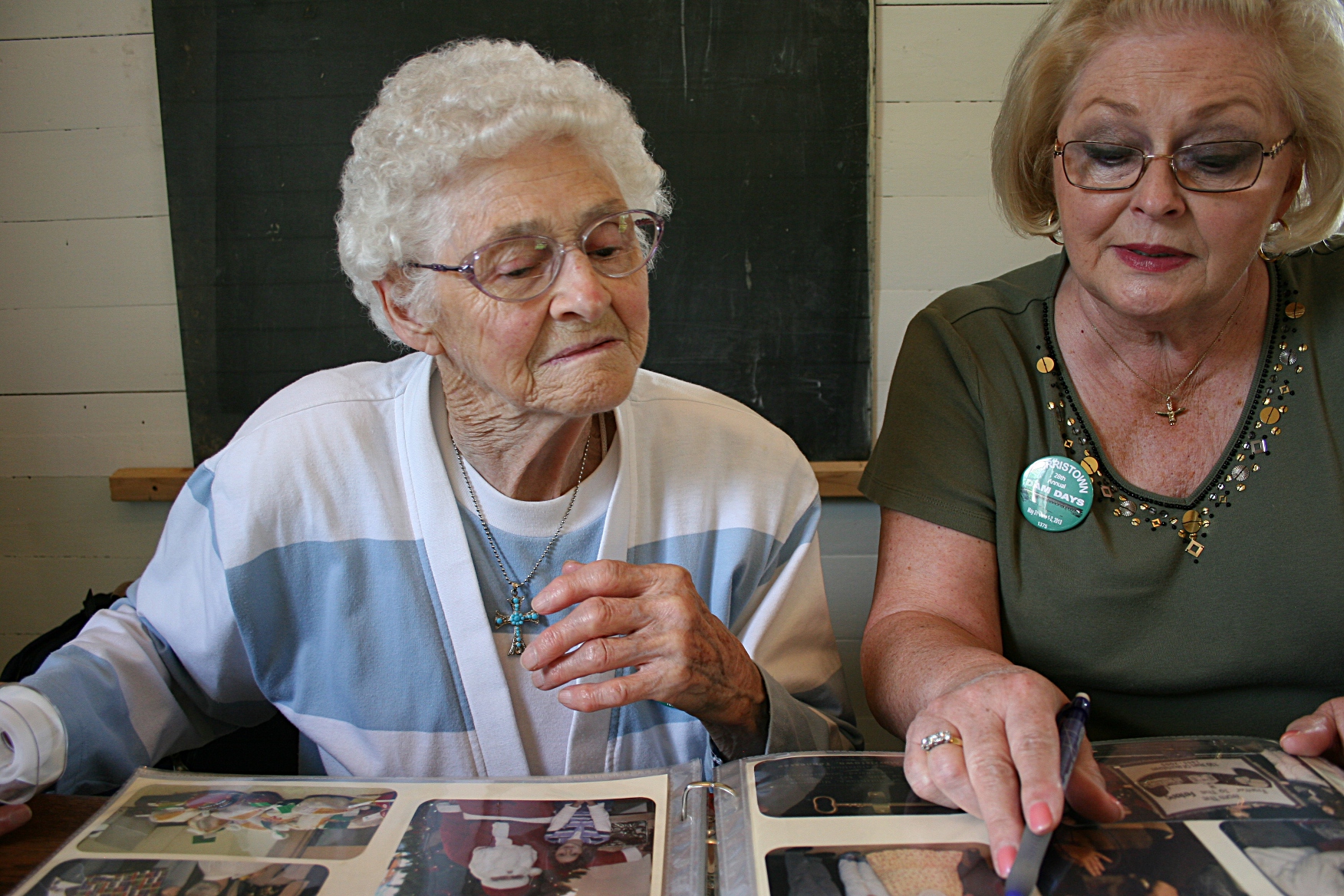
Helen Newman and Cindy Packard visit while they write, cut and tape information into the album. I told them just to ignore me and my camera and they obliged. I simply love this photo of the pair.
And that’s how these small town museum collections grow—with donations from the likes of a hometown girl come home every year and the dedication of volunteers like the 87-year-old Newman.
BONUS PHOTOS:
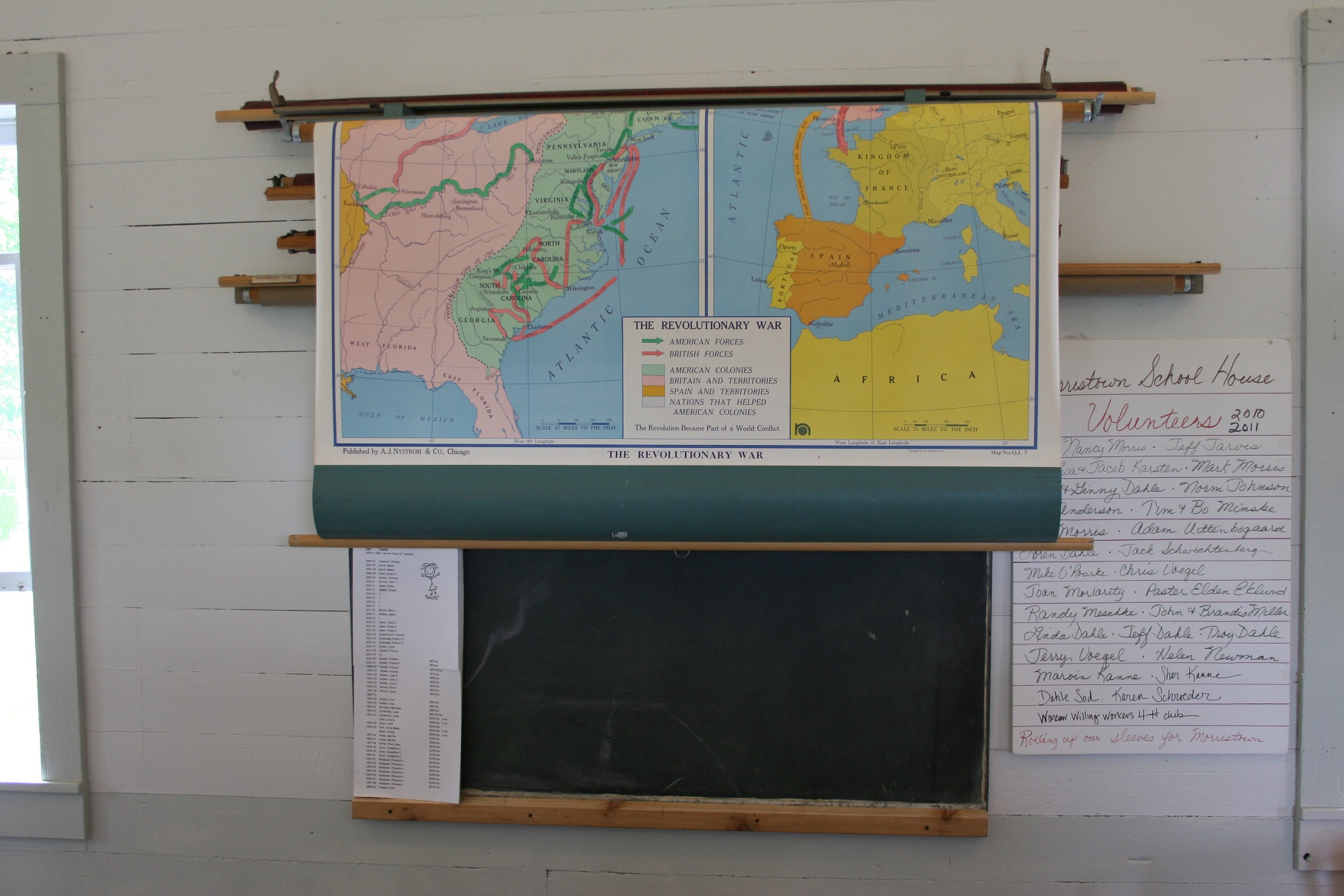
There’s something about an old school map that takes me back to Vesta Elementary School, my childhood school.

A display of school-related items includes a lunch pail, books and photos.
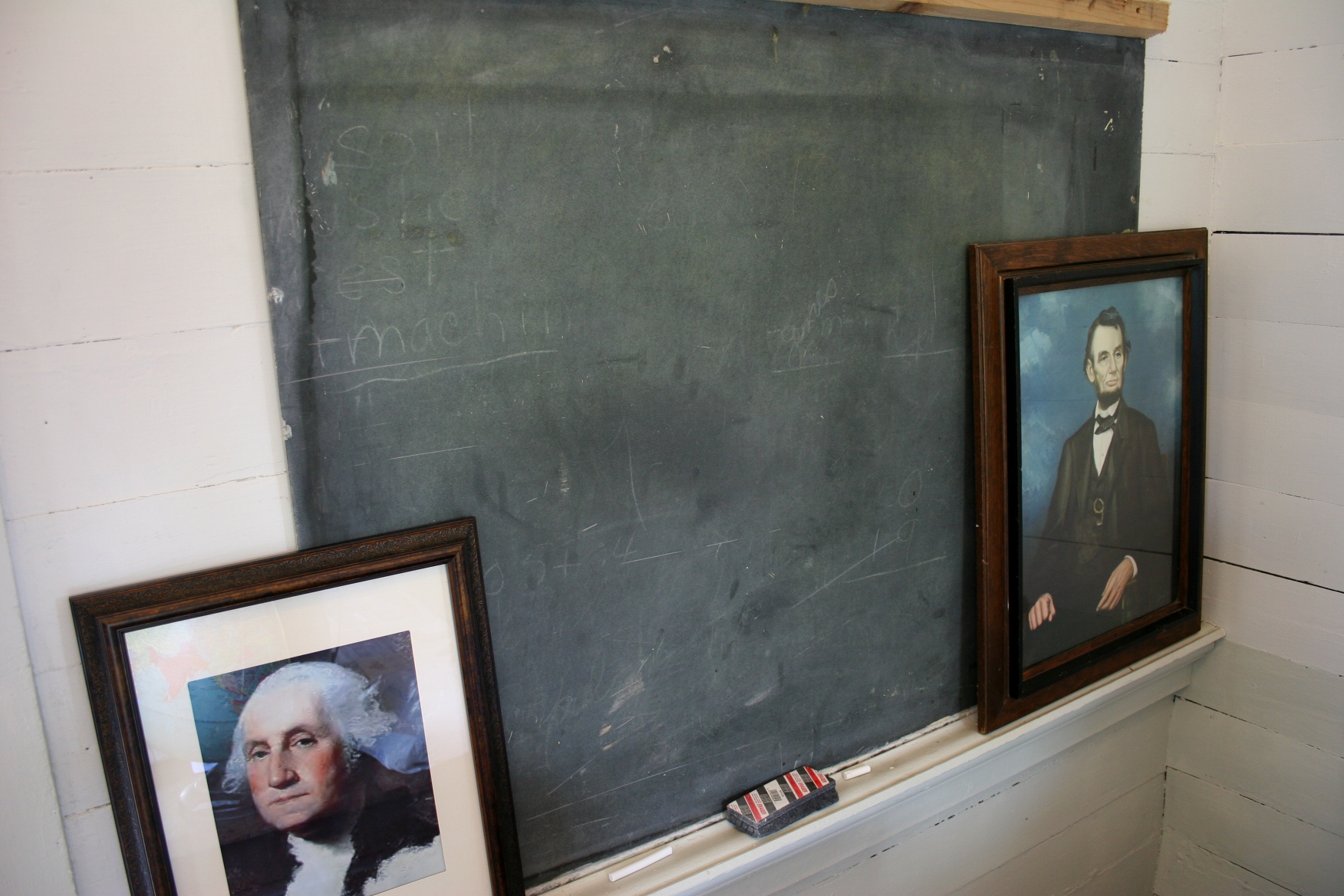
Presidential portraits grace a corner blackboard by the teacher’s desk.
FYI: To read a previous post on the historic Morristown Feed Mill, click here. A second mill post will be forthcoming. Also check my recent archives for stories from Morristown Dam Days.
© Copyright 2013 Audrey Kletscher Helbling


 Minnesota Prairie Roots
Audrey you did another great job with this post of a small town museum! Fascinating!!! I love the map picture—definitely brings back memories!!!!
Thank you, Beth Ann. Yeah, I kind of wanted to rip that map off the wall and take it home with me. It would look so cool hung as a work of art and focal point discussion piece for those of us who remember learning from these.
I would have helped you steal the map!! I also remember them and the last one was a blank pull down screen for the slide projector!! Laugh! Lovely work Audrey, and interesting for me too and I did not know that the KKK also hated asian and jewish families as well, that article sent chills down my spine, this was not so long ago that they were hiding behind sheets.. awful.. anyway on a more cheerful subject John and I are hoping to take YOU on a tour of route 66 service stations on saturday, after the concrete is poured.. I shall be sure to pop in a link so you don’t miss out on some of our local streets.. c
Ha. Ha. If ever I need a cohort in crime, you’re my woman. I am totally looking forward to the tour of Route 66 service stations. Oh, I’d love to be along on that ride.
Wow, the KKK info stands out to me, too. I did not know we had chapters in MN, but I suppose I shouldn’t be surprised. They were pretty widespread back in the day.
You packed an amazing amount of information in this post, Audrey! Your newspaper experience shows.
Once a journalist, always a journalist.
I was aware of the KKK in Owatonna, but not in the other communities.
Thanks so much for sharing – the history in this place is AMAZING!!! I love when the volunteers are passionate about what they do and love interacting with the public – enjoy the history and the stories. Sometimes I miss living in a small town because of the sense of community. Have a Great Weekend:)
The passion of these volunteers impresses.
Another great article! and another place to add to my “places to visit” list.
Thank you. Just check ahead, because I don’t know how often the museum and mill are open. I’d go on to the Morristown city website for starters.
Again….I love your post, and that old school house. It’s so neat to have the elderly volunteers, they have so much to share 🙂 It’a always a bonus to have the maps and blackboard in these old school houses, it sure brings back the memories of my school days.
These volunteers possess such enthusiasm and passion and I love seeing their dedication.
And, yes, the “artifacts” bring back a lot of good memories.
I love old schoolhouses. The original schoolhouse on Orcas Island is now a museum – not much in it, but it’s fun. I have a friend here in town who bought one just because she didn’t want it to be torn down. She had it moved to a spot near the lake – so cute!
OK, you need to show us the relocated schoolhouse on the lake. Did your friend convert this into a cabin? This sounds like a blog post and/or a feature for The Globe.
Yes, I’ve been meaning to ask her if I could interview her about it. And if I could get paid for it, so much the better!
Oh, yes, getting paid for writing about the old schoolhouse is even better.
I know of an old school house for sale! Wonderfully kept up.
And where would that be, Mari? Can you provide more details.