
IN THE DISTANCE, down the gravel road, a helicopter swept across the fields and then disappeared.
“Did it crash?” I asked my husband, worry lacing my words.
“Do you see a fireball?” he responded, answering my question.
I didn’t. And it was obvious to me then that the rise of the land was blocking my view of the helicopter.

But I needed to visually confirm, to see this flying machine up close. So Randy turned off the asphalt county road onto 230th Street East, aiming toward a hilltop dairy farm marked by five looming silos.
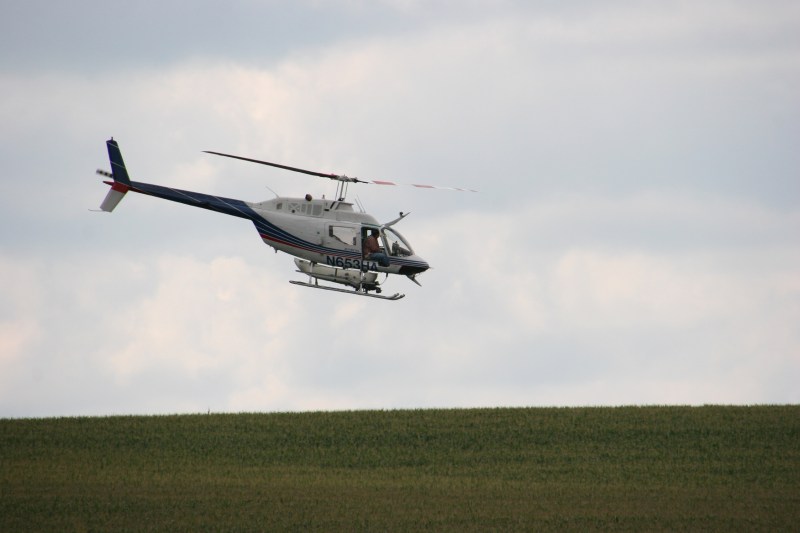
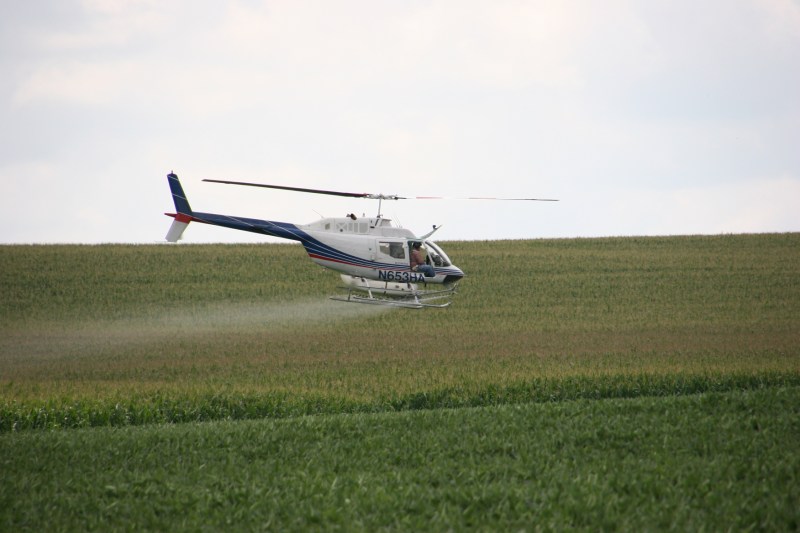
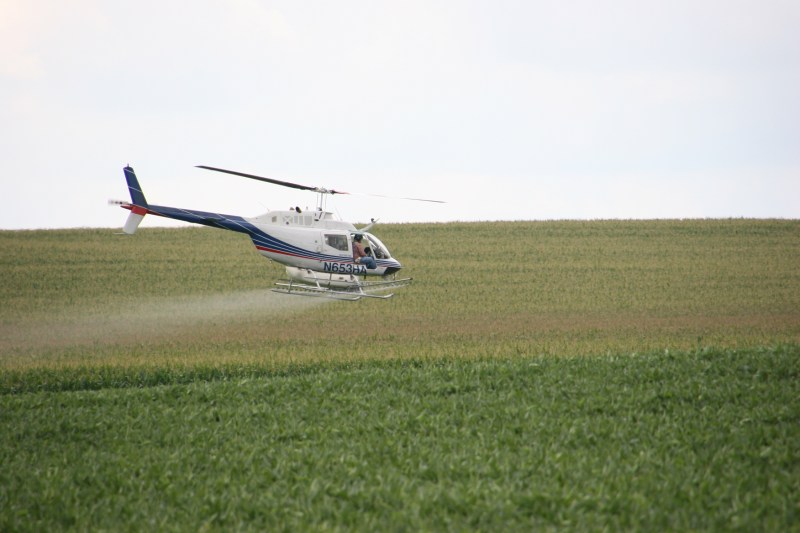
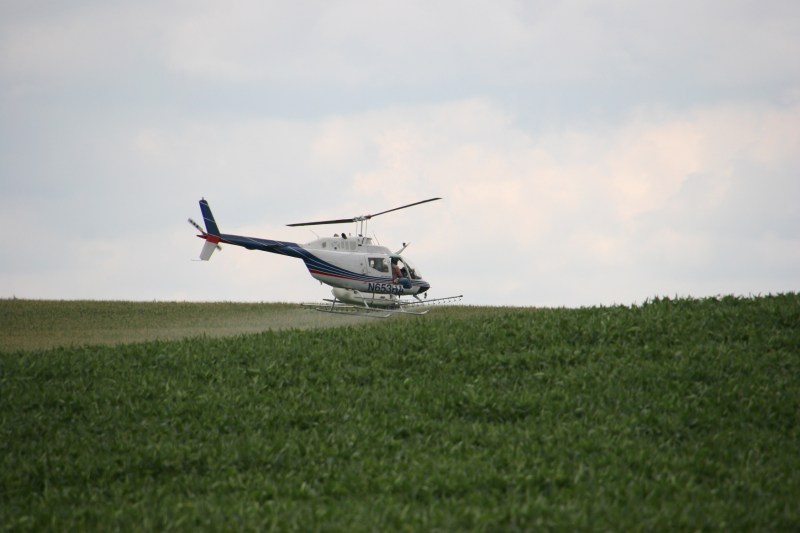
Before we made it to the farm, though, the chopper was back, skimming and spraying chemicals upon acres of corn at this location southeast of Faribault. Randy braked our van to a stop and I was out the passenger side door before the wheels stopped turning, eager to photograph an aerial application up close.
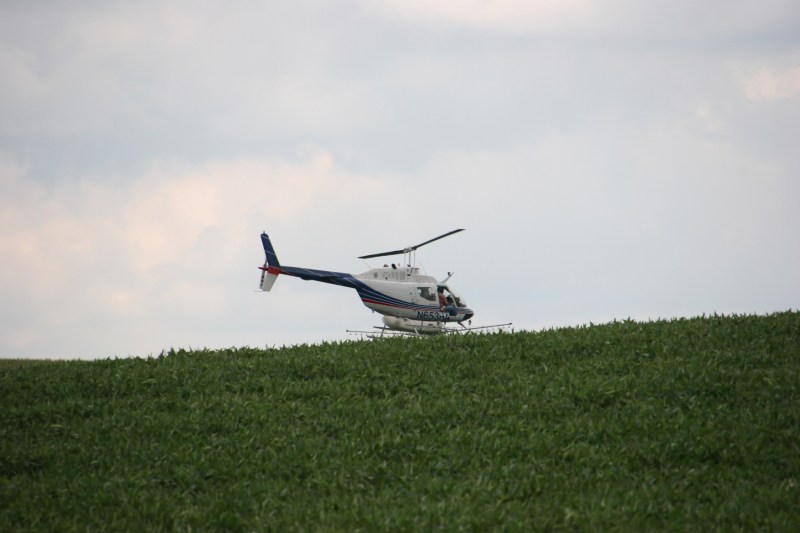
The helicopter files over a hill in the corn field.
Whether you agree or not with the spraying of chemicals upon the land to control weeds, fungus and insects or to fertilize crops, you have to admire the skills of these pilots. This appears a dangerous undertaking as the copter zooms above the fields, the pilot simultaneously spraying, guiding his aircraft and watching the ground for obstacles—like silos, power lines and hills.
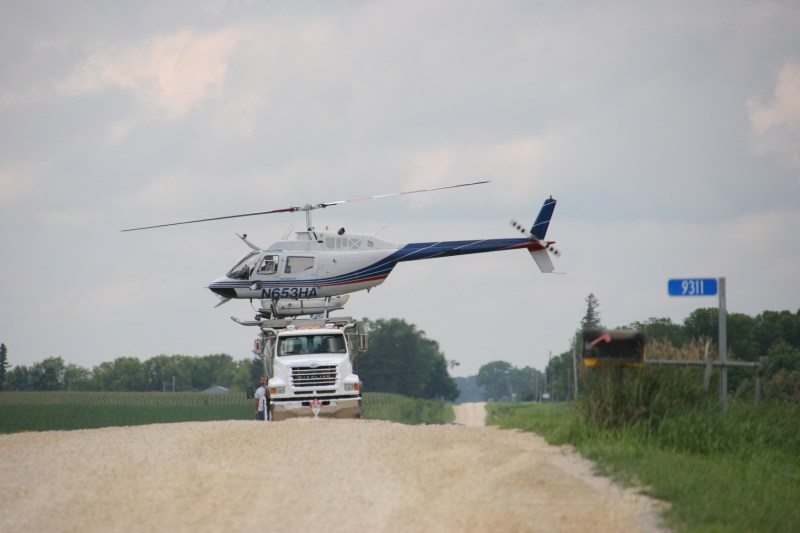
While the pilot’s skills impressed me, I was especially fascinated by what I saw as we crested the hill next to the Tatge dairy farm.
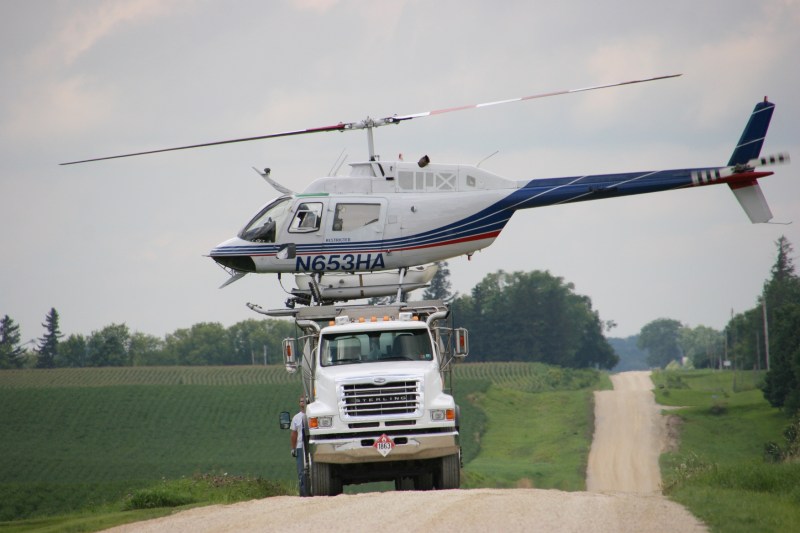
The helicopter had landed atop a truck in the middle of the country gravel road.
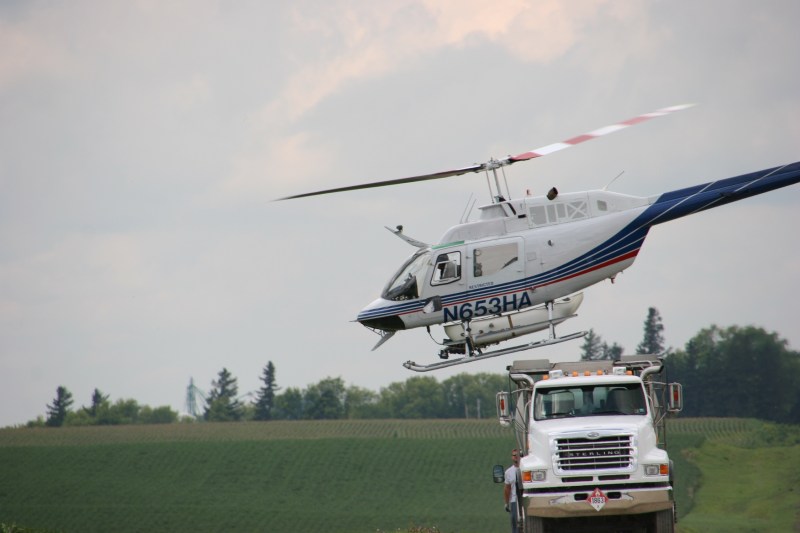
The helicopter lifts off from the mixing truck, ready for another round of spraying.
I’d never thought about this—how an aerial spraying helicopter refills with both chemicals and fuel. We didn’t stop to ask questions. I wasn’t about to distract the team of men focused on their work.
© Copyright 2016 Audrey Kletscher Helbling


 Minnesota Prairie Roots
Impressive skills.
Absolutely agree.
Helicopter pilots have amazing skills without a doubt. My brother who does a lot of flights in his job to locate animals, etc. has always said he has the utmost respect for any of his pilots that have flown helicopters . When I went up with him years ago our pilot was one that had also done helicopter tours over the Grand Canyon with the company that we actually used when we did that tour. The skill and expertise was amazing so I can imagine that the crop spraying was similar in the necessary technique and skills. What a cool thing to be able to watch.
The skill set has to be high. Yes, I feel fortunate to have come upon this and then to be able to photograph it. There’s a reason I typically carry my camera with me.
In my part of southwest Minnesota, crop spraying planes are more commonplace. Those pilots require a lot of skill too. I know – I’ve seen them going over or near my house time and time again. I’ve never seen helicopters doing it. That would be interesting!
I grew up in southwestern Minnesota (Redwood County) and recall seeing crop dusting planes, too, but never helicopters.
BTW, I’m in the middle of reading your book. Our upbringings were similar.
Yikes! I’ve never seen that up close. Interesting photos, especially when the helicopter landed on the truck to reload. Weren’t you worried about some of those chemicals landing on you? Or weren’t you close enough for that?
I only thought of the chemicals after the fact. The helicopter is so low to the crop (perhaps 10 feet above) that the spray is closely targeted. Plus, it was a calm day; no spraying on windy days when drift could be an issue. So to answer your question, no worries really. I was using my telephoto lens also, so was not nearly as close as it may seem in these images.
Okay, that’s good!
Good shots but these chemicals are known carcinogens in all likelihood. And they drift many miles. And they kill pollinators.
Karin
I don’t know what was being sprayed on this field. My purpose in posting this was neither to endorse or oppose the use of chemicals but to photographically document what I saw.
I love to see the crop dusters — they really bring me joy for some reason — but, like Colleen above, I’ve never noticed one using a helicopter nor seen it refill. I always expect the planes to be yellow, but I saw one about two weeks ago and it was white like your helicopter.
Red or yellow is the color I always expect, too.
That’s very interesting and a little unnerving at the same time
Agreed.
I have personally known many duster pilots over the years some of them still with us and some not. A very good friend of mine was a copter pilot in Vietnam doing 2 tours there then onto crop dusting. After all the dangerous flying he performed he was unfortunately killed when one morning he went into an old barn to retrieve some stuff and at that point in time the old barn collapsed on him. It was a very sad day what with all he had been through…………….
As a side note, if your interested to know, the two small fin looking things (like a sharks fin) one on the top and one on bottom of the helicopters fuselage are wire strike cutters. If the copter pilot does not see some power line or telephone wires and flies into them the cutters will (hopefully) slice through the wires and prevent a crash.
I am so sorry to hear about the tragic death of your friend, especially after all he endured in Vietnam.
Thanks for the info on the fins. I appreciate that you pointed that safety feature out to us.
Great photos and on my trek up north I see them frequently circling the farms and it seems like they almost graze the top of the cars going by. But I do worry about you being outside inhaling all those chemicals. And seems like crop dusters take on a dangerous job. Landing on a truck certainly takes some skill !
Thanks for your concern. But the spraying appears so precisely targeted on a calm day that I have no worries.
We saw this exact thing happening up North in the potato fields, it’s quite a sight isnt it! Sadly I didnt have my camera with me…when will I learn??? Great shots Audrey!
Thanks, Jackie. I bet you carry your camera with you more often than not. When I don’t, I typically regret it.
Thanks for the post and the information about crop dusting.
This post is more photo documentary than anything.
We have potato farms which border our subdivision. Each summer, the helicopters spray to kill the green plants off, and within a few days the small red potatoes are dug from the ground by a very large tractor with a special potato attachment. It really is fascinating. In all of the years that we’ve lived here, we have never had any spray residual wafting toward us. As you say, the sprayer goes quite close to the tops of the plants and it is always done on a calm day. They don’t want to waste any of the expensive stuff, by overspraying, I’m sure.
Exactly.
Smooth.
I’m always impressed how one can maneuver a gigantic machine like that. ART.
Hope you are well, dear. x
PS. just got home from London W/ entire family.
talk soon.
Welcome home. What a fabulous trip that must have been with your entire family.