I took this photo 10 years ago, when the refurbished Security Bank Building clock was reinstalled in downtown Faribault. (Minnesota Prairie Roots copyrighted file photo 2015)
THIS WEEK MARKED a week of time. Of deadlines and changes. Time to get the fish house off the lake by midnight Monday in the lower two-thirds of Minnesota or risk a fine or house removal. Time to pull out the snowblower, for some the first time this winter. Time to give up sweets, or whatever, in the penitent season of Lent. And now this weekend, time to move time forward an hour.
Looking from the bank clock south on Central Avenue. (Minnesota Prairie Roots copyrighted file photo 2015)
That got me thinking about some of the outdoor public clocks I’ve seen through the years. They are not only useful if you want to know the time. But they are also works of art and part of local history.
A 1950s scene along Faribault’s Central Avenue, with the Security Bank Building clock in the background, is depicted in this mural in our downtown district. (Minnesota Prairie Roots copyrighted file photo)
Take for example, four prominent clocks in Faribault. A refurbished 1915 box style clock graces the Security Bank Building at 302 Central Avenue in the heart of downtown. In 2015, a professional clock “doctor” and a local stained glass artist restored the clock with funding efforts led by the Faribault Rotary Club. The bank clock is truly an historic and artistic jewel in my community. I can only imagine how many people have walked beneath that clock in its 110-year history.
The 1929 section of Buckham Memorial Library with its signature central tower. (Minnesota Prairie Roots copyrighted file photo)
Several blocks to the south, a clock focuses the base of the central tower at Buckham Memorial Library, a lovely Moderne/Art Deco style limestone building constructed in 1929 and on the National Register of Historic Places. The stained glass window below the clock was designed by Charles Connick of Boston. This is a timeless classic building where generations of families have pulled books from the shelves to grow their knowledge and simply for the joy of reading.
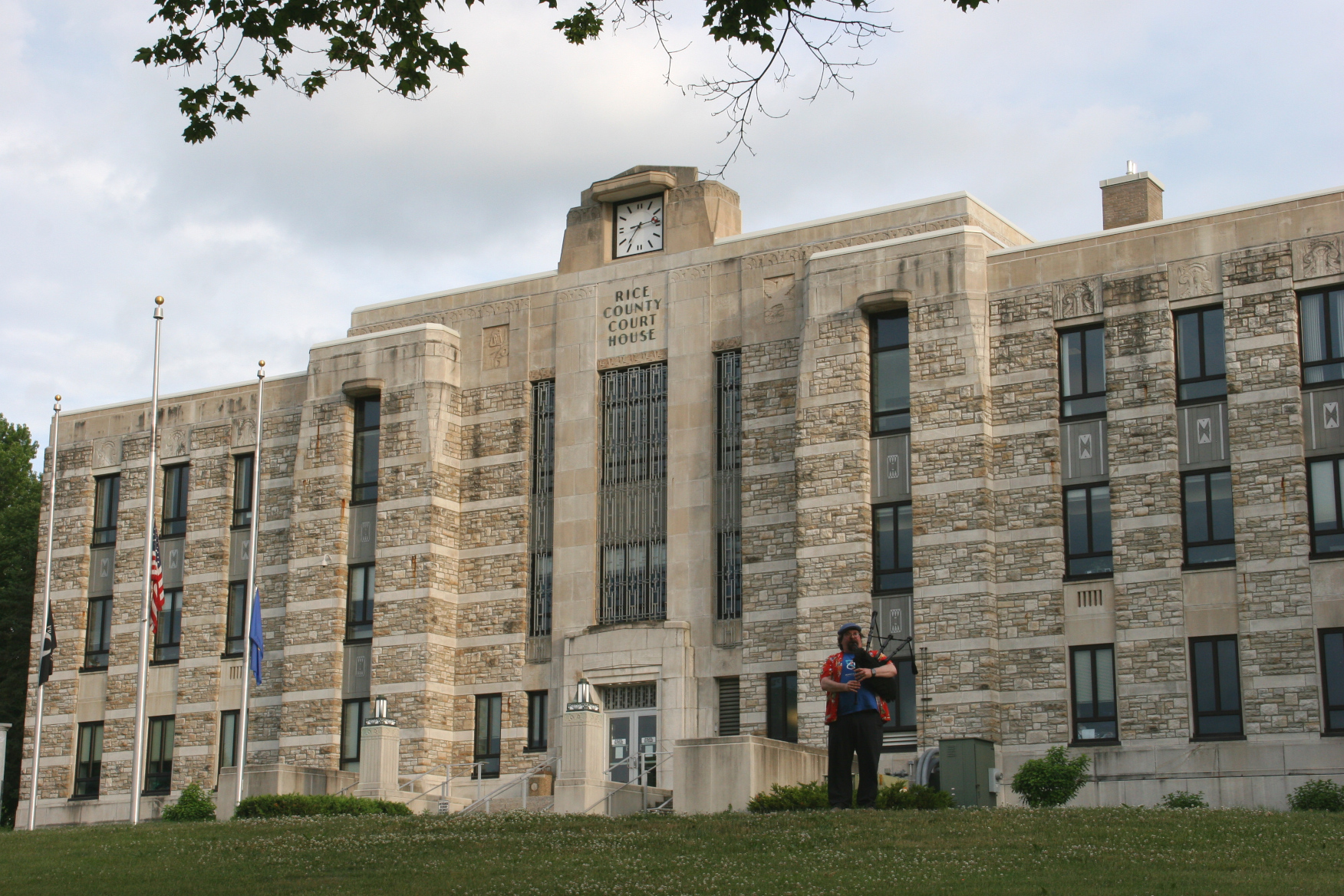
A bagpiper plays outside the Rice County Courthouse topped by a clock. (Minnesota Prairie Roots copyrighted file photo)
Just blocks away, a clock fronts the Fourth Street side of the Rice County Courthouse, built in 1932, also in the Art Deco style. Each year, events honoring veterans happen at the Rice County Veterans Memorial within view of the courthouse clock. For a moment or an hour, time stands still as we remember the sacrifices made for country, for democracy, by our veterans.
A view of the Shumway Hall tower from City View Park. (Minnesota Prairie Roots copyrighted file photo)
And then across the Straight River on the east side of Faribault, the Shumway Hall clock tower rises on the campus of Shattuck-St. Mary’s School in a complex of buildings that looks more castle than private college prep school. City View Park atop a hill blocks from campus offers a bird’s eye view of the tower, a view that is especially stunning in autumn. Shumway’s tower is assuredly a Faribault landmark, with Shumway Hall built in 1887 and on the National Register of Historic Places. Thousands of students have passed beneath that clock tower as they learned, studied and grew. Time passages.
Each day we mark time. Just as these notable outdoor public clocks do in Faribault. I expect most locals take these historic clocks for granted, pass by them without a thought. Too often we do that in our personal lives also, thinking we have all the time in the world. Until we don’t.
Blowing snow reduces visibility during a prior winter storm in Rice County. (Minnesota Prairie Roots copyrighted file photo)
AS I WRITE this Tuesday afternoon, a sense of foreboding looms. Grey, with a tinge of otherworldly light, defines the sky. Branches of bare trees lean. Unbalanced. Darkness encroaches, presses upon the earth with an anticipatory heaviness. By the time you read this, my area of southern Minnesota will be under siege with a full-blown blizzard. Unless the weather forecasters are wrong.
But this time the forecast of up to eight inches of snow with wind gusts topping 55 mph seems likely. I’ve already asked Randy to stay home from work because driving 24 miles in white-out conditions would not be smart. Or safe. The National Weather Service warns of treacherous travel, potentially life-threatening conditions. Power lines and trees laden with heavy wet snow could snap.
The weather rather matches my mood. I feel a sense of foreboding on so many levels. I struggle sometimes to see the light for the grey skies, for the oppressiveness that prevails. I wonder what will happen next. What storm is brewing?
(Minnesota Prairie Roots copyrighted file photo)
During a weather event, I can prepare. Take precautions. Buy bread and milk (note I didn’t write, “buy eggs”). Stay home. Shelter in place. Face whatever comes. I’ve lived through blizzards, wind storms and even a tornado. I am a hardy American who happens to live in Minnesota, next to our wonderful Canadian neighbors.
And so that is the approach I must take. Stand strong against the negative forces. Speak up. Continue to show compassion, care, kindness, love. Hold hope. Understand that blizzards don’t last forever, although this one seems never-ending.
A city of Faribault snowplow hits the road during a past winter storm. (Minnesota Prairie Roots copyrighted file photo)
Every single snowplow matters in removing burdensome snow from roadways. Imagine what a fleet of snowplows can do against the deepest snow drifted by raging winds. I’ve seen the results. Roads are cleared. The snow melts. The sun shines. Winter ends. The trees bud green. That is my visual hope during these grey days tinged with an otherworldly light.
I AM WRITING THIS OPINIONATED POST with no apologies. As an American woman with a college degree in mass communications (news/editorial emphasis) and experience as a newspaper reporter, I’ve always felt strongly about a free press. Even more so today with threats to that freedom. If you are unaware of current actions against the press, research and read. A free press is a vital part of democracy.
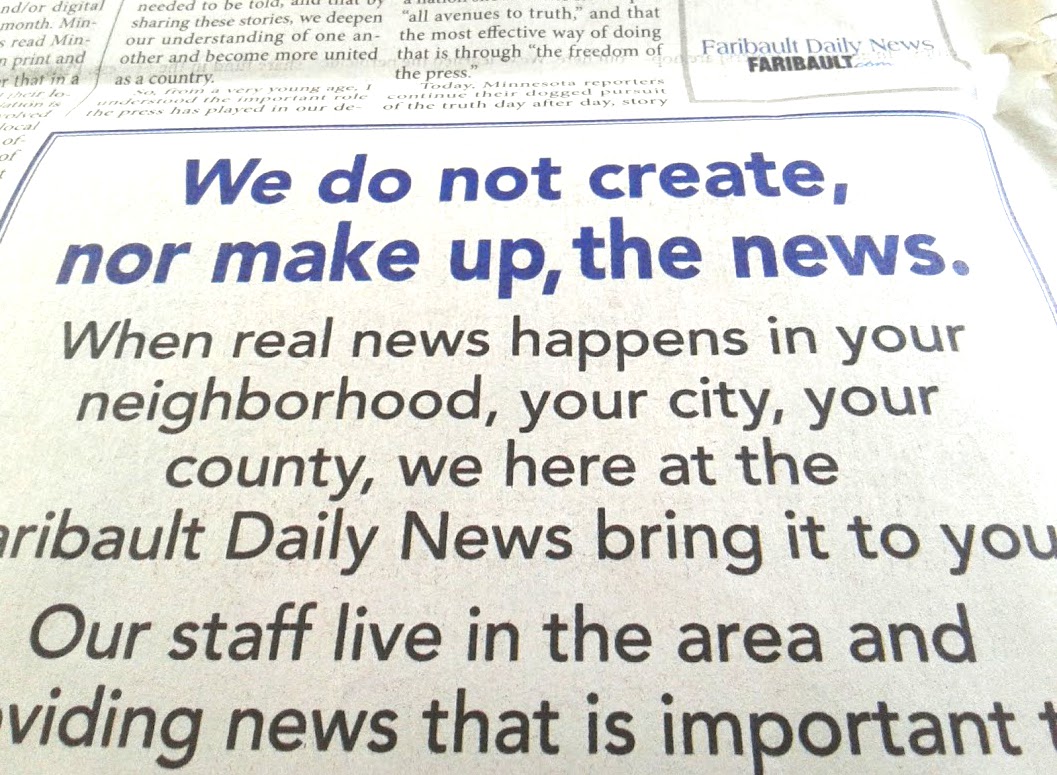
The second page of the Daily News from the August 15, 2017, issue explains the importance of a free press and its role. (Minnesota Prairie Roots copyrighted file photo 2017)
Journalists serve, among other roles, as government watchdogs. That means they, ideally, provide accurate and balanced reporting on government, at all levels. The “fourth estate” holds the government accountable via the stories they write. Not agenda-driven stories shaped by a biased editorial perspective or by information spoon fed to them by a press secretary. But rather stories based on quotes, actions, interviews, facts. Good solid reporting. Not misinformation, disinformation and/or propaganda. I must, though, state the obvious here. Not all sources speak truth to the media. And not all media write truth.
Suppression and criticism of the press are nothing new. Some of the criticism is deserved. Much of it is not. You may like journalists or you may not. That’s not the point. The point is that we need a free press, one unsuppressed/uncensored by those who are in positions of power. If you think otherwise, then look to history and to countries under authoritarian leaders, dictators. Under those leaders, messaging is/has been carefully controlled. Manipulation, intimidation and absolute power rule.
I started my newspaper career at a small town Minnesota weekly, typing my stories on a manual typewriter. This photo was taken in a Hastings antique shop, where I left a message. (Minnesota Prairie Roots copyrighted file photo)
During my journalism career, I have not been immune to those who wanted to control what I wrote. They did that sometimes in a back door way via criticizing me and my work and/or by shutting me out. Thankfully, my editors always had my back.
Let me give you some examples. While covering a school board meeting for a small town southern Minnesota weekly, a teacher said some things that were controversial. Decades out, I can’t recall details. But I do remember how this teacher fumed about my quoting him in a news story. The quote did not reflect favorably on him. But he made the statement at a public meeting. And it needed to be reported. Readers could decide what they thought of his comments.
In that same community, a local realtor called me out for quoting him in a story about a city council meeting. Again, I don’t remember details. But he was absolutely irate and verbally attacked and bullied me for what I’d written. (Sound familiar? Bullying. Fake news.) My reporting was accurate. I was not about to cave to his pressure. Once again, my editor stood up for me. He knew I demanded the best of myself in my work and that I would settle for nothing less than fair and accurate reporting.
Flash ahead to a different small town where I, once again, found myself despised. This time by a school superintendent. He didn’t like that I covered a student walk-out. It happened. I observed, interviewed him and students. And he retaliated. Every time I attended a school board meeting, he refused to give me an agenda or the packet of information distributed to board members and to the editor of the local weekly newspaper. (I worked for a regional daily.) He refused to talk to me. He made no effort to hide his disdain or to make information accessible to me. His was clearly an effort to stop me from reporting on anything school related, including school board meetings. His strategy did not work.
Published in the Faribault Daily News in August 2017 as part of the “Whiteout” campaign. (Minnesota Prairie Roots copyrighted file photo 2017)
Attacks on journalists have become more rabid in recent years. I think we can all agree on that. Don’t kill the messenger for the message he/she delivers. Respect those journalists who truly are doing their best to report fairly and accurately and who hold themselves and their work to high standards. Turn to those reliable sources for news.
Certainly, some media outlets and journalists are incredibly biased with specific agendas. They have become mouthpieces for government leaders, political parties and issues. I’m not praising those who are manipulating people to shape public opinion and to push ideas. Unfortunately, though, I see more and more government leaders, politicians and others targeting dedicated-to-the-craft journalists. These hardworking reporters are being shut out, degraded and abused because they accurately report what they see and hear in their watchdog role. Kinda like me with that small town school superintendent decades ago, just a lot more amplified and with much more serious consequences.
Thankfully, plenty of journalists committed to writing the truth still remain. They are strong men and women of integrity and morals who give a damn about democracy and a free press. Now, more than ever, we need to recognize the value of a free press, underscore FREE. Even though I no longer work as a newspaper journalist, I still strongly value freedom of the press. It is, always has been, a cornerstone of democracy.
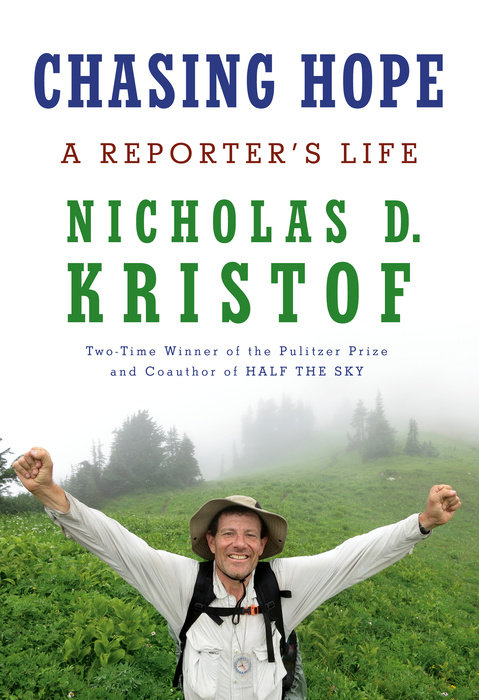
(Book cover sourced online)
FYI: I encourage you to read Chasing Hope—A Reporter’s Life by Nicholas D. Kristof, currently an op-ed columnist for The New York Times. The two-time Pulitzer Prize-winning journalist worked as a foreign correspondent in Hong Kong, Beijing and Tokyo. He witnessed some pretty horrible atrocities—including the massacre in Tiananmen Square, the genocide in Darfur and much more—and offers remarkable insights via his experiences, observations and exceptional storytelling.
Of special note in Kristof’s book is a reference to an August 2008 campaign rally in Lakeville, Minnesota, which the author calls “one of the finest moments in American politics in my lifetime.” Kristof shares a story about Senator John McCain, who was then vying for the Republican Presidential nomination. I refer you to pages 239 and 240 in Chasing Hope. This book is worth the read for that story alone. It will give you hope. And, no, I’m not telling you more. Read the book.
TWO DECIDEDLY WINTER EVENTS are happening in my area of southern Minnesota this weekend. First up, the Faribault Flannel Formal from 5-10 p.m. Saturday, March 1, at the Craft Beverage Curve in Faribault. There is a cost to attend.
This mural based on an historic photo of skating on the Straight River hangs on the side of 10,000 Drops Distillery. (Minnesota Prairie Roots copyrighted file photo December 2019)
Minnesotans’ love of flannel will focus this fun gathering inside the complex housing 10,000 Drops Craft Distillers and Corks & Pints at 28 NE 4th Street. Although I’ve never attended, because a noisy, packed setting is difficult for me to manage, I know it’s a popular event.
So what’s on the schedule? Well, there’s a Best Dressed Lumber Jack and Jane contest. That means attendees should arrive dressed in their best Paul Bunyan style attire with plenty of buffalo plaid flannel. Minnesota embraces the legendary lumberjack and his sidekick, Babe the Blue Ox.
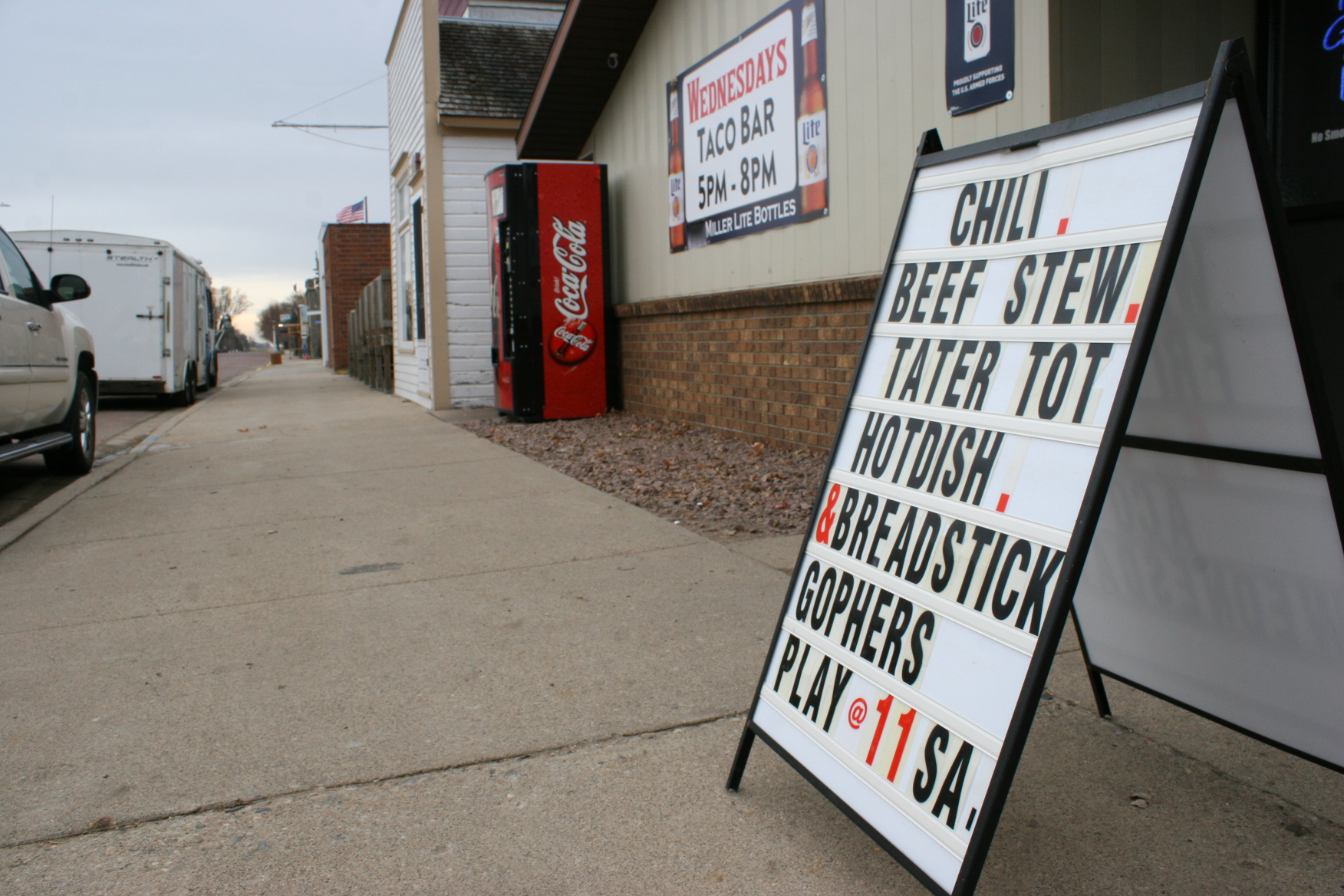
Tater Tot Hotdish advertised on a sandwich board outside an eatery in Belview in southwestern Minnesota. (Minnesota Prairie Roots copyrighted file photo 2019)
But the competition doesn’t stop there. A Hotdish (not casserole) Contest and sampling of hotdish entries is another Flannel Formal staple. Tater Tot Hotdish and Chicken Wild Rice Hotdish are Minnesota favorites, although certainly entries are not limited to those two.
I expect there will be other competitions, although those are not specifically listed in promotional information. Raffles are. And so is music by North Branch-based Buffalo Alice, a band that plays a unique blend of classic rock and country.
Pull out the original or updated (pictured here) version of “How to Talk Minnesotan” by Howard Mohrto brush up on the Minnesota Language Systems. (Book cover sourced online)
I’d encourage you, if you plan to attend, to brush up on your Minnesota Speak. Drag out your looooong o’s. Practice phrases like “that’s different” and “you betcha!” And, of course, say a long Minnesota goodbye when you leave the Formal.
(Promo courtesy of the Valley Grove Preservation Society)
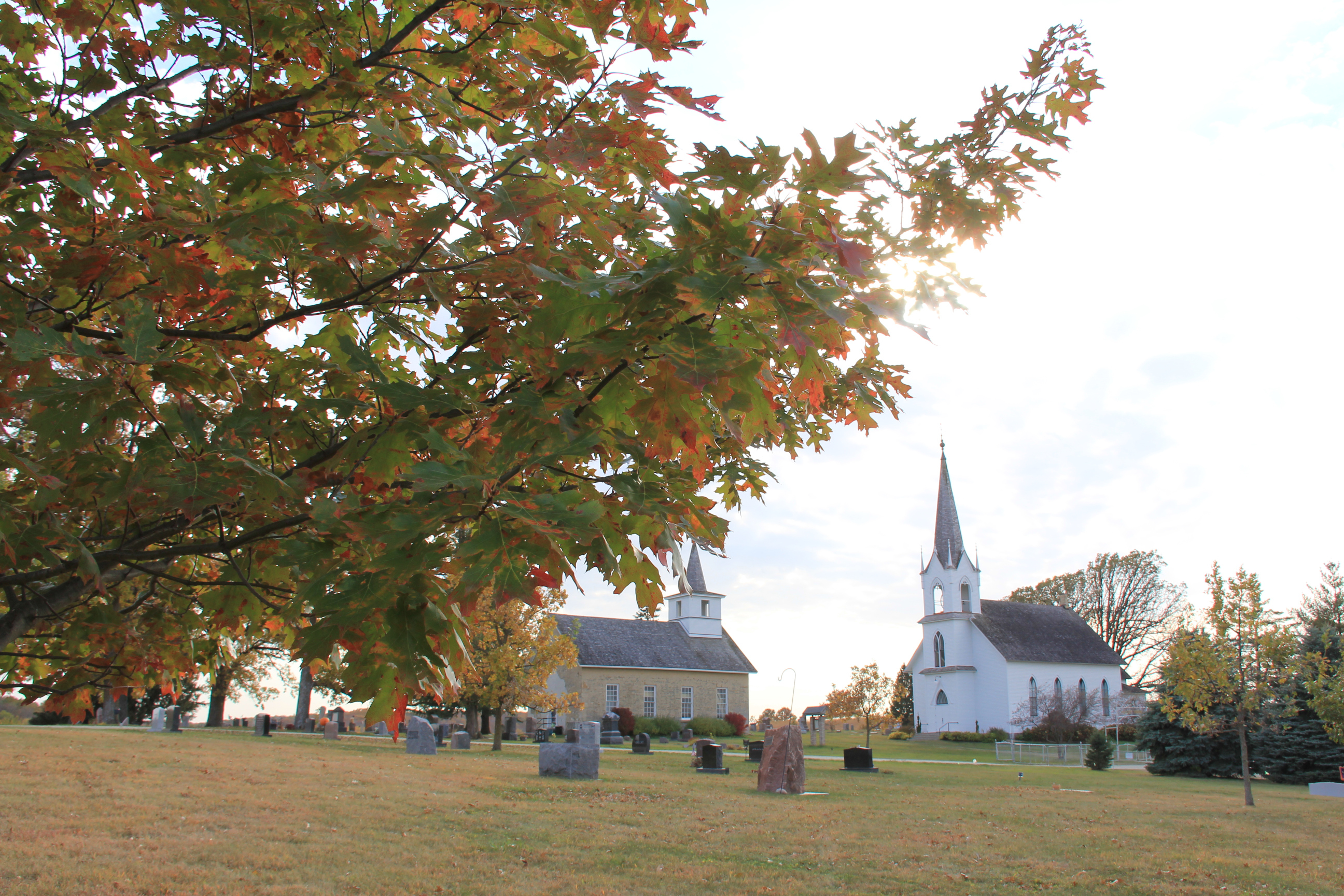
On Sunday, March 2, head over to the Nerstrand area for a 1-3 p.m. free Doughnut Hole Roasting Party at the historic Valley Grove Churches. This hilltop setting, 9999 155th St. East, is perhaps my favorite rural location in Rice County because of its beautiful natural setting and peacefulness. Plus, I love the two historic churches there.
A favorite photo I took of the Valley Grove churches. (Minnesota Prairie Roots copyrighted file photo October 2024)
The Valley Grove Preservation Society Board will have a bonfire roaring for the doughnut holes they will provide along with roasting sticks. Just bring a chair, your own warm drinks and dress weather appropriately. I’d encourage wandering around the cemetery and walking on the prairie along with connecting with people passionate about preserving these Norwegian immigrant churches and the land surrounding them.
I’ve never attended this novel party, but would like to sometime.
There you go. Two places. Two events. Two reasons to get out of the house on the first two days of March in southern Minnesota.
An artistic interpretation of the night sky painted on the underside of the water tower in Cosmos, Minnesota. (Minnesota Prairie Roots copyrighted photo November 2024)
THE NIGHT SKY HOLDS a vastness that makes me feel small. It’s mysterious and dark and, in some ways, intimidating. Yet, it possesses an alluring beauty that draws me to gaze heavenward. To imagine. To delight. To stand in awe of its infinity.
Fascination with the night sky seems universal. Kids, like my kindergartner grandson and, years ago, my own son, fixated on the solar system and all the night sky encompasses. I, too, find it interesting, although not to the degree of learning everything I can about the expanse above me.
Rather, if I learn of a newsworthy event in the night sky, I may step out after dark to look. Right now, that’s a seven-unit “planet parade” of Mercury, Venus, Jupiter, Mars and Saturn visible to the naked eye after sunset and Uranus and Neptune visible via a visual aid.
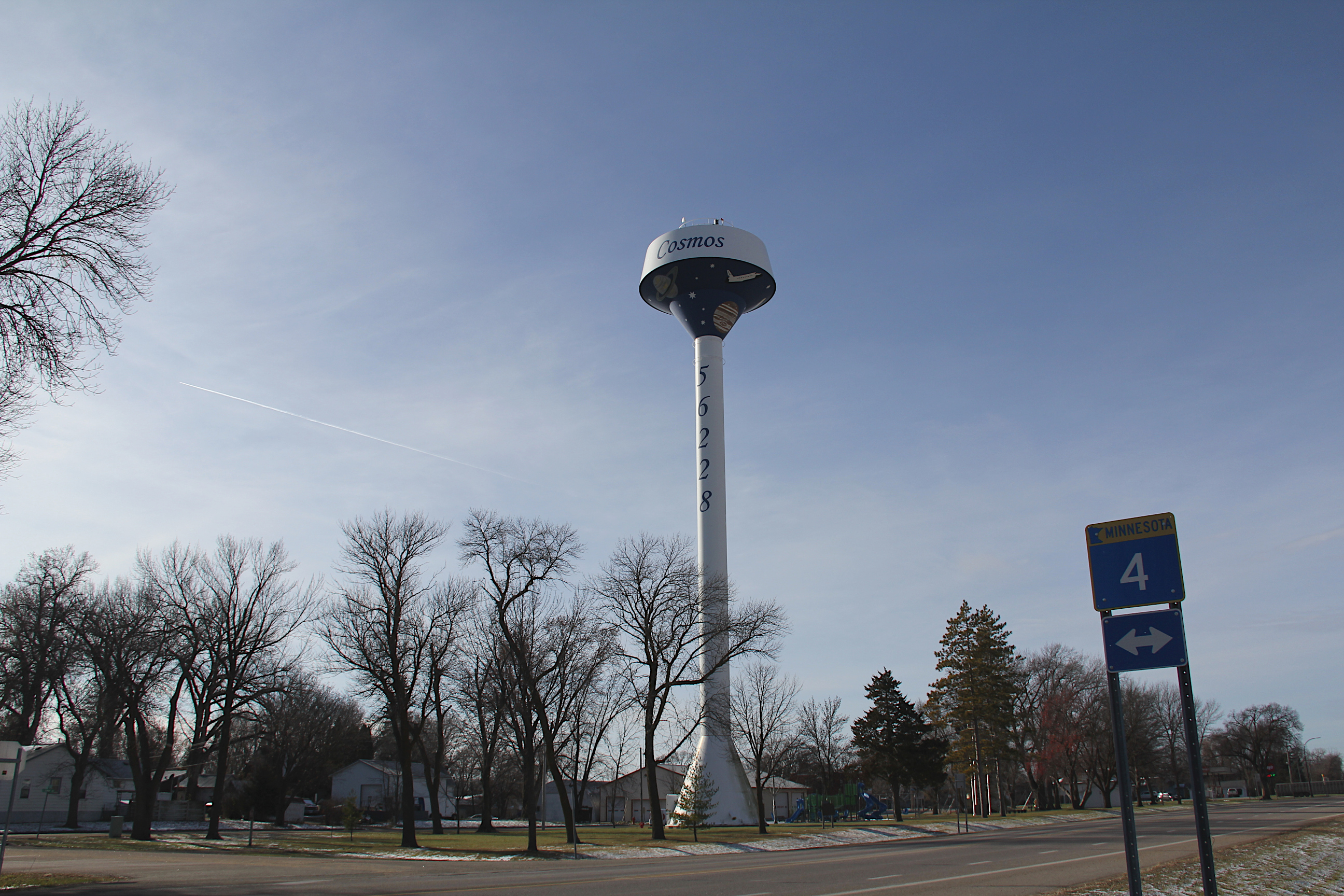
My first view of the space-themed water tower in Cosmos. The town is located at the intersections of Minnesota State Highways 4 and 7. (Minnesota Prairie Roots copyrighted photo November 2024)
All of this reminds me of a cosmic discovery I made this past fall while on the back roads to Morris in far western Minnesota. In the small town of Cosmos, population around 500, in southwestern Meeker County, I discovered a unique space-themed water tower and community event, the Cosmos Space Festival.
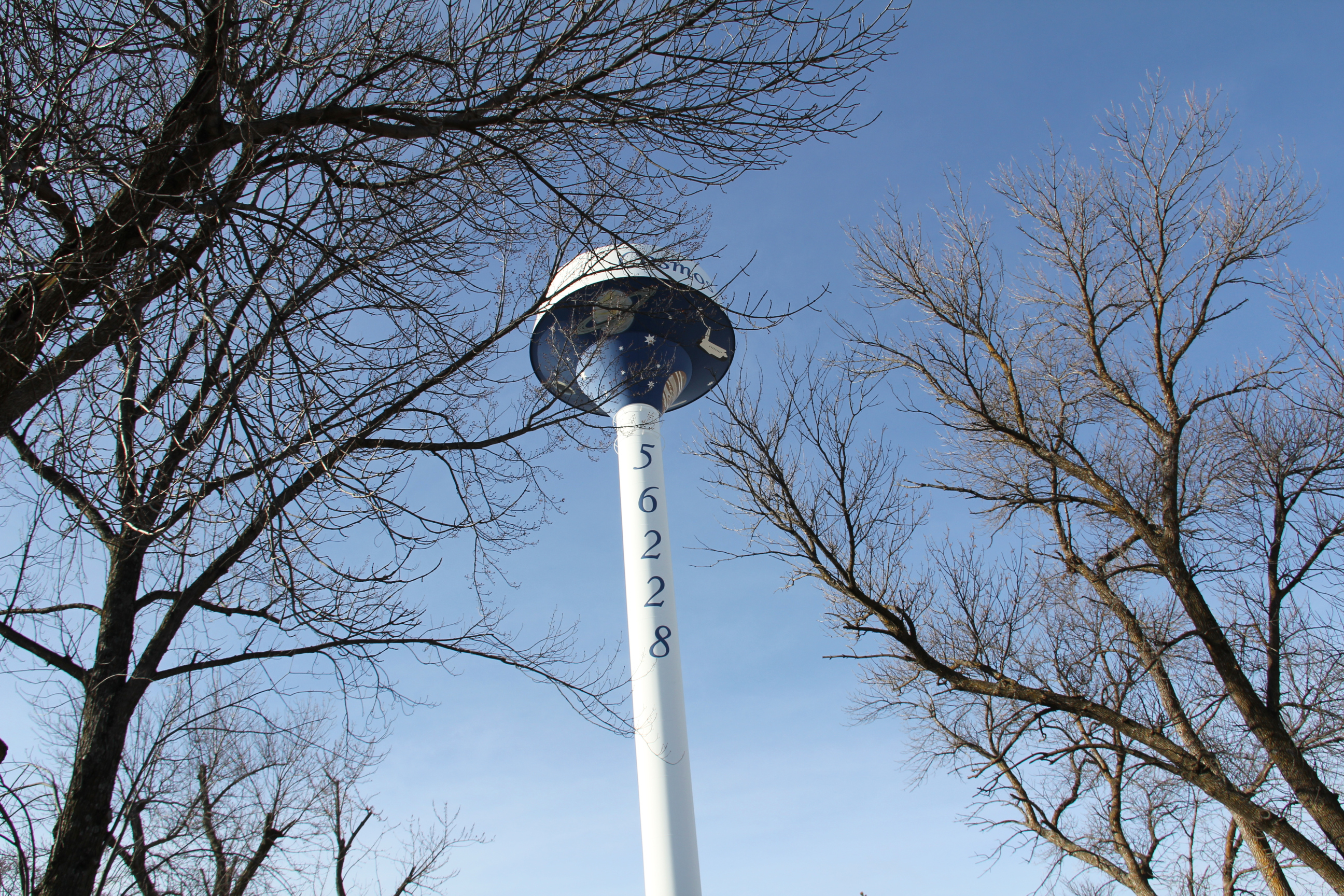
The underbelly of the Cosmos water tower is themed to space. (Minnesota Prairie Roots copyrighted photo November 2024)
With a town name like Cosmos (originally called Nelson), it should come as no surprise that the community would build on the Greek word meaning “order and harmony.” The cosmic focus makes this place along Minnesota State Highways 7 and 4 stand out among all the other little towns in this part of the state. When I spotted the water tower with a space shuttle, planets, stars and more painted on its underbelly, I immediately wanted to stop and photograph this work of art, this town identifier.
You’ll find cosmic street names in Cosmos. (Minnesota Prairie Roots copyrighted photo November 2024)
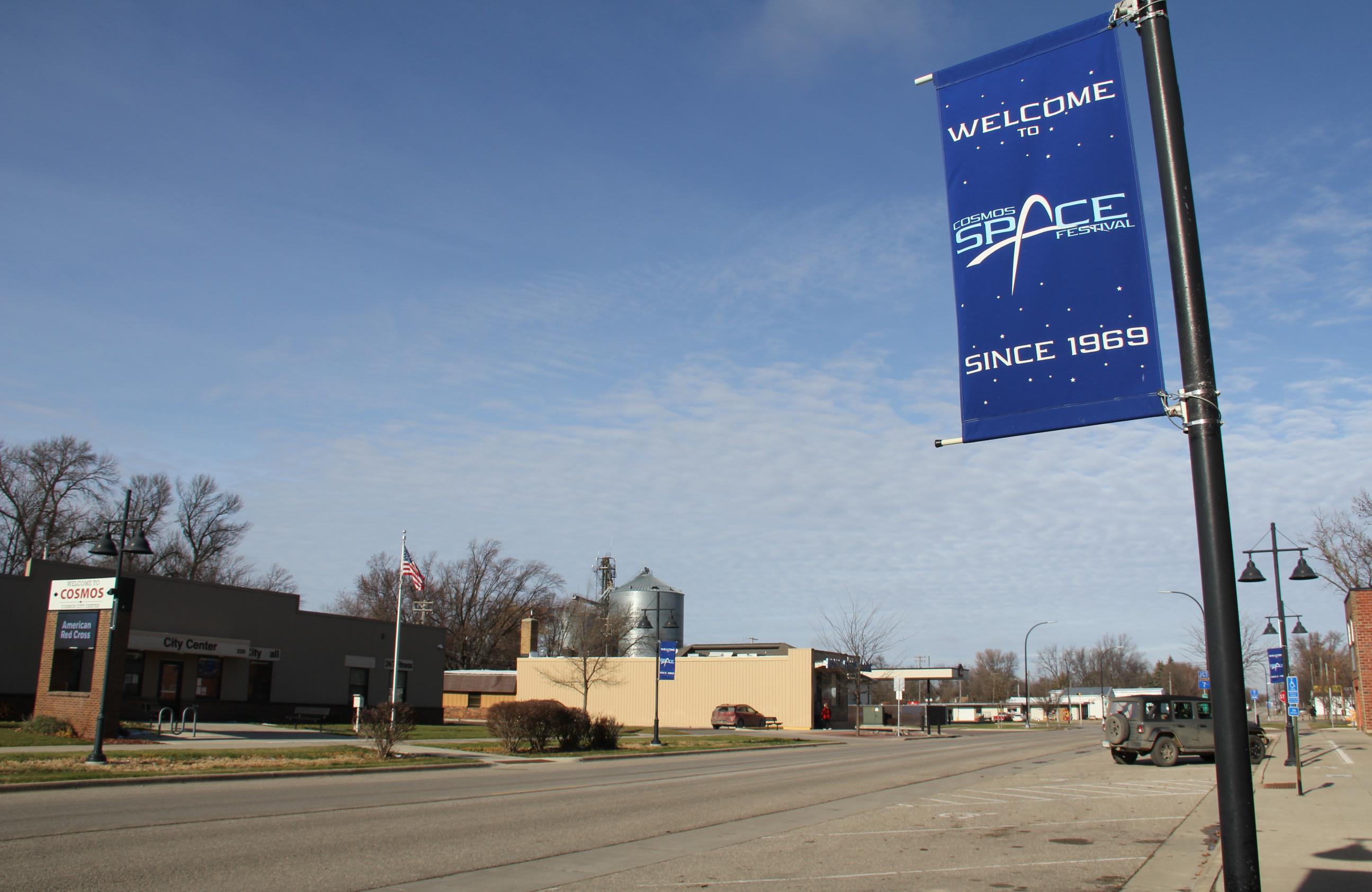
In the process, I discovered that all the streets are named after planets and constellations and that the town celebrates the Cosmos Space Festival annually on the third weekend of July. That started in 1969 as a celebration of man’s (Neil Armstrong and Buzz Aldrin in Apollo 11) first moon landing. I’m old enough to have watched that monumental moment in history on a black-and-white television.
Cosmos Space Festival banners hang throughout the downtown, shown here. (Minnesota Prairie Roots copyrighted photo November 2024)
The Cosmos space fest has been going strong ever since, marking its 57th year on July 17-20, 2025. The festival features your usual small town celebration activities like street dances, softball tournaments, city-wide garage sales, a hog roast, pedal tractor pull, pony rides, beer garden, fireworks, parade and much more. That includes the crowning of fest royalty—Little Miss Universe and Man on the Moon. Gotta love those cosmic titles.
And you gotta love how kids (and adults) get excited about the night sky. Locally, River Bend Nature Center is hosting its annual Minnesota Starwatch Party from 8-10 p.m. on Thursday, March 27, with retired meteorologist, amateur astronomer, stargazing columnist and author Mike Lynch. I attended the starwatch party with my husband and son many years ago. Lynch brings telescopes and vast knowledge, so this is a hands-on educational program.
The memorable water towerin Cosmos, zip code 56228. (Minnesota Prairie Roots copyrighted photo November 2024)
Another opportunity to view the night sky through telescopes happens more frequently, from 8-10 p.m. the first Friday of every month inside and outside Goodsell Observatory on the campus of Carleton College in neighboring Northfield. I’ve been to this free monthly activity twice, again years ago with my husband and son. The next open house is on Friday, March 7. But only if the night sky is clear for viewing.
The Cosmos water tower is among the best I’ve seen. It’s interesting, unique, artsy and makes this small Minnesota town stand out. (Minnesota Prairie Roots copyrighted photo November 2024)
Whatever your interest level in the night sky, it’s fascinating. Vast. Dark. The subject of poetry and song and science. And above all, it’s a cosmic wonder, whether viewed from Cosmos, Faribault, Northfield or your little place in the big wide universe.
Randy holds a Peanut Buster Parfait purchased during a previous visit to The Little DQ. (Minnesota Prairie Roots copyrighted file photo)
SPRING HAS UNOFFICIALLY ARRIVED in Faribault. The Little DQ opened this past weekend. And that, in my community, signals closing the door on winter and cracking it open to spring. Never mind that winter can continue well into April, sometimes even May, here in the North. But let’s not consider that possibility. There are enough other things to feel pessimistic about right now.
Sunday evening Randy and I drove across town to the local walk-up/drive-up Dairy Queen for the $2.49 Peanut Buster Parfait opening weekend special. That’s always the bargain treat when The Little DQ opens at the end of February and then closes in October.
Since these are typically the only two times we go to DQ in a year, I was excited to get this fudgy, salty, sweet treat. We pulled up around 8 pm, surprised not to see a line of vehicles. But then again it was the end of the weekend, the hours winding down to the 10 pm closing.
A friendly voice greeted us over the intercom as Randy ordered two Peanut Buster Parfaits. “We’re out of peanuts,” the teen on the other end told us. “You can substitute something else.”
Not a Peanut Buster Parfait, but an M & M Parfait. (Minnesota Prairie Roots copyrighted photo February 2025)
After some grumbling between us, we settled on M & Ms as a peanut replacement. I was too surprised to fully consider other options. My mind was fixated on peanuts because a Peanut Buster Parfait is simply not a Peanut Buster Parfait without the peanuts.
We both shared the thought that employees of The Little DQ could have sourced peanuts from the next door convenience store, a grocery store across the highway or even the other DQ down the road. Never mind. It was just an idea.
And so we ate our minimally fudgy M & M Parfaits and reminisced about the other time we arrived at The Little DQ to order Peanut Buster Parfaits on closing weekend. “We’re out of ice cream,” said the voice on the other end of the intercom. At least this time we got ice cream.
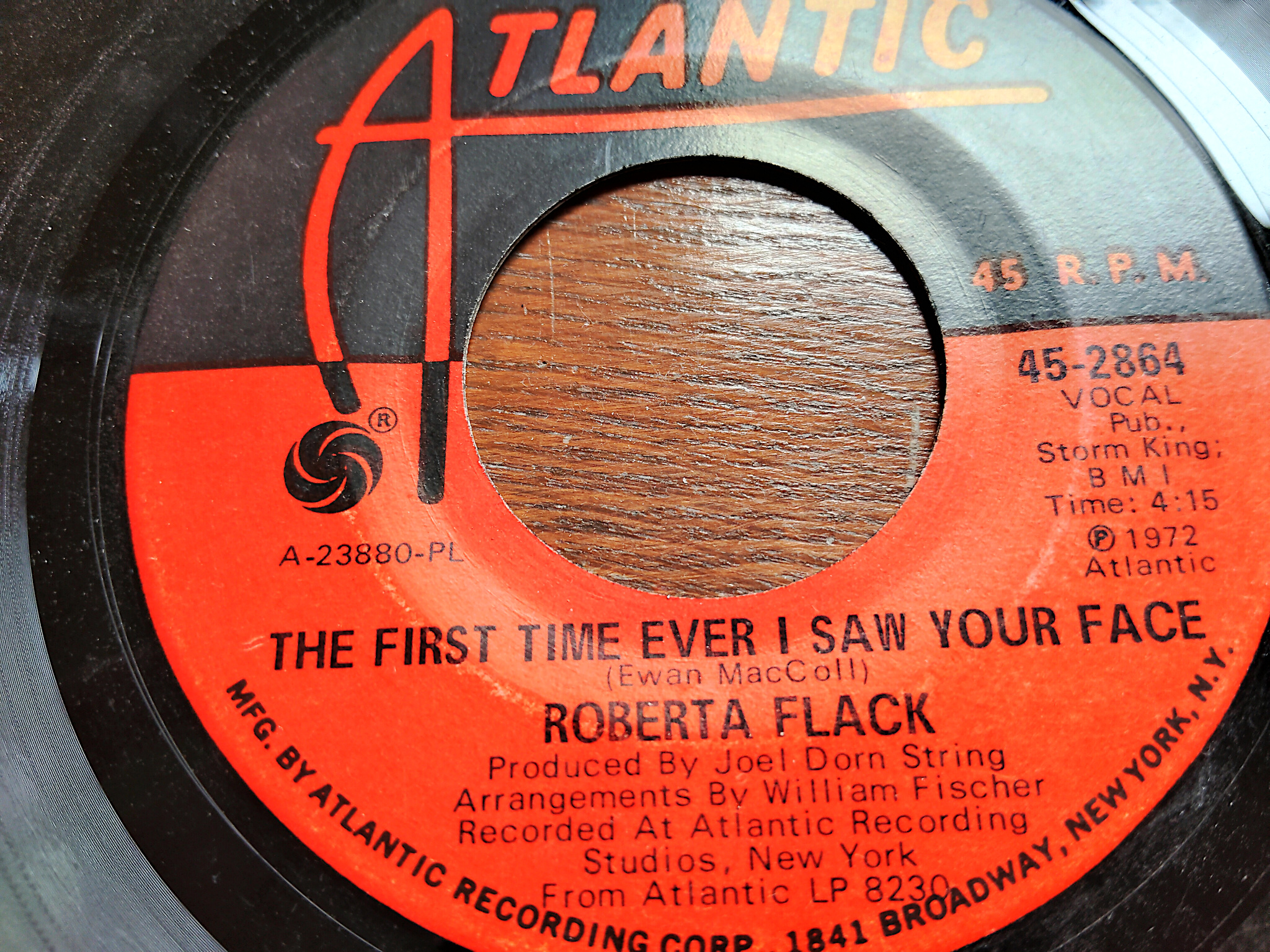
My vintage single of Roberta Flack’s hit song, “The First Time Ever I Saw Your Face.” (Minnesota Prairie Roots copyrighted photo February 2025)
WHEN ROBERTA FLACK SANG, her words flowed effortlessly. Soothing. Her voice like poetry singing words of love.
Flack died today (Monday) at age 88, news which pulled me back to the early 1970s and her Grammy award-winning singles, “The First Time Ever I Saw Your Face” (1973) and “Killing Me Softly With His Song” (1974). I love those two hits of new love and of love exposed.
I filed through my vintage 45 rpm vinyls until I found Flack’s, then dropped the record onto the turntable to once again immerse myself in feelings of young love. I was in high school when Flack’s singles released and then became Billboard hits.
The songs are universal in theme, undeniably beautiful in delivery. At least that’s my perspective as a Baby Boomer who can’t read a single musical note, can’t carry a tune and knows she likes a song when she likes it.
The timing of Flack’s death during February, Black History Month, seems worth noting, too. She accomplished much as a Black woman. At the age of 15, Flack received a full scholarship to Howard University, a historically Black private college in Washington DC. She earned a bachelor’s in music in 1958, going on to teach music while also pursuing a singing career. Clearly, she accomplished her goals.
(Book cover sourced online)
In researching her background, I learned of a 2023 children’s picture book autobiography, The Green Piano: How Little Me Found Music, written by Flack and by Tonya Bolden with illustrations by Hayden Goodman. The title references a piano Flack’s father found in a junkyard, then refurbished and painted a grassy green. Flack was nine years old when she got that first piano. That it came from a junkyard reminds me of the bicycles my maternal grandfather pulled from the junkyard, repaired, painted and gifted to me and my siblings. I was just as thrilled to have my own bike as Flack was to have her own piano.
Flack’s backstory of growing up in a family that valued music and recognized her talent is a love story, too. If only every child would be loved so deeply and encouraged to follow his/her dreams, what a beautiful world this could be.
TELL ME: Whose music do you appreciate and why? And if you remember Roberta Flack, I’d like to hear your thoughts on her and her work.
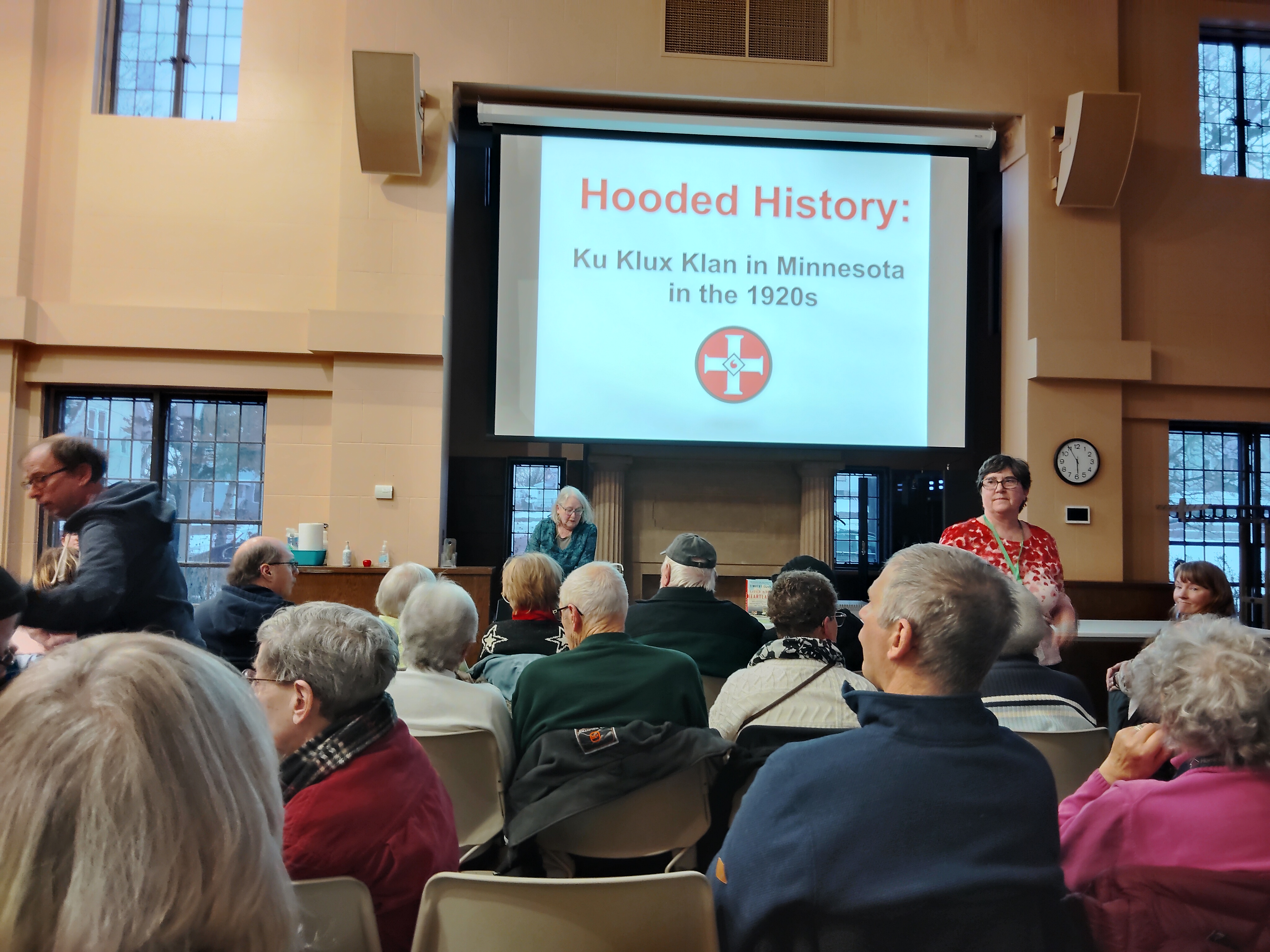
The audience settles in as Nancy Vaillancourt, center, is about to begin her presentation, “Minnesota’s Hooded History.” (Minnesota Prairie Roots copyrighted photo February 2025; all photos taken with my smartphone)
NOT MUCH HAS CHANGED in 100 years. That summarizes my thoughts after attending a talk, “Minnesota’s Hooded History—The Ku Klux Klan in 1920s Minnesota,” followed by a Q & A Thursday evening at my local library. Hate groups still exist in America, just with different names, different targets, different locations, different levels of participation.
But the core ideology of these groups, based on what I heard and what I’ve read, remains unchanged. The same in 1925 as in 2025. Historian and retired librarian Nancy Vaillancourt could have been talking about current day America when she shared her research into the KKK in Minnesota. The KKK professed a strong Christian faith, patriotism, Americanism, American ideals and more as they targeted first Blacks, then Catholics, Jews and others, including immigrants. Sound familiar? Today this hatred and intolerance is coming not only from organized hate groups, but also from individuals and from people in positions of power.
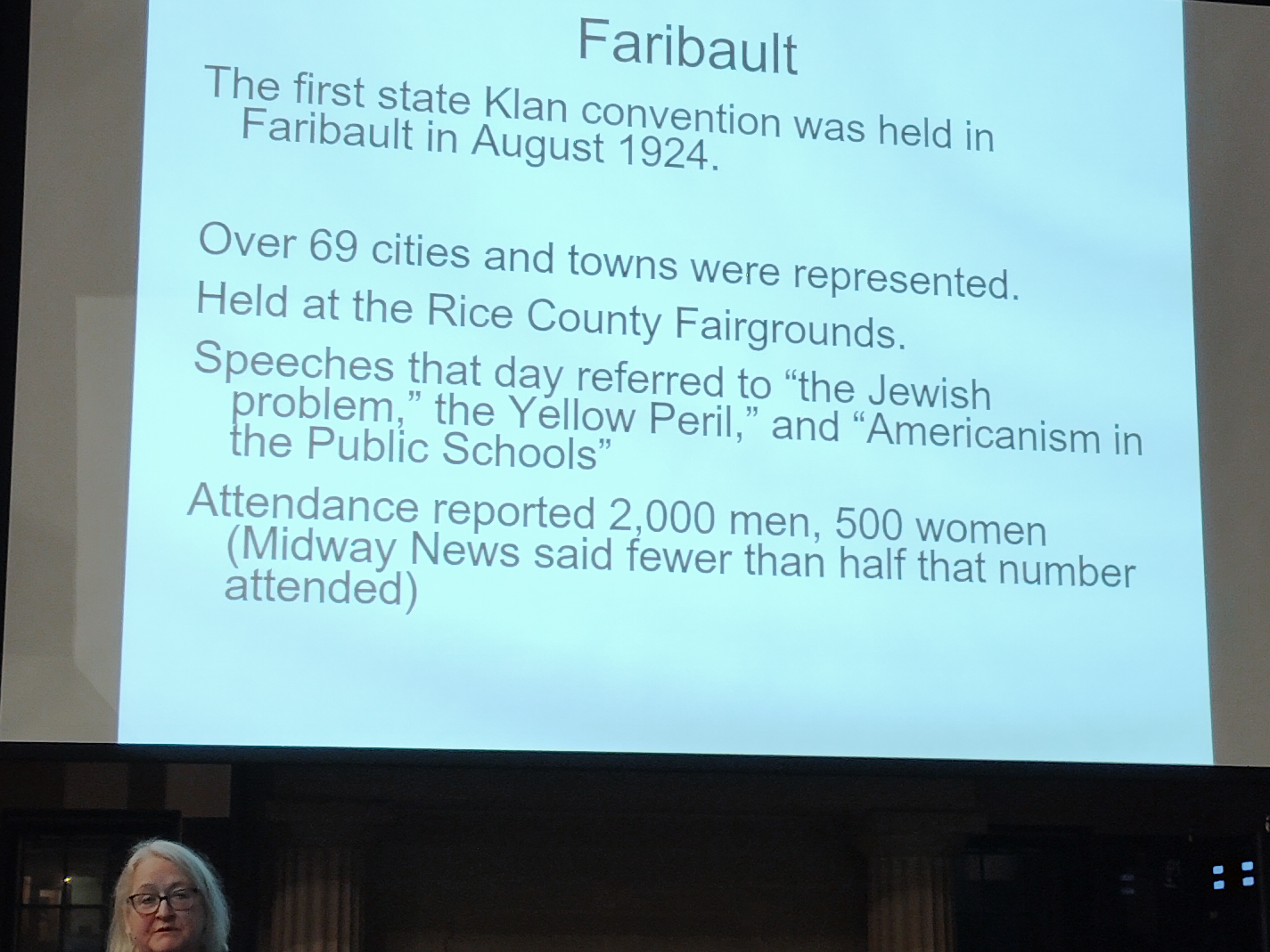
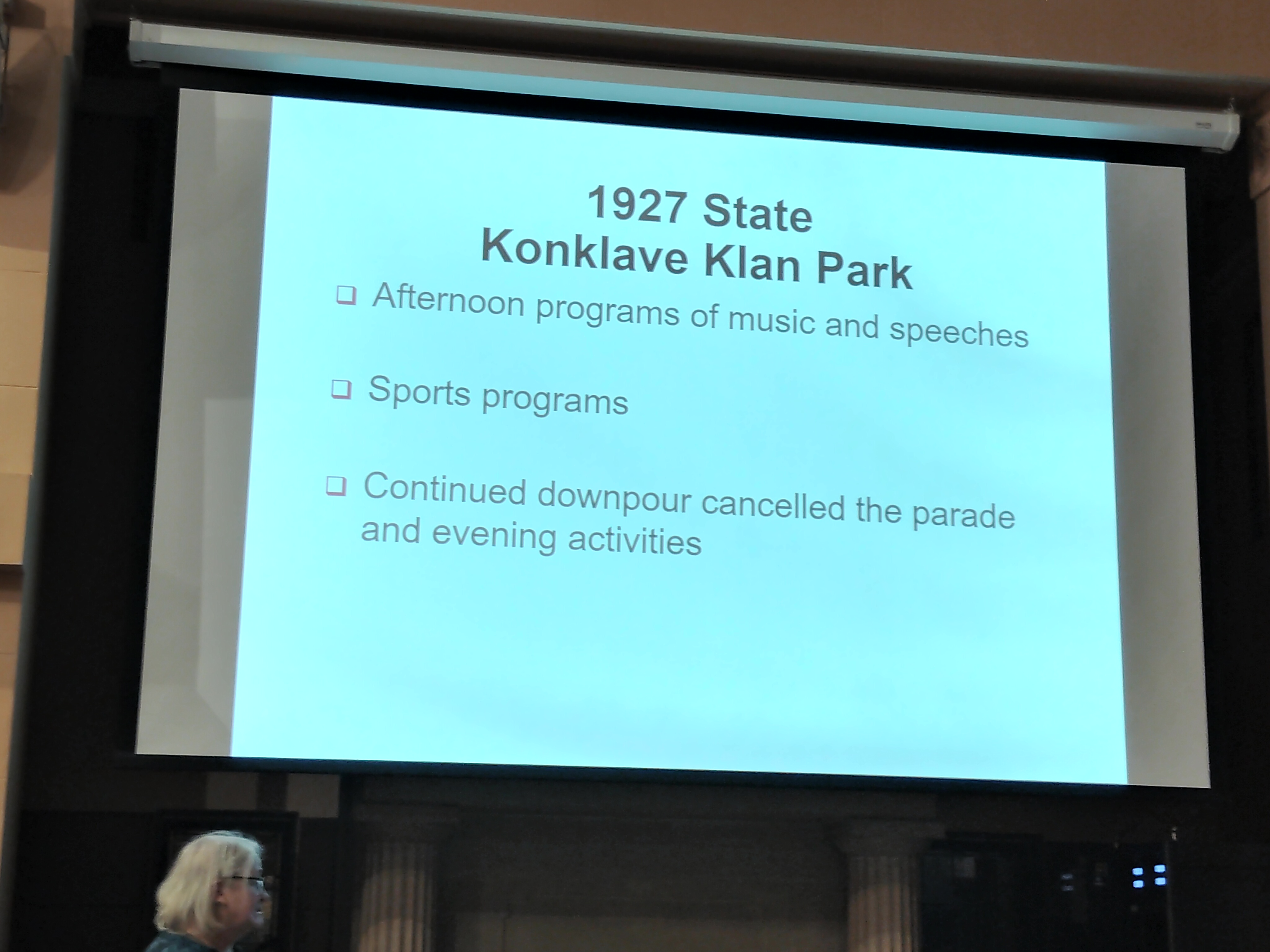
Faribault hosted the first state Klan convention, with details outlined in this slide presented by Nancy Vaillancourt. (Minnesota Prairie Roots copyrighted photo February 2025)
Back to Vaillancourt’s presentation Thursday evening. About 100 attendees packed the Great Hall meeting room at Buckham Memorial Library to capacity in a city which hosted Minnesota’s first state Klan convention in August 1924. Klan members from 69 cities and towns attended the event at the Rice County Fairgrounds in Faribault with the KKK claiming 2,500 in attendance. A publication noted fewer than half that number actually attended. Inflated crowd numbers. Sound familiar?
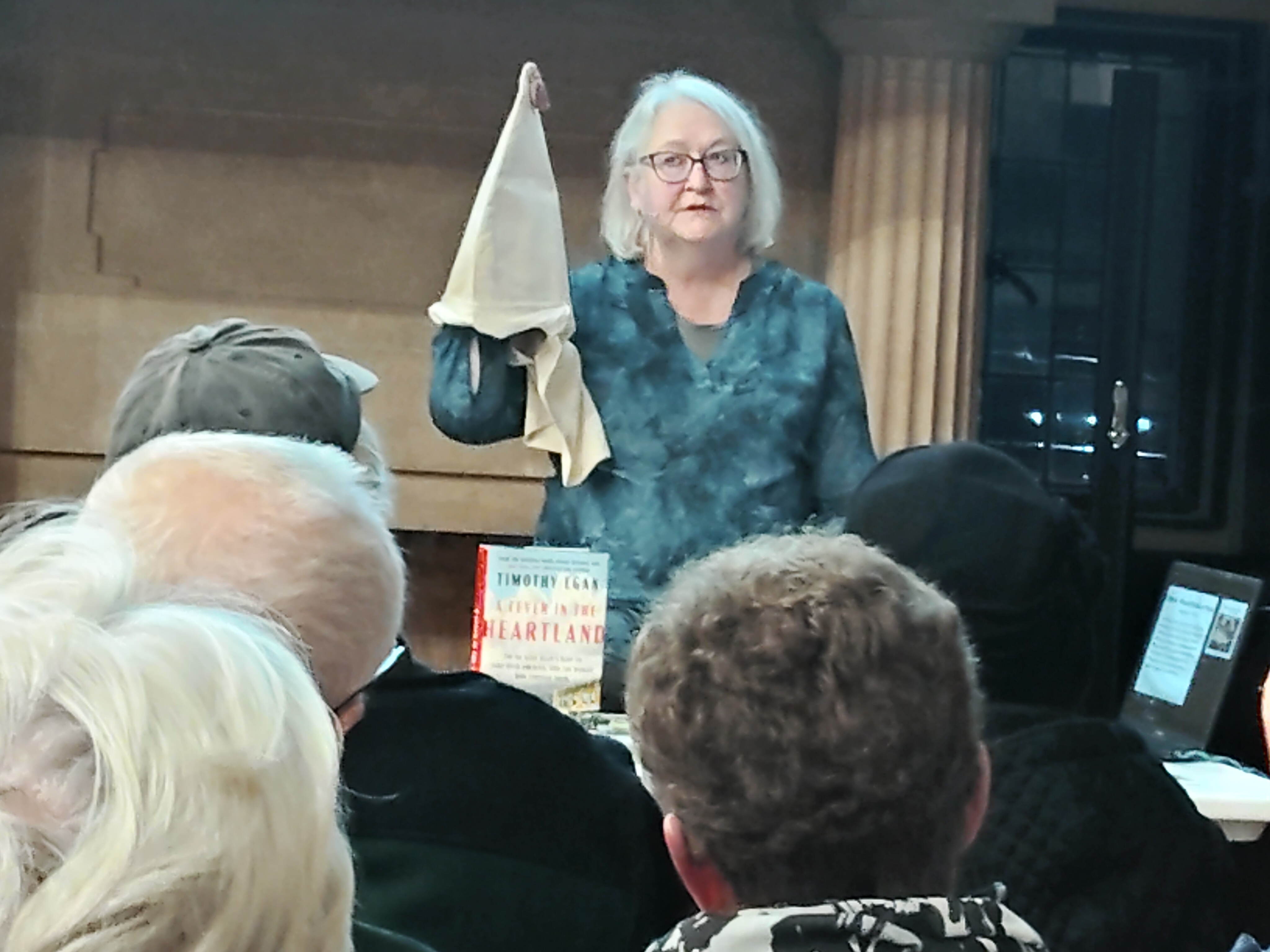
Nancy Vaillancourt displays an authentic Klan hood given to her by a woman from Blooming Prairie. She warned audience members that some items she would be showing may be disturbing and that they could step out if necessary. (Minnesota Prairie Roots copyrighted photo February 2025)
Certainly, hosting a state KKK convention is not a proud moment in a city’s history. But it is history none-the-less and important to know. We cannot deny our past, even if hurtful and painful and awful. And Vaillancourt revealed plenty of hurt and hate as she presented, focusing on the KKK in my region of southern Minnesota. She confirmed the presence of Klan chapters in nearly 60 Minnesota counties at one time. Groups of men, women and sometimes children who, in their hooded coverings, spewed hatred and intolerance while waving American flags and singing “Onward Christian Soldiers.”
Cross burnings occurred in Faribault, (including on the bluffs below St. Mary’s Hall), Stockton, Red Wing, Winona and other locations cited not only by Vaillancourt, but by audience members. Like Teresa, whose husband’s grandmother had a cross burned in her yard near Waterford (outside Northfield) because she was Catholic. Klan hatred toward Catholics was particularly strong in 1920s Minnesota.
A Catholic mother, who had just given birth, watched as the KKK paraded past the Owatonna hospital while en route from the Steele County Fairgrounds to Central Park during the state Klan convention in 1926. Can you imagine the fear she felt? Not unlike the fear targeted groups of people are experiencing today in this country.
Sounds like a deceptively wholesome gathering at the Klan Park in Owatonna. (Minnesota Prairie Roots copyrighted photo February 2025)
Because Vaillancourt is from Owatonna, much of her talk focused on that community just south of Faribault along Interstate 35. Owatonna, it seems, was a hotbed of Klan activity, hosting local and state gatherings. But the fact that stood out for me was the Klan’s purchase of 20 acres of land east of downtown Owatonna. That land became Klan Park, a place to gather, organize and socialize. The local chapter even constructed a meeting house there. While it is disheartening to hear this, it was uplifting to learn that the land was sold in 1945—to a man whose wife was Catholic. Attendee Bonnie shared that bit of information about her great uncle, who was invited to join the Klan, declined because of his wife’s Catholicism and then eventually bought the land. Today that former KKK park is the site of soccer practice fields, Vaillancourt noted, where a diverse group of youth play.
Vaillancourt covered a whole lot more in her presentation. Like how the Klan recruited from fraternal orders, Protestant churches, via fiery speeches, by invitation. Fear and social and economic pressure were used to draw people into the Klan. Sound familiar? In Virginia, in northern Minnesota, the entire school board claimed Klan membership and made Bible reading in school compulsory. The mayor of St. James was a major grand dragon of the KKK. The Northfield Klan hosted a KKK homecoming Labor Day parade in September 1926. The Klan was big on parades. That makes sense given the intimidation and fear a mass of hooded marchers can instill in the public. And Owatonna residents were afraid, Vaillancourt said.
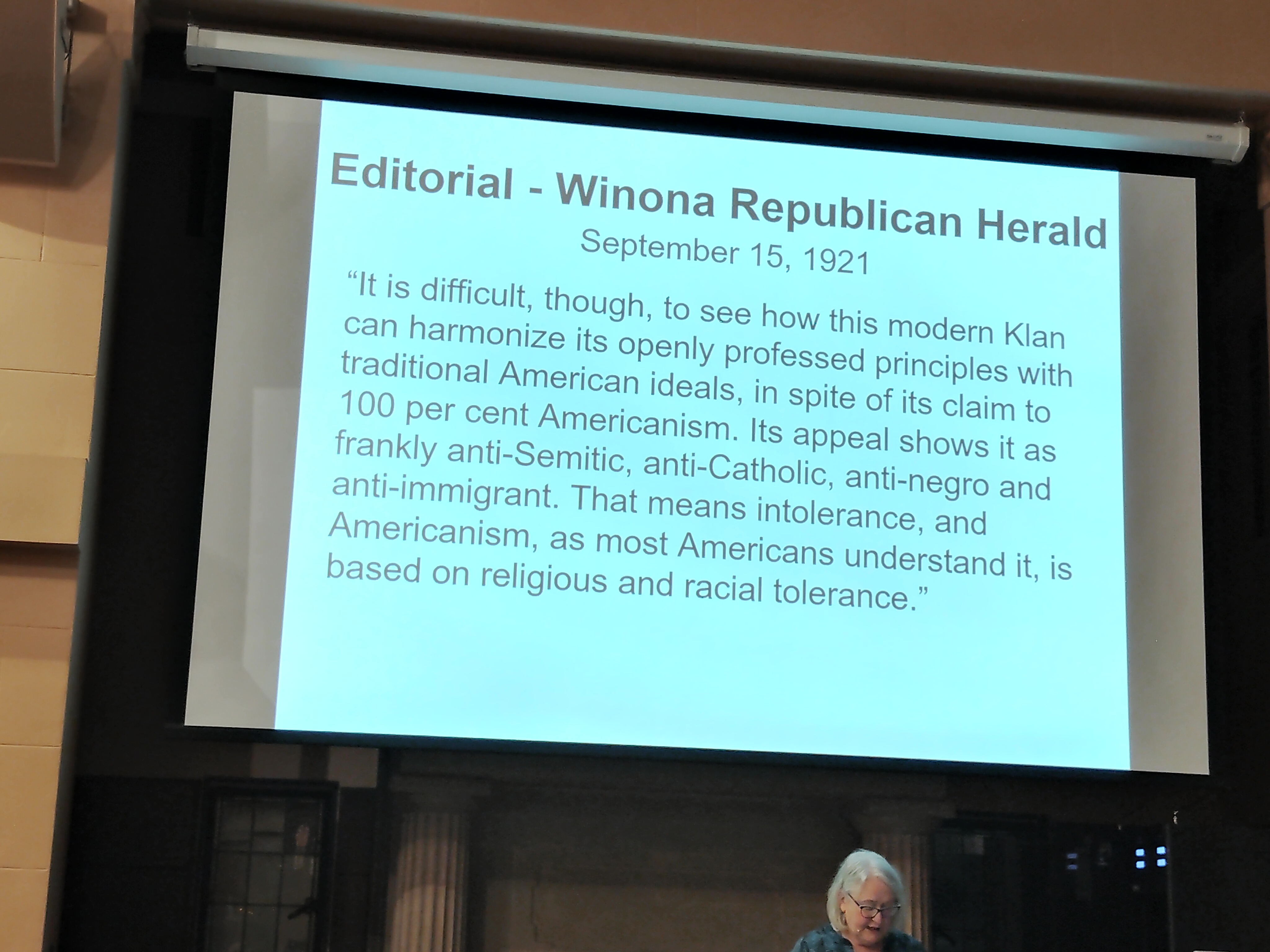
A powerful editorial from a southeastern Minnesota newspaper. (Minnesota Prairie Roots copyrighted file photo February 2025)
Yet, there were individuals—like Bonnie’s great uncle—organizations and media who resisted and challenged the Klan. The NAACP, the National Vigilance Association, the Knights of Columbus… Vaillancourt specifically noted the Catholic-based KC group for effectively exposing Klan members in a community.
This gives me hope, when I hear of media, individuals and organizations that stood up and refused to accept hatred and intolerance. It gives me hope, too, when members of my community turn out in strong numbers to learn about “Minnesota’s Hooded History.” Knowledge is powerful. It gives me hope, too, when someone like Nancy Vaillancourt cares, researches and shares because, she says, she wants “to get the truth out.” Even while some still deny it.
A photo gallery exhibit, “Testify—Americana Slavery to Today, The Diane and Alan Page Collection,” will be displayed in the hallway connecting Buckham Memorial Library and the Faribault Community Center from April 1-23. The exhibit will also be at other libraries throughout the Southeastern Libraries Cooperating (SELCO) system.
The “Minnesota’s Hooded History” program was made possible with support from Minnesota’s Arts and Cultural Heritage Library Legacy Fund and SELCO.
I recently finished this book about slavery, freedom and abolition. A must-read. (Book cover sourced online)
DURING THIS, BLACK HISTORY MONTH, I’ve intentionally read books about slavery, Black people and the Black experience. It’s important to me that I widen my knowledge and understanding. Many of the stories are heartbreaking, almost unbelievable in the mental and physical cruelty inflicted upon Blacks. This is hard stuff to read. But it is in the hard stuff that we begin to fully comprehend the importance of empathy, kindness, compassion and the need to stand strong against that which is hateful, hurtful and oppressive.
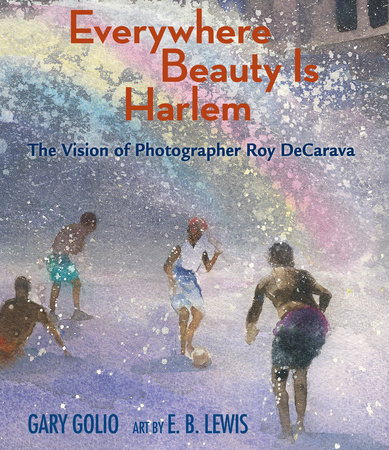
This book resonates with me personally and professionally in telling the story of 1940s world famous photographer Roy DeCarava, unknown to me until I read this book. Trained in the arts and in photography, he would go on to photograph everyday life in his native Harlem via work for the Works Progress Administration Project, fellowships and more. He worked as a photographer for major publications, has/had his photos featured in exhibits and art museums, became an art professor… And he was Black.
But what I love most about this story is that DeCarava aimed to photograph everyday life, everyday scenes, everyday people in the streets of Harlem. He shows life in raw reality. He worked back in the days of film, admittedly much more challenging than shooting with a digital camera. I started with film, too. You often get only one chance to take a photo. No firing off shots. No digital manipulation. Just a single, unedited print.
I took this portrait, one of my favorites, nearly 11 year ago at International Festival Faribault. (Minnesota Prairie Roots copyrighted file photo 2014)
I will never match the talent of DeCarava. But I do share his focus. I also aim to photograph the ordinary, the everyday, right where I live (or mostly in southern Minnesota). Like him, I notice details. The light. The moments. The expressions. The people, scenes, settings and events that define a place. The anything that might make for an interesting photo.
Unlike DeCarava, my roots are rural. I’ve only ever been to New York City once, while in college. I was awed by the skyscrapers, the street vendors, Chinatown and men hurrying along Wall Street in leisure suits. (This was in 1977.) But I have no desire to return to a place that feels too closed in, too busy, too chaotic.
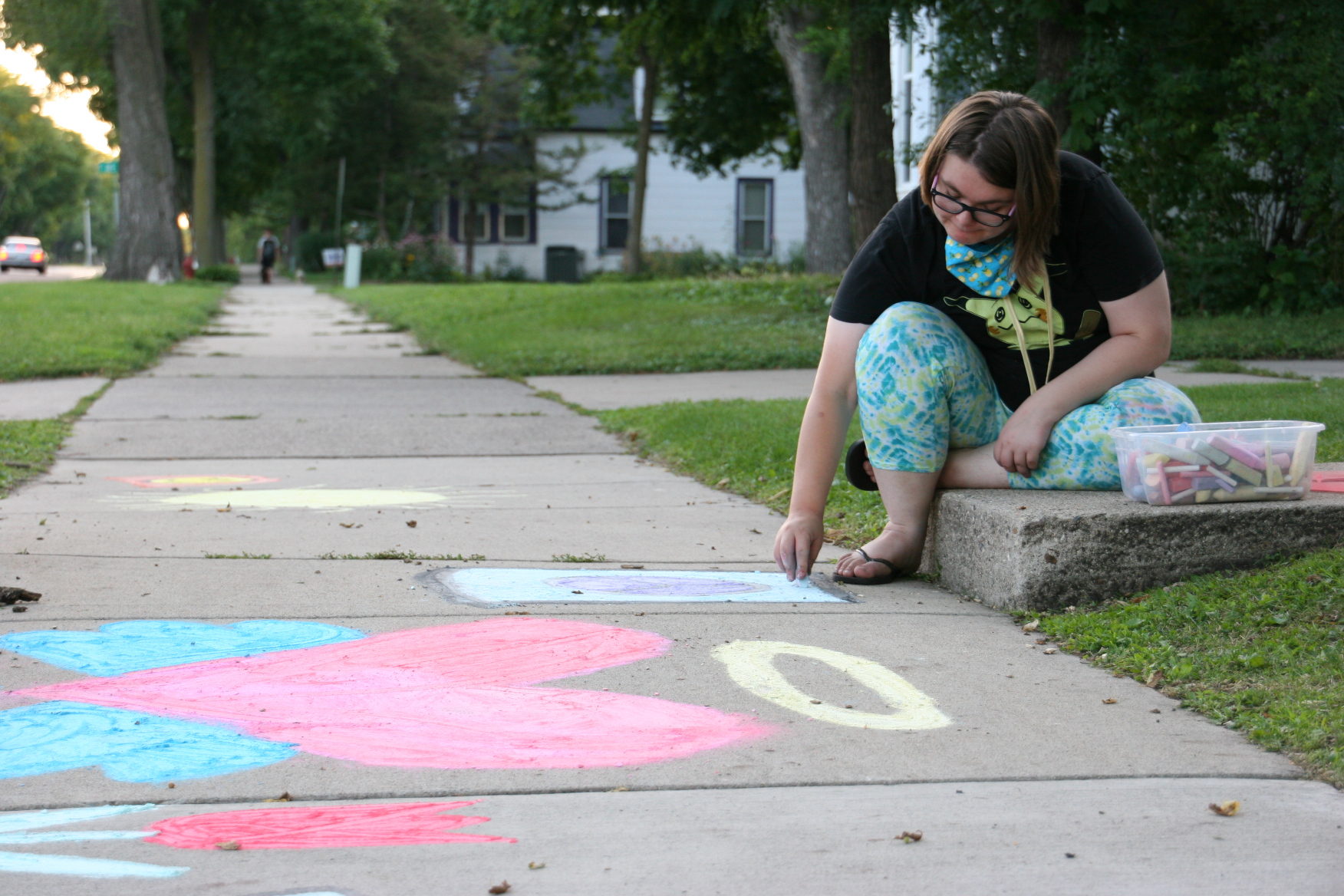
My photo of Jane chalking art on a Faribault sidewalk. (Minnesota Prairie Roots copyrighted file photo August 2020)
Yet, Harlem in Upper Manhattan was DeCarava’s home, where he found the subjects of his photos. Everywhere Beauty Is Harlem gives a snapshot of the images this photographer snapped. A man on the subway. A boy drawing on the sidewalk with chalk. Black and brown children dancing in water spraying from a fire hydrant.
Beyond the visuals, the story in this children’s picture book encompasses the essence of DeCarava’s photographic focus on the everyday and the ordinary. I really ought to buy a copy of this book for my personal library. If you want to understand my photographic work, then read this multi award-winning children’s picture book. But, more importantly, read this book to learn about a world famous Black photographer whose talent for visual storytelling is a gift to all of us. To see the world through his eyes presents life as it is. Real. Raw. Unedited.
#
FYI: I encourage you to also check out the photography of New York City photographer Keith Goldstein, whose work I follow on his blog, “For Earth Below.” His street photography has opened my eyes to humanity in a way that I never see here in southern Minnesota. His talent is remarkable. Goldstein, I think, works much like Roy DeCarava did, with his camera focused on the everyday, the ordinary. And therein both have found the extraordinary.
A photo I took of a sharing library in Pine River, Minnesota, prompted me to write this essay. (Minnesota Prairie Roots copyrighted photo July 2024)
IF I WAS A REBEL, and I’m not (although a streak of defiance runs through my veins), I’d write a strongly opinionated piece on a controversial topic.
But I don’t like conflict. I prefer status quo to chaos, normalcy to the unexpected. Yet, that is not reality. Life can be easy and hard and good and awful and a whole mix of everything. Sort of like Sideways Arithmetic from Wayside School. I like school. Never liked math.
Nor do I particularly like William Shakespeare’s work with the exception of Romeo and Juliet. Who doesn’t love a love story, even if tragic? Shakespeare’s other writing seems archaic, boring and impossibly unrelatable. I offer no apologies for that view.
I am decidedly a fan of Laura Ingalls Wilder, who certainly has her critics, too. But her detail-rich writing in Little House in the Big Woods, On the Banks of Plum Creek, Little Town on the Prairie and more inspires me as a writer. Plus, I grew up some 25 miles from Walnut Grove, smack dab in the middle of the Minnesota prairie. When you live in a land of wide open spaces, big skies and sweeping winds, you approach writing from a detailed perspective that engages all the senses.
I can’t make much sense of sweeping Absolute Power, which has nothing to do with the senses. Not common sense anyway. Common sense tells me Spider Man is not real. Nor are heroes of the Justice League. Yet, I’d like to call in Superman, Wonder Woman and other superheroes to tackle the threats facing us today, and save the day.
Or perhaps strong-willed orphan Sally Lockhart of The Ruby in the Smoke could clear the smoke obscuring vision. Her experiences dealing with unseemly types qualifies her, in my opinion, to take on anything. Like uncovering lies, aggression, narcissism, manipulation and diversionary tactics. I appoint her to abolish the Department of Government E, or something like that, for starters.
Yes, there’s lots to contemplate. But today I’ve escaped to the sharing library, visually pulled a few books from the shelf to create this essay. And if nothing I’ve written resonates with you, then consider Lunkers Love Nightcrawlers. Head to the lake with a container of nightcrawlers, drop your baited line in the open water or drill a hole in the ice. Fish for answers. Good luck.
#
NOTE: I’ve underlined the titles of books from the sharing library which I’ve incorporated into this essay.This essay is not the piece I wrote for the contest I referenced here last week.


























 Minnesota Prairie Roots
Raging blizzards March 5, 2025
Tags: America, analogy, blizzard, commentary, Minnesota, opinion, snow, weather, winter storm
AS I WRITE this Tuesday afternoon, a sense of foreboding looms. Grey, with a tinge of otherworldly light, defines the sky. Branches of bare trees lean. Unbalanced. Darkness encroaches, presses upon the earth with an anticipatory heaviness. By the time you read this, my area of southern Minnesota will be under siege with a full-blown blizzard. Unless the weather forecasters are wrong.
But this time the forecast of up to eight inches of snow with wind gusts topping 55 mph seems likely. I’ve already asked Randy to stay home from work because driving 24 miles in white-out conditions would not be smart. Or safe. The National Weather Service warns of treacherous travel, potentially life-threatening conditions. Power lines and trees laden with heavy wet snow could snap.
The weather rather matches my mood. I feel a sense of foreboding on so many levels. I struggle sometimes to see the light for the grey skies, for the oppressiveness that prevails. I wonder what will happen next. What storm is brewing?
During a weather event, I can prepare. Take precautions. Buy bread and milk (note I didn’t write, “buy eggs”). Stay home. Shelter in place. Face whatever comes. I’ve lived through blizzards, wind storms and even a tornado. I am a hardy American who happens to live in Minnesota, next to our wonderful Canadian neighbors.
And so that is the approach I must take. Stand strong against the negative forces. Speak up. Continue to show compassion, care, kindness, love. Hold hope. Understand that blizzards don’t last forever, although this one seems never-ending.
Every single snowplow matters in removing burdensome snow from roadways. Imagine what a fleet of snowplows can do against the deepest snow drifted by raging winds. I’ve seen the results. Roads are cleared. The snow melts. The sun shines. Winter ends. The trees bud green. That is my visual hope during these grey days tinged with an otherworldly light.
© Copyright 2025 Audrey Kletscher Helbling