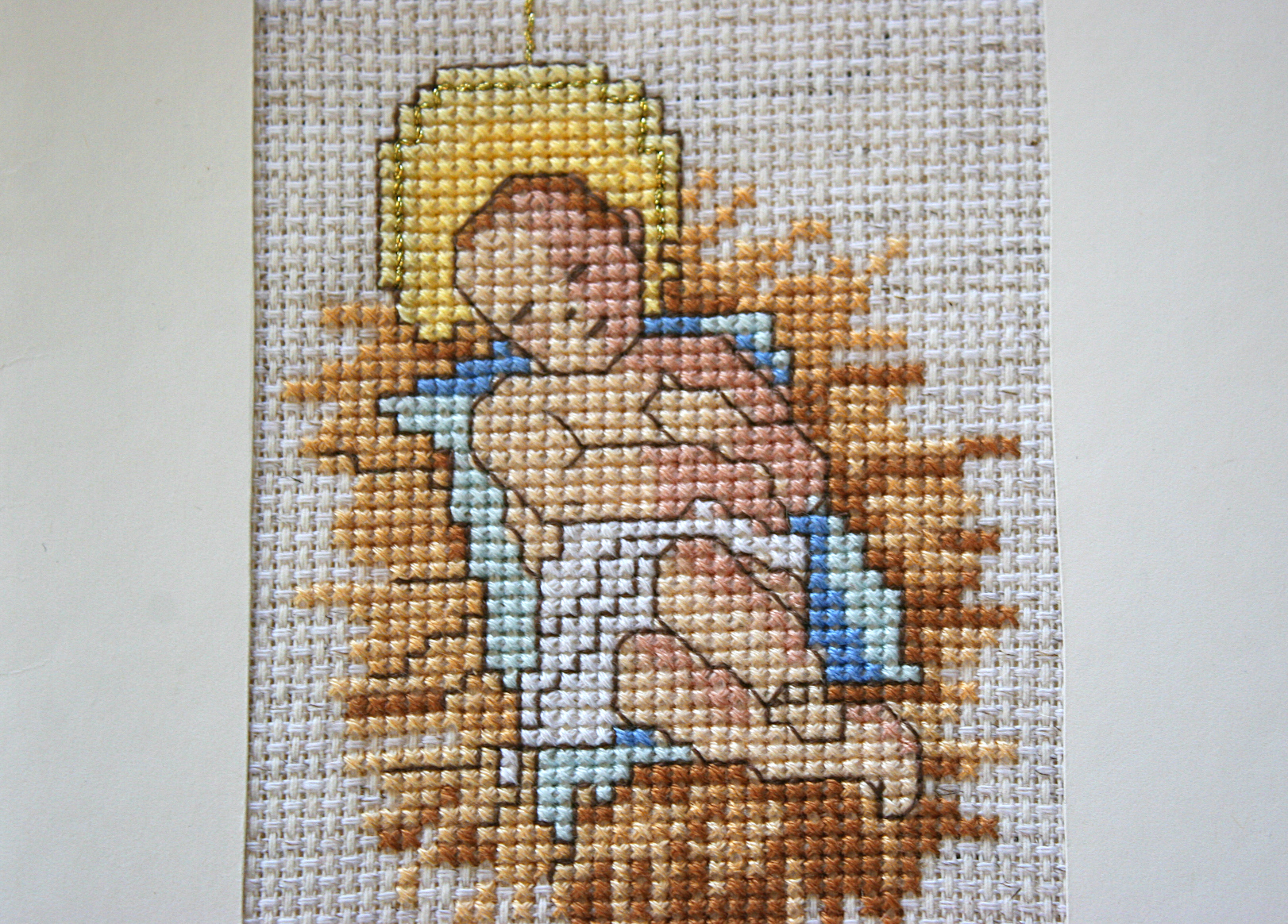
Baby Jesus stitched by my cousin Traci Sanford. (Minnesota Prairie Roots copyrighted photo)
SIX COUNTED CROSS-STITCH CARDS depicting the birth of Christ grace an aged chest of drawers anchoring a corner of my living room. I’ve leaned the cards against the backdrop mirror reflecting my Christmas tree.
These works of art visually tell the Christmas story minus a few important characters—Joseph and the Three Wisemen, who would later come bearing gifts. Perhaps those cards were lost. Or maybe my cousin Traci, who stitched the art, didn’t complete the series. She gifted my mom with these cards. One each Christmas.
A few years back, after Mom moved into assisted living and eventually long-term care, my extended family divided the Nativity sets our mother collected. And, among those I chose were these cards. My mom was also an avid counted cross stitch artist.
I cherish the stitched collection. Not only for its artistic value but also for the emotional connection to a mother celebrating her final Christmas on this earth. That is reality and I’ve reached a sense of peace in that certainty.
This Christmas, I hope you, too, experience peace. I hope you find a connection to those loved ones no longer on this earth via treasured memories or objects. I hope you feel connected also to those still here. To those who can still hear the words, “I love you.”
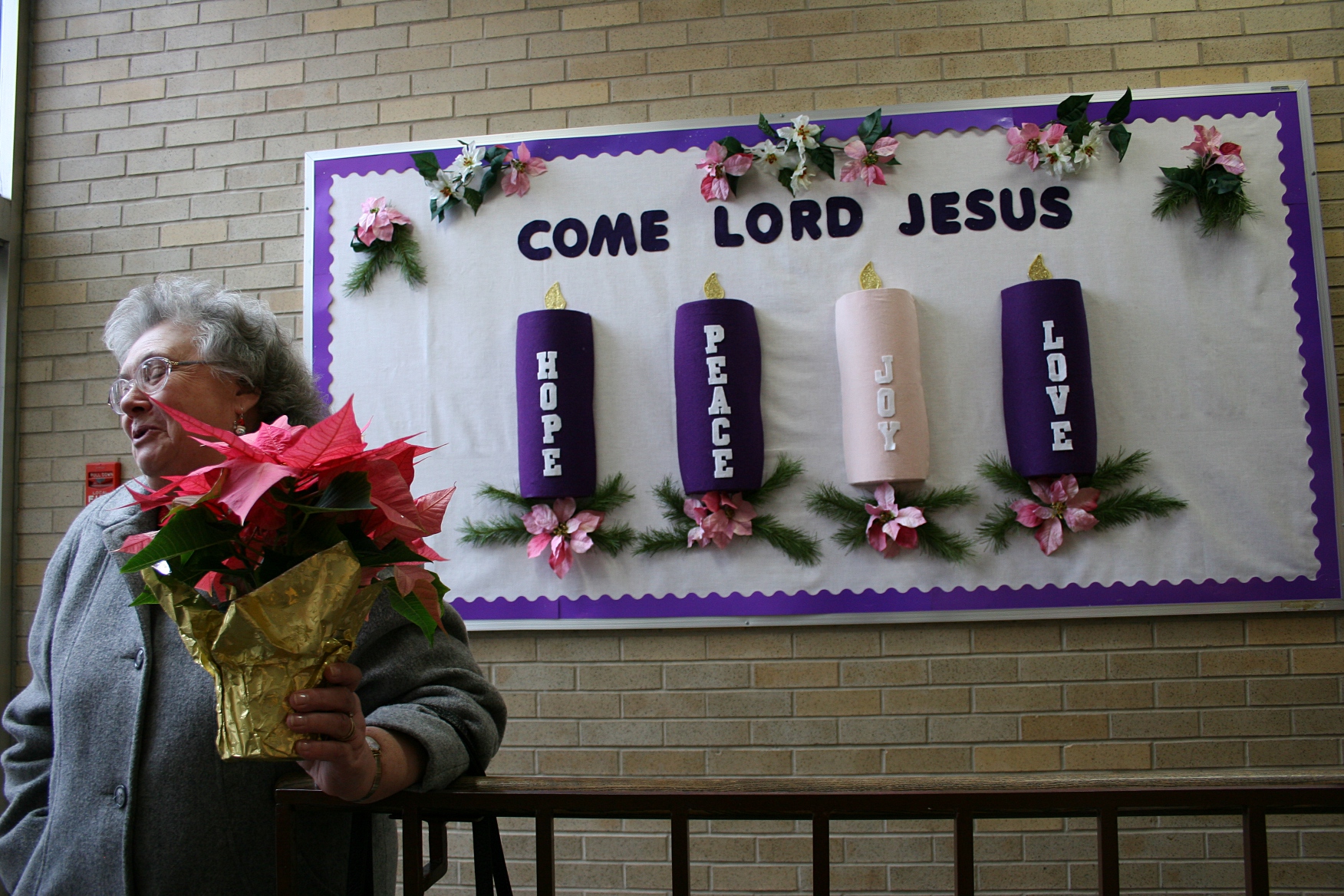
After the Community Christmas Dinner. (Minnesota Prairie Roots copyrighted file photo December 2012)
IN THE DAYS LEADING to Christmas, busyness can cause us to lose focus. Busy baking. Busy cleaning. Busy buying. Busy wrapping and trying to do too much. I invite you to pause and reflect.
Reflect on hope.
Reflect on peace.
Reflect on joy.
Reflect on love.
Those four words centered a bulletin board display I photographed in 2012 at Fourth Avenue United Methodist Church. I love this image. For the message. And for the story behind it. The Faribault church annually (except during COVID) hosts a free Community Christmas Dinner in mid-December. Volunteers serve a full holiday meal in the church basement. I’ve attended many times and enjoyed not only the food, but also the coming together of my community.
In this particular photo, a woman awaits a ride home. I’d just finished my meal and came across her standing at the top of the stairs, poinsettia in hand. The holiday flowers decorated dinner tables and diners were welcome to take them home. She was unaware of my presence. I framed the moment. A moment that, against the backdrop Advent message, captures the reason for the season.
Hope. Peace. Joy. Love. May all be yours as we draw near to Christmas.
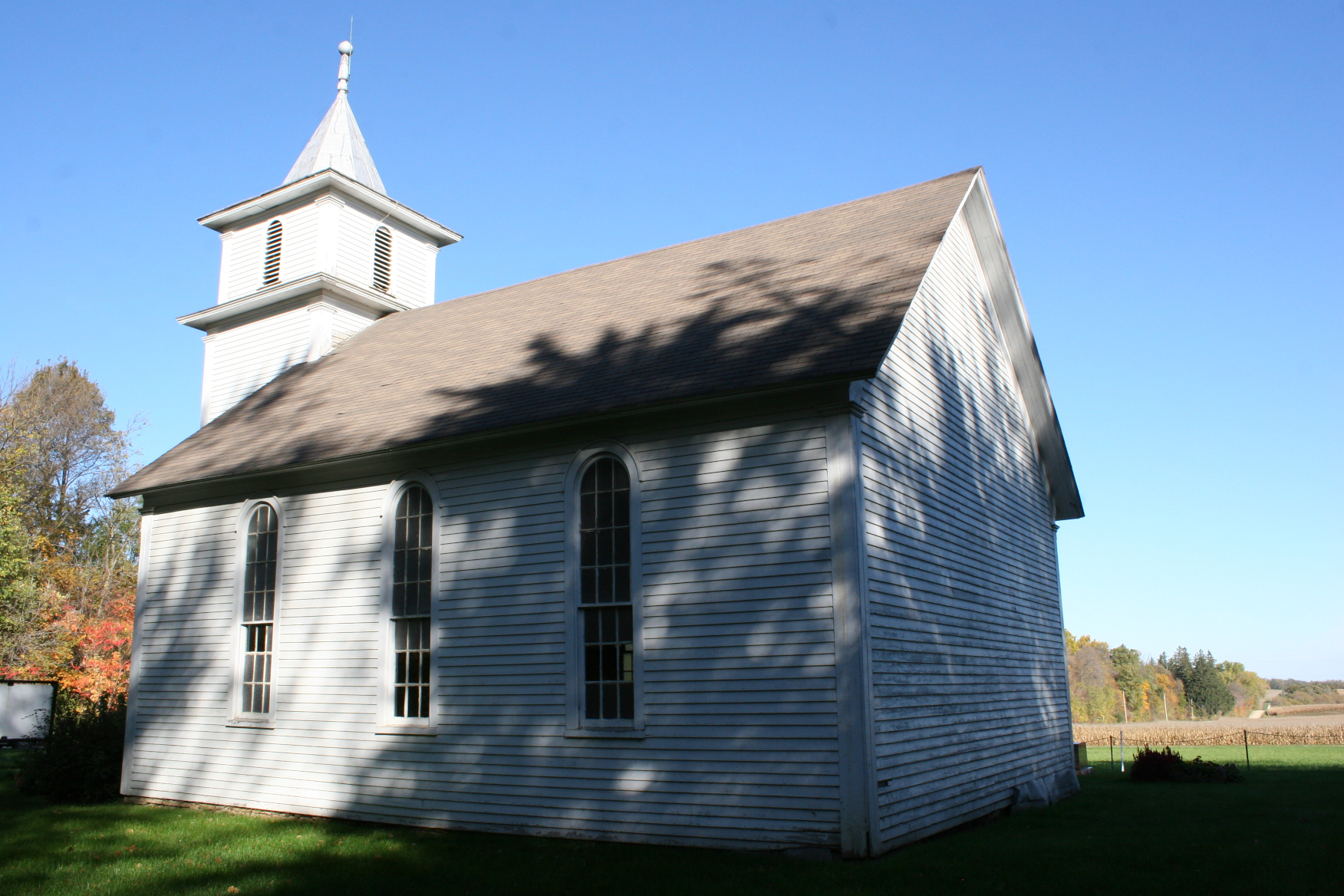
A simple country church, Eidsvold Norwegian Methodist. (Minnesota Prairie Roots copyrighted photo October 2021)
WHENEVER I HAPPEN upon an aged rural Minnesota church, as I did recently in Leon Township south of Cannon Falls, I wonder about the immigrants who founded it. What are their stories? How did they feel living an ocean apart from their beloved homelands and families? I admire their strength. Their ability to board a ship and sail toward The Land of Opportunity.
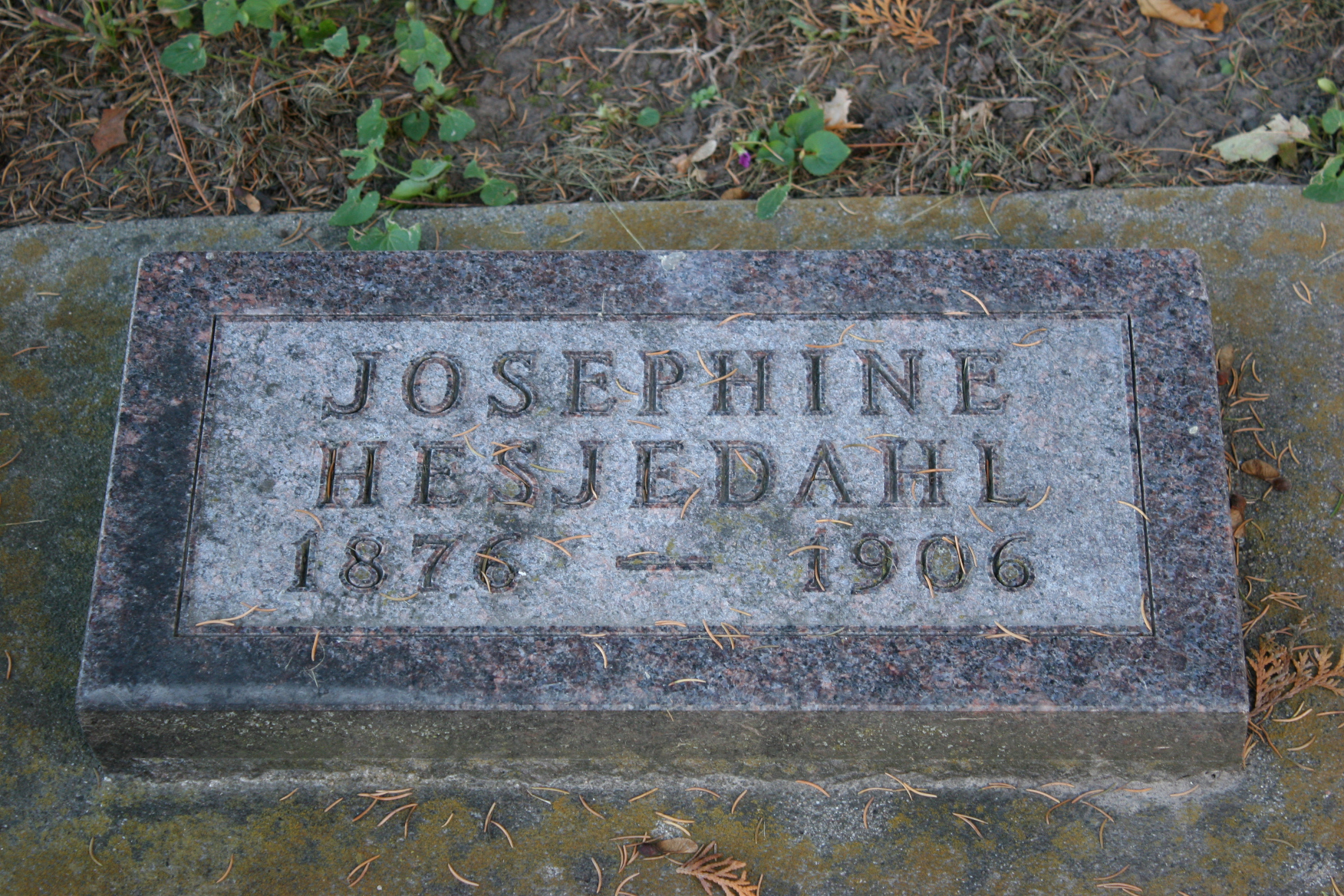
A Norwegian name in the Eidsvold Church cemetery. (Minnesota Prairie Roots copyrighted photo October 2021)
Oftentimes, the very names of these country churches and the names of those buried in the churchyard cemeteries reveal roots and heritage.
A brief history of the church. (Minnesota Prairie Roots copyrighted photo October 2021)
The small white clapboard church Randy and I discovered on 70th Street in the Sogn Valley area was clearly founded by Norwegian immigrants. Eidsvold Norwegian Methodist Church banners a sign with a brief history. Founded in 1893. Also known as “Ring Church.” Built by Gulbrand Nilson. Last service in 1949.
My initial view of the Eidsvold Church. (Minnesota Prairie Roots copyrighted file photo October 2021)
An online search dates the congregation’s organization to 1860. Perhaps the signage date references building construction. I couldn’t find much other information other than parishioners originally meeting for worship in homes, a common practice.
My own great grandfather, Rudolph Kletscher, who immigrated to the US from Germany in 1885, eventually settling on a farm near my hometown of Vesta in southwestern Minnesota, opened his home for worship. A pastor from the Lutheran church in neighboring Echo led services for 8-9 families and in 1900 those German immigrants built St. John’s Lutheran Church in town.
For those brave souls settling in a new land, I expect their faith provided comfort, strength and hope. And a place to gather, to sing and pray in their mother tongue, to support one another, to socialize. To celebrate. Baptisms. Weddings. Confirmations. Christmas and Easter. And to mourn.
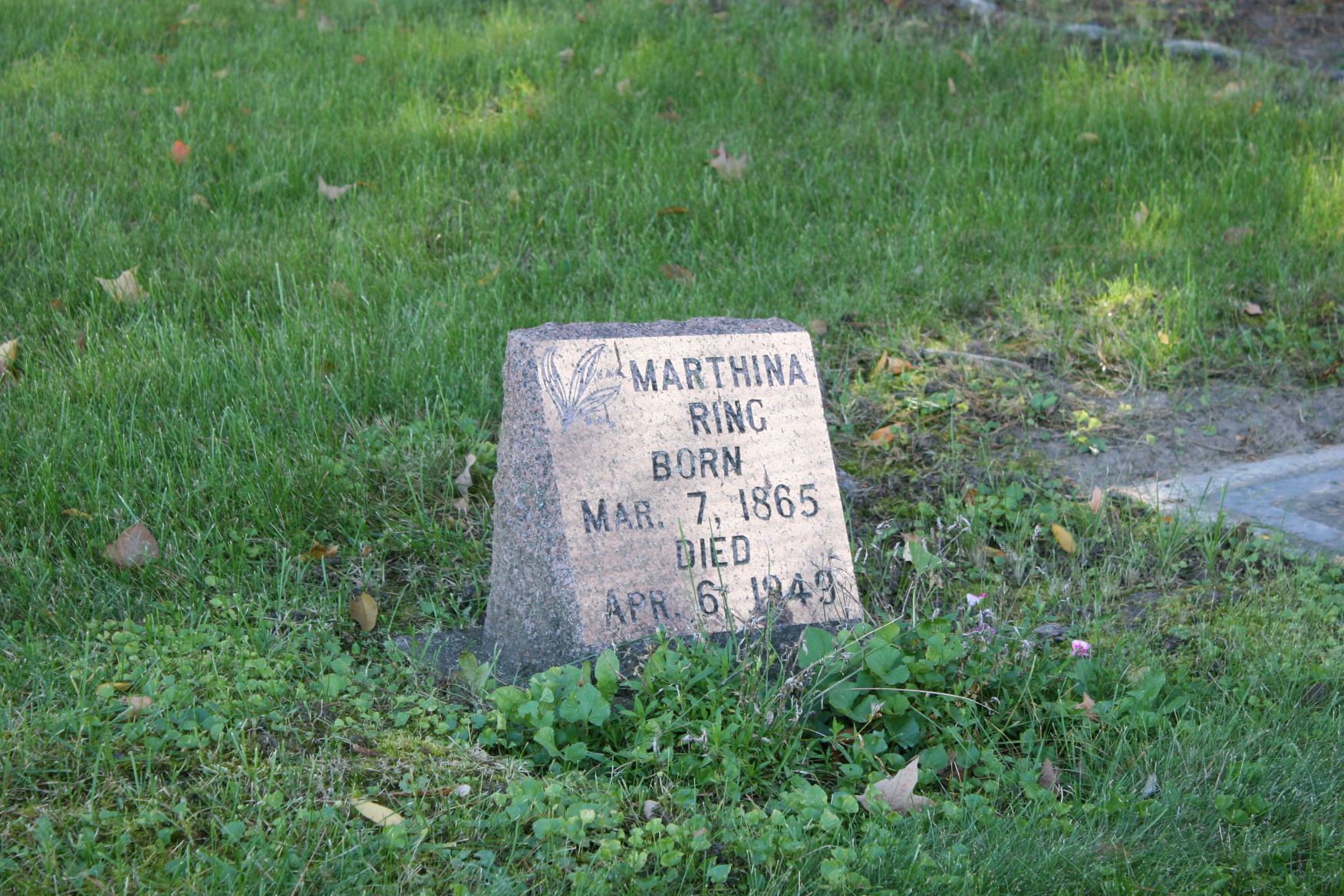
The final service held at Eidsvold, as noted on the church sign, was the funeral of Marthina Ring on April 11, 1949. I determined to find her grave marker and I did. It’s a small, unassuming stone engraved with her birth and death dates. Born March 7, 1865. Died April 6, 1949. Other Ring family stones are larger, more prominent. John Ring, I learned online, was a leading supporter of this church. I have no idea of his connection to Marthina.
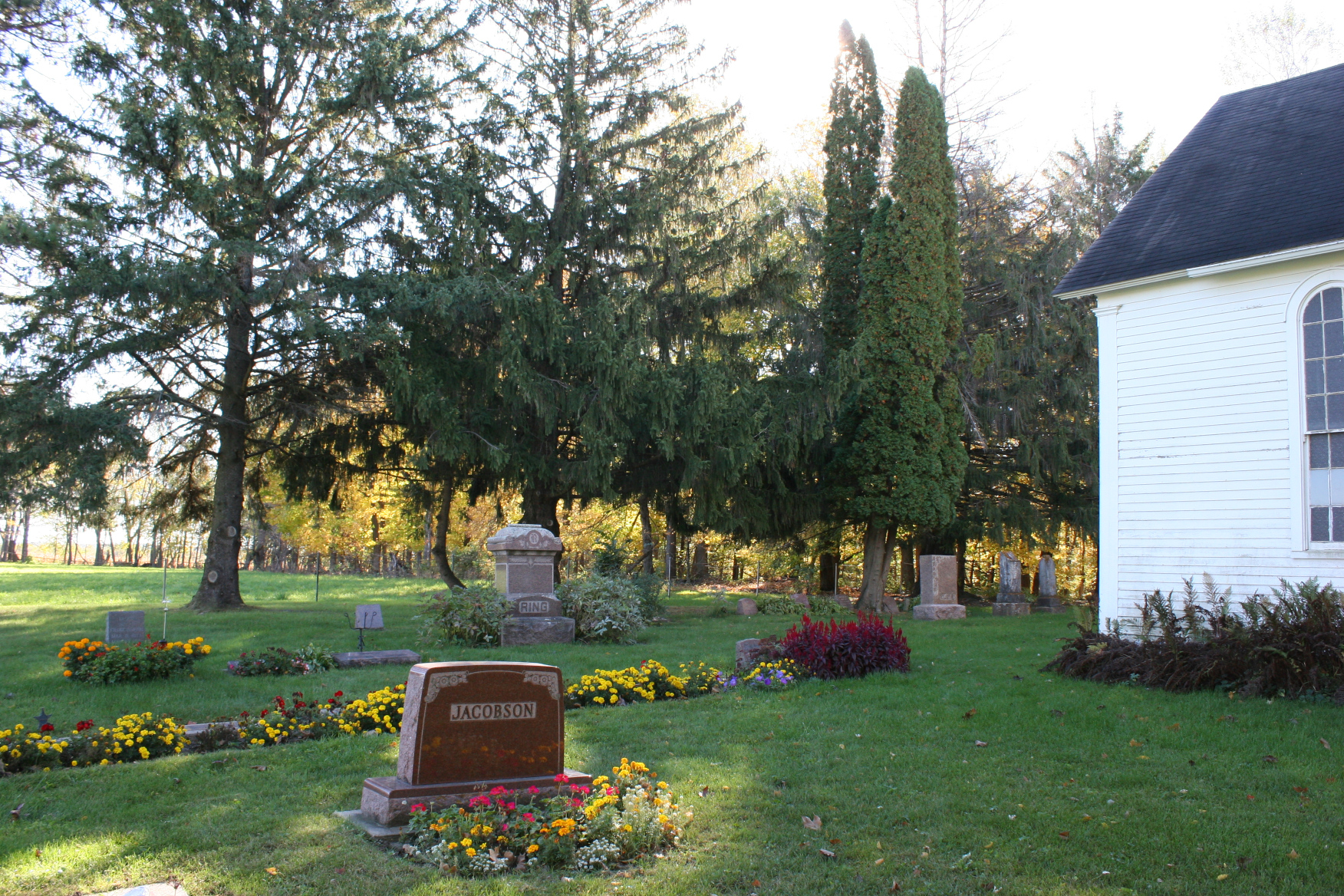
Beautiful flowers grace the cemetery. (Minnesota Prairie Roots copyrighted photo October 2021)
This cemetery appears cared for with golden marigolds, red and pink geraniums and other annuals splashing color among the grey and brown tombstones.
Water at the ready… (Minnesota Prairie Roots copyrighted photo October 2021)
Jugs of water snugged against the church foundation show me that someone comes here regularly to water those plants.
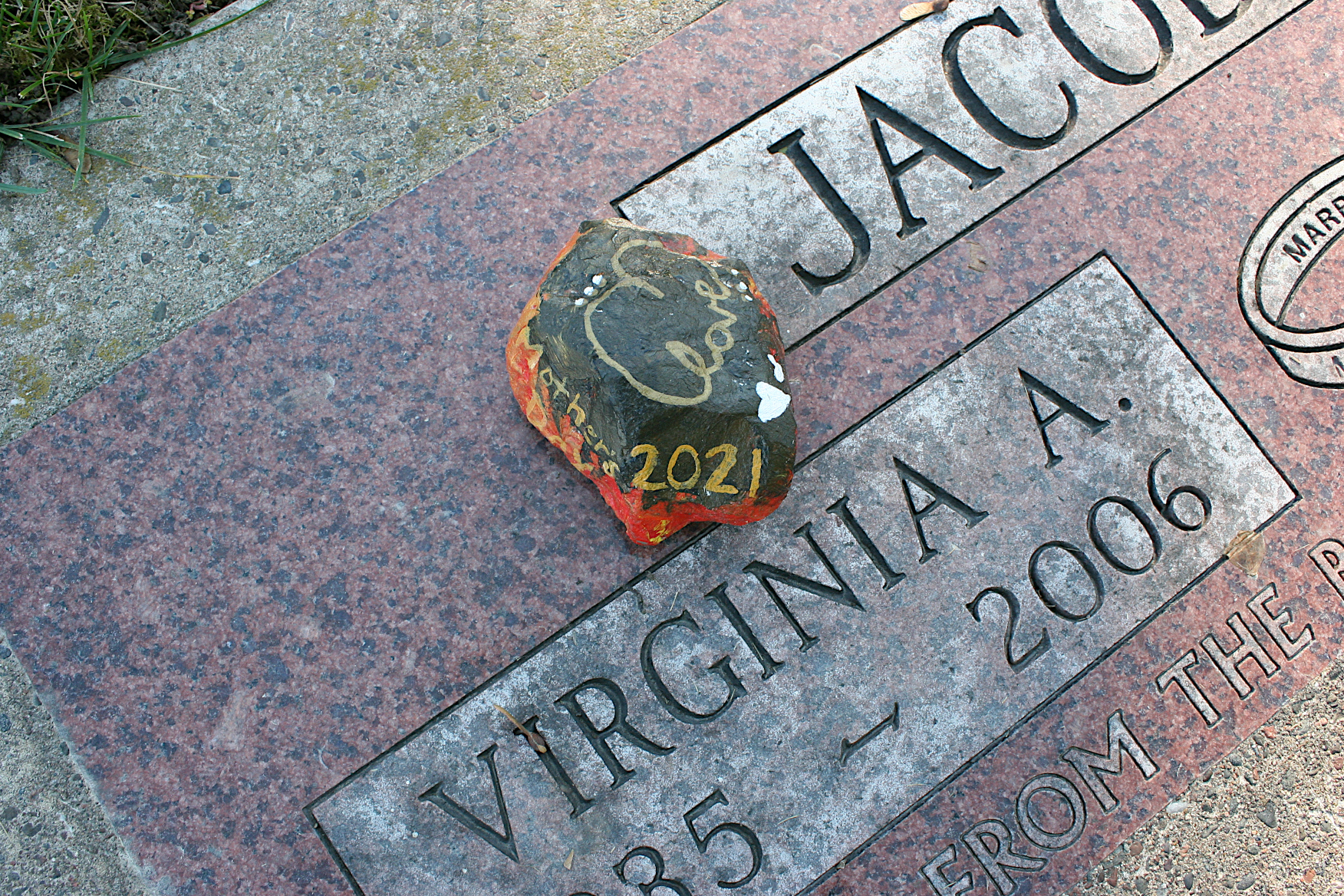
A token of love left for a mother. (Minnesota Prairie Roots copyrighted photo October 2021)
And a painted stone placed atop a marker for Virginia Jacobson reveals how much she is missed. Has been missed since her 2006 passing.
The door into Eidsvold was padlocked. (Minnesota Prairie Roots copyrighted photo October 2021)
That this church and graveyard have not been abandoned here among the fields in the Sogn Valley pleases me. This land, this church building, this cemetery meant something to those long ago Norwegian immigrants. And that is to be valued. Cherished. Honored. Celebrated, even by those of us with no connection to Eidsvoll/Eidsvold, Norway.
#
IF YOU KNOW more about the Ring Church, please share. I welcome additional information. As is often the case at rural churches, I found the front door locked.
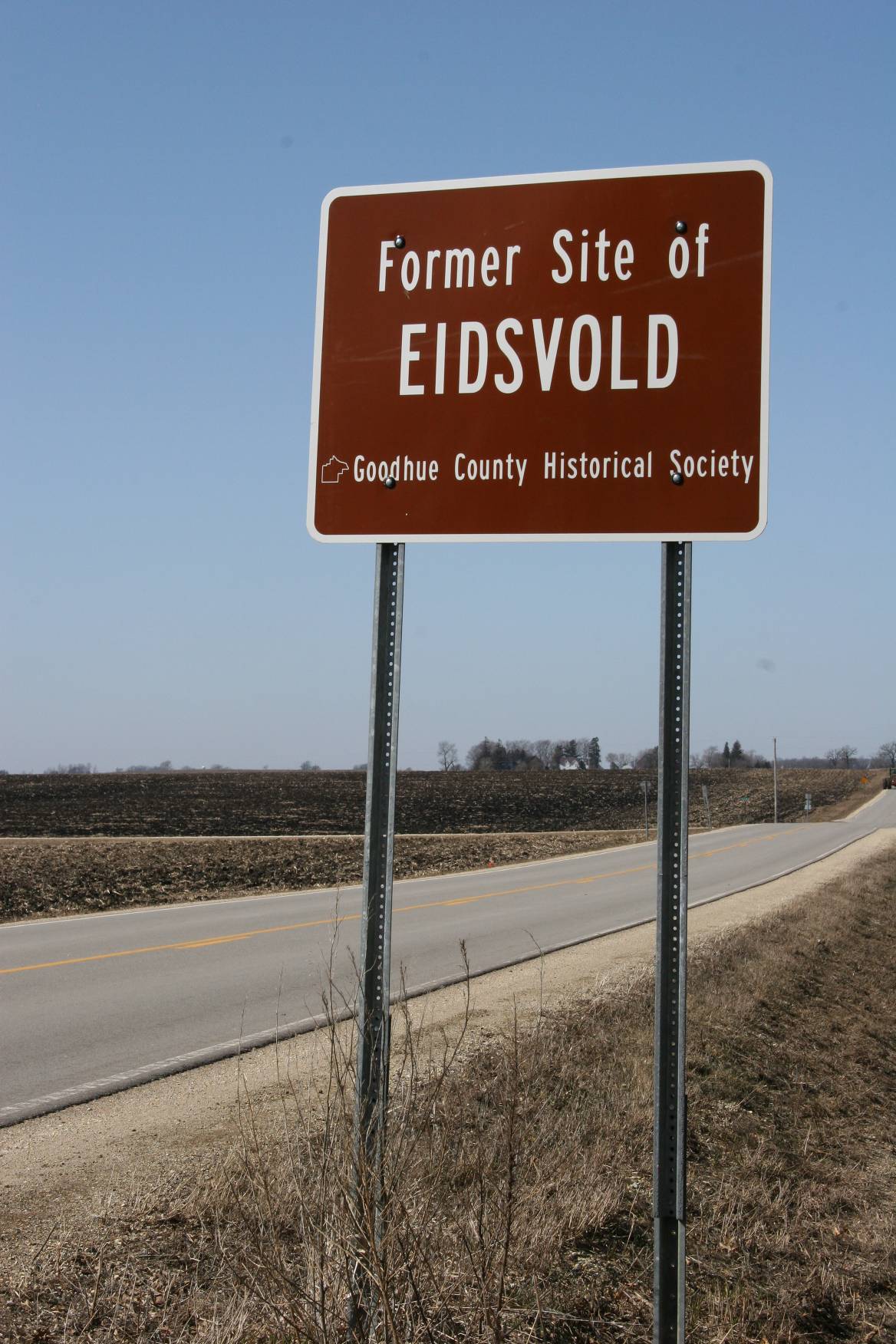
The Goodhue County Historical Society placed this historical interest sign at the ghost town of Eidsvold. The sign was erected to preserve the history of this former post office site and to recognize its historical contribution to the area. (Minnesota Prairie Roots copyrighted file photo 2010)
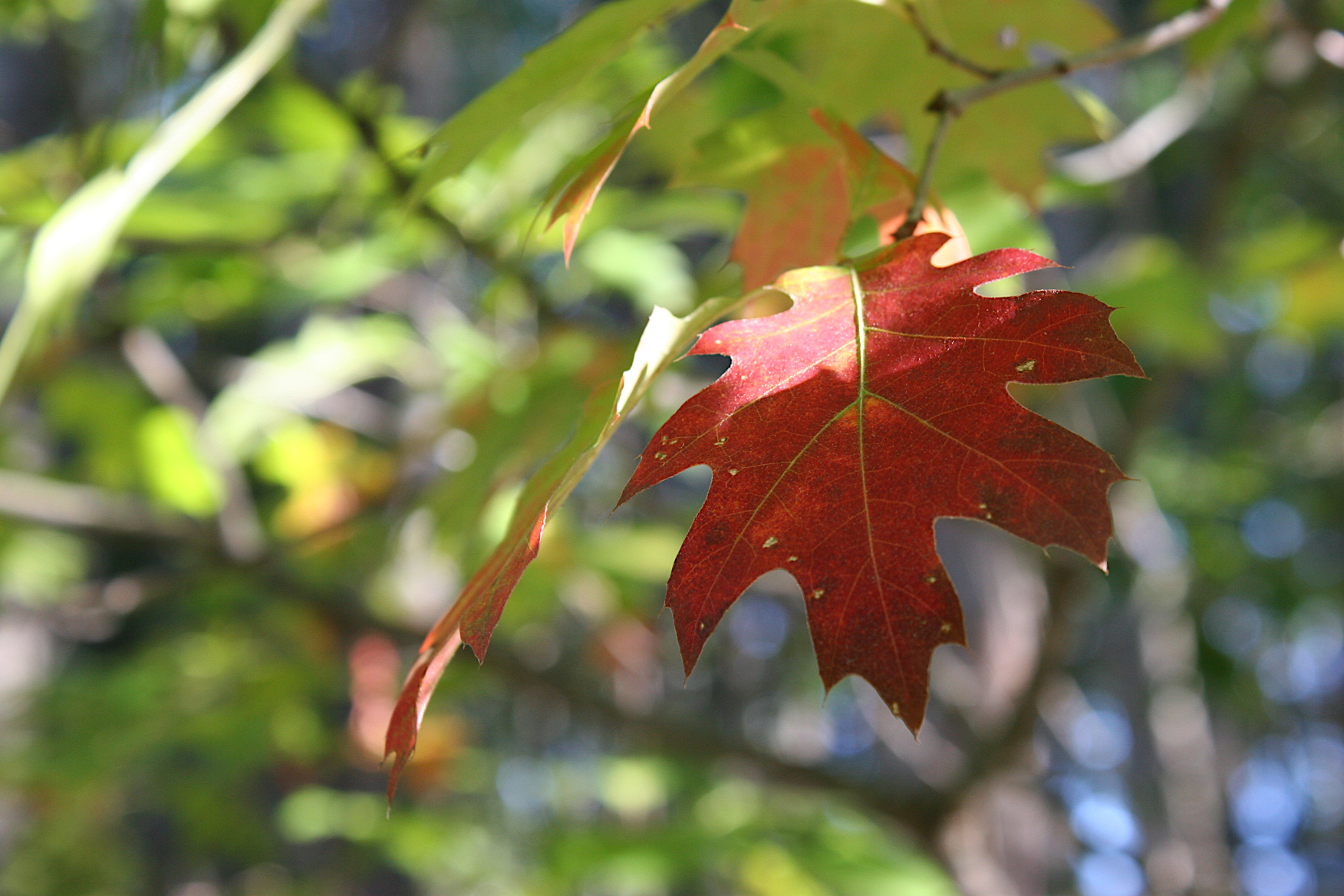
Two weeks ago, leaves were already changing color at Mission Park. Minnesota Prairie Roots copyrighted photo September 2021.
I NEVER EXPECTED that my search for information about Mission Park in Mission Township in the central Minnesota lakes region would connect to Faribault. But it did. To my church, Trinity Lutheran.
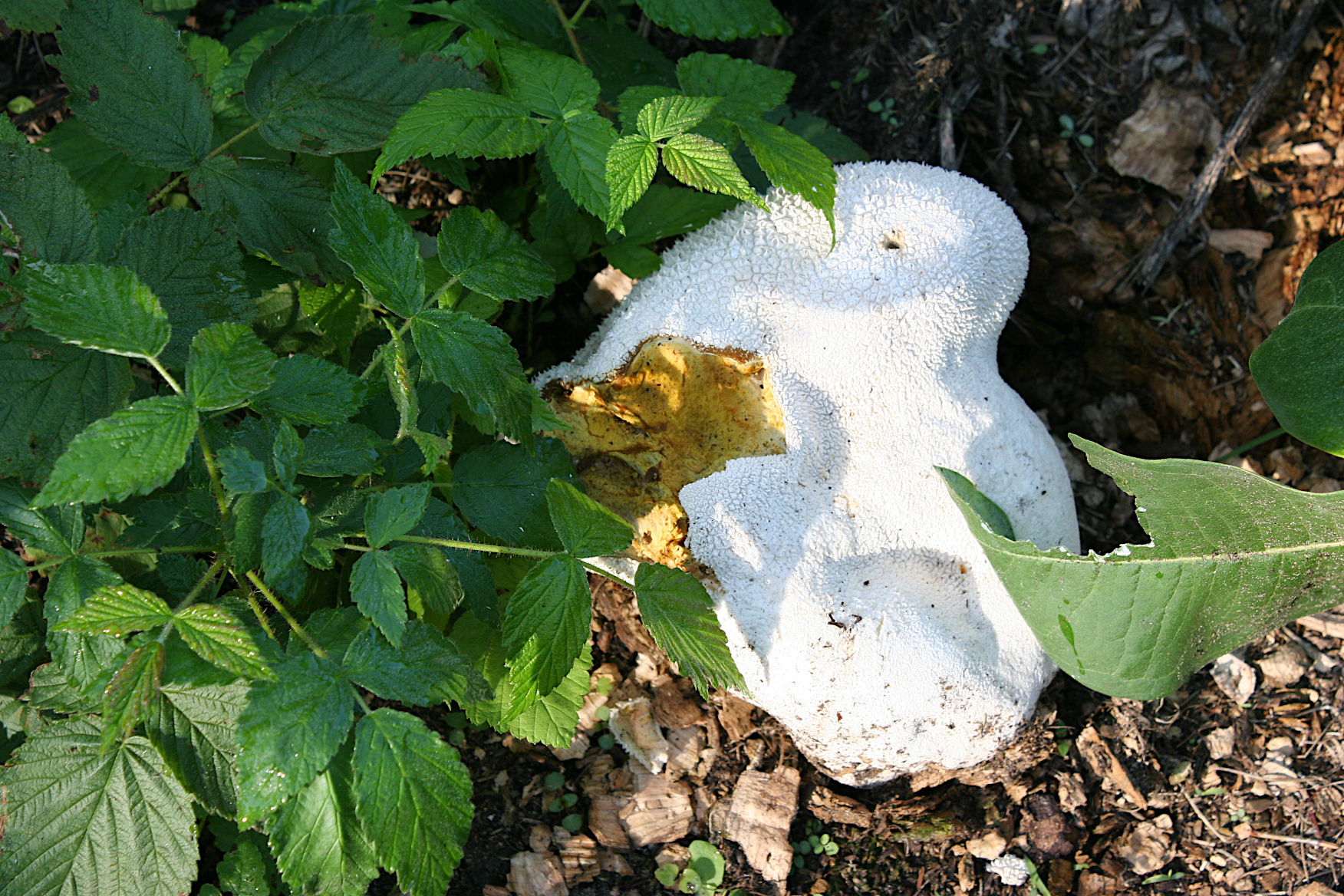
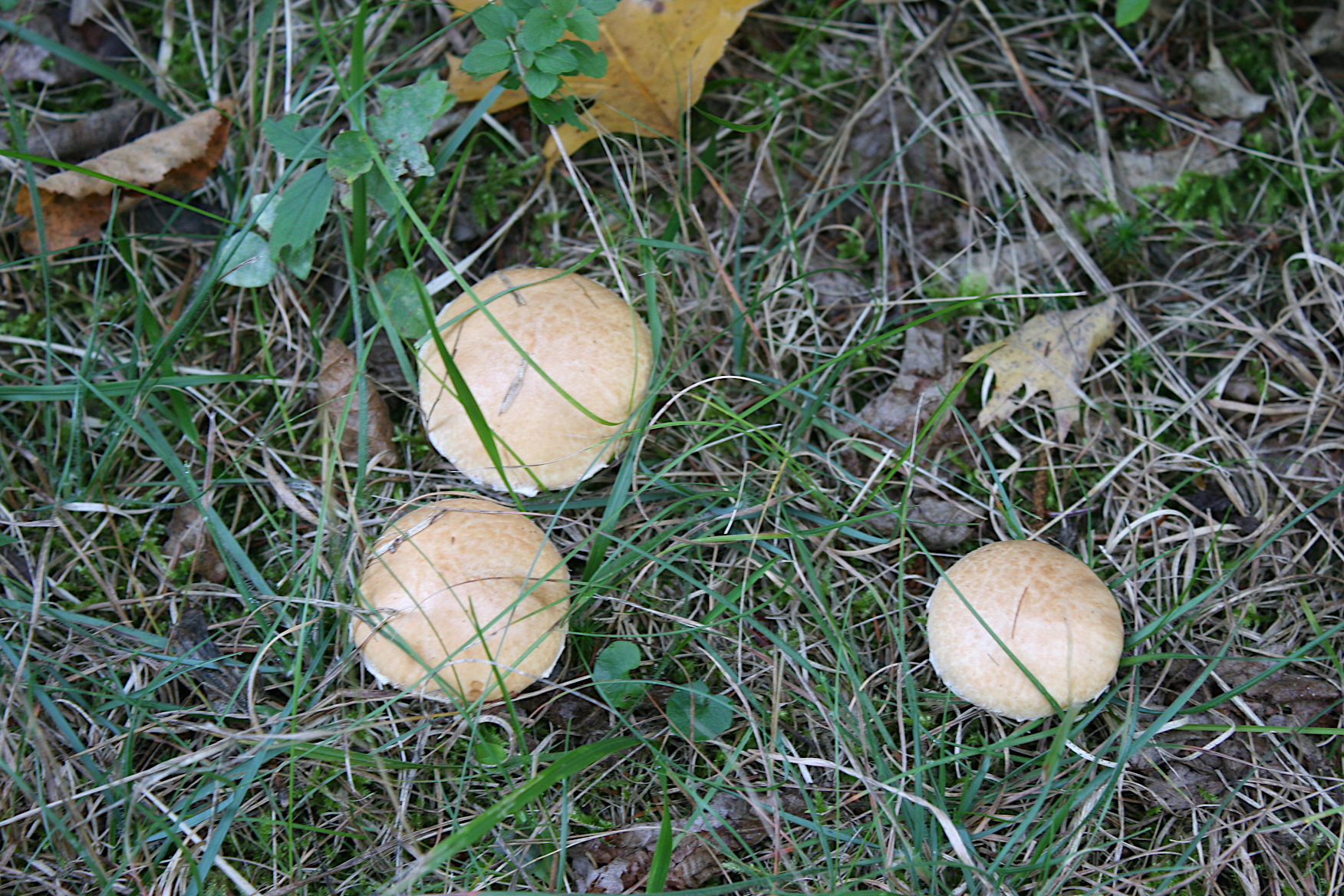
Among the many mushrooms I discovered in the woods at Mission Park. Minnesota Prairie Roots copyrighted photo September 2021.
But let’s back up a minute. As I read the township history, I noted that Mission Township is named after a mission founded there among the Ojibwe in 1857 by the “Rev. Ottmar Cloetter,” a pastor with the Lutheran Church, Missouri Synod.
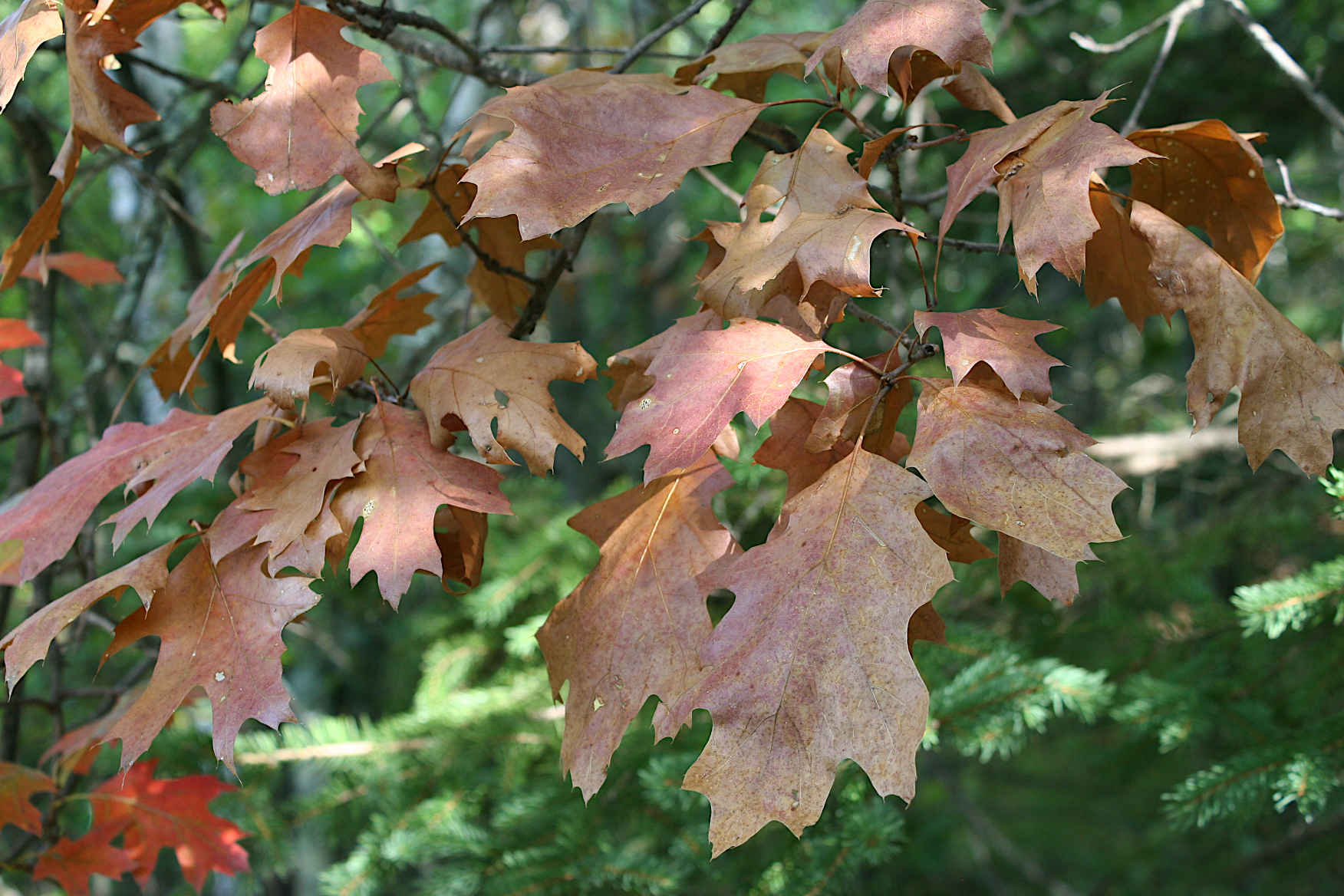
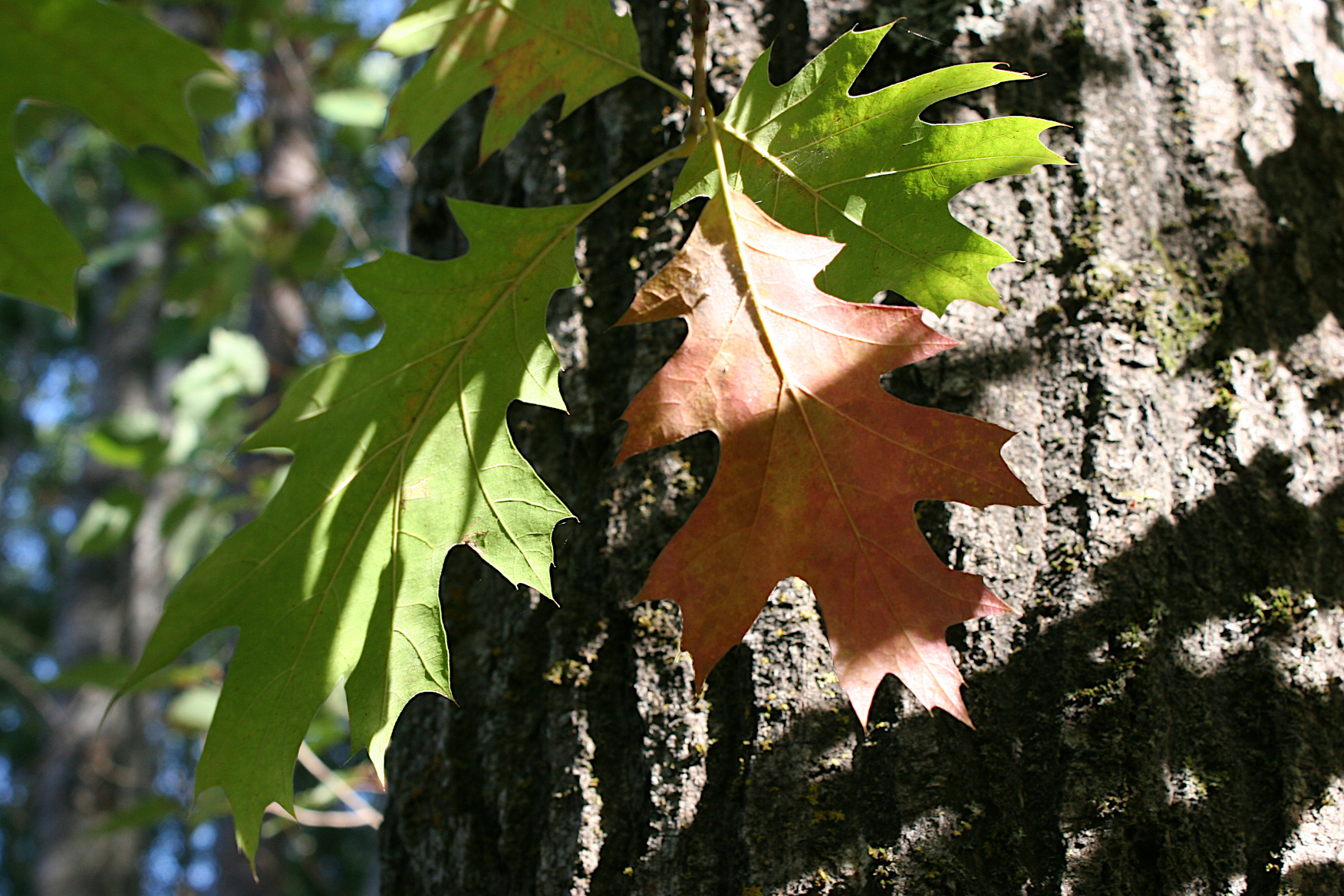
Even brown oak leaves hold beauty. Minnesota Prairie Roots copyrighted photo September 2021.
Almost immediately I questioned the spelling of the surname as “Cloetter.” The Rev. O.H. (Ottomar Helmut) Cloeter served as pastor at Trinity from 1957-1978. The name similarities between the Faribault pastor and the missionary noted in the township history gave me reason to pause. And investigate.
More mushrooms growing in the woods. Minnesota Prairie Roots copyrighted photo September 2021.
That led me to the Minnesota Digital Library and a 1931 letter from O. Cloeter of Vernon Center. He was the son of the pastor who moved from Michigan to start a mission among the Ojibwe. Located 14 miles north of current-day Brainerd, the mission station was called Gabitaweegama. That means “parallel waters,” denoting the mission’s location on a strip of land between the Mississippi River and Mission Creek. Ernst Ottmar Cloeter (not Cloetter) settled there with his young family in a newly-built log cabin. During the U.S.-Dakota War of 1862, Crossing-the-Sky, a leader of the Gull and Rabbit Lake Ojibwe, advised Cloeter and his family to leave (presumably for their safety). The mission station was destroyed and Cloeter relocated to Crow Wing.
Another oak changing color at Mission Park. Minnesota Prairie Roots copyrighted photo September 2021.
Six generations of Cloeter men would go on to become pastors, including O.H. Cloeter—great grandson of the long ago missionary. The younger Cloeter ended his ministry at Trinity in Faribault. I found it interesting that his family’s pastoral history traces back to Mission Township and to Mission Park, a park I appreciate for its quiet, wooded natural beauty. Now I also value the park for its sacred and historical connection.
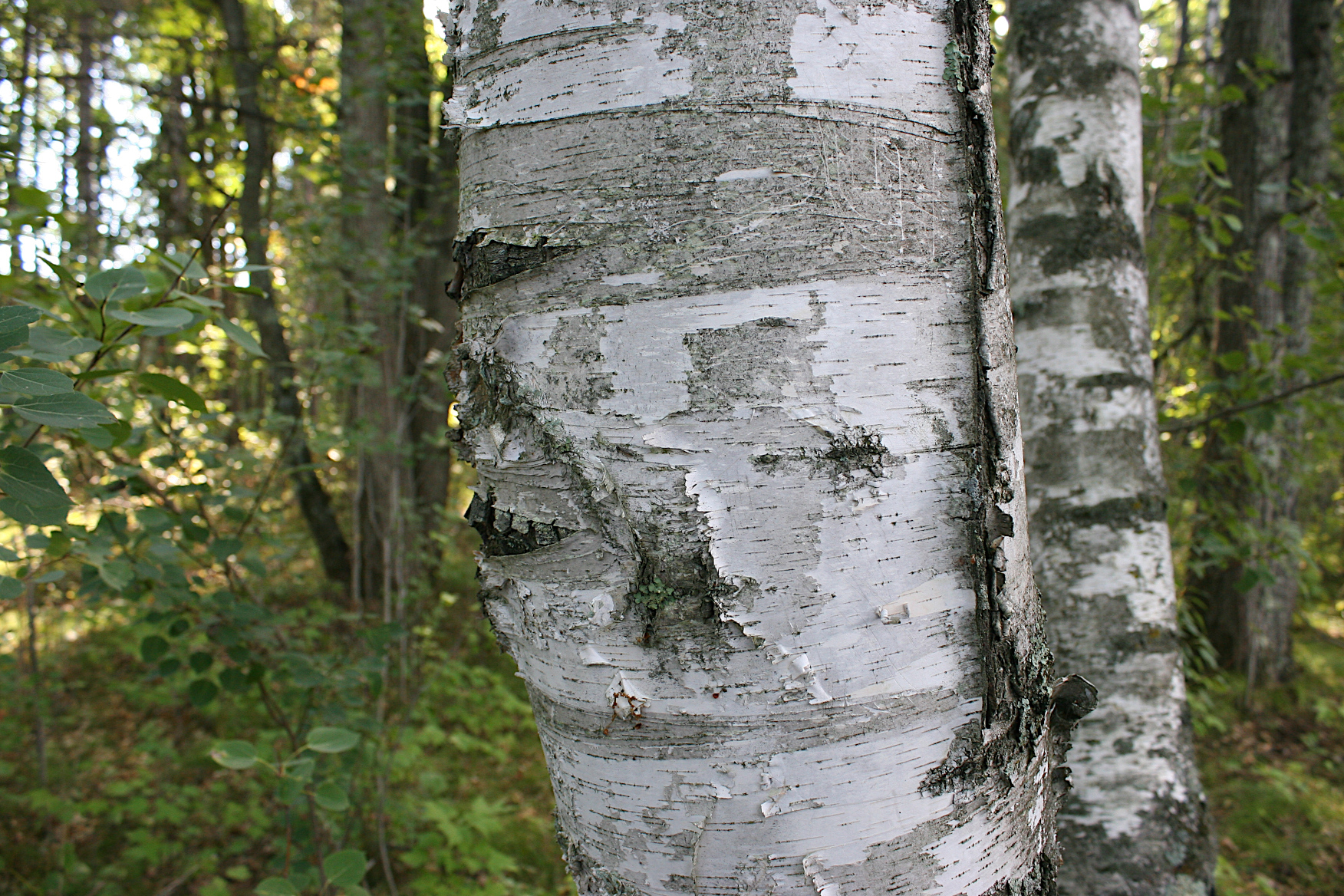
Birch trees populate the northwoods, including at Mission Park. Minnesota Prairie Roots copyrighted photo September 2021.
When I next walk the trails of Mission Park, I will consider the Ojibwe and how some perhaps resented the intrusion of a white missionary into their culture and lives while others embraced the newcomers. Here, among the woods and rivers and lakes, the Ojibwe hunted for deer, gathered berries, crafted birch bark in to canoes, raised their families… They lived off and of the land that would become Minnesota.
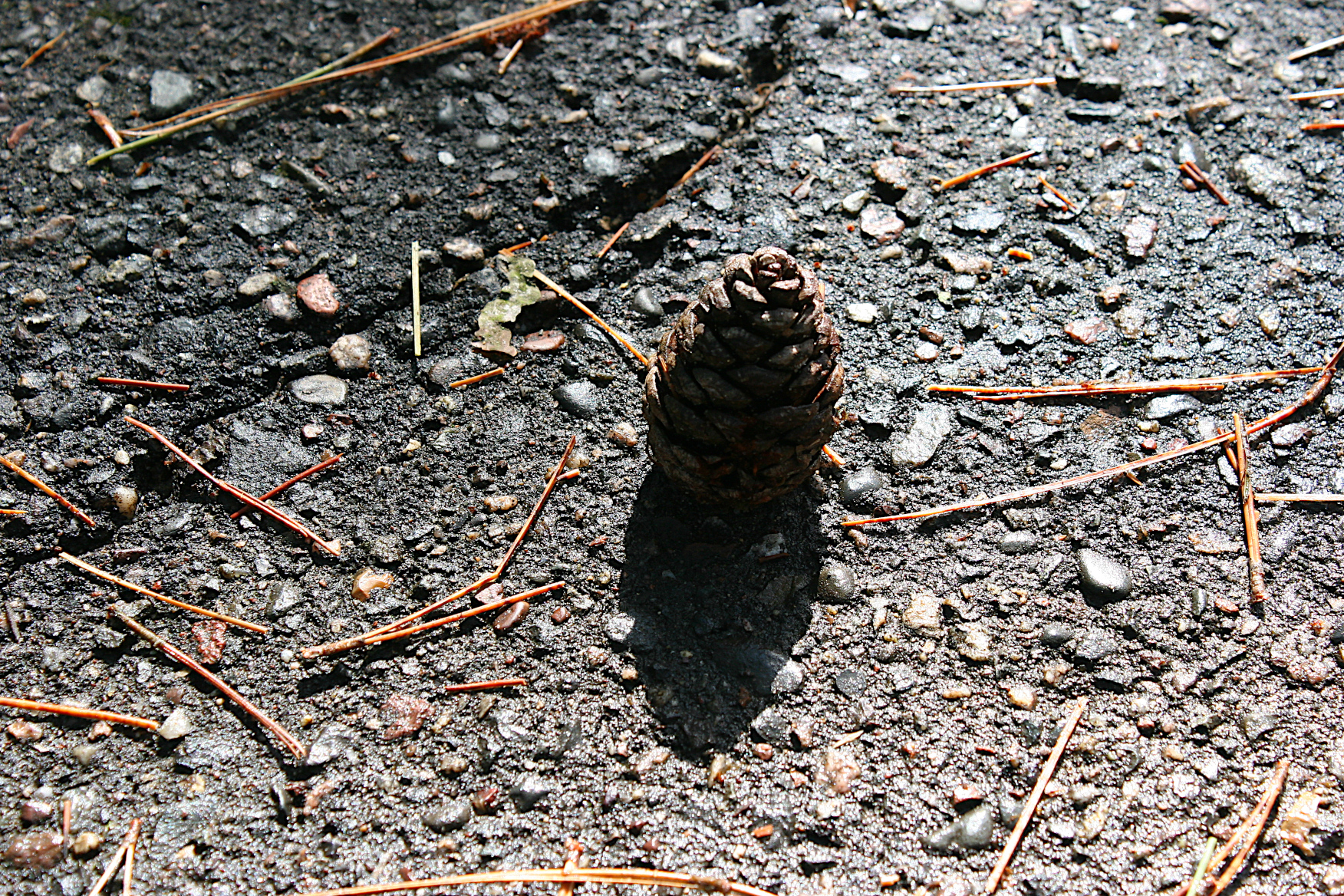
A pinecone dropped upright onto a path at Mission Park. Minnesota Prairie Roots copyrighted photo September 2021.
And I’ll consider, too, how the Rev. Ernst Ottmar Cloeter settled here in the year before Minnesota became a state with expectations of connecting with these Native Peoples. It’s interesting how history and people intertwine. How choices and actions connect us, even after 164 years.
A sculpture inside St. Michael’s Catholic Church, Buckman, MN. Minnesota Prairie Roots file photo September 2020.
AS HOLY WEEK MOVES ever closer to Easter Sunday, I find myself focusing on hope. It’s such a positive word. One that I’ve held close to my heart through some really difficult challenges in life.
This past pandemic year has challenged all of us. Stretched our endurance, our patience, our ability to cope. To live life in a way that would keep us, and those we love, safe. I’ve felt frustrated about lax attitudes and behaviors regarding COVID-19. But through all of this, I’ve tried to balance that with hope.
Minnesota Prairie Roots file photo May 2020.
Hope seems synonymous with spring in Minnesota. Nature reveals hope in spring bulbs popping, in trees budding, in dormant grass greening and much more.
After a season of cold and darkness, hope breaks forth in longer days. More warmth. More sunshine. More light.
And now, in this too long season of COVID, hope for an end to this pandemic.
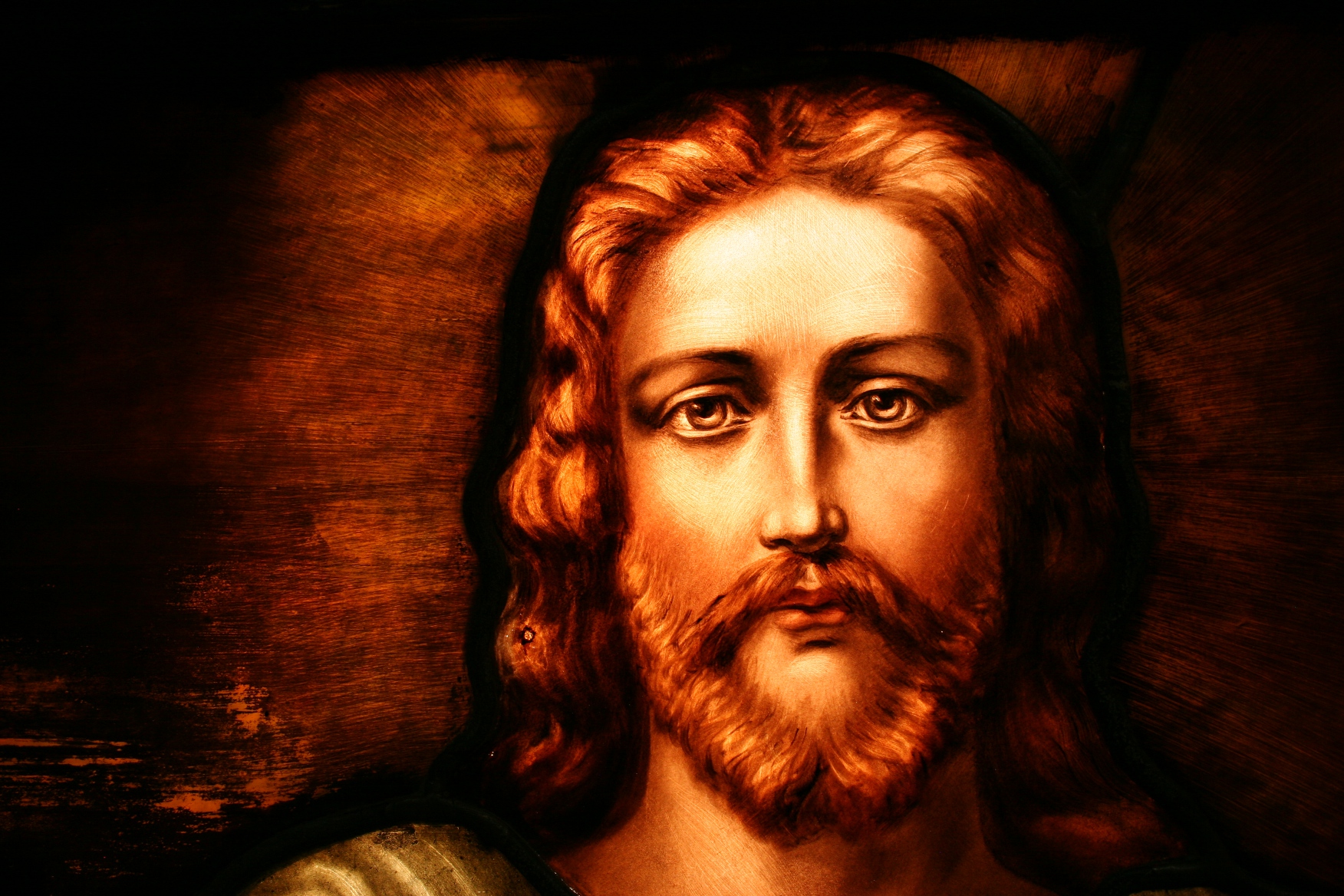
A photo of Christ’s face from a stained glass window in my church, Trinity Lutheran, Faribault. Minnesota Prairie Roots file photo 2012.
As a woman of faith, I also view this time of year through the lens of eternal hope. I see the face of Jesus. Determined. Caring. Suffering. Dying. And then living, breathing. Alive. Darkness replaced by light on Easter morning. The light of eternal life.
This Easter Sunday, just like last, I’ll miss celebrating Easter in person with my faith family. I’ll miss the feeling that comes with worshiping inside a church with other Christians. I’ll miss the scent of lilies and the reverberation of the organ. I’ll miss the blessings of being among friends, of joyful Easter greetings.
Yet, I can still view the Easter service online or listen on the radio. I can experience worship indirectly. I can praise God and pray and let the joyful music of Easter fill my ears. And my mind. Hope remains. I know that my Redeemer lives! What comfort this sweet sentence gives!
Inspirational and honoring words are embedded in the mosaic tile on a memorial for Barb Larson (murdered in an act of domestic violence) in Faribault. Minnesota Prairie Roots file photo.
TO YOU, MY DEAR READERS, I wish you a most blessed, joyful and hope-filled Easter!
Photographed at St. Mary’s Catholic Church, New Trier, MN. Minnesota Prairie Roots file photo March 2017.
ASH WEDNESDAY PASSED yesterday not without my lack of awareness of this special day in the Christian church. Rather, I experienced the day with an acute awareness rooted in a recent personal loss—the death of my father-in-law.
Now, a day after the Wednesday symbolizing death and repentance and the beginning of Lent, I am thinking of my husband’s father, his funeral and burial only one week ago.
…for dust you are and to dust you will return—Genesis 3:19.
I doubt any words can better describe the reality of death. Ashes to ashes. Dust to dust. That’s basic. Understandable. Maybe uncomfortable for some. But it’s truth. We’re all going to die, whether at age 90 like my father-in-law or age 19 like my nephew Justin in 2001. Sometimes death takes our loved ones way too soon.
Last Thursday, as we celebrated the Mass of Christian Burial for Tom and heard the priest speak those familiar words of dust to dust, grief and reality descended. Yet, as a woman of faith, hope balances that in the belief that I will see my loved ones again in heaven. Dad Helbling. Justin. My dad and grandparents and many aunts and uncles…and others I’ve had the joy of loving. For to love is to also open one’s heart to grief. And to hope.
St. Michael’s Catholic Church, Buckman, MN. Minnesota Prairie Roots file photo September 2020.
It was an unusually frigid February day in central Minnesota with the temp hovering around zero as we gathered at St. Michael’s Catholic Church in Buckman. Over the course of more than three hours, memories imprinted upon me. Memories shaped in part by a global pandemic, which affected the ways in which we could be comforted. Randy and I declined hugs and handshakes. There would be no luncheon, the time of one-on-one visits. No getting together with siblings, at least for us, either before the funeral or after.
Yet, simply being together in the same building brought comfort. Comfort came, too, in flowers and music and Scripture. Like the words of Ecclesiastes 3:1-14, read by my sister-in-law Rosie. When she read a time to embrace and a time to refrain, I thought, how fitting for a funeral during COVID-19.
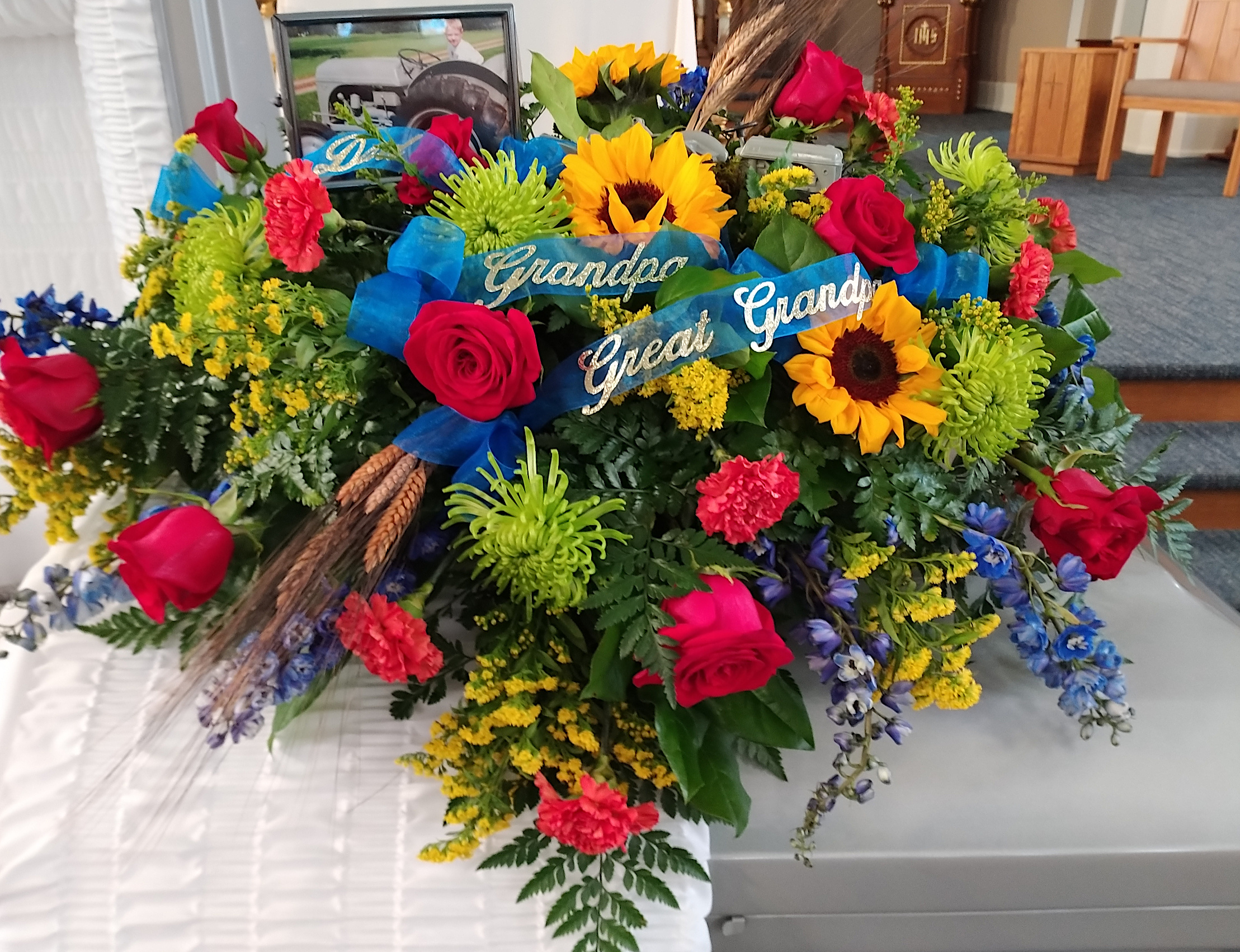
The casket spray, which incorporated a tractor photo and a toy tractor.
Images seared into my mind—like the lowering of the casket lid over my father-in-law. Or the surprise of seeing my then preschool-aged son in an image atop the casket spray. He was perched on the seat of his grandpa’s Ford 9N tractor in a photo I took decades ago.
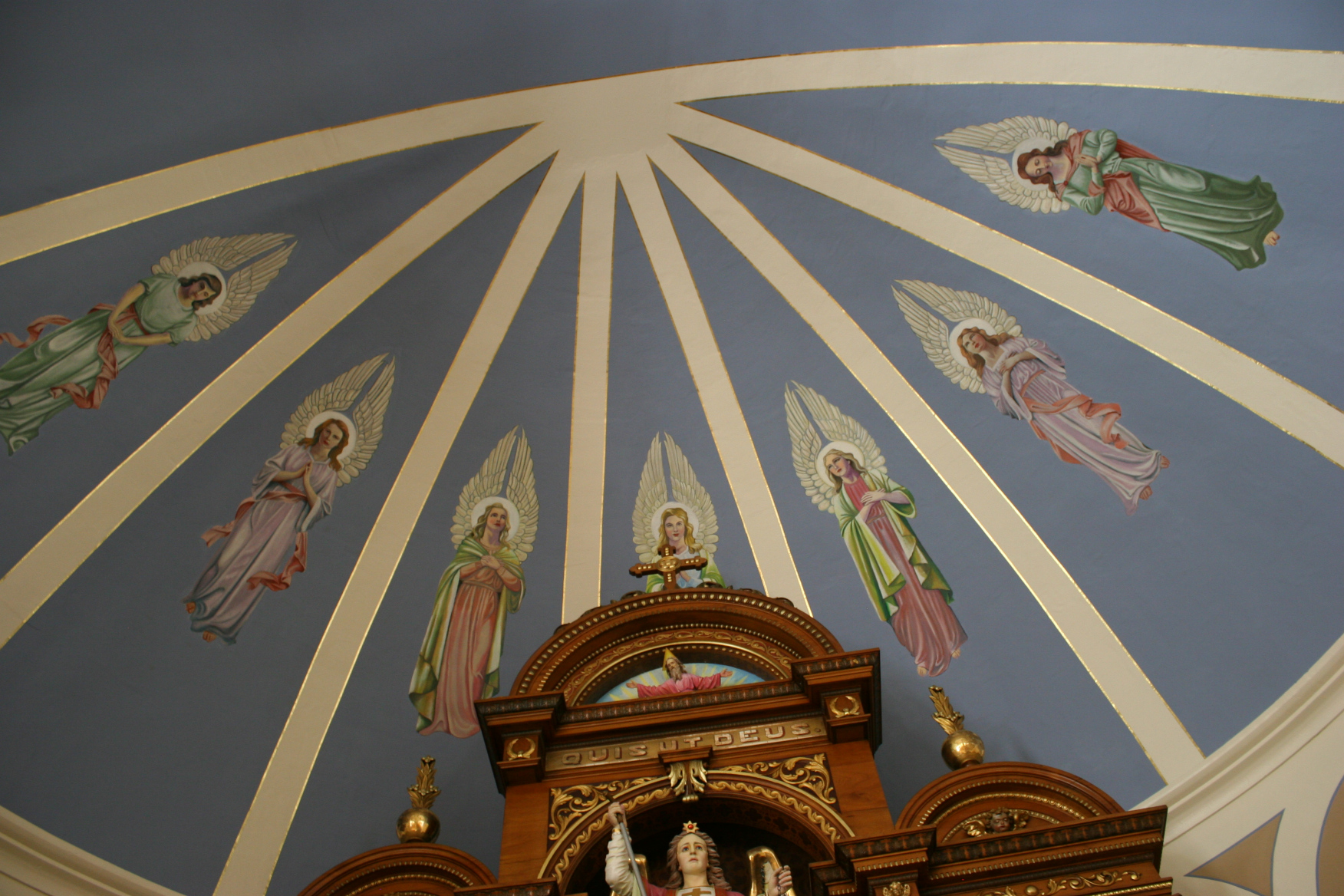
We sat in the front pew to the left. Above the altar, in the blue ceiling, are the heavenly angels that drew my focus. Minnesota Prairie Roots file photo September 2020.
Many times throughout the service—especially during the farewell chant and song of angels welcoming Dad into heaven—I focused on the heavenly angels painted on the ceiling high above the altar. What a gift the artists and craftsmen of this aged church left for mourners. Art comforts.
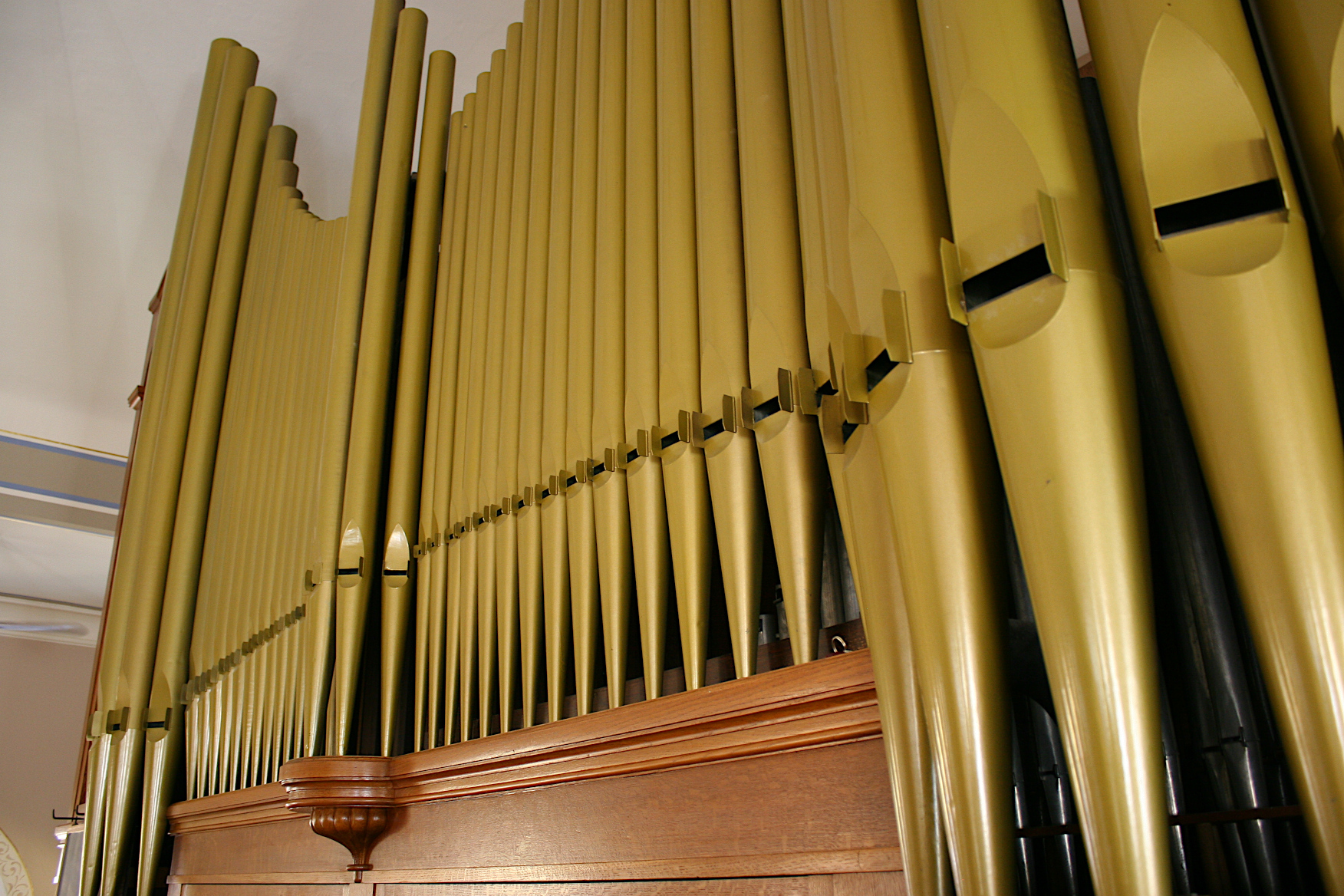
Pipes on the St. Michael’s organ. Minnesota Prairie Roots file photo September 2020.
So does music, especially music. “Joyful, Joyful, We Adore Thee” and “The Lord is My Shepherd” and “Holy God, We Praise Thy Name” and many other songs filled this massive church with the most beautiful, heavenly music performed by musicians in the balcony. St. Michael’s has incredible acoustics. Randy and I suggested to his classmate Janel prior to the service that perhaps the musical team could play a polka or waltz in honor of Dad, who so enjoyed both and who also played piano, organ and accordion (not the concertina, as the priest noted). My sister-in-law Vivian shared with me later that the hymn “Whispering Hope,” played before the casket closed, was a popular waltz at wedding dances in the area and was a favorite of her parents. I love nuances like that which personalize a funeral.
As I sat through the service next to Randy on an uncomfortably hard straight-back pew, physically-distanced from family, I determined not to cry. I didn’t want to cry into my mask. I considered how surreal this felt to experience a funeral during a global pandemic. And how surreal also to experience a funeral during Minnesota’s longest cold snap in nearly three decades.
We dressed for the weather, wearing long johns under our dress pants. Randy told me his dad wore long johns often back on the farm so this extra layer of warmth seemed another fitting tribute. Before heading to the cemetery, we slipped out of dress shoes into snow boots.
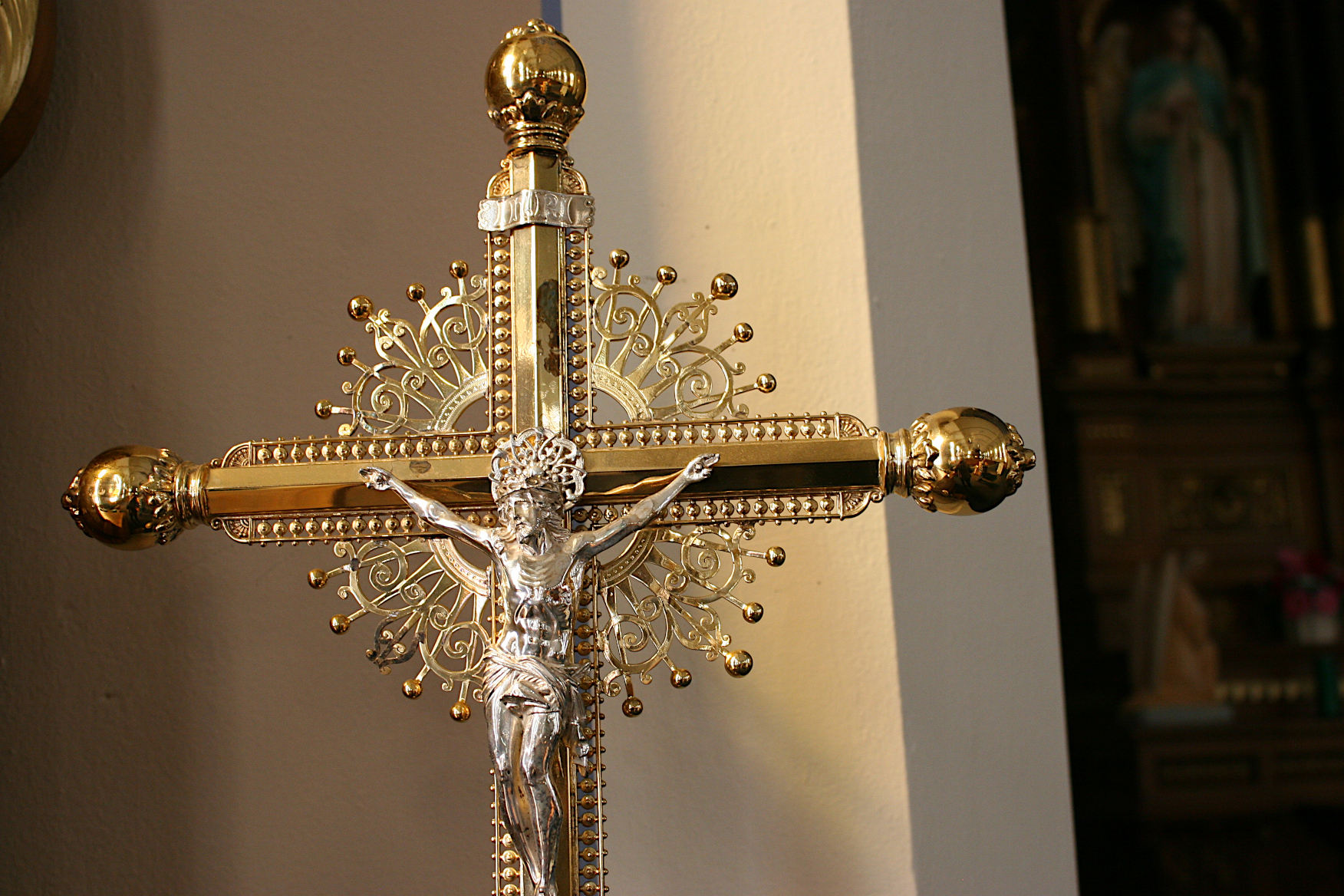
The crucifix carried to the cemetery. Minnesota Prairie Roots file photo September 2020.
And then, once grandchildren slid their grandfather’s casket into the hearse for the short drive to the cemetery, mourners followed by foot, crossing Minnesota State Highway 25. A church officiant stood half-way into the traffic lane, bundled for warmth, purple mask covering his face, holding a pole with crucifix atop as traffic waited out of respect for us to cross the road. It was a strong visual moment for me. The red pick-up truck parked curbside contrasting with mourners dressed in black. Waiting vehicles. Masks and stocking caps and bald heads (among those who chose to brave the elements minus head coverings). The priest in his, oh, so Minnesotan red buffalo plaid coat and matching ear flapper cap. An icy parking lot with occasional welcome patches of gravel. And then, the final steps across the snow to the burial site.
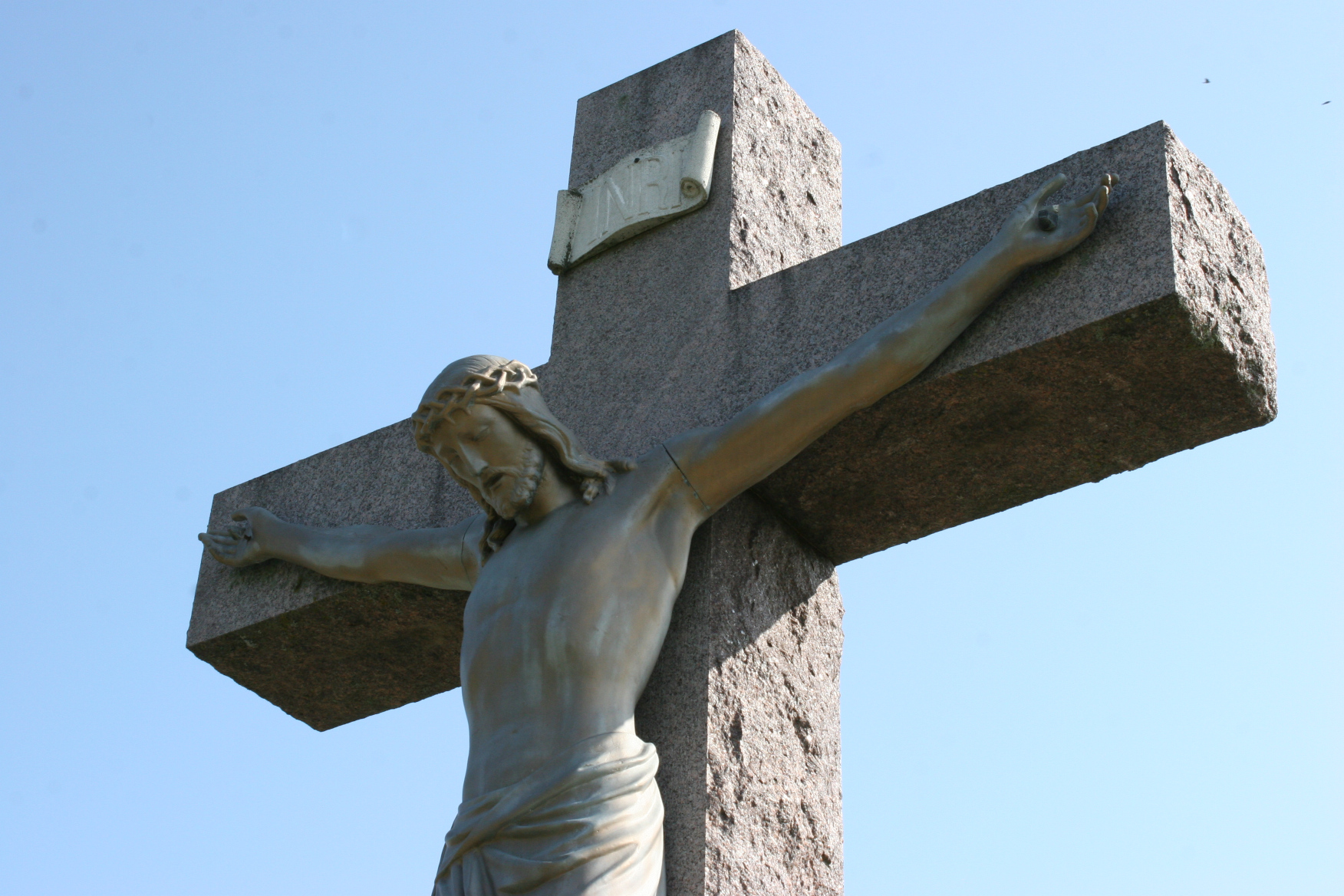
This art rises above St. Michael’s Cemetery. Minnesota Prairie Roots file photo September 2020.
As my nieces and nephews carried my father-in-law’s casket, I felt the heaviness of grief. The cold of death, balanced by the promise of eternal life. Grief and joy.
And then, in one last act of love, we each stepped up to pull flowers from the casket spray to lay upon the casket. I chose a red rose, not yet blackened by the cold, placed it on the shiny grey surface. And then, with my mittened hand, I patted the lid twice in a final farewell to my father-in-law.
Outside my husband Randy’s home church, St. Michael’s in Buckman. Minnesota Prairie Roots file photo September 2020.
FOR MANY, THE WORD “church” prompts visions of a physical structure, a place where people of faith gather to worship. Certainly, that’s part of the definition. But, even more important, “church” is the people. That’s why, in times of natural disaster or fire or whatever may render a physical building unusable, the “church” continues.
This sign marks a back pew. Minnesota Prairie Roots file photo September 2020.
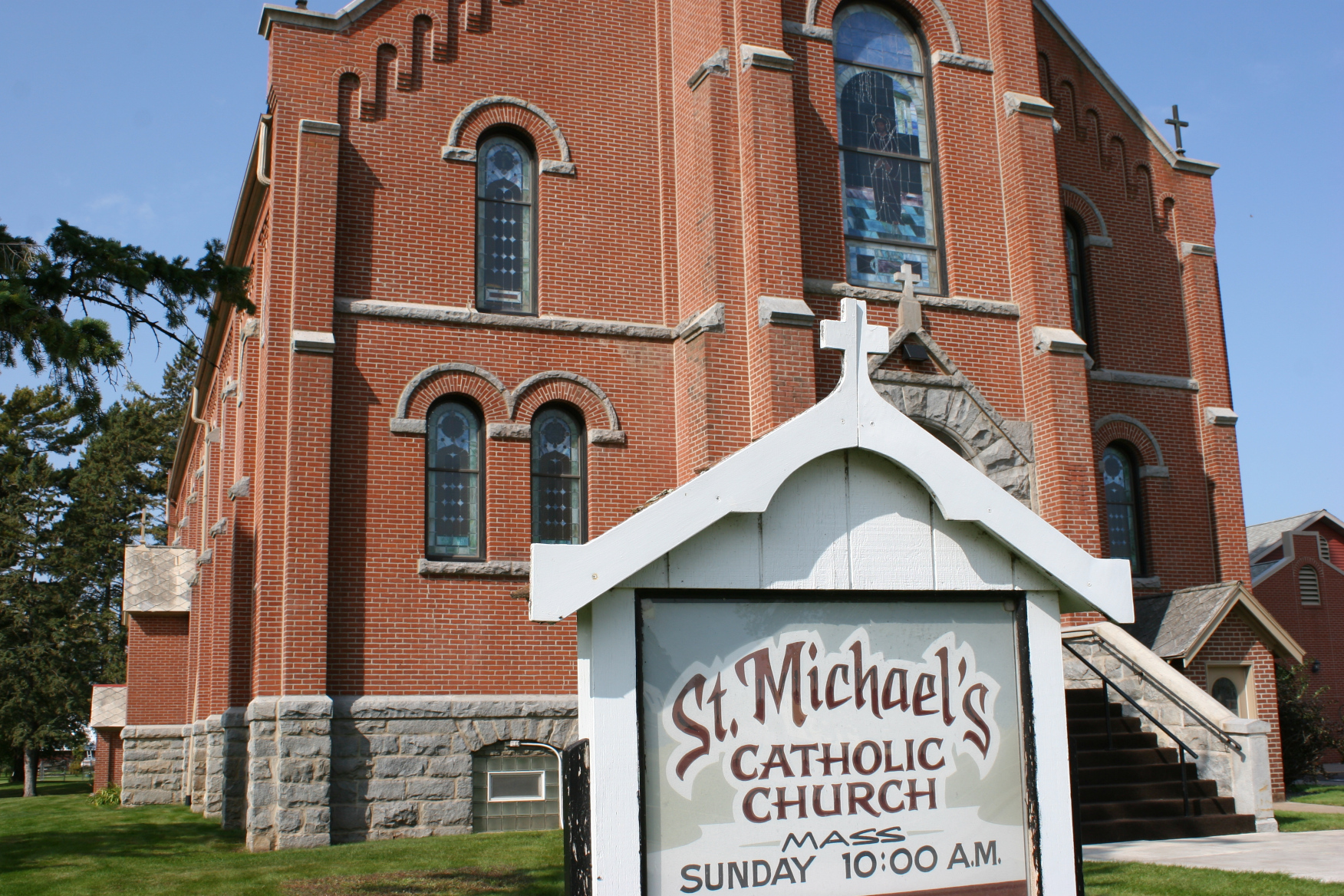
For 118 years, the faithful have gathered at St. Michael’s Catholic Church in Buckman. Even during COVID-19, Mass happens three mornings a week. On the September weekday Randy and I visited, not a soul was around, giving us ample opportunity to explore this beautiful aged sanctuary.
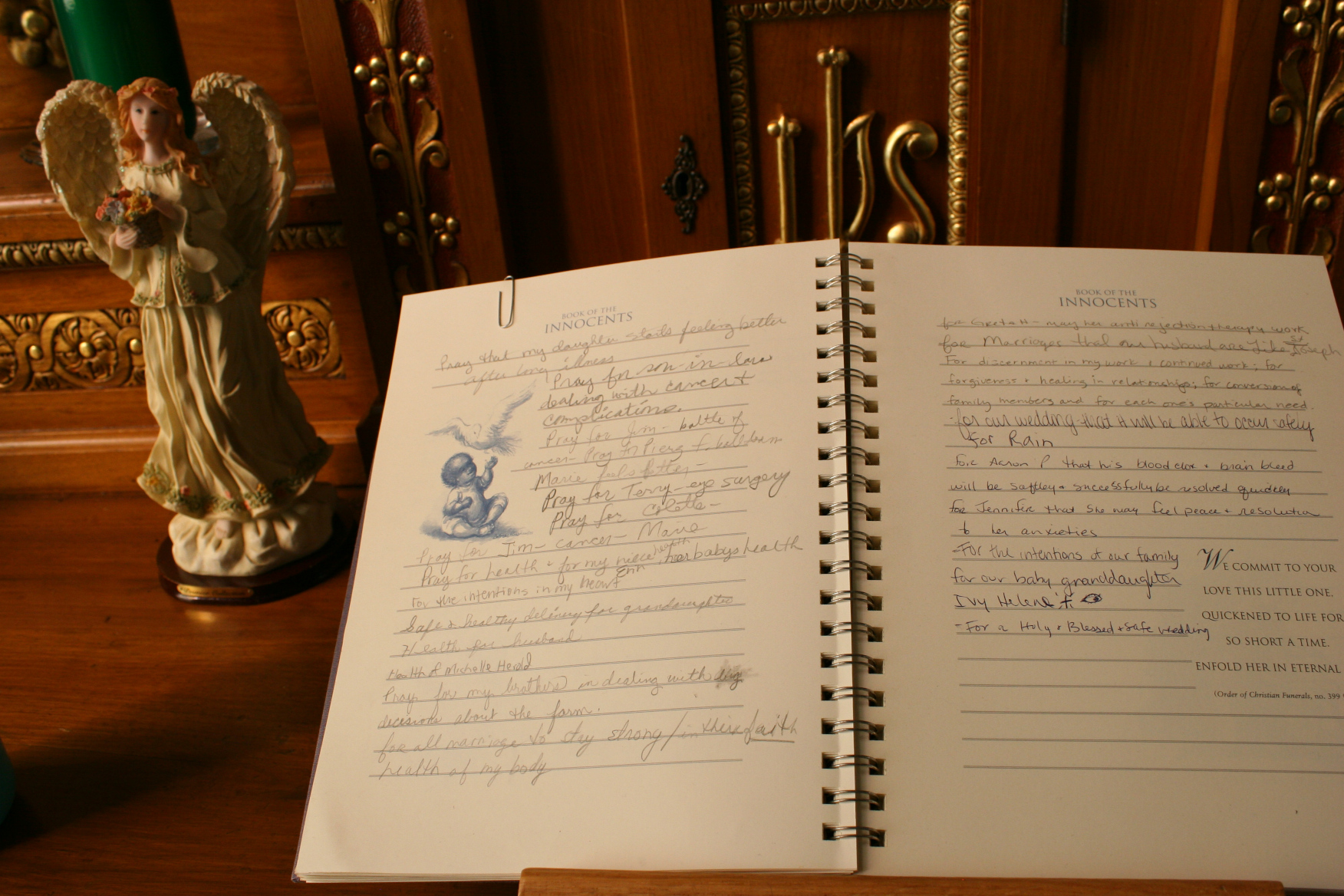
Book of the Innocents photographed at St. Michael’s. Minnesota Prairie Roots file photo September 2020.
Despite the absence of people, I experienced the presence of those who call St. Michael’s their church home. I saw the human spiritual connection in handwritten prayers recorded in The Book of Innocents.
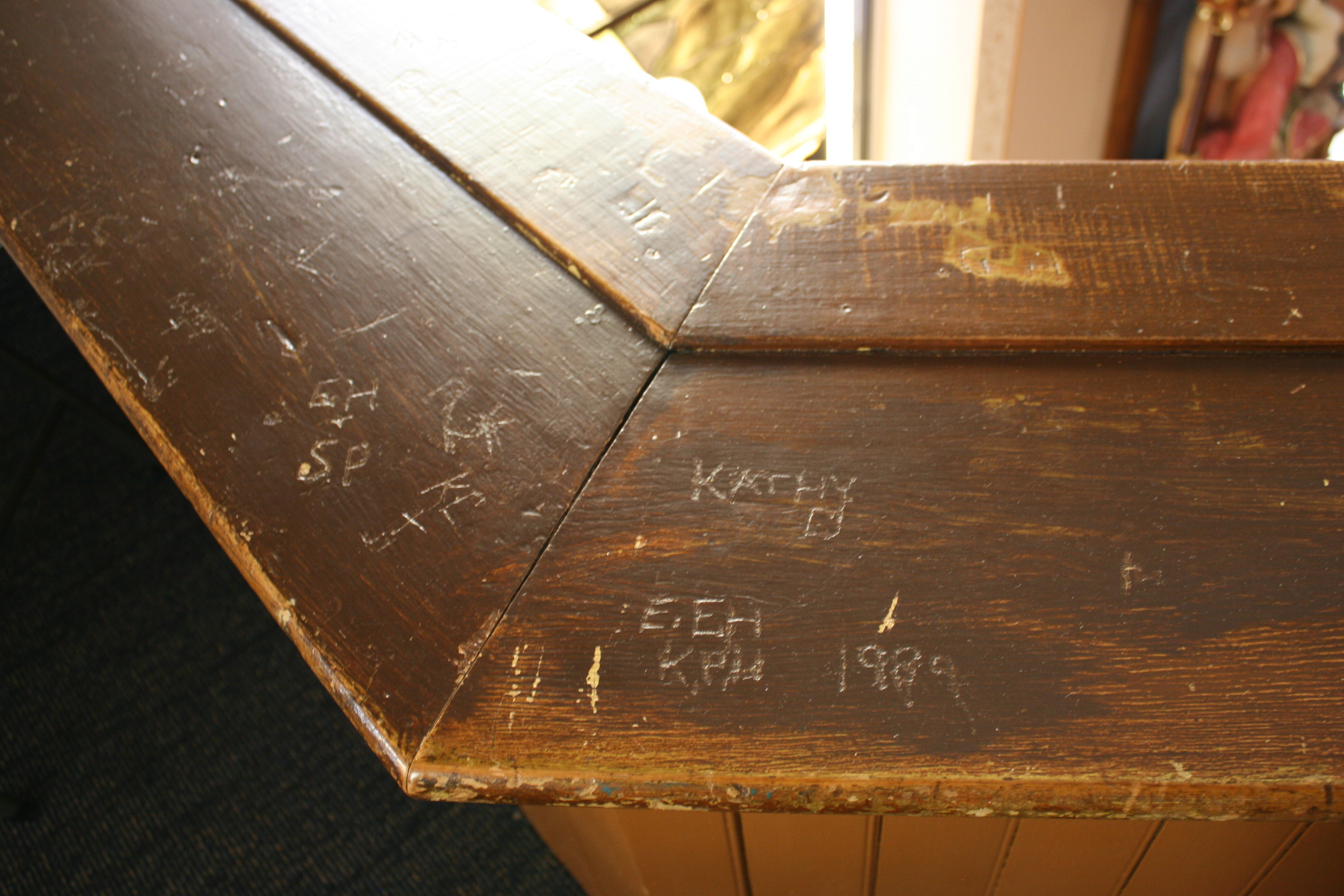
They left their mark… Minnesota Prairie Roots file photo September 2020.
Upstairs, atop the balcony wall ledge, I noticed initials, names and dates etched in wood. Another human notation, albeit probably not appreciated by all. But the scratchings are part of St. Michael’s history.
A view from the balcony. Minnesota Prairie Roots file photo September 2020.
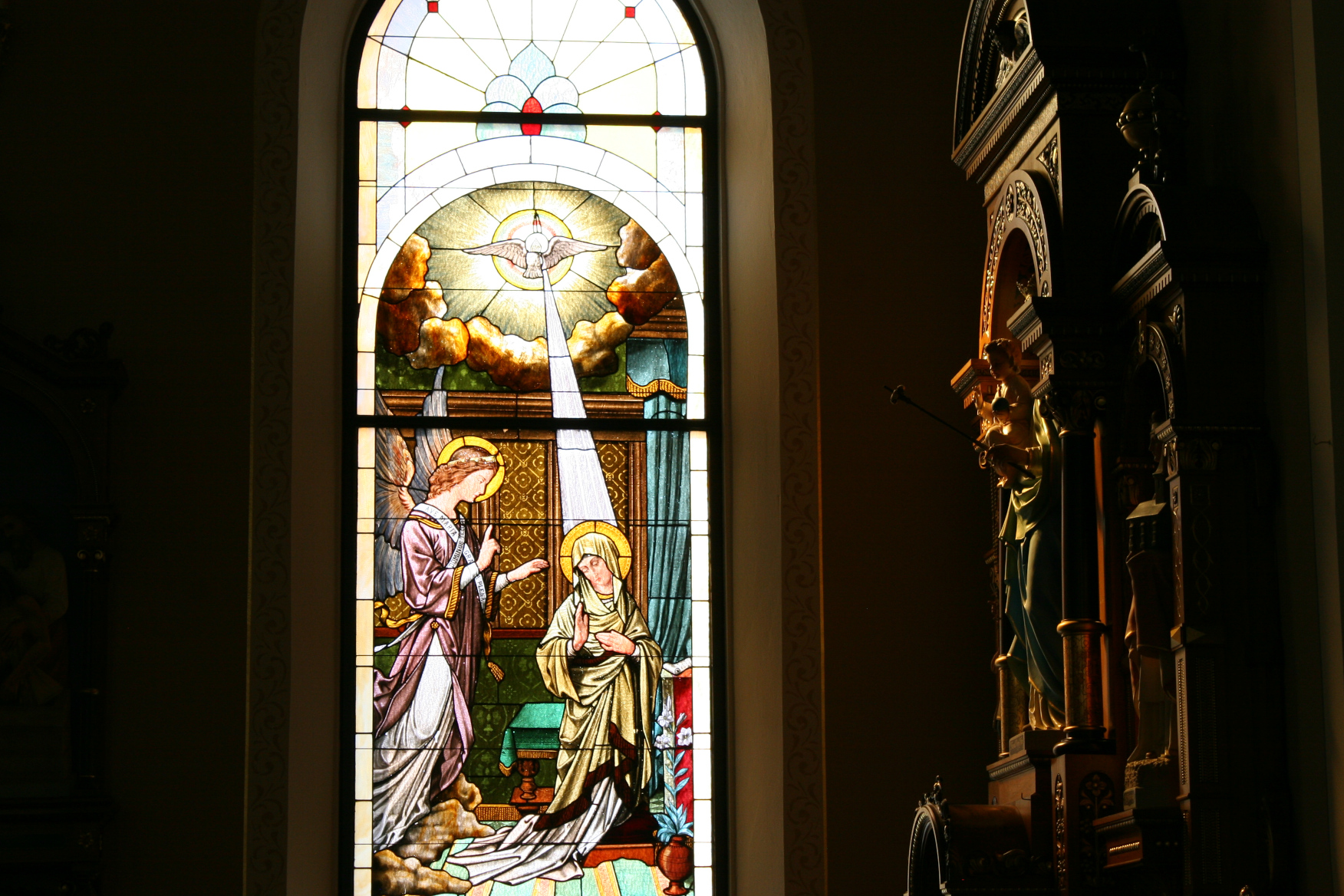
Stained glass windows abound, this one next to a side altar. Minnesota Prairie Roots file photo September 2020.
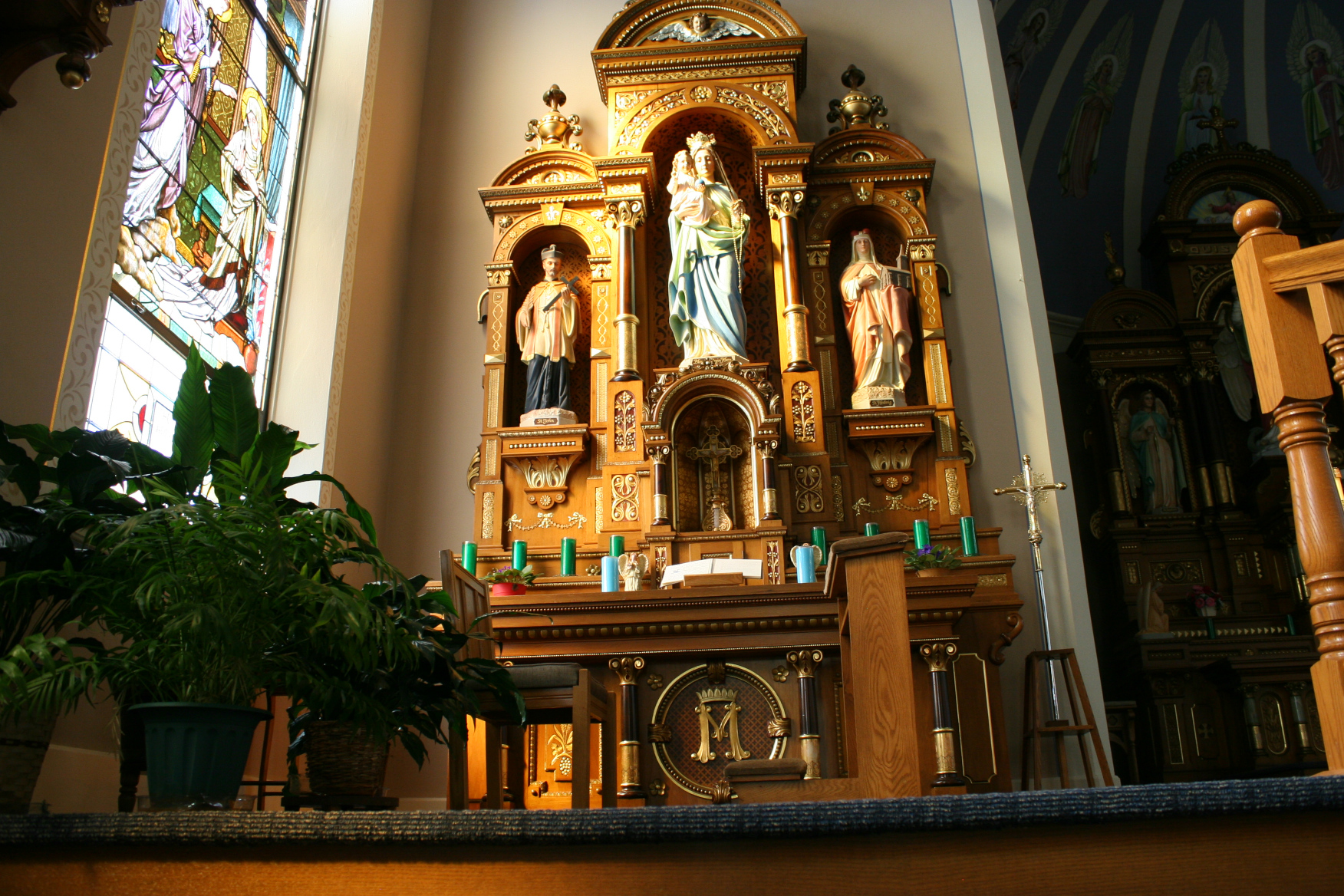
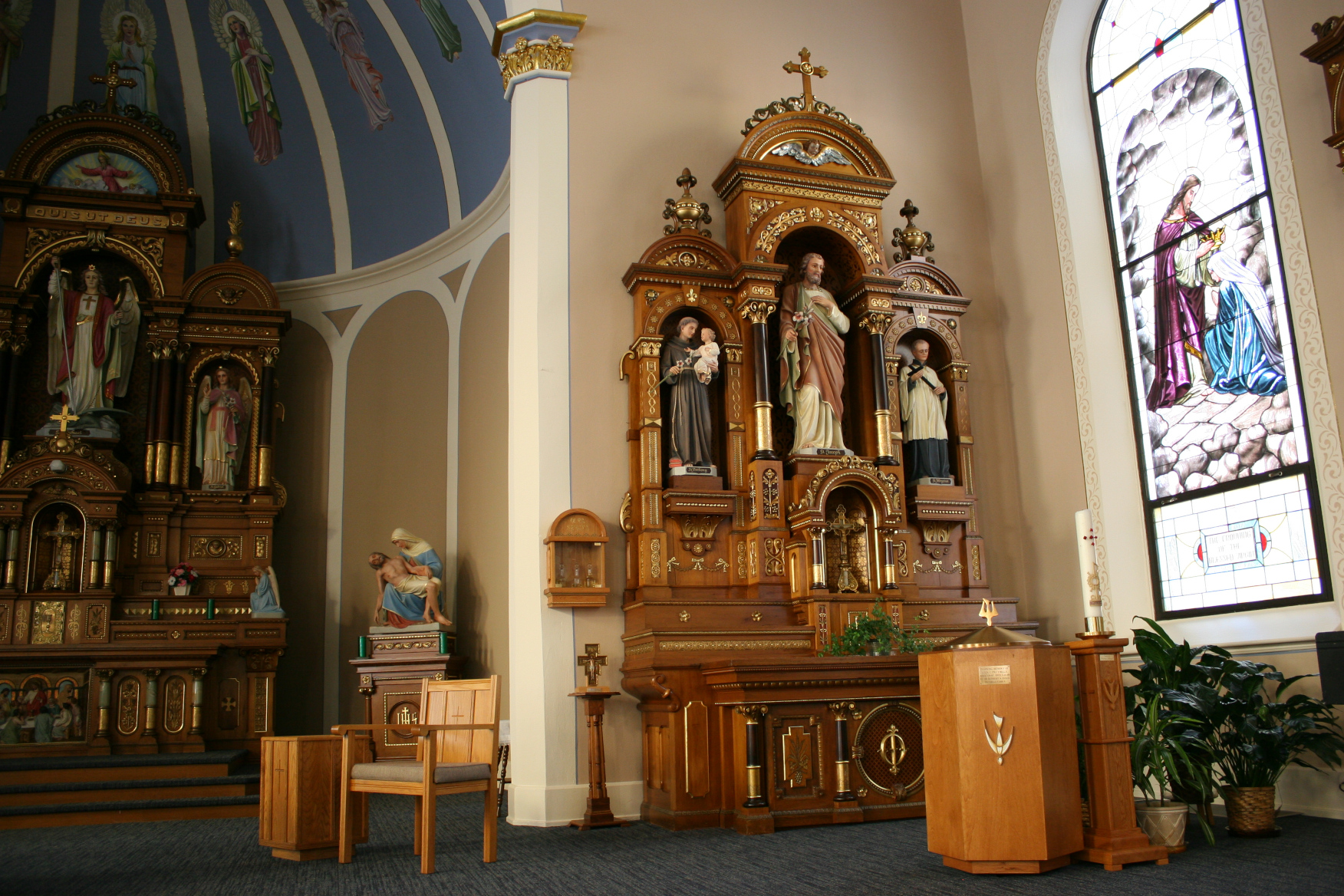
The beautiful side altar. Minnesota Prairie Roots file photo September 2020.
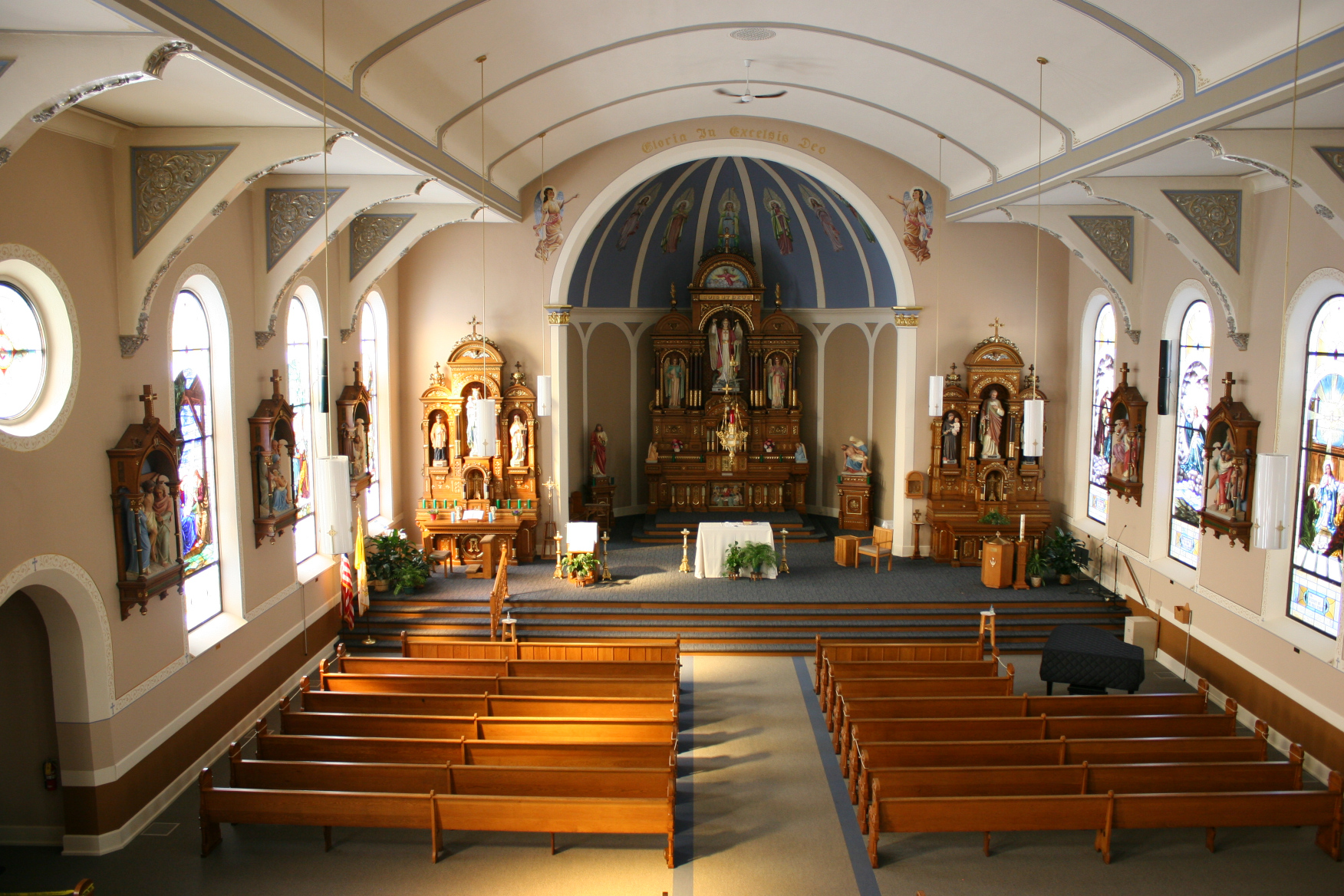
As I looked down upon the massive sanctuary defined by stained glass, sculptures, woodcarvings, paintings and other impressive art, I considered the humanity of this place. Baptisms. First Communions. Weddings. Funerals. Events—joyful and sad—which brought/bring people together to celebrate or to mourn. Mass, too, with singing and praying and forgiving and worshiping and growing in faith.
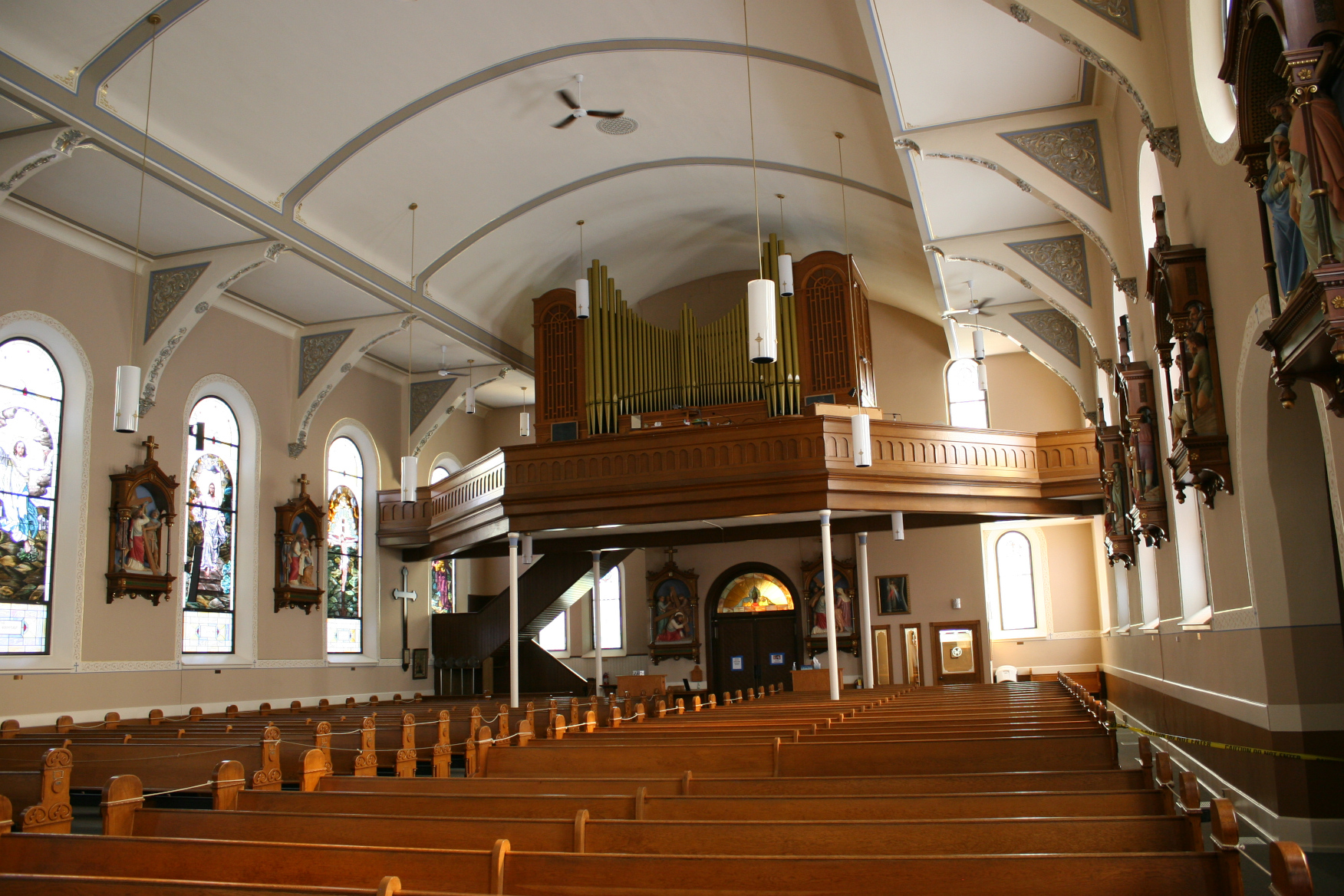
Looking toward the back of the church and the balcony. Minnesota Prairie Roots file photo September 2020.
Generations have gathered here, within these walls, as a faith family.
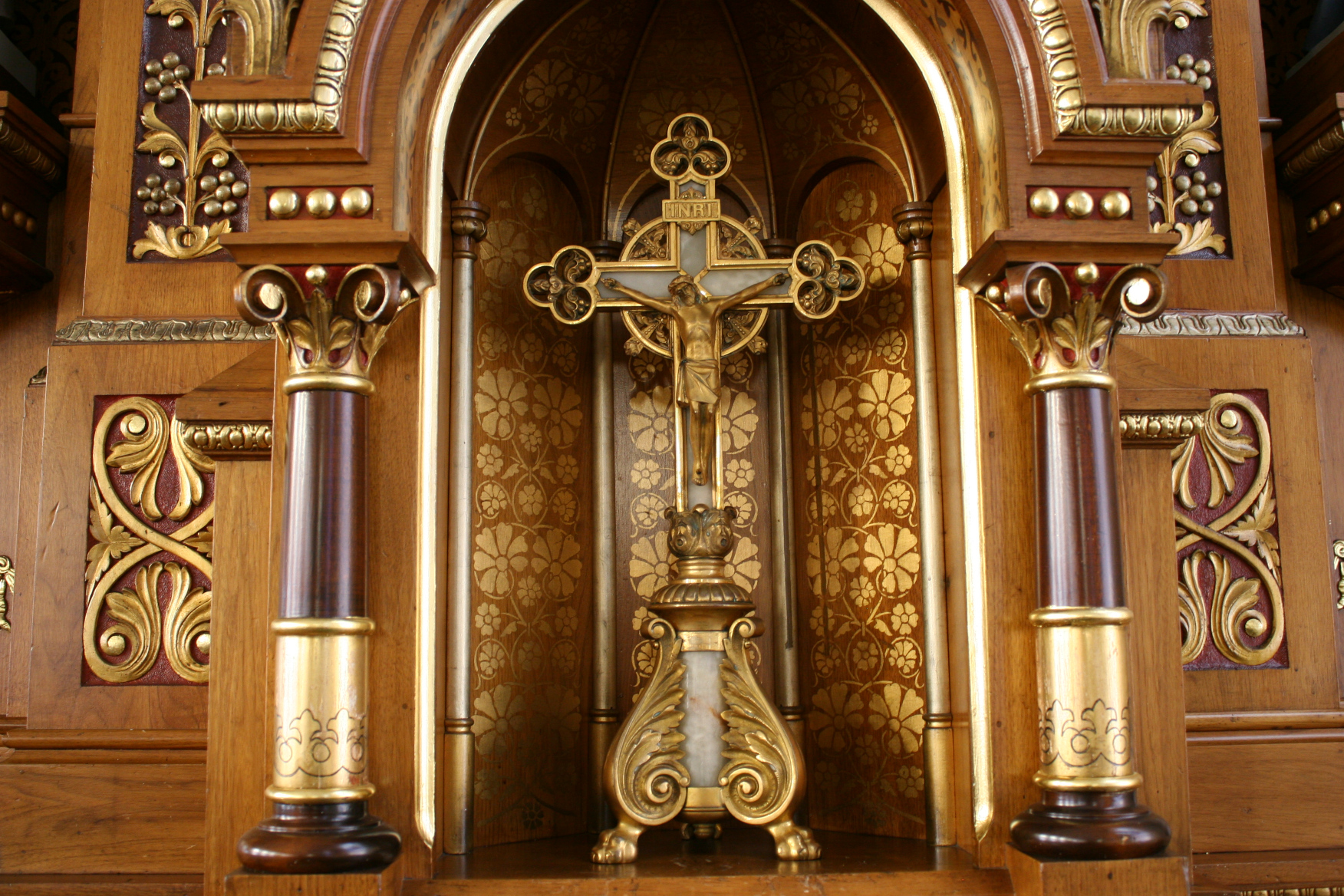
This stunning cross stands in the center of the main altar. Minnesota Prairie Roots file photo September 2020.
I’ve found comfort and joy here, too, celebrating the marriage of my father-in-law and a sister-in-law and grieving the loss of a brother-in-law and then my mother-in-law 27 years ago. Since then, the church has been restored and a side entry and fellowship hall added, making the building much more accessible.
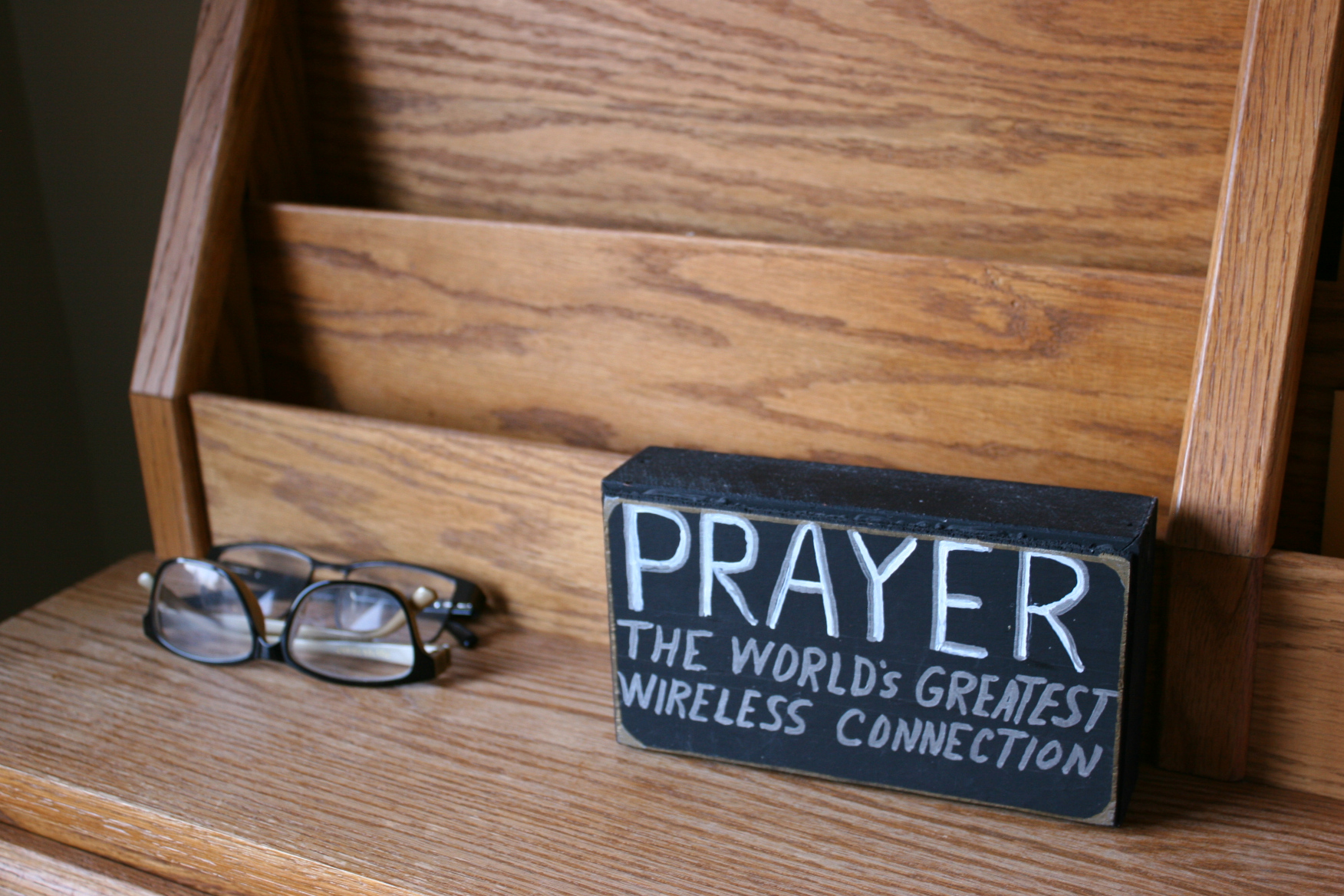
Spotted on a table in the entry. Minnesota Prairie Roots file photo September 2020.
In the new entry, I paused to read a small sign: PRAYER THE WORLD’S GREATEST WIRELESS CONNECTION. I laughed and thought, so true while simultaneously considering how much the world has changed since the construction of this church in 1903.
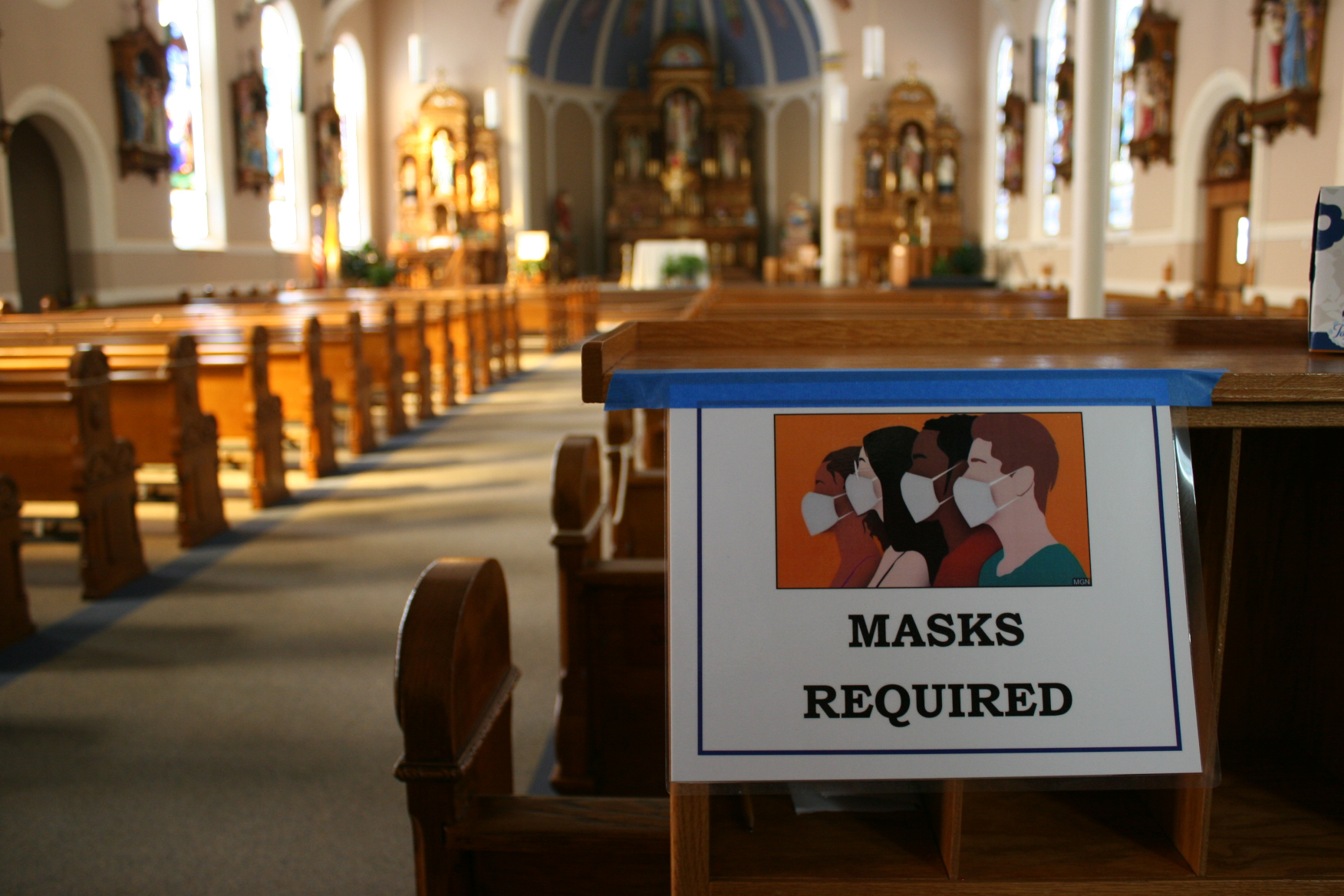
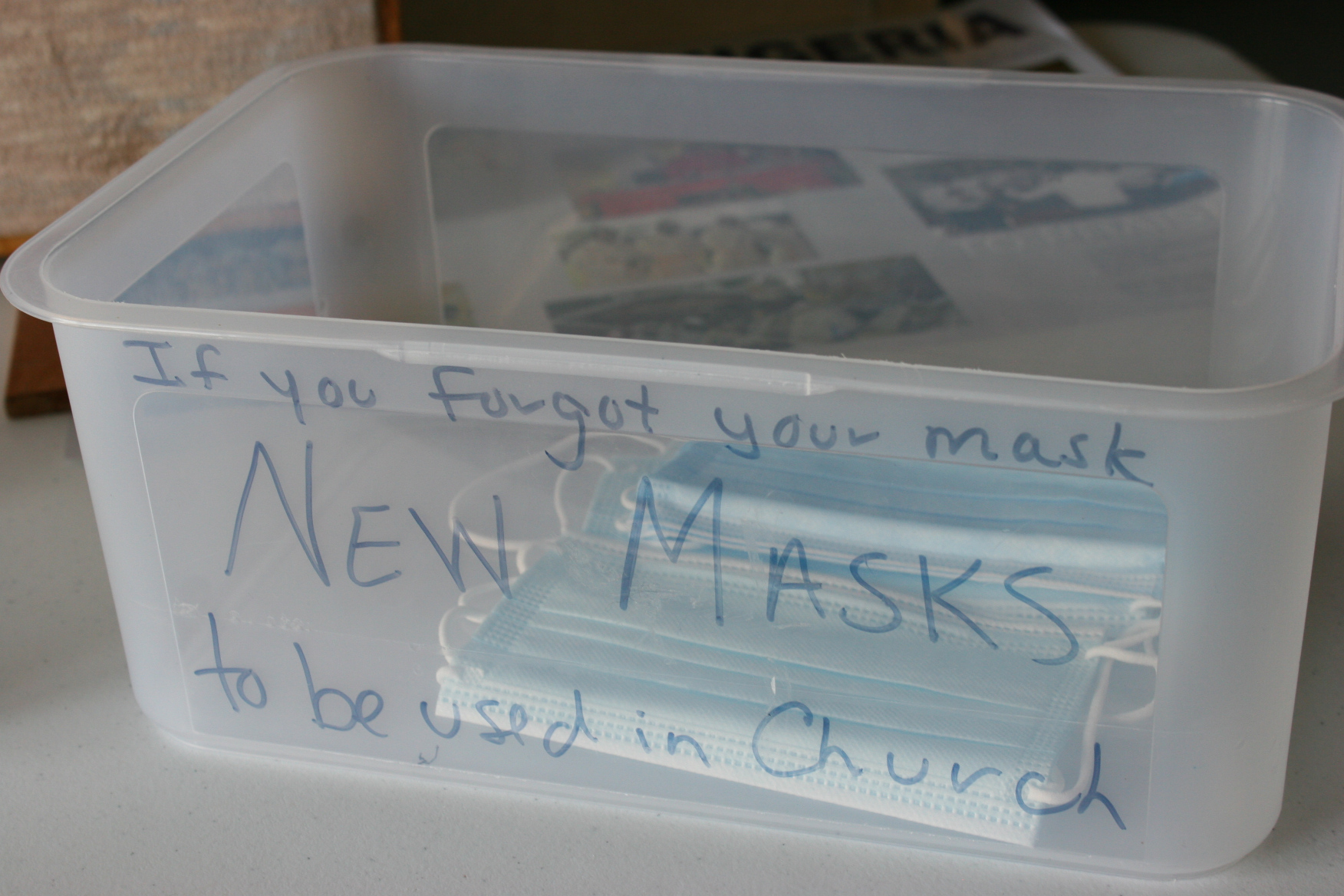
Masks are available for worshipers inside the entry. Minnesota Prairie Roots file photo September 2020.
Yet, little has changed. People still define St. Michael’s. They gather here—as they have for generations—within this art rich sanctuary, embracing liturgy steeped in music and tradition, to worship God. And to connect, heart-to-heart, with one another and with their Savior. Even during a global pandemic.
This is the final post in my three-part series on St. Michael’s Catholic Church, Buckman, Minnesota.
St. Michael’s Catholic Church in Buckman. Minnesota Prairie Roots file photo September 2020.
WHEN I STEP INSIDE A CHURCH like St. Michael’s Catholic Church in Buckman in central Minnesota, I feel overwhelmed by the sheer artistic beauty and craftsmanship. I wonder about those who built this massive church in 1903, dedicating it on September 29, St. Michael’s Day. How did they manage to build this 118 years ago without modern equipment? That amazes me.
Looking toward the front of St. Michael’s. Minnesota Prairie Roots file photo September 2020.
Beyond the actual structure, which surely took much muscle, many manpower hours and grit to complete, I wonder about the artists behind the artwork inside. Who crafted the stained glass windows? Who built the altars? Who shaped the statues and painted the angels and built the pews?
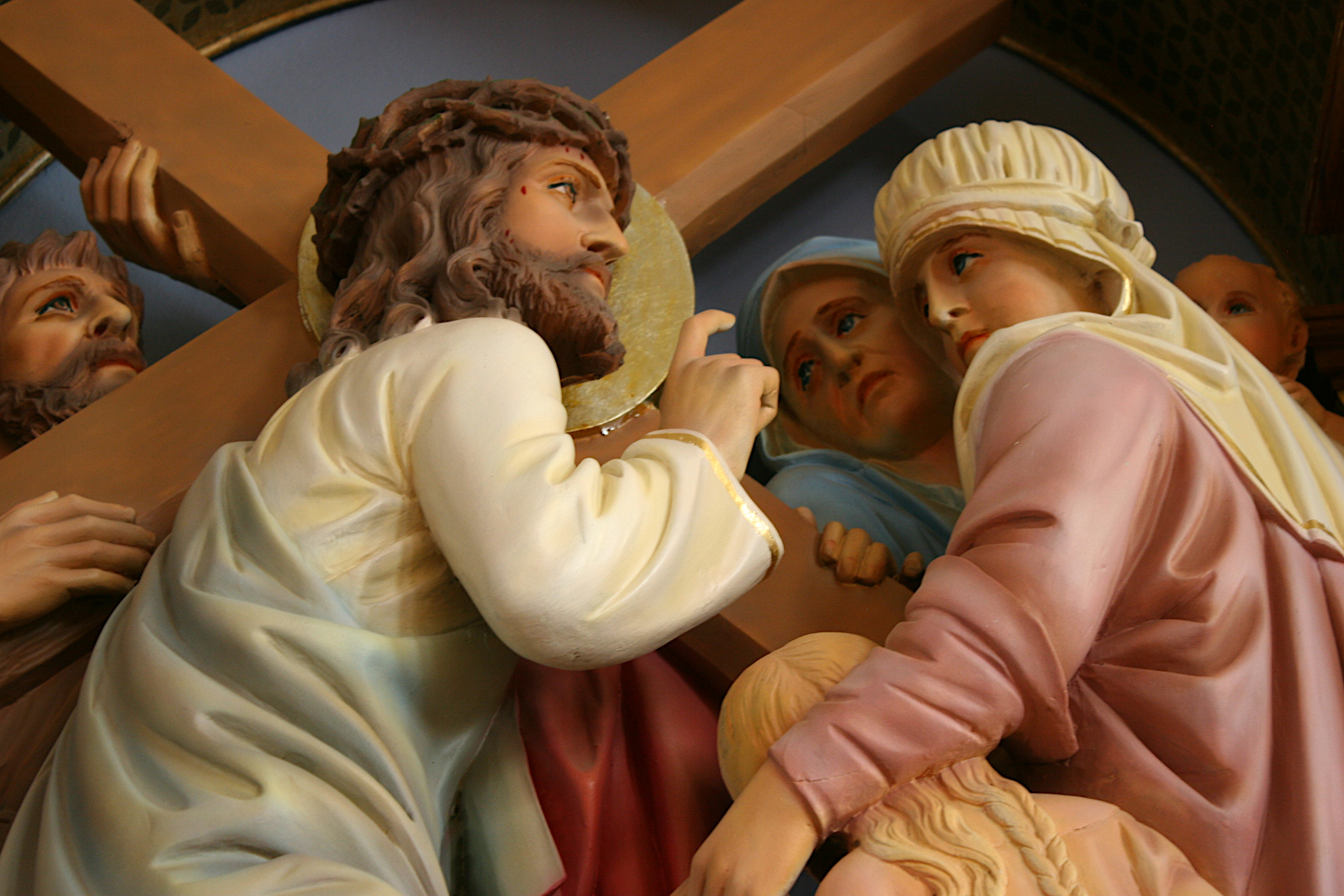
A stained glass depiction of Jesus carrying his cross. Minnesota Prairie Roots file photo September 2020.
One of the side altars, right, at St. Michael’s. Minnesota Prairie Roots file photo September 2020.
The Nativity represented in stained glass, left. Minnesota Prairie Roots file photo September 2020.
I am grateful to those faith-focused artists and craftsman who created such beauty here in the middle of Minnesota. A place for farm families (mostly) to gather for Mass. To praise God. To confess their sins. To press their hearts in prayer. To mourn. To celebrate. To grow deeper in their faith.
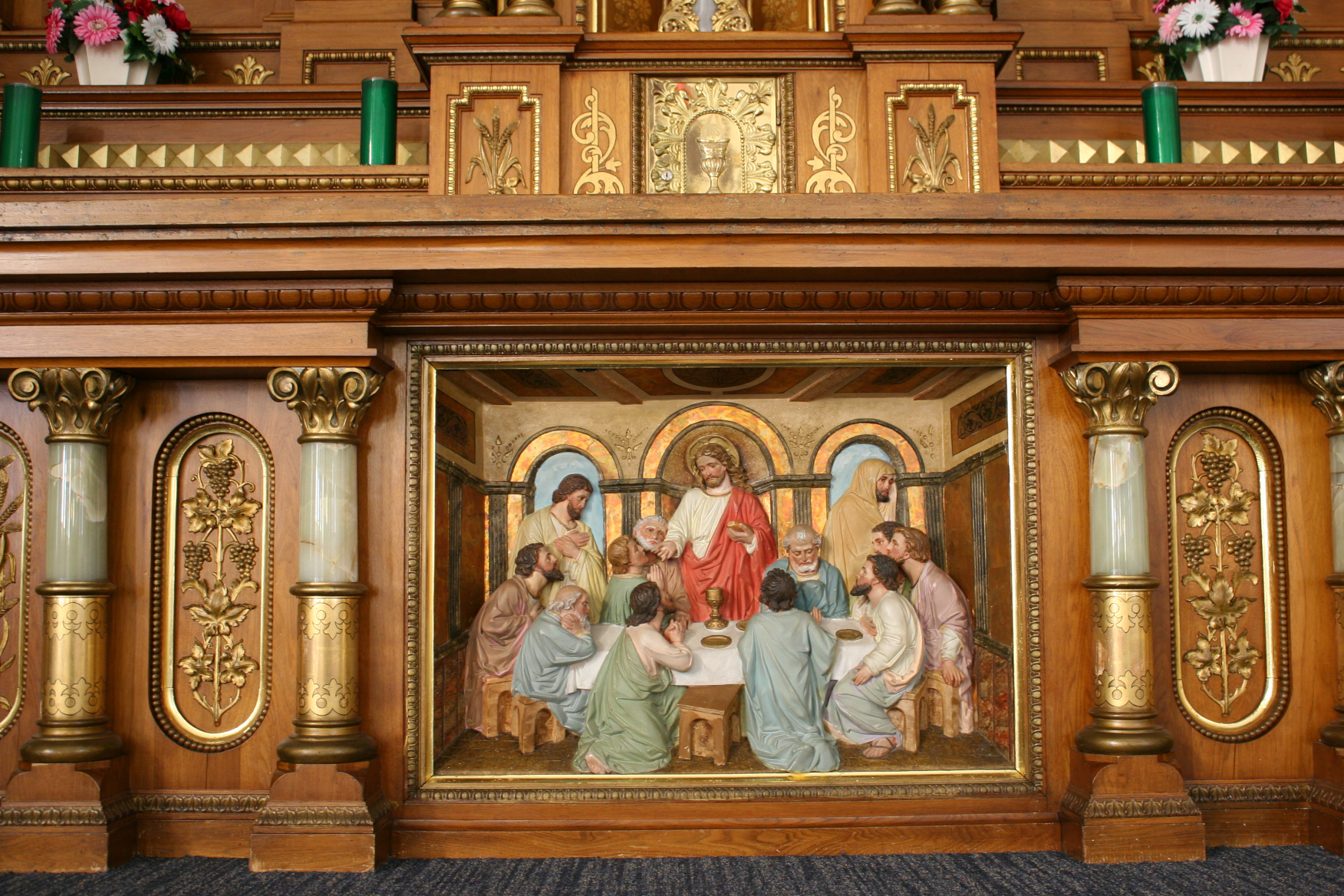
The Last Supper is depicted on the lower part of the main altar. Simply stunning. Minnesota Prairie Roots file photo September 2020.
The Helbling family made St. Michael’s their church home upon relocating to Minnesota from North Dakota in 1963. My husband, Randy, and his siblings attended elementary school across the street. That school, next to the cemetery, is long gone. My mother-in-law and a brother-in-law are buried here, across Minnesota Highway 25 from the church. So, by marriage, St. Michael’s is now part of my history.
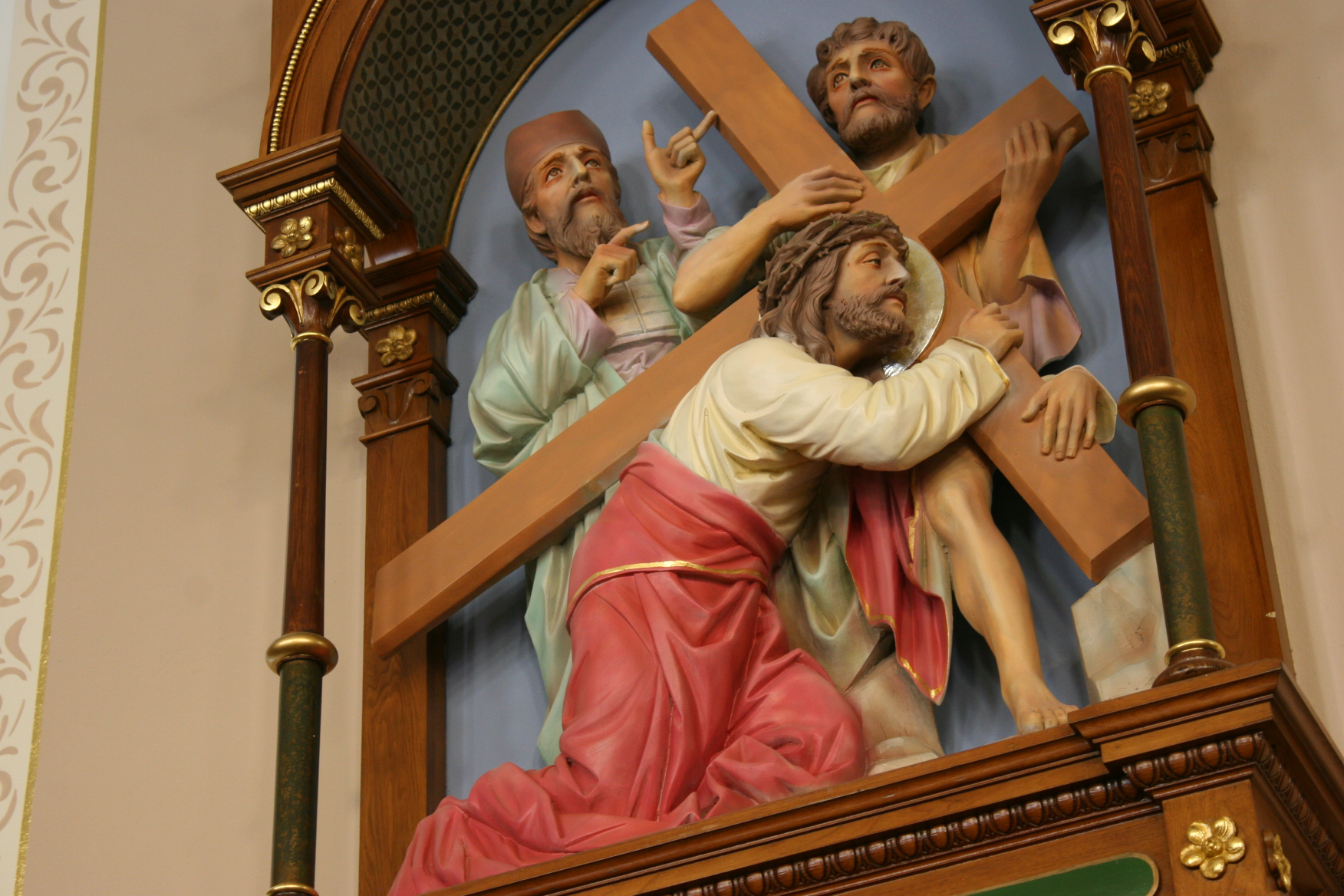
Just look at the emotions sculpted into this art. I see peace, pain, determination… Minnesota Prairie Roots file photo September 2020.
Certainly, I don’t hold the deep emotional connection that comes from years of worshiping within the walls of this rural Minnesota church. But I still hold a deep appreciation for this place which was such a valued part of my in-laws’ lives.
Stained glass windows and sculptures adorn the side walls of St. Michael’s. Minnesota Prairie Roots file photo September 2020.
As a woman of faith—I grew up Lutheran—I value aged churches and art. Religious art is often symbolic, reinforcing Bible truths and stories. It can uplift, comfort, provide peace, bring joy, remind us of our weaknesses and the source of strength and hope. It can center and ground us when we most need to feel centered and grounded.
Massive pipes on the pipe organ in the St. Michael’s balcony. Minnesota Prairie Roots file photo September 2020.
Many times, church art has reinforced my faith, helped me to feel the presence and closeness of God whether in a stained glass window, the words of a familiar hymn or the comfort of a worn wooden pew.
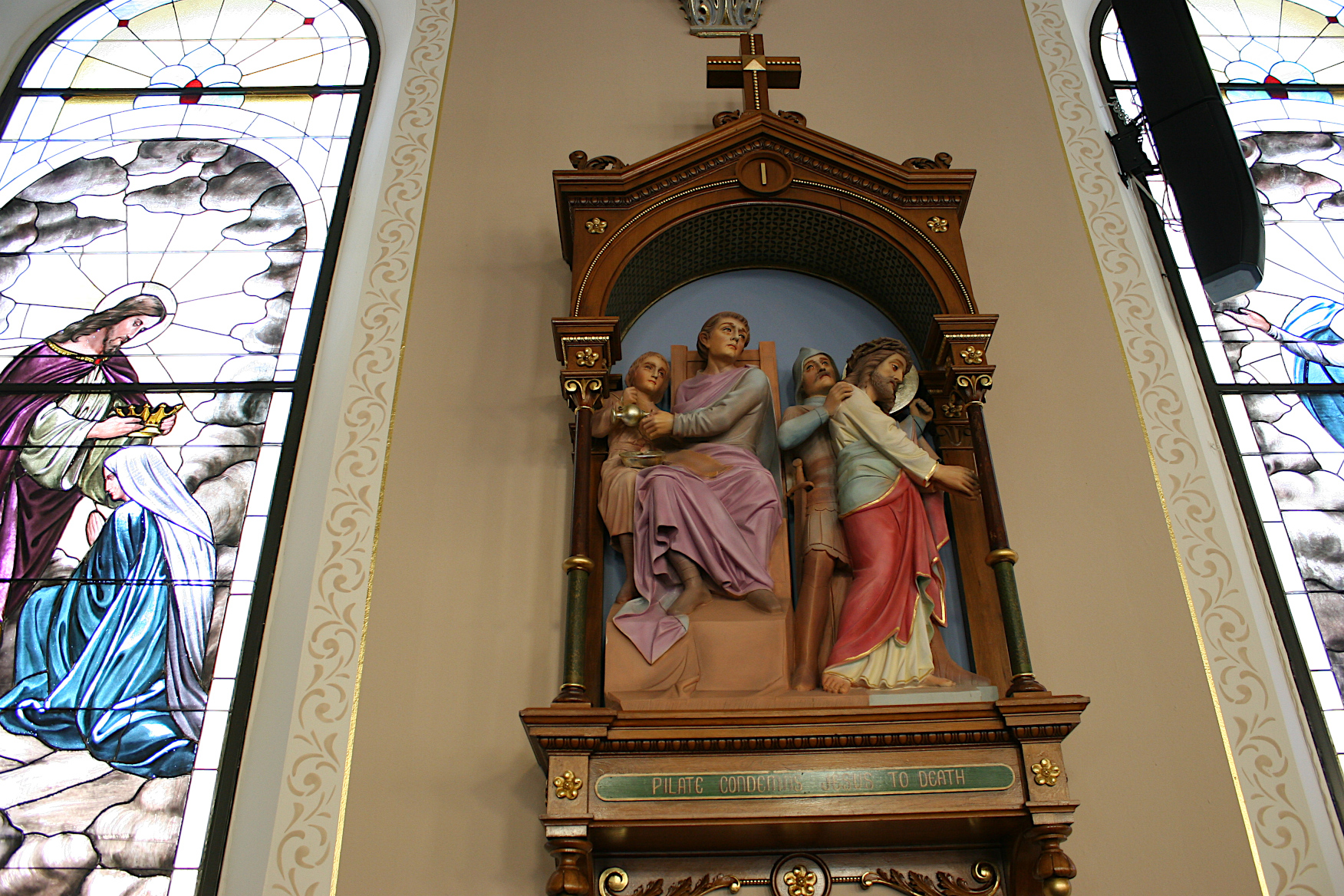
“Pilate condemns Jesus to death” sculpture between two stained glass windows. Minnesota Prairie Roots file photo September 2020.
Inside St. Michael’s, generations of families have gathered. I am grateful for those early settlers who labored to create this sanctuary in the small town of Buckman, Minnesota.
Please check back as I take you inside St. Michael’s for the final post in this three-part series.
IMAGINE, AS A YOUNG BOY, moving nearly 400 miles across the plains of North Dakota east to Minnesota with your family to start a new life. You’ve left behind your grandparents and other extended family, and the comforting familiarity of farm home, church and school. For my husband, that was reality.
St. Michael’s Catholic Church in Buckman. Minnesota Prairie Roots file photo September 2020.
As the Tom and Betty Helbling family settled onto a farm southeast of Buckman in central Minnesota in the early 1960s, Randy found himself adjusting from a one-room country schoolhouse with one teacher to a parochial school with multiple classrooms and teachers. He no longer faced cancellation of recess due to coyotes circling the playground at Chimney Butte School near St. Anthony. Rather, he faced nuns slapping his hands with a ruler or drilling thumbs into his skull, adding to his angst as the new boy in school. And then there was the matter of the frightening statue across the street inside the massive St. Michael’s Catholic Church.
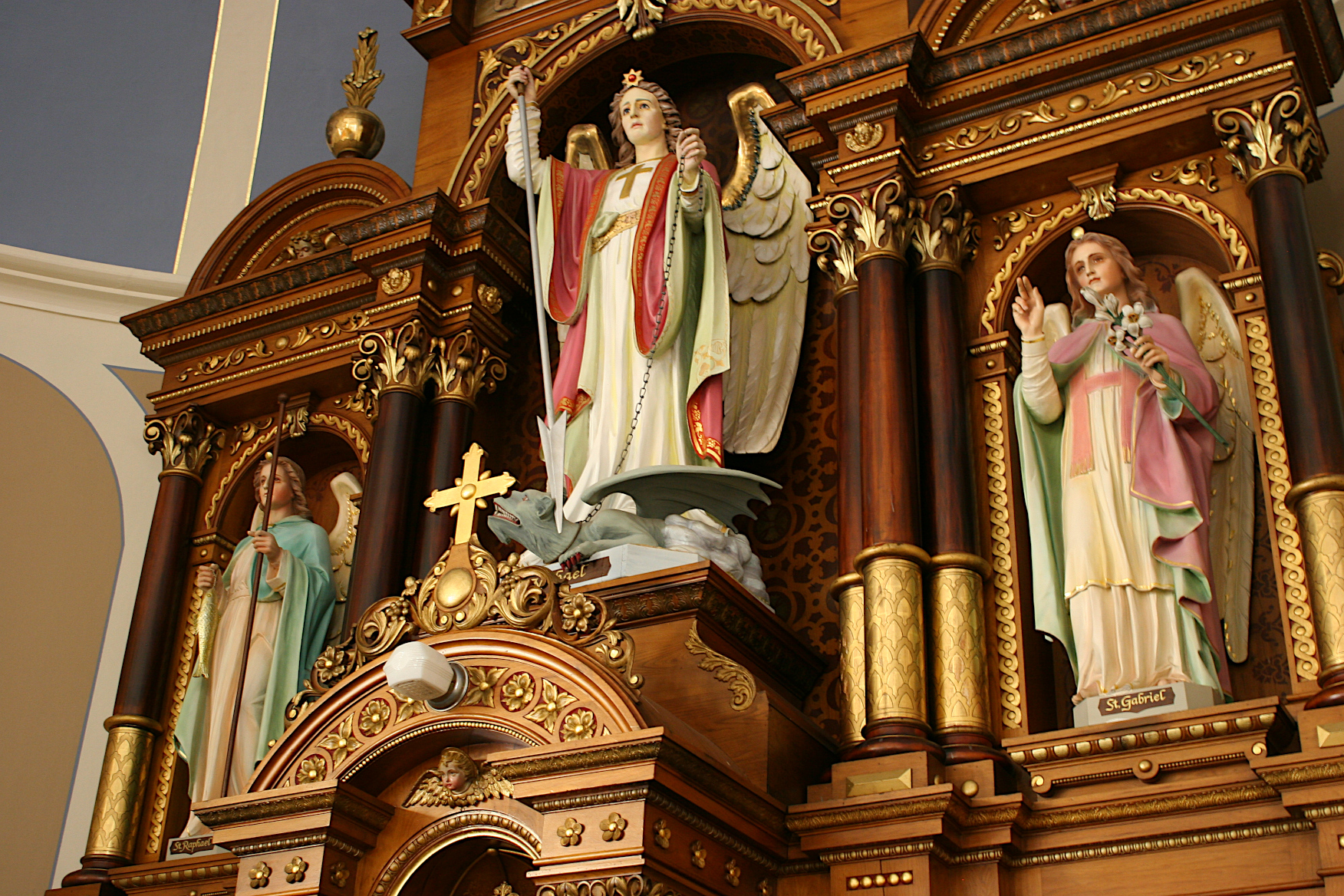
In the center, St. Michael overpowering Satan. Minnesota Prairie Roots file photo September 2020.
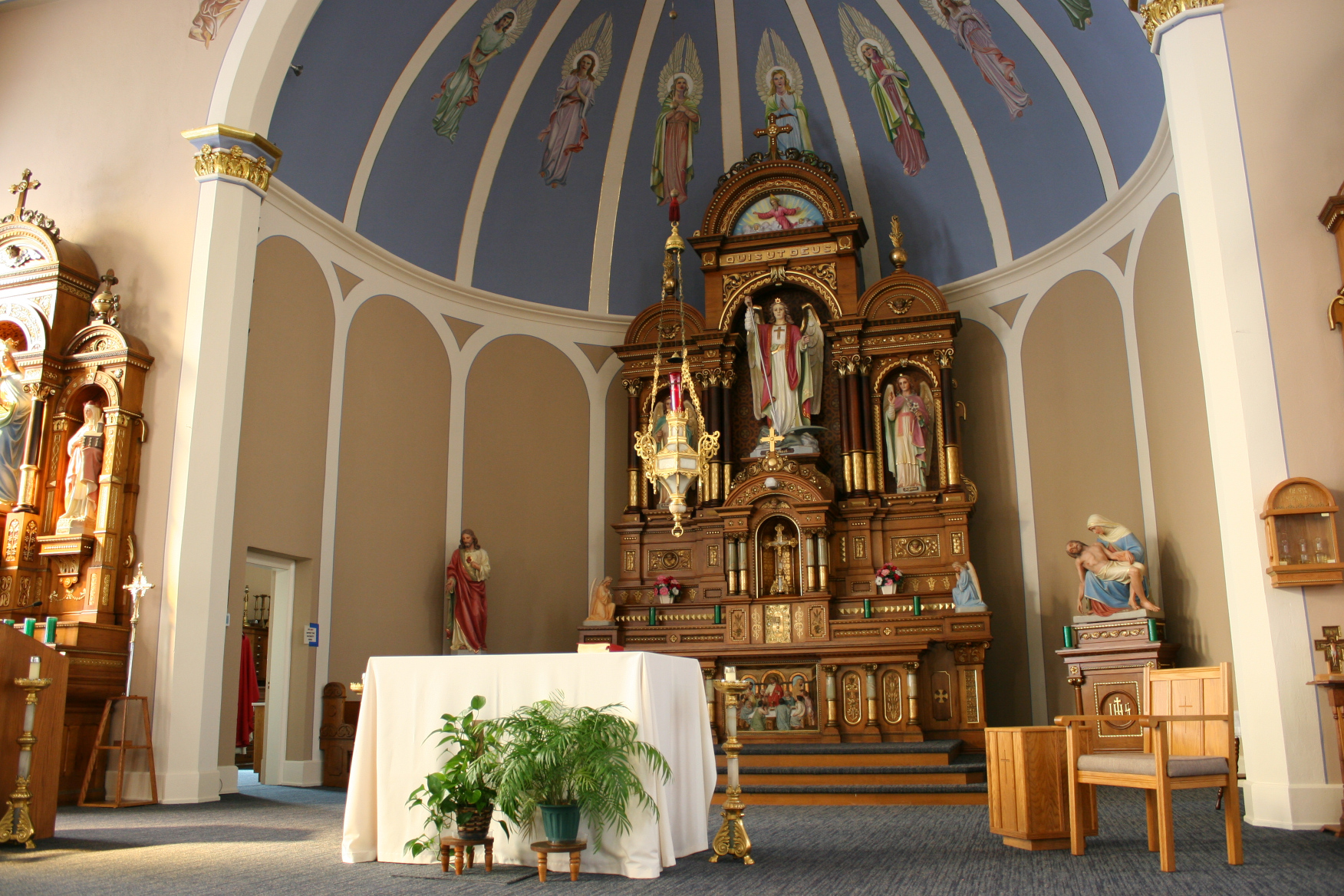
Some six months ago, I heard for the first time about Randy’s boyhood fear of the statue which centers the main altar at St. Michael’s, where he attended weekday and Sunday Mass. The statue features a triumphant St. Michael overpowering Satan with a spear. A horrid, crouching other-worldly creature with an open mouth of sharp teeth and equally sharp claws represents Satan. Enough to scare any child looking over adult heads to that altar art. Not even the chain and weapon would be enough to inspire confidence in the Evil One’s captivity.
St. Michael’s stretches long and high. Minnesota Prairie Roots file photo September 2020.
All of that aside, St. Michael’s is a truly beautiful church. Massive in size and vast in art. I’ve come to know it only through marriage as I grew up 145 miles to the south of Buckman and in the Lutheran faith.
“The Nativity” stained glass, one of many similar windows inside St. Michael’s. Minnesota Prairie Roots file photo September 2020.
A stunningly beautiful cross, one of many. Minnesota Prairie Roots file photo September 2020.
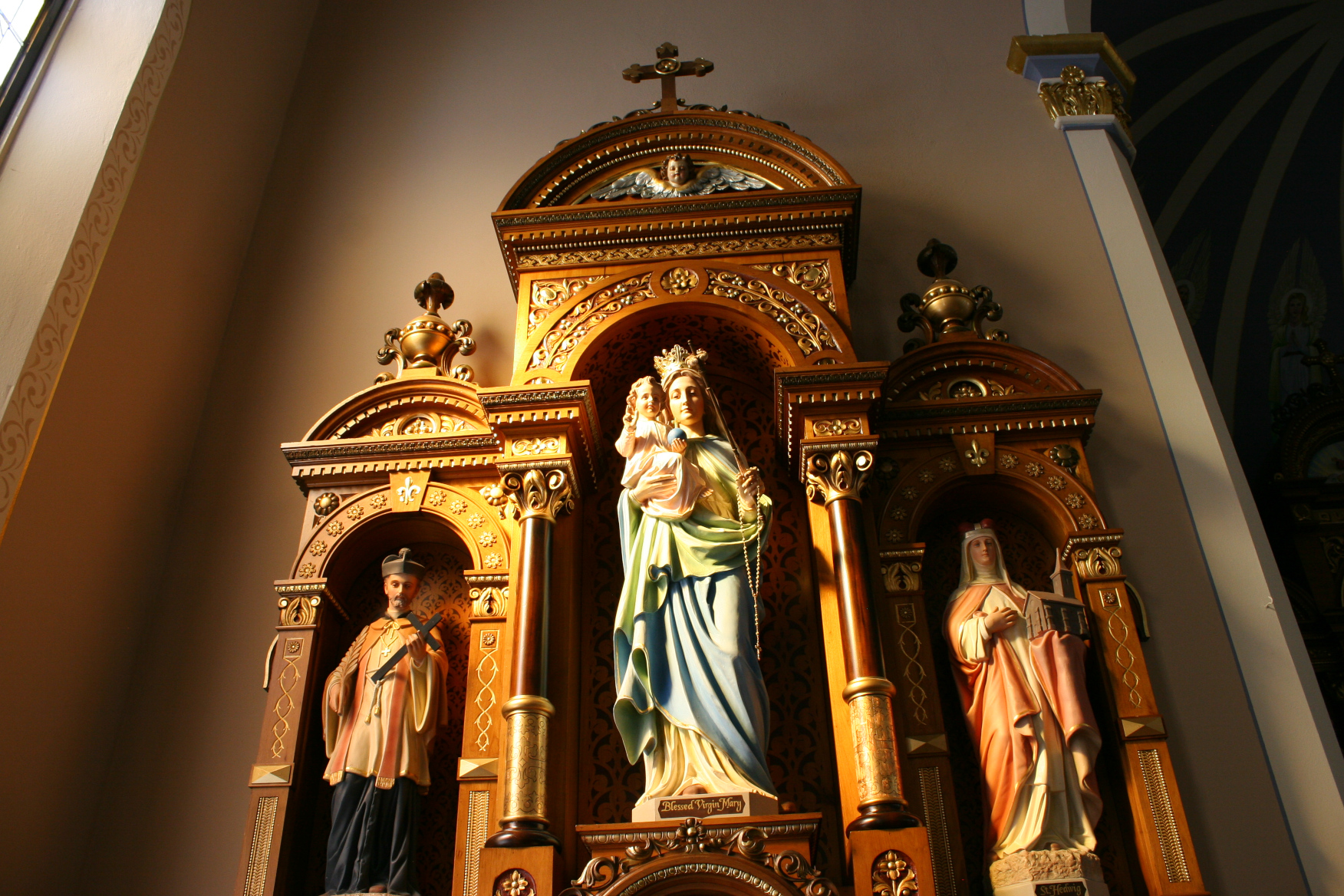
Statues on a side altar. Minnesota Prairie Roots file photo September 2020.
I don’t pretend to understand the meaning of all the art which graces this space. But one thing I do understand is that this house of worship excels in craftsmanship and artistry. Each piece of art holds meaning, significance, purpose. From the stained glass windows to the sculptures to the ornate altars.
Looking toward the back of the church and to the balcony. Minnesota Prairie Roots file photo September 2020.
Years have passed since I stepped inside St. Michael’s. So when Randy and I visited his mother’s and brother’s gravesites at the church cemetery last September, we decided to also check out the recently-restored church. I expected locked doors, so often the case now in rural and small town churches. But the doors to an addition were open and we had the place to ourselves. Note that plenty of security cameras film visitors.
My favorite art in St. Michael’s are these angels painted on the ceiling above the altar. Minnesota Prairie Roots file photo September 2020.
My reaction was one of awe as I stood inside the sanctuary with its soaring ceiling, art seemingly everywhere. It’s a photographer’s paradise. An art lover’s dream. A place of peace for the faithful.
A side altar up close. Minnesota Prairie Roots file photo September 2020.
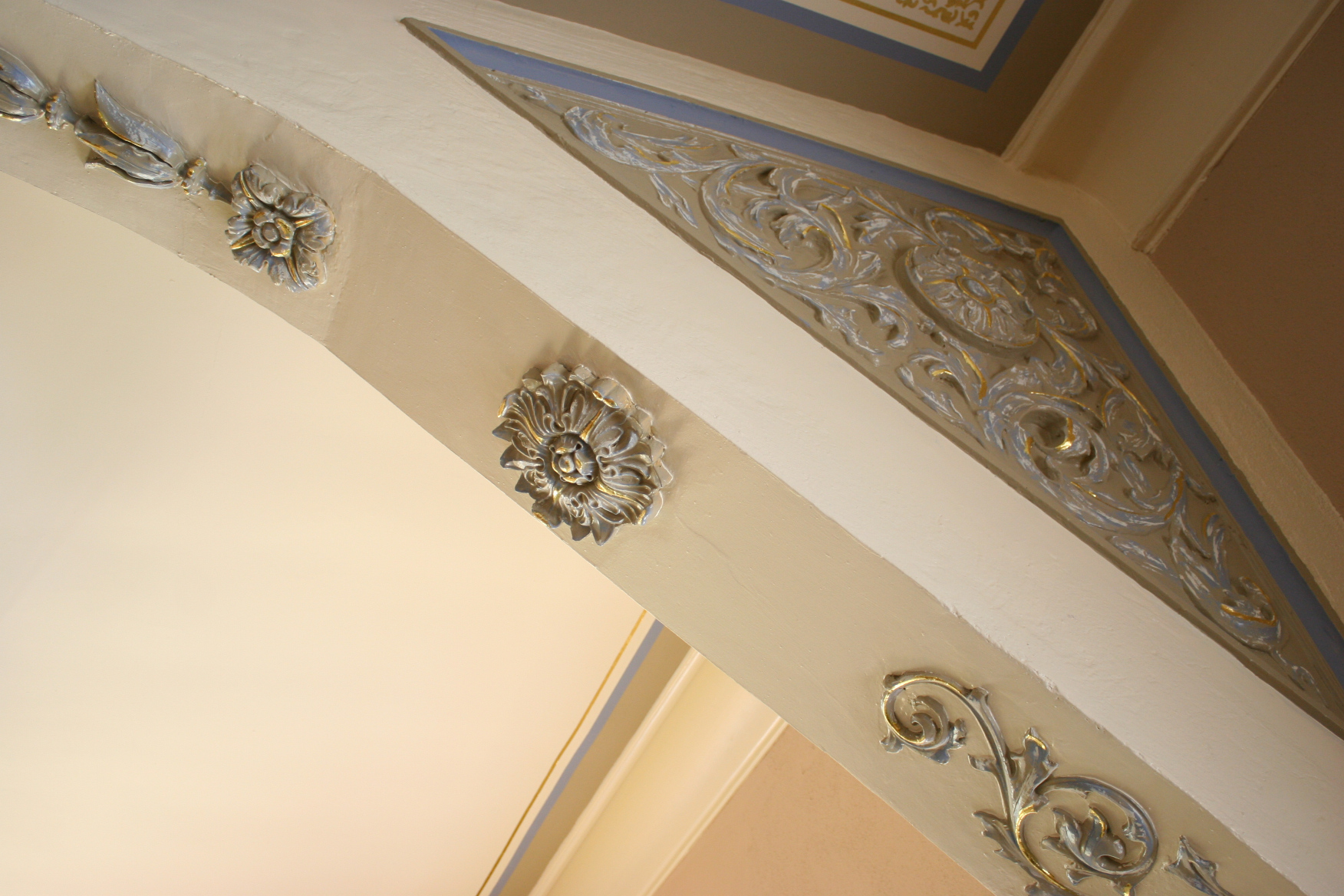
Ornate ceiling details. Minnesota Prairie Roots file photo September 2020.
One of many detailed sculptures. Minnesota Prairie Roots file photo September 2020.
I felt overwhelmed as I moved from one area of the church to the next—attempting to take in all I saw. The whole picture. The details. Oh, the details.
The center altar, with that frightening statue. Minnesota Prairie Roots file photo September 2020.
I stood for a moment, placing myself in Randy’s shoes as that young boy from North Dakota seeing this all for the first time. I locked eyes on the statue of St. Michael towering over Satan, the terrible, horrible creature with the sharp teeth and claws. And I understood Randy’s fear manifested there all those decades ago.
Please check back as I bring you more photos from inside St. Michael’s Catholic Church, Buckman, Minnesota.

















 Minnesota Prairie Roots
Recent Comments