Minnesota Prairie Roots

Writing and photography by Audrey Kletscher Helbling

An obit: I didn’t know Jim, but now I do April 27, 2016

Filed under: Uncategorized — Audrey Kletscher Helbling @ 5:00 AM
Tags: , , , , , ,
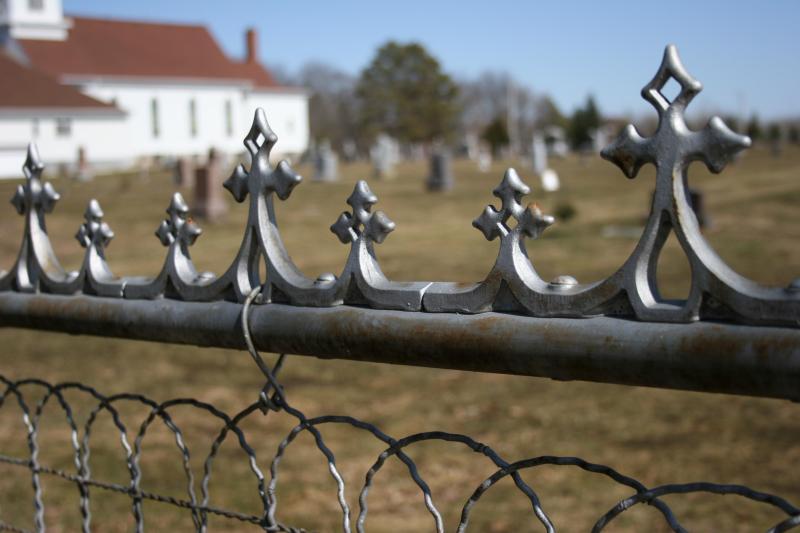
A fence surrounds the Urland Lutheran Church Cemetery in the Sogn Valley area.

A fence surrounds the Urland Lutheran Church Cemetery in the Sogn Valley area. Minnesota Prairie Roots file photo 2010 used here for illustration purposes only.

MORE AND MORE, I READ OBITUARIES. Probably because I am aging and more people I know are now dying.

I didn’t know Jim Mueller of Clearwater, though. Yet I still read his 22 column inch obit published April 21 in The Gaylord Hub, a small southern Minnesota weekly where I worked as a reporter for two years right out of college. The Hub arrives in my mailbox each week, a tangible reminder of my past and of the passage of time.

James Henry Mueller left his hometown of Gaylord in 1973, five years before I arrived. If he had still resided there, I likely would have interviewed him. He was that kind of guy. Socially active. A storyteller. A businessman. A character. He would have made for an interesting feature.

Consider this line from the beginning of his obit: Jimmy grew up doted on by his ma and arguing with his pa.

But it is the ninth and final paragraph of this lengthy obit which makes me wish I’d known this 88-year-old:

Jim’s many hats included: Veteran Navy Man, Well Driller, Grain Bin Mover, Beer Seller, Horse Wrangler, and Postmaster. He was a smooth dancer and an ace at bridge. He will fondly be remembered as a Teller of Tales, A Spinner of Yarns, and a Preacher of Sermons.

In addition, paragraph eight notes that Jim donated his body to science. Even in death, his story continues.

NOW IT’S YOUR TURN. How would you like to be remembered? What hats would others say you wore? What do you think of this trend to personalize obituaries with insights and commentary?

© Copyright 2016 Audrey Kletscher Helbling


From small town Minnesota: Should Gaylord keep its noon & 6 p.m. whistles? March 2, 2016

Filed under: Uncategorized — Audrey Kletscher Helbling @ 5:00 AM
Tags: , , , , , , ,
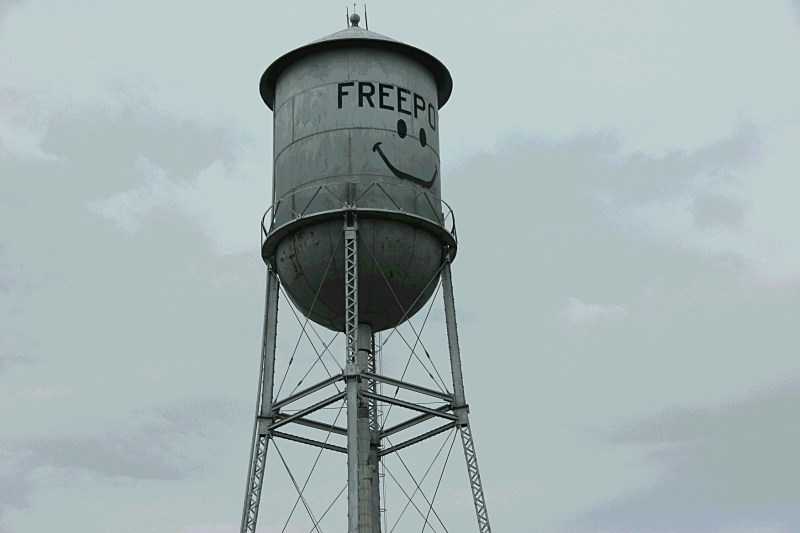
I photographed this aged water tower, which looks a lot like the 1917 one in Gaylord, several years ago. It stands in Freeport, Minnesota, along Interstate 94.

I photographed this aged water tower, which looks a lot like the 1917 one in Gaylord, several years ago. It stands in Freeport, Minnesota, along Interstate 94.

WHAT IS THE PRICE of history, of nostalgia, of tradition in a small town?

Folks in Gaylord, a county seat community of some 2,300 in southern Minnesota, are grappling with that question as the city replaces its aging water tower with a new one.

Should the city spend several thousand dollars annually for inspections and $100,000 every 10 years for upkeep of the 1917 tower? Or should the tower be torn down? And, if so, what happens to the siren attached to it?

The issue isn’t simply one of economics. That’s clear in Facebook comments on the City of Gaylord Facebook page. Residents and former residents are discussing not only whether to keep the tower, but whether to continue with the tradition of blowing the noon and 6 p.m. whistles. A siren on the old water tower blares twice daily as it has for decades. The whistle has become a hot topic of discussion.
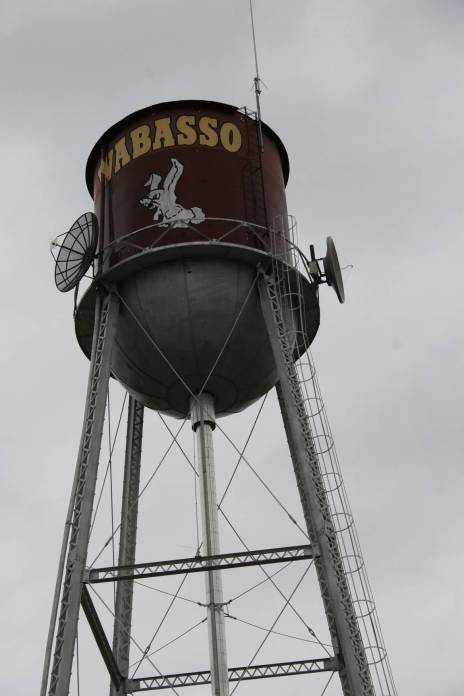
Wabasso's water tower, painted in the school colors and adorned with a white rabbit, the school mascot.

This aged water tower stands in Wabasso, Minnesota, where I attended high school. Wabasso means “white rabbit” and is the school’s mascot. Minnesota Prairie Roots file photo.

I understand the small town nostalgia bit. I grew up on a farm near Vesta, a town of several hundred with an old water tower (long gone) and those roaring daily sirens. I also lived in Gaylord where I worked as a newspaper reporter for two years fresh out of college.

The noon and 6 p.m. whistles (and if I remember correctly, even a 9 p.m. whistle) in Vesta alerted residents to the time of day. Time for dinner. Time for supper. Time to get home and prepare for bed.
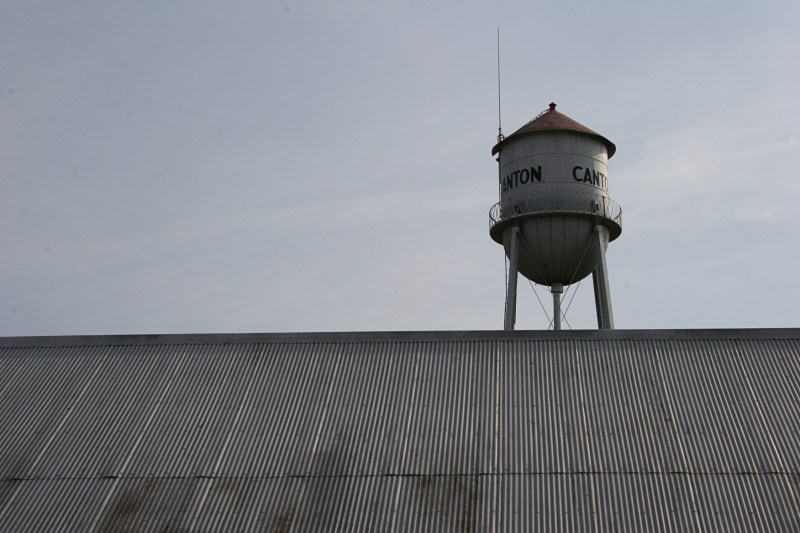
This water tower stands in Canton, Minnesota, near the Iowa border. Minnesota Prairie Roots file photo.

This water tower stands in Canton, Minnesota, near the Iowa border. Minnesota Prairie Roots file photo.

Do those whistles still hold importance in 2016? Are they necessary? Are they welcome?

In perusing comments from Gaylord, I read of overwhelming support for keeping the whistles.

Folks write of the whistle in terms of small town charm and values, nostalgia, memories, historical importance, uniqueness and more.

One Gaylord native says of the siren:

It was the singular mechanical device that, by itself, taught us Gaylord kids what responsibility meant. If I and my siblings weren’t walking in the door at noon and six, there was hell to pay. It is a legacy.

Another commenter surmises:

I have continued the tradition and taught my children to listen for the whistle. A watch just isn’t enough when you are talking about kids. They need an audible reminder of the progression of time. The noon whistle is a blatant reminder of the time of day, as is the 6:00 whistle. I think it is an important tool for responsibility as we raise the next generations. The matter of $5,000 – $10,000 is actually a small price to pay when averaged out for a big payout. Besides, what is more monumental in a small town than a noon and/or 6:00 whistle. Can’t get that in the “big city”.

The City Council will decide on the 1917 tower and the whistle in several months. For now, they’ve taken this stand:

The council has determined taking it (the old water tower) down makes the most sense in the long run. The City is looking into keeping the whistle in some capacity…An alternative whistle is being explored; an unused severe weather siren (behind the Prairie House), is proposed to be relocated to the old water tower site.

WHAT ARE YOUR THOUGHTS on keeping the aged tower and/or daily whistles? Let’s hear.

FYI: Click here to reach the City of Gaylord Facebook page. Read the comments and even listen to the siren.

© Copyright 2016 Audrey Kletscher Helbling


Beer, brats & bare feet January 24, 2014

RIGHT NOW YOU’RE likely wondering about that title, Beer, brats & bare feet. What’s the connection?

The commonalities, my friends, are the letter “b” and Minnesota.

Let me explain.

The other morning a customer stopped by the automotive machine shop which my husband runs in Northfield, Minnesota. Nothing extraordinary about that. Customers filter in and out all day.

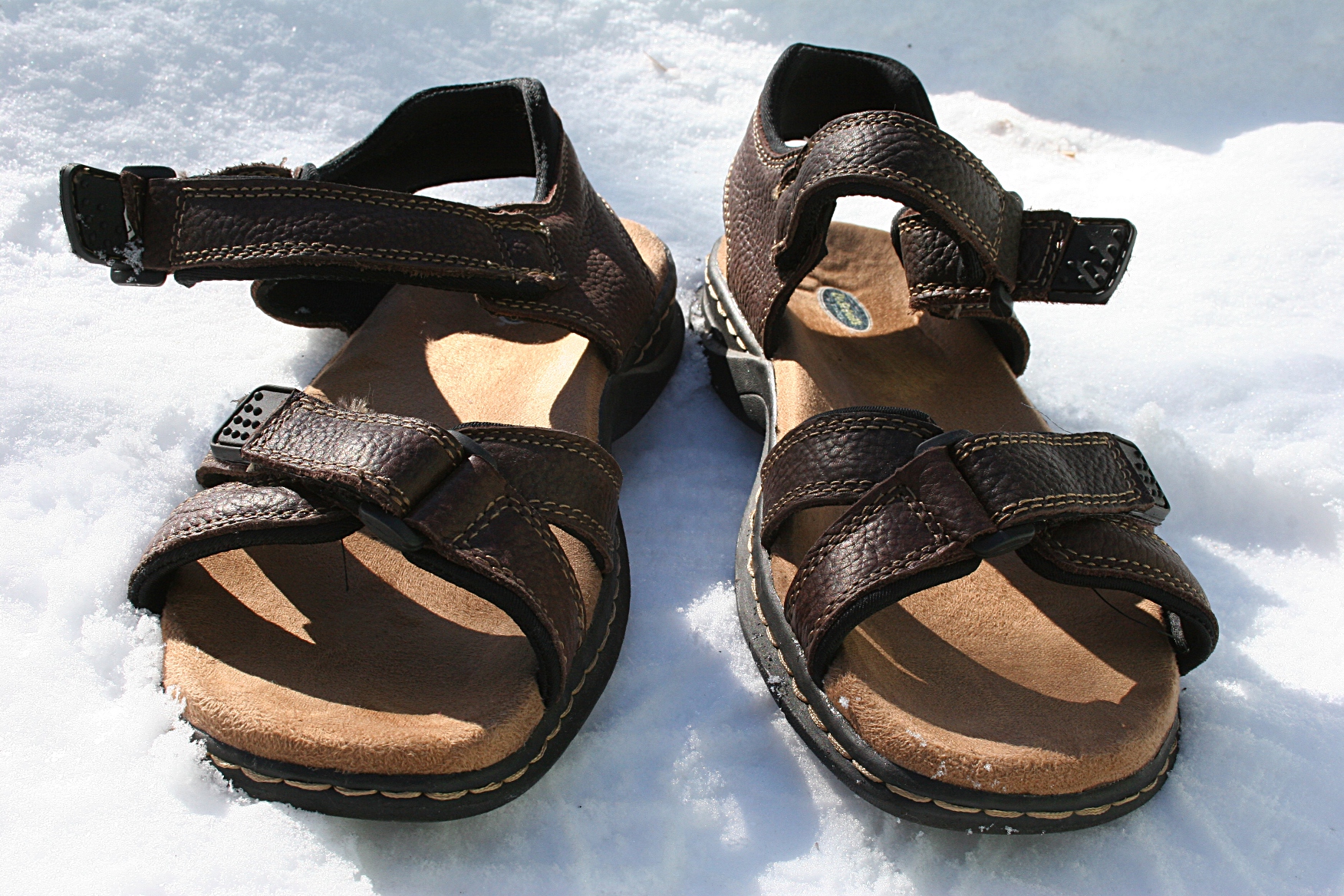
Imagine wearing sandals right now outdoors in Minnesota.

Imagine wearing sandals right now outdoors in Minnesota.

But this customer arrived in sandals. On a day when temperatures hovered around zero degrees Fahrenheit and the windchill plunged the “feels like” temp even lower. This guy wasn’t wearing socks with his sandals, as you might expect, although he was wrapped in a winter coat.

Naturally, my spouse inquired about the bare feet and sandals. The customer replied (and this is not an exact quote) that he was tapping into his inner hippie.

Alright then.

My husband loves brats and grills them in the winter along with meats that I will eat. Minnesota Prairie Roots file photo.

My husband loves brats and grills them year-round along with meats that I will eat. Minnesota Prairie Roots file photo.

Over at St. Peter’s Lutheran Church in rural Gibbon, Minnesota, parishioners are apparently tapping into our state’s Scandinavian and German heritages via a Sven & Ole Book Fair at an All You Can Eat Pancake & Bratwurst Dinner from 11 a.m. – 5 p.m. Sunday, January 26.

Bars made by Lutherans, but not from St. Peter's Church. Minnesota Prairie Roots file photo.

Bars made by Lutherans, but not from St. Peter’s Church. Minnesota Prairie Roots file photo.

Also on the menu are applesauce, cheese, cookies and bars. Yes, bars. How Minnesotan is that?

And how Minnesotan that the book fair comes via Sven & Ole’s Books in the nearby noted German city of New Ulm. And, yes, the proprietor’s name truly is Sven and his brother’s middle name is Olaf, Ole for short, according to the bookstore website.

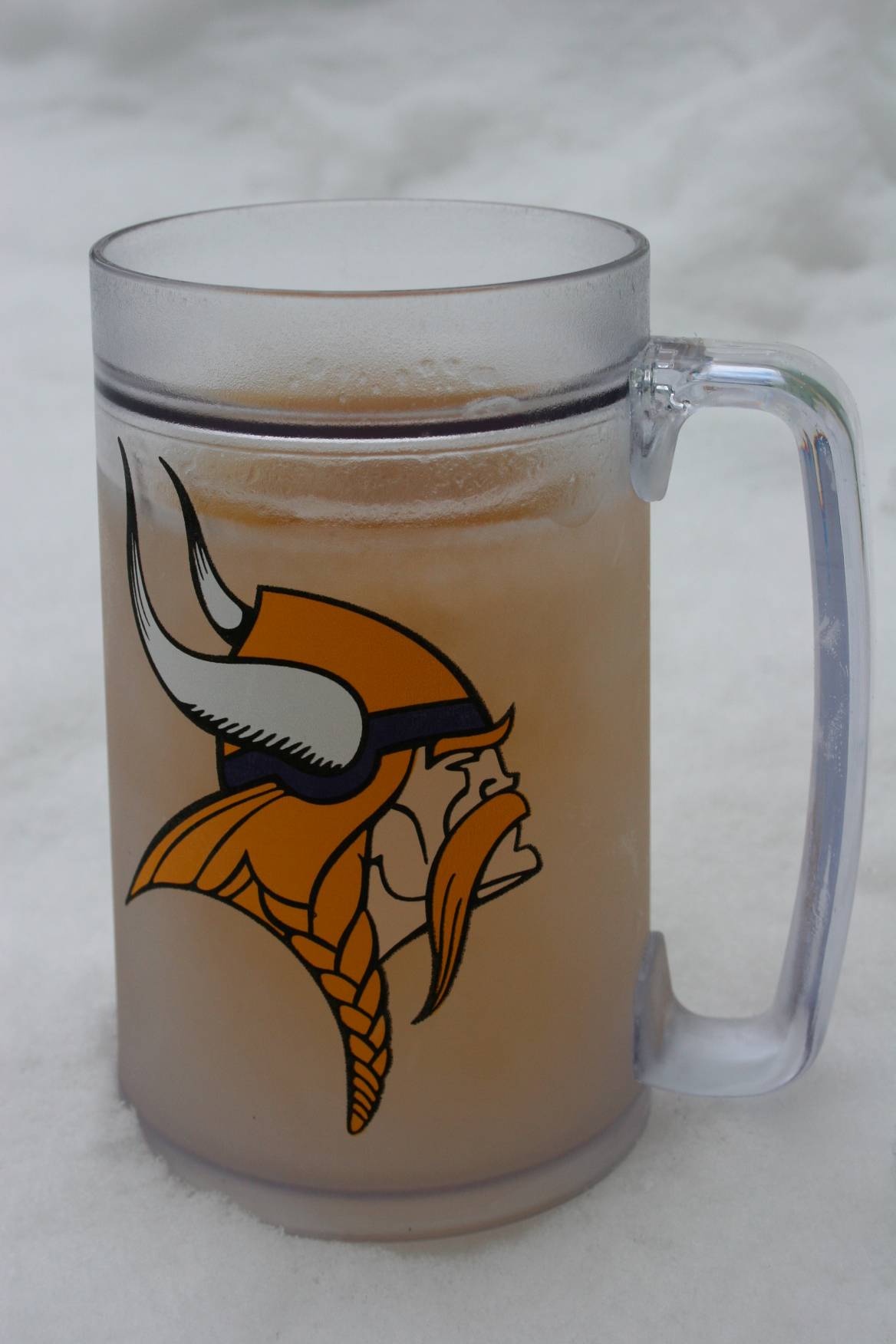
Icy cold beer served up in a Minnesota Vikings mug.

Icy cold beer served up in a Minnesota Vikings mug. Minnesota Prairie Roots file photo.

Now about that beer, which I think would be a better accompaniment for brats than pancakes. I like neither brats nor pancakes, although I am 100 percent German. But I do like bars, the kind you eat. And I enjoy an occasional mug of beer.

I learned through a recent column in The Gaylord Hub, a small-town newspaper where I worked as a reporter and photographer right out of college, about the Minnesota Historical Society’s “Beer and Brewing in the Land of Sky Blue Waters” lecture/workshop offering. It is funded through grant monies from Minnesota’s Arts and Cultural Heritage Fund as part of the Minnesota Historical Society in the Libraries Adult Programming.

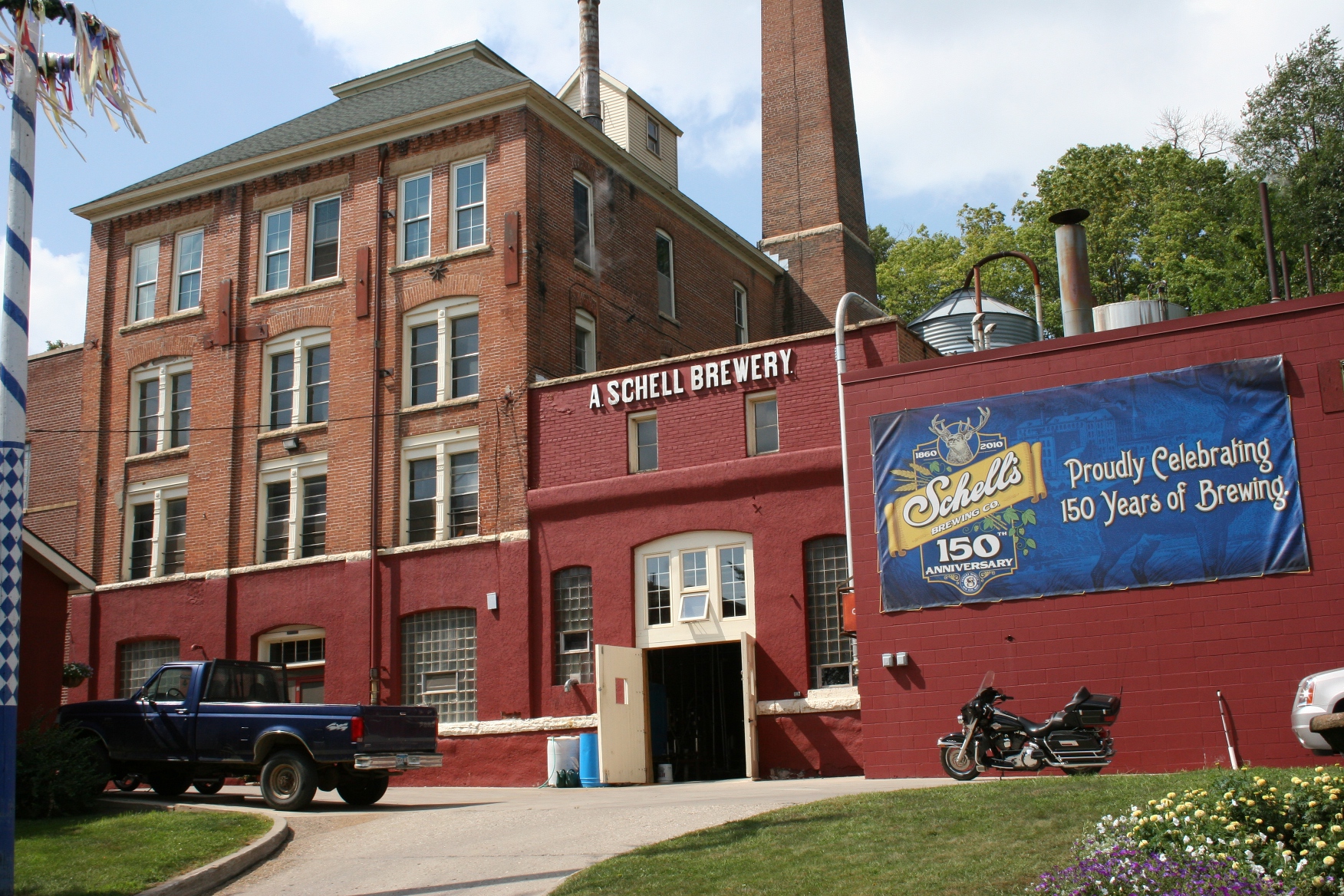
August Schell Brewing Company in New Ulm. Minnesota Prairie Roots file photo.

August Schell Brewing Company in New Ulm. Minnesota Prairie Roots file photo.

A “discussion of brewing history along with beer tasting by Schell’s,” a New Ulm brewery, was recently held at the Gaylord Public Library, for adults 21 and over with valid ID, according to info written by Gaylord’s librarian. Two days later, nearby St. Peter hosted the same beer event at its community center.

So there you have it. Beer, brats and bare feet in Minnesota. Cheers.

Thoughts?

© Copyright 2014 Audrey Kletscher Helbling


Dispelling a Mayberry myth in rural Minnesota December 16, 2011

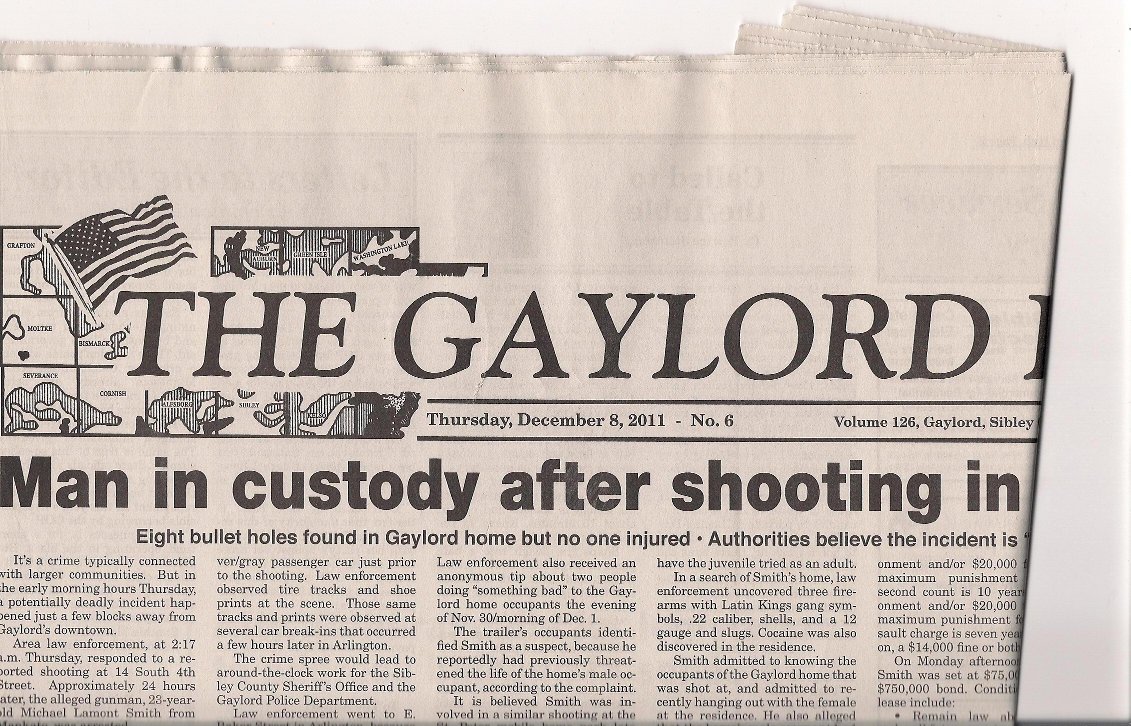
Man in custody after shooting in Gaylord

Two men arrested after incident with police officers in Winthrop

Three years since rural Green Isle homicide

These disturbing headlines all published recently in a single issue of a 10-page small-town Minnesota weekly newspaper.

How life has changed in the 31 years since I pounded out news articles there, for The Gaylord Hub, on a vintage manual typewriter. The biggest news stories during my 1978 – 1980 tenure as a reporter were fires and motor vehicle crashes and the controversy over the expansion of local chicken barns.

I didn’t write about eight bullets fired into a Gaylord home in an alleged gang-related shooting or a scuffle between police and a suspect or a three-year unsolved homicide.

And I didn’t have to report on a courthouse shootings like the one which occurred Thursday in quiet Grand Marais, an artsy get-away destination along the shores of Lake Superior.

Thirty years ago, small towns were still relatively untouched by violent, drug-related or other crime. Not so anymore. One need only pick up any weekly newspaper to read about major crimes that rock even the most rural regions.

Just this week in Redwood County in rural southwestern Minnesota, warrants were issued for 31 individuals on felony drug charges following a year-long, five-county investigation, according to information published in The Redwood Falls Gazette. Most suspects have been arrested and charged.

That’s my home county you’re talking about here, a place of small towns, grain elevators, farm sites, and corn and soybean fields—about as rural as you can get.

This isn’t Mayberry anymore.

While I can wax nostalgic about how things “used to be,” the reality of life is this: Times have changed. People have changed. Respect for parents and authority and laws have eroded.

Crime, once considered a big-city problem, reaches deep into the most rural of locations.

It is sad.

But it is the truth.

IF YOU LIVE in a rural area, have you see increases in crime? Explain. How have you, personally, or your community been impacted? How is your community dealing with crime? Please submit a comment and share.

© Copyright 2011 Audrey Kletscher Helbling


Some fine examples of giving in rural Minnesota April 5, 2011

WHEN I READ through the March 31 edition of The Gaylord Hub, a rural Minnesota weekly newspaper where I worked from 1978 – 1980, something caught my eye.

The 10-page paper was packed with stories about community members helping one another. The quantity of articles impressed me enough to write this post, to emphasize to you that even during these challenging times, Minnesotans are reaching out to one another.

These are stories we need to read among the hard news stories of floods and earthquakes, wars and suicide bombers, rising gas prices and falling property values, the news that causes us to ask, “What is this world coming to?”

The articles I read reaffirm that among all the bad in the world, plenty of good still exists. And often, young people are leading the way to assist those in need.

In Gaylord, the Sibley East Junior High Student Council recently raised $600 for the Sibley County Food Shelf. Likewise, the Gaylord Cub Scouts, Boy Scouts, leaders and parents collected 1,032 pounds of food and $70.65 for the county food shelf in a one-day drive.

Students from Sibley East Elementary Schools in Gaylord and Arlington raised $10,431.32 in the Pennies for Patients fundraiser for the Leukemia and Lymphoma Society, placing in the top 25 among 473 participating schools. How’s that for a small school (between 200 – 499 students) in rural Minnesota?

The adults in the Gaylord area aren’t sitting idly by watching the younger generation pursue charitable giving.

The winner in a local drawing chose Sibley County Food Share, Inc., as the recipient of a $2,500 donation from the Monsanto Fund.

Sertomans, at their weekly meeting, discussed plans for a benefit to help the Lindemann family as their daughter, Paisley, battles cancer.

The newspaper also published a story about an education memorial fund established for Kaylee and Gavin, the young children of Michael Struck, a Minnesota Department of Transportation worker who died after his backhoe was swept away recently in flood waters.

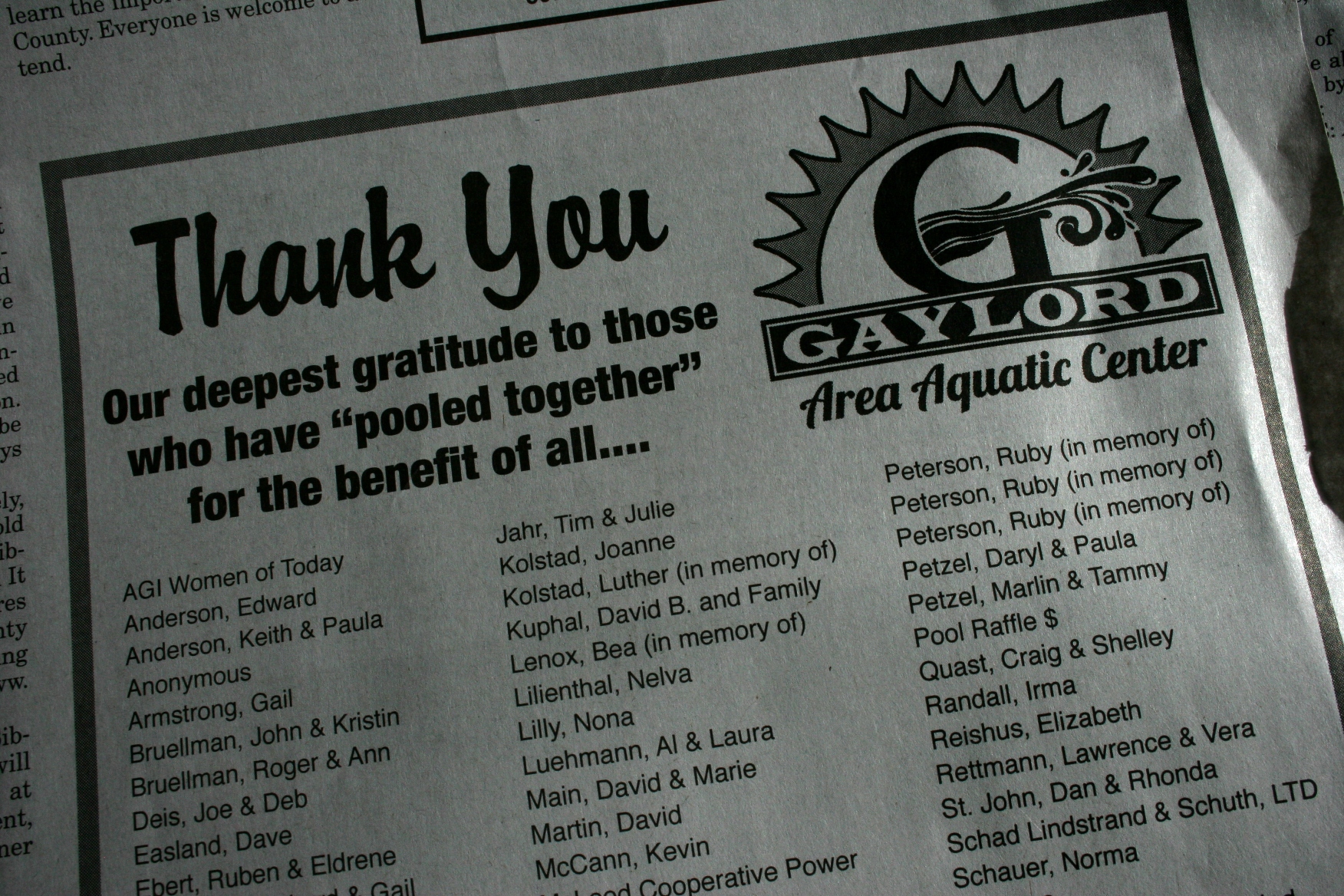
And then, in a front page article, readers learned that $63,000 in donations have been made to Gaylord’s new aquatic center. Donations will be used to buy amenities (play features) for the pool. All 69 donors are listed in an ad published on page 5.

This is just an observation I’ve made over the years—and I think it’s an accurate one—but residents of small towns are often willing to open their pocketbooks to projects that in larger cities would be funded with taxpayer dollars. Why? I think community pride and ownership and the deep personal connections small town residents have to one another prompt such generosity.

Finally, the last philanthropic piece of news was buried deep in a front page article titled “Fire Department receives FEMA grant.” After explaining that the local department has received a nearly $60,000 grant to purchase firefighting equipment, the reporter writes about the annual firemen’s banquet.

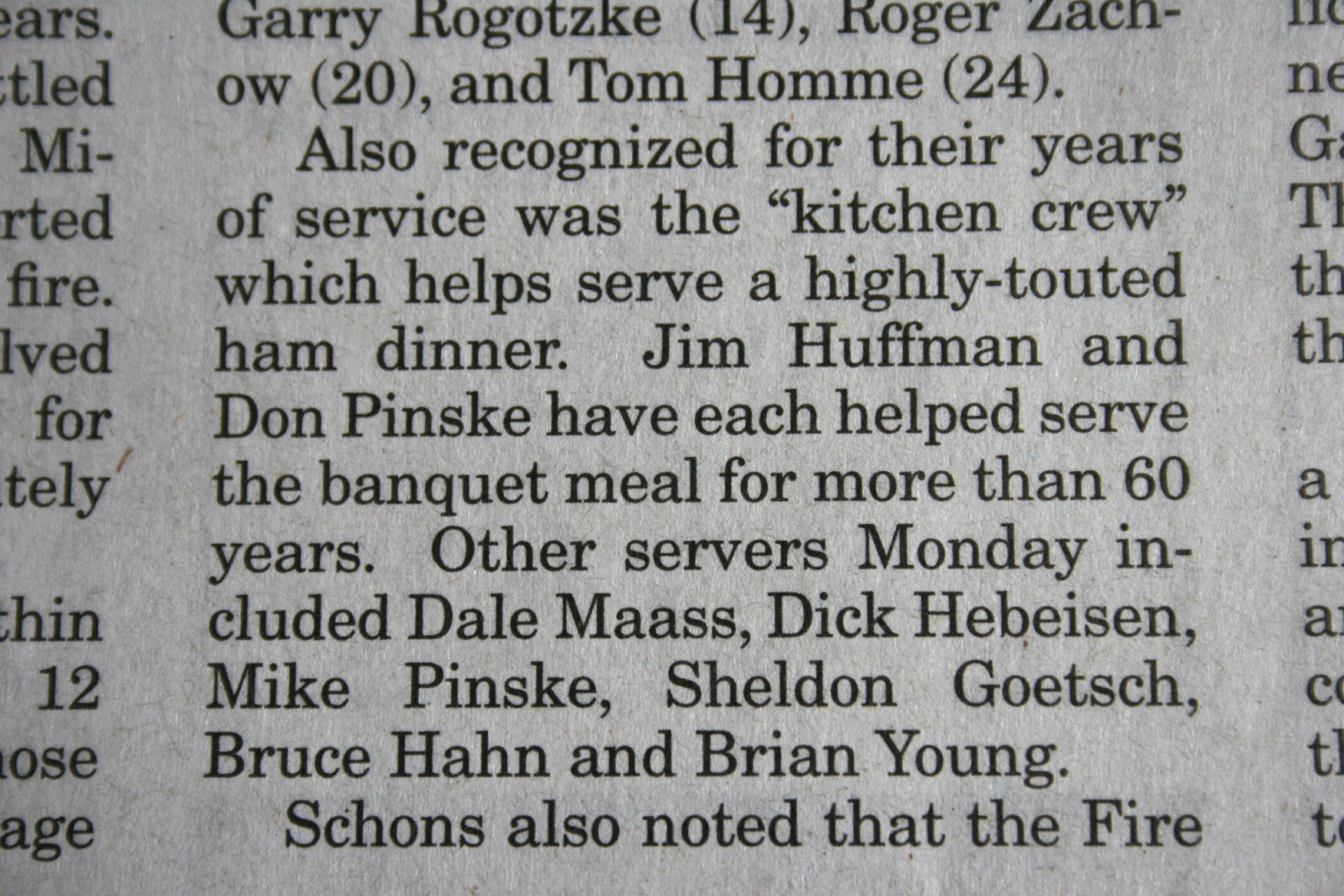
And that is where I found this little gem: “Also recognized for their years of service was the ‘kitchen crew’ which helps serve a highly-touted ham dinner. Jim Huffman and Don Pinske have each helped serve the banquet meal for more than 60 years.”

Sixty years. Now that’s dedication and an outstanding example of selfless giving back to the community.

© Copyright 2011 Audrey Kletscher Helbling


Together let’s make this harvest season safe October 7, 2010

Filed under: Uncategorized — Audrey Kletscher Helbling @ 2:07 PM
Tags: , , , , , , , , , ,


Bishop Jon Anderson, Southwestern Minnesota Synod, Evangelical Lutheran Church of America, blesses the Prahl family.


SEVERAL WEEKS AGO I wrote about a Tractor Roll-in and Harvest Blessing Service at Trinity Lutheran Church in rural Gaylord.

Yesterday I received my September 30 issue of The Gaylord Hub, a community newspaper where I worked for two years right out of college. Even after three decades removed from Gaylord, I’m still interested in the happenings in this small town.

As I paged through the issue, I came across a photo on page four from the Trinity harvest blessing service. Pastor William Nelsen had e-mailed the same image, and several others, to me. But they were just sitting in my in-box and I wasn’t sure I would ever publish them on Minnesota Prairie Roots.

But then, yesterday, that blessing service photo in The Hub, followed by a story two pages later, prompted me to write this post. The news article shared information about an accident in which a farmer’s clothing became entangled in a power take off driven rotor shaft. The farmer sustained severe head, chest and arm injuries and was airlifted from the scene. The irony of the harvest blessing photo and the farm accident story publishing in the same issue of The Hub was not lost on me.

Yes, harvest season is well underway here in southern Minnesota. And with it comes the added danger of accidents on the farm and on roadways. Farmers are tired, stressed, overworked.

Motorists are impatient and in a hurry.

This time of year we all need to take great care as we’re out and about in rural Minnesota. If you get “stuck” behind a combine or a tractor or a slow-moving grain truck, exercise caution and don’t be in such an all-fired hurry to zoom around the farm machinery.

If you’re a farmer, please use proper signage, turn signals and flashing lights and stick to the edge of the roadway as much as you can. Bulky farm machinery limits a motorist’s ability to see around you, which can lead to accidents.

Together, with understanding and patience and, yes, even consideration, farmers and non-farmers can join in making this a safer harvest season.


Pastor Bill Nelsen blesses the Klaers family and their harvest during the service.


Pastor Bill Nelsen blesses the Kahle-Giefer family and their harvest. Farmers drove about 40 tractors and combines to the worship service attended by 200-plus worshipers.


I snapped this harvest photo along a rural road near Northfield on Sunday afternoon.


© Copyright 2010 Audrey Kletscher Helbling

Photos courtesy of Margie Nelsen