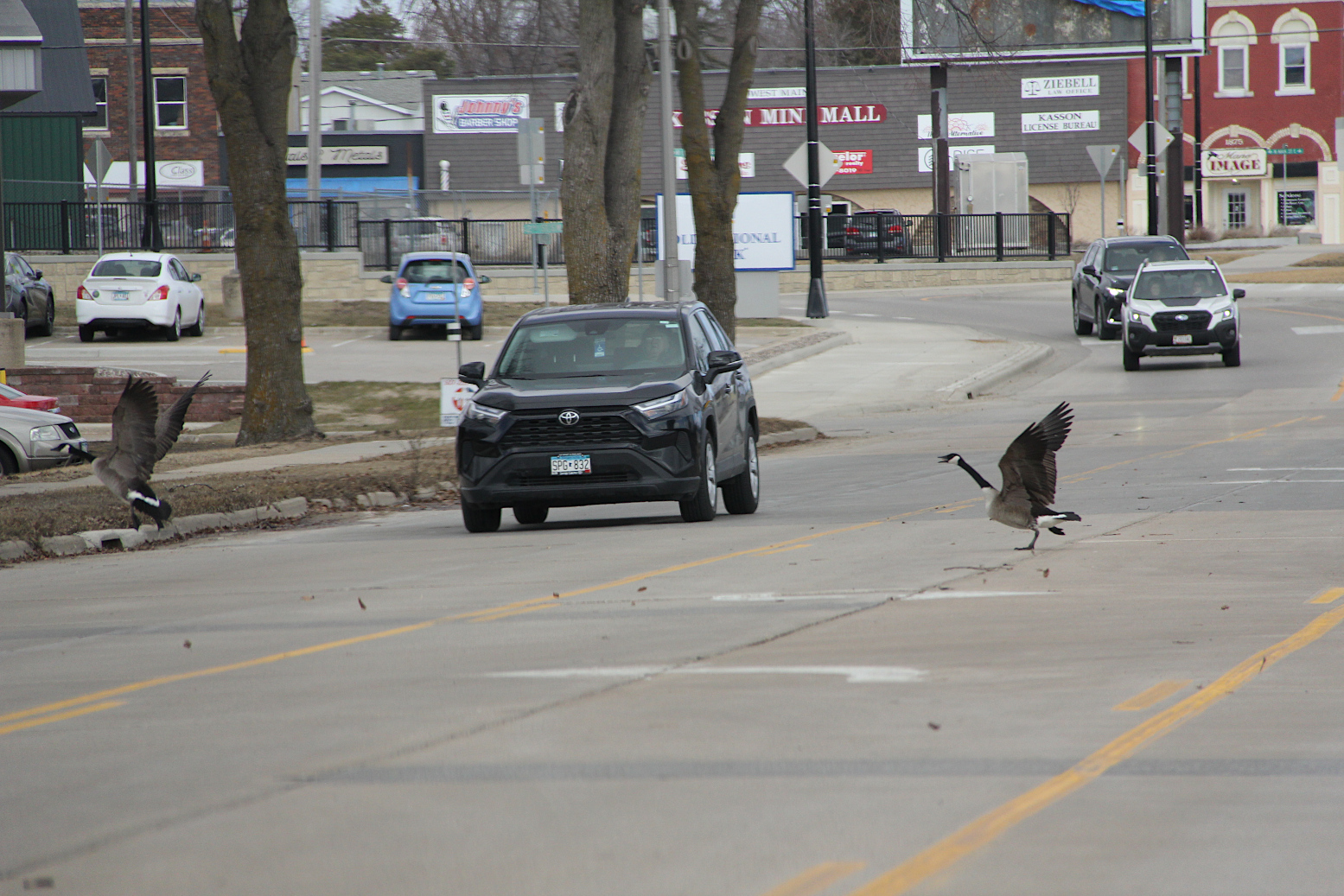
Geese cross a street in small town Kasson, Minnesota. (Minnesota Prairie Roots copyrighted photo March 2026)
TO TAKE PAUSE is sometimes necessary, as in a recent road encounter in the southeastern Minnesota community of Kasson. Two Canadian geese hurriedly crossed a downtown street, their long legs stretching, necks craning, wings lifting in flight.
They understood the danger of approaching vehicles. And we, in our vehicles, understood the need to stop and allow them to go safely on their way.
This marked, in some ways, a sweet moment in time when all of us on that roadway paused in our journeys to respect these geese, who were really at our mercy.
Both geese spread their wings to fly away from danger. (Minnesota Prairie Roots copyrighted photo March 2026)
It felt good to be in community on this mid-March morning without thought of differences or division, but rather in communal understanding that we all needed to do what was right. Sometimes that’s all it takes to realize that we truly can work together for the common good, this time for the common good of those birds. And I suppose for us, too, as I doubt anyone wanted a goose in their radiator.
There are lessons to be learned in everyday life. Lessons in patience and understanding and cooperation. On this winter morning in Minnesota, two geese taught all of us to slow down, to work together, to recognize that little moments matter in life as much as the big moments. The lives of those geese mattered enough for all of us to stop and that is a lesson we can take with us into our communities, our country, our world.
THOUGHTS? Any similar stories to share of an everyday moment like this with lessons learned?
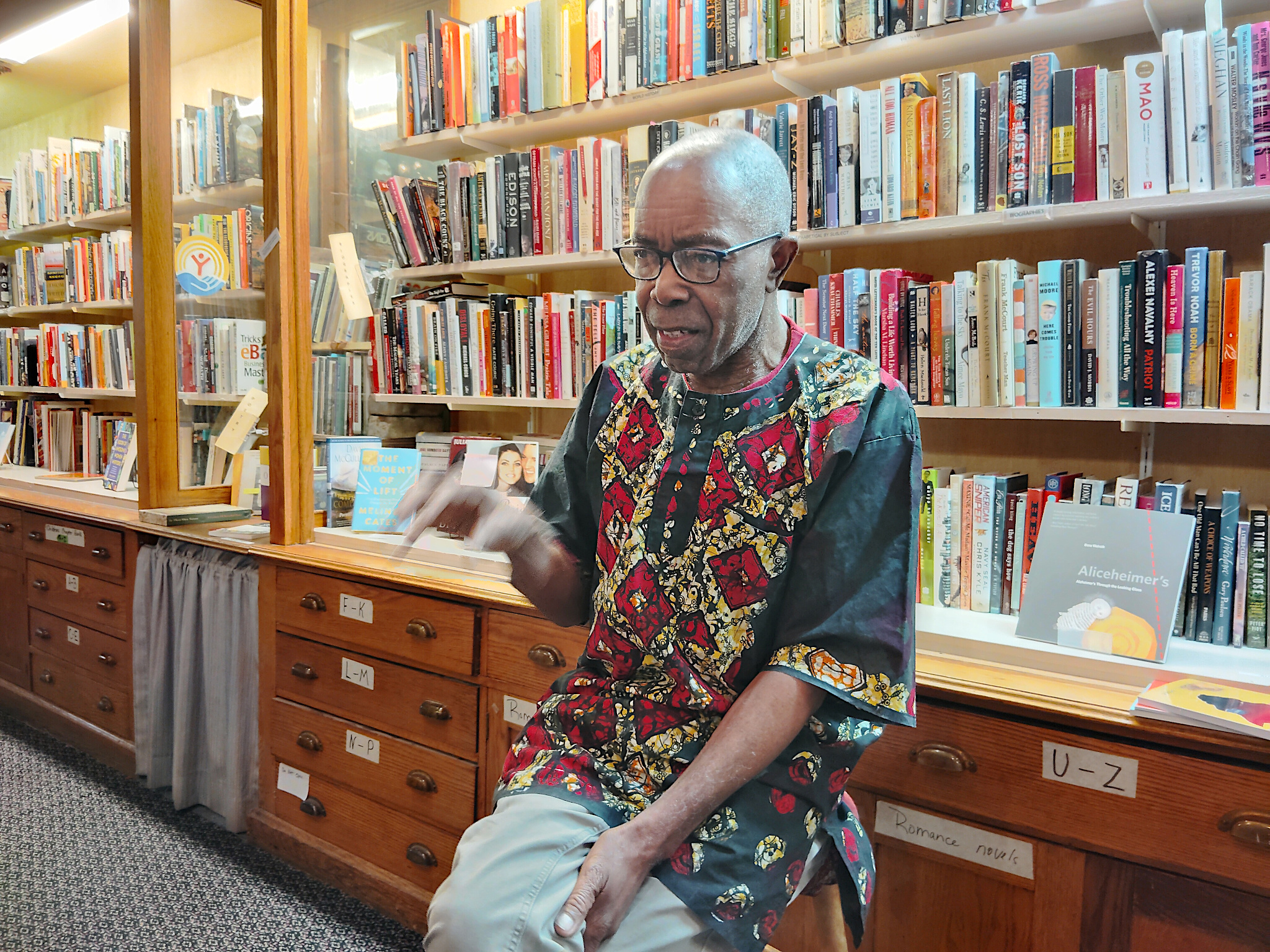
Joseph Mbele shares stories, proverbs and culture on February 11 at Books on Central, Faribault. (Minnesota Prairie Roots copyrighted photo February 2026)
Last Wednesday evening, Joseph Mbele, retired St. Olaf College professor of post-colonial literature, cultural consultant, author and storyteller, shared three African proverbs during a literary event at Books on Central. This man, who calls himself an African and a Tanzanian, held the rapt attention of attendees gathered in the used bookshop in the heart of downtown Faribault, home to many Somalis.
THE CROCODILE
While I enjoyed the two African folktales Mbele told, I really appreciated the proverbs. They are, by nature of a proverb, succinct. A few words carry a whole lot of punch. First up, this proverb: “Before you cross the river, don’t insult the crocodile’s mouth.”
Immediately the image of a crocodile’s sharp teeth popped into my mind. As it should have. This proverb, Mbele explained, is about being respectful to people in our relationships and in life in general. Be anything but respectful and we risk negative consequences. Snap.
THE BLACKSMITH
Second up this African proverb: “It’s because of man that the blacksmith makes weapons.” Thinking in African terms, the weapons would be knives and spears. I thought of guns. Mbele repeated the proverb, letting it sink into our brains. “It’s because of man that the blacksmith makes weapons.” The lesson here, Mbele said, is that we can be better than this—be kind, helpful and supportive—so we don’t need to bear arms/weapons. That’s an oversimplification, of course. But proverbs are not meant to be complex.
THE VISUALLY-IMPAIRED
Third, Mbele recited this proverb: “The one-eyed person only thanked God after he saw a blind person.” As someone with vision issues, that hit home. The proverb is a way of teaching gratitude, Mbele said. The contrast between seeing with only one eye and total blindness put the situation in perspective. The thought that there’s always someone who has it worse probably flitted through the minds of everyone in the bookshop.
THE STORYTELLERS
Mbele talked about the tradition of Africans sitting around telling stories to entertain and teach. Languages like his native Matengo, an indigenous language in Tanzania, are oral, not written. As he spoke, I began to understand the importance of folktales in African life. Stories connect people and, like proverbs, teach lessons.
Applied to my own community, Mbele explained that Somali men gathering on downtown Faribault street corners are simply socializing and sharing stories and are not to be feared. “It’s un-African to be by yourself,” he said of a culture that focuses on family and togetherness.
He even went so far as to say an African could be considered evil or a witch if living alone. That surprised me, but drove home the cultural importance of community and family. Now if only everyone in Faribault could hear these proverbs and insights from this native Tanzanian. Then perhaps they would not fear that which they don’t understand, like the Somali elders gathered on street corners downtown telling stories, sharing news or simply sitting in each other’s presence.





 Minnesota Prairie Roots
Recent Comments