An egret flies over the Cannon River by the barely visible dam at North Alexander Park on Friday evening. (Minnesota Prairie Roots copyrighted photo June 21, 2024)
WILDLIFE SENSES, understands, picks up on nuances that we as humans often fail to notice in our heads-bent-to-our-smartphones, busy scheduled lives.
A blue heron perches on the edge of a tree along the Cannon River by the park-side dam. (Minnesota Prairie Roots copyrighted photo June 21, 2024)
The recent flooding is a prime example. I saw countless cellphones raised to record floodwaters and rising rivers. I carried my 35 mm Canon camera, drawn just like everyone else to document the historic natural event unfolding before me along the Cannon River in Faribault.
An egret and blue heron seem to be checking out the river as a red-winged blackbird sits among the grasses to the right. That’s the Faribault Mill in the background, railings for the park-side dam in the foreground. (Minnesota Prairie Roots copyrighted photo June 21, 2024)
But I also noticed the wildlife. They, too, were observing. Watching the water. And watching people invade their river habitat by the hundreds. I sensed how uncomfortable the egret, blue heron, ducks and red-winged blackbirds were amid all the human chaos. So many people and so much traffic.
Flying high above the flooded river. (Minnesota Prairie Roots copyrighted photo June 21, 2024)
I expect they longed for quiet. Peace. A respite from the attention. A return to normalcy. No more peering eyes. No more crowds gathering.
A bullhead partially emerges from shallow water on dam’s edge as it tries to swim up the floodwaters. (Minnesota Prairie Roots copyrighted photo June 21, 2024)
Another bullhead attempts to swim up river. (Minnesota Prairie Roots copyrighted photo June 2021)
And then there were the fish, primarily bullheads, but a few bass, attempting to swim up through water that was rushing down, spilling over the edges of the dam by North Alexander Park. The fish appeared determined to make it to the other side, to the quieter waters of the widened river. It seemed a losing cause to me. But who am I to discourage a stubborn bullhead? If anything, it was fascinating to watch.
A duck family swims in the shallow floodwaters next to the top of the dam. (Minnesota Prairie Roots copyrighted photo June 21, 2024)
Finally, I observed a mama duck and her brood aside the top of the dam. They began edging, descending toward the river. Foolish ducks, I thought, judging the mother mallard. And then I voiced my concern out loud, “Stop, you’ll drown!”
The ducks move toward the deep river. (Minnesota Prairie Roots copyrighted photo June 21, 2024)
I can only imagine the thoughts of that mother and her six ducklings. “Did that woman really say that, warn us to stay out of the water lest we drown?” If ducks could laugh, the seven of them would have chortled, chuckled, carried on and then shared what they’d heard me say. Quack. Quack. Quackity. Quack.
A mallard drake swims in the Cannon River, nowhere near the female duck and ducklings. (Minnesota Prairie Roots copyrighted photo June 21, 2024)
But it was my husband who spoke for them. “They’re ducks, Audrey,” Randy said. “They can swim.”
An egret stands watchful and tall, next to the water rushing, roiling over the dam. (Minnesota Prairie Roots copyrighted photo June 21, 2024)
Uh, yeah. He was right. But it was the mom in me emerging, the protective spirit that, in that moment, did not separate wildlife from human so focused was I on the dangers of the swollen, swift-moving river.
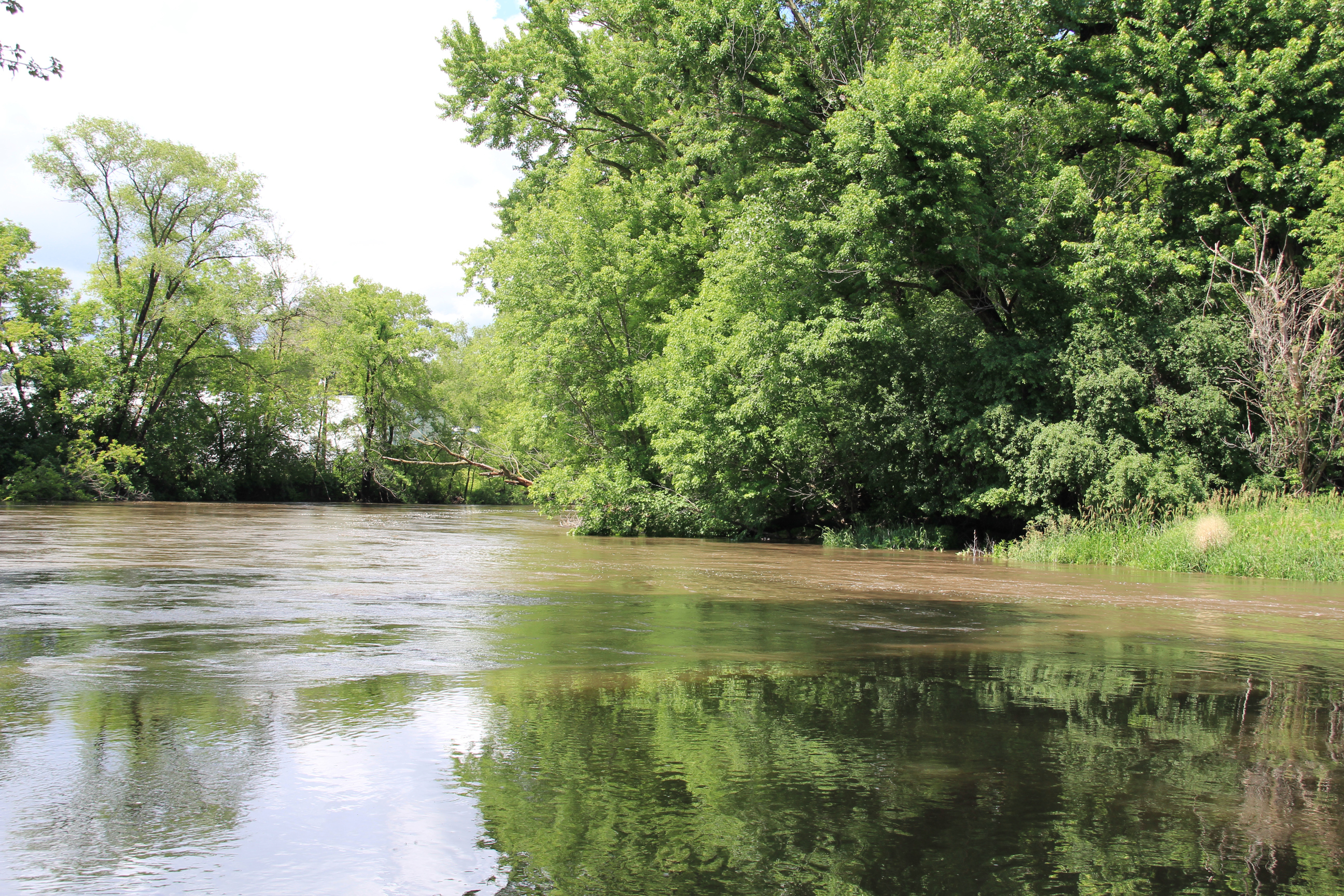
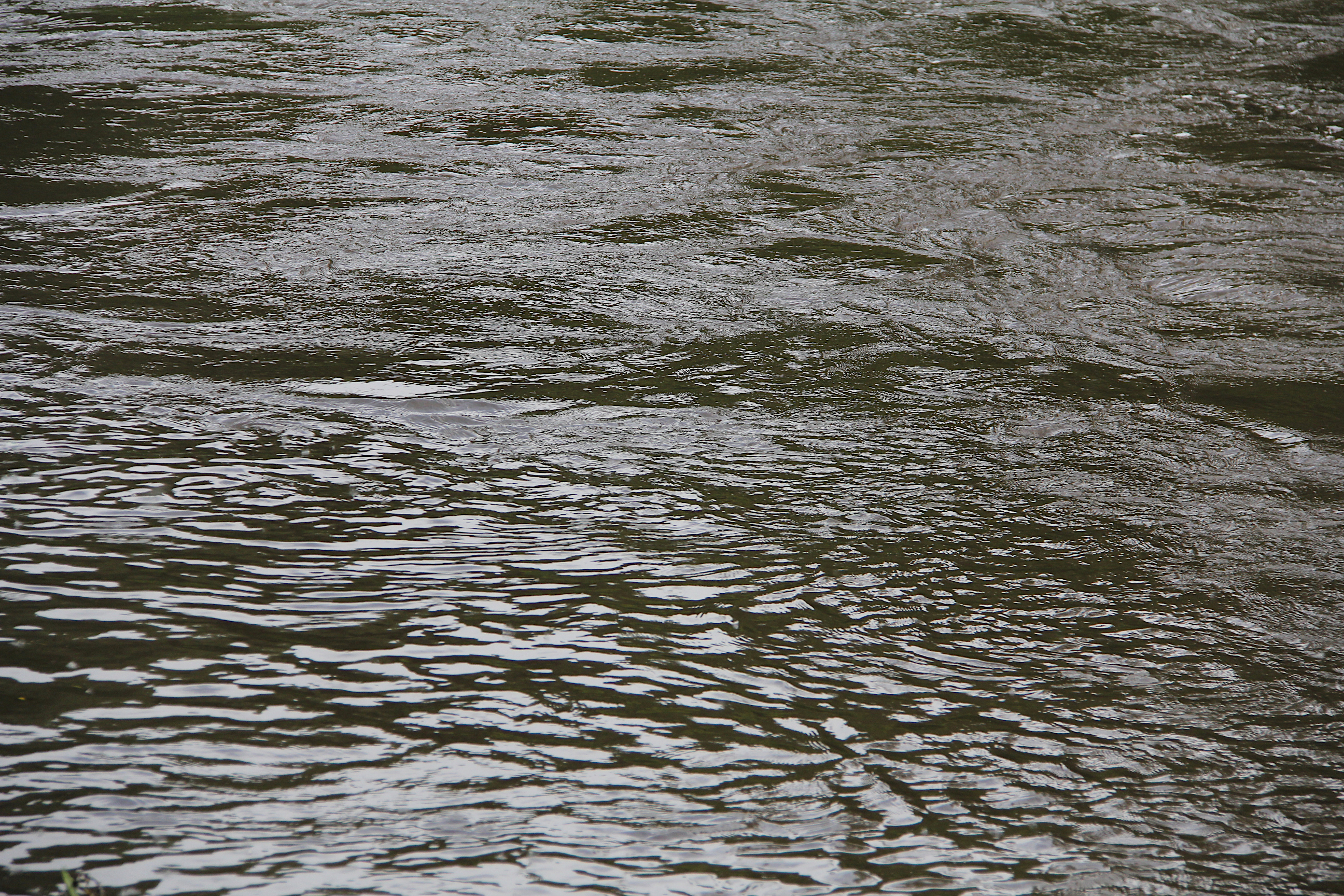
River reflections. (Minnesota Prairie Roots copyrighted photo June 2024)
THE SHRILL TRILL OF TREE FROGS cut through the woods along the river. Yet, the frogs remained unseen, despite their overwhelmingly loud voices seemingly screaming for attention. Nature is odd like that sometimes. Raucous, but stealthy enough to remain hidden.
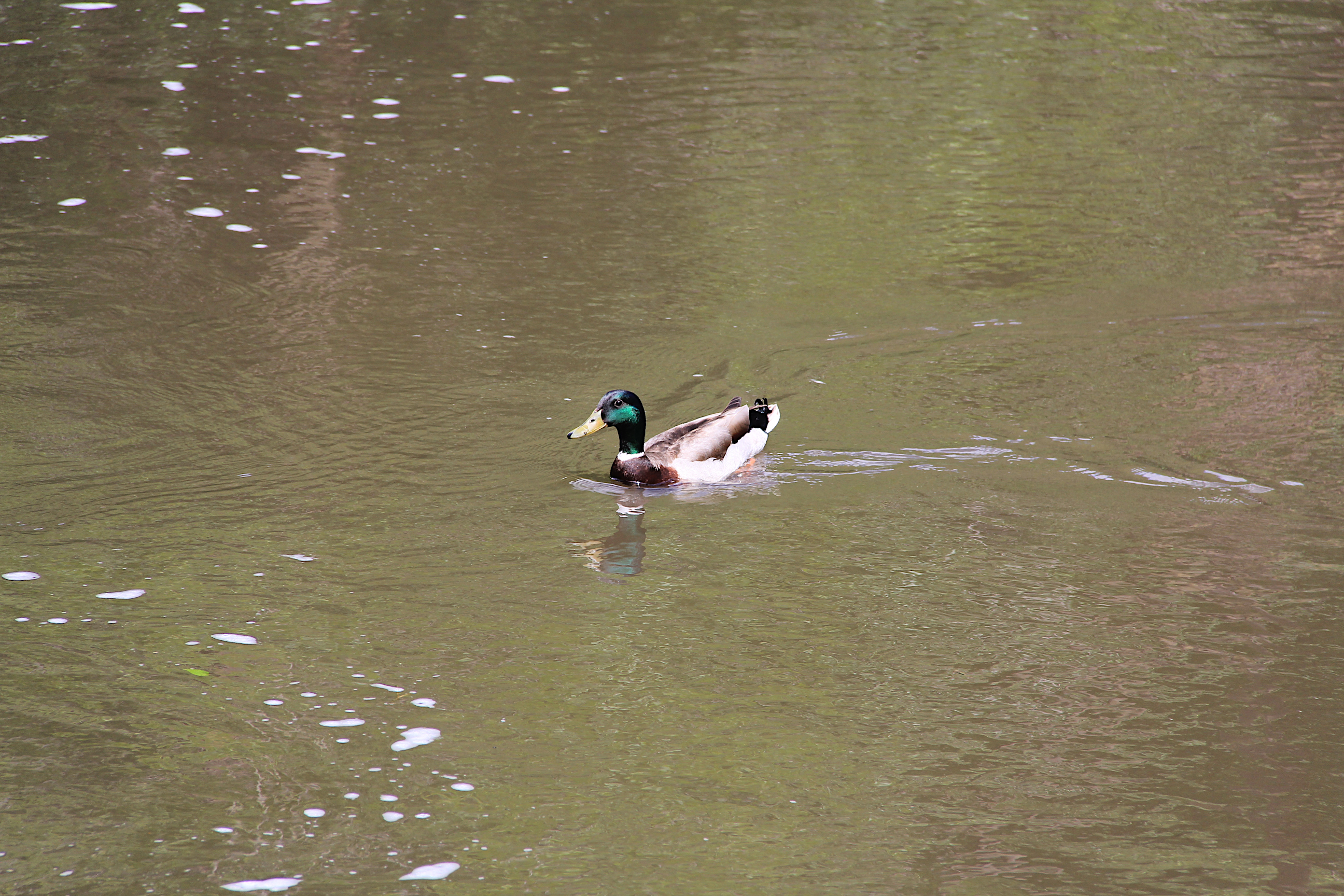
A mallard drake adds a spot of color to the dirty river water. (Minnesota Prairie Roots copyrighted photo June 2024)
Yet, on this walk along the Cannon River near Two Rivers Park in Faribault, not all creatures stayed unseen by me. A mallard drake swam in the river, shimmering iridescent neck and head contrasting sharply with water muddied by recent heavy rains.
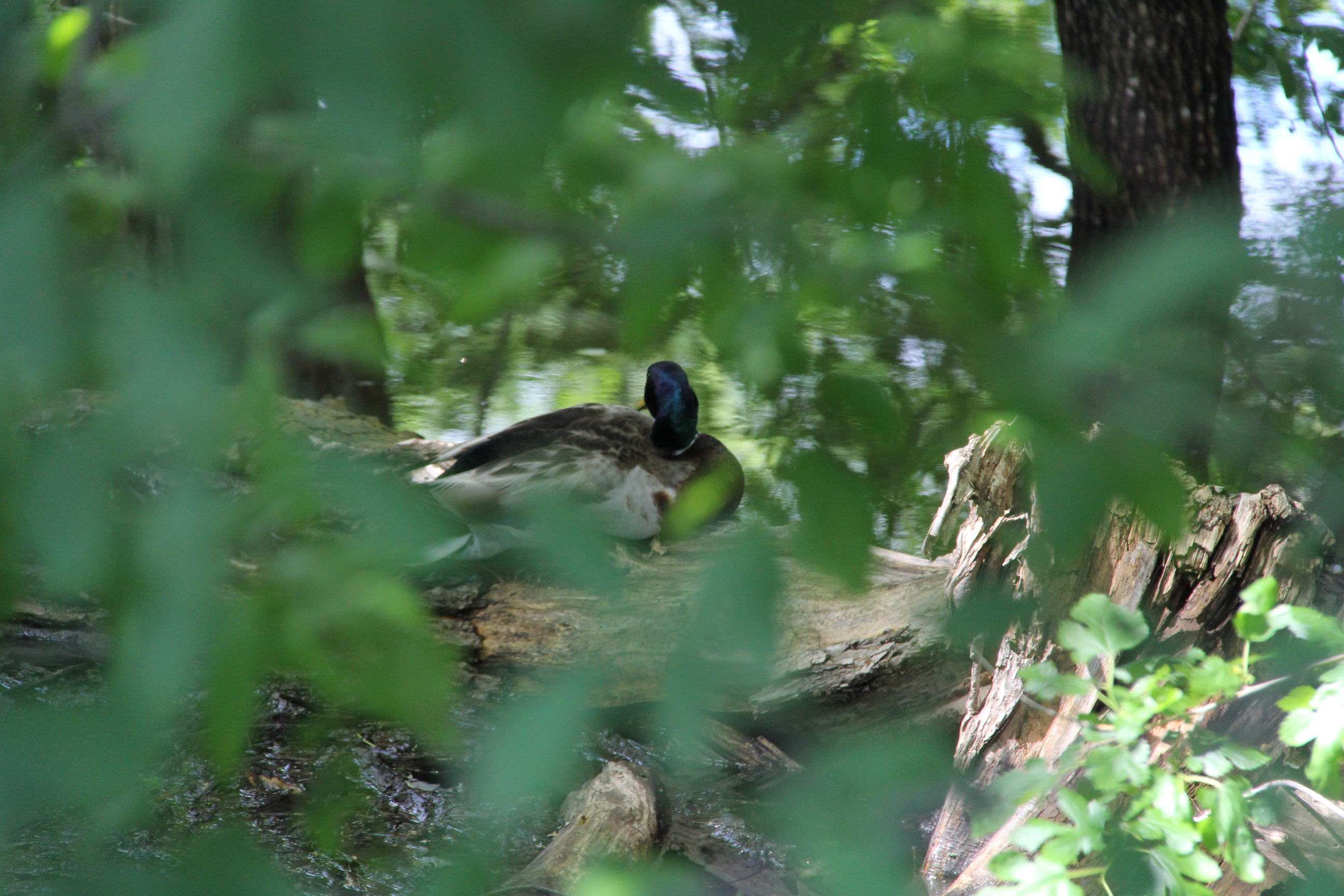
A mallard drake nearly hidden from view along the wooded edge of river backwaters. (Minnesota Prairie Roots copyrighted photo June 2024)
Through a curtain of leaves, I spotted a second drake settled on a fallen limb. Sometimes you have to look closely to notice nature in a natural landscape.
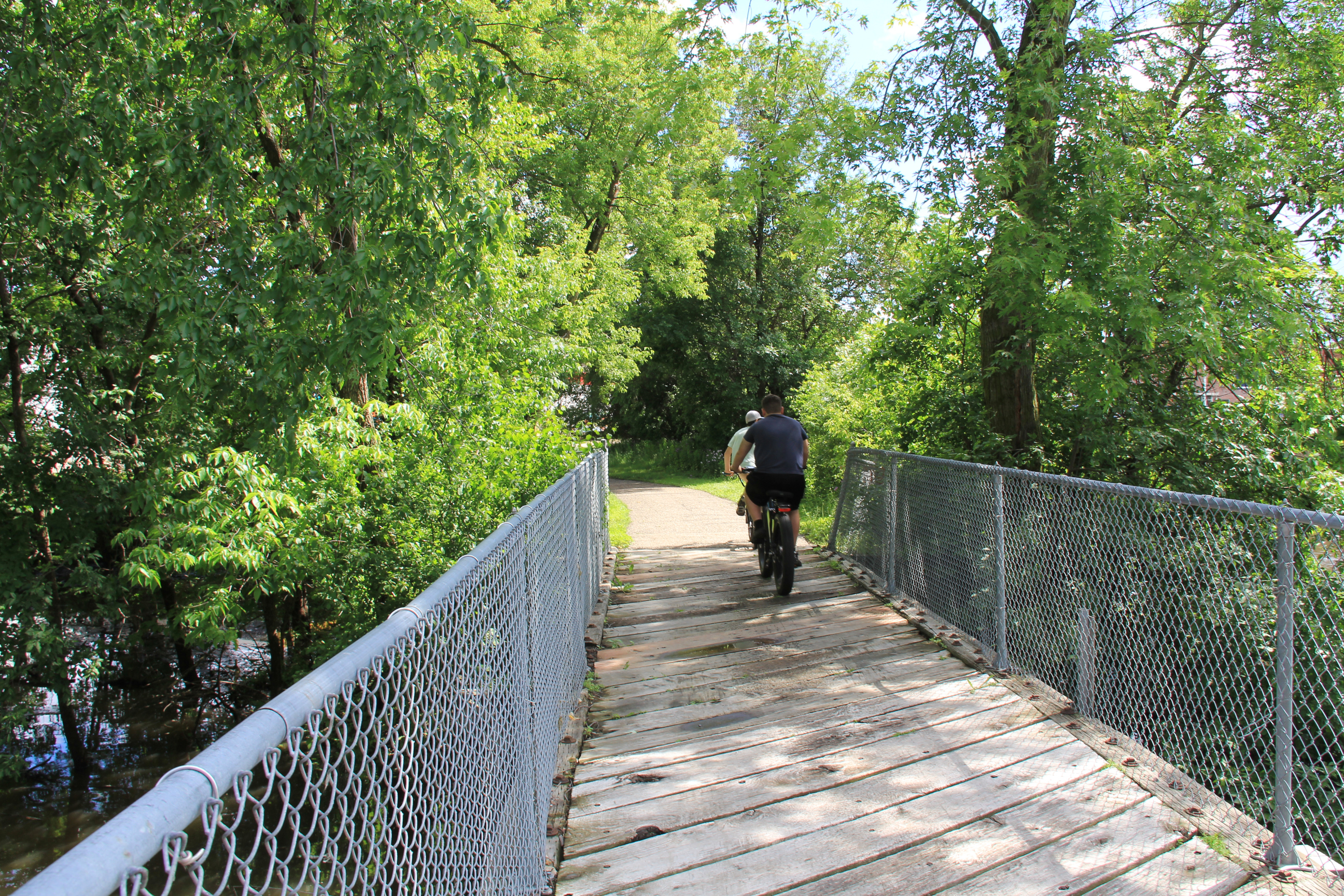
Crossing the river along the Straight River Trail near Two Rivers Park. (Minnesota Prairie Roots copyrighted photo June 2024)
I doubt the two youth pedaling the bike trail across the river bridge, along the river, around the bend beside the woods, noticed.
Two rows of boxcars parked near the former Faribault Canning Company by the Straight River Trail were painted with graffiti. (Minnesota Prairie Roots copyrighted photo June 2024)
They likely noticed the parked boxcars, though, painted with graffiti. Bold. Vivid. Graphics seemingly screaming for attention. Messages undecipherable to me. Street art. Public art. Boxcar art. Perhaps even some gang graffiti.
The rushing, rippling Straight River by the Straight River Trail near Fleckenstein Bluffs Park. (Minnesota Prairie Roots copyrighted photo June 2024)
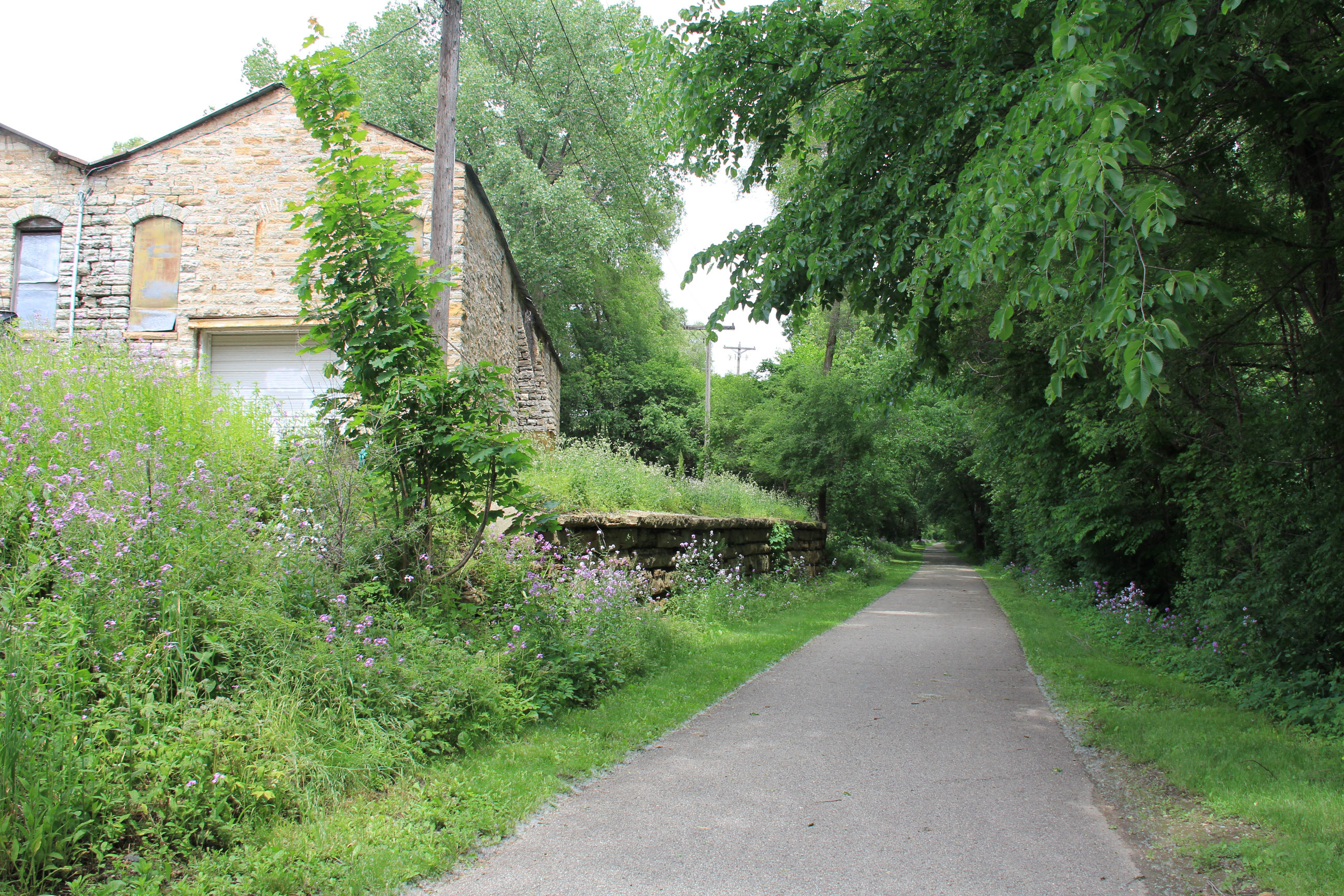
A portion of the Straight River Trail that runs through Faribault. (Minnesota Prairie Roots copyrighted photo June 2024)
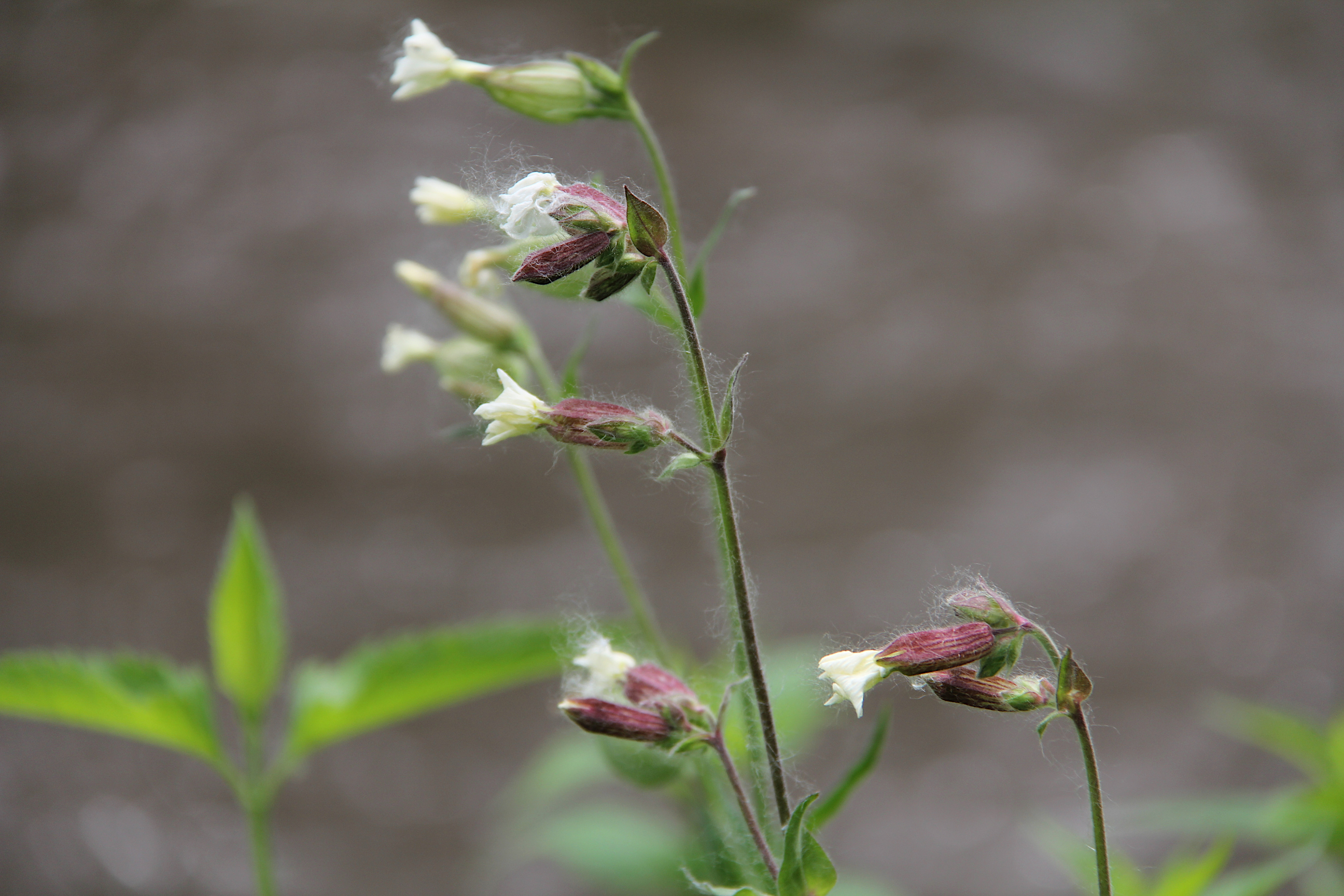
Wildflowers grow along the Straight River bank. (Minnesota Prairie Roots copyrighted photo June 2024)
Nature paints her own art in reflections and ripples upon water’s surface, in a canopy of trees draping a trail, in a clump of wildflowers or weeds, depending on perspective.
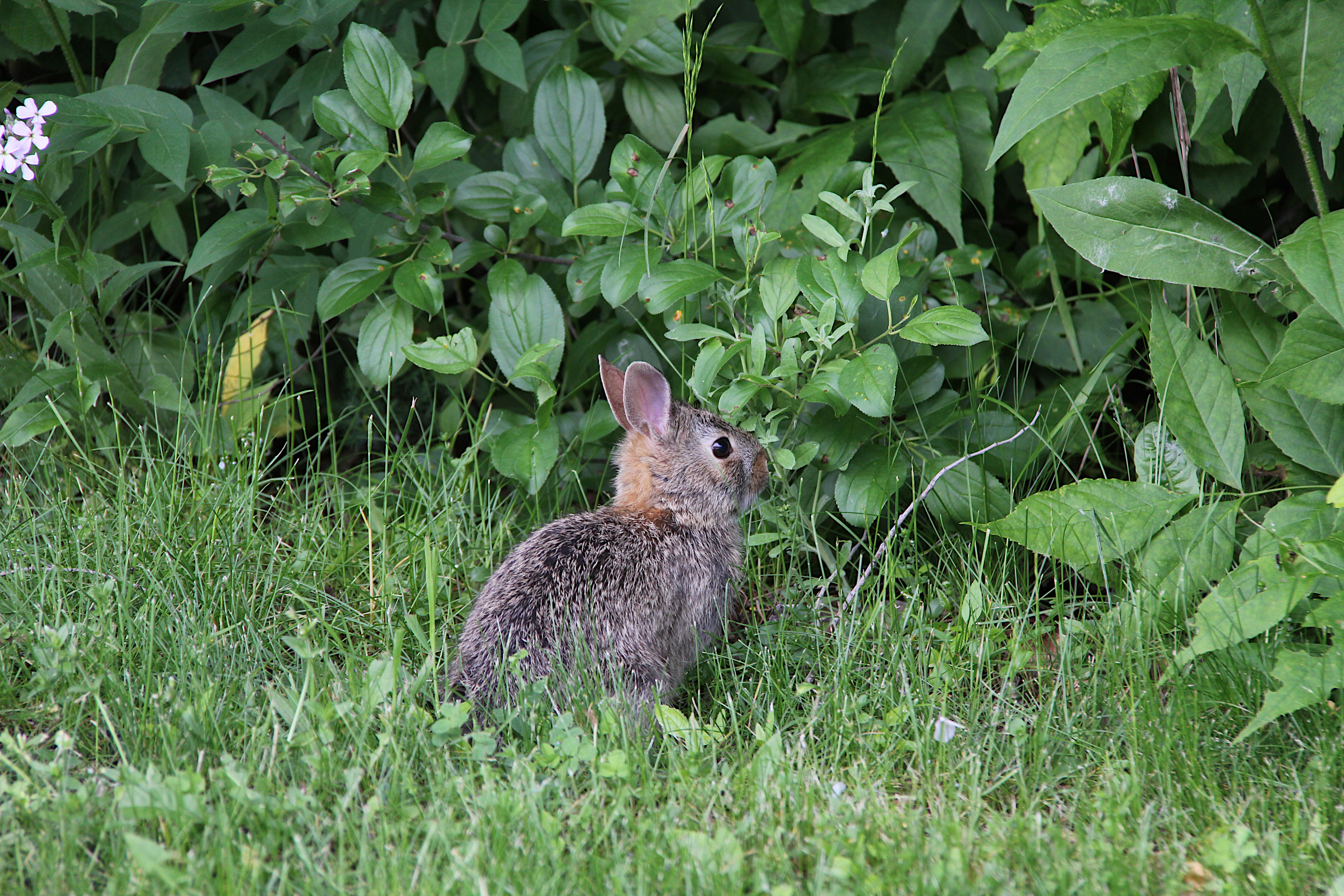
I got mighty close to this rabbit before it hopped away. (Minnesota Prairie Roots copyrighted photo June 2024)
I noticed all of this and a juvenile bunny hunkered at woods’ edge, attempting to appear unseen in a statue still pose. I crept nearer and nearer, clicking my camera until the rabbit eventually decided inaction was likely not the safest option. I posed no threat. But a young creature of the wild doesn’t understand that.
I’m thankful for city parks and trails that give me access to the river and nature in general. (Minnesota Prairie Roots copyrighted photo June 2024)
And so this is what I noticed, along the river. Floral and fauna. Noise of tree frog and nearby traffic. Scared rabbit. Duck upon muddy waters. Paint upon boxcars. Me, trying to find my place in the all of it, here beside the river.
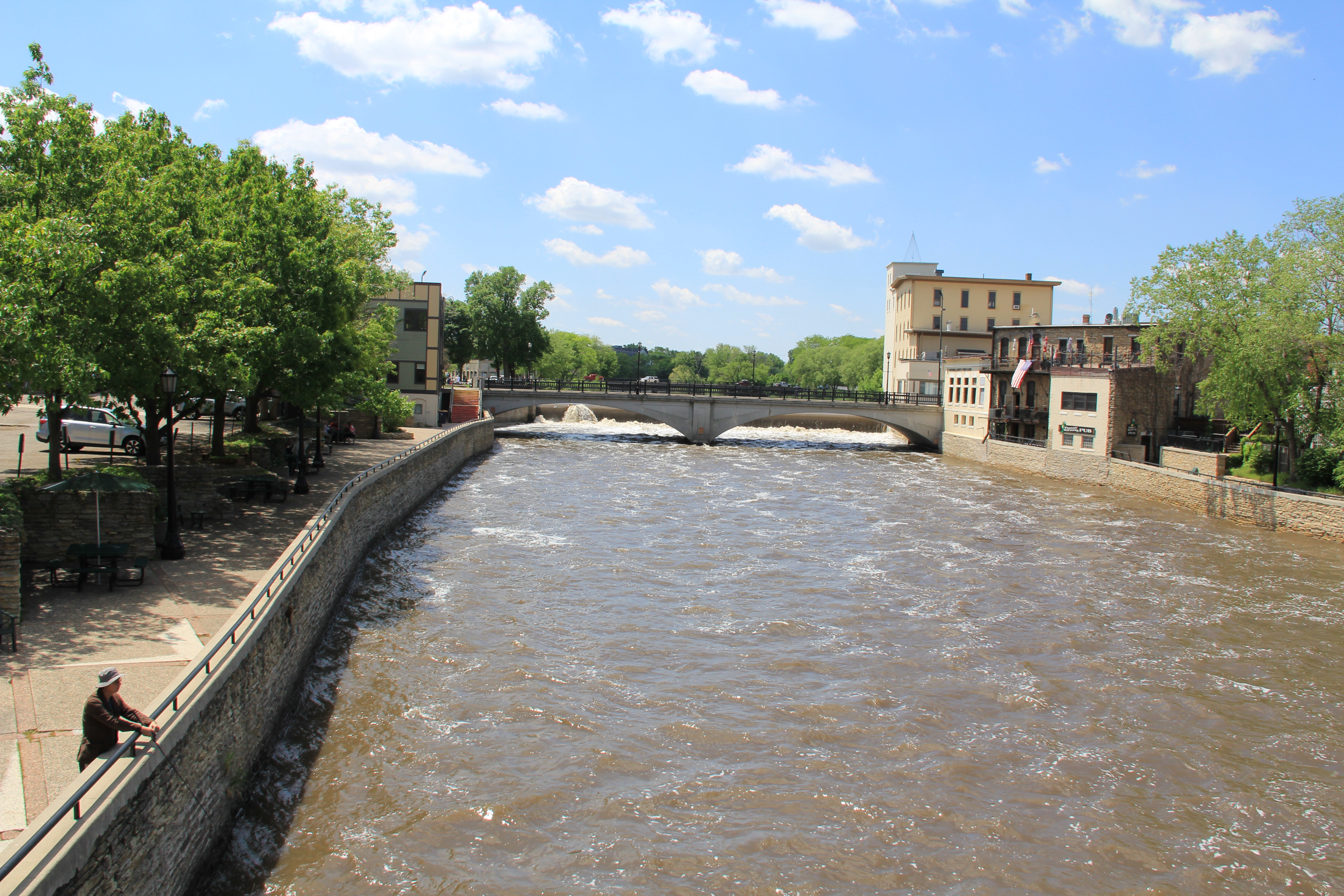
Looking down on the Cannon River from the pedestrian bridge, historic Ames Mill (and dam) in the distance, Riverwalk on each side of the river, where a man fishes, lower left. (Minnesota Prairie Roots copyrighted photo May 2024)
TO WALK ALONGSIDE a river, to watch a river, to hear a river is to experience the arts. A river, with its movement, is like a poetic dance. A river, when roaring over rocks or a dam, is like music. A river, too, is like watercolor flowing fluid and free.
Part of the “Creatures & Features of the Cannon River” art project by Kate Woodstrup and Kathy Larson Ness. (Minnesota Prairie Roots copyrighted photo May 2024)
In Northfield, the Cannon River and art flow one into the other along the Riverwalk in the heart of an historic downtown. This southern Minnesota community, in 2023, highlighted the river and the arts through the Artists on Main Street program. Eight art projects were chosen for these latest public art installments.
Part of the “Meet Me at the River” art. (Minnesota Prairie Roots copyrighted photo May 2024)
Recently I followed the Riverwalk to see the work of several creative placemaking artists. A $25,000 grant from the Minnesota State Arts Board and $10,000 from the City of Northfield 1% for the Arts Program funded last year’s “Meet Me at the River” artwork.
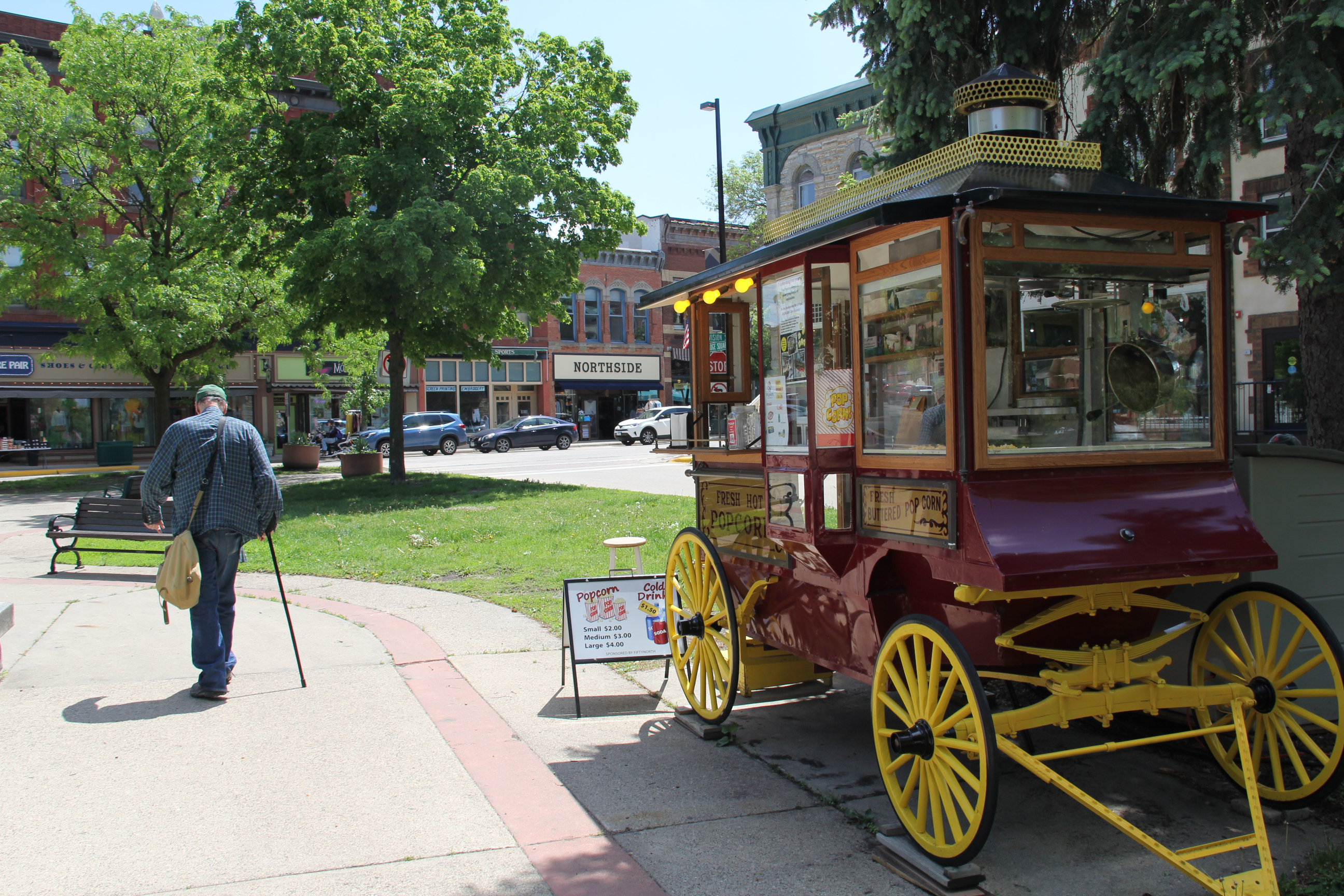
The popcorn wagon, operated by volunteers from FiftyNorth. (Minnesota Prairie Roots copyrighted photo May 2024)
I started at Bridge Square, a community gathering spot along the Cannon. The park centers the downtown business district. It’s a place to picnick, to meet, to buy popcorn from the popcorn wagon, to listen to music or to simply enjoy the outdoors next to the river.
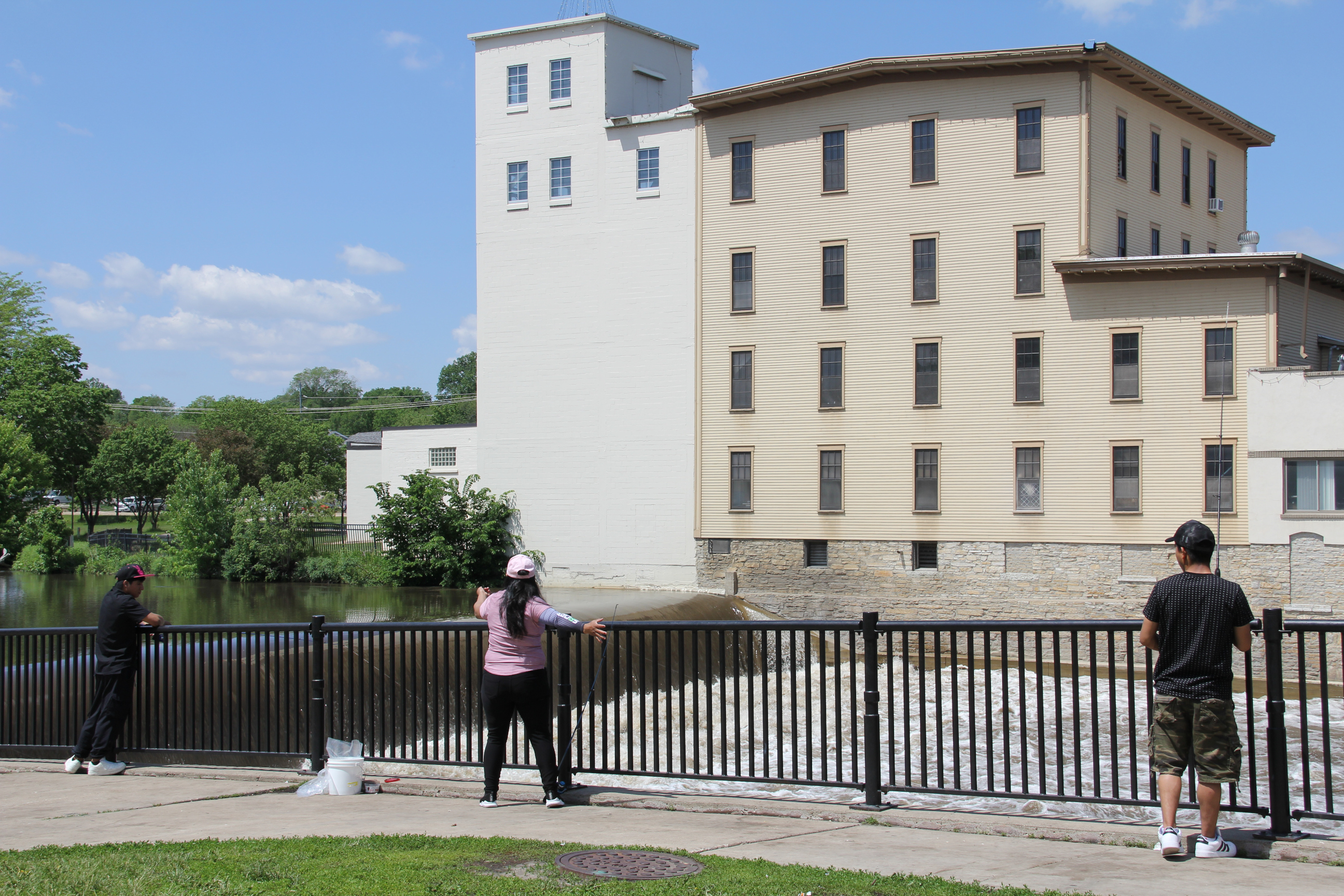
Fishing the Cannon River at the Ames Mill Dam. (Minnesota Prairie Roots copyrighted photo May 2024)
Here water rushes over a dam next to the historic Ames Mill. Anglers dangle lines in the water from the Riverwalk. It’s a popular fishing spot. Definitely a “Meet Me at the River” site.
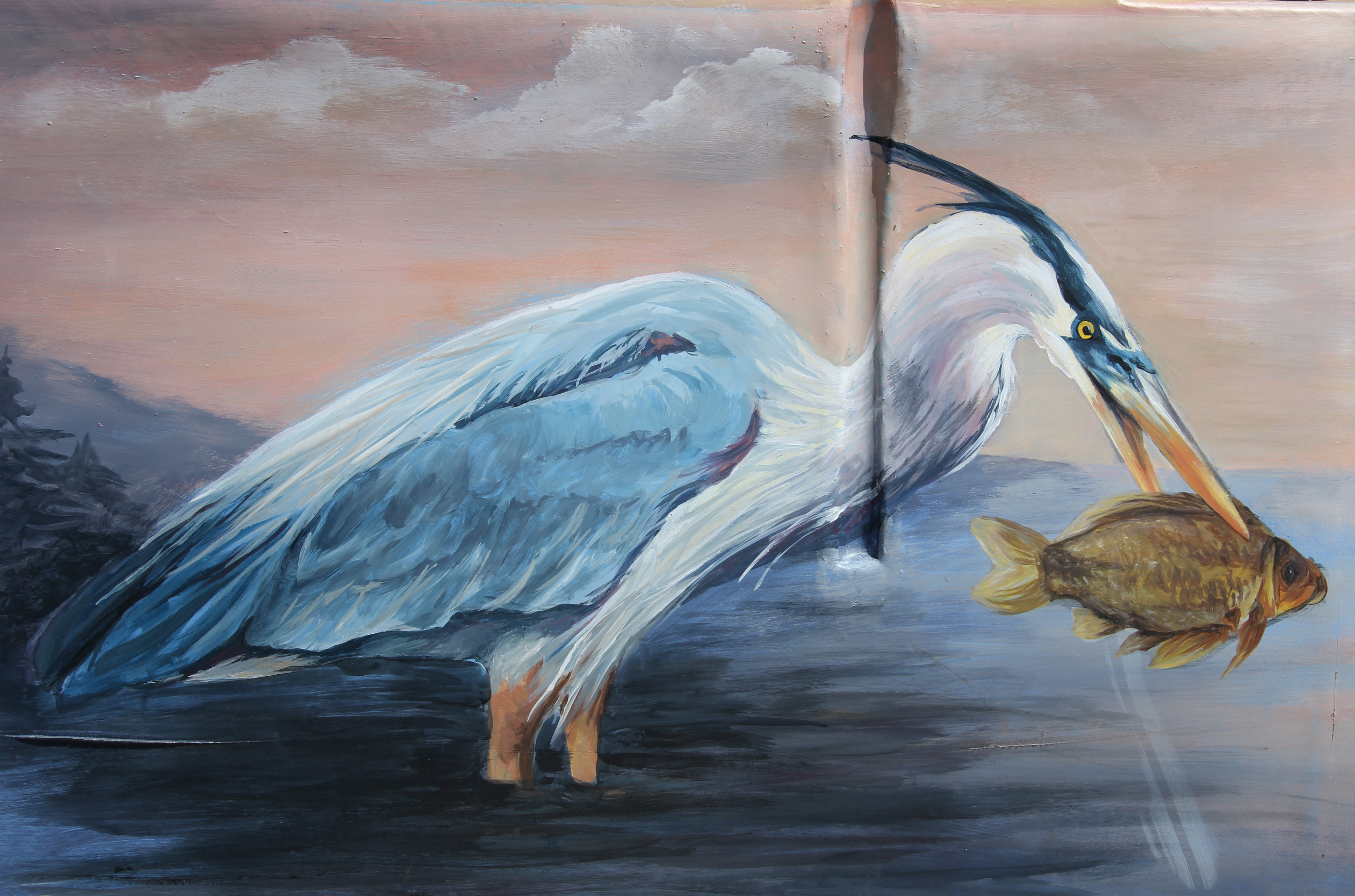
Blue heron art for “Creatures & Features.” (Minnesota Prairie Roots copyrighted photo May 2024)
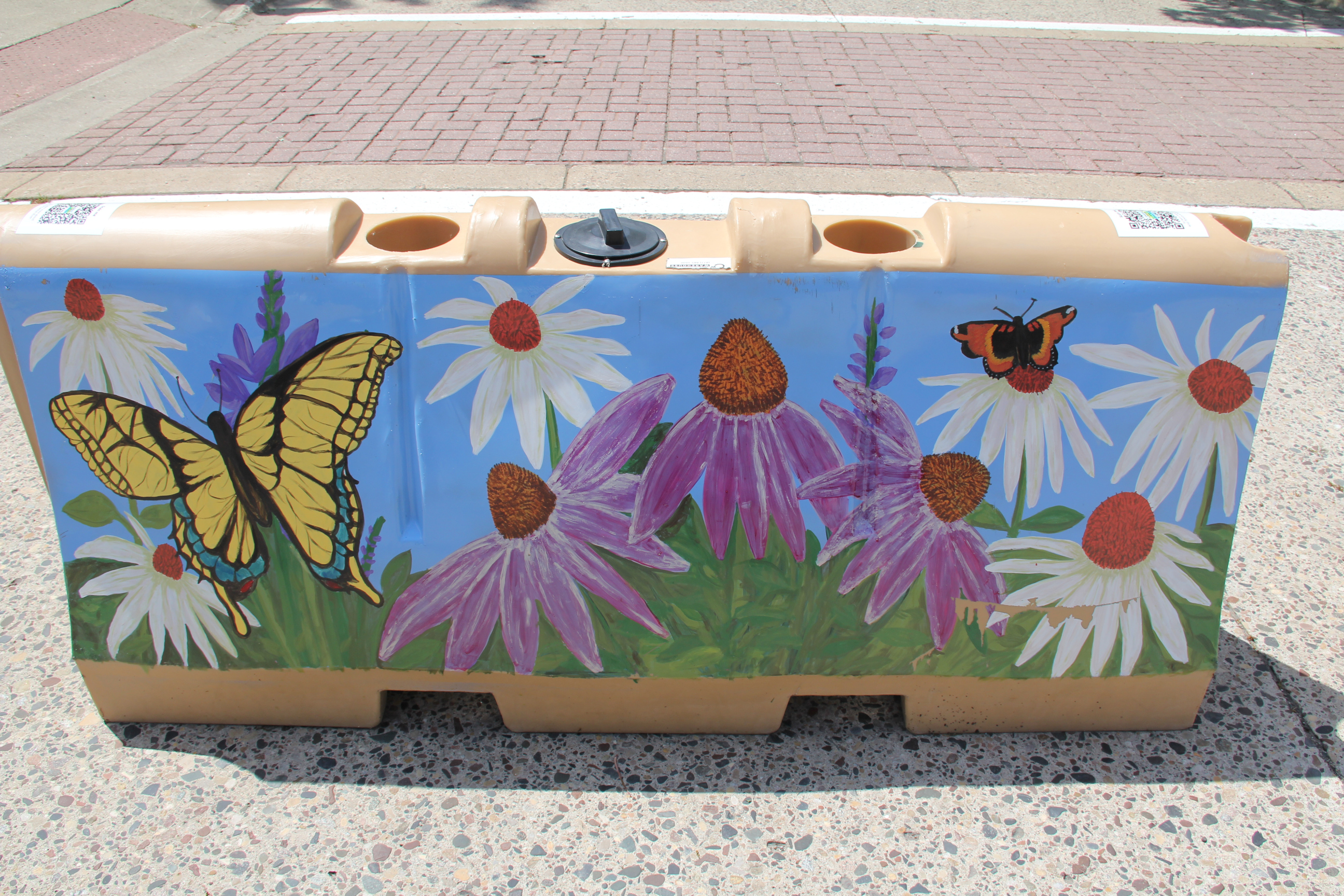
Butterflies and plants native to the Cannon River area. (Minnesota Prairie Roots copyrighted photo May 2024)
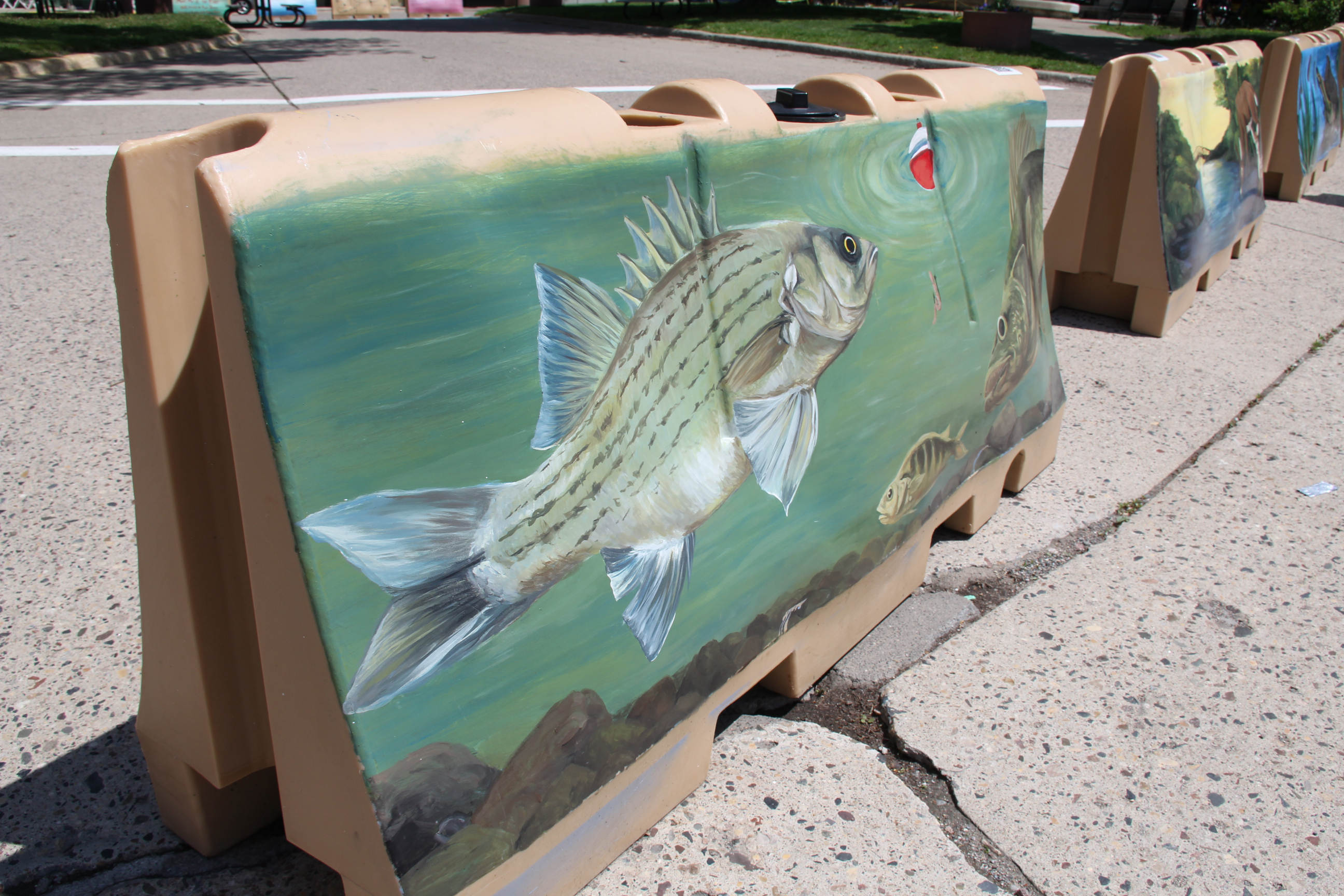
Among fish found in the Cannon, striped bass. (Minnesota Prairie Roots copyrighted photo May 2024)
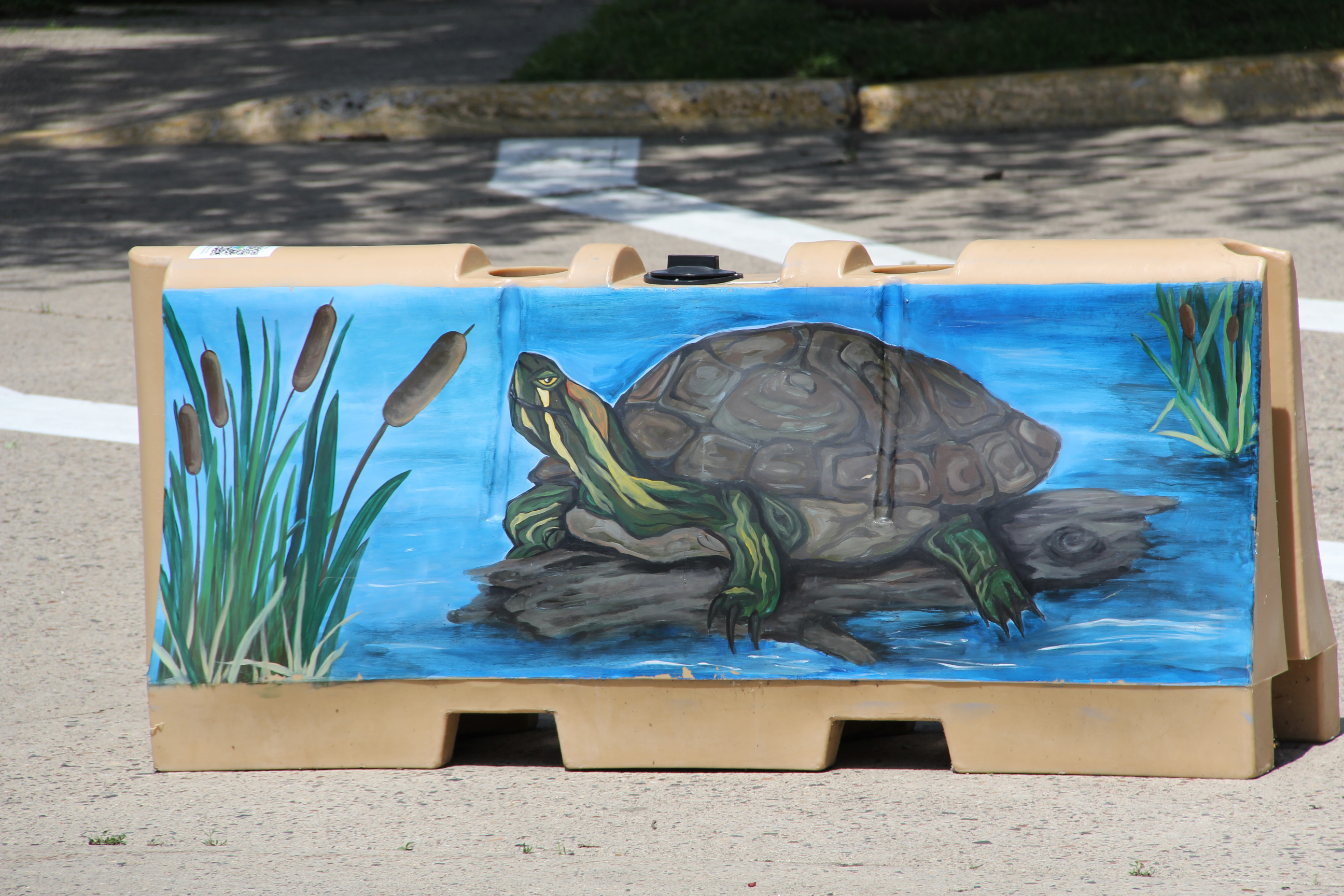
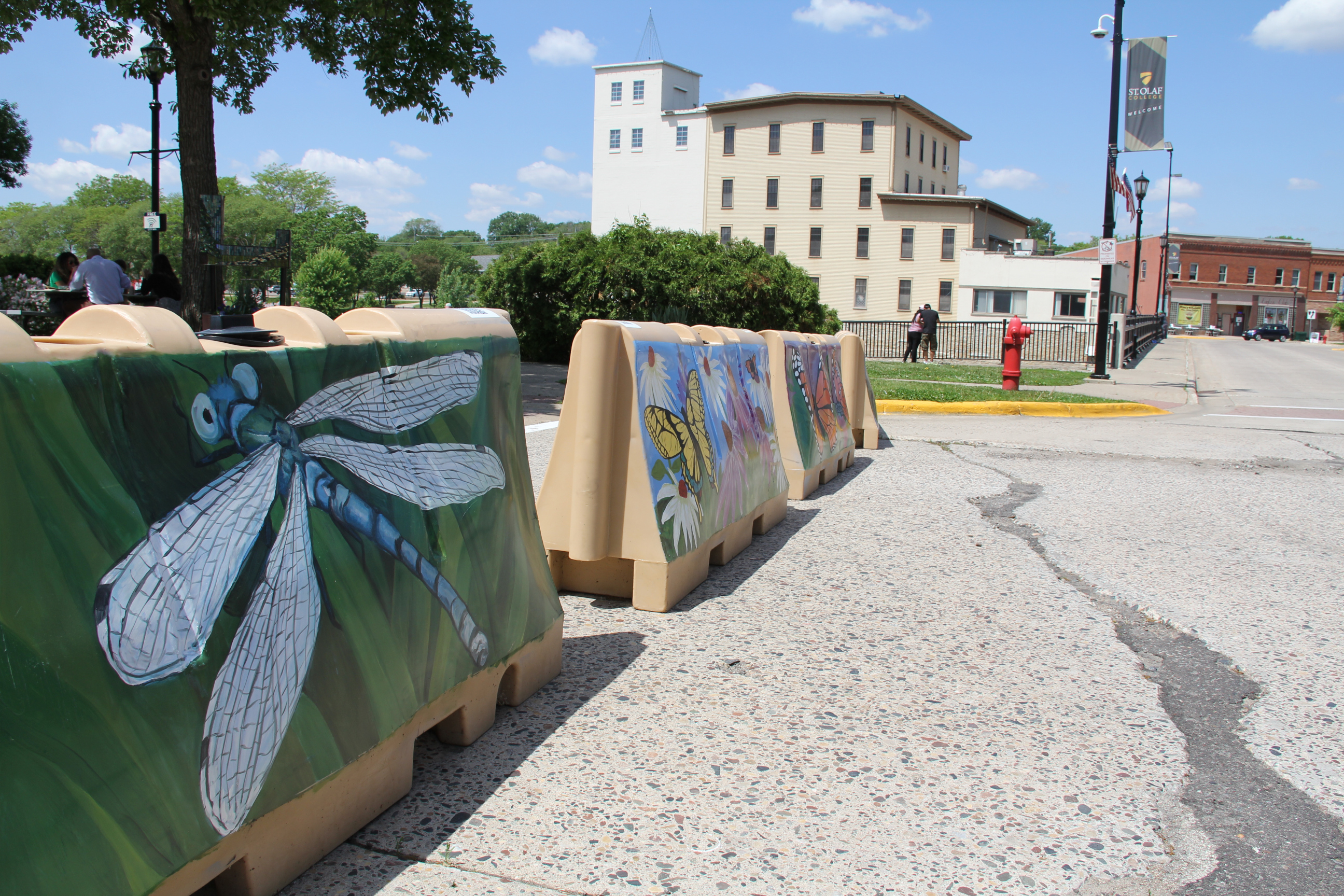
Artists Kate Woodstrup and Kathy Larson Ness added their art to Bridge Square via “Creatures & Features of the Cannon River” painted onto 11 plastic barriers that block traffic, keeping the square safe for pedestrians. A striped bass, blue heron, turtle, beavers, deer, frogs, butterflies, a dragonfly, native flowers and grasses, and more showcase life in and along the river. It’s a visual, nature-themed delight appealing to all ages. Part science. Part ecology. Part environmental awareness. Part art.
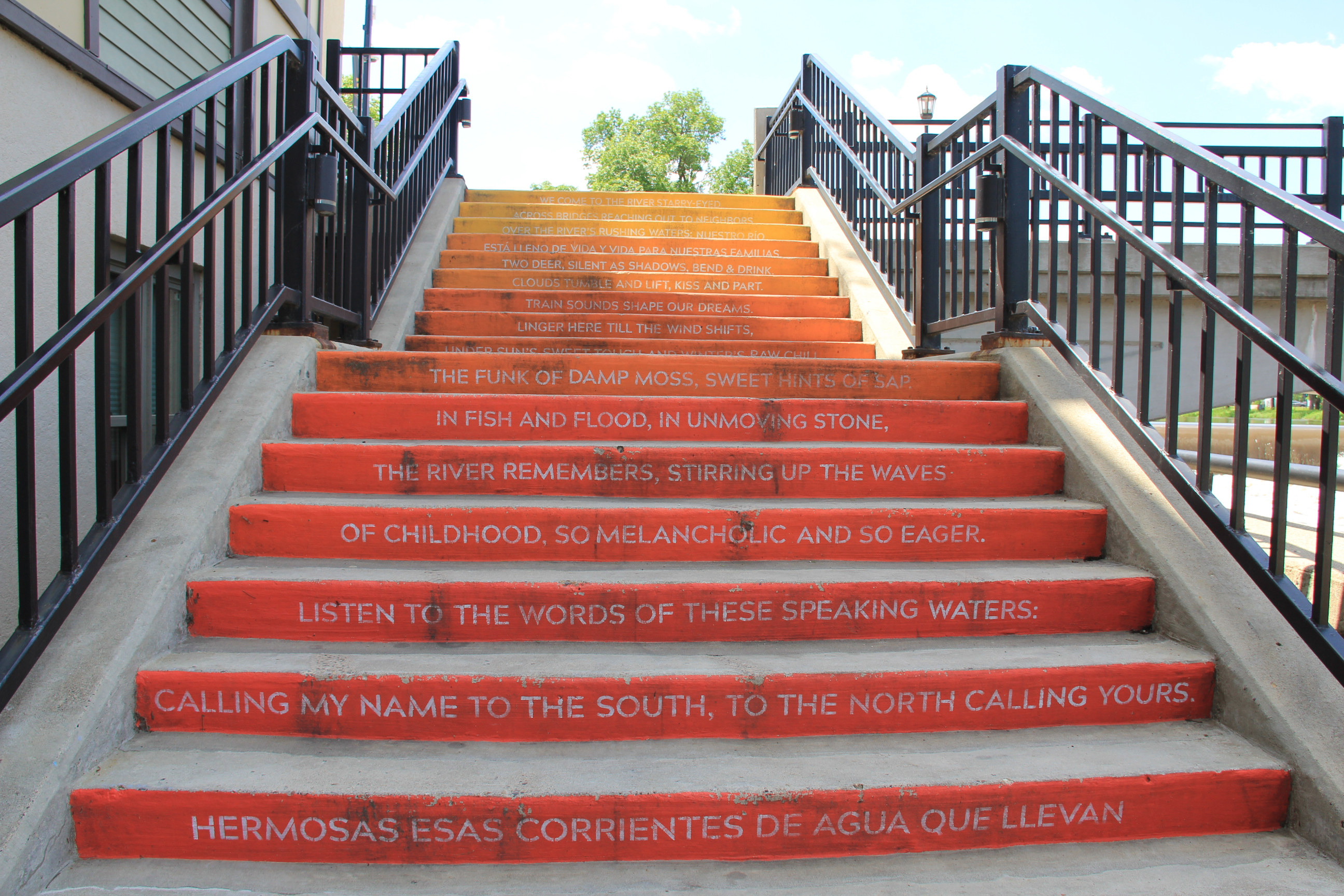
These “Poem Steps” lead up to Bridge Square, down to the Riverwalk. (Minnesota Prairie Roots copyrighted photo May 2024)
From Bridge Square, I aimed north, down the “Poem Steps,” a river poem collaboratively crafted by 17 Northfield poets during a past public arts project. Northfield has a strong community of poets. The city also stamps poetry into concrete as part of the Sidewalk Poetry initiative. The literary arts thrive in this college city.
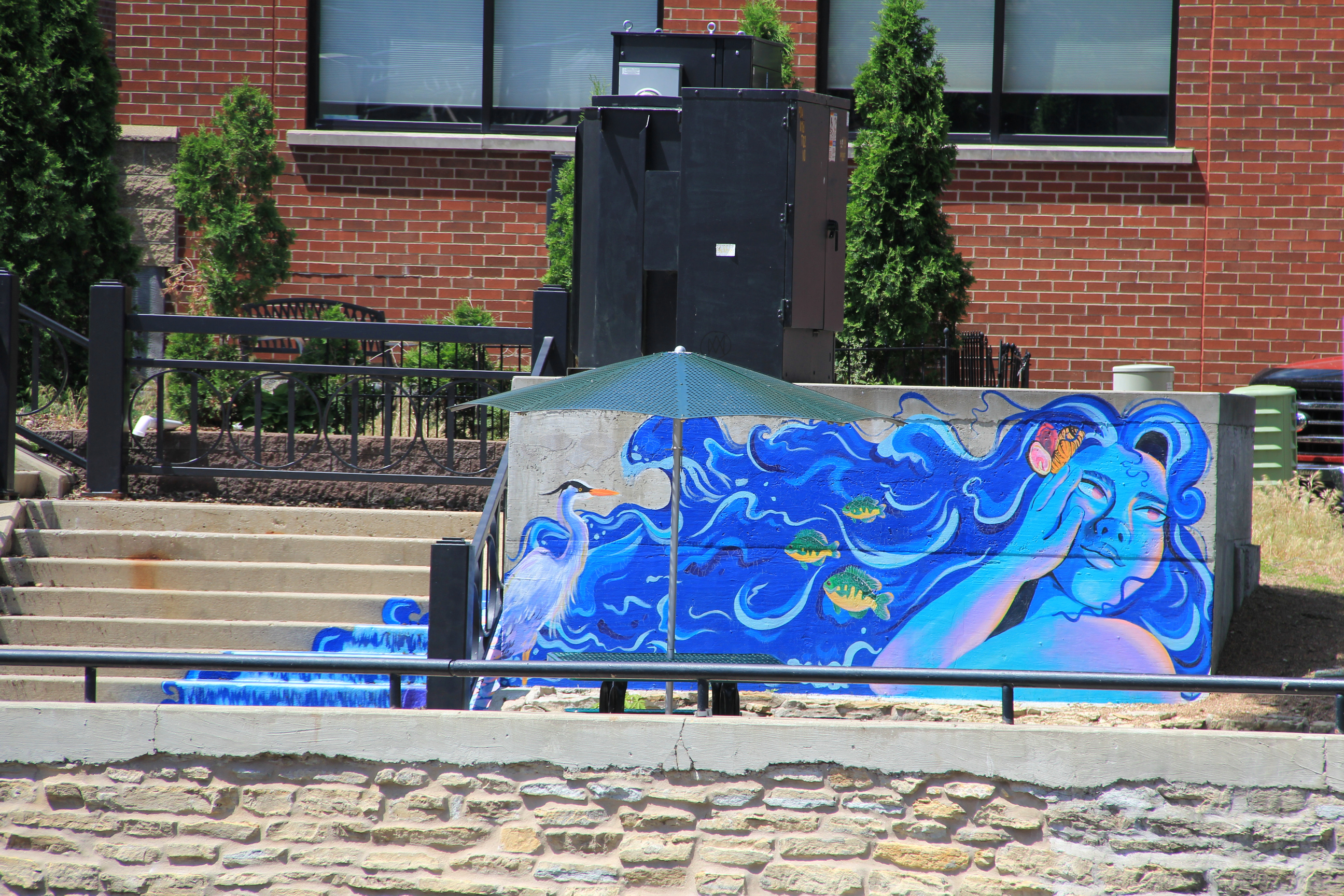
“Lady Cannon” mural on the west side of the river along the Riverwalk. (Minnesota Prairie Roots copyrighted photo May 2024)
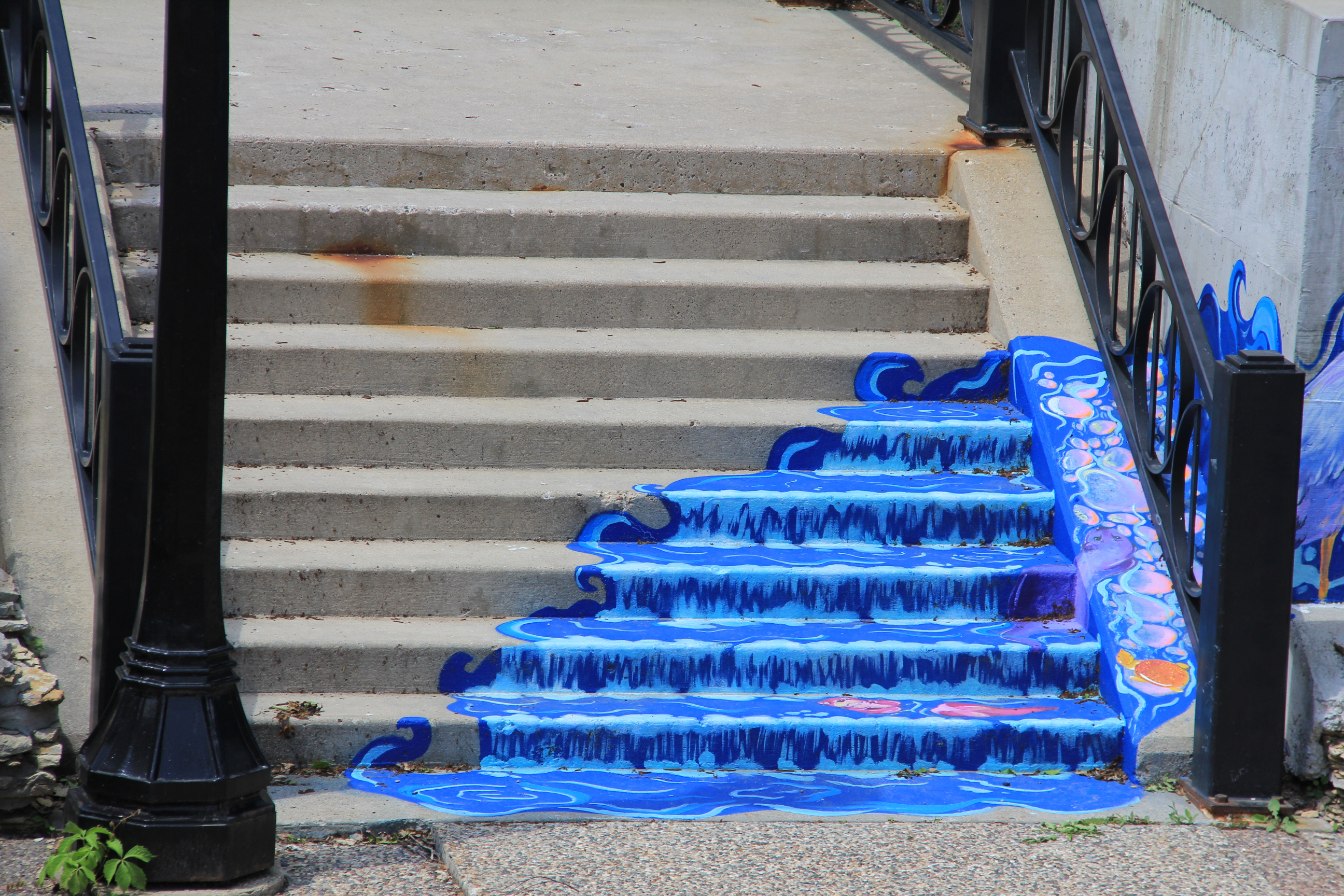
The goddess’ hair, like water, spills down steps. (Minnesota Prairie Roots copyrighted photo May 2024)
Next up, I spotted a colorful mural across the river. Maya Kenney and Raquel Santamaria created “Lady Cannon,” a water goddess whose flowing blue hair depicts the river. Fish weave into her locks and a heron stands riverside. This personification of the river connects people to the Cannon on a personal level. I crossed the pedestrian bridge for a closer look.
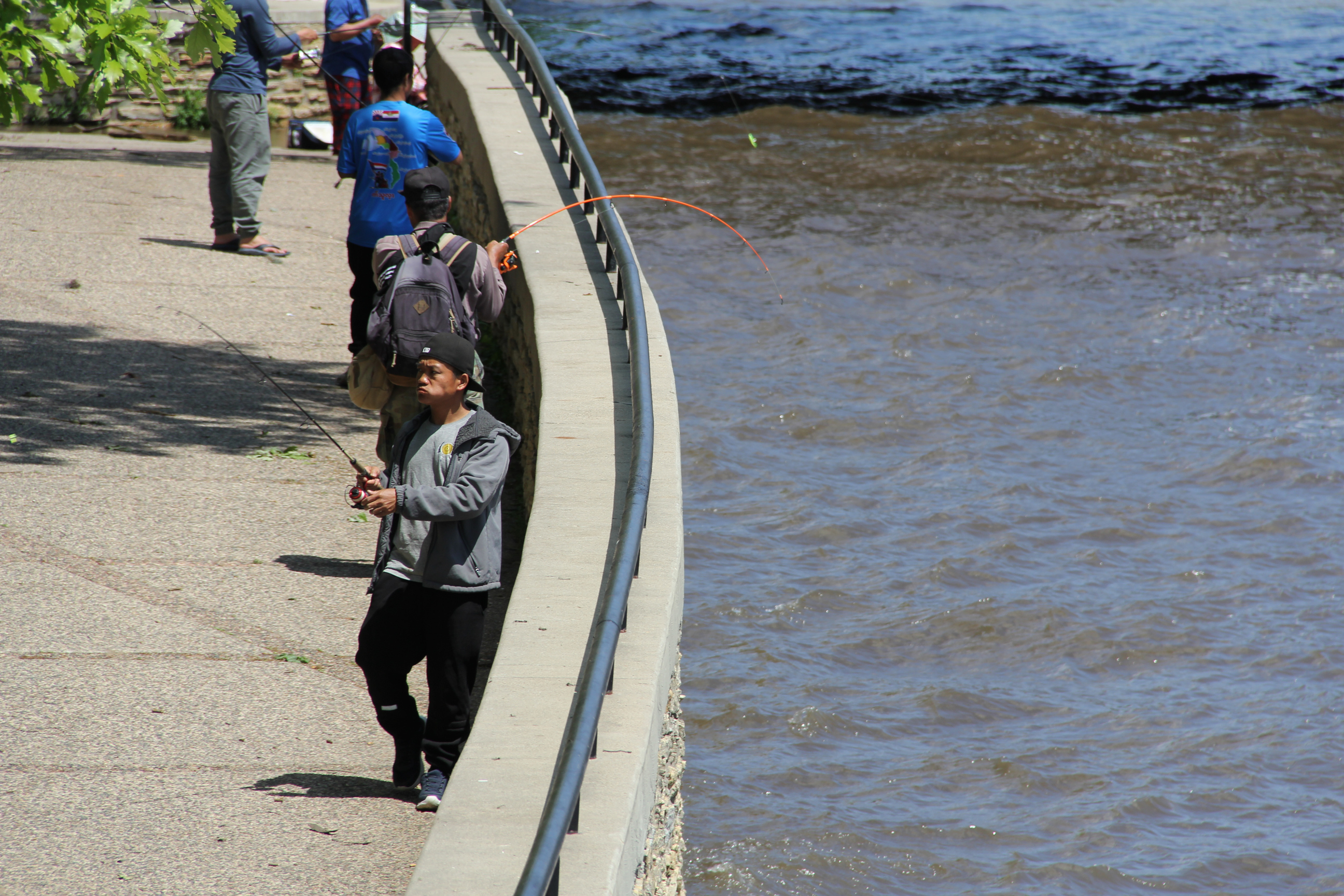
Fishermen line the Riverwalk on a May afternoon to fish the Cannon. (Minnesota Prairie Roots copyrighted photo May 2024)
A short distance from “Lady Cannon,” anglers stood nearly shoulder-to-shoulder fishing the river.
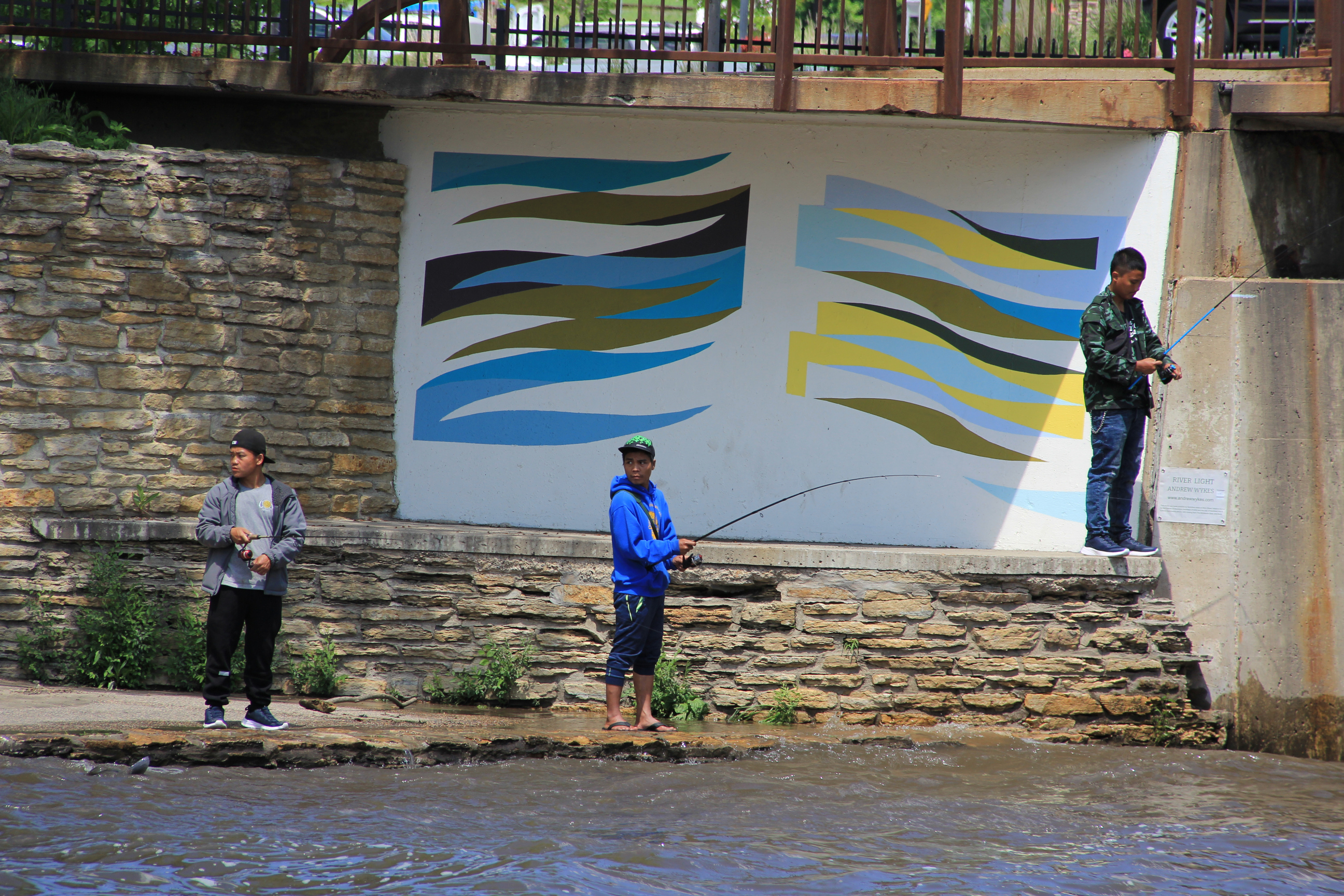
Fishing next to “River Light,” a mural by Andrew Wykes. (Minnesota Prairie Roots copyrighted photo May 2024)
Farther down, under the Second Street bridge, a trio of young men dropped lines in the water against backdrop art created by Andrew Wykes. His simplistic abstract mural, “River Light,” captures the movement, color and beauty of the Cannon River.
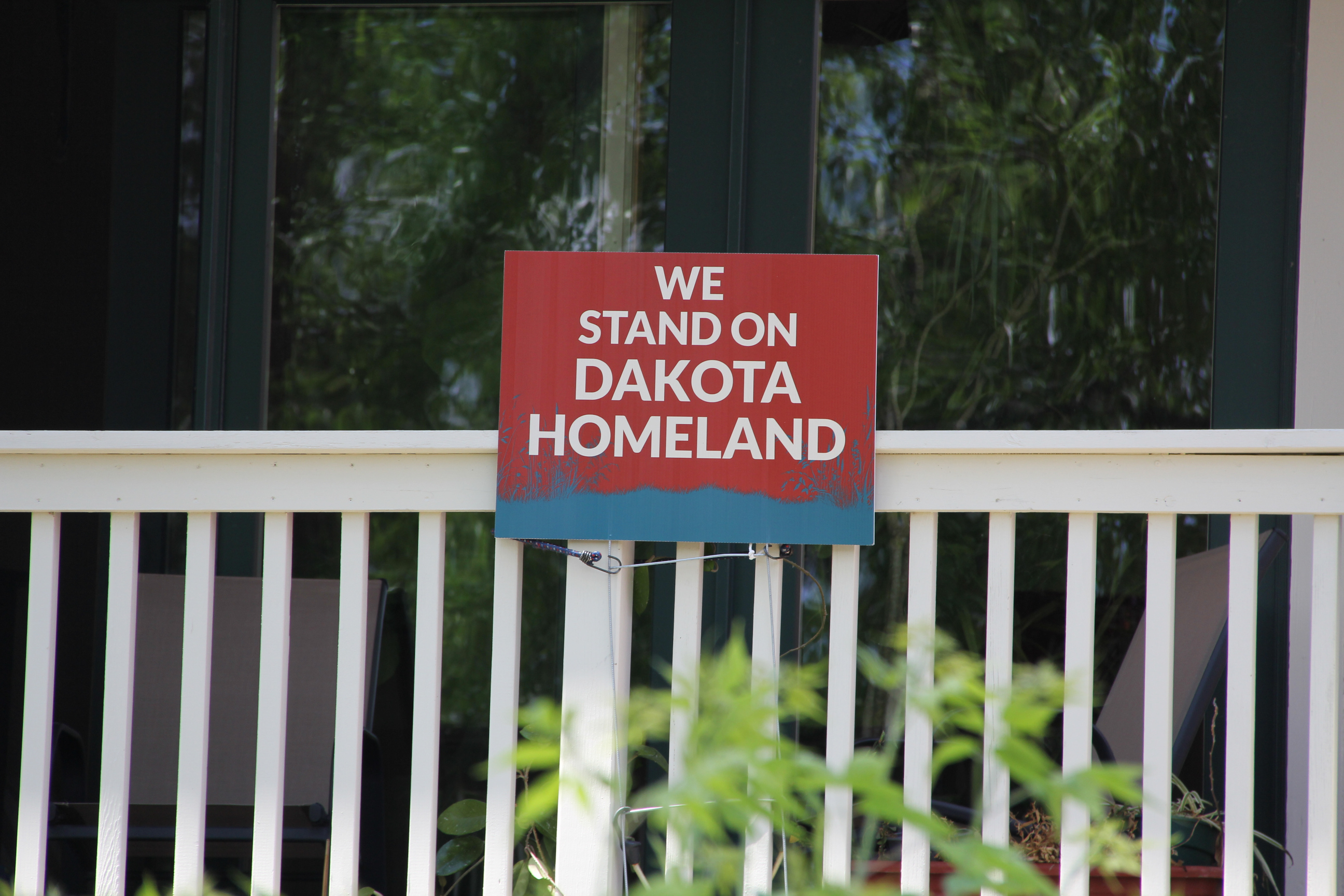
A sign spotted along the Riverwalk recognizes the Dakota’s homeland. (Minnesota Prairie Roots copyrighted photo May 2024)
The relationship between the river and people stretches back to a time long before these artists added their creative interpretations of the river and river life. A bold sign posted on a second story balcony high above the Cannon reads: WE STAND ON DAKOTA HOMELAND. Long before we became “Meet Me at the River,” the Dakota found, followed, fished this river. I appreciate the reminder that Indigenous Peoples were the original inhabitants of this land along the Cannon. They wrote the poetry, heard the music, watched the water dance, experienced the art of the river long before me, long before “Meet Me at the River.”
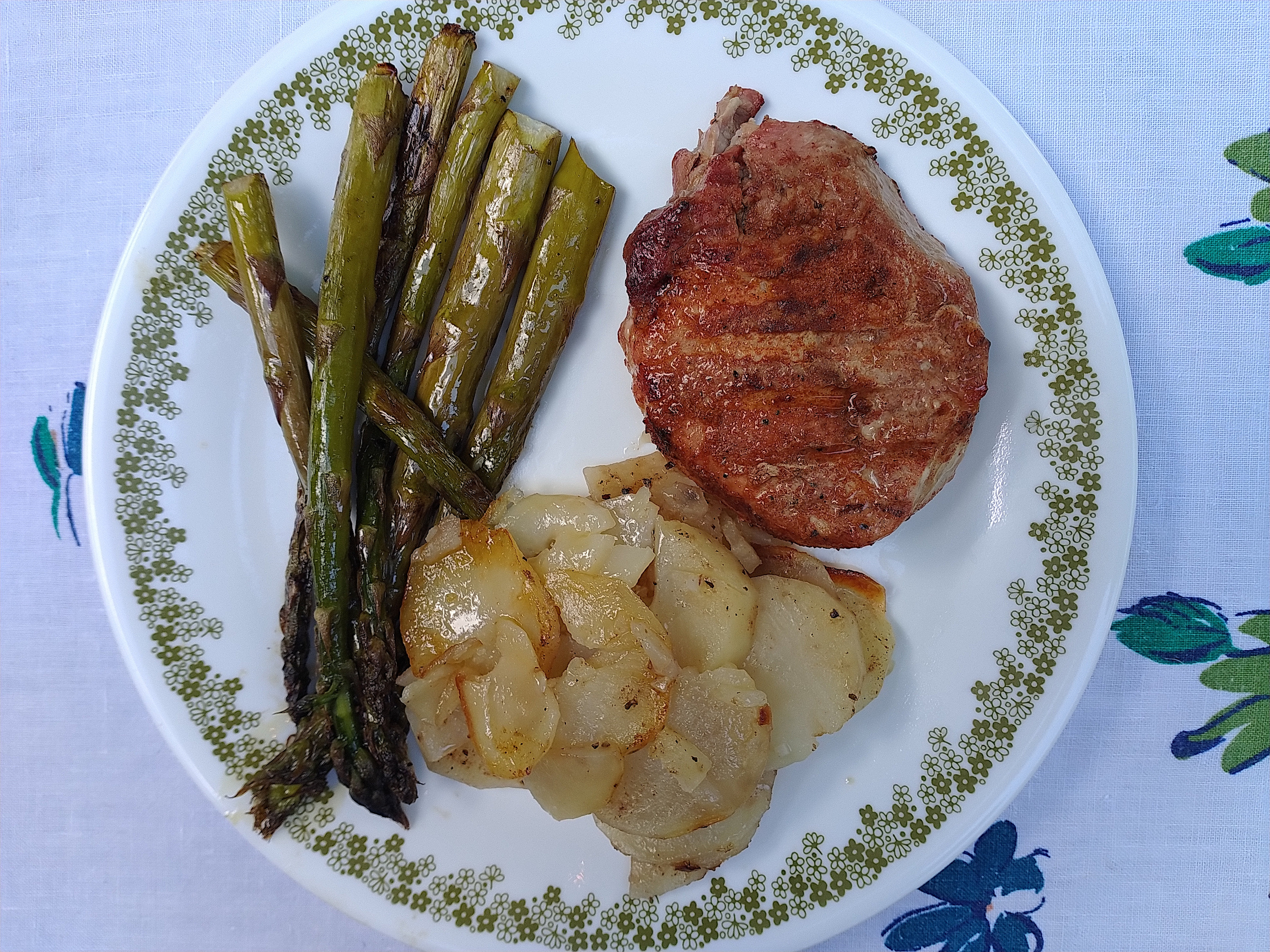
Chops, seasoned potatoes and asparagus made on a charcoal grill and served on my mom’s 1970s Spring Blossom Green Corelle dinnerware, set on a vintage tablecloth. (Minnesota Prairie Roots copyrighted photo June 2024)
SCENT OF GARLIC permeates the air as Randy lifts the lid from his Weber grill, smoke momentarily pouring out. He flips the pork chops, adjusts the packets of potatoes and asparagus. I can hardly wait to taste the food he’s preparing. It’s always delicious.
I feel fortunate that my husband enjoys grilling year-round. Yes, even in the depths of a Minnesota winter, although he draws the line on cooking outdoors when a snowstorm rages. I appreciate the break from meal prep. And there’s nothing quite like food cooked over charcoal. Randy is a purist when it comes to grilling. No gas grill for him.
He’s a meat-and-potatoes man. So if I want something beyond the basics, I come up with a vegetable side. On this day, it’s fresh asparagus purchased at the Faribault Farmers’ Market. Asparagus is one of my favorite veggies. I keep it simple, drizzling the spears with olive oil and sprinkling them with freshly ground pepper and sea salt.
We dine outdoors this time of year. Randy carries the card table up from the basement. I select a vintage tablecloth from my vast collection. And then we settle onto lawn chairs grabbed from the garage. Nearby a tabletop fountain, which he gifted me years ago on our wedding anniversary, burbles. It helps mask the constant din of traffic along our busy street.
If the mosquitoes and flies aren’t hovering, it’s a lovely dining experience.
There’s nothing quite like dining alfresco in Minnesota this time of year. If you live in a mostly warm weather state, you perhaps take eating outdoors for granted. I don’t. Once the weather warms here, I prefer to eat outdoors—on our patio or, on the rare occasion we eat out, on a restaurant patio/deck. We also often pack sandwiches, yogurt, fruit and nuts for a picnic lunch at an area park. It’s all about being outside, sunshine warming our backs, breeze brushing our skin, birds singing, lush green filling our vision.
Great food consumed outdoors, now that’s a Minnesota dining experience that feeds body and soul.
Fishing at the dam by Father Slevin Park in Faribault. (Minnesota Prairie Roots copyrighted photo June 2024)
RIVERS REEL US IN, like fish to bait. There’s something about water, especially a river. It’s mesmerizing, soothing, poetic and, right now, rather dangerous.
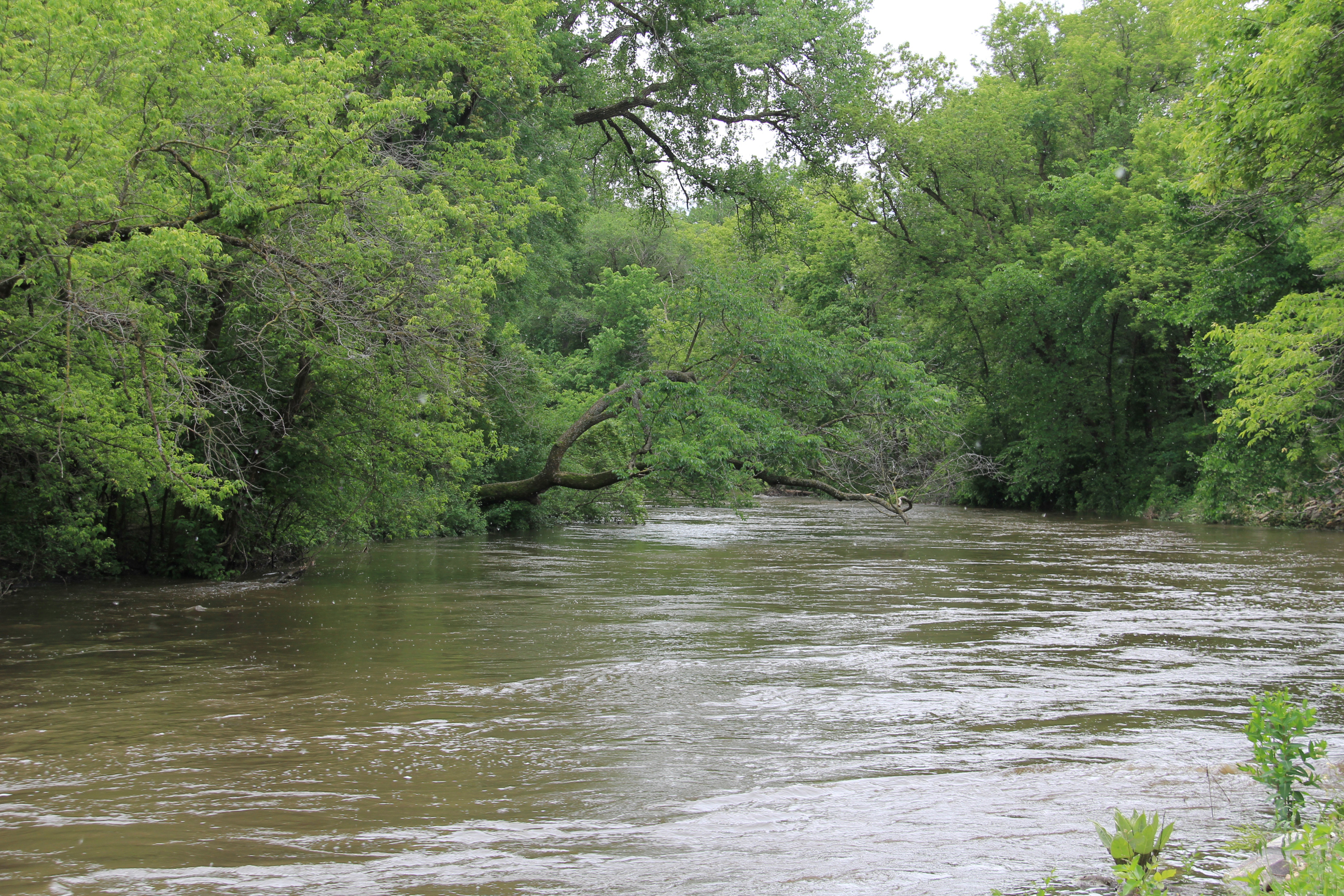
The rushing Straight River, photographed just off the Straight River Trail near Fleckenstein Bluffs Park. (Minnesota Prairie Roots copyrighted photo June 2024)
Recent days found me watching the two rivers—the Cannon and the Straight—which flow through Faribault. They are full to overflowing, muddied and rushing after significant rainfall dropped an unofficial 3.5 inches into my rain gauge over the weekend. That followed weeks of heavy rain.
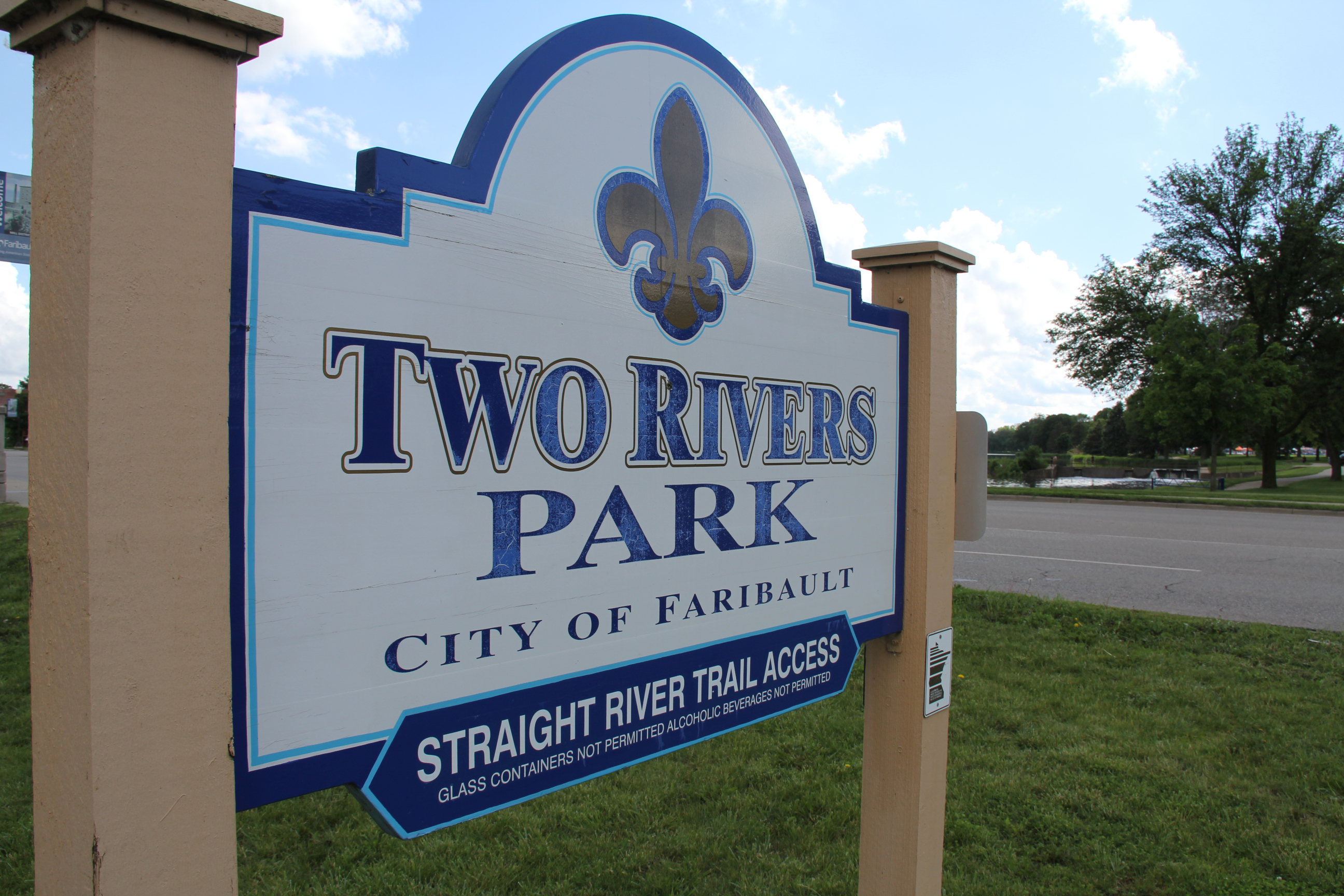
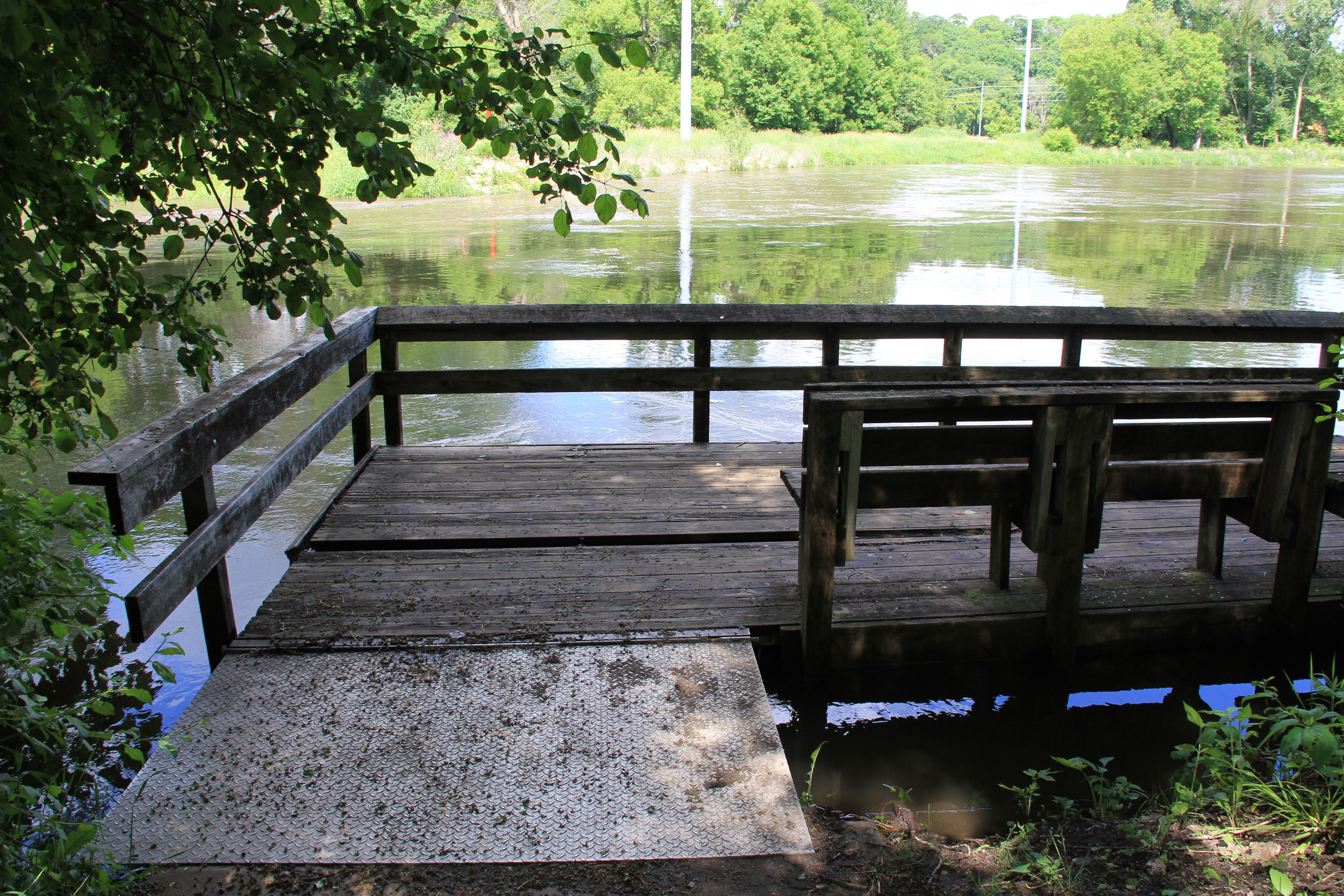
On the day I photographed this dock at Two Rivers Park, it was nearly submerged by the Straight and Cannon Rivers, which meet here. The dock typically sits high above the water. In retrospect, I should have stayed off this dock, which doesn’t seem all that safe. (Minnesota Prairie Roots copyrighted photo June 2024.
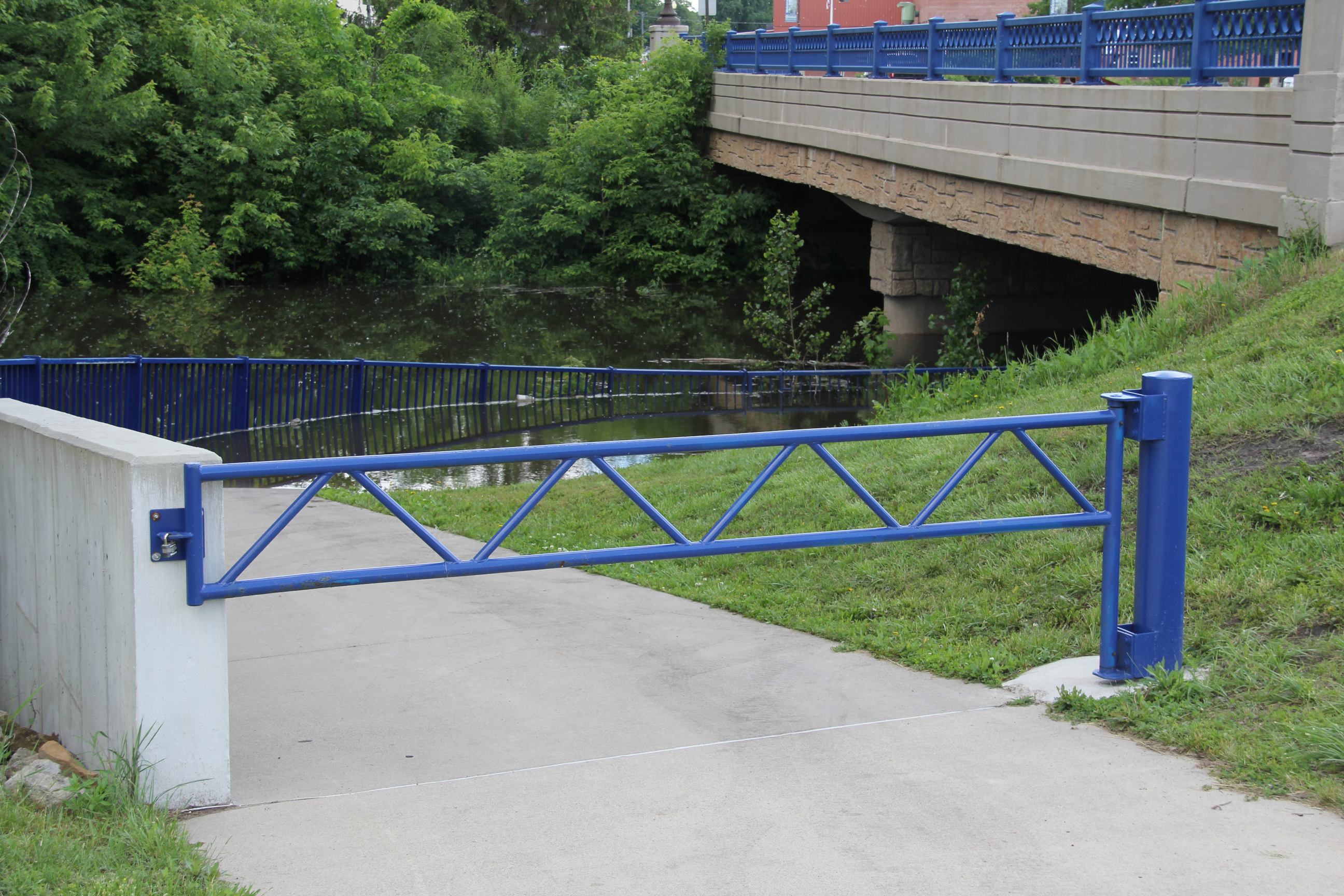
The City of Faribault has closed a section of a recreational trail running under the Second Avenue bridge due to flooding from the Cannon River. (Minnesota Prairie Roots copyrighted photo June 2024)
River levels are high, replenished after a near snow-less winter and the drought of 2023. But enough is enough. We need consistent sunshine and for the rain to stop. And for people to take extra care around fast-moving rivers.
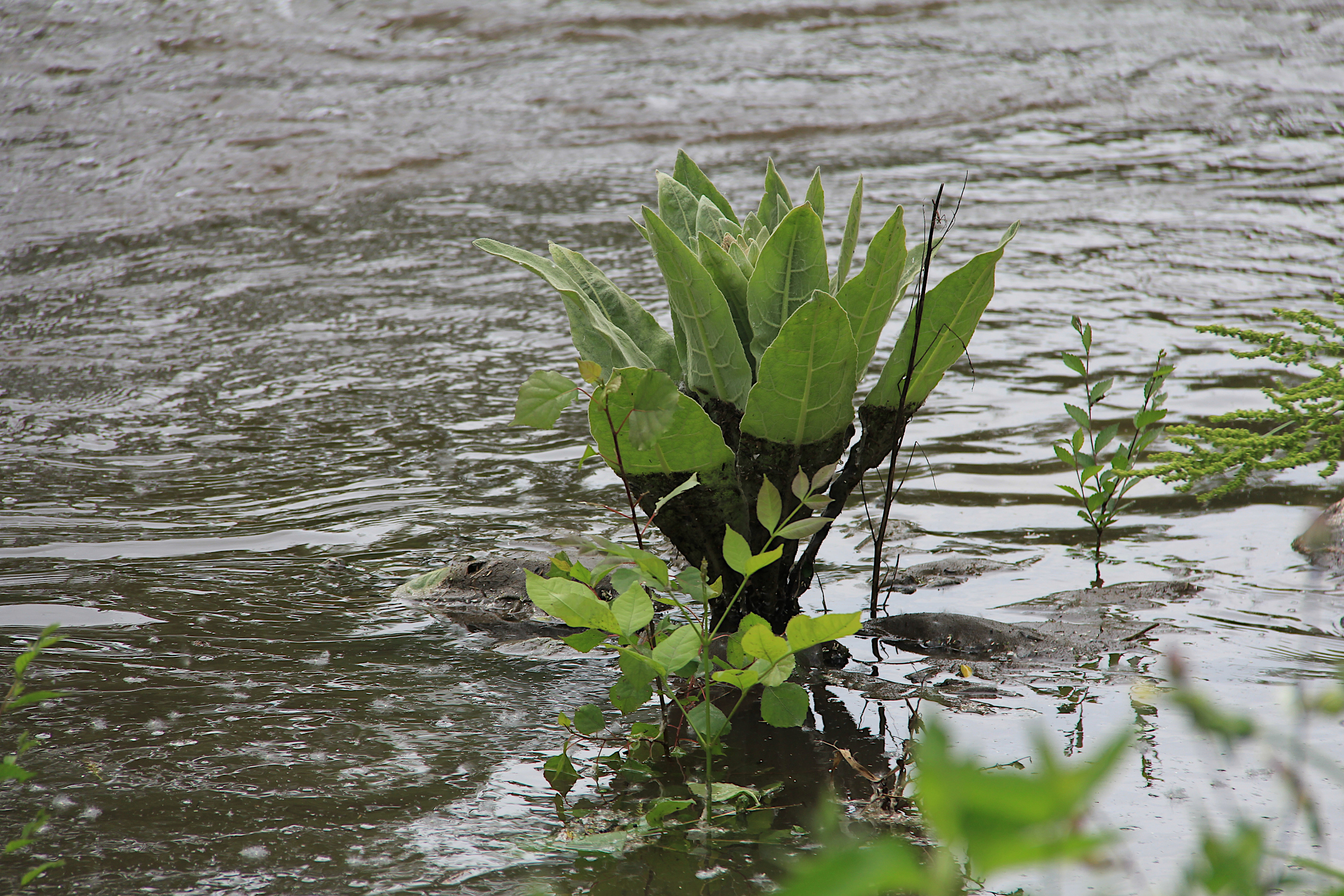
Muddy marks on this plant show how high the roiling Straight River rose, just off the Straight River Trail near Fleckenstein Bluffs Park. (Minnesota Prairie Roots copyrighted photo June 2024)
The Rice County Sheriff’s Department has advised people to be cautious on local waterways and to stay off the Cannon River. Six young people and three adults were recently rescued from the Cannon after their canoes and kayaks overturned. I saw drone footage of rescuers plucking people from the river. They were wearing life jackets, clinging to fallen trees. They got out alive. They were fortunate.
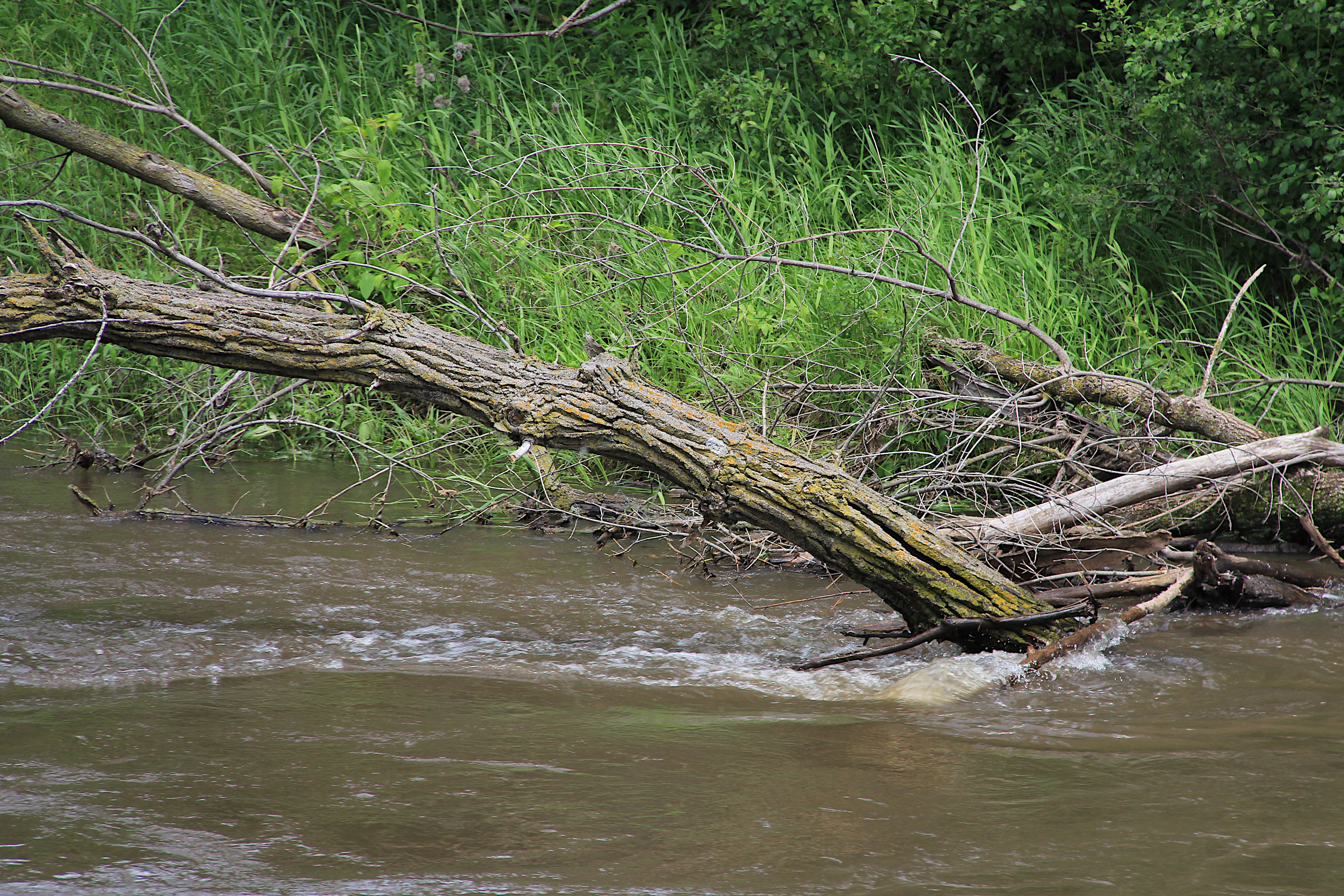
Fallen trees and limbs like these in the Straight River near Fleckenstein Bluffs Park present a hazard to anyone on the water. (Minnesota Prairie Roots copyrighted photo June 2024)
Local rivers are snagged with obstacles, especially trees downed by a 2018 tornado. The current is fast, the water swift-moving, dangers hidden below the surface. Watercraft can easily capsize, turning an outing into tragedy or near tragedy.
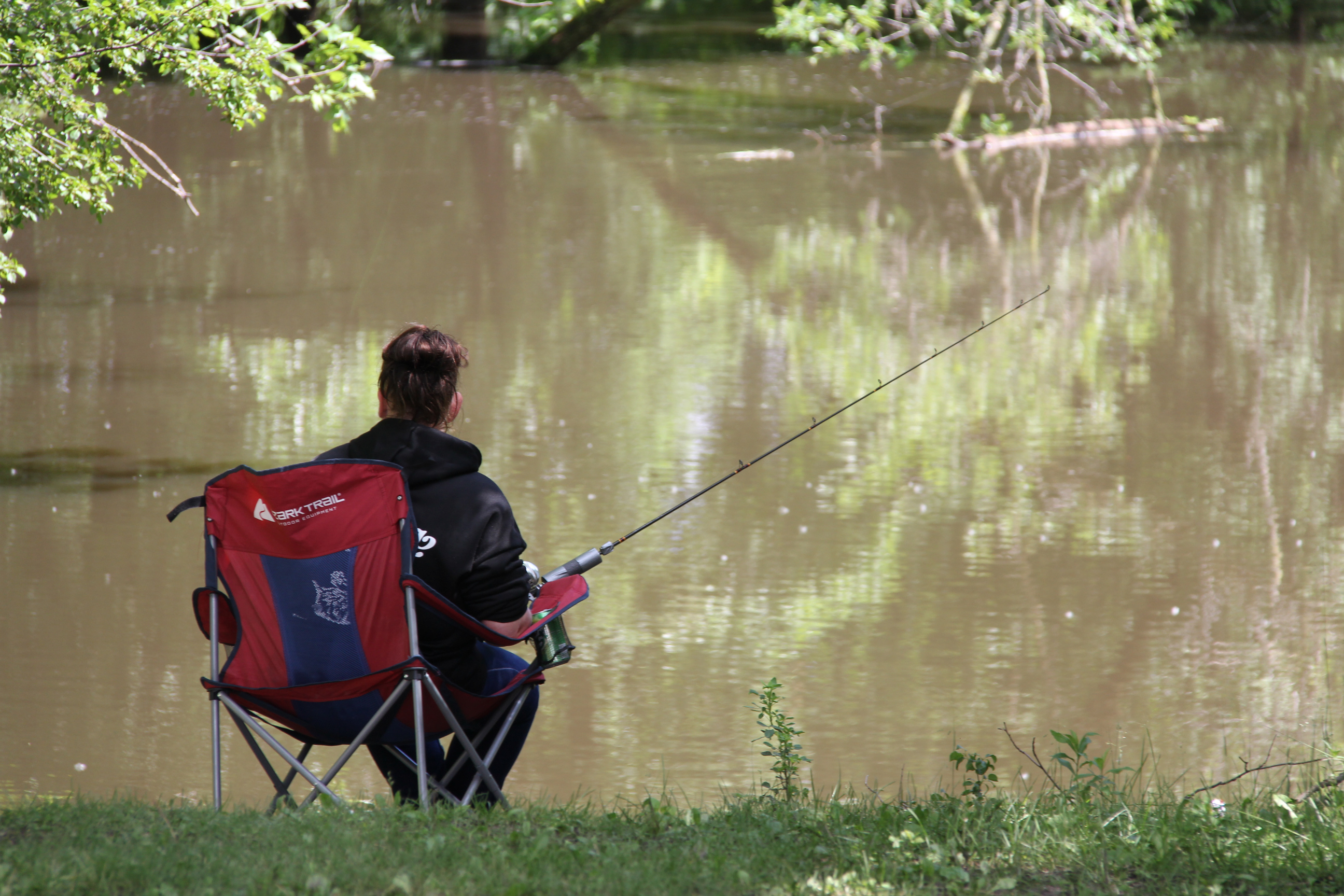
Fishing the muddy Cannon River at Two Rivers Park. (Minnesota Prairie Roots copyrighted photo June 2024)
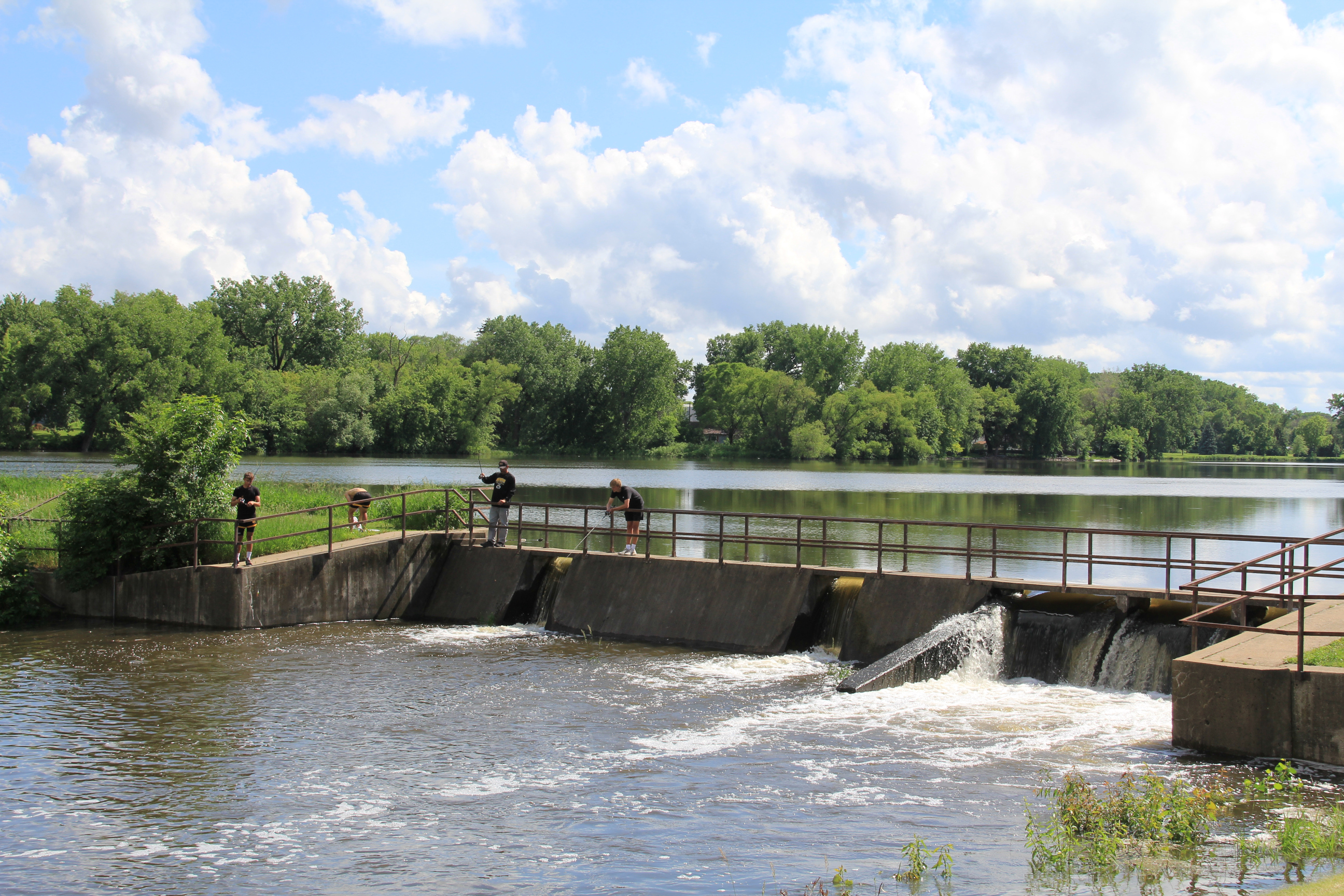
I observed anglers safely fishing along the river bank at Two Rivers Park, above the dam by North Alexander Park and by the Woolen Mill Dam. These have always been popular fishing spots in town, although at Two Rivers most people fish from the dock. That was nearly under water when I stopped by. I didn’t visit the King Mill Dam, but I anticipate anglers were lining the shoreline there also.
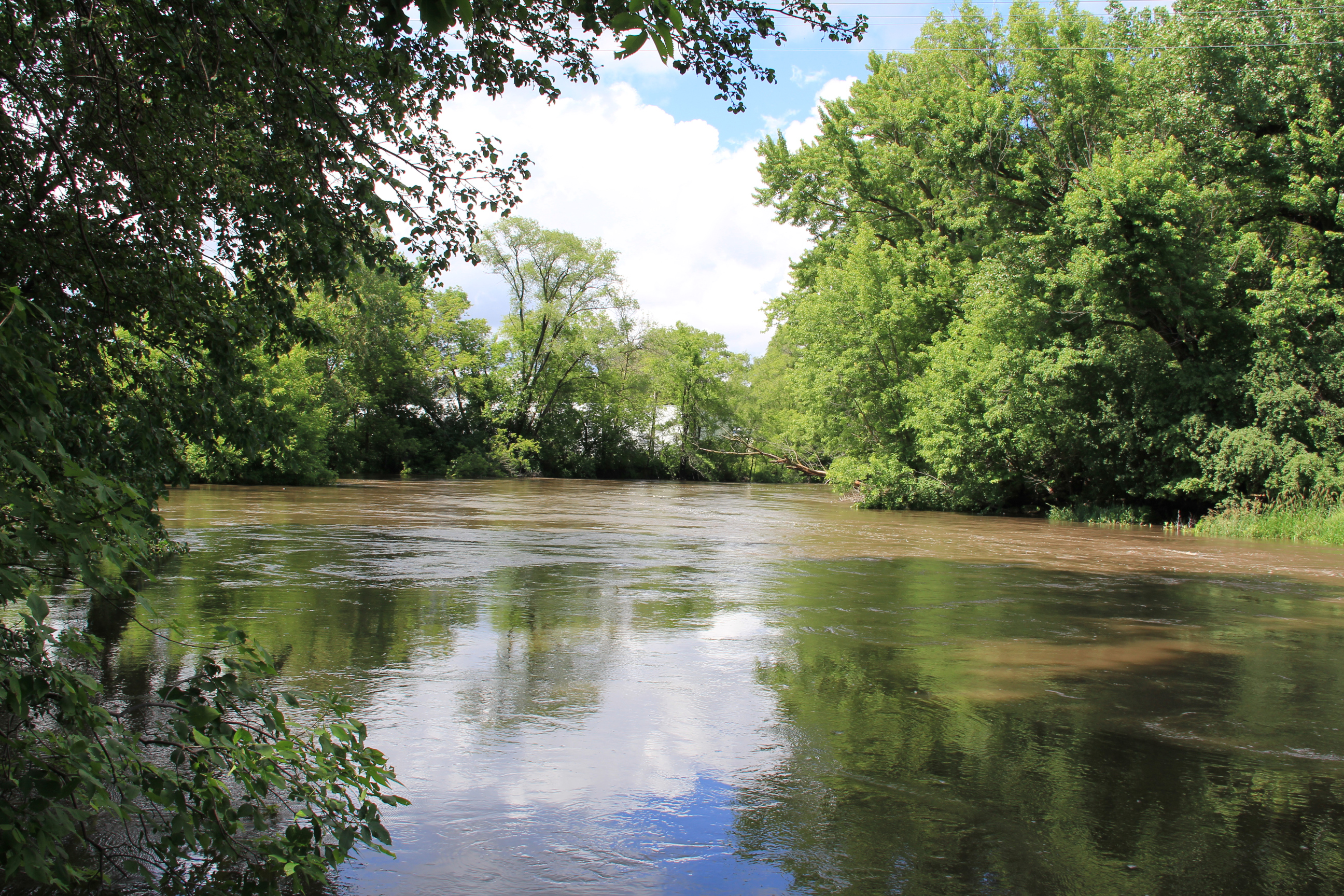
The Cannon River is high and swift-moving at Two Rivers Park. The park was the staging scene for a recent water rescue. (Minnesota Prairie Roots copyrighted photo June 2024)
An abandoned bobber tossed into the water where the Cannon and Straight rivers converge showed just how swift the current. I have no doubt the river could quickly pull a person under who’d fallen from a canoe or kayak.
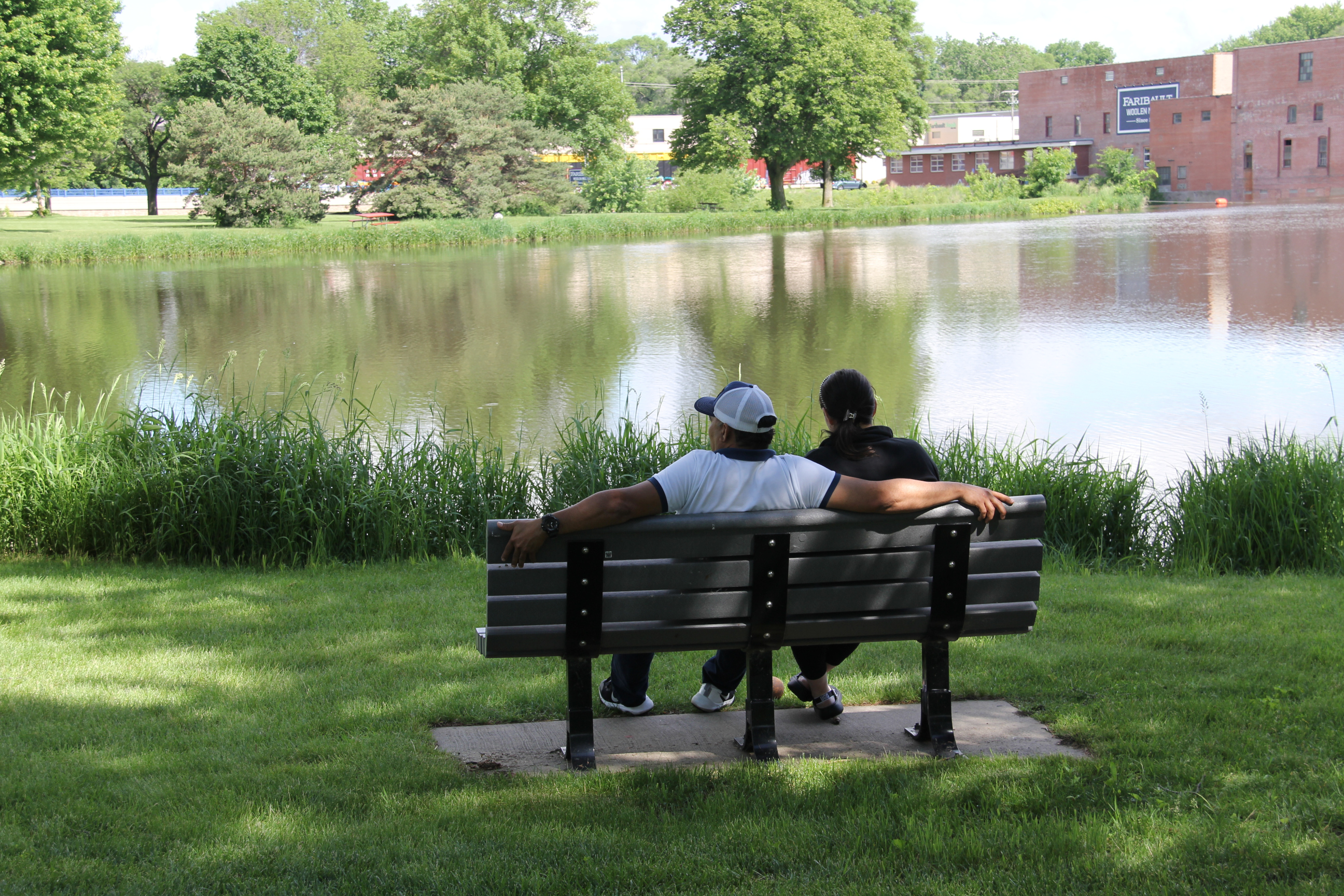
Relaxing along the Cannon River in North Alexander Park, the Faribault Woolen Mill on the opposite shoreline. (Minnesota Prairie Roots copyrighted photo June 2024)
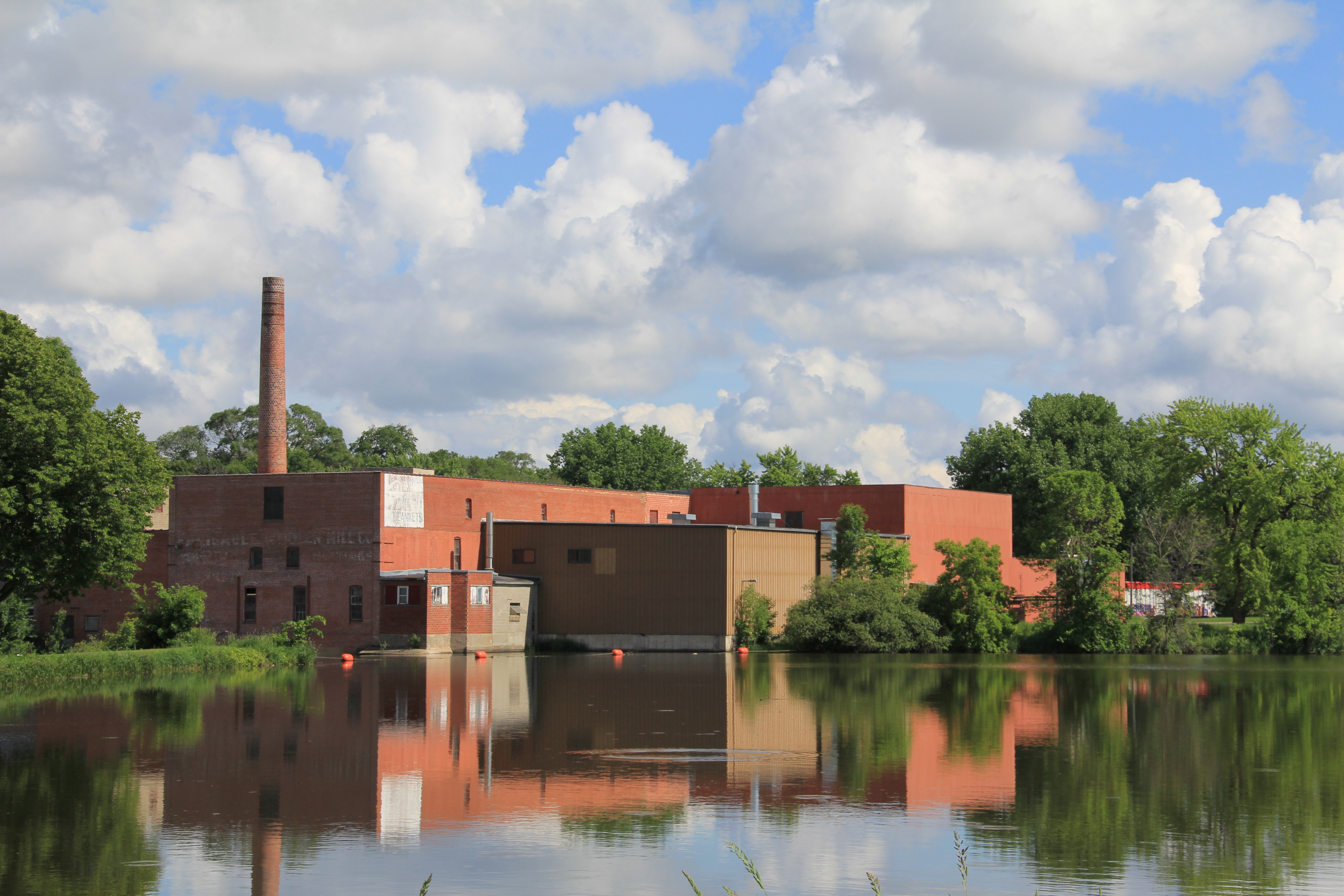
The iconic, historic Faribault Mill sits aside the Cannon River. (Minnesota Prairie Roots copyrighted photo June 2024)
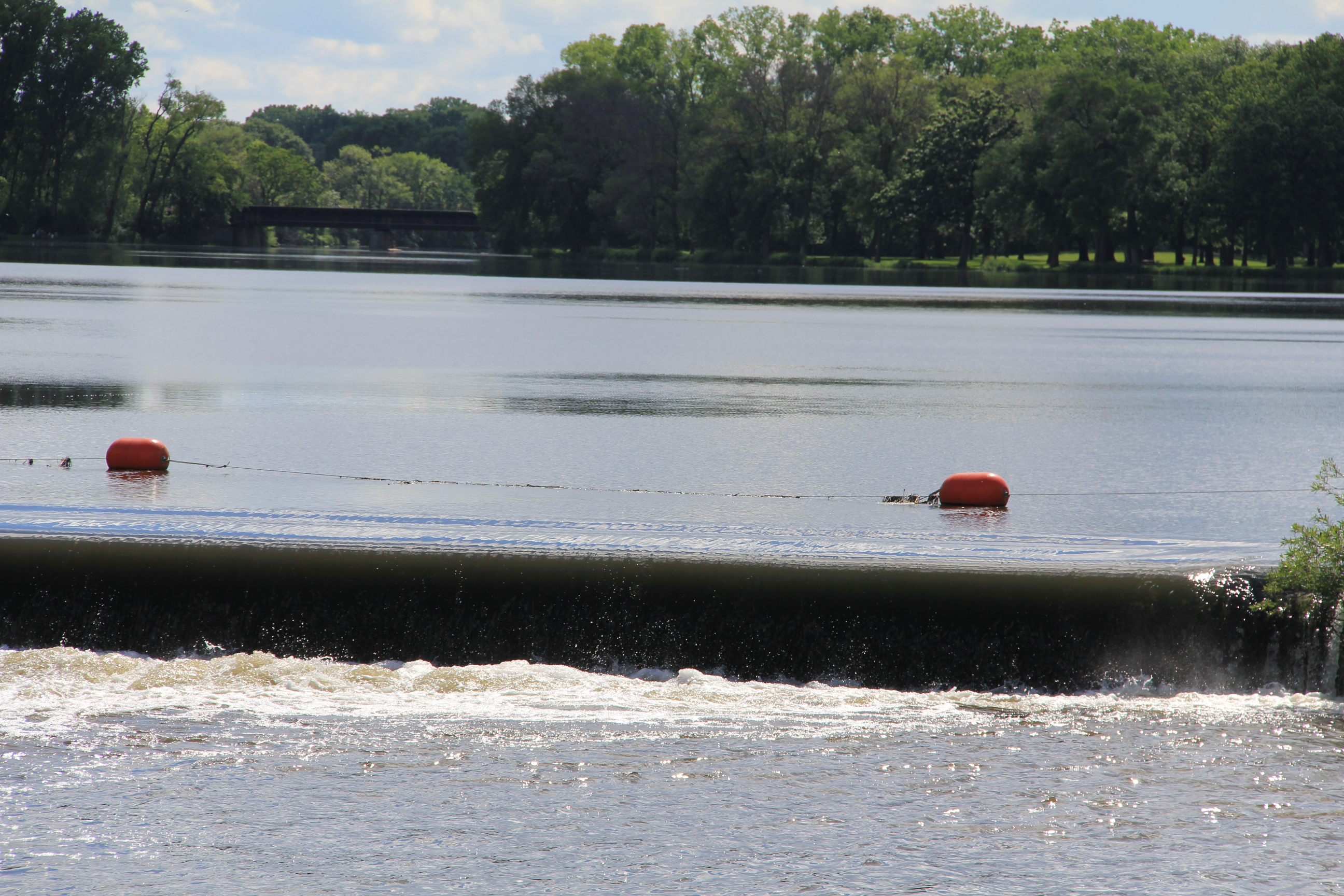
This photo taken several days ago shows the minimal drop over the Woolen Mill dam, with raging river below.(Minnesota Prairie Roots copyrighted photo June 2024)
It’s easy enough to get misled by the water. Sit aside the wide stretch of the Cannon before it spills over two dams and the scene looks tranquil. The water’s surface is smooth, reflecting sky and trees and the historic woolen mill. But when the water spills over the dams, it transforms into something muddy and menacing, not to be messed with.
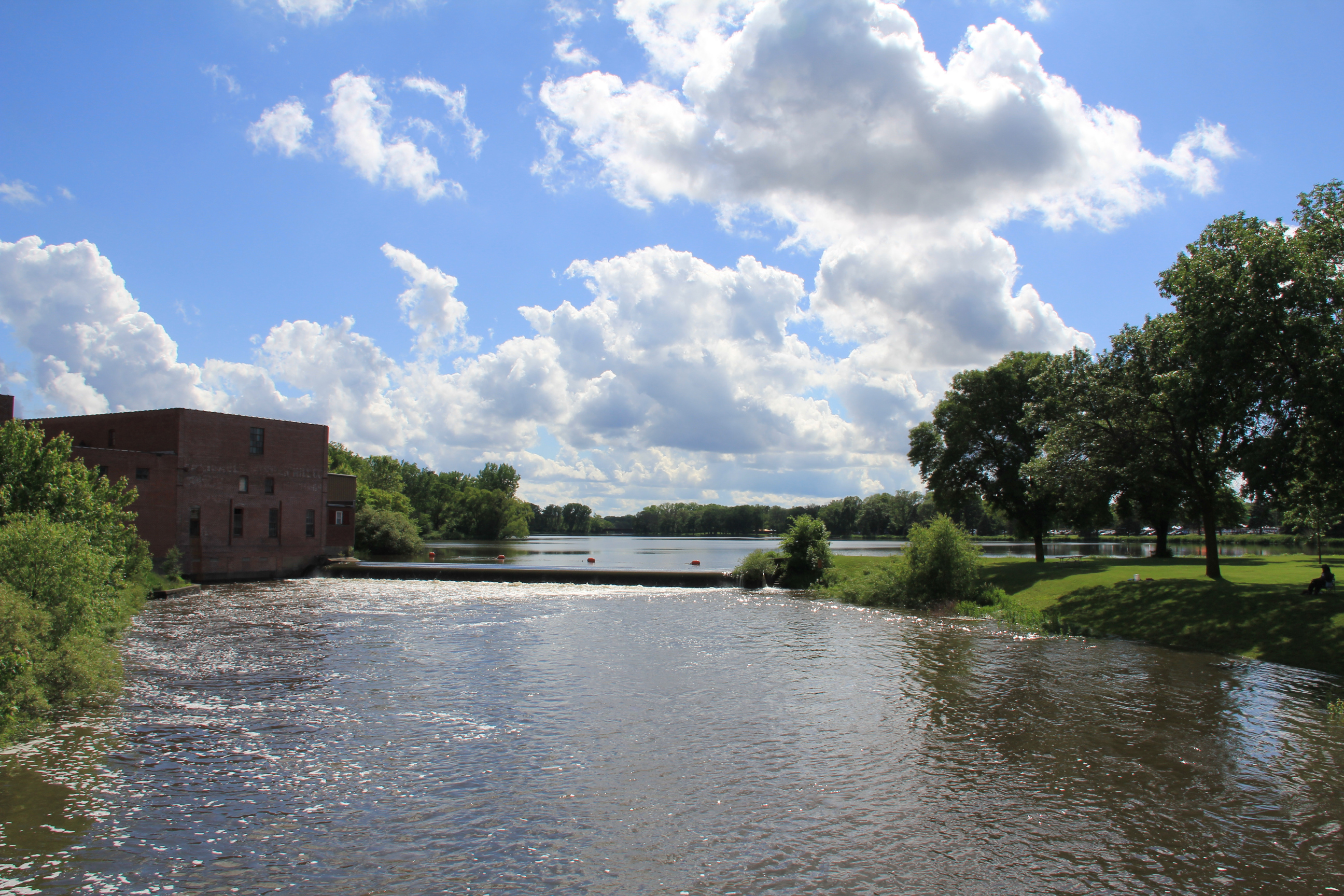
The scenic Cannon River and dam near the Faribault Mill. (Minnesota Prairie Roots copyrighted photo June 2024)
Respect the rivers, I say, even if it is tempting to launch a canoe or ease into a kayak. River levels will drop in due time as summer unfolds. There will be ample opportunity to get on the water, to enjoy the river scenery, to delight in the natural beauty of Mni Sóta, Dakota for “land of sky tinted waters.”
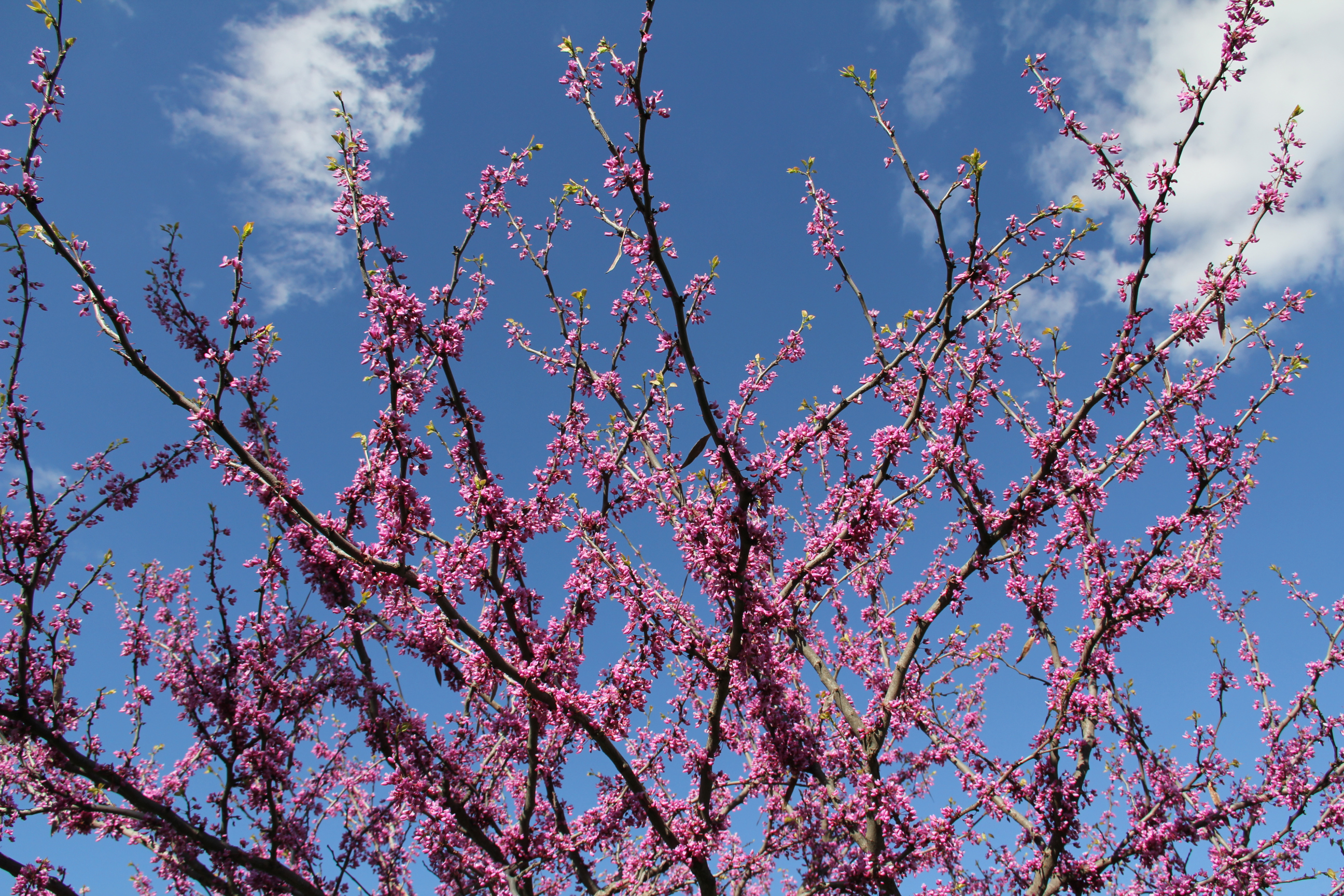
Looking up toward flowering branches and the bold blue sky of spring. (Minnesota Prairie Roots copyrighted photo May 2024)
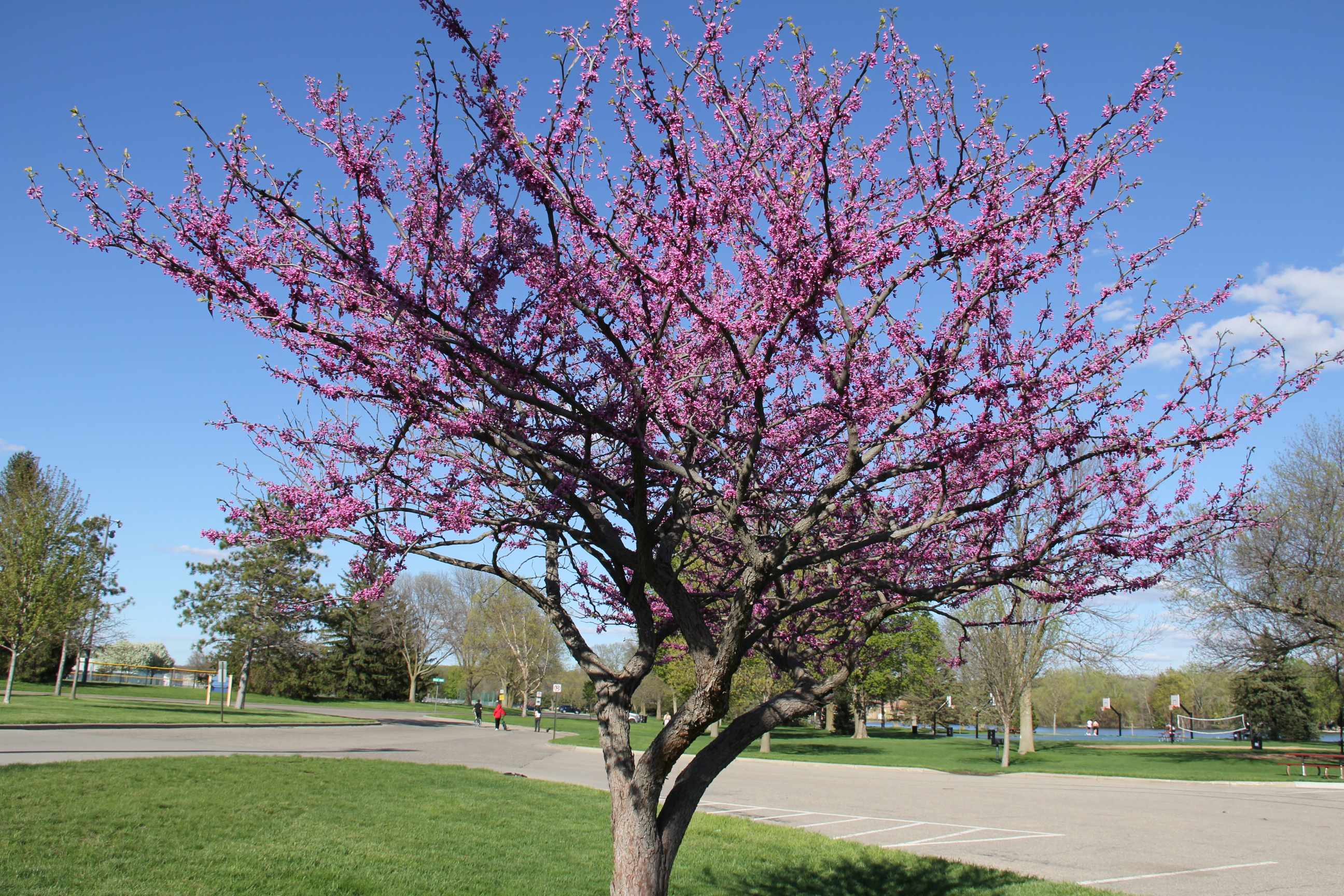
SPRING IN SOUTHERN MINNESOTA looks a lot like colors in a new box of crayons. Sharp. Bold. Vibrant. Vivid green grass. Bold blue sky. Hot pink tree blossoms. Spring flowers bursting bright reds and yellows. These are the hues of spring.
Color everywhere… (Minnesota Prairie Roots copyrighted photo May 2024)
The landscape is a page upon which nature colors over gray. The world explodes in color, a welcome visual delight to winter weary eyes.
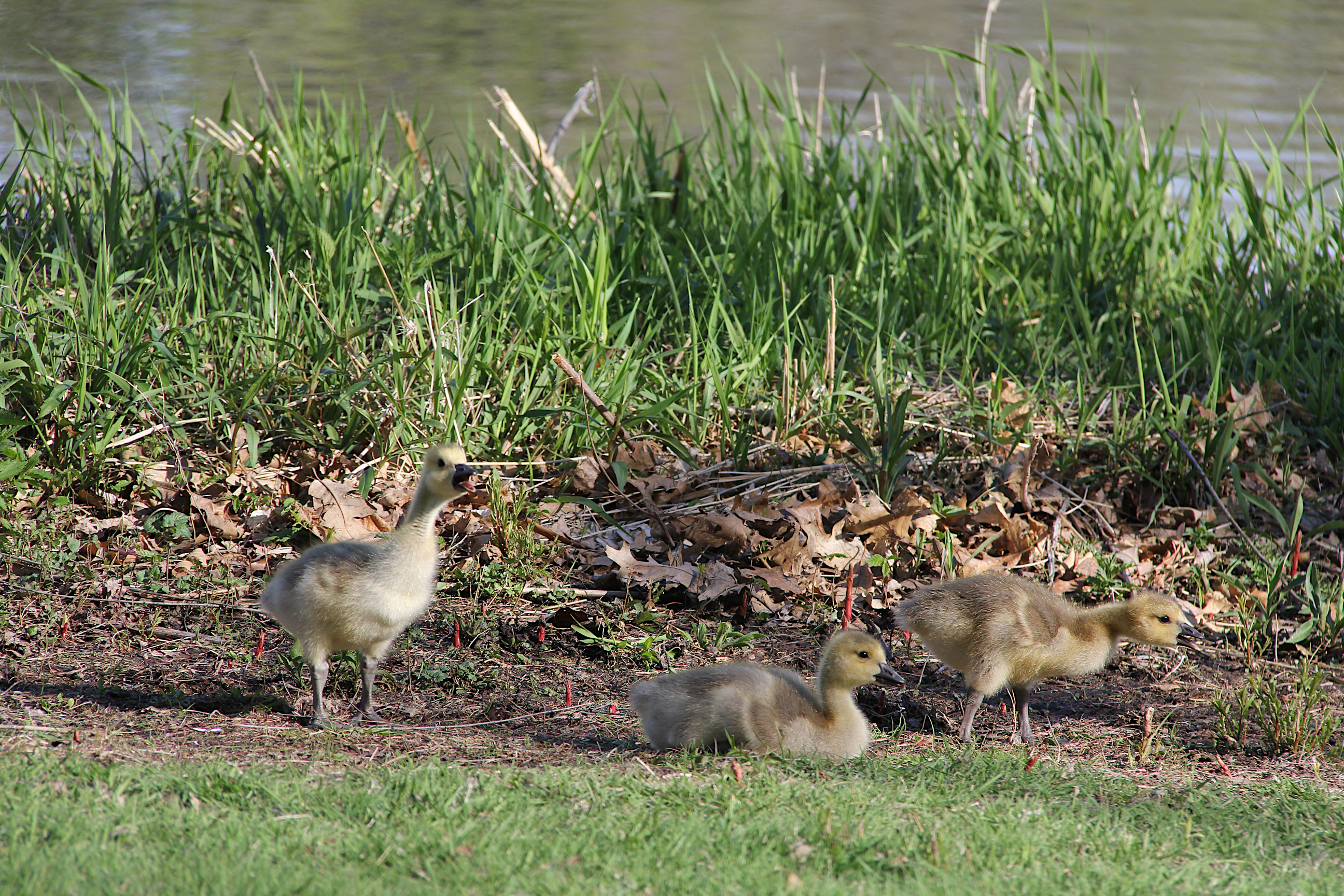
Growing goslings explore the river bank. (Minnesota Prairie Roots copyrighted photo May 2024)
I can’t get enough of this, even after more than sixty years of observing the seasonal transformation during April into May. It never gets old—this morphing of the seasons. How beautiful this world around us, teeming with new growth, new life.
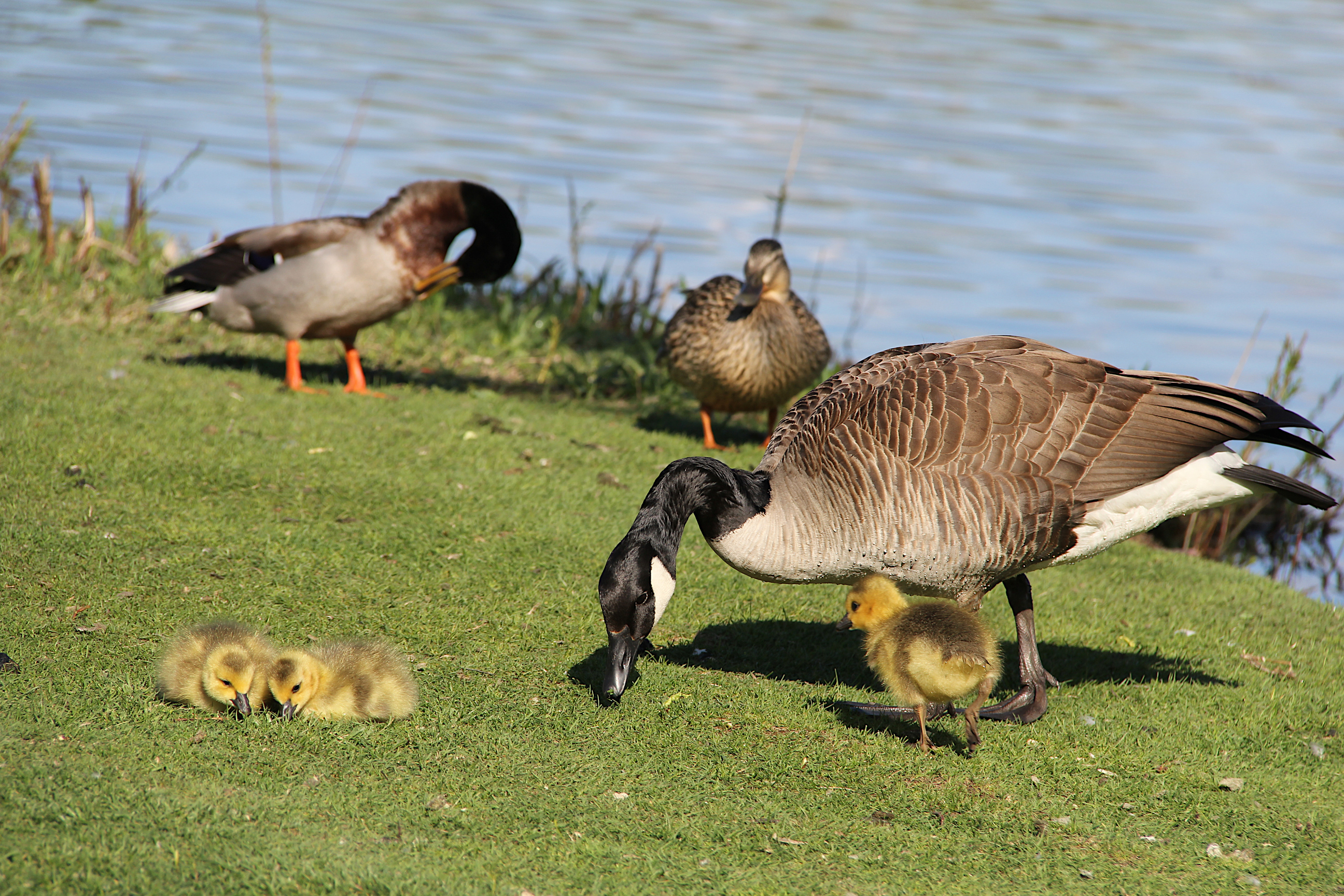
Goose and goslings aside ducks along river’s edge. (Minnesota Prairie Roots copyrighted photo May 2024)
Every spring I await the goslings and ducklings. They are pure fluffy cuteness. I admire from afar, keenly aware of their protective parents. I dodge goose poop, not always successfully, to get within viewing range. But I respect their space.
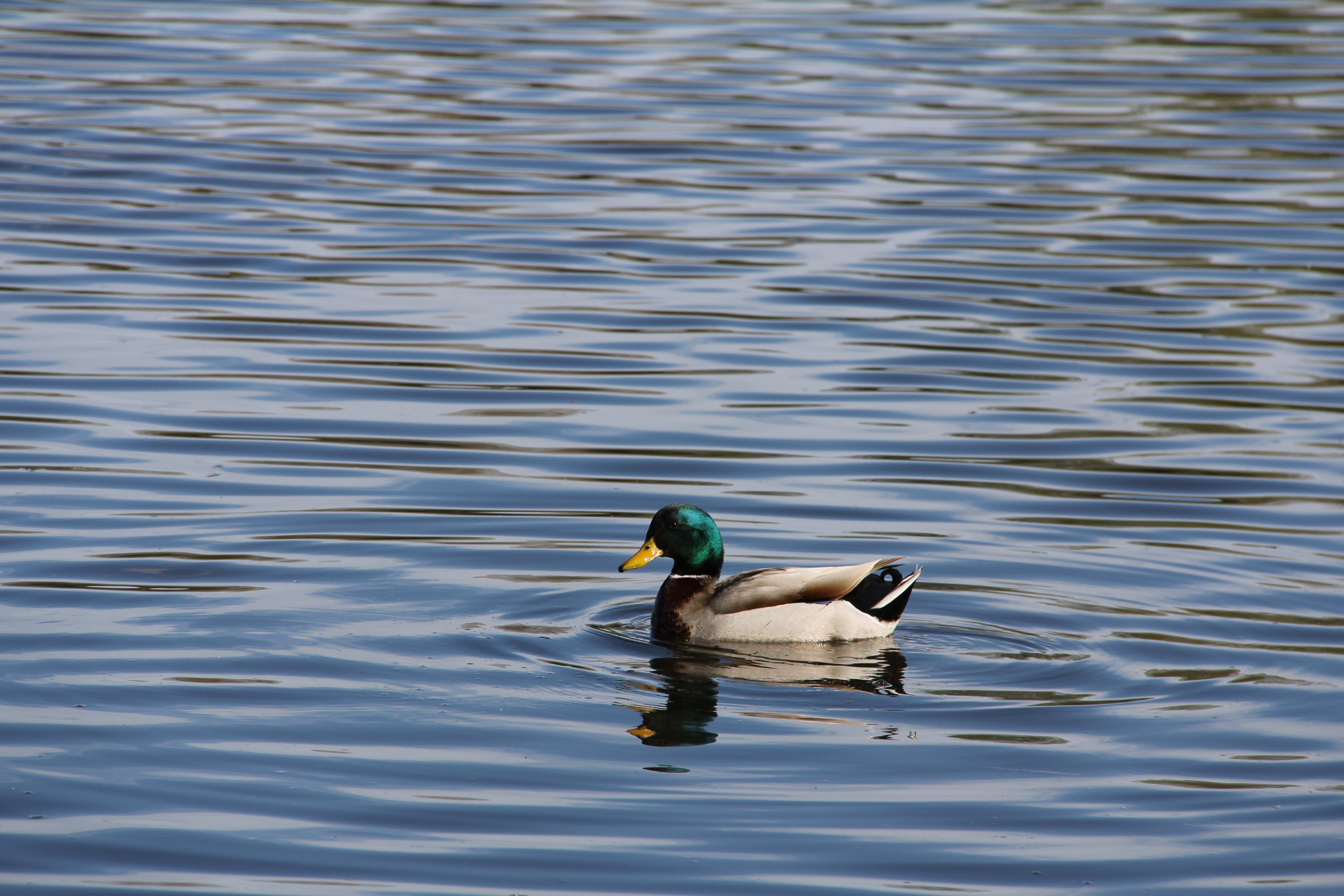
Beautiful scene: a mallard drake swimming on the river. (Minnesota Prairie Roots copyrighted photo May 2024)
I find myself mesmerized by waterfowl as they forage for food along the shoreline or glide through the river, water rippling a trail. Reflections trace tranquility upon the water’s surface. All is quiet and good in that peaceful scene.
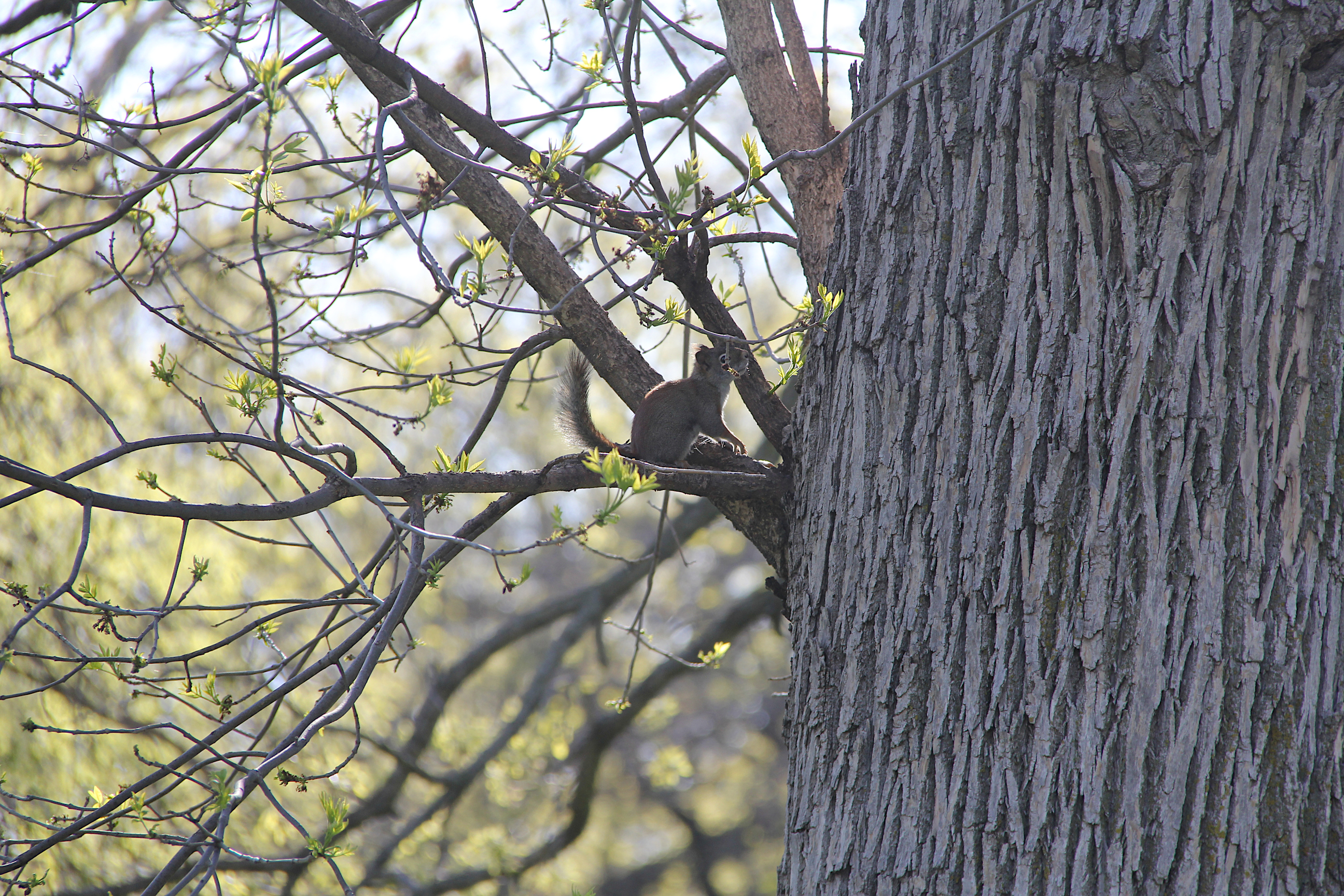
A squirrel, nearly camouflaged by a tree. (Minnesota Prairie Roots copyrighted photo May 2024)
But not all is still. On land, squirrels scamper up trees, root in the ground. I never tire of their antics, amazed by their acrobatic skills, their Olympian abilities to leap with precision, climb with speed. They are really quite amazing even if sometimes a nuisance when digging up lawns and in flower pots.
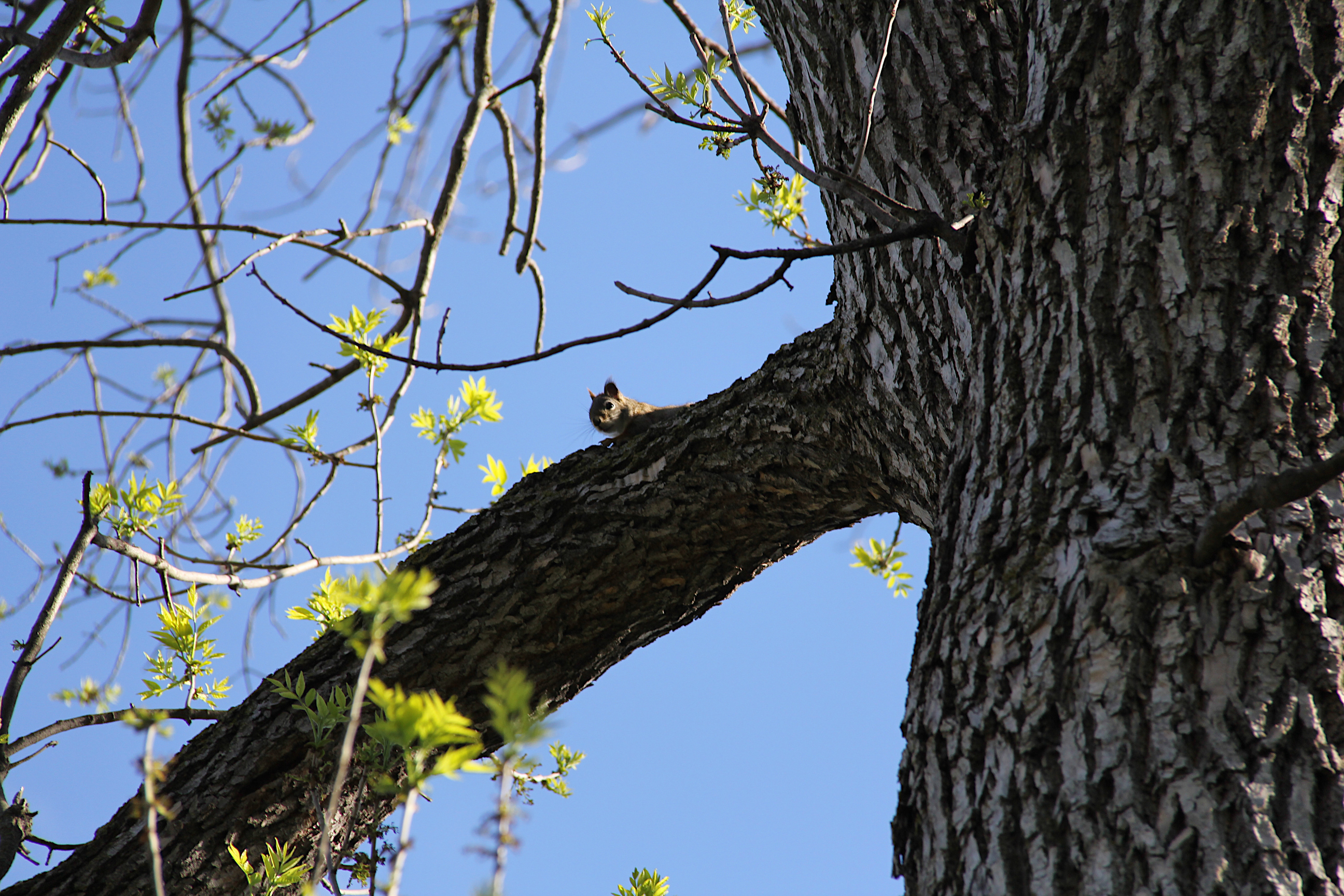
A squirrel peeks over a limb on a leafing tree. (Minnesota Prairie Roots copyrighted photo May 2024)
There’s so much to appreciate in this season not only visually, but in sound, too. Chirping birds, especially raucous this time of year. Trill of peepers in ponds and wetlands. Rustle of a rabbit across dried leaves. Call of a rooster pheasant in flight. Whisper of the wind through leafing treetops.
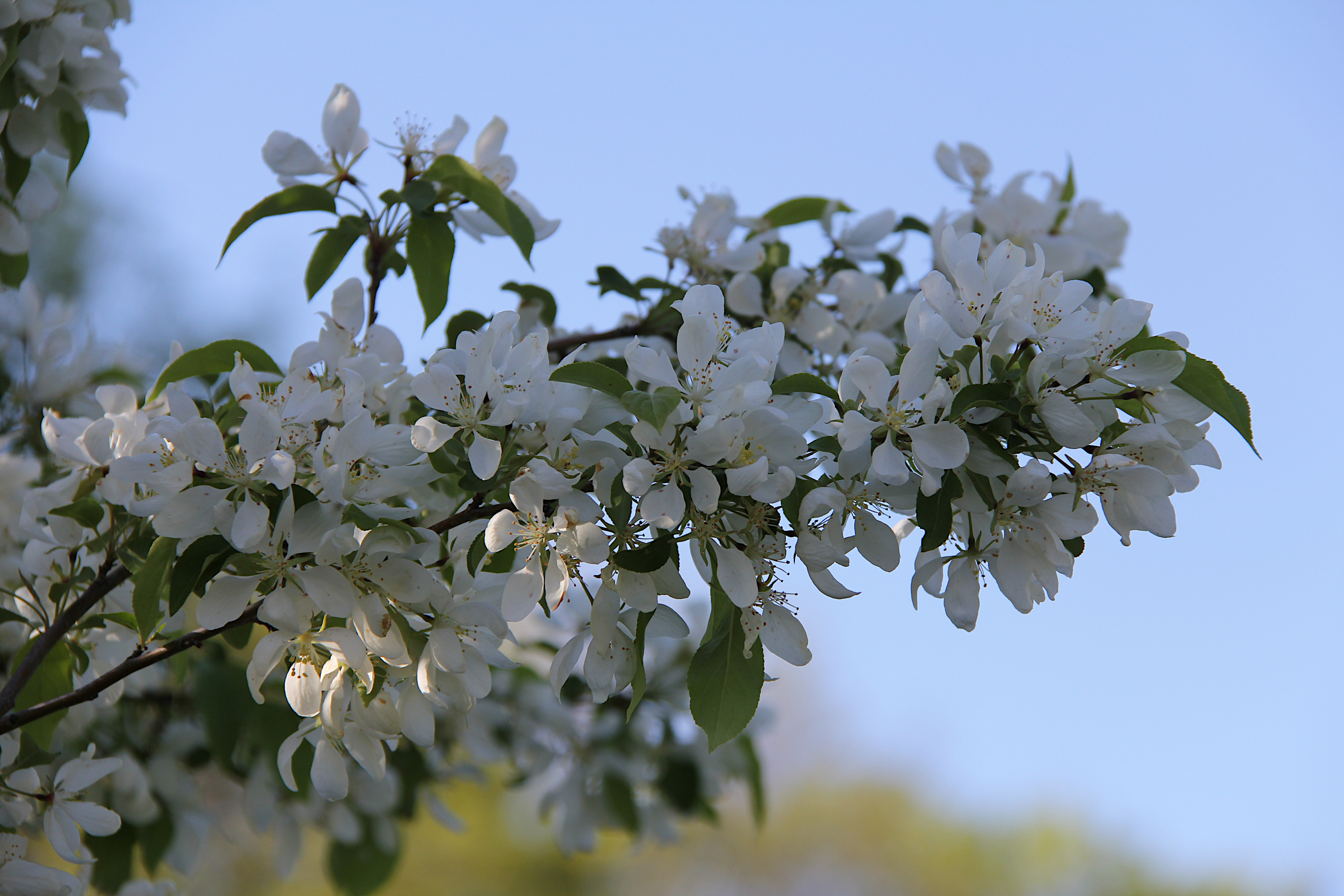
And then the scent, oh, the distinct, earthy smell of spring. Soil. Rain. Flowers. I dip my nose into apple blossoms, their fragrance a reminder of apples to come, of apple crisp pulled from the oven, of pies baked in Grandma’s kitchen.
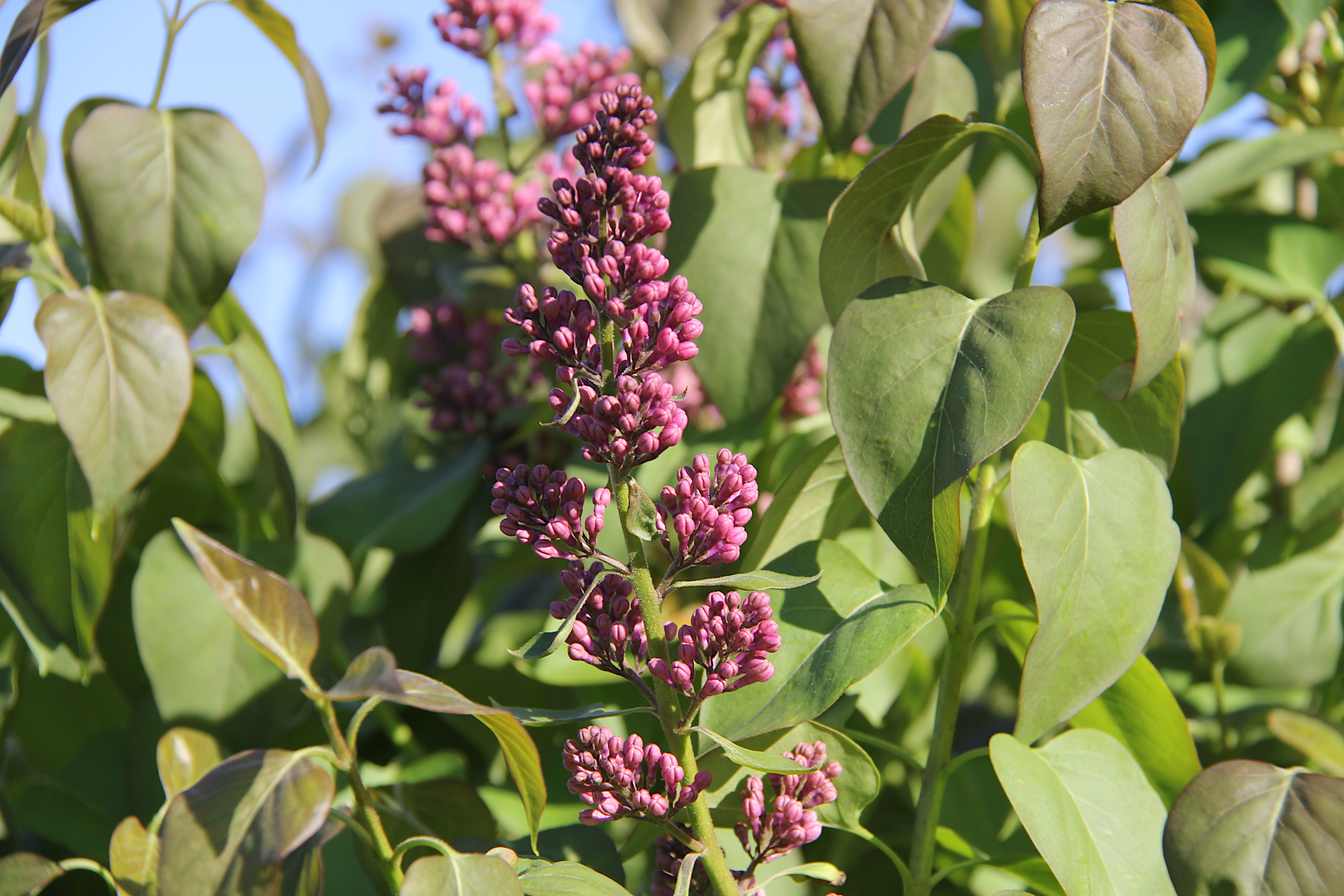
Lilacs are budding and flowering. (Minnesota Prairie Roots copyrighted photo May 2024)
But it is lilacs which, for me, hold the strongest scent of spring. Perhaps because of the memories connected to this flowering bush. I remember bouquets of lilacs filling my childhood farmhouse, their heavy perfume masking the odor of cow manure. The lilacs came from my bachelor uncle’s nearby farm. Mike would bring bouquets to his sister-in-law. Or my mom would drive the washboard gravel roads to pick her own. Today, my husband brings me bouquets of lilacs each May, understanding the memories and love these blossoms represent.
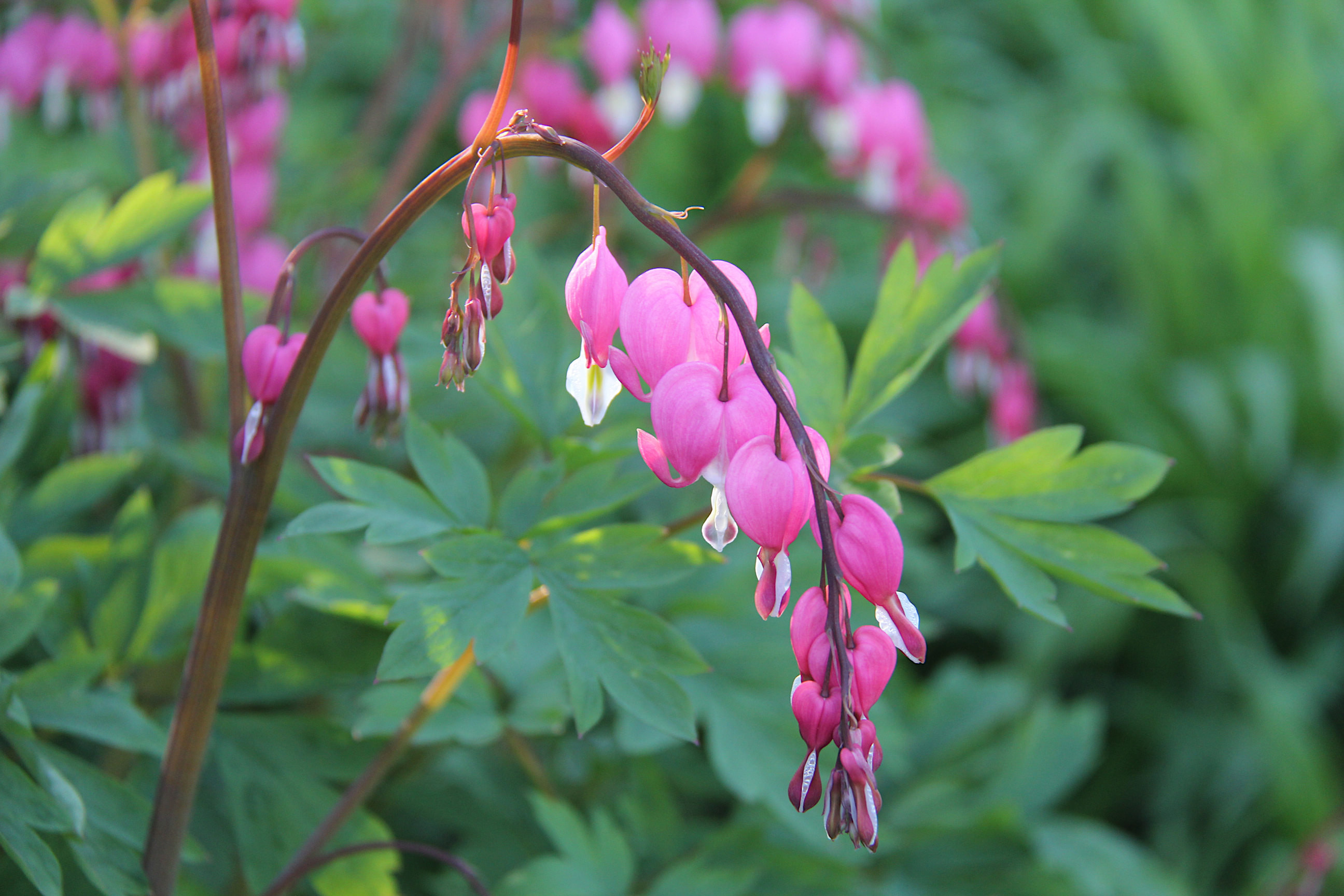
Bleeding hearts, one of the first flowers of spring. (Minnesota Prairie Roots copyrighted photo May 2024)
This is spring in Minnesota to me. All of it. Bold. Beautiful. Bright. Me, feeling like a kid giddy with joy over a box of new crayons.
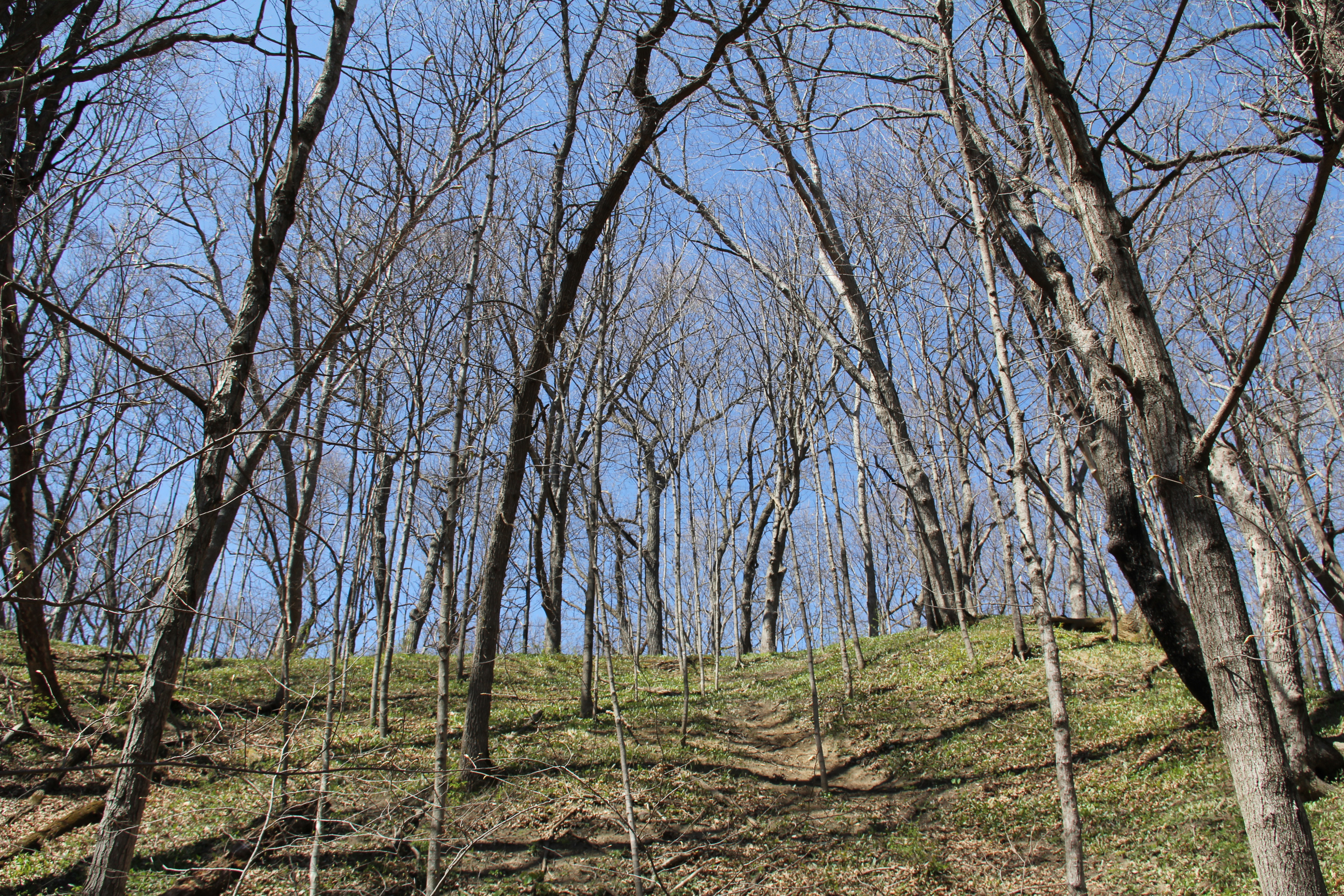
Green is slowly tipping trees, coloring the ground as we bridge into spring. This hillside scene was photographed in Falls Creek County Park, rural Faribault. (Minnesota Prairie Roots copyrighted photo April 2024)
THIS TIME OF YEAR in Minnesota—this early spring—everything appears more vibrant. At least to my winter weary eyes. My eyes, which have viewed mostly muted shades of brown and gray for too many months, can’t get enough of this landscape edging with color.
Bold blue skies blanket River Bend’s prairie, which will soon be lush with new growth. (Minnesota Prairie Roots copyrighted photo April 2024)
Intense green in buds and lush lawns, thriving with recent rains and then sunshine and warming day-time temps, layer the landscape. Sometimes the sky is such a bold blue that my eyes ache with the beauty of it all. Green against blue, the natural world a poem, a painting, a creative story.
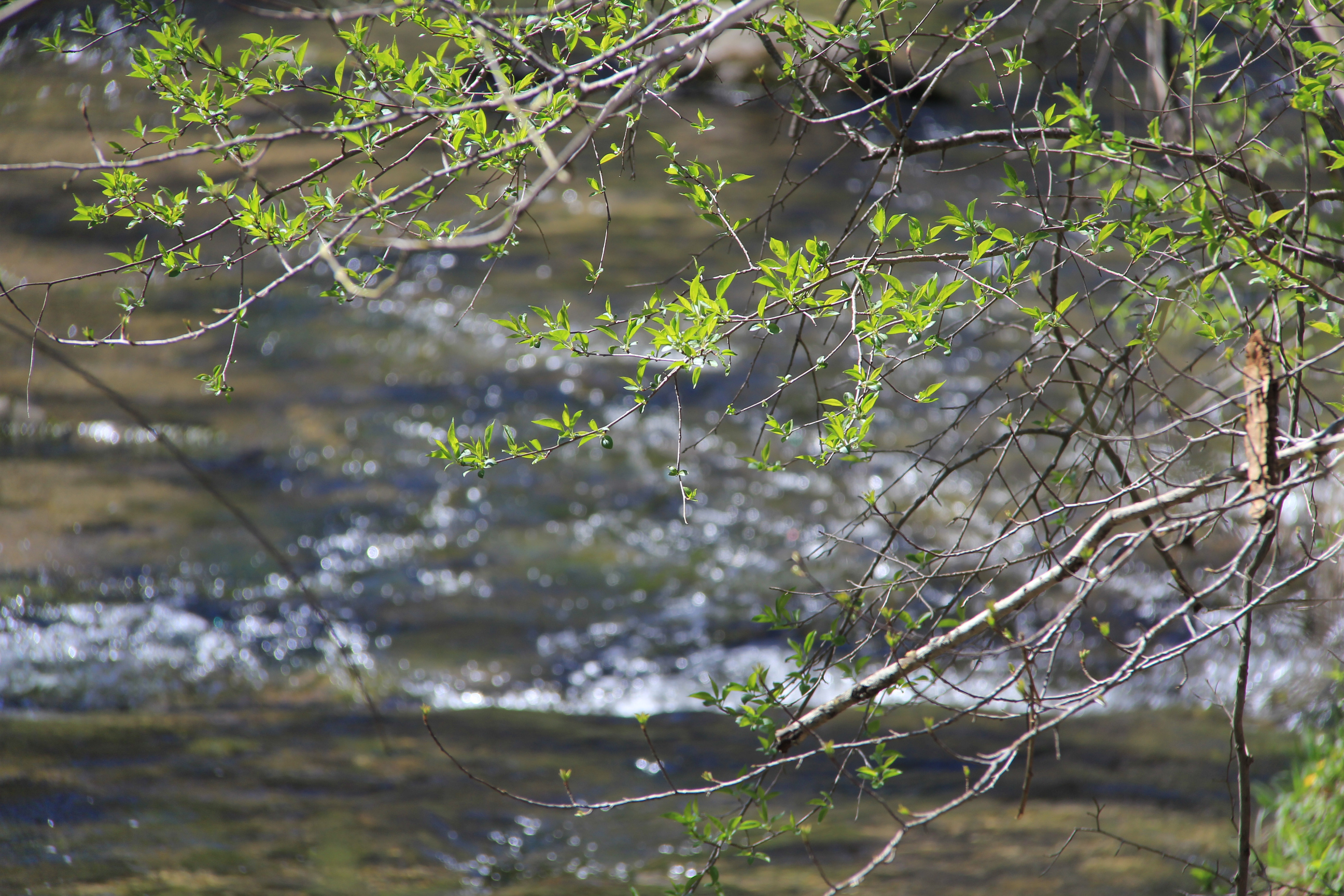
Buds emerge against the backdrop of the creek at Falls Creek County Park. (Minnesota Prairie Roots copyrighted photo April 2024)
Like most Minnesotans, I find myself emerging, getting outdoors more, immersing myself in nature. Not that I don’t spend time outside in winter. But now, in late April, I’m out more often.
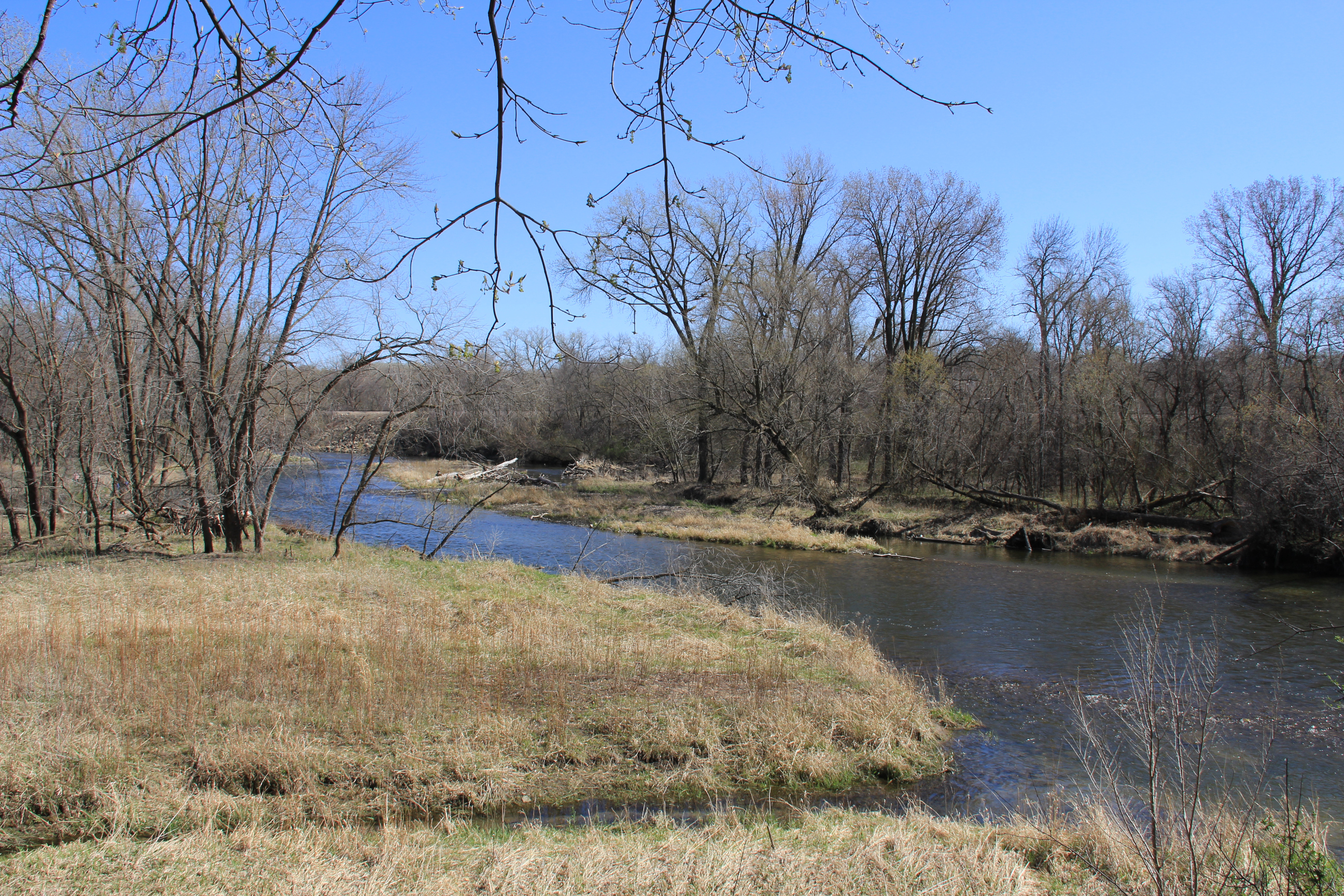
The Straight River twists through River Bend Nature Center, winding through Faribault to connect with the Cannon River. (Minnesota Prairie Roots copyrighted photo April 2024)
Parks and trails and the local nature center draw me into woods, along prairie, aside replenished wetlands and ponds, by rivers and creeks. Even a walk through a neighborhood to observe tulips flashing vivid red and yellow pleases me. There’s so much to take in, to delight in as this season unfolds.
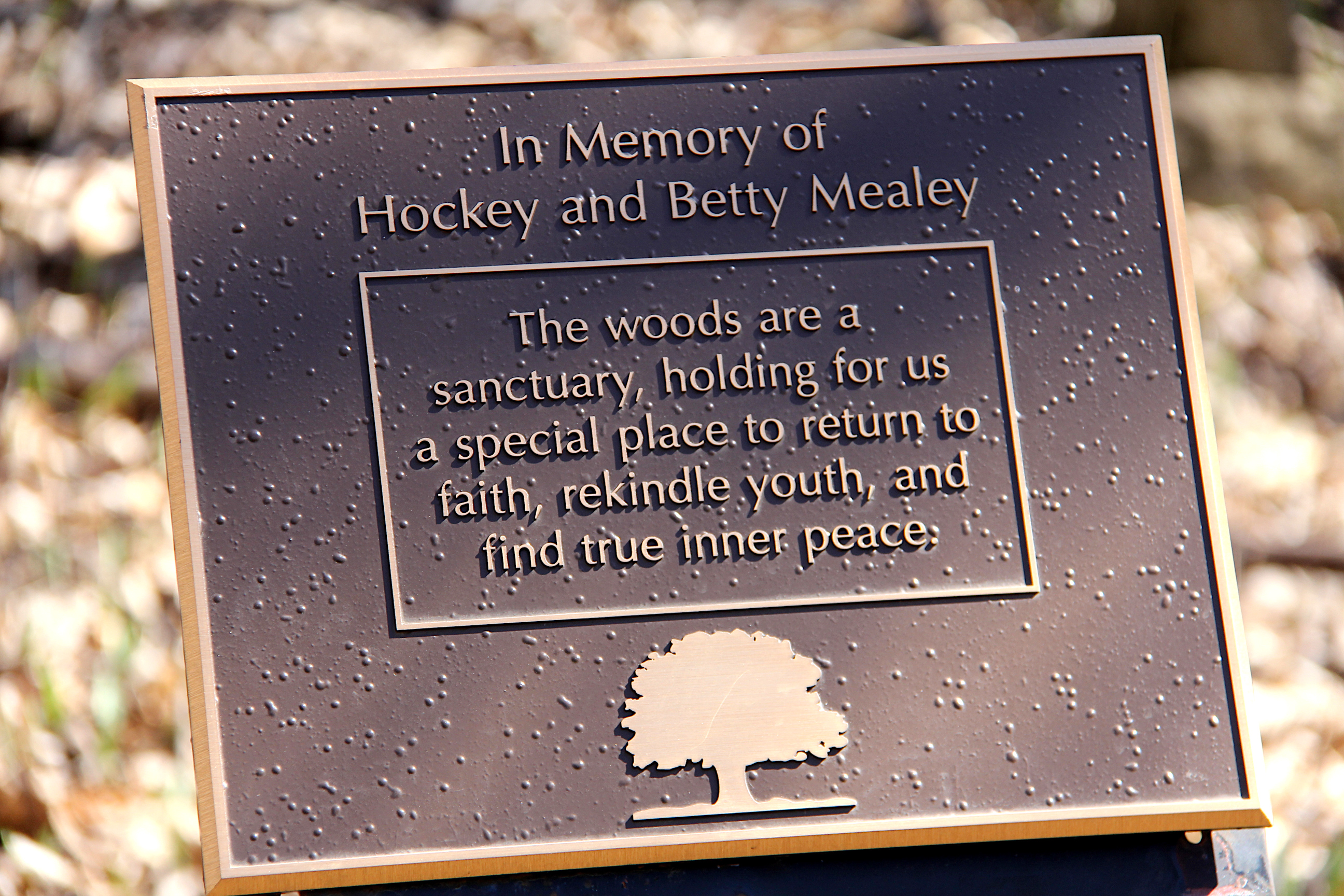
Inspirational signs are scattered throughout River Bend. (Minnesota Prairie Roots copyrighted photo April 2024)
“One touch of nature makes the whole world kin,” reads a quote from William Shakespeare printed on a memorial plaque placed on a bench at River Bend Nature Center in Faribault. I’m no Shakespearean scholar, but I interpret that to mean nature connects us.
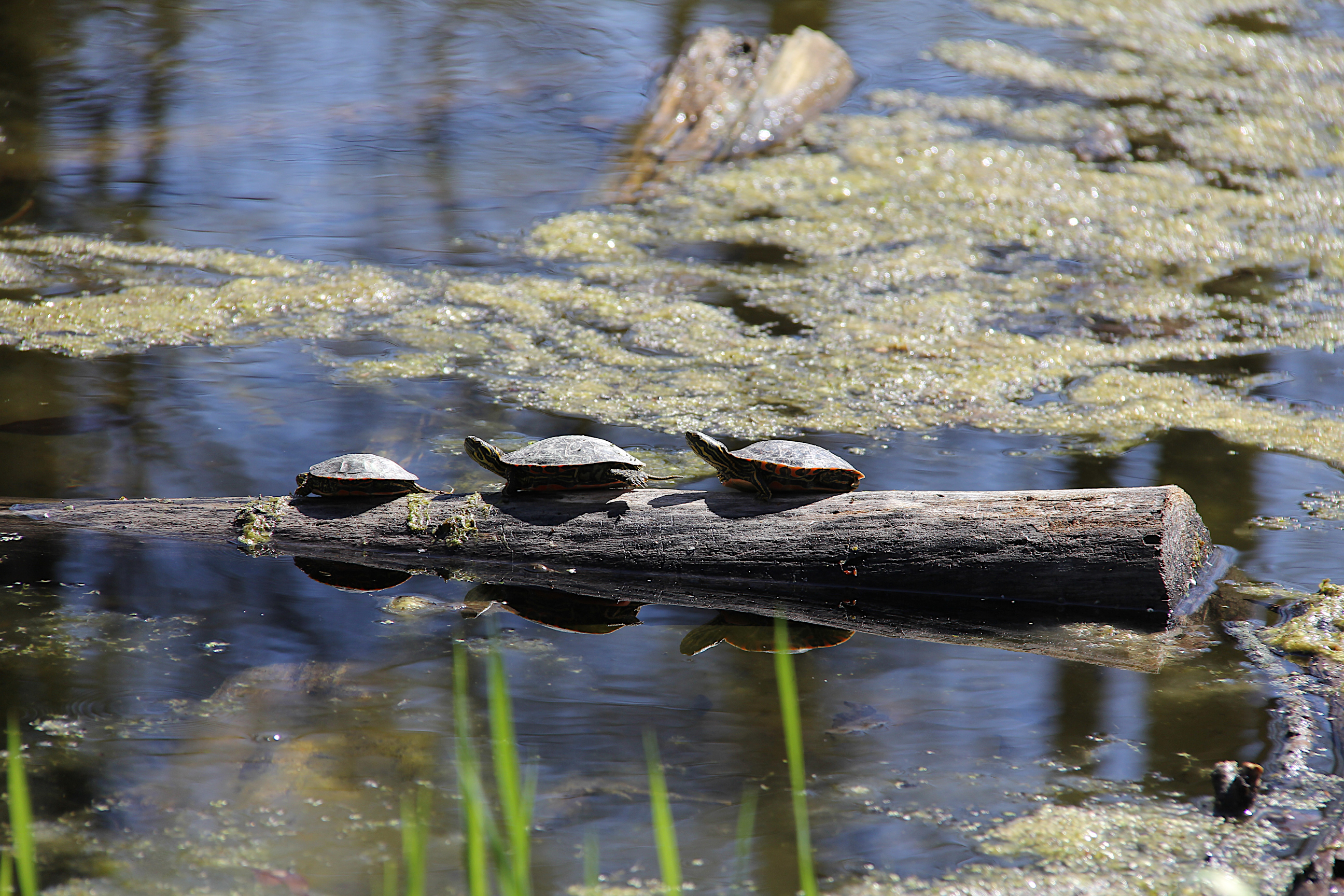
Turtles galore lined logs at River Bend’s Turtle Pond on a recent sunny afternoon. (Minnesota Prairie Roots copyrighted photo April 2024)
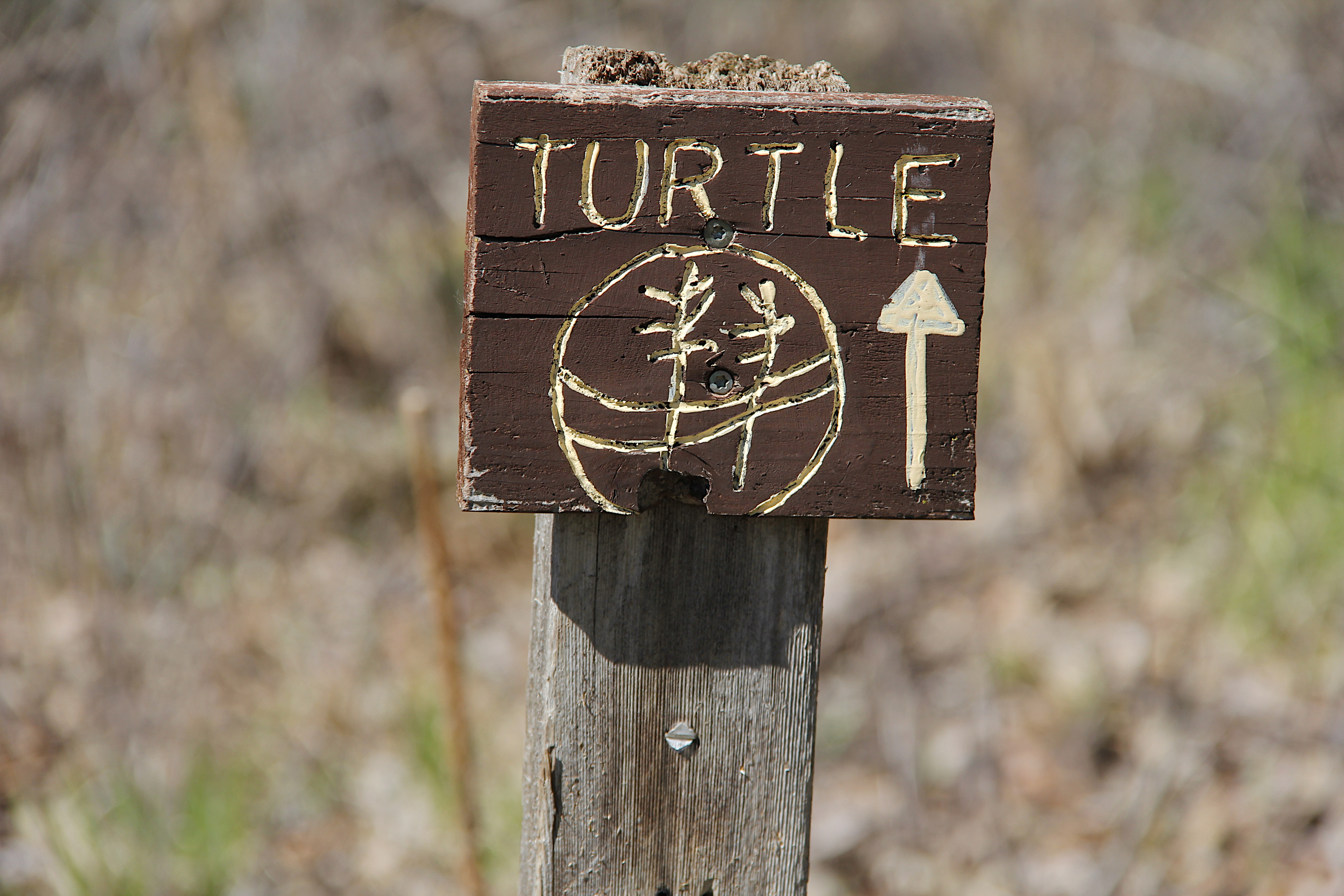
That happened recently at the Turtle Pond. I paused to photograph three turtles lining a log, still as statues in the afternoon sunshine. Then a passing friend noticed and asked what I saw. And then he pulled out his cellphone to photograph. And then the photographer who was shooting senior photos on the boardwalk bridge over the pond, noticed the turtles, too. We were, in that moment, kin in nature, touched by the countless turtles perched on logs in the water.
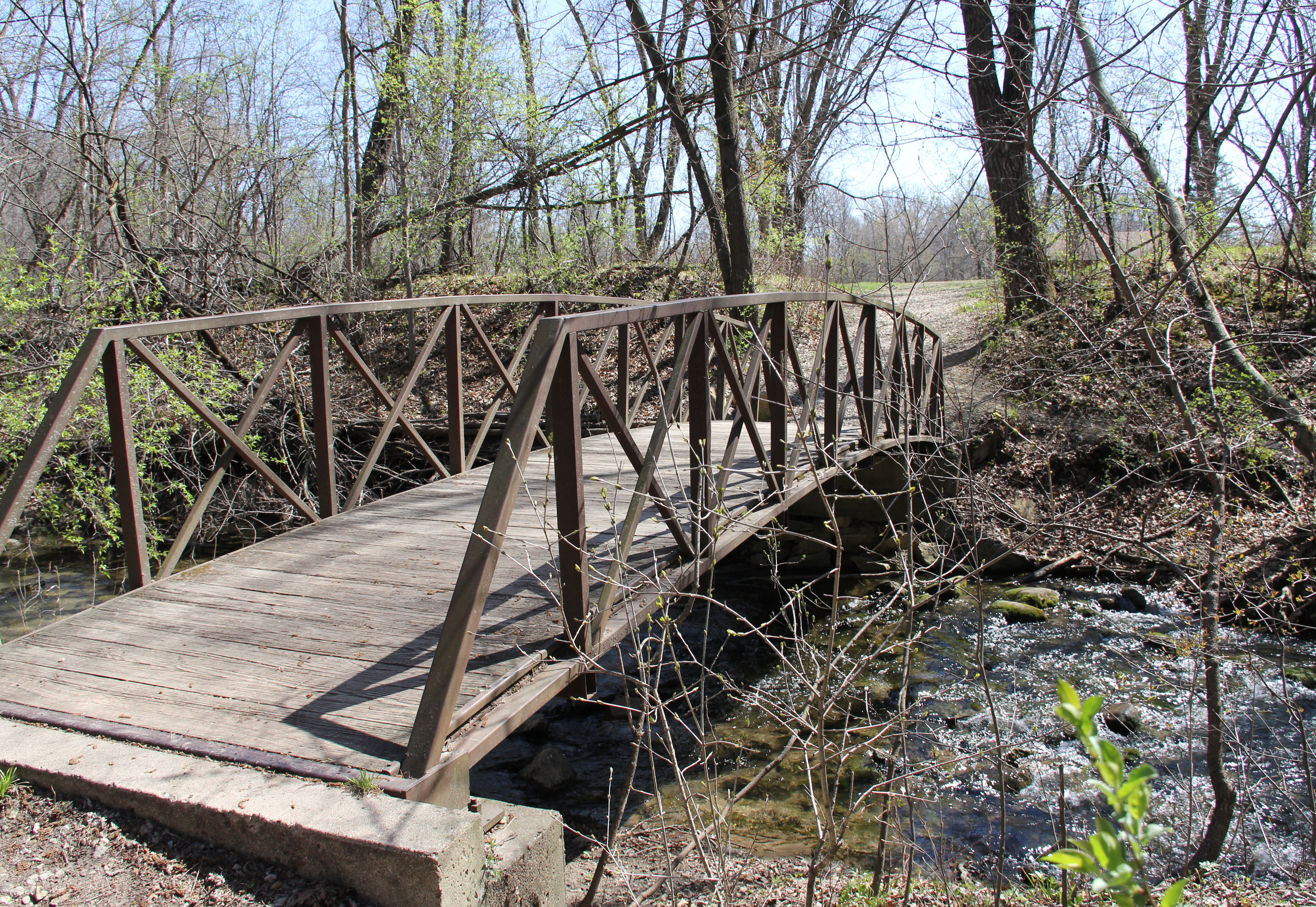
This bridge spans a creek in Falls Creek County Park, leading to hiking trails in the woods on one end and an open grassy area on the other. (Minnesota Prairie Roots copyrighted photo April 2024)
Nature also connected me with others at Falls Creek County Park, rural Faribault. A family picnicking by the park shelter prompted memories of long ago picnics there with my growing family. I walked over to tell the young parents how happy I was to see them outdoors, grilling, enjoying the beautiful spring day with Ezra in his Spider-Man costume and Millie in her stroller. Nature makes us kin.
Wildflowers are blooming, including these at Falls Creek County Park. (Minnesota Prairie Roots copyrighted photo April 2024)
People simply seem nicer, kinder, more open to conversation when they’re outdoors. It’s as if the wind whispers only good words into our thoughts. It’s as if clouds disperse to reveal only sunny skies. It’s as if sounds are only those of silence or of birds, not of anger and hostility. Nature calms with her voice, her presence.
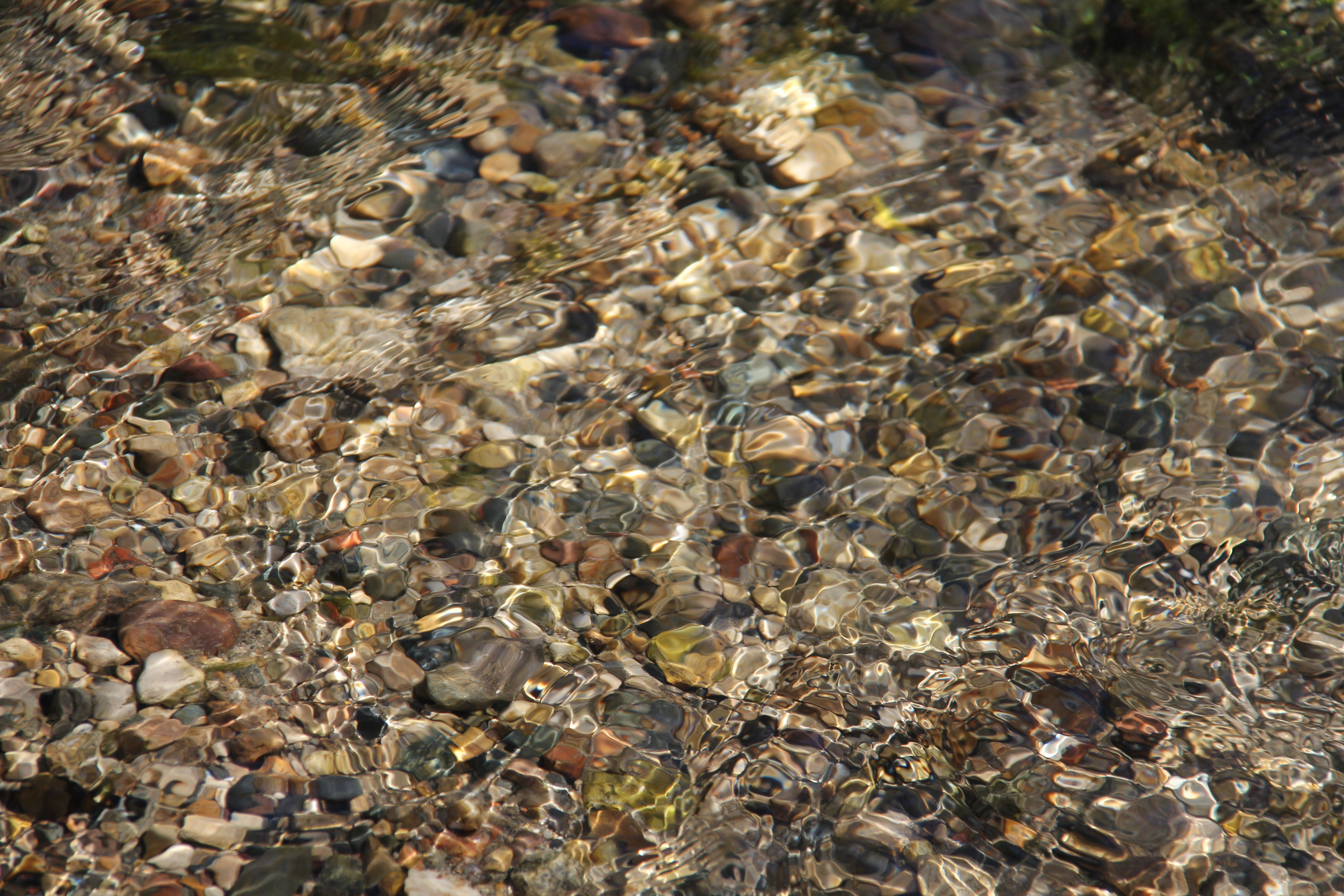
Water mesmerizes as it flows over stones in a clear-running creek at Falls Creek County Park. (Minnesota Prairie Roots copyrighted photo April 2024)
I love to stand aside a burbling creek, to hear water rushing over rocks. In that moment, I hear only the soothing, steady rhythm of music and none of the noise of life. Peace, sweet peace, consumes me.
Trails at Falls Creek County Park are packed dirt, narrow, rugged, uneven and sometimes blocked by fallen trees. (Minnesota Prairie Roots copyrighted photo April 2024)
The same goes for walking within nature. Trees embrace me. Wildflowers show me beauty. Dirt beneath my soles connects me to the earth, filling my soul.
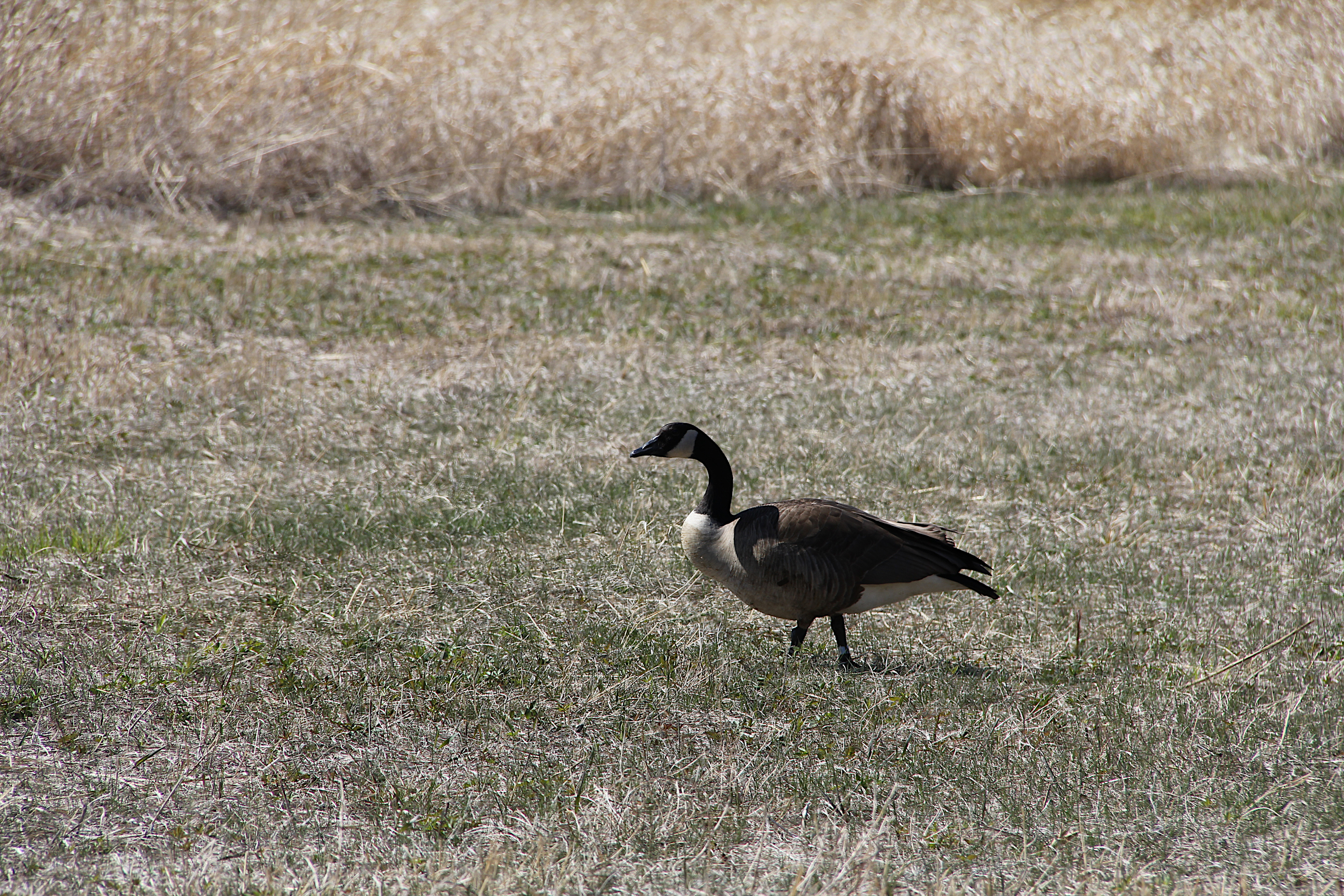
On a recent afternoon at River Bend, geese searched the prairie for food. (Minnesota Prairie Roots copyrighted photo April 2024)
And then there are the creatures. The Canadian geese wandering the prairie, searching for food, their long necks bending, pilfering the dried grass while I dodge the droppings they’ve left along the pathway. They are fearless, a lesson for me in standing strong.
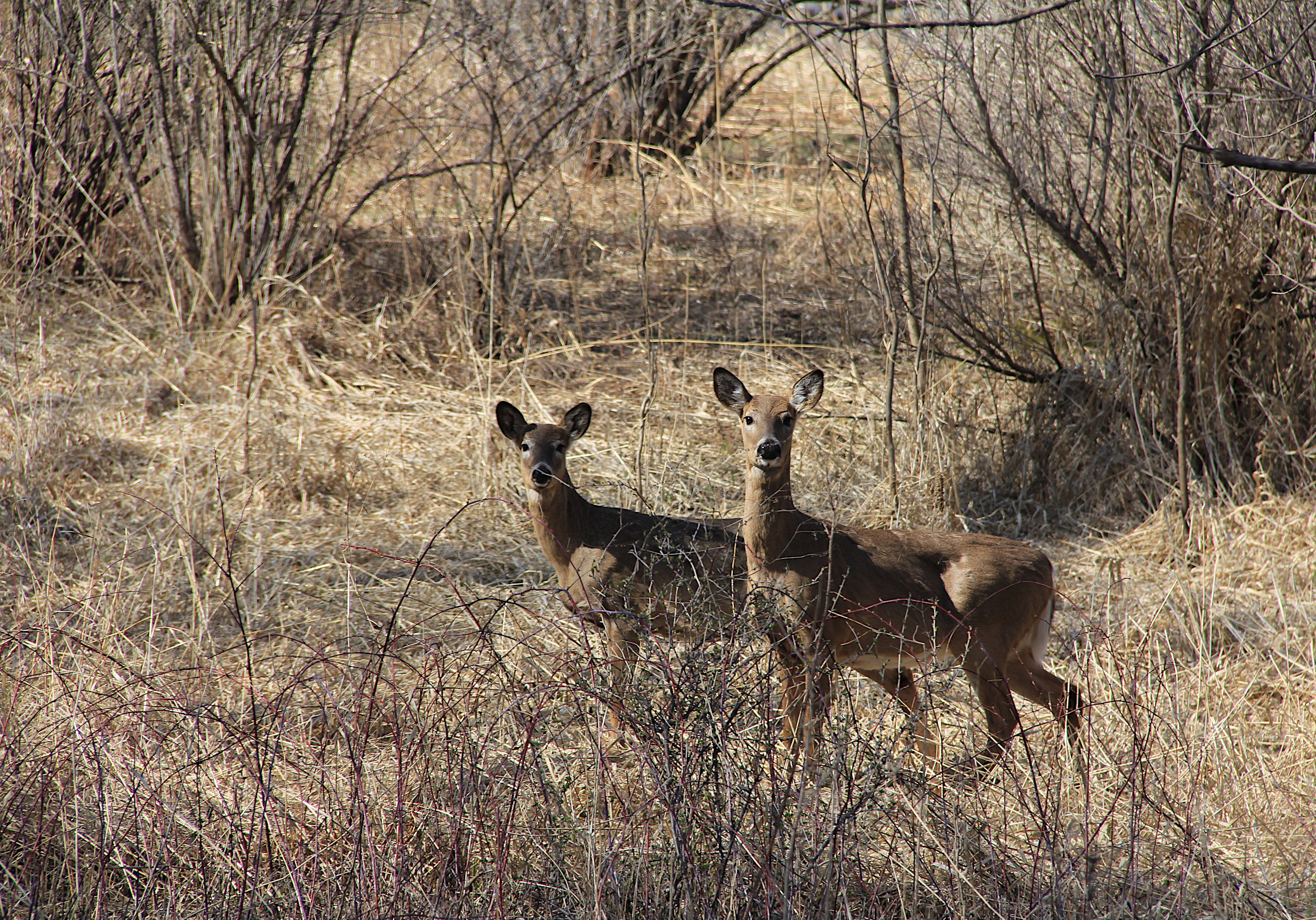
Deer at River Bend. (Minnesota Prairie Roots copyrighted photo April 2024)
Deer gather, then high-tail away when they grow weary of me watching them. They’ve had enough, even if I haven’t.
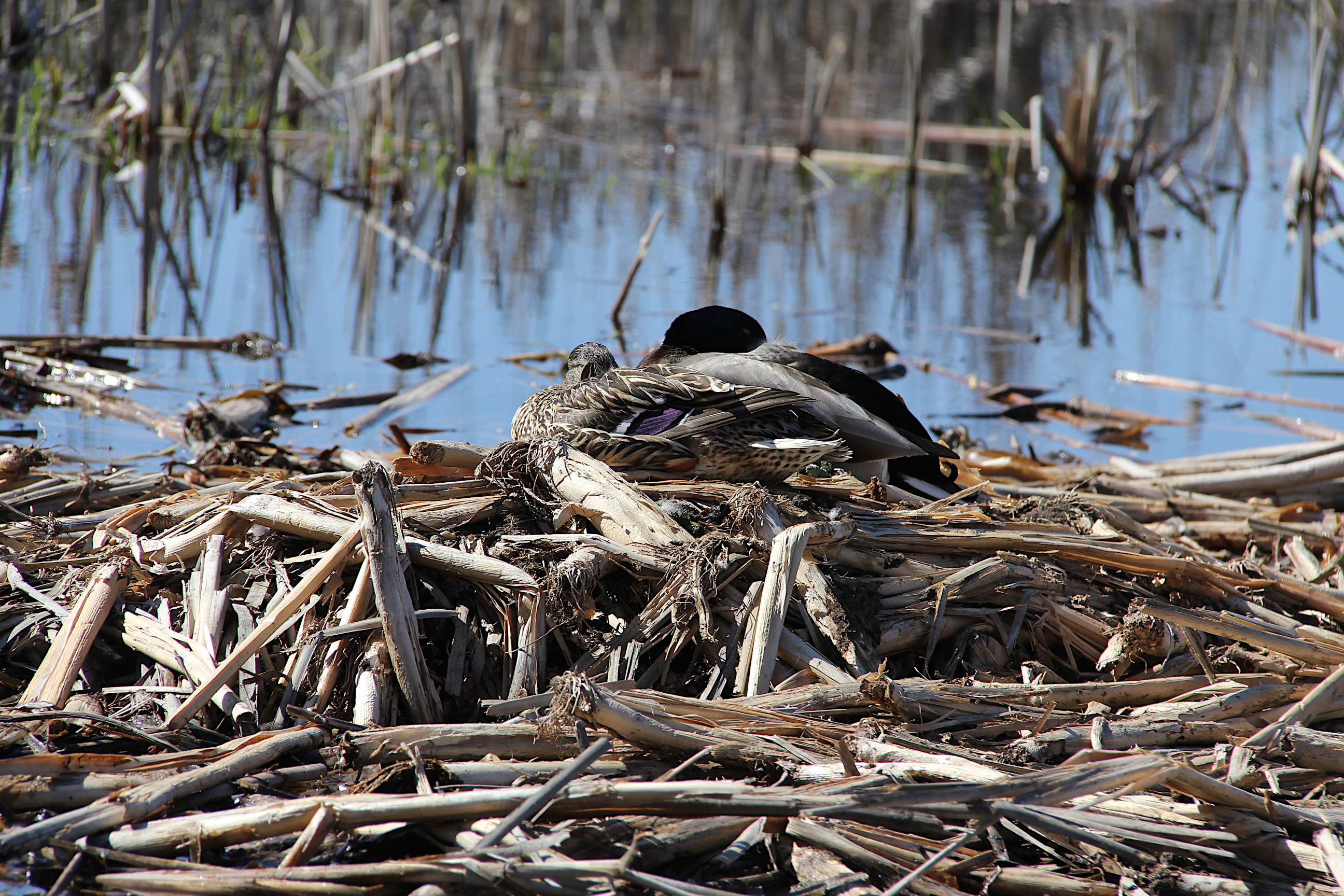
A nesting mallard hen and drake, nearly camouflaged on a wetland pond at River Bend. (Minnesota Prairie Roots copyrighted photo April 2024)
And at the pond, mallards nest. Unmoving. Determined. Heads folded into feathers. Settled there among dried stalks, water bold blue, reflecting the sky. Spring peepers sing a symphony of spring. It is a scene, a performance that holds me.
Rustic signage, which I love, marks landmarks and trails inside River Bend. (Minnesota Prairie Roots copyrighted photo April 2024)
Shakespeare was right. “One touch of nature makes the whole world kin.”
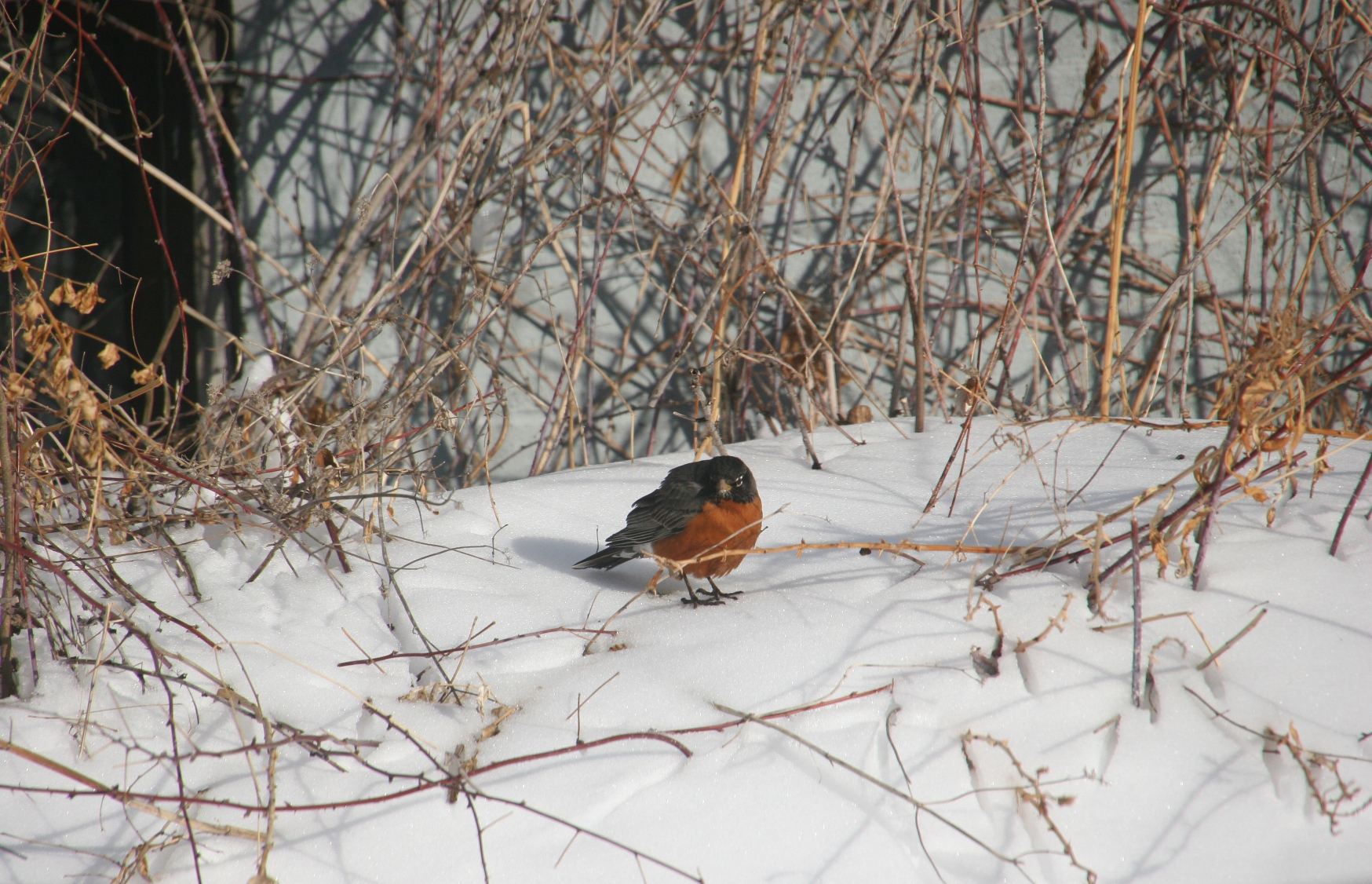
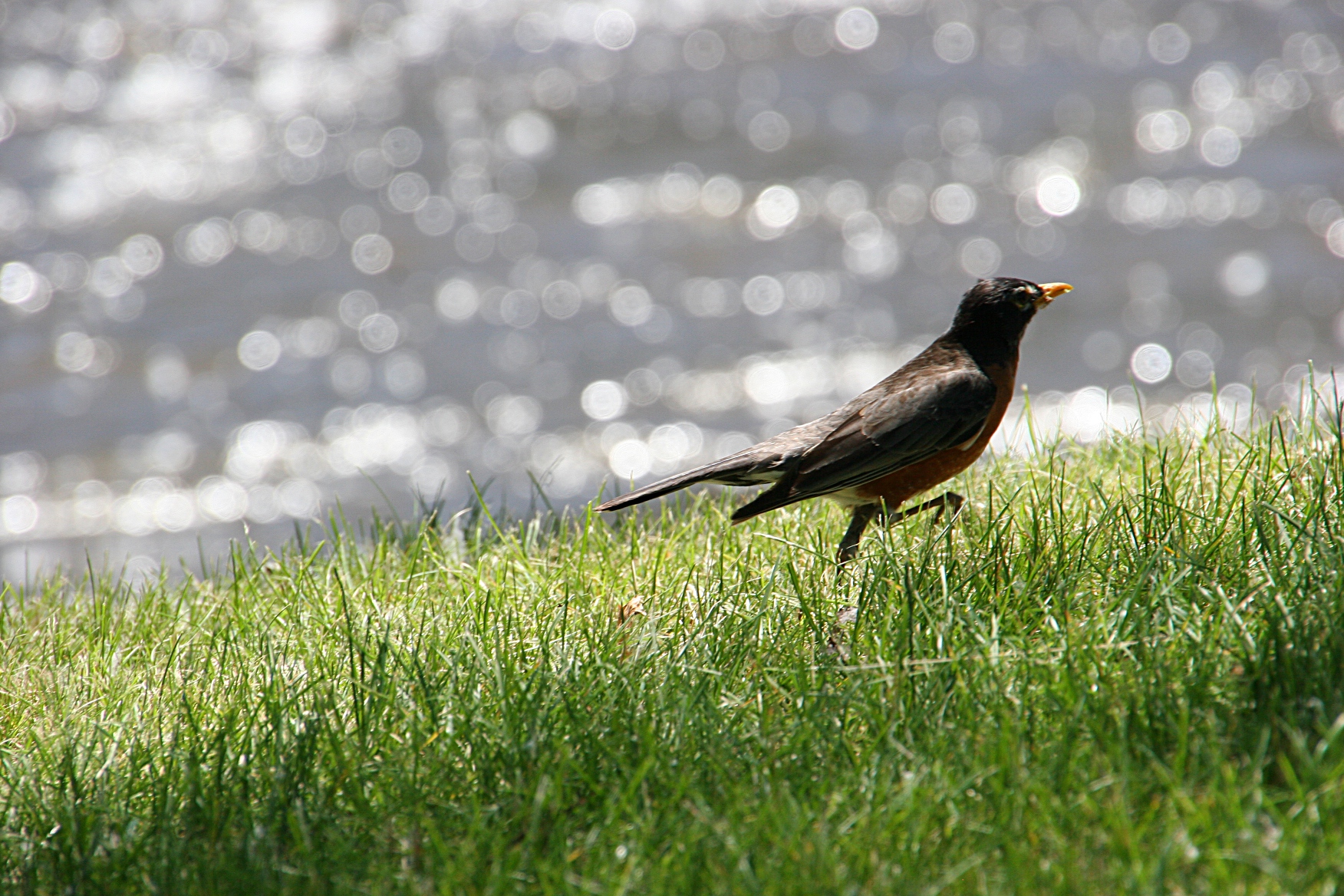
In April 2018, this robin huddled in the snow. (Minnesota Prairie Roots copyrighted file photo April 2018)
THIS TIME OF YEAR, birds sound louder, their voices amplified. Birds are marking territories, seeking mates. Or perhaps they are announcing their return to Minnesota or their survival of winter, even the mild one of 2023-2024.
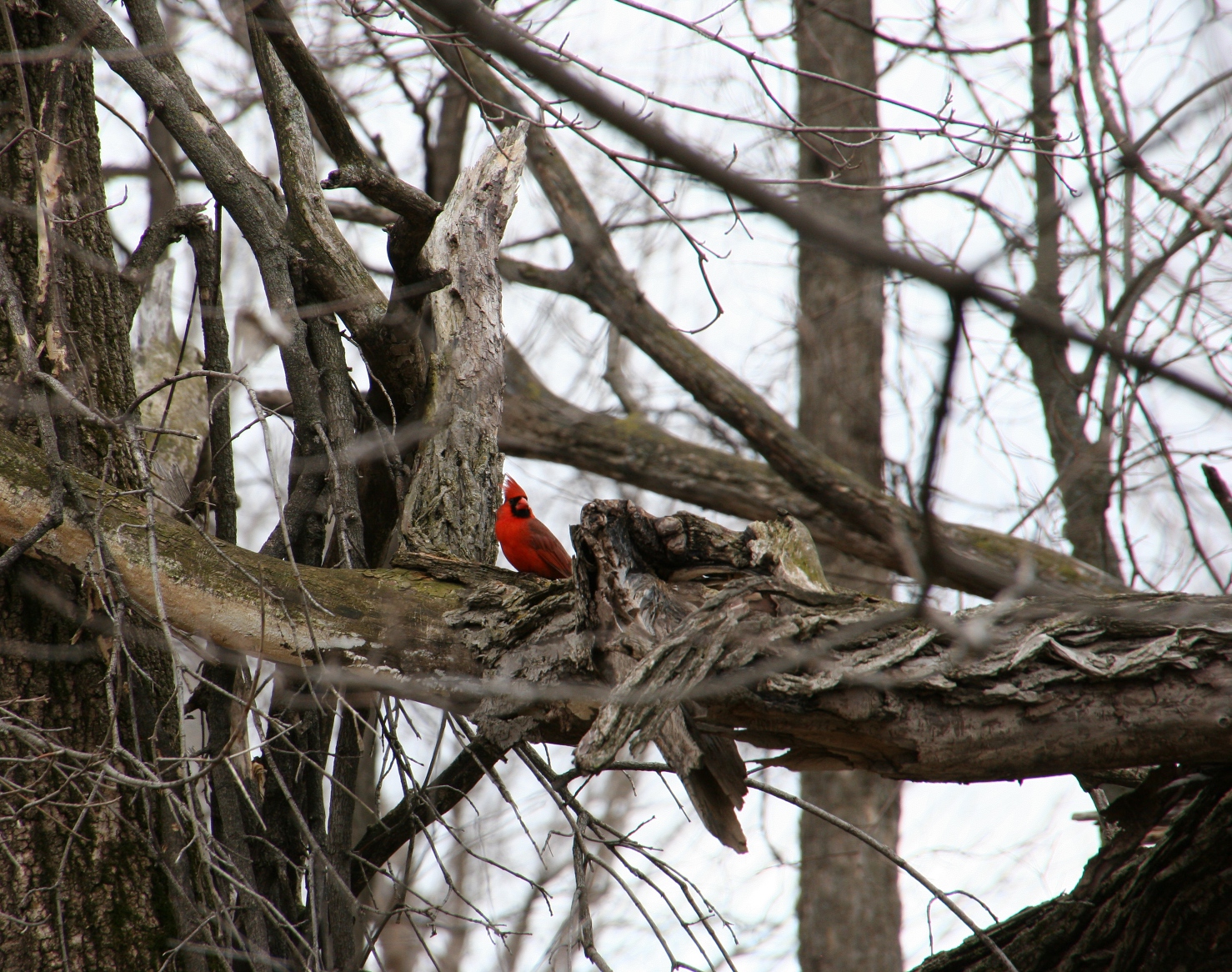
A cardinal. (Minnesota Prairie Roots copyrighted file photo April 2019)
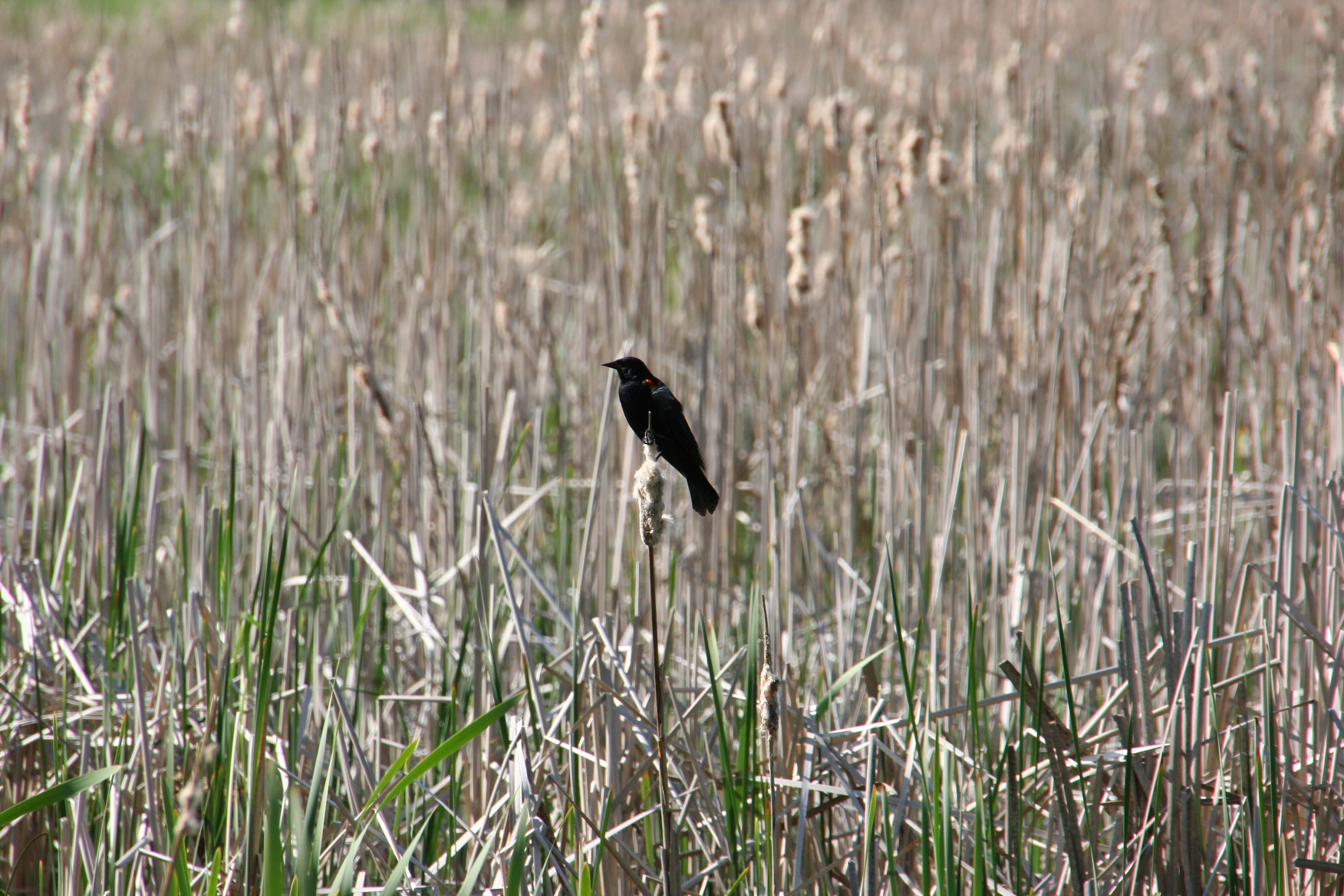
Cardinals trill. Red-winged blackbirds and robins sing in their distinguishable voices, which I can’t quite describe. But I know them when I hear them.
Red-winged blackbird among dried cattails in a pond. (Minnesota Prairie Roots copyrighted file photo May 2017)
When I step out my backdoor to hang laundry on the clothesline, I hear the morning birdsong, even above the drone of traffic along my busy street. When I walk at the local nature center, I hear birdsong rising from the woods, the marshes, the prairie. To hear birds singing is to hear the refrain of spring.
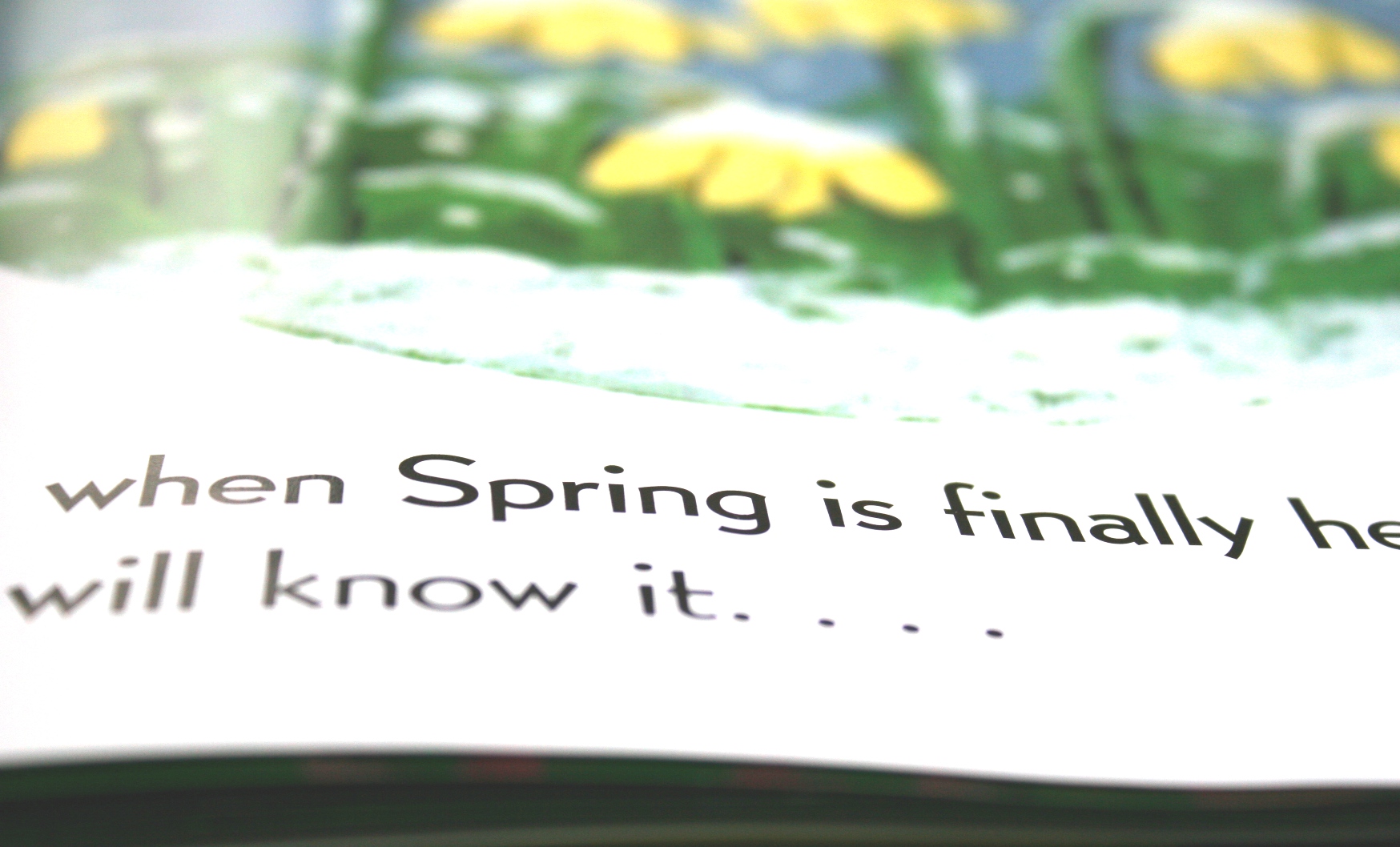
From the pages of a children’s picture book… Birds announce spring’s arrival in Minnesota. (Minnesota Prairie Roots file photo 2019)
It’s lovely and uplifting and hopeful. And in many ways remarkable. Here are these small feathered creatures singing spring songs that captivate us with their boldness, their melody.
Soon the grass will be lush and long, like a carpet for robins and other birds. (Minnesota Prairie Roots copyrighted file photo)
Each spring, without fail, I find myself listening intently to birdsong as if the song is a new release. In a way, it is. A release from winter’s grip. A release to days that are warmer and greener and teeming with life. Those are the signs, the hopes, of spring in Minnesota.
Leaping across a path near the parking lot at River Bend Nature Center in 2013. (Minnesota Prairie Roots copyrighted file photo April 2013)
THEY LEAPT LIKE BALLERINAS across the dirt trail, white tutu tails flashing.
They were a herd of 11 deer sighted recently at Faribault’s River Bend Nature Center. I stood on Raccoon Trail aside Randy simply watching. One after the other they leapt with such grace, such practiced precision.
I photographed these deer at River Bend in April 2022, not far from where we sighted 16 deer on March 13. (Minnesota Prairie Roots copyrighted file photo April 2022)
Only moments earlier, as we hiked down Arbor Trail on the nature center’s northeast side, Randy touched my arm, motioning me to stop. There, ahead of us, across the intersecting dirt path, several deer lingered in lowland grasses. I didn’t initially see them, my distance vision not all that acute. But eventually I spotted the camouflaged deer.
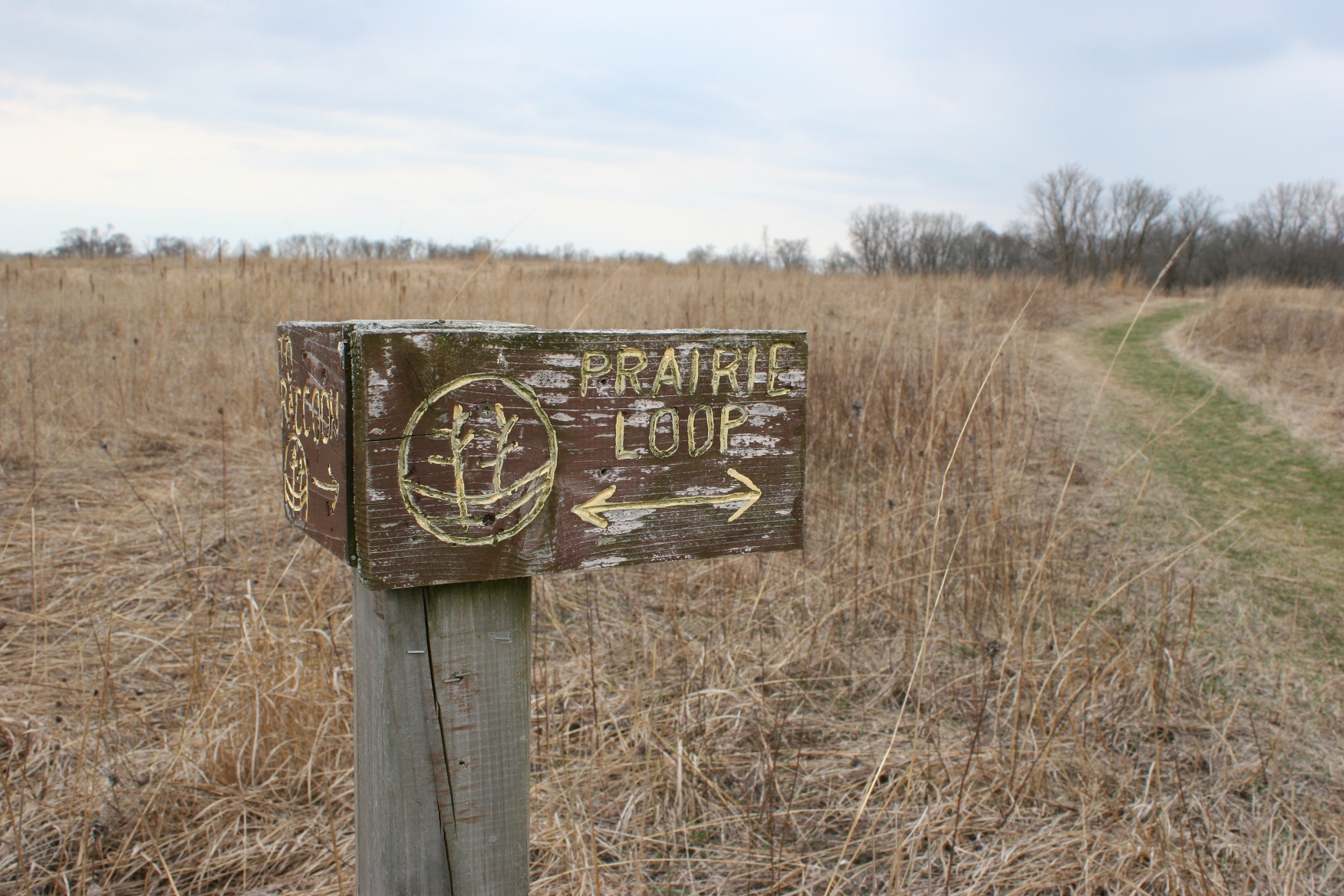
Rustic signs mark trails at River Bend. (Minnesota Prairie Roots copyrighted file photo April 2017)
And then we saw more in the distance, nearer the Prairie Loop. There, barely visible behind trees.
A sense of wonderment, of awe, of just wanting to take in the scene before me overtook my spirit. Such moments in nature deserve full attention. We watched while two men walked right past us, unaware of the nearby deer so engaged were they in conversation.
We waited, whisper-quiet. Watching. Then the deer moved, ambling along the edge of tall dried grasses, staying parallel to the trail. Soon more deer emerged from a stand of trees and trailed the first traveling troupe. It was a sight, the endless stream of deer moving east.
Our attention turned that direction, toward the deer, one by one, long-leaping over Raccoon Trail, into the woods, up the hill, toward the prairie. We started counting. One, two, three…all the way to eleven. Only when the last deer exited the stage did we dare move, so mesmerized were we by the performance.
Inspirational quotes like this are spread throughout River Bend. I especially love this one. (Minnesota Prairie Roots copyrighted file photo June 2019)
Randy and I resumed our hike, following Raccoon Trail until the biting wind of the March evening prompted us to turn back. By that time we were talking again or walking in comfortable silence. I wished aloud that I had my 35 mm camera with me. I’ve never been this near so many deer at River Bend. Eleven. But perhaps it was better I was without my camera so I could focus on the moment rather than on focusing and framing images.
Camouflaged deer among the prairie grasses of River Bend. (Minnesota Prairie Roots copyrighted file photo April 2022)
Then, back at the intersection of Raccoon and Arbor Trails, Randy alerted me to more deer. Five this time. Standing statute still, without stage fright. Watching us. Us watching them in a stare-down. I wondered which of us would move first. Wildlife or human.
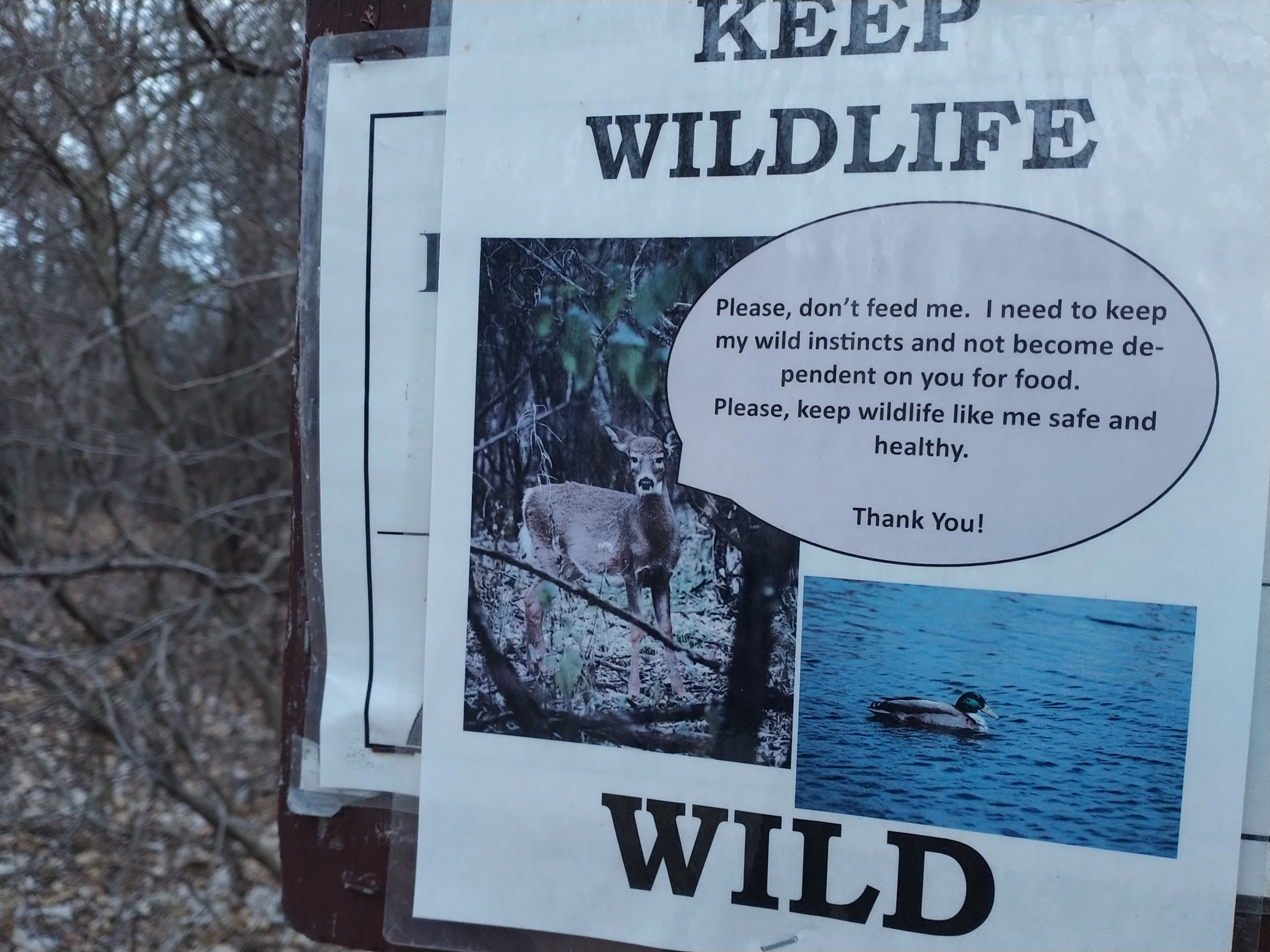
This sign posted in a kiosk along Raccoon Trail reminds visitors that deer and other wildlife, are just that, wildlife. (Minnesota Prairie Roots copyrighted photo March 2024)
I ooohed over the cute babies, last year’s fawns. Even if deer are dreadful when darting onto roadways and unwanted when dining on garden flowers and vegetables, I appreciate them in their natural habitat. This is their home, their stage, this land of tall grasses and woods. Here they walk with elegance. Here they leap with the grace of seasoned ballet dancers. Here they give me pause to stop, to listen to the trill of red-winged blackbirds as we watch each other—deer and human—in the fading light of a March evening at River Bend.
Ice fishing themed neon art advertises Grain Belt beer, made by August Schell Brewing Co. in New Ulm, Minnesota. (Minnesota Prairie Roots copyrighted photo January 2024)
IN THE UPSTAIRS ROOM of a small town southern Minnesota bar, I found myself drawn to the neon beer signs decorating the dark walls underscored by corrugated tin. The signs add an element of kitschy art to this space at The R Bar in Randolph where a group gathered for a holiday work party, Randy and I among them.
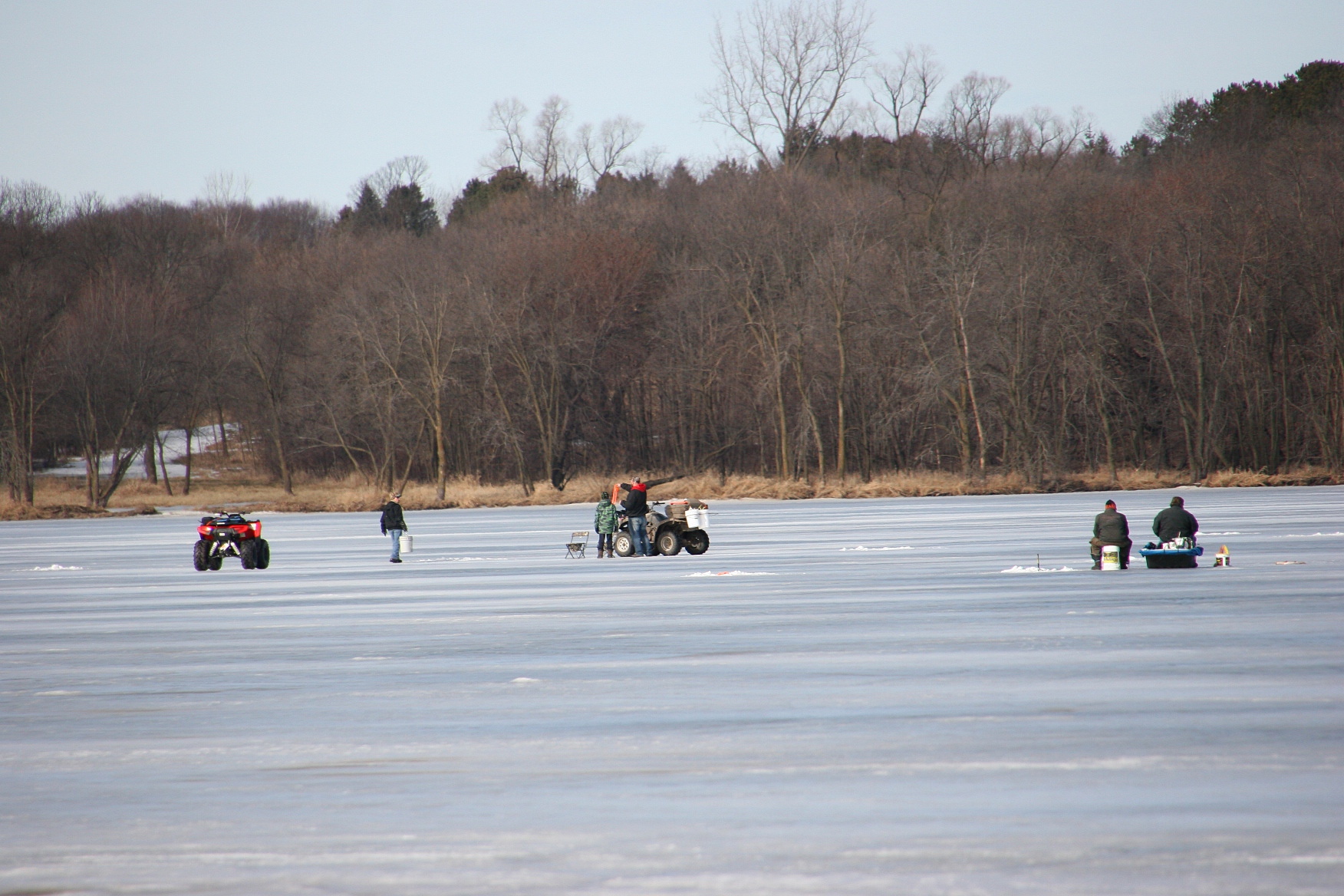
Ice anglers on Union Lake, rural Faribault, fish in the open on a sunny winter afternoon. (Minnesota Prairie Roots copyrighted file photo)
Next to the slim cooler holding an assortment of mass-produced beers and a few other drinks, I spotted neon signage that is about as Minnesotan as it gets—a bundled up ice fisherman pulling a fish through a hole in the ice, beer beside him.
Ice fishing on the Cannon River near the Faribault Mill. (Minnesota Prairie Roots copyrighted file photo February 2023)
Winter in Minnesota, if this would be a typical winter, finds anglers pulling fish houses onto lakes or sitting on overturned 5-gallon buckets to fish through holes drilled in the ice. But this has not been a usual winter here with temps (before this week) above normal and many lakes remaining open rather than frozen over. Several weeks ago, 122 anglers had to be rescued after ice broke away from the shore on Upper Red Lake in northern Minnesota. Following that, law enforcement officials restricted motorized vehicles from driving onto the lake until the ice consistently thickens to support motor vehicle traffic.
Ice fishing shacks are set up like a mini village on Lake Mazaska west of Faribault in Shieldsville. (Minnesota Prairie Roots copyrighted file photo)
I recognize this all sounds a bit odd to anyone unfamiliar with ice fishing. Vehicles, and we’re not talking just recreational vehicles, we’re talking mostly pick-up trucks, are driven onto the ice as anglers head for the hot fishing spots on our frozen lakes.
I myself engaged in the sport of ice fishing some 40 years ago, pre-children. Randy and I would sit inside his friend Jerry’s small ice shack warmed by a portable heater, play cards, drink beer and drop our lines into holes drilled through the ice. As the hours passed, we watched for our bobbers to tip in the frigid lake water, indicating a bite. I don’t remember catching many fish. But I recall the unsettling noise of cracking ice as Randy drove his Chevy pick-up truck across the icy lake and as we huddled inside the tight ice fishing hut.
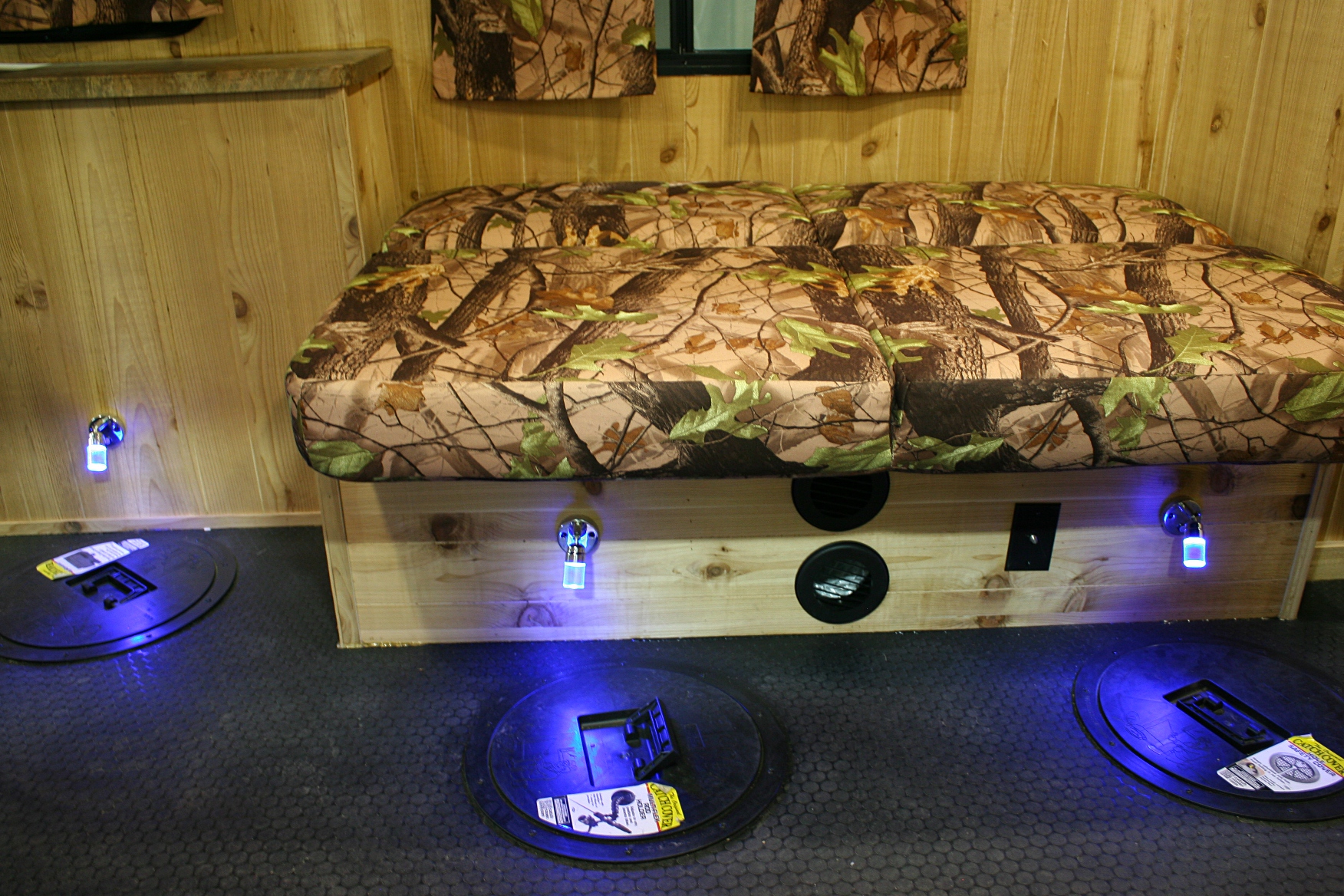
The interior of an ice fishing house/camper, photographed several years ago at a sports show in Owatonna. Remove the lids and drop your line into the water on a frozen lake. (Minnesota Prairie Roots copyrighted file photo)
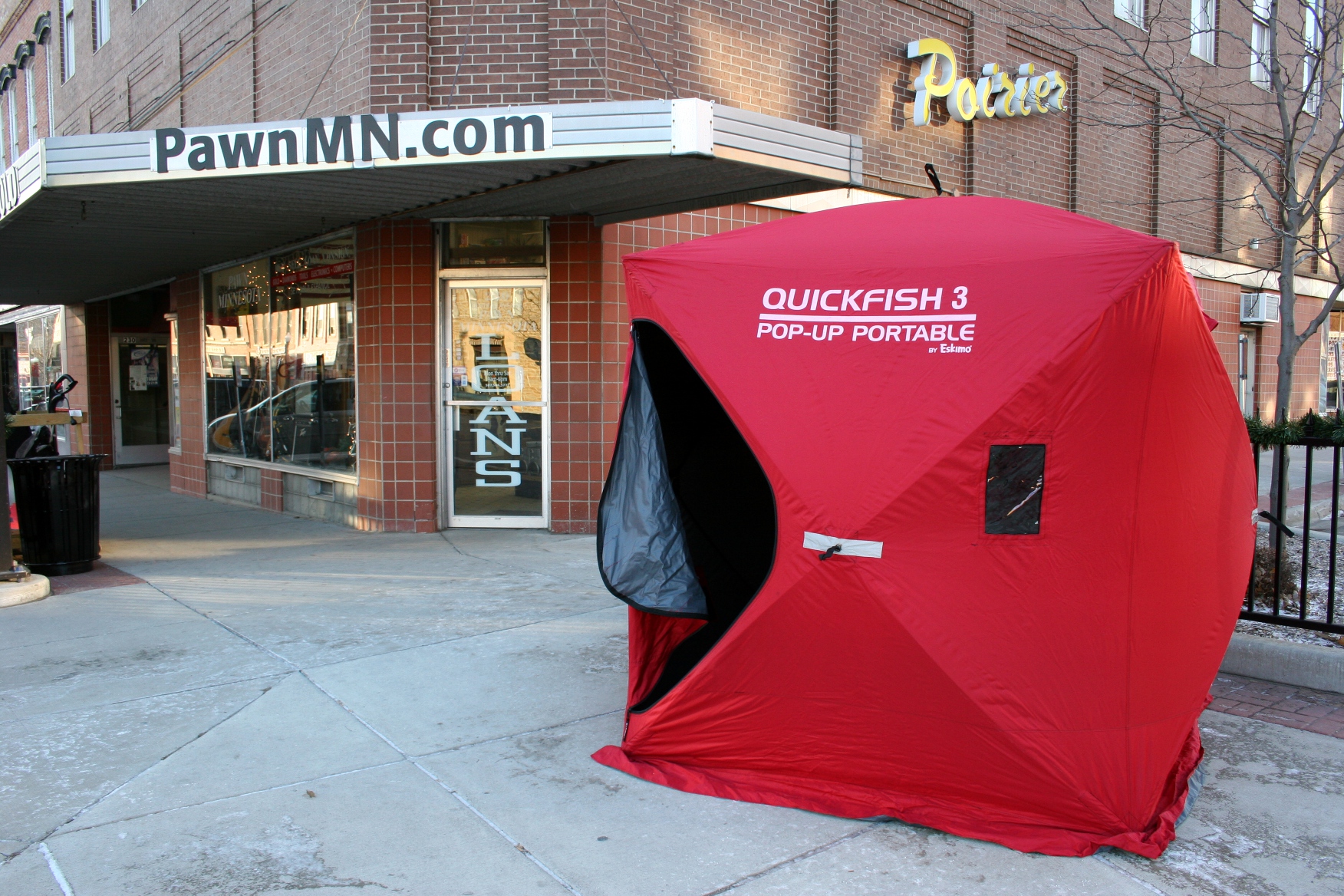
Much has changed through the decades. Fish houses have grown in size to almost mini cabins complete with kitchens and bunks to sleep overnight. This is a serious sport, big business in Minnesota. Of course, for those with more limited resources, tent-like pop-up portable fish houses remain an affordable option as does sitting on a cooler or a bucket under the winter sky.
A pop-up portable fish house at Pawn MN in downtown Faribault. (Minnesota Prairie Roots copyrighted file photo)
I doubt I will ever return to ice fishing. It doesn’t appeal to me like it did those winters, oh, so long ago. And I don’t trust the ice like I did back in the day when I was younger, less prone to considering ice thickness and safety. I’ve lived enough Minnesota winters to believe the warning, “No ice is ever completely safe.”
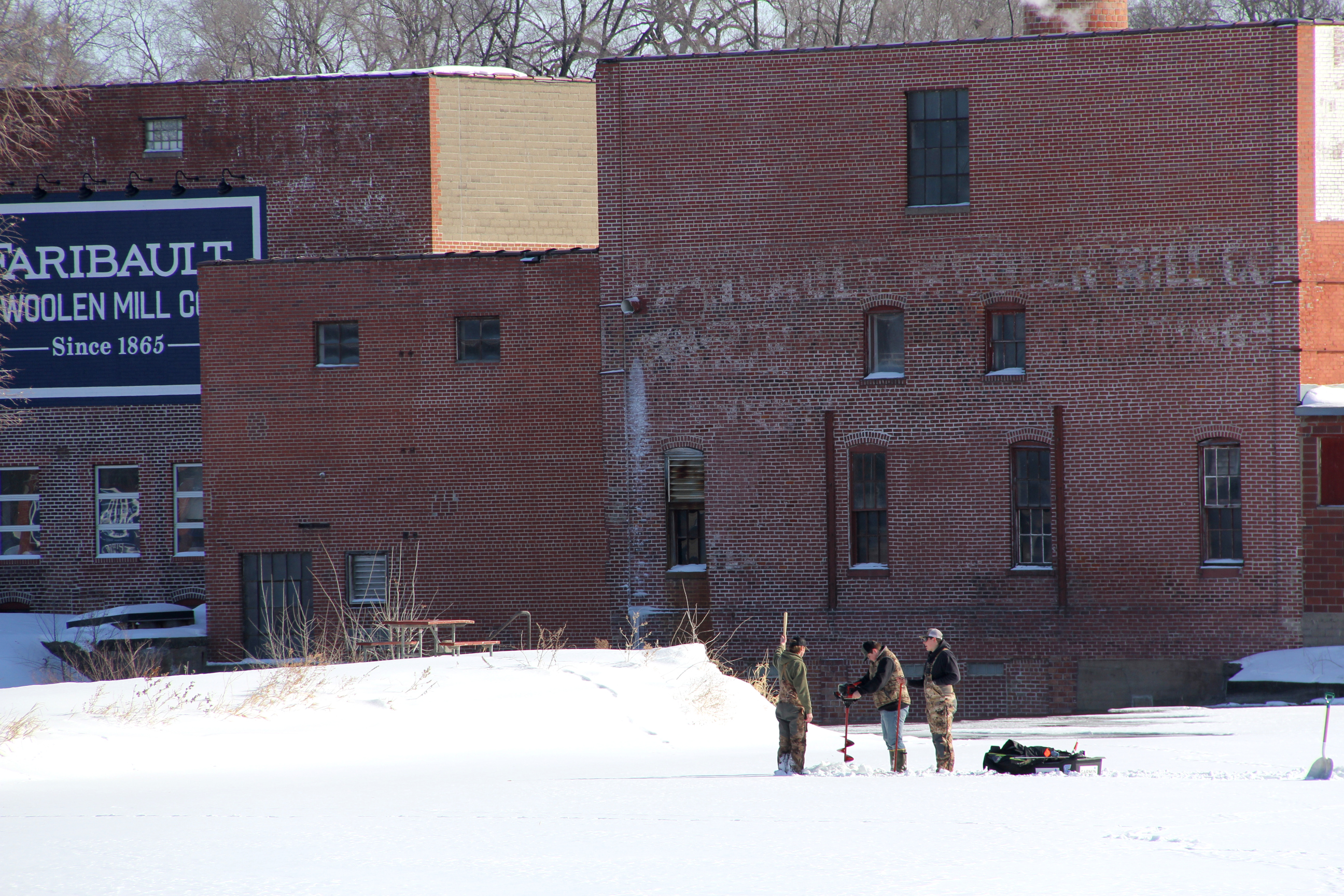
Drilling a hole in the frozen Cannon River to fish near the Faribault Mill. (Minnesota Prairie Roots copyrighted photo February 2023)
But I still celebrate ice fishing and its importance in Minnesota. It’s a favorite winter pastime/sport, especially for guys who seem intent on bonding over beers. It’s an important part of tradition and of our economy.
And, on this January evening, ice fishing is also an art form. I found it, here in The R Bar, the neon image of an ice fisherman glowing in this space of pool tables, tabletop shuffleboard, dart boards, high-top tables, a shiny wood-grain bar top, and a slim cooler holding Minnesota-made Grain Belt and other beer. This is winter in Minnesota, defined not by the light snow falling outside the bar, but by a neon symbol of fishing through a hole drilled in a frozen lake.














 Minnesota Prairie Roots
Recent Comments