Minnesota Prairie Roots

Writing and photography by Audrey Kletscher Helbling

Beyond poetry anthologies May 21, 2011

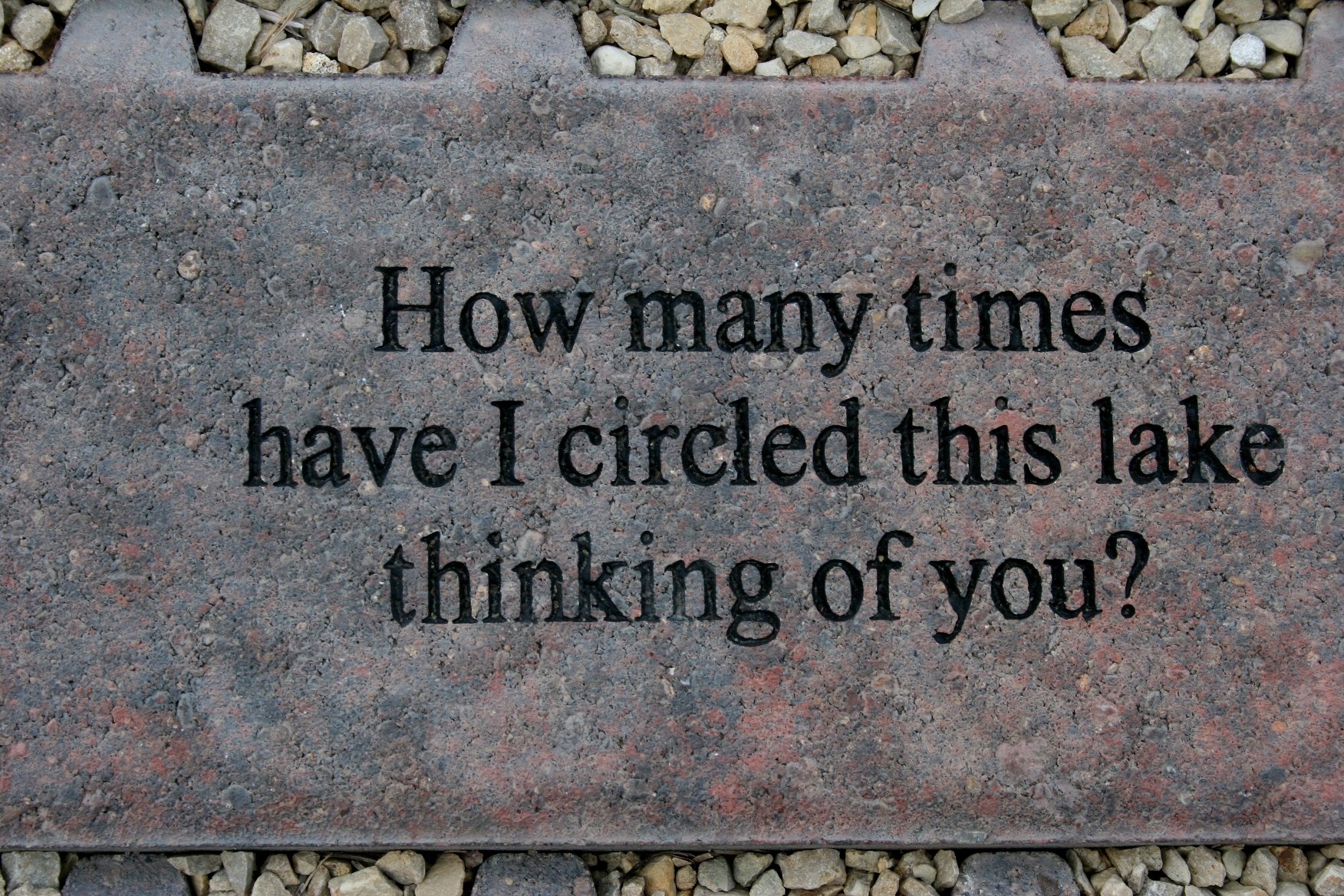
Poetic words imprinted upon a paver at the Lake Harriet bandshell in south Minneapolis.

WHAT AN EXCITING time to read, and write, poetry.

Yes.

Read on.

If you’re among those who consider poetry boring, unapproachable, complex and difficult to understand, then you’ve read only boring, unapproachable, complex and difficult to understand poems.

Yes, those types of poems exist.

But today, oh, today, poetry is pushing beyond simply words printed in anthologies to highly-public and engaging venues.

At least three Minnesota communities—St. Paul (Everyday Poems for City Sidewalk), Mankato (WordWalk) and now Northfield (Sidewalk Poetry Contest)—have embraced sidewalk poetry, poems imprinted upon sidewalks.

In Fergus Falls, the Fergus Area College Foundation sponsors a seasonal poetry contest and posts the winning poem on four Burma Shave style billboards. I won the spring Roadside Poetry Project competition. (Click here to read a story published today in The Marshall Independent about my writing and my Roadside Poetry poem.)
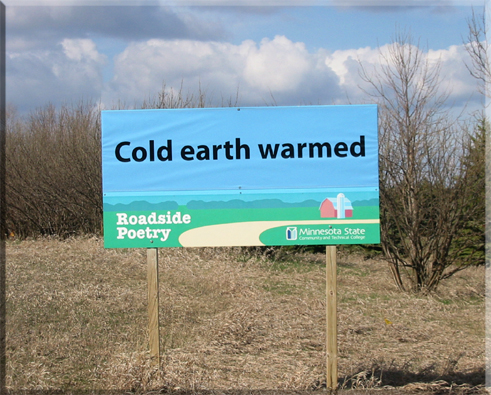
The first line in my spring poem posted on four billboards.

In Hackensack, as part of its annual summer Northwoods Art Festival and Book Fair, the Northwoods Art Council has invited Minnesota poets to submit poems for display. Attendees then read and vote for their favorite poems.

But the latest news in the poetry world comes from St. Paul poet Todd Boss and Minneapolis art director/animator/designer Angella Kassube, who have created “motionpoems.” The pair defines these poems as “a hybrid of poetry and film.”
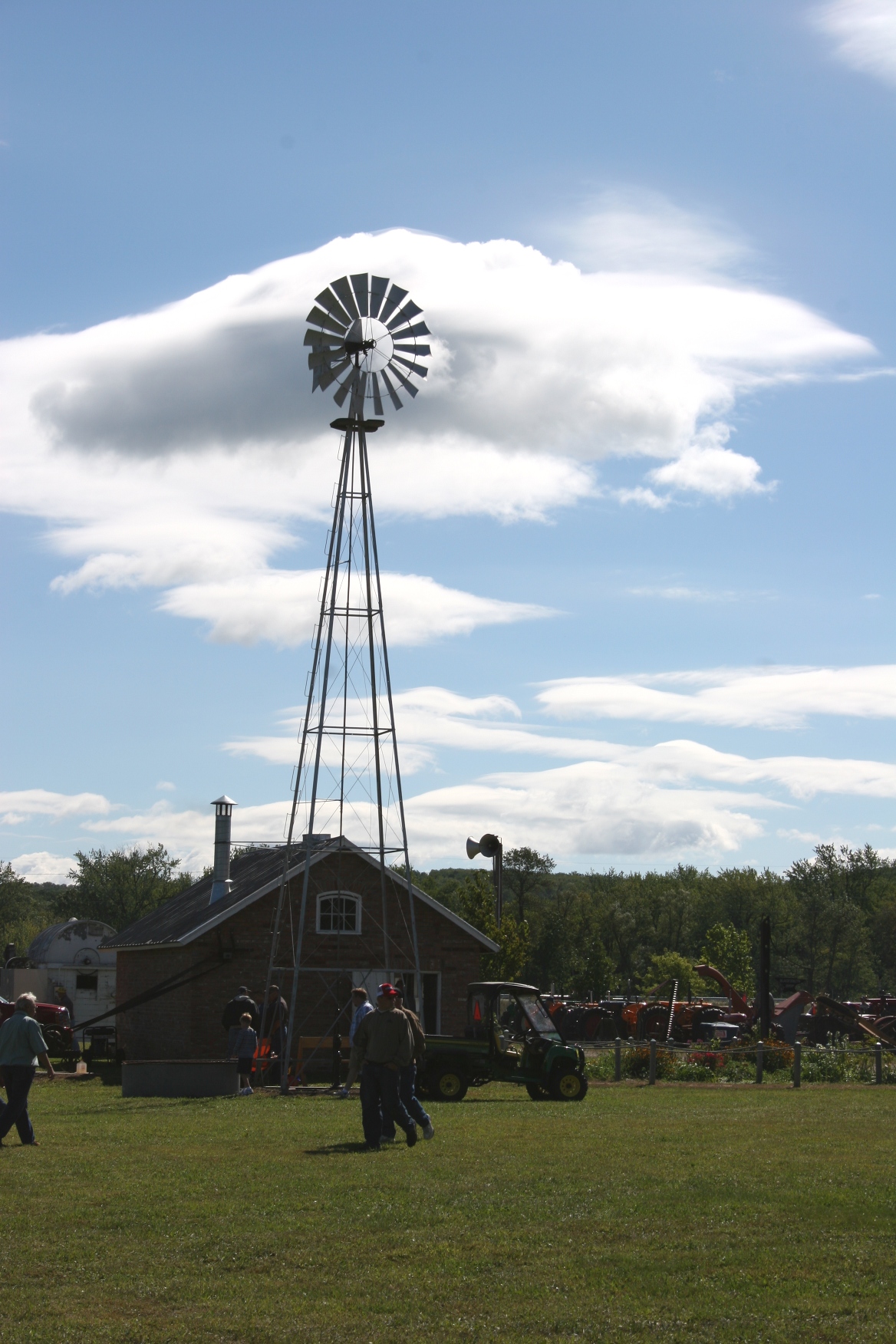
The windmill is the subject of a motionpoem written by Toss Boss. I took this photo at the Rice County Steam and Gas Engines grounds near Dundas last fall.

In short, they bring poems to life via animation. From what I’ve seen and heard online, this approach works, making poetry more accessible, understandable and, dare I say, exciting. But don’t take my word for it. Click here and view several motionpoems, including my favorite, Todd Boss’ THE GOD OF OUR FARM HAD BLADES.

The duo started this project two years ago, creating more than 20 poems. Now they are expanding, collaborating with New York publisher Scribner’s respected annual Best American Poetry anthology, 2011 volume, to produce 12 – 15 motionpoems. They’ll work with writers ranging from Pulitzer Prize winners to emerging writers. Eventually, the motionpoems will be accessible, for free, online.

I see great promise in these new approaches to poetry that reach beyond printed poems and poetry readings. I see the promise for reaching a wider, more receptive audience.

WHAT’S YOUR TAKE on sidewalk or billboard poetry and/or motionpoems? Would you be more likely to read these types of poems than traditionally-published poetry?

© Copyright 2011 Audrey Kletscher Helbling

Roadside Poetry Project photo courtesy of Paul Carney


The Boys of ’61 memorial May 9, 2011

ON AUGUST 21, 1862, he was mustered into the Seventh Regiment Minnesota Volunteer Infantry, Company K. He was 34 years old. He was my great great grandfather, John Dallmann.

More than two years later, he was among seven men from his company wounded in the Battle of Nashville. The battle represented one of the Union Army’s largest victories during the Civil War. Two soldiers from Company K were killed in that December 15-16, 1864, conflict.

Remarks written in the Company K roster, published in Minnesota in the Civil and Indian Wars 1861-1865, under the supervision of The Board of Commissioners appointed by the act of the Minnesota legislature in 1889, state that Dahlman (the roster spelling) was “Wounded at Nashville; discharged in hospital in ’65.”

Other than that basic information, I know nothing of my great great grandfather’s military service.

He was among some 24,000 Minnesotans who marched off to war 150 years (or so) ago. Some came home; many died on battlefields or of disease.

My great great grandfather, John Dallmann (seated in the front row) was wounded on December 16, 1864, at the Battle of Nashville. My great grandmother, Anna Dallmann Bode is standing in the center in the back row, between her siblings, Minna, left to right, Carl, Herman and Hulda.

On this the sesquicentennial of our nation’s bloodiest war, plans are in place to construct a memorial honoring “all Minnesota citizens who served and fought to preserve Minnesota and the Union between 1861 and 1866,” according to the Minnesota Boys of ’61 nonprofit corporation.

A one-acre site south of the State Capitol in Summit Park has been selected for the state-wide memorial, current location of a monument to Josiah King, the first Minnesotan to volunteer for the Union.

Design plans call for granite monuments recognizing each Minnesota regiment, battery, battalion or independent organization encircling a full-scale bronze infantryman, calvaryman and civilian volunteer. Artillery pieces will flank each side of the memorial.

Efforts are currently underway to raise $750,000 for the project, which will be funded entirely by private donations.

For Minnesotans, this monument offers an opportunity to honor a soldier-ancestor on a state-wide level. Contributions made payable to “Minnesota Boys of ’61 Memorial” should be sent to:

Minnesota Boys of ’61 Memorial

1524 East Cliff Road

Burnsville, MN. 55337

A “Wall of Honor” will recognize donors at various levels, beginning with patriot donors who give a minimum $150. Contributors may choose to be recognized by personal or business name or may honor an ancestor.

Those who donate over $1,000 in money or in-kind services will also receive a signed, limited edition print of Minnesota Iron, the official Boys of ’61 print by Minnesota artist David Geister.

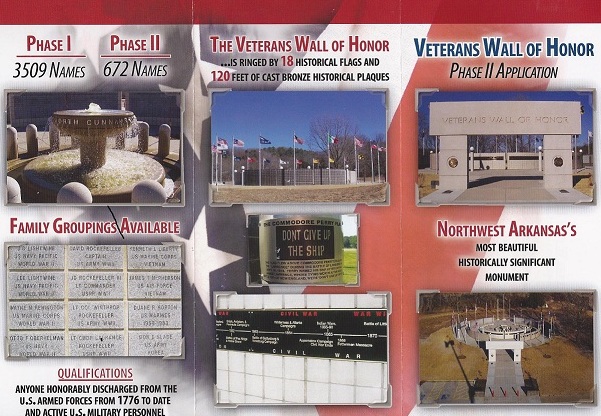
My great great grandfather's name is listed on the Veterans Wall of Honor in Bella Vista, Arkansas, where my two maternal aunts and their husbands live.

FYI: Log on to boysof61.org for more information about the Minnesota memorial and how you can donate.

Click here to read about the Arkansas memorial.

© Copyright 2011 Audrey Kletscher Helbling

Family photo courtesy of Dorothy Bowman


An emergency road service ordeal February 5, 2011

IT SHOULD HAVE BEEN a hassle-free situation. That is why we have emergency road service coverage through our auto insurance. It is for times like this—when the car breaks down and you are stranded.

That happened to our eldest daughter Friday evening as she was leaving her St. Paul office for the commute to her Minneapolis home.

When a light came on in her car and when she had difficulty steering, she quickly got off the road and pulled into a convenience store.

Getting a tow truck should have been easy, worry-free, as promised by the insurance company. It was anything but.

A call to the insurance company came with a promise that help was on the way. But, as the minutes ticked by and no tow truck arrived, my daughter called to check on the reason for the delay.

She was told the tow truck driver couldn’t find her, although she was at a busy convenience store just off Interstate 94 and had specified her exact location. The driver, claimed, however, that he couldn’t find her. He was from Columbia Heights, not St. Paul.

So my eldest, by this time frustrated, called a St. Paul towing company.

They were “really nice,” she told me when phoning to update me on her situation.

Well, “Minnesota Nice” soon changed to “Minnesota-Not-So-Nice.” The driver first asked for $90 cash to pay the towing fee.

Who carries $90 cash?

Not my daughter.

Instead, he accepted her credit card, which, for whatever reason, wouldn’t work.

So she asked if he would take a check. He would. She wrote out a check and was already en route to Minneapolis with a friend who had come to her rescue when her cell phone rang.

It was the manager of the towing company saying the firm could not accept her check and would be towing her car back to the convenience store.

What would you do?

Probably exactly what my daughter did. She explained that she was not trying to rip off the towing company, that she had plenty of money in her bank account. It didn’t matter, so she headed back to the convenience store to use the ATM which the towing company rep told her was located there.

She withdrew $90 cash, paid the tow truck driver, ripped up the $90 check in front of him and left, two hours after she first called the insurance company that promised worry-free, drive-and-sign emergency road service.

© Copyright 2011 Audrey Kletscher Helbling