Minnesota Prairie Roots

Writing and photography by Audrey Kletscher Helbling

When yet another vehicle strikes another child heading to school October 18, 2017

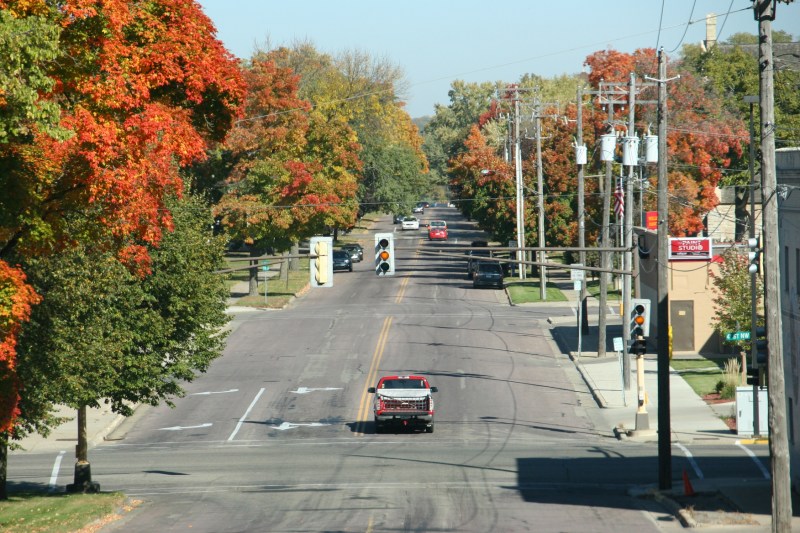
A teen was struck on busy Second Avenue (pictured here intersecting with Minnesota State Highway 60), several blocks north of this Faribault intersection. Minnesota Prairie Roots file photo October 2015.


IF YOU’VE EVER EXPERIENCED trauma, you understand how a news story can trigger difficult memories.

Tuesday morning a vehicle struck a 13-year-old girl as she crossed a busy Faribault street on the way to her bus stop. Conscious, but incoherent, she was airlifted to a Twin Cities trauma center with unknown injuries.

Now the 54-year-old male driver of the 1998 Lincoln Navigator that hit the girl faces possible charges. According to news reports, he drove his vehicle around the right side of vehicles stopped for the teen at the Second Avenue crosswalk.

When I heard the news, my mind flashed back to May 12, 2006, the date a car hit my then 12-year-old son as he crossed a busy Faribault street on the way to his bus stop.

The similarities end in the commonality of Faribault Middle School students struck on busy streets around 7:30 a.m. while going to bus stops.

My son suffered only minor injuries of a broken bone in his hand, a possible rib fracture and a bump on his head after bouncing off the windshield of a blue 4-door car, possibly a Chevy Cavalier or Corsica. That driver left the scene and has never been found despite police follow-ups on many leads and a $1,000 reward offer (now expired).

In the years since that May morning when fear gripped my heart, I’ve sometimes wondered about that motorist. How could he/she drive away from my boy, just leave him lying on the side of the road? Police suspect, and I agree, that the driver had something to hide, a reason to continue on.
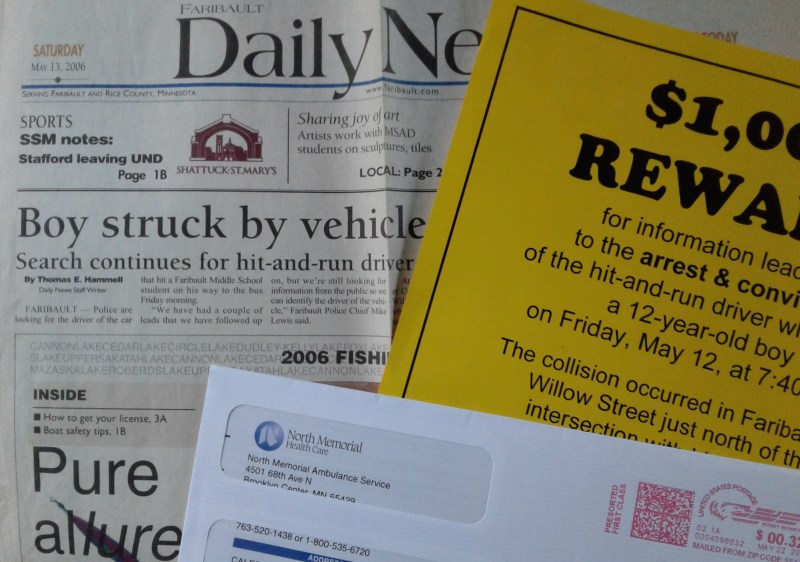


I still keep a file of email exchanges with police, newspaper clippings, medical bills, insurance documents, the accident report, the reward flier and even handwritten get well cards crafted by children to my son. This incident is part of my family’s history now, part of our story.

I changed on that May morning 11 years ago. I lost some faith in the goodness of people. For awhile I was angry, driven to find the man or woman who failed to stop. I couldn’t understand the lack of compassion and still can’t. But my resolve to find the individual lessened as the years passed, replaced by an acknowledgment that I likely will never have answers.

Still, on days like Tuesday when I hear of another child struck on her way to school, the memories rise, strong and painful.


FYI: Click here to read an award-winning poem I wrote about the hit-and-run involving my son.

© Copyright 2017 Audrey Kletscher Helbling


Don’t tell me you’re “fine” when you’re not & other insights March 5, 2017


HOW ARE YOU? I’ve never liked that question, even realizing the underlying kindness that laces those three trite words.

The standard answer of “I’m fine” is expected. The truth most often is not.


ttfa-1024x1024


Now Minneapolis writer Nora McInerny Purmort—who has faced her share of “I’m not fine” days—tackles the “How are you?” question in a podcast series from American Public Media. Terrible, (Thanks for Asking) is a must-listen series in which Nora seeks only honest responses to “How are you?”

I’ve listened to one podcast thus far. “Unbroken” features an interview with sexual assault survivor Sarah Super. It’s an incredible, horrible, powerful and, yes, sometimes graphic, story. But so worth your time for the insights revealed. Sarah is one strong woman. And we can learn so much from her about the importance of speaking up, of being heard and more.

Both she and Nora address the issue of silence. And, yes, I picked that from the interview because silence is all too pervasive. I’m talking the hard, uncomfortable silence that those who have suffered trauma, those who are dealing with health issues, those who are facing unimaginable difficulties and challenges hear. Yes, hear. Silence truly can be deafening.

Sarah cites the reason many friends and loved ones remained silent following her assault: “I didn’t know what to say or do.”

Puh-lease.

“Your silence,” Sarah says, “feels like apathy.” The definition of apathy is lack of interest, enthusiasm or concern. Lack of. Imagine how that feels to your loved one who is hurting. Lack of.

Nora reiterates Sarah’s thoughts: “Silence hurts when you are on the other end of something awful.”

In an interview with National Public Radio about her podcast series, Nora repeats, “The worst thing—and it doesn’t matter if you’re dealing with death, or if you’re dealing with all of these other things that we’ve talked to people about—silence is the worst thing you can hear from people.”

She gets it. Within six weeks, this young woman lost her father to cancer, miscarried and then lost her husband to brain cancer. Since then, Nora has authored the book It’s Okay to Laugh (Crying Is Cool, Too). And now the enlightening podcasts have followed.

What can we learn from all of this? My take-away is this: First, we need to speak up, to end the silence, to really care when we ask someone, “How are you?” And then we need to listen, really listen. That means setting aside our stories, our comments, our whatever, and truly focusing on what the other person is telling us. It’s about them. Not us.

#

CHECK BACK TOMORROW for a way that Minnesota is breaking the silence on an issue that affects all of us, directly or indirectly.

© Copyright 2017 Audrey Kletscher Helbling