Minnesota Prairie Roots

Writing and photography by Audrey Kletscher Helbling

At home comfy with Paul Bunyan in Faribault October 22, 2024

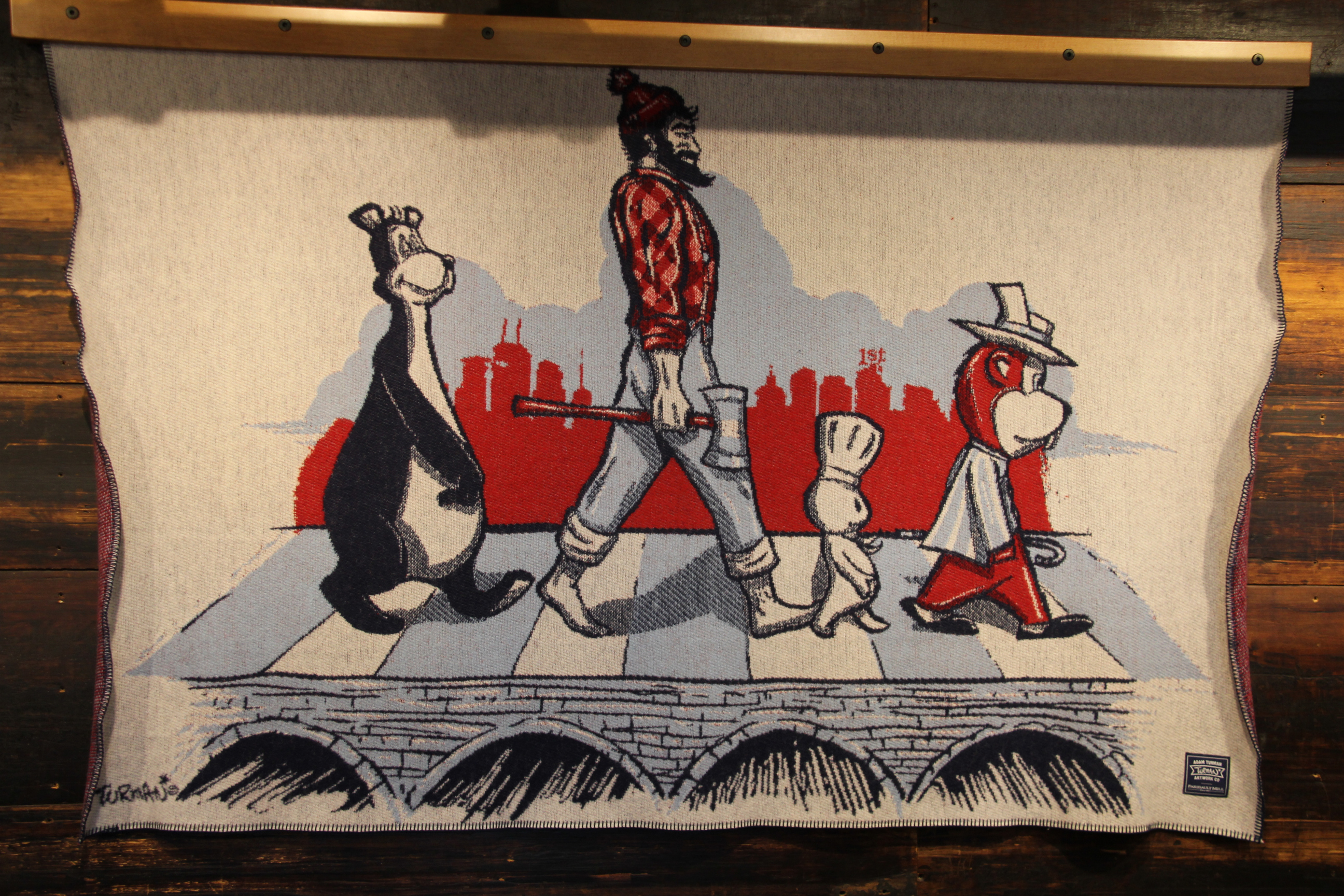
Minnesota artist Adam Turman designed this Abbey Road throw (inspired by the Beatles “Abbey Road” visual) for the Faribault Mill. It features the Hamm’s beer bear, Paul Bunyan, the Pillsbury Dough Boy and State Fairchild, all legendary Minnesota icons, against a metro skyline backdrop. (Minnesota Prairie Roots copyrighted photo October 2024)

AS A LIFE-LONG MINNESOTAN, certain things pop out at me as iconic Minnesota. Topping that list—Paul Bunyan and Babe the Blue Ox. I realize we’re not the only place claiming this over-sized legendary lumberjack and his ox as ours. But both are assuredly important in state lore, tourism and business identity, mostly in central and northern Minnesota where our lumber industry is rooted.
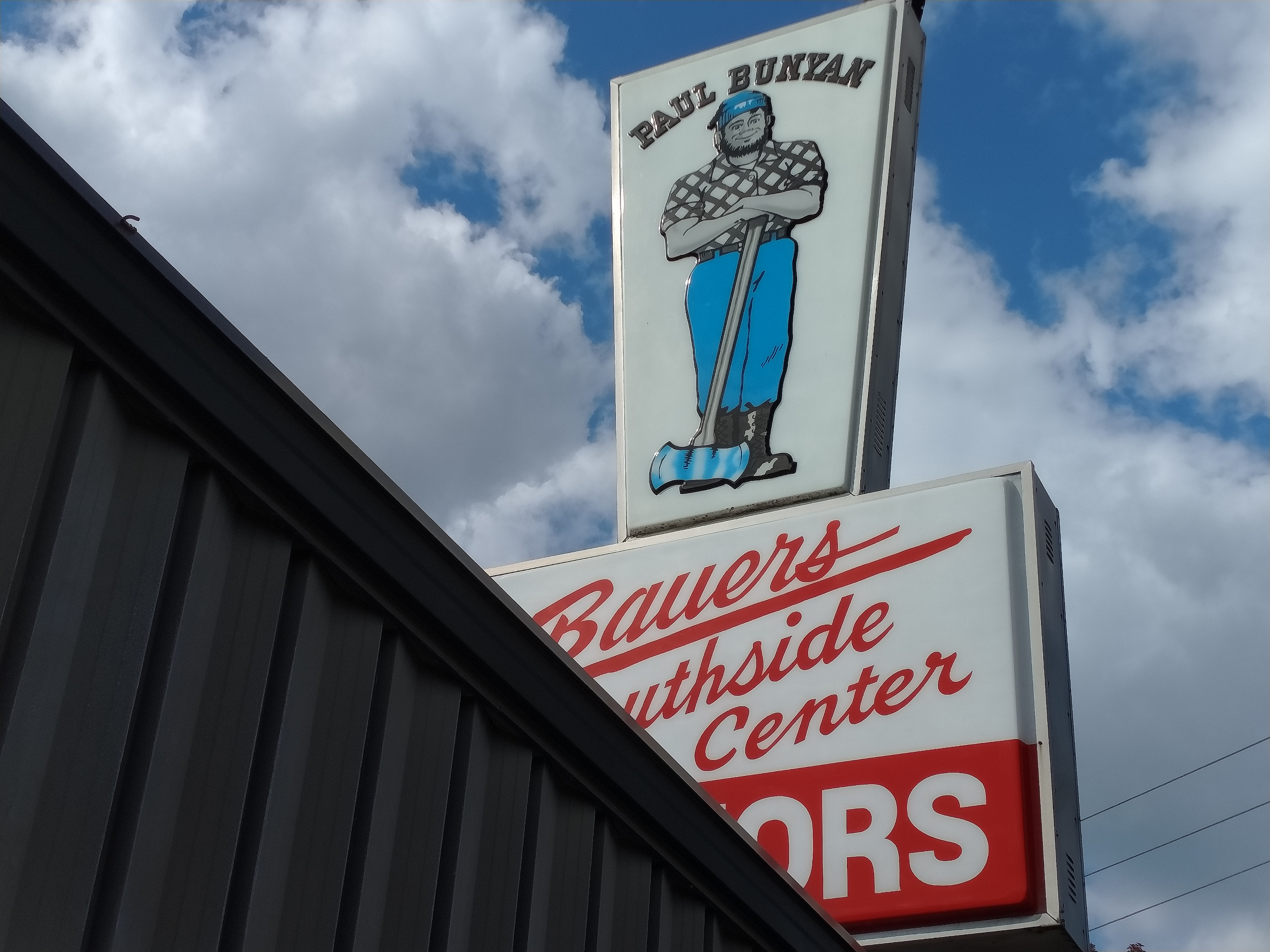
This Paul Bunyan sign is just blocks from my home. Granted, Paul is not wearing his usual buffalo plaid flannel shirt. (Minnesota Prairie Roots copyrighted photo September 2023)

Yet, I only need head south a few blocks from my house to see Paul marking Bauers Southside Liquor, once also home to the adjoining Paul Bunyan South gas station and convenience store. It closed years ago as did all the other Paul Bunyan stores in Faribault.
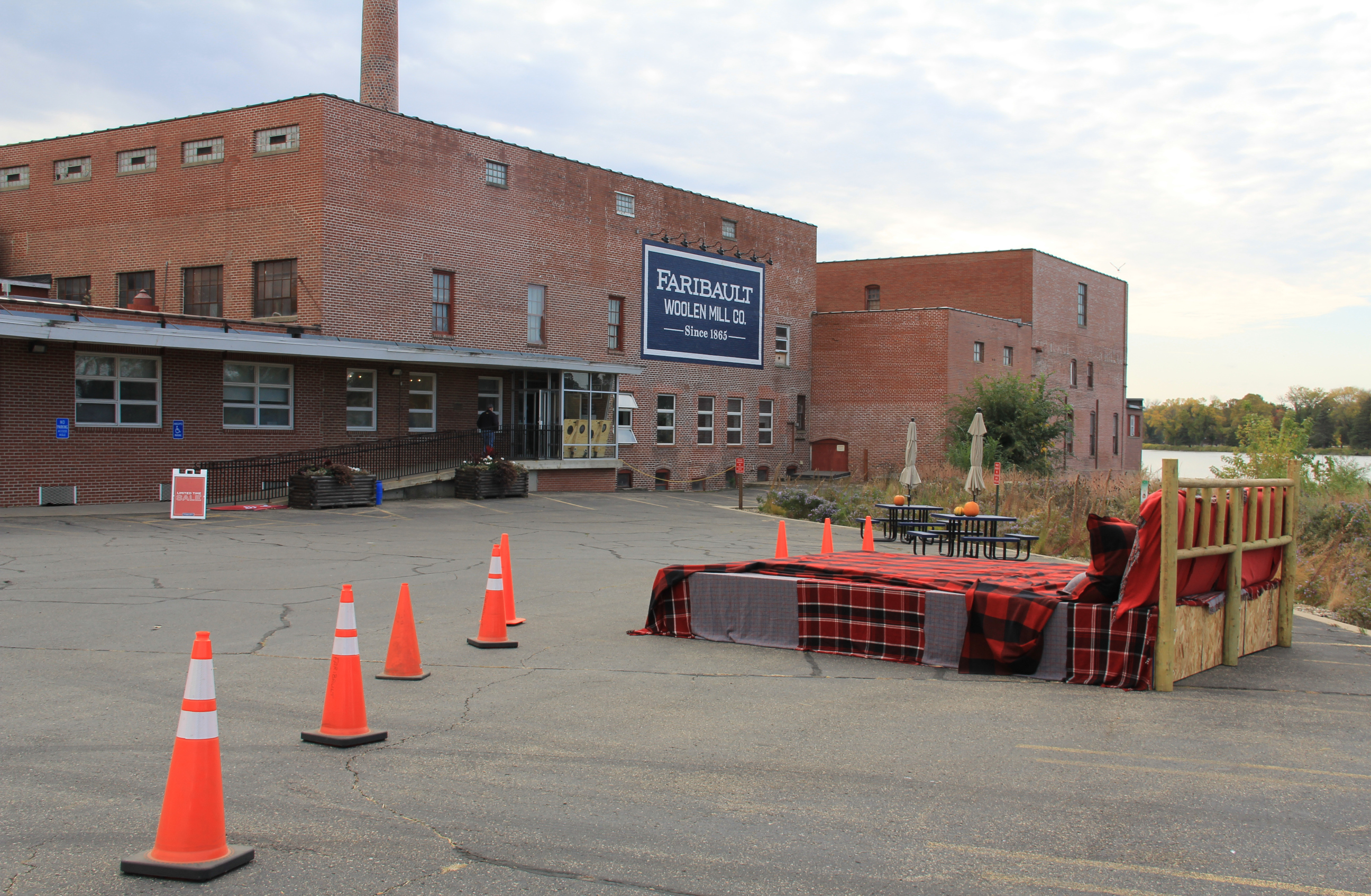
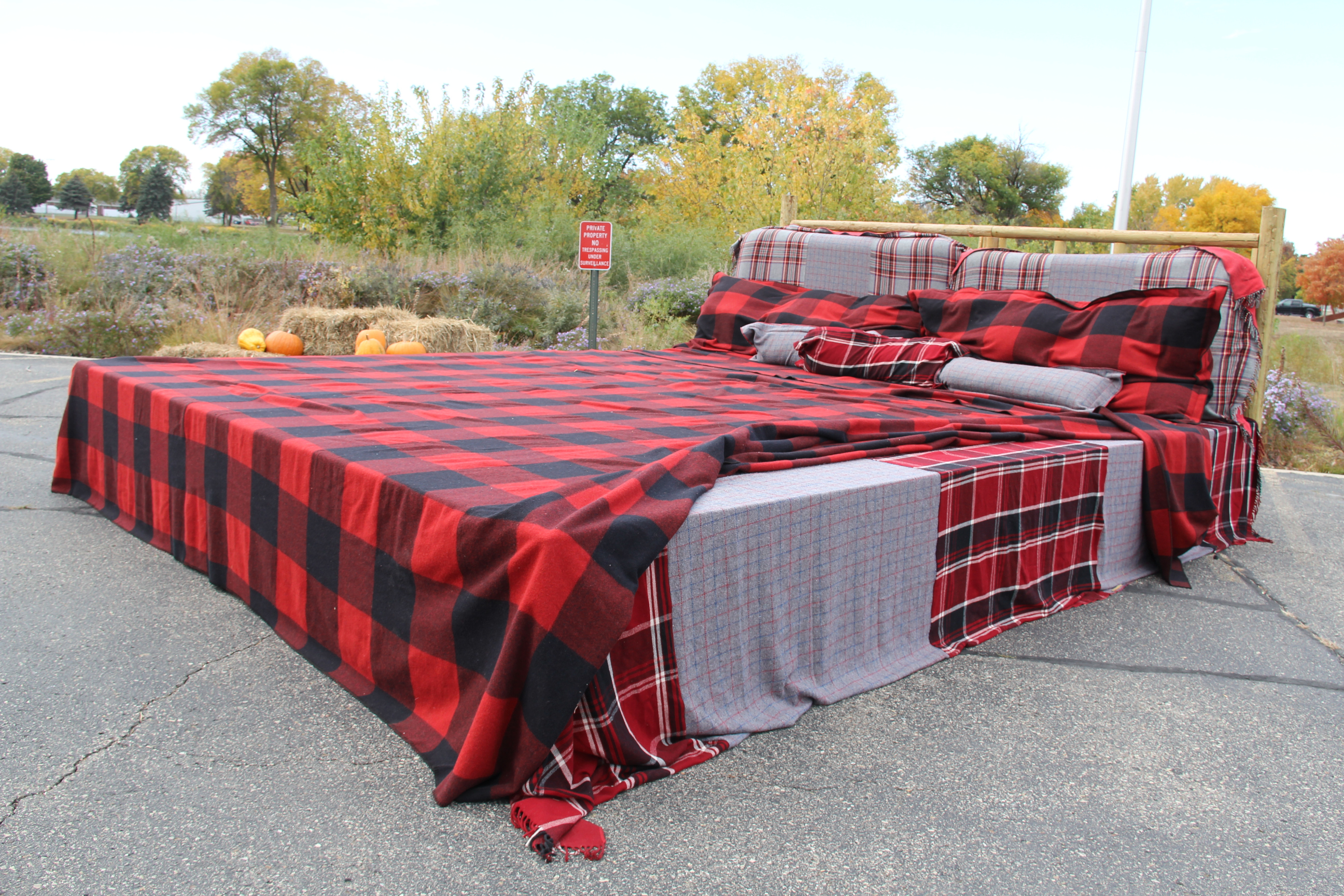
Paul Bunyan’s bed sits by the Faribault Mill along the Cannon River on Faribault’s northside. (Minnesota Prairie Roots copyrighted photo October 2024)
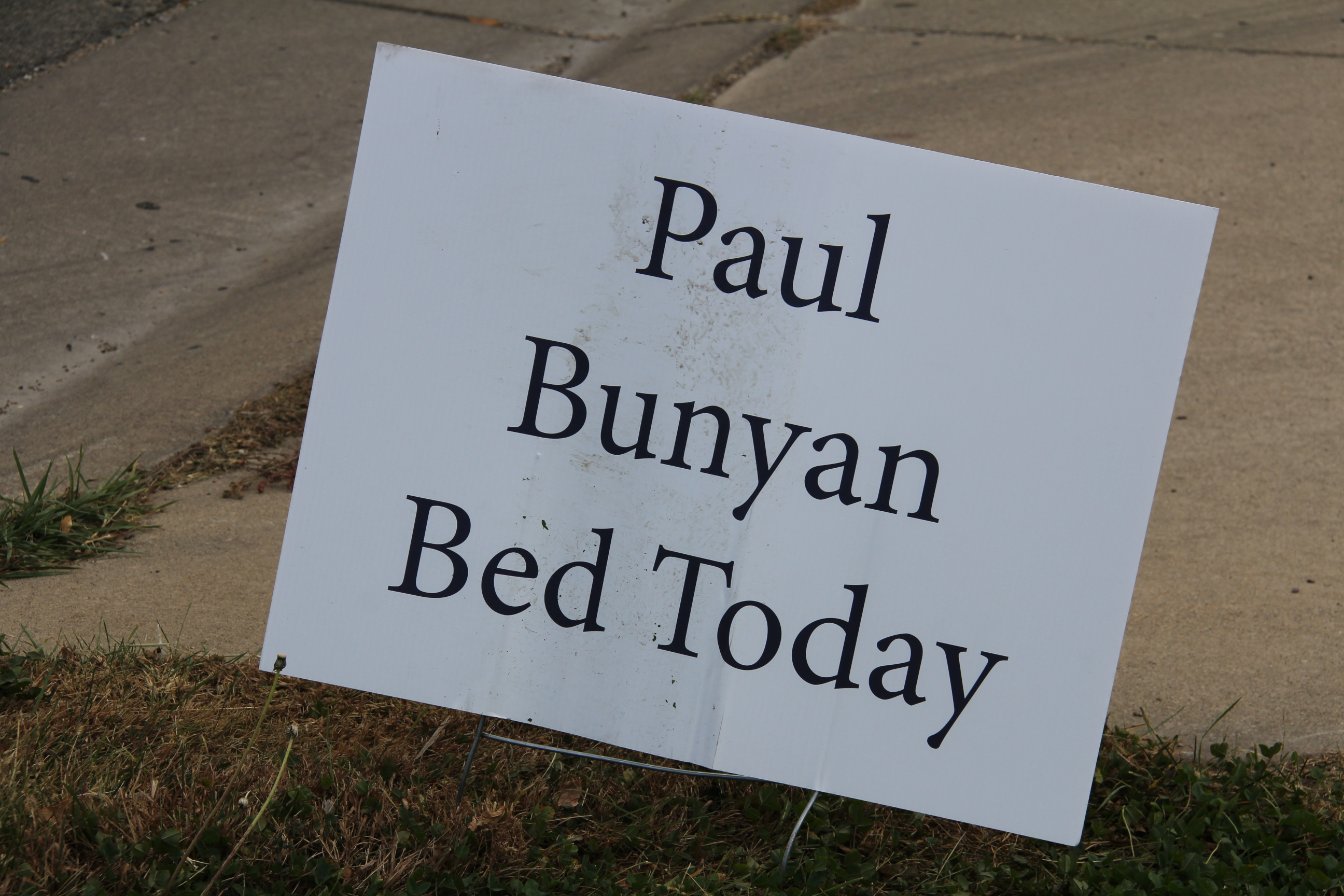
A roadside sign welcomes visitors to hop into Paul Bunyan’s bed. (Minnesota Prairie Roots copyrighted photo October 2024)
The bed showcases several of the Mill blanket patterns. (Minnesota Prairie Roots copyrighted photo October 2024)

Yet, the legendary lumberjack maintains his influence locally. Recently, I spotted an enormous buffalo plaid blanketed “bed” in the parking lot of Faribault Mill, an iconic business since 1865 known for its wool blankets. Signs invited folks to stop, climb onto the Paul Bunyan bed and take photos.
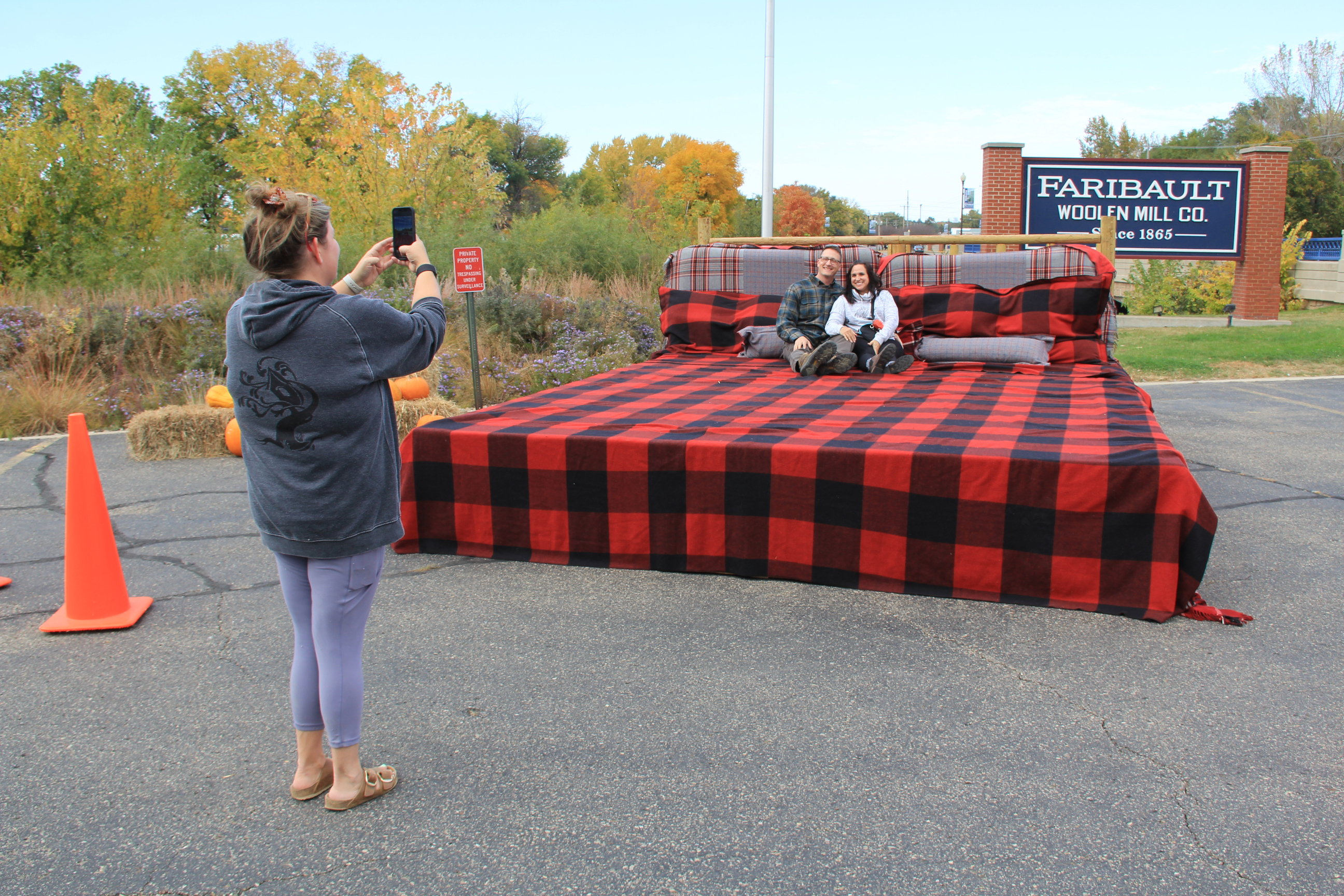
A friend photographs friends who climbed into Paul Bunyan’s bed. (Minnesota Prairie Roots copyrighted photo October 2024)

While I was there, one couple did just that. They were camping in nearby Nerstrand Big Woods State Park with others and headed into Faribault for stops at a local apple orchard and also at the Mill. I tipped them off to other places to visit, especially our historic downtown. I never pass on an opportunity to tell visitors about my community.

A comfy photo op in Paul Bunyan’s bed. (Minnesota Prairie Roots copyrighted photo October 2024)

On this Saturday, after photographing that creative marketing bed, I followed the two couples from Minneapolis into the Mill retail store. I haven’t been inside in a while. To my delight, I found more Minnesota icons on Mill products. I should note here that the Mill has a second mill (acquired in 2022) in Monmouth, Maine (Brahms Mount) which specializes in cotton textiles. Paul Bunyan is also big in Maine folklore.
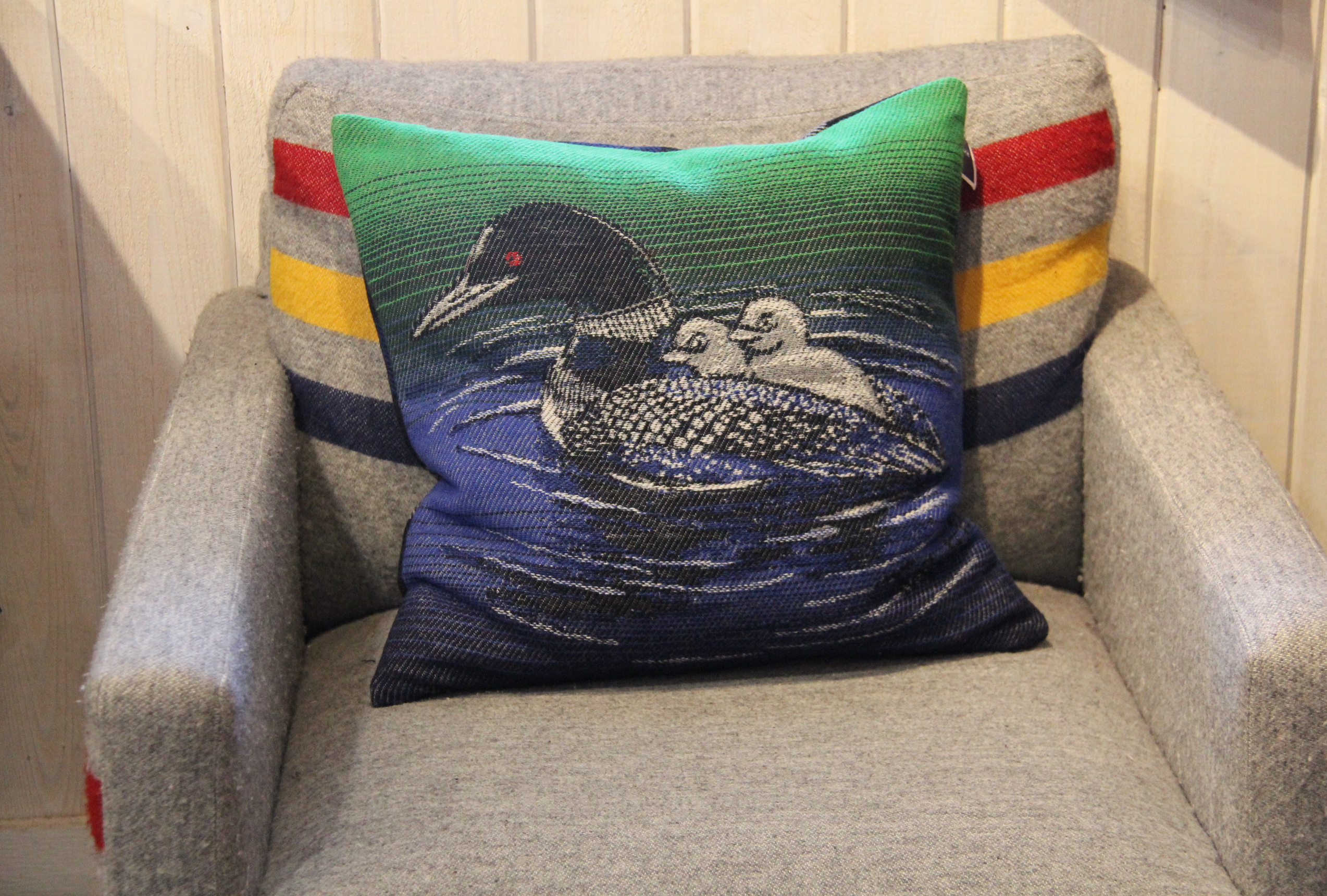
Adam Turman designed this loon throw pillow displayed on an easy chair upholstered with Faribault Mill blankets. (Minnesota Prairie Roots copyrighted photo October 2024)

I love how Faribault Mill tapped into Minnesota talent. Artist Adam Turman created art for throws and pillows that is distinctly part of Minnesota culture and life. I’ve been a fan of Turman since viewing his art on seasonal-themed murals in neighboring Northfield. His work for Faribault Mill features Paul Bunyan and Babe, the Hamm’s beer bear, the Pillsbury Dough Boy, State Fairchild, loons, a snowy owl, cardinal, Split Rock lighthouse and the Boundary Waters Canoe Area Wilderness.
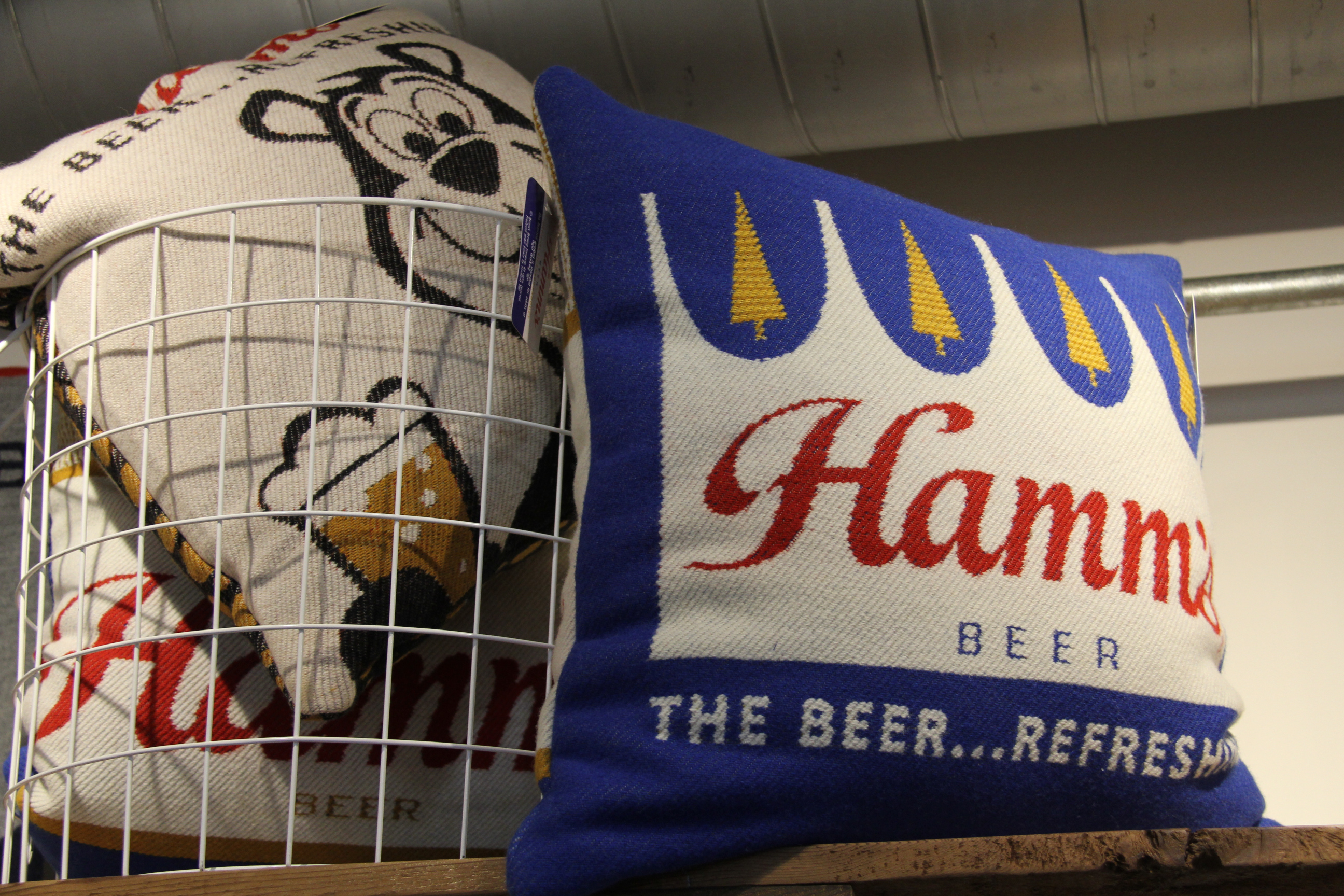
The Faribault Mill partnered with Hamm’s Beer on these pillows. Hamm’s was first brewed in Minnesota, “the land of sky blue waters,” in 1865. It is no longer made in Minnesota. (Minnesota Prairie Roots copyrighted photo October 2024)

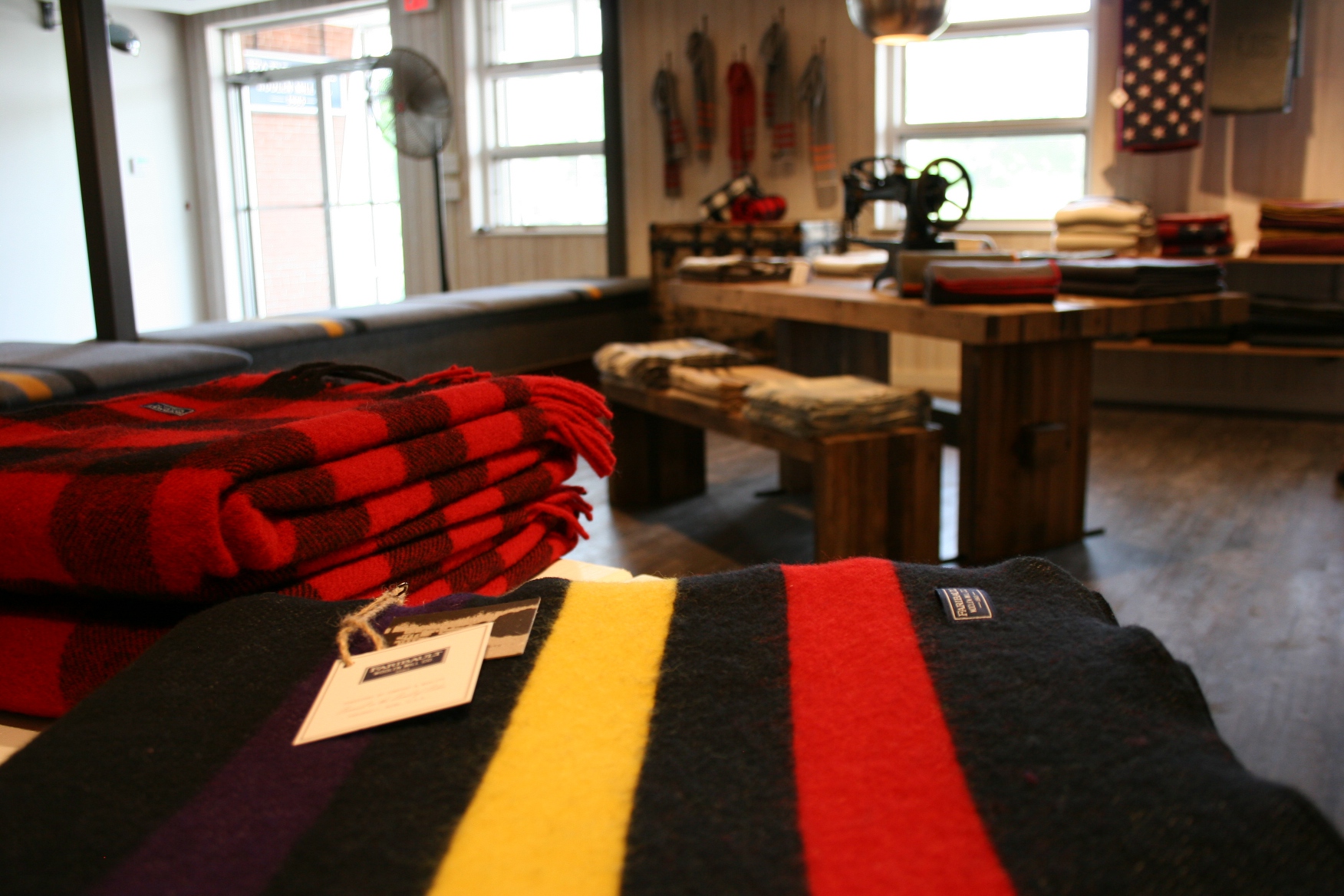
While strolling through the Mill store, I focused on the art-themed merchandise among all the traditional primarily plaid and solid-hued woolen blankets people have come to associate with Faribault’s mill.
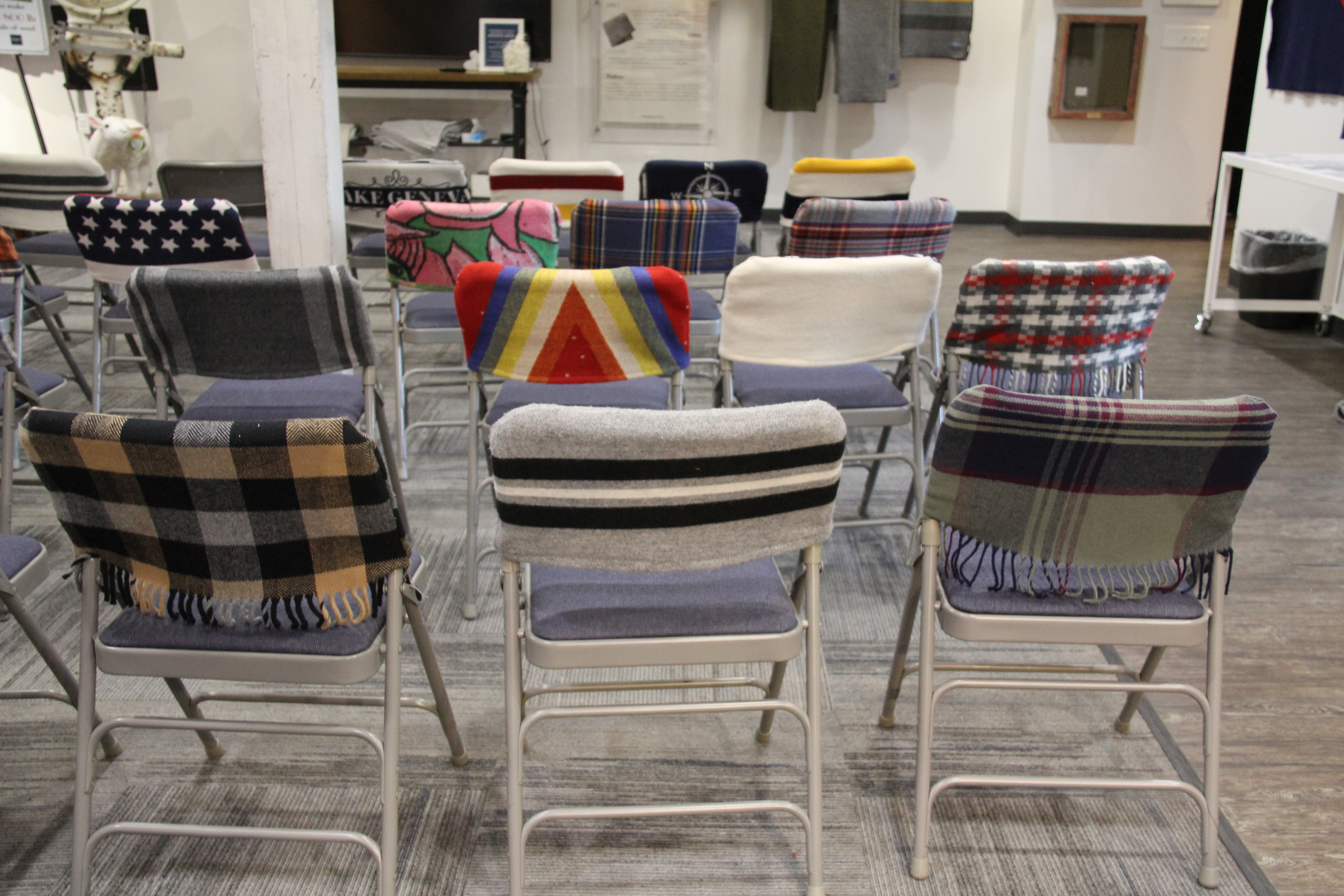
Visitors touring the Mill settle on these blanket remnant draped chairs to learn more about the Mill. (Minnesota Prairie Roots copyrighted photo October 2024)

In a room just off the main shop, I spotted folding chairs set up for folks who tour the mill. Tours are available at 11 am and 1 pm Fridays and Saturdays for a fee. Wool blanket remnants drape the chair backs, creating a memorable and colorful scene.
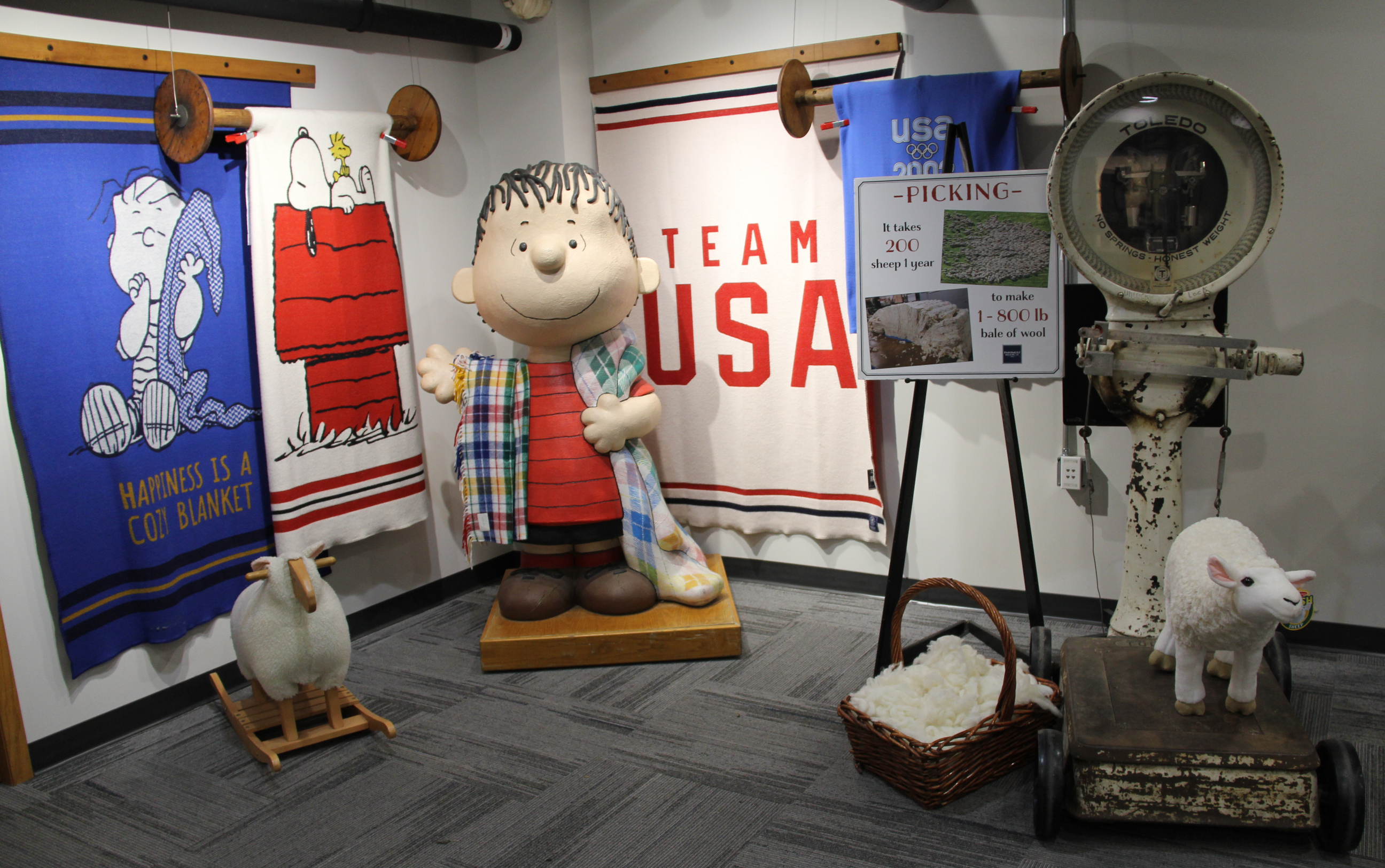
Peanuts themed throws are among Mill merch, shown here in the gathering space for those touring the factory. (Minnesota Prairie Roots copyrighted photo October 2024)

Also memorable are the Linus statue and the Peanuts-themed throws. We Minnesotans are proud of the Peanuts crew created by Charles Schulz, born in Minneapolis and raised in St. Paul. And I am proud of the Faribault Mill, a long-standing business in my community known for its quality made-in-America products. During the two World Wars, the then Faribault Woolen Mill made wool blankets for Army soldiers.
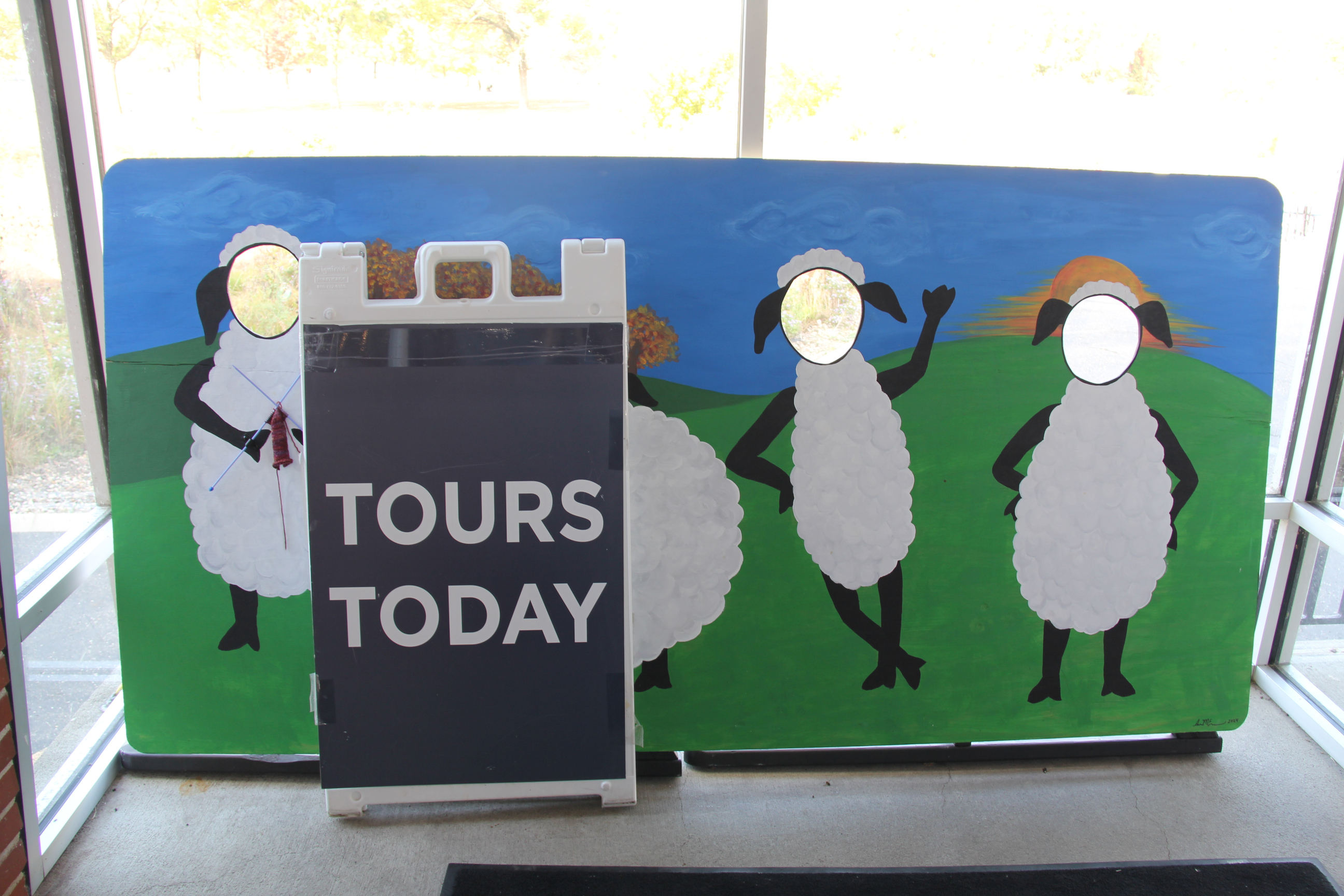
Another photo op, sheep cut-outs photographed inside the entrance to the retail store. (Minnesota Prairie Roots copyrighted photo October 2024)

Today Mill employees continue to create quality products, and not just blankets, at its two plants. The Mill also weaves into the fabric of America via a Paul Bunyan-sized spirit of generosity. For every bed blanket sold, the company donates a blanket to nonprofits serving youth experiencing homelessness in major cities across the U.S. That’s through its Spread the Warmth program. The Mill has also donated blankets to local youth.

The marketing and business teams at Faribault Mill clearly understand the value of connecting with community, of giving back and of drawing customers via creativity. The Paul Bunyan-sized buffalo plaid blanketed bed and the Minnesota art by Adam Turman both grabbed my attention. While the bed has been put to bed for the season—maybe because Paul Bunyan needs his wool blankets back for the forthcoming winter—you can still step inside the retail store and wrap yourself in the warmth of Minnesota from blankets to legendary icons.

© Copyright 2024 Audrey Kletscher Helbling


Noticing details at Faribault’s historic woolen mill February 23, 2017

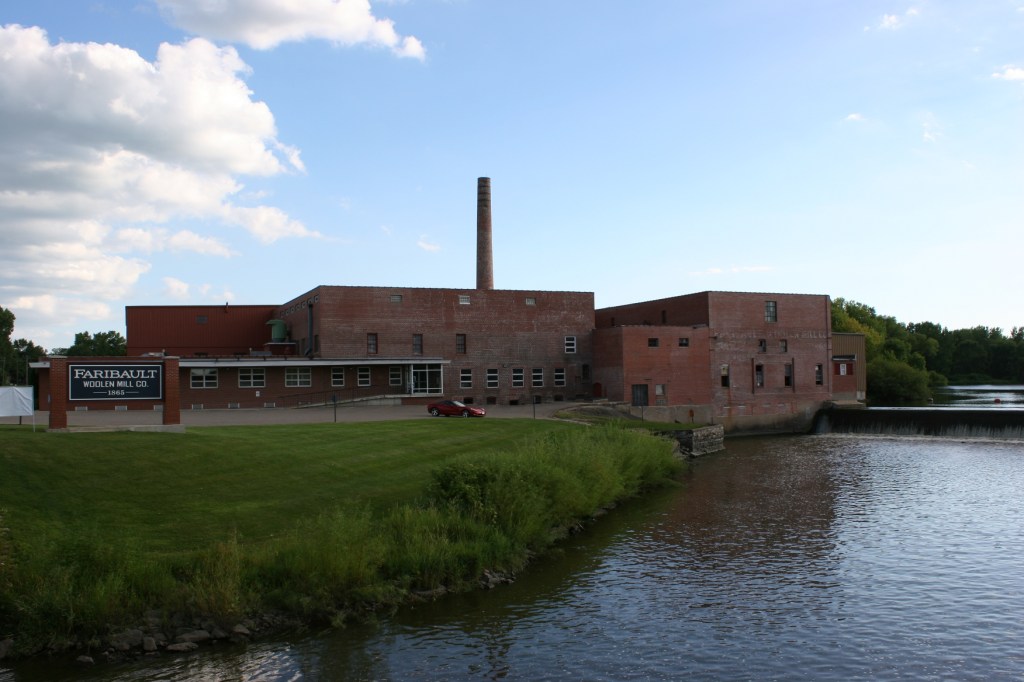
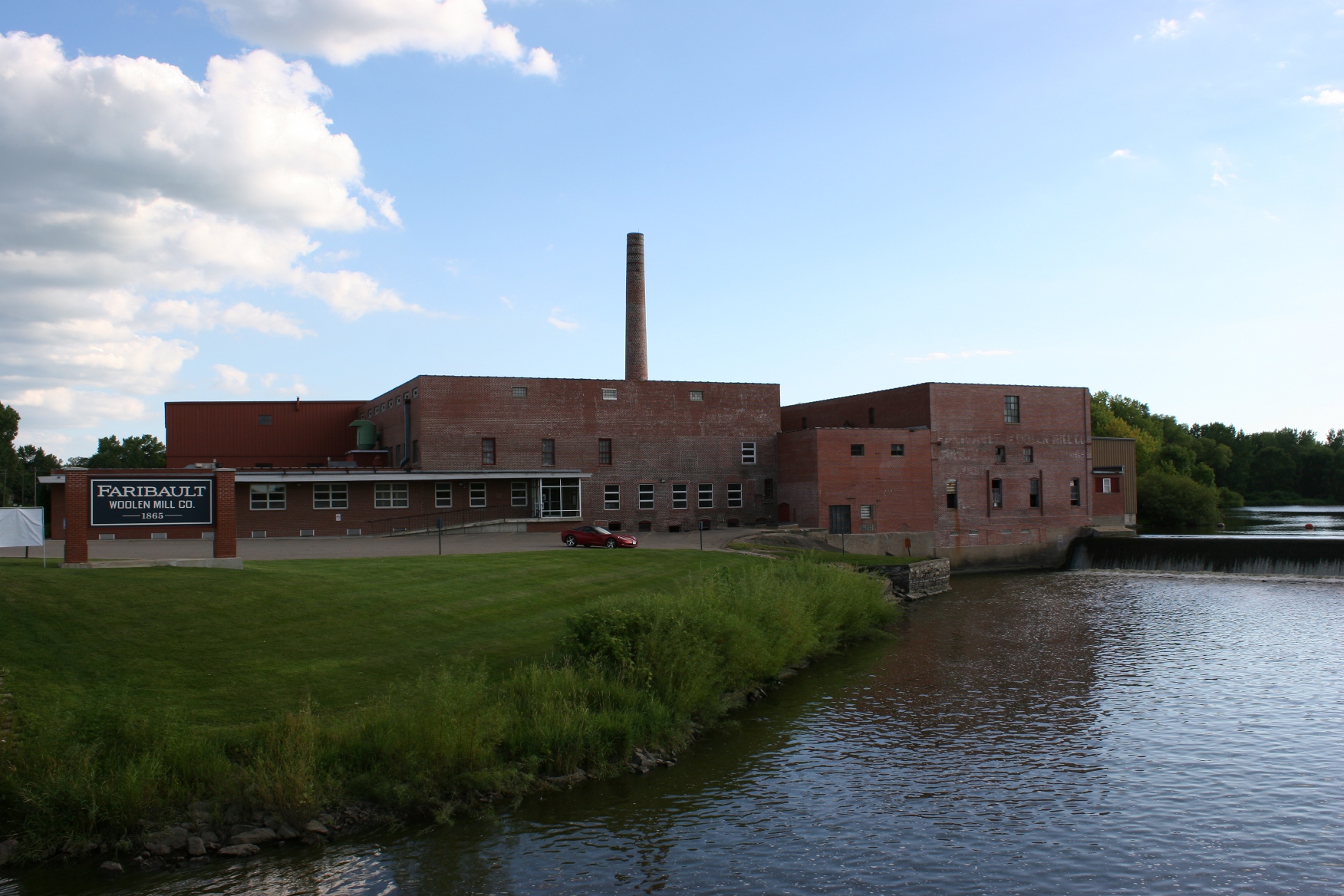
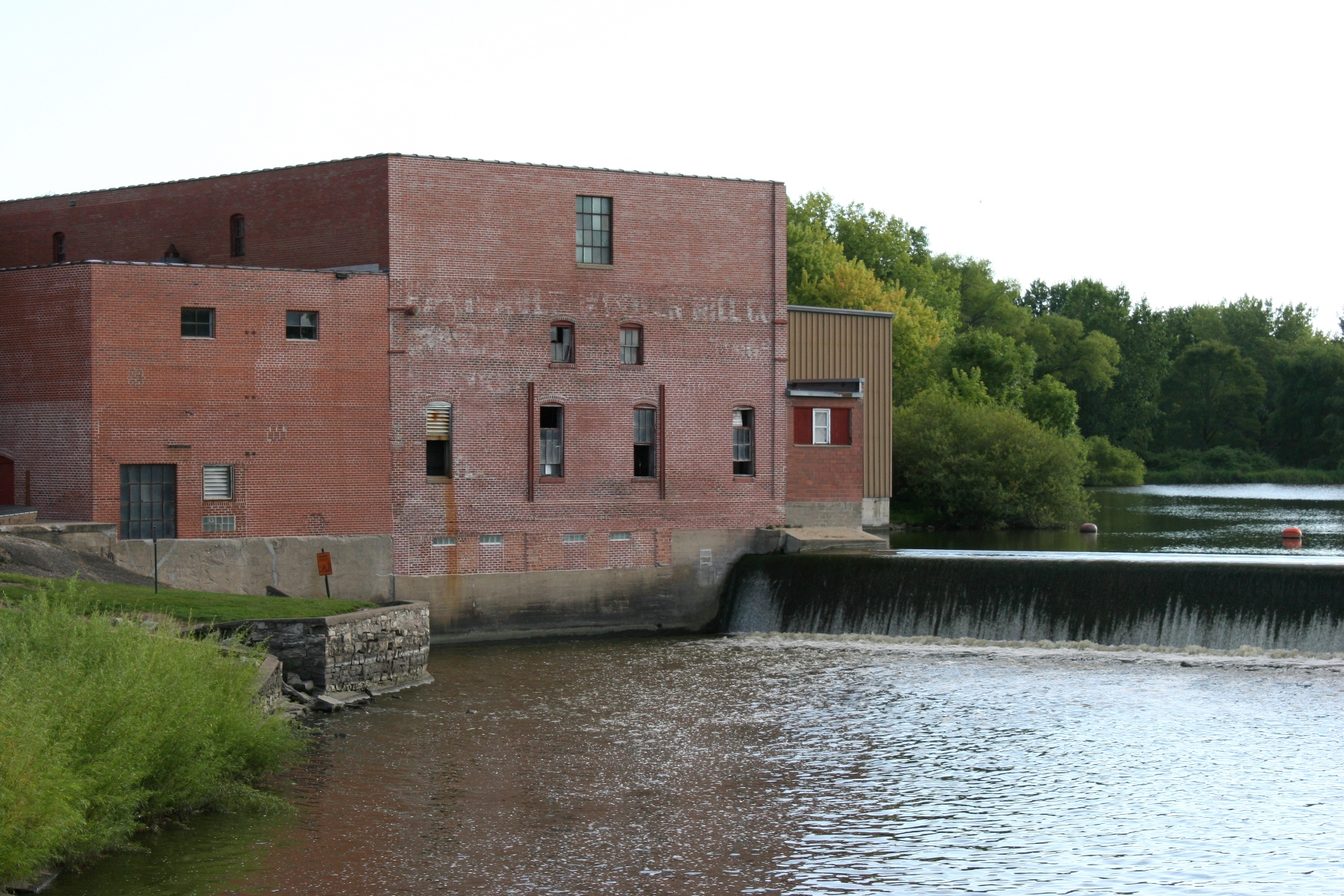
The Faribault Woolen Mill sits on the bank of the Cannon River.

The Faribault Woolen Mill sits on the bank of the Cannon River. Minnesota Prairie Roots file photo.

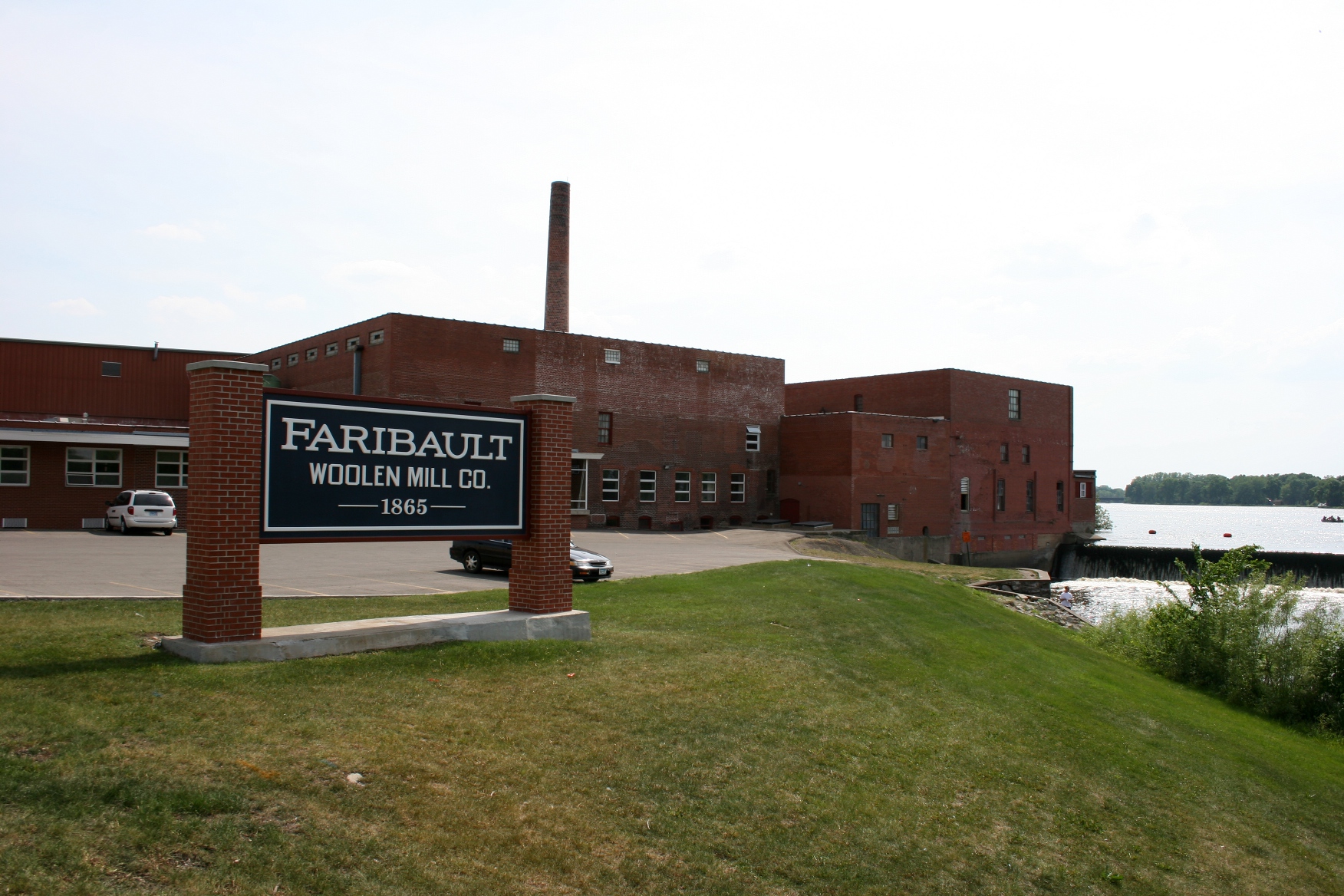
SNUGGED ALONG THE BANKS of the Cannon River in Faribault, the 150-year-old Faribault Woolen Mill stands as a noted local landmark and a nationally-recognized producer and purveyor of high quality wool blankets and more.

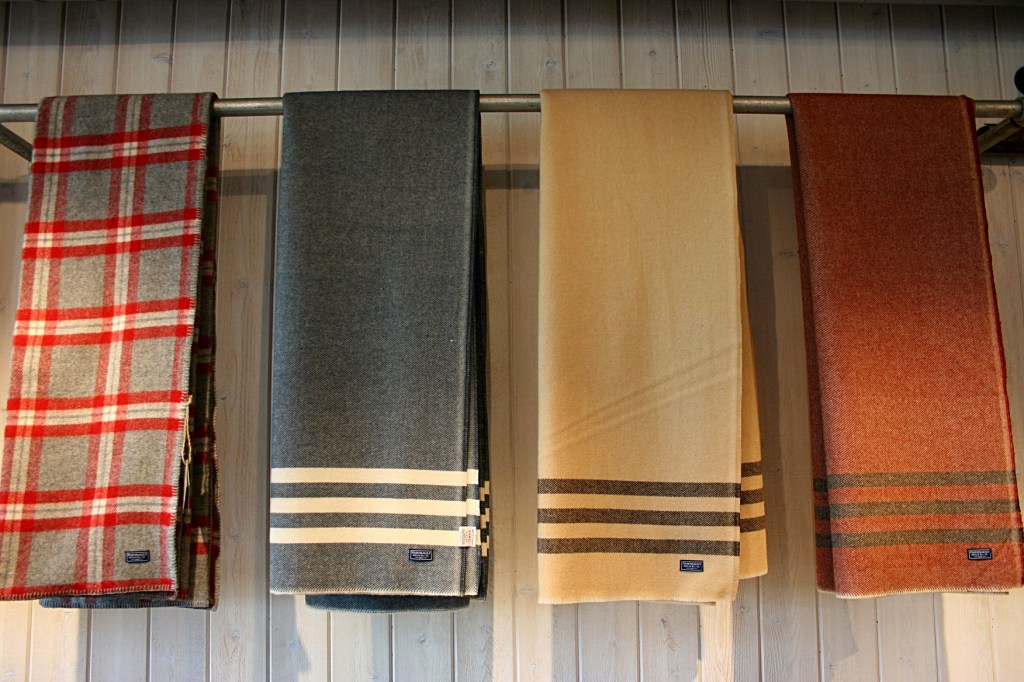
Faribault Woolen Mill blankets/throws are artfully hung on a simple pipe.

Faribault Woolen Mill blankets/throws are artfully hung on a simple pipe. Minnesota Prairie Roots file photo.

In recent years, with the acquisition of the briefly-closed mill by successful and marketing savvy Minnesota businessmen, the mill has experienced growth and significant national exposure. Many times I’ve picked up a magazine to see the mill’s products featured.

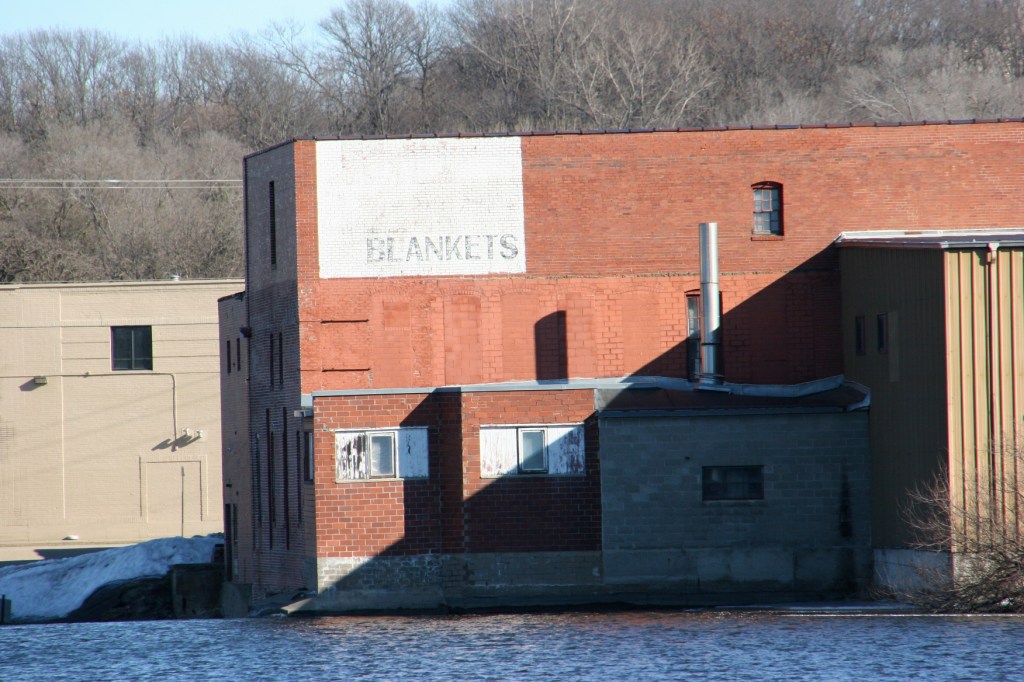
In the upper left corner of the mill, the sign unnoticed by me until several days ago.

In the upper left corner of the mill, the sign unnoticed by me until several days ago.

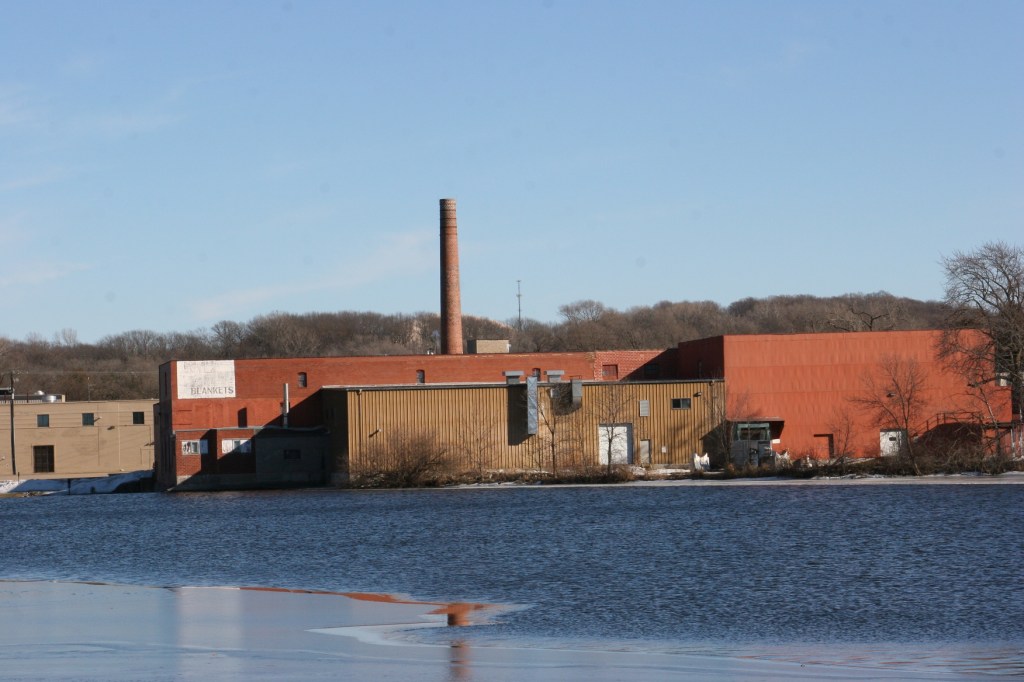
What I’d not noticed until recently was a faded sign along the back side of the historic mill, the side visible from North Alexander Park. My view of the mill complex is typically the public side motorists see while driving by on Second Avenue.

The back of the mill as photographed from the North Link Trail. The mill is on the National Register of Historic Places. Several years ago the city of Faribault received a $300,000 Minnesota Historical Cultural Heritage grant for rehab of the smokestack.

The back of the mill as photographed from the North Link Trail. The mill is on the National Register of Historic Places. Several years ago the city of Faribault received a $300,000 Minnesota Historical Cultural Heritage grant for rehab of the smokestack.

But this time I was walking, following the North Link Trail that runs through the park and is part of a city-wide recreational trails system. I paused to appreciate the inky blue waters of the Cannon on a brilliantly sunny afternoon when my gaze drifted to the mill. There I focused on white sign advertising BLANKETS. Faded, indiscernible lettering hovered over that key word.

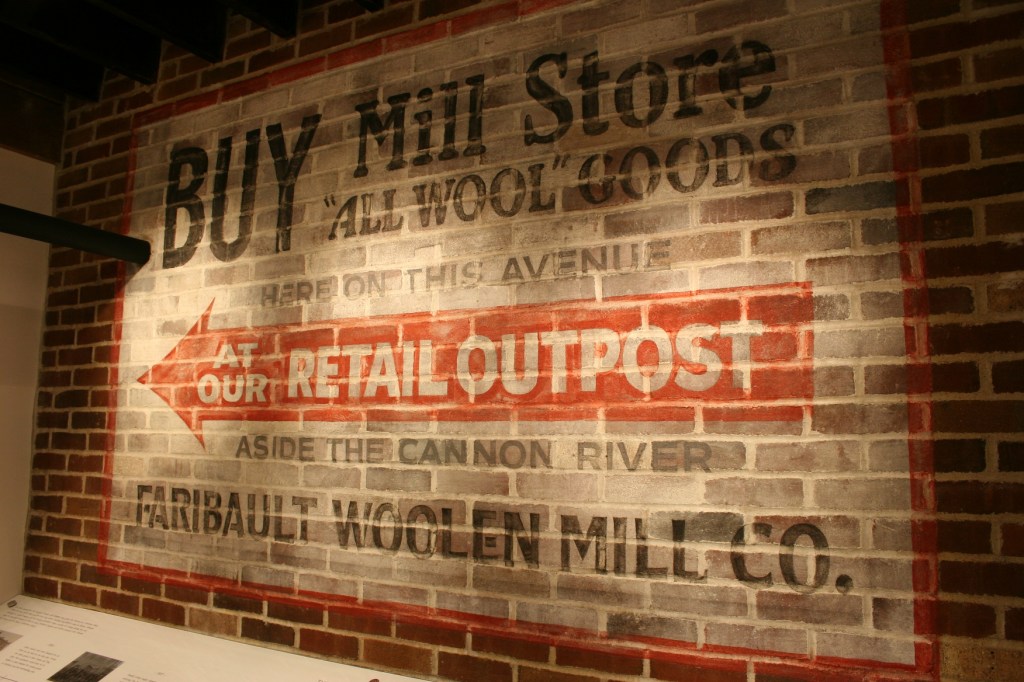
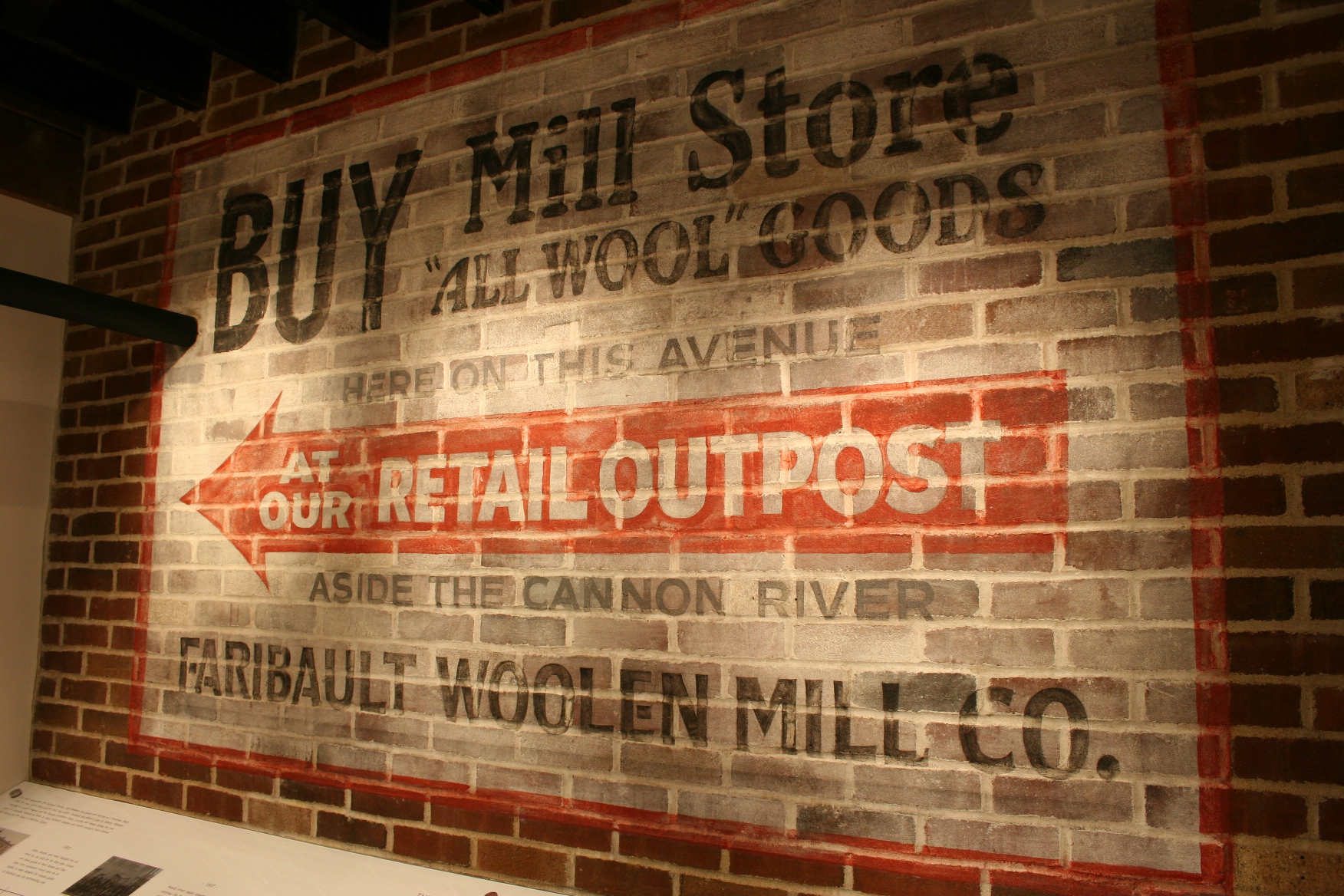
A replica of an original sign is now in the Woolen Mill's historic display area.

A replica of an original sign is now in the Woolen Mill’s historic display area. Minnesota Prairie Roots file photo.

I wondered how, in my 35 years living in the area, I failed to notice the vintage signage. Sometimes familiarity of place creates a lack of visual awareness. We become so accustomed to our usual surroundings that we fail to truly see. And to appreciate.

TELL ME: Have you ever felt the same upon discovering something (what?) in your community that’s been there forever but you didn’t see?

© Copyright 2017 Audrey Kletscher Helbling

 

Threads of tenacity, loyalty & quality weave through Faribault Woolen Mill book December 7, 2015

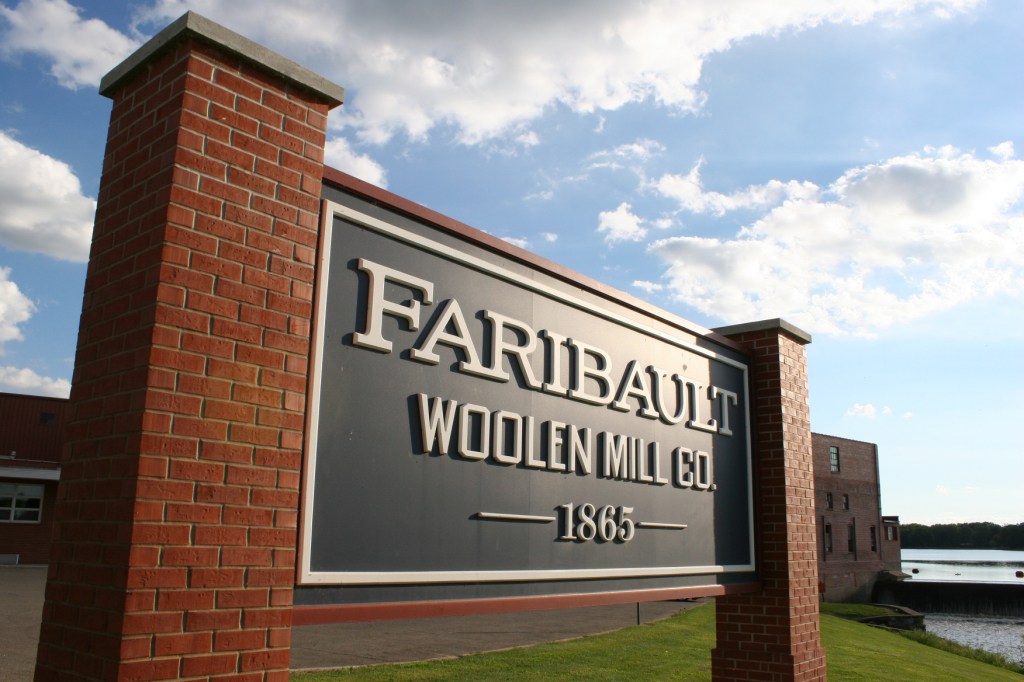
This sign marks The Faribault Woolen Mill, which sits along the banks of the Cannon River in Faribault, Minnesota.

This sign marks The Faribault Woolen Mill, which sits along the banks of the Cannon River in Faribault, Minnesota. Minnesota Prairie Roots file photo August 2015.

“DID YOU GUYS HAVE a tan mitten found yesterday?” customer Molly asked in a recent entry on the Faribault Woolen Mill Facebook page. She’d shopped at a mill overstock sale the day prior and lost a mitten knit by a family member. To Molly, it wasn’t about the mitten as much as the memory and love attached to it.

A mill employee asked Molly to send a photo to aid in the search. Whether the mitten has been found, I don’t know. But I view the mill’s response as a current day example of how this 150-year-old Faribault business cares like family.

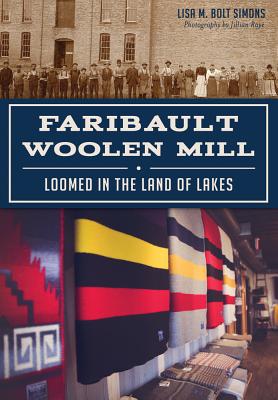
Book cover by The History Press

Book cover by The History Press

That’s a recurring theme in a just-published book, Faribault Woolen Mill—Loomed in the Land of Lakes, by my friend, Faribault author Lisa M. Bolt Simons. Lisa cites numerous cases of the mill’s loyalty to Faribault and its employees. In 1961, for example, mill owners purchased a cabin near Bemidji for use by employees, customers and others. That appreciation goes both ways. Community residents and employees have remained fiercely loyal to the woolen mill. Many employees returned to work after the mill briefly closed. Employment longevity reaches into decades, up to sixty years for one mill employee, spotlighting a strong work ethic.

Appreciative customers exist world-wide. Lisa found an August 1966 mill retail store guest book entry notation that The Beatles (yes, those Beatles) visited. That seems unlikely, though, given the Beatles only Minnesota concert, at Met Stadium, happened in August of 1965. However, during eight months in 1966, nearly 2,000 people from 45 states and nine countries signed the mill guest book.

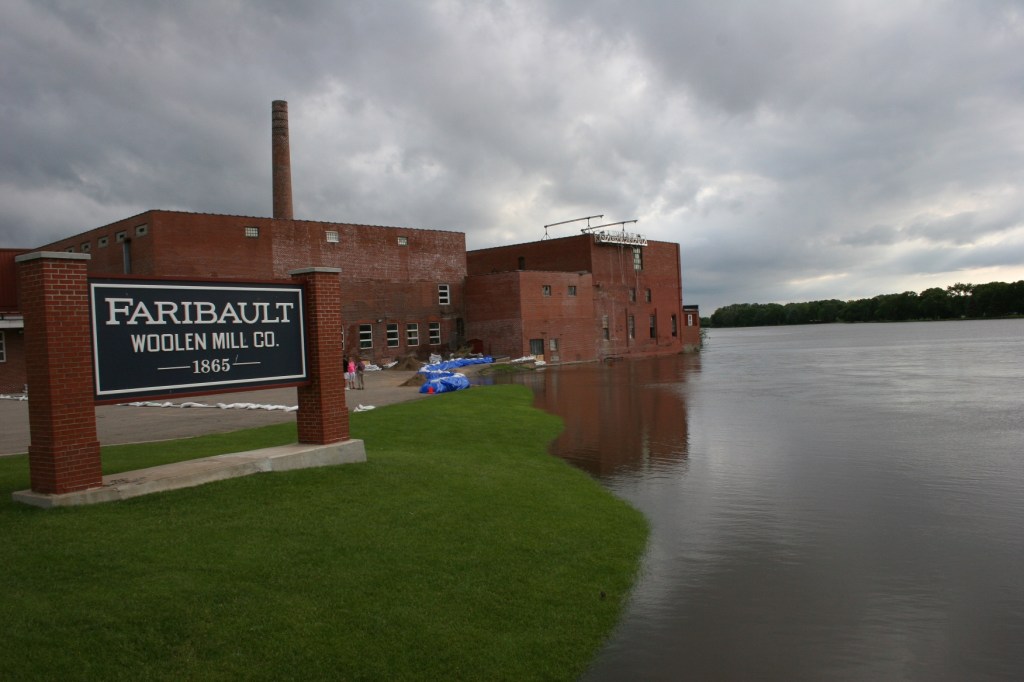
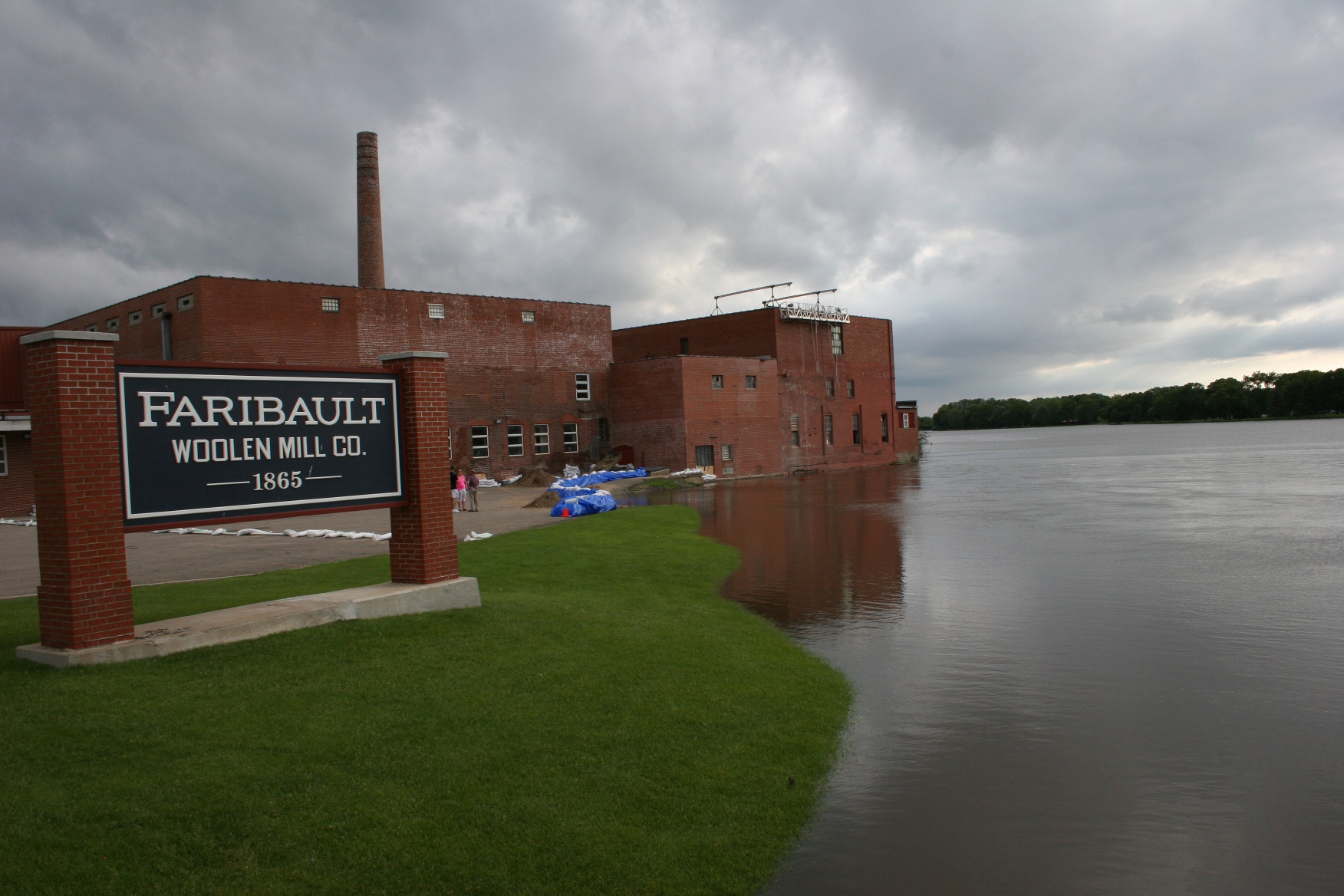
Sandbags protect the Faribault Woolen Mill from the rising Cannon River.

Sandbags protect the historic Faribault Woolen Mill from the rising Cannon River in June 2014. The mill is listed on the National Register of Historic Places. That designation in 2012 allowed the business to apply for, and receive, a $300,000 grant from the Minnesota Historical Society for mill restoration. This photo is published in black-and-white on page 96 of Lisa M. Bolt Simons’ book. Minnesota Prairie Roots file photo 2014.

Lisa’s 126-page book, published by The History Press, is packed with information that shows extensive research on her part to tell the complete story of Minnesota’s oldest manufacturer. Her bibliography runs four pages. I must note here that Lisa references my June 12, 2012, blog post, “Historic Faribault Woolen Mill Opens Store with Artsy Vibe,” in the preface. One of my photos is also published in her book.

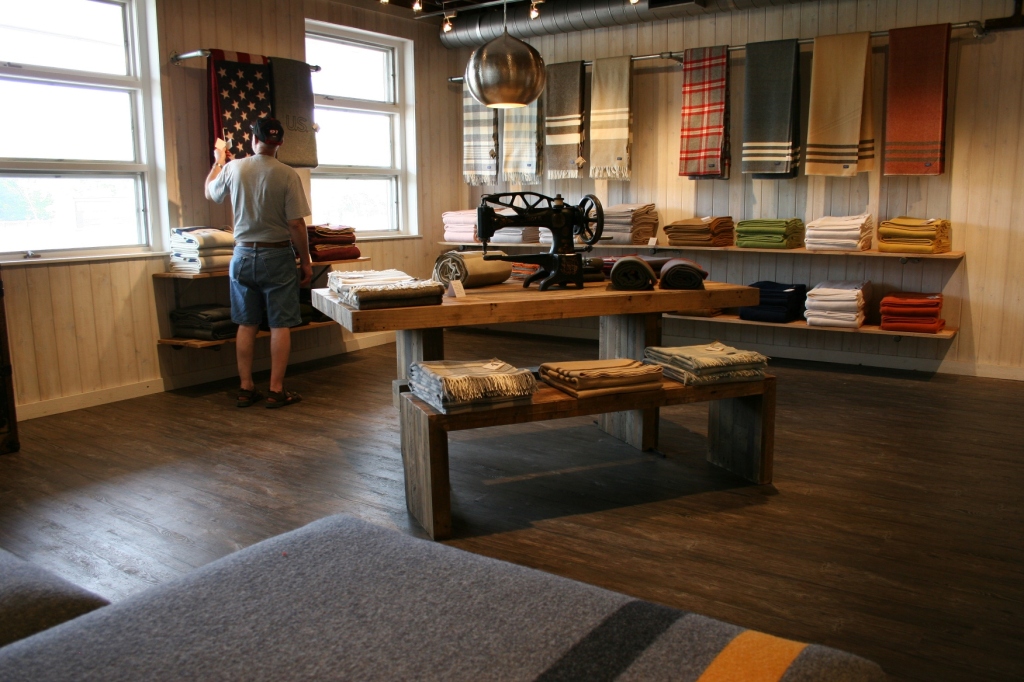
Perusing merchandise at the recently reopened Faribault Woolen Mill retail store.

Perusing merchandise at The Mill Store shortly after it opened in 2012. Minnesota Prairie Roots file photo.

Typically, I do not enjoy reading history. But I finished Lisa’s book in just a few days. It was that interesting. I didn’t grow up in Faribault. So, unlike natives, I didn’t know the history of the mill which started with the Klemers, a family ownership that extended into five generations. I didn’t know about the mill’s multiple locations, about the five fires. I didn’t know how close the mill came to closing during several economic down-turns. I didn’t know why the family sold to outside investors, a move that eventually resulted in the mill’s closure in 2009.

Lisa references public court documents that offer insights into the short-term closure. She also quotes employees who dealt with bounced paychecks and unpaid health insurance premiums. Her information confirms what my neighbor, a retired mill retail store employee, told me years ago.

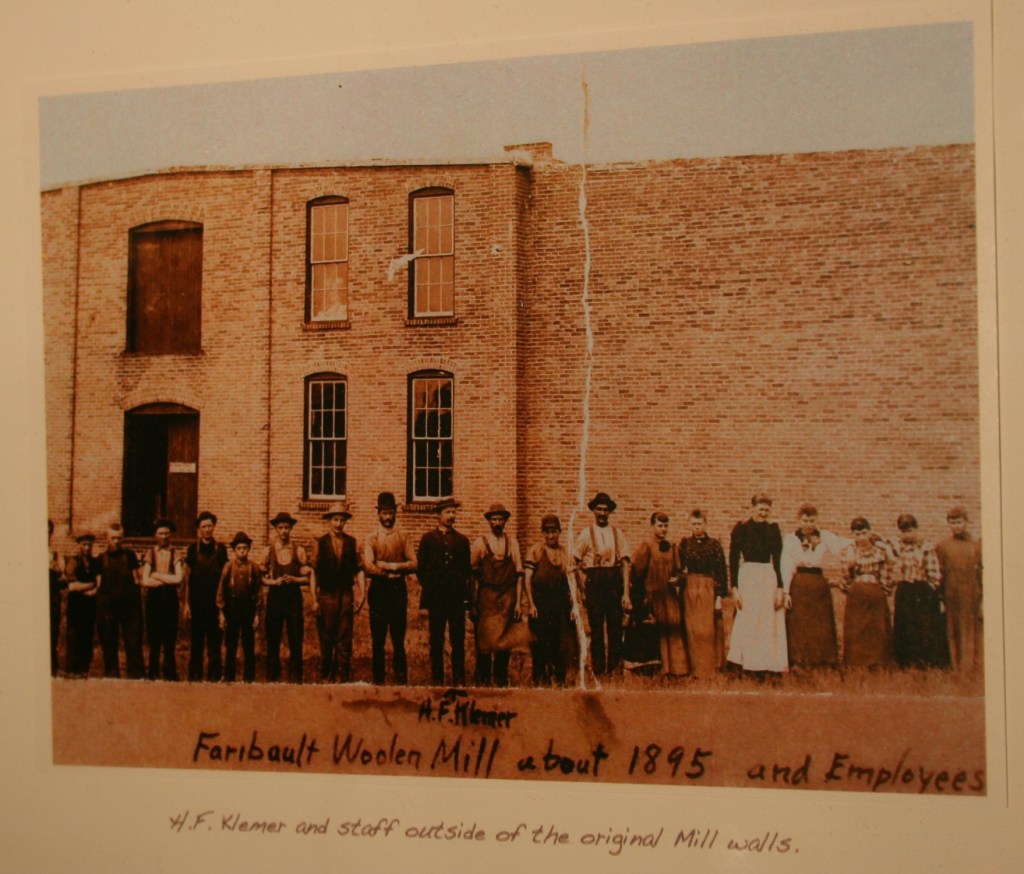
An historic photo from the mill, among those showcased in a mini wall of Woolen Mill history.

An historic photo from the mill, among those showcased in a mini wall of Woolen Mill history. Minnesota Prairie Roots file photo.

Through the challenges of fires, floods (in 2010 and 2014) and finances, the Faribault Woolen Mill survived with a tenacity that continues today under the ownership of Paul and Chuck Mooty and their leadership team. The cousins reopened the mill in 2011. A theme of endurance weaves throughout the book.

Crisp white cubbies, ever so perfect for showing off blankets/throws.

Crisp white cubbies, ever so perfect for showing off blankets/throws at The Mill Store. Minnesota Prairie Roots file photo 2012.

As it did from the beginning, the mill remains rooted in producing quality wool products, specializing in blankets that have warmed troops, hotel guests, airline passengers, newlyweds… Today you’ll find Faribault Woolen Mill products in boutiques and trendy places nation-wide, many of those notable locations listed in the book.

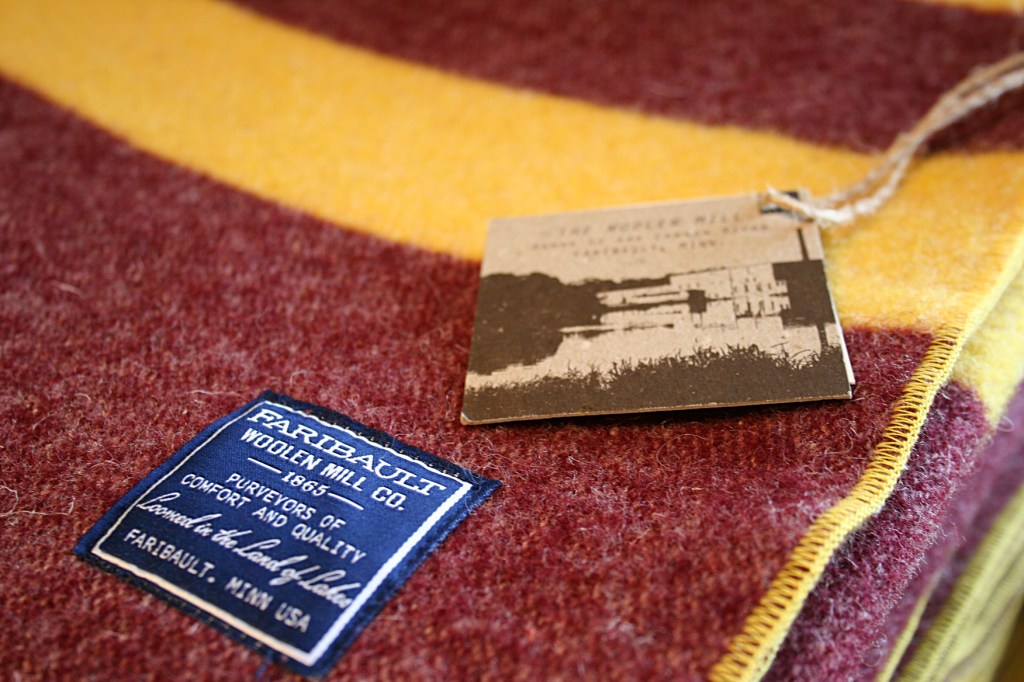
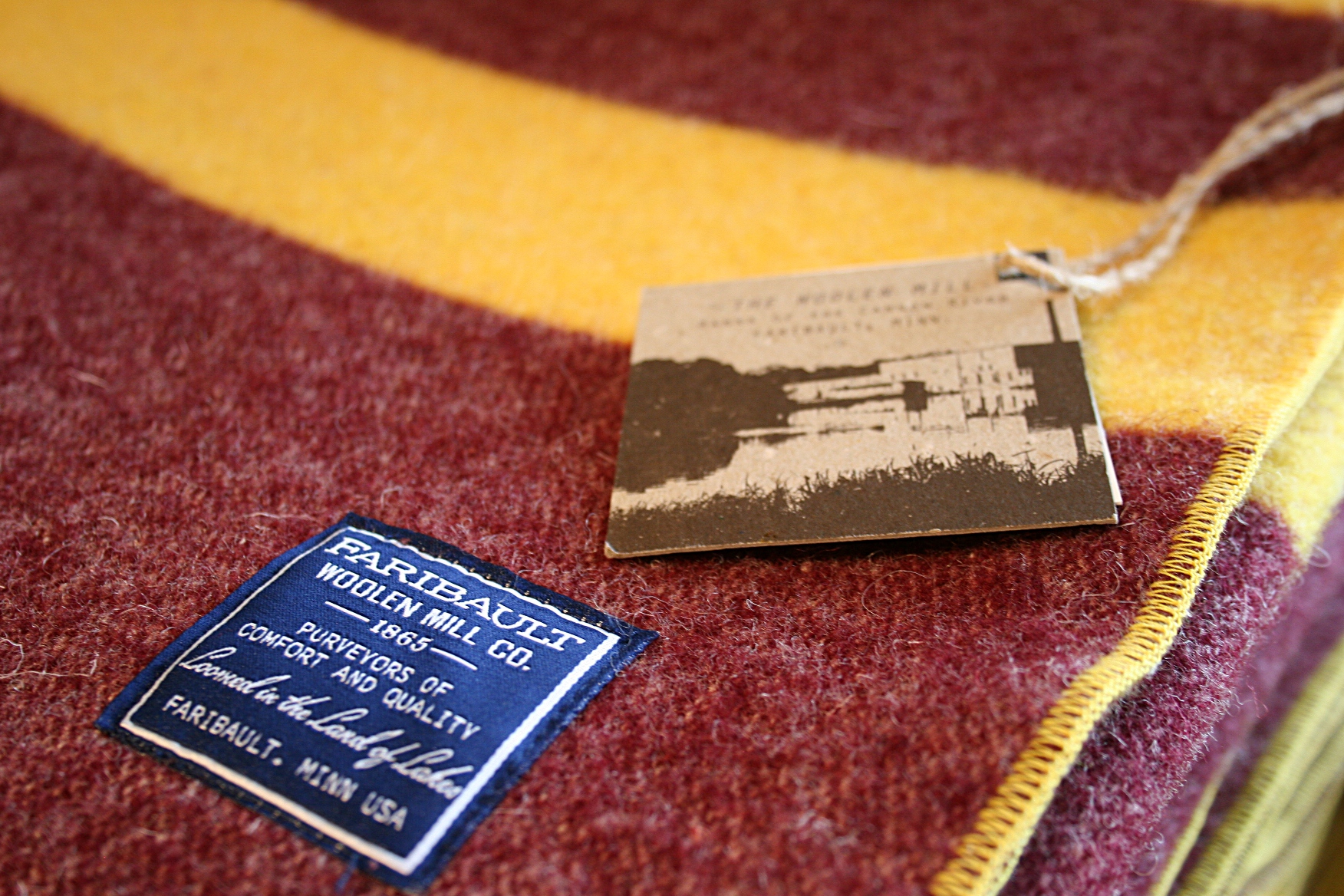
The mill's products are labeled as "Loomed in the Land of Lakes" by "Purveyors of Comfort and Quality." Minnesota Prairie Roots file photo 2012.

The mill’s products are labeled as “Loomed in the Land of Lakes” by “Purveyors of Comfort and Quality.” Minnesota Prairie Roots file photo 2012.

Because of Lisa’s book, I now hold a deeper appreciation of the Faribault Woolen Mill, one of the last vertical woolen mills in the U.S. I understand why locals value this business hugging the banks of the Cannon River. A quote from Jean Mooty, who restarted the retail store and is the wife of co-owner Paul Mooty, says it all: “The mill gets in your blood.”

Lisa M. Bolt Simons. Photo by Jillian Raye Photography.

Lisa M. Bolt Simons. Photo by Jillian Raye Photography.

FYI: The Mill Store, 1500 Second Avenue Northwest, will host “A Book, Beer + Blankets” book tour launch from 4 p.m. – 7 p.m. on Wednesday, December 9. Lisa will give a short presentation at 5:30 p.m. Faribault’s F-Town Brewery will offer beer tasting. And, of course, Faribault Woolen Mill products will be available for purchase.

(Note: I received a complimentary copy of Faribault Woolen Mill—Loomed in the Land of Lakes. The inclusion of my mill photo and references to me and my blog did not influence this unbiased and honest review of the book.)

© Copyright 2015 Audrey Kletscher Helbling
Book cover image by The History Press
Author portrait by Jillian Raye Photography


Faribault Woolen Mill celebrates 150th anniversary August 13, 2015

This sign marks The Faribault Woolen Mill, which sits along the banks of the Cannon River in Faribault, Minnesota.

This sign marks the Faribault Woolen Mill, which sits along the banks of the Cannon River in Faribault, Minnesota.

STASHED IN MY BEDROOM CLOSET are two blankets from the Faribault Woolen Mill—one a baby blanket in muted pink and aqua, the other a full-sized pink blanket. Both were gifts from a neighbor who once worked in the mill’s retail store.

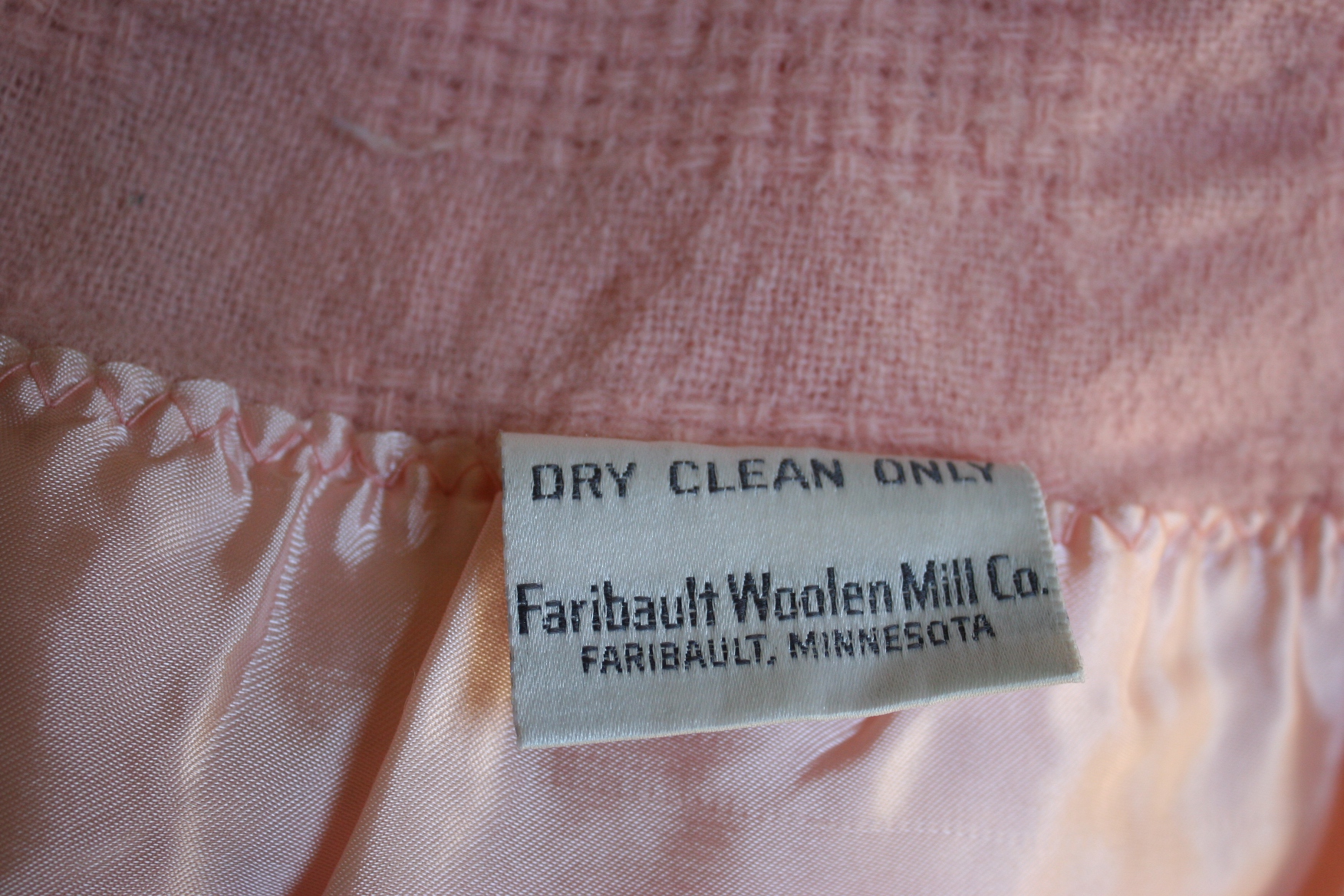
A label on a Faribault Woolen Mill blanket I own.

A label on a Faribault Woolen Mill blanket I own.

I expect in many homes throughout my community, locally-loomed blankets, throws, scarves and more cover beds, warm laps and wrap around necks on the coldest of Minnesota winter days and nights.

Crisp white cubbies, ever so perfect for showing off blankets/throws.

Crisp white cubbies, ever so perfect for showing off blankets/throws at the Faribault Woolen Mill retail store. Minnesota Prairie Roots file photo June 2012.

While the temperature isn’t exactly wool-worthy here in southern Minnesota in mid-August, autumn is tinging our days with cool nights and the subtlest of color changes in foliage. We realize that summer is waning and, once again, we’ll soon pull out the wool and the flannel.

An historic photo from the mill, among those showcased in a mini wall of Woolen Mill history.

An historic photo from the mill is among those showcased in a mini wall of Woolen Mill history inside the retail store. Minnesota Prairie Roots file photo 2012.

This Saturday the Faribault Woolen Mill is pulling out its collection of locally-loomed products to sell in the 150th Marketplace, all in celebration of the mill’s 150th anniversary. Among Marketplace merchandise are the mill’s new 2015 line and special anniversary items, including a limited edition reissue of the 1949 plaid stadium blanket, Faribo Pak-A-Robe. The blanket comes in a carrying case that converts to a seat pad.

The mill's products are labeled as "Loomed in the Land of Lakes" by "Purveyors of Comfort and Quality." Minnesota Prairie Roots file photo 2012.

The mill’s products are labeled as “Loomed in the Land of Lakes” by “Purveyors of Comfort and Quality.” Minnesota Prairie Roots file photo 2012.

I’ve been to enough Woolen Mill sales to know the outdoor Marketplace will be crowded with those who appreciate the mill’s authentic products. Made in America and craftsmanship appeal to folks. And that’s a good thing for the mill, founded in 1865. One hundred fifty years. That says something about tenacity. This business, which provided blankets for American troops during both World Wars, supplied blankets to airlines in the early 1970s, and, from the late 60s to early 90s, produced more than half of the blankets made each year in the U.S., has survived the ebbs and flows of the economy.

The Faribault Woolen Mill sits on the bank of the Cannon River.

The Faribault Woolen Mill sits on the bank of the Cannon River.

Yet, despite world-wide business success, the Faribault Woolen Mill almost didn’t make it to its sesquicentennial. The mill was shuttered in 2009 due to financial problems. Two years later Minnesota businessmen and cousins, Chuck and Paul Mooty, purchased the mill, revived it and the rest is history.

Sandbags protect the Faribault Woolen Mill from the rising Cannon River.

Sandbags protect the Faribault Woolen Mill from the rising Cannon River in June 2014. Minnesota Prairie Roots file photo.

The mill was also threatened twice in recent years by flooding of the Cannon River.

Faint Faribault Woolen Mill lettering remains on the old section of the mill complex.

Faint Faribault Woolen Mill lettering remains on the old section of the mill complex.

For my community, the mill is an important tourism draw and an equally important part of Faribault’s history. The mill, the oldest manufacturing entity in Minnesota, is on the National Register of Historic Places. But it’s likely not the aged building as much as the fine craftsmanship of mill products that brings shoppers here looking for quality and American authenticity.

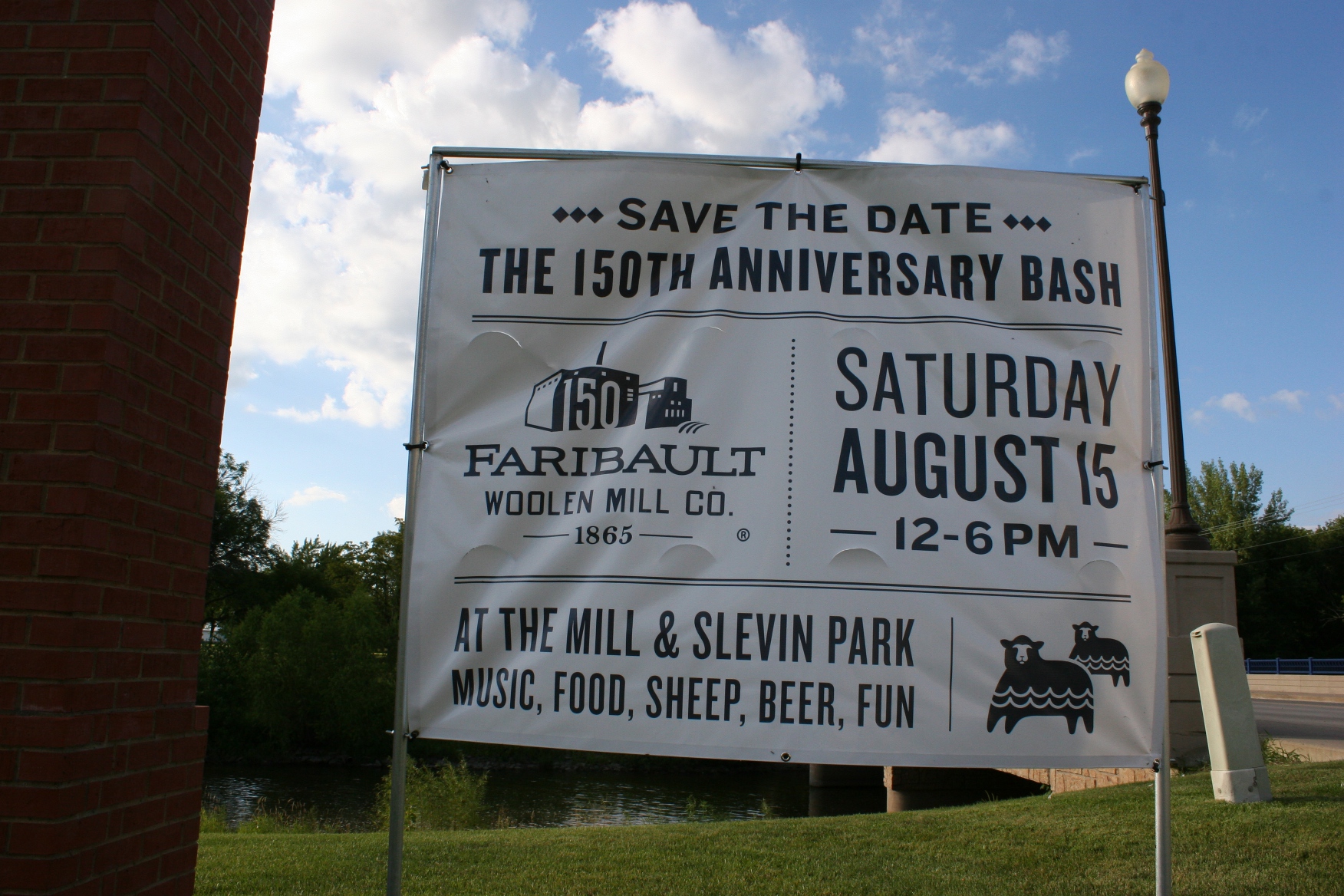
This sign outside the mill advertises Saturday's 150th anniversary festivities.

This sign outside the mill advertises Saturday’s 150th anniversary bash.

Saturday’s celebration will provide a great opportunity for all of Faribault to showcase itself, starting with food vendors at the mill’s outdoor anniversary celebration along the banks of the Cannon River. I’m happy to see a line-up of locals—The Cheese Cave, Uncle B’s Last Chance BBQ Shack, Bashers Bar & Grill/J & J Bowling Center, Lyons Meats and F-Town Brewing. Several other vendors from the Twin Cities metro will be there, too, with brats, cheesecake, coffee and ice cream.

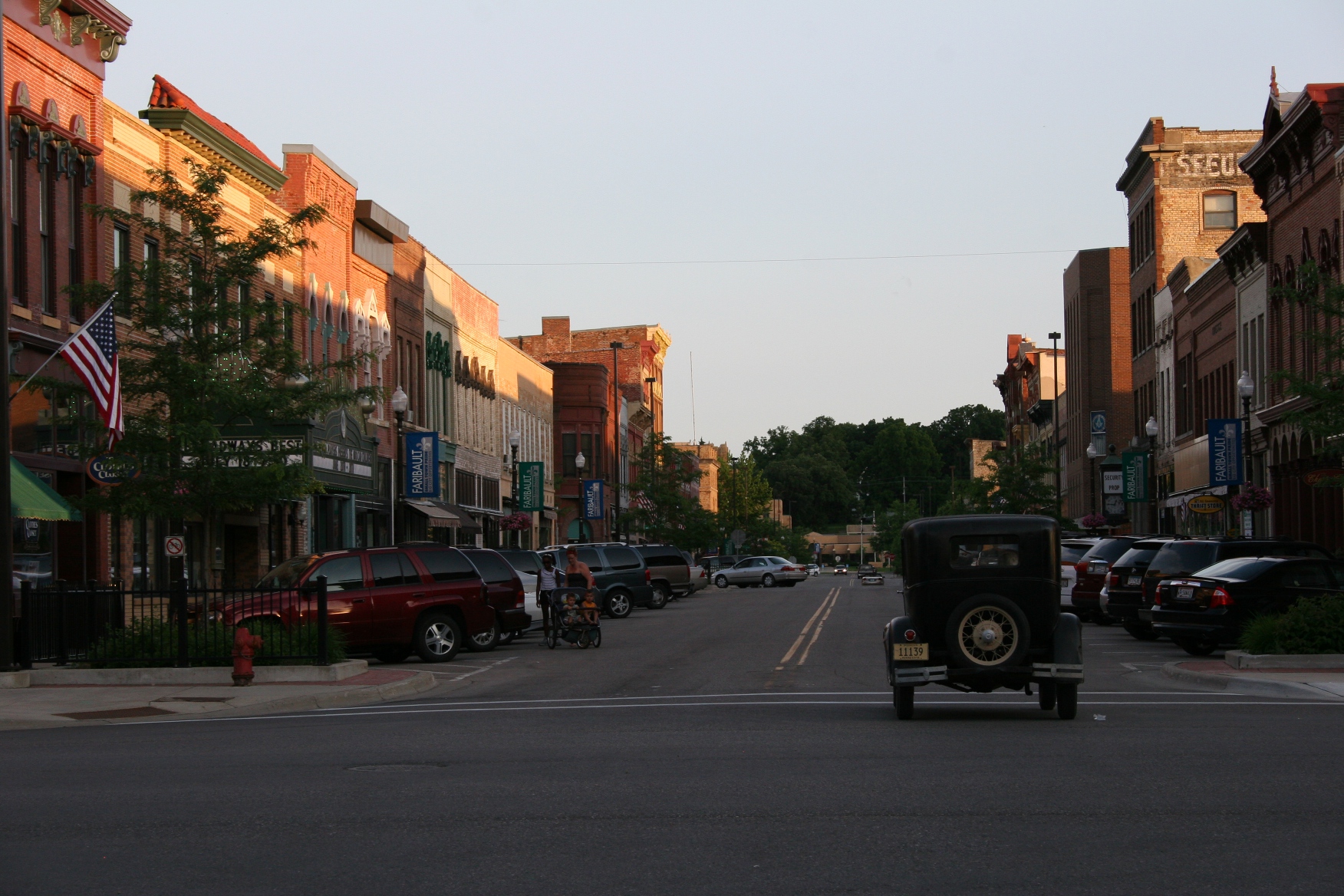
Leaving the show and driving southbound on Central Avenue through historic downtown Faribault.

A section of Faribault’s historic downtown, along Central Avenue. Minnesota Prairie Roots file photo 2014.

I hope visitors will also follow Second Avenue from the mill to Fourth Street and then to Central Avenue to check out our historic downtown and all the local shops. (Click here for a list of downtown shops and their locations.) Located near downtown at 739 Willow Street, Annie Belle Creations crafts Faribault Woolen Mill blankets into capes, coats and other clothing. Owner Lu Ann Heyer started in 1989 as a designer of stuffed animals for the Faribault Woolen Mill.

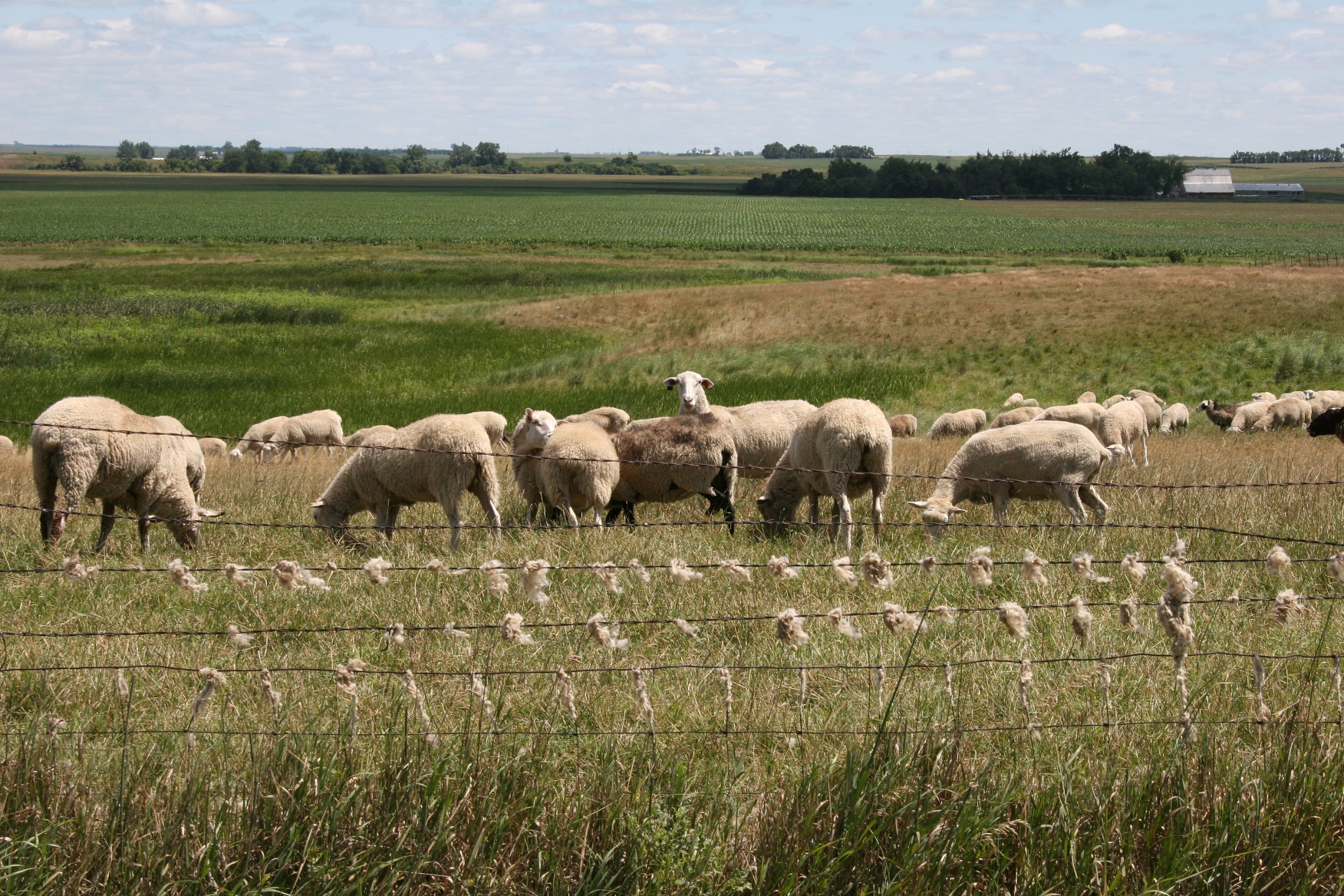
Pasture land near the park for these grazing sheep. Note their wool clinging to the fence.

Sheep graze near Blue Mounds State Park in southwestern Minnesota. Minnesota Prairie Roots file photo used for illustration purposes only.

Back at the mill and Father Slevin Park, there’ll be plenty to do. “The Running of the Sheep,” an event which is exactly as its name suggests, happens at 1 p.m. Other attractions include a petting zoo, games, raffles and more. Between 3 p.m. – 6 p.m. the folk/roots/indie rock group The Pines will perform as will Abracadabra,  a group of musicians who have traveled with the likes of Bob Dylan and The Beach Boys.

Perusing merchandise at the recently reopened Faribault Woolen Mill retail store.

A view inside the Faribault Woolen Mill retail store shortly after it opened under new ownership in 2012. Minnesota Prairie Roots file photo.

Visitors are encouraged to bring blankets to spread on the lawn while enjoying festivities. I expect Faribault Woolen Mill blankets, in particular, would be appreciated. You can even share your Faribault Woolen Mill blanket stories online at Memory Mill.

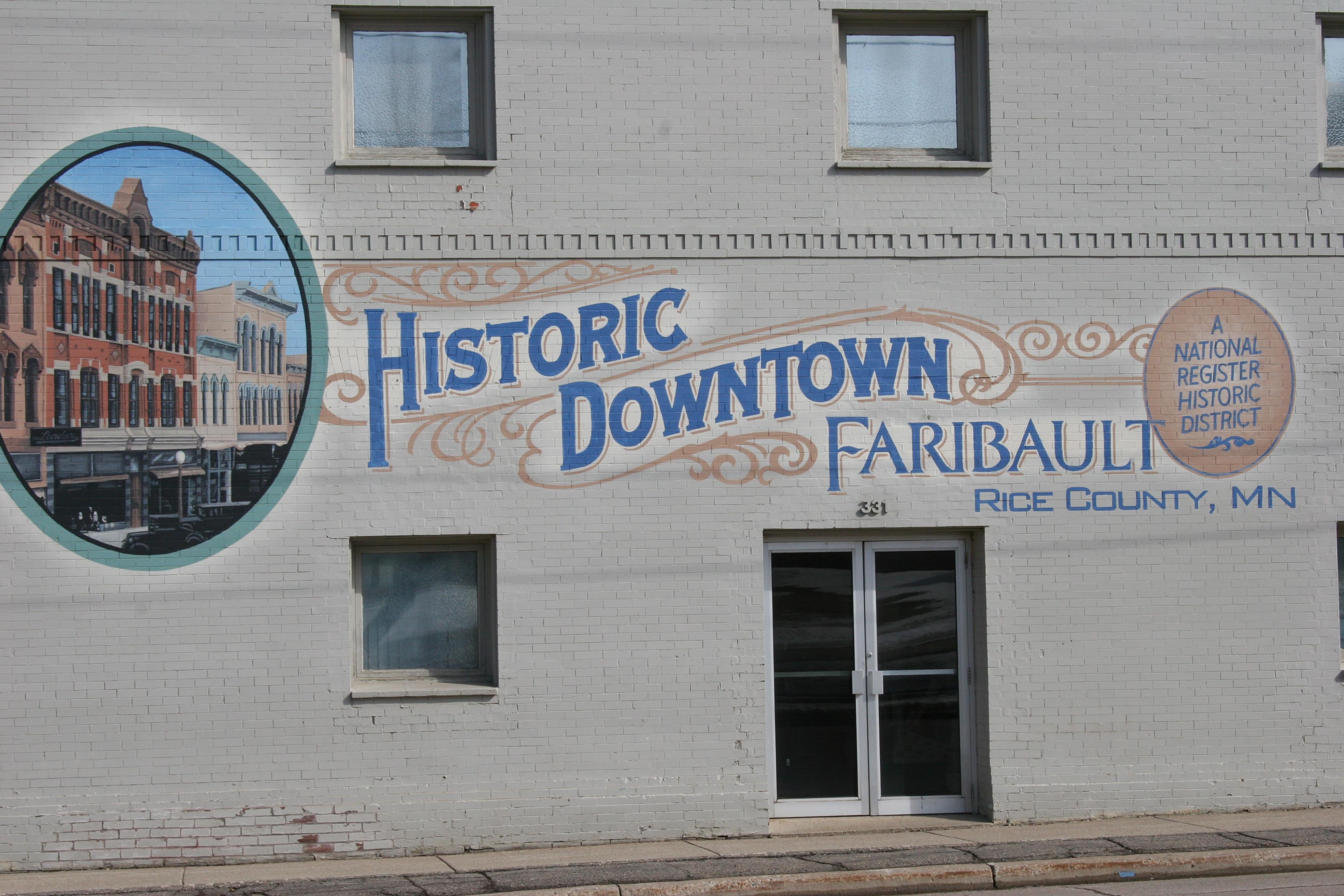
A mural, one of several in the downtown area, promotes historic Faribault.

A mural, one of several in the downtown area, promotes Faribault’s downtown as a National Register Historic District. Minnesota Prairie Roots file photo.

If you’ve never been to Faribault, come early, before the mill party, to poke around town. We’re just a short drive down Interstate 35 from the Twin Cities. Then at noon, join the mill as its celebration begins and continues for six hours.

A view of the Faribault Woolen Mill from Father Slevin Park across the Cannon River.

A view of the Faribault Woolen Mill from Father Slevin Park across the Cannon River.

FYI: The Faribault Woolen Mill is located at 1500 Northwest Second Avenue, near the Rice County Fairgrounds and the Rice County Historical Society Museum. The mill’s retail store will be closed on Friday and Saturday, with merchandise sold in the special anniversary Marketplace on Saturday.

Faribault Woolen Mill blankets/throws are artfully hung on a simple pipe.

Faribault Woolen Mill blankets/throws are artfully hung on a simple pipe in the retail store. Minnesota Prairie Roots file photo 2012.

Small group tours of the mill are offered at 11 a.m. and 1 p.m. on Thursdays. Note that these fill quickly and that you should schedule in advance.

© Copyright 2015 Audrey Kletscher Helbling
 

Historic Faribault Woolen Mill opens retail store with an artsy vibe June 12, 2012

Perusing merchandise at the recently reopened Faribault Woolen Mill retail store.

RUSTIC. SIMPLISTIC. MINIMALIST.

Those words wash over me as I step into the Faribault Woolen Mill Company’s recently re-opened retail store.

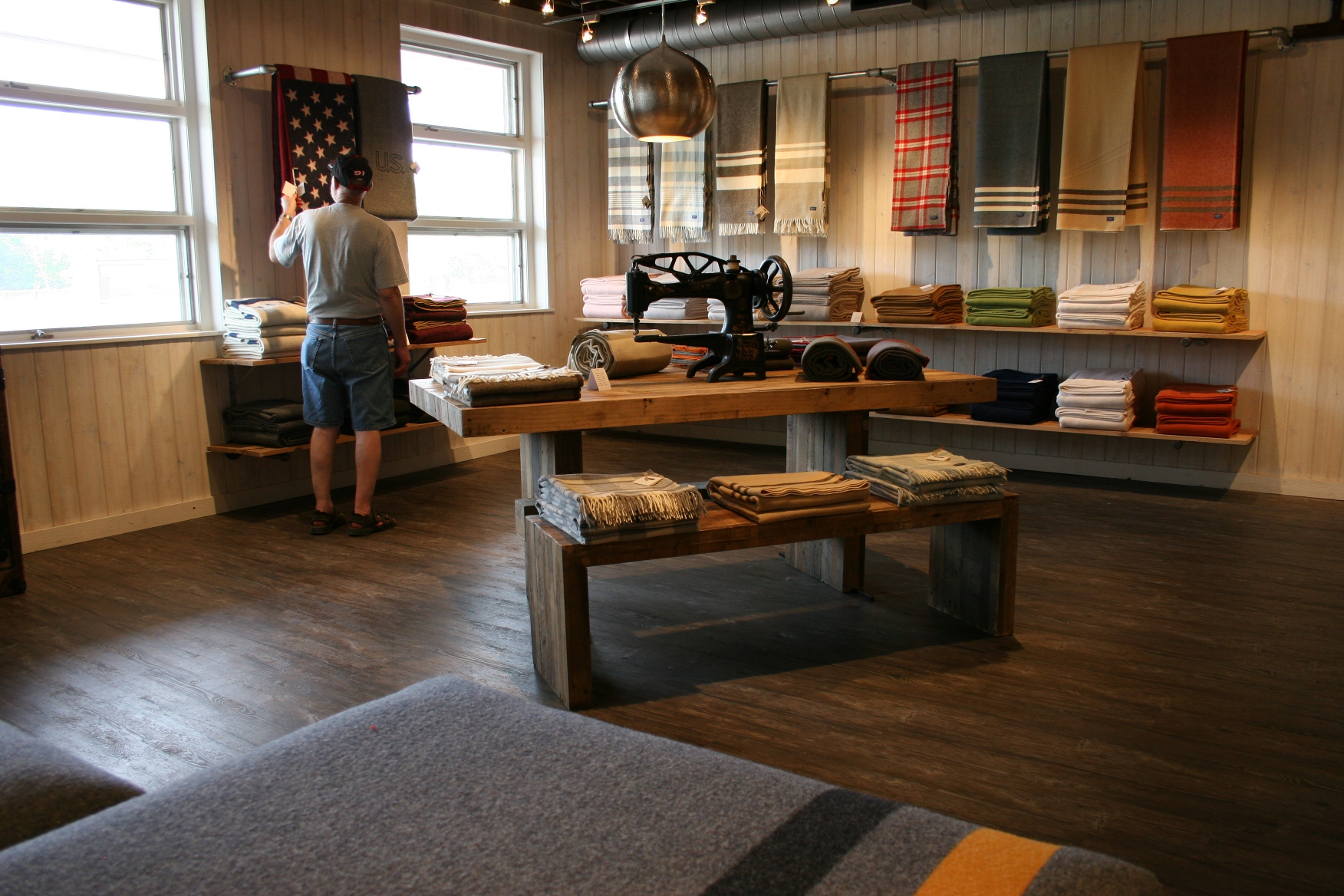
I could have strolled into an art gallery for the artsy vibe of this place. It has that feel, that sense of style and creative energy, which tells you this is no cookie-cutter retail outlet but someplace special.

The retail store has a comfy, relaxed and trendy feel.

From the white-washed paneled walls to the utility spools brushed in crisp white paint to the shelves leveled upon a ladder to the uniform white cubbies, the décor here is bare bones basic. It’s perfect for showing off the woolen blankets hung and folded ever so precisely in this historic woolen mill along the banks of the Cannon River in Faribault.

Faribault Woolen Mill blankets/throws are artfully hung on a simple pipe.

Crisp white cubbies, ever so perfect for showing off blankets/throws.

Jean Moody is tending the store on this recent hot and humid Saturday afternoon in May when the thought of purchasing a wool blanket seems not even a remote possibility. My curiosity draws me inside the store, into this building where I’ve never set foot even though I’ve lived in Faribault for nearly 30 years.

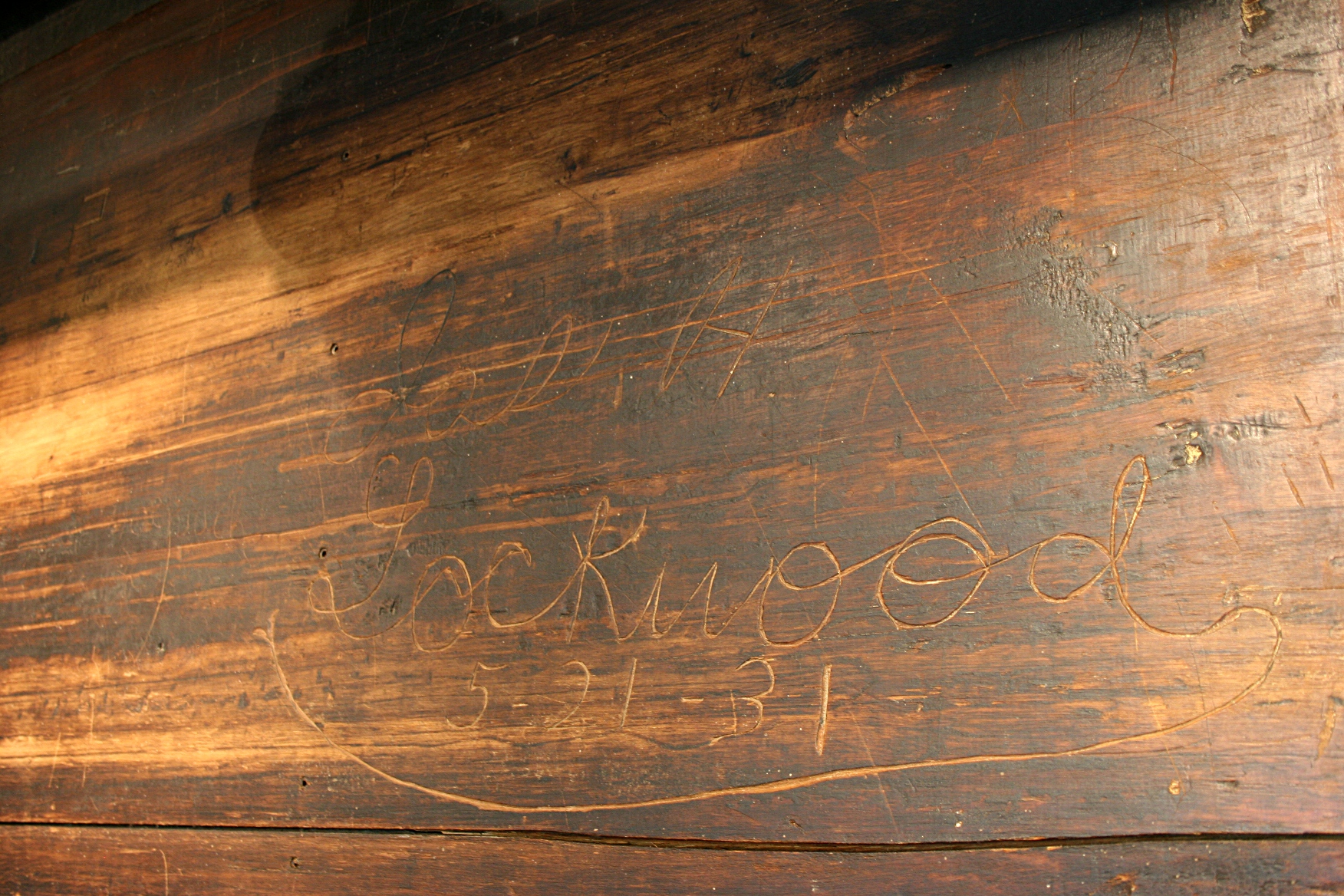
A wall once located near bathrooms has been incorporated into the retail store, behind the check-out counter, to showcase a name etched in wood in 1931.

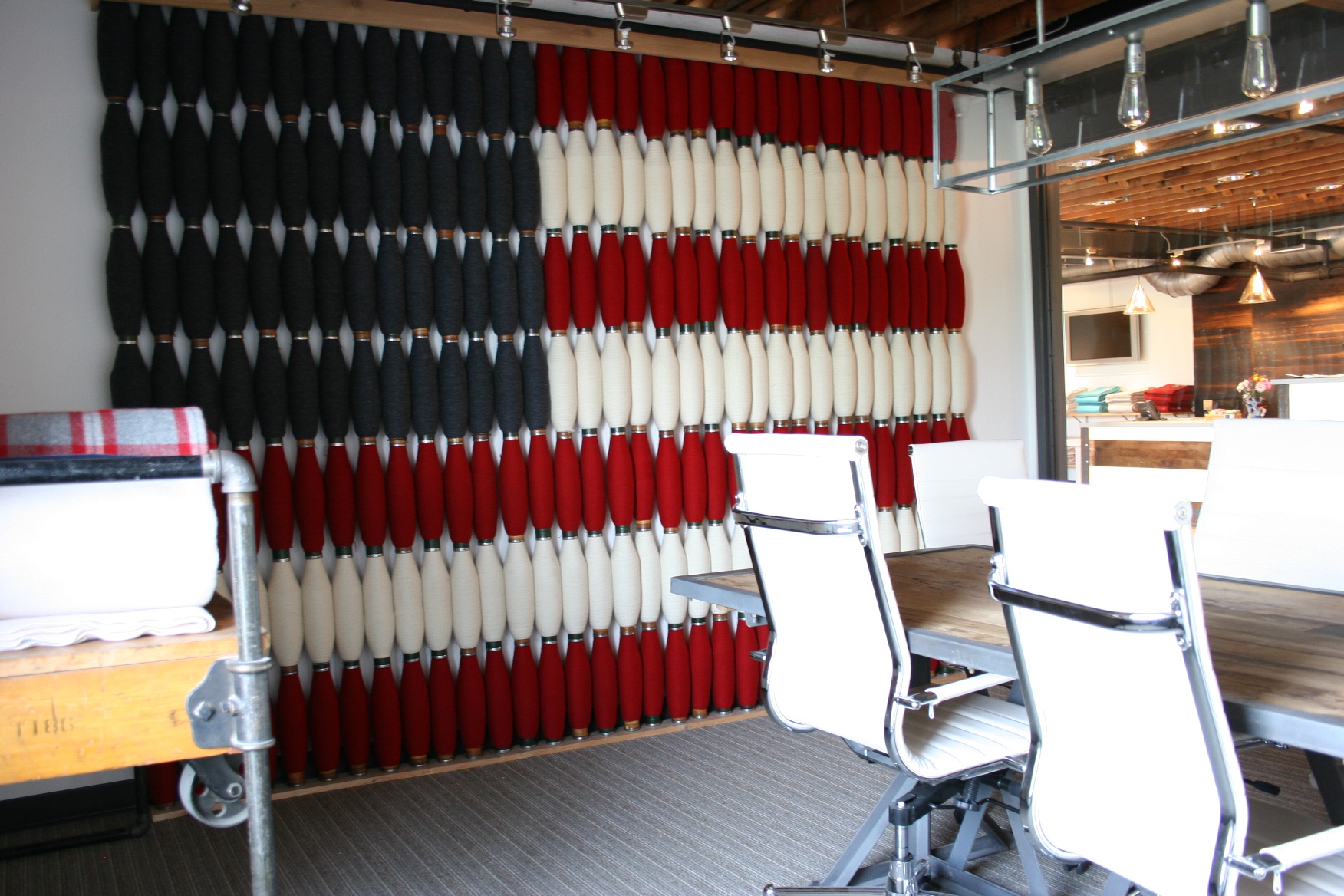
An American flag on a wall in a meeting room, visible through floor to ceiling glass in the retail store, emphasizes the Woolen Mill’s dedication to “American made” products.

On this afternoon, Jean welcomes me, obliging my request to photograph a meeting room and also a wall behind the retail counter. I have no idea she is the wife of Paul Mooty, who purchased the foreclosed mill and reopened it in 2011 with his cousin, Chuck Mooty, until she introduces herself later.

She’s friendly and engaging and genuinely interested in connecting with Faribault residents and grateful for the warm welcome given to her family.

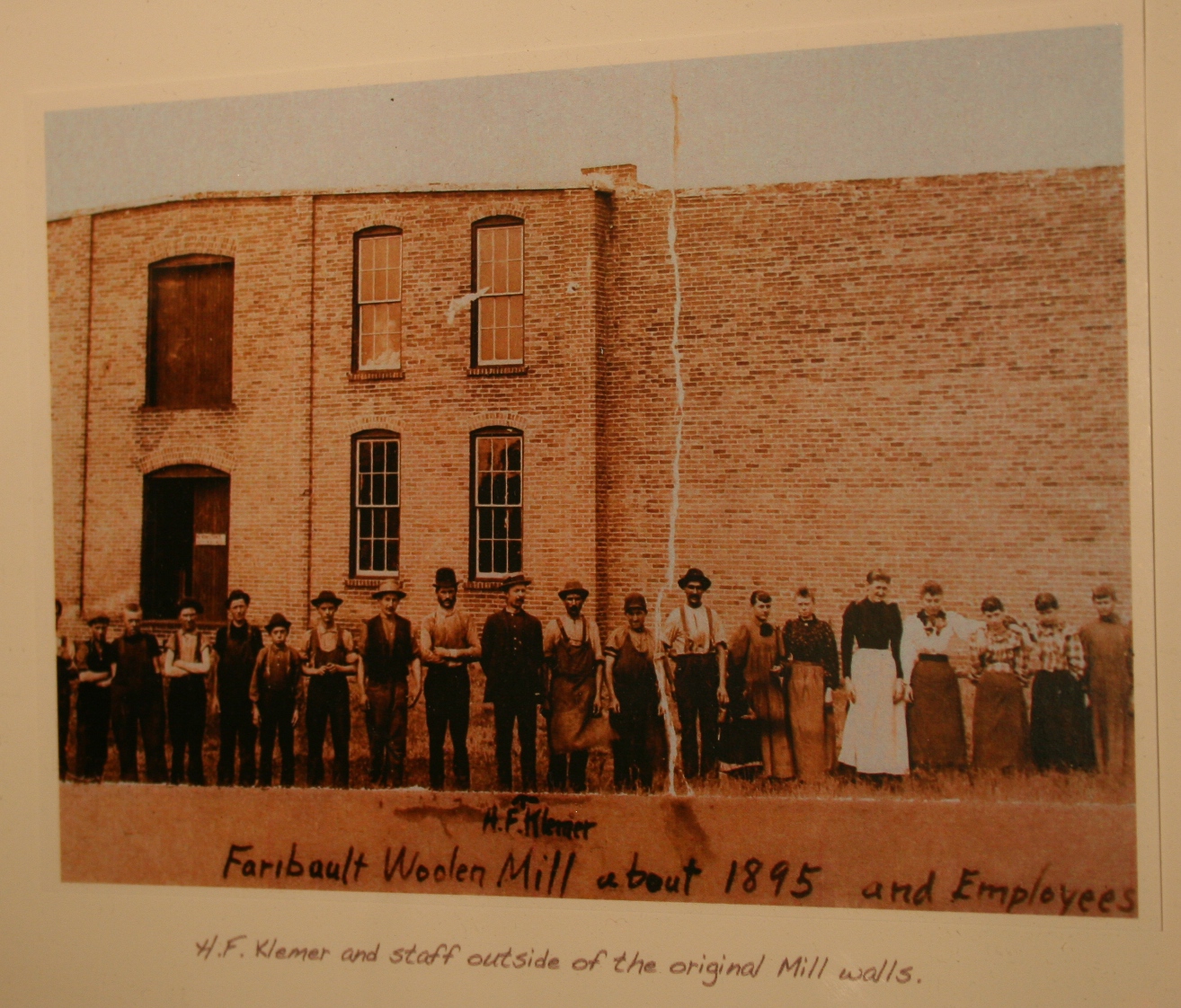
An historic 1895 circa photo from the mill, among those featured in a mini wall of Woolen Mill history.

After the sudden closure of the mill in 2009, locals seem delighted with the Mooty cousins’ revival of the mill which dates back to 1865.

In its labeling, the mill promotes itself as “Purveyors of Comfort and Quality” with its products “Loomed in the Land of Lakes.”

The Faribault Woolen Mill’s mission, according to the company website is “to provide the finest quality goods made only by American craftsmen here in Faribault, Minnesota.”

Wool blankets with a definite Northwoods feel are sold in the retail store.

Fine examples of that craftsmanship are presented to the public in the woolen blankets and throws so artfully displayed in the store which, according to Jean, has a Ralph Lauren/Northwoods look.

I’d agree. Comfort. Simplicity.  Americana. All qualities in Ralph Lauren’s signature fashion style exist in this mill store which seems destined to once again become a must-see destination for visitors to Faribault, one of Minnesota’s oldest and most historic cities.

The historic Faribault Woolen Mill sits along the banks of the Cannon River.

FYI: The Faribault Woolen Mill retail store holds its grand opening from 4:30 p.m. – 7 p.m. on Thursday, June 14. A ribbon-cutting is scheduled in conjunction with the Faribault Heritage Days Mayor’s Reception.

Tours of the Woolen Mill, located on the banks of the Cannon River at 1500 Second Avenue Northwest near the Rice County Fairgrounds, will be offered as part of the Heritage Days celebration at 2 p.m. and 2:30 p.m. on Wednesday, June 13, and again on Friday, June 15. Preregister by calling (507) 334-2064.

For more info about the Faribault Woolen Mill, click here to link to the company website.

A replica of an original sign is now in the Woolen Mill’s historic display area.

Even this Woolen Mill conference/meeting room possesses an inviting, rustic appeal.

© Copyright 2012 Audrey Kletscher Helbling

Note: These photographs were shot one month ago.