Minnesota Prairie Roots

Writing and photography by Audrey Kletscher Helbling

A look at Taopi, plus an overview of failures, injustices & war in Minnesota October 9, 2023

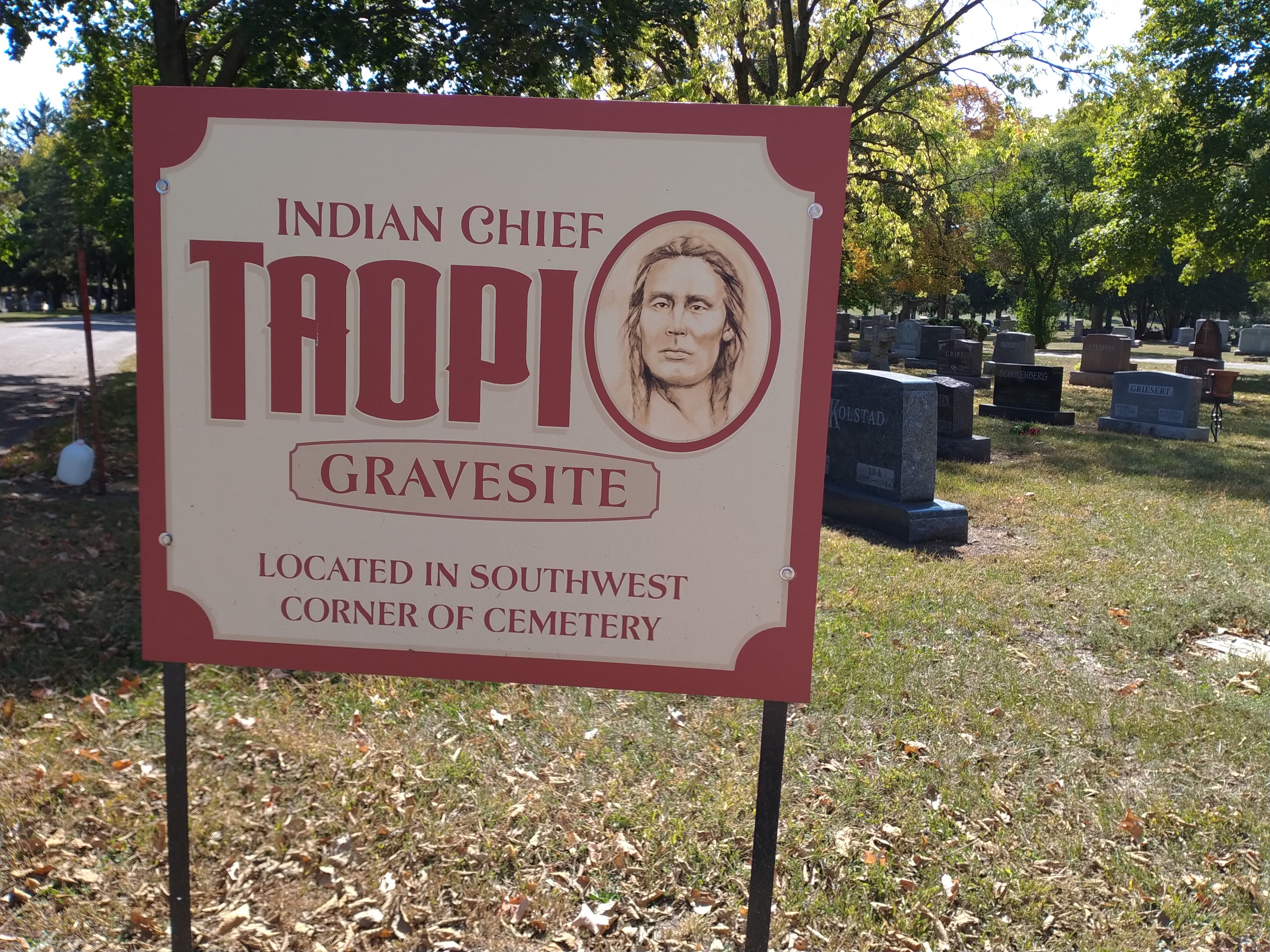
Just inside the entrance to Maple Lawn Cemetery, a sign directs visitors to Taopi’s gravesite. (Minnesota Prairie Roots copyrighted photo October 2023)

MY GOAL WAS SIMPLE—to write a piece honoring Indigenous Peoples’ Day. My focus, I initially decided, would be on Taopi, a member of the Little Crow Band of the Mdewakanton Dakota Tribe. Taopi is perhaps best known in Faribault, where he lived for a while and is buried. A small Mower County town near the Iowa border also honors him in name. But my writing expanded beyond Taopi.
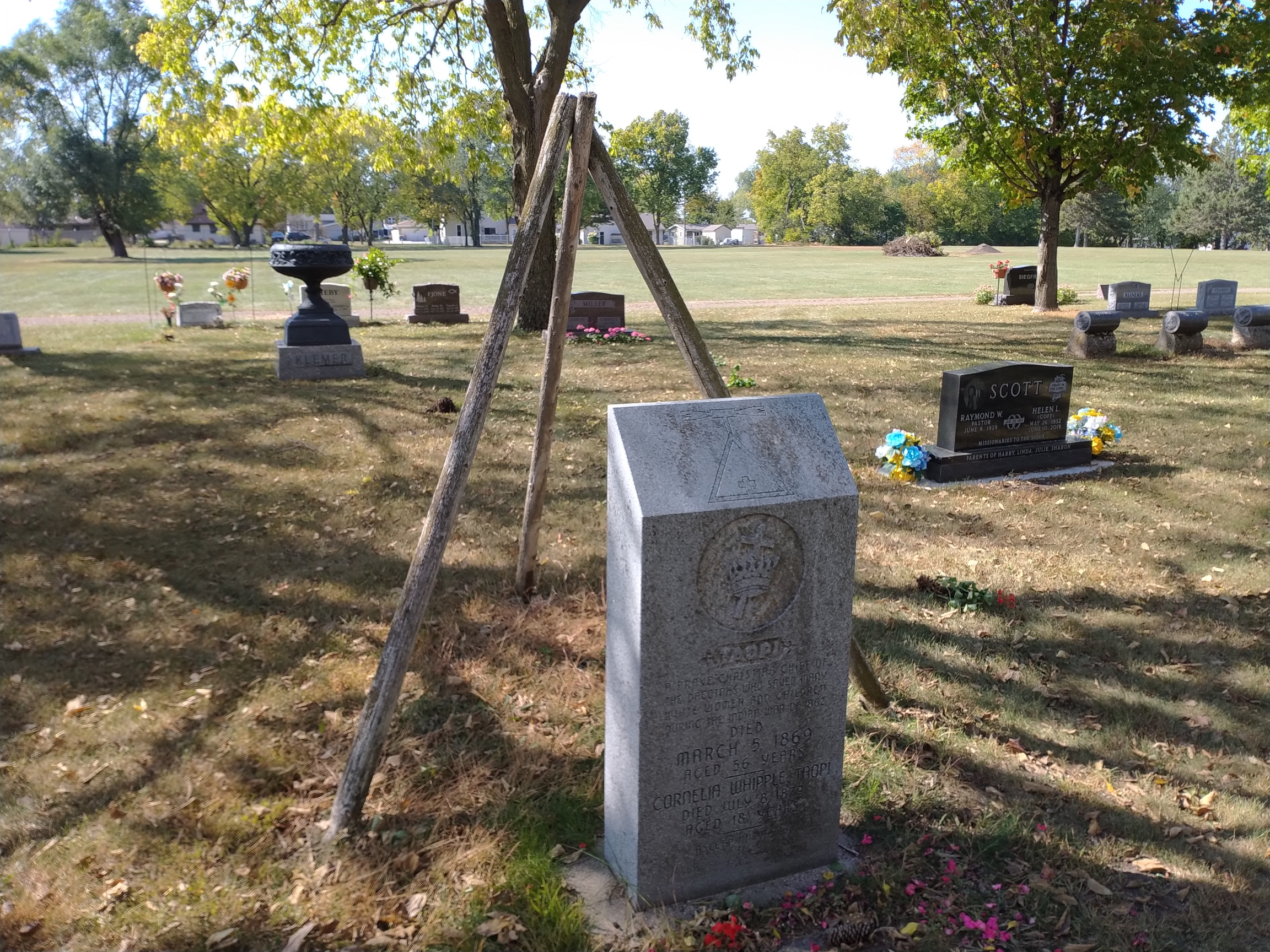
Taopi’s grave, and that of his daughter, are easily spotted via the propped poles. (Minnesota Prairie Roots copyrighted photo October 2023)

Recently I visited Taopi’s gravesite at Maple Lawn Cemetery. My interest piqued. I wanted to learn more about this Dakota leader and his importance in my community and in Minnesota history. His place in history connects to the US-Dakota War of 1862, a war all too familiar to me. My native Redwood County, where the Lower Sioux Agency was located, centered that deadly, short-lived conflict between white people and Native Peoples.

Now, viewing this war through a lens not tinted primarily by a white perspective, I understand the injustices. Decades ago, when I wrote a high school term paper on the war, I admittedly wrote a biased, unbalanced report based on biased, unbalanced research sources.

With time and maturity came the realization of the great injustices done, first when the US government acquired Indigenous Peoples’ land at a seemingly low cost and then failed to honor those treaties. The treaties opened nearly 24 million acres to white settlers. It was the Natives, the original inhabitants of this land, who found themselves cheated of government annuities, starving, pushed off their land and confined to strips of land along the Minnesota River. That includes the Wahpekute, a small band of the Dakota who lived in south central Minnesota, including the Faribault area. I live just below a Faribault city park called Wapacuta.
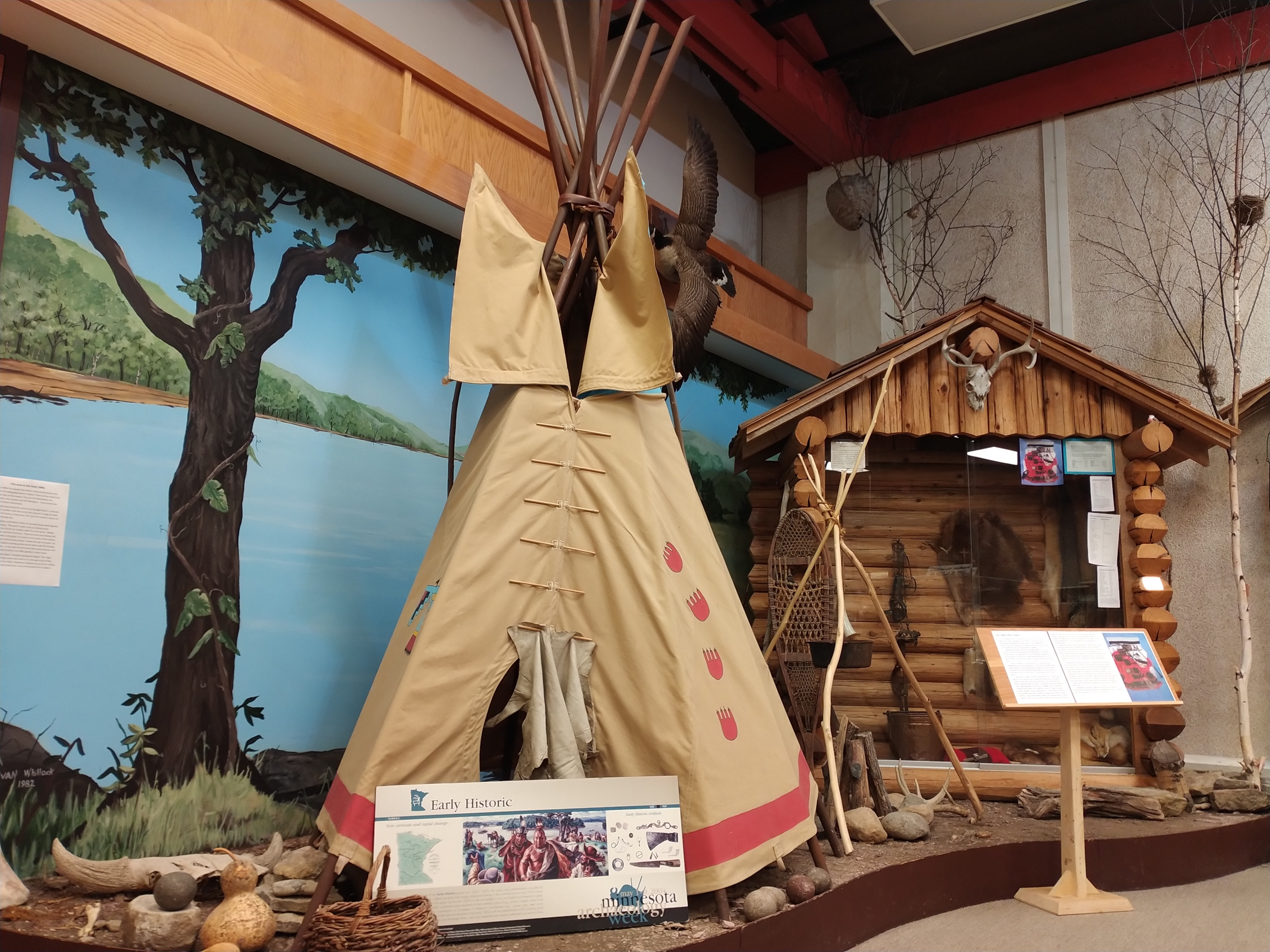
An exhibit at the Rice County Historical Society Museum. Artifacts from Indigenous Peoples are also displayed in cases. (Minnesota Prairie Roots copyrighted photo October 2023)

At the time of the US-Dakota War of 1862, Taopi was in the thick of all of it as a “farmer Indian,” the name tagged to Native Peoples who opted to farm, adapting the ways of the white man in occupation, dress and sometimes religion. He lived near the Lower Sioux Agency, relocated to a reservation there following the Treaty of Mendota in 1851. Those who continued with their hunting and fishing culture were known as “blanket Indians.” Taopi assuredly felt the animosity of his own people for the lifestyle and other choices he made.
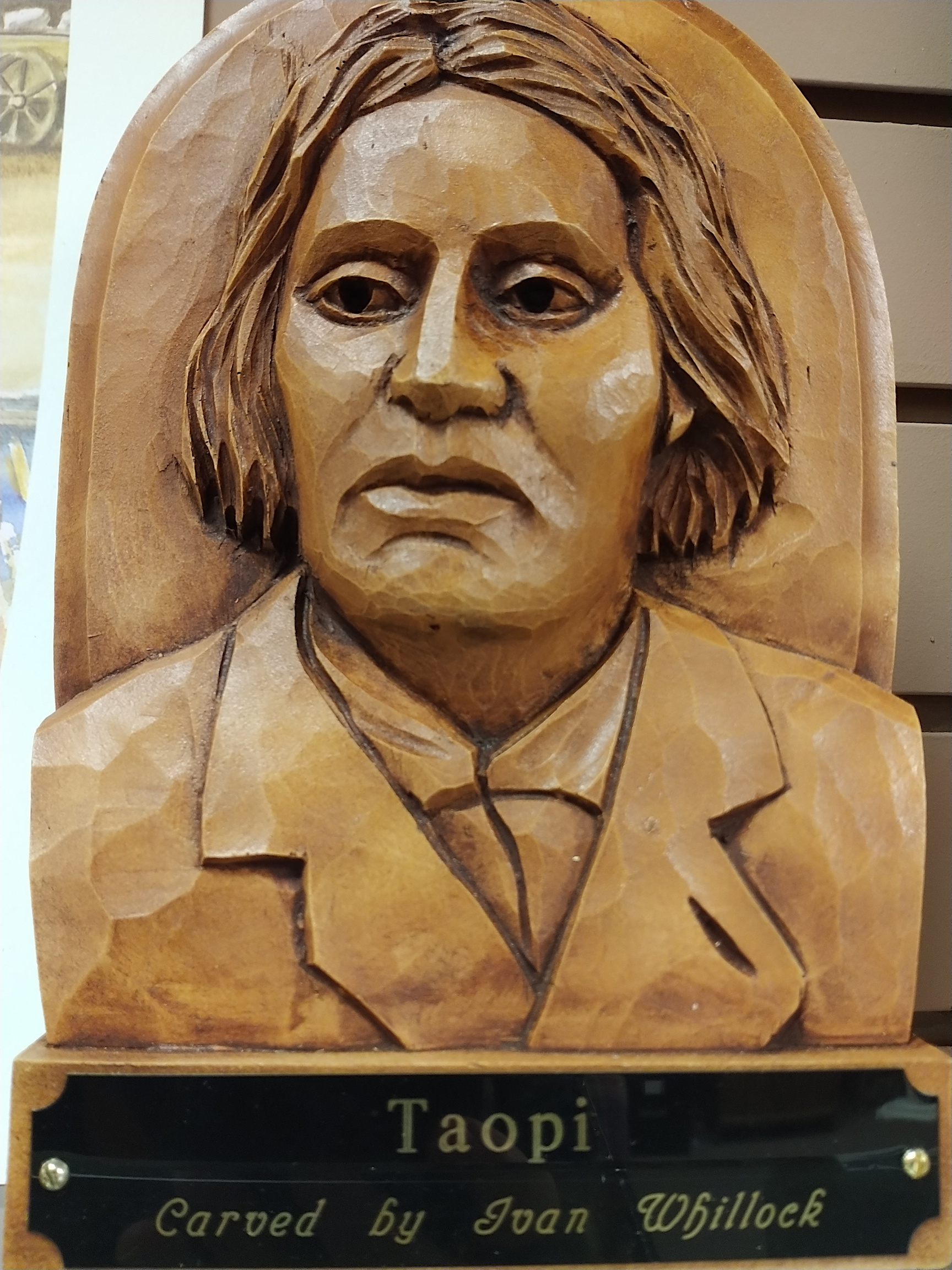
A woodcarving of Taopi by noted Faribault artist Ivan Whillock is for sale in the Rice County Historical Society Museum’s gift shop. One is also displayed in a museum exhibit on Taopi. (Minnesota Prairie Roots copyrighted photo October 2023)

I can only imagine the pressure Indigenous Peoples experienced as white settlers moved into the area. The change, at times, had to feel overwhelming. Life would never be the same. Long-time homelands were lost, tradition and culture endangered. And so Taopi and others adapted, likely accepting that change was inevitable.
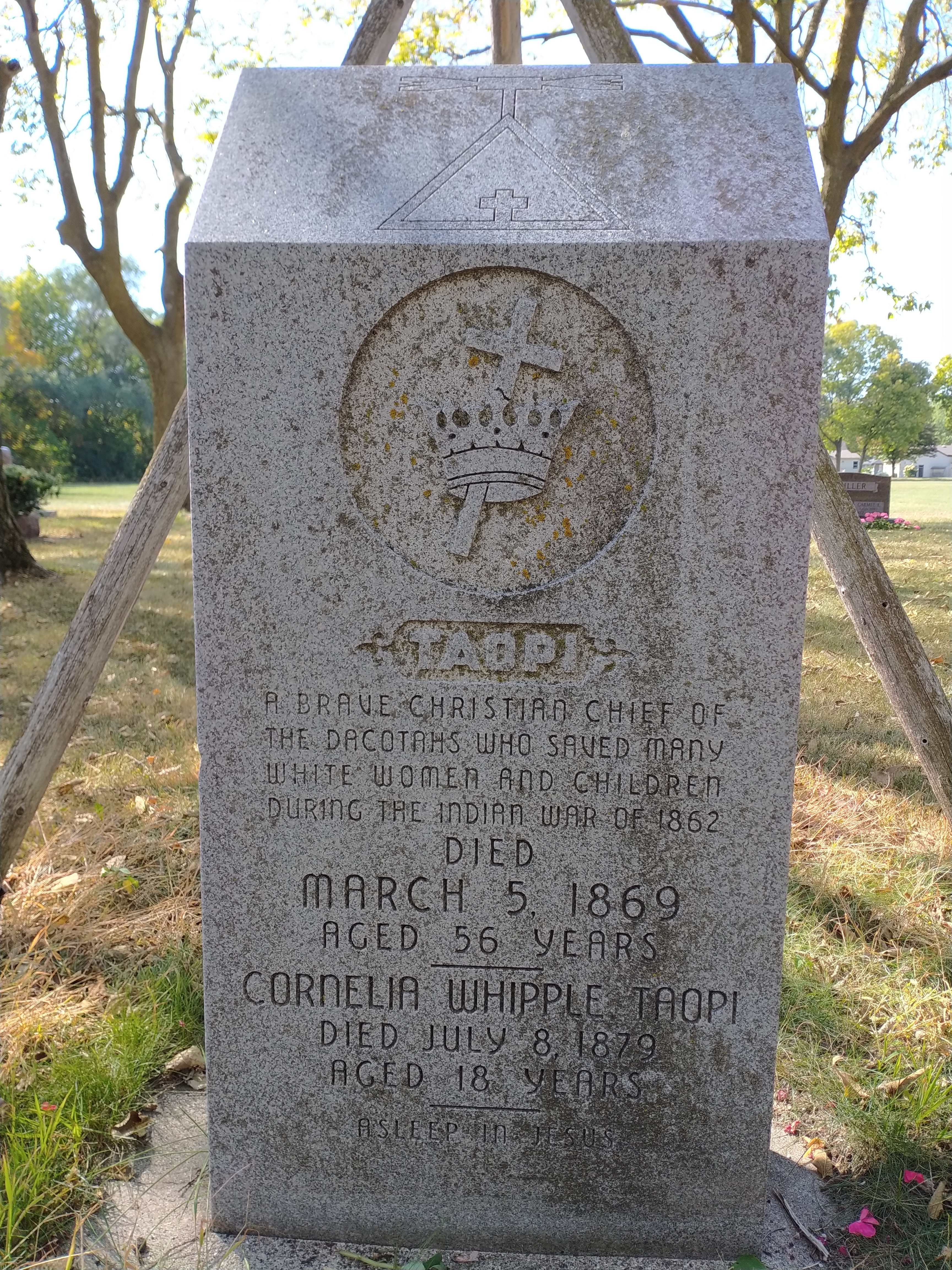
The gravesite of Taopi and his daughter, Cornelia Whipple Taopi (named after Cornelia Whipple, married to Bishop Henry Whipple). (Minnesota Prairie Roots copyrighted photo October 2023)

But one thing that remained constant with Taopi was his focus on peace. He opposed the war and was a leader in the Dakota Peace Party. He is credited with saving the lives of many.

Yet, at war’s end, Taopi found himself caught—disliked by his peoples, who considered him a traitor, and disliked by whites holding a deep animosity toward any Native person. In Faribault, though, he had a friend in Bishop Henry Whipple, a strong advocate for First Peoples, and in town founder Alexander Faribault. Eventually, Taopi and other Natives moved onto land owned by Alexander Faribault, living under his protection on a bluff overlooking the Straight River. Taopi died in 1869. In 1895, the Indigenous Peoples of Faribault were displaced once again, moved to the Lower Sioux Reservation. They had always existed on the fringes in Faribault, never fully-accepted by most residents while under the protection of the bishop and town founder.
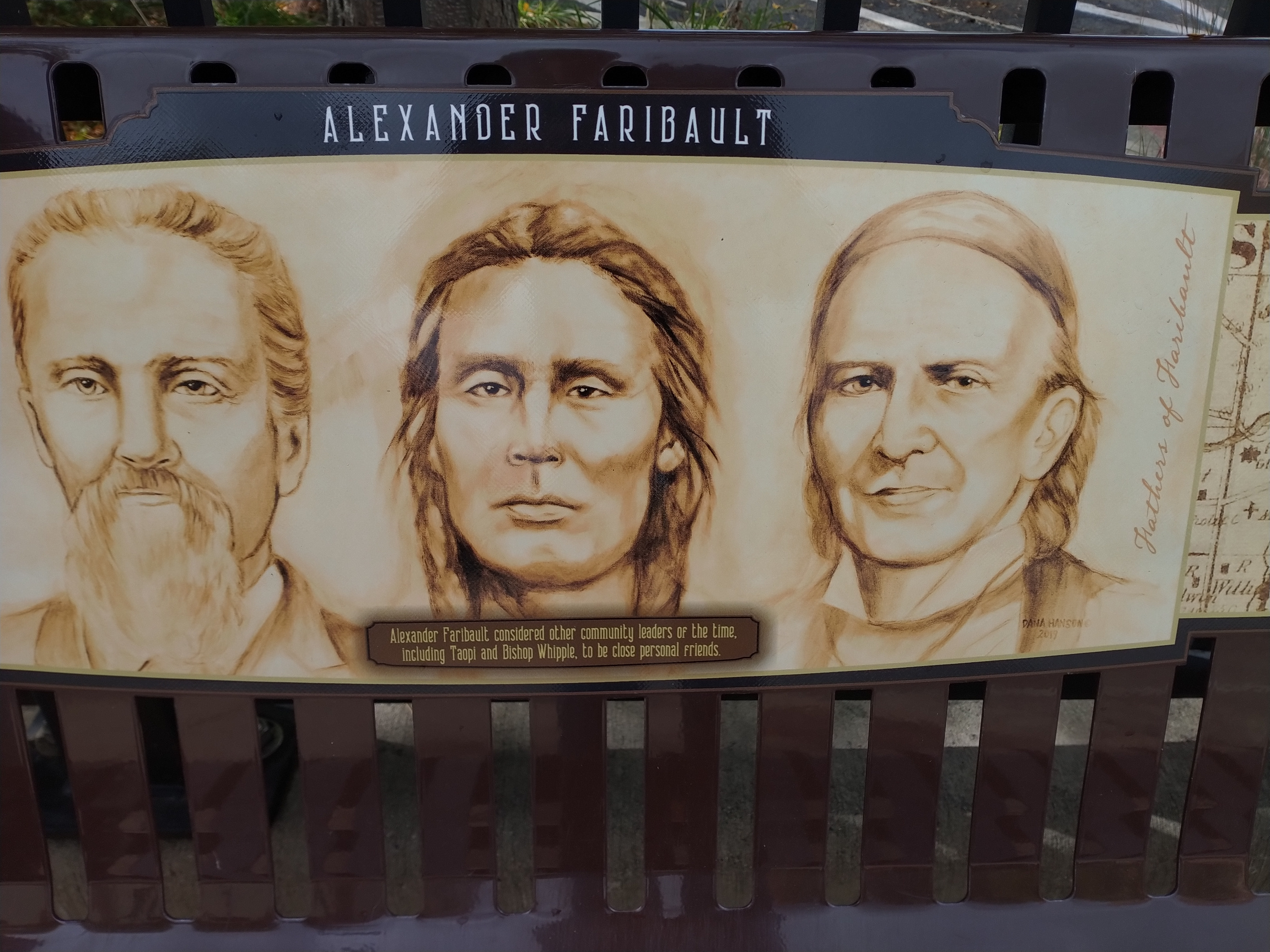
Dana Hanson’s “Father’s of Faribault” (left to right, Alexander Faribault, Taopi and Bishop Henry Whipple) featured on a bench along Central Avenue in downtown Faribault. The same artwork hangs inside Buckham Memorial Library. (Minnesota Prairie Roots copyrighted photo October 2023)

And so that is a brief look at Taopi, whose gravesite I visited. His presence remains visible elsewhere in Faribault. He’s featured in an exhibit at the Rice County Historical Society Museum. A “Fathers of Faribault” portrait of Taopi, Bishop Whipple and Alexander Faribault by Dana Hanson hangs at Buckham Memorial Library. Just a block to the north, that same artwork graces an historic-themed bench. Taopi was, most assuredly, a man of importance in local and state history. I will remember him primarily as a man of peace in a time when peace was decidedly elusive.

#

© Copyright 2023 Audrey Kletscher Helbling

Sources: The First Cathedral, an Episcopal Community for Mission by Benjamin Ives Scott and Robert Neslund; the Minnesota Historical Society website; and the Rice County Historical Society Museum’s Taopi display.


 

In Seaforth: Celebrating books, art & people October 4, 2023

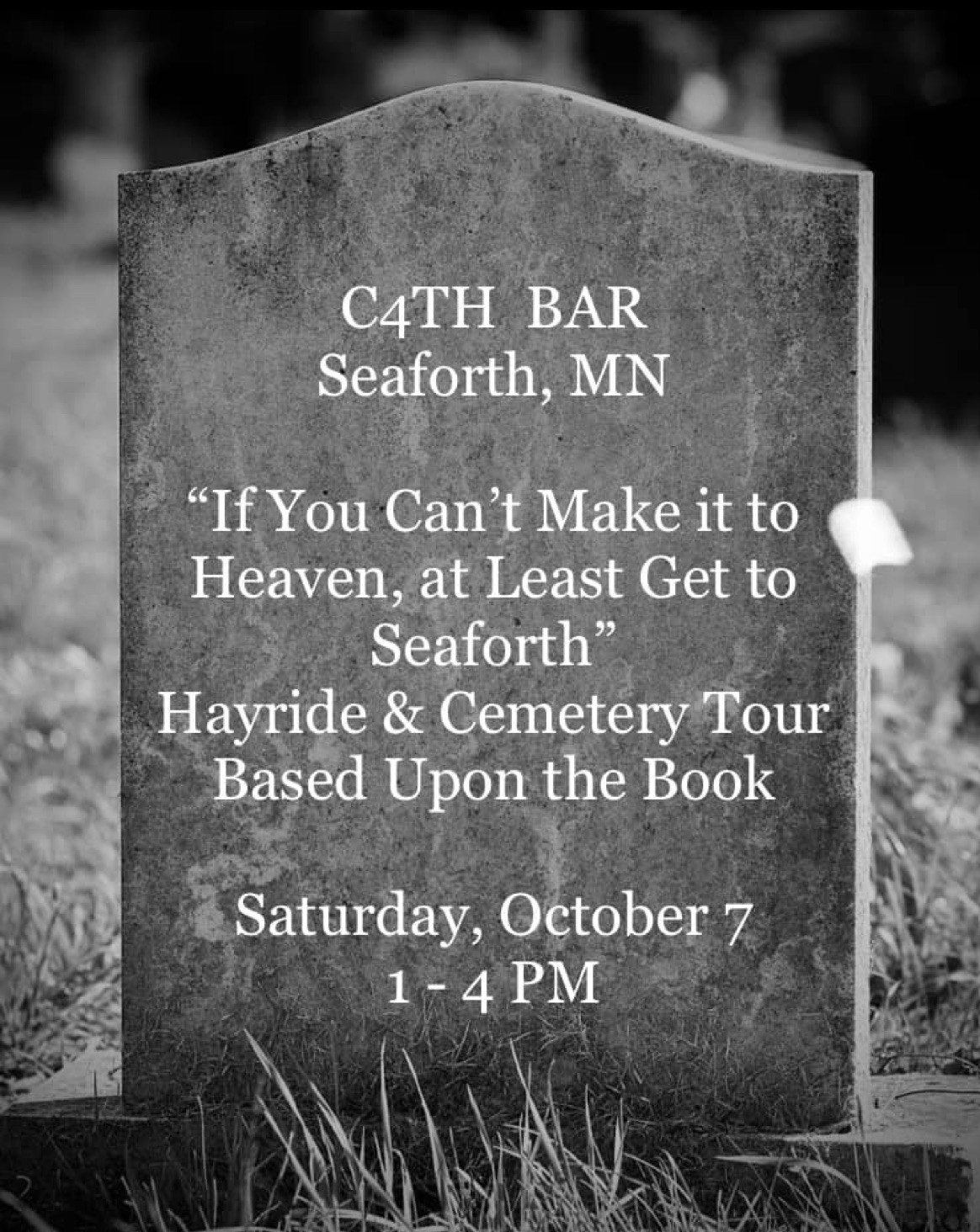
Promo for Saturday’s event, courtesy of Elizabeth Johanneck.

THEY ARE LONG-TIME FRIENDS. Friends who grew up together, who have a history of experiences and stories and of being there for one another. And they are both authors of books rooted in rural Redwood County, the land which shaped and grew them and their enduring friendship.

On Saturday, October 7, Twin Cities resident Elizabeth “Beth” Johanneck, author of If You Can’t Make it to Heaven, at Least Get to Seaforth—The Monica Stories and Then Some, and Granite Falls resident Cynthia “Cindy” Bernardy Lavin, author of the children’s book I Think I’ll Call You Annie: Based Upon a True Story (which Beth illustrated), return to Seaforth, population 77, for a 1-4 pm event sure to draw lots of interest.

The C4th Bar hosts the afternoon activities, which include a meet-and-greet (1-3 pm) with the authors and Monica Pistulka Fischer, prominently featured in Beth’s collection of short stories and art from the Seaforth and Wabasso areas. Books will be available for purchase.

Event promo courtesy of Elizabeth Johanneck.

But there’s much more planned than a book signing and time to chat with the long-time friends. The event also includes a hayride and self-guided tour of St. Mary’s Cemetery just northwest of Seaforth. Attendees can visit the gravesites of locals included in both books.

Image sourced online.

Back at the bar, Cindy, a retired elementary school teacher, will read her book about Seaforth’s most famous pig and offer a pig art project for kids.

The original painting of “Seaforth Main Street,” featured here on the cover of Beth’s book, will be on display at Saturday’s celebration. (Minnesota Prairie Roots copyrighted file photo 2023)

Art is an important part of this celebration as art is an integral part of Beth’s book. Her book includes the only printed collection of selected paintings by her grandfather, Arnold Kramer, dubbed “Minnesota’s Grandpa Moses.” He documented early to mid 1900s rural life and scenes, creating an historical agrarian treasure of some 400 paintings upon his retirement from farming. His original painting, “Seaforth Main Street,” which graces the cover of Beth’s book, will be displayed at Saturday’s celebration.

The C4th Bar is also honoring Kramer and several other Seaforth residents (and one pig) with special drinks: “The Grandpa Moses” for folk artist Arnold Kramer; “The Angie” for business owner Angie Bergen; “The Monica” for Monica Pistulka Fischer; and “The Annie” for Dana and Connie Dittbenner and Annie the Pig. “The Monica” and “The Annie” are non-alcoholic drinks. Hot chocolate and make your own s’mores will also be available.

No event is complete without music. The celebration features the live music of Cowboy Dave Gewerth.

It will be quite an afternoon in Seaforth. I can almost envision the scene of a packed bar, of Beth and Cindy mingling, of glasses raised, of stories shared, of memories made. That’s the thing about small towns, especially—you may leave, but you remain forever connected to the place, the events, the people. Like Beth and Cindy, long-time friends who on Saturday return to their roots to celebrate publication of their books, but, more importantly, Seaforth and its residents.

#

FYI: To purchase If You Can’t Make it to Heaven, at Least Get to Seaforth—The Monica Stories and Then Some, click here. (Also available through Barnes & Noble and independent bookstores, including Chapter Two Bookstore in Redwood Falls.) To read my review of the book, click here.

To purchase I Think I’ll Call You Annie, click here. Also available at independent bookstores and Barnes & Noble.

Disclaimer: I edited and proofed the manuscript for Beth’s book. My poem, “Her Treasure,” is printed in the book as a companion piece. Beth, Cindy and I attended Wabasso High School together, graduating with the class of 1974. Beth and I were also lockermates.

© Copyright 2023 Audrey Kletscher Helbling


Lutefisk, bars, kolacky, horseradish & more October 3, 2023

Across the cornfield stands Vang Lutheran Church north of Kenyon and home to an annual lutefisk supper. (Minnesota Prairie Roots copyrighted file photo October 2011)

IN THIS SEASON of church dinners, I am reminded of an event I covered decades ago as a young reporter fresh out of Minnesota State University, Mankato, with a journalism degree. My editor assigned me to write about and photograph the annual Lutefisk Dinner (or maybe it was supper) at Bernadotte Lutheran in Bernadotte, an unincorporated community northeast of New Ulm.

Having heard a few things about lutefisk—cod soaked in lye—I was in no hurry to undertake this assignment. But work is work and I eventually headed to this rural church to get the story. I don’t recall all the details from that late 1970s introduction to lutefisk. But I do remember a hardworking crew of volunteers, enthusiastic diners packing the church basement and my first taste of this Scandinavian seafood. A generous dose of melted butter made lutefisk, which reminded me of warm Jell-O, palatable. Sorry, Norwegians.

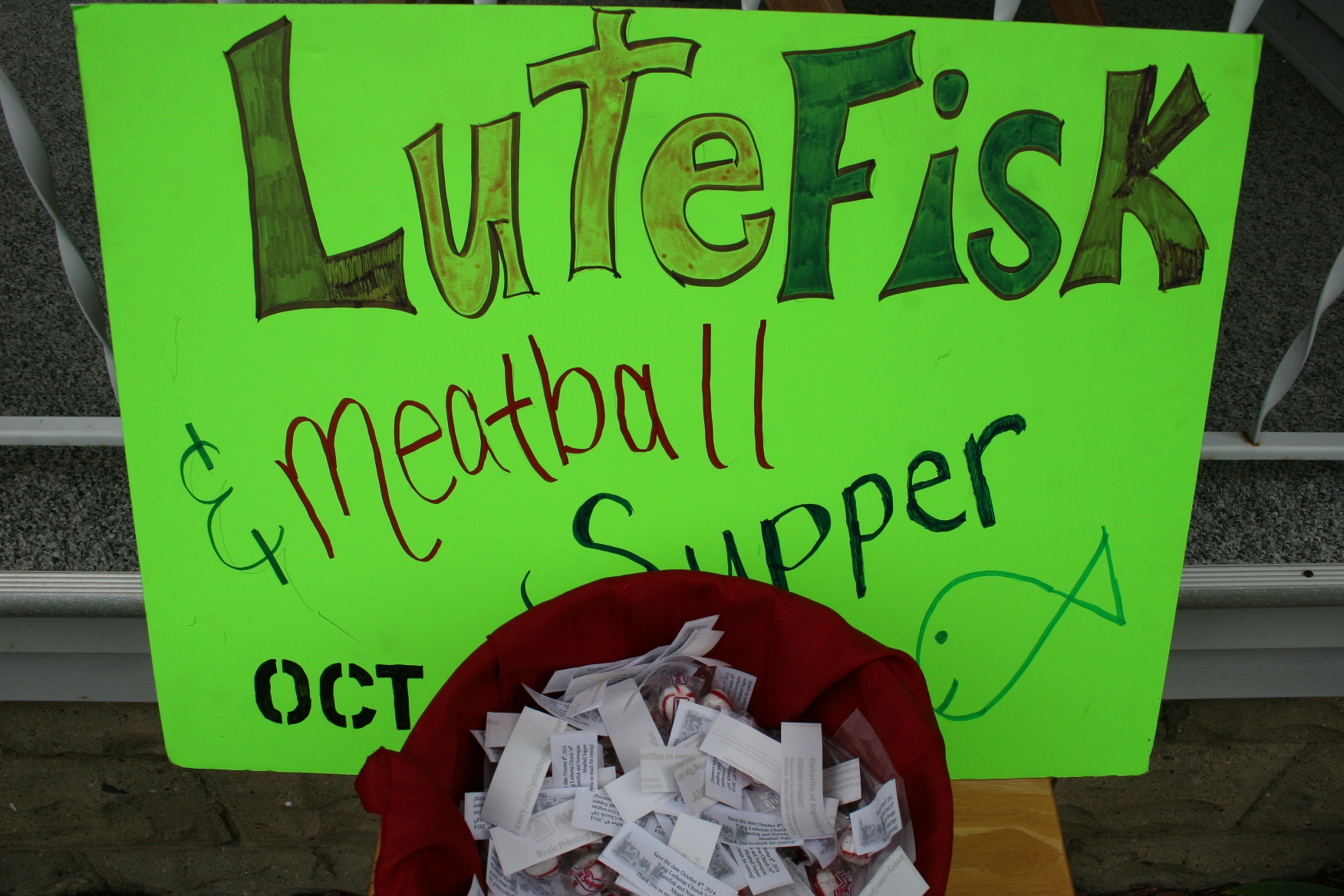
A sign promoting Vang’s 2014 Lutefisk & Meatball Supper. (Minnesota Prairie Roots copyrighted file photo 2014)

Lutefisk dinners remain popular in Minnesota’s Scandinavian enclaves. Like Vang Lutheran, rural Dennison, hosting a Lutefisk and Meatball Dinner on Wednesday, October 11, starring lutefisk and Norwegian meatballs with gravy plus fruit soup, lefse and Norwegian pastries. On Saturday, October 14, First Lutheran in Blooming Prairie is also serving a Lutefisk and Meatball Dinner. Except their meatballs are Swedish (what’s the difference?). Sorry, folks, all three dine-in seatings at First Lutheran are sold out, proving just how popular lutefisk dinners are in these parts. The Blooming Prairie lutefisk dinners have been around since 1934.

Bars. (Minnesota Prairie Roots copyrighted file photo)

BARS & BARS, NOT TO BE CONFUSED

This got me thinking about ethnic and unusual foods some of us love and others of us don’t. For example, this past July while vacationing in the central Minnesota lakes area, I came across turkey gizzards and pickled eggs prominently displayed on an end cap at a Crosslake grocery store. You couldn’t pay me to try the gizzards, priced at $12.49 for 16 ounces. But I’d give pickled eggs a try. Apparently there’s a market in Paul Bunyan country for these delicacies. And in some Minnesota bars, not to be confused with the bars we Minnesotans eat.

Ah, bars. They hold two definitions. I recall my native-born California son-in-law’s confusion about bars. It took a bit of explaining for him to understand that bars, besides a place to imbibe, are also, in Minnesota, a sweet treat that is not a cookie, cake or brownie. But similar, made in a cake pan and cut into squares.

Prune kolacky ready to bake at Franke’s Bakery. (Minnesota Prairie Roots copyrighted file photo March 2013)

KOLACKY OR SAUERKRAUT

Then there are kolacky, a Czech pastry unknown to me until I moved to this region. It was at Franke’s Bakery in nearby Montgomery, self-proclaimed “Kolacky Capital of the World,” that I first tasted this dough into which prunes, apples, raspberries, blueberries and other fruit or a poppy seed filling are folded. Kolacky are so popular in this Czech stronghold that Franke’s baked nearly 1,800 dozen of the treats for the annual town celebration, Kolacky Days, in July. That’s a whole lot of kolacky, like nearly 22,000.

Me? I prefer a Bismarck oozing with custard. And, yes, I am German, which might also explain my love of sauerkraut. Henderson, where my paternal great grandparents settled upon arriving in America, celebrates Sauerkraut Days annually. And, yes, there’s a sauerkraut eating contest. I grew up eating homemade sauerkraut fermented from cabbage grown in our large garden. My grandma made kraut and my dad thereafter.

Homemade horseradish in jars. (Minnesota Prairie Roots copyrighted file photo October 2012)

HOW ABOUT HORSERADISH OR COTTAGE CHEESE PIE?

Dad also made horseradish, a tradition which continues in my extended family today, 20 years after his death. Horseradish seems an acquired taste. Not everyone likes a condiment that burns nostrils, clears sinuses, waters eyes, nips the tongue. But I do.

And once upon a time I also ate SPAM, a canned meat made in Austin, Minnesota, and wildly popular in Hawaii. I liked it in Pizza Burgers—SPAM, onion and American cheese ground in a hand-cranked meat grinder and then canned chili (without beans) stirred in. I haven’t quite figured out the “without beans” in chili. Mom made and spread the mix on homemade bun halves, broiled until the cheese bubbled. Yum. I no longer eat SPAM. Or Jell-O. Make that red Jell-O with bananas, a staple of extended family gatherings many decades ago.

On the shelves at Reed’s Market in Crosslake. (Minnesota Prairie Roots copyrighted photo July 2023)

Food, in many ways, connects to memories, traditions, heritage. You won’t find me eating peanut butter on pancakes or Cottage Cheese Pie, food oddities my husband brought into our marriage. I don’t much like pancakes and I’ve never made the Helbling signature pie. Nor have I made my mom’s favorite pie, Sour Cream Raisin. But I love cottage cheese and I eat Raisin Bran cereal. Just don’t ask me to eat turkey gizzards. Or lutefisk. Once was enough for this writer.

© Copyright 2023 Audrey Kletscher Helbling


Spotlighting cancer in the light of hope October 2, 2023

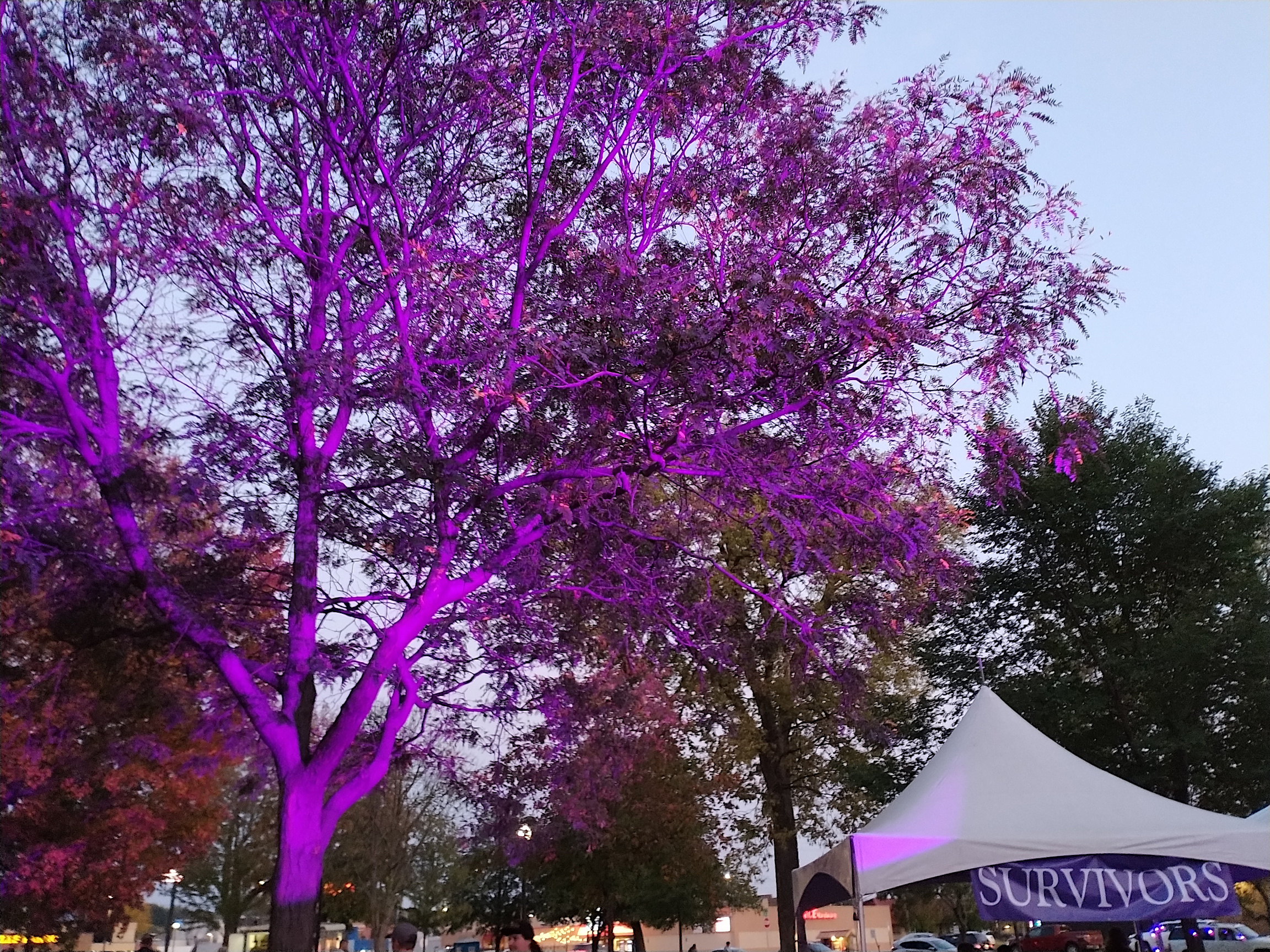
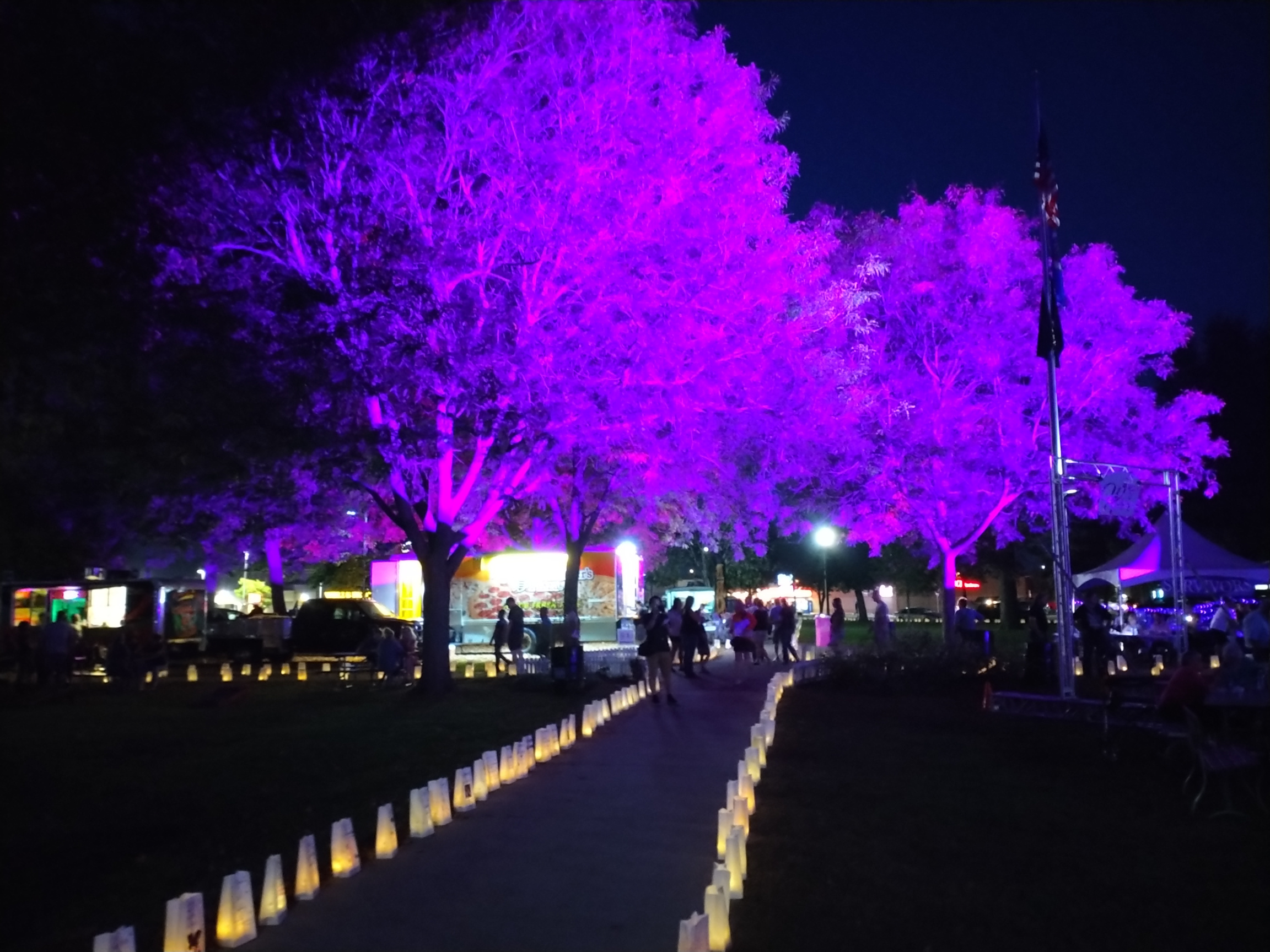
Purple spotlights transformed trees to shades of purple. (Minnesota Prairie Roots copyrighted photo September 2023)

IN THE EARLY EVENING DARKNESS of Faribault’s Central Park, on an unseasonably summery September Saturday, I felt enveloped in a magical world of autumn leaves sparkling purple. The setting seemed surreal, magical, enchanting. And the feeling felt hopeful.

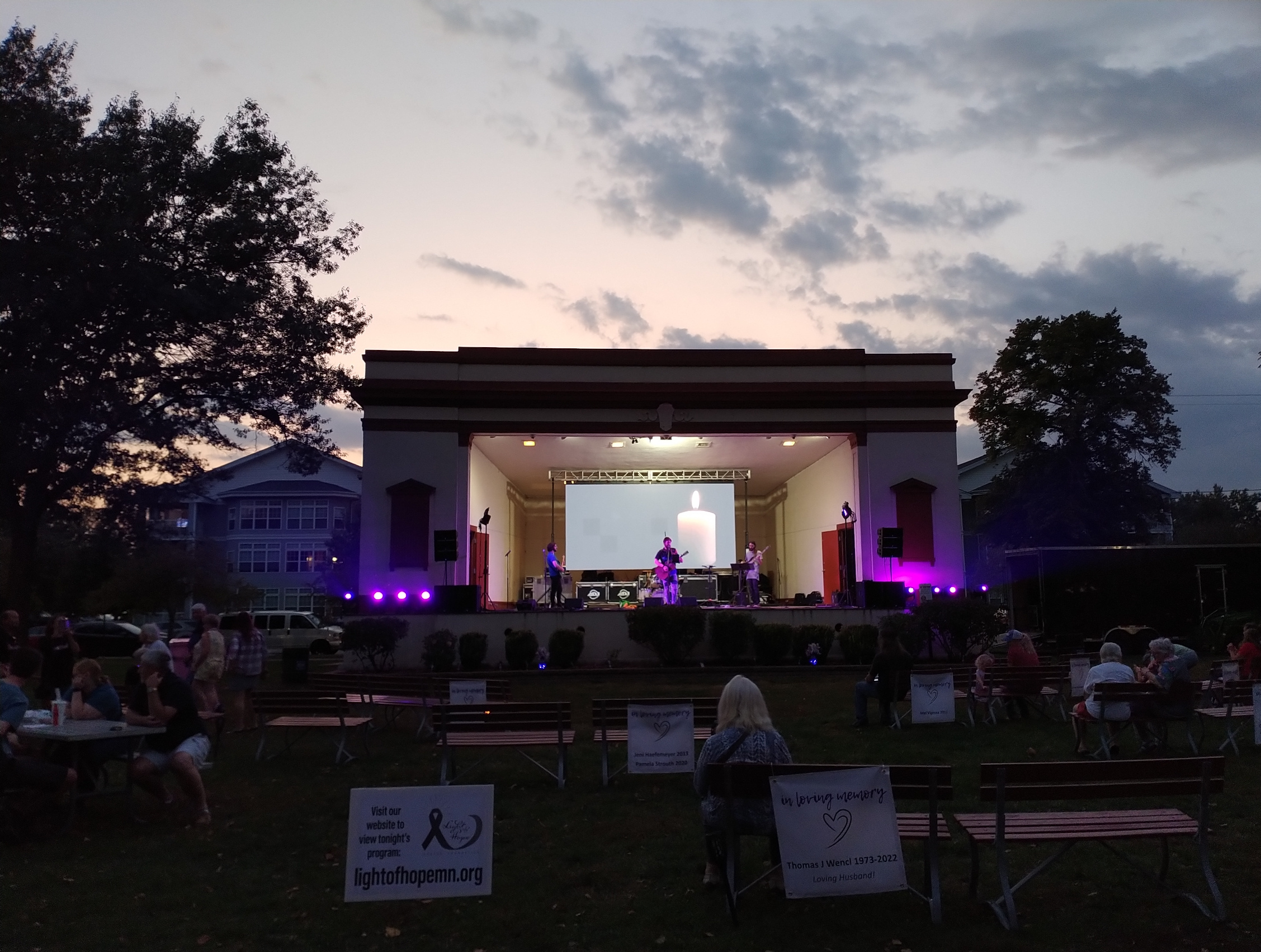
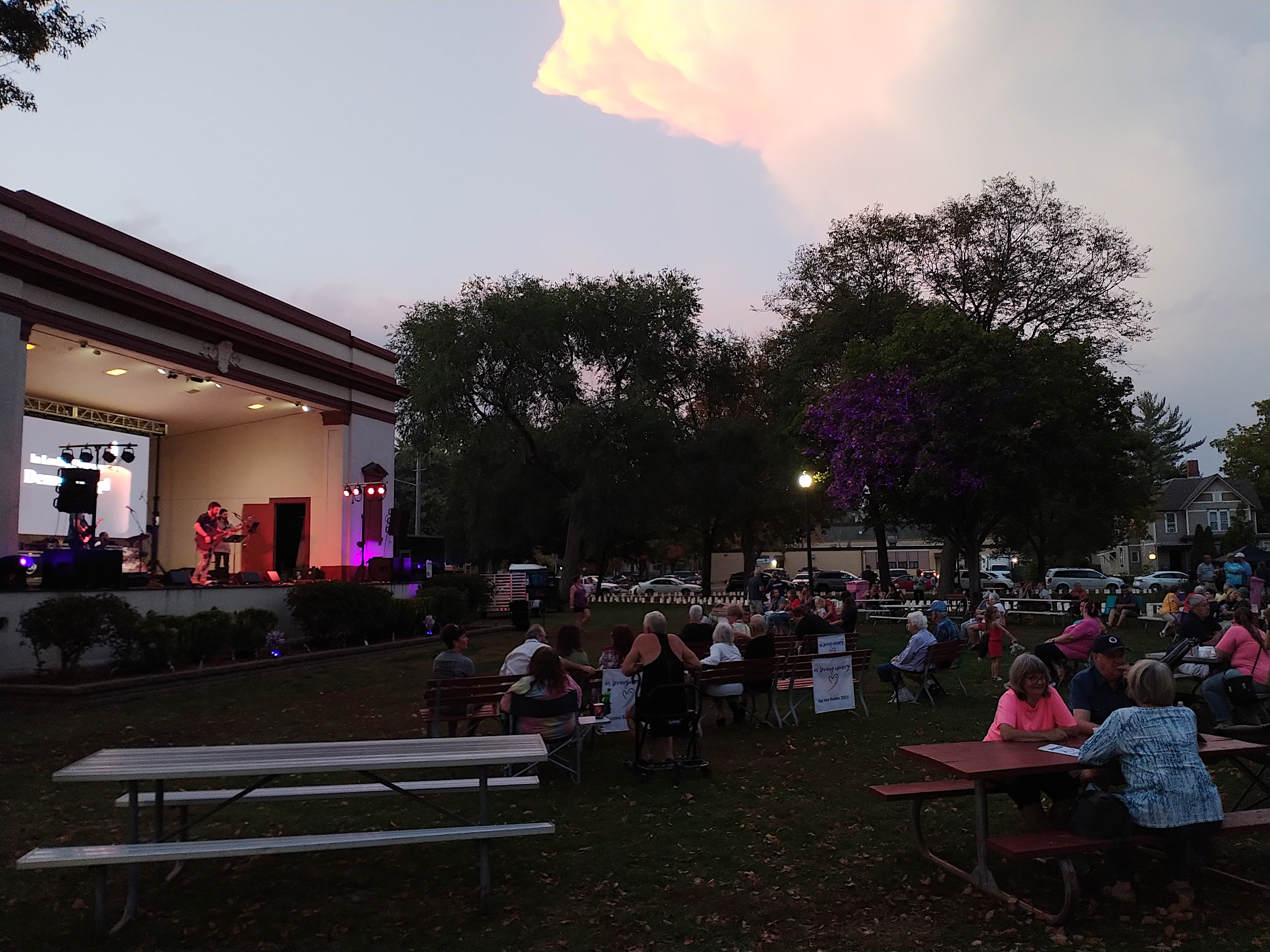
Musician Steve Huber performed first followed by Joe and the Mechanics in the Central Park Bandshell. (Minnesota Prairie Roots copyrighted photo September 2023)

I was among hundreds gathered for the first-ever Light of Hope Celebration to recognize those lost to cancer, those battling cancer, those who’ve survived cancer…and those of us who love (d) them. Purple spotlights shone on trees centering the park, creating a serene, yet celebratory, scene while musicians performed in the bandshell, speakers spoke and kids engaged in activities just for them.

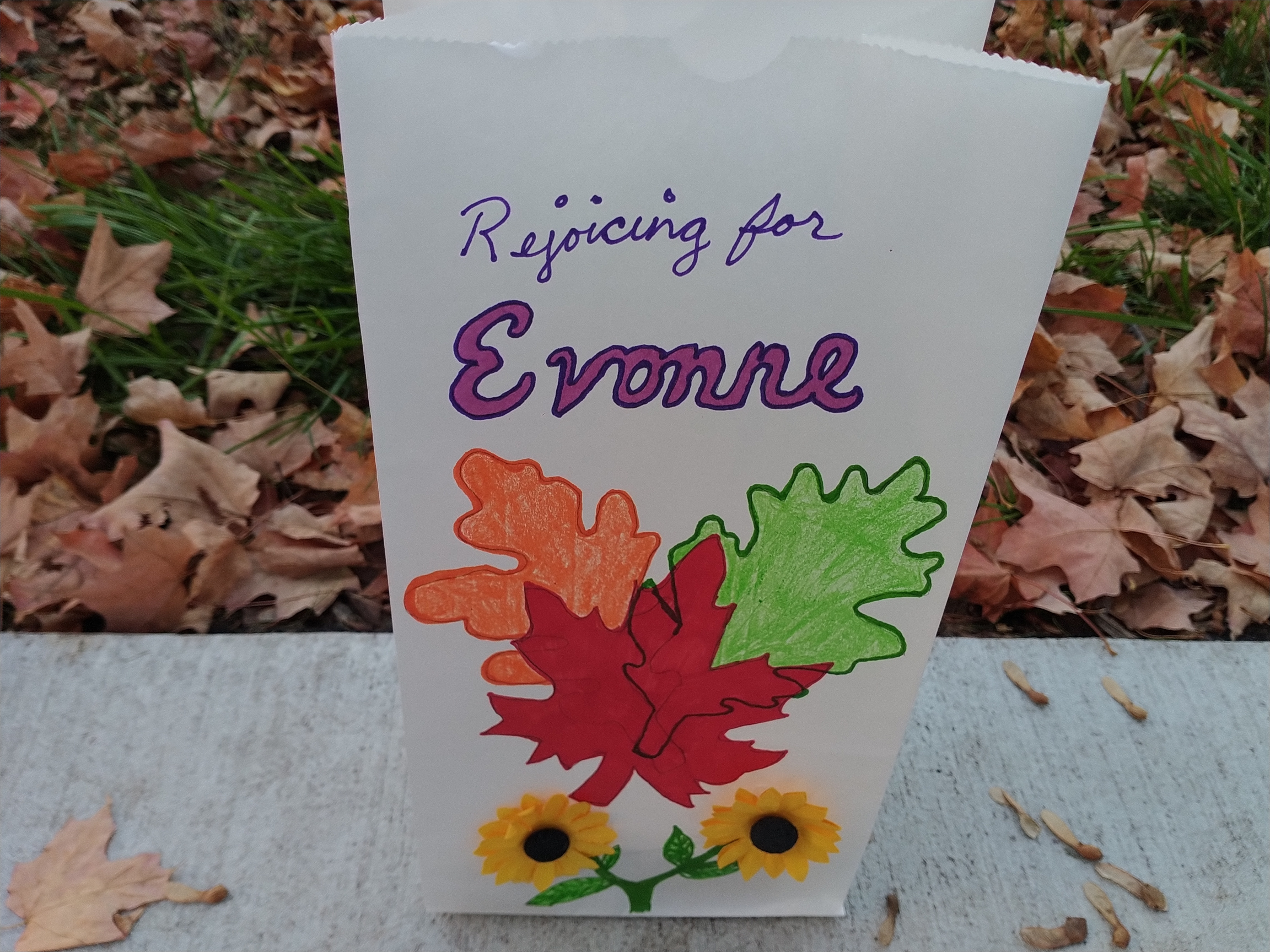
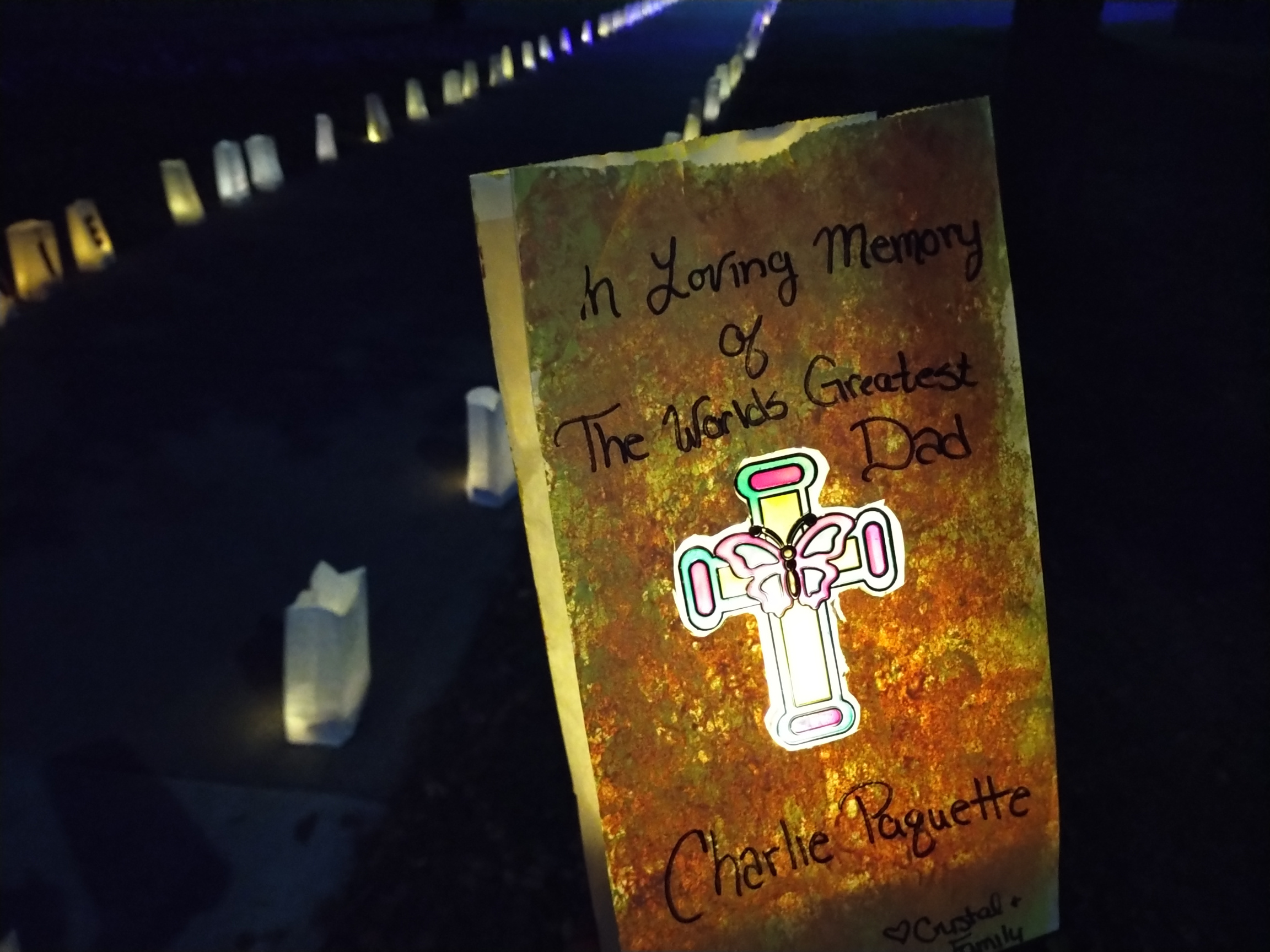
An autumn-themed luminary for a cancer survivor. (Minnesota Prairie Roots copyrighted photo September 2023)

My focus, though, was on the hundreds of luminaries lining the sidewalks that edged and crisscrossed this central community gathering spot. I walk here daily, among the towering trees and scampering squirrels. The din of traffic, the presence of others, the locations of St. Vincent de Paul and the Cathedral of Our Merciful Saviour across the streets are all reminders that Faribault truly is about community. We need one another. And I felt, at this event, a strong sense of community, of coming together, of leaning on one another.

Gathering to talk, to listen to music, to celebrate. (Minnesota Prairie Roots copyrighted photo September 2023)

I felt such love as I hugged the local x-ray tech who did my recent mammogram. I assured her my results were good. She and I have a history, meeting several years ago in the hospital ER when I broke my wrist. I hugged others, too, whom I haven’t seen in a while. It felt right, to reach out and encircle these individuals who, at some point, have been there for me, whether personally or professionally. And if my cousin and a friend, who are currently undergoing chemotherapy for aggressive, advanced breast cancer, had been there, I would have held them close in prolonged hugs also.

I saw so much love written upon luminaries by those who lost loved ones to cancer. (Minnesota Prairie Roots copyrighted photo September 2023)

Twenty years ago I was on the receiving end of many hugs as I stood inside my hometown church, St. John’s Lutheran in Vesta, embracing family and friends at the death of my dad. He died of esophageal cancer and other health issues. At the cemetery, I wrapped my arm around my mom, shaking with cold and grief on that brutal winter day. She was a breast cancer survivor.

Many family—including my husband, a sister and sister-in-law—and friends have survived cancer. Many family—including a dear nephew and aunt—and friends have died of cancer. And today many in my circle are battling cancer, including a much-beloved cousin, a brother-in-law and a dear friend. Cancer is brutal and awful and horrible. And it seemingly spares no family.

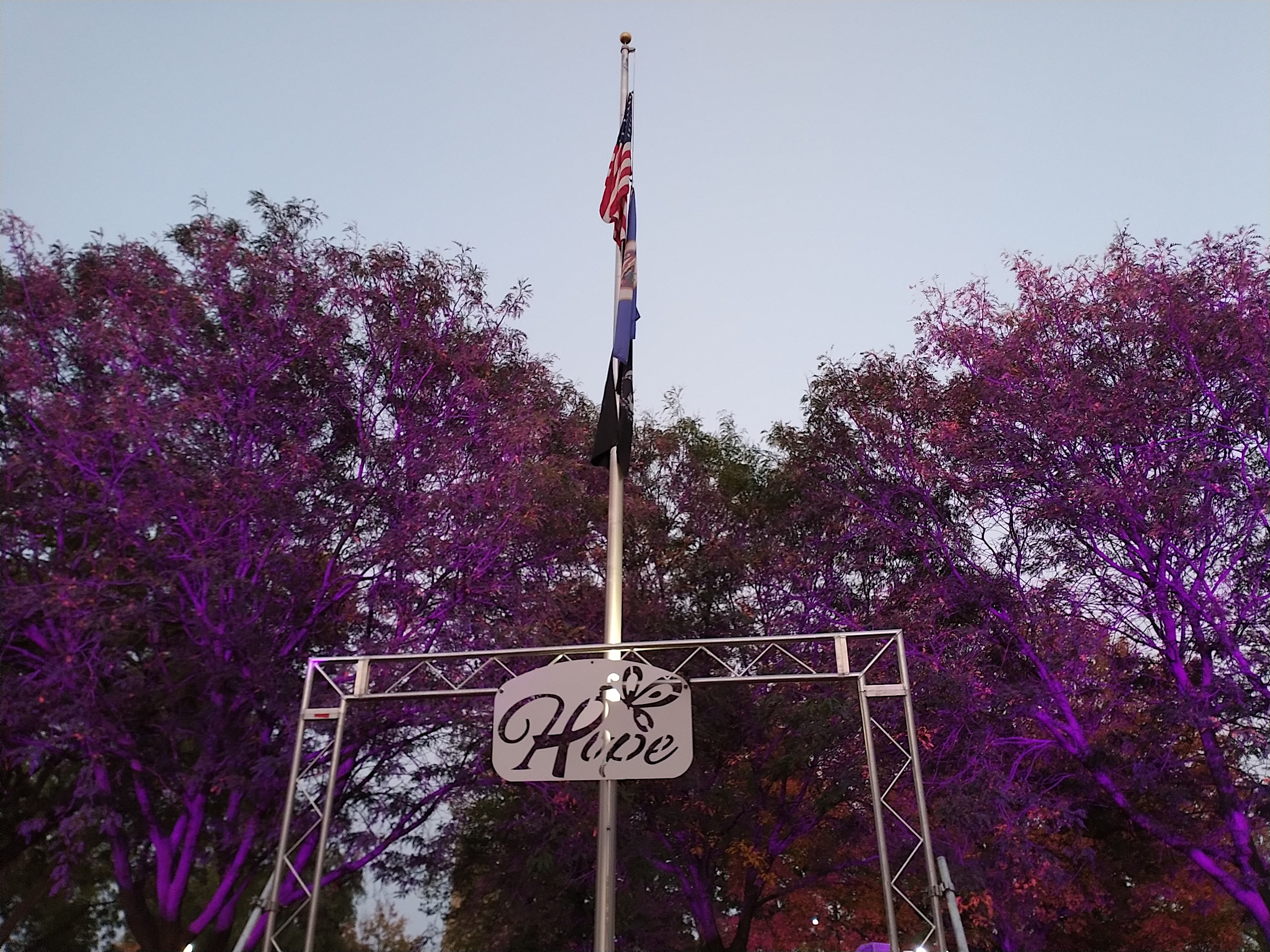
A beautiful hope sign suspended in the center of the park. (Minnesota Prairie Roots copyrighted photo September 2023)

But there is hope. In the support of others. In events like the one on Saturday organized by the Light of Hope Cancer Foundation with a mission “to empower local cancer patients and families to focus on treatment and healing by providing immediate and practical financial support while advocating and fundraising for research, education and cancer prevention.” There is strength in a supportive and caring community.

A survivors’ tent, right, offered survivors of cancer a place to gather, celebrate and enjoy cake. (Minnesota Prairie Roots copyrighted photo September 2023)

And there is hope, too, in knowing options are available for treatment. That is also personal for me as my uncle, Dr. Robert M. Bowman, developed the drug Letrozole (Femara), approved by the Food and Drug Administration in 1998 to treat certain types of breast cancer in post-menopausal women. Today, as my retired chemist uncle lies in hospice suffering from Parkinson’s, his wife, my beloved Aunt Dorothy, tells me how grateful Robin feels for having created a life-saving drug. He gave women hope.

I shot this scene shortly before leaving at 7:45 pm. So beautiful…the luminaries, the trees morphed purple by spotlights. (Minnesota Prairie Roots copyrighted photo September 2023)

As I walked among the hundreds of luminaries, first in the light of early evening and then in the darkness, I remembered, grieved silently, contemplated, celebrated… And I felt hope. Strong, beautiful, powerful hope.

© Copyright 2023 Audrey Kletscher Helbling