
ON THE MORNING OF OUR GRANDSON’S preschool holiday party, Randy took time off work to watch a group of preschoolers perform an unrehearsed version of the Christmas story. The little ones eagerly donned swatches of cloth, transforming into multiple Marys, Josephs, angels and shepherds. My eyes focused on Isaac, brown tunic slipped over his plaid flannel shirt, shepherd’s staff in hand. I worried he might bonk a classmate over the head. He never did. In the end, the pastor-directed impromptu play proved entertaining and joyful, a blessing to all.
Later that evening, after he returned from a half day of work, Randy joined me at the Paradise Center for the Arts in Faribault to watch an invitation-only final dress rehearsal of Charles Dickens’ A Christmas Carol performed by The Merlin Players. Well-rehearsed, directed, staged, acted and presented, this play contrasted sharply with the one we’d seen earlier that day. Yet, the messages of peace, love and good will (among others) repeated. The Dickens’ play ended with the line: “God bless us everyone!”
Two plays in one day—one familiar to me, the other not. One faith-based, the other centered on choices one makes in life. Both powerful in their own way. One loose and unstaged, the other professionally done.
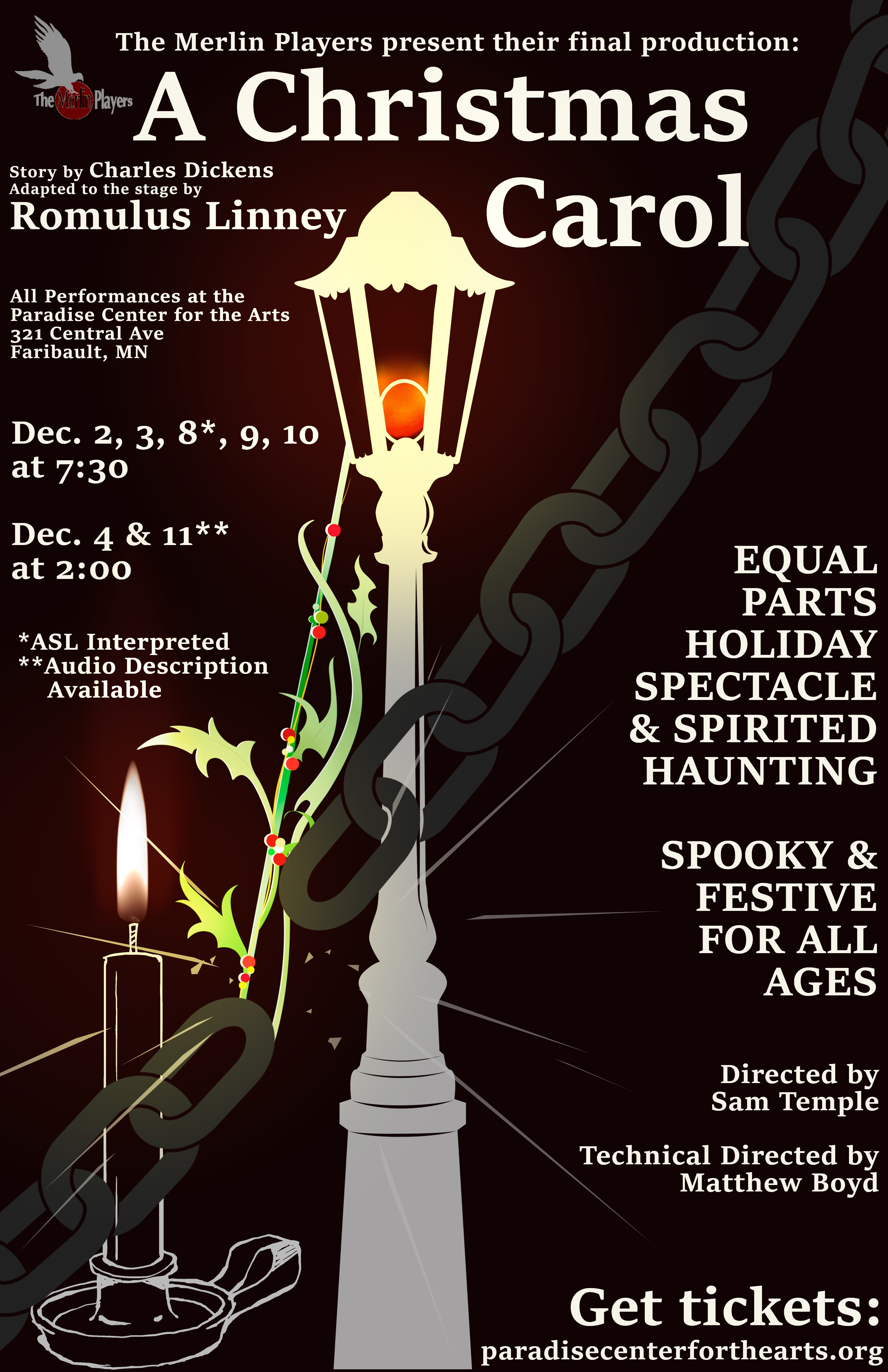
That I’ve never read or seen A Christmas Carol is something I hesitate to admit. I am, after all, an English minor, an avid reader, a writer. Of course, I knew the basic story line of main character Ebenezer Scrooge visited by the ghosts of Christmas past, present and future. But that’s about it. So I walked into the theater Thursday evening not quite knowing what to expect, although I anticipated another outstanding performance by The Merlin Players. Fifteen years ago they presented this same play at the Paradise. Now the theater company is disbanding, choosing to end with a repeat of A Christmas Carol, albeit different in presentation.

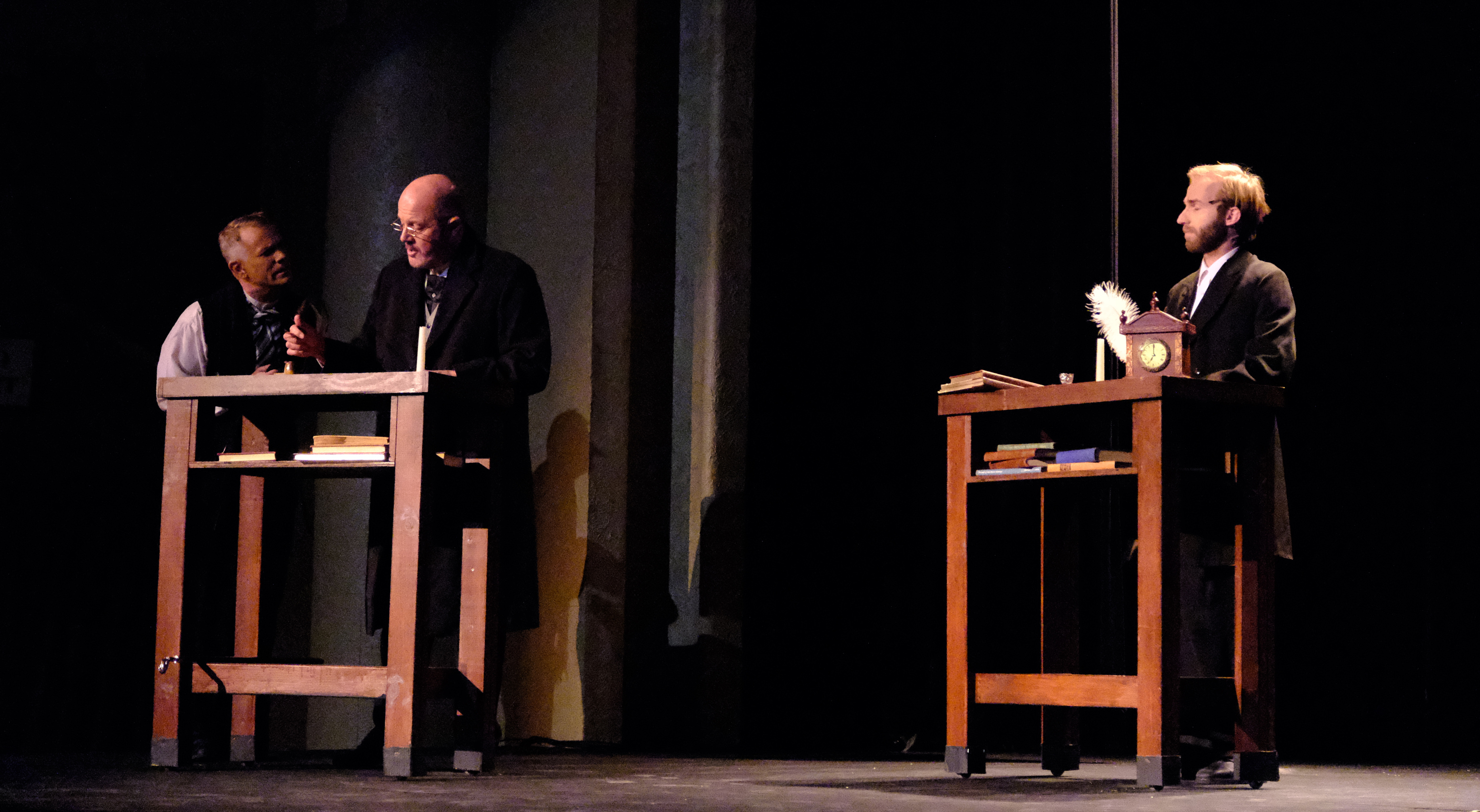
As I sat in my theater seat listening and watching, central themes began to emerge. “There’s more to life than work,” Mrs. Fezziwig (Alane Bendtsen) states as Ebenezer Scrooge faces the Ghost of Christmas Past. I thought of my husband who just that morning missed work to attend our 3-year-old grandson’s preschool party and pageant. I felt grateful for his decision. Age has a way of shifting priorities. And in this theatrical production, a story has a way of exposing regrets. Scrooge focused his life on work, on making money, on getting things and, in the end, gave up so much, including love.
I expect we have all experienced many Scrooge moments, when we stand at a crossroads and make choices that aren’t the best, that, in the end, hurt us, those we love, even strangers. Choices that are self-serving and unkind. I expect we have all turned away those in need, like Scrooge did in a brief interaction with a child caroler (Ella Boland) in a moment I found especially touching.
Sam Temple, who directed the play, notes that “through this story, Dickens sought to solidify Christmas as a season for charity, kindness, and compassion for the downtrodden.” That carries through in the unfolding plot and dialogue with a message as timely today as in 1843 when Dickens penned this story.
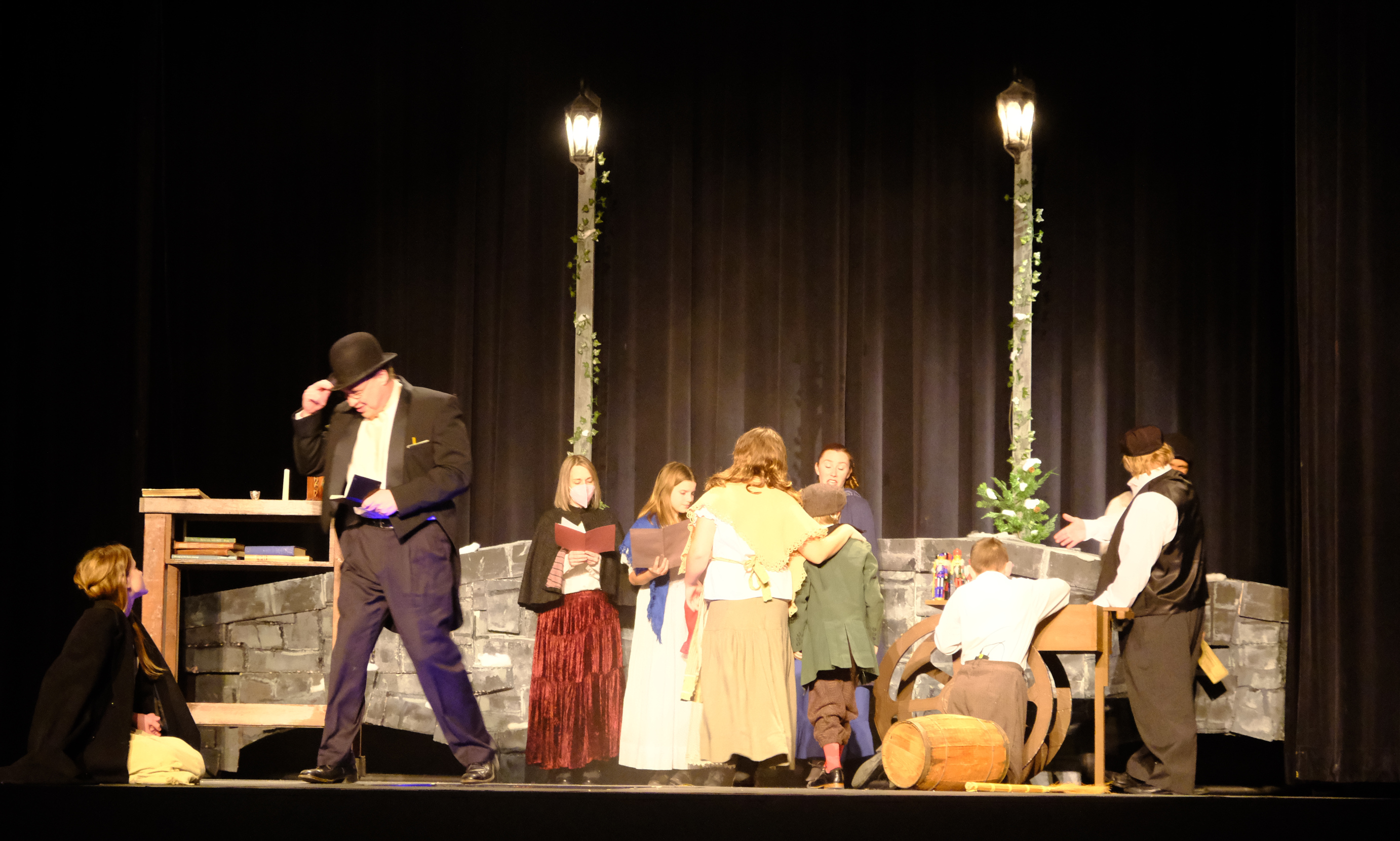
From the youngest to oldest, these 26 performers (all playing multiple roles except Steve Searl/Scrooge) pour their hearts and souls into retelling Dickens’ A Christmas Carol. I cannot imagine trying to direct a cast of this size; Sam Temple proved he was up to the task. The lines. The movement. The dancing. The costuming. The technical aspects. The music and singing—Jingle Bells, Silent Night, O Tannenbaum… The festive spirit of the season emerges. Everything comes together seamlessly.
That I came into this performance with no preconceived ideas, no comparisons to other productions, allows for an unbiased review. I sat back. Took it all in, appreciating the dramatic special effects which include the banging of chains, globes of floating light, a towering and menacing black Ghost of Christmas Yet to Come and more. I’m intentionally not revealing details. Technical Director Matthew Boyd and crew outdid themselves in creatively enhancing this theatrical version of Dickens’ Christmas classic.

I exited the theater feeling reflective and uplifted by the transformation of Scrooge from money-focused and miserly to kind, caring, compassionate. “I am not the man that I was,” he declares. He stood at a crossroads and, in the end, chose good will, kindness, love. He experienced what I would term A Christmas Awakening.
FYI: A Christmas Carol opens at 7:30 pm Friday, December 2, at the Paradise Center for the Arts along Central Avenue in historic downtown Faribault. Other 7:30 pm performances are on December 3, 8, 9 and 10. Two afternoon shows are set for Sunday, December 4 and 11 at 2 pm. If you plan to attend, I highly encourage you to reserve tickets now or you may not get a seat. Tickets are selling quickly. Click here for more info.
© Copyright 2022 Audrey Kletscher Helbling
































Recent Comments