HER POEMS SING with the rhythm of a writer closely connected to land, heritage and history. She is Gwen Nell Westerman of Mankato, Minnesota poet laureate and author of Songs, Blood Deep, published by Duluth-based Holy Cow! Press.
Of Dakota and Cherokee heritage, Westerman honors her roots with poems that reflect a deep cultural appreciation for the natural world. The water. The sky. The seasons. The earth. The birds and animals. They are all there in her writing, in language that is down-to-earth descriptive. Readers can hear the birdsong, feel the breeze, see the morning light… That she pens nature poems mostly about the land of my heart—fields and prairie—endears me even more to her poetry.
This slim volume of collected poems is divided into seasons of the year, each chapter title written in the Dakota language. The book features multiple languages—Dakota, Cherokee, Spanish and English. That adds to its depth, showing that, no matter the language we speak, write or read, we are valued.
This silo mural in downtown Mankato celebrates the cultural diversity of the region, including the Dakota. (Minnesota Prairie Roots copyrighted photo November 2023)
Westerman clearly values her Native heritage, how lessons and stories have been passed to her through generations of women, especially. Songs, blood deep. In her poem “First Song,” she shares a lesson her grandmother taught her about the importance of sharing. After reading that thought-provoking poem, I considered how much better this world would be if we all focused on the singular act of sharing.
The Dakota 38 Memorial at Reconciliation Park in downtown Mankato lists the names of the 38 Dakota men hung at this site on December 26, 1862. (Minnesota Prairie Roots copyrighted photo November 2023)
This poet, who is also a gifted textile artist (creator of quilts), wraps us in her words. In the season of waniyetu, her poetry turns more reflective and introspective, as one would expect in winter. She writes of family, injustices and more. “Song for the Generations: December 26” is particularly moving as that date in history references the mass execution of 38 Dakota sentenced to death in 1862 and hung in Mankato. Westerman writes of rising and remembering, of singing and prayer. It’s a truly honorable poem that sings of sorrow and strength.
Her poems remind us that this land of which she writes was home first to Indigenous Peoples. Westerman writes of a state park in New Ulm, the sacred Jeffers Petroglyphs and Fort Snelling, where Dakota were imprisoned after the U.S.-Dakota War of 1862 and before their exile from Minnesota. The name of our state traces to Mni Sota Makoce, Dakota for “the land where the water reflects the sky.” It’s included in Westerman’s poetry.
I appreciate poems that counter the one-sided history I was taught. I appreciate Westerman’s style of writing that is gentle, yet strong, in spirit. Truthful in a way that feels forgiving and healing.
In the all of these poems, I read refrains of gratitude for the natural world, gratitude for heritage and gratitude for this place we share. We sang. We sing. Songs, blood deep.
FYI: Songs, Blood Deep, is a nominee for the 2024 Minnesota Book Award in poetry. The winner will be announced May 7. This is Westerman’s second poetry book. Her first: Follow the Blackbirds. In addition to writing poetry and creating quilts, Westerman teaches English, Humanities and Creative Writing at Minnesota State University, Mankato.
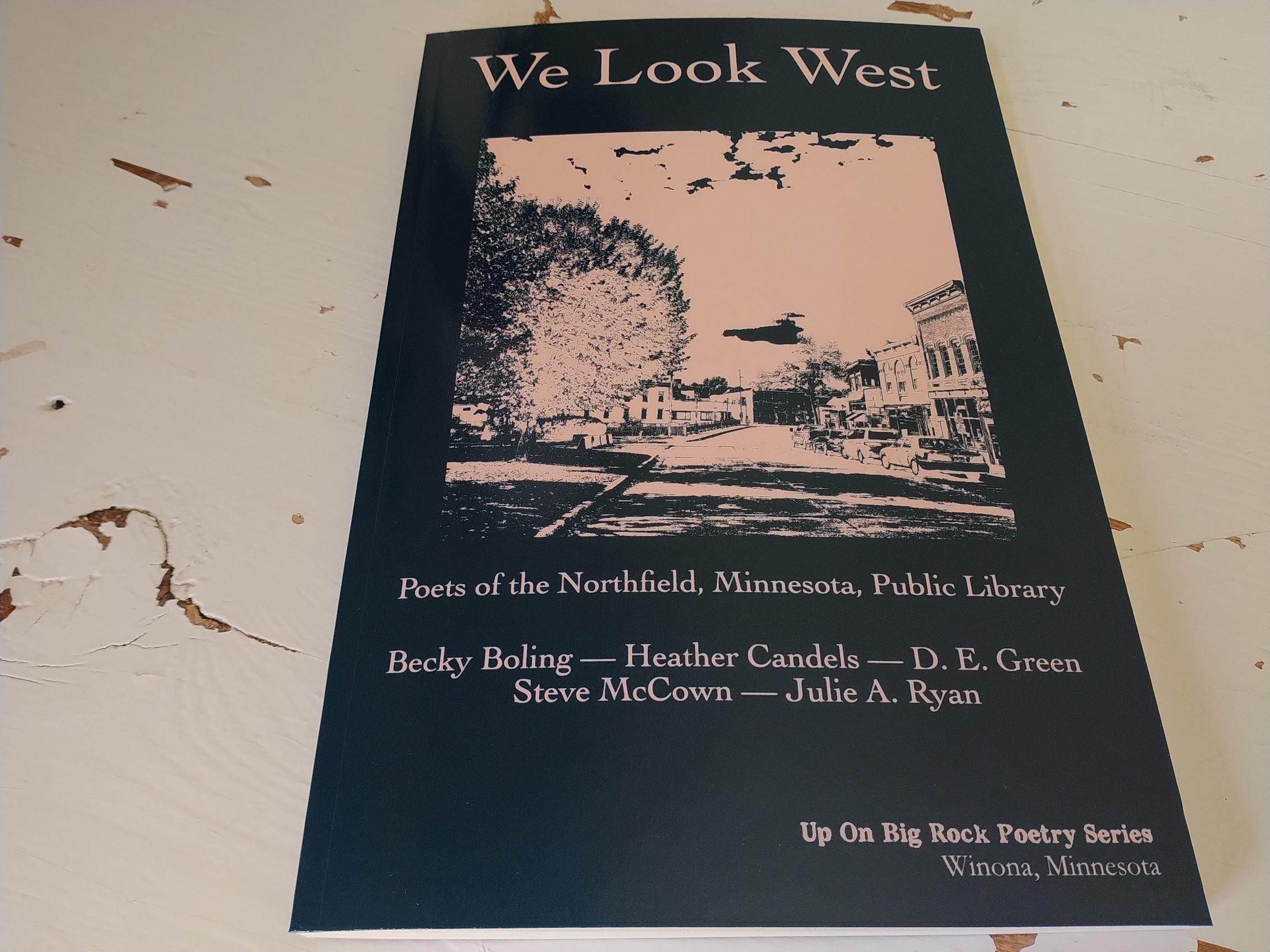
Just-published, a 116-page anthology featuring the poetry of five Northfield, Minnesota, poets. (Minnesota Prairie Roots copyrighted photo April 2024)
ON AN APRIL AFTERNOON when gray skies reverberated thunder and unleashed sheets of rain upon parched southern Minnesota, I read their words, table-side lamp pooling light onto pages. It felt right, to cozy under a fleece throw, to immerse myself in the poetry of Becky Boling, Heather Candels, D.E. Green, Steve McCown and Julie A. Ryan on a day meant for sheltering indoors.
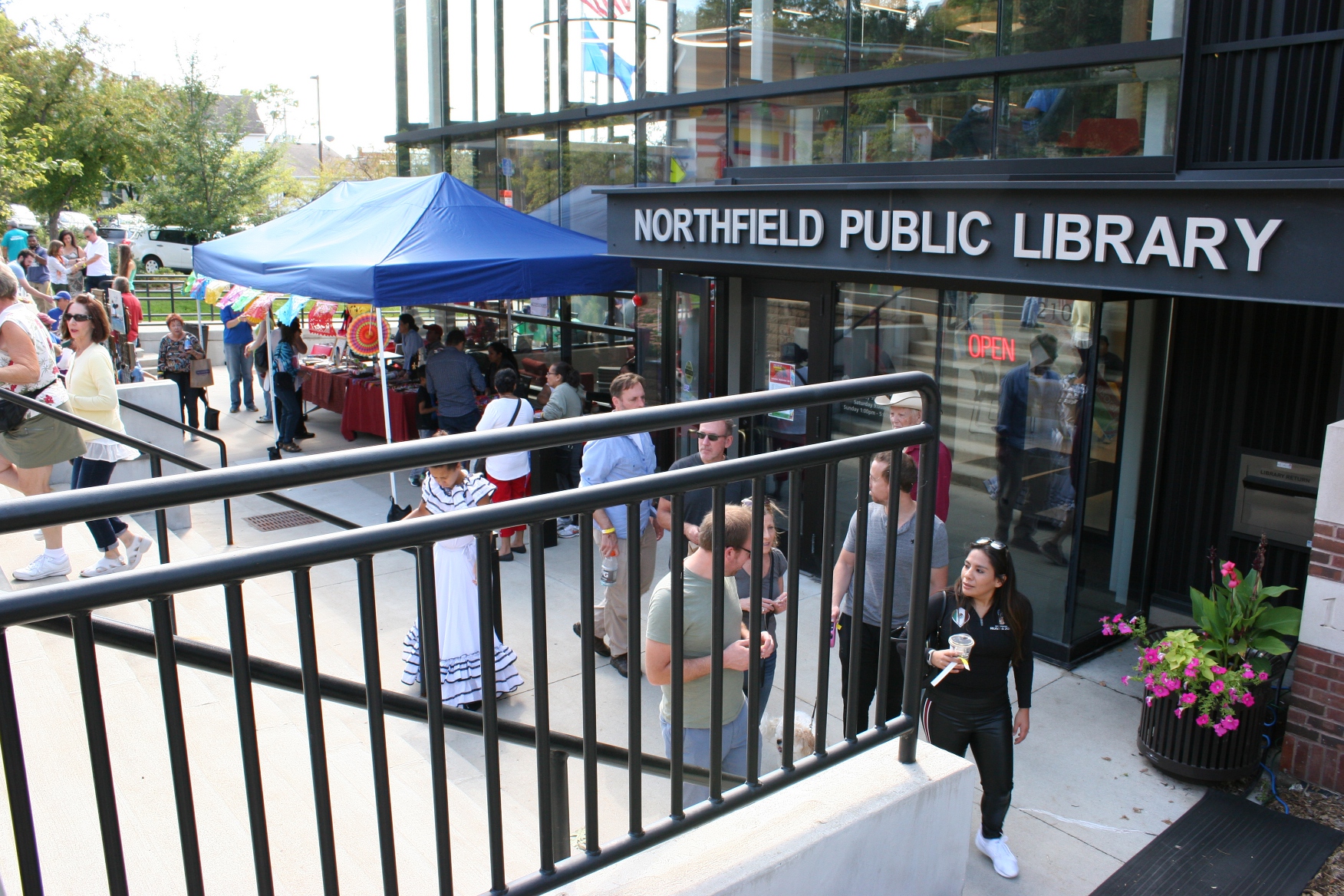
Outside the Northfield Public Library during a 2019 celebration of Hispanic Heritage Month. (Minnesota Prairie Roots copyrighted file photo September 2019)
Antiques on 4th in Cannon Falls. (Minnesota Prairie Roots copyrighted file photo October 2021)
Youthful memories of grandmothers, homemade ice cream, small towns as they once were and much more flow through the pages. At times I feel as if I’m reading about “the dusty excess of nostalgia” of my life, as Steve McCown writes “In an Antique Store.” His mention of a Tom Thumb toy cash register sends me back to a long ago Christmas. His poems are sparse, yet fully-descriptive in the way of language carefully-culled by a man who taught high school and college English.
An Elvis impersonator performs during Bean Hole Days in Pequot Lakes. (Minnesota Prairie Roots copyrighted file photo July 2021)
Likewise, Julie A. Ryan, has me reminiscing with “Candy Cigarettes,” the chalky white sticks of fake cigarettes that I, too, “smoked” in the 1960s. Ryan paints with her words, revealing the visual artist side of her creativity. She mentions Van Gogh and painting and also leans into music within her poetry. Especially powerful is her poem, “’68 Comeback Special,” in which she shares about a near-death experience, of almost meeting Elvis. Her final poem, “We Look West,” titles the book, summarizing well the transition of life from sunrise/birth to sunset/death. That themes the anthology, the movement of life from east to west.
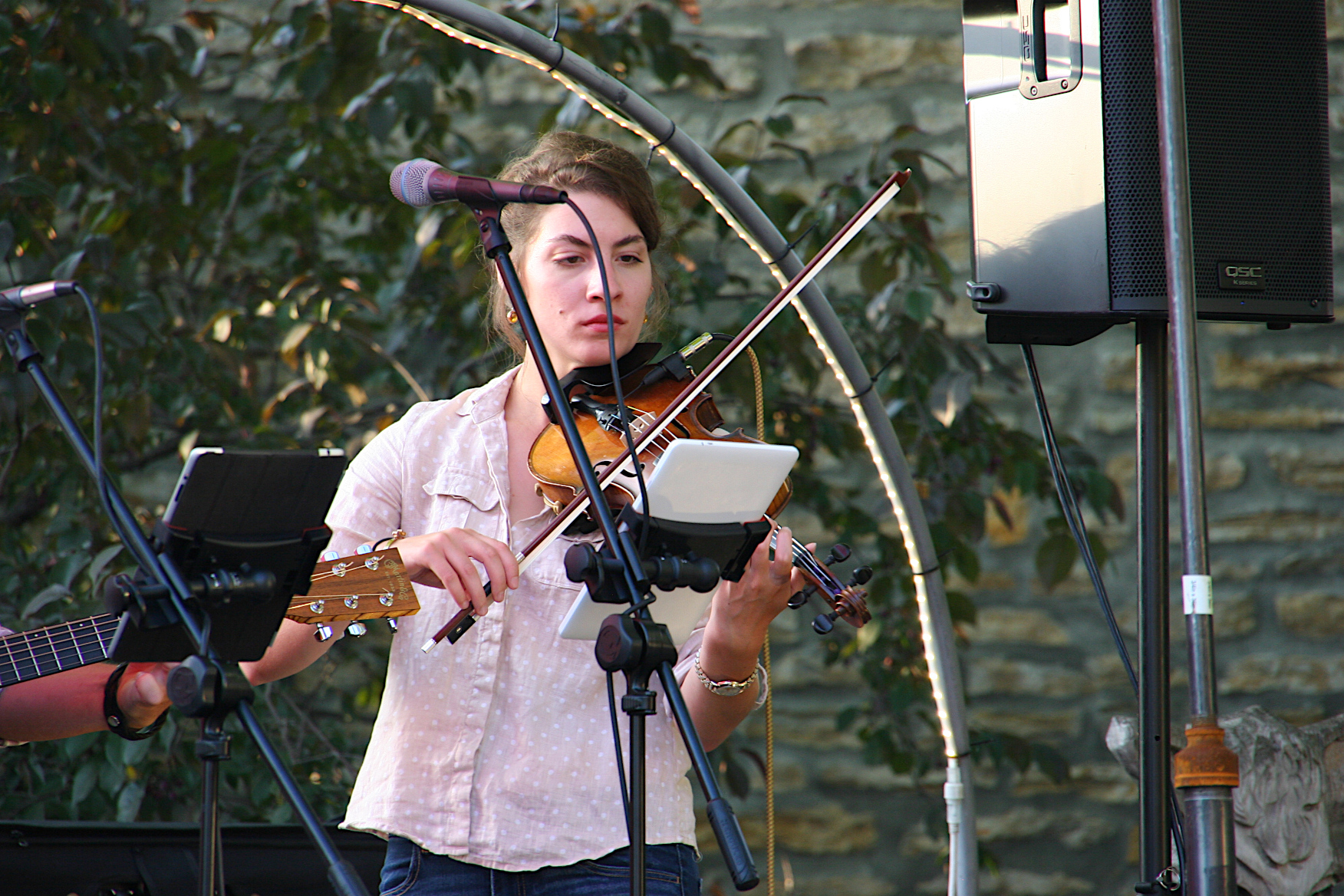
Performing at The Contented Cow in downtown Northfield. (Minnesota Prairie Roots copyrighted file photo August 2020)
In her poetry, Becky Boling moves readers through life from playground monkey bars to motherhood to contemplating old age. I am particularly drawn to “Violin Lesson,” in which Boling observes her young son learning to play the violin. From a deep cushioned armchair, she is caught up in the artistry, the beauty, the movement as am I through her observational writing. And then she closes with the emotional thought of not wanting the moment to end, of understanding that some day she will let her son go. As the mother of three, I feel her sadness at the lesson completed. I expect in her 36 years of teaching Spanish and Liberal Arts at Carleton College in Northfield, Boling has observed the movement of young people whose parents let them go to learn and grow their independence.
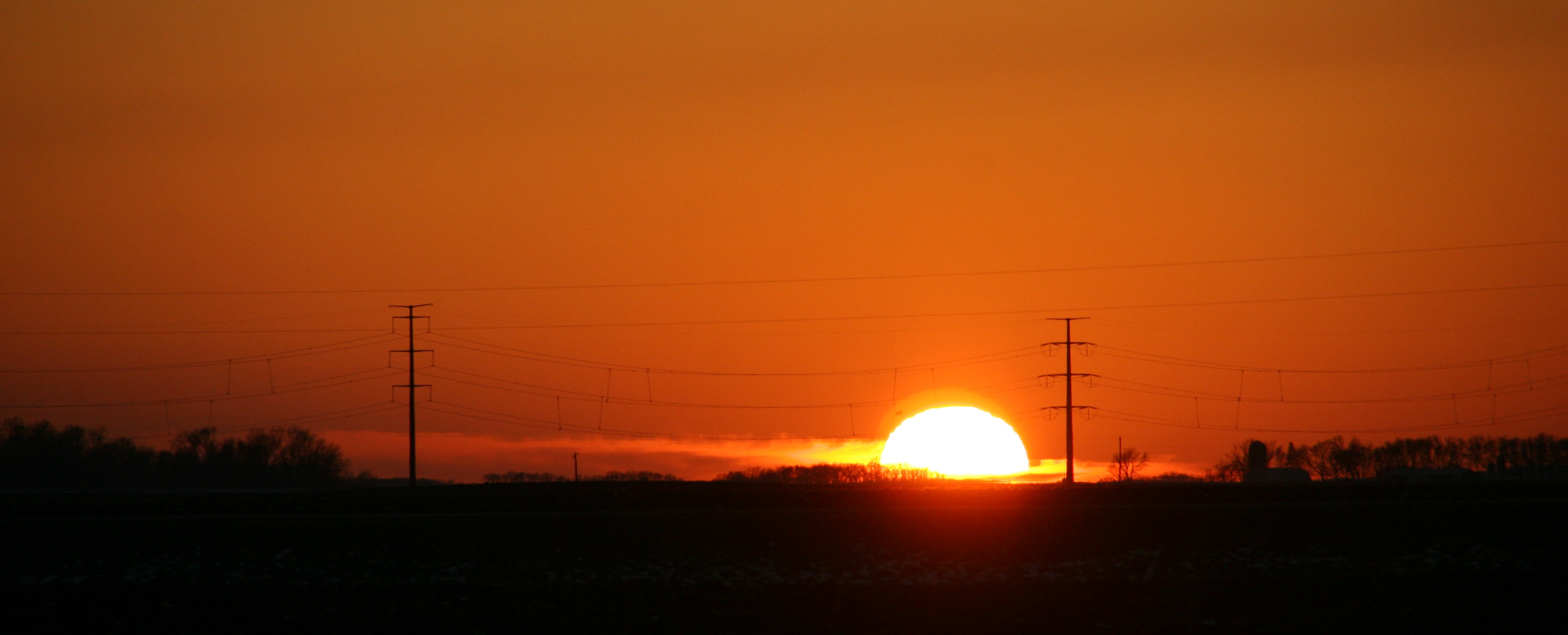
A southwestern Minnesota prairie sunset between Redwood Falls and Morgan. (Minnesota Prairie Roots copyrighted file photo)
D.E. Green, who taught English for 33 years at Augsburg University, has likely seen the same. His poems reflect life and love. Particularly endearing is his poem, “For Becky: Love Sonnet after Neruda,” written for Boling, to whom he’s married. (They also share the position of interim co-poet laureates in Northfield.) His appreciation for and study of Shakespeare show in this love poem, as touching as any love poem I’ve read. “I love you unthinkingly/like a deep breath, a careless yawn, a sigh,” he writes. Beautiful. Green also reflects on his life lived “good enough” and on life during retirement. His poetry should be required reading for anyone closer to west than to east.
My mom lived in a care center, confined to a wheelchair in the end years of her life. I took this photo of her hands about a year before her January 2022 death. (Minnesota Prairie Roots copyrighted file photo December 2020)
Heather Candels, too, reflects on her passing life in a poem aptly titled “Passing.” But it is “Situation Comedy,” a poem about a 104-year-old woman living in a care center, which elicits an especially emotional reaction from me. I can picture the centenarian shoving her walker (as my octogenarian mom did) to the dining room, then sitting with Grace and Lloyd, whom she secretly calls Grease and Lard. “Something has to be funny about all this,” Candels writes. The former English teacher is a gifted storyteller who brings unexpected emotional lines to her writing.
In “A Sign,” Heather Candels writes about racial injustice via white lilies of the valley and “their colonies spreading underground/roots nurtured by the rich dark soil…” This poem alone is reason enough to buy this anthology. Photo taken in Madison, Wisconsin. (Minnesota Prairie Roots copyrighted file photo September 2020)
And then there are the poems that touch on tough topics, on social issues, on disparities. Climate change. Evidence in the Nuremberg Trials. Racial injustice. Poetry doesn’t right life. But it opens our minds, causes us to think, reflect, perhaps take positive action as we move from east to west.
Mention poetry and many people likely stop listening. In a way, I understand. To their ears, they hear the stuffy, rhyming, difficult poems of yesteryear. The poems that made no sense to many of us. The poems that had to be read as part of a high school English class.
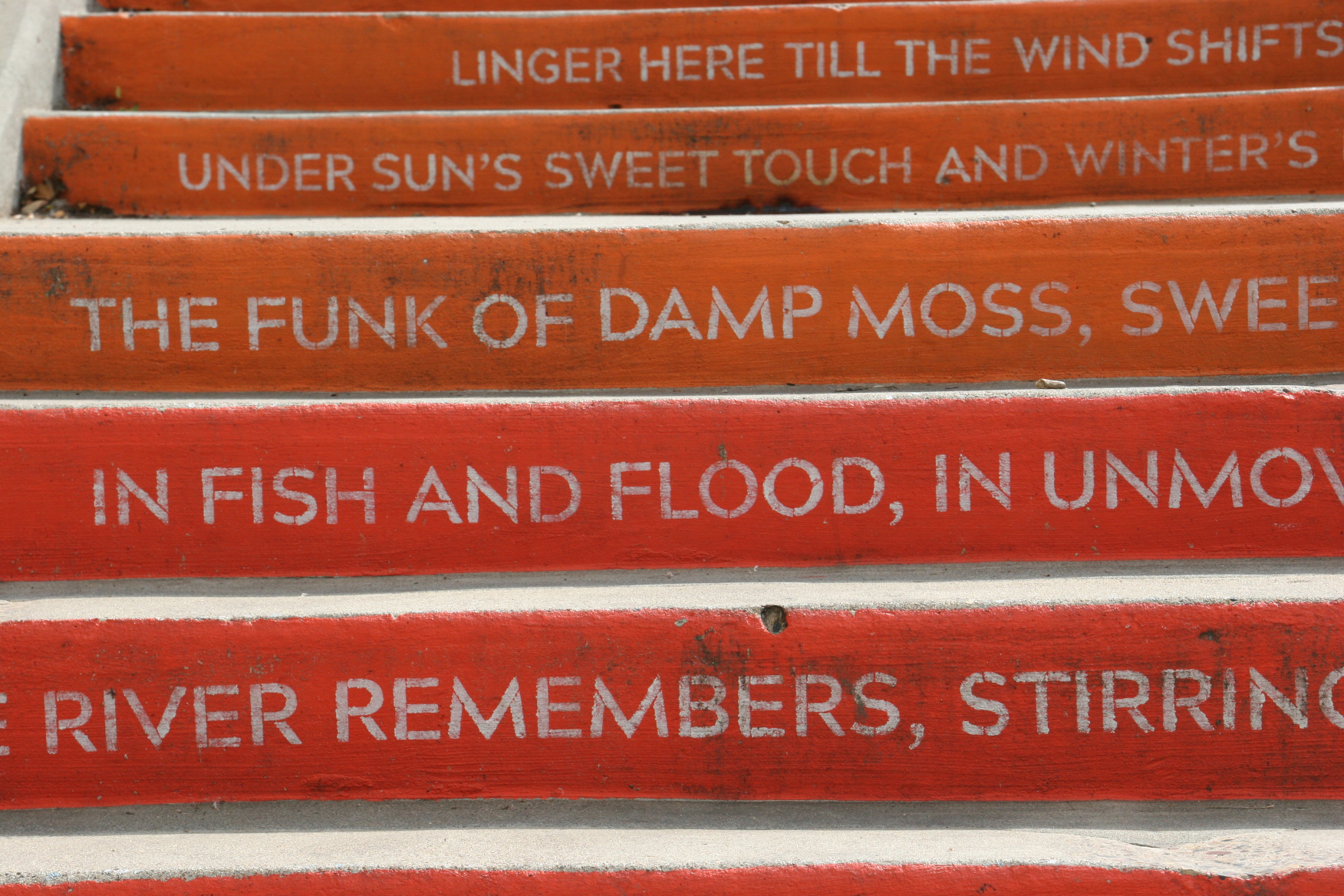
A close-up of lines in the poem steps along the River Walk in downtown Northfield. (Minnesota Prairie Roots copyrighted file photo 2022)
While I’m not privy to how poetry is taught today, I do recognize that it’s, overall, much more approachable, at least in Minnesota. We are home to a talented array of poets with their writing published not only in anthologies and literary journals, but also presented in widely-accessible, public ways.
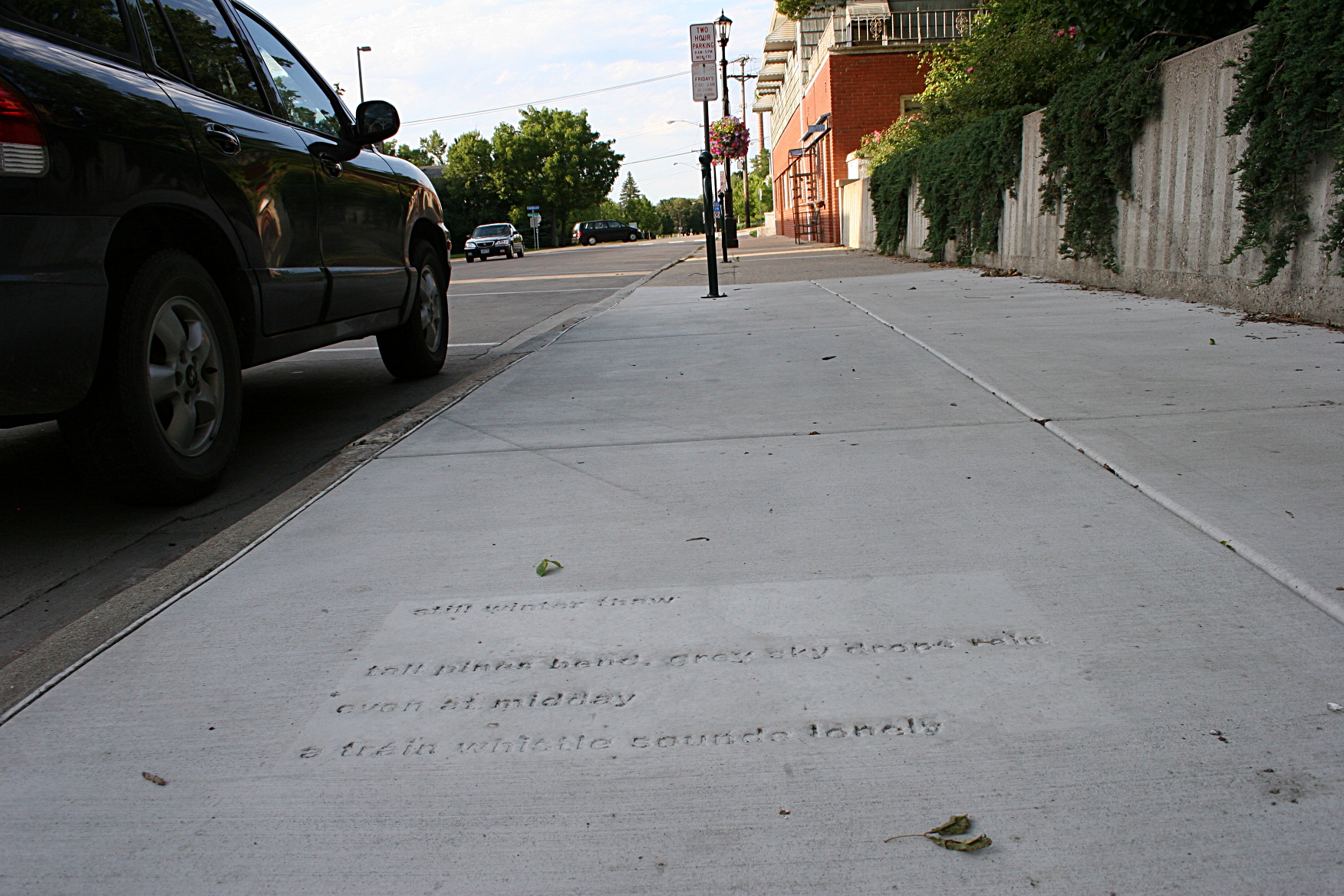
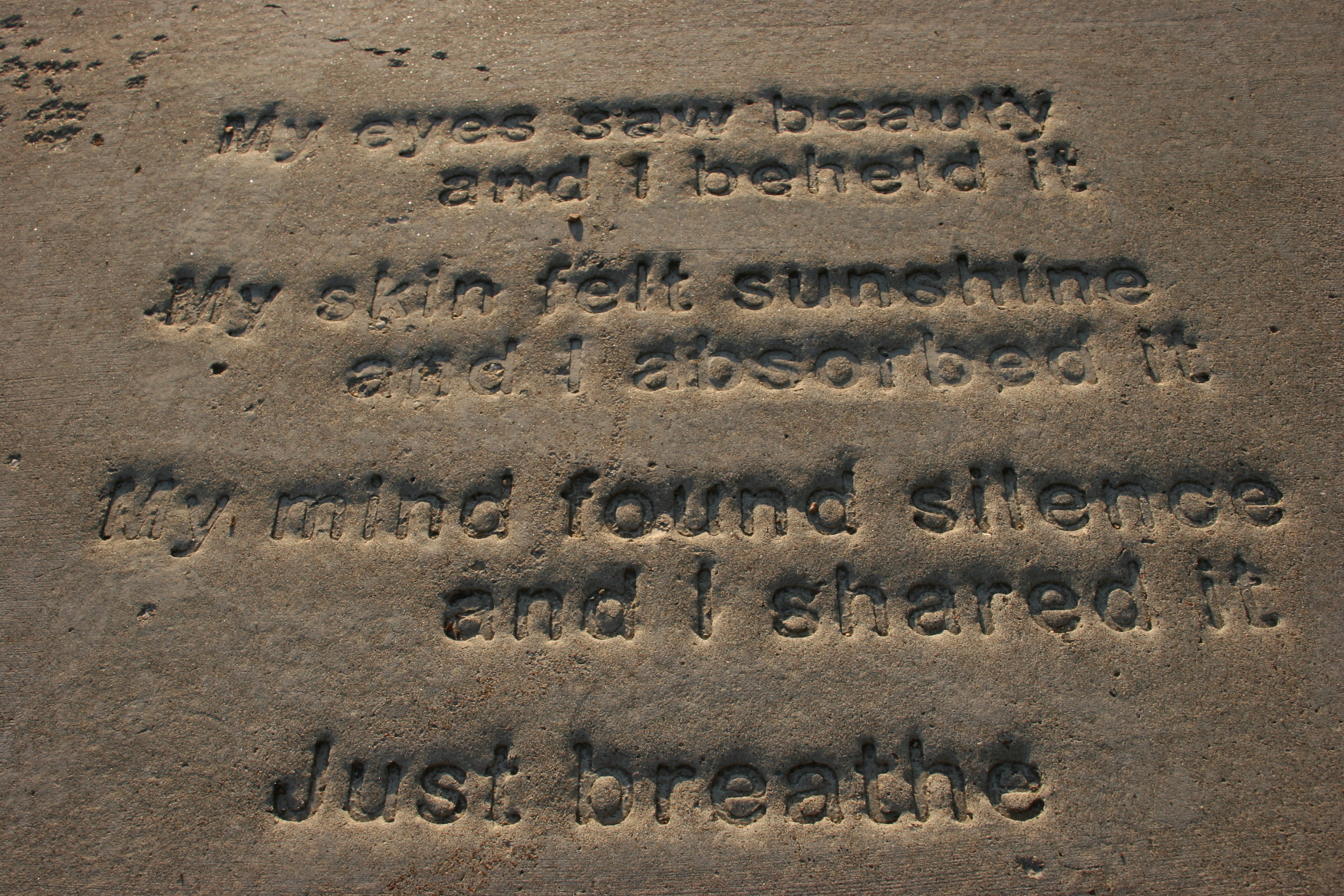
A poem by Patrick Ganey is stamped into the sidewalk near the Northfield Public Library: still winter thaw/tall pines bend, grey sky drops rain/even at midday/a train whistle sounds lonely (Minnesota Prairie Roots copyrighted file photo)
Nearby Northfield, for example, prints poetry into sidewalks. In 2011, the Arts and Culture Commission launched Sidewalk Poetry. Through that annual competition, selected poems are stamped into sidewalks in the historic downtown, along routes to schools and in residential neighborhoods. I always enjoy walking in downtown Northfield and pausing to read poetry. As a poet myself, I appreciate how much this community values this literary art.
This month, National Poetry Month, and into May, Northfield-based nonprofit Rice County Neighbors United is offering “Poem in a Bag.” Submitted original and favorite poems were printed, rolled and placed in poetry boxes (not bags) set out at select Northfield businesses and at the Northfield Public Library. Poems are printed in both English and Spanish and paired with original art by local artists. What a fun idea, to give away poems, perhaps reaching people who would not otherwise read poetry. I’ve submitted several poems for this project.
My poem, “Lilacs,” inspired “Lilacs on a Table,” an oil on linen painting by Jeanne Licari. This was part of an poet-artist collaborative exhibit at Crossings at Carnegie in Zumbrota ten years ago. Today my poem is part of Northfield’s “Poem in a Bag.” (Minnesota Prairie Roots copyrighted file photo April 2014)
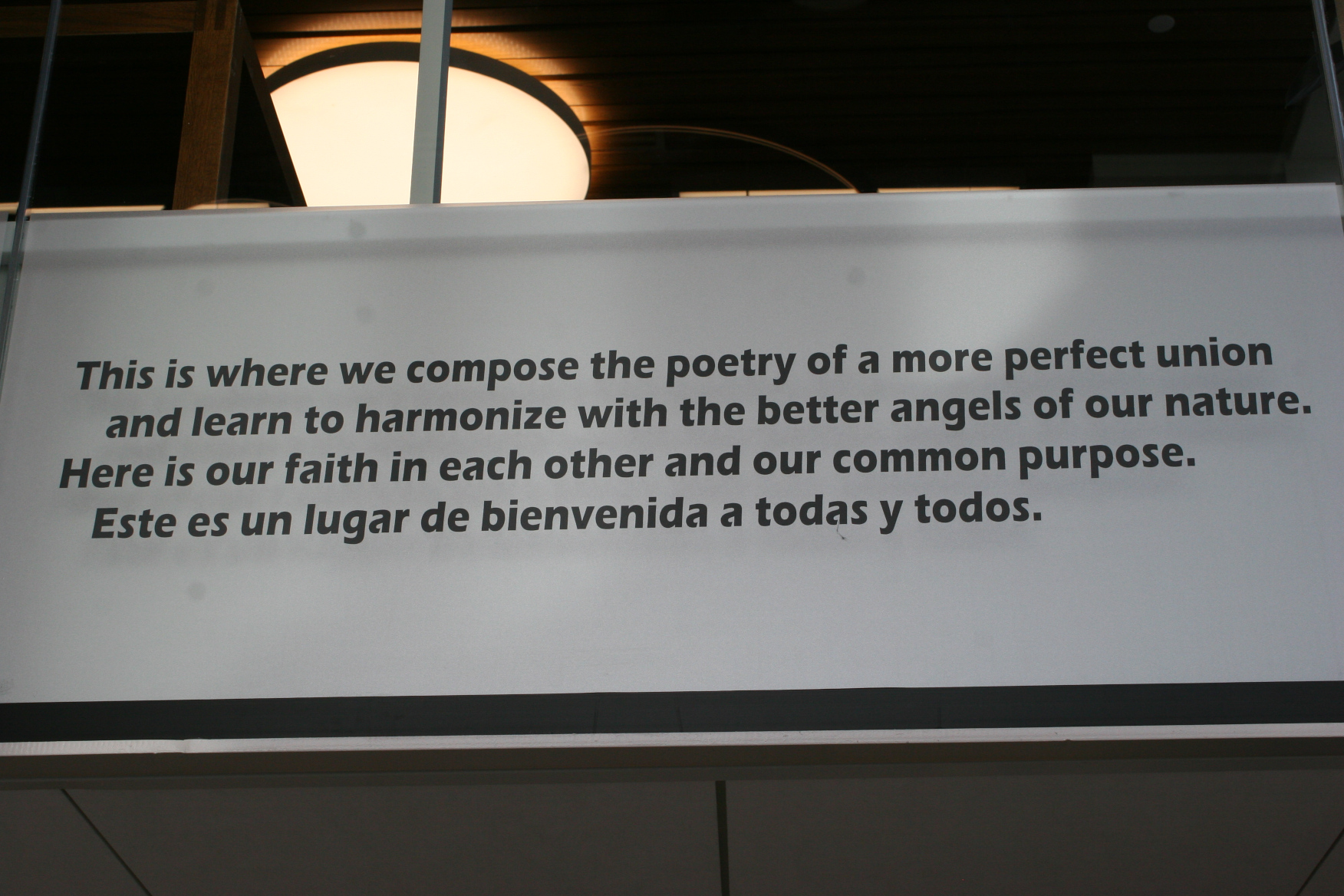
A portion of a poem by Rob Hardy, former Northfield Poet laureate, in the Northfield Library atrium. (Minnesota Prairie Roots copyrighted file photo)
At the Northfield Public Library, Open Mic Poetry is held monthly in the atrium for poets to share their writing with an appreciative audience. The next event is at 6:30 pm Wednesday, May 8.
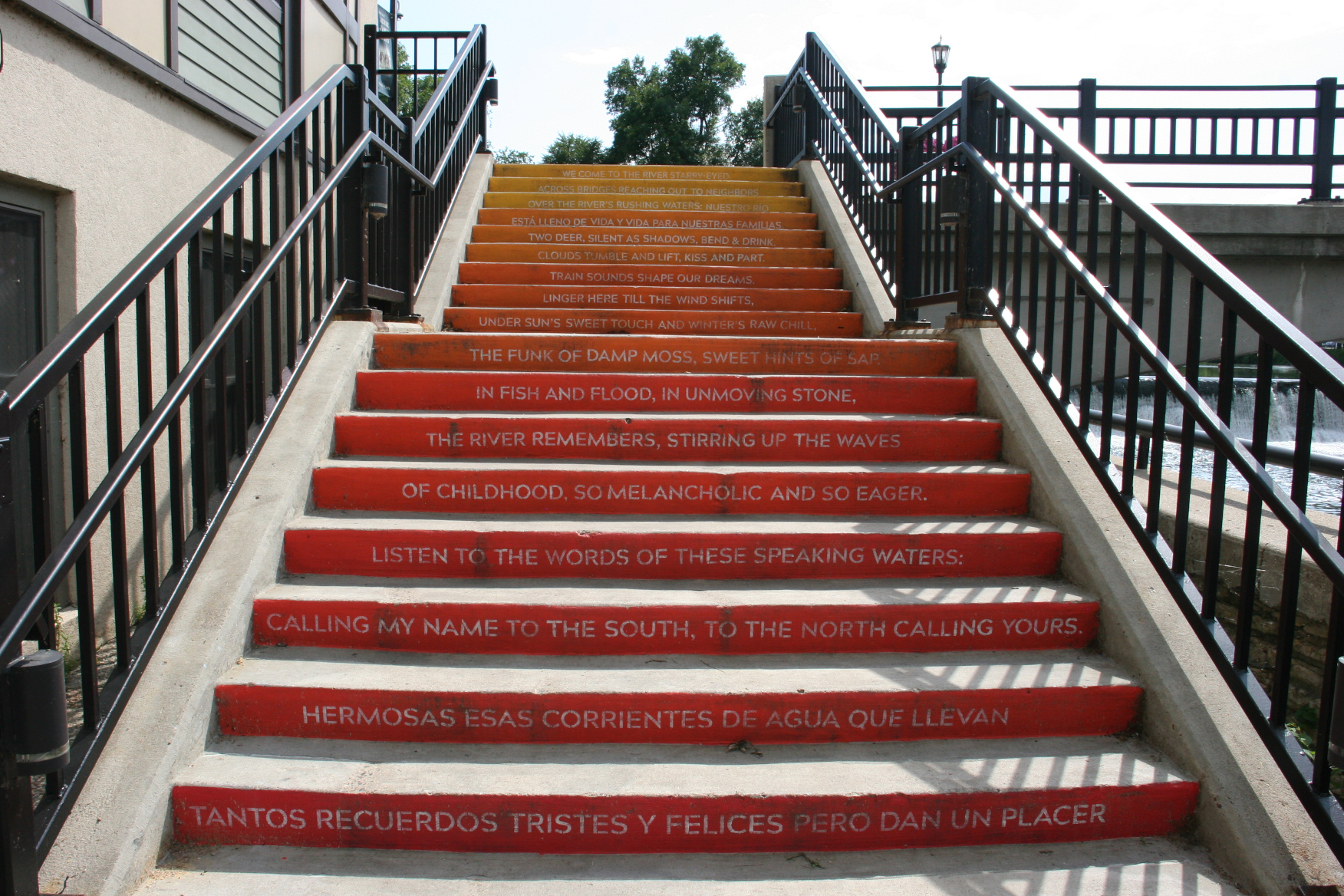
Poem steps in Northfield along the River Walk. (Minnesota Prairie Roots copyrighted file photo 2022)
Northfield also has a poet laureate actively promoting poetry and poetry events within the community. A new laureate will soon be named to replace past laureate Rob Hardy and current interim co-poet laureates Becky Boling and D.E. Green.
This new anthology features the poetry of five Northfield poets. (Minnesota Prairie Roots copyrighted photo April 2024)
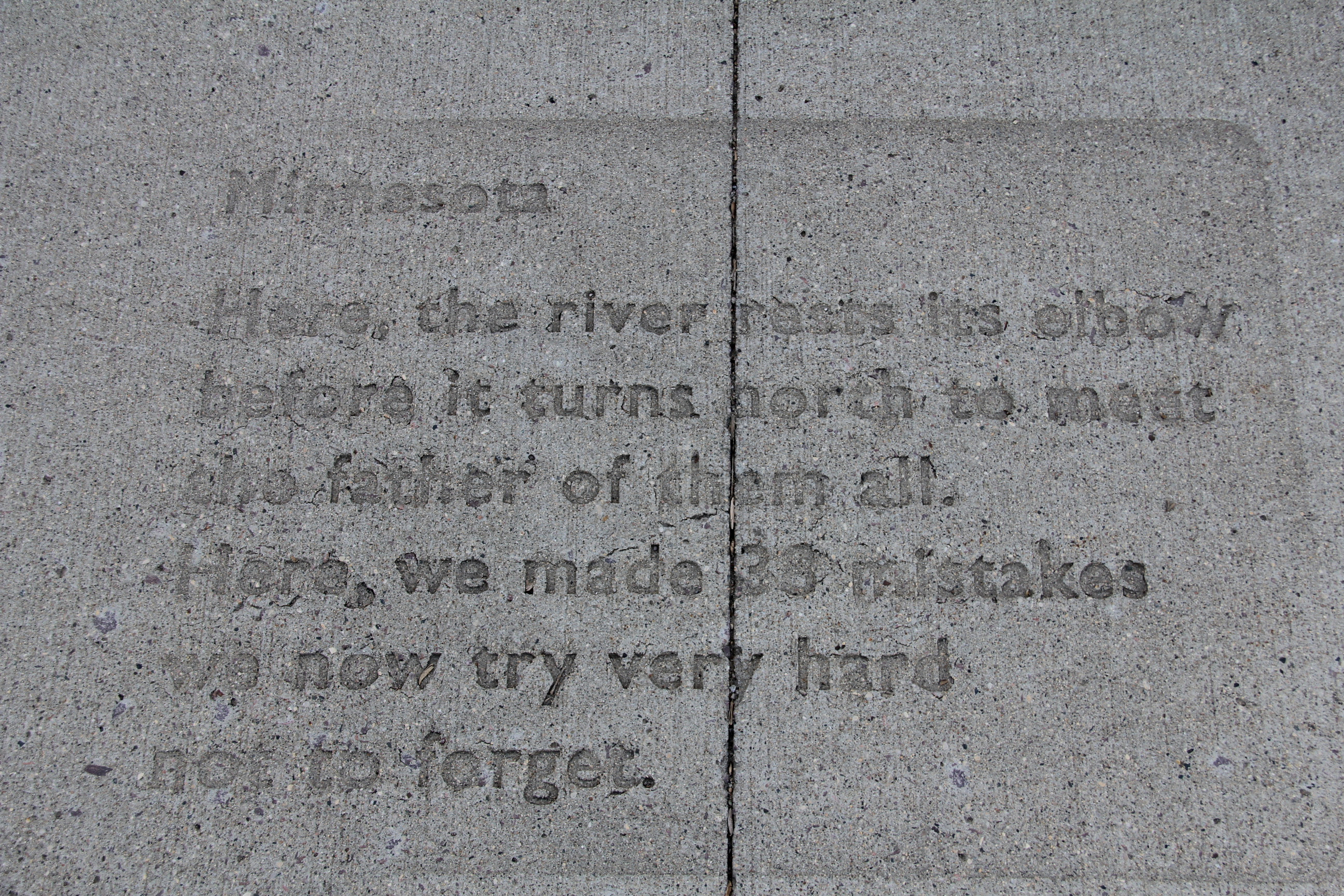
This sidewalk poem in Mankato’s Riverfront Park references the mass hanging of 38 Dakota (plus two) in December 1862 in Mankato. (Minnesota Prairie Roots copyrighted file photo November 2023)
I also have two other recently-released poetry books to read: Broad Wings, Long Legs, A Rookery of Heron Poems in which Minnesota writers (including Larry Gavin of Faribault and many other recognizable poets) contemplate a regional icon, and Songs, Blood Deep by Poet Laureate of Minnesota, Gwen Nell Westerman of Mankato. Westerman is Minnesota’s first Native poet laureate and teaches English, humanities and creative writing at Minnesota State University, Mankato, my alma mater.
My poem, posted along the West Mankato Trail. (Minnesota Prairie Roots edited & copyrighted photo November 2023)
Mankato is a community rich in poetry. I’ve found poems stamped into concrete at Riverfront Park as part of WordWalk. But it’s a project of the Southern MN Poets Society which really puts poetry out in the community. Through the Mankato Poetry Walk & Ride, winning poems are printed on signs and posted along walking and biking trails in Mankato and North Mankato. My poems have been included perhaps half a dozen times—I’ve lost count—with one, “The Mighty Tatanka,” a poem about bison, currently displayed along a trail in West Mankato.
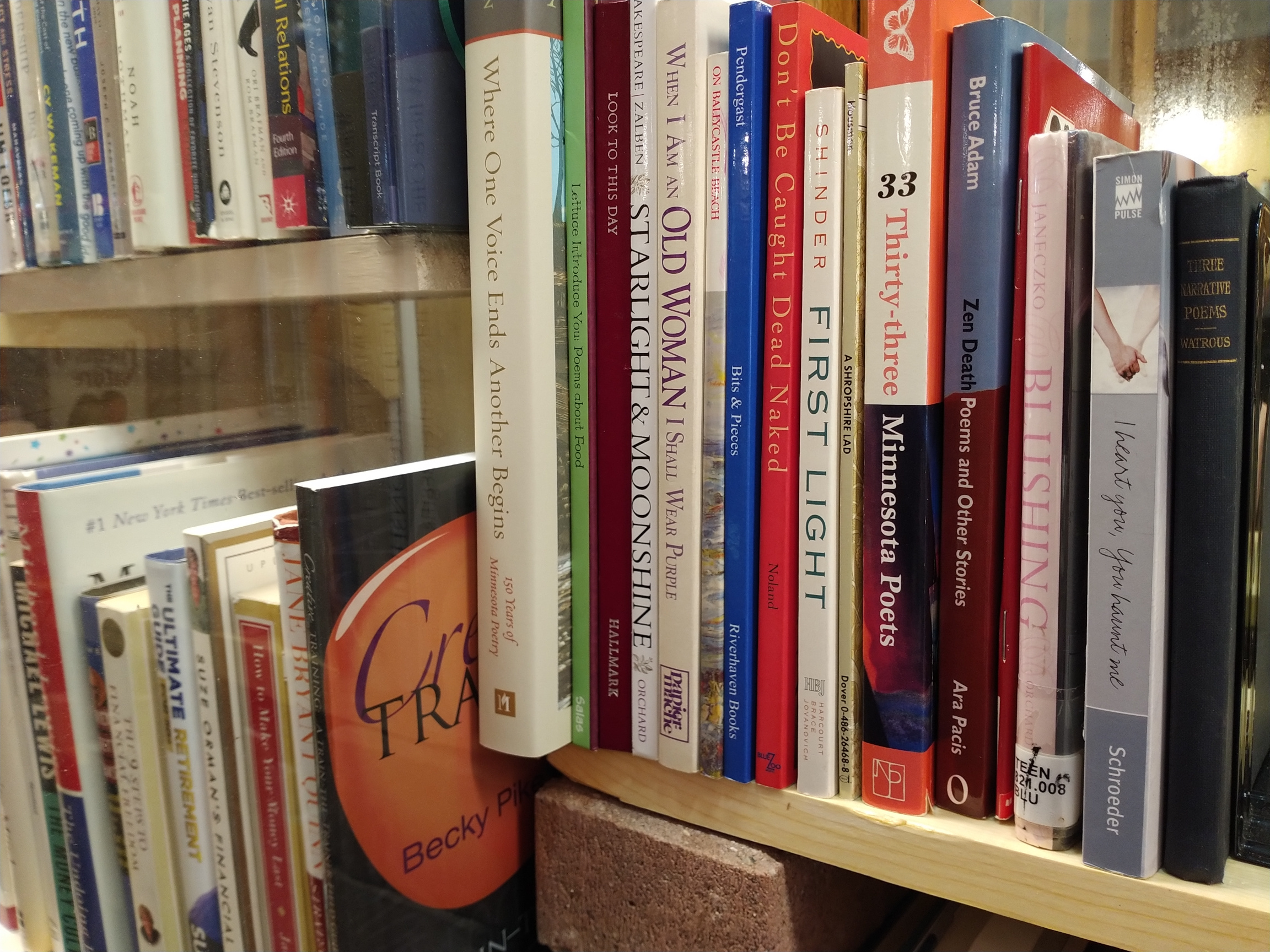
A sampling of poetry books, right, for sale at Books on Central in Faribault. (Minnesota Prairie Roots copyrighted photo April 2024)
Poetry is seemingly everywhere these days, unconfined to the space between book covers. Yet poems printed upon paper remain the primary place to find poetry. I recently picked up a stash of poetry books from my local library. I also perused poetry offerings at Books on Central, a Rice County Area United Way bookshop selling used books in downtown Faribault. In Northfield, independent bookseller Content Bookstore not only sells poetry books, but regularly hosts book signing events with writers, including poets.
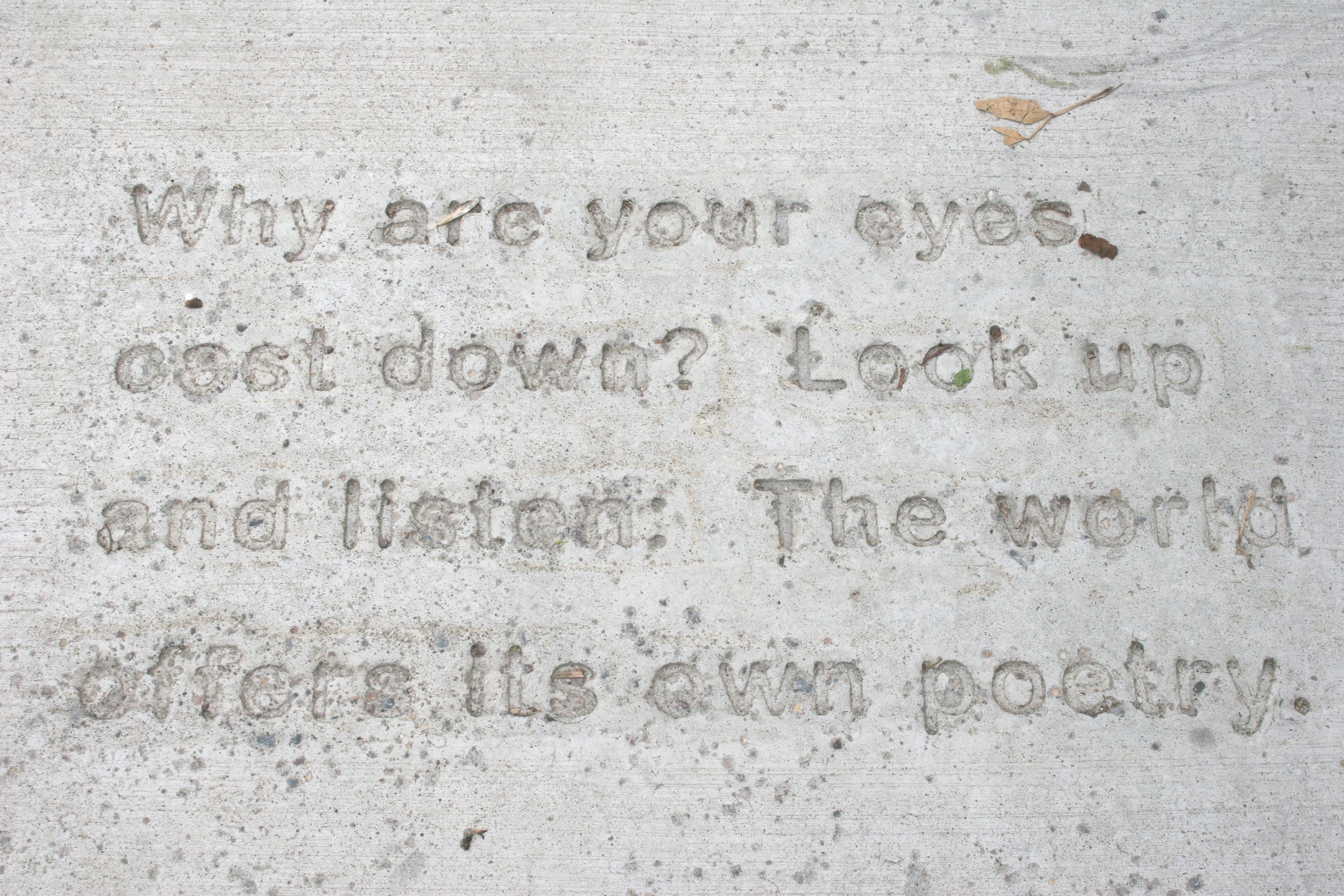
An especially thought-provoking poem in Northfield’s Sidewalk Poetry project. (Minnesota Prairie Roots copyrighted file photo August 2020)
How we access poetry has certainly changed over the years. It is my hope that, even if you think you don’t like poetry, you open your mind to this creative art form. There’s much to be learned about nature, about ourselves, about life through the carefully-selected, sparse words of gifted poets, many of whom call Minnesota home.
FYI: Please check back for a more in-depth look at “Poem in a Bag” and reviews of poetry anthologies referenced in this post. Now, tell me, do you read poetry, have a favorite poem?
The restored Security State Bank Building clock in historic downtown Faribault. (Minnesota Prairie Roots copyrighted file photo)
TIME, WHEN YOU’RE YOUNG, seems to pass slowly. You’re waiting, always waiting. To turn another year older. To master a skill. To gain independence. To do whatever seems so important you wonder how you can possibly wait for another day or week or month to pass.
Now I wish time would slow down. But it can’t and it won’t and so I accept the reality of time passing, of aging, of days disappearing too quickly. Of celebrating my 50-year high school class reunion this year. Of my youngest turning thirty. Of me nudging seventy.
A street clock in historic downtown Wabasha. (Minnesota Prairie Roots copyrighted file photo)
In a recent conversation with a beloved aunt, she shared that she can’t believe how old her nieces and nephews are, considering she’s only twenty-nine. I love that about Aunt Dorothy, who has always and forever declared herself on the cusp of thirty while in reality she’s closing in on ninety. I like her thinking.
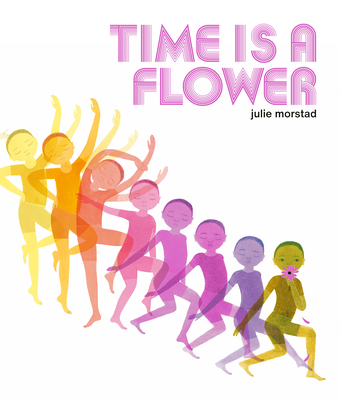
(Book cover sourced online)
By happenstance, I picked up a children’s picture book at my local library a few weeks ago that focuses on time. I’m not trying to go back in time to my childhood. Rather, I enjoy books written for kids. Many hold important messages and beautiful art that resonate with me. I highly-recommend you check out recently-published children’s picture books to see how they’ve evolved over the decades into some timely masterpieces of words and art.
Among the books I selected was Time Is a Flower, written and illustrated by Julie Morstad of Vancouver, British Columbia. In her opening page, Morstad writes of time as a clock, as a calendar, in the traditional ways we consider time.
A prairie sunset in southwestern Minnesota. (Minnesota Prairie Roots copyrighted file photo)
But then the book unfolds, page by page, into time comparisons that are simplistic, everyday, ordinary, unremarkable. Yet remarkable in the way Morstad presents them with sparse words and bold art. If I could rip the pages from her book, I would frame her illustrations of a sunset reflected in sunglasses; a child’s long wavy locks woven with bird, butterfly and flower; and a wiggly tooth in a gaping mouth.
A swallowtail butterfly feeds on a zinnia. (Minnesota Prairie Roots copyrighted file photo)
Time is the moments, the memories. The details. Not necessarily the extraordinary. That is the message I take from Morstad’s book. Appreciate the caterpillar, not just the butterfly. Appreciate the seed, not just the flower. Value the slant of sunlight across the floor, and the shadows, too.
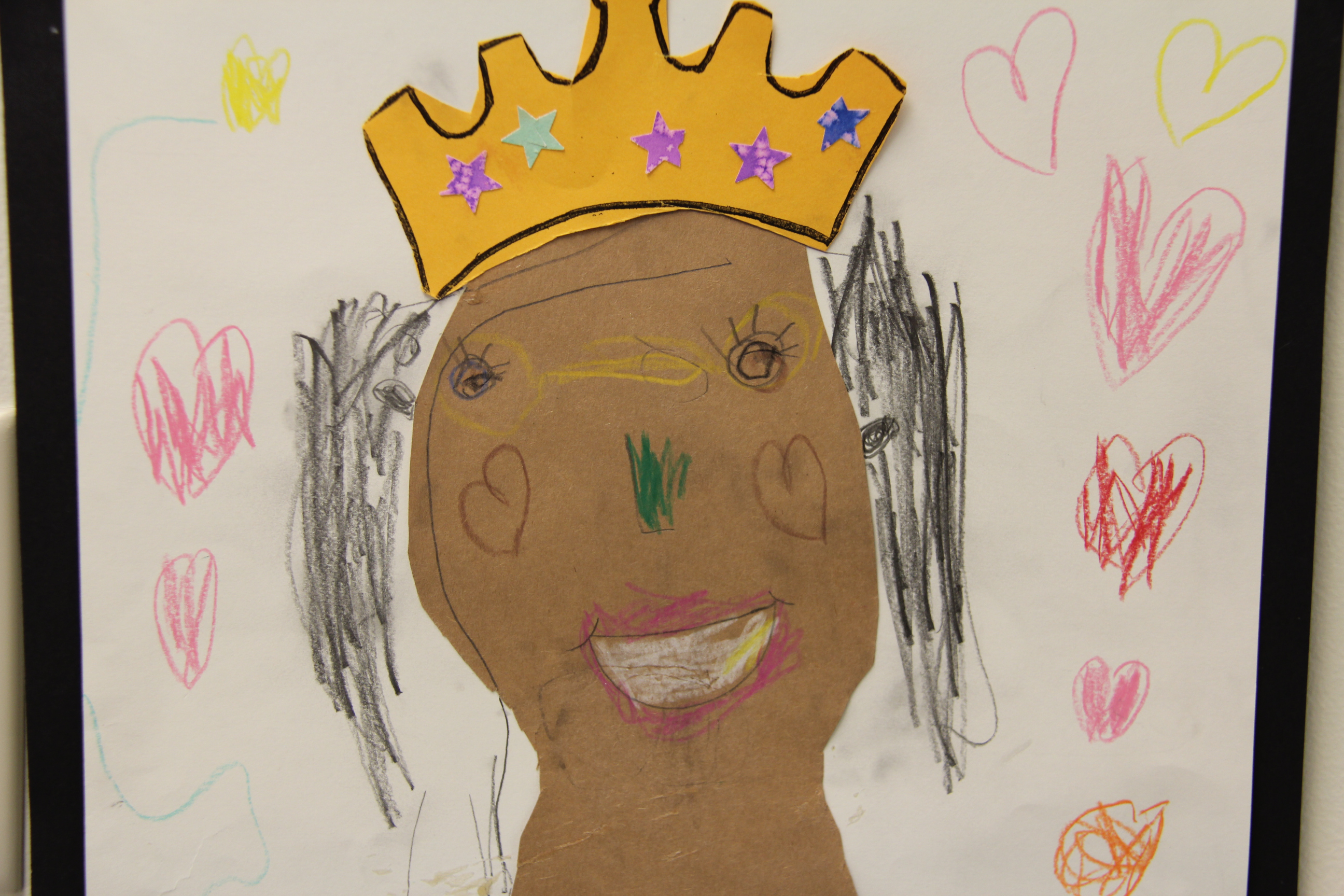
A princess by Roosevelt Elementary School kindergartner Ruweyda, exhibited in March 2023 at the Student Art Show, Paradise Center for the Arts, Faribault. (Minnesota Prairie Roots copyrighted file photo)
As I consider Time Is a Flower, I think of my dear aunt half a country away in New Jersey. Too many years have passed since I’ve seen Aunt Dorothy, so long that I can’t recall the last time we embraced. But I hold memories of her, of our time together. She was the young aunt who arrived from the Twin Cities with discarded jewelry and nail polish for me and my sisters. She was the aunt who called her husband, “My Love,” an endearing name that imprinted upon me her deep love for Uncle Robin (who died in January). She is the aunt who took me into New York City when I was a junior in college visiting her on spring break. She is the aunt who, for my entire life, has called me “My Little Princess.”
A 1950s scene in downtown Faribault honors history and the passage of time in this mural. (Minnesota Prairie Roots copyrighted file photo)
Yes, time passes too quickly. The clock ticks. Days on the calendar advance. Years pass.
Each spring the daffodils bloom. (Minnesota Prairie Roots copyrighted file photo)
But within each day, seconds and minutes and hours remain. Time to live. Time to love. And time to remember that time is like a flower. Sprouting. Growing. Blooming. Dying. Time is a moment, until it’s a memory.
Most people no longer wear wrist watches. I still do. (Minnesota Prairie Roots copyrighted file photo)
NOTE: Remember, this Sunday, March 10, time changes as we shift to daylight savings time in the U.S. We lose an hour of time as we spring forward.
I CAN’T IMAGINE a world without books. From the time I was first read to and then learned to read as a young child, I have loved books. From books, I’ve learned, I’ve escaped, I’ve broadened my world well beyond southern Minnesota.
From reading the writing of others, I’ve grown, too, as a writer. Laura Ingalls Wilder, in her Little House books, taught me the importance of detail, of setting, in writing. I grew up on the prairie, some 20 miles from Walnut Grove, once home to the Ingalls family. A grade school teacher read the entire Little House series to me and my classmates. Books have, in many ways, shaped me.
Book cover image sourced online.
But imagine a world without books. That was a reality for slaves in America, denied access to books and to education. I just finished reading Kin: Rooted in Hope, written by Carole Boston Weatherford and illustrated by her son, Jeffery Boston Weatherford. The young adult book, published by Atheneum Books for Young Readers, was named a Coretta Scott King Author Honor Book 2024. It is a book that ought to be read by everyone not only for its insightful poetry-style storytelling, but also for its haunting scratchboard art.
Looking down on the pages of the book with a mix of black and white paper. (Minnesota Prairie Roots copyrighted photo February 2024)
Adding to the overall subliminal effect is the way in which the book is printed. Black words ink white paper. White words imprint black pages. And the artwork is made by etching away black ink to reveal white. This mixed usage of black and white, reinforces the storyline of slavery and slave owners. Black. White.
As I read Kin, which I pulled from a book display for kids and teens at my local library, I was increasingly horrified by what I read. Sure, I’ve read about slavery in history books. But this approach of historical fiction really brought home the ugliness, the abuse, the violence, the awfulness of slavery in a personal way. Fiction rooted in truth.
Children born into slavery. Whippings. An auctioneer’s gavel. Names written on an inventory list along with commodities. Jemmy. Big Jacob. Lyddia. Tom. Walter. Isaac. Mush ladled into a trough. Swimming banned lest an escape to freedom be attempted. And on and on. Atrocities that seem unfathomable to inflict upon individuals chained in Africa, sailed to Maryland, sold, abused, treated like property by wealthy white families.
Photo used for illustration only. (Minnesota Prairie Roots copyrighted file photo)
But in the all of this, threads of kinship, endurance, strength and hope, even defiance, run. Perhaps my favorite line in the book is that of Prissy, a house servant waiting on a dinner guest. He leers at her, making an inappropriate comment. She wants to tell him that she spit in his soup. At this point half way into the book, I applaud her unstated rebellion. As the chapters unfold, so does the move toward freedom for slaves. The author writes of freedom at last and of current day issues (controversial statues in public places, the murder of George Floyd…), all interspersed with a whole lot of history (including historic figures like Frederick Douglass and Harriet Tubman…).
Even though this book is written for young adults, it should be read by older adults, too, who need to hear Prissy’s defiant voice. Author Carole Boston Weatherford gives voice to those who endured slavery, and to those whose family histories trace to enslavement, including her ancestors. Her son’s detailed scratchboard art reinforces the story, the words which wrench the spirit.
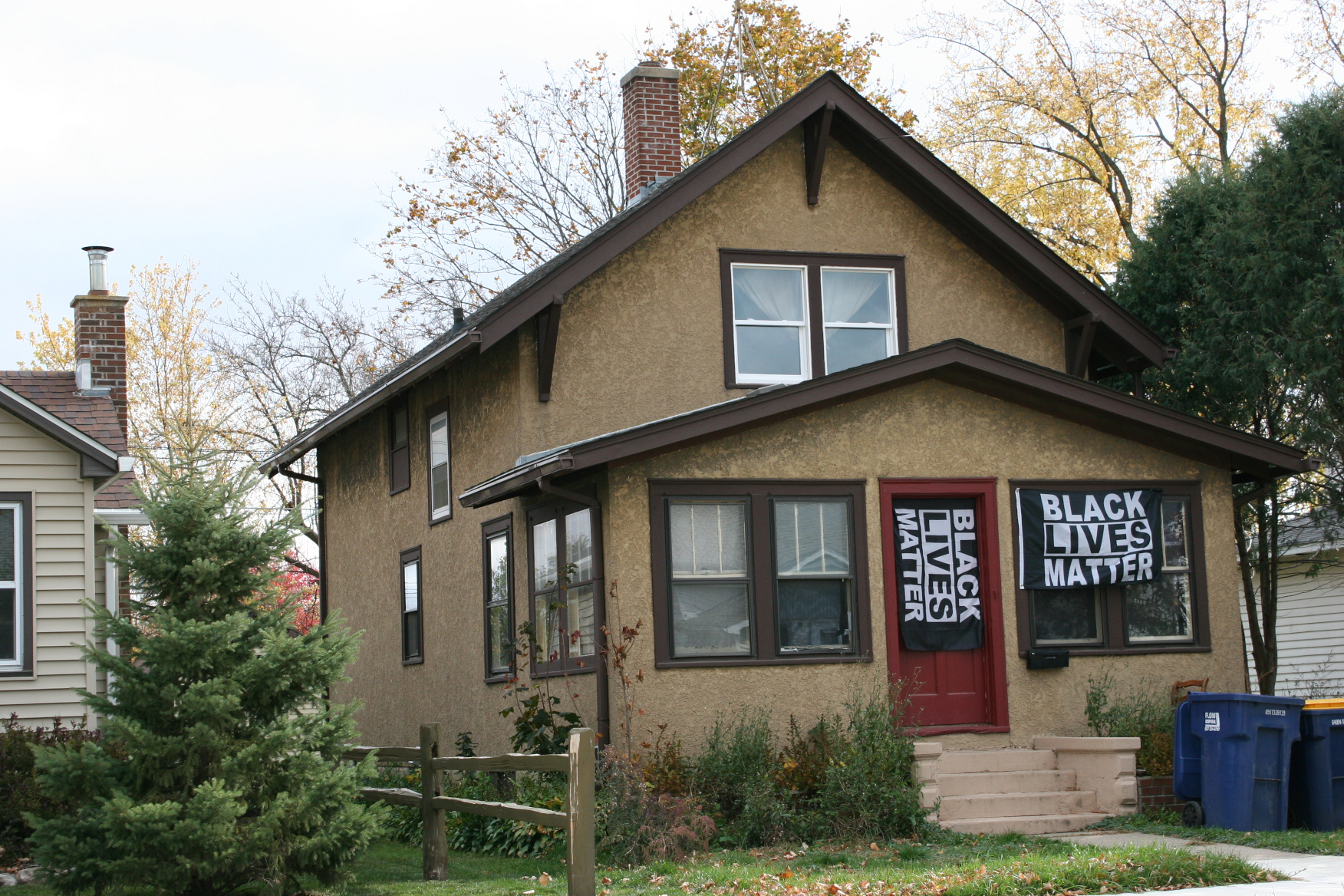
I photographed this scene in 2020 in Kenyon, MN. It remains one of my favorite images of this message given its location in a small town.(Minnesota Prairie Roots copyrighted file photo October 2020)
Kin: Rooted in Hope proves an especially fitting read during February, Black History Month. Through this book of historical fiction, I’ve learned more about a part of U.S. history which is horrendous in every possible way. That humanity can treat humanity so atrociously seems unfathomable…until I consider underlying and outright racist attitudes which continue yet today.
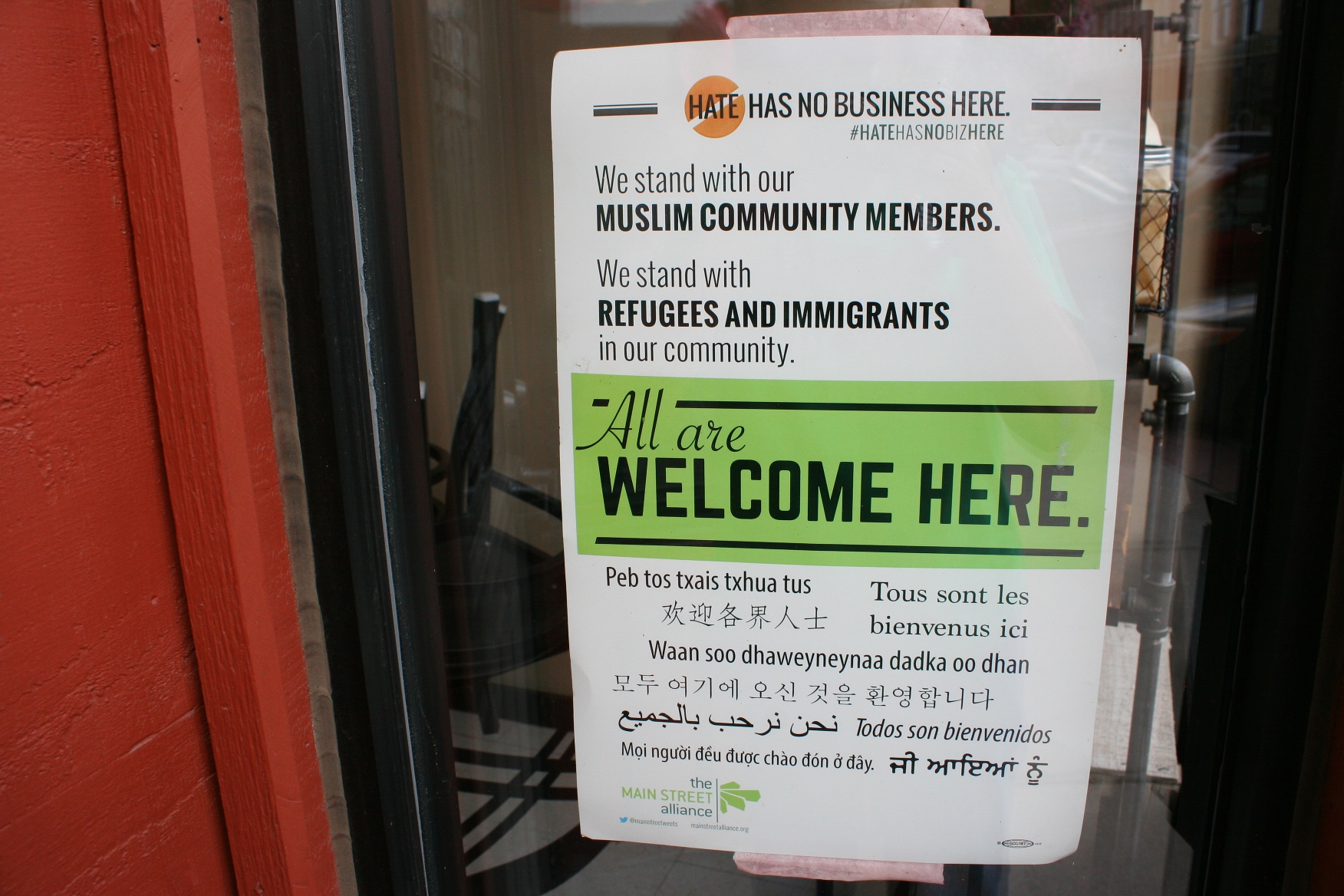
This welcoming sign was posted on the door of a downtown Faribault business in 2018. (Minnesota Prairie Roots copyrighted file photo 2018)
IN A VALENTINE’S DAY post last week, I focused on connecting in everyday life, on hugging all of humanity. Those words proved prophetic for me personally. And I am the better, the richer, for the insights I learned, the connections I made, during a February 15 talk by a Minnesota college professor, cultural consultant and author at Books on Central in Faribault.
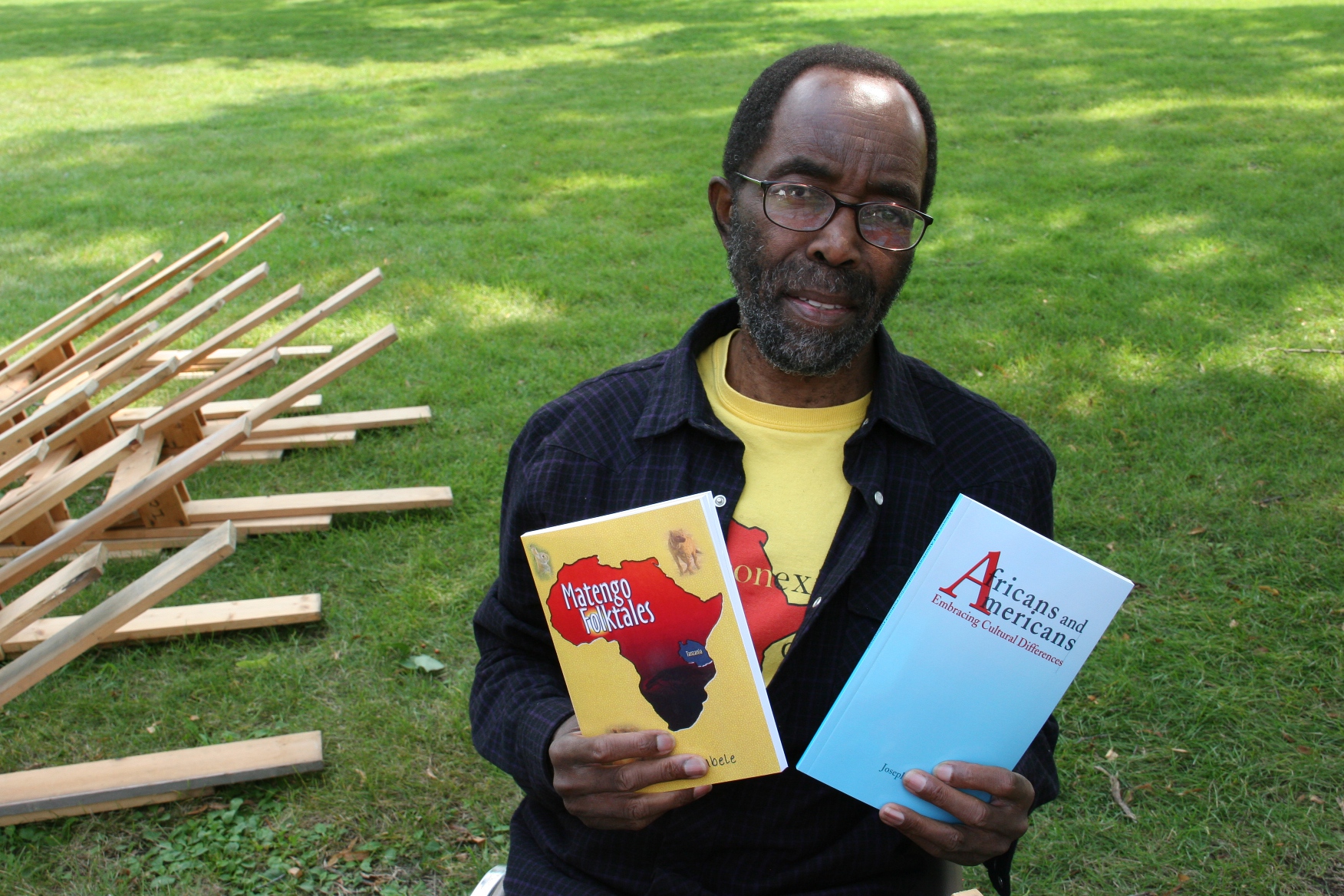
Author Joseph L. Mbele, photographed at the International Festival Faribault in 2015. (Minnesota Prairie Roots copyrighted file photo 2015)
Joseph L. Mbele was the featured speaker at this public event highlighting cultural differences. Faribault is a culturally-diverse community, home to many immigrants, including significant Somali and Hispanic populations. And that has all too often created tension between locals and those who now call my southern Minnesota city home. Mbele recognizes that and has worked with community leaders, business owners and others in Faribault and neighboring cities to raise awareness of cultural differences and bridge the gaps which divide us.
Via storytelling, humor and insightful perspectives as someone who grew up in Tanzania and has lived in the U.S. for 32 years, Mbele riveted the attention of the group gathered in the used bookshop run by Rice County Area United Way. Rather than fully recap Mbele’s presentation, I want to focus on the personal interactions I experienced with two young Somali men in attendance.
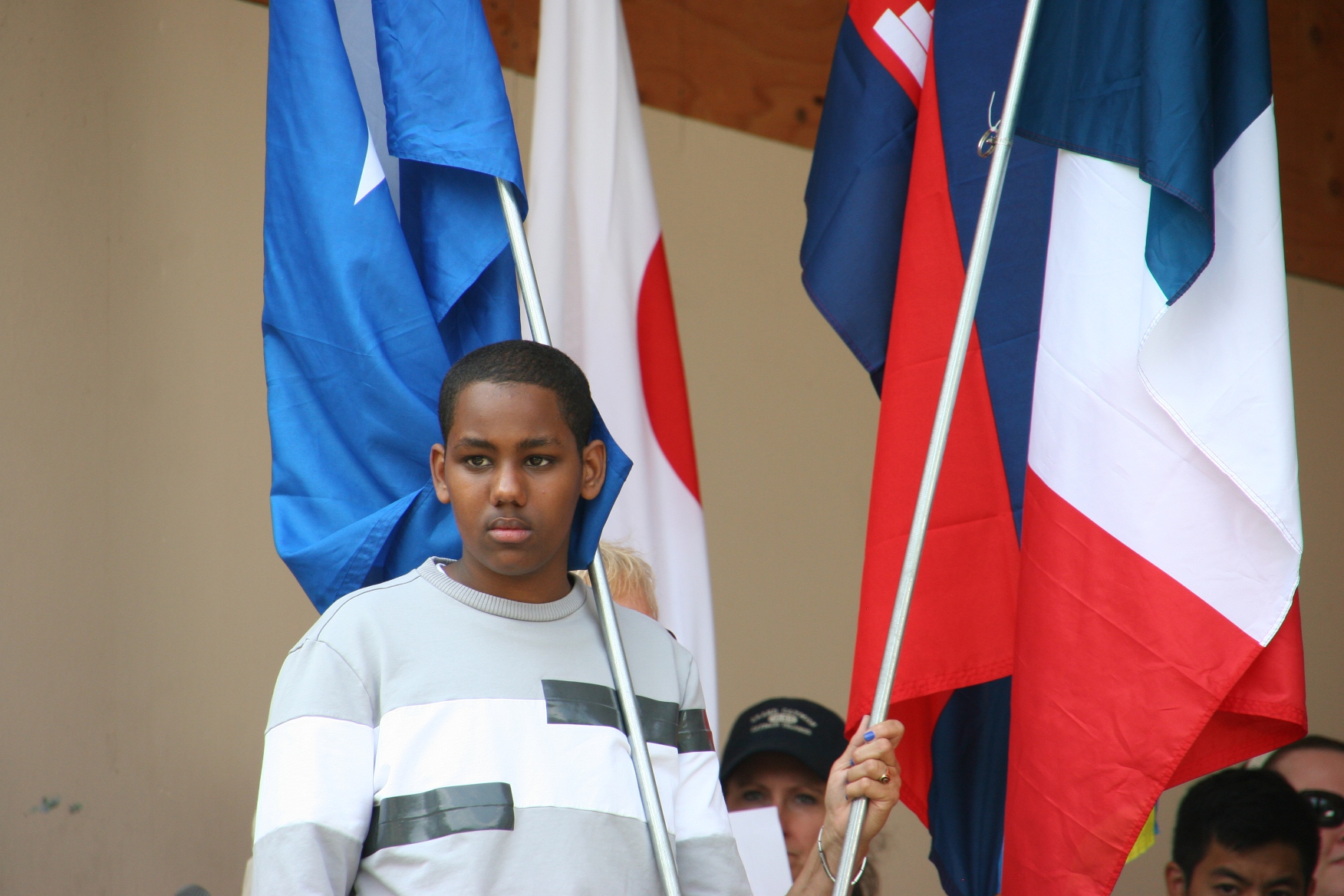
This teen represented Somalia (blue flag with a white star) at the International Festival Faribault in 2015. (Minnesota Prairie Roots copyrighted file photo 2015)
When I arrived at the bookstore, I settled onto a folding chair next to Solomon, as I heard it, (or perhaps correctly Sulaiman/Suleiman; I didn’t ask for the spelling of his name). I can’t sit next to someone and not engage in conversation. I soon learned that Sulaiman, 34, came to the U.S. from Somali at age 14, graduated from Faribault High School, played soccer on the fields by the junior high, has a wife in Somalia (the process is lengthy to bring her to the U.S., he said), works as an over-the-road trucker and has a job interview with a local company this week. Any business would be fortunate to have him on their team. He impressed me with his friendly personality, wide smile and openness. Sulaiman reflected what Joseph Mbele stated earlier about Africans being highly-social, desiring to be around and engage with other people.
I felt thankful to learn from my new friend that he hasn’t faced many challenges as a native Somalian living in Faribault. I didn’t have the heart to share the negative comments I’ve heard about Somalians. I focused instead on getting to know this delightful young man pressed next to me in a row of folding chairs in the cozy bookshop.
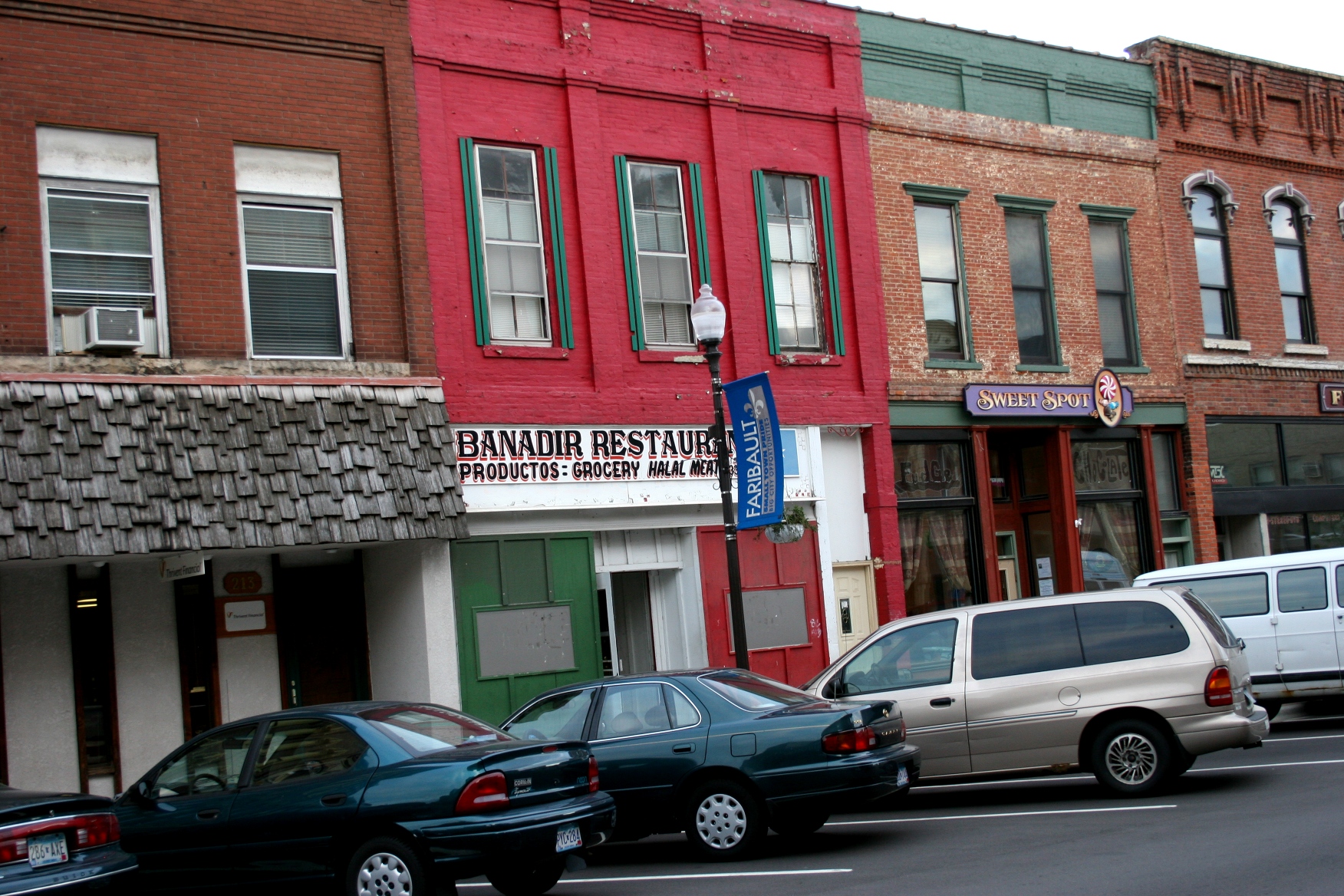
Banadir, a Somali restaurant and grocery, is located in historic downtown Faribault. (Minnesota Prairie Roots copyrighted file photo 2011)
Throughout Mbele’s talk highlighting African culture like African time (versus American time when everyone is on time), sidewalk gatherings to share news and to socialize, the social importance of food and music among Africans, the value of coming together and much more, I felt the sense of understanding unfolding. Laughter erupted often. Heads nodded. Questions surfaced during discussion. It felt good to be part of this gathering, to learn, to connect. I love that Mbele addressed bookstore volunteer Dave Campbell as “brother.” That endearing name shows that Mbele values Campbell and their personal connection. They are friends.
A diverse group attended a past International Festival Faribault, here observing the flag ceremony. (Minnesota Prairie Roots copyrighted file photo 2015)
And I felt, too, that I’d made a new friend in Sulaiman and, afterwards his brother, Ibrahim (again, I’m uncertain on the name spelling), also in attendance. As I retreated to the rear of the bookstore to grab a sweet treat and refill my water glass, Ibrahim approached and we chatted. He extended his hand in a handshake, significant because Muslims typically would not shake a woman’s hand. Mbele explained earlier the separation of men and women is not one of disrespect but faith-based and cultural.
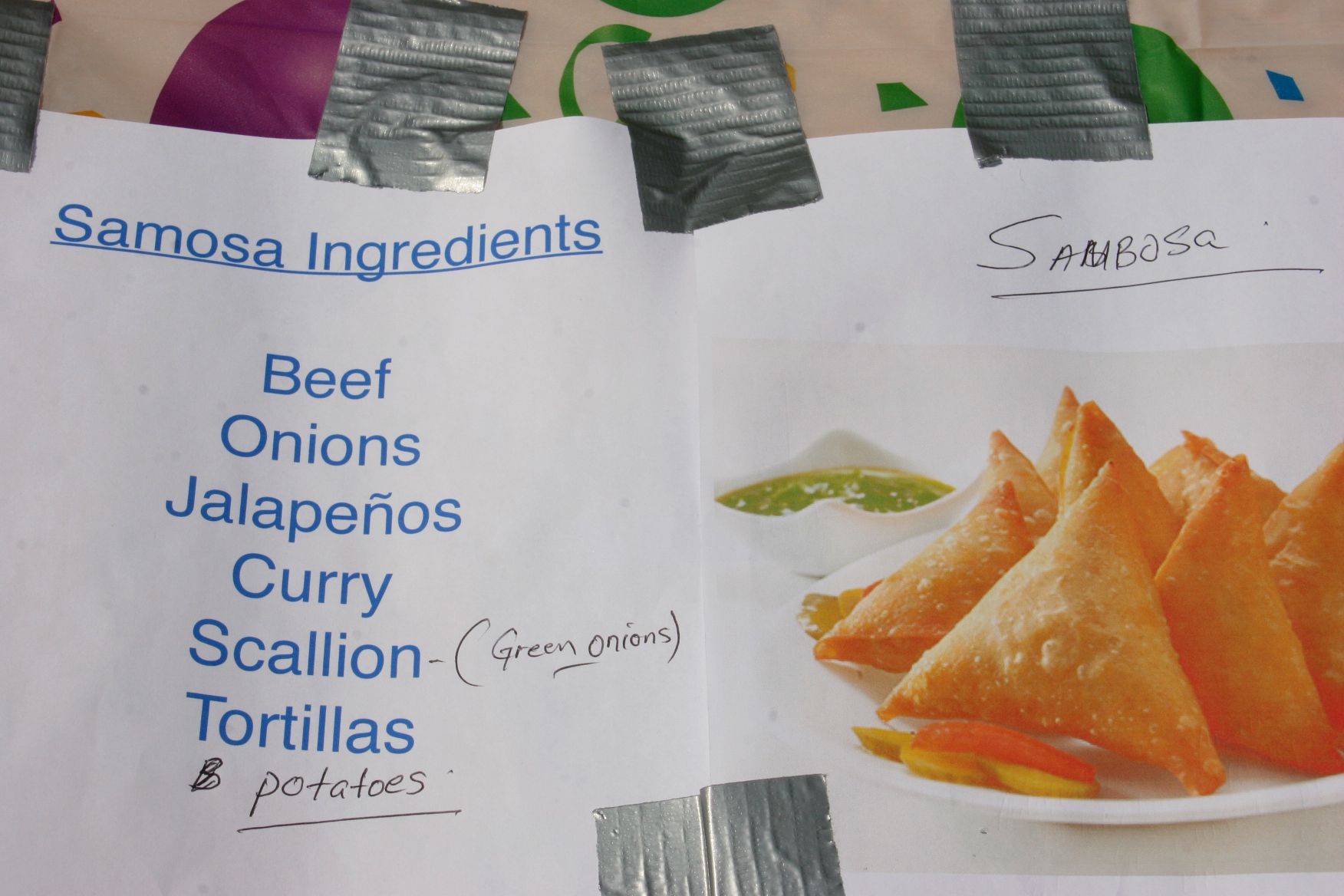
A sign photographed at a past International Festival Faribault, where I first tasted sambusa. (Minnesota Prairie Roots copyrighted file photo)
Ibrahim and I talked only briefly. He was, like his brother, warm, engaging, friendly. I remember him telling me that food brings people together, that he likes pizza. And I replied that I like sambusa, a Somali triangle-shaped pastry stuffed with spicy meat. We laughed. Earlier he invited those attending the bookshop gathering to visit Somali restaurants and shops in downtown Faribault.
And then Ibrahim asked, “Can I hug you?” Of course. We embraced right there in the back of the United Way bookshop. I felt such warmth, such affection, for this young man I’d just met. There were no cultural differences between us. We were simply two individuals who respected and appreciated one another. United by our humanity.
#
Jospeh Mbele’s latest book, an easy and informative read. (Book cover sourced online)
FYI: I’d encourage you to read any or all of the books written by Joseph L. Mbele: Africans and Americans: Embracing Cultural Differences; Chickens in the Bus: More Thoughts on Cultural Differences; and Matengo Folktales. This professor at St. Olaf College in Northfield is a gifted storyteller and writer. I’d also encourage you, if you live in my area, to shop at Books on Central. All proceeds from book sales go to the Rice County Area United Way and help people and organizations in my area.
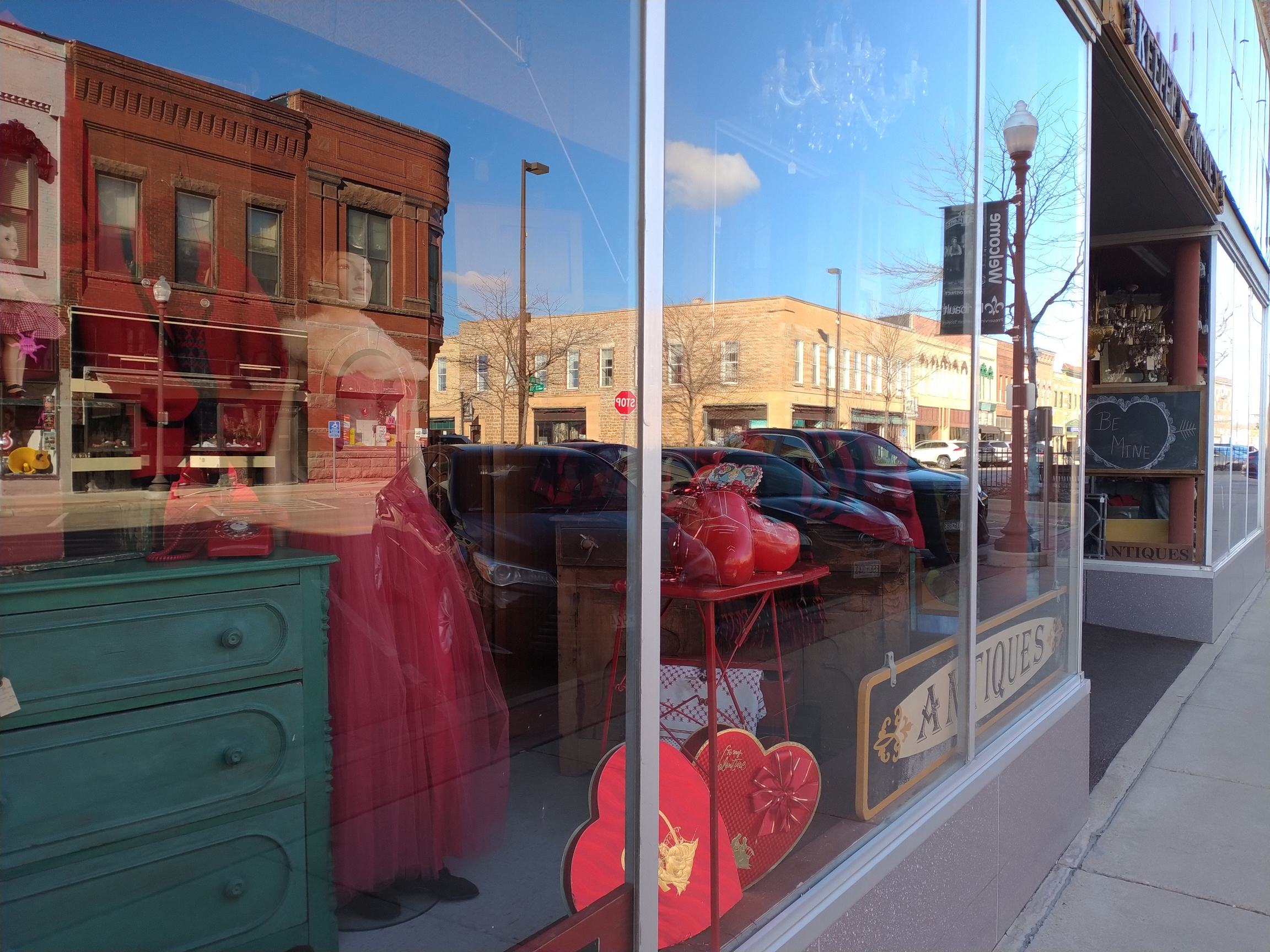
A display window at Keepers Antiques along Central Avenue in Faribault. (Minnesota Prairie Roots copyrighted photo February 2024)
PHOTOGRAPHING SCENES behind glass often proves challenging. First, you need to watch for your own reflection so as not to photograph yourself. And then there are all the other reflections playing upon the glass.
I faced those obstacles while photographing a valentine themed window display with my cellphone outside Keepers Antiques in historic downtown Faribault recently. I tried my best, waiting for vehicles to pass, angling myself out of the photo, working to frame the scene. Yet, even with all that finagling, the results were not outstanding. Or so I thought.
When I viewed the images on my computer, I was pleasantly surprised to notice unseen details in the overall window display image. That prompted thoughts of the popular “I Spy” photo-based picture books for kids. Readers need to find specific items in each photographed scene.
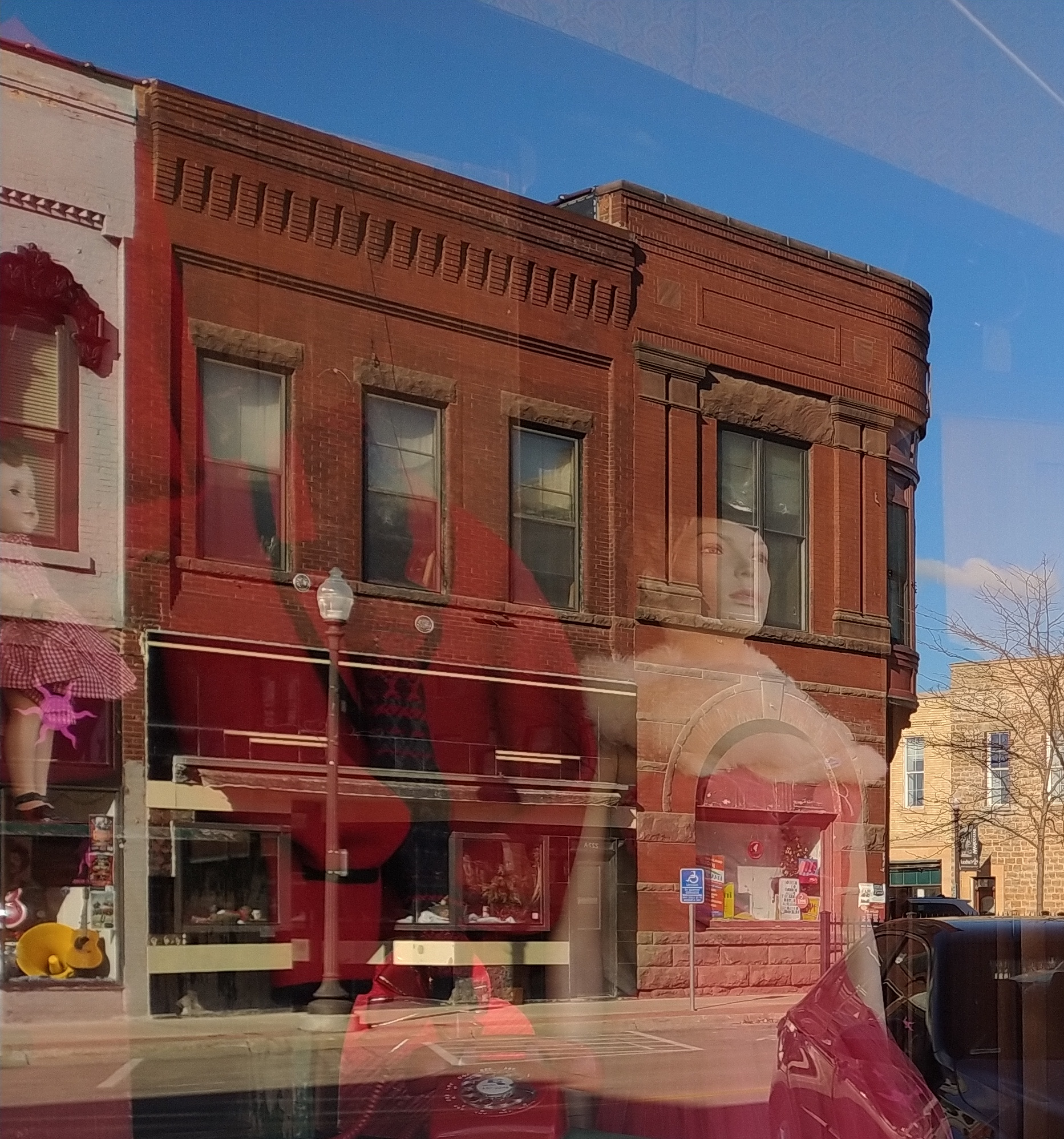
With historic buildings across the street reflecting in the antique shop window, it appears that two faces are peering from second floor windows on the far left and to the right. Love that ghostly visual. (Minnesota Prairie Roots copyrighted photo February 2024)
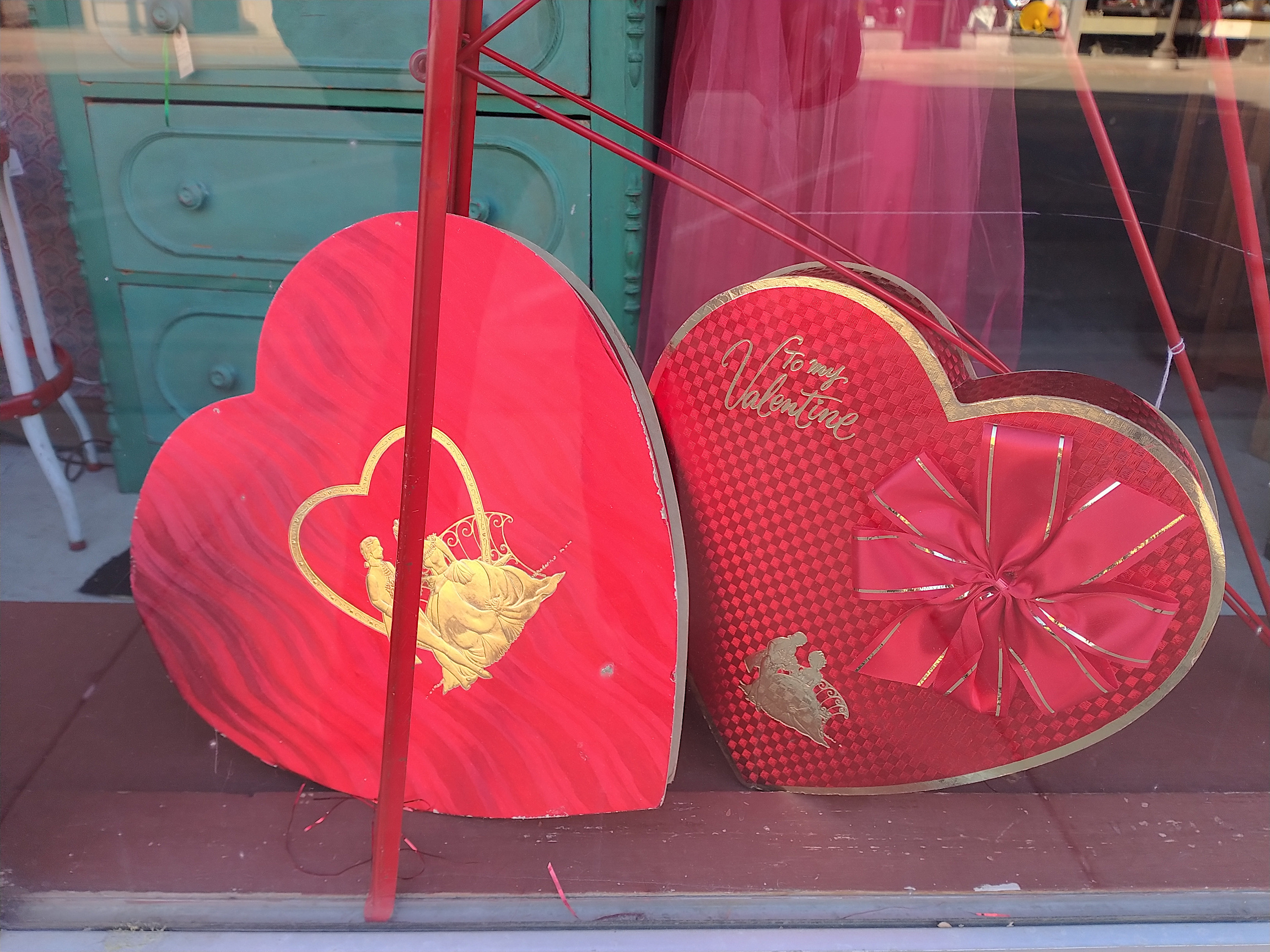
In the collage of antiques and collectibles Nona Boyes creatively placed in the window of her antique shop, I saw the makings of an “I Spy” book. (Study the first image in this post.) I spy a doll in a checked dress. I spy a red telephone. I spy a stop sign. I spy faces in windows. I spy a red ironing board. I spy a chandelier. I spy two candy boxes. I spy a valentine in a shoe. I spy a fleur de lis, the symbol of my community. What do you spy?
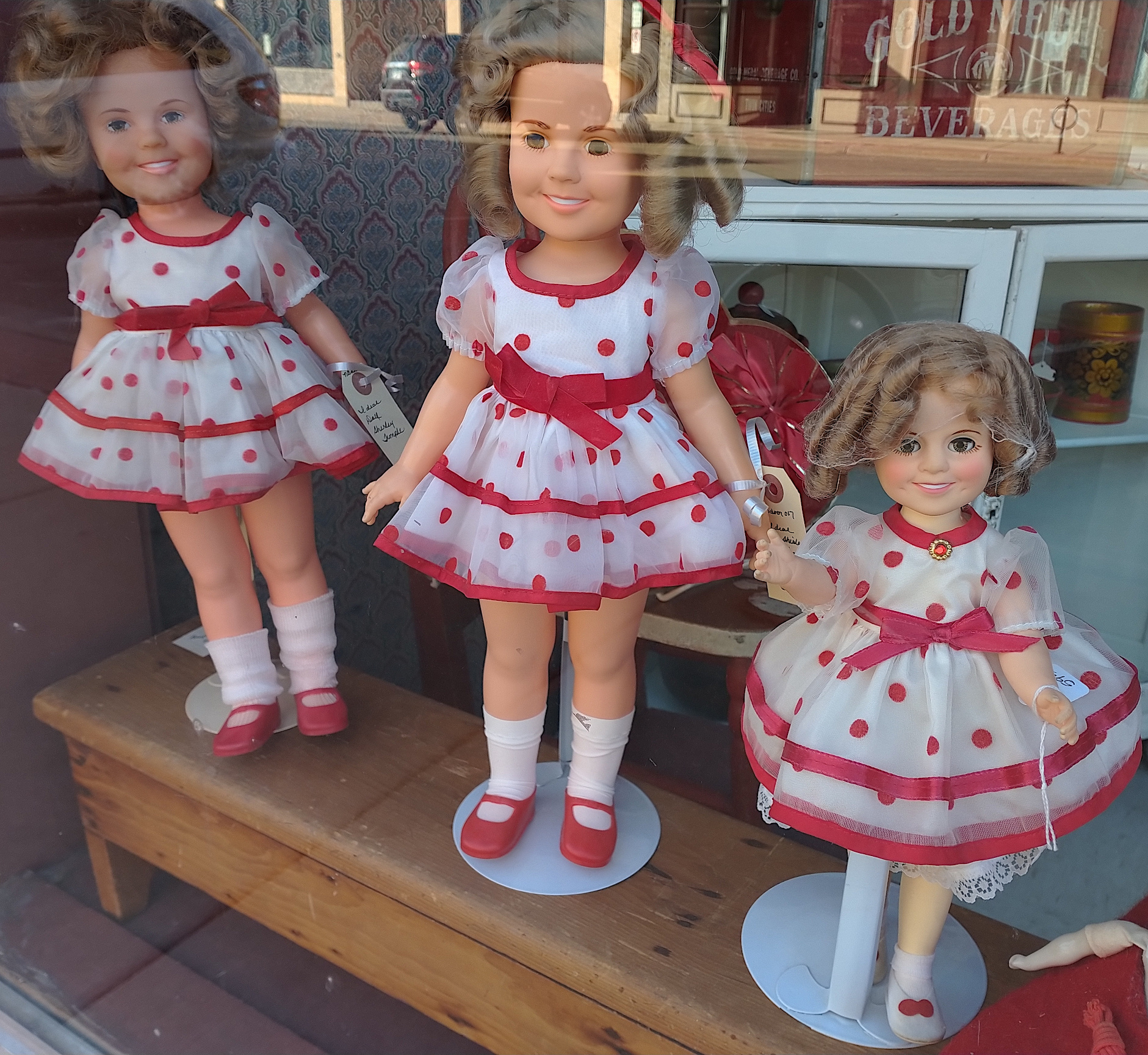
Shirley Temple dolls times three. (Minnesota Prairie Roots copyrighted photo February 2024)
What you won’t spy in the overview window display are three 1970s vintage Shirley Temple Ideal dolls. They were there, just not in the section I initially framed. I photographed them separately. In the doll portraits, I spy a red brooch. Do you? I spy, too, one white shoe with a red bow. I spy the word “beverages.”
Those I spy candy boxes. (Minnesota Prairie Roots copyrighted photo February 2024)
And I spy in the all of this an opportunity to turn a photo challenge into something interesting as only a photographer and writer can do. Through my creative lens, I saw pages in an “I Spy” book unfolding before me.
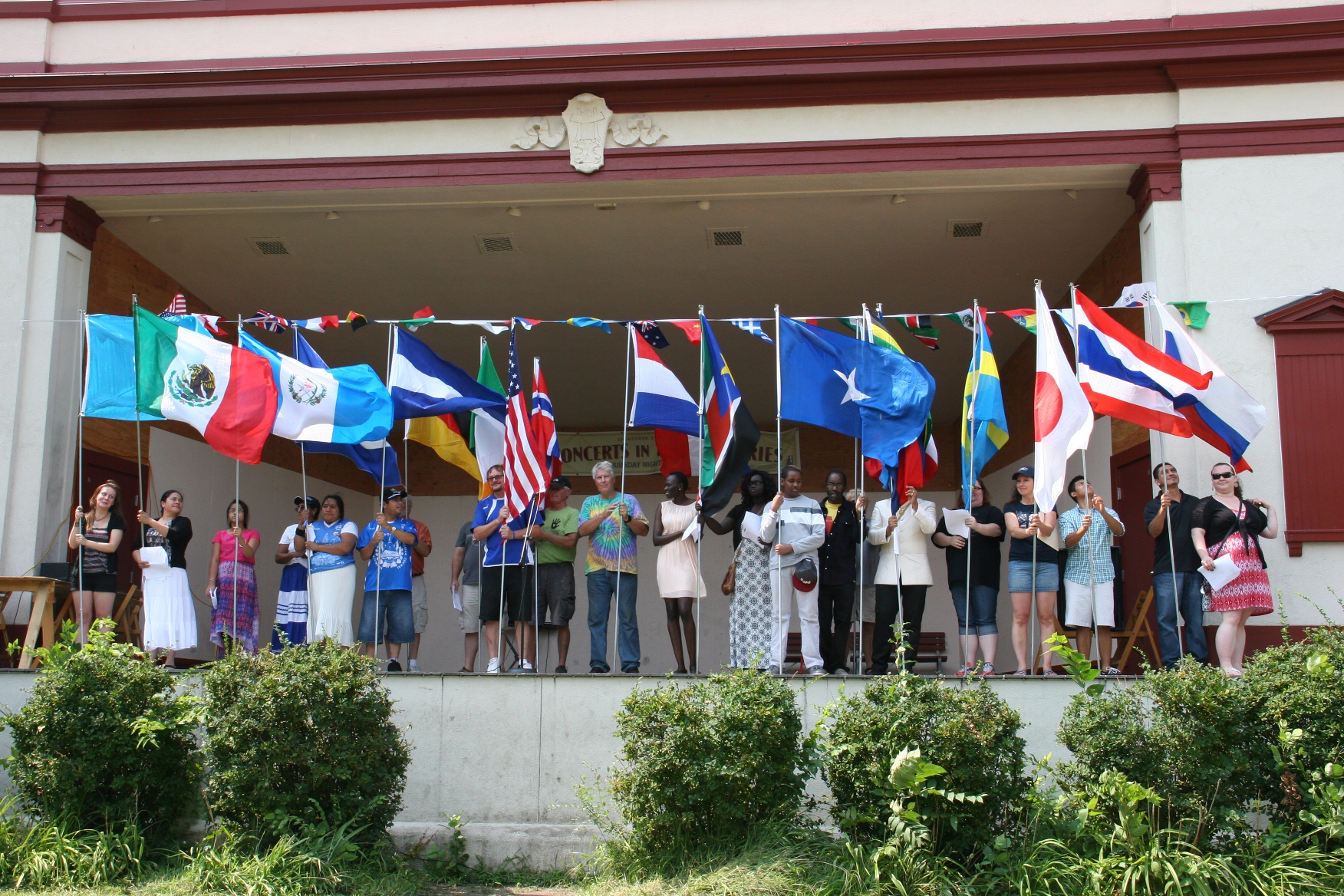
A flag ceremony, representing the country of origins of many peoples who call Faribault home, was part of the 2015 International Festival Faribault. Joseph Mbele is shown just to the right of center in this photo, dressed in black with a yellow and red shirt. (Minnesota Prairie Roots copyrighted file photo August 2015)
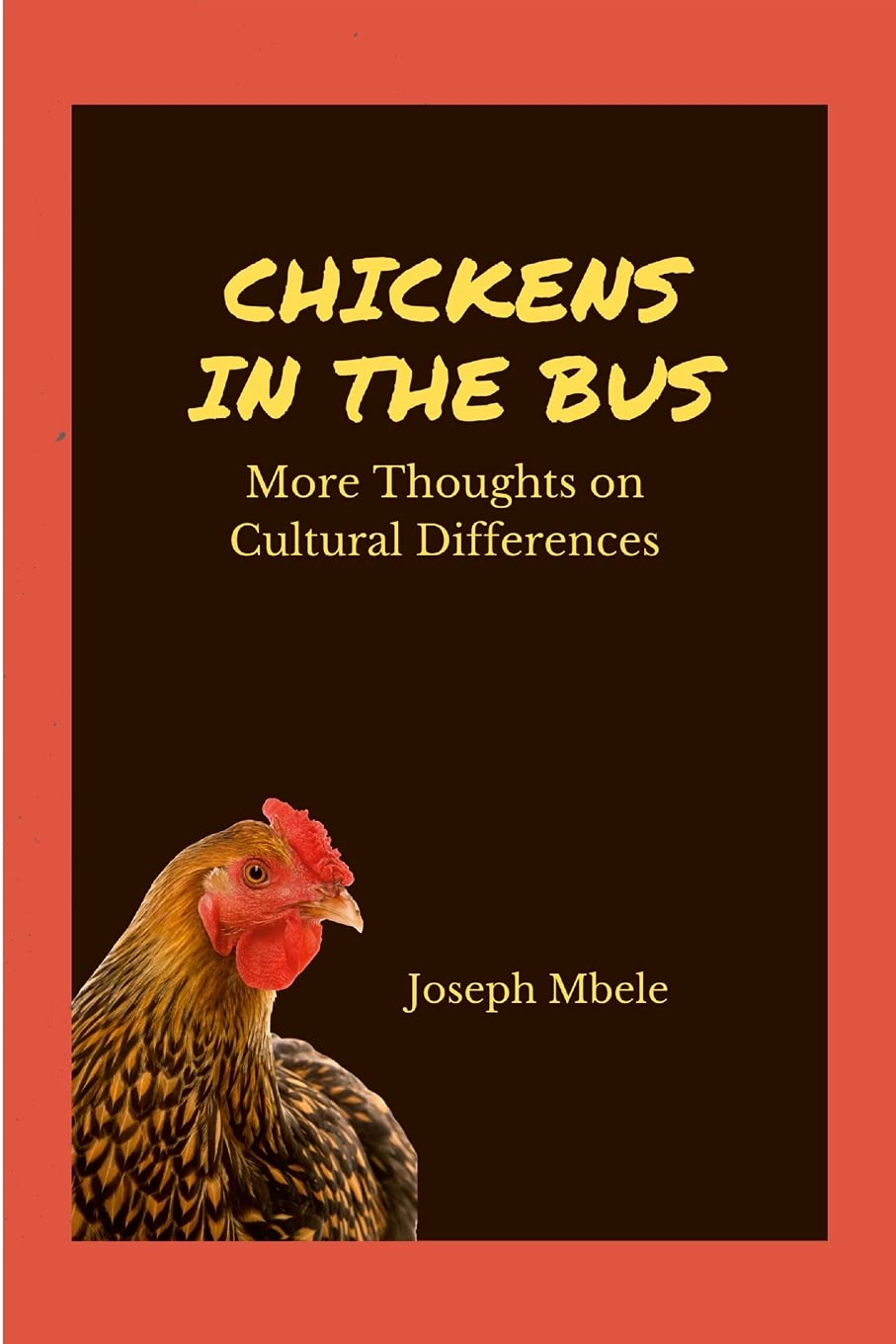
I FIRST MET JOSEPH L. MBELE in 2015 at the International Festival Faribault. The author, cultural consultant and professor of English at St. Olaf College in Northfield was representing his native Tanzania during this fest celebrating the cultural diversity of my community. Then late last year I talked to Mbele again, when he was selling his latest book, Chickens in the Bus: More Thoughts on Cultural Differences, at a local holiday church bazaar. He is engaging, soft-spoken, knowledgeable and just an overall kind and gentle soul.
Author Joseph L. Mbele with two of his three books, photographed at the 2015 International Festival Faribault. (Minnesota Prairie Roots copyrighted file photo August 2015)
This image shows the cultural diversity of Faribault. This photo was taken at a downtown car showin 2015. (Minnesota Prairie Roots copyrighted file photo July 2015)
That he is appearing at a business along Faribault’s Central Avenue is meaningful in itself. Many Somali residents live in second floor apartments here in the heart of our downtown business district. Other of our newest immigrants have opened restaurants and shops along the avenue and side streets, making for a diverse downtown. But it was their presence here that stirred up complaints and controversy a few years back, and likely still does, although those are not as loudly vocalized as previously.
Mbele’s latest book, published in 2021. (Cover image sourced online)
In Chickens in the Bus, Mbele terms this “the sidewalk issue.” Business owners expressed concerns about Somali men congregating outside, blocking sidewalks, scaring customers away, Mbele writes. His words are not new to me. I’d heard them, too, from business owners and from local residents. People were, they said, afraid to come downtown. I’ve never feared walking along Central Avenue past groups of Somali men. What people don’t understand, they all too often fear.
To Mbele’s credit, he has worked hard to inform, to enlighten, to listen, to help bridge cultural divides. He spoke to Faribault business owners. He spoke to members of the Somali community. He’s also spoken publicly at libraries and elsewhere. I appreciate his efforts.
At the core of “the sidewalk issue” are cultural differences, according to this native Tanzanian who specializes in teaching folklore at Northfield’s St. Olaf College. Somalians come from an oral culture, one that relies on social gatherings to share news, Mbele writes. “…Somali gatherings in downtown Faribault are the Somali newsstands,” he told local business owners and includes in his book. That’s so down-to-earth understandable.
Mbele’s slim volume, Chickens in the Bus, which I purchased at the November 2023 holiday market, is an excellent primer for anyone desiring to learn more about cultural differences. This author and cultural consultant highlights how those differences can both challenge communities, but also present opportunities in an ever-increasingly connected world that is decidedly global. He writes in a way that is peaceful and soothing and seeks to create harmony.
A rooster, photographed at a rural Faribault farm and used here for illustration only. (Minnesota Prairie Roots copyrighted file photo May 2018)
I learned a lot about “African Time” and “American Time,” about native-born Africans who do not view themselves as black or as “people of colour” (vs African Americans who do), about chickens in the bus, and much more. In Africa, Mbele writes, someone may carry a chicken onto a bus, a gift from a rural villager.
His newest book, a sequel to Africans and Americans: Embracing Cultural Differences, proved an easy and informative read, one that enlightened me about my newest neighbors. They enrich Faribault with their culture, bringing their food, language, dress, customs and more. I will never travel to Africa. So I am the richer for the Africans who now call southern Minnesota home, who bring their culture into my community, to me.
An iconic northwoods Minnesota lake cabin. (Minnesota Prairie Roots copyrighted file photo July 2022)
I RECENTLY FOUND LINDA NORLANDER’S fourth book—Death of a Fox—in the new fiction section of my local library. Labeled #4 in “A Cabin by the Lake Mystery,” the series name and cover art drew me to pull the book from the shelf and read the back cover summary. I do, indeed, judge a book by its cover and title. Take note, book editors and marketing teams.
The fourth book in Norlander’s cabin mystery series. (Sourced from Norlander’s website)
Given the series name, I expected this book might be by a Minnesotan or set in Minnesota. It’s both. Sort of. The author grew up in Minnesota as the daughter of a rural newspaper editor, raised her family on 10 acres of land in the central part of our state and then moved to Tacoma, Washington. I won’t hold that against her because, well, Minnesota winters are not for everyone forever. But Norlander’s cabin mysteries are for anyone who likes a good mystery set in the Minnesota northwoods.
I’m a long-time fan of mysteries, dating back to the Nancy Drew mystery series of my youth. I’ll admit that I’ve had to force myself to read outside that genre. I still don’t read romance novels, although Norlander’s writing does include a bit of romance for main character Jamie Forest, a freelance editor who recently moved from her native New York City to a family lake cabin in northern Minnesota.
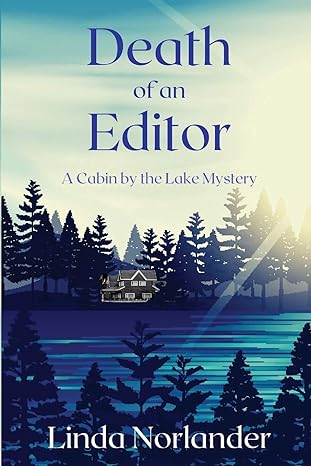
The first book in the cabin mystery series. (Book cover image sourced online)
In that tranquil setting, Jamie attempts to reclaim her life, leaving behind a traumatizing event involving law enforcement in the Big Apple. This I learned in book #1, Death of an Editor. I’m reading the books in order and just finished the first. I couldn’t put it down. It was that good.
Loons are common on the lakes of central and northern Minnesota. (Minnesota Prairie Roots copyrighted file photo July 2022)
Good not only mystery-wise, but also because this is definitely a Minnesota-centric read. Norlander references reserved Minnesotans, hot dish (not casserole), Minnesota Nice, loons…even appropriately names a local eatery the Loonfeather Cafe.
The author doesn’t shy from hard topics either, like biases against Native Americans (many of her characters are partial or full-blooded Ojibwe, including Jamie), proposed copper and nickel mining, and school shootings, all integral parts of the plot in Death of an Editor and part of Minnesota’s past and present. And, yes, an editor is murdered in this fictional book.
Jamie quickly becomes a suspect in that murder. Without revealing too much of the story, I will share that she sets out to clear her name, then that of another accused, along the way finding herself in life-death situations. There are many heart-stopping moments, questions about who can be trusted and who can’t. Lots of mysteries within the mystery to unravel.
Land greed. A troubling family past. Corrupt and threatening law enforcement officers. Men in red caps. Efforts to save the pristine northwoods from development. Secrets. Even Minnesota weather, which is forever and always a topic of conversation in our state, shape this first of Norlander’s books. Death of an Editor is set in summer and Norlander’s three subsequent books happen in our other three distinct seasons.
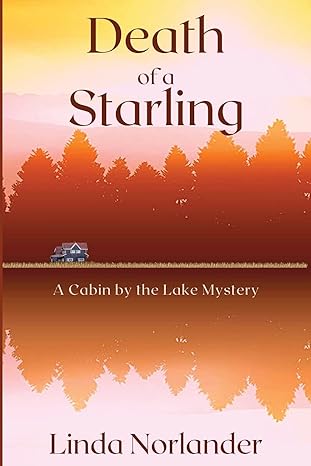
The second book in Norlander’s series. (Book cover image sourced online)
I just started her autumn seasonal second book, Death of a Starling, and am already drawn into the thickening plot, a continuation of book #1 as Jamie, considered an outsider and big city tree hugger, continues her efforts to uncover the truth. Already I’m finding this book to be another enthralling mystery that I can’t put down, not even to watch the 10 o’clock news.
A delivery truck for Cry Baby Craig’s hot sauce, parked behind the business in downtown Faribault. (Minnesota Prairie Roots copyrighted file photo 2021)
WITH ONLY DAYS until Christmas, hostess and other last-minute gifts purchased locally are great options. I’m most familiar, of course, with what can be found in Faribault. But I have a few ideas from neighboring communities also.
Faribault Mill blankets/throws artfully hung on a simple pipe in the factory store. (Minnesota Prairie Roots copyrighted file photo)
First up, Faribault. We are nationally and internationally-known for the Faribault Mill, previously the Faribault Woolen Mill. The mill’s high-quality woolen blankets and throws are its signature products sold at its factory store, in several Twin Cities metro locations, online and elsewhere. I have several of these high-end blankets gifted to me through the years. They’re not inexpensive. Selections range from traditional patterns to Peanuts designs (which I hear are incredibly popular with Gen Z; especially Snoopy) to the artwork of Adam Turman. His art is more Minnesota centric with loons, Up North outdoors scenes and nature themes on mill throws.
Award-winning Amablu Gorgonzola from Caves of Faribault. (Minnesota Prairie Roots copyrighted file photo)
Handcrafted cheeses aged in sandstone caves along the Straight River in Faribault are a tasty gift for anyone who appreciates blue, Gouda, Gorgonzola and Swiss cheeses. These are award-winning cheeses. I always have a Caves of Faribault cheese in my refrigerator. This is top-notch cheese available locally at HyVee Grocery and in many other retail locations in Minnesota and across the country. Other local artisan cheese makers include Shepherd’s Way Farms, rural Nerstrand, and Cannon Belles Cheese, Cannon Falls.
The original Cry Baby Craig’s hot sauce. (Minnesota Prairie Roots copyrighted file photo)
Also wildly popular in the food category is Cry Baby Craig’s gourmet hot sauce, made in the heart of historic downtown Faribault. It’s gained a following in the metro and beyond. My son-in-law from Wisconsin loves this sauce crafted with ingredients sourced from area farms. As with Faribault-made blue cheese, there’s always a bottle of CBC in my fridge. It’s available for pick-up right at the Central Avenue location and elsewhere. I just picked up three bottles of three different sauces the other day.
Cry Baby Craig’s recently partnered with 10,000 Drops Craft Distillers a block away to craft Lokal Vodka infused with pickled pepper brine and CBC hot sauce. The distillery also creates plain vodka and key lime, blood orange and meyer lemon Lokal Vodka. So if someone on your gift list appreciates vodka and you want to support local, head to 10,000 Drops. Loon Liquors Distillery in neighboring Northfield also does vodka and other hard liquors.
Minnesota wines, including from Vintage Escapes Winery just to the west of Faribault in rural Kilkenny, would be a good hostess gift. Or coffee, roasted at Mighty Fine! Coffee, next to the distillery in Faribault.
This may seem like an odd gift, but handcrafted European style butter from Hope Creamery in small town Hope (south of Faribault along Interstate 35) is something I’ve always wanted to try and which I think would be an excellent gift for anyone who loves to bake. It’s sold in Hope and also at select grocery stores (including at Fareway and HyVee in Faribault) inside and outside the metro.
Craig Kotasek’s print of Minnesota-based Jolly Green Giant brand peas.(Minnesota Prairie Roots copyrighted file photo)
For the art appreciator, I recommend the letterpress art of Craig Kotasek of Tin Can Valley Printing. He uses old school letterpress to create prints, greeting cards and more. I’m perhaps a bit biased given Craig worked at the same weekly newspaper, The Gaylord Hub, where I worked as a reporter and photographer right out of college. Craig worked on the printing side, many years after me. His art is sold at select locations in and around his Le Sueur business base.
Two rural-themed books featuring the work of Minnesota writers and purchased at Books on Central. (Minnesota Prairie Roots copyrighted photo December 2023)
I love books. And our area has some great independent bookstores to buy books for the book lover on your list. Content Bookstore in Northfield. Little Professor Book Center in Owatonna. And, new to Faribault, Books on Central, a volunteer-run used bookstore owned by, and benefiting, the Rice County Area United Way. Housed in a former jewelry store, this bookshop features a central vintage chandelier, built-in shelves and drawers, and friendly, helpful staff. It’s a stunning, cozy space with a remarkable, high-quality selection of used books at reasonable prices. Yes, I’ve already purchased several books here, nearly all Minnesota centric.
My writing has published in these volumes of The Talking Stick, the 2023 volume 32 not included in this stack. (Minnesota Prairie Roots copyrighted file photo)
Which brings me to my last suggestion. The Talking Stick, an anthology published by the Jackpine Writers’ Bloc, features a collection of fiction, creative nonfiction and poetry by Minnesotans or those with a strong connection to Minnesota. Any of the anthologies would make an excellent gift for the book lover on your list. And, yes, I have writing in the latest edition of TS and many years prior. The anthology can be ordered online.
That’s it, my ideas for gifts that are mostly from my region. Happy last-minute shopping Minnesota style.



























 Minnesota Prairie Roots
Recent Comments