Minnesota Prairie Roots

Writing and photography by Audrey Kletscher Helbling

No limit on Minnesota fish fries March 3, 2017

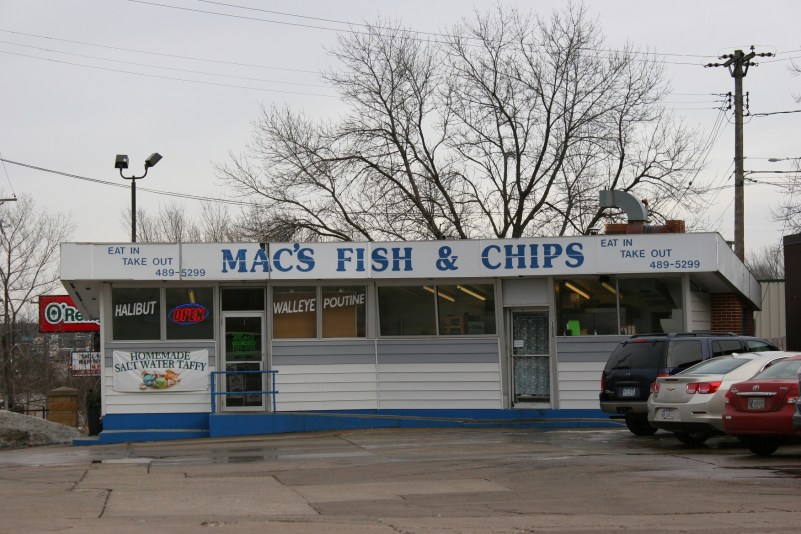
This recent roadside photo I snapped of Mac's Fish & Chips, on the corner of Hamline and Larpenteur in St. Paul, prompted this blog post. Mac serves deep-fried halibut, walleye, cod, shrimp, clams and, yes, chicken, along with a few sides in this former Clark Gas Station building. You can also buy Mac's battered walleye at Target Field in Minneapolis.

This recent roadside photo I snapped of Mac’s Fish & Chips, on the corner of Hamline and Larpenteur in St. Paul, prompted this blog post. Mac’s serves deep-fried halibut, walleye, cod, shrimp, clams and, yes, chicken, along with a few sides in this former Clark Gas Station building. You can also buy Mac’s battered walleye at Target Field in Minneapolis.

IT’S THE SEASON of the Friday Night Fish Fry in Minnesota.

As a life-long Lutheran, I’ve never been part of the Catholic-based tradition of eating fish on Fridays during Lent. But I respect that deep-rooted practice of shunning meat, although I will admit I’ve always considered fish to be meat. Catholics have a different opinion.

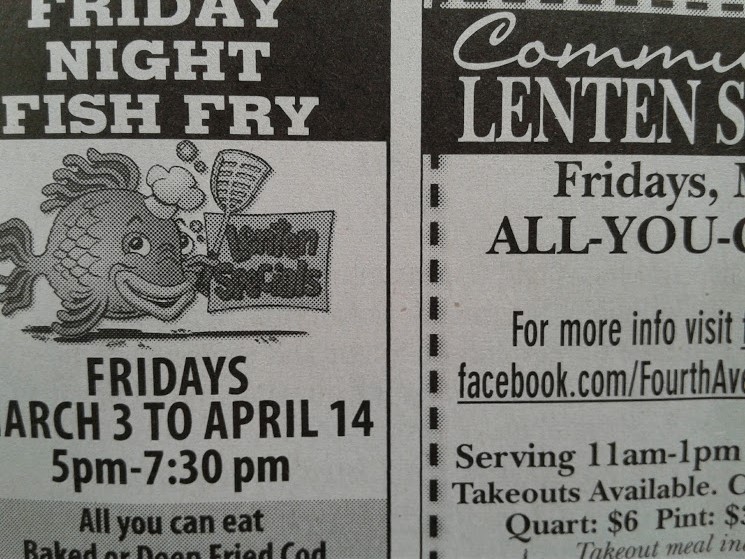
A snippet of two side-by-side ads that published on Thursday in the Faribault Daily News.

A snippet of two side-by-side ads for a Friday Fish Fry and for a Friday Lenten Soup Luncheon that published in the Faribault Daily News.

That aside, the beginning of Lent this week kicks off church and community fish fries, not to mention Friday fish specials at restaurants and Knights of Columbus halls. The Twin Cities-based The Catholic Spirit contacted all of the parishes in the St. Paul-Minneapolis Archdiocese for a list of fish fries and Lenten meals. Ninety-one responded. From Our Lady of the Prairie in Belle Plaine to St. Bridget of Sweden in Lindstrom to St. Albert the Great in Minneapolis, congregations will be serving fish aplenty and accompanying side dishes.

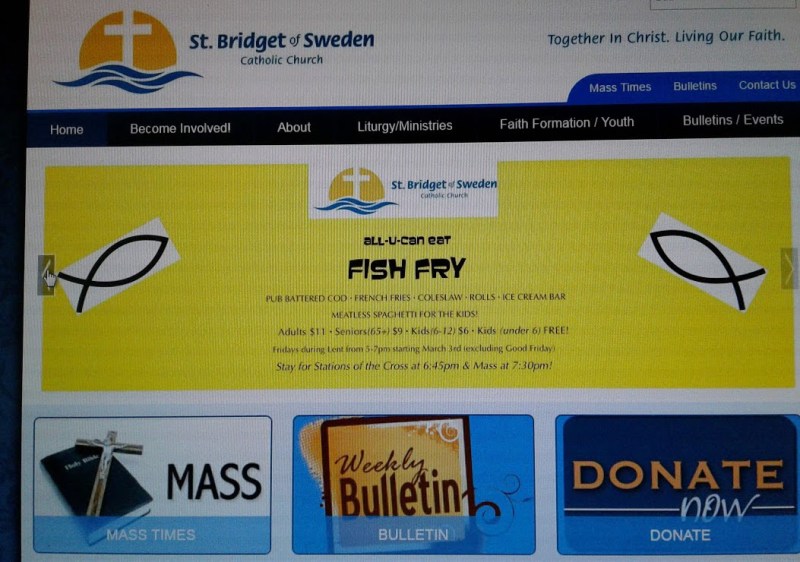
Fish Fry details from the St. Bridget of Sweden website.

Fish Fry details from the St. Bridget of Sweden website.

I’ve dined at enough church dinners—Catholic, Lutheran and otherwise—to know that food prepared by the faithful is often some of the best and tastiest. Perhaps it’s time I tried a fish fry.

TELL ME: Have you dined at a church-hosted fish fry? Where? Here’s your opportunity to recommend a fish fry.

FYI: Click here for the list of fish fries and Lenten meals compiled by The Catholic Spirit.

© Copyright 2017 Audrey Kletscher Helbling


Part III from Pleasant Grove: Saddle up for church February 3, 2017

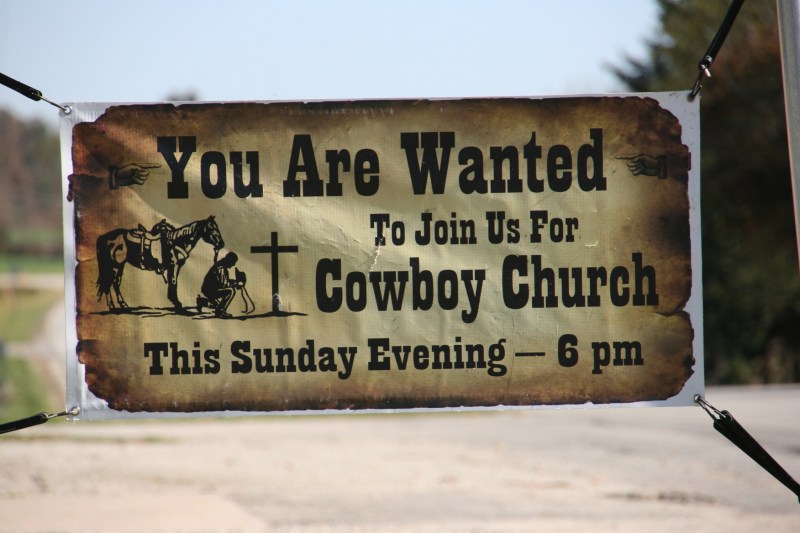
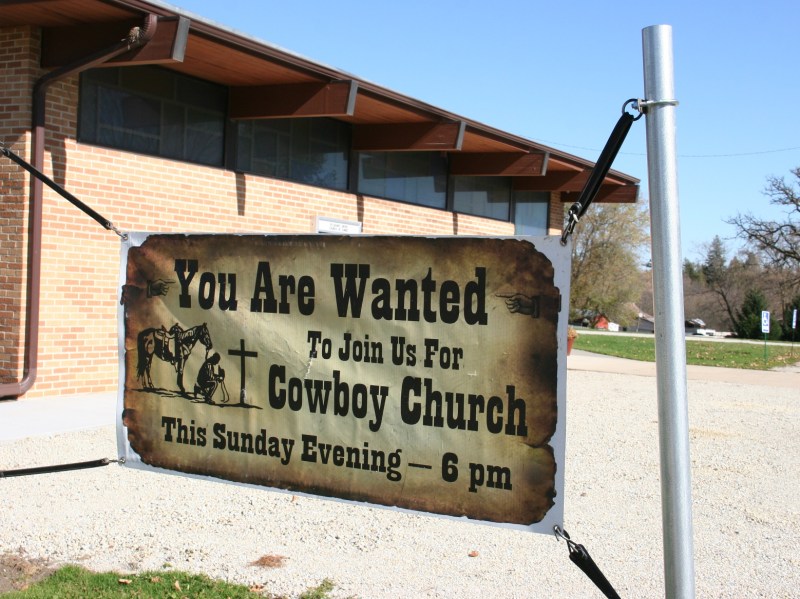
cowboy-church-95-sign-close-up


PUT ON YOUR TEN GALLON HAT, pull on your cowboy boots, and sattle (sic) up your horse or just come as you are in your horseless carriage.

That’s the invitation extended on the Pleasant Grove Church of Christ website for Cowboy Church. Cowboy Church? What exactly is that?


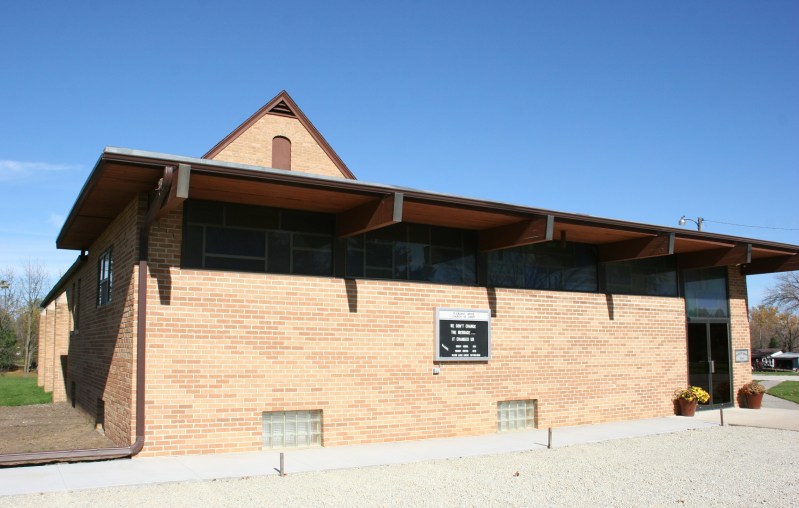
cowboy-church-97-church-building


I wondered the same when I happened upon a banner outside the church in the unincorporated village of Pleasant Grove, yet another interesting place discovered on an autumn day trip to southeastern Minnesota. Pleasant Grove. What a lovely sounding name.


cowboy-church-96-sign-with-church-in-background


But back to that sign. Cowboy Church, according to the website, is a casual bluegrass worship service held at 6 p.m. on the fourth Sunday of the month. It apparently features cowboy musicians and western music, which seems logical given the name. And a meditation.

Past events at Cowboy Church have included an ice cream social; serving of a cowboy’s favorite dessert, pie; and a beef stew supper. Sounds like a good time to me.

TELL ME: Have you ever heard of, or attended, Cowboy Church? Or share a unique church experience outside traditional worship.

This concludes my three-part series from Pleasant Grove, located east of Stewartville or southeast of Rochester. Click here to read Part I and click here to read Part II.

© Copyright 2016 Audrey Kletscher Helbling
 

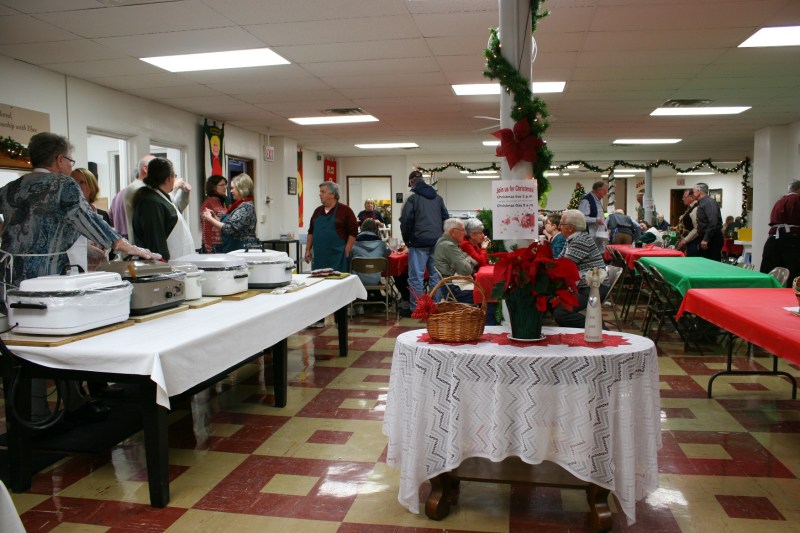
Experiencing the spirit of Christmas at a community dinner in Faribault December 20, 2016

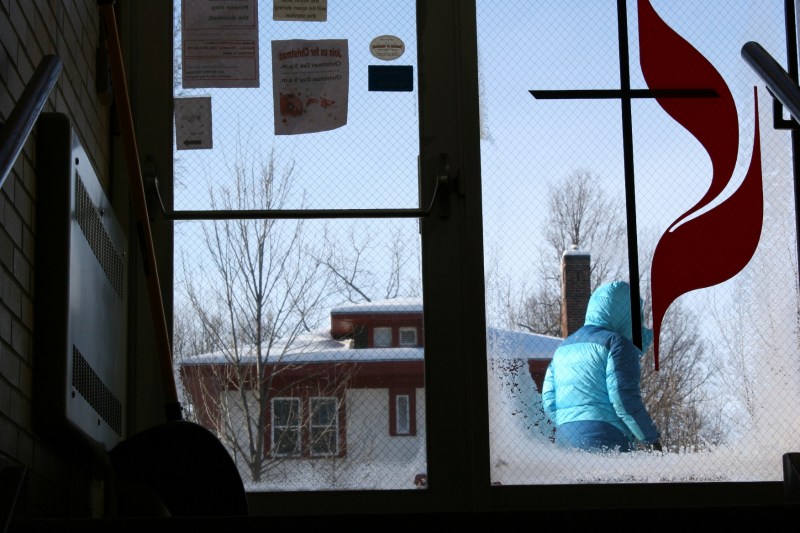
Despite temperatures in the double digits below zero, people braved the cold to attend the Community Christmas Dinner. Here a diner leaves the church.

Despite temperatures in the double digits below zero, people braved the cold to attend the Community Christmas Dinner. Here a diner, bundled against the frigid cold, leaves the church

OUTSIDE FOURTH AVENUE United Methodist Church, a 1990s Ford Fiesta with 300,000 plus miles idled in the bitter cold early Sunday afternoon. Indoors, brothers Tom and Joe, bellies full from a holiday meal of turkey and all the fixings, waited. They hoped their car would warm for the 15-mile ride back home to Owatonna in minus zero temps.

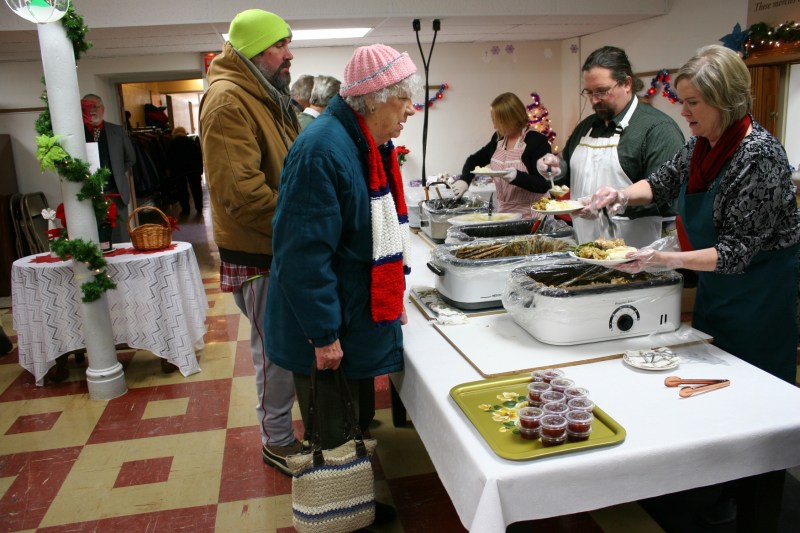
Volunteers plate a meal of turkey, mashed potatoes and gravy, stuffing, meatballs and green beans for diners. Additionally, cranberries and Christmas Cake were on the menu.

Volunteers plate a meal of turkey, mashed potatoes and gravy, stuffing, meatballs and green beans for diners. Additionally, cranberries and Christmas Cake were on the menu.

They’d driven here for the free Community Christmas Dinner served by volunteers from this Faribault congregation. Joe wondered aloud whether he’d need to eat later at an Owatonna church which serves a free meal each Sunday evening.

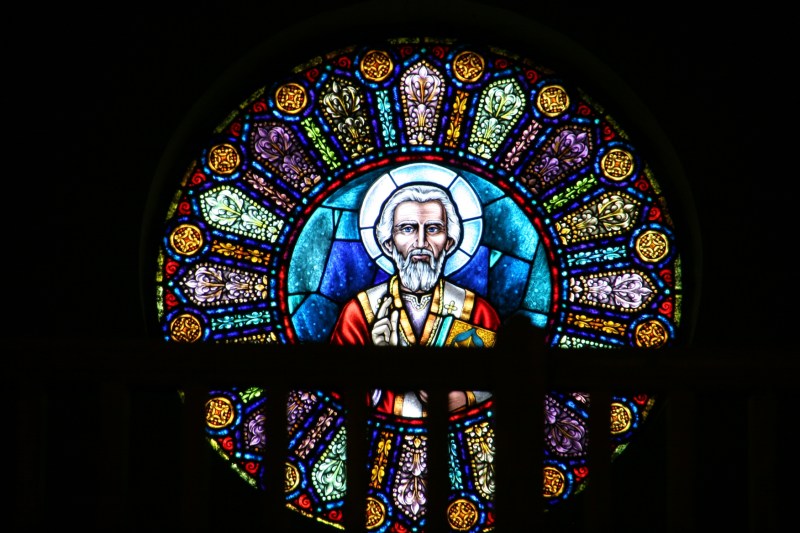
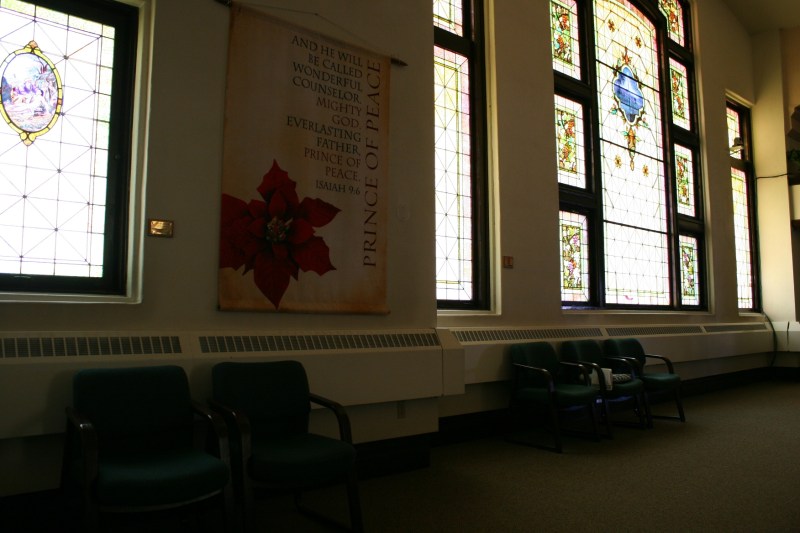
Stunning stained glass windows at the back of the sanctuary.

Stunning stained glass windows at the back of the sanctuary.

While the two waited, I encouraged them to step inside the sanctuary to view the beautiful stained glass windows. The brothers admired the art, Tom pointing to a smaller pane resembling one in his childhood home, the house that became his after their father’s passing. Soon, I bid them farewell, wishing them both a Merry Christmas.

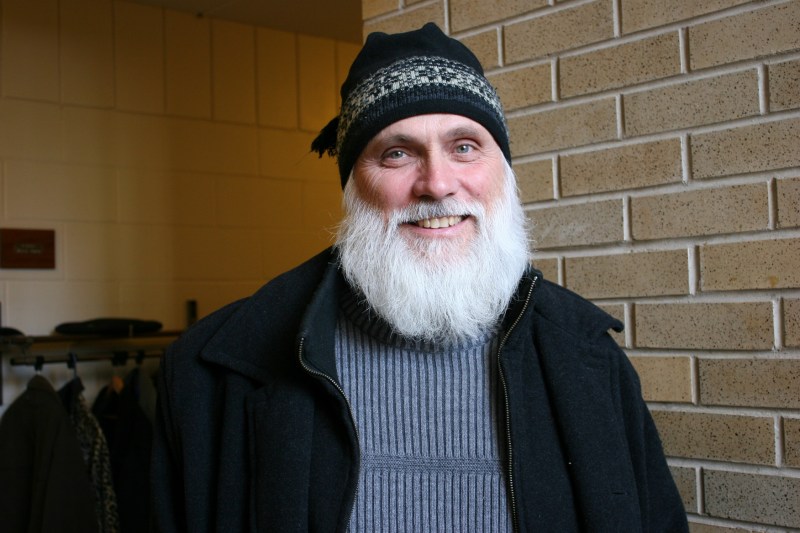
Doesn't he look just like Saint Nick?

Doesn’t he look just like Saint Nick?

Back in the church basement hallway, I came face-to-face with Santa Claus. Not in his suit, but looking every bit the part with a full white beard and a twinkle in his eye. The guy (whose name I didn’t get because who asks Santa for his “real” name?) plays Santa occasionally—for his step-daughter’s special needs class. He clearly enjoys the opportunity to bring joy to these students.

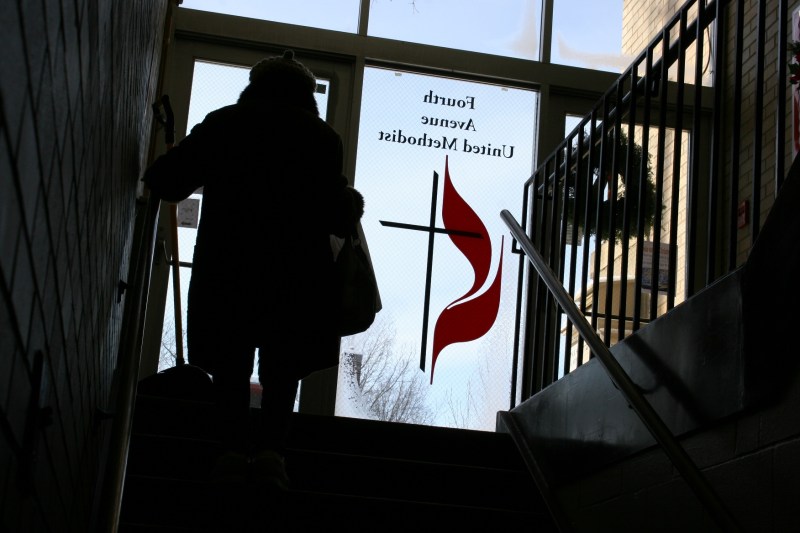
Exiting the church after dinner.

Exiting the church after dinner.

Later, I observed an elderly woman climb the basement stairs, plastic bag in hand with meal left-overs inside. I watched as my husband held the door for her, stepped outside and helped her across the snow-packed sidewalk to her car.

Diners sat down to a holiday meal in the church basement.

Diners sit down to a holiday meal in the church basement.

In all three instances—in the conversations with brothers Tom and Joe, in the quick photo shoot of Santa, in the care Randy showed to the elderly woman, I experienced the spirit of Christmas. Gratitude and giving. Giving and gratitude.

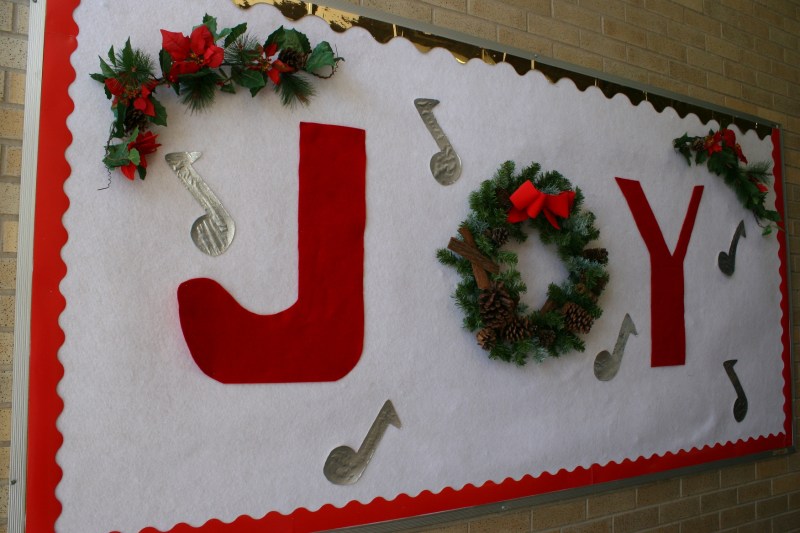
This bulletin board, just inside the side entry to the church basement, proclaims holiday joy.

This bulletin board, just inside the side entry to the church basement, proclaims holiday joy.

To the many volunteers who prepare, serve and clean up after this holiday community meal, thank you. You provide more than food for the body. On this Sunday, in your church basement, you blessed me and others with Christmas joy. In conversations. In smiles. In helping hands. What a gift.

BONUS PHOTOS:

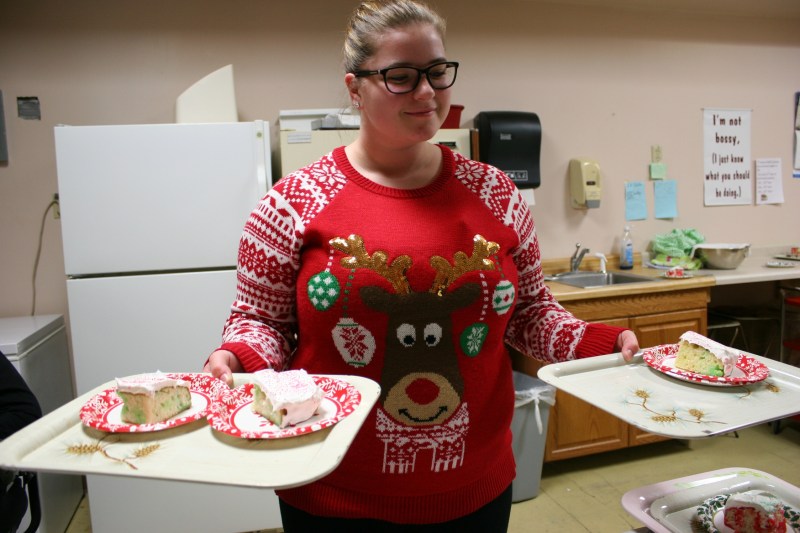
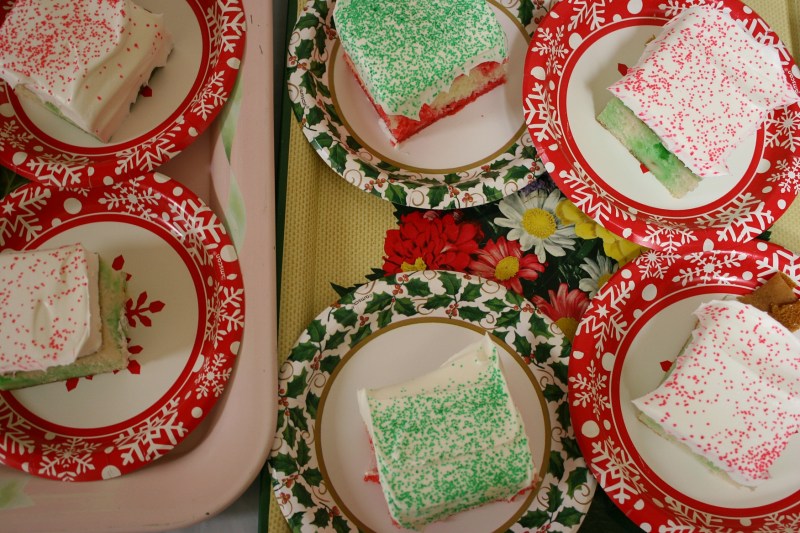
Volunteers served Christmas Cake (aka Poke Cake) and brought left-overs to the Cake Room following the meal.

Volunteers serve Christmas Cake (aka Poke Cake) and return left-overs to the Cake Room following the meal.

Slices of Christmas cake are plated and then delivered to diners on vintage trays.

Slices of Christmas cake are plated and then delivered to diners on vintage trays.

Baby Whitney with her Christmas Cake.

Baby Whitney enjoys Christmas Cake.

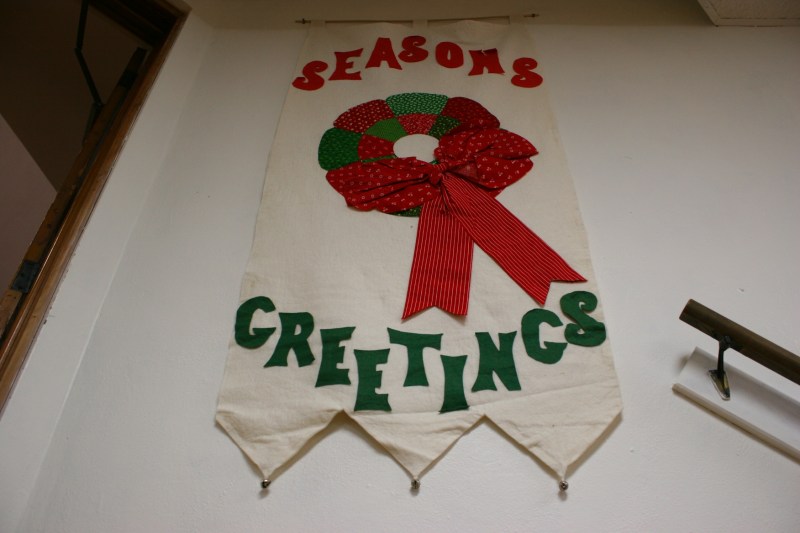
Holiday banners hang from basement walls.

Holiday banners add a festive flair to basement walls.

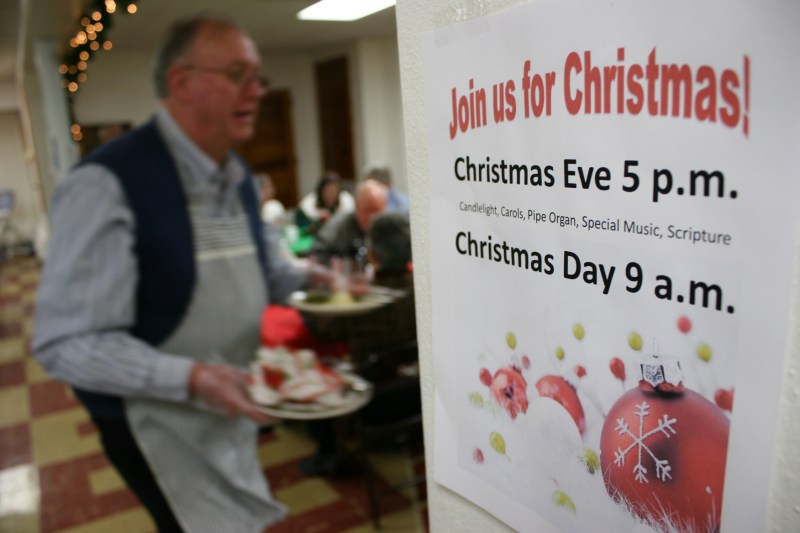
Signs posted throughout the basement welcome guests to Christmas worship services.

Signs posted throughout the basement welcome guests to Christmas worship services.

Volunteers can reach into this tub for aprons.

Volunteers can reach into this tub for aprons.

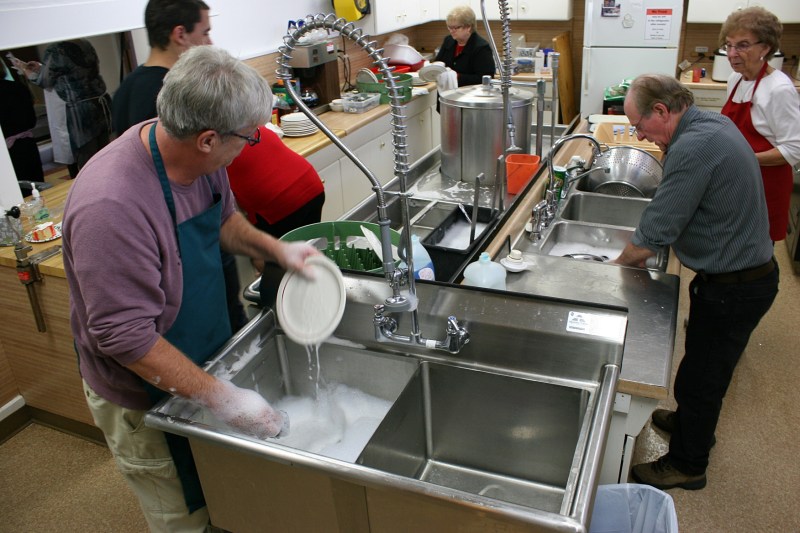
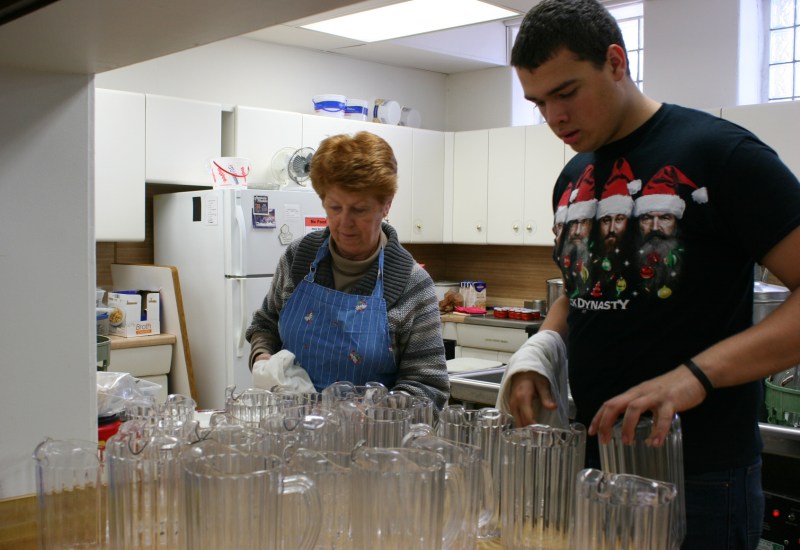
Behind the scenes, volunteers are busy washing dishes.

Behind the scenes, volunteers are busy washing dishes.

Each table is decorated with unique and festive holiday decor.

Each table is decorated with unique and festive holiday decor.

This is the view walking into the dining hall. Diners can leave a free will offering, a portion of which goes to Rice County charities.

This is the view walking into the dining hall. Diners can leave a free will offering in the basket, a portion of which goes to Rice County charities.

Christmas decorations grace a shelving unit.

Christmas decorations grace a shelving unit.

Back in the kitchen, the crew continues to work.

Back in the kitchen, the crew continues to work.

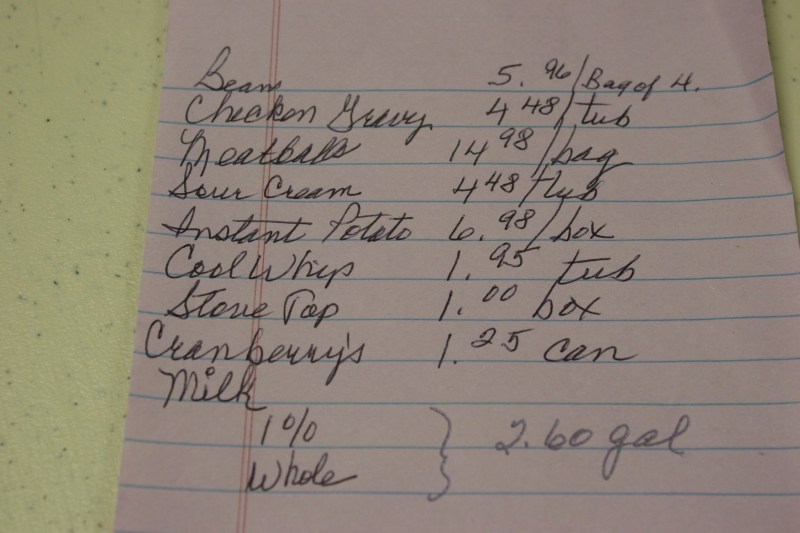
After serving ended, I spotted this food list on a table.

After serving ended, I spotted this food list on a table.

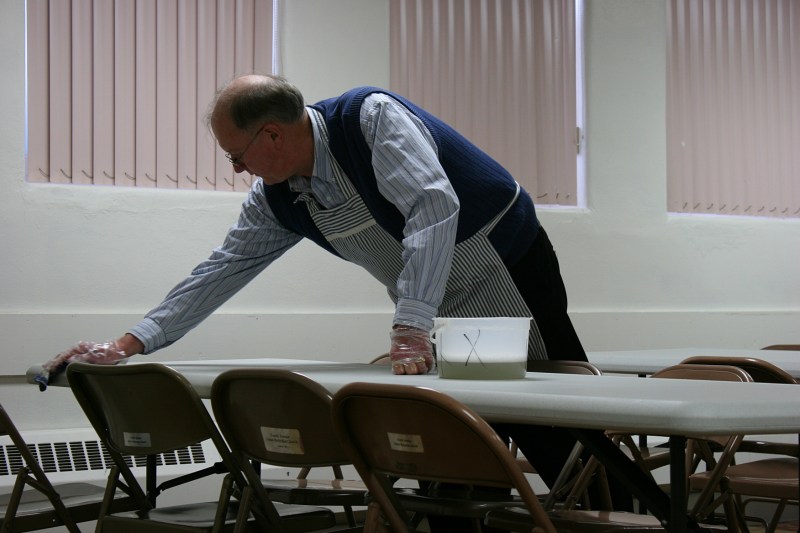
Washing tables after 210 meals were served.

Washing tables after 210 meals were served.

© 2016 Audrey Kletscher Helbling
 

Beyond filling bellies at a Faribault “soup kitchen” June 28, 2016

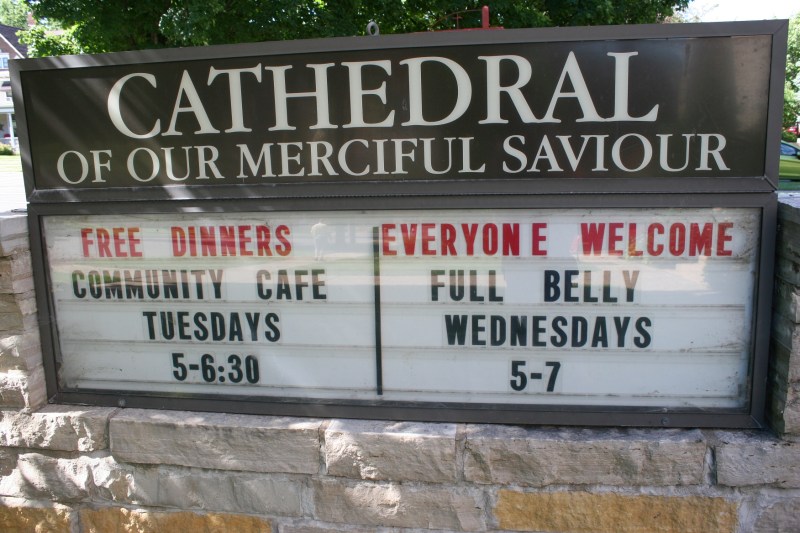
A sign in front of the church advertises the free meals served here twice a week.

A sign in front of the church advertises the free meals served here twice a week.

FOR DONNA STROHKIRCH, finding funding for Full Belly based out of Faribault’s Cathedral of Our Merciful Saviour is an ongoing effort. Feeding the 60 -70 people who come for the non-profit’s free meals on a Wednesday evening costs about $100.

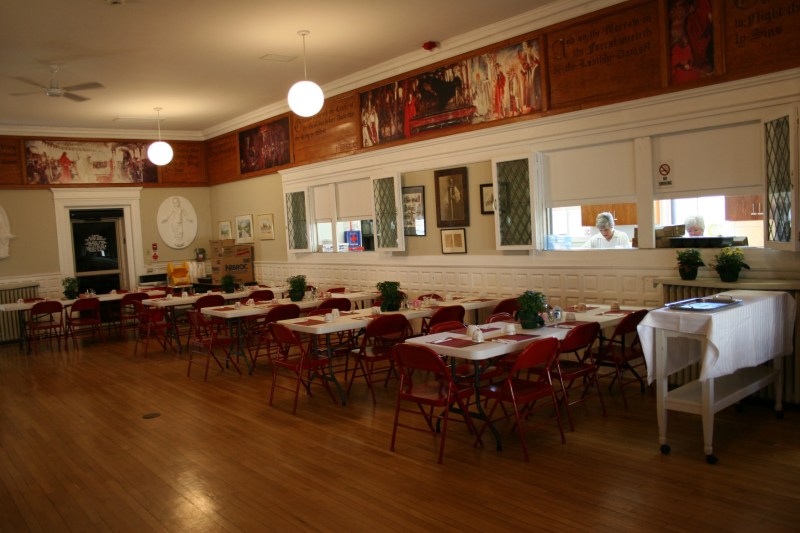
The Guild House dining room and kitchen. Minnesota Prairie Roots file photo.

The Guild House dining room and kitchen. Minnesota Prairie Roots file photo from an unrelated event.

It is, says Donna—meal planner, shopper, cook, greeter and so much more—a miracle that the kitchen continues to operate. She’s already had to trim back from serving three meals weekly to just once a week. And even though she’s dipped into her Social Security income to provide for those in need, this seventy-something woman remains prayerfully optimistic. God always provides, she says. With a smile.

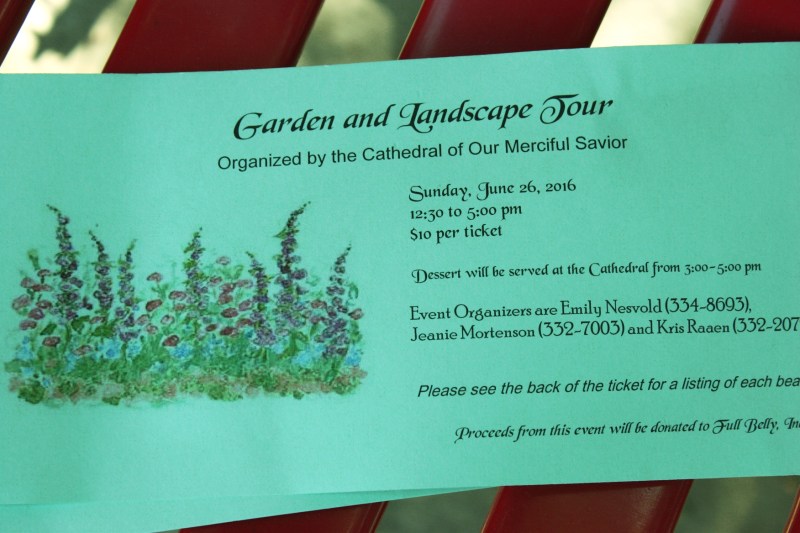
The beautifully-designed tickets, complete with directions to the gardens on the back.

The beautifully-designed tickets, complete with directions to the gardens on the back.

Sunday afternoon, Full Belly benefited from a Cathedral-organized Garden and Landscape Tour. I talked with Donna about her meal ministry after touring six Faribault area gardens on a brilliantly sunny and beautiful summer afternoon in southern Minnesota.

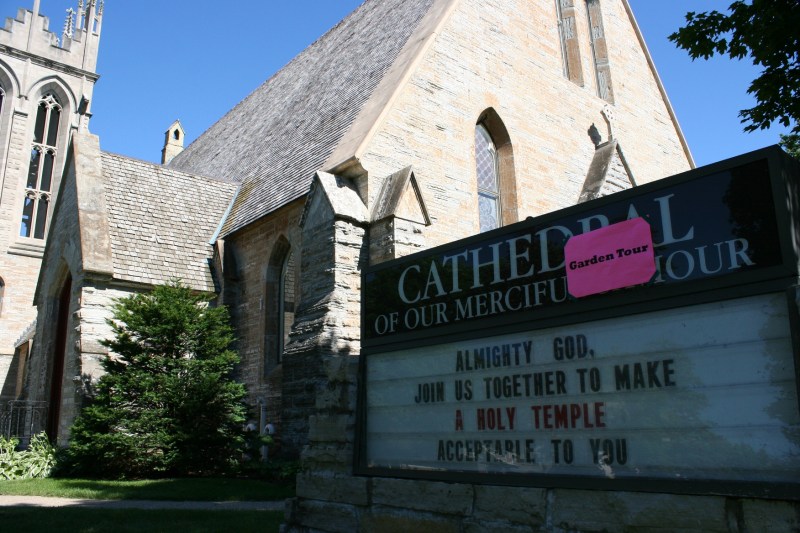
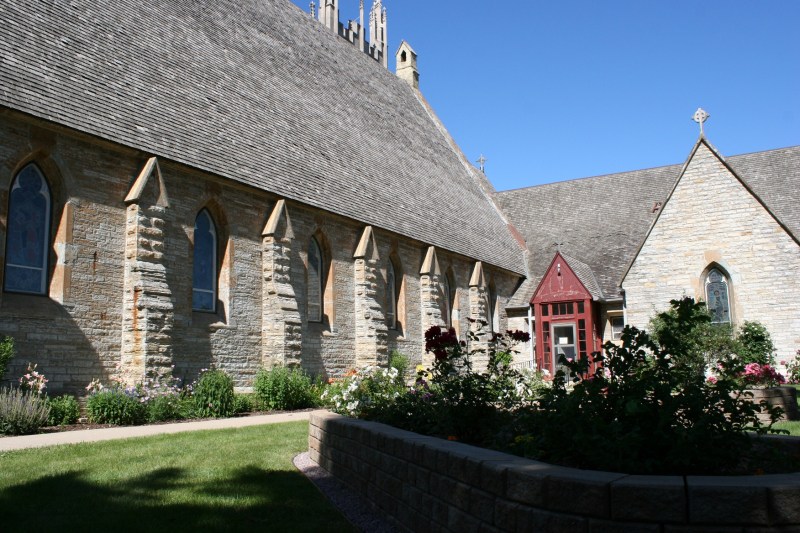
The Cathedral of Our Merciful Saviour is the first Episcopal church in the U.S. to be built as a cathedral. Construction began in 1862 and was completed in 1869.

The Cathedral of Our Merciful Saviour is the first Episcopal church in the U.S. to be built as a cathedral. Construction began in 1862 and was completed in 1869. It attracts lots of visitors interested in this historic building.

Inside the air conditioned space connecting the Cathedral and Guild House, Donna answered my questions between welcoming guests to a dessert table. “It’s always been my mission to have a soup kitchen,” she says, referencing the extensive poverty she witnessed in Alaska before moving to Minnesota three years ago. Shortly thereafter, with the support of family, she started Fully Belly. It’s truly a family affair with a daughter-in-law, grandkids and several unpaid volunteers assisting Donna.

Beautiful gardens, complete with benches, grace the area that connects the cathedral to the Guild House.

Beautiful gardens, complete with benches, grace the area that connects the Cathedral to the historic Guild House, left.

They serve full, well-balanced meals, not just soup, to anyone in need. Most diners are elderly, living on fixed incomes. “Food is me,” says Donna, who comes with a broad background in the food profession. “Love and food kind of go together.”

Lovely lilies in a side garden remind me of

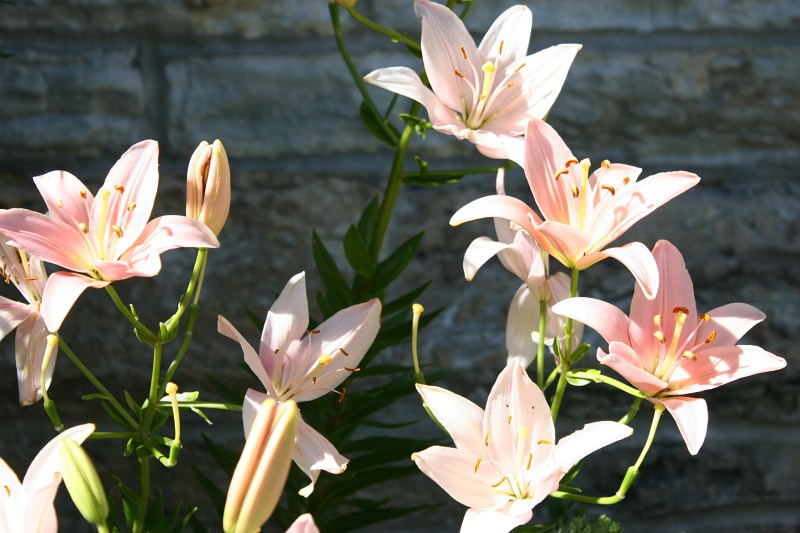
Lovely lilies in a Cathedral side garden remind me of Matthew 6:28, “Consider the lilies of the field, how they grow. They don’t toil, neither do they spin.”

It’s clear from our brief conversation that Donna’s purpose extends beyond filling empty bellies. “It’s my mission from God to help people. I’ve always taken care of people,” she says. Full Belly also provides much-needed fellowship. It is that social aspect, that showing love to others, that food for the soul, which fuels Donna’s passion for feeding others a free meal once a week. She mingles with her dinner guests, talks to them, makes them feel welcome.

Flowers grow alongside the Cathedral and Guild House and in expansive beds.

Flowers grow alongside the Cathedral and Guild House and in expansive beds.

Donna is clearly passionate about feeding the hungry in the Faribault community. And then she mentioned one more thing: She’s always wanted to go on a mission trip. But she lacks money for such a trip and she’s dealing with health issues. Yet, she seems determined. I expect, as she has with Full Belly, that Donna will find a way to finance a mission trip, fulfilling what she views as her life’s mission—to help people.

FYI: Click here to learn more about Full Belly, including information on how you can support this meal ministry. Full Belly serves a free meal from 5 p.m. – 7 p.m. Wednesday evenings at the Cathedral Guild House, behind the church (515 Second Avenue Northwest) near downtown Faribault.

The Community Cathedral Cafe also serves free meals at the Cathedral Guild House from 5 p.m. – 6:30 p.m. Tuesdays.

Check back as I take you to the gardens featured on the Fully Belly fundraiser garden tour.

© Copyright 2016 Audrey Kletscher Helbling
 

Part II: The detailed craftsmanship of Holden Lutheran Church April 1, 2016

Filed under: Uncategorized — Audrey Kletscher Helbling @ 5:00 AM

Tags: , , , , , , ,
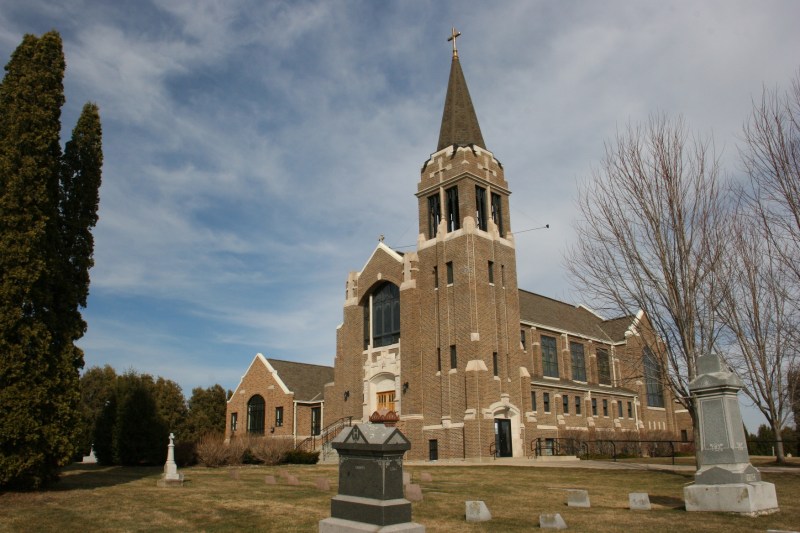
Holden Lutheran Church, rural Kenyon, Minnesota.

Holden Lutheran Church, rural Kenyon, Minnesota.

IT IS THE DETAILS, always the details, that define a place, a person, a whatever. In long-standing country churches, especially, detailed craftsmanship prevails.

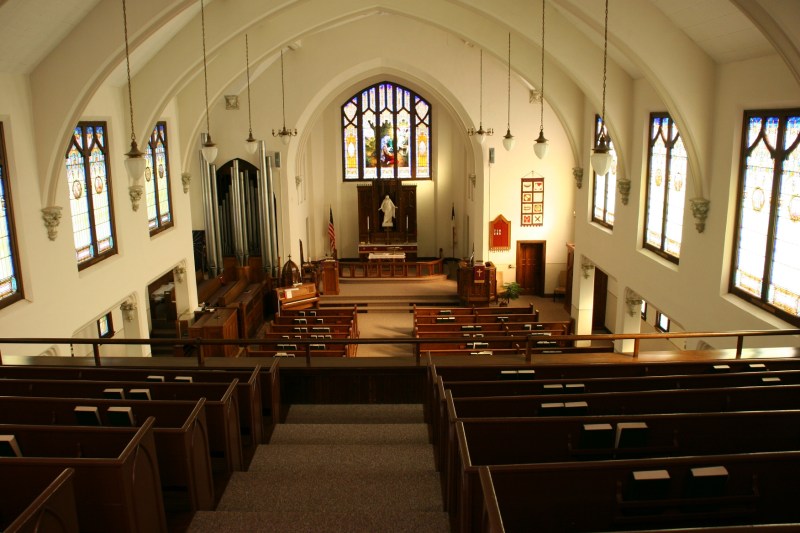
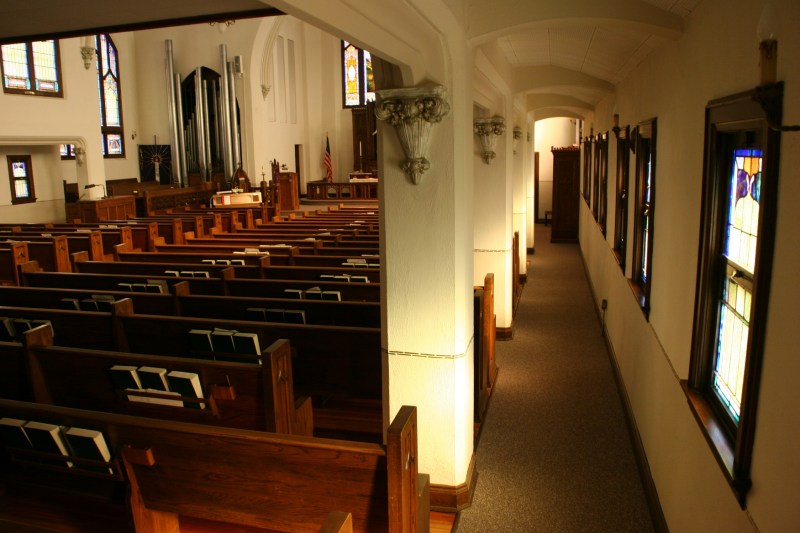
The sanctuary as photographed from the balcony.

The sanctuary as photographed from the balcony.

Craftsmanship and beauty at the altar.

Craftsmanship and beauty at the altar.

This glorious Easter themed window shines above the altar.

This glorious Easter themed window shines above the altar.

Looking from the front of the sanctuary to the rear and the balcony.

Looking from the front of the sanctuary to the rear and the balcony.

Holden Lutheran Church, rural Kenyon, Minnesota, is a prime example with countless stained glass windows, handcarved wood and chiseled stone. I can imagine the rough hands of a Norwegian farmer, the calloused hands of a bricklayer, the creative hands of an artist shaping this church into this glorious house of worship.

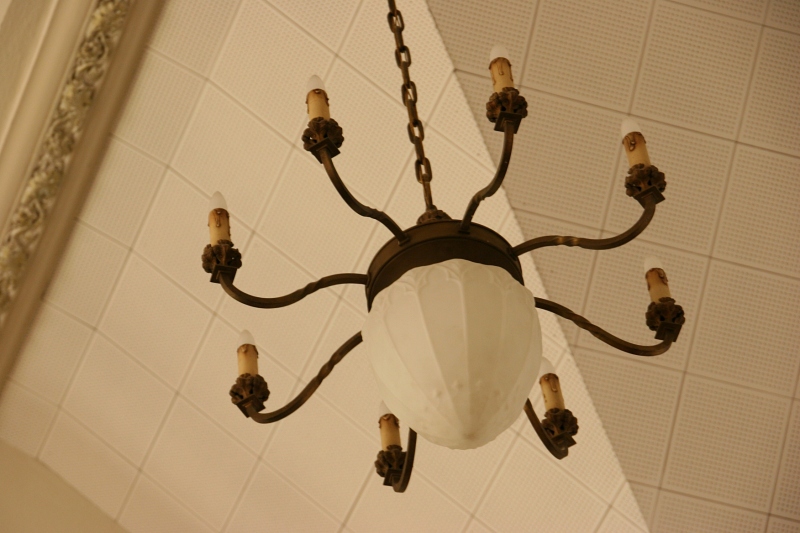
I assume this is an original vintage light suspended in the sanctuary.

I assume this is an original vintage light suspended in the sanctuary.

I wonder, though, did long ago parishioners form committees, as Lutherans are wont to do, or did they simply do what needed to be done? The current congregation has several committees, including a Property Management Committee.

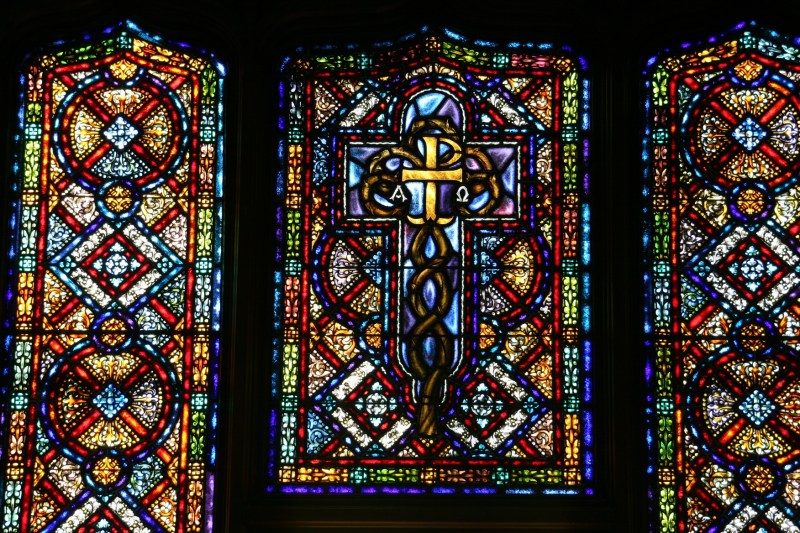
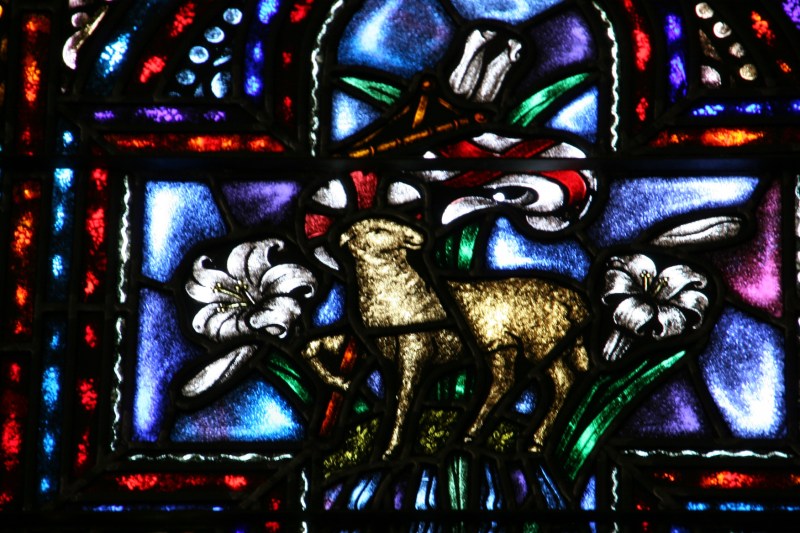
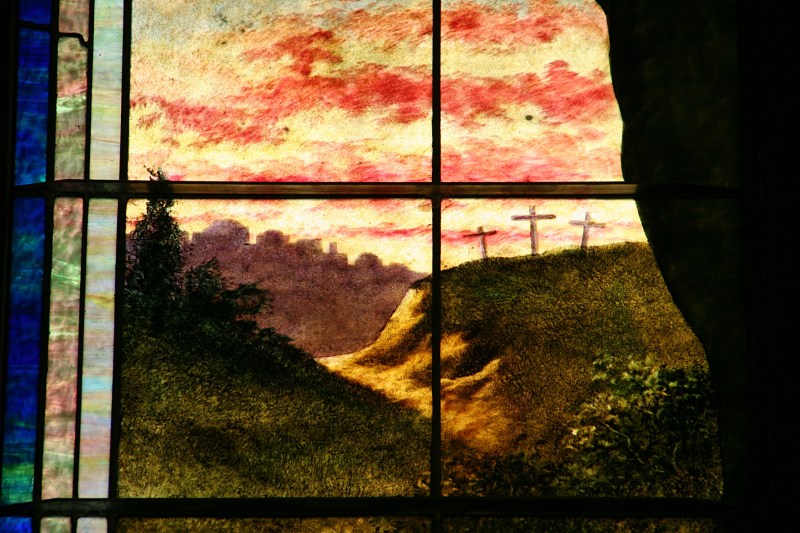
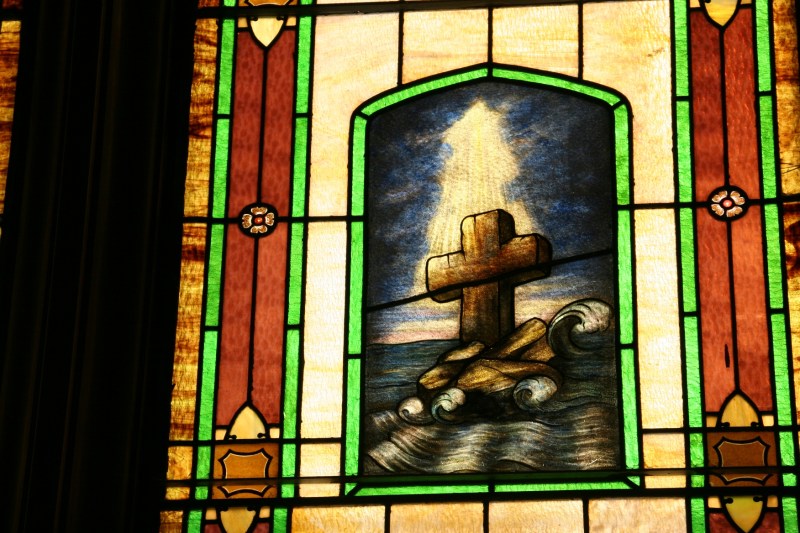
Look at the details of three distant crosses in this snippet of a stained glass window.

Look at the detail of three distant crosses in this snippet of a stained glass window.

However Holden evolved, I am impressed, as I often am, by the efforts entailed in building a structure like this for $56,687 in 1924 without modern day tools and equipment. How did they do it? Hard work and determination, I expect.

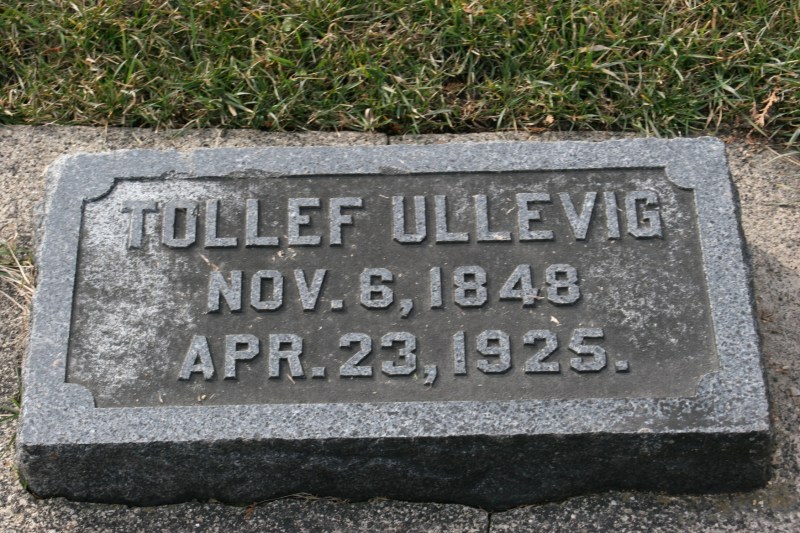
Gravestones bear many Norwegian names.

Gravestones bear many Norwegian names.

It takes a lot of money to sustain and improve such a massive structure and to pay the heating and other bills. That Holden continues to do so reveals faithfulness, tenacity and a determined spirit that traces to the Norwegian immigrants who founded this congregation.

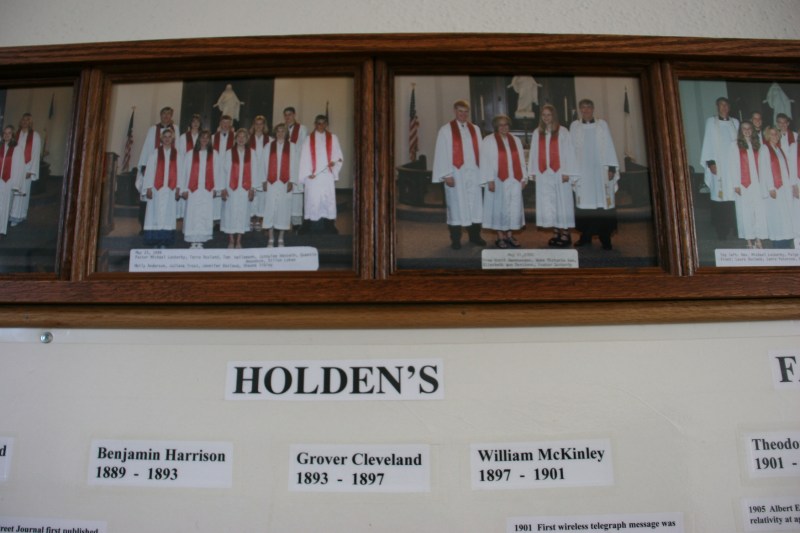
Confirmation photos hang above a history timeline.

Confirmation photos hang above a history timeline.

History remains an integral part of Holden as evidenced in a time-line posted inside the church and in photos displayed.

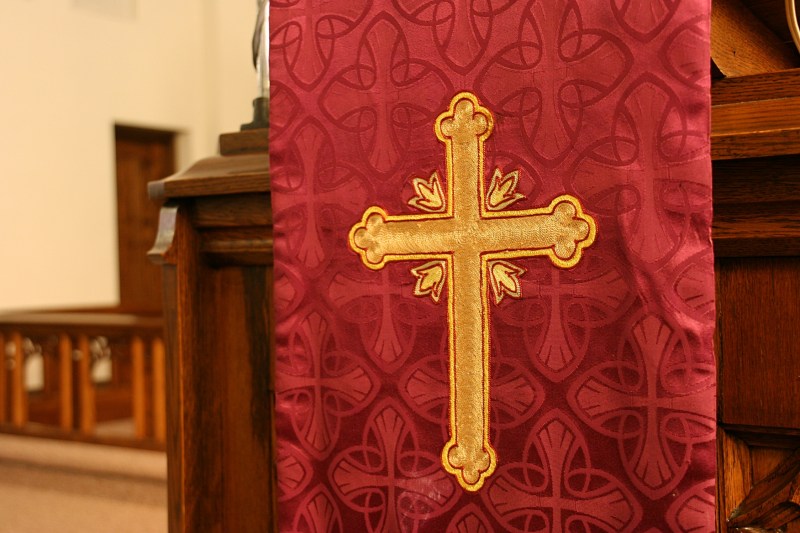
Hanging from the pulpit.

The art of a seamstress hangs from the pulpit.

This bible, lying open on the lectern, was turned to

This bible, lying on the lectern, is open to Proverbs 6 – 8.

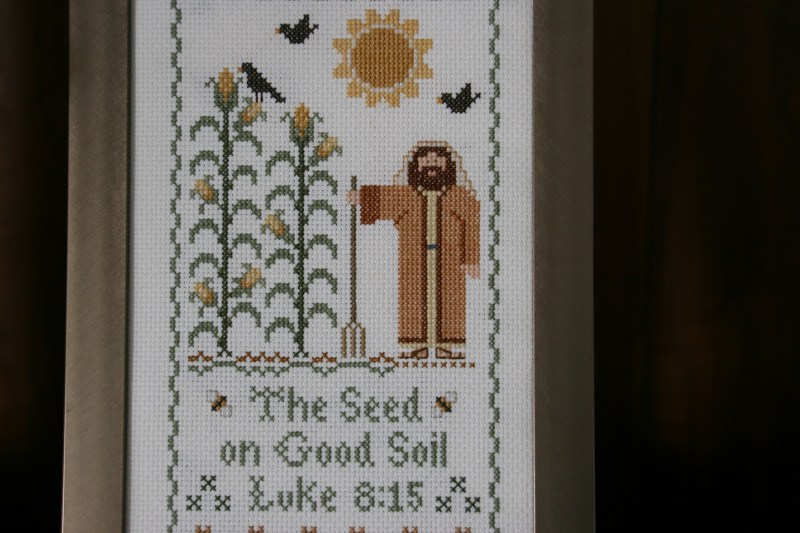
I photographed this counted cross-stitch art in the church basement. It seems especially fitting for this rural region of Minnesota.

I photographed this counted cross-stitch art in the church basement. It seems especially fitting for this rural region of Minnesota.

Details, too, still matter. One need only look to see them. It is the details, always the details, that define a place like Holden Lutheran Church.

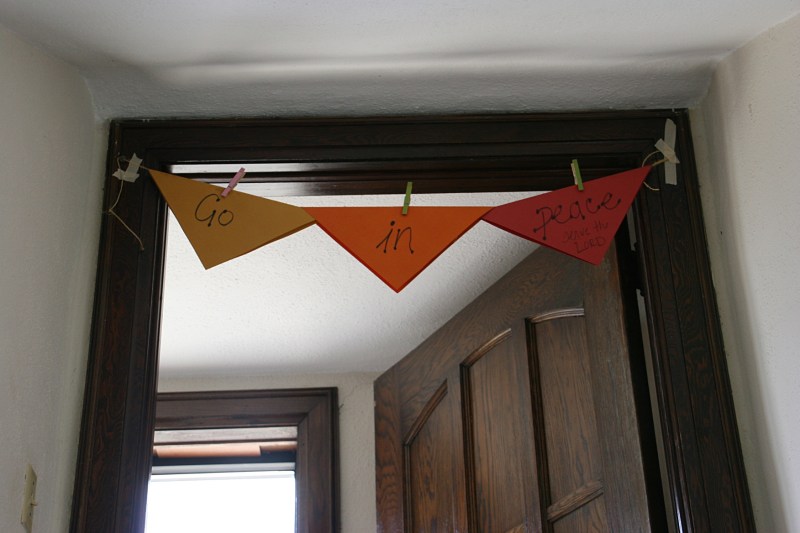
A simple banner message for those exiting the church entry to the south.

A simple banner message for those exiting the church to the south.

FYI: Click here to read my first post on Holden.

© Copyright 2016 Audrey Kletscher Helbling
 

Part I: Inside Holden, an historic Norwegian Lutheran church in rural Minnesota March 31, 2016

Holden Lutheran Church, rural Kenyon, Minnesota.

Holden Lutheran Church, rural Kenyon, Minnesota.

THE LAST TIME I STOPPED at Holden Lutheran Church, rural Kenyon, the heavy oak doors to the sanctuary were closed and Sunday morning worship underway. Not wanting to intrude in the middle of the service, my husband and I instead wandered the cemetery, vowing to return.

The beautiful sanctuary of Holden Lutheran Church.

The beautiful sanctuary of Holden Lutheran Church.

Several weeks ago we did, on a Saturday afternoon, en route home from Wanamingo to Faribault along the back roads rather than the more direct Minnesota State Highway 60. Goodhue County Road 30 led us right by this landmark Norwegian brick church standing high and solid among farm fields and farm sites.

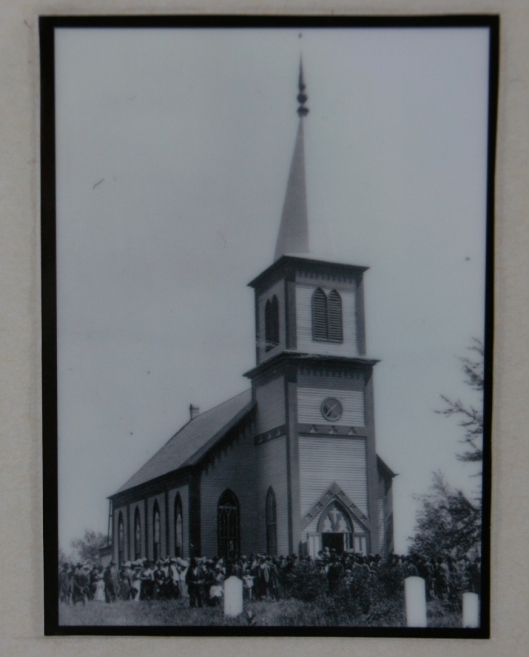
A photo of the "old church" is posted in the present church.

A photo of the “old church,” built in 1871, is posted in the present church.

With my rural roots and deep appreciation for country churches, I was excited to tour this church built in 1924. The congregation was established in 1856. Previously, members worshiped (for 53 years) in a standard wood-frame country church.

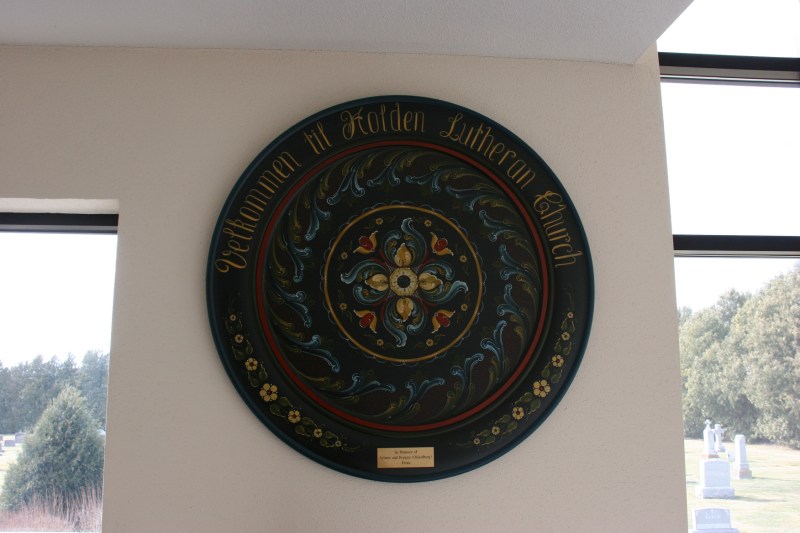
Holden's Norwegian heritage is reflected in this rosemaling art hung in the narthex.

Holden’s Norwegian heritage is reflected in this rosemaling art hung in the narthex.

This congregation is especially notable for its strong Norwegian heritage tracing back to Telemarken, Norway, specifically the village of Holden. From thence comes the name.

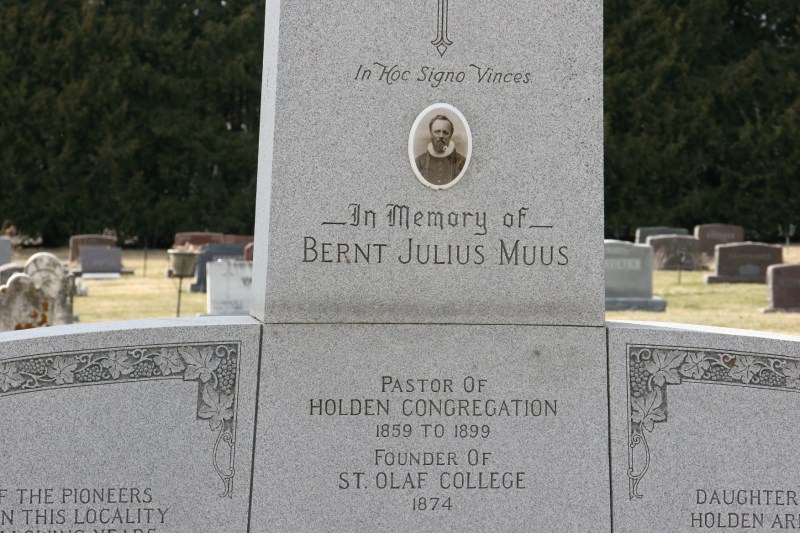
This memorial to the Rev. Bernt Muus was built in

This memorial to the Rev. Bernt Muus was unveiled in May 1937. It is dedicated “In gratitude to God who enabled the pioneers to establish His church in this community…and to the pioneers for building upon Jesus Christ and His Word.”

Holden Lutheran is also notable for its connections to Luther College in Decorah, Iowa, and to St. Olaf College in Northfield, Minnesota. A memorial on the church grounds honors Holden’s first pastor, Bernt Julius Muus, who founded St. Olaf and helped to found Luther. He shepherded Holden for 40 years.

Stained glass windows fill the sanctuary, including this one in the balcony.

Stained glass windows fill the sanctuary, including this one in the balcony.

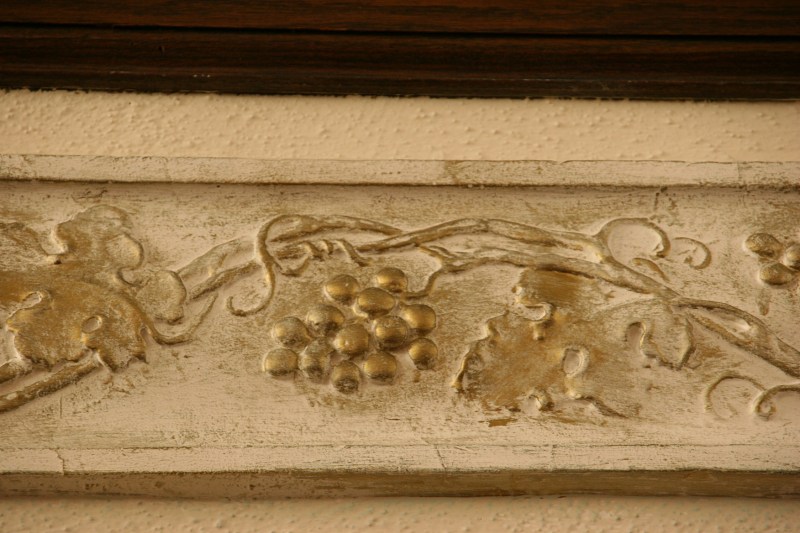
Grapes carved into wood along the balcony.

Grapes carved into wood along the balcony.

A view of a sanctuary side aisle showcases the craftsmanship of this church.

A view of a sanctuary side aisle showcases the craftsmanship of this church.

This is a place of deep history and heritage reflected in craftsmanship and artifacts within the church building.

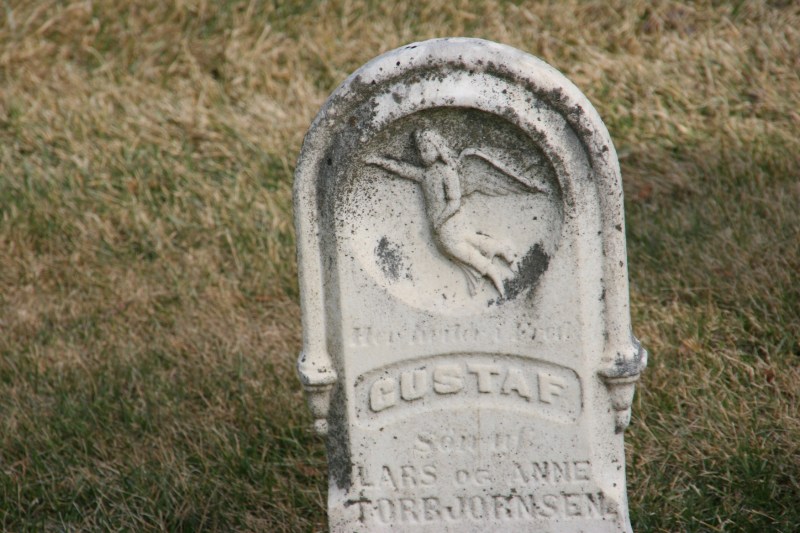
A gravestone in the old part of the cemetery surrounding the church.

A gravestone in the old part of the cemetery.

And in names—like Gustaf, Tollef, Ole—chiseled in to stone in the graveyard.

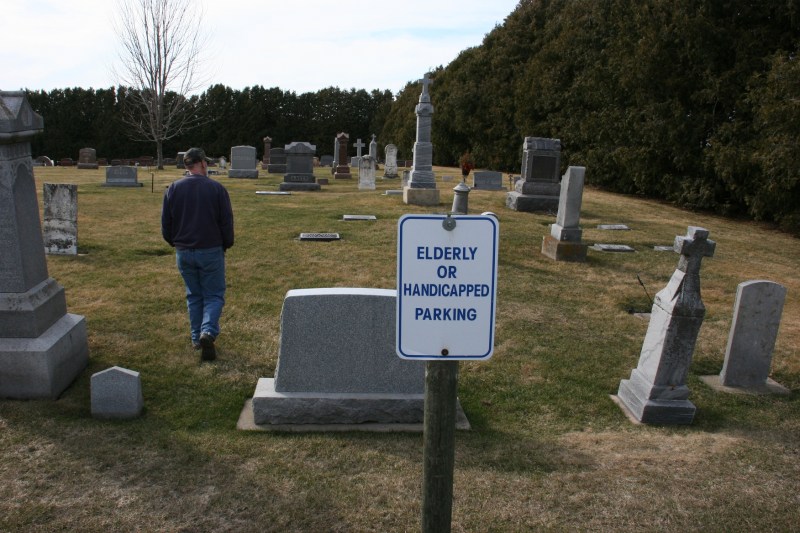
I trail Randy from the back church parking lot into another section of the cemetery.

I trail Randy from the back church parking lot into another section of the cemetery.

Here in this rural place, the wind blows steady on a sunny spring-like March afternoon. I meander with my husband among the gravestones, noting a weathered holiday wreath on one. And then, as I step back and back and back to photograph this massive church in its entirety, I skirt a mound of fresh earth. Not that long ago, mourners gathered here, like the Norwegian speaking settlers 160 years prior, to grieve and to bury a loved one.

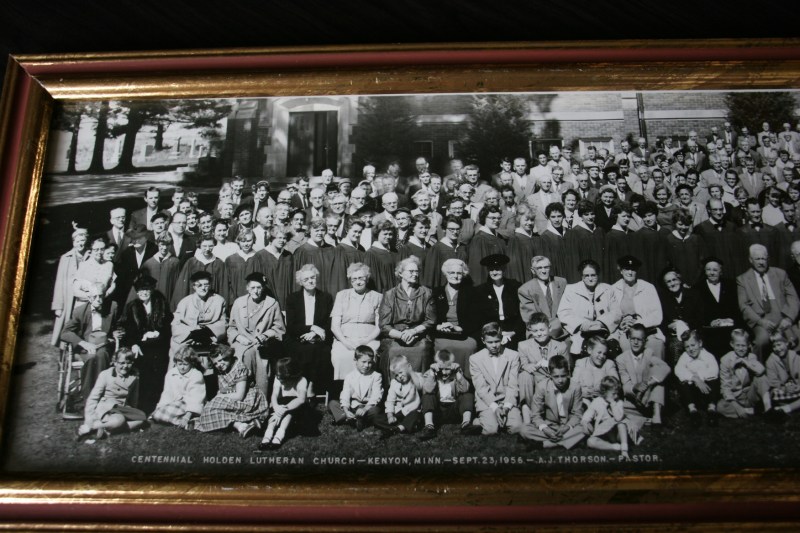
In the church basement, I found and photographed a portion of the church centennial photo.

In the church basement, I found and photographed a portion of the church centennial photo.

Time imprints upon generations in the cycle of life.

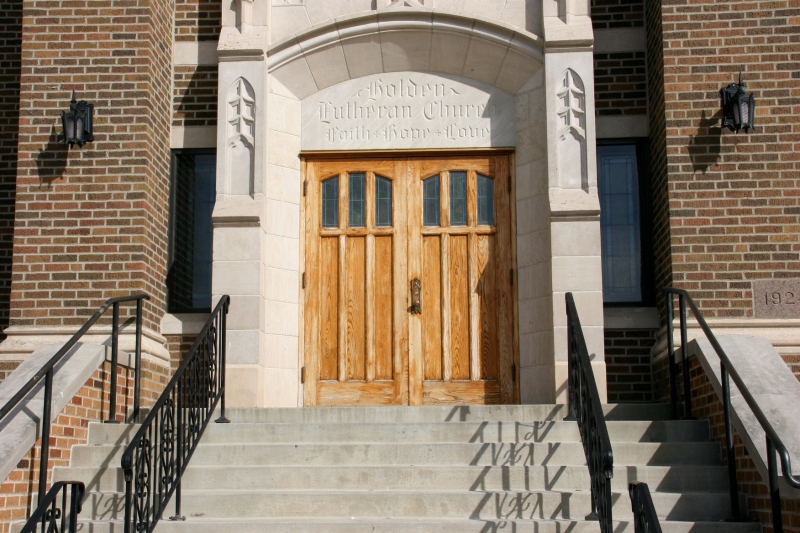
The front entry to Holden Lutheran is stunning. Faith, hope and love are chiseled above the oak doors.

The front entry to Holden Lutheran is stunning. Faith, hope and love are chiseled above the oak doors.

Through these church doors, below the far-reaching steeple tipped with a cross, the faithful have gathered here to worship God, to exchange vows, to baptize children, to mourn the dead. And in late autumn to dine on roast beef, pulsa, lefse, rommegrot and fruit soup at the annual All Saints Dinner celebrating Holden’s Norwegian heritage.

FYI: Check back tomorrow for more photos from Holden Lutheran Church.

© Copyright 2016 Audrey Kletscher Helbling
 

With joy & thankfulness on Easter March 27, 2016

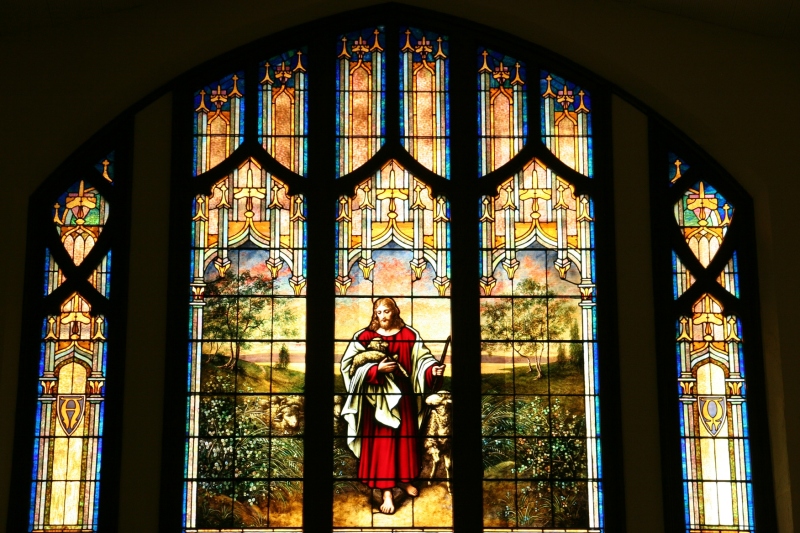
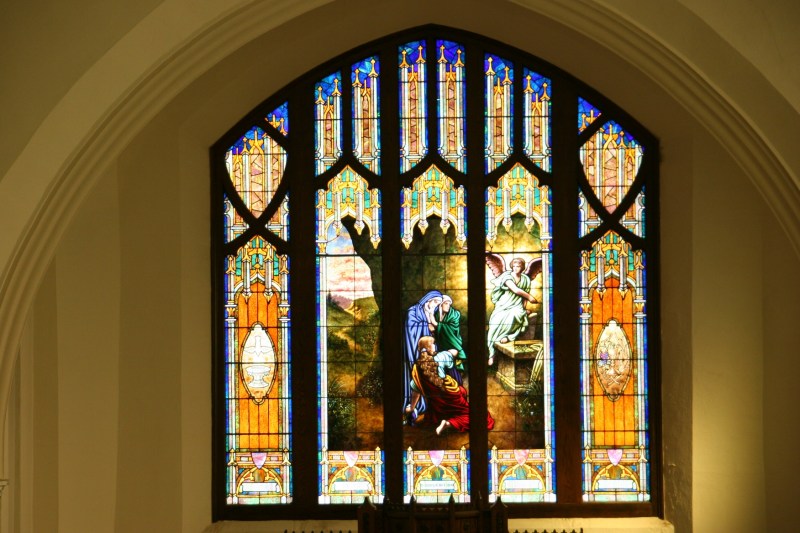
This stained glass window of the women at Jesus' empty tomb rises above the altar at Holden Lutheran Church, rural Kenyon, Minnesota.

This stained glass window of the women at Jesus’ empty tomb rises above the altar at Holden Lutheran Church, rural Kenyon, Minnesota.

Why do you look for the living among the dead?

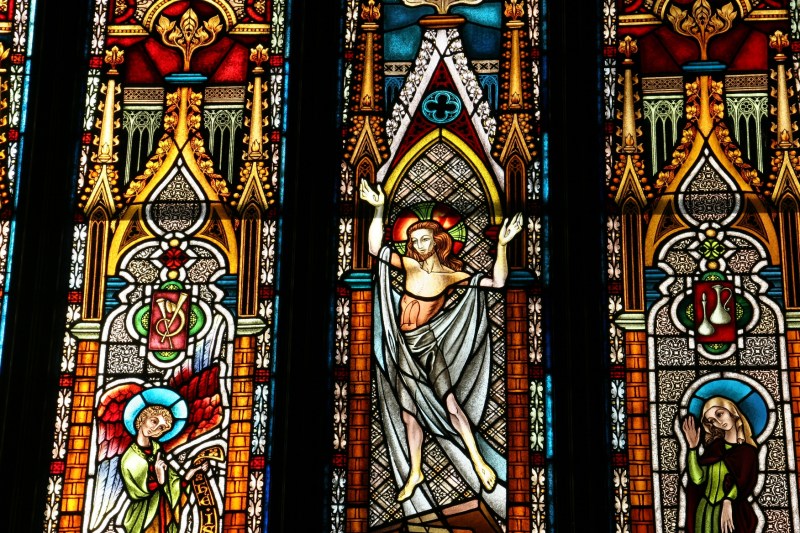
This shows a snippet of the center stained glass window in a trio above the altar at Trinity Lutheran Church, Wanamingo, Minnesota.

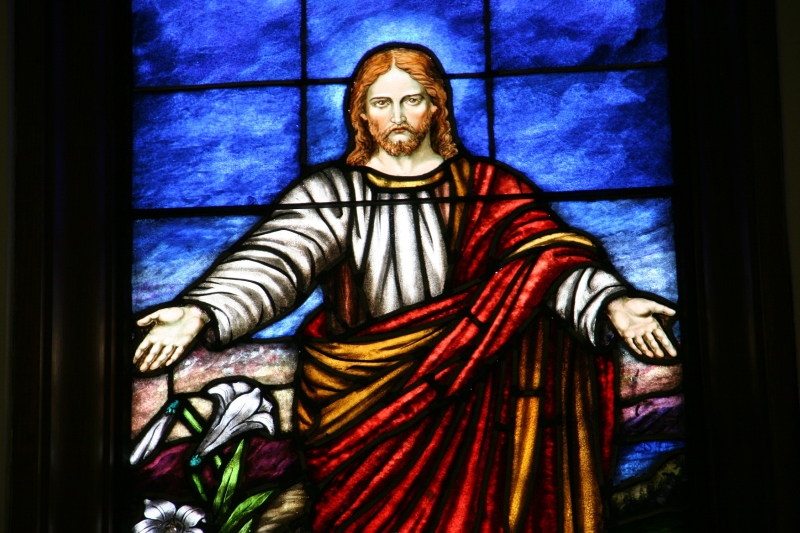
This depiction of the risen Lord centers three stained glass windows above the altar at Trinity Lutheran Church, Wanamingo, Minnesota.

He is not here; he has risen!

© Photos copyright 2016 Audrey Kletscher Helbling

Scripture text from the New International Version of the Holy Bible, Luke 24:5 & 6


In loving remembrance & with gratitude on Good Friday March 25, 2016

Filed under: Uncategorized — Audrey Kletscher Helbling @ 5:00 AM
Tags: , , , , , , ,
A stained glass window inside Holden Lutheran Church, rural Kenyon, Minnesota.

A stained glass window inside Holden Lutheran Church, rural Kenyon, Minnesota.

Copyright 2016 Audrey Kletscher Helbling

 

Part IV from Wanamingo: Touring Trinity Church March 24, 2016

Filed under: Uncategorized — Audrey Kletscher Helbling @ 5:00 AM
Tags: , , , , , , , , ,
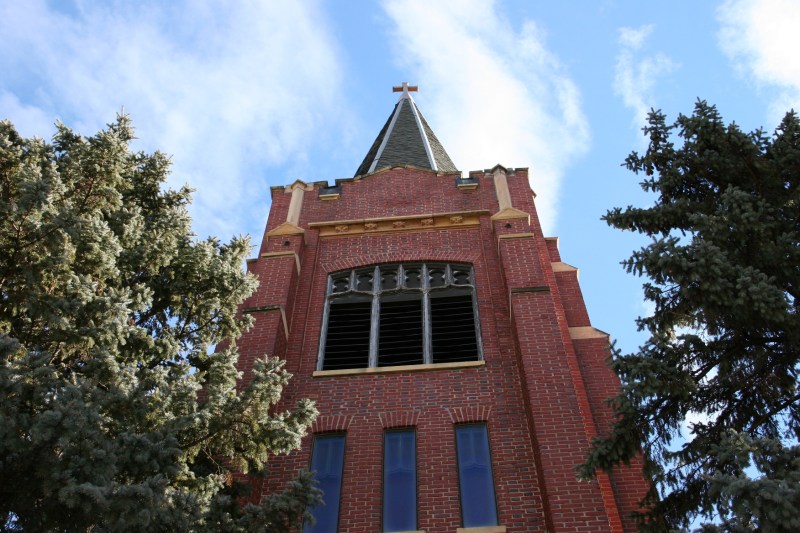
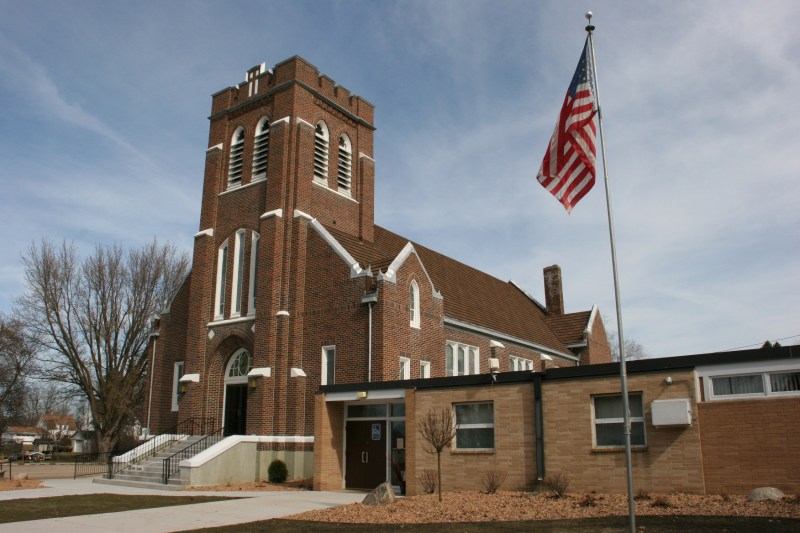
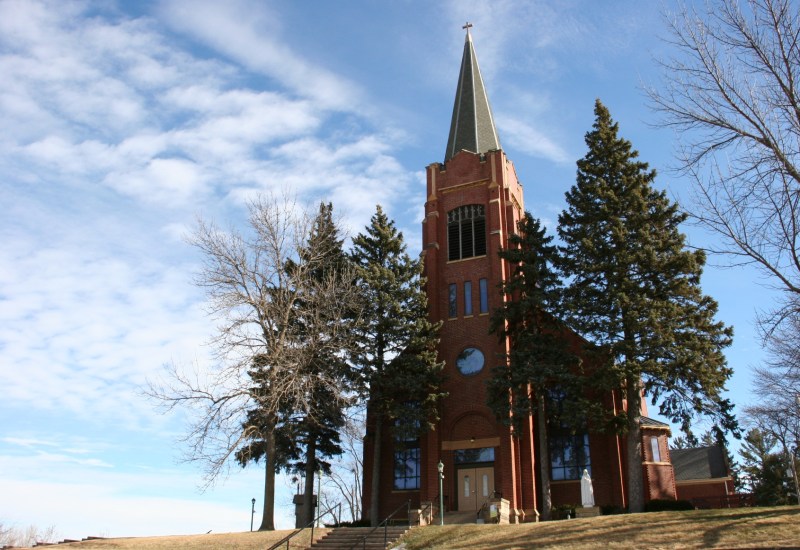
Trinity Lutheran Church, 301 Second Avenue, Wanamingo, Minnesota.

Trinity Lutheran Church, 301 Second Avenue, Wanamingo, Minnesota.

THE LUTHERAN CHURCH STANDS solid on a corner lot a few blocks off Wanamingo’s Main Street. Brick strong. Enduring strong. In the faith strong.

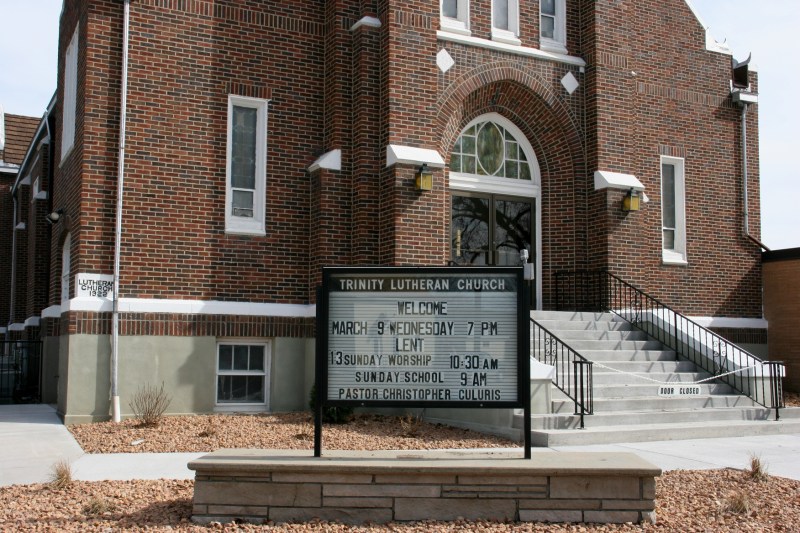
The cornerstone of this ELCA church is dated 1922, to the left in this photo.

The cornerstone of this ELCA church is dated 1922, to the left in this photo.

A cornerstone on Trinity Lutheran Church simply notes LUTHERAN CHURCH 1922. I know nothing more about the history of this congregation, of this building.

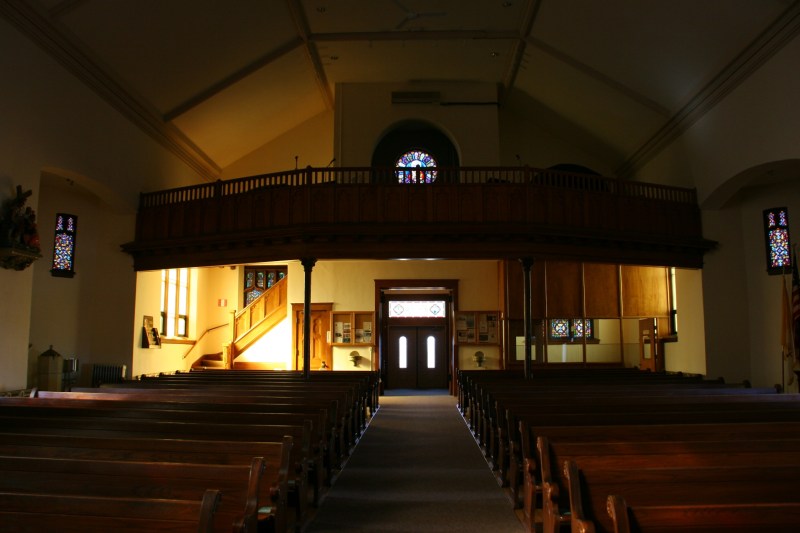
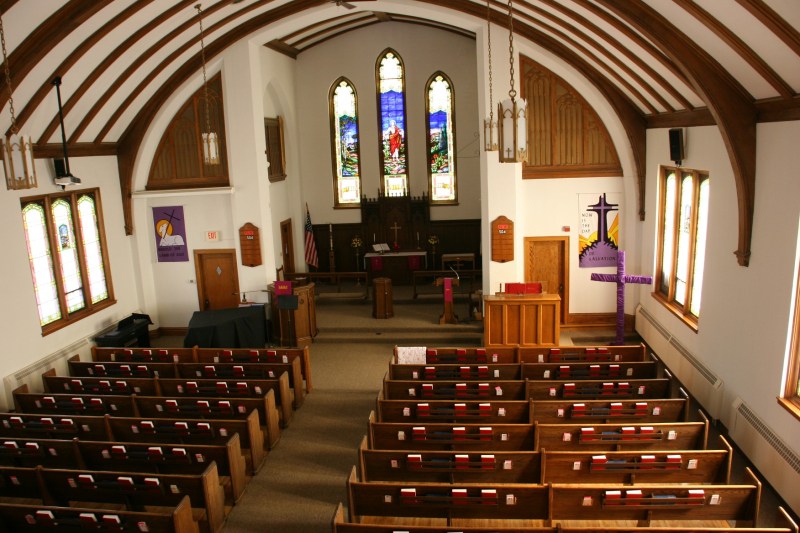
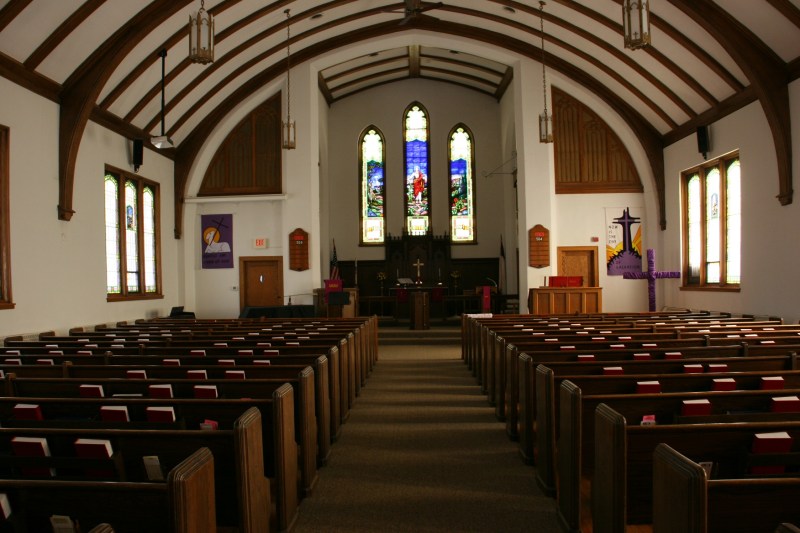
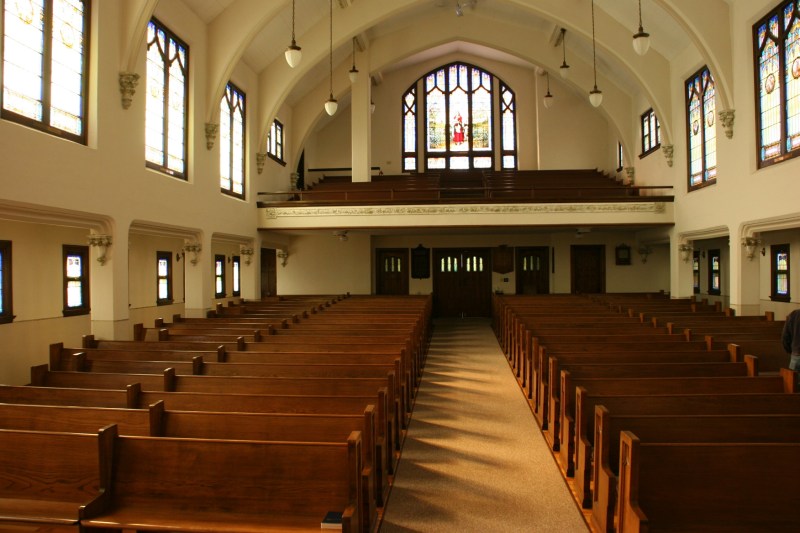
The beautiful sanctuary as photographed from the balcony.

The beautiful sanctuary as photographed from the balcony.

That matters not. For I appreciate churches like this which are lovely houses of worship. For these truly are houses to the families of faithful. Therein, worshipers, if not related by blood, are related by the commonality of faith and lives shared. They truly become family in joy and in grief.

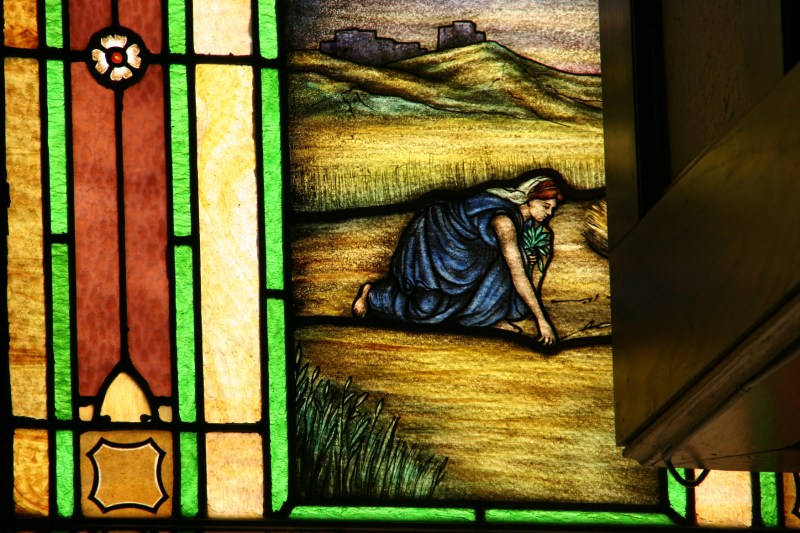
One of my favorite stained glass windows in Trinity is this one of Ruth gathering grain to help support her mother-in-law. The window is partially covered by the balcony.

One of my favorite stained glass windows in Trinity is this one of Ruth gathering grain to help support her mother-in-law. The window is partially covered by the balcony. To me, this window symbolizes deep love and devotion to family.

This trio of stained glass windows rises above the altar.

This trio of stained glass windows rises above the altar.

One of the windows flanking the side of the sanctuary.

One of the windows flanking the sanctuary.

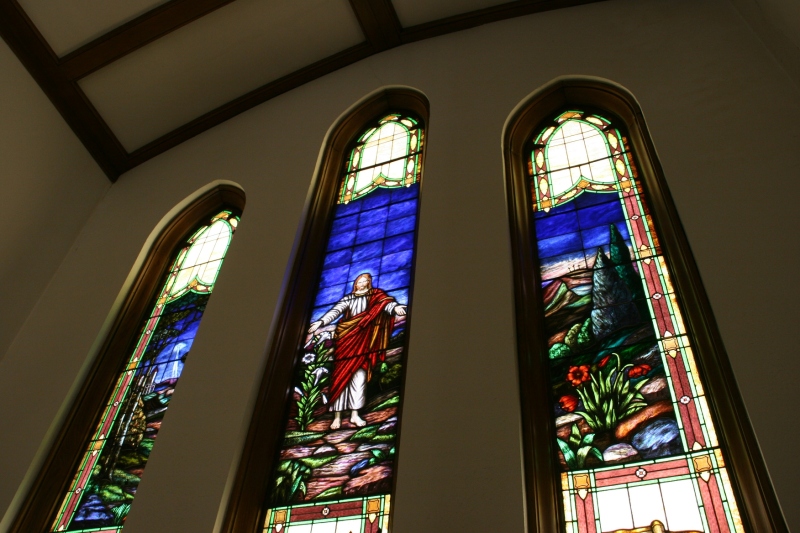
Within the walls of an aged sanctuary like Trinity, visual symbols of faith embrace those who enter therein. Intricate stained glass windows shine the light of grace and of Scripture.

One can only imagine the messages delivered from this sturdy pulpit.

One can only imagine the messages delivered from this sturdy pulpit.

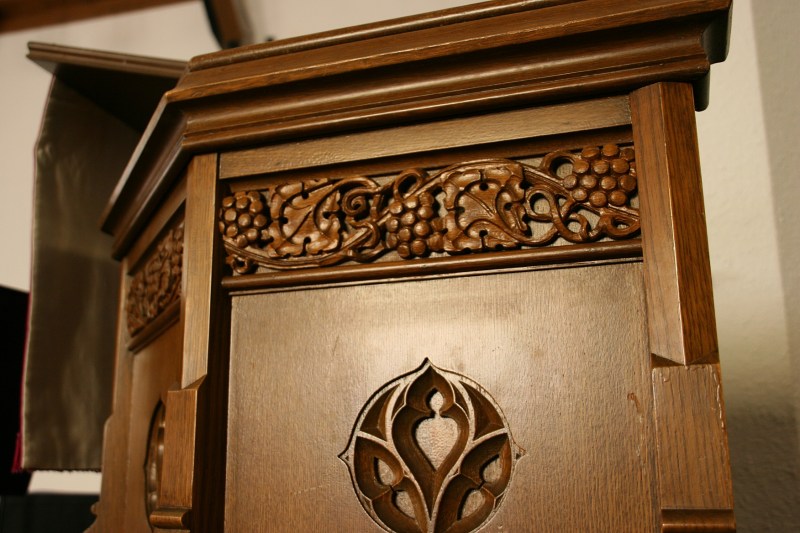
The sturdy pulpit with its handcarved trim looms as a time-honored place for preaching of the Word, the wood dulled by the hands of many preachers.

Balcony pews.

Balcony pews.

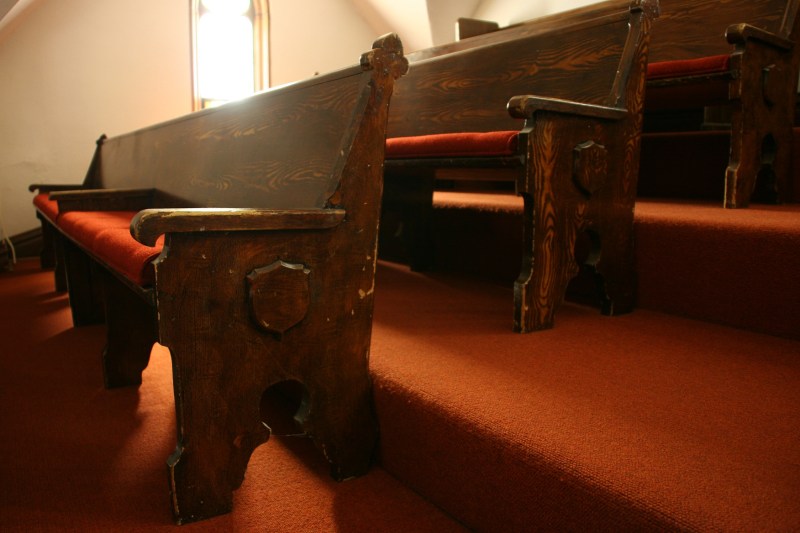
Worn pews reflect the history of generations.

Another view from the church aisle.

Another view, this from the center church aisle.

Art, history and a heavenly presence prevail. It is here, within the walls of Trinity. Visually. And in spirit.

BONUS PHOTOS:

The risen Lord centers the trio of stained glass windows above the altar.

The risen Lord centers the trio of stained glass windows above the altar.

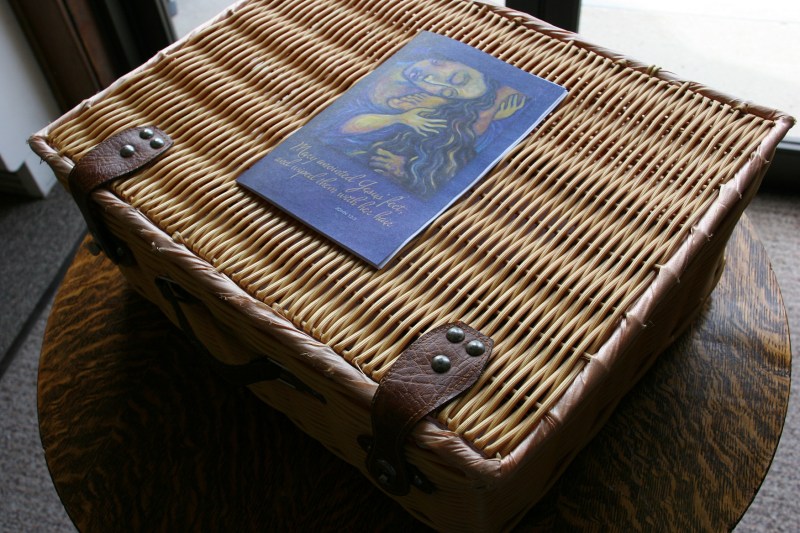
A basket holds church bulletins and other worship essentials.

A basket holds church bulletins and other worship essentials.

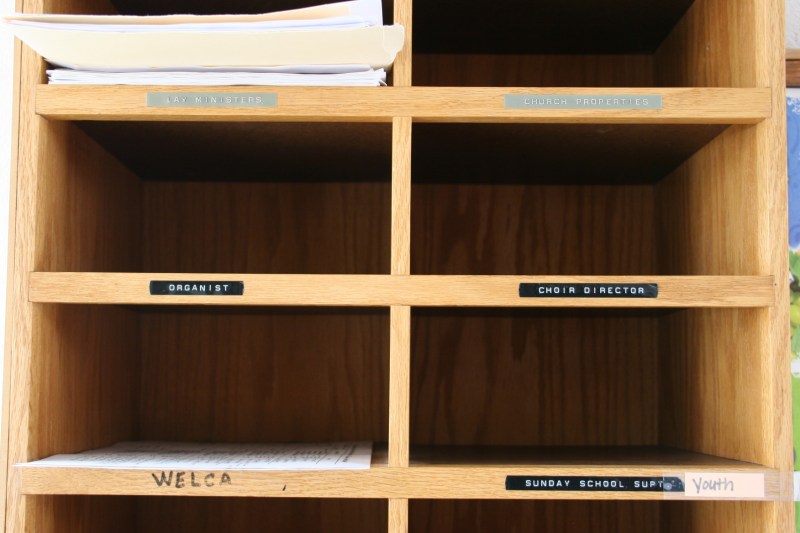
Church mail slots.

Church mail slots.

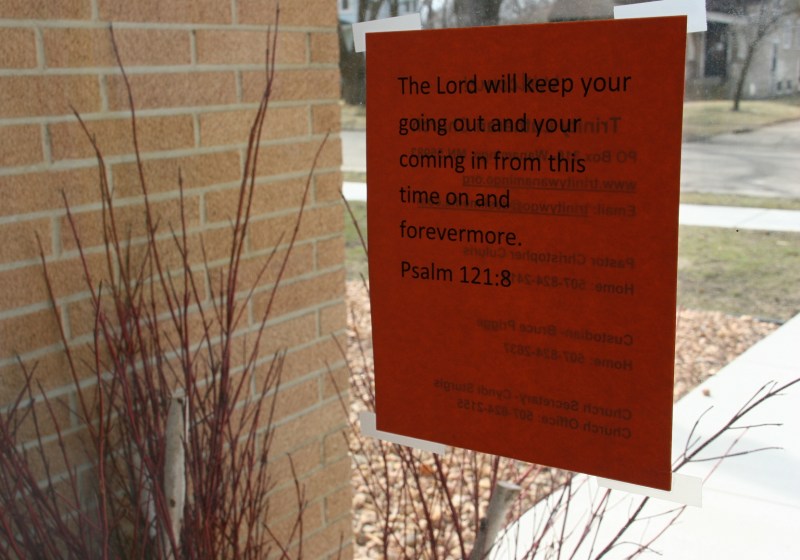
A final message for worshipers is posted on a window next to an exterior front door.

A final message for worshipers is posted on a window next to an exterior front door.

FYI: Please check back next week for more posts in my “from Wanamingo” series.

© Copyright 2016 Audrey Kletscher Helbling

 

Photo memories of St. Mary’s of Melrose March 12, 2016

Filed under: Uncategorized — Audrey Kletscher Helbling @ 8:37 PM
Tags: , , , , , , ,
The Church of St. Mary rises above the land, defining Melrose. Minnesota Prairie Roots file photo 2011.

The Church of St. Mary rises above Melrose. Minnesota Prairie Roots file photo 2011.

TODAY, AS I PHOTOGRAPHED two rural Minnesota Lutheran Churches, I thought of another church I photographed nearly five years ago in Melrose. The Church of St. Mary. It’s a beautiful Catholic church. Opulent and splendid and filled with a spirit of holiness.

Friday afternoon that magnificent 1898 church 100 miles northwest of the Twin Cities caught fire. Damage is estimated at $1 million.

To current and former parishioners of St. Mary’s and to the Melrose community, I am deeply sorry.

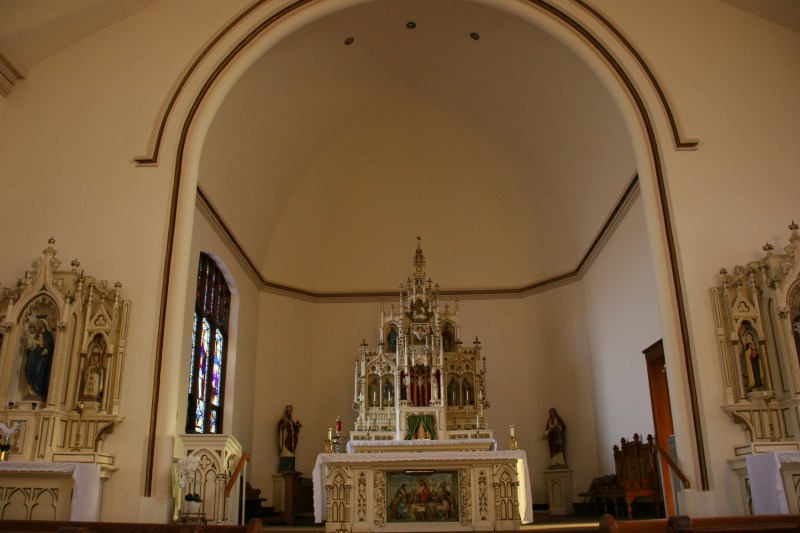
A view from the back of St. Mary's Catholic Church looking toward the main altar.

A view from the back of St. Mary’s looking toward the main altar. Minnesota Prairie Roots file photo 2011.
When I photograph a church, I do so because I appreciate the beauty, history, art, and faithfulness therein. I understand the significance of a house of worship in connecting and centering a church family and in building generations of memories and a tradition of faith.

Just look at this detailed side altar. I could have spent hours in St. Mary's.

Just look at this detailed side altar. I could have spent hours in St. Mary’s. Minnesota Prairie Roots file photo 2011.

Today I understand even more, though, how important my work of visually preserving small town and country churches. If my St. Mary’s photos from 2011 comfort the folks of Melrose in the aftermath of this devastating fire, then I am blessed.

Click here to see my first photo essay, “Hail St. Mary’s of Melrose.”

Click here to see my second photo essay, “St. Mary’s of Melrose, Part II.”

© Copyright 2016 Audrey Kletscher Helbling